 Skip to content
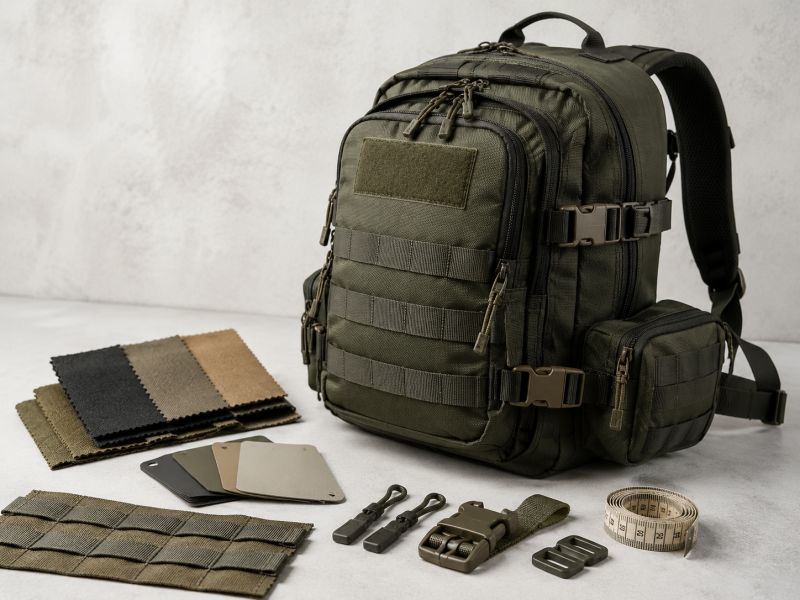
Tactical Bag Heavy Duty Material Guide for Custom Projects
A tactical bag can look strong in photos and still fail in real use. That is the part many brand teams only realize after the first sample, or worse, after the first shipment. The fabric may feel thick, the color may look right, and the MOLLE webbing may look tough. But once the bag is loaded with tools, outdoor gear, first aid items, radios, safety supplies, or heavy personal equipment, weak choices show up fast.
A torn shoulder strap is not only a sewing issue. A sagging bottom is not only a fabric issue. A zipper that waves or splits is not only a zipper issue. Most failures come from the way material, lining, coating, webbing, hardware, stitching, and structure work together.
For custom tactical bag projects, heavy duty material should be chosen by use scene, loading weight, wear area, water resistance need, price target, sample standard, and repeat order plan. 600D polyester, 900D polyester, 500D nylon, 1000D nylon, Cordura-style fabric, ballistic nylon, coated fabric, and reinforced panels can all be right in different situations. The best choice is the one that matches the real job of the bag, not the one that sounds strongest on paper.
That is why a material guide should not stop at fabric names. It should help a brand team decide what to use, where to reinforce, what to test, what to confirm before sampling, and what details to send for a cleaner quotation.
Jundong works with custom bag projects across outdoor, work, travel, retail, safety, and tactical uses. For teams planning a tactical backpack, MOLLE bag, tactical waist bag, rescue bag, style bag, or heavy duty utility pack, the right material decision can reduce sample changes, keep bulk quality steadier, and make the product easier to reorder later.
What Makes a Tactical Bag Material Truly Heavy Duty?
A tactical bag material is truly heavy duty when it can handle abrasion, weight, repeated pulling, weather exposure, and structural stress in real use. Fabric thickness matters, but it is only one part of the decision. Fiber type, denier, weave, coating, backing, lining, webbing, thread, stitching, and reinforcement all affect how strong the finished bag feels and performs.
A common mistake is to judge the whole bag by one number, such as 600D or 1000D. Denier tells you about yarn thickness, not the complete strength of a finished bag. Two fabrics with the same denier can perform differently if the fiber, weave, coating, finishing, and backing are different.
For tactical bags, the word “heavy duty” should be tested against the product’s real job. Will the bag carry tools? Will it be used for outdoor training? Will it hold medical supplies? Will it be sold as a retail tactical backpack? Will the end user attach pouches to MOLLE webbing? These change the material choice.
A strong outer shell may still need a reinforced bottom, foam support, stronger lining, tight webbing, and bartack stitching at stress areas. For example, a 1000D fabric on the body does not save the bag if the shoulder strap base uses weak stitching or thin backing. The bag works as a system.
For brand teams, the smarter starting is not “What is the strongest fabric?” It is “What kind of load, use, price level, and product image does this bag need to support?” Once that is clear, fabric selection becomes much easier.
Which Materials Are Best for Custom Tactical Bags?
The best tactical bag material depends on the product type, use intensity, price direction, and brand positioning. 600D polyester works for cost-aware tactical-style bags. 900D polyester gives a stronger handfeel. 500D nylon balances strength and weight. 1000D nylon or Cordura-style fabric suits tougher uses. Ballistic nylon is useful for firm, wear-resistant gear bags and reinforced areas.
Here is a practical comparison for early material planning:
| Material | Best Fit | Main Strength | Watch Before Approval |
|---|---|---|---|
| 600D Polyester | Entry tactical backpacks, promo tactical-style bags, light utility bags | Cost control, color options, common availability | Not ideal for heavy load without reinforcement |
| 900D Polyester | Mid-level outdoor and tactical-style bags | Stronger handfeel than 600D | Coating and backing quality should be checked |
| 500D Nylon | EDC tactical bags, lighter outdoor packs | Good balance of weight and durability | Higher cost than common polyester |
| 1000D Nylon | Heavy duty tactical backpacks, tool-style bags, MOLLE packs | Tough feel, strong wear resistance | Heavier and usually more expensive |
| Cordura-style Fabric | Premium outdoor and tactical products | Strong brand perception and abrasion resistance | Cost and availability should be reviewed early |
| Ballistic Nylon | Gear bags, duty bags, reinforced panels | Firm structure, good resistance to wear | Stiffer handfeel may not suit every design |
| Ripstop Nylon | Lightweight outdoor panels and tear-control areas | Helps limit tear spread | Not always the best single choice for heavy load |
| Coated Oxford Fabric | Budget to mid-level tactical and utility bags | Flexible price and structure options | Coating quality varies by grade |
| PVC/TPU-coated Fabric | Wet use, waterproof panels, special gear bags | Strong water barrier | Weight, smell, folding marks, and sewing method need review |
The right choice often comes from mixing materials. A bag can use 900D polyester for the main body, heavier fabric on the bottom, mesh inside, padded backing, and stronger webbing outside. This gives better cost control than using premium fabric everywhere.
For heavy use projects, material review should happen before sample making. Send the bag type, target load, reference photo, and preferred price direction to info@jundongfactory.com, and Jundong can help review fabric, lining, webbing, zipper, buckle, and reinforcement direction before the first sample.
600D vs 900D vs 1000D: Which Fabric Fits Your Tactical Bag Project?
600D, 900D, and 1000D are often compared in tactical bag projects, but they should not be treated as simple good-better-best levels. 600D is practical for lighter and price-sensitive programs. 900D gives a stronger feel for mid-duty use. 1000D is better for heavier tactical backpacks, MOLLE bags, and gear bags when weight and cost are acceptable.
The mistake is to think that 1000D is always the best choice. A 1000D fabric can be overbuilt for a compact sling bag. It may add weight, reduce softness, and make the product feel too stiff for retail use. On the other hand, 600D may look fine on a sample but feel weak if the bag is expected to carry metal tools, large bottles, or emergency gear.
A better way to choose is to match the fabric to the bag’s real use:
| Project Goal | Practical Fabric Direction |
|---|---|
| Price-friendly tactical-style backpack | 600D polyester with selected reinforcement |
| Stronger retail tactical backpack | 900D polyester or nylon blend option |
| Heavy outdoor MOLLE backpack | 1000D nylon or Cordura-style fabric |
| Compact EDC sling bag | 500D nylon or 600D/900D polyester |
| Heavy tool-style tactical pack | 1000D nylon, ballistic nylon, reinforced bottom |
| Rescue or emergency gear bag | Durable polyester or nylon with clean lining and labeled compartments |
| Long-term private label line | Stable fabric source, controlled color, repeatable components |
For large repeat programs, do not only ask for “1000D.” Ask for fabric sample, coating type, color standard, backing strength, handfeel, and approved sample record. The final product depends on the whole material package.
If the product is sold online, weight also affects shipping cost and user comfort. A heavier fabric can make the product feel tougher, but it can also make the bag less comfortable for everyday use. This is why many strong tactical bags use material zoning: tougher fabric at high-wear areas and lighter fabric at lower-stress panels.
Nylon vs Polyester for Tactical Bags: Which One Should Brand Teams Choose?
Nylon usually offers stronger performance for demanding tactical bags, while polyester is often chosen for cost control, color stability, and wider project flexibility. Nylon is suitable for higher-end outdoor and tactical gear. Polyester works well for retail, promotional, and mid-duty tactical-style bags when structure and reinforcement are planned properly.
Nylon has a strong reputation in outdoor and tactical products because it can offer good abrasion resistance and strength. It often feels more premium, especially in 500D or 1000D options. For tactical backpacks, MOLLE bags, and gear bags that need a more serious performance image, nylon can support the product story well.
Polyester is not a weak choice by default. Many retail and private label tactical-style bags use polyester because it is cost-friendly, widely available, easier to manage in color programs, and suitable for larger quantities. For brands that need several colors, seasonal updates, or entry-level price levels, polyester may be more practical.
The real decision is not “nylon or polyester?” It is “What does this product need to prove?” A high-load rescue pack has different requirements from an outdoor lifestyle backpack. A product for a tool brand has different needs from a campaign giveaway. A tactical bag for daily commuting may need comfort and weight control more than extreme abrasion resistance.
A good factory review should compare both material families with the same design, not as abstract fabric names. Sometimes a well-built 900D polyester bag with strong stitching, reinforced base, and quality webbing can perform better than a poorly balanced nylon bag with weak components.
Why Coating, Lining, and Backing Matter More Than Many Teams Expect
Coating, lining, and backing affect water resistance, handfeel, shape, sewing stability, and product life. A tactical bag with strong outer fabric can still feel cheap or fail early if the coating peels, the lining tears, the backing cracks, or the bottom lacks support. For custom projects, these hidden layers deserve early review.
Many people ask for “waterproof tactical bags,” but most soft tactical bags are better described as water-resistant unless the full structure is designed for sealing. Outer fabric can have PU coating, PVC backing, TPU coating, or water-repellent treatment, but water can still enter through seams, zipper openings, needle holes, and poorly covered corners.
Lining also changes how the bag works. A rescue bag may need a clean, light-colored lining so contents are easy to see. A tool-style tactical bag may need a stronger inner fabric, binding at pocket edges, and reinforcement behind rivets or stress areas. A retail backpack may need a smoother lining that looks neat in product photos.
Backing affects body shape. Some fabrics look firm in rolls but collapse after cutting and sewing. Some coatings improve structure but make the fabric harder to sew cleanly. Some PVC backings feel strong but may add smell, stiffness, or folding marks. These details matter when a brand wants repeatable bulk results.
For outdoor, safety, and work-use tactical bags, the material stack should be checked together:
| Layer | What to Review |
|---|---|
| Outer fabric | Denier, fiber, weave, color, abrasion feel |
| Coating/backing | PU, PVC, TPU, water resistance, handfeel, peeling risk |
| Lining | Tear strength, cleaning, color, visibility, pocket support |
| Padding | Thickness, rebound, comfort, shape |
| Webbing | Width, density, pull strength, color matching |
| Thread | Strength, color, sewing compatibility |
| Hardware | Buckle grade, zipper size, puller strength |
| Bottom support | Extra panel, foam, PE board, binding, feet if needed |
This is where early material advice saves time. A clear review before sampling can prevent three or four avoidable sample changes.
Where Should Heavy Duty Tactical Bags Be Reinforced?
Heavy duty tactical bags should be reinforced at load-bearing and high-wear areas, especially shoulder strap bases, top handles, bottom panels, side compression straps, MOLLE webbing zones, zipper ends, buckle connections, pocket edges, and internal divider seams. These areas face pulling, rubbing, bending, and repeated user handling.
A bag usually fails where force gathers, not where the fabric looks weakest. The shoulder strap base is a classic example. Even with strong fabric, the strap can tear away if the stitching area is too small, the backing is weak, or the load spreads poorly. Bartack stitching, larger connection panels, inner reinforcement, and stronger thread can all help.
The bottom panel is another high-risk area. It touches the ground, carries the load, and receives impact when the user drops the bag. For heavier bags, the bottom may need thicker fabric, extra lining, foam, PE board, rubber feet, or double-layer construction. This is especially useful for tool-style tactical packs and rescue gear bags.
MOLLE areas also need careful reinforcement. People attach pouches, clips, tools, bottles, and accessories to webbing. If the MOLLE webbing is only decorative, it may not survive real pulling. Webbing spacing, stitch density, bartack positions, and backing fabric should be checked before bulk work begins.
Reinforcement is not about adding weight everywhere. It is about putting strength where the bag needs it most. That is how a tactical bag can remain durable without becoming too heavy, stiff, or costly.
How Do MOLLE Webbing, Buckles, Zippers, and Stitching Affect Material Performance?
MOLLE webbing, buckles, zippers, and stitching can decide whether a strong fabric becomes a reliable tactical bag or just a tough-looking shell. If components are weak, the outer material cannot perform well. A tactical bag should be reviewed as a full construction system, not as fabric alone.
MOLLE webbing must be more than a style feature. For serious use, spacing, stitch length, webbing density, and backing structure should be consistent. Uneven webbing makes attached pouches sit poorly. Weak stitching can loosen after repeated pulling. Thin webbing may curl, twist, or lose shape.
Zippers should match the bag size and use scene. A small zipper may be fine for a light pocket, but not for a main compartment that holds heavy gear. Larger zipper teeth, stronger sliders, puller design, and zipper end protection can reduce failure risk.
Buckles and straps deserve the same attention. A strong bag body with low-grade buckles creates a weak experience. Side compression straps, sternum straps, waist belts, and quick-release buckles should match the product’s load expectation.
Stitching is often invisible to the end user, but it is one of the most practical signs of quality. Bartack sewing at stress areas, clean binding, proper seam allowance, and suitable thread all help the bag survive daily use. In tactical bags, a beautiful design without stress control is not enough.
Which Tactical Bag Types Need Which Material Structure?
Different tactical bag types need different material structures. A tactical backpack may need balanced body fabric, padded back panels, and strong shoulder strap bases. A MOLLE bag needs reinforced webbing zones. A tactical waist bag needs lighter but firm fabric. A rescue or emergency bag needs clean lining, clear compartments, and reliable labels.
Here is a practical planning table:
| Tactical Bag Type | Suggested Material Structure |
|---|---|
| Tactical backpack | 900D polyester, 500D nylon, or 1000D nylon with padded back and reinforced straps |
| MOLLE system bag | Strong outer fabric, dense webbing, reinforced stitch backing |
| Tactical sling bag | 500D nylon or 600D/900D polyester with comfort-focused strap design |
| Tactical waist bag | Lighter fabric with firm backing, quality zipper, stable buckle |
| style gear bag | Heavy fabric, reinforced base, strong zipper, padded inner dividers |
| Rescue bag | Durable outer shell, clean lining, clear pocket structure, label support |
| Emergency kit bag | Polyester or nylon shell, organized compartments, export-ready packing |
| Tool-style tactical bag | 1000D nylon, ballistic nylon, hard bottom or reinforced base |
| Outdoor utility bag | 600D/900D polyester or nylon with water-resistant treatment |
| Military-style private label bag | Strong fabric, accurate color, MOLLE detail, private label options |
A compact tactical waist bag does not need the same material weight as a large gear backpack. A rescue bag may care more about visibility, sorting, and label clarity than extreme stiffness. A private label tactical backpack may need a balance of appearance, cost, weight, and repeatability.
This is also why a single catalog choice can be risky. A product that looks close to your idea may not match your real use scene. Custom development lets the material, structure, logo, label, and packing plan match the product purpose more closely.
How Does a Tactical Bag Factory Review Material Before Sampling?
A tactical bag factory should review the product’s use scene, load, size, pocket layout, material target, coating needs, MOLLE layout, hardware level, logo method, packing plan, and price direction before sampling. The goal is to make the first sample closer to the final product and reduce costly revisions.
A useful review begins with the job of the bag. A brand team may send a reference image, but the factory needs to know what the bag will carry, where it will be used, how often it will be handled, and what price level it must meet. Without this, the sample may look right but work poorly.
The second step is structure. How many compartments are needed? Does the bag need a laptop section, tool loops, mesh pockets, elastic holders, MOLLE panels, bottle pockets, or removable pouches? Each feature affects sewing sequence, material use, and cost.
The third step is material pairing. Outer fabric, lining, padding, webbing, zipper, buckle, thread, label, and packing should be selected together. A heavy outer fabric with weak lining creates imbalance. A high-cost fabric with a low-grade zipper weakens the product image.
Then comes sample control. Material sample, color sample, logo sample, pre-production sample, and packing reference should be confirmed before bulk work. For long-term programs, records should be kept for repeat orders, including fabric spec, color standard, logo placement, stitch details, packing method, and carton marks.
Jundong supports project review, structure advice, sampling, sample adjustment, material and component sourcing, and quality checks. For custom tactical bag development, this kind of early review helps reduce guesswork before production.
What Should Teams Send for a Faster Tactical Bag Quote?
For a faster tactical bag quote, send the bag type, reference photo or drawing, target size, expected load, material preference, coating need, MOLLE requirement, pocket layout, logo method, color, quantity, packing method, destination country, and target delivery time. Clear project details help the factory suggest a realistic material and structure.
A simple “How much for a tactical bag?” is hard to quote accurately. A tactical backpack with 1000D nylon, MOLLE webbing, padded back panel, heavy zippers, multiple compartments, and retail packing will not have the same cost as a simple 600D tactical-style daypack.
A clear request should include:
| Detail | Why It Matters |
|---|---|
| Bag type | Backpack, sling bag, waist bag, rescue bag, tool-style bag |
| Reference image | Shows shape, style, pocket direction |
| Size | Affects material use, weight, carton size |
| Expected load | Guides fabric, reinforcement, strap structure |
| Material idea | Helps compare cost and performance |
| Coating need | Affects water resistance and handfeel |
| MOLLE layout | Affects webbing use and sewing time |
| Logo method | Changes cost, sample time, and appearance |
| Color or camo | Affects material sourcing and repeatability |
| Quantity | Affects price, material purchase, production planning |
| Packing | Affects labor, carton size, labels, shipment |
| Destination | Helps review export packing and label needs |
| Timeline | Helps check sample and bulk planning |
For most custom bag projects, standard MOQ is usually 500 pcs per design. Some simple styles may be arranged at 200–300 pcs, with a higher unit cost because material purchasing and the full production process still need to be handled. Sample time is usually 5–7 days, and some simple styles can be faster depending on structure and material readiness.
Teams can send project details to info@jundongfactory.com for review.
How Much Does Custom Tactical Bag Material Affect Price?
Material can strongly affect tactical bag price, but it is not the only cost driver. Fabric type, denier, coating, lining, webbing volume, zipper size, buckle level, reinforcement, pocket complexity, logo method, quantity, packing, and quality checks all shape the final cost. A cheaper fabric can become expensive if it causes failures or returns.
The outer fabric is usually one of the most visible cost factors. Moving from 600D polyester to 1000D nylon or Cordura-style fabric can raise the material cost, but the difference may be worth it for a premium product. For a light retail program, that upgrade may not be necessary.
Webbing and hardware can also add cost. A MOLLE-heavy bag uses more webbing and more sewing time. Heavy zippers, stronger buckles, padded straps, reinforced handles, and structured bottoms all add value, but they also add labor and material.
Logo and packing choices matter too. A simple woven label is different from a rubber patch, metal plate, heat transfer logo, or multi-position branding setup. Retail hangtags, barcode labels, warning labels, instruction cards, individual packing, and carton marks all affect project handling.
The best cost plan is not to remove strength blindly. It is to place cost where it protects the product. For example, keeping a stronger bottom panel and strap base may be more valuable than using expensive fabric on low-stress areas.
Why Work with a Custom Tactical Bag Factory Instead of a Catalog Platform?
A catalog platform may be fine for simple, ready-made tactical-style bags, but it often limits material choice, structure adjustment, sample revision, private label detail, and repeat order control. A custom tactical bag factory can review material, improve structure, adjust samples, support branding, manage quality checks, and keep records for future orders.
Catalog choices are fast, but they often start with the product that already exists. That can be useful for simple orders. But for brands planning a long-term line, a safety project, an outdoor gear program, or a private label product, the ready-made option may create limits quickly.
A factory-led project starts from the product goal. The team can review size, material, structure, weight, pocket layout, MOLLE design, webbing, zipper, buckle, logo, label, packing, and delivery plan. This is more useful when the bag needs to match a brand standard or a specific use scene.
The biggest value is control. Sample standards can be approved. Materials can be recorded. Bulk checks can follow the approved sample. Carton marks and packing can match channel needs. Repeat orders can use records instead of starting from zero.
Jundong is based in Guangdong and works with custom bag projects across outdoor, work, travel, retail, promotional, safety, and tactical categories. With development, sampling, material sourcing, quality inspection, and export support, the team can help turn a tactical bag idea into a production-ready product.
FAQ: Tactical Bag Heavy Duty Material Guide
1. What is the best material for heavy duty tactical bags?
Certainly. The best material for a heavy duty tactical bag depends on what the bag needs to carry, where it will be used, and how long the product line is expected to run. For high-abrasion and heavy-load tactical backpacks, 1000D nylon, Cordura-style fabric, or ballistic nylon can be strong choices. For mid-duty outdoor, retail, or private label tactical bags, 900D polyester or selected nylon options may give a better balance between strength, weight, and cost. For lighter tactical-style backpacks or campaign-driven bags, 600D polyester can still work if the bottom, shoulder strap base, handle, zipper ends, and MOLLE webbing areas are reinforced properly.
The smarter choice is not always the thickest fabric. A tactical bag made with strong outer fabric but weak webbing, light buckles, poor lining, or loose stitching may still fail. A more reliable plan is to review the full structure: outer shell, coating, backing, lining, zipper, buckle, thread, webbing, reinforcement, and packing method. For brand teams, the best material is the one that matches the real use scene and can be repeated consistently in bulk orders.
A practical way to start is to define the expected loading weight, target retail level, product size, water resistance need, and expected order quantity. Once these details are clear, Jundong can help compare fabric options before sampling, so the first sample is closer to the final product instead of becoming a guessing exercise.
2. Is 1000D nylon better than 600D polyester for tactical bags?
Definitely, 1000D nylon is usually stronger and more abrasion-resistant than 600D polyester in demanding tactical bag applications, but that does not mean it is always the right choice. 1000D nylon works well for heavy tactical backpacks, MOLLE system bags, equipment bags, tool-style tactical packs, and outdoor gear bags that need a tough surface and higher load tolerance. It gives a serious, durable handfeel that many tactical gear brands like.
However, 1000D nylon also brings trade-offs. It is heavier, usually more expensive, and may feel too stiff for small sling bags, waist bags, or everyday carry products. A compact bag made with 1000D nylon may look tough but feel uncomfortable or bulky for daily users. That can affect product reviews, shipping cost, and repeat sales.
600D polyester is more cost-friendly and widely used for lighter tactical-style bags, promotional projects, retail entry lines, and private label programs with multiple colors. If the use scene is light to medium duty, 600D polyester with smart reinforcement can be a practical option. The key is not to compare only the number. A well-structured 600D bag with reinforced stress areas can be more suitable than an overbuilt 1000D bag that is too heavy for its purpose.
For custom orders, a good fabric decision should consider use intensity, comfort, price level, channel, sample target, and long-term reorder stability.
3. Which material is better for MOLLE tactical bags?
Of course. MOLLE tactical bags need more than strong fabric; they need a stable webbing structure. For serious MOLLE use, 1000D nylon, Cordura-style fabric, strong 900D polyester, or selected coated Oxford fabric can all be considered, depending on the product level and cost target. The outer fabric should hold shape well, but the MOLLE area also needs dense webbing, accurate spacing, proper backing, and strong bartack stitching.
Many tactical-style bags fail because the MOLLE system is treated like decoration. It may look correct in photos, but when users attach pouches, bottles, small tools, flashlights, radios, or first aid kits, the weak appear quickly. The webbing may curl, the stitch line may loosen, or the panel may start pulling away from the main body. This is why MOLLE bags should be reviewed as a load-bearing system, not just a fabric choice.
For a better result, review these details before sample approval:
| MOLLE Detail | Why It Matters |
|---|---|
| Webbing density | Helps prevent curling and twisting |
| Stitch spacing | Affects pouch stability |
| Backing fabric | Supports pulling force |
| Bartack sewing | Strengthens repeated stress areas |
| Panel placement | Keeps the bag balanced when loaded |
| Webbing color | Helps brand and bulk consistency |
If your project includes true MOLLE function, send the expected attachment type and loading use to Jundong early. That helps the team suggest a more realistic fabric and webbing plan before sample making.
4. Do tactical bags need waterproof coating?
Sure. Most tactical bags benefit from water-resistant coating, but not every tactical bag needs a fully waterproof structure. PU coating, PVC backing, TPU coating, and water-repellent treatment can help protect the fabric from light rain, splashes, and damp outdoor conditions. However, water resistance is not decided by the outer fabric alone. Seams, zipper openings, needle holes, bottom panels, flap design, and lining structure all affect real performance.
A common misunderstanding is asking for a “waterproof tactical bag” when the product is actually a soft backpack with many stitched areas. Unless the bag is designed with sealed seams, waterproof zippers, welded construction, or special coated panels, it is usually more accurate to call it water-resistant. That is still useful for outdoor, safety, travel, and worksite use, but expectations need to be clear from the start.
For most tactical backpacks and MOLLE bags, a PU-coated polyester or nylon can be practical. For wet environments, rescue use, boat-related gear, or field kits exposed to damp ground, stronger coating, covered zippers, reinforced bottoms, and better inner protection may be needed.
The right coating also affects handfeel. Heavy PVC backing may feel firm but can add weight, stiffness, odor, or folding marks. TPU can improve water protection but may raise cost. This is why coating should be reviewed together with fabric, structure, and price direction, not chosen as a single line item.
5. Are Cordura-style fabrics worth the higher price?
Absolutely, Cordura-style fabrics can be worth the higher price when the project needs a stronger product image, better abrasion resistance, and long-term use confidence. They are often considered for premium tactical backpacks, outdoor gear bags, MOLLE bags, duty-style packs, and private label products where fabric quality is part of the selling story. If the bag is positioned as a serious gear product, better fabric can help support that promise.
That said, not every tactical-style bag needs Cordura-style fabric. If the project is a price-sensitive retail line, event program, entry-level tactical backpack, or multi-color private label test run, a strong polyester or nylon option may give better value. The money saved can be used for stronger zippers, better buckles, reinforced straps, improved lining, cleaner packing, or a more useful pocket layout.
This is where many teams make the wrong decision. They spend too much on the shell fabric and not enough on the areas users touch every day. A tactical bag feels reliable when the handle, strap, zipper, buckle, stitching, and bottom panel all work well together.
A practical rule is simple: use premium fabric when it protects the brand promise, supports the retail price, or fits the use scene. Use a balanced fabric plan when cost, weight, and repeat volume matter more. Jundong can help compare both directions before sampling so the product does not become overbuilt or underbuilt.
6. How do I choose material for a private label tactical backpack?
Certainly. Start with the product position, not the fabric name. A private label tactical backpack may be designed for outdoor retail, daily carry, work tools, emergency kits, camping, security teams, or online sales. Each use has a different material logic. A daily tactical backpack may need lighter weight and comfort. A tool-style pack may need stronger bottom support. A MOLLE pack may need reliable webbing and reinforced stitching. An outdoor gear bag may need better coating and abrasion resistance.
A practical material decision should include five checks:
| Check | What to Decide |
|---|---|
| Use scene | Outdoor, work, rescue, retail, daily carry |
| Load level | Light, medium, heavy, or tool-related |
| Price level | Entry, mid-level, premium |
| Brand detail | Logo, label, color, packaging |
| Repeat plan | One-time project or long-term line |
For entry and mid-level private label backpacks, 600D or 900D polyester may offer good cost control. For higher-end products, 500D nylon, 1000D nylon, or Cordura-style options can support a more durable product story. If the product uses MOLLE webbing, compression straps, padded laptop areas, or many pockets, structure review becomes just as important as the outer fabric.
For a cleaner start, prepare a reference photo, target dimensions, loading idea, logo file, preferred color, quantity, packing style, and target delivery time. With these details, the factory can suggest material options that match both product use and commercial reality.
7. Can one tactical bag use different materials in different areas?
Definitely. Using different materials in different areas is often smarter than using one expensive fabric across the whole bag. Tactical bags do not wear evenly. The bottom, shoulder strap base, handle, MOLLE panel, zipper ends, and pocket edges usually face more stress than side panels or decorative areas. Placing stronger materials only where needed can improve durability without making the whole bag too heavy or too expensive.
For example, a tactical backpack may use 900D polyester for the main body, heavier fabric on the bottom, mesh inside the pockets, padded fabric on the back panel, and dense webbing on the MOLLE area. A tool-style tactical bag may use ballistic nylon or reinforced fabric on high-wear zones while keeping other parts lighter. A sling bag may use 500D nylon for a better balance of strength and comfort.
This approach also helps with shipping and user experience. A bag made entirely from very heavy fabric can feel tough but may become tiring to carry. Mixed-material construction keeps the product more practical.
The key is planning the material map before sampling. Each panel should have a reason. Where does the bag rub? Where does it carry weight? Where will users pull, open, close, hang, or attach accessories? Once these areas are clear, material zoning becomes a professional way to control both quality and cost.
8. How long does a custom tactical bag sample take?
Usually, a custom tactical bag sample takes about 5–7 days after the main details are confirmed. Simple styles may be faster when materials are ready, the structure is clear, and logo work is not complex. More detailed tactical bags may take longer, especially if they include MOLLE panels, multiple compartments, special buckles, custom rubber patches, reinforced bottoms, padded straps, or special coating requirements.
Sample time is not only sewing time. Before sewing begins, the team may need to review the structure, create or adjust the pattern, source fabric, confirm webbing, match buckles, prepare the logo method, and check how the bag should be assembled. If a project has unclear details, the sample may be delayed because the team has to confirm too many items during the process.
To speed up sampling, send these details early:
| Detail | Helps With |
|---|---|
| Reference image | Shape and style direction |
| Size | Pattern and material use |
| Loading need | Reinforcement planning |
| Material preference | Fabric sourcing |
| Logo file | Branding sample |
| Pocket layout | Structure planning |
| Color | Material matching |
| Quantity | Cost planning |
| Packing request | Final project review |
A good sample is not just a pretty prototype. It should become the standard for bulk work. For long-term programs, approved samples, material records, logo placement, stitching details, and packing references should be saved for repeat orders.
9. What details should I send before requesting a tactical bag quote?
Of course. The more complete your project details are, the more accurate the quotation and material suggestion will be. A tactical bag can vary greatly in cost depending on fabric, size, pocket layout, MOLLE webbing, zipper grade, buckle choice, lining, reinforcement, logo method, packing, and quantity. A short message asking “How much is a tactical bag?” is usually not enough for a reliable price.
For a faster review, send the following:
| Detail | Why It Helps |
|---|---|
| Bag type | Backpack, sling bag, waist bag, rescue bag, tool-style bag |
| Reference image or drawing | Shows structure and appearance direction |
| Size and capacity | Affects fabric use and carton size |
| Expected loading weight | Guides reinforcement and strap design |
| Material preference | Helps compare price and performance |
| Coating need | Affects water resistance and handfeel |
| MOLLE layout | Affects webbing use and sewing time |
| Pocket structure | Affects labor and function |
| Logo method | Changes sample process and cost |
| Quantity | Affects unit cost and material purchase |
| Packing style | Affects labor, labels, carton marks |
| Destination country | Helps review export packing details |
| Delivery target | Helps production planning |
For most custom bag projects, Jundong’s standard MOQ is usually 500 pcs per design. Some simple styles can be reviewed at 200–300 pcs, but the unit cost will usually be higher because material purchasing and the full production process still need to be handled. Clear details help both sides save time and avoid wrong assumptions.
10. Is working with a custom tactical bag factory better than choosing ready-made catalog bags?
In many serious projects, yes. Ready-made catalog bags can be useful when speed matters more than uniqueness, structure, or long-term consistency. They are suitable for simple one-time use, quick stock needs, or basic tactical-style products. But when a brand wants its own material plan, logo placement, color direction, pocket layout, MOLLE structure, packing method, and repeat order control, custom factory support is usually a better fit.
A catalog bag starts from what already exists. A custom tactical bag starts from what the project needs. That difference matters. If your product needs a stronger bottom, different zipper, cleaner lining, custom label, retail barcode, adjusted MOLLE layout, special color, or revised handle structure, a ready-made option may not give enough control.
For brand teams, the real value is not only product appearance. It is repeatability. Can the next order match the approved sample? Can the same fabric be sourced again? Can the logo position stay consistent? Can carton marks, labels, and packing rules be repeated? Can stress areas be checked before shipment?
Jundong supports material selection, structure advice, sampling, sample revision, OEM/ODM development, quality checks, packing support, and export coordination. That makes custom work more suitable for outdoor gear brands, tactical equipment lines, private label operators, safety programs, worksite projects, and long-term product collections.
Let's work together
With over 10 years of OEM/ODM bag industry experience, I would be happy to share with you the valuable knowledge related to leather products from the perspective of a leading supplier in China.

Factory catalogue
Table of Contents
Latest blogs


Make A Sample First?
If you have your own artwork, logo design files, or just an idea, please provide details about your project requirements, including preferred fabric, color, and customization options, we’re excited to assist you in bringing your custom bag designs to life through our sample production process.