 Skip to content
Target Keywords: custom travel bags,travel gear bags,carry-on travel bags,weekender bags,travel duffle bags,travel backpacks,private label travel bags,OEM travel bags,ODM travel bags,travel bag factory,carry-on fit,travel bag capacity,travel bag compartments,shoe compartment bags,laptop travel bags,underseat travel bags,40L backpack carry-on,personal item size,carry-on luggage size,travel bag sample
20 Tag Keywords: Custom Travel Bags, Travel Gear Bags, Carry-On Travel Bags, Weekender Bags, Travel Duffle Bags, Travel Backpacks, Private Label Travel Bags, OEM Travel Bags, ODM Travel Bags, Travel Bag Factory, Carry-On Fit, Bag Capacity Planning, Travel Bag Compartments, Shoe Compartment Bags, Laptop Travel Bags, Underseat Travel Bags, 40L Backpack Carry-On, Personal Item Bag Size, Travel Bag Sample, Bulk Travel Bag Production
A travel bag can look great in a photo and still fail in real travel. It may hold less than expected. The shoe pocket may steal space from the main compartment. The laptop sleeve may sit in the wrong place. The bag may measure within a size target when empty but become too thick when packed. For travel gear brands, a good custom travel bag is not only about shape and logo. It is about capacity, compartment logic, comfort, material strength, loaded size, and repeatable bulk quality.
Custom travel bags for travel gear brands should be planned around real trip length, usable capacity, compartment layout, carry-on size, material strength, comfort, and bulk consistency. A good travel bag is not only large. It should organize clothes, shoes, laptop, toiletries, documents, and quick-access items while staying comfortable to carry and suitable for airline size targets after loading.
What Are Custom Travel Bags For Travel Gear Brands?
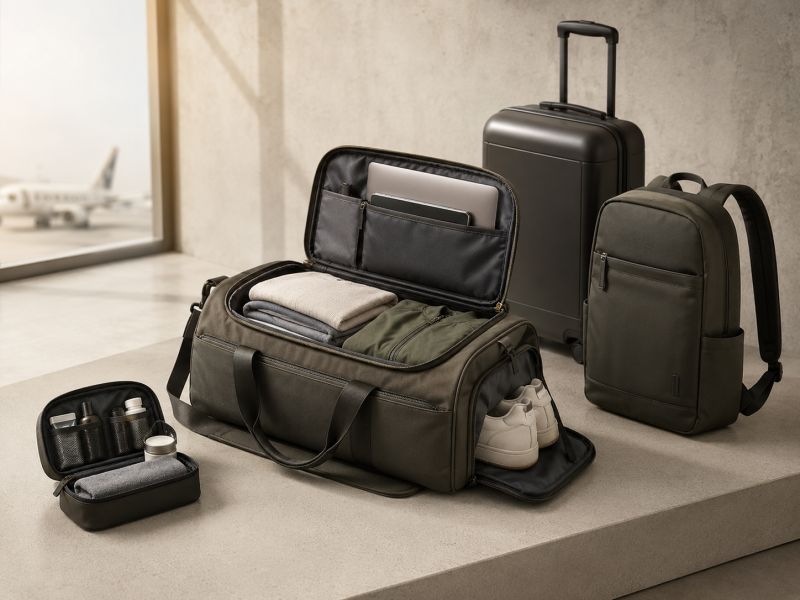
Custom travel bags for travel gear brands are developed around real travel use, not only logo placement. They may include travel duffle bags, weekender bags, travel backpacks, underseat bags, carry-on bags, trolley bags, garment bags, shoe-compartment bags, and organizer sets. The best design connects trip length, capacity, compartments, material, comfort, brand style, and bulk production needs.
A travel gear brand usually does not need another generic bag. It needs a product that fits a clear travel story. A weekend escape bag should feel different from a business carry-on backpack. A gym-to-flight duffle should not be planned like a hotel amenity tote. A compact underseat bag should not pretend to be a 5-day travel solution.
This is where custom development matters. The brand decides who the bag is for, how long the trip is, what gear needs to fit, how the bag will be carried, and whether it should target carry-on or underseat use. The factory then helps turn those ideas into dimensions, panels, compartments, reinforcement, materials, logo positions, labels, and packing rules.
A strong travel bag is a balance. Too much space can make the bag bulky. Too many pockets can reduce usable room. Heavy materials can improve structure but hurt comfort. A neat shape can look premium but may limit packing flexibility. These trade-offs should be discussed before sampling, not after bulk goods are finished.
Why Travel Gear Bags Are Different From Simple Luggage
Simple luggage focuses mainly on storage and movement from one place to another. Travel gear bags are more lifestyle-driven. They may need to move from airport to hotel, gym to office, car trunk to campsite, or train station to weekend apartment.
This means the bag has to serve multiple habits. It may need a laptop sleeve for work, a shoe compartment for changing footwear, a wet pocket for toiletries or gym items, a quick-access pocket for passport and phone, and a trolley sleeve for luggage pairing. A simple large compartment may be enough for some products, but a travel gear brand often needs a better user journey.
The difference is not only outside appearance. It is hidden in the layout, weight balance, opening direction, zipper path, handle strength, and how quickly someone can find small items during travel.
Who Needs Custom Travel Bag Development?
Custom travel bag development is useful for travel gear brands, outdoor labels, retail programs, e-commerce brands, hotel projects, airline-related gifts, corporate travel kits, sports brands, camera accessory brands, university travel programs, and private label collections.
Each project has a different priority. A retail brand may care about shelf appeal, barcode labels, and SKU control. An outdoor label may care about abrasion resistance and water-resistant fabric. A business travel brand may care about laptop protection and a clean look. A hotel project may care about lightweight packing and brand presentation.
The same bag style can become very different when the use changes. That is why the first discussion should not begin with “make this bag cheaper.” It should begin with “who will use it, what will they pack, where will they carry it, and what size target should it follow?”
What Types Of Travel Bags Can A Brand Develop?
Travel gear lines can include several product types. A brand may start with one main travel bag, then add matching accessories later.
| Bag Type | Best Use | Key Planning Focus |
|---|---|---|
| Travel duffle bag | Gym trips, weekend travel, sports travel | Capacity, shoulder strap, shoe pocket, handle strength |
| Weekender bag | 2–3 day lifestyle travel | Shape, fabric feel, laptop pocket, premium details |
| Travel backpack | Hands-free travel, commuting, carry-on use | Back comfort, laptop sleeve, compartments, loaded size |
| Underseat bag | Short flights, personal item target | Compact size, quick access, soft structure |
| Carry-on soft bag | Airline travel, short business trips | Loaded size, structure, trolley sleeve, packing flow |
| Garment travel bag | Business wear, suits, dresses | Fold structure, hanger area, wrinkle control |
| Organizer set | Travel accessories, packing cubes, pouches | Size system, colour grouping, SKU packing |
| Shoe-compartment bag | Travel shoes, gym shoes, sports use | Separation, ventilation, cleaning, space trade-off |
A brand does not need to develop every type at once. The smarter move is to decide the main use first, then choose the right bag form.
How Much Capacity Should A Custom Travel Bag Have?
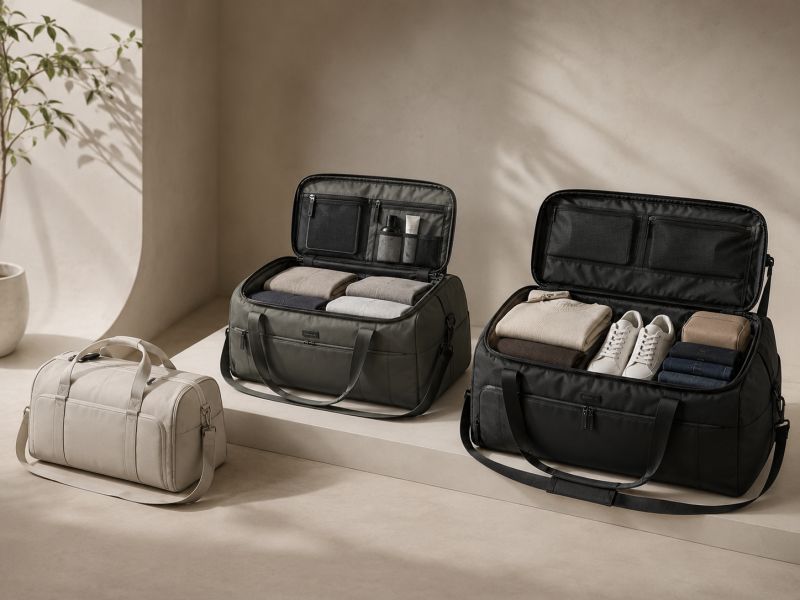
A custom travel bag should have enough usable capacity for the planned trip length without becoming heavy, bulky, or difficult to carry. Capacity should be judged by real contents: clothes, shoes, laptop, toiletries, chargers, documents, jacket, and return-trip extras. A well-planned 30L bag can feel more useful than a poorly divided 40L bag.
Capacity is often misunderstood. A larger litre number sounds better in product copy, but it does not always mean a better travel bag. If the opening is narrow, the pocket layout is awkward, or the shoe compartment blocks the main space, a large bag can feel smaller than it claims.
For travel gear brands, capacity should be tested with realistic packing sets. A 2-day business trip is not the same as a 2-day beach trip. A traveller carrying a laptop and sneakers needs different space from someone packing folded clothes and toiletries only. The bag should be planned around the use case that matters most to the brand.
The real challenge is balancing capacity with comfort and size control. A large bag may sell well online, but if it becomes too heavy, too thick, or too wide after loading, it may lead to complaints. A smaller bag can feel more premium if the layout is efficient and the pockets are placed where people naturally need them.
What Capacity Works For 1–2 Day Trips?
For 1–2 day trips, many brands focus on compact travel backpacks, small duffles, underseat bags, or light weekender styles. The bag should hold one change of clothes, basic toiletries, chargers, wallet, passport, phone, and possibly a laptop or tablet.
The goal is speed. A short-trip bag should be easy to pack, easy to carry, and easy to place under a seat or in an overhead bin target. Too many compartments may slow the user down. A clean main section, padded tech area, and one or two quick-access pockets often work better than a busy interior.
For this trip length, comfort matters more than maximum storage. A small bag that carries well feels better than a larger one that bumps into the body, pulls on one shoulder, or becomes awkward in airport queues.
What Capacity Works For 2–3 Day Weekender Bags?
A 2–3 day weekender bag usually needs room for folded clothing, underwear, toiletries, chargers, a light jacket, and sometimes shoes or a laptop. This is where layout becomes more important.
A good weekender design often uses a wide opening. People want to see what they packed without digging. A side shoe compartment can be useful, but only if it does not eat too much room from the main compartment. A wet pocket can help with toiletries, swimwear, or gym items. A trolley sleeve makes the bag easier to pair with luggage.
For lifestyle brands, the bag also needs to look good when filled. A weekender that collapses too much may feel cheap. A bag that is too stiff may feel heavy. The sweet spot is enough structure to hold shape with enough softness to pack flexibly.
Can I Take A 40L Backpack As A Carry-On?
A 40L backpack may work as a carry-on for some travel situations, but it depends on outer dimensions, loaded thickness, airline rules, pocket bulge, strap shape, and how tightly it is packed. The litre number alone is not enough. A slim 40L backpack may pass more easily than a short, thick backpack that expands outward.
For travel gear brands, this is an important design risk. A backpack promoted as carry-on friendly should be tested after loading, not only measured flat. External pockets, laptop padding, compression straps, back panel thickness, and overpacked front compartments can all increase real size.
A safer product plan is to set a target outer size first, then build the capacity inside that shape. If the brand wants a 40L capacity, the layout must be efficient, and compression control becomes important.
When Does A Large Capacity Bag Become Hard To Carry?
A large capacity bag becomes harder to carry when weight balance, strap width, handle reinforcement, body thickness, and load position are not managed well. A big bag that sits too far from the body feels heavier than it is. A duffle with thin webbing can hurt the shoulder. A backpack with poor back support can pull backward.
Capacity should not be increased without reviewing the carrying system. For duffles, check handle wrap, shoulder pad, D-ring position, and bottom support. For backpacks, check shoulder strap curve, back padding, chest strap option, and laptop position. For weekender bags, check whether the bag still looks clean when loaded.
How To Balance Capacity And Carry-On Fit
Capacity and carry-on fit often compete with each other. More capacity usually means more depth, more bulge, or more flexible expansion. Carry-on fit needs controlled outer dimensions. The best travel bags solve this by using efficient rectangular packing space, smart pocket placement, compression, and careful material choice.
For soft bags, loaded size is more important than empty size. A bag may measure correctly before packing but become too thick after shoes, laptop, jacket, and toiletries are added. This is why sample testing should include real contents and a size check after loading.
Which Compartments Matter Most In Travel Bags?

The most important travel bag compartments are the main packing area, laptop sleeve, shoe compartment, wet pocket, quick-access pocket, internal mesh pocket, bottle pocket, cable pocket, passport pocket, and trolley sleeve. Not every bag needs all of them. A good layout follows real travel behaviour, keeps items easy to find, and avoids adding weight or cost without clear value.
Compartments can make a travel bag better, but only when they solve real problems. A pocket that looks nice in a photo may be useless if it is too narrow for a phone, too deep for quick access, or placed under a bulky flap. A shoe compartment may be loved by gym travellers but disliked by light packers if it reduces main space.
The design should begin with a packing map. What does the traveller pack first? What needs to be reached during the trip? What must stay separate? What should be protected? What should be hidden? Once those habits are clear, the layout becomes easier.
Why Main Compartment Access Changes User Experience
The main compartment is the heart of a travel bag. Its opening style can make the bag feel easy or frustrating. A wide U-shaped opening helps users see the contents. A clamshell-style opening can make a backpack pack more like luggage. A narrow top opening may look sleek but can make it hard to reach items at the bottom.
For weekenders and duffles, a wide opening usually works well because clothes and shoes need space. For travel backpacks, clamshell access can improve packing and security. For underseat bags, a smaller opening can work if quick-access pockets are well placed.
The main compartment should match the use. A bag for business travel needs neat access to laptop and documents. A bag for casual travel needs easy access to clothes and toiletries. A bag for outdoor use may need faster access to jacket, bottle, or wet items.
When To Add A Shoe Compartment
A shoe compartment is useful when the bag is designed for gym travel, sports travel, weekend trips, or footwear-focused brands. It keeps shoes away from clean clothes and can make the bag feel more organized.
But it is not always needed. A shoe compartment takes space from somewhere else. If it is too large, the main compartment shrinks. If it is too small, it cannot hold common shoe sizes. If the fabric is too thin, the compartment may collapse or transfer dirt.
A good shoe compartment should consider opening direction, ventilation, cleaning, lining, and the largest shoe size expected. For brands planning travel duffles or gym-weekender hybrids, this feature can be valuable. For slim carry-on backpacks, it may need careful size control.
How To Plan Laptop, Wet, And Quick-Access Pockets
Laptop pockets should be padded, placed where weight stays stable, and sized for the target device. A laptop sleeve near the back panel often works better for backpacks because it keeps weight close to the body. In a duffle or weekender, the laptop pocket needs enough protection so it does not bend or collide with shoes and clothes.
Wet pockets should be used carefully. They are helpful for toiletries, swimwear, gym clothes, or damp towels, but they should not leak into the main section. Lining choice, seam handling, zipper placement, and drainage risk need review.
Quick-access pockets are small but important. Passport, phone, keys, earbuds, charger, boarding pass, and wallet need easy access. These pockets should be reachable without opening the full bag. A hidden back pocket can be useful for travel security.
Do More Pockets Always Make A Better Bag?
No. More pockets can make a bag heavier, more expensive, and more confusing. Each pocket adds fabric, lining, zipper, sewing time, inspection work, and sometimes bulk. Too many small pockets may look impressive online but reduce the clean packing space travellers actually need.
The best layout has fewer but better pockets. A strong travel bag usually has one main compartment, one tech section, one or two quick-access pockets, and one special-use area such as a shoe or wet compartment. Extra pockets should be added only when they support the intended use.
How Should Carry-On Fit Be Planned?
Carry-on fit should be planned from the target outer dimensions, loaded thickness, soft bag expansion, handles, wheels, external pockets, and shoulder strap storage. Airline rules vary, so brands should avoid broad promises without a clear target. A practical design controls the bag’s size after packing and tests the sample with real contents before confirming bulk production.
Carry-on planning is not just a measurement exercise. A bag may meet a common size target when empty, but once packed, the front pocket may bulge, the shoe compartment may expand, and the handles may add height. Soft travel bags are especially tricky because they can be overfilled.
For product development, the safest approach is to choose a target: overhead bin carry-on, underseat personal item, compact commuter bag, or road-trip weekender. Each target has different size logic. Trying to make one bag serve every airline, every route, and every traveller usually creates a confusing product.
What Is A Practical Carry-On Size Target?
A practical carry-on size target should be based on the intended sales channel and travel use. Many brands use common cabin luggage references, but exact airline rules vary by region, fare type, aircraft, and route. For soft bags, the target should include some allowance because the packed bag can expand.
When developing a custom travel bag, outer dimensions should include all parts that affect fit: body, handles, wheels, front pockets, back padding, side pockets, and hardware. If a bag has expansion panels, it should be measured both compressed and expanded.
The most practical product wording is usually careful and accurate, such as “designed with carry-on travel in mind” or “targeted for common cabin-size use,” unless the brand has tested against a specific airline rule.
What Is The New Size For Carry-On Luggage?
There is no single new carry-on size that applies everywhere. Airlines and regions may update baggage rules, and size limits can differ between carry-on luggage and personal items. Some carriers focus on linear dimensions, while others list length, width, and height separately.
For custom development, this means the brand should not design only around a headline number. It should choose a realistic target based on where the product will be sold and used. If the bag is for international travel, a more conservative size may reduce risk. If it is for road trips or weekend lifestyle use, capacity and comfort may matter more than strict cabin limits.
Why Loaded Size Matters More Than Empty Size
Loaded size matters because travel bags change shape when packed. Clothes push the main compartment outward. Shoes add thickness. Laptop padding adds stiffness. Bottles and toiletries create uneven bulges. A front pocket that looks flat in product photos may become the part that pushes the bag over a size target.
During sampling, measure the bag empty, normally packed, and fully packed. This gives a much better view of real travel performance. If the bag is marketed for carry-on use, the loaded test should be part of sample approval.
Carry-On Vs Underseat Bag: Which Is Better?
Carry-on bags are better when the product needs more room for short trips, clothing, shoes, and tech gear. Underseat bags are better for quick access, short flights, business essentials, and travellers who want to avoid overhead bin stress.
A travel gear brand may need both. A carry-on duffle or backpack can serve weekend travel. An underseat bag can serve business flights, laptop carry, and personal item use. The underseat bag must stay more compact, so pocket placement and shape control become even more important.
What If A Personal Item Is 2 Inches Too Big?
If a personal item is 2 inches too big, it may still fit in some soft-bag situations, but it can also be rejected, checked, or charged depending on the airline, airport staff, aircraft, and how full the bag is. For product design, 2 inches is not a small issue if the bag is promoted for underseat use.
The better approach is to design with margin. Avoid thick front pockets, uncontrolled expansion, oversized side bottle pockets, and stiff shapes that cannot compress. A soft bag can sometimes squeeze, but a brand should not depend on that as the main size strategy.
How External Pockets, Handles, And Wheels Affect Fit
External details can quietly ruin fit. A front pocket adds thickness. Side bottle pockets add width. A padded back panel adds depth. Wheels and trolley handles add height and structure. Shoulder pads and loose straps can catch during storage.
When planning carry-on or underseat products, every outside part should be counted. If a feature does not improve the travel experience enough, it may be better to remove it or make it flatter. Fit-friendly design often comes from clean outside structure and better internal organization.
Travel Duffle Vs Weekender Vs Backpack: Which Type Fits Your Line?

A travel duffle works well for sporty, flexible, high-capacity use. A weekender bag works better for lifestyle travel, short trips, and a more polished look. A travel backpack is stronger for hands-free movement, commuting, and carry-on planning. A brand may also build a travel set when one bag cannot cover all packing habits, channels, and price levels.
Choosing the right travel bag type is a product positioning decision. The same capacity can feel very different in a duffle, backpack, or weekender. A 35L duffle may look casual and roomy. A 35L backpack may feel more technical. A 35L weekender may feel more premium but less ergonomic if the strap system is weak.
The best choice depends on where the bag will be used. Airport? Gym? Hotel? Road trip? Business trip? Outdoor weekend? The carrying method, compartment layout, and outer shape should follow that use.
When To Choose A Travel Duffle Bag
Choose a travel duffle when the product needs flexible storage, a sporty look, and fast packing. Duffles work well for gym travel, short outdoor trips, team travel, sports gear, and weekend use.
The advantage is packing freedom. The main compartment can hold clothes, shoes, towels, jackets, and gear with fewer restrictions. The challenge is weight distribution. If the bag becomes too heavy, the shoulder strap, handle wrap, D-rings, and side seams must be strong enough.
For better function, a travel duffle may include a shoe compartment, wet pocket, end pocket, trolley sleeve, reinforced bottom, detachable shoulder strap, and internal mesh pockets. But the design should stay clean. Too many extra pockets can turn a flexible duffle into a heavy and confusing bag.
When To Choose A Weekender Bag
Choose a weekender bag when the brand wants a softer lifestyle feel for 2–3 day trips. Weekenders often sit between fashion and function. They need enough capacity for clothes and essentials, but they also need to look good in hotels, airport lounges, city breaks, and retail displays.
A good weekender should hold its shape without feeling stiff. Fabric, lining, zipper quality, handle strength, and logo details matter a lot. A poor weekender looks collapsed when empty and overstuffed when full. A strong one feels relaxed but controlled.
Weekender bags often work well with canvas, nylon, polyester, PU details, leather accents, metal hardware, internal pockets, laptop sleeves, and trolley sleeves. The key is balance: travel function with brand style.
When To Choose A Travel Backpack
Choose a travel backpack when hands-free carrying, commuting, airline movement, and laptop protection matter. Travel backpacks are popular because they move easily through airports, trains, city streets, and daily work settings.
A travel backpack needs more structure than a simple daypack. It may include a clamshell opening, padded laptop sleeve, back panel, shoulder strap padding, hidden passport pocket, bottle pocket, compression straps, and luggage sleeve.
The challenge is thickness. A backpack can look compact from the front but become too deep when packed. If carry-on or underseat use is a goal, depth control and loaded-size testing are important.
When To Build A Travel Set Instead Of One Bag
Sometimes one bag cannot serve every use. A travel set may work better. A brand can pair a main weekender with packing cubes, a shoe bag, toiletry pouch, passport pouch, tech organizer, foldable tote, or laundry bag.
Travel sets are useful for private label lines, e-commerce bundles, hotel retail, membership gifts, outdoor gear programs, and seasonal travel campaigns. They can increase perceived value and help the brand cover different price levels.
The set should look connected. Fabric colour, logo method, zipper puller, label style, and packing should feel consistent. A random set of accessories can look cheap. A coordinated set can look like a real product line.
Which Materials Work Best For Custom Travel Bags?

The best materials for custom travel bags depend on target use, load, style, cost, and expected durability. Polyester, nylon, Oxford fabric, and canvas are common options. Coated or water-resistant fabrics can help for outdoor and wet conditions. Padding, lining, zippers, webbing, buckles, and reinforcement are just as important as the outer fabric.
A travel bag is a stress product. It is lifted, dragged, packed tightly, placed on floors, pushed into compartments, and carried for long periods. The fabric must look good, but the hidden structure matters just as much.
A beautiful outer material cannot save weak webbing. A thick fabric cannot fix poor zipper movement. A strong handle still needs proper stitching and reinforcement. Material planning should include the full system: shell fabric, lining, foam, webbing, zipper, hardware, bottom support, and sewing method.
Polyester, Nylon, Oxford, And Canvas For Travel Use
Polyester is a practical option for many travel bags. It offers stable colour, good print options, controlled cost, and many fabric weights. Nylon can feel stronger and more technical, especially for outdoor or higher-performance styles. Oxford fabrics, such as 600D, 900D, 1000D, or 1680D options, are often used when abrasion resistance and structure matter.
Canvas gives a lifestyle look. It is often used for weekender bags, travel totes, and premium casual bags. It feels natural and sturdy, but it may be heavier than polyester and may require more careful colour and wrinkle control.
The best fabric should match the bag type. A compact underseat backpack may need lighter but strong fabric. A travel duffle may need stronger abrasion resistance. A weekender may need better hand feel and shape.
When To Use Coated Or Water-Resistant Fabrics
Coated or water-resistant fabrics are useful when the bag may face rain, wet floors, gym use, outdoor travel, or beach trips. TPU-coated fabric, PU-coated fabric, coated polyester, or coated nylon can help improve surface resistance.
However, water-resistant does not always mean waterproof. Zippers, seams, stitching holes, and bag construction also affect water performance. If the bag needs stronger water protection, the structure must be reviewed carefully.
For travel gear brands, it is better to describe water performance accurately. Overpromising can lead to complaints. The sample should be reviewed for surface feel, coating flexibility, crease marks, zipper compatibility, and sewing performance.
How Padding, Lining, Webbing, And Zippers Affect Durability
Padding protects laptops, tablets, cameras, and structured items. EPE foam, sponge, PE board, and other support materials can improve shape and protection. But padding also adds thickness, weight, and cost.
Lining affects the inside experience. A clean lining makes the bag feel finished. A poor lining may tear, stain, or make the bag feel cheap. For wet pockets, lining choice becomes even more important.
Webbing and zippers carry daily stress. Handles should use strong webbing and reinforced stitching. Zippers should move smoothly around curves. Shoulder straps need good stitching at stress. Hardware should match the expected load and style.
What Material Choice Means For Cost And Brand Feel
Material choice communicates brand level. A lightweight polyester bag can be practical and cost-friendly. A nylon travel backpack can feel more technical. A canvas weekender can feel more lifestyle. PU details can add a cleaner retail look. Coated fabric can support outdoor positioning.
Cost changes with fabric weight, coating, lining, foam, zipper grade, hardware, webbing, and sewing complexity. For a brand project, the smartest material is not always the most expensive one. It is the one that supports the intended use, target price, and product story.
How Should Logo And Private Label Details Be Planned?
Logo and private label details should be planned around bag type, fabric surface, pocket position, product line style, retail channel, and packing rules. Travel bags may use embroidery, rubber patches, woven labels, heat transfer, leather patches, metal plates, zipper pullers, inner labels, hangtags, barcodes, SKU labels, and carton marks. Branding should improve recognition without hurting function.
A travel bag logo is not just decoration. It can affect the perceived quality of the whole product. A rubber patch can feel sporty. Embroidery can feel classic. A woven label can feel clean and flexible. A metal plate can look premium but may add cost and weight.
The logo should not fight the bag structure. If it sits over a curved pocket, thick seam, or soft folding area, it may look uneven. If it is placed where the bag bends, it may wear faster. Branding should be reviewed on the real sample.
Which Logo Method Works On Travel Bags?
Embroidery works well on many fabric travel bags, especially canvas, polyester, and some nylon structures. Rubber patches are useful for sporty and outdoor looks. Woven labels are flexible and work across product lines. Heat transfer can work for flat fabric areas and certain logo styles. Leather patches and metal plates can support premium travel designs.
The best logo method depends on fabric, logo detail, order quantity, target price, and brand style. For travel bags, durability matters. A logo should remain clean after handling, folding, and normal travel use.
Where Should Branding Be Placed?
Branding should be visible but not intrusive. Common positions include the front panel, side pocket, handle wrap, zipper puller, woven side label, inner label, or back panel. For backpacks, the front upper area often works. For duffles, the side or front panel is common. For weekender bags, a small woven label or leather patch may look more refined.
Placement should avoid high-stress bend zones, heavy folds, and areas that may be covered by straps. If the bag is part of a travel set, use consistent logo placement rules across the main bag and accessories.
Why Avoid A Black Suitcase Or Plain Black Travel Bag?
Black travel bags are popular because they look clean and hide dirt, but a plain black bag can be hard to identify in airport, hotel, and group travel settings. For luggage-style products, black also blends in with many other bags, which can reduce brand visibility.
This does not mean black should be avoided completely. Black can work very well for business travel, premium retail, and minimalist brands. The key is to add identity: contrast zipper pullers, woven labels, colour lining, rubber patches, reflective details, custom webbing, or a unique front panel shape.
For travel gear brands, colour is not only style. It affects recognition, shelf presence, photography, and product line memory.
When To Use Inner Labels, Hangtags, Barcodes, And SKU Labels
Private label travel bags often need more than one visible logo. Inner labels support brand identity and care information. Hangtags tell the product story. Barcodes and SKU labels support retail, warehouse, and e-commerce workflows. Carton marks help receiving teams sort goods faster.
These details should be planned early. Adding labels after sample approval can affect cost, packing, and production time. If the brand has multiple colours or sizes, SKU planning becomes especially important.
What Affects The Price Of Custom Travel Bags?
The price of custom travel bags is affected by capacity, bag type, fabric, lining, padding, number of compartments, zippers, webbing, hardware, logo method, labels, packing, order quantity, and timeline. More features can improve function, but they also add weight, sewing time, inspection work, and cost. Smart design protects the core travel experience first.
A travel bag has more cost layers than a simple tote or pouch. Every pocket needs fabric, lining, zipper, stitching, and inspection. A laptop sleeve needs padding. A shoe compartment needs extra panels. A wet pocket may need special lining. A trolley sleeve needs reinforcement. A premium logo may need extra setup.
The goal is not to remove all features. The goal is to remove features that do not serve the target use. A clean, well-planned bag usually sells better than a busy bag full of weak details.
Capacity, Compartments, Material, And Structure
Four factors shape most of the cost:
| Cost Factor | Why It Matters | What To Review |
|---|---|---|
| Capacity | Larger size uses more fabric, lining, zipper, and carton space | Match trip length and carry target |
| Compartments | More pockets add labour and inspection | Keep only useful sections |
| Material | Fabric, coating, foam, lining, webbing, and hardware affect cost | Match use and brand level |
| Structure | Bottom support, padding, trolley sleeve, and reinforcement add work | Strengthen stress areas first |
A clear specification helps avoid vague pricing. If the bag type, dimensions, fabric, pocket count, logo, quantity, and packing method are unclear, the quote can only be a rough estimate.
Why More Features Can Reduce Usable Space
More features can reduce usable space because each pocket adds seams, lining, folds, and layers. A shoe compartment takes room from the main compartment. Thick laptop padding adds depth. A wet pocket can block flexible packing. Front organizer pockets may look useful but make the bag thicker.
This is why feature planning should be selective. The best travel bags feel intuitive. Users should know where to put shoes, laptop, passport, clothes, and small items without needing ten tiny pockets.
What Suitcase Do Flight Attendants Say Not To Use?
Travel professionals often dislike oversized, hard-to-control, heavy, or hard-shell bags that are difficult to lift, fit, or identify quickly. For travel bag development, the lesson is practical: avoid designs that look good empty but become awkward when loaded.
For soft travel bags, the same thinking applies. Avoid uncontrolled expansion, weak handles, poor strap balance, sharp hardware, and plain designs that are hard to recognize. A travel bag should help movement, not slow it down.
This topic is useful because it reminds brands to think beyond style. A bag used in airports, hotels, and vehicles must be easy to carry, easy to identify, and realistic for travel pressure.
How To Control Cost Without Weakening The Bag
Cost can be controlled by simplifying pocket layout, using one main fabric, choosing practical lining, standardizing hardware, reducing unnecessary colour versions, and confirming packing rules early. But stress areas should not be weakened.
Keep strength where it matters: handles, shoulder straps, zipper ends, bottom corners, laptop sleeve, and load-bearing seams. Remove details that add cost without improving use. A thoughtful 3-pocket bag can be better than a 9-pocket bag that feels heavy and crowded.
If your team has a target cost, send the bag type, size target, capacity goal, compartment list, fabric idea, logo, quantity, packing method, deadline, and destination to info@jundongfactory.com. Jundong can review practical options before sampling.
How Does The Custom Travel Bag Process Work?
The custom travel bag process usually moves from reference design to technical specification, then to material and layout review, sample development, sample testing, approval, bulk production, inspection, packing, and shipment. A strong project starts with clear bag type, target dimensions, capacity goal, compartments, fabric direction, logo file, quantity, packing needs, deadline, and destination.
Travel bag development should be structured. A rough photo can start the discussion, but it cannot define the full product. The factory needs to understand the intended use, target user, load, carry method, size target, feature list, and brand look.
Jundong is a Guangdong-based custom bag factory with 20+ years of OEM/ODM experience, 600+ employees, an 18,000㎡ production area, and 80 QC inspectors. The team supports custom, private label, OEM, and ODM travel bag projects across material review, pattern development, sampling, production, QC, packing, and delivery.
From Reference Design To Technical Specification
A reference photo shows style direction. A technical specification turns that direction into a buildable product. It should include dimensions, target capacity, fabric, lining, pocket layout, laptop size, shoe compartment size, zipper type, strap system, logo method, labels, and packing method.
Without these details, two bags that look similar online can become very different in cost and function. A clear specification helps align design, sample room, production, QC, and packing teams.
From Material And Layout Review To Sample
Before sampling, material and layout should be reviewed together. A heavy fabric may need stronger sewing and better shape control. A large laptop pocket may change back panel thickness. A shoe compartment may affect bag balance. A wet pocket may need lining and seam review.
Sampling confirms these decisions in physical form. The sample should be used, packed, carried, opened, closed, measured, and reviewed. A sample is not only a display item. It is the first real test of the product idea.
From Approved Sample To Bulk Production
After approval, the sample becomes the production reference. Fabric, colour, size, logo, pocket layout, zipper, webbing, lining, padding, labels, carton marks, and packing rules should be locked.
Changing details after approval may affect cost and lead time. For travel bags with many parts, small changes can have wide effects. A zipper change may affect opening size. A lining change may affect sewing. A pocket change may affect usable capacity. Good records help protect bulk consistency.
What Should Brands Test Before Approving A Sample?
Brands should test a travel bag sample with real contents, including clothes, shoes, laptop, toiletries, chargers, passport, jacket, and water bottle when relevant. Review packing flow, carry comfort, handle strength, strap balance, zipper movement, wet pocket use, shoe compartment fit, loaded size, and carry-on target. A good sample approval prevents bulk problems.
Travel bags are judged in motion. They are lifted from the floor, placed on luggage, opened at security, carried through stations, packed in hotel rooms, and squeezed into storage spaces. A sample that looks clean on a table may behave differently when full.
The sample test should be simple but honest. Pack it as the end user would. Carry it for a few minutes. Open and close each section. Check whether items are easy to find. Measure the loaded size. Look for strain at seams and straps.
Real Packing Test With Clothes, Shoes, And Laptop
Use real contents during sample review. For a weekender, pack 2–3 days of clothing, toiletries, charger, and shoes. For a backpack, add a laptop, tablet, documents, and small electronics. For a duffle, add the expected sports or travel gear.
This test quickly reveals whether the layout works. If shoes crush the clothing area, revise the shoe compartment. If the laptop is hard to remove, adjust the opening. If toiletries make the front pocket bulge, review pocket depth.
Carry Comfort, Handle Strength, And Strap Balance
Carry comfort should be tested when the bag is full. A lightly packed sample can hide strap problems. Check shoulder strap width, padding, handle grip, strap angle, and how the bag sits against the body.
Handle strength and strap balance are especially important for travel duffles and weekenders. The heavier the load, the more stress goes into webbing, D-rings, stitching, and reinforcement panels.
Zipper, Opening, Wet Pocket, And Shoe Compartment Checks
Zippers should move smoothly, especially around corners and thick seams. The opening should be wide enough for easy packing. Wet pockets should be checked for lining function, placement, and whether they affect nearby sections.
Shoe compartments should be tested with the largest expected shoe size. If the shoe compartment is too small, it becomes a weak selling feature. If it is too large, it steals space from the main section.
Loaded Size And Carry-On Fit Review
Measure the bag after packing. This is more useful than empty measurement. Check body length, width, depth, pocket bulge, handle height, wheel height if applicable, and strap storage.
For carry-on or underseat targets, loaded sample testing is essential. The result can guide compression straps, pocket flattening, depth control, or size adjustment before bulk production.
How Is Bulk Quality Controlled For Travel Bags?
Bulk quality for travel bags should be controlled through material checks, cutting review, sewing inspection, reinforcement checks, compartment inspection, laptop sleeve measurement, zipper testing, webbing review, handle and shoulder strap checks, logo position, packing count, SKU labels, barcode labels, and carton marks. Travel bags have many parts, so process control matters.
Travel bags are more complex than simple pouches. They have outer fabric, lining, padding, compartments, zippers, webbing, buckles, labels, and reinforcement. If one part is wrong, the whole user experience can suffer.
Quality should be checked step by step. Incoming materials should be reviewed before cutting. Sewing should be checked during production. Finished bags should be measured and tested against the approved sample. Packing should follow written rules.
Material, Cutting, Sewing, And Reinforcement Checks
Material inspection checks fabric shade, coating, thickness, lining, foam, webbing, zipper, hardware, and label materials. Cutting checks make sure panels match the approved pattern. Sewing checks focus on seam strength, neatness, and alignment.
Reinforcement is critical at handles, shoulder strap ends, zipper ends, bottom corners, laptop areas, trolley sleeves, and shoe compartment edges. These are the parts that carry stress in real use.
Compartment, Laptop Sleeve, And Pocket Inspection
Compartment inspection checks whether pockets are in the right position, the right size, and sewn correctly. Laptop sleeves should match the confirmed device size and padding standard. Mesh pockets, wet pockets, passport pockets, and bottle pockets should be checked for usability.
A pocket that is too small can create complaints even if the rest of the bag is good. Functional details must be measured, not guessed.
Zipper, Webbing, Handle, And Shoulder Strap Testing
Zippers should open and close smoothly. Webbing should match strength and colour standards. Handles should be reinforced and comfortable to grip. Shoulder straps should be attached securely and balanced for carrying.
For heavier travel bags, strap and handle testing is especially important. Weak stitching may not show in photos, but it will show during use.
Packing Count, SKU, Barcode, And Carton Marks
Packing checks confirm quantity, colour, logo version, label, barcode, SKU, polybag, carton mark, and destination requirements. This is important for retail, e-commerce, hotel, and multi-SKU travel gear projects.
If a project includes several colours, sizes, and matching accessories, carton organization should be planned before production. Clear packing rules reduce receiving and warehouse confusion.
What Should You Send To A Travel Bag Factory?
To get a useful quote for custom travel bags, send the bag type, reference image, target size, capacity goal, compartment list, carry-on or underseat target, fabric direction, logo file, quantity, colour breakdown, packing method, label needs, deadline, and destination. These details help the factory review feasibility, sample time, cost, MOQ, production, and packing rules.
A clear request saves time. “I need a travel bag” is too broad. A factory needs to know whether the project is a duffle, weekender, backpack, trolley bag, garment bag, underseat bag, or travel set.
The more clearly the use is defined, the more practical the suggestions will be. A travel bag for airline carry-on needs different thinking from a travel bag for road trips, hotel gifts, gym use, or outdoor retail.
Bag Type, Size Target, And Capacity Goal
Send the intended bag type first. Then share target dimensions and capacity goal. If the bag should be carry-on friendly, underseat friendly, or suitable for 2–3 day trips, say that clearly.
If you are unsure about size, share the packing list. Clothes, shoes, laptop, toiletries, chargers, and jacket volume can help the factory suggest a better structure.
Compartment List, Fabric Direction, And Logo File
List the required compartments: main section, shoe pocket, laptop sleeve, wet pocket, quick-access pocket, bottle pocket, inner mesh pocket, trolley sleeve, hidden pocket, or organizer section.
Share the fabric direction, such as polyester, nylon, Oxford, canvas, coated fabric, PU details, or other materials. Send logo artwork, logo method preference, label ideas, and brand colour references if available.
Quantity, Packing Method, Deadline, And Destination
Quantity should be separated by colour, size, version, or set if needed. Packing details should include individual polybag, hangtag, barcode label, SKU label, FBA label, carton mark, or set packing requirements.
Sampling usually takes 5–7 days for many standard custom bag projects. Simple styles may be faster, while complex travel bags with special structures, materials, or multiple versions may take longer. Bulk production usually takes 20–30 days after sample approval, depending on quantity, materials, logo, and packing.
For a faster project review, send your bag type, reference images, size target, capacity goal, compartment list, fabric idea, logo, quantity, packing needs, deadline, and destination to info@jundongfactory.com.
FAQs About Custom Travel Bags
What Capacity Is Best For A Weekender Travel Bag?
A weekender travel bag often works best when it can hold 2–3 days of clothing, toiletries, chargers, and one pair of shoes or a laptop if needed. The exact capacity depends on the target user and trip type. A good weekender should not only be roomy. It should be easy to pack, comfortable to carry, and clean-looking when filled.
What Size Travel Bag Fits Carry-On Rules?
Carry-on size depends on airline, region, aircraft, and fare type, so one universal size should not be promised without checking the target channel. For custom development, choose a practical outer size target, include handles, wheels, pockets, and padding in the measurement, and test the sample after loading.
Are Travel Backpacks Better Than Duffle Bags?
Travel backpacks are better for hands-free movement, commuting, and laptop carry. Duffle bags are better for flexible packing, sports gear, and weekend use. Neither is always better. The right choice depends on the brand position, user habit, trip length, carry method, and target price.
Do Travel Bags Need A Shoe Compartment?
Not every travel bag needs a shoe compartment. It is useful for gym travel, sports travel, weekender bags, and footwear-related brands. It may not be ideal for compact underseat bags or slim business backpacks because it can reduce the main packing space. If added, it should fit the target shoe size and not damage the bag balance.
What Fabric Is Best For Durable Travel Bags?
Durable travel bags often use polyester, nylon, Oxford fabric, canvas, coated fabrics, strong lining, reinforced webbing, and quality zippers. The best fabric depends on style, load, budget, and use. A sporty travel bag may need strong Oxford or nylon. A lifestyle weekender may use canvas or polyester with PU details.
How Long Does Sampling Usually Take?
Sampling usually takes 5–7 days for many standard custom bag projects. Simple styles may take 2–3 days when materials and logo details are clear. Complex travel bags with shoe compartments, laptop sleeves, wet pockets, trolley sleeves, special fabric, or several versions may take longer.
What Is The MOQ For Custom Travel Bags?
Jundong’s standard MOQ is usually 500 pcs per design. Some simple styles may be reviewed at 200–300 pcs case by case. Lower-cost basic styles may require 1000 pcs or more. MOQ depends on material, size, structure, logo, colour count, packing, and project details.
Can You Add Laptop Sleeves And Wet Pockets?
Yes, laptop sleeves, wet pockets, shoe compartments, quick-access pockets, bottle pockets, hidden pockets, trolley sleeves, and organizer sections can be added based on the project. These details should be reviewed during sampling because they affect usable capacity, weight, sewing complexity, and cost.
Can You Support Private Label Packaging?
Yes, private label packaging can include woven labels, inner labels, hangtags, barcode labels, SKU labels, FBA labels, polybags, carton marks, and set packing. These details should be confirmed before bulk production because they affect packing labour, inspection, and delivery organization.
What Details Help The Factory Quote Faster?
A faster quote needs bag type, reference images, target dimensions, capacity goal, compartment list, carry-on or underseat target, fabric direction, logo file, quantity, colour breakdown, packing method, label needs, deadline, and destination. A clear packing list or sample reference can also help the factory suggest better structure and cost options.