 Skip to content
Waterproof PVC Bag Construction: How Materials, Seams, and Welding Affect Performance
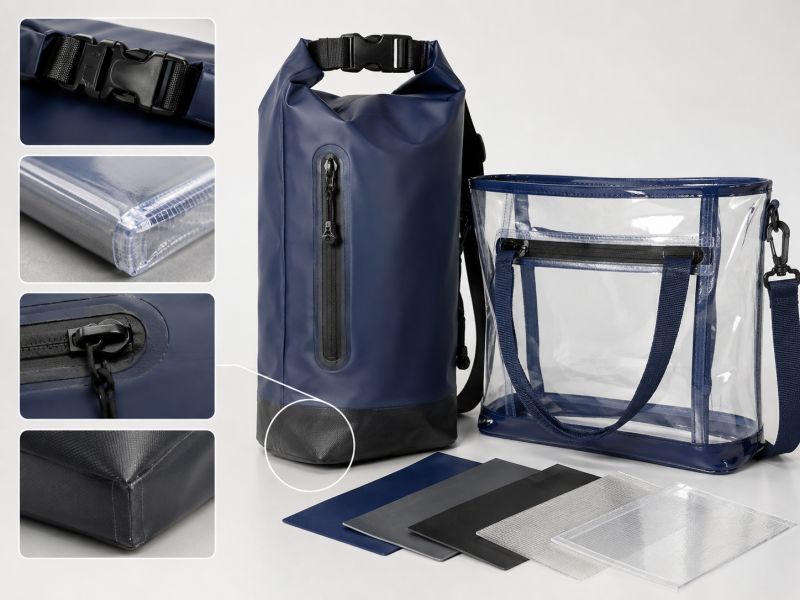
A waterproof PVC bag may look simple from the outside. It may be clear, glossy, colorful, matte, soft, structured, foldable, or heavy-duty. But the real story sits in places most people do not notice at first glance: the side seam, the bottom corner, the zipper end, the roll-top fold, the strap anchor, and even the logo position.
That is where good waterproof bag development starts.
For brand teams, outdoor programs, beach product lines, event projects, travel retailers, cosmetic brands, tool brands, and private label teams, the word “waterproof” can mean very different things. A clear PVC pouch for swimwear packaging does not need the same structure as a dry bag for paddleboarding. A waterproof tool bag used on a wet worksite needs a different build from a lightweight beach giveaway bag. A cooler bag with a sealed lining has different risks from a simple roll-top storage bag.
Waterproof PVC bag construction depends on more than PVC material. Real performance comes from the right material thickness, coated fabric structure, welded or stitched seam method, closure design, bottom reinforcement, logo placement, and quality testing. For custom projects, the construction should match the use scene, load requirement, appearance goal, price plan, packing style, and delivery schedule.
That is why serious projects should not start with a single photo and a target price only. They should start with a structure review. What will the bag carry? Will it face rain, sand, pool water, ice, mud, tools, or repeated folding? Will the logo sit on a waterproof panel? Will the handles be stitched, welded, or reinforced with patches? Should the opening use a roll-top, zipper, flap, snap, or hybrid closure?
Once those details are clear, the factory can suggest a smarter path: PVC tarpaulin for strength, transparent PVC for visibility, mesh-reinforced PVC for tear resistance, RF-welded seams for cleaner waterproof zones, or mixed stitching and welding for complex bag shapes. This is how a waterproof PVC bag moves from a nice product idea into a workable bulk order.
What Makes a PVC Bag Truly Waterproof?
A PVC bag becomes truly waterproof when the material, seam method, closure, corners, straps, and testing plan work together. PVC film or coated fabric can block water, but water often enters through weak structure areas. The main risk is not always the fabric surface. It is usually the seam, zipper end, bottom corner, handle attachment, or stitched patch.
A better way to judge waterproof performance is to ask: where can water enter under pressure, movement, folding, or load?
PVC is naturally useful for waterproof bag projects because it can form a smooth water-blocking surface. But once that material is cut, folded, welded, stitched, printed, or joined with webbing, the structure changes. Every operation can strengthen the bag or create a weak spot.
For example, a flat PVC panel may resist water very well. But if that panel is stitched without sealing, the needle holes can create tiny paths for water. If the bottom corners are not formed cleanly, water may collect and stress the joint. If the handles are added directly through a main waterproof panel, the attachment may create leakage or tearing risk.
This is why “waterproof” should never be treated as one single promise. A good factory will separate the bag into zones:
| Bag Area | Main Concern | Better Planning Method |
|---|---|---|
| Main body panels | Material strength and surface water blocking | Choose suitable PVC thickness and finish |
| Side seams | Leakage and peel strength | Use welding or sealed seam treatment |
| Bottom corners | Water pooling and stress | Add reinforcement or rounded corner planning |
| Opening | Rain, splash, or immersion risk | Match roll-top, zipper, flap, or snap structure |
| Strap anchors | Pulling force and water entry | Add patches, bar tack areas, or protected joints |
| Logo area | Decoration may break waterproof surface | Use print or controlled patch placement |
For a light beach bag, the goal may be splash resistance and easy cleaning. For a dry storage bag, the goal may be stronger seam sealing and a roll-top closure. For an outdoor work bag, the goal may be a balance between waterproof zones, load strength, and easier access.
That balance is where real development work begins.
Waterproof Material vs Waterproof Construction: What Is the Difference?
Waterproof material means the fabric or film itself can resist water. Waterproof construction means the full bag is built so water has fewer paths to enter. This includes seams, openings, zipper ends, corners, handles, patches, and inner lining. A bag can use waterproof PVC material but still fail if the seams, closure, or strap areas are not planned correctly.
This difference matters because many project teams compare bags by material name only. They see “PVC” and assume the bag will perform like a dry bag. That can lead to wrong sampling decisions.
A transparent PVC cosmetic pouch may use waterproof material, but the zipper and stitched binding may only support splash resistance. A PVC beach bag may handle wet towels and poolside use, but it may not be suitable for immersion. A roll-top PVC tarpaulin dry bag with welded seams is closer to a true waterproof construction.
Here is a simple way to explain the difference:
| Term | What It Usually Means | Common Use |
|---|---|---|
| Waterproof material | Fabric surface blocks water | PVC sheet, PVC tarpaulin, TPU-coated fabric |
| Water-resistant bag | Handles rain or splashes | Travel bags, tool bags, event bags |
| Splash-proof bag | Good for short contact with water | Beach pouches, cosmetic PVC bags |
| Waterproof construction | Seams, closure, and body are planned together | Dry bags, marine gear bags, outdoor storage bags |
The safest approach is to define the expected environment before sampling.
Will the bag sit beside a pool? Will it be used on a boat? Will it hold wet swimwear? Will it carry food with ice packs? Will it protect tools during rainy work? Will the end user expect short water contact or stronger water resistance?
A clear use scene prevents overbuilding and underbuilding. Overbuilding raises cost and may make the bag too stiff. Underbuilding saves money at first but can create returns, complaints, and brand damage later.
Which PVC Materials Work Best for Waterproof Bags?
The best PVC material depends on the bag type, use scene, structure, and price target. PVC tarpaulin works well for stronger dry bags and outdoor storage bags. Transparent PVC fits clear pouches, cosmetic bags, stadium bags, and beach bags. Mesh-reinforced PVC is better for heavier loads. TPU-coated fabric can be used for premium projects that need a softer handfeel.
Material selection is not only about thickness. It also includes flexibility, weldability, tear resistance, clarity, surface finish, folding behavior, smell control, color consistency, and compatibility with logo methods.
PVC tarpaulin is widely used for waterproof storage bags because it is strong, weldable, and practical for bulk projects. It can be matte or glossy. It can also be used with roll-top closures, welded seams, and reinforced bottoms.
Transparent PVC is more visual. It works well for clear makeup bags, beach pouches, stadium bags, swimwear packing bags, and retail gift sets. But clarity is not the only concern. The material must be thick enough to hold shape, soft enough for use, and suitable for the chosen zipper or heat sealing method.
PVC coated polyester gives a more fabric-like structure. It is useful when the bag needs a textile base with a waterproof coating. This can fit outdoor, promotional, and travel-related products.
Mesh-reinforced PVC adds tear strength and structure. It is useful for heavier-duty bags, tool storage, marine storage, and large waterproof carry bags.
TPU-coated fabric is often used when a softer, lighter, or premium feel is needed. It may cost more, but it can fit outdoor brands that care about handfeel and weight.
| Material Type | Best Fit | Watch Carefully |
|---|---|---|
| PVC tarpaulin | Dry bags, outdoor bags, beach bags, marine bags | Thickness, stiffness, welding quality |
| Transparent PVC | Clear pouches, cosmetic bags, stadium bags | Clarity, yellowing, zipper match |
| PVC coated polyester | Light waterproof bags, travel storage, event bags | Coating quality, seam planning |
| Mesh-reinforced PVC | Heavy-duty waterproof bags, tool bags | Edge finishing, weight, folding feel |
| TPU-coated fabric | Premium outdoor bags, lightweight dry bags | Cost, lead time, coating stability |
For Jundong custom projects, material review usually works best when the team can see a reference photo, target size, use scene, logo plan, and quantity. These details help narrow the options quickly without wasting time on the wrong material direction.
Welded Seams vs Stitched Seams: Which Is Better for Waterproof PVC Bags?
Welded seams are usually better for key waterproof areas because they join compatible materials without needle holes. Stitched seams are useful for handles, straps, pockets, linings, and complex shapes, but they may need extra sealing if placed in wet zones. For many custom PVC bags, the best choice is not welding or stitching alone. It is the right combination.
This is one of the most common decisions in waterproof bag construction.
A welded seam uses heat, pressure, high frequency, or other bonding methods to join thermoplastic materials. Instead of piercing the material, it fuses layers together. That makes it useful for dry bags, roll-top bags, clear PVC pouches, waterproof storage bags, and other designs where seam leakage must be reduced.
A stitched seam uses thread to hold panels together. It is flexible and useful for complex bag shapes, curved panels, webbing, shoulder straps, pocket systems, zipper areas, and lined structures. But stitching creates needle holes. If those needle holes sit in a main waterproof zone, water may find a path.
So the decision should not be emotional. It should be functional.
| Structure Choice | Strength | Waterproof Performance | Best Use |
|---|---|---|---|
| Full welded seams | Clean and sealed | Strong in wet zones | Dry bags, simple waterproof bags |
| Stitched seams | Strong for load areas | Needs sealing in wet zones | Straps, pockets, complex shapes |
| Stitching + seam tape | Better than plain stitching | Depends on tape quality | Rain bags, outdoor gear |
| Welding + stitching | Balanced structure | Strong if zones are planned well | Tool bags, travel bags, cooler bags |
The mistake is thinking welded seams are always better everywhere. A handle anchor may need stitched webbing and reinforcement because it carries weight. A complex tool bag may need pockets, dividers, zippers, and webbing that are easier to build with stitching. But the wet zones should still be protected.
A good structure plan asks two things at the same time:
Where must water stay out?
Where must the bag hold weight?
Once those two zones are separated, the build becomes much smarter.
How Does RF Welding Improve PVC Bag Seam Performance?
RF welding improves PVC bag seam performance by using radio frequency energy, pressure, and tooling to fuse compatible thermoplastic layers. The result can be a cleaner, more consistent seam without normal stitch holes. It is useful for waterproof panels, dry bags, clear PVC pouches, welded patches, reinforced bottoms, and areas where repeatable seam quality matters.
For a brand team, RF welding does not need to sound complicated. The practical value is simple: it can create a more sealed joint than regular stitching in the right material and structure.
RF welding is especially useful when a project needs clean edges and a controlled waterproof zone. It can help reduce seam gaps, support repeat orders, and make the bag look more finished. It can also create clear PVC pouches with smooth edges, roll-top dry bags with sealed side seams, or reinforced patches on stress areas.
Still, RF welding is not magic. It depends on material compatibility, thickness, tooling, pressure, temperature control, seam width, operator skill, and sample testing. Some materials weld better than others. Some complex shapes may need a hybrid build. Some designs may require extra tooling or pattern changes.
For project teams, the key is not to ask, “Can this be welded?” only.
A better set of is:
| What to Check | Why It Matters |
|---|---|
| Is the material weldable? | Not all coated fabrics behave the same |
| What seam width is planned? | Narrow seams may fail under stress |
| Where will the weld line sit? | Poor placement can affect appearance or function |
| Will straps cross the seam? | Stress areas need extra planning |
| Does the logo go before or after welding? | Wrong order can damage appearance |
| How will bulk seams be checked? | Sample success must repeat in production |
If your team has a waterproof PVC bag idea with special structure, send the use scene, size, reference image, and logo file to info@jundongfactory.com. A practical review before sampling can prevent expensive structure changes later.
Where Do Waterproof PVC Bags Usually Leak?
Waterproof PVC bags usually leak at the side seams, bottom corners, zipper ends, roll-top folds, handle attachment areas, shoulder strap anchors, logo patch areas, and accessory openings. These spots are often under movement, pressure, folding, or pulling force. A strong waterproof design should identify these risk areas before the first sample is made.
Leakage rarely comes from the middle of a clean PVC panel. It usually comes from the places where the bag has been joined, folded, punctured, stitched, or stressed.
The bottom corner is a classic example. Water can collect there. Weight can push down there. The bag may also rub against the floor, boat deck, sand, or rough ground. If the corner is too sharp, too thin, or poorly welded, it becomes a failure area.
Zipper ends are another common issue. Even a water-resistant zipper may not fully protect the ends unless the surrounding structure is planned well. A zipper can help access, but it also breaks the continuous waterproof surface. That is why roll-top structures are often preferred for stronger water protection.
Handle and strap anchors create another challenge. A bag full of towels, tools, food, or gear pulls on the attachment areas. If the strap is stitched through the main panel without reinforcement, that zone may become both a tearing risk and a water-entry risk.
Logo placement can also create problems. A printed logo on a flat PVC panel may be safe. But a stitched patch placed on a main waterproof panel may introduce needle holes. A heat-applied logo may need temperature control to avoid surface damage.
Here is a simple risk map:
| Leak Risk Area | Common Cause | Safer Planning |
|---|---|---|
| Side seam | Weak weld or unsealed stitching | Wider weld or sealed seam |
| Bottom corner | Stress and water pooling | Reinforced corner or rounded build |
| Zipper end | Open structure around zipper stop | Flap, seal, or protected zipper end |
| Strap anchor | Pulling force and stitch holes | Reinforced patch and smart placement |
| Logo patch | Stitching on wet zone | Print or place patch away from critical zones |
| Accessory opening | Drain holes, snaps, rivets | Confirm if hole is functional or risky |
A waterproof bag should be reviewed like a system, not a single object. Every part has a job. Every job creates a risk. Good construction lowers those risks before the bag reaches the end user.
Roll-Top, Zipper, or Flap: Which Closure Should You Choose?
Choose a roll-top closure for stronger waterproof storage, beach use, water sports, and dry bag styles. Choose a water-resistant zipper when fast access matters more than full sealing. Use a flap when the bag needs rain protection or a more casual structure. The best closure depends on the expected water exposure, bag shape, access needs, and price plan.
The closure is one of the biggest choices in waterproof PVC bag design because it controls how the user opens, closes, and trusts the product.
A roll-top closure is simple and effective. The user folds the top several times and clips or secures it. This structure reduces direct water entry and works well with welded side seams. It is common in dry bags, beach storage bags, boat gear bags, and outdoor waterproof sacks.
A zipper is more convenient. It allows fast access and a more familiar bag style. But zippers need careful wording and planning. Many zippers used in PVC bags are water-resistant, not fully waterproof. They may handle splashes or rain, but not immersion. For travel bags, tool bags, cooler bags, and gear bags, that may be enough.
A flap cover adds protection over a zipper or opening. It can improve rain resistance and create a more finished look. But a flap alone does not make a bag waterproof. It must work with seam structure, zipper planning, and panel design.
| Closure Type | Best For | Main Advantage | Main Limit |
|---|---|---|---|
| Roll-top | Dry bags, beach bags, marine storage | Stronger water blocking | Slower access |
| Water-resistant zipper | Travel, tools, cooler bags | Easy access | Zipper ends need care |
| Flap cover | Rain bags, work bags, casual outdoor bags | Adds protection and style | Not a full seal alone |
| Snap or button | Clear pouches, light storage | Simple and low cost | Limited water resistance |
The right closure should match the promise on the product. If the product is positioned for wet towels and beach gear, a simpler splash-resistant structure may work. If it is positioned for kayaking, boating, or outdoor emergency kits, stronger closure planning becomes much more serious.
How Do Bottoms, Handles, and Straps Affect Waterproof Bag Durability?
Bottoms, handles, and straps affect waterproof bag durability because they carry weight, face friction, and create stress around seams. Even if the main PVC body blocks water well, weak strap anchors or thin bottom panels can fail during real use. Strong waterproof PVC bags often need reinforced bottoms, protected corners, wider webbing support, and controlled stitch or weld placement.
A bag is not tested only by water. It is tested by human behavior.
People drag bags. They overfill them. They pack wet towels, tools, bottles, shoes, ice packs, cables, or sports gear. They hang them from hooks, throw them into cars, place them on sand, stack them in cartons, and fold them after use.
That is why bottom and strap planning matters.
For a beach PVC bag, the bottom may need enough structure to stand, drain sand easily, or hold wet items without sagging. For a tool bag, the bottom may need double-layer PVC, board support, reinforced corners, or protective feet. For a cooler bag, the bottom must handle weight from food, drinks, and ice packs. For a travel storage bag, the handle and shoulder strap must feel comfortable and remain stable.
Straps create a different challenge from flat seams. A strap pulls in one direction, while a welded seam may be designed for another type of force. When those forces meet, the factory needs to decide whether to add reinforcement patches, stitch outside critical wet zones, widen the stress area, or combine welding and stitching.
| Detail | Why It Matters | Better Choice |
|---|---|---|
| Bottom layer | Holds load and faces abrasion | Add thickness or reinforcement |
| Bottom shape | Affects standing and packing | Match flat, box, or round base to use |
| Handle webbing | Carries daily pulling force | Use suitable width and stitch pattern |
| Strap anchor | High stress zone | Reinforce before bulk production |
| Corner structure | Common crack or leak area | Round, patch, or weld carefully |
| Inner lining | Affects cleaning and leakage | Seal or bind based on use |
Durability is not about making everything thicker. It is about adding strength in the correct places. A smart structure can feel lighter, cost less, and still perform better than a bag that is simply overbuilt.
How Can Logos Be Added Without Damaging Waterproof Performance?
Logos can be added to waterproof PVC bags through screen printing, heat transfer, PVC patches, rubber patches, woven labels, debossing, embossing, or metal plates. The safest method depends on the material and the waterproof zone. Printed logos usually protect the panel better than stitched patches placed on critical wet areas.
Logo work is often treated as decoration, but on a waterproof PVC bag it becomes part of the structure plan.
A large printed logo on a transparent PVC pouch may be simple. A rubber patch on a roll-top dry bag needs more care. A woven label stitched onto a main waterproof panel may look nice but create holes. A metal plate may add brand value, but rivets or fixing holes need review. A heat transfer logo may look clean, but temperature and pressure must match the PVC surface.
The order of production also matters. Some logos should be applied before welding. Some should be added after panel cutting. Some need testing for adhesion, color transfer, cracking, or peeling after folding.
| Logo Method | Good For | Watch Carefully |
|---|---|---|
| Screen printing | Clear PVC, flat panels, simple logos | Ink adhesion and placement |
| Heat transfer | Clean brand graphics | Heat control on PVC surface |
| PVC or rubber patch | Outdoor and lifestyle styles | Avoid main wet zones if stitched |
| Woven label | Casual and retail styles | Stitch holes and placement |
| Metal plate | Premium look | Fixing method and corrosion risk |
For brand teams, the logo should be visible, clean, durable, and safe for the structure. It should not sit across a fold line, seam line, or high-stress waterproof area unless the method is planned for that purpose.
If the logo is central to the product, send artwork early. Jundong can review logo size, placement, color, method, and sample path before the first PVC bag sample is made.
How Should a Factory Test Waterproof PVC Bags Before Shipment?
A factory should test waterproof PVC bags by checking material thickness, seam width, welding strength, leakage risk, zipper function, roll-top closure, handle pull strength, bottom load strength, logo adhesion, packing quality, and sample consistency. The test plan should match the product’s real use rather than rely on one simple inspection step.
Testing must be practical. Not every PVC bag needs the same test. A clear cosmetic pouch, a beach bag, a roll-top dry bag, a waterproof tool bag, and a cooler bag do not face the same conditions.
For a dry bag, the team may focus on welded seam quality, closure folding, and leakage checks. For a waterproof tool bag, handle pull strength and bottom load testing may matter more. For a transparent PVC pouch, zipper smoothness, edge finishing, and print adhesion may be more relevant. For a cooler bag, lining sealing and cleaning performance should be reviewed.
A useful test plan may include:
| Test Item | Purpose |
|---|---|
| Material thickness check | Confirm the approved material is used |
| Seam width check | Make sure weld lines meet the planned structure |
| Seam peel review | Check whether bonded areas hold properly |
| Water leakage check | Review wet-zone protection |
| Zipper test | Confirm smooth opening and closing |
| Roll-top folding test | Confirm closure behavior after repeated use |
| Handle pull test | Check stress areas under load |
| Bottom load test | Review strength when filled |
| Logo adhesion test | Reduce peeling or cracking risk |
| Packing inspection | Protect the bag during export delivery |
The most useful quality control habit is approved sample comparison. The bulk product should match the approved sample in material feel, color, logo size, seam structure, dimensions, closure, reinforcement, and packing method.
That is why clear sample approval saves time later. A rushed sample can turn into confusion during bulk production. A well-reviewed sample becomes the reference for the whole order.
How Does Construction Affect Custom PVC Bag Price?
Custom PVC bag price changes with material thickness, fabric type, welding method, seam length, zipper choice, bottom reinforcement, handle structure, logo method, packing style, test needs, and order quantity. Two bags may look similar in photos but differ greatly in cost if one uses stronger PVC, wider welded seams, reinforced corners, or more complex branding.
Price is not only about the size of the bag. It is about how many decisions sit inside the bag.
A thin transparent PVC pouch with a simple zipper and one-color print is very different from a heavy PVC tarpaulin roll-top bag with welded seams, reinforced bottom, printed logo, adjustable strap, and individual packing. Both can be called waterproof PVC bags, but their cost logic is not the same.
Here are common factors that move the price:
| Cost Factor | Why It Changes Price |
|---|---|
| PVC thickness | Thicker material usually costs more and may need different handling |
| Material type | Tarpaulin, transparent PVC, coated fabric, TPU differ in cost |
| Welded seam area | More welding time and setup affect cost |
| Zipper type | Water-resistant zippers cost more than basic zippers |
| Reinforcement | Extra panels, patches, or board increase materials and labor |
| Strap structure | Adjustable straps, padded handles, and webbing anchors add work |
| Logo method | Printing, patching, heat transfer, and metal plates differ |
| Packing | Retail packing, labels, and carton sorting add steps |
| Quantity | Larger orders help reduce unit cost after setup is spread out |
Jundong’s standard starting quantity is usually 500 pieces per design. For some simple styles, 200–300 pieces may be arranged, but the unit cost is often higher because material purchasing and the full production steps still need to run. Once the order reaches 500 pieces or more, the price structure is usually more competitive.
The best cost control method is not cutting quality blindly. It is choosing the right construction for the real use.
For example, an event giveaway bag may not need a heavy-duty dry bag structure. A marine storage bag should not be treated like a light promotional pouch. A tool bag may need stronger bottom and strap support even if the waterproof level is moderate.
Smart cost planning means spending money where the product actually needs it.
What Should Teams Confirm Before Making a Waterproof PVC Bag Sample?
Before making a waterproof PVC bag sample, teams should confirm the bag type, reference image, target size, capacity, material preference, use environment, waterproof expectation, closure type, handle or strap structure, logo file, quantity, packing method, timeline, destination country, and test requirements. Clear information helps the factory suggest the right structure before development starts.
A sample is not just a small version of a future order. It is the test stage for material, structure, appearance, cost, and production feasibility.
The more complete the starting information is, the faster the sample review becomes. This does not mean every team must have a finished tech pack. A reference photo, rough size, use scene, logo idea, and quantity can already start a meaningful review.
A helpful sample request may include:
| Detail to Send | Why It Helps |
|---|---|
| Bag type or reference image | Shows the expected style |
| Target size and capacity | Helps judge material and structure |
| Use scene | Defines waterproof expectation |
| Material preference | Speeds up sourcing and quotation |
| Closure type | Affects waterproof performance and cost |
| Strap or handle design | Affects strength and production method |
| Logo artwork | Helps choose print, patch, or label method |
| Quantity | Affects price and material planning |
| Packing method | Helps plan labels, cartons, and delivery |
| Delivery timeline | Helps judge sampling and bulk schedule |
| Destination country | Helps review export and packing details |
For many custom PVC bag projects, sampling can often move faster when the structure is simple and materials are available. More complex waterproof bags may need extra review, especially if they involve welded seams, reinforced bottoms, special zippers, multiple compartments, or retail-ready packing.
If your team is planning a waterproof PVC beach bag, dry bag, clear pouch, outdoor gear bag, cooler bag, or waterproof tool bag, send the project details to info@jundongfactory.com. Jundong can review the material, structure, logo method, sample path, and production plan before bulk work begins.
A better sample starts with better. That is how a waterproof PVC bag becomes easier to quote, easier to approve, and easier to repeat in future orders.
Closing Note
Waterproof PVC bag construction is not a single material choice. It is a full product decision. The material must suit the use scene. The seams must match the waterproof goal. The opening must fit real user behavior. The bottom and straps must handle weight. The logo must support the brand without damaging the structure. The sample must become a reliable guide for bulk production.
For serious custom projects, the best result comes from early structure review, clear sample approval, and quality checks that match the actual product use. That approach helps brand teams reduce risk, control cost, improve user experience, and build PVC bags that feel right from the first sample to repeat orders.
FAQs About Waterproof PVC Bag Construction
1. What is the best construction for a waterproof PVC bag?
Certainly — the best waterproof PVC bag construction is the one that matches the real use scene, not the one that only looks strong in photos. For dry bags, water sports storage, marine gear, and outdoor wet-use projects, PVC tarpaulin with welded seams and a roll-top closure is usually a stronger choice. For beach bags, clear pouches, cosmetic bags, and event bags, transparent PVC or PVC coated fabric with sealed edges, reinforced handles, and a suitable zipper can work well.
A strong construction plan should include material thickness, seam method, opening style, bottom shape, strap position, logo method, and packing method. These details affect how the bag performs after repeated folding, loading, pulling, and exposure to water. A light clear PVC pouch may need a clean edge and a smooth zipper. A waterproof tool bag may need a reinforced bottom, stronger webbing, and mixed welding plus stitching. A dry bag may need wider welded seams and a roll-top closure.
For custom projects, do not select construction only by material name. Start from the use scene, load weight, water exposure, appearance goal, and target quantity. That gives the factory enough information to suggest a build that is practical, stable, and cost-aware.
2. Which PVC material should be used for waterproof bags?
Sure — PVC tarpaulin is often the strongest choice for roll-top dry bags, outdoor waterproof bags, and marine-style storage, while transparent PVC works better for clear pouches, beach bags, cosmetic bags, and stadium-style bags. PVC coated polyester is a practical option for lighter promotional or travel storage bags. Mesh-reinforced PVC is a smart choice when the bag needs better tear resistance and more body.
Material selection should not stop at thickness. A project team should also check softness, stiffness, transparency, smell control, folding behavior, print compatibility, welding compatibility, color consistency, and handfeel. For example, a 0.3 mm transparent PVC pouch may feel neat for beauty sets, but it may not be suitable for a large waterproof gear bag. A 500D or 1000D PVC tarpaulin structure may work better for outdoor bags, but it may feel too heavy for simple retail packing.
Here is a simple guide:
| Use Scene | Common Material Direction |
|---|---|
| Dry bag | PVC tarpaulin |
| Clear beach pouch | Transparent PVC |
| Waterproof tool bag | Heavy PVC or reinforced PVC |
| Event waterproof bag | PVC coated fabric or clear PVC |
| Outdoor gear bag | PVC tarpaulin or reinforced PVC |
| Cosmetic PVC pouch | Transparent PVC |
The safest path is to send a reference image, target size, and use scene before sampling. A factory review can help avoid a material that looks right but performs poorly.
3. Are welded seams better than stitched seams for waterproof PVC bags?
Of course — welded seams are usually better for main waterproof zones because they join compatible PVC layers without regular needle holes. That makes them useful for dry bags, roll-top waterproof bags, clear PVC pouches, and wet-use storage bags. However, stitched seams still have value in handles, shoulder straps, pocket structures, lining areas, zipper zones, and complex bag shapes.
The real decision is not “welded or stitched.” It is “where should each method be used?” A welded side seam can reduce leak risk, but a shoulder strap may need stitching because it carries weight. A fully welded simple dry bag may perform well around water, but a tool bag with multiple pockets and reinforced handles may need a hybrid structure.
A practical construction plan may look like this:
| Area | Better Method |
|---|---|
| Main side seams | Welding |
| Bottom waterproof joints | Welding or reinforced welding |
| Handle attachment | Stitching with reinforcement |
| Shoulder strap anchors | Stitching, bar tack, or patch support |
| Logo on main panel | Printing or heat transfer |
| Inner compartments | Stitching or binding |
For stronger waterproof performance, avoid placing plain stitched seams in areas that will face standing water, pressure, or heavy splashing. If stitching must be used in a wet zone, the sample should include seam sealing, tape, inner lining, or other protection based on the product’s use.
4. How does RF welding affect waterproof PVC bag performance?
Definitely — RF welding can improve waterproof PVC bag performance by creating cleaner, more consistent joints on suitable PVC materials. Instead of using thread, RF welding uses energy, pressure, and tooling to bond thermoplastic layers together. This helps reduce needle-hole leakage risk and creates a smoother seam for many waterproof bag structures.
RF welding is useful for roll-top dry bags, clear PVC pouches, flat waterproof panels, welded logo patches, reinforced edges, and bottom structures. It can also help with repeat production because the seam shape and width can be controlled more consistently when the tooling and material are stable.
Still, RF welding needs the right material and structure. Not every coated fabric reacts the same way. Material thickness, coating type, seam width, pressure, tooling shape, and operator skill all affect the result. If the design includes thick webbing, curved panels, inner lining, heavy hardware, or complex pockets, stitching may still be needed in some areas.
For procurement teams, RF welding should be discussed early, not after the design is fixed. Once the pattern, logo position, zipper type, and strap structure are already set, changing to RF welding may require extra revision. A good sample plan should confirm weldable material, seam width, weld location, and test method before bulk production begins.
5. Where do waterproof PVC bags usually leak?
Absolutely — waterproof PVC bags usually leak at joined, folded, stressed, or pierced areas rather than in the middle of a clean PVC panel. Common risk areas include side seams, bottom corners, zipper ends, roll-top folds, handle attachments, shoulder strap anchors, logo patches, rivets, drainage holes, and accessory openings.
The bottom corner is one of the most common risk areas because it faces water collection, weight pressure, abrasion, and folding stress. Zipper ends are another weak area because the zipper breaks the continuous waterproof surface. Strap anchors are also sensitive because they carry pulling force and may involve stitching through the body panel. Logo patches can create problems if they are stitched onto a key waterproof area without planning.
A useful risk review may include:
| Risk Area | Why It Matters |
|---|---|
| Side seam | Water can enter through weak joints |
| Bottom corner | Stress and water collect in the same area |
| Zipper end | Small gaps may remain around the stop area |
| Strap anchor | Pulling force can open weak seams |
| Logo patch | Stitches may create water paths |
| Hardware opening | Rivets or holes may need protection |
During sampling, these areas should be checked before appearance approval. A bag can look clean from the outside but still have structural risks that only show up during use. That is why real waterproof review should include wet-area checks, pull checks, folding checks, and approved sample comparison.
6. Is a roll-top closure better than a waterproof zipper?
In many wet-use projects, yes — a roll-top closure is often more reliable than a zipper for stronger water protection because it folds the opening several times and reduces direct water entry. It is a strong choice for dry bags, beach storage bags, marine bags, water sports bags, and outdoor waterproof sacks. It also works well with welded side seams.
A zipper is more convenient when the user needs quick access. This makes it useful for travel bags, tool bags, gear bags, cooler bags, cosmetic bags, and clear pouches. But many zippers used on PVC bags are water-resistant rather than fully waterproof. That means they may handle rain or splashes, but they should not be promoted as suitable for immersion unless the full structure supports that claim.
Here is a practical comparison:
| Closure | Best For | Main Strength | Main Limit |
|---|---|---|---|
| Roll-top | Dry bags, marine bags, beach storage | Better water blocking | Slower access |
| Water-resistant zipper | Travel, tools, cooler bags | Fast access | Zipper ends need care |
| Flap cover | Rain protection, outdoor work bags | Extra cover | Not a full seal alone |
| Snap closure | Light pouches | Low cost and simple | Limited protection |
Choose roll-top when water protection is the top goal. Choose zipper when daily convenience matters more. Choose a hybrid structure when the bag needs both function and style.
7. Can custom logos be added to waterproof PVC bags without hurting performance?
Certainly — custom logos can be added safely when the logo method and placement are planned before sampling. Screen printing, heat transfer, PVC patches, rubber patches, woven labels, embossed marks, and metal plates can all work on PVC bags, but each method affects the structure differently.
For main waterproof panels, printing is often safer than stitched patches because it does not pierce the material. Heat transfer can give a clean branded look, but temperature and pressure must suit the PVC surface. PVC or rubber patches look strong for outdoor and lifestyle styles, but if they are stitched onto a wet zone, the stitch holes need review. Metal plates may look premium, yet rivets or fixing holes can create risk if placed poorly.
A better logo plan asks:
| Logo Detail | Why It Matters |
|---|---|
| Placement | Avoid seam lines, fold lines, and stress zones |
| Size | Oversized logos may cross risky areas |
| Method | Printing, patching, and plating affect the bag differently |
| Color | Ink and PVC surface must be compatible |
| Order of work | Some logos should be applied before welding |
| Test need | Folding and adhesion should be checked |
If the logo is central to the product identity, send the artwork early. Jundong can help review logo size, placement, material match, and sample method before the bag structure is locked.
8. How long does it take to make a waterproof PVC bag sample and bulk order?
Sure — many simple PVC bag samples can be made in about 5–7 days when material, size, logo method, and structure are clear. Some simpler styles may move faster, around 2–3 days, if the material is available and the structure does not need special tooling. Bulk production is commonly around 20–30 days, depending on quantity, material sourcing, welding work, logo process, packing, and final inspection.
More complex waterproof PVC bags may take longer. For example, a roll-top dry bag with welded seams and basic printing may move faster than a waterproof tool bag with reinforced bottom, thick webbing, multiple pockets, water-resistant zipper, shaped panels, and retail packing. If the project includes special PVC color, custom zipper, multiple logo positions, heavy reinforcement, or multi-SKU packing, the timeline should be checked before sample approval.
A simple planning view:
| Project Type | Sample Direction |
|---|---|
| Clear PVC pouch | Often faster if material is ready |
| Basic beach bag | Usually straightforward |
| Roll-top dry bag | Needs weld review |
| Waterproof tool bag | Needs structure and load review |
| Cooler bag with PVC shell | Needs lining and insulation review |
| Multi-SKU retail set | Needs packing and label planning |
For urgent projects, send the reference image, quantity, logo file, and delivery target together. Clear starting details help the factory judge what can move quickly and what needs more review.
9. What affects the price of custom waterproof PVC bags?
Definitely — custom waterproof PVC bag price is shaped by material thickness, PVC type, welding area, seam complexity, zipper choice, bottom reinforcement, strap structure, logo method, packing style, test needs, and quantity. Two bags may look similar online, but one may cost more because it has thicker PVC, wider welded seams, reinforced corners, stronger handles, or retail-ready packing.
A thin clear PVC pouch with one-color printing will not share the same cost logic as a heavy PVC tarpaulin dry bag with welded seams, adjustable shoulder strap, reinforced bottom, and individual packing. Cost is also affected by how much setup is needed. Welding tooling, logo preparation, material sourcing, sample revision, label sorting, and carton marking all take time.
Here is a simple cost view:
| Cost Driver | Effect |
|---|---|
| Thicker PVC | Higher material cost, stronger feel |
| Welded seams | More process control |
| Water-resistant zipper | Higher accessory cost |
| Reinforced bottom | More material and labor |
| Adjustable strap | More webbing and hardware |
| Custom logo | Depends on print or patch method |
| Retail packing | Adds label, insert, and carton work |
| Smaller quantity | Higher unit cost due to setup spread |
Jundong’s standard starting quantity is usually 500 pieces per design. For some simple styles, 200–300 pieces may be arranged, but the unit cost is usually higher because the full production process still runs. For stronger cost control, match the construction to the real use scene instead of making every part heavier than needed.
10. What should we send before requesting a waterproof PVC bag sample?
Of course — the best sample request should include a reference image, target size, capacity, use scene, waterproof expectation, PVC material preference, closure type, handle or strap design, logo file, quantity, packing method, deadline, destination country, and any test requirement. A complete starting file helps the factory suggest the right construction before time is spent on the wrong sample direction.
You do not need to have a perfect technical file at the beginning. Many projects can start with a clear photo, rough dimensions, logo artwork, target quantity, and use scene. For example, “clear PVC beach bag for swimwear retail” gives a very different direction from “heavy waterproof PVC tool bag for wet worksite use.” The more specific the use scene is, the easier it is to choose material, seam method, closure, reinforcement, and logo placement.
A helpful request list:
| Detail | Why It Helps |
|---|---|
| Reference image | Shows the expected style |
| Size | Helps calculate material and capacity |
| Use scene | Defines waterproof level |
| Quantity | Affects price and production planning |
| Logo file | Helps choose the right method |
| Closure type | Affects water protection |
| Strap design | Affects strength and comfort |
| Packing method | Affects labels, cartons, and delivery |
| Deadline | Helps plan sample and bulk timing |
For project review, details can be sent to info@jundongfactory.com. Clear information makes sampling smoother, pricing more accurate, and bulk production easier to control.
Let's work together
With over 10 years of OEM/ODM bag industry experience, I would be happy to share with you the valuable knowledge related to leather products from the perspective of a leading supplier in China.

Factory catalogue
Table of Contents
Latest blogs


Make A Sample First?
If you have your own artwork, logo design files, or just an idea, please provide details about your project requirements, including preferred fabric, color, and customization options, we’re excited to assist you in bringing your custom bag designs to life through our sample production process.