 Skip to content
Drawstring Bag Price: What Really Changes Cost in Custom Projects?
A lot of people start with the same line: “We just need a simple drawstring bag. Why is the quote so different from one factory to another?” On paper, it sounds like an easy product. Two panels, two cords, one logo. But in real projects, a drawstring bag is rarely “just a bag.” The price changes with fabric choice, weight, size, print method, stitching detail, cord quality, packaging, and quantity. Even two bags that look similar in a photo can land in very different cost levels once you compare thickness, handle feel, print cleanliness, and how long they are expected to last.
That is why the best way to look at drawstring bag price is not to ask for one universal number. A better approach is to ask what kind of bag you are really building. Is it a light giveaway for one event? A gym sack meant to be reused for months? A cotton packaging pouch for retail? A canvas gift bag that has to feel premium when opened? Price only becomes meaningful when the intended use is clear.
For most custom projects, drawstring bag price is shaped less by the word “drawstring” and more by the product specification behind it. Simple promotional styles in polypropylene or lightweight polyester can sit at the low end, while heavier cotton, canvas, Oxford, specialty fabrics, pockets, reinforced corners, and more advanced print methods move the cost upward. Quantity, sample needs, and packaging also change the quote in a big way. In short: the right price is the price that matches the bag’s job, not the cheapest number on a spreadsheet. Current also show that entry promotional styles can come in under $2 each at 50 pieces, while material-specific custom programs span from low-cost polyester into much higher premium fabrics and finishes.
Many teams lose time because they compare quotes before they compare specifications. They line up three numbers, assume one is expensive, and then later find out the cheapest option used a thinner fabric, smaller print area, weaker cords, no proof cycle, or a totally different packing method. That kind of comparison is not really price control. It is misalignment. The useful move is to break the product into cost drivers, then decide where the bag must perform and where it can stay simple.
What Is the Real Price of a Custom Drawstring Bag?
The real price of a custom drawstring bag can move from entry-level promotional cost to premium retail-packaging cost depending on material, print method, and order setup. Very basic polypropylene or simple polyester event bags can sit at the low end. Heavier cotton, canvas, Oxford, RPET, satin, velvet, mesh, or leather versions cost more. If the bag includes pockets, lining, zipper parts, woven labels, hangtags, or special packing, the total goes up again. currently show low-end promotional styles under $2 each at 50 pieces, while custom material programs can span from roughly $0.25 to several dollars per piece depending on build.
The most useful way to read price is by project type, not by one headline number. A light giveaway sack for a school run or trade event is not priced like a branded retail pouch. A retail pouch is not priced like a gym sack with reinforced corners. And none of them should be priced like a leather drawstring gift bag.
| Project type | Typical build | Cost tendency |
|---|---|---|
| Entry promo bag | Polypropylene or light polyester, stock size, simple one-color print | Lowest |
| Sports or event bag | 210D polyester or light nylon, larger size, stronger cords | Low to mid |
| Reusable cotton pouch | Cotton or light canvas, cleaner finish, gift or packaging use | Mid |
| Heavier lifestyle bag | Canvas, Oxford, reinforced corners, bigger logo area | Mid to upper-mid |
| Retail or premium gift pouch | Satin, velvet, jute, linen, specialty trims, brand packaging details | Upper-mid to high |
| Luxury version | Genuine leather, specialty finishing, premium presentation | Highest |
A practical rule helps here: the more often the bag will be reused, the less useful the lowest price becomes. For a one-day campaign, a thin low-cost bag may do the job. For retail, hospitality, subscription boxes, team programs, or repeat merch drops, the bag becomes part of the brand experience. At that stage, feel, print sharpness, and durability matter more than winning the quote by a few cents.
If you are comparing offers and the numbers feel scattered, ask every factory to quote the same checklist: material, fabric weight, finished size, print size, print colors, cord type, corner reinforcement, packaging, carton setup, sample stage, and lead time. Without that, you are not comparing like for like.
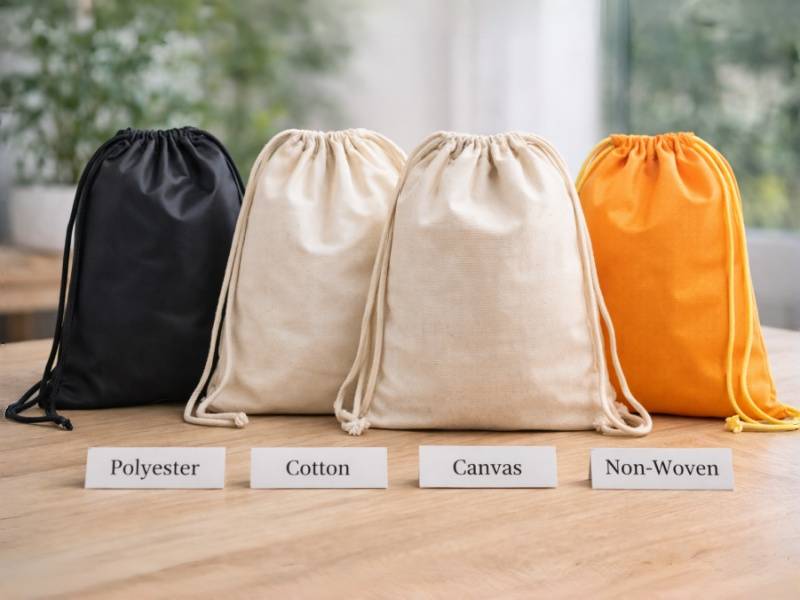
Which Type of Drawstring Bag Costs Less: Polyester vs Cotton vs Canvas vs Non-Woven?
If price is the main concern, non-woven polypropylene and light polyester usually come in lower than cotton and canvas. Cotton tends to sit in the middle when the bag is simple. Canvas usually costs more because it is heavier, denser, and more premium in hand feel. But “less expensive” does not always mean “better value.” The right fabric depends on whether the bag is meant for a short promotion, daily reuse, retail packaging, or a more branded lifestyle product. Public listings also show these materials repeatedly across current drawstring programs.
Here is the commercial logic behind each material:
| Fabric | Usual cost level | Feel | Best fit |
|---|---|---|---|
| Non-woven / polypropylene | Lowest | Light, practical, basic | Campaign giveaways, short-term event use |
| Polyester | Low | Smooth, light, common for sport use | Gyms, schools, team events, active use |
| Cotton | Mid | Soft, natural, easy to position as eco-conscious | Gift pouches, simple retail packaging |
| Canvas | Mid to high | Heavier, stronger, more premium | Reusable merchandise, lifestyle and retail use |
Polyester is popular for a reason. It gives a good balance of light weight, good printability, and manageable cost. That is why many sport sacks and event bags use 210D polyester. It is not always the nicest hand feel, but it often wins when the project needs scale without becoming too fragile. Current public product still position polyester as a core material for drawstring bags, especially in promotional and active-use styles.
Cotton and canvas shift the conversation. They usually feel more “real,” more reusable, and more suitable for gift, packaging, or brand-forward projects. But they also invite stricter expectations. Once a bag is cotton or canvas, people notice fabric weight, seam straightness, print sharpness, shrinkage, and handle feel more quickly. So yes, the price rises—but so does scrutiny.
If you are not sure where to start, begin with the job of the bag:
- One-off promotion: non-woven or light polyester
- Sports, events, schools: polyester or light nylon
- Packaging, gifting, retail add-on: cotton
- Better hand feel and repeated daily use: canvas or Oxford
At Jundong, that kind of decision is easier to control because the team can develop across multiple material families and match the bag to the use scene, rather than forcing one fabric into every project. The factory profile and drawstring program both show support for multi-material development, fast sampling, and structure adjustment.
Why Do Size, Fabric Weight, Printing Method, and Construction Change the Price So Much?
Drawstring bag cost changes fast because these details change both material consumption and production difficulty. A larger bag uses more fabric and longer cords. A heavier fabric adds material cost and often slows sewing. A one-color logo is not priced like a full-color transfer. Reinforced corners, pockets, lining, zipper parts, or special cord ends all add labor and handling time. also keep emphasizing material choice, decoration method, and bag features as major variables.
Start with size. A small retail pouch and a gym sack may both be called “drawstring bags,” but they do not behave like the same product in production. More width and height mean more fabric, larger print areas, bigger cartons, and sometimes higher freight cost. Bigger is not just bigger. It affects the whole order.
Then comes fabric weight. Light fabrics save money, but they do not create the same hand feel, drop, or carrying confidence. On cotton and canvas versions, even small jumps in fabric weight can change how premium the bag feels. On polyester or nylon, density affects opacity, strength, and the way the surface presents a logo. Jundong’s own current drawstring program even separates pricing by material family and fabric weight, including 6oz, 8oz, 10oz, and 12oz cotton canvas options, which is a good reminder that “cotton bag” is still too vague for real quoting.
Printing method is another major cost lever. Current public programs commonly offer single-color print, full-color print, full-color transfer, embroidery, screen printing, and heat transfer. A simple one-color print is often the most cost-efficient when the artwork is bold and the quantity is healthy. Full-color transfer works well when the visual is more detailed, but the unit cost and setup logic are different. Embroidery may look more premium, yet it is rarely the lowest-cost choice for light event bags.
Finally, there is construction. Reinforced corners, inner pockets, card holders, zipper closures, wider straps, and specialty cords all sound small on a product sheet. They are not small on a quote. A bag with stronger corners and better straps may cost more, but it can also reduce breakage, lower complaint risk, and keep the bag in use longer. That matters when the bag represents a brand after the event is over.
How Do MOQ, Bulk Quantity, and Packaging Affect Bag Factory Quotes?
MOQ and total quantity influence price because setup work, print preparation, cutting loss, and packing labor do not disappear on small runs. A short run carries more fixed cost per piece. A larger run spreads those costs across more units, which usually lowers the unit price. Packaging matters too. A bag packed loose in export cartons is not priced the same as a bag with an individual polybag, hangtag, insert card, barcode label, or retail-ready presentation. Current public programs show everything from 1-piece or 25-piece minimums in print-on-demand channels to 500-piece starts in custom factory-style programs.
This is where many sourcing discussions go wrong. Someone asks for “your best price,” but the quantity is still uncertain, the print method is still open, and the packaging is still undecided. That turns quoting into guesswork. What looks like a price issue is often a specification issue.
The reason quantity matters is simple. A custom run has opening costs:
- artwork checking
- color matching
- print setup
- sampling or proofing
- material planning
- cutting and packing workflow
Those tasks may not look large in a spreadsheet, but they are very real in a factory. If the order is 100 pieces, each unit absorbs more of that opening cost. If the order is 3,000 pieces, the same opening cost is shared more efficiently.
Packaging is another hidden driver. If the bag is only for event distribution, loose packing may be enough. If it is for retail, gift, or online fulfillment, the order may need:
- individual polybag
- barcode sticker
- warning label
- hangtag
- insert card
- master carton mark
- ratio pack or assortment rules
That is why two quotes for the “same bag” can still be far apart. One quote may only cover the bag itself. The other may cover the bag plus the packing system required downstream.
For projects that need clear cost control, it helps to ask for three quote levels:
- Basic bulk pack
- Standard branded pack
- Retail-ready pack
That approach gives room to adjust cost without redesigning the whole product. If you want Jundong to break your project that way, you can ask for a structured quote based on quantity, print method, and packaging level at info@jundongfactory.com. That usually produces a much more useful discussion than one number without context.
When Should You Ask for a Sample, and How Much Does a Custom Drawstring Bag Sample Cost?
Ask for a sample when the bag’s material feel, print result, size fit, or construction detail matters to the project. For a very simple repeat order on a known stock style, a fresh sample may not be necessary. But for a new fabric, new size, new print method, or retail-facing bag, a sample is usually worth it. Sample cost also varies by type. Some programs offer free or nominal stock samples, while pre-production samples with your own artwork usually cost more because they involve setup, proofing, and handling. Public currently show both sample fees and free sample / nominal shipping models depending on the program.
Not every project needs the same kind of sample. There are at least three useful levels:
| Sample type | What it checks | When to use it |
|---|---|---|
| Stock or random sample | Fabric feel, general workmanship, size reference | Early shortlisting |
| Material or color swatch | Fabric weight, color direction, texture | When fabric choice is still open |
| Pre-production sample | Real size, print, cord, construction, finish | Before bulk on new projects |
A random sample is useful, but it can also mislead if people treat it like the final product. A stock sample may show general workmanship, yet it does not prove your exact print placement, your final color, or your chosen cord. That is why the pre-production sample matters on branded work.
Current public listings show this clearly. One seller lists a $12.50 sample fee for random samples to request a separate quote for a pre-production sample with their own artwork. Another notes that samples are available upon request before bulk runs. In other words, “sample cost” is not one fixed number; it depends on whether you are checking the base bag or approving the actual custom version.
You should definitely sample first when:
- the logo is detailed
- the color is brand-sensitive
- the bag will be sold, not just given away
- the fabric is heavier or unfamiliar
- the project includes pockets, gussets, or reinforcements
- the first order may lead to repeat programs
Jundong’s profile also highlights rapid sampling, multi-round sample support, color confirmation, logo approval, and pre-production sample handling, which is exactly the kind of structure that lowers surprise before bulk starts.
How Long Does the Custom Drawstring Bag Process Take From Sampling to Bulk Production?
A realistic custom drawstring bag timeline often includes artwork review, material confirmation, sample development, revisions if needed, final approval, and bulk production. For straightforward projects, public factory-style currently show 3–7 days for samples and roughly 15–25 days for bulk, while print-focused domestic programs often show 10–15 business days after proof approval and payment. The actual schedule depends on fabric availability, print method, quantity, and packing requirements.
A common mistake is to count only sewing time. The real clock starts earlier:
- design or spec confirmation
- fabric and color confirmation
- proof or sample
- revision cycle
- final approval
- bulk cutting, sewing, printing, packing
- export booking or delivery arrangement
If the bag is simple and uses a common fabric, the schedule can stay compact. But when the job includes custom dyeing, woven labels, complex packaging, or multiple SKUs, the timeline changes. A drawstring bag is still a sewn product. It needs coordination, not just printing.
Public show a similar split between faster stocked print programs and factory-led custom development. One seller lists 10–15 business days as standard printing turnaround after proof and payment. Another factory-style source lists 3–7 days for samples and 15–25 days for bulk. Those windows are not identical because the project types are not identical.
That is why you should ask a factory for three dates, not one:
- sample completion
- bulk completion
- estimated ship-out date
This gives a more usable schedule for planning campaigns, launches, or seasonal demand. If your project has a target date, send it early with the spec sheet. That makes it easier to decide what can stay custom and what should stay standard. For projects with tight timing, Jundong can review the spec and suggest where to simplify without making the bag feel cheap. You can request that review at info@jundongfactory.com.
Who Is the Right Production Partner for Your Project: Bag Factory vs Trading Company?
The right production partner depends on the project. A direct bag factory is often a better fit when you need material control, faster technical feedback, sample revisions, and clearer visibility into production details. A trading company can be useful when a project spans many categories or needs one external coordinator. But for a drawstring bag project that involves repeated sampling, print adjustment, fabric decisions, and cost engineering, direct factory access usually gives a cleaner path. Jundong’s profile shows in-house development, design, sample support, and QC depth, which are exactly the functions that matter in this kind of work.
The real issue is not the company label. It is control. Who is checking the material? Who is revising the sample? Who is confirming the print placement? Who is watching the bulk run? If every technical change has to go through one more relay step, the process slows down and the chance of mismatch rises.
A good production partner for drawstring bags should be able to discuss:
- which fabric fits the use case
- whether the logo should be screen printed or transferred
- how the cords should feel and hold
- whether corner reinforcement is necessary
- what packing level matches the final channel
- how to lower cost without removing the wrong feature
That is not just “sales.” That is product thinking.
Jundong’s uploaded factory introduction is useful here because it does not only talk about product categories. It also confirms the working structure behind them: foreign trade sales team, product development team, design team, sample room, 600+ staff, around 18,000 square meters, and 80 QC staff, along with support for multi-material projects and many bag categories. That kind of setup matters more than a polished quote sheet.
If you are screening new partners, ask for more than a catalog. Ask how they handle:
- sample revisions
- fabric substitutions
- proof approval
- in-line checks
- final inspection
- barcode or retail labeling
- repeat-order consistency
Those replies usually tell you more than the first unit price.
Are Cheap Drawstring Bags Really Cheaper in the End?
Cheap drawstring bags are only truly cheaper when the bag has a short life, low visibility, and low performance expectation. For one-day giveaways, that can be perfectly fine. But for school programs, sports use, retail packing, team merchandise, or repeated daily use, the cheapest bag often becomes more expensive once you account for breakage, poor print appearance, weak cords, thin fabric, or a look that does not support the brand. Low cost is not the same thing as low total spend.
A bag fails in a few common ways:
- the cords cut into the shoulder and feel harsh
- the corners split when the bag is loaded
- the print cracks, peels, or looks weak
- the fabric becomes too transparent
- the size is wrong for the intended contents
- the bag looks too flimsy for the brand it carries
None of those problems are theoretical. They change whether the bag is used once, reused for months, or thrown away immediately. And that changes the real value of the order.
This is why cost per use is more meaningful than cost per piece. A bag that costs a little more but stays in circulation longer may deliver more visibility, less complaint risk, and a better brand impression. That is especially true when the bag is used in public spaces like gyms, schools, events, travel, or retail carry-out.
There is also an internal cost to poor choices: more email loops, more rework, more complaints, more rushed replacements, and more friction before the next order. None of that shows up in the cheapest first quote.
So the right is not “What is your lowest price?” It is “What is the lowest cost version that still does the job properly?” That is a much stronger starting line for a real project.
How Can You Lower Drawstring Bag Price Without Hurting Quality, Function, or Brand Image?
The safest way to lower drawstring bag price is to simplify the right variables, not all variables. Usually that means keeping the bag’s core function intact while adjusting size, print coverage, fabric weight, packaging, or accessory details. The biggest savings often come from specification discipline, not from forcing the bag into the cheapest possible material. In many custom programs, quantity planning and print simplification reduce cost more safely than cutting structural quality.
Here are the adjustments that usually help without ruining the bag:
1. Reduce print complexity before reducing bag quality
A simple one-color logo often saves more cleanly than downgrading the fabric too far. If the artwork can work in one strong color, that is usually a better cost move than accepting a bag that feels weak.
2. Match the fabric to the real use
Do not pay for heavy canvas if the bag is only for one event. But do not force thin non-woven into a branded retail role either. Right-sizing the material is one of the cleanest cost controls.
3. Review the finished size
Oversized bags waste fabric and carton space. A bag only needs to be large enough to do its job well. Even modest size reductions can lower both material and shipping pressure.
4. Keep reinforcement where it matters
Do not remove every strengthening detail blindly. If the bag will carry shoes, bottles, or event materials, weak corners can cost more later. Save money somewhere else first.
5. Simplify packaging
Many orders do not need retail-ready pack. If the bags will be handed out in bulk, loose carton packing or a simpler individual pack can reduce total spend.
6. Plan quantity better
If the gap between 300 pieces and 1,000 pieces is not huge in your budget, the larger order may make more sense once the unit cost and freight efficiency are considered.
A smart quote review often gives three versions:
- best cost
- balanced
- better presentation
That structure helps teams choose intentionally rather than negotiating in the dark. If you want that kind of side-by-side quote for a custom drawstring bag, Jundong can build it around your target use, fabric preference, logo method, and delivery schedule at info@jundongfactory.com.
A Better Way to Read Drawstring Bag Price
Drawstring bag price becomes much easier to manage once you stop treating the bag as one simple commodity. The product may look basic, but the commercial logic behind it is not basic at all. Material, weight, print method, size, structure, packaging, quantity, and timing all shape the final number. That is why the most useful quote is rarely the lowest first quote. It is the quote that matches the bag’s real job.
If the bag is for a short campaign, keep it lean. If it is for gym use, school use, merch, retail, or gift presentation, build it to fit that role. If you need faster approval, sample early. If you need cleaner cost control, ask for quote levels instead of one blended number. Those decisions usually do more for the project than squeezing another few cents out of the wrong spec.
For teams developing custom drawstring bags across polyester, cotton, canvas, Oxford, RPET, satin, velvet, mesh, jute, or specialty constructions, Jundong’s current factory profile and drawstring program show the kind of support that matters most: design assistance, rapid sampling, multiple material options, QC depth, and coordinated production handling.
Top 10 FAQs About Drawstring Bag Price
FAQ 1. What is a realistic budget for a custom drawstring bag order?
A realistic budget starts with use, not with a random target number. A light event giveaway, a gym sack, a cotton retail pouch, and a heavy canvas drawstring bag may all fall under the same product name, but they do not belong in the same cost level. The true budget is shaped by fabric type, fabric weight, finished size, logo method, quantity, packaging style, and delivery timing.
A simple way to think about it is this: if the bag is meant for short-term promotional use, the structure can stay simple and the budget can stay lower. If the bag needs to feel good in hand, carry weight, hold shape, or support a more premium brand image, the budget usually needs to move up. Trying to force every project into the lowest cost band often creates a second problem later: weak cords, thin fabric, poor print, or a bag that feels too cheap for the brand it carries.
| Project type | Usual build direction | Budget tendency |
|---|---|---|
| Event giveaway | Lightweight fabric, simple print, basic cords | Lower |
| Sports or gym use | Polyester or nylon, stronger corners, larger size | Lower to mid |
| Retail pouch | Cotton, canvas, cleaner stitching, better hand feel | Mid |
| Gift or premium packaging | Heavier fabric, better finish, refined presentation | Mid to higher |
The most useful way to control cost is to ask the factory to quote two or three build levels instead of only one version. That gives you a clearer view of what each upgrade is doing to the total.
FAQ 2. What is a sensible MOQ for custom drawstring bags?
A sensible MOQ depends on fabric, printing method, customization level, and how efficient the order setup can be. For some simple styles, small runs are possible. For more customized projects, especially those involving special fabrics, custom dyeing, larger print areas, woven labels, or retail-style packing, the opening workload is higher, so the MOQ often moves up.
The key thing to understand is that MOQ is not only about whether a factory is flexible. It is also about whether the project still makes sense once you include material planning, print setup, sample handling, packing preparation, and line scheduling. If the quantity is too low for the complexity requested, the bag may still be possible, but the unit cost usually rises sharply.
A smart way to review MOQ is to ask three questions:
- What is the minimum for this exact spec?
- What quantity gives a noticeably better unit cost?
- At what level does the price become much more efficient?
That approach gives your team a decision path instead of one hard number. In many cases, a project that feels expensive at 200 pieces looks much more reasonable at 500 or 1,000 pieces because the setup cost is spread across more units.
If your order includes a custom print, size change, and branded packing, it is usually better to discuss the whole structure together rather than asking for MOQ in isolation. That leads to a more realistic plan.
FAQ 3. What details should I send before asking for a quote?
The fastest way to get a useful quote is to send a clear product brief, even if it is short. Many slow quote cycles happen because the request only says “drawstring bag with logo,” which leaves too much open. A factory then has to guess the material, size, print area, cord type, and packing style, and the number you receive may not match what you actually need.
At minimum, it helps to send:
- Reference photo or sketch
- Finished size
- Target fabric or at least the intended use
- Logo artwork
- Logo size and preferred logo method
- Estimated quantity
- Packing request
- Needed date
- Destination country
If you do not know all of these yet, that is still fine. The most important thing is to explain how the bag will be used. A bag for sports events is different from a bag for jewelry packaging, hotel gifts, product kits, or school programs. Once the use scene is clear, the factory side can guide the fabric, structure, and print choice much more accurately.
A good quote request should help three things:
What is the bag supposed to do?
How should it look?
How many pieces are needed?
That is usually enough to start a serious discussion without wasting days on back-and-forth.
FAQ 4. Which fabric is best for my drawstring bag project?
The best fabric depends on what the bag needs to do after it leaves the carton. There is no single “best” fabric for every drawstring bag. A low-cost event bag, a reusable gym sack, a cotton gift pouch, and a heavier retail bag all need different material logic.
Here is a practical way to look at it:
| Fabric | Feel | Best fit |
|---|---|---|
| Non-woven | Light, basic, practical | Short events, quick distribution |
| Polyester | Smooth, light, durable enough for daily carry | Sports, schools, gym use |
| Cotton | Soft, natural, simple but warm | Gift pouches, light retail use |
| Canvas | Heavier, stronger, more premium | Reusable merchandise, better presentation |
| Oxford / Nylon | Tougher, more technical look | Utility, active use, stronger structure |
| Velvet / Satin / Linen | Decorative, presentation-focused | Gift packaging, branded presentation |
The mistake many teams make is choosing fabric only by unit cost. That works for some projects, but not all. If the bag is meant to stay in use, be seen in public, or support a more premium impression, hand feel, body, stitching appearance, and print result matter much more.
The right is not “Which fabric is cheapest?” It is “Which fabric fits the job without paying for things the project does not need?” That is where the best balance usually sits.
FAQ 5. What usually makes drawstring bag price go up faster than expected?
Price usually jumps when the spec looks simple at first glance but becomes more demanding once the details are added. The biggest cost movers are often fabric upgrade, larger size, more complex logo work, reinforcement details, custom packaging, and small quantity combined with too many special requests.
Here are some common examples:
- Moving from light polyester to heavy canvas
- Increasing the bag size without rethinking the actual use
- Changing from one-color print to a detailed full-color decoration
- Adding lining, zipper pockets, inside pockets, card holders, or metal trims
- Requiring individual retail packing, barcodes, insert cards, and hangtags
- Keeping the quantity low while asking for many unique details
Another hidden driver is decision timing. If fabric, print method, or packaging keeps changing after the quote stage, the project often gets slower and more expensive because materials, samples, and line planning have to be adjusted.
A lot of cost pressure can be avoided early by separating the bag into three layers:
- Must-have function
- Nice-looking upgrades
- Details that can stay optional
That structure makes it easier to protect what really matters while removing features that add cost without adding enough value. It also prevents a common mistake: cutting the wrong part of the bag and ending up with a cheaper product that no longer feels right.
FAQ 6. Do I really need a sample before bulk production?
In many cases, yes. A sample is the easiest way to catch problems before they become bulk problems. Even when a drawstring bag looks simple, small issues can still create trouble later: the fabric may feel too thin, the size may not fit the intended contents, the print placement may look off, or the cord may feel cheaper than expected.
A sample is especially useful when the project includes:
- A new fabric
- A new size
- A more visible logo
- A bag that will be sold or gifted
- A branded color that needs approval
- Reinforced corners, pockets, or extra details
- A first order that may lead to repeat orders
There are different sample stages, and they do not all serve the same purpose. A random stock sample helps you check general workmanship. A fabric swatch helps with feel and color direction. A pre-production sample is the one that matters most before bulk, because it reflects the actual build much more closely.
Skipping the sample stage can save a little time at the beginning, but it can cost much more if the bag arrives with the wrong feel, wrong print balance, or wrong proportion. For branded work, that is rarely a good trade.
If you want to move faster with fewer surprises, Jundong can review the bag spec, suggest the best sample route, and help narrow down what truly needs approval before bulk begins. Your team can discuss that at info@jundongfactory.com.
FAQ 7. How long does the full process usually take from sample to shipment?
The full timeline depends on fabric availability, logo method, quantity, packing detail, and how quickly approvals move on both sides. The common mistake is to count only sewing time. In real projects, the clock starts earlier: artwork review, fabric confirmation, sample making, revisions if needed, approval, bulk cutting, sewing, finishing, packing, and then shipment arrangement.
A practical timeline often looks like this:
| Stage | Typical time direction |
|---|---|
| Artwork and spec review | A few days |
| Sample making | About one week, sometimes longer |
| Sample revision | Several more days if changes are needed |
| Bulk production | Often two to four weeks depending on quantity and detail |
| Packing and shipment booking | Extra time depending on method and destination |
Projects move faster when the spec is stable. They slow down when the team is still changing fabric, logo size, or packing after sampling begins. One small change does not always sound serious, but in a sewn product, each change can affect cutting, print layout, material planning, or packing instructions.
The best way to protect your schedule is to ask for three separate dates:
- Sample completion date
- Bulk completion date
- Expected ship-out date
That gives you a working calendar, not just a vague overall lead time. If your project has a launch date or event deadline, share it as early as possible so the build can be adjusted before timing becomes a problem.
FAQ 8. How can I lower the cost without making the bag feel cheap?
The safest way to lower cost is to simplify the right details, not all details. Many teams cut cost by removing visible quality too early, and the result is a bag that looks flat, feels weak, or no longer supports the brand image. A better approach is to protect the bag’s main function and then simplify the areas that matter less.
Here are the changes that usually help most:
- Simplify the print before downgrading the bag too much
- Adjust the size so it fits the actual contents instead of staying oversized
- Choose a fabric that is fit for use, not just the cheapest available
- Keep reinforcement where the bag carries stress
- Use a simpler packing method if the bag is not going directly into retail display
- Plan a more efficient quantity if the project may repeat
For example, changing a detailed multi-color decoration into a bold one-color graphic can often save money while still looking clean. Reducing the finished size slightly can lower fabric use and carton volume without hurting function. Simplifying the packaging can also save more than expected, especially when the order does not require retail-ready presentation.
A good cost review usually creates three build directions:
- Best cost
- Balanced option
- Better presentation
That makes comparison easier and helps the team avoid the common trap of pushing everything to the lowest possible level. If you want that kind of side-by-side review for a drawstring bag project, Jundong can build it around your target use, logo style, quantity, and timing at info@jundongfactory.com.
FAQ 9. Which logo method works best for drawstring bags?
The best logo method depends on fabric type, artwork style, budget, and the look you want the bag to carry. There is no single method that works best for every case. A sharp one-color logo on polyester may look great in screen print. A more detailed visual may work better in heat transfer. A heavier cotton or canvas bag may also support embroidery or a woven label, depending on the design.
Here is a simple comparison:
| Logo method | Best for | Things to watch |
|---|---|---|
| Screen print | Bold, simple graphics | Best when artwork is not too fine |
| Heat transfer | More complex graphics, photo-like detail | Surface feel and durability should be checked |
| Embroidery | Premium look on stronger fabrics | Not ideal for very thin or very low-cost bags |
| Woven label / patch | Brand detail, neat finish | Adds another component and sewing step |
The wrong logo method can make a good bag look average. Fine details may disappear in the wrong print style. Large solid areas may feel heavy on light fabric. On cotton and canvas, artwork sharpness can also change depending on weave and surface texture.
That is why logo choice should be reviewed together with the fabric, not after the bag is already decided. If the bag is simple, a clean print often looks better than an overworked decoration. If the bag is more premium, a subtle label or embroidery may add more value than a loud graphic.
The strongest result usually comes from matching artwork style to fabric character, not from choosing the most complicated method available.
FAQ 10. How do I keep the bulk order consistent with the approved sample?
The most reliable way to keep bulk production close to the approved sample is to lock the details early and document them clearly. The approved sample should not be treated as a general reference only. It should become the control standard for fabric, color, size, print placement, cord type, stitching quality, packing method, and overall hand feel.
A stable project usually includes these checkpoints:
- Approved physical sample
- Final artwork file
- Confirmed fabric and color reference
- Final size tolerance
- Cord style and color confirmation
- Packing instruction
- Carton marking details
- Inspection standard before shipment
Most sample-to-bulk problems happen because one of these items was left too open. The bag may be “almost the same,” but almost is not enough if the project depends on color consistency, retail appearance, or repeat-order stability. Even small differences in fabric weight, print placement, or cord texture can change the finished impression.
It also helps when the factory side uses a structured QC flow instead of checking only at the end. The best control happens when material checks, in-line sewing checks, print checks, and final inspection are linked together. Jundong’s factory profile includes sample support, product development, dedicated QC staff, and multi-stage inspection handling, which is exactly the kind of setup that helps reduce drift between approved sample and bulk order.
If repeat business matters to your team, this FAQ is one of the most important ones on the whole list. Consistency is what turns a first order into a workable long-term program.
Let's work together
With over 10 years of OEM/ODM bag industry experience, I would be happy to share with you the valuable knowledge related to leather products from the perspective of a leading supplier in China.

Factory catalogue
Table of Contents
Latest blogs
Make A Sample First?
If you have your own artwork, logo design files, or just an idea, please provide details about your project requirements, including preferred fabric, color, and customization options, we’re excited to assist you in bringing your custom bag designs to life through our sample production process.