 Skip to content
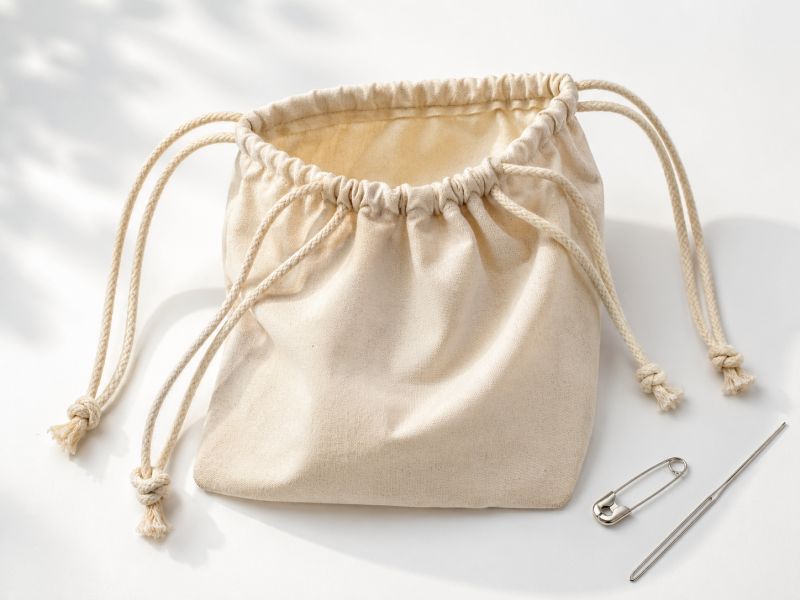
A double drawstring bag looks simple from the outside. Two cords. Two sides. One pull. Done.
But anyone who has worked with real bag samples knows the truth.
If the cord path is wrong, the bag will not close evenly. If the casing is too tight, the cord will drag. If the cord is too thick, the top opening may wrinkle. If the cord is too thin, the bag may feel weak, cheap, or unstable in daily use. A small threading mistake can make a drawstring pouch, gym sack, dust bag, promotional pack, or drawstring backpack feel poorly made.
That is why threading is not just a small finishing step. It is part of the whole product structure.
A double drawstring bag is threaded by inserting one cord from the left opening through both top channels and back out on the left side, then inserting a second cord from the right opening through both channels and back out on the right side. When both cords are pulled outward, the bag closes from both directions. This creates a balanced closure, smoother handling, and better carrying comfort than many single-cord styles.
For personal repair, this can be done with a safety pin, bodkin, paper clip, or cord threader. For custom bag projects, the process should be planned earlier: casing width, cord diameter, seam strength, eyelets, knot space, pull length, and packing method all affect the finished result.
For brands, retailers, and project teams, the real goal is not only “how to put the cord in.” The goal is to make the drawstring system work well after repeated opening, closing, packing, shipping, and real use.
What Is a Double Drawstring Bag and How Does It Work?
A double drawstring bag uses two separate cords that pass through the top casing from opposite directions. Each cord travels around the full opening and exits on the same side where it entered. When both sides are pulled, the opening closes evenly. This structure is common in drawstring backpacks, gift pouches, sports sacks, dust bags, laundry bags, and retail packaging bags.
Structure Details That Matter
A double drawstring system usually includes four basic parts:
| Part | Function | What Can Go Wrong |
|---|---|---|
| Top casing | Holds the cord path | Too narrow, uneven, rough inside |
| Cord | Opens, closes, and sometimes carries weight | Too thick, too thin, too slippery |
| Side opening | Allows cord entry and exit | Poorly finished opening may fray |
| Knot / stopper / eyelet | Secures the cord ends | Weak finishing can loosen or break |
The design works because each cord controls the full opening from one side. When the user pulls both cords, the top edge gathers toward the center. This gives a more balanced closure than a single drawstring pulled from only one direction.
For a small jewelry pouch or soft packaging bag, the structure can stay very light. For a drawstring backpack, the cords may also act as shoulder straps. In that case, the cord path must handle pull force, body movement, and repeated tension.
This is where many low-cost samples fail. They may look acceptable in photos, but the cord may drag, twist, cut into the fabric, or pull unevenly after use. A good double drawstring design should feel smooth, quiet, stable, and easy to reset.
How Do You Thread a Double Drawstring Bag Step by Step?

To thread a double drawstring bag, attach a safety pin or threading tool to the first cord. Insert it through the left casing opening, move it across the front channel, pass around the opposite side, continue through the back channel, and bring it out from the left side again. Repeat the same process from the right side with the second cord.
Step-by-Step Threading Process
Use this method for most soft drawstring pouches, gym sacks, storage bags, and drawstring backpacks.
| Step | Action | Practical Tip |
|---|---|---|
| 1 | Prepare two cords of equal length | Add extra length for knots or shoulder use |
| 2 | Attach tool to cord end | Safety pin or bodkin works well |
| 3 | Insert first cord from left side | Move slowly to avoid twisting |
| 4 | Pass through both casing channels | Cord should exit left side again |
| 5 | Insert second cord from right side | Repeat the same path in reverse |
| 6 | Align both cords | Pull gently until both sides are even |
| 7 | Finish cord ends | Knot, stopper, heat seal, or metal tip |
| 8 | Test opening and closing | Pull 10–20 times before approval |
The key is this: each cord must travel through the full top channel and return to its own side.
If the first cord starts on the left, both ends of that cord should finish on the left. If the second cord starts on the right, both ends should finish on the right. When each side has two cord ends, the bag can close evenly from both directions.
For a drawstring backpack, the lower cord ends may also be fixed to bottom corners through grommets, tabs, loops, or reinforced patches. That changes the finishing step but not the top threading logic.
If a team is preparing a custom sample, it helps to send the factory a simple photo mark-up showing where the cord should enter, exit, knot, and attach. This reduces misunderstanding during first sample making.
Which Tools Are Best for Threading or Re-Threading Drawstring Cords?
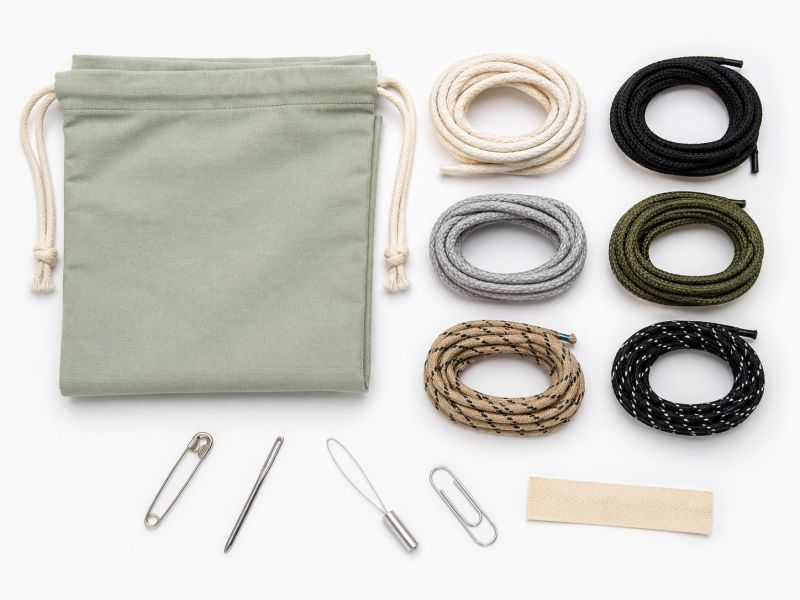
The best tool depends on cord thickness, casing width, and bag material. A safety pin works for most home repairs. A bodkin is smoother for soft fabric channels. A cord threader works well for bulk handling. For factory sampling, proper tools reduce damage, save time, and keep cord placement more consistent across repeated samples.
Tool Comparison
| Tool | Best For | Limit |
|---|---|---|
| Safety pin | Home repair, basic pouch | Can open inside casing |
| Bodkin | Smooth fabric channels | Needs enough channel width |
| Cord threader | Repeated threading work | Not always available at home |
| Paper clip | Emergency repair | Weak for thick cords |
| Tape-wrapped cord end | Flat tape or soft cord | May loosen inside casing |
| Tweezers | Pulling cord near opening | Not useful for long channels |
A safety pin is the easiest tool for most people. It gives enough grip and weight to move through the casing. But it is not always ideal for delicate fabric, satin pouches, fine cotton bags, or narrow channels because the pin may catch the seam allowance.
A bodkin or cord threader is cleaner. It slides through the channel with less snagging. For a factory, this matters because repeated threading work must be fast and stable. If the threading step damages the casing or stretches the opening, the finished bag loses shape before it even reaches packing.
For thicker cords, the tool should not add too much bulk. A large safety pin attached to a thick cord may get stuck in the casing. In that case, a slimmer threader or taped cord end works better.
A good sample should not require force during threading. If it does, the structure may need adjustment before bulk production.
Why Does a Double Drawstring Bag Get Stuck, Twisted, or Uneven?
A double drawstring bag usually gets stuck because the casing is too narrow, the cord is too thick, the inner seam allowance is rough, or the cord has twisted during threading. Uneven cord length often comes from inaccurate cutting, poor alignment after threading, or weak finishing at the knots, eyelets, or lower anchor.
Common Problems and How to Fix Them
| Problem | Likely Cause | Better Solution |
|---|---|---|
| Cord gets stuck | Casing too tight | Increase casing width |
| Cord twists | Cord rotated during threading | Keep cord flat and tension even |
| One side longer | Poor final alignment | Pull and reset before knotting |
| Top opening wrinkles | Cord too thick or casing too narrow | Match cord diameter to fabric weight |
| Cord slips out | Weak knot or no stopper | Add stopper, knot, or bar tack |
| Eyelet pulls loose | Thin fabric or weak reinforcement | Add patch or stronger washer |
A common mistake is choosing a cord by appearance only. A thick rope may look premium, but if the bag is made from lightweight polyester or thin cotton, it may pull too aggressively against the top edge. The result can be wrinkling, dragging, or stress marks.
Another issue is casing construction. If the seam allowance inside the channel is not trimmed or controlled, the cord may catch on small fabric folds. The user feels this as friction. In a sample review, this may seem minor. In repeated daily use, it becomes annoying.
For drawstring backpacks, uneven pull can also come from the bottom attachment. If one lower corner has a stronger pull angle than the other, the bag may sit crooked on the back. This is not only a threading issue. It is a pattern and reinforcement issue.
Before confirming a sample, test the drawstring system like a real user. Open it fully. Close it quickly. Pull one side harder. Wear it on the shoulder. Pack it with weight. Then check if the cord still runs smoothly.
For custom drawstring bag development, Jundong can review cord thickness, casing size, reinforcement, and sample finishing before bulk production. Project details can be sent to info@jundongfactory.com.
Double Drawstring Bag vs Single Drawstring Bag: Which Type Is Better?

A double drawstring bag is usually better when the product needs smoother closing, balanced pull, or shoulder-carry function. A single drawstring bag can work well for simple packaging, dust storage, or low-stress use. The better choice depends on product size, fabric weight, use scene, target price, and expected handling frequency.
Practical Comparison
| Feature | Single Drawstring | Double Drawstring |
|---|---|---|
| Cord quantity | One cord | Two cords |
| Closure balance | Pulls from one side | Pulls from two sides |
| Cost | Usually lower | Slightly higher |
| User experience | Simple | Smoother and more balanced |
| Backpack use | Limited | Better suited |
| Best use | Small pouch, dust bag, gift bag | Gym sack, backpack, retail pouch, event bag |
A single drawstring structure is not “worse.” It is simply more limited. For small pouches, jewelry bags, shoe dust bags, simple cotton sacks, or low-weight packaging, one cord can be enough. It is cost-friendly and easy to produce.
A double drawstring system gives a fuller experience. It closes faster, feels more balanced, and gives users a clear left-right pulling action. This is why it is often used for sports drawstring bags, school activity bags, promotional backpacks, and reusable packaging where the user may open and close the bag many times.
From a cost view, double drawstring bags need more cord and slightly more handling time. If the bag uses grommets, reinforced bottom corners, plastic stoppers, metal tips, or custom rope, the price can increase further. But for products that depend on comfort and repeated use, that extra structure may be worth it.
The best decision starts with use, not price alone. A simple dust bag should not be overbuilt. A drawstring backpack should not be underbuilt.
What Cord Type Should You Use for a Custom Double Drawstring Bag?
The best cord type depends on handfeel, pull strength, fabric weight, washing needs, and brand style. Cotton cord feels natural and soft. Polyester cord is durable and cost-stable. Nylon cord is strong and smooth. Flat tape gives a modern look. Elastic cord works for special functional bags but is not suitable for every drawstring structure.
Cord Material Comparison
| Cord Type | Feel | Best Use | Watch Out For |
|---|---|---|---|
| Cotton cord | Soft, natural | Canvas bags, gift pouches | May absorb moisture |
| Polyester cord | Stable, durable | Sports bags, daily bags | Can feel synthetic if too stiff |
| Nylon cord | Smooth, strong | Outdoor, travel, technical bags | May slip without good stopper |
| PP cord | Cost-friendly | Promotional bags | Lower premium feel |
| Flat tape | Clean, modern | Retail packs, fashion bags | Needs wider casing |
| Elastic cord | Stretchy | Special functional closures | Not ideal for backpack straps |
Cord choice affects far more than appearance.
A cotton drawstring on a canvas pouch creates a natural look. It suits lifestyle packaging, handmade-style retail bags, and soft storage pouches. But for high-moisture environments or repeated washing, cotton may not perform as well as synthetic options.
Polyester is widely used because it balances price, color, strength, and production stability. It works well for drawstring backpacks, event bags, shoe bags, laundry bags, and daily-use drawstring sacks.
Nylon cord is often chosen when strength and smooth pull matter. It pairs well with outdoor bags, sports sacks, and travel storage bags. But because it can be slippery, knot design and cord stopper choice must be checked.
Flat tape can create a more modern look, especially for fashion, retail, and branded packaging. But it needs a wider casing and careful threading so the tape does not fold inside the channel.
For brand projects, cord should be approved together with fabric, lining, logo method, and packing style. These details should not be treated separately.
How Long Should the Cords Be for a Double Drawstring Bag?
Cord length should be based on bag width, top channel path, knot allowance, carrying style, and lower attachment method. For a simple pouch, each cord usually needs to travel around the full top opening plus extra length for knots. For a drawstring backpack, the cord must also be long enough to work as shoulder straps.
Practical Cord Length Logic
There is no single fixed cord length that works for every double drawstring bag. The right length depends on the structure.
A simple drawstring pouch only needs cord for the top closure. A drawstring backpack needs cord for the top closure and shoulder straps. A laundry bag may need a longer pull length for easier handling. A luxury pouch may need shorter, cleaner cord ends to avoid a messy look.
A basic formula for a pouch is:
Cord length = full top casing path + knot allowance + pull allowance
For a backpack style:
Cord length = top casing path + shoulder strap path + bottom fixing allowance + adjustment space
| Bag Type | Cord Length Focus | Extra Consideration |
|---|---|---|
| Small pouch | Clean closure | Short knots, neat finish |
| Shoe dust bag | Easy open/close | Soft cord, smooth casing |
| Gym sack | Shoulder comfort | Strong cord and reinforced bottom |
| Laundry bag | Wide opening | Longer pull space |
| Gift bag | Appearance | Decorative ends or ribbon |
| Travel pouch | Repeated use | Anti-fray finish |
During sample approval, cord length should be tested with the bag both empty and filled. Some bags look fine when flat but become too tight after packing. Others have long dangling cords that look messy after closing.
If the bag will be used by children, cord length and safety details need extra care. Long loose cords may not be suitable for all products or regions. In those cases, shorter pulls, flat tape, breakaway details, or adjusted structures may be considered.
What Should Teams Check in a Factory Sample Before Bulk Production?

Before approving a double drawstring bag sample, check cord length, pull smoothness, casing width, seam strength, knot position, stopper option, eyelet quality, lower reinforcement, fabric reaction, logo placement, packing shape, and sample-to-bulk repeatability. A drawstring system should be tested by use, not only judged by appearance.
Sample Review Checklist
| Check Item | Why It Matters | Pass Standard |
|---|---|---|
| Cord length | Affects comfort and closure | Even on both sides |
| Pull smoothness | Affects daily use | Opens and closes without force |
| Casing width | Controls friction | Cord moves freely |
| Stitching | Holds channel shape | No skipped stitches |
| Eyelet / grommet | Handles tension | Firm, no fabric tearing |
| Bottom corner | Supports backpack pull | Reinforced and balanced |
| Knot / stopper | Prevents slipping | Secure and neat |
| Logo position | Protects brand look | Not distorted when closed |
| Packing | Affects shape on arrival | No cord tangle or crease issue |
Sample review should include movement. Many teams only look at the front, back, logo, color, and measurement. Those are necessary, but not enough.
The drawstring system is an active part. It must move. That means it should be tested under repeated opening and closing. For a drawstring backpack, it should also be worn and loaded. For a pouch, it should be filled and tied. For retail packaging, it should be opened and closed the same way an end user would handle it.
Logo placement deserves special attention. A logo that looks centered when the bag is flat may shift or wrinkle when the drawstring closes. If the brand mark sits too close to the top casing, gathering may distort it. Good sample planning places the logo where it remains visible after real closure.
For project teams preparing a new drawstring bag, send size, material, target use, logo artwork, cord preference, packing method, and quantity plan to info@jundongfactory.com for a sample review.
How Can a Factory Improve the Threading Process for Custom Drawstring Bags?
A professional bag factory improves double drawstring threading by planning casing size, cord diameter, seam tolerance, reinforcement, cord finishing, QC checks, and packing method before production begins. The best result comes from matching structure, material, and use scene instead of treating the cord as a last-minute accessory.
What a Strong Production Process Controls
| Production Area | Control Detail | Result |
|---|---|---|
| Pattern | Correct casing width and opening position | Smooth cord movement |
| Sewing | Even channel and clean seam allowance | Less snagging |
| Cord cutting | Accurate length control | Balanced pull |
| Reinforcement | Strong eyelets, tabs, or bottom patches | Better durability |
| Finishing | Heat seal, knots, tips, or stoppers | Cleaner handling |
| Inspection | Pull test and visual check | Fewer use complaints |
| Packing | Cord arranged before packing | Better arrival condition |
Threading should never be seen as a small final task after sewing. In reality, the threading result is built into the pattern from the start.
If the top casing is too narrow, no worker can make the cord feel smooth. If the opening is placed incorrectly, the cord angle will be awkward. If the fabric is too soft and the cord is too heavy, the top may collapse. If the bottom corner lacks reinforcement, a drawstring backpack may fail during use.
A reliable factory will check these details during sample development, not after mass production starts. For example, a thicker rope may require a wider casing and stronger eyelets. A flat tape may require careful alignment. A lightweight pouch may need a softer cord and smaller knots.
For Jundong, custom drawstring bag development can include fabric selection, cord matching, logo placement, sample making, packing details, and repeated structure checking. With 20+ years of bag development and production experience, the team can support drawstring bags for events, retail, travel, gifts, sports, packaging, and brand merchandise.
FAQs About Threading Double Drawstring Bags
1. Do double drawstring bags need two separate cords?
Yes, most double drawstring bags use two separate cords. Each cord passes through the full top casing and exits on the same side where it entered. This creates two pull sides. When both cords are pulled outward, the bag closes evenly.
Some special designs may use one continuous cord arranged in a different path, but that is less common. For most drawstring backpacks, gift pouches, sports bags, and reusable sacks, two separate cords are easier to assemble, adjust, replace, and repair.
For bulk production, two separate cords also make inspection clearer. The factory can check left cord length, right cord length, knots, stoppers, and lower attachment separately.
2. Is a double drawstring bag stronger than a single drawstring bag?
A double drawstring bag is not always stronger by default, but it often gives better pull balance. Strength depends on fabric, stitching, cord type, eyelets, reinforcement, and how the cord is fixed.
For a small dust bag, single drawstring construction may be strong enough. For a drawstring backpack or gym sack, double drawstring construction is usually better because the load is shared across two sides and can also support shoulder carry.
If strength matters, check the bottom corners, grommets, bar tacks, and cord quality. These areas usually fail before the top casing does.
3. Can I re-thread a drawstring bag without a safety pin?
Yes. You can use a bodkin, cord threader, paper clip, hairpin, thin wire, or a taped cord end. The tool only needs to be slim enough to pass through the casing and firm enough to guide the cord.
For narrow channels, avoid bulky tools. They may get stuck or damage the seam. For thick cords, wrap the cord end tightly with tape to create a smooth tip before pushing it through.
If re-threading feels too hard, the cord may be too thick, the casing may be twisted, or the inner seam may be blocking the path.
4. What is the best cord for a custom drawstring backpack?
For drawstring backpacks, polyester or nylon cord is often a strong choice because both can handle repeated pull and shoulder use. Polyester gives stable cost and broad color options. Nylon gives smoother pull and higher strength.
Cotton cord can work for softer lifestyle bags, but it may not be ideal for heavy gym sacks or outdoor use. Flat tape can feel more comfortable on the shoulder, but the bag pattern must allow enough casing width.
The best cord should be confirmed with the actual fabric and sample, not chosen from a swatch alone.
5. How long does it take to thread a double drawstring bag?
For one simple bag, threading may take only a few minutes with a safety pin or threader. In factory production, the time depends on bag size, casing width, cord type, worker skill, finishing method, and whether the cord also works as a shoulder strap.
A small pouch is faster. A drawstring backpack with bottom grommets, knots, stoppers, or reinforced tabs takes longer.
If a design is prepared well, threading is smooth. If the casing is tight or the cord is poorly matched, the process slows down and quality risk rises.
6. Why does one side of my drawstring bag pull longer than the other?
Uneven pull usually happens when the two cords were cut at different lengths, not aligned before knotting, or pulled unevenly after threading. It may also happen if one cord is twisted or stuck inside the casing.
To fix it, open the bag fully, pull both cords gently, adjust the lengths on each side, and retie the knots. If the problem returns, the casing may be too tight or the cord surface may have too much friction.
For production samples, uneven pull should be corrected before approval because it affects both appearance and user experience.
7. Are cotton or polyester cords better for bulk drawstring bags?
Cotton cord gives a softer, more natural look. It works well for canvas pouches, gift bags, lifestyle packaging, and casual drawstring sacks. Polyester cord is usually more stable for repeated use, color matching, cost control, and larger production runs.
For sports, school, event, and daily-use drawstring bags, polyester often performs better. For premium natural-style packaging, cotton may look warmer and more tactile.
The best choice depends on the product role. A retail pouch and a gym sack should not always use the same cord.
8. What details should be sent for a custom drawstring bag sample?
Send the bag size, fabric choice, lining needs, cord type, cord color, logo file, logo position, closure style, eyelet or stopper preference, target use, packing method, and expected quantity.
Reference photos also help, but they should not replace technical details. If the bag must work as a backpack, include strap length expectations and bottom attachment style.
Clear sample details reduce back-and-forth communication and help the factory prepare a more accurate first sample.
9. How does cord thickness affect the final price?
Cord thickness affects material cost, casing size, handling time, and finishing method. A thicker cord may require a wider casing, larger eyelets, stronger reinforcement, and more careful packing. These changes may increase cost.
However, a thicker cord is not always better. If the bag is lightweight, a heavy cord may feel awkward and distort the top edge. If the bag is built for daily use, a stronger cord may improve value.
Price should be reviewed together with structure, not cord alone.
10. Can Jundong customize double drawstring bags with logo, color, size, and packaging?
Yes. Jundong can support custom drawstring bags with different fabrics, cord types, colors, logo methods, sizes, packing styles, and private label details. Options may include canvas, cotton, polyester, nylon, PU, PVC, neoprene, mesh, and other materials depending on the project.
Logo methods may include printing, woven labels, rubber patches, embroidery, heat transfer, and other finishes. Packaging can be adjusted for retail, event, gift, travel, or promotional use.
To start a custom drawstring bag sample, send your design idea, size, material preference, logo file, and quantity plan to info@jundongfactory.com.