 Skip to content
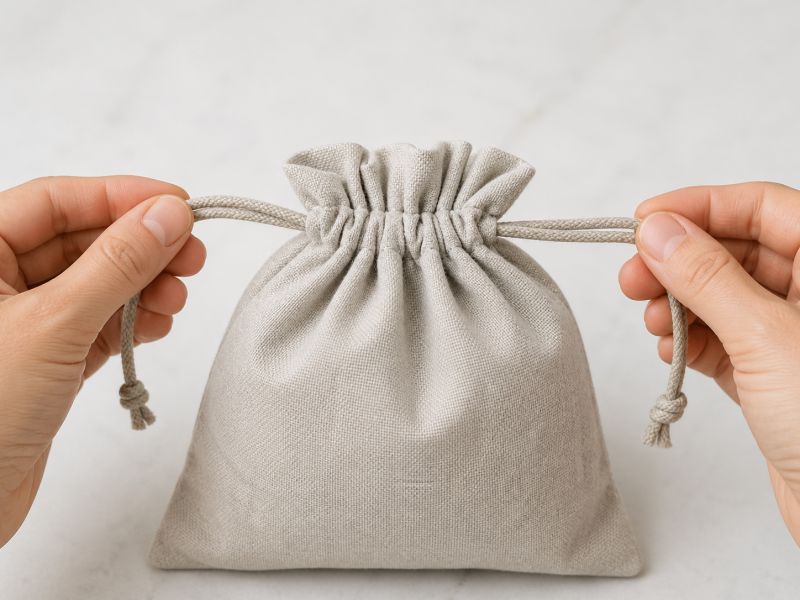
A drawstring bag looks simple at first glance. Two fabric panels, a cord channel, a pull string, and a closed bottom. Easy, right?
Not always.
The moment a brand wants a drawstring bag for product packaging, events, retail sets, gym use, school kits, travel storage, beauty pouches, or brand merchandise, small details start to matter. The fabric must hold its shape. The seams must stay closed. The drawstring must slide smoothly. The logo must sit in the right position. The bag must look clean after packing, shipping, handling, and repeated use.
That is why “how to make a drawstring bag without sewing” is more than a craft topic. It is also a useful way to test an idea before a proper sample is made.
A no-sew drawstring bag can help teams check size, shape, fabric feel, logo placement, closure style, and packaging use at an early stage. It is fast. It is low cost. It helps turn a rough idea into something people can touch. But it also has limits. Glue, bonding tape, and knots cannot fully replace stitching when the bag needs strength, repeat use, retail quality, or bulk consistency.
A drawstring bag can be made without sewing by cutting fabric, folding the edges, bonding the side seams with fabric glue or heat tape, creating a top cord channel, and inserting a drawstring. This method works well for quick samples, gift bags, light packaging, and early design testing. For daily use, branded projects, or bulk orders, sewn construction is usually more durable, cleaner, and easier to control in repeat production.
This guide walks through the practical side of no-sew drawstring bags. It covers materials, methods, timing, strength, cost, sample preparation, and the moment when a DIY sample should move into professional development.
What Is a No-Sew Drawstring Bag?
A no-sew drawstring bag is a simple fabric bag made without stitching. Instead of sewn seams, it uses fabric glue, heat bonding tape, knotting, folding, pre-cut fabric, or adhesive methods to close the sides and form the drawstring channel. It works best for light-duty use, quick samples, craft projects, gift packaging, and early shape testing before a more durable sample is developed.
A no-sew drawstring bag is not one fixed product. It can be a small jewelry pouch, a cotton gift bag, a non-woven event giveaway bag, a satin beauty pouch, a felt craft bag, or a quick mockup for a custom project.
The shared idea is simple: create a pouch that closes with a cord, without using a needle, sewing machine, or stitched seam.
For home use, this method is attractive because it is easy to start. For product teams, it has another value. It can help test ideas quickly before spending time and money on a formal prototype.
For example, a cosmetic brand may want a soft drawstring pouch for a gift set. Before making a factory sample, the team can make a no-sew version to check whether the pouch is tall enough, whether the bottle set fits, and whether the logo should sit in the center or lower third.
An event company may want a simple bag for badges, gifts, and small items. A no-sew mockup can show whether the size feels right in hand.
A retail brand may want a dust bag for shoes, bags, candles, or accessories. A no-sew sample can help compare flat size, opening width, cord thickness, and fabric transparency.
But here is the part many people miss.
No-sew construction is useful for concept testing, not always for final product use. A glued seam may look fine on day one. After loading, pulling, folding, shipping, or washing, it may fail. That does not mean the no-sew method is bad. It means the method should match the job.
| Use Case | No-Sew Method Works? | Better Production Choice |
|---|---|---|
| Craft project | Yes | No-sew is fine |
| Light gift pouch | Yes | Glue or heat tape may work |
| Early size mockup | Yes | No-sew is useful |
| Retail packaging pouch | Sometimes | Stitching is usually cleaner |
| Gym drawstring backpack | No | Sewn seams are better |
| Heavy product storage | No | Reinforced seams needed |
| Repeat brand orders | Limited | Factory sample recommended |
A no-sew drawstring bag is a smart starting tool. It lets teams move fast. But when the bag needs to represent a brand, support weight, pass internal review, or ship in bulk, the structure must be treated more seriously.
Which Materials Work Best for a No-Sew Drawstring Bag?

The best materials for a no-sew drawstring bag are fabrics that fold cleanly, bond well, and do not fray too much. Felt, non-woven fabric, cotton, lightweight canvas, polyester, satin, and microfiber are common choices. Felt and non-woven fabric are easiest for quick samples. Cotton, canvas, polyester, and satin are better when the sample needs to look closer to a branded product.
Material is the part that decides whether a no-sew bag feels “quick but useful” or “messy and temporary.”
Some fabrics are friendly to glue. Some are not. Some fold neatly. Others spring back. Some fray at the cut edge. Others stay clean without edge finishing.
For DIY use, felt is one of the easiest options. It does not fray much, feels stable, and holds shape well. The downside is that it does not always look refined enough for brand packaging unless the product has a playful or craft style.
Non-woven fabric is also common. It is low cost, easy to cut, and widely used for simple promotional bags. It can work for quick mockups, event samples, and test pouches. But it may feel less premium than cotton, canvas, or satin.
Cotton is more natural and familiar. It works well for gift bags, bakery packaging, lifestyle goods, candles, accessories, and eco-minded product sets. It can fray, so folded edges or bonding tape are helpful.
Canvas gives more structure. It feels stronger and more retail-ready. But heavier canvas is harder to bond without stitching. For no-sew tests, lightweight canvas is easier than thick canvas.
Polyester is practical. It can be smooth, light, and easy to print. It is common in drawstring backpacks, sports bags, and event bags. However, some polyester fabrics need heat sealing or proper edge treatment to avoid loose fibers.
Satin gives a soft and polished look. It is often used for jewelry, beauty, fragrance, and gift packaging pouches. It can be slippery, so glue placement and folding accuracy matter.
| Material | Best For | No-Sew Difficulty | Visual Feel |
|---|---|---|---|
| Felt | Craft samples, kids’ projects, early mockups | Easy | Soft, playful |
| Non-woven | Event bags, giveaways, simple packaging | Easy | Simple, practical |
| Cotton | Gift bags, lifestyle packaging, retail pouches | Medium | Natural, clean |
| Lightweight canvas | Branded pouches, durable samples | Medium | Strong, structured |
| Polyester | Event bags, sports pouches, travel storage | Medium | Practical, smooth |
| Satin | Beauty, jewelry, premium gift packaging | Medium to hard | Soft, polished |
| Microfiber | Electronics, eyewear, delicate goods | Medium | Smooth, protective |
| PU | Fashion pouches, premium-style samples | Hard | Sleek, structured |
A strong material decision starts with the real use scene.
Ask:
- Will the bag carry weight?
- Will it be washed?
- Will it protect a product?
- Will it be displayed in retail?
- Will it be packed flat or filled?
- Does the brand need a natural, sporty, luxury, or technical feel?
- Does the surface need printing, embroidery, heat transfer, or a woven label?
For early concept testing, choose a material that is easy to handle. For a custom project, choose a material that behaves like the final product.
That small difference saves time later.
How Do You Make a Drawstring Bag Without Sewing Step by Step?
To make a drawstring bag without sewing, cut a fabric rectangle, fold and bond the side seams, leave the top area open for the cord channel, fold the top edge down, bond the channel, insert a cord with a safety pin or bodkin, then pull both ends to close the bag. For a cleaner sample, press each fold before bonding and let the adhesive set fully before use.
A no-sew drawstring bag can be made in several ways, but the simplest version uses one piece of fabric.
Here is a practical method.
Basic Materials Needed
| Item | Purpose |
|---|---|
| Fabric | Main bag body |
| Fabric glue or heat bonding tape | Replaces stitching |
| Cord, ribbon, or rope | Drawstring closure |
| Scissors or rotary cutter | Clean cutting |
| Ruler or measuring tape | Size control |
| Iron | Needed for heat bonding tape |
| Safety pin or cord threader | Pulls cord through channel |
| Clips | Holds edges while bonding |
Step 1: Decide the Finished Size
Start with the product or use scene.
A jewelry pouch may only need 10 × 15 cm.
A gift pouch may need 20 × 30 cm.
A shoe dust bag may need 35 × 45 cm.
A gym-style drawstring backpack may need 35 × 45 cm or larger.
Add extra allowance for side bonding and the top cord channel.
A simple size formula:
| Area | Suggested Allowance |
|---|---|
| Side bonding | 1–2 cm each side |
| Bottom bonding | 1–2 cm |
| Top drawstring channel | 4–6 cm |
| Safety space | 1–2 cm |
Step 2: Cut the Fabric
Cut a rectangle if you want to fold the bottom.
Cut two matching panels if you want a front and back piece.
A folded-bottom design uses fewer seams and is easier for no-sew making. It also reduces one weak area.
Step 3: Fold and Press the Edges
Fold the side edges inward. Press them with an iron if the fabric allows heat. This makes the final bag look cleaner.
For slippery fabrics like satin, use clips instead of pins if you do not want holes.
Step 4: Bond the Side Seams
Apply fabric glue or heat bonding tape along the side edges. Keep the adhesive line straight and even.
Do not apply glue too close to the drawstring channel opening. The cord needs space to move.
Step 5: Create the Top Channel
Fold the top edge down to form a tunnel for the cord. The channel must be wide enough for smooth movement.
A thin ribbon may need only 1.5–2 cm.
A thick cotton cord may need 3 cm or more.
Bond only the lower edge of the fold. Keep both side openings clear so the cord can pass through.
Step 6: Insert the Cord
Attach the cord to a safety pin. Push it through the channel. Pull it around the top and bring both ends out.
For a double-drawstring bag, thread one cord from the left and another from the right. This gives better closure and a more balanced look.
Step 7: Test the Closure
Pull the cord several times. Check whether the channel catches, twists, or pulls apart.
Then place the intended item inside. This is where many rough samples reveal hidden problems. The bag may be too short. The opening may be too tight. The fabric may wrinkle around the logo. The cord may feel too thin.
That is the value of a quick sample. It shows problems early.
Step 8: Record the Details
If the sample feels right, record:
- Flat size
- Filled size
- Fabric type
- Cord length
- Cord thickness
- Logo size
- Logo position
- Closure style
- Packing method
For custom drawstring bag development, this information helps Jundong review the project faster and suggest practical next steps. For sample support, send your size, material idea, logo file, quantity estimate, and usage scene to info@jundongfactory.com.
Fabric Glue vs Heat Bonding Tape: Which No-Sew Method Is Better?

Fabric glue is better for beginners, soft mockups, and irregular shapes because it is easy to apply. Heat bonding tape is better when the bag needs flatter seams, cleaner edges, and a neater appearance. Glue is flexible but can dry unevenly. Heat tape looks cleaner but needs suitable fabric and careful temperature control. For long-term use, stitching is still stronger.
Both methods can make a no-sew drawstring bag. The better choice depends on what the sample is meant to prove.
Fabric glue is forgiving. It works on many fabrics and does not require much equipment. It is good for quick pouches, visual samples, and small craft runs. The downside is drying time. If the glue is too thick, it can leave stiff marks. If too thin, the seam may open.
Heat bonding tape creates a cleaner finish. It sits between folded fabric layers and melts under heat. This can make the seam look more like a finished edge. But it needs pressure, heat, and fabric that can tolerate ironing. Satin, PU, coated fabrics, and some synthetics may be sensitive to heat.
Here is a practical comparison.
| Method | Best For | Strength | Appearance | Main Risk |
|---|---|---|---|---|
| Fabric glue | Quick samples, soft pouches | Medium | Medium | Stiff marks, drying time |
| Heat bonding tape | Neat mockups, flat seams | Medium | Cleaner | Heat damage, weak bond if under-heated |
| Knotting | Simple cloth pouches | Low to medium | Casual | Bulky corners |
| Adhesive strips | Temporary samples | Low | Clean at first | Peeling |
| Stitching | Final products, bulk use | High | Professional | Requires equipment |
For a product team, the best use of glue or tape is not to fake a final product. It is to check shape, use, and fit.
If the no-sew sample will be shown to internal teams, photographed, or used for a concept review, heat bonding tape may look better. If speed matters more, fabric glue is easier.
For production, however, most drawstring bags benefit from sewing. A stitched seam can handle pulling, folding, packing, and repeated use far better than adhesive.
The honest rule is simple:
Use no-sew methods to test the idea. Use sewn construction to protect the product experience.
How Long Does It Take to Make a No-Sew Drawstring Bag?
A simple no-sew drawstring bag usually takes 15–40 minutes to assemble, but the full process can take longer because glue or bonding areas need time to set. Small felt or non-woven pouches are fastest. Cotton, canvas, satin, double-channel closures, logo placement, and lined designs take more time because they require cleaner measuring, folding, pressing, and testing.
Time depends less on the bag name and more on the number of decisions involved.
A small plain pouch is quick. Cut, fold, glue, thread the cord, done. A branded sample takes longer because the team needs to check proportion, surface, and usability.
A common mistake is counting only assembly time. For no-sew bags, setting time matters. A glued seam may need several hours before it reaches usable strength. If someone tests the bag too early, the seam may open even if the method would have worked after full curing.
| Bag Type | Active Making Time | Extra Waiting Time | Notes |
|---|---|---|---|
| Felt craft pouch | 15–25 min | Short | Easy to cut and bond |
| Non-woven gift bag | 20–30 min | Medium | Good for event mockups |
| Cotton pouch | 25–40 min | Medium | May need pressed folds |
| Satin pouch | 30–50 min | Medium | Slippery fabric needs care |
| Canvas pouch | 35–60 min | Medium to long | Heavier fabric is harder to bond |
| Logo test sample | 40–90 min | Depends | Placement review takes time |
For teams developing a custom bag, time should also include decision review.
Does the product fit?
Does the bag close well?
Does the logo look too high or too low?
Does the cord feel cheap?
Does the pouch still look good when filled?
Does the material wrinkle after tightening?
These checks are more valuable than rushing the sample.
A drawstring bag is often judged in motion: opening, filling, tightening, holding, hanging, and packing. A sample that looks fine on a table may not work well in use. That is why even a quick no-sew sample should be tested with real items.
Is a No-Sew Drawstring Bag Strong Enough for Daily Use?

A no-sew drawstring bag can be strong enough for light packaging, gifts, craft use, and temporary storage, but it is usually not the best option for daily carry, sports use, travel, heavy products, or repeated retail handling. The weak areas are side seams, bottom corners, cord channels, and adhesive strength. For regular use, sewn and reinforced construction performs better.
Strength is not only about whether the bag holds together once. It is about whether it keeps working after pulling, filling, tightening, folding, and moving.
The most common failure areas are easy to predict.
The side seam opens because adhesive does not handle tension well.
The bottom corner separates because weight gathers there.
The cord channel tears because the drawstring pulls against a weak fold.
The fabric frays because the cut edge was not finished.
The logo area wrinkles because the material stretches when closed.
For a small gift pouch, these issues may not matter. For a drawstring backpack, they matter immediately.
A bag used for sportswear, shoes, school kits, event merchandise, or retail products must handle more than one gentle use. It may be packed in cartons, compressed during shipping, pulled open many times, or carried by end users.
That is where factory construction changes the result.
A stronger drawstring bag may need:
- Stitched side seams
- Reinforced bottom corners
- Double-folded cord channel
- Bar tack stitching at stress areas
- Overlocked or bound inner edges
- Thicker cord
- Metal or plastic cord tips
- Washable fabric
- Printed or woven branding that survives handling
| Requirement | No-Sew Bag | Sewn Bag |
|---|---|---|
| Light gift use | Good | Good |
| Product packaging | Sometimes | Better |
| Daily carry | Weak | Better |
| Heavy items | Not ideal | Better |
| Sports use | Not ideal | Better |
| Retail quality | Limited | Better |
| Repeat orders | Hard to control | Easier to control |
No-sew bags are useful. They are not useless. They just should not be asked to do the work of a reinforced product.
For brands planning regular use, retail display, or repeat programs, Jundong can help evaluate fabric, seam structure, cord channel, logo method, and packing style before a formal sample is made.
When Should Brands Move from DIY No-Sew Samples to Factory Samples?
Brands should move from a DIY no-sew sample to a factory sample when the bag needs accurate sizing, stable stitching, custom fabric, logo testing, retail packaging, stronger seams, cost evaluation, or bulk repeatability. A no-sew sample is useful for early idea testing, but a factory sample is needed when the product must be priced, reviewed, approved, and produced consistently.
The best moment to move from DIY to factory development is not “after the idea is perfect.”
It is when the unknowns become practical.
A no-sew sample can show size and shape. It cannot fully confirm production cost, seam durability, fabric availability, logo performance, packing efficiency, or repeat production stability.
For example, a cotton drawstring pouch may look simple. But the final cost can shift depending on fabric weight, cutting loss, printing method, cord type, and packing method. A satin pouch may look elegant, but the logo method may need testing because the surface is slippery. A canvas pouch may feel strong, but the thick folded channel may become bulky.
A factory sample helps turn the idea into a controlled product.
Move to factory sampling when you need:
| Trigger | Why It Matters |
|---|---|
| Custom logo | Placement, size, and process need testing |
| Specific material | Fabric weight and finish affect cost and look |
| Exact size | Bulk cutting requires clear measurements |
| Product fit | Filled shape may differ from flat size |
| Retail packaging | Folding, barcode, label, and carton packing matter |
| Repeat order plan | Details must be recorded for consistency |
| Stronger use | Seam and cord channel need production testing |
A strong sample process does not only produce one bag. It produces a record that can be repeated.
That record may include fabric reference, color, logo file, logo size, stitch type, cord length, packing style, carton marks, and inspection notes.
Jundong has sales, development, design, sampling, production, and quality teams, which helps turn a rough bag idea into a sample that can be reviewed from both visual and production sides. For custom drawstring bag samples, send your project details to info@jundongfactory.com.
What Affects the Price of Custom Drawstring Bags?
The price of custom drawstring bags depends on fabric, size, fabric weight, logo process, cord type, lining, pocket structure, order quantity, packing method, inspection needs, and sample complexity. Simple non-woven or polyester bags usually cost less. Cotton, canvas, satin, RPET, PU, lined designs, custom labels, and detailed printing usually increase cost because they require more material control and handling time.
Price is not only about one bag. It is about how the bag is made, handled, checked, packed, and repeated.
A drawstring bag with a single-color print on non-woven fabric is very different from a cotton pouch with a woven label, double drawstring, inside pocket, retail hangtag, and custom carton packing.
Both are drawstring bags. They do not belong in the same cost discussion.
Main Cost Factors
| Factor | Cost Impact | What to Decide Early |
|---|---|---|
| Fabric type | High | Cotton, canvas, polyester, satin, RPET, PU |
| Fabric weight | Medium to high | Light, medium, heavy |
| Bag size | High | Flat size and filled size |
| Logo method | Medium to high | Print, embroidery, patch, woven label |
| Cord type | Medium | Cotton, polyester, ribbon, rope |
| Structure | Medium | Single layer, lined, pocket, double channel |
| Quantity | High | Small run or bulk order |
| Packing | Medium | OPP bag, carton, retail pack, barcode |
| Inspection | Medium | Standard or stricter checks |
| Sample rounds | Medium | Simple sample or multiple revisions |
The lowest unit cost usually comes from simple structure, easy material, common cord, standard packing, and higher quantity. But lowest cost is not always the smartest choice.
A cheap cord can make the whole bag feel weak.
A thin fabric can make the logo show through badly.
A poor seam can create complaints later.
An unclear packing method can slow down warehouse handling.
For importers and brand teams, the better target is not “the cheapest drawstring bag.” It is the right cost for the intended use.
A gym bag needs strength.
A jewelry pouch needs surface feel.
A travel laundry bag needs washable fabric.
A gift pouch needs clean presentation.
A school event bag needs cost control.
A premium product pouch needs better touch and closure.
When asking for a quote, include the use scene, not only the size. A good factory can often suggest a more suitable fabric or structure before cost is locked.
What Should You Send for a Custom Drawstring Bag Sample?

To request a custom drawstring bag sample, send the target size, fabric idea, reference photos, logo file, color reference, cord style, use scene, packing method, expected quantity, and any product that must fit inside. Clear information helps the factory judge feasibility, suggest better materials, estimate cost, and reduce sample revisions before bulk production.
A clear sample brief saves more time than most people expect.
Many sample delays happen because the first request is too vague. “We need a cotton drawstring bag with logo” is a start, but it is not enough for accurate development.
Better information gives the sample team a clear target.
Custom Sample Brief Checklist
| Information | Example |
|---|---|
| Bag use | Gift pouch for skincare set |
| Finished size | 20 × 30 cm |
| Product size | Bottle set, 18 cm tall |
| Fabric | 8 oz cotton or similar |
| Color | Natural cotton, Pantone logo |
| Logo file | AI, PDF, SVG, or high-resolution PNG |
| Logo size | 8 cm wide, centered |
| Cord | Cotton cord, natural color |
| Closure | Single or double drawstring |
| Packing | One piece per OPP bag |
| Quantity estimate | 500 / 1,000 / 3,000 pcs |
| Target delivery | Needed before event date |
| Quality focus | Clean print, soft handfeel, stable seam |
The use scene is especially helpful.
A drawstring bag for candles needs a different fabric feel than one for sports shoes. A pouch for cosmetics needs cleaner surface handling than one for event giveaways. A dust bag for leather goods may need a soft inner surface to prevent scratches. A cooler-style drawstring bag may require insulation, not just fabric.
Logo files also matter. Vector files are best for clean printing and scaling. If only a picture is available, the logo may need redrawing before production.
For best results, send reference images too. They help communicate style, softness, opening shape, and finishing expectations.
A strong brief does not make the project complicated. It makes the project clearer.
For sample review, you can email your size, logo file, quantity estimate, and product use to info@jundongfactory.com.
FAQs About Making and Customizing Drawstring Bags Without Sewing
1. Can you make a drawstring bag without a sewing machine?
Yes. A drawstring bag can be made without a sewing machine by using fabric glue, heat bonding tape, knotting, or folded adhesive seams. This works best for light pouches, craft bags, gift packaging, and early shape samples. For daily carry or bulk custom projects, sewn seams are usually stronger and more consistent.
A sewing machine is not required for a simple no-sew pouch. Many people make drawstring bags with only fabric, glue, scissors, and cord. The method is useful when speed matters or when the goal is to test a size idea.
However, the absence of sewing changes the strength of the bag. Adhesive seams do not handle pulling as well as stitches. If the bag will carry shoes, books, tools, sportswear, or heavier products, a sewn structure is safer.
For brands, the no-sew method is best viewed as a concept tool. It helps: Is the size right? Does the closure work? Does the product fit? Does the bag style match the brand? Once those basics are clear, a factory-made sample gives a more reliable result.
2. What is the easiest fabric for a no-sew drawstring bag?
Felt and non-woven fabric are usually the easiest materials for a no-sew drawstring bag because they cut easily, bond quickly, and do not fray as much as many woven fabrics. Cotton is also a good choice if the edges are folded cleanly. Satin and canvas can look better, but they require more careful handling.
Felt is forgiving. It holds shape, does not slide much, and can be cut without much edge finishing. Non-woven fabric is also easy for low-cost samples and simple event bags.
Cotton gives a more natural feel, but it can fray. That means the folds should be clean and the bonded areas wide enough. Canvas feels stronger, but thick canvas can resist glue and create bulky corners. Satin looks polished, but it slips during cutting and bonding.
The easiest fabric is not always the best final fabric. It depends on whether the goal is quick testing, gift presentation, retail packaging, or repeated use.
3. Do no-sew drawstring bags last long?
No-sew drawstring bags can last for light use, but they are not usually built for long-term daily handling. Their lifespan depends on fabric type, adhesive quality, seam width, drying time, load weight, and how often the drawstring is pulled. For repeated use, stitching and reinforced stress areas are better.
A no-sew bag may last a long time if it only holds lightweight items and is not opened often. For example, a jewelry pouch or small gift bag may work well.
But a bag used for sportswear, travel storage, school kits, or product transport faces more stress. The side seams and top channel take repeated pulling. Glue can weaken over time, especially with moisture, heat, washing, or heavy loading.
If durability matters, a sewn sample should be made before bulk production. This gives the team a chance to test seam strength, cord movement, fabric thickness, and packing behavior.
4. Is fabric glue washable on drawstring bags?
Some fabric glues are washable after full curing, but not all of them perform the same. Washability depends on the glue formula, fabric type, curing time, water temperature, and washing method. For products that must be washable, sewn seams are usually a safer choice than relying only on glue.
Always check the glue label before washing. Some fabric glues need 24–72 hours to cure. Washing too early can weaken the bond.
Even washable glue may become stiff or uneven on certain fabrics. It may also affect the look of thin cotton, satin, or light polyester. For a branded drawstring bag that users may wash, test the material and bonding method before approval.
For retail or repeat orders, stitching gives more predictable results. Glue may still be used for small decorative areas, but not as the main strength structure.
5. Are no-sew drawstring bags good for packaging?
No-sew drawstring bags can be good for light packaging, sample mockups, small gifts, and short-term presentation. They are less suitable when the packaging must look premium, hold heavier products, survive shipping, or be repeated across bulk orders. For retail packaging, sewn seams and controlled finishing usually give a cleaner result.
Packaging is not only about holding an item. It affects the way people feel when they receive the product.
A no-sew pouch may work for a handmade gift or early display test. But retail packaging needs consistency. Every pouch should have the same size, same logo placement, same closure feel, and same appearance after filling.
If a drawstring bag is part of the product value, the finishing must match the brand level. That usually means cleaner seams, better cord, stable fabric, and controlled packing.
6. What size should a drawstring bag sample be?
A drawstring bag sample should be sized around the item it will hold, with extra space for easy loading, closure, and shape. A good starting rule is to add 2–5 cm around small products and more space for bulky items. Flat size, filled size, and opening width should all be checked before approval.
Flat measurements can be misleading. A bag that measures 20 × 30 cm flat may feel smaller once it holds a thick product. The opening also becomes narrower when the cord is pulled.
For product packaging, place the real item inside the sample. Check whether it slides in easily, whether the top can close, and whether the filled shape looks attractive.
For custom production, send both product size and preferred bag size. This allows the factory to suggest a practical adjustment before sample making.
7. How do brands add a logo to drawstring bags?
Brands can add logos to drawstring bags through screen printing, heat transfer, embroidery, woven labels, rubber patches, PU patches, or custom hangtags. The best method depends on fabric, logo detail, order quantity, desired texture, and budget. For cotton and canvas, printing and woven labels are common. For premium bags, patches or embroidery may work better.
Logo placement should be tested before final approval. A logo that looks centered on a flat bag may shift when the bag is filled or tightened.
The fabric surface also matters. Cotton absorbs ink differently than polyester. Satin may need a more careful print method. Canvas can handle stronger branding but may require thicker ink coverage.
For a cleaner result, send a vector logo file and confirm logo size, color, and position during sampling.
8. What is the best drawstring bag type for events?
The best drawstring bag for events is usually lightweight, easy to carry, cost-controlled, and clear in branding. Non-woven, polyester, and lightweight cotton are common choices. For sports events, polyester drawstring backpacks work well. For conferences or gift sets, cotton or canvas pouches may look more refined.
Event bags must match the event rhythm. They should be easy to distribute, easy to pack, and useful enough for people to keep.
A large event may prioritize cost and fast production. A brand launch may prioritize appearance. A sports event may need stronger cords and backpack-style wear. A beauty event may need smaller pouches with a softer finish.
The best type is the one that fits the audience, budget, and handling process.
9. What is the MOQ for custom drawstring bags?
MOQ for custom drawstring bags depends on material, logo method, structure, and order complexity. Simple styles are easier to start in smaller quantities, while custom fabric, special color, detailed printing, lining, or unique trim usually require higher quantities. For a stable quote, share the size, fabric, logo, packing method, and estimated order volume.
MOQ is not only a factory rule. It is tied to material purchasing, cutting, printing setup, labor planning, and packing.
A simple polyester or non-woven drawstring bag may be easier to arrange in smaller runs. A custom-dyed cotton bag or special satin pouch may require more quantity because material and color setup have minimums.
If you are testing a new product, it is better to discuss a practical first run instead of guessing. The first order should be large enough to control cost, but not so large that it creates inventory pressure.
10. When is factory production better than DIY making?
Factory production is better when the drawstring bag needs stronger seams, accurate logo placement, consistent sizing, better material sourcing, retail packaging, repeat order control, or bulk delivery. DIY making is useful for testing an idea. Factory development is better when the bag must look professional, perform reliably, and be repeated across many pieces.
DIY making gives freedom. Factory production gives control.
A no-sew sample can help a team make early decisions. But once the product will be sold, shipped, displayed, gifted at scale, or linked to brand value, the construction should be more reliable.
Factory production also helps with details that are hard to manage by hand: cutting accuracy, seam allowance, logo alignment, cord length, packing method, inspection standards, and repeat consistency.
That is the difference between a sample idea and a ready-to-order product.
For custom drawstring bags, Jundong can support product review, material advice, sample development, logo methods, packing options, and quality checks. Send your project brief to info@jundongfactory.com for a practical review.