 Skip to content
Quick-Access Waist Bag for Makeup Artists: What It Is, Who Needs It, How to Custom It, and Which Production Partner Fits the Job Best
A good makeup waist bag is not a small accessory. In real working conditions, it becomes part of the artist’s hand movement, body rhythm, and speed. On a bridal morning, a crowded backstage floor, a retail demo counter, or a tight studio schedule, the difference between reaching once and reaching three times adds up. That difference affects timing, hygiene, posture, product control, and even the calmness the artist projects to the person in the chair.
Many teams still treat this item as a basic pouch with a strap. That is usually where the design starts to fail. A waist bag for working artists is not only about carrying brushes. It must support fast access, stable weight distribution, simple cleaning, clear zoning, and reliable closure. It should help the artist move without feeling overloaded, digging through deep pockets, or setting tools down on whatever surface is available.
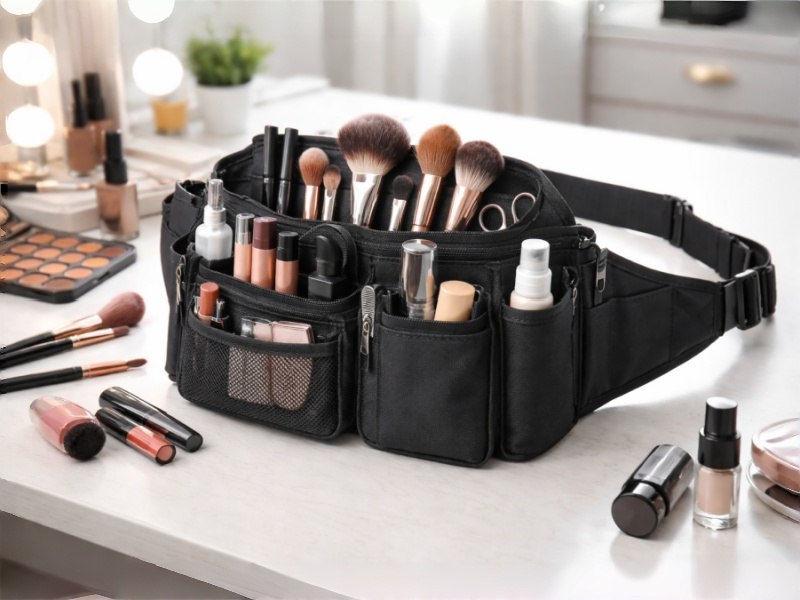
A quick-access waist bag for makeup artists is a wearable tool organizer built for fast, one-hand access to brushes, disposables, lip products, small palettes, cotton items, and daily essentials while the artist is working. Unlike a regular cosmetic bag, it is designed around movement, speed, hygiene, and workflow. The best versions combine light weight, wipe-clean materials, stable belt support, practical pocket depth, and clean internal zoning, making them useful for bridal services, retail events, salon work, backstage teams, education kits, and private label beauty tool lines.
Current commercial listings and product collections show that the strongest demand clusters around brush belts, waterproof or wipe-clean surfaces, adjustable straps, personalized branding, and multi-pocket layouts, with some retail-style examples featuring around 22 pockets and many wholesale listings starting from 10 pieces for simpler versions, while more developed custom runs often start higher.
What Is a Quick-Access Waist Bag for Makeup Artists, and Why Is It Different From a Regular Makeup Bag?
A quick-access waist bag is a working tool belt built to keep the most-used items visible, reachable, and separated while the artist is standing and moving. It differs from a regular makeup bag because it is organized around active use, not storage. A regular pouch keeps products together. A quick-access waist bag keeps the right tools in the right place, ready at the right second.
A normal cosmetic pouch can hold many items, but it usually hides them inside one or two large compartments. That works for packing. It works far less well for live service. When an artist needs a powder brush, lip wand, cotton bud, palette knife, and blotting paper within seconds, deep storage becomes friction. The artist has to stop, unzip, search, reposition, and sometimes use two hands. On a tight schedule, that friction is expensive.
A purpose-built waist bag changes that dynamic. It places high-frequency tools on the body, usually at hip level, where the hand naturally returns. It creates visual order. A brush section stays separate from disposables. Cream products stay away from tissues. Clean items stay away from used tools. That sounds simple, but this is where many generic versions go wrong: they carry enough, yet they do not separate enough.
There is also a psychological difference. A table case suggests setup. A waist bag suggests readiness. That matters in bridal suites, film touch-up work, fashion fittings, in-store events, and education settings where the artist is moving around people rather than sitting beside a fixed station.
Another difference is contamination control. A general pouch often encourages over-handling. The artist keeps touching multiple products to reach one. A stronger waist layout reduces unnecessary contact. That alone can make the tool feel more professional.
Who Should Use a Makeup Artist Waist Bag, and When Does It Make the Biggest Difference?
A makeup artist waist bag is most useful for people who work standing up, moving often, or serving multiple faces in sequence. That includes freelance artists, bridal teams, salon floor staff, backstage crews, beauty educators, retail demo staff, and assistant artists. It matters most when speed, reach, and tidy workflow are more valuable than maximum storage volume.
Freelance bridal artists are a strong fit because their working environment is rarely fixed. One job may happen in a hotel room, the next in a family home, the next in a venue prep area. Table space may be limited. Clean surfaces may be limited. The artist still needs to keep the core tools close and organized.
Backstage and event teams have a different need. Their work is not only fast. It is crowded. People move around them. Lighting shifts. Timing changes. Bags placed on the floor or a side chair are easy to lose track of. A waist-worn format reduces that problem.
Beauty schools and training programs also have a clear use case. A waist bag teaches workflow discipline. It forces students to think about tool order, hand sequence, hygiene zones, and reset habits between applications. For a school or academy line, the bag becomes both a tool and a training structure.
Retail and brand activation teams need a slightly different version. They usually need a clean exterior, easy logo placement, and controlled product visibility. They may carry fewer brushes but more branded testers, disposables, mirror tools, or quick hygiene items.
There is one group that should think carefully before choosing this style: artists who carry large complexion assortments, many full-size products, or heavy kit weight all day. For them, a waist bag is often best used as a frontline organizer, not the full kit. The smarter system is often a two-layer setup: core fast-access tools on the body, bulk stock in a nearby main case.
If your team is planning a custom program for beauty schools, salon groups, or branded artist kits, it makes sense to map the real working scenario before developing the structure. That usually saves time later. For project inquiries, Jundong can be reached at info@jundongfactory.com.
Which Types of Quick-Access Waist Bags Are Best for Different Makeup Artist Workflows?
There is no single best shape for every artist. The right type depends on kit size, product mix, movement level, and service environment. The most useful categories are brush-belt styles, hybrid zipper waist bags, apron-style organizers, modular pouch systems, and crossbody-to-waist convertible designs.
A brush-belt style works well when brushes are the priority. These designs usually feature multiple vertical slots and shallow front sections. They are simple, light, and easy to understand. They work well for academies, entry-level kits, and artists who mainly need brush visibility. Their weakness is product containment. Small items can get crowded or exposed.
A hybrid zipper waist bag adds enclosed sections for loose or fragile items. This type is often better for artists carrying disposables, lash tools, lip products, cotton pads, mini sprays, or compact creams. It is more practical than an open brush belt when the work setting involves movement or travel.
An apron-style organizer creates more panel area and can hold many categories at once. It suits hair-and-makeup crossover teams, educators, and artists who like visible layout. The trade-off is bulk. If the apron gets overloaded, it can swing, fold, or feel heavy at the waist.
A modular pouch system is useful for branded kits and team standardization. One pouch can be assigned to brushes, one to lips, one to hygiene items, one to disposables. This format works well for group training, event staffing, and repeat internal systems. It is less romantic than a handcrafted artist belt, but often more scalable.
A convertible design can move between waist and crossbody wear. This solves a real problem: not every artist wants full waist load for every hour of the day. An adjustable system adds flexibility. Some retail and wholesale listings already show this feature along with adjustable size bands and organized multi-pocket layouts.
Here is a practical comparison:
| Type | Best For | Main Strength | Main Risk |
|---|---|---|---|
| Brush Belt | Students, brush-heavy work | Fast visual access | Weak loose-item control |
| Hybrid Zipper Waist Bag | Freelance and bridal use | Better containment | Slightly slower access |
| Apron Organizer | Hair + makeup teams | Large working surface | Can feel bulky |
| Modular System | Schools, teams, branded kits | Easy standardization | Less personal feel |
| Convertible Waist/Crossbody | Multi-scene use | Flexible wear method | More hardware complexity |
The design decision should begin with how the artist moves, not with how the product looks in a catalog photo.
Why Do Material, Zipper, and Pocket Design Matter So Much in a Professional Makeup Waist Bag?
Material, zipper, and pocket design matter because the bag is touched constantly, opened constantly, and exposed constantly to powder, cream, oil, alcohol, wipes, and movement. A weak choice in any of these areas can make the bag look acceptable in photos yet frustrating in real use. The strongest designs feel easy on day one and still feel controlled after repeated cleaning and wear.
The material decision is usually the first major fork. PU offers a smooth, polished look and can be easy to wipe clean. That makes it attractive for beauty-related kits. It also presents branding well. But lower-grade PU can crease, peel, or feel overly hot in long use. Nylon and polyester usually perform better when the goal is lighter weight, softer body, and longer-term flexibility. They also support stitching stability well. Canvas gives character and structure, but it absorbs dirt more easily unless treated. Clear PVC can be useful in small windows or outer sections when visibility matters, but too much clear panel area can feel stiff and look less refined.
Pocket design matters even more than material in many cases. Some bags fail because the pockets are too deep. Others fail because the pockets are too shallow and tools jump out when the artist bends. Brush slots must grip without crushing. Open sections must allow fast entry without turning into spill zones. Zipper pockets must not block the hand. Mesh helps visibility, but poor mesh placement catches product edges and frays.
Lining is often overlooked. In this category, lining should not be treated as decoration. It is part of the working surface. A wipe-clean interior is extremely useful because residue buildup is not theoretical in beauty work. Current retail listings for artist belts and waist organizers repeatedly highlight water-resistant or wipe-clean surfaces for exactly this reason.
Zippers are another quiet quality test. A good zipper should move smoothly with one hand. It should not grab the lining. It should not require the user to brace the bag with the other hand every time. For a working artist, zipper resistance is not a small inconvenience. It breaks flow.
A better design process usually asks these five things early:
- Which items are reached every 30 seconds?
- Which items must stay enclosed?
- Which tools must stay clean and separated?
- How much body contact can the user tolerate over a long shift?
- How often will the bag be wiped, sprayed, or spot-cleaned?
How Do You Custom a Quick-Access Waist Bag for Private Label, OEM, or ODM Projects?
Custom development starts with clarity, not decoration. The strongest projects do not begin with color or logo. They begin with use case, carry method, tool list, target price direction, and visual positioning. Once those are fixed, custom options become easier to judge and much harder to misuse.
Most teams entering this category care about six decisions first: shape, pocket logic, main fabric, cleaning method, logo treatment, and packaging style. If these are still vague, sampling tends to drift. One revision changes the pocket depth. Then the strap changes. Then the logo size changes. Then the cost target breaks. The project becomes slower than it needed to be.
Logo choice should match the tone of the product. Screen print works for cleaner, lower-cost programs and large visual branding. Embroidery feels more tactile but may add thickness and cleaning friction. Woven labels are small, practical, and reliable for understated branding. Rubber patches bring a more modern or sporty feel. Metal plates look premium but can feel hard against the body if placed badly. A beauty tool bag is worn, not only viewed, so comfort matters.
Color should also be treated carefully. Many beauty kits default to black because it hides stains, feels professional, and supports broad use. That is a valid choice. But all-black is not always the best choice for internal visibility. A slightly lighter lining can make products easier to identify quickly. That small decision improves use more than many branding upgrades.
Custom packaging deserves more thought than it usually gets. A waist bag for artists can be sold as a stand-alone item, included in a starter kit, issued as a school tool pack, used in event staffing, or bundled in a beauty brand accessory line. The packaging brief should reflect that purpose. A retail gift box, a polybag with insert card, and a training kit carton all communicate different product roles.
When teams send a development brief, the most useful material usually includes:
- Reference photos
- Estimated size
- Intended wear method
- Tool categories to be stored
- Preferred fabric direction
- Logo artwork
- Quantity expectation
- Timing target
- Packaging preference
That is enough to start a practical conversation. It does not need to be perfect. A rough brief with the right priorities is better than a polished brief with the wrong ones.
What Is the Sample Process, and How Long Does It Take to Develop a Custom Makeup Artist Waist Bag?
A custom makeup artist waist bag usually moves through brief review, structure proposal, material confirmation, first sample, revision, and pre-production approval. The timing depends on design complexity, fabric sourcing, logo method, and how quickly feedback moves. For a straightforward style, development can move fast. For a new structure with multiple revisions, it takes longer because function must be checked, not only appearance.
The first step is not sewing. It is interpretation. The development team needs to understand what “quick-access” means for this specific project. Does it mean visible brush slots? Silent zipper movement? One-hand access? Lightweight body feel? Easy cleaning? Better weight balance? Different teams use the same words and mean different things.
Then comes material and layout definition. This stage is where many future delays are created or prevented. If the brush pocket width is guessed, revisions are likely. If the belt width is not tested against load, revisions are likely. If the logo placement interferes with the natural fold of the bag, revisions are likely. Sample timing is not only a calendar issue. It is a decision-quality issue.
A typical path may look like this:
| Stage | What Happens | What Often Delays It |
|---|---|---|
| Brief Review | Use case, size, structure, branding discussed | Incomplete references |
| Material Setup | Fabric, lining, zipper, logo method chosen | Waiting on exact material direction |
| First Sample | Structure and layout tested | Pocket logic not fully defined |
| Revision | Fit, depth, strap, and usability adjusted | Too many new changes introduced together |
| PP Approval | Final version locked for bulk run | Last-minute branding or packaging edits |
For simpler custom projects, many teams in this product family aim for a first sample in roughly one to two weeks after the brief and materials are confirmed, though the actual calendar depends heavily on the structure and revision count. Wholesale platform listings in related categories also show short dispatch times for ready-made versions, but those should not be confused with true custom development timing.
One mistake appears again and again: people review the sample while thinking only about how it looks laid flat on a table. A waist bag should also be reviewed while worn, loaded, zipped, bent, wiped, and used with one hand. A nice sample that fails those tests is not actually ready.
If you already have a draft idea, rough drawing, or target structure, Jundong can help turn it into a workable sample path. Contact: info@jundongfactory.com.
How Much Does a Custom Makeup Artist Waist Bag Cost, and What Really Changes the Price?
The cost of a custom makeup artist waist bag is shaped less by the name of the product and more by the construction logic behind it. Two styles can look similar from the front and still land in very different cost positions because the real drivers sit inside the seams, pockets, lining choices, and branding details.
The first cost driver is material direction. A soft polyester base will not behave like a structured PU body. A treated fabric with wipe-clean performance will not cost the same as a standard lining. Clear windows, reinforced edges, and comfort backing all add up.
The second driver is organization complexity. A plain belt pouch is simple. A bag with twenty or more brush slots, zipper pockets, mesh sections, elastic loops, reinforced strap attachments, and layered compartments becomes much more labor-heavy. Current listings in this category already show a wide commercial spread, from low-cost simple styles to more structured designs, with MOQ expectations shifting sharply depending on how custom the product becomes.
The third driver is logo and finishing method. A woven label and a metal logo plate do not create the same cost, feel, or assembly sequence. Neither do standard zipper pulls and custom molded pulls. Small details can have outsized effect when repeated over an entire run.
The fourth driver is quantity and development stage. Small runs carry setup pressure. Larger runs spread that cost better. But that does not mean the lowest unit cost is always the smartest choice. A design that is too ambitious for the intended quantity can become a poor fit from the start.
A practical way to think about pricing is this:
- Base cost comes from shape, size, and fabric family.
- Labor cost rises with pocket count, layered construction, and finishing detail.
- Branding cost comes from logo method and packaging style.
- Project cost changes with quantity, revisions, and delivery expectation.
The most common mistake is comparing offers using only the front photo and the quoted number. A stronger comparison asks:
- Is the fabric the same thickness and cleanability?
- Is the pocket count truly the same?
- Is the strap build equal?
- Is the logo method equal?
- Is the packaging equal?
- Is the sample standard equal?
If those are not aligned, the comparison is weak.
How Do You Choose the Best Production Partner or Workshop for Makeup Artist Waist Bags?
The best production partner for this product is not the one with the most dramatic catalog. It is the one that understands wearability, pocket logic, repeatability, and revision control. This category sits in an awkward middle ground: it is not as simple as a basic cosmetic pouch, and it is not as large as a travel organizer. That means the team developing it needs good judgment in both bag structure and actual use behavior.
Start with experience in functional soft goods, not just beauty-themed packaging. A team may be good at flat cosmetic pouches yet weak at body-worn organization. Those are different skill sets. Ask to discuss pocket depth, belt comfort, stitching reinforcement, cleaning surface choices, and real use scenarios. The quality of the discussion often tells you more than the gallery photos.
Next, look at sample discipline. A reliable workshop should be able to explain what will be checked in the first sample, what belongs in revision, and what must be fixed before pre-production approval. If the conversation stays too vague, the project may stay vague all the way to bulk.
Communication rhythm matters more than many teams expect. This product category is full of small decisions. Brush slot count. Pocket taper. Back support material. Strap width. Logo feel. Zipper direction. If updates are slow or scattered, tiny issues pile up.
Quality control should also be treated practically. For this type of bag, inspection should not stop at visual appearance. It should include:
- Stitch consistency
- Pocket symmetry
- Strap attachment strength
- Zipper smoothness
- Edge cleanliness
- Logo placement accuracy
- Wipe-clean performance
- Loaded-wear balance
Another useful sign is whether the team thinks in terms of repeat orders. A working artist bag often leads to extensions: school kits, retail kits, stylist versions, color updates, branded accessories, and training sets. If the initial development is handled cleanly, follow-up versions become much easier.
For teams building a long-term beauty accessory line rather than a one-off item, that repeatability matters as much as the first sample.
Are Quick-Access Waist Bags a Good Product Direction for Beauty Brands, Schools, and Pro Artist Kits?
Yes, this can be a very strong product direction when positioned correctly. A quick-access waist bag sits at the intersection of usefulness, identity, and routine. It is not merely decorative. It solves a visible working problem. That gives it stronger staying power than many accessories that look attractive but do not become part of daily use.
For beauty brands, this item can support a more professional image. It suggests process, craft, and real-world application. It also creates space for practical branding instead of purely promotional branding. The product becomes associated with work, not just gifting.
For schools and academies, it helps standardize training. Students can be taught the same setup logic, cleaning flow, and tool zoning. That improves classroom consistency and helps the brand of the school feel more organized.
For salons and service groups, the bag can become part of team presentation. Matching tool systems create visual order. They also reduce the improvisation that often causes clutter during service.
For artists, this category has another advantage: it is visible during use. That makes it more expressive than an organizer hidden in a suitcase. If branding is done tastefully, the bag can carry identity without looking forced.
The strongest commercial direction usually comes from one of these four roles:
- Professional work tool
- Training kit component
- Retail add-on for serious users
- Team-issued service organizer
Where projects become weak is when the item tries to be everything at once. A school kit, luxury artist belt, low-cost promo item, and fashion waist bag should not all share the same design logic. The product role should be fixed early.
This category also gives good room for line extension. Once the base structure is successful, it can branch into brush-only versions, compact touch-up versions, hairstylist crossover versions, assistant versions, and branded starter kits. That makes it useful not only as a single product, but as a family concept.
If your team is planning a branded tool organizer, artist starter system, or academy-issued belt bag, Jundong can help evaluate structure, materials, and sampling direction at info@jundongfactory.com.
The Design Standard That Usually Separates a Good Waist Bag From a Frustrating One
A strong makeup waist bag does not force the artist to adapt to the bag. The bag adapts to the artist’s sequence.
That is the real test.
Too many versions are built as if storage volume is the main goal. For working use, clarity beats volume. A smaller bag with clean access is often better than a larger bag with confused layout. A lighter bag worn for six hours can outperform a heavier bag that holds more but slows movement.
The most successful projects in this category usually share the same hidden traits:
- The artist can find the core tools without looking too long
- The bag stays stable when the body turns
- The material cleans without drama
- The pockets hold shape
- The strap feels intentional, not secondary
- The logo does not fight the function
- The sample was tested in motion, not only on a table
That is why the product deserves serious development attention. It may look small. It is not a small-use item.
For teams creating this style under their own name, the goal should not be to copy the cheapest belt on a trading platform or the most decorative item in a gift catalog. The stronger route is to study how artists actually move, what they reach most, what gets dirty fastest, what feels heavy soonest, and what details reduce friction over a full working day.
Do that well, and the bag becomes memorable for the right reason: it helps people work better.
Top 10 FAQs About Quick-Access Waist Bags for Makeup Artists
FAQ 1. What should a professional quick-access waist bag include if it is meant for real working use rather than just display?
A professional quick-access waist bag should be built around actual movement, working rhythm, and repeated daily use, not just around appearance. Many products look organized in photos, but once they are worn for several hours, the weak parts show up quickly. A bag that is made for real work should have clear tool zoning, stable waist support, easy-clean surfaces, secure but accessible pockets, and enough structure to hold shape without feeling stiff or bulky.
For most makeup artists, the most practical layout includes a mix of open brush slots, zippered compartments, shallow quick-drop pockets, and one or two sections for items that must stay cleaner or more protected, such as lash tools, lip products, cotton items, or disposables. A good bag should allow an artist to work mostly with one hand, because needing two hands every time a zipper sticks or a brush gets trapped will slow the whole service flow.
The belt itself matters more than many people expect. If the belt is too narrow, the weight starts to cut into the waist. If it is too soft, the bag can swing or collapse when the artist bends, walks, or turns. Comfort is not a luxury detail here. It affects how long the bag can actually be worn without irritation.
Here is a simple checklist that helps separate a working design from a decorative one:
| Feature | Why It Matters |
|---|---|
| Brush slots with proper depth | Keeps tools visible without letting them fall out |
| Wipe-clean lining | Helps manage powder, cream, and residue buildup |
| Reinforced waist attachment | Improves stability during movement |
| Mixed pocket types | Supports both fast access and protected storage |
| Balanced body structure | Reduces sagging and awkward body pull |
The best test is practical, not visual: Can the artist wear it, move in it, reach into it quickly, and clean it easily after a real job? If the is yes, then the bag is built for use, not just for presentation.
FAQ 2. Which materials work best for a makeup artist waist bag, and how should brands choose between nylon, polyester, PU, canvas, and clear PVC?
The best material depends on how the bag will be used, how often it will be cleaned, what image the brand wants to present, and how much structure the bag needs. No single material is “best” for every project. What matters is whether the material supports the actual job the bag is expected to do.
Nylon is often a strong choice when light weight, flexibility, and everyday durability are priorities. It works well for artists who move often and do not want the bag to feel heavy before tools are even loaded in. Polyester is also practical and can be easier to position at a more controlled cost level, especially for larger-volume programs. PU is popular when a cleaner, more polished beauty-focused look is needed. It can present branding nicely and is generally easier to wipe than untreated canvas, but the quality level matters a lot. Low-grade PU can crack, peel, or crease too quickly. Canvas gives a more lifestyle-driven or artisanal look, but it usually needs more thought around stain resistance and cleaning. Clear PVC is useful in controlled areas where visibility matters, but it is rarely ideal as the main body material for a comfortable waist-worn product.
A practical material choice should look at these five factors:
- How often will the bag be wiped or spot-cleaned?
- Will the bag be used in bridal, retail, school, salon, or backstage settings?
- Does the brand want a polished look or a softer utility look?
- How much body contact will the bag have during long wear?
- Will the bag need to hold shape or stay more flexible?
This comparison is often helpful:
| Material | Best For | Strength | Watch-Out |
|---|---|---|---|
| Nylon | Mobile artists, everyday work | Light, flexible, durable | Surface look is more functional |
| Polyester | Cost-conscious structured programs | Practical, scalable | Can feel less refined depending on grade |
| PU | Beauty-focused branded kits | Smooth look, easy to wipe | Quality variation can be big |
| Canvas | Lifestyle or creative identity lines | Character and texture | Can stain more easily |
| Clear PVC | Visibility sections, inserts | Easy visual access | Can feel stiff or less premium |
The strongest projects usually do not choose material by trend alone. They choose it by wear experience, cleanability, visual direction, and repeat use performance. That is what keeps the bag useful after the first few jobs, not just attractive in a launch sample.
FAQ 3. How many pockets and compartments should a quick-access waist bag have for makeup artists?
There is no perfect universal pocket count, because the right number depends on workflow, service type, tool mix, and how the artist likes to work. In practice, the better is not “How many pockets should the bag have?” but “What must stay visible, what must stay separated, and what must stay protected?”
A waist bag with too few compartments becomes messy quickly. A bag with too many compartments can become over-engineered and confusing, especially if the pockets are narrow, awkwardly placed, or too similar in size. That is why a well-designed layout is more valuable than a high pocket count used only as a sales claim.
For many working artists, a useful structure includes:
- 6–12 brush slots for daily brushes
- 1–2 zipper sections for loose or hygiene-sensitive items
- 2–4 open pockets for fast-grab tools
- 1 shallow section for disposables or tissues
- Optional elastic loops for small tools such as tweezers or spatulas
That does not mean every project should follow the same formula. A bridal-focused bag may prioritize brushes, lip tools, clips, blotting items, and compact touch-up products. A backstage version may need more open access and faster turnover. A school-issued version may need simpler organization that is easy for beginners to maintain.
The real mistake is designing from the outside in. Some teams decide the outer shape first and then try to force the interior to fit. That often leads to pockets that look neat on paper but work badly in real use. The better approach is to build around tool behavior:
| Tool Type | Storage Need |
|---|---|
| Brushes | Vertical access with controlled depth |
| Lip products | Smaller secure sections |
| Cotton/disposables | Clean, separate area |
| Lash tools | Protected, stable placement |
| Mini palettes | Wider but shallow compartment |
The goal is not maximum storage. The goal is fast clarity under pressure. A bag that helps the artist find the right tool without stopping the service will always outperform a bag that simply offers more compartments but less logic.
FAQ 4. Can a quick-access waist bag be fully customized with logo, color, size, pocket layout, and packaging?
Yes, this type of bag can usually be customized in many practical ways, but the most successful projects do not start by changing everything at once. Full customization works best when the team first fixes the core use scenario and then adjusts the visible and structural details around that purpose. Otherwise, the project can become visually busy, harder to sample, and less coherent as a product.
Most custom programs in this category can adjust overall size, main fabric, lining, pocket layout, strap style, zipper details, logo method, hardware color, and packaging format. Some projects also customize internal labeling, hangtags, instruction cards, or kit inserts. For school programs or team-issued systems, it is common to develop a more standardized layout with limited visual variation. For beauty brands, logo treatment and overall finish may receive more attention.
The most common logo methods include:
| Logo Method | Look & Feel | Best Use Direction |
|---|---|---|
| Screen Print | Clean, simple, cost-friendly | Entry programs and bold branding |
| Embroidery | Tactile and visible | Classic or craft-leaning identity |
| Woven Label | Small and practical | Understated branding |
| Rubber Patch | Modern, sporty feel | Youthful or utility-style lines |
| Metal Plate | Refined, polished | Premium visual positioning |
One thing many teams overlook is that branding should not interfere with wear comfort or function. A beautiful metal logo plate placed in the wrong zone can rub against the body. A large embroidered logo across a flexible pocket can distort how that pocket opens. Good customization is not only about adding brand identity. It is also about protecting usability.
Packaging can be customized too, and this matters more than it seems. The same waist bag may be positioned as a professional working tool, a training kit item, a retail accessory, or a branded event issue piece. Those roles should not share the same packaging logic. Presentation should match how the product will actually be used and received.
If a brand already has a rough concept, even a hand sketch or a reference photo can be enough to start a structured development discussion.
FAQ 5. What information should be prepared before requesting a sample for a custom makeup artist waist bag?
The best sample requests are clear, focused, and realistic. They do not need to be overdesigned, but they should tell the development team what the bag is supposed to do, not just what it should look like. When a sample request is vague, the first prototype often ends up reflecting assumptions rather than actual working needs.
At minimum, it helps to prepare the following:
- Reference images or rough sketch
- Estimated size or preferred wearing scale
- Main tool categories that will go inside
- Preferred fabric direction
- Logo artwork or preferred logo method
- Expected quantity direction
- Target timeline
- Packaging preference if already known
The most valuable part is often the tool list. A waist bag for bridal artists is not organized the same way as one used for retail counters, academy training, or backstage touch-ups. If the team knows the bag needs to hold brushes, lash glue, lip products, cotton buds, tissues, clips, and mini palettes, they can start making better layout decisions immediately.
It is also useful to describe the intended wearing method. Will the bag sit at the waist only? Should it convert to crossbody wear? Does the user prefer a softer body or a more structured shape? Should the focus be on very fast open access, or on cleaner protected storage? Those differences shape the sample far more than many people expect.
Here is a simple briefing structure:
| Item to Provide | Why It Helps |
|---|---|
| Reference visual | Shows general style direction |
| Tool list | Helps define pocket logic |
| Preferred size | Prevents scale mismatch |
| Material idea | Speeds up fabric selection |
| Logo file | Allows correct branding planning |
| Use scenario | Keeps the sample practical |
| Quantity expectation | Helps align development route |
A strong first brief will not guarantee a perfect first sample, but it will reduce avoidable confusion. In this kind of product, clarity early on saves time later.
FAQ 6. How long does it usually take to develop and approve a custom makeup artist waist bag sample?
The timeline depends on design complexity, material readiness, logo method, revision count, and how quickly decisions move between both sides. A simpler style based on common materials can move much faster than a new structure with many special details. That is why there is no serious one-number promise that fits every project.
In many cases, the path includes these stages:
- Initial brief review
- Material and structure confirmation
- First sample
- Revision round if needed
- Pre-production confirmation
The first sample is usually the stage where the project becomes real. Up to that moment, many ideas still sound equally workable. Once the sample is worn, loaded, zipped, and tested in motion, the difference between a “nice concept” and a “usable working product” becomes obvious.
What slows the process most often is not production itself, but late design decisions. For example:
- Pocket depths were not defined clearly
- Logo placement changes after the first sample
- Strap width was not tested against weight
- Material direction changes mid-development
- The sample is reviewed visually but not physically worn
A practical timeline comparison looks like this:
| Project Type | Typical Development Difficulty | What Usually Affects Timing Most |
|---|---|---|
| Basic structure with simple logo | Lower | Material confirmation and communication speed |
| Functional multi-pocket bag | Medium | Layout revision and wear testing |
| Premium branded version with packaging | Higher | Finish details, logo method, packaging approval |
| New concept with special structure | Highest | Multiple revisions and structure refinement |
The smartest way to shorten the calendar is not to rush the sewing stage. It is to make the early brief more complete and the sample review more practical. A waist bag should be checked on the body, with real tools inside, during actual movement. That is what prevents pretty-but-frustrating designs from slipping through.
FAQ 7. What usually causes the biggest price difference between two similar-looking makeup artist waist bags?
The largest price differences usually come from construction complexity, material quality, pocket engineering, hardware choices, branding method, and quantity, not from the product name or the front-view photo. Two waist bags can look similar online and still be built in very different ways once you examine the inside.
The first hidden cost factor is often labor intensity. A bag with many shaped compartments, layered pocket panels, reinforced attachment, and multiple finishing steps takes far more work than a simple pouch with a belt. Even if the outside looks similar, the internal build may be much more demanding.
The second major factor is material grade. One black fabric is not equal to another black fabric. The same goes for lining, zipper, webbing, foam, binding, and logo trim. A smoother wipe-clean material, heavier-duty waist attachment, cleaner zipper pull, or better-graded PU surface can all shift the cost.
The third factor is project scale. Small runs usually carry more setup pressure per unit. That does not mean small projects are impossible. It simply means expectations need to match structure complexity.
This table explains the difference clearly:
| Cost Driver | How It Raises the Price |
|---|---|
| Pocket count and layering | More sewing steps and more precision work |
| Higher-grade fabric | Better feel, stronger wear, better finish |
| Custom logo hardware | Adds tooling or extra assembly work |
| Reinforced straps and support | Improves wear but adds structure cost |
| Special packaging | Increases material and packing work |
| Lower quantity | Reduces efficiency per unit |
The mistake many teams make is comparing offers based only on a photo and a quoted number. The better comparison asks whether the materials, stitching standard, logo method, pocket layout, packaging, and sample standard are truly aligned. If they are not aligned, then the comparison is not really fair.
A lower quote is not automatically a better quote. For this type of product, the real value often sits in the details that affect daily use, not in the headline number.
FAQ 8. Is a waist bag better than a brush belt, crossbody kit, or tabletop makeup case for professional artists?
It depends on how the artist works, how much they carry, how mobile the service is, and whether speed or storage volume matters more in that specific setting. A waist bag is not automatically better than every other format. It is better when the work requires constant movement, quick access, and body-level organization.
A brush belt is often lighter and more direct for brush-heavy use, but it may not protect smaller items well. A crossbody kit gives more room and can reduce waist pressure, but it may swing when moving and can be slower to access. A tabletop case gives the best overall storage and visibility for large kits, but it depends on having a stable setup area. That is why many experienced artists do not treat these options as competitors. They treat them as different layers of the same working system.
A waist bag becomes especially useful in these situations:
- Bridal prep with limited table space
- Backstage jobs with frequent movement
- Retail demonstration counters
- Quick touch-up work
- Teaching setups where core tools must stay on the body
This comparison helps clarify the choice:
| Format | Best Use | Biggest Strength | Main Limitation |
|---|---|---|---|
| Waist Bag | Mobile service and quick access | Fast reach during movement | Limited total storage |
| Brush Belt | Brush-dominant workflow | Very visible brush access | Less protection for loose items |
| Crossbody Kit | Moderate mobility with more capacity | Better capacity balance | Can shift while moving |
| Tabletop Case | Station-based work | Highest storage and full setup view | Depends on available surface |
So the better is not “Which one is best?” but “Which one supports the artist’s real working sequence with the least friction?” For many professionals, the waist bag works best as a frontline organizer, while the main stock stays in a larger nearby case.
FAQ 9. What quality checks matter most before moving a custom waist bag into bulk production?
Before bulk production begins, the most important quality checks are the ones that confirm the bag will still work well after being loaded, worn, opened repeatedly, and cleaned, not just the ones that confirm it looks correct when laid flat. This is a product that lives in motion, so static inspection alone is never enough.
A strong pre-production review should look at five areas:
- Structure accuracy
- Wear comfort
- Pocket usability
- Hardware performance
- Visual consistency
Structure accuracy means the finished dimensions, pocket depths, and opening logic match the approved sample. Wear comfort means the bag stays balanced once filled with typical tools and does not dig sharply into the waist. Pocket usability means brushes, lip products, cotton items, and small tools can be placed and removed smoothly without snagging or collapsing. Hardware performance includes zipper smoothness, buckle reliability, strap adjustment, and attachment strength. Visual consistency covers stitching, logo placement, edge cleanliness, and overall finishing.
A good review table may look like this:
| Inspection Area | What Should Be Checked |
|---|---|
| Size & layout | Pocket size, panel alignment, overall proportion |
| Wear test | Stability, pressure, body fit during movement |
| Access test | One-hand opening, tool removal, visibility |
| Cleaning check | Surface response to basic wiping |
| Hardware check | Zippers, buckles, strap adjustment, seams |
| Branding check | Logo position, clarity, finish consistency |
One common mistake is approving the sample too early because it “looks good enough.” For this product, appearance is only one layer. The stronger habit is to test it with real tools inside, on the body, for a practical session. That is when weak pocket depth, swing, zipper drag, or uncomfortable logo placement usually becomes obvious.
FAQ 10. Who usually orders custom quick-access waist bags, and how can this product be positioned for stronger long-term demand?
This product usually attracts studios, beauty brands, training schools, salon groups, promotional kit planners, event teams, and professional artist programs. It is especially useful when the goal is not just to sell another accessory, but to create something that becomes part of how the user actually works. That is why this category often performs best when it is positioned as a tool-driven item, not just as a style-driven item.
For beauty brands, it can be introduced as part of a pro artist collection, brush and tool system, or limited kit extension. For academies, it works well as a training issue item because it helps standardize setup habits. For salons, it can support team consistency and cleaner service presentation. For event groups, it becomes a practical staff-use organizer rather than a decorative giveaway.
The strongest long-term direction usually comes from one of these product roles:
| Positioning Direction | Why It Works |
|---|---|
| Professional Tool Organizer | Strong practical value and repeat use |
| Academy Training Kit Item | Helps create structured classroom use |
| Brand Extension Accessory | Supports identity and utility together |
| Event/Service Team Gear | Useful in real working conditions |
Long-term demand is stronger when the design solves a visible working problem: slow access, messy setup, poor hygiene separation, or awkward movement during service. If the bag is treated only as a trendy belt pouch with a logo, it becomes easier to replace and harder to remember. If it becomes part of a real workflow, it gains staying power.
That is why good development in this category should always begin with service behavior, not just shape. When the function is honest, the product feels more credible, more useful, and easier to keep reordering in future versions.
Start Your Custom Quick-Access Waist Bag Project With Jundong
A strong quick-access waist bag for makeup artists is not defined by how many pockets it has or how polished it looks in a photo. What matters is whether it supports real work: fast access, clean tool separation, stable wear, practical pocket depth, easy-clean materials, and a layout that matches how artists actually move. When those details are handled well, the bag becomes more than a carrying item. It becomes part of the working process, helping artists stay organized, move faster, and maintain a cleaner, more professional setup.
At Jundong, we can help turn that kind of working concept into a usable product through material selection, structure development, sample making, logo customization, and production planning. Whether you are building a branded artist tool line, a school-issued kit, a salon-use organizer, or a retail-ready beauty accessory, the goal is the same: create a waist bag that feels right in real use, not just on paper. That is where thoughtful development makes the difference.
If you would like to discuss a custom project, you are welcome to contact Jundong at info@jundongfactory.com.
Let's work together
With over 10 years of OEM/ODM bag industry experience, I would be happy to share with you the valuable knowledge related to leather products from the perspective of a leading supplier in China.

Factory catalogue
Table of Contents
Latest blogs

Make A Sample First?
If you have your own artwork, logo design files, or just an idea, please provide details about your project requirements, including preferred fabric, color, and customization options, we’re excited to assist you in bringing your custom bag designs to life through our sample production process.