 Skip to content
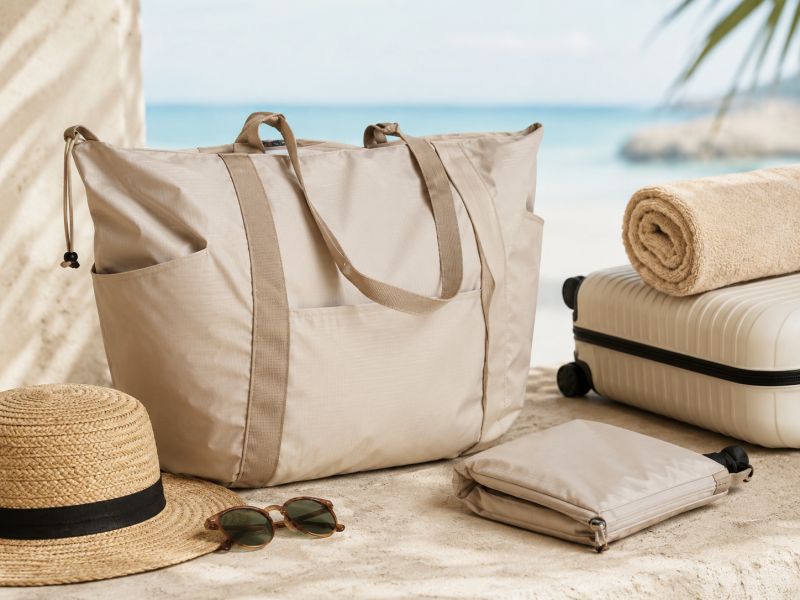
A foldable beach bag sounds easy to design until it has to perform in a real trip. It needs to hide inside luggage before arrival, open large enough for towels and sunscreen in the morning, carry damp swimwear in the afternoon, and still look clean enough for a resort lobby, cruise cabin, beach club, or travel shop. That is why lightweight structure matters. A thin bag can fold small, but it may sag under towels. A rigid bag can hold shape, but it may take up too much luggage space. The real value sits between these two extremes.
A strong foldable beach bag should pack down neatly, open quickly, carry beach essentials comfortably, and keep its key stress areas reinforced. It should be light in luggage but stable when filled with towels, sandals, sunscreen, bottles, phones, room cards, and wet items. The best designs control fabric weight, bottom depth, handle strength, pocket placement, logo position, and folded size together.
Imagine a traveler arriving at a seaside hotel with one carry-on suitcase and no space for a hard beach tote. The next morning, the same person needs a towel, sunscreen, water bottle, sunglasses, sandals, phone, and room card. A well-planned foldable beach bag solves that quiet travel problem: small before use, useful during the day, and easy to pack again after the trip.
Plan A Foldable Beach Bag That Travels Well
A foldable beach bag should not be judged only by how small it becomes when empty. It should also carry towels, sunscreen, bottles, sandals, wet items, phone, and room card without feeling weak or messy. The best design feels light in luggage, opens into a useful beach tote, and returns to a clean folded form after use.
For travel programs, the most reliable styles usually share the same qualities: practical material, compact fold, wide main opening, reinforced handles, secure pocket, wet-friendly detail, clear logo area, and packing that protects the shape. These choices make the bag easier to use in hotels, resorts, cruise cabins, pool areas, beach clubs, and travel shops.
Jundong supports custom foldable beach bag projects with material review, size planning, sample development, logo process review, bulk production, quality checks, packing, labeling, and delivery support. To start a practical review, prepare the use scene, target size, folded size goal, material idea, logo artwork, quantity, packing needs, destination, and deadline. Project details can be sent to info@jundongfactory.com.
A travel beach bag may seem small before the trip begins, but when it is planned well, it becomes one of the most-used items during the whole stay. It carries the towel, protects the phone, handles damp clothing, folds into luggage, and follows the traveler home as a useful reminder of the trip.
What Makes A Beach Bag Travel-Ready?

A travel-ready beach bag should fold small, weigh little, open quickly, carry real beach essentials, dry or clean without trouble, and remain comfortable when loaded. It should also protect phones, room cards, sunscreen, sunglasses, and wet items without becoming bulky inside luggage.
A beach bag made for travel has to perform in two very different moments. Before the trip, it needs to disappear into a suitcase, carry-on, hotel drawer, cruise cabin shelf, or weekend duffel. During the trip, it needs to open into a useful tote that can handle towels, sandals, sunscreen, bottles, hats, wet swimwear, snacks, and small valuables.
Many foldable bags look good when empty but fail when filled. The body may sag, the handles may twist, the bottom may collapse, and small items may sink under towels. On the other side, some beach totes look strong when opened, but fold too thickly for travel. A travel-ready bag must solve both problems at the same time: compact storage before use and stable carrying during use.
For hotels, resorts, cruise programs, beach clubs, travel retail sets, and summer promotions, the travel-ready standard is higher than “can be folded.” The bag should feel natural during a full day near water. It may be carried from a hotel room to the beach, placed under a pool chair, used on a boat, taken to lunch, shaken clean, and packed again. If the material wrinkles badly, if the logo cracks on the fold line, or if damp swimwear spreads moisture into the main area, the design still needs work.
A practical travel-ready beach bag usually needs:
Lightweight main fabric that does not feel fragile.
Compact fold style for luggage and storage.
Enough opened volume for at least one towel and daily items.
Comfortable shoulder handles for walking.
A secure inner pocket for phone, room card, cash, and keys.
A quick-access area for sunscreen or bottle.
A wet-friendly pouch or coated section when pool or swim use is expected.
Reinforcement at handle joints, top edge, side seams, and bottom corners.
Logo placement away from hard fold lines.
Packing method that keeps the item neat before distribution.
A strong foldable beach bag does not need to be complicated. In many cases, one main compartment, one secure pocket, one wet or bottle area, and a comfortable handle are enough. The real value comes from how these parts work together after folding, filling, carrying, and cleaning.
| Travel Use Need | Practical Design Direction | Why It Matters |
|---|---|---|
| Suitcase storage | Flat fold, pouch fold, or roll fold | Reduces packing pressure |
| Beach-day load | 15–35 L opened capacity | Holds towels, sunscreen, bottles, sandals |
| Wet clothing | Coated pocket or removable pouch | Keeps damp items separate |
| Sand exposure | Mesh panel or easy-clean fabric | Reduces trapped sand |
| Valuables | Inner zipper pocket | Protects phone, room card, keys |
| Shoulder comfort | Wider handles with proper drop | Reduces pressure when loaded |
| Logo clarity | Stable logo panel | Keeps artwork clean after folding |
| Reuse after trip | Durable seams and practical shape | Increases long-term use |
A travel-ready beach bag should feel small before the day begins and spacious once the towel goes inside. That balance is what makes the design useful.
What Does Foldable Mean?
Foldable means the bag can be reduced into a smaller form without damaging the fabric, stitching, handles, logo, pockets, zipper, or overall shape. For beach bags, folding may mean flat folding, rolling, folding into an inner pouch, folding into an attached pocket, or using a soft body that collapses neatly when empty.
Foldability should not be judged only by how small the bag looks in a product photo. The folded form must be repeatable. A hotel team, retail staff, traveler, or event team should be able to fold and unfold the bag without fighting the structure. If it folds well only once under perfect conditions, it may cause problems later.
Different fold styles suit different uses:
| Fold Style | Best Use Scene | Strength | Watch Carefully |
|---|---|---|---|
| Flat fold | Resort room gifts, bulk storage, suitcase packing | Easy to stack and pack | Logo fold line, handle placement |
| Roll fold | Soft travel totes, lightweight fabric bags | Flexible and simple | Uneven thickness from handles |
| Pouch fold | Travel gift sets, compact retail items | Looks neat and portable | Pouch size and refolding ease |
| Inner-pocket fold | Self-storage travel accessories | No separate pouch needed | Pocket zipper stress |
| Soft collapse | Large lightweight totes | Fast and simple | Can look messy if fabric is too thin |
A bag can be foldable yet still feel strong. The key is placing support only where needed. Handles, top edge, side seams, and bottom corners may need reinforcement, while the main body can stay soft enough for packing. Heavy support across the whole bag may make it hard to fold. Too little support may make it weak when opened.
Fold testing should include all final details. A plain body may fold well, but a zipper, rubber patch, wet pouch, label, lining, or reinforced base can increase thickness. The logo must also be reviewed. If it sits across a sharp fold, it may crease, crack, peel, or distort. A good foldable beach bag keeps the logo on a stable panel or soft bend area.
A useful fold review should check:
Can the bag fold the same way after repeated use?
Does the fold create deep marks on the logo?
Do handles create bulky corners?
Does the zipper bend smoothly?
Can the bag fit into a carry-on pocket, suitcase lid, drawer, or travel pouch?
Can it reopen without looking crushed?
Can people refold it without a diagram?
The best foldable design feels simple in real life. It folds naturally, opens cleanly, and keeps working after repeated trips.
What Is The Best Foldable Travel Bag?
The best foldable travel bag is compact before use, roomy after opening, light in luggage, strong at stress areas, and easy to clean after sand, sunscreen, or moisture exposure. It should not be selected only because it folds small. If it cannot hold a towel, bottle, sunscreen, and phone safely, it is not suitable for real beach travel.
For beach travel, the strongest foldable styles often use polyester, nylon, mesh combinations, lightweight canvas, coated fabric sections, or soft zipper tote structures. Each style serves a different travel scene. Polyester is practical for color, folding, and general beach use. Nylon gives a smoother travel-gear feel. Mesh helps release sand and dry faster. Lightweight canvas looks more natural and refined, but it needs more care around wet items. Coated pockets help handle damp clothing without making the entire bag stiff.
A strong foldable travel bag should meet these standards:
It folds flat, rolls cleanly, or stores inside a pouch.
It opens without heavy wrinkles or twisted panels.
It holds one full towel plus sunscreen, phone, water, and small items.
It has a secure pocket for valuables.
It feels comfortable on the shoulder when full.
It can handle damp swimwear or wet towels with a suitable pocket or pouch.
It does not feel disposable after one trip.
It keeps the logo clear after folding and carrying.
Different travel settings need different foldable bag types:
| Travel Setting | Better Bag Direction | Useful Details |
|---|---|---|
| Resort room gift | Flat-fold polyester or light canvas tote | Clean logo panel, inner pocket |
| Cruise or island tour | Lightweight zipper tote | Secure closure, easy carrying |
| Beach club | Foldable tote with structured front panel | Visible logo, polished shape |
| Family trip | Mesh-panel foldable bag | Sand release, wet gear handling |
| Pool program | Polyester with coated pouch | Damp item control |
| Retail travel set | Pouch-fold beach tote | Compact presentation |
The best foldable travel bag is not the smallest one. It is the one that keeps the right balance between folded size, opened capacity, comfort, and durability.
How Small Should It Fold?
A travel beach bag should fold small enough to fit inside luggage without taking the space of another full bag. For many travel totes, a folded size close to a small book, tablet sleeve, or compact pouch is practical. However, folded thickness matters more than many people expect.
A wide flat fold can slide into luggage more easily than a small but thick bundle. Thick handles, padded grips, large rubber patches, heavy zippers, reinforced bottoms, and layered pockets can make the folded item bulky. If compact travel packing is the priority, these parts should be reviewed early.
The correct folded size depends on opened capacity:
| Opened Use | Opened Capacity | Practical Fold Direction |
|---|---|---|
| Light pool tote | 10–18 L | Small pouch fold or thin flat fold |
| One-person beach tote | 15–24 L | Flat fold or inner-pocket fold |
| Couple beach tote | 24–32 L | Flat fold, roll fold, or medium pouch |
| Family beach tote | 35–45 L | Larger flat fold with controlled thickness |
| Cruise or tour tote | 20–30 L | Flat fold with zipper or pouch fold |
The folded form should also match how the item is presented. A hotel room gift may need a flat fold that looks neat with a hangtag or welcome card. A travel retail product may work better as a pouch-fold bag. A cruise gift may need clear labeling and easy distribution. A beach club item may need clean stacking before handout.
Folding should not damage daily function. If the folded line sits directly over a large print, the logo may crack or crease. If a wet pouch is sewn into the wrong place, the fold may become thick and uneven. If a bottom panel is too rigid, the bag may take up too much space. If handles are too thick, they may create pressure marks.
A good folded size should pass three checks:
It fits where people actually store it.
It opens into the planned capacity without heavy distortion.
It can be folded again after use without frustration.
For travel use, repeatability is more important than a dramatic first fold. People should be able to fold it naturally after a beach day, even if the bag is slightly damp or sandy.
Why Does Carry-On Space Matter?
Carry-on space matters because beach bags often travel before they are used. A rigid beach tote may be attractive, but it can take too much space in a suitcase. A foldable beach bag should reduce packing pressure, not create another item people struggle to fit.
Many trips now involve limited luggage. A weekend resort stay, cruise cabin, island tour, airport transfer, or family holiday may leave little room for a full-size tote. A travel beach bag should slide into a suitcase lid, fit between clothing layers, sit inside a side pocket, or fold into a compact pouch.
Carry-on space affects design choices:
Material should be strong but not overly thick.
Handle webbing should be comfortable but not bulky.
Pockets should help organization without adding heavy layers.
Logo placement should avoid hard fold lines.
Bottom support should help carrying without creating a rigid block.
Wet storage should be useful but not oversized.
Packing form should remain neat after repeated folding.
For hotels, resorts, and travel programs, carry-on space also affects whether the bag gets taken home. A bag that is easy to pack after checkout has a higher chance of reuse. A bulky bag may be left behind, even if it looked good during the stay.
A well-designed foldable beach bag should behave like a travel tool:
Small before use.
Useful during the day.
Easy to clean after use.
Simple to pack again.
Nice enough to reuse at home.
The travel experience does not end at the beach. It ends when the bag goes back into luggage without creating a problem.
Why Avoid A Black Travel Bag?
A black travel bag can look clean and modern, but it is not always ideal for beach travel. Under strong sun, black fabric can feel hotter. On certain surfaces, sunscreen residue, salt marks, lint, and pale sand can show clearly. It can also be harder to spot among dark luggage, beach chairs, pool furniture, and shaded storage areas.
Black can still work well for some designs. It suits sport-style travel bags, city-to-beach collections, bold contrast logos, and stain-hiding needs. But for beach resorts, cruise gifts, poolside programs, and summer travel sets, lighter or brighter colors often feel more natural and easier to identify.
Better beach travel color choices often include:
Sand beige.
Natural canvas.
Warm gray.
Ivory with darker trim.
Sky blue.
Aqua.
Coral.
Soft green.
Navy with light webbing.
Off-white with coated bottom.
Mid-tone shades are often safer than pure black or pure white. They hide small marks better while keeping a summer feeling. A sand beige polyester tote, aqua nylon zipper tote, or natural canvas foldable bag can feel lighter and more travel-friendly than solid black.
Color should be reviewed on the actual fabric because each surface behaves differently. Black canvas may hold lint. Black coated fabric may show salt marks. Black polyester may hide stains better but feel hot. If black is used, contrast stitching, lighter handles, or a brighter logo can improve visibility.
| Color Direction | Advantage | Watch Carefully |
|---|---|---|
| Black | Modern, strong contrast, stain-hiding | Heat feel, salt marks, sunscreen residue |
| White | Fresh and clean | Staining, yellowing, visible dirt |
| Sand beige | Natural and travel-friendly | Shade consistency |
| Navy | Classic and practical | Heat under sun |
| Aqua or coral | Easy to spot, lively beach mood | Trim color matching |
| Natural canvas | Soft and lifestyle-oriented | Moisture and stain control |
A travel beach bag should be easy to find, pleasant under the sun, and consistent with the trip mood.
What Items Should It Hold?
A foldable beach bag for travel should hold at least one towel, sunscreen, sunglasses, phone, room card, water bottle, lightweight clothing, and small personal items. Larger versions may also need space for sandals, wet swimwear, snacks, books, children’s items, or a second towel.
The challenge is that foldable bags must stay compact before use while still carrying real items after opening. Towels need open volume. Bottles need upright support. Phones and room cards need a secure pocket. Sunscreen needs quick access. Wet swimwear needs separation. Sandals need a washable or lower area.
A practical travel load guide:
| Travel Use | Suggested Capacity | Item Load | Useful Detail |
|---|---|---|---|
| Light pool visit | 10–18 L | One towel, sunscreen, phone, card | Inner pocket, quick fold |
| Resort beach day | 18–28 L | Towel, bottle, sandals, sunglasses | Wider opening, shoulder handles |
| Couple trip | 25–35 L | Two towels, shared sunscreen, bottle, wet pouch | Stronger handles, bottom support |
| Cruise or island tour | 20–30 L | Towel, light clothing, phone, water | Zipper or secure pocket |
| Family travel | 35–45 L | Towels, snacks, toys, wet items, bottles | More pockets, stronger seams |
A practical design should leave spare room after the planned load. If the bag is completely full during review, it will likely feel too small in real travel. People often add hats, snacks, wet clothing, souvenirs, water, or children’s items during the day.
For most travel beach bags, a 75–85% planned fill is more realistic. This leaves enough room for quick packing and reduces stress on seams, handles, and closures. The goal is not only to fit items, but to make those items easy to reach and carry.
The best travel-ready beach bag should carry the day without feeling like luggage. It should feel light in the suitcase and reliable beside the water.
Why Does Lightweight Structure Matter?

Lightweight structure matters because a travel beach bag must save luggage space before use and still carry towels, bottles, sunscreen, sandals, phones, room cards, and wet swimwear without sagging. A good design reduces unnecessary fabric weight while keeping strength at handles, seams, bottom corners, pocket openings, and fold lines.
A foldable beach bag is judged twice: once in luggage, and again beside the water. Before the trip, people want it to feel almost invisible in a suitcase. At the beach or pool, they expect it to behave like a real tote. If the bag is only light, it may feel weak. If it is only strong, it may be too bulky to pack. The right structure connects both needs.
Lightweight does not mean using the thinnest fabric everywhere. It means using the right material weight, the right panel shape, and reinforcement only where the load appears. A 210D polyester tote may fold very small, but it may need stronger webbing and seam support if it holds bottles. A 600D polyester tote may feel stronger, but it may fold thicker. A canvas tote may look more refined, but it may take more suitcase space and dry more slowly.
Travel use creates repeated movement. The bag may be folded tightly, opened in a hotel room, loaded with towels, carried on bare shoulders, placed on wet sand, filled with damp swimwear, shaken clean, and folded again. Weak design problems show quickly: handle pulling, bottom sagging, twisted seams, wrinkled logo areas, and uncomfortable shoulder pressure.
A strong lightweight structure should do four things well:
Reduce empty weight in luggage.
Keep opened capacity useful.
Place strength at load areas.
Fold neatly after use.
| Structure Goal | Good Design Direction | What It Protects |
|---|---|---|
| Low empty weight | Polyester, nylon, mesh, light canvas | Luggage space and travel comfort |
| Useful capacity | 15–35 L for most travel beach use | Towels, sunscreen, bottle, sandals |
| Handle strength | Wider webbing, box stitch, bar tack | Shoulder carrying and load safety |
| Bottom control | Flexible base, double layer, removable insert | Shape and balance when filled |
| Fold recovery | Soft panels, planned fold lines | Clean look after opening |
| Pocket function | Secure inner pocket, wet pouch, bottle area | Daily use and item access |
| Logo stability | Stable panel away from sharp fold | Clear visual result after packing |
A lightweight beach bag should not feel delicate. It should feel easy before use and dependable during use.
What Is The Best Lightweight Travel Bag?
The best lightweight travel bag is compact when folded, comfortable when carried, and strong enough for real beach-day items. For beach travel, it should hold at least one towel, sunscreen, phone, room card, bottle, sunglasses, and small personal items without twisting or sagging.
The best style depends on the trip. A resort room gift may need a flat-fold tote with a clean surface and soft handle. A cruise or island tour may need a lightweight zipper tote. A family beach trip may need mesh panels, wet storage, and stronger handles. A pool program may need a coated pouch or water-resistant lining. A retail travel set may need a pouch-fold structure that looks neat before use.
A practical lightweight travel bag should include:
A fabric that folds well and does not feel paper-thin.
A main compartment large enough for a towel.
A secure pocket for phone, card, cash, and keys.
Comfortable handles for shoulder carry.
A bottom that does not collapse sharply under bottles.
A logo area that stays clear after folding.
A material that can handle sand, sunscreen, and damp items.
| Travel Bag Type | Suitable Capacity | Main Advantage | Watch Carefully |
|---|---|---|---|
| Thin foldable tote | 10–18 L | Very compact | Limited load strength |
| Polyester beach tote | 18–32 L | Balanced weight and strength | Fabric grade and handle stitching |
| Nylon zipper tote | 20–30 L | Secure and travel-friendly | Zipper fold line |
| Mesh-panel tote | 20–35 L | Sand release and airflow | Privacy and logo area |
| Light canvas tote | 18–30 L | Natural and refined look | Folded thickness and moisture |
| Coated pocket tote | 20–35 L | Wet item control | Coating marks after folding |
The strongest lightweight option is not always the lightest in grams. It is the one that stays useful after towels, bottles, and wet clothing are added.
How Light Is Too Light?
A beach bag is too light when it loses shape, feels unstable, or shows stress under ordinary beach items. If the handles twist after one towel and a bottle, if the fabric pulls around the pocket, or if the bottom collapses sharply, the design has become weak instead of lightweight.
A small pool tote can use lighter fabric because it carries less. A two-towel travel beach bag needs stronger panels, handle support, and better bottom control. A family-size foldable bag should never rely on very thin fabric alone. The larger the bag, the more important selective reinforcement becomes.
Warning signs of an overly light beach bag include:
Handles stretch, twist, or narrow under load.
Side seams pull when the bag is full.
Bottom corners sag after adding bottles.
The body fabric becomes transparent under tension.
Pocket edges wrinkle or pull outward.
The zipper area bends when towels press against it.
Logo artwork distorts when the bag is carried.
The bag collapses completely when placed on the ground.
| Bag Use | Fabric Direction | Needed Support |
|---|---|---|
| Light pool use | 210D polyester or light nylon | Basic stitching, small pocket |
| One-towel travel | 210D–420D polyester or nylon | Reinforced handles, inner pocket |
| Resort beach day | 420D–600D polyester, mesh mix, light canvas | Stronger top edge and base |
| Two-towel use | 600D polyester, nylon, canvas mix | Wider handle, bottom depth |
| Family travel | Strong polyester, mesh mix, reinforced base | Extra seam and handle support |
A lightweight bag should remove useless bulk, not useful strength. The design should stay soft enough to fold but strong enough to carry.
What Keeps Shape After Folding?
A foldable beach bag keeps shape after folding through fabric recovery, smart panel shape, clean seam placement, flexible base support, and controlled fold lines. The material must bend without lasting damage, while the opened bag should still look neat enough for beach, pool, resort, cruise, or retail use.
Shape recovery is affected by material thickness, coating flexibility, lining, pocket placement, handle weight, logo method, and bottom structure. A fabric may feel good when flat, but after folding and pressing inside a carton, it may open with heavy wrinkles. A coated material may resist moisture, but fold marks may stay visible if the coating is too stiff. A large rubber patch may look strong, but it can create a thick raised area when folded.
Good shape recovery often comes from moderate structure, not hard structure. A flexible reinforced base can help the bag sit better when filled. A removable bottom insert can improve shape during use, while keeping packing more manageable. A lined polyester tote can open cleaner than an unlined thin tote, but lining should not make the bag too bulky.
Important shape details include:
Fold line placed away from the logo.
Pocket thickness kept away from major folds.
Handles placed flat during packing.
Side seams kept straight after opening.
Bottom support flexible enough to fold.
Fabric selected for crease recovery.
Logo method tested after folding.
| Shape Issue | Likely Cause | Better Adjustment |
|---|---|---|
| Heavy wrinkles | Fabric too thin or poor recovery | Use stronger fabric or light lining |
| Bulky folded corners | Thick handles or pockets | Change fold direction or trim thickness |
| Logo crease | Artwork crosses fold line | Move logo to stable panel |
| Bottom sagging | No base support | Add double-layer or flexible base |
| Twisted body | Poor panel balance | Adjust pattern and seam position |
| Crushed look after opening | Over-tight packing | Review carton fold method |
A foldable beach bag does not need to stand like a hard tote, but it should not look tired before the first use.
Do Lightweight Bags Hold Towels?
Yes, lightweight beach bags can hold towels when capacity, fabric strength, bottom shape, and handles are planned together. Towels are bulky rather than very heavy, but once sunscreen, water bottles, sandals, wet swimwear, and small personal items are added, the load becomes more demanding.
For one towel, a lightweight foldable tote around 15–24 L can work well if it has a wide opening and secure pocket. For two towels, around 25–35 L is more practical, depending on towel thickness. For family travel, 35–45 L may be needed, but that size requires stronger seams, wider handles, and better bottom support.
Towel capacity should be tested with real towel types. Thin microfiber towels take much less space than thick resort towels. A bag that holds two thin towels may only hold one thick towel plus daily items. If the design is for hotels, resorts, or cruise use, sample testing should include the actual towel size or a close match.
| Towel Load | Suggested Capacity | Structure Need |
|---|---|---|
| One thin towel | 10–18 L | Light body, simple handle |
| One full beach towel | 18–28 L | Wide opening, inner pocket |
| Two towels | 25–35 L | Stronger handles, better base |
| Two towels + sandals + bottle | 30–38 L | Wider bottom, side seam support |
| Family towel load | 35–45 L | Reinforced handles and bottom |
The best lightweight towel bag should not be filled to the top during review. Leave about 15–25% spare space for hats, snacks, wet clothing, or small purchases. This also reduces stress on the seams and handles.
Which Parts Need Reinforcement?
A lightweight beach bag needs reinforcement at stress areas, not across the whole body. The most important areas are handle joints, top edge, side seams, bottom corners, pocket openings, zipper ends, and the logo panel if it carries embroidery or a patch.
Reinforcement can be subtle. It may use stronger webbing, backing fabric, double stitching, binding, bar tack, box stitch, seam tape, or a flexible base layer. The goal is to keep the bag light while protecting the areas that carry real pressure.
Handle joints are usually the first area to review. When the bag holds towels and bottles, the load pulls upward through the handle stitching. If the fabric behind the handle is weak, tearing can occur even when the handle itself is strong. The top edge also matters because it carries the shape of the opening. A weak top edge may stretch and make the bag look distorted.
Reinforcement should be planned around use:
| Area | Why It Needs Support | Practical Method |
|---|---|---|
| Handle joints | Main load pressure | Box stitch, bar tack, backing fabric |
| Top edge | Keeps opening stable | Binding, double-layer fabric |
| Side seams | Holds body shape when full | Strong seam allowance, clean binding |
| Bottom corners | Load and abrasion area | Double layer, reinforced corner stitch |
| Pocket openings | Repeated pulling | Binding, bartack, stronger edge |
| Zipper ends | Opening stress | Extra stitch, end tab |
| Logo panel | Prevents puckering or distortion | Stable panel or backing layer |
Over-reinforcement can damage foldability. Thick bottom boards, heavy handles, large patches, and stiff backing may make the folded bag bulky. The best result adds strength where needed and keeps the rest soft.
How Does Weight Affect Comfort?
Weight affects comfort before the bag is used and after it is packed. A heavy empty beach bag feels inconvenient in luggage. A weak light bag feels uncomfortable once filled because the handles dig in, the load shifts, or the bottom sags. Good lightweight structure keeps empty weight low and spreads loaded weight more evenly.
Handle comfort is one of the most important details. Thin straps may look clean, but they can press into the shoulder when the bag holds towels, bottles, and damp clothing. Wider webbing spreads pressure better. A handle drop around 25–35 cm often works well for shoulder carry, depending on bag size and height.
Weight distribution is just as important as total weight. If bottles roll to one side, the bag pulls unevenly. If wet swimwear sits loose at the bottom, the bag feels damp and heavy. If small items sink under towels, people keep digging through the bag. A side bottle pocket, inner zipper pocket, coated wet pouch, and balanced bottom shape can make the same load feel easier to carry.
A comfort review should include:
Empty bag weight in hand.
Folded size in luggage.
Shoulder feel with towel and bottle load.
Handle pressure after several minutes.
Side balance when bottles are packed.
Body contact while walking.
Ease of lifting from a beach chair or floor.
Stability when placed on the ground.
| Comfort Detail | Good Direction | Problem If Ignored |
|---|---|---|
| Empty weight | Light enough for luggage | Feels unnecessary before use |
| Handle width | Wider for heavier styles | Shoulder pressure |
| Handle drop | Around 25–35 cm for many totes | Awkward carry position |
| Bottle position | Side pocket or stable inner space | Bag pulls to one side |
| Wet storage | Coated pouch or wet pocket | Damp weight spreads inside |
| Bottom shape | Moderate depth and support | Sagging and poor balance |
| Pocket access | Valuables stay near top | Items disappear under towels |
A lightweight beach bag should feel easy in the suitcase and reliable on the shoulder. That balance is what turns a foldable tote into a travel product people actually reuse.
Which Material Works Best?

The best material for a foldable travel beach bag depends on five things: folded thickness, opened strength, drying speed, cleaning method, and logo result. Polyester and nylon are usually strong choices for packable travel use. Mesh helps with sand and wet gear. Canvas gives a more polished lifestyle look. Coated fabric works well as a wet pocket or lining detail.
A foldable beach bag should not be judged by fabric name alone. The same “polyester beach tote” can feel thin and temporary at one fabric weight, but strong and reusable at another. The same “canvas beach tote” can look refined in a resort shop, yet feel too bulky if the weight is too heavy for suitcase packing. The material must match the trip, the capacity, the logo method, and the way the product will be packed.
For travel use, material choice has to balance two opposite needs. The bag must fold small before use, then hold towels, sunscreen, bottles, sandals, and wet swimwear after opening. If the material is too soft, the body collapses and small items sink to the bottom. If the material is too thick, the folded product becomes hard to pack.
A practical fabric plan should consider:
How small the bag must fold.
How much weight the opened bag must carry.
Whether towels, sandals, or wet swimwear will go inside.
Whether the bag needs a zipper, wet pouch, or mesh pocket.
How the logo will be applied.
How the product will be packed, stored, and distributed.
Whether the material can handle sunscreen marks, sand, salt, and damp use.
For foldable travel beach bags, common material directions include 210D, 420D, 600D, 840D, and 1000D polyester or nylon, lightweight canvas around 6–12 oz for softer foldable styles, heavier canvas around 12–16 oz for more structured looks, mesh panels for airflow, and coated fabrics or PVC/TPU/EVA/PEVA details for wet-use areas.
| Material Direction | Folded Thickness | Strength Feel | Drying Speed | Logo Surface | Best Use |
|---|---|---|---|---|---|
| 210D polyester | Very low | Light | Fast | Good for print or label | Compact travel gifts |
| 420D polyester | Low to medium | Balanced | Fast | Good logo surface | Resort totes, beach clubs |
| 600D polyester | Medium | Stronger | Medium-fast | Strong for print, patch, label | Reusable beach bags |
| Nylon | Low to medium | Smooth and strong | Fast | Needs process review | Cruise, boat, travel sets |
| Mesh | Very low | Depends on binding | Very fast | Needs solid panel | Sand, wet gear, family travel |
| 6–10 oz canvas | Medium | Natural and soft | Slower | Strong logo texture | Resort, wellness, retail |
| 12–16 oz canvas | Higher | Structured | Slower | Strong for embroidery/patch | Premium lifestyle tote |
| Coated fabric | Medium | Protective | Surface dries fast | Needs testing | Wet pocket, lining, pool use |
| PVC/TPU detail | Medium to high | Wipe-clean | Surface dries fast | Limited, test first | Poolside, wet-zone sections |
A strong travel beach bag often uses mixed materials instead of one fabric everywhere. For example, a polyester body can use mesh side pockets, a canvas logo panel, a coated wet pouch, or a reinforced bottom. This keeps the product light while improving real use.
Polyester Vs Nylon Beach Bags
Polyester and nylon are both practical for foldable travel beach bags, but they create different product feelings. Polyester is versatile, color-friendly, and easy to develop into many travel tote styles. Nylon feels smoother, lighter in hand, and more technical, making it suitable for cruise, boat, resort activity, and compact zipper designs.
Polyester is often the safer all-around choice. It works well for foldable totes because it can be light, stable, and available in many fabric weights. A 210D polyester body can fold very compactly, but it may need reinforcement if the bag carries bottles and towels. A 420D or 600D polyester body gives stronger support and a better reusable feel, though the folded thickness increases. For many resort and travel programs, 420D–600D polyester offers a good balance between packability and strength.
Nylon is a strong direction when the design needs a smoother, more travel-gear look. It can feel refined without heavy weight. It works well for zipper totes, pouch-fold travel bags, boat-day bags, and compact beach bags. Nylon can also be coated for better water resistance, but coating should be tested because folding marks, logo adhesion, and surface feel can change after repeated packing.
Choose polyester when the bag needs broad color choices, stable logo options, cost control, and flexible style development. Choose nylon when the design needs a lighter technical feel, smoother hand touch, and travel-ready appearance.
| Detail | Polyester | Nylon |
|---|---|---|
| Common weights | 210D, 420D, 600D, 840D, 1000D | 210D, 420D, 600D, coated nylon options |
| Hand feel | Practical, stable, flexible | Smooth, light, technical |
| Foldability | Strong when weight is controlled | Strong for compact travel use |
| Color options | Usually broad | Good, but finish-dependent |
| Logo compatibility | Print, transfer, embroidery, patch, label | Patch, label, selected print after testing |
| Wet use | Good with coating or lining | Good with coating |
| Travel scene | Resort gifts, beach clubs, summer sets | Cruise, boat, island trips, sport travel |
A polyester beach bag can feel more lifestyle-friendly. A nylon beach bag can feel more travel-performance-focused. The better choice depends on the mood and the load target.
Mesh Vs Canvas Beach Bags
Mesh and canvas solve different problems. Mesh is light, breathable, fast-drying, and useful for sand release. Canvas is more textured, more refined, and stronger for a natural resort or retail look. Mesh makes beach use easier. Canvas makes the product feel more substantial.
Mesh works well for sandy beaches, waterparks, family trips, pool gear, sandals, toys, goggles, and damp towels. Sand can escape more easily, and airflow helps wet items dry faster. For travel, mesh also folds well because it is soft and light. The weakness is privacy. Contents are visible, so valuables need a solid pocket or pouch. Mesh also needs strong binding because the edge areas carry a lot of stress.
Canvas gives a calmer, more polished look. It fits seaside hotels, resort shops, wellness retreats, lifestyle collections, and travel gift sets that need a more natural appearance. Canvas supports embroidery, screen print, woven labels, leather patches, and soft neutral color palettes. The main limitation is moisture. Canvas can absorb water, hold sunscreen marks, and dry more slowly than polyester, nylon, or mesh.
For many foldable travel beach bags, a mixed design works better than full mesh or full canvas:
Solid canvas or polyester front panel for logo and privacy.
Mesh side or lower panel for sand release.
Coated inner pouch for wet swimwear.
Light lining for a cleaner inside feel.
Reinforced bottom for towels and bottles.
Webbing handles for comfort and strength.
| Feature | Mesh | Canvas |
|---|---|---|
| Sand handling | Excellent | Moderate |
| Drying speed | Fast | Slower |
| Privacy | Low | Strong |
| Folded thickness | Very low | Medium to high |
| Logo surface | Needs solid panel | Excellent |
| Resort look | Casual and active | Natural and refined |
| Cleaning | Easy shake-out | Needs more care |
| Best scene | Waterparks, beach trips, family use | Resorts, shops, lifestyle travel |
If the product must dry quickly and release sand, mesh is valuable. If the product must look premium and reusable beyond the beach, canvas has stronger visual appeal. A hybrid structure can deliver both.
Waterproof Vs Water-Resistant
Waterproof and water-resistant are different. A water-resistant beach bag can handle light splashes, damp towels, wet surfaces, and short contact with moisture. A waterproof bag needs special material, sealed seams, and a closure that prevents water entry. Most foldable beach bags are more practical as water-resistant or wet-friendly designs.
Full waterproof construction is not always needed for travel beach use. Most people need protection from wet swimwear, sunscreen spills, damp towels, poolside surfaces, or light rain. A coated pocket, PVC pouch, TPU lining, or water-resistant fabric can solve those daily problems without making the whole bag stiff or bulky.
A fully waterproof dry-bag style is useful for boating, kayaking, water sports, or heavy wet exposure. But it usually changes the look and user experience. Roll-top closure, sealed seams, thicker coated material, and welded construction can make the bag more technical. That may not fit a resort room gift, boutique travel tote, or lifestyle beach bag.
A more practical approach is to divide wet-use needs into levels:
| Wet Use Level | Design Direction | Suitable Scene |
|---|---|---|
| Light splash | Polyester, nylon, or canvas with careful finishing | Resort pool, beach walk, hotel use |
| Damp item separation | Coated pocket, PEVA lining, PVC pouch, TPU pouch | Wet swimwear, damp towel |
| Sand and wet gear | Mesh section with solid main body | Family beach, waterpark, sandals |
| Heavy wet exposure | PVC, TPU, coated fabric, dry-bag style closure | Boat, water sports, high wet use |
| Premium wet-friendly look | Canvas body with coated pouch | Resort gift, shop item, wellness travel |
For foldable beach bags, the wet-control area should be placed where damp items actually go. Making the whole product waterproof may add weight, cost, and folding difficulty. A smaller wet pocket or removable pouch often gives better day-to-day value.
Which Fabric Dries Faster?
Mesh usually dries fastest because air passes through it freely. Lightweight polyester and nylon also dry faster than canvas, especially when they are unlined or lightly coated. Canvas dries more slowly because it absorbs more moisture. Coated fabrics can wipe dry on the surface, but moisture may still remain around seams, linings, and folded areas.
Drying speed matters because travel schedules are tight. A beach bag may need to go from pool chair to suitcase on the same day. If the inside stays damp, it can create odor, stain clothing, or feel unpleasant when packed with clean garments. This is important for cruise trips, short resort stays, island tours, day excursions, and family travel.
Drying performance comes from both fabric and structure. A fast-drying material can still hold moisture if the design traps water in thick seams, heavy lining, deep pockets, or tight folded corners. A canvas tote can feel much more travel-friendly if it includes a removable wet pouch. A polyester tote can dry better if it has a wide opening and breathable pocket placement.
Useful drying details include:
Mesh pockets for sandals or toys.
Wide opening for airflow.
Light lining instead of thick cotton lining.
Coated wet pouch for damp swimwear.
Avoiding overly thick seam bundles.
Drain-friendly pocket position when suitable.
Material that does not trap sunscreen residue easily.
| Material | Drying Speed | Travel Strength | Risk |
|---|---|---|---|
| Mesh | Very fast | Airflow, sand release, light weight | Low privacy |
| Lightweight polyester | Fast | Good foldability and color | Thin grades may need support |
| Nylon | Fast | Smooth travel feel | Coating may slow drying |
| Coated textile | Surface fast | Wet-item protection | Seam moisture |
| PVC/TPU detail | Surface wipes dry | Pool and wet zones | Less breathable |
| Canvas | Slower | Natural texture | Holds moisture and marks |
The best foldable travel beach bag does not always need the fastest-drying full body. It needs a smart wet-area plan. A polyester body with mesh pockets and a coated wet pouch may dry and function better than one single material used everywhere.
Which Material Supports Custom Logos?
The best material for logo work depends on surface texture, fold direction, color contrast, artwork detail, and how the bag will be used. Canvas and cotton give excellent texture for embroidery, screen print, labels, and patches. Polyester supports many logo methods and works well for foldable travel bags. Mesh usually needs a solid logo panel. Nylon, coated fabric, PVC, and TPU should be tested before final approval.
Foldable bags create one special logo challenge: the artwork may be folded, pressed, rubbed, exposed to sunlight, touched by sunscreen, or packed under weight. A logo that looks good on a flat sample can suffer if placed across a sharp fold line. The logo area should be planned together with the folding method.
Common logo choices include:
Screen print for clean, flat logos on polyester, canvas, and cotton.
Heat transfer for colorful artwork on suitable polyester.
Embroidery for textured logos on canvas, cotton, or thicker polyester.
Woven label for subtle travel styling.
Rubber patch for sporty, beach, mesh, or coated designs.
Leather patch for natural canvas looks.
Metal plate for more structured styles, with foldability checked carefully.
| Material | Suitable Logo Options | Best Placement | Watch Carefully |
|---|---|---|---|
| Canvas | Screen print, embroidery, woven label, leather patch | Front panel, upper body, side label | Moisture marks and shrinkage |
| Polyester | Screen print, heat transfer, label, rubber patch | Stable flat panel | Fold line and ink durability |
| Nylon | Woven label, rubber patch, tested print | Reinforced zone | Surface finish and adhesion |
| Mesh | Patch or solid fabric panel | Sewn-on front panel | Logo clarity and edge strength |
| Coated fabric | Tested print, rubber patch, woven label | Area away from hard fold | Peeling or crease marks |
| PVC/TPU | Tested print, patch, label | Smooth low-stress area | Heat, folding, surface grip |
| EVA-style body | Patch, molded label, rivet detail | Stable outer panel | Bulk and packing space |
For foldable beach bags, a smaller logo in the correct position often performs better than a large logo across the whole front. The safest logo zone is visible when carried, stable when loaded, and away from the deepest fold. That placement protects both appearance and daily use.
A strong logo plan should also consider material color. Light fabric with dark logo is easy to read, but stains must be controlled. Dark fabric hides marks, but sunscreen and salt residue may appear. Mid-tone fabrics can give a cleaner balance for travel use.
The right material should make the logo feel like part of the product, not an afterthought. When material, fold direction, and logo process are planned together, the beach bag looks better after packing, carrying, and repeated use.
How Should A Factory Plan The Design?

A foldable travel beach bag should be planned from real use backward: what it carries, how small it folds, where it gets wet, how it feels on the shoulder, and how it looks after opening. The best design keeps the body light while reinforcing handles, seams, pockets, bottom corners, and logo areas.
A foldable beach bag is not only a soft tote with less fabric. It needs to work through a full travel cycle. It may be packed flat in a suitcase, opened inside a hotel room, filled with towels and sunscreen, carried to the beach, placed on wet sand, used for damp swimwear, cleaned quickly, and folded again before checkout. Each stage adds a design requirement.
The planning should begin with use scene and load, not decoration. A resort room gift may need a clean flat-fold shape, soft handle, and polished logo area. A cruise or island tour tote may need a zipper and stronger water-resistant fabric. A family travel bag may need mesh panels, wet storage, and wider handles. A beach club tote may need better shape retention because it will be seen in photos, seating areas, and retail corners.
A practical design plan usually reviews these details first:
Opened size and real carrying capacity.
Folded size and folded thickness.
Material weight and recovery after folding.
Bottom depth and support method.
Handle width, drop, and stitching.
Pocket layout for phone, card, sunscreen, bottle, and wet items.
Logo position away from hard fold lines.
Closure type: open top, zipper, snap, tie, or pouch fold.
Packing method for storage, display, or distribution.
Bulk consistency between approved sample and final goods.
The best foldable design avoids two extremes. If the bag is too soft, it folds well but feels weak when loaded. If it is overbuilt, it carries well but becomes too thick for luggage. Good planning puts support only where the load appears.
| Design Area | Practical Target | Why It Matters |
|---|---|---|
| Opened capacity | 15–35 L for most travel beach use | Fits towel, sunscreen, bottle, sandals |
| Folded thickness | As thin as possible without weakening structure | Saves suitcase and storage space |
| Bottom depth | 10–18 cm for many travel totes | Helps towels and bottles sit better |
| Handle drop | Around 25–35 cm for shoulder carry | Improves comfort when full |
| Handle width | Wider for larger loads | Reduces shoulder pressure |
| Inner pocket | Zipper pocket for valuables | Protects phone, card, cash, keys |
| Wet area | Coated pocket or removable pouch | Separates damp swimwear |
| Logo area | Stable panel, away from sharp fold | Reduces crease and distortion |
| Packing | Flat fold, pouch fold, or roll fold | Supports storage and delivery |
A strong design should look simple to the user, but every part should have a reason. The bag should fold with ease, open with shape, carry with comfort, and return to luggage without becoming a problem.
What Are The Best Beach Bags For Travel?
The best beach bags for travel are lightweight, foldable, easy to clean, comfortable to carry, and roomy enough for a real beach-day load. They should hold at least one towel, sunscreen, water, phone, room card, sunglasses, and light clothing without feeling weak or messy.
Different travel settings need different structures. A single “best” style does not fit every use. A hotel gift may need a neat folded shape and a natural look. A cruise tote may need zipper security. A family beach bag may need mesh and wet storage. A poolside bag may need coated details. A retail travel tote may need good display and strong folded presentation.
Useful travel beach bag types include:
Foldable polyester tote for general travel and resort use.
Nylon zipper tote for cruise, boat, and day tours.
Mesh-panel beach bag for sand release and family use.
Light canvas foldable tote for a calmer resort look.
Polyester tote with coated wet pouch for pool and swim use.
Pouch-fold tote for compact travel gift sets.
Flat-fold beach tote for hotel room placement and storage.
| Travel Scene | Better Bag Direction | Useful Details |
|---|---|---|
| Resort room gift | Flat-fold polyester or light canvas tote | Clean logo panel, inner pocket |
| Cruise or island tour | Lightweight zipper tote | Secure closure, compact packing |
| Beach club | Foldable tote with stable front panel | Polished look, visible logo area |
| Family travel | Mesh-panel foldable bag | Sand release, wet gear handling |
| Pool program | Polyester with coated pouch | Damp item separation |
| Travel retail set | Pouch-fold beach tote | Compact display and storage |
| Wellness resort | Natural canvas or soft polyester tote | Calm color, soft hand feel |
A good travel beach bag should feel useful before, during, and after the beach day. It should be small enough before use, roomy enough during use, and neat enough to pack again afterward.
How Should The Bottom Be Built?
The bottom should support towels, bottles, sandals, and wet items without making the folded bag too bulky. A foldable beach bag does not always need a hard base, but it usually needs enough bottom control to prevent sagging and uneven carrying.
A soft bottom folds very well, but it may collapse when a bottle sits inside. A double-layer fabric bottom adds strength while keeping the bag flexible. A flexible reinforced bottom improves shape for mid-size travel totes. A removable insert gives better structure when the bag is open, but it adds one more part to handle. A coated bottom helps when the bag touches wet floors, pool decks, or sand.
The bottom depth is just as important as the material. For light pool totes, 8–12 cm may be enough. For one-towel travel beach bags, 10–14 cm is often practical. For two-towel or family travel styles, 14–20 cm gives better room for sandals, bottles, and damp clothing. Too little depth makes the bag tall and messy. Too much depth may make it bulky when folded.
| Bottom Style | Best Use | Main Benefit | Watch Carefully |
|---|---|---|---|
| Soft flat bottom | Light pool tote | Folds very thin | Less load support |
| Double-layer fabric | Standard travel tote | Better strength with low bulk | Still may sag under bottles |
| Flexible reinforced base | 20–35 L beach bag | Better shape and carrying balance | Fold line placement |
| Removable insert | Larger travel tote | Stronger shape after opening | Extra part and packing step |
| Coated bottom | Pool or wet surface use | Easier cleaning | Coating fold marks |
| Mesh lower section | Sandy use | Sand release and airflow | Privacy and edge strength |
A good bottom should help the bag carry better without turning it into rigid luggage. The best test is simple: load the sample with towel, bottle, sunscreen, sandals, and damp pouch, then place it on the floor. If the base collapses sharply or pulls the handles unevenly, the bottom needs adjustment.
Which Pocket Layout Works?
The best pocket layout keeps valuables secure, sunscreen easy to reach, wet items separate, and the main compartment open for towels. Most foldable beach bags do not need many pockets. They need the right pockets in the right places.
A practical pocket plan usually starts with one inner zipper pocket. This pocket protects phone, room card, cash, and keys. Without it, small valuables sink under towels or mix with wet items. A side pocket or front pocket can hold sunscreen or a small bottle. A coated pouch or wet pocket can separate damp swimwear. A mesh pocket can hold sandals, goggles, toys, or sandy items.
A clean travel layout may include:
Main compartment for towels and clothing.
Inner zipper pocket for phone, card, cash, and keys.
Side pocket for sunscreen or bottle.
Coated wet pouch for swimwear.
Optional mesh pocket for sandals or beach toys.
| Pocket Type | Best Use | Suggested Position | Watch Carefully |
|---|---|---|---|
| Inner zipper pocket | Phone, card, cash, keys | Upper inner back panel | Should not sink too low |
| Side pocket | Bottle or sunscreen | Left or right side | Depth and elastic tension |
| Front slip pocket | Sunglasses, wipes, small items | Front panel | Should not block logo area |
| Mesh pocket | Sandals, toys, damp gear | Side or lower panel | Edge binding strength |
| Coated wet pocket | Swimwear or damp towel | Inner side or removable pouch | Odor and drying |
| Detachable pouch | Valuables or wet items | Inside with loop or snap | Extra packing step |
Pocket placement should support folding. If a thick zipper pocket sits on a main fold line, the folded bag may become uneven. If a wet pouch is too large, it may create a bulky corner. If a front pocket covers the logo zone, the design may look crowded.
The most useful travel beach bags feel organized but not complicated. One secure pocket, one quick-access pocket, and one wet-friendly detail often work better than six small compartments.
How Should Handles Be Tested?
Handles should be tested with real load and repeated movement. A travel beach bag may carry towels, bottles, sunscreen, sandals, snacks, wet swimwear, books, and personal items. These loads stress the handle joints, top edge, side seams, and shoulder comfort.
A proper handle test should not only pull the handles once. It should copy daily use: lifting from a hotel floor, walking to the beach, placing the bag down, lifting again, carrying on one shoulder, and packing the bag while full. Thin handles may look neat when empty, but they can dig into the shoulder once the bag carries two towels and bottles.
Useful handle planning details include:
Handle drop around 25–35 cm for many shoulder-carry beach totes.
Wider webbing for larger or heavier styles.
Box stitch or bar tack at handle joints.
Backing fabric behind handle attachment areas.
Smooth handle edges for bare shoulder comfort.
Balanced handle placement so the bag does not tip forward.
Reinforced top edge to reduce pulling.
| Bag Size | Suggested Handle Direction | Load Concern |
|---|---|---|
| 10–18 L light tote | Standard webbing or fabric handle | Low to medium load |
| 18–28 L travel beach bag | Wider webbing, reinforced joints | Towel, bottle, sandals |
| 25–35 L two-towel tote | Stronger stitching, shoulder-friendly drop | More weight and movement |
| 35–45 L family bag | Wider handle, stronger joint support | Wet items, snacks, multiple towels |
A useful handle test includes:
Load the bag with the expected items.
Add about 20–30% extra weight to reflect real overpacking.
Lift the bag repeatedly by both handles.
Carry it on the shoulder for several minutes.
Check whether handles twist or narrow under pressure.
Check whether stitching pulls at the joint.
Check whether the top edge deforms.
Check comfort on bare shoulder and thin summer clothing.
A strong handle should not only survive the load. It should make the bag pleasant to carry.
How Long Does Sampling Take?
Sampling usually takes about 5–7 days after key details are confirmed. Simple foldable beach bag styles may take around 2–3 days when the size, material, logo method, and structure are straightforward. More detailed styles may take longer, especially when they include mesh panels, coated wet pockets, zipper closures, custom patches, special fabric, or fold-in pouch structures.
A sample should prove both the folded form and the opened function. It is not enough for the bag to look good on a table. It should fold neatly, open cleanly, hold real items, carry comfortably, protect valuables, and pack again without looking damaged.
To keep sampling efficient, prepare these details before development begins:
Target open size.
Target folded size or packing style.
Material direction.
Logo artwork and placement.
Expected item load.
Pocket needs.
Closure style.
Handle preference.
Quantity plan.
Packing requirement.
Delivery schedule.
| Detail Provided Early | Why It Helps |
|---|---|
| Reference photo or sketch | Clarifies shape and style direction |
| Open size | Controls towel and bottle capacity |
| Folded size goal | Prevents packing problems later |
| Material direction | Speeds fabric review |
| Logo file | Allows process and placement check |
| Pocket needs | Prevents structure changes after sample |
| Packing method | Controls fold line and carton planning |
| Quantity and schedule | Helps choose realistic production route |
For foldable beach bags, sample review should include real packing and real loading. Put in a towel, sunscreen, bottle, phone, room card, sandals, and wet pouch if needed. Then carry the bag, fold it, open it again, and check the logo. This gives a more honest result than viewing the sample empty.
What Should A Sample Prove?
A foldable beach bag sample should prove that the design works in luggage and at the beach. It should fold neatly, open cleanly, carry real items, feel comfortable on the shoulder, protect small valuables, keep the logo clear, and pack again after use.
A good sample should remove uncertainty before bulk production. It should show whether the material is too thin, whether the folded size is too thick, whether the logo creases, whether the handle feels rough, whether towels fit easily, and whether wet storage is useful. Any issue found at sample stage is easier to adjust than after the full order is produced.
Sample checks should include:
Folded size and folded thickness.
Ease of refolding.
Opened shape recovery.
Main compartment capacity.
Bottom sagging under load.
Bottle and sunscreen placement.
Handle comfort and strength.
Pocket access.
Wet pouch or coated pocket use.
Logo position after folding.
Zipper, snap, or closure movement.
Packing and carton method.
| Sample Check | What To Look For | Problem If Ignored |
|---|---|---|
| Folded form | Compact, neat, repeatable | Hard packing and uneven cartons |
| Opened shape | Clean recovery, no severe twisting | Crushed appearance |
| Capacity | Fits planned towel and item load | Too small in real use |
| Bottom support | Holds bottles and sandals better | Sagging and poor balance |
| Handle comfort | Good shoulder feel | Pressure and poor reuse |
| Pocket layout | Phone and sunscreen easy to reach | Messy daily use |
| Wet area | Damp items stay separated | Moisture spreads inside |
| Logo area | No heavy crease or distortion | Poor visual result |
| Packing | Product stays neat in packaging | Wrinkles and handling issues |
For travel beach bags, the sample should be reviewed after several movements, not only once. Fold it, open it, load it, carry it, place it down, remove the items, fold it again, and check the surface. A design that survives this simple cycle is much closer to real travel use.
The final goal is a bag that feels effortless: compact before use, useful when full, comfortable while walking, clean after beach exposure, and easy to pack again.
What Affects Price And Bulk Orders?
Price is shaped by fabric type, opened size, folded size, handle strength, pocket layout, closure style, logo method, packing format, quantity, and delivery schedule. For foldable beach bags, the largest changes usually come from material weight, reinforcement, wet pockets, zipper use, folded thickness, and how neatly the bags can be packed.
A foldable travel beach bag may look simple from the outside, but its cost is not decided by size alone. A thin open-top tote with one printed logo is very different from a travel beach bag with lining, zipper closure, bottle pocket, wet pouch, reinforced handles, mesh panels, and retail-ready packing. Each detail affects material use, sewing time, checking work, folded size, carton quantity, and final presentation.
The most efficient design is not always the cheapest one. A very low-cost foldable bag can create problems after real use: handles twist, the bottom sags, fabric wrinkles badly, pockets pull out of shape, or the logo cracks along the fold line. For travel programs, these small failures matter because the bag is used in visible places: resort rooms, cruise cabins, beach clubs, pool decks, travel shops, and welcome gift sets.
A practical price plan should separate “useful cost” from “decorative cost.” Useful cost improves carrying, folding, cleaning, logo clarity, and durability. Decorative cost may improve appearance, but it should not make the bag harder to fold or less comfortable to carry.
Important cost areas usually include:
Material weight and fabric quality.
Opened capacity and panel size.
Folded thickness and packing method.
Handle width, length, and stitching.
Pocket count and pocket material.
Wet area, pouch, or coated lining.
Closure type, such as open top, snap, zipper, or drawcord.
Logo process and logo placement.
Individual packing, hangtags, barcode labels, or insert cards.
Quantity, color count, and schedule.
| Cost Area | Simple Direction | Higher-Detail Direction | Main Effect |
|---|---|---|---|
| Fabric | Lightweight polyester | Nylon, coated textile, canvas, mesh mix | Changes weight, hand feel, folding, strength |
| Size | One-towel tote | Two-towel or family size | Increases fabric use and carton volume |
| Fold style | Flat fold | Pouch fold, inner-pocket fold, roll fold | Adds pattern and sewing work |
| Pockets | One inner pocket | Zipper pocket, bottle pocket, wet pouch | Improves use but adds labor |
| Closure | Open top | Zipper, snap, tie, drawcord | Adds security and structure |
| Handle | Standard webbing | Wider, padded, reinforced handle | Improves loaded comfort |
| Logo | One-color print | Embroidery, heat transfer, patch, woven label | Changes appearance and durability |
| Packing | Individual polybag | Hangtag, barcode, insert card, gift packing | Supports display and distribution |
| Quantity | Smaller run | Larger planned order | Setup cost spreads differently |
| Timing | Normal schedule | Urgent schedule | Affects material and line planning |
For foldable beach bags, the best price is usually achieved through a clean structure: suitable fabric, strong handles, one secure pocket, a practical fold method, and a logo area that does not fight the fold.
How Do Size And Fabric Affect Price?
Size affects price through fabric usage, cutting layout, lining area, handle length, zipper length, binding, sewing time, and carton volume. Fabric affects price through material cost, weight, color stability, folding recovery, cleaning behavior, logo result, and hand feel. When size and fabric increase together, total cost can rise faster than expected.
A 20 L foldable beach tote and a 35 L travel beach tote may look close in style, but the larger version needs more than extra front and back fabric. It may need deeper side panels, wider bottom depth, longer handles, stronger stitching, larger pockets, and more careful folded packing. If the design also adds lining or a zipper, the cost changes again.
Fabric weight is another major factor. A 210D polyester bag can fold very small and stay light, but it may need reinforcement if it carries towels and bottles. A 420D or 600D polyester body gives a stronger reusable feel, but it folds thicker. Canvas feels more polished, but even 10–12 oz canvas can increase folded bulk. Mesh can reduce weight and help with sand, but it may need solid fabric panels for privacy and logo placement.
The best cost decision starts with the load:
One towel and sunscreen: lighter material can work.
Two towels and bottle: stronger fabric and handles are needed.
Family travel use: wider base and reinforced seams become important.
Pool or wet use: coated pouch or wet pocket may be more useful than full waterproof material.
Retail travel set: folded presentation and hand feel become important.
| Size Direction | Practical Capacity | Cost Impact | Best Use |
|---|---|---|---|
| Small foldable tote | 10–18 L | Lower fabric use, easy packing | Pool, spa, light day use |
| Standard travel beach bag | 18–28 L | Balanced material and structure | Resort beach day, one towel |
| Larger beach tote | 25–35 L | More fabric, stronger handles | Couple travel, beach club |
| Family travel bag | 35–45 L | Larger panels, more reinforcement | Family resort, waterpark |
| Oversized bag | 45 L+ | Higher material and carton volume | Special retail or group use |
| Fabric Direction | Cost Behavior | Strength | Folded Thickness | Better Use |
|---|---|---|---|---|
| 210D polyester | Lower | Light | Very low | Compact travel gifts |
| 420D polyester | Balanced | Medium | Low to medium | Resort and beach club totes |
| 600D polyester | Higher than light grades | Stronger | Medium | Reusable travel beach bags |
| Nylon | Medium to higher | Strong and smooth | Low to medium | Cruise, boat, compact travel |
| Mesh | Depends on quality and binding | Medium | Low | Sand, wet gear, family use |
| Light canvas | Medium | Natural feel | Medium | Resort shop, lifestyle use |
| Heavy canvas | Higher | Strong feel | Higher | Premium tote, less compact |
| Coated fabric | Higher than basic textile | Wet-friendly | Medium | Wet pouch, lining, pool use |
A smart size and fabric plan avoids paying for volume that people do not need. A 28 L bag with good bottom depth may carry better than a 35 L bag with poor shape. A 420D polyester body with reinforced handles may perform better than a heavier fabric used without proper structure.
How Does Folded Size Affect Packing?
Folded size affects carton quantity, warehouse storage, room-set preparation, retail display, shipping volume, and handout efficiency. For large orders, a small difference in folded thickness can change how many pieces fit into each carton and how easily the bags are handled before delivery.
Folded width and height matter, but folded thickness often has the bigger impact. A small pouch that becomes thick may take more carton space than a wider flat-fold bag. Thick webbing handles, rubber patches, full zippers, padded sections, large pockets, wet pouches, and rigid bottom panels can all increase folded bulk.
The best folded style depends on how the bag will be used before reaching the final user:
Flat fold works well for stacking in cartons, placing in hotel rooms, and packing into suitcases.
Pouch fold works well for travel gift sets and retail shelves because it looks compact.
Roll fold works well with soft textiles but can become uneven if handles are thick.
Inner-pocket fold is convenient because no separate pouch is needed, but the pocket must be strong enough for repeated folding.
Semi-structured fold gives better opened shape but needs more carton space.
| Fold Style | Packing Advantage | Best Scene | Watch Carefully |
|---|---|---|---|
| Flat fold | Stacks neatly, good carton use | Resort gifts, large programs | Logo fold line |
| Pouch fold | Compact and giftable | Travel sets, retail display | Thick bundle, refolding ease |
| Roll fold | Flexible for soft fabric | Light textile bags | Uneven handle bulk |
| Inner-pocket fold | Self-storage convenience | Travel accessories | Pocket zipper stress |
| Semi-structured fold | Better opened shape | Premium travel tote | Larger carton volume |
Folded size should be checked with the final material, final logo, final pocket layout, and final packing method. A sample made without the logo patch or wet pouch may fold thinner than the finished goods. A large front print may also crease if the fold line is not planned.
Practical folded-size checks include:
Does the folded bag stack evenly?
Does the handle create a thick corner?
Does the logo sit on a fold line?
Does the zipper bend sharply?
Does the wet pocket create a hard lump?
Can the folded bag fit into the planned polybag, sleeve, or gift pack?
How many pieces fit into one carton?
Does the folded bag still look neat after transport?
Folded size is not only a travel feature. It is a cost and handling feature. A cleaner fold can save space, protect the product, and make delivery preparation smoother.
What Logo Process Works Best?
The best logo process depends on fabric surface, artwork detail, color count, fold position, use scene, and durability needs. Foldable beach bags need extra care because the logo may be folded, pressed, rubbed, exposed to sunlight, touched by sunscreen, and packed under weight.
A logo that looks good on a flat sample may not perform well after repeated folding. If the artwork crosses a hard fold line, it may crease, crack, peel, or distort. If the logo is placed on mesh without a solid panel, it may look unclear. If embroidery is too large on thin fabric, the panel may pucker. If a rubber patch is too thick, the folded bag may become bulky.
Common logo choices include:
Screen print for simple logos on polyester, canvas, cotton, and some coated surfaces after testing.
Heat transfer for colorful artwork on suitable polyester.
Embroidery for textured logos on canvas, cotton, or thicker polyester.
Woven labels for subtle travel styling.
Rubber patches for sporty beach bags, mesh-panel bags, and coated styles.
Leather patches for natural canvas looks.
Metal plates for more structured styles, when foldability is not heavily affected.
| Logo Method | Better Match | Visual Effect | Watch Carefully |
|---|---|---|---|
| Screen print | Polyester, canvas, cotton | Clean and flat | Fold line, ink durability |
| Heat transfer | Suitable polyester | Colorful and sharp | Peeling, cracking, heat exposure |
| Embroidery | Canvas, cotton, thicker polyester | Textured and refined | Puckering, added stiffness |
| Woven label | Most textile bags | Subtle and neat | Label size and position |
| Rubber patch | Polyester, mesh, coated textile | Sporty and durable-looking | Thickness and fold bulk |
| Leather patch | Canvas, natural fabric | Warm lifestyle feel | Moisture exposure |
| Metal plate | Structured tote | More polished | Scratches, folding difficulty |
A foldable travel beach bag usually benefits from a logo area that is stable but not stiff. A smaller, well-placed logo often performs better than a large front graphic that crosses the main fold. The logo should stay visible when carried and safe when folded.
Useful logo planning checks include:
Where is the main fold line?
Will the logo crease when packed?
Does the fabric surface support the chosen process?
Will sunscreen, salt, or water affect the logo?
Does the logo remain readable on textured fabric?
Does the logo make the folded bag thicker?
Does the logo match the intended visual style?
For travel beach bags, logo planning should happen before sample making, not after the bag shape is already fixed. This prevents avoidable problems with folding, position, and finish.
What MOQ Should Be Expected?
Standard MOQ is usually 500 pcs per design for custom bag projects. Some simple foldable beach bag styles may be reviewed at 200–300 pcs, depending on material availability, structure, logo method, packing, and schedule. Special materials, custom colors, complex trims, or very low-cost basic styles may require higher quantities.
MOQ is connected to setup work. Even a simple foldable beach bag requires pattern development, material confirmation, cutting setup, logo setup, sewing arrangement, checking work, packing, and carton planning. When quantity is too small, these fixed steps are spread across fewer pieces, which increases the unit cost.
MOQ can change according to several details:
Standard fabric color or custom-dyed fabric.
Simple print or special patch.
Open top or zipper closure.
One pocket or multiple pockets.
Plain fold or pouch-fold structure.
Standard packing or retail packing.
One colorway or several colorways.
Normal schedule or urgent schedule.
| Project Type | MOQ Direction | Reason |
|---|---|---|
| Simple polyester foldable tote | Easier to review at 200–300 pcs | Common fabric, simple structure |
| Standard custom beach tote | Around 500 pcs | Normal setup for custom details |
| Mesh-panel travel bag | Around 500 pcs or reviewed case by case | Mesh, binding, panel work |
| Canvas foldable resort tote | Around 500 pcs | Fabric weight and shrinkage review |
| Zipper foldable tote | Around 500 pcs or higher planning need | More sewing and function checks |
| Rubber patch style | Depends on patch setup | Mold or patch order requirement |
| Custom color fabric | Often higher | Fabric sourcing or dyeing requirement |
| Multi-color program | Higher total quantity | Separate setup and sorting |
A clean first version can help control quantity pressure. A standard fabric color, one logo method, simple pocket layout, and flat fold are easier to develop. Later versions can add extra colorways, wet pockets, custom webbing, special patches, or more detailed packaging.
Sample fees can usually be refunded or deducted when the order reaches 2000 pcs. For foldable beach bags, sampling is especially useful because the open size, folded size, logo placement, handle comfort, and packing method all need to be checked before larger production.
How Is Quality Controlled?
Quality should be checked from material arrival to final packing. Foldable beach bags need checks in two conditions: folded and opened. A bag may look good when open but fold badly. It may fold neatly but sag when filled. It may carry well but show heavy logo creasing after packing.
Important quality checks include fabric shade, fabric weight, cutting size, logo position, handle stitching, pocket placement, closure function, folded thickness, opened shape, loaded carrying, loose threads, carton quantity, and packing condition.
For foldable beach bags, consistency matters because many pieces may be displayed, gifted, or distributed at the same time. If folded sizes differ, packing looks messy. If logo positions shift, the product looks uneven. If handle length varies, carrying comfort changes. If pocket height is too low, phone access becomes inconvenient.
A practical control process should include:
Material check before cutting.
Color and fabric weight review.
Cutting size check.
Logo process check before full run.
First finished piece review.
In-line sewing check.
Handle stress check.
Folded size check.
Loaded carry check.
Final packing check.
| Check Area | What To Inspect | Common Problem |
|---|---|---|
| Fabric | Shade, texture, weight, defects | Color difference, weak hand feel |
| Cutting | Panel size and shape | Uneven body or poor fold |
| Logo | Size, position, color, clarity | Artwork crosses fold line |
| Sewing | Seams, binding, pockets, handles | Loose threads, twisting |
| Handle strength | Lift and stress areas | Pulling at handle joints |
| Bottom shape | Sagging, support, balance | Poor load distribution |
| Folded form | Size, thickness, repeatability | Uneven packing |
| Opened shape | Recovery after folding | Crushed or wrinkled appearance |
| Pocket function | Access, depth, zipper | Phone pocket too low or tight |
| Closure | Zipper, snap, tie, pouch fold | Hard to use when full |
| Final packing | Fold direction, label, carton mark | Creasing, wrong sorting |
Loaded testing is very important. The bag should be checked with the planned items: towel, sunscreen, bottle, sandals, phone, room card, and wet pouch if included. For larger styles, adding 20–30% extra load helps reveal handle and seam stress.
The approved sample should act as the reference for size, material, color, logo, fold method, pocket layout, handle length, and packing. When the final goods follow the approved sample closely, the product feels consistent across hotel rooms, retail shelves, cruise gifts, resort programs, and repeat orders.
A foldable beach bag should be light, but it should not feel uncertain. Good quality control protects the details people notice most: easy folding, clean opening, comfortable carrying, secure storage, neat logo display, and reliable presentation after delivery.
Optional FAQ Section
This section covers practical concerns that often appear before a foldable beach bag design is confirmed: strength, zipper use, mesh material, towel capacity, sample checking, price changes, and space-saving packing. Each detail should be reviewed through real travel use, not only by looking at the bag when empty.
Are Foldable Beach Bags Strong Enough?
Yes, foldable beach bags can be strong enough when the fabric, handles, seams, bottom corners, and pocket openings are planned for real beach-day loads. Foldable does not mean weak. It means the bag can pack down neatly while keeping enough strength where stress appears.
The key is selective reinforcement. The full body does not need to be thick, but the handle joints, top edge, side seams, and bottom corners should be supported. A lightweight polyester or nylon bag may carry well if the webbing handles are strong, the stitching is clean, and the bottom is shaped for towels and bottles.
A strong foldable beach bag should be tested with actual items, not just by hand-pulling the fabric. A useful test load may include one or two towels, a water bottle, sunscreen, sandals, phone, room card, and damp swimwear pouch.
| Area | What To Check | Risk If Weak |
|---|---|---|
| Handle joints | Box stitch, bar tack, backing layer | Tearing under load |
| Side seams | Straight sewing, clean edge binding | Shape distortion |
| Bottom corners | Double-layer or reinforced points | Sagging and abrasion |
| Inner pocket | Secure attachment and zipper function | Phone or card storage failure |
| Top edge | Stable opening | Stretching when carried |
A foldable bag should feel light in luggage, but confident once filled.
Do Lightweight Beach Bags Need A Zipper?
Not every lightweight beach bag needs a zipper. A zipper is useful when the bag will be used during cruises, island tours, boat trips, airport transfers, retail travel sets, or busy beach clubs. For simple hotel-to-pool use, an open top with one inner zipper pocket may be enough.
A full zipper improves security, but it also adds weight, cost, sewing steps, folded thickness, and opening control. If the zipper is too short or the opening becomes narrow, towels and sandals become harder to pack. For large beach bags, a wide-mouth zipper or recessed zipper works better than a tight straight zipper.
A practical closure plan can be divided by use:
| Use Scene | Closure Direction | Reason |
|---|---|---|
| Poolside gift | Open top + inner zipper pocket | Fast access, light structure |
| Resort beach day | Snap, tie, or inner pocket | Light security without bulk |
| Cruise or tour | Full zipper | Better protection during movement |
| Boat trip | Zipper or drawcord | Reduces item loss |
| Retail travel set | Zipper or pouch fold | Neater display and storage |
If the bag must fold very flat, avoid heavy zipper teeth, thick zipper pulls, and stiff zipper tape. The zipper should protect contents without making the bag feel rigid.
Is Mesh Better For A Travel Beach Bag?
Mesh is better when sand release, airflow, and wet gear handling are more important than privacy. It works well for waterparks, family beach trips, pool programs, sandals, toys, goggles, and damp towels. Mesh also folds easily because it is light and flexible.
However, full mesh is not always the best direction. Contents are visible, small items may need separate storage, and logo placement is limited. A full mesh body may also feel too casual for a resort room gift or a more polished travel collection.
A mixed-material layout often gives stronger results:
Solid polyester or canvas front panel for logo and privacy.
Mesh side panels for sand release and drying.
Mesh pocket for sandals or beach toys.
Coated pouch for wet swimwear.
Webbing handles for strength and comfort.
| Design Type | Best Fit | Watch Carefully |
|---|---|---|
| Full mesh bag | Waterpark, family beach, active use | Privacy and logo clarity |
| Mesh side panels | Resort beach and travel totes | Binding strength |
| Mesh pocket only | Sandals, toys, wet gear | Pocket edge tension |
| Solid body + mesh detail | Travel and resort use | Material color matching |
Mesh is very useful, but it often works best as part of a smarter material combination.
Can A Foldable Bag Hold Two Towels?
Yes, a foldable beach bag can hold two towels if the capacity, bottom depth, handle strength, and fabric weight match the load. A two-towel bag usually needs around 25–35 L of usable space, depending on towel thickness and whether sandals, bottles, sunscreen, or wet clothing are also carried.
Two towels create bulk. They may not be extremely heavy when dry, but once a water bottle, sunscreen, sandals, and damp swimwear are added, the load becomes more demanding. A thin foldable tote may look large enough when empty, but it can sag when filled.
A two-towel travel beach bag should usually include:
A wide top opening.
A bottom depth around 14–18 cm.
Reinforced handle stitching.
Shoulder-friendly handle drop.
One inner zipper pocket.
A wet pouch or coated pocket if swimwear is included.
Fabric that does not stretch badly under load.
| Load Target | Suggested Capacity | Structure Need |
|---|---|---|
| One thin towel | 10–18 L | Light fabric, simple handles |
| One full towel + items | 18–28 L | Wider opening, secure pocket |
| Two towels + sunscreen | 25–35 L | Stronger handles, better base |
| Two towels + sandals + bottle | 30–38 L | Reinforced bottom and side seams |
For real review, test the bag with the actual towel type. Thick resort towels take much more space than thin travel towels.
How Should Custom Samples Be Checked?
A custom sample should be checked in both folded and opened form. It should fold neatly, open cleanly, hold the planned items, carry comfortably, protect valuables, and pack again without looking damaged.
The sample should not be judged only when empty. Foldable beach bags often reveal problems after real loading. Handles may twist. The bottom may sag. A logo may crease across the fold line. A pocket may be too low for a phone. A wet pouch may create a bulky corner when folded.
A practical sample review should include:
Fold and refold test.
Opened shape recovery check.
Towel loading test.
Bottle and sunscreen placement check.
Shoulder carry test for several minutes.
Handle joint and top edge review.
Inner pocket access check.
Wet pouch or coated pocket test.
Logo crease check after folding.
Packing and carton fit review.
| Sample Area | Pass Standard |
|---|---|
| Folded form | Neat, repeatable, not overly thick |
| Opened body | Clean shape without severe twisting |
| Main compartment | Fits planned towel and item load |
| Handles | Comfortable and stable under load |
| Pockets | Easy to reach and correctly placed |
| Logo | Clear after folding and carrying |
| Wet area | Damp items stay separated |
| Packing | Product remains neat after storage |
Sampling usually takes around 5–7 days after key details are confirmed. Simple styles may take around 2–3 days when material, size, logo, and structure are straightforward.
What Details Increase The Price?
Price increases when a foldable beach bag uses larger dimensions, heavier fabric, special material, lining, zipper closure, wet pocket, multiple compartments, reinforced handles, custom logo patches, special colors, retail packing, or urgent scheduling.
Some added cost is useful because it improves daily performance. Strong handles, one secure pocket, a better bottom, and a well-placed logo can make the bag feel far more reliable. Other details should be used carefully. Too many pockets, thick patches, heavy lining, or rigid panels may add cost while reducing foldability.
Common price-increasing details include:
Larger open capacity.
Higher-denier polyester or nylon.
Canvas instead of light synthetic fabric.
Full lining or coated lining.
Full top zipper.
Wet pocket or removable pouch.
Rubber patch, embroidery, or leather patch.
Custom webbing or zipper color.
Hangtag, barcode, insert card, or gift packing.
Multiple colors or sizes.
| Detail | Cost Effect | Practical Value |
|---|---|---|
| Stronger fabric | Medium | Better reusable feel |
| Wider handles | Low to medium | Better carrying comfort |
| Inner zipper pocket | Medium | Protects small valuables |
| Wet pouch | Medium to high | Separates damp items |
| Full zipper | Medium to high | Better travel security |
| Rubber patch | Medium to high | Strong visual detail |
| Retail packing | Medium | Better display and sorting |
A good price plan keeps the features that people use often and removes the parts that only add bulk.
Which Packing Method Saves Space?
Flat folding usually saves the most space for large quantity packing because the bags stack neatly in cartons. Pouch folding looks compact and attractive for travel sets, but it may create thicker bundles. Roll folding works well for soft materials, although handles and pockets can create uneven thickness.
The best packing method depends on how the bags will be stored, displayed, and handed out. A hotel room gift may need flat folding with a clean hangtag or welcome card. A travel retail item may need pouch folding. A cruise or island tour program may need compact individual packing with easy sorting. A resort shop item may need shelf-ready folding and barcode labeling.
Space-saving packing should consider:
Folded width.
Folded thickness.
Logo fold position.
Handle placement.
Patch thickness.
Zipper direction.
Wet pouch position.
Carton quantity.
Color and style sorting.
| Packing Method | Best Use | Space Benefit | Watch Carefully |
|---|---|---|---|
| Flat fold | Hotel rooms, large programs | Easy stacking | Logo crease line |
| Pouch fold | Travel sets, retail gifts | Compact appearance | Thick bundle |
| Roll fold | Soft travel bags | Flexible packing | Uneven shape |
| Inner-pocket fold | Self-storage style | No separate pouch | Pocket stress |
| Hanging fold | Resort shops | Better display | More storage space |
For foldable beach bags, packing should be tested with the final sample. A sample without final logo, patch, zipper, wet pouch, or insert card may not show the real folded thickness. A good packing method keeps the product neat, protects the logo, and makes storage easier before distribution.