 Skip to content
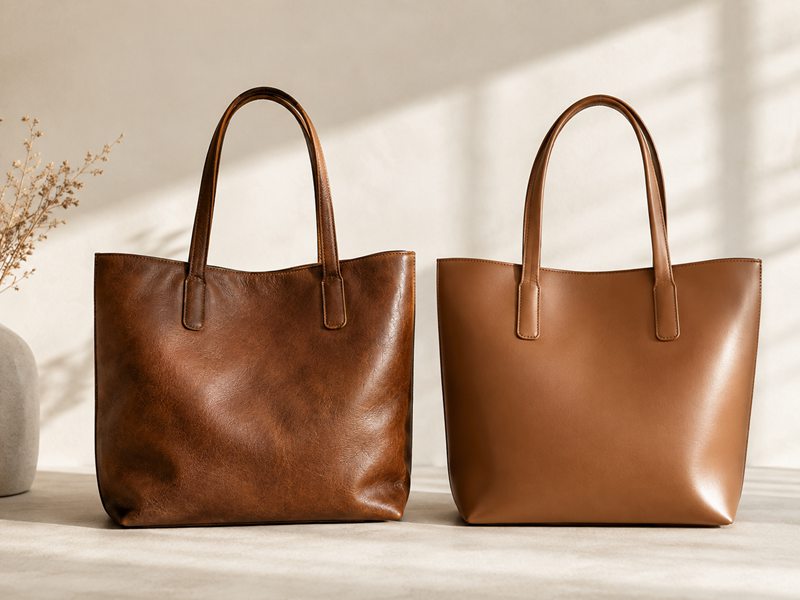
A leather tote can look convincing in photographs yet behave very differently after six months of commuting, store display, or warehouse storage. A uniform grain may come from heavily corrected animal hide or an embossed synthetic surface. A soft hand feel may come from premium calfskin, microfiber, or a well-developed PU coating. Even the familiar “genuine leather” label confirms less about performance than many people expect.
Real leather tote bags are made from tanned animal hide and normally show natural variation in grain, fibre structure, stretch, and aging. Faux leather uses a coated textile or synthetic substrate to reproduce that appearance. A reliable judgment combines the product declaration with surface, edge, backing, touch, and construction checks; when the material claim affects a large order, laboratory identification should replace destructive home tests.
For a custom project, identification is only the beginning. Leather grade, usable cutting yield, thickness, finish, handle structure, edge treatment, lining, hardware, storage conditions, and testing requirements all influence how the finished tote looks, performs, and costs. One attractive swatch can hide several costly unknowns. The real test comes when that swatch must become hundreds or thousands of consistent bags—and that is where the story gets interesting.
What Are Real and Fake Leather Tote Bags?

A real leather tote uses tanned animal hide for the declared leather components. A faux version uses a coated textile, nonwoven base, microfiber structure, or another engineered material designed to resemble leather. A counterfeit tote concerns unauthorized branding or copied commercial identity, not simply material composition. These differences affect labelling, appearance, durability, development cost, and quality control.
The word “fake” creates unnecessary confusion because it can describe either a material or a product. In material discussions, it often means PU, PVC, microfiber leather, leatherette, or another non-animal alternative. In intellectual-property discussions, it refers to an unauthorized copy of a branded product. A genuine leather tote can still be counterfeit, while an originally designed PU tote with honest labelling can be completely legitimate.
Material names also reveal less about performance than they appear to. “Genuine leather” confirms an animal-hide origin more clearly than it defines grade, finish, thickness, strength, or durability. “PU leather” identifies a broad construction category but says little about coating quality, backing, adhesion, or resistance to repeated folding. Two materials carrying the same name can perform very differently.
For a custom collection, the specification should move beyond simple names and describe what is actually required. Useful details include:
- Material composition and intended leather components
- Leather grade or synthetic construction
- Thickness and tolerance
- Surface grain and gloss
- Colour reference and shade tolerance
- Softness or stiffness
- Backing and reinforcement
- Finish adhesion and folding behaviour
- Edge treatment
- Care requirements
- Restricted-substance or testing needs
- Acceptable natural variation
The finished tote must also be evaluated as a complete structure. Outer leather, handles, lining, thread, edge paint, reinforcement, adhesives, hardware, and packaging interact with one another. A high-value hide cannot compensate for weak handle anchoring, unstable edge paint, unsuitable reinforcement, or poor storage conditions.
| Term | What it usually describes | What it does not prove |
|---|---|---|
| Genuine leather | Material derived from animal hide | Full-grain quality, durability or species |
| Full-grain leather | Hide retaining the natural grain surface | Consistent colour or defect-free cutting |
| Top-grain leather | Grain-layer leather with some surface refinement | One universal finish or performance level |
| Bonded leather | Reconstituted leather fibres with binders | Solid hide construction |
| PU leather | Polyurethane surface on a supporting base | One fixed thickness, strength or lifespan |
| PVC leather | Vinyl-based coated material | Suitability for every bag or climate |
| Microfiber leather | Engineered fine-fibre synthetic structure | Identical performance to animal hide |
| Vegan leather | Material presented as animal-free | Plastic-free or biodegradable composition |
| Counterfeit bag | Unauthorized commercial imitation | Any particular material composition |
What Does Genuine Leather Mean?
Genuine leather generally means the material is made from animal hide, but the phrase is not a complete grade specification. It does not automatically identify full-grain, top-grain, corrected-grain, split, suede, nubuck, or another leather construction. It also does not state the animal species, tanning method, finish, thickness, softness, colour stability, or usable cutting quality.
The familiar claim that genuine leather is always the “third grade” is too simplistic for international product development. Some leather businesses use it as a broad composition term, while others apply it to corrected or split material. The wording therefore needs supporting details.
A workable specification may read more like this:
“Cow leather, corrected grain, semi-matte pigmented finish, approved pebbled texture, specified thickness tolerance, matched to the signed colour swatch.”
That description provides a clearer basis for sampling and inspection than “premium genuine leather.” It also helps prevent a quotation based on one material from being fulfilled with another. Where leather composition appears on packaging or sales materials, the wording should match the actual construction and destination requirements.
Which Types of Leather Are Used for Totes?
Full-grain leather is chosen when natural texture, visible character, and long-term surface development are central to the design. Its grain variation requires careful panel placement, especially on wide tote bodies. Strict appearance requirements can reduce cutting yield and raise cost.
Top-grain and corrected-grain leathers are often selected for cleaner, more controlled surfaces. Sanding, pigmentation, embossing, and protective finishing can improve consistency, although heavy finishing may reduce the natural look expected from leather.
Split leather comes from a lower layer of the hide and commonly receives a coating or embossed face. Suede and nubuck provide soft, napped surfaces but need more attention to staining, colour variation, rubbing, and packaging contact.
Bonded leather is made from leather fibres or fragments combined with binders and a supporting structure. It should not be treated as equivalent to a solid hide panel.
The best option depends on the silhouette, panel size, intended contents, handle construction, expected wear, cleaning needs, price position, and desired consistency across repeat orders.
Is Faux Leather the Same as Fake Leather?
Faux leather is an openly described alternative created to reproduce the look or feel of animal hide. It becomes deceptive only when it is presented as genuine leather or when its composition is hidden behind misleading wording. For clear product communication, “faux,” “synthetic,” “PU,” “PVC,” or “microfiber” is preferable to the emotionally loaded word “fake.”
PU leather usually combines a polyurethane surface with woven, knitted, nonwoven, or microfiber backing. PVC material uses a vinyl-based coating and may provide firm structure, easy cleaning, and weather resistance, although weight, hand feel, flexibility, and cold performance need review. Microfiber leather uses a denser engineered base and may offer a more refined touch than basic PU.
The category name is only the beginning. Important differences include coating thickness, backing strength, finish adhesion, abrasion resistance, folding resistance, odour, hydrolysis behaviour, colour consistency, and edge performance.
A well-developed synthetic tote may suit a uniform seasonal collection better than an inconsistent hide. An unsuitable synthetic surface, however, may crack or peel at the opening, corners, handles, and folded edges.
Is a Faux Leather Tote a Counterfeit?
A faux leather tote is not automatically counterfeit. Counterfeiting concerns unauthorized trademarks, logos, protected artwork, packaging, or a product identity intended to mislead people about its commercial source. Material composition and brand authenticity are separate questions.
An original PU tote with its own proportions, hardware, colour arrangement, labels, and packaging can be a legitimate product. A copied tote made from excellent genuine leather can still violate intellectual-property rights. A copied product presented with a false leather declaration creates both branding and composition problems.
Reference products should therefore be used carefully during development. Functional features such as approximate capacity, handle drop, pocket layout, opening method, or structural firmness can help communicate a design direction. Protected logos and recognisable signature details should not be reproduced without authorization.
Useful project records include dated artwork, pattern revisions, approved logo files, authorization documents, material declarations, sample comments, and packaging approvals. These records help distinguish original development from imitation and make future repeat orders easier to control.
Which Tote Bags Are Most Often Counterfeited?
There is no dependable worldwide ranking that identifies one tote model as the single most counterfeited bag. Results vary by country, enforcement activity, retail season, online platform, resale value, and the way seized products are categorized. A model frequently copied online may not be the one most often intercepted by customs authorities.
Handbags and wallets are clearly exposed categories. US Customs and Border Protection reported 5,132,402 handbag and wallet items seized for intellectual-property infringement in fiscal year 2024, representing 15.8% of all goods seized. This shows the scale of the category without proving that one particular tote holds the top position. Current figures are available through CBP’s intellectual-property resources.
Highly recognizable products are attractive to counterfeit operations because visual details can be copied from public photographs. Distinctive shapes, hardware, monograms, packaging, and strong resale demand increase exposure.
For an original collection, identifiable proportions, custom hardware, controlled logo placement, traceable packaging, internal labels, and documented artwork can strengthen product identity without imitating protected designs.
What Is the History of Faux Leather?
Leather-like coated fabrics were developed to offer more uniform surfaces, predictable dimensions, simpler cleaning, and alternatives to natural hide. Earlier constructions relied heavily on coated cloth and vinyl-type surfaces. These materials provided consistent colour and water resistance but could feel stiff, heavy, or plastic-like.
Polyurethane systems expanded the possibilities for softer touch, greater flexibility, finer embossing, and lighter fashion applications. Improvements in release paper allowed surfaces to reproduce pebbled grain, pores, wrinkles, and matte effects more convincingly. Microfiber structures later created denser engineered bases that could feel closer to leather while maintaining controlled sheet dimensions.
Newer materials may contain recycled content, partially bio-based coatings, or plant-derived components. Such descriptions require careful reading. “Plant-based” does not necessarily mean entirely renewable, plastic-free, biodegradable, or compostable.
This development history explains why appearance and touch are no longer enough for reliable identification. Modern synthetic surfaces can look highly convincing, while heavily corrected animal leather can appear extremely uniform. Cross-section examination, material records, and appropriate testing provide stronger evidence.
How Can You Tell Real Leather from Fake?

Confirm the material declaration first, then compare the grain, cross-section, backing, flexibility, smell, finish, and behaviour of the approved swatch and finished tote. No single home check proves composition. Coated leather can look synthetic, while advanced PU or microfiber can imitate natural grain. When the claim affects a large order, use traceable samples and laboratory identification.
The most reliable approach uses several layers of evidence rather than one dramatic test. Start with the material specification, bill of materials, colour swatch, sample code, and packaging wording. Then inspect a loose cutting because its face, reverse side, thickness, and cross-section are easier to see than those of a completed tote.
Move next to the approved sample. Check whether the outer body, handles, trim, zipper pullers, base, pocket edging, and logo patch use the materials described in the specification. A tote may combine genuine leather, PU, fabric, reinforcement board, and coated edge finishes. The statement “leather tote” can become misleading if it fails to identify which visible components are actually leather.
Bulk verification should connect the incoming material to the signed sample. Record the material code, colour, lot, thickness, grain, backing, and intended component. Compare several pieces from different parts of the shipment rather than examining only the neatest sheet or hide placed on top.
The following checks are useful when interpreted together:
| Check | Genuine leather may show | Faux leather may show | Why it is not conclusive |
|---|---|---|---|
| Documentation | Leather type, grade and tannery details | PU, PVC, microfiber or synthetic description | Paperwork can be incomplete or incorrect |
| Grain | Irregular pores and subtle variation | Embossed or repeated texture | Corrected leather can be embossed |
| Touch | Warm, flexible and responsive | Uniform, cool or coating-like feel | Premium microfiber can feel natural |
| Smell | Hide, tannage, oil or wax notes | Plastic, coating or little odour | Adhesives and packaging can mask both |
| Cross-section | Dense interlocking fibre structure | Surface layer over textile backing | Edge paint may conceal construction |
| Reverse side | Fibrous flesh surface | Woven, knitted or nonwoven support | Lining may prevent access |
| Water | Possible darkening or absorption | Droplets often remain on the coating | Finished leather may repel water |
| Flexing | Fine irregular creases | Uniform folds or coating stress | Results depend on finish and thickness |
| Microscopy | Natural leather fibre structure | Engineered backing and coating layers | Test scope must match the claim |
Do Material Labels Prove Leather Content?
A label records the declared composition, but it is not independent proof. Confidence increases when the wording agrees with the quotation, purchase specification, bill of materials, approved swatch, sample record, incoming inspection documents, and physical construction.
Descriptions such as “leather feel,” “leather touch,” “premium leather texture,” or “leather-like material” do not mean animal hide. “Genuine leather” should also be supported with details such as leather type, grain treatment, finish, thickness, colour, and intended components.
Mixed-material construction needs particular care. The main body may be PU while the handles are genuine leather, or the exterior may be leather while reinforcement, lining, piping, edge coating, and internal trim are synthetic. One broad statement may hide these differences.
Material wording should be settled before labels and packaging enter production. The US Guides for Select Leather and Imitation Leather Products address misleading composition claims and the disclosure of non-leather materials that resemble leather under 16 CFR Part 24.
How Do Grain and Pores Differ?
Natural hide normally contains variation in pore size, pore spacing, wrinkles, fibre density, grain direction, and healed marks. These differences are often easier to see under angled light than under bright frontal lighting. A 10× inspection loupe can also help reveal small surface details.
Synthetic material usually receives its texture through embossing or release paper. Repeated clusters, identical pebbles, and evenly spaced pores across a large panel may indicate an engineered surface. Examine several areas rather than focusing on one convincing section.
Grain inspection still has limits. Corrected leather may be sanded, coated, and embossed until the natural surface becomes difficult to recognise. High-quality synthetic leather may use a large, varied pattern that avoids obvious repetition. A perfectly uniform grain is therefore a warning sign, not a final verdict.
For a finished tote, compare the front, back, gussets, base, handle tabs, and trim. Genuine panels should show controlled natural variation, but that variation should remain within the signed appearance standard. Natural character should not excuse loose grain, deep damage, weak areas, or uncontrolled shade differences.
Which Touch and Smell Checks Work?
Genuine leather often feels warm, slightly elastic, and responsive. When pressed, it may form fine, uneven creases around the contact area. When bent gently, the grain can change subtly as the fibres compress and extend. The response should be compared with the approved leather swatch rather than a remembered idea of how leather “should” feel.
PU may feel smoother, cooler, or more uniform. Basic material can produce a flat plastic sensation, while premium PU and microfiber may feel soft and highly convincing. Heavily pigmented animal leather can also feel coated and less natural.
Smell offers another clue but remains subjective. Leather may carry notes from tanning, oils, waxes, dyes, or finishing agents. Synthetic surfaces may smell of polymers or have very little odour. Adhesives, ink, edge paint, mould-prevention treatment, cartons, and storage conditions can dominate both.
Allow newly unpacked goods to rest in a ventilated area before judging odour. If smell matters to retail presentation, define an inspection procedure instead of relying on one person’s reaction.
Does Real Leather Absorb Water?
Unfinished or lightly finished leather may absorb a small droplet, darken temporarily, and return close to its original shade after drying. A polymer-coated surface usually causes water to bead or remain on top. This difference explains the popularity of the water test, but it does not make the test decisive.
Pigmented, patent, waxed, or protected genuine leather may resist water because the finish blocks immediate absorption. Faux material may absorb moisture through a damaged coating, exposed edge, seam hole, or textile backing. Surface behaviour therefore reflects the finish as much as the underlying composition.
Water can also stain aniline leather, alter suede nap, create tide marks, weaken edge treatment, or affect adhesives. Do not apply it casually to a finished sales sample.
During development, water behaviour should be evaluated as a performance requirement. Clarify whether the tote needs simple wipe cleaning, resistance to occasional rain, or a specified water-resistance test. Material, seams, opening design, edge construction, and workmanship all affect the result.
Are Cut Edges and Backings Different?
A clean cross-section often reveals more than the face. Solid leather contains an interlocking three-dimensional fibre network through its thickness. The grain side is usually denser, while the flesh side shows a more open fibrous structure. Variations depend on the hide, splitting, sanding, backing, and finish.
PU and PVC usually show separate layers: a surface coating, an intermediate layer where applicable, and a woven, knitted, nonwoven, or microfiber base. A basic synthetic sheet may reveal this construction clearly when cut. Microfiber can look more fibrous and requires closer inspection.
Bonded leather presents another structure. Leather fibres or fragments are combined with binders and may be supported by another layer. It should not be mistaken for an intact hide panel.
Finished totes often conceal these clues through folded edges, piping, binding, lining, or edge paint. Retain a loose cutting from the approved material and another traceable cutting from the production lot. Comparing these samples is more reliable than scraping or damaging an expensive finished bag.
Is the Burn Test Safe?
The burn test is not suitable for finished totes and should not be performed casually in an office, showroom, warehouse, or home. It permanently damages the material and can release unpleasant or hazardous fumes from polymer coatings, pigments, adhesives, edge paint, backing fabrics, foam, thread, or protective finishes.
The popular rule says animal leather chars and smells like burnt hair, while synthetic material melts and smells like plastic. A completed bag is rarely made from one substance, so the result can be confusing. A genuine leather panel may have a polymer finish and adhesive backing; PU may be laminated to cotton or polyester. Both can produce mixed reactions.
Burning an approved sample also destroys an important production reference. Documentation review, loose-cutting inspection, cross-section analysis, and microscopy provide safer evidence. Fire may create a striking demonstration, but it does not create a dependable material-control record.
When Is Lab Testing Needed?
Laboratory identification is appropriate when composition affects product claims, price, contractual terms, customs information, retail labelling, or a substantial production commitment. It is also useful when documentation conflicts with physical inspection or when coated, bonded, laminated, and microfiber structures cannot be identified confidently.
ISO 17131:2020 specifies microscopy for identifying leather and distinguishing it from other materials. Its limitation is important: the method identifies whether the sample is leather but is not designed to determine a specific animal species.
The submitted piece should come from the actual material lot and remain traceable to colour, batch, product code, date, and intended component. A showroom swatch from another lot cannot verify the goods being cut.
Testing plans should also distinguish identity from performance. Microscopy may establish leather composition, while separate methods may be needed for rubbing colourfastness, flex resistance, abrasion, finish adhesion, stitch tear, water spotting, or restricted substances. The required tests should reflect the tote’s use and destination rather than an unrelated generic checklist.
Which Leather Type Is Best for Tote Bags?

The best leather depends on the tote’s shape, load, daily use, surface appearance, care conditions, production volume, and price position. Genuine leather suits designs built around natural character and aging. PU supports colour consistency and controlled cost. Microfiber offers a refined synthetic option when stronger hand feel, structure, and durability are needed.
A material should not be selected from appearance alone. A soft hide may look beautiful on a swatch but collapse when used on a large work tote. A thick leather may feel luxurious yet make the finished bag uncomfortably heavy. A firm PU may hold a structured silhouette but show coating stress where the top edge folds repeatedly.
Begin with the finished product rather than the material name. Define the intended contents, finished dimensions, empty weight, handle drop, closure, internal layout, expected use frequency, cleaning conditions, and desired appearance after wear. These details reveal whether the tote needs softness, rigidity, low weight, uniformity, natural variation, abrasion resistance, or simple maintenance.
The outer surface is only one part of the structure. Lining, backing, foam, reinforcement board, handle cores, adhesives, edge paint, thread, and hardware influence how the tote feels and performs. A premium hide cannot compensate for weak handle anchoring or an unsuitable base. Likewise, a well-engineered synthetic material can produce a strong product when its construction is properly developed.
| Selection factor | Genuine leather | Standard PU | Microfiber leather |
|---|---|---|---|
| Surface character | Natural and individually varied | Controlled embossed texture | Controlled with a more leather-like feel |
| Colour consistency | Requires shade management | Easier to repeat | Easier to repeat |
| Large-panel cutting | More difficult | Predictable roll or sheet cutting | Predictable roll or sheet cutting |
| Natural aging | May develop patina | Coating wears rather than patinates | Surface wears rather than patinates |
| Cleaning | Depends strongly on finish | Usually easy to wipe | Usually easy to wipe |
| Cutting loss | Often higher | More predictable | More predictable |
| Weight control | Depends on hide and thickness | Easier to engineer | Easier to engineer |
| Cost position | Usually higher | Usually lower | Often above standard PU |
| Main inspection focus | Grade, grain, colour and yield | Coating, backing, adhesion and flexing | Fibre base, surface strength and flexing |
| Best visual use | Natural premium character | Uniform fashion colours | Refined leather-like appearance |
How Do Leather Grades Compare?
Full-grain leather retains the natural grain surface. It may display pores, wrinkles, healed marks, and differences between sections of the hide. This character can support a premium design, but wide tote panels require careful placement. Strict appearance requirements reduce usable cutting area and increase material consumption.
Top-grain leather is taken from the grain layer but may receive light correction for a cleaner surface. Corrected-grain leather undergoes more sanding, pigmentation, embossing, or protective finishing. It can provide greater visual consistency than a highly natural hide.
Split leather comes from a lower layer and normally needs a coating or embossed finish to create its visible face. Suede and nubuck have napped surfaces that require more attention to staining, rubbing, moisture, and packaging contact. Bonded leather uses reconstituted leather fibres with binders and should not be treated as solid hide.
Grade names do not prove performance. Tannage, thickness, fibre strength, finish adhesion, colourfastness, cutting position, and workmanship still need confirmation.
Genuine Leather vs. PU vs. Microfiber: Which Is Better?
Genuine leather is a strong choice when natural texture, tactile depth, individual variation, and long-term surface development support the product identity. Its fibre structure can provide good strength, but large clean panels cost more because hides are irregular and contain areas that may not meet the approved appearance.
PU combines a polyurethane surface with woven, knitted, nonwoven, or engineered backing. It offers broad colour choices, consistent grain, predictable dimensions, and easier coordination across multiple products. Its performance depends on coating quality, thickness, base material, adhesion, abrasion resistance, and behaviour under heat and humidity.
Microfiber leather uses a dense fine-fibre base designed to reproduce some structural qualities of animal hide. It may provide better hand feel, tear strength, flexing performance, and shape retention than basic PU, though the exact material must still be tested.
The useful comparison is not natural against artificial. It is one approved material against another under the tote’s actual conditions. A strong microfiber can outperform weak split leather, while a suitable genuine hide may age more gracefully than either synthetic choice.
Which Material Lasts Longer?
No material name provides a reliable lifespan on its own. Genuine leather can remain attractive for many years when the hide, tannage, finish, construction, use, storage, and care are suitable. It can also stain, stretch, dry, crack, transfer colour, or lose shape when those conditions are poorly matched.
PU wear often appears as surface cracking, coating loss, peeling, delamination, or damage around repeated folds. Heat and humidity may accelerate deterioration in unsuitable formulations. Premium PU can perform well, while low-cost material may fail quickly even when it looks good during sampling.
Microfiber may offer improved flexing, tear strength, and surface support, but the coating still determines much of its visible aging.
Durability should be measured through suitable methods. Relevant evaluations may include flex resistance, rubbing colourfastness, abrasion, finish adhesion, stitch tear, and water spotting. ISO methods include ISO 5402 for flex resistance, ISO 11640 for rubbing, ISO 17076 for abrasion, ISO 11644 for finish adhesion, and ISO 23910 for stitch tear. Acceptance values should reflect the tote’s actual use.
Which Material Is Easier to Maintain?
Smooth PU and microfiber surfaces are generally easier to wipe because their coatings resist immediate absorption. This makes them practical for work totes, beauty-related collections, travel accessories, gift sets, and light-coloured seasonal products. Mild cleaning is usually possible, but alcohol, strong solvents, high heat, and abrasive rubbing can damage the coating.
Genuine leather care depends on its finish. Pigmented leather may tolerate gentle wiping, while aniline leather can absorb oil, rain, cosmetics, and colour transfer more readily. Suede and nubuck require specialised cleaning because liquids and friction can change the nap.
Care instructions should be developed with the material rather than written at the end. Consider how the tote will be used:
- Will it be placed on office floors or public transport?
- Will cosmetics or pens be carried inside?
- Is rain exposure likely?
- Will light-coloured clothing contact a dark surface?
- Will the product be stored in a warm vehicle?
- Could cartons remain in humid storage?
The approved care wording should identify safe cleaning, drying, storage shape, unsuitable chemicals, and precautions against sunlight, humidity, and colour transfer.
Are Natural Marks Quality Defects?
Natural marks are not automatically defects, but they require an agreed appearance standard. Fine pores, wrinkles, healed scars, grain variation, and slight colour differences may form part of the intended character. Deep cuts, open damage, weak sections, loose grain, severe shade change, or prominent marks in focal areas may be unacceptable.
Large tote panels make variation more visible than small wallets or card holders. A mark that disappears within a small component may dominate the front of a 40 cm tote. Panel location must therefore be considered during material grading.
A practical method divides the pattern into appearance zones:
| Product area | Suggested appearance control |
|---|---|
| Front body | Strictest grain and colour selection |
| Back body | High consistency with limited natural variation |
| Gussets | Moderate variation may be acceptable |
| Base | Appearance and abrasion both matter |
| Handles | Grain, strength and thickness must remain balanced |
| Interior facings | Minor visual variation may be acceptable |
| Hidden reinforcement | Strength matters more than surface appearance |
Physical defect samples and photographs should show acceptable, conditional, and rejected examples. A vague instruction such as “natural defects allowed” creates inconsistent cutting and inspection.
Why Does Tote Structure Affect Material Choice?
A slouchy tote needs material that drapes smoothly without producing harsh creases. A structured work tote requires enough body to remain upright, yet excessive stiffness can make the opening uncomfortable and create bulky seams. A foldable tote needs repeated bending resistance, while a large carryall depends more heavily on tear strength and reinforced handle attachments.
Panel size changes how the same material behaves. A leather suitable for a small handbag may become too heavy across a large tote. Wide uninterrupted panels also expose grain and shade differences more clearly. Deep gussets and tight curves can be difficult to sew with thick material.
Construction can adjust these characteristics. Backing, foam, lining, base boards, and laminated reinforcement can add shape without relying entirely on thick leather. Skiving reduces seam bulk, although excessive thinning can weaken handle tabs, top edges, and corners.
Material changes made after pattern approval may alter finished dimensions, weight, stitching, edge quality, and balance. Pattern, leather, reinforcement, and workmanship should be developed together.
Who Should Choose Each Material?
Genuine leather is well suited to premium lifestyle collections, executive work totes, high-value gifts, and designs where natural texture and individual character are part of the appeal. It requires acceptance of controlled variation and more careful handling of colour, grain, cutting yield, edge finishing, and storage.
PU works well for fashion colours, beauty collections, coordinated gift sets, seasonal launches, and projects requiring uniform surfaces. It also supports embossed textures, metallic finishes, printed effects, and easy-clean surfaces. Coating quality and repeated-fold performance must be checked carefully.
Microfiber is appropriate when a refined synthetic option is needed for work totes, structured fashion bags, wallets, or coordinated accessory lines. It can provide stronger hand feel and structure than standard PU while maintaining controlled colour and cutting dimensions.
Animal-free positioning requires more than choosing a synthetic outer surface. Adhesives, trims, labels, handle components, coatings, and packaging claims may also need review. Terms such as plant-based or bio-based should be supported by clear composition information rather than visual appearance alone.
Why Do Leather Tote Bag Prices Differ?
Two leather totes with similar dimensions can carry very different prices. The difference usually comes from the leather specification, cutting yield, structure, workmanship, hardware, interior details, order quantity, color split, testing, packaging, and delivery terms. “Genuine leather” alone is not enough for an accurate quotation because hides bearing that description can differ greatly in usable area, thickness, finish, appearance, and performance.
Leather Specification
Leather should never be priced from a material name alone. A workable specification normally identifies the animal source, leather layer, tanning method, surface treatment, thickness, temper, grain appearance, color, and acceptance standard for natural marks.
Full-grain cowhide retains more of the original grain surface. Top-grain leather may be lightly corrected to improve visual consistency. Heavily corrected leather has a more uniform coated surface, while split leather comes from a lower layer of the hide and may receive a film or embossed finish. Bonded leather contains reconstituted leather fibers and should be identified separately rather than grouped with intact hide leather.
Even within the same category, cost can change considerably. A soft, drum-dyed cowhide with an aniline-style finish behaves differently from a firmer coated cowhide designed to resist scratches. One may require careful shade matching and selective cutting; the other may offer a more consistent surface and better material utilization.
| Leather detail | What should be specified | Why it affects cost |
|---|---|---|
| Material type | Cowhide, calfskin, sheepskin, split leather | Hide size, strength, feel, and availability differ |
| Surface grade | Natural grain, lightly corrected, heavily corrected | Cleaner surfaces usually allow fewer visible defects |
| Tanning | Chrome-tanned, vegetable-tanned, combination-tanned | Processing time, feel, color, and aging behavior differ |
| Finish | Aniline-style, semi-aniline, pigmented, waxed, embossed | Coating and finishing processes affect appearance and consistency |
| Thickness | For example, 1.2–1.4 mm | Thicker or tightly controlled material may require more selection |
| Temper | Soft, medium, firm | Influences structure, cutting, skiving, and reinforcement |
| Appearance | Matte, glossy, pebbled, smooth | Smooth surfaces reveal marks more easily |
| Natural marks | Accepted, limited, or excluded on visible panels | Stricter visual standards reduce usable hide area |
A quotation that says only “100% genuine leather” leaves too much open to interpretation. It may conceal important differences in grade, coating, backing, thickness, and visible-panel quality.
Cutting Yield
Leather is usually costed by area, but not every part of a hide can become part of a tote. The outline is irregular, and the surface may contain scars, loose grain, wrinkles, holes, shade variation, or softer sections. Pattern shape also matters: large front and back panels are harder to place than small tabs and trims.
A practical calculation is:
Usable cutting yield = net pattern area ÷ leather area allocated
Consider two totes that each contain 3.0 square feet of finished shell components:
| Cutting condition | Net leather in one tote | Cutting yield | Leather allocated per tote |
|---|---|---|---|
| Efficient placement with moderate mark acceptance | 3.0 sq. ft. | 75% | 4.0 sq. ft. |
| Large clean panels with strict mark limits | 3.0 sq. ft. | 60% | 5.0 sq. ft. |
The second version consumes 25% more leather, even though the finished dimensions are identical. Across 500 pieces, that difference becomes 500 additional square feet of allocated leather.
Yield can fall when a design requires:
- One-piece front and back panels
- Precise grain matching
- Very smooth leather
- Light colors that expose stains or scars
- Tight shade consistency
- Directional embossing
- Symmetrical natural grain
- Long handles cut from selected sections
- Few visible natural marks
A lower leather rate per square foot does not always produce the lower tote cost. Material with uneven coating, inconsistent thickness, or excessive surface defects may create more cutting waste. A sound quotation therefore considers both the leather rate and the expected cutting yield.
Size and Structure
Larger dimensions increase leather consumption, but size affects more than surface area. An oversized tote may require wider unbroken panels, heavier reinforcement, stronger handles, and more support around the base.
The gusset depth is especially important. Increasing the depth adds leather to the side panels and base while also increasing the capacity and expected load. A tote designed for a laptop, documents, or daily commuting usually needs more structural support than a lightweight fashion tote.
Thickness also changes how the bag must be handled. A soft 1.0 mm leather may need reinforcement to hold a clean silhouette. A firm 1.6 mm leather may stand well on its own but require skiving at seams, folded edges, handle attachments, and zipper areas. Leather is often sold by area rather than weight, so thicker material does not translate into a simple percentage increase. Hide selection, splitting accuracy, sewing difficulty, and edge treatment must also be considered.
Structural materials can include:
- Baseboard
- Foam
- Nonwoven backing
- Fabric reinforcement
- Handle cores
- Leather board
- Zipper support tape
- Corner reinforcement
These components may be hidden after assembly, yet they influence shape retention, handle strength, seam stability, and long-term appearance.
Construction and Workmanship
A simple open-top tote with unlined construction requires fewer operations than a fully lined version with a recessed zipper, multiple compartments, painted edges, reinforced handles, and a structured base.
Edge construction is one of the clearest cost differences.
A raw-cut edge may need accurate cutting and light finishing. A folded edge requires skiving, adhesive application, folding, alignment, and stitching. A painted edge may require a base coat, drying, sanding, color coats, correction, and a protective topcoat. Wide handles and curved openings demand particularly steady application because uneven paint is easy to see.
Stitching cost also depends on more than seam length. Small curves, narrow tabs, thick intersections, contrast thread, and strict stitch alignment slow the operation. If the design uses visible stitching on smooth leather, minor deviations become more noticeable.
| Construction choice | Work involved | Relative cost effect |
|---|---|---|
| Unlined, open top | Fewer components and assembly steps | Lower |
| Drop-in lining | Lining cutting, pocket work, and attachment | Moderate |
| Recessed zipper closure | Zipper frame, alignment, end finishing | Moderate to high |
| Folded leather edges | Skiving, adhesive, folding, and stitching | Moderate |
| Multi-layer edge paint | Coating, drying, sanding, and correction | Moderate to high |
| Structured body | Reinforcement placement and shape control | High |
| Multiple compartments | Extra patterns, zippers, seams, and lining work | High |
Two totes can look almost identical in photographs while differing significantly inside the seams. A useful sample review should examine edge layers, reinforcement placement, seam allowances, stress areas, lining attachment, and handle construction—not only the exterior.
Hardware and Branding
Hardware can be a small visual feature with a large effect on cost. A plain stock D-ring is very different from a custom logo clasp with its own mold, polished surface, selected plating color, and durability requirements.
Hardware cost is influenced by:
- Base metal
- Component weight
- Wall thickness
- Plating process
- Surface polish
- Color consistency
- Logo engraving
- Custom mold requirements
- Pull-strength expectations
- Corrosion-resistance requirements
- Quantity per bag
Zippers also require a complete specification. Coil, molded plastic, and metal zippers have different costs and performance characteristics. Tape color, tooth finish, slider type, puller design, end stops, and zipper length all affect the result.
Custom metal logos, zipper pullers, buckles, and feet often involve a one-time tooling charge in addition to the unit cost. Small order quantities carry a higher allocated tooling cost per tote. Using an existing hardware shape with laser engraving or a small embossed leather patch can reduce early-stage spending without making the design look unfinished.
Logo methods create further differences. Blind embossing usually needs a logo die and suitable leather. Foil stamping adds foil selection and application control. A metal plaque introduces hardware, attachment components, and surface protection. Embroidery is more suitable for lining or textile sections than for many thick leather constructions.
Lining and Interior Details
The interior is often underestimated during early costing. An unlined tote may expose the flesh side of the leather and internal seams, while a lined version requires additional patterns, materials, sewing, pressing, and inspection.
A complete interior specification should state:
- Lining material and weight
- Lining color
- Number and size of pockets
- Zippered or open pockets
- Laptop sleeve requirements
- Key strap or bottle holder
- Binding method
- Interior logo treatment
- Leather or textile pocket trim
- Base reinforcement
- Care-label placement
A single zip pocket involves more than one rectangular piece. It may need the pocket bag, zipper, slider, leather trim, reinforcement, logo patch, and several sewing operations. Adding two compartments can change the internal construction substantially, even if the exterior remains untouched.
Light-colored lining may also require cleaner handling and closer inspection. Printed fabric needs artwork control, color approval, and repeat alignment. Leather lining offers a premium feel but adds weight, material consumption, and more difficult assembly.
Order Volume and Color Split
Order quantity affects how pattern preparation, equipment adjustment, cutting setup, logo tooling, material procurement, sample development, and inspection are distributed across each piece.
Total quantity alone can be misleading. One thousand black totes are more efficient than one thousand totes divided into five colors, especially when each shade requires separate leather lots, thread, edge paint, lining, zipper tape, and hardware finishes.
For Jundong custom bag projects, 500 pieces per design is the usual starting quantity. Selected simple styles may be assessed at 200–300 pieces, depending on materials and construction. Feasibility also depends on the quantity assigned to each color rather than only the combined total.
Consider the difference:
| Order structure | Total pieces | Color quantity | Operational effect |
|---|---|---|---|
| One design, one color | 1,000 | 1,000 per color | Fewer material changes and approvals |
| One design, four colors | 1,000 | 250 per color | Four leather colors and more setup work |
| Two designs, four colors each | 1,000 | 125 per design/color | More patterns, approvals, and material fragmentation |
More colors can also leave small quantities of unused leather, lining, thread, and edge paint. If the material mill sets a minimum for each color, low color quantities may require the project to absorb the unused balance.
For a useful cost comparison, the quotation should show quantity per design and per color.
Sampling, Tooling, and Testing
Development costs should be separated from the recurring unit cost. This makes it easier to see which expenses occur once and which continue throughout production.
A sample may require pattern development, trial cutting, leather selection, logo setup, hardware sourcing, sewing, edge finishing, and revisions. Standard samples at Jundong are usually completed in 5–7 days after the required materials and specifications are confirmed. Simple versions may take 2–3 days, while custom hardware, unusual leather, complex logos, special packaging, or repeated revisions require more time.
Sample charges may be deducted when the confirmed production quantity reaches 2,000 pieces. The applicable arrangement should be written into the quotation rather than assumed.
Testing can also change cost. Depending on the intended use and destination, a project may require checks for:
- Colorfastness
- Abrasion resistance
- Seam strength
- Handle attachment strength
- Zipper performance
- Hardware pull strength
- Coating adhesion
- Material composition
- Restricted substances
- Carton durability
A test may apply to one material, one color, or the complete tote. Changing leather color, hardware plating, lining print, or edge paint may require additional verification. Testing requirements should therefore be confirmed before the commercial order, not introduced after materials have been prepared.
Quality Requirements
Stricter acceptance standards often increase material usage and inspection time. This is particularly true for natural leather because every hide has individual grain, shade, and surface characteristics.
If a brand permits small healed scars on the gusset but excludes them from the front panel, cutting can be planned accordingly. If every visible panel must have nearly identical grain and shade, more hide area may be rejected or redirected to hidden components.
The specification should define:
| Inspection item | Required agreement |
|---|---|
| Natural marks | Which marks are accepted and where they may appear |
| Shade variation | Acceptable difference within one tote and between pieces |
| Grain variation | Natural variation allowed or tightly matched |
| Dimensions | Measurement method and tolerance |
| Handle length | Finished drop and tolerance |
| Stitching | Thread color, stitch density, alignment, and loose-thread limits |
| Edge paint | Color, smoothness, layer coverage, and cracking limits |
| Logo | Position, size, depth, color, and alignment |
| Hardware | Finish, function, scratches, and color consistency |
| Load performance | Test weight, duration, and pass criteria |
| Packaging | Shape, protection, labels, and carton arrangement |
A lower quotation may reflect wider acceptance limits rather than better efficiency. Visual approval samples and written tolerances help prevent this difference from appearing only during inspection.
Packaging and Delivery
Packaging can be minimal or highly presentation-focused. A basic protective setup may include tissue, a dust bag or protective sleeve, a polybag, and an export carton. A presentation set may add a shaped insert, branded dust bag, care card, hangtag, gift box, tissue seal, ribbon, barcode label, and individual shipping carton.
Structured totes often need internal stuffing to prevent collapse. Metal logos and clasps may need protective film. Light leather may require additional wrapping to reduce color transfer and surface rubbing.
Packaging also affects freight. A tote shipped flat occupies less carton space than one packed upright with full stuffing. Gift boxes can increase shipment volume even when the net bag weight stays the same.
Before comparing prices, confirm whether each quotation includes:
- Individual packaging
- Branded dust bag
- Stuffing materials
- Hangtags and care cards
- Barcode or carton labels
- Gift box
- Master carton
- Export handling
- Freight
- Duties and taxes
The trade term and destination must be identical. An ex-factory figure cannot be compared directly with a delivered figure that includes international freight, customs handling, and local delivery.
Quotation Comparison
A reliable comparison requires every production partner to cost the same approved specification. If one quotation includes full-grain cowhide, custom-plated hardware, a cotton lining, load testing, and branded gift packaging while another lists only “genuine leather tote,” the totals do not represent the same product.
Use the following fields when reviewing quotations:
| Cost field | Details that should appear |
|---|---|
| Leather | Type, layer, thickness, finish, color, and visible-panel grade |
| Consumption | Net pattern area and cutting-yield assumption |
| Construction | Dimensions, closure, edge method, reinforcement, and compartments |
| Hardware | Base metal, finish, size, logo, zipper type, and quantity |
| Branding | Embossing, foil, metal logo, print, or embroidery |
| Interior | Lining, pockets, dividers, labels, and trims |
| Quantity | Pieces per design and per color |
| Development | Samples, revisions, dies, molds, and tooling |
| Verification | Agreed material and performance tests |
| Packaging | Every individual and carton component |
| Commercial basis | Currency, trade term, destination, and quotation validity |
| Schedule | Sample time, material preparation, and production time |
When two totals differ, request a cost bridge showing which specification creates the difference. The most useful explanation is not “better quality”; it is a measurable distinction such as leather grade, allocated square feet, edge-finishing method, hardware material, or pocket construction.
Cost Control Without Losing Value
The safest cost reduction protects the features that shoppers touch, see, and depend on. Replacing the main leather without checking feel, aging, flexing, and color stability can weaken the product identity. Smaller design adjustments are often more effective.
Possible changes include simplifying hidden seams, reducing unnecessary panel divisions, using an existing hardware form, combining color quantities, limiting custom plating, simplifying the interior, or choosing protective packaging that uses less shipping volume.
Material changes should remain clearly described. If the exterior body is genuine leather but selected trim or interior sections use another material, the composition should state that accurately.
Do not remove reinforcement from handles, base corners, zipper ends, or other high-stress areas merely to reduce the unit cost. Those savings are rarely worthwhile if the tote loses shape, the handles stretch, or seams begin to open during regular use.
A well-built quotation connects every price difference to a visible feature, measurable specification, construction operation, or commercial condition. Once those details are aligned, the brand can choose where to invest—and where to simplify—without guessing what has been removed.
How Does a Factory Develop a Custom Leather Tote?

A factory develops a custom leather tote by turning the brand concept into measurable specifications, selecting suitable leather, engineering the patterns, building and testing samples, approving a sealed reference, and controlling bulk production against the same standards. Strong development work covers appearance, capacity, carrying comfort, load strength, stitching, edge finishing, hardware, branding, packaging, cost, and delivery time—not merely the exterior shape.
Product Brief
Development begins with how the tote will actually be used. A work tote carrying a laptop, charger, documents, and water bottle needs a different structure from a soft fashion tote intended for light personal items. A promotional leather tote may prioritize a visible logo and controlled cost, while a premium retail style may need carefully matched grain, custom-plated hardware, and detailed edge painting.
The initial brief should define the intended user, use occasion, carrying method, expected contents, desired silhouette, opening style, interior organization, unit cost target, order quantity, number of colors, launch date, and destination.
| Development item | Information to confirm | Why it matters |
|---|---|---|
| Intended use | Work, travel, shopping, fashion, gifting | Determines capacity and structure |
| Main contents | Laptop, documents, bottle, cosmetics, daily items | Guides dimensions and pocket layout |
| Carrying method | Hand, forearm, shoulder, detachable strap | Controls handle drop and attachment strength |
| Desired shape | Soft, semi-structured, rigid | Affects leather temper and reinforcement |
| Closure | Open top, magnetic snap, zipper, drawstring | Changes security, access, and assembly |
| Exterior style | Minimal, paneled, gusseted, folded, reversible | Influences leather yield and workmanship |
| Interior | Unlined, lined, pockets, divider, laptop sleeve | Changes materials and assembly time |
| Branding | Embossing, foil, metal plaque, print | Requires suitable leather and tooling |
| Quantity | Pieces per design and per color | Affects material preparation and unit cost |
| Packing | Dust bag, gift box, hangtag, barcode | Affects protection and shipment volume |
A useful brief does not need to be highly technical. Reference photos, sketches, an existing bag, a list of required features, and target dimensions can provide a practical starting base.
Technical Specifications
The concept is converted into a technical pack with front, back, side, base, and interior views. Every important dimension should be measurable on the finished tote.
The specification normally includes:
- Finished width, height, and depth
- Top-opening width
- Base dimensions
- Handle length, width, drop, and spacing
- Detachable strap length and adjustment
- Pocket dimensions and positions
- Zipper length and opening direction
- Logo size and placement
- Hardware size and finish
- Leather thickness and surface
- Lining material and color
- Reinforcement locations
- Stitching and edge-finishing methods
- Packaging components
- Measurement tolerances
The measuring method also needs to be clear. A soft tote can produce different readings depending on whether it is measured flat, standing, lightly filled, or pulled taut. Photographs showing the measuring position help prevent disputes later.
Capacity should be checked through real objects rather than dimensions alone. If the tote is designed for a 15-inch laptop, the laptop sleeve must accommodate the device thickness as well as its length and width. The top opening must also be large enough for the laptop to enter without scraping the zipper or stressing the side seams.
Leather Selection
Leather selection should balance appearance, hand feel, structure, durability, cutting efficiency, and cost. The same design may behave very differently in soft pebbled cowhide, firm vegetable-tanned leather, smooth corrected-grain leather, or lightweight sheepskin.
A usable leather specification identifies:
- Animal source
- Grain or split layer
- Tanning method
- Surface finish
- Embossed or natural texture
- Finished thickness
- Softness or firmness
- Gloss level
- Color
- Backside treatment
- Natural-mark acceptance
- Colorfastness expectations
- Required chemical or composition testing
A physical swatch is more dependable than a color shown on a monitor. Ideally, the approved swatch should be large enough to show grain, shade movement, surface coating, and touch. Small swatches can hide variations that become obvious across a large tote panel.
Thickness should be measured with a gauge at several locations. Natural leather is rarely identical throughout an entire hide. A nominal specification such as 1.2–1.4 mm gives the workshop a measurable acceptance limit while allowing realistic material variation.
Flex the swatch repeatedly, rub it with dry and damp cloths, inspect the grain under angled light, and check how easily the surface scratches. A material that looks beautiful while flat may wrinkle heavily around a curved gusset or show whitening along folded edges.
If genuine leather is combined with PU trim, microfiber lining, or bonded leather reinforcement, each material should be identified accurately. Mixed construction may be completely suitable, but the description should never imply that every visible and hidden component is intact hide leather.
Pattern Engineering
A leather tote pattern includes much more than the visible front and back panels. It also covers gussets, base pieces, handles, tabs, pocket parts, zipper frames, facings, reinforcements, lining sections, seam allowances, fold lines, skiving zones, and edge-paint allowances.
The pattern maker must consider how leather behaves during folding, sewing, stretching, and edge finishing. Thick intersections can become bulky where handles meet the upper facing. Curved zipper openings may ripple if the leather is too firm. A soft base may sag unless the reinforcement extends far enough toward the corners.
Large one-piece panels create a clean appearance but need larger defect-free areas of hide. Dividing the body into smaller panels may improve material utilization, yet it introduces more seams and changes the visual character. The right choice depends on whether uninterrupted grain or controlled cost is more important.
Handle patterns deserve special attention. Long handles cut in a weak direction may stretch. The structure may therefore include a non-stretch core, folded leather layers, reinforcement tape, edge paint, and reinforced attachment patches. Skiving must reduce bulk without making the attachment zone too thin.
Before cutting selected leather, the team may use paper patterns or trial material to confirm proportions, openings, pocket access, and assembly order. The actual sample must still be made in the intended leather because substitute materials cannot reproduce its exact stretch, thickness, grain, or folding behavior.
Carrying Comfort
Handle drop determines whether the tote sits comfortably in the hand, on the forearm, or over the shoulder. Body depth, clothing thickness, and the position of the top opening also affect comfort.
The following dimensions are useful starting references rather than fixed rules:
| Carrying style | Common handle drop | Development consideration |
|---|---|---|
| Hand carry | 10–15 cm | Compact appearance but limited arm clearance |
| Forearm carry | 16–22 cm | Needs smooth edges and balanced handle spacing |
| Shoulder carry | 24–32 cm | Must allow for outerwear and a filled bag body |
| Adjustable strap | Defined by shortest and longest setting | Hardware and attachment zones carry more force |
A narrow leather handle can look elegant but may press into the shoulder when the tote is full. A very wide handle spreads the load better but may feel bulky. The correct width depends on intended weight, leather softness, handle construction, and styling.
Balance should be tested with realistic contents. If the handles are positioned too close together, the tote may tip outward. If they are too far apart, the opening may distort. A laptop compartment placed on one side can also pull the body out of balance.
If the intended working load is 8 kg, the approval record should define the test weight, carrying duration, lifting cycles, and acceptable result. “Strong handles” is not a measurable requirement. A useful acceptance rule checks whether the attachments tear, stitches open, handles stretch excessively, hardware bends, or the body becomes permanently distorted.
Hardware and Branding
Hardware selection takes place early because its size affects the pattern. A zipper slider, magnetic snap, D-ring, buckle, rivet, bag foot, and detachable hook all need suitable reinforcement and installation space.
The specification should identify the base metal, dimensions, weight, plating color, surface texture, logo treatment, and functional requirements. A visual name such as “gold hardware” is not precise enough. Pale gold, champagne gold, bright gold, and antique brass can look noticeably different beside leather.
Custom hardware may require drawings, three-dimensional files, a mold, prototype pieces, plating approval, and functional testing. Stock hardware can shorten development and avoid tooling, but dimensions and finish still need approval before pattern completion.
Logo application must suit the chosen leather:
- Blind embossing works well when the surface holds a clear impression.
- Foil stamping adds color but needs controlled heat, pressure, and adhesion.
- A metal plaque creates stronger visibility but adds weight and attachment work.
- Screen printing suits certain coated surfaces but should be checked for adhesion.
- Embroidery is usually more practical on textile lining, patches, or selected soft panels.
An embossing sample should confirm logo width, depth, position, orientation, and clarity. Deep embossing on thin or soft leather may distort the panel, while a shallow mark may disappear in heavily pebbled grain.
First Sample
The first leather sample checks whether the concept works as a physical product. It should reveal proportion, capacity, carrying comfort, structure, leather behavior, pocket access, closure operation, logo appearance, and likely production difficulty.
At Jundong, a standard bag sample is usually completed within 5–7 days after the materials and specifications are confirmed. A simple tote may take 2–3 days. Complex leather, special colors, custom hardware, detailed logos, gift packaging, or unusual construction may extend development to approximately 7–15 days.
The first sample may expose issues that were difficult to see in a drawing. Common examples include:
- The opening is too narrow for the intended contents.
- The handle drop is uncomfortable over a coat.
- The tote collapses when placed on a table.
- The baseboard creates a visible ridge.
- A magnetic snap is difficult to close when the bag is full.
- The lining pulls the exterior inward.
- The zipper ends look bulky.
- The logo is lost in the grain.
- Edge paint cracks around tight curves.
- Hardware feels too heavy for the leather.
The purpose of the first sample is not to prove that no changes are needed. It is to discover necessary changes before leather and components are prepared for the full order.
Sample Review
Review should follow a fixed sequence so visible styling does not distract from functional problems.
| Review area | What to inspect |
|---|---|
| Dimensions | Width, height, depth, opening, base, handles, pockets |
| Capacity | Fit of intended objects and ease of insertion |
| Comfort | Handle grip, shoulder clearance, balance, total weight |
| Shape | Standing stability, side profile, base sagging, corner shape |
| Leather | Grain, shade, thickness, touch, scratching, folding behavior |
| Construction | Seam alignment, bulk, reinforcement, lining attachment |
| Stitching | Straightness, density, backstitching, skipped stitches |
| Edge finish | Smoothness, paint coverage, cracking, color consistency |
| Closure | Zipper movement, snap alignment, opening access |
| Hardware | Function, scratches, plating, noise, attachment strength |
| Branding | Size, depth, clarity, color, alignment |
| Packing | Shape protection, hardware protection, presentation |
Feedback should be measurable. “Make the handles longer” is open to interpretation. “Increase finished handle drop from 23 cm to 27 cm” gives the pattern maker a clear instruction.
Photographs should show the exact location of each adjustment. A consolidated revision file is more reliable than scattered messages because it reduces conflicting instructions. Each item can be marked as approved, revised, removed, or pending confirmation.
Revision Control
A revised sample should focus on agreed changes while preserving approved features. Without revision control, improving one area can unintentionally alter another. Increasing gusset depth may affect the zipper length, lining pattern, baseboard, capacity, leather consumption, and carton dimensions.
Each revision should record:
- Sample version
- Date
- Requested change
- Old specification
- New specification
- Reason for change
- Cost effect
- Schedule effect
- Approval status
Changes should be grouped before the next sample begins. Repeated single-item modifications consume more time and can make it difficult to identify which version contains the correct combination of features.
When appearance and function are approved, a sealed sample is signed or otherwise identified as the production reference. However, the sealed piece should work together with the technical pack, material swatches, hardware sample, logo artwork, and packaging specification. One physical tote cannot document every allowable tolerance or hidden component.
Pre-Production Approval
Before bulk cutting, the project should have a complete approval set:
- Sealed leather swatch
- Approved color
- Approved sample
- Final patterns
- Measurement chart
- Bill of materials
- Lining and reinforcement details
- Thread and edge-paint colors
- Hardware samples
- Logo artwork and placement
- Packaging sample or packing instruction
- Inspection criteria
- Performance tests
- Quantity per design and color
- Carton marks and labels
A pre-production meeting confirms the assembly sequence and highlights sensitive areas. For a leather tote, these may include shade matching, grain direction, handle placement, skiving thickness, zipper alignment, edge-paint quality, and protection of polished hardware.
Standard custom bag programs generally begin at 500 pieces per design. Selected simple styles may be assessed at 200–300 pieces, depending on leather availability, color quantity, hardware, and construction. Sample charges may be deducted when the confirmed quantity reaches 2,000 pieces, subject to the agreed order terms.
Leather Cutting
Leather should be inspected and sorted before cutting. Hides are grouped by color, grain, thickness, firmness, and visible marks. Mixing unmatched hides within one tote can create an obvious shade difference between the front, back, and gusset.
Patterns are positioned according to panel visibility and stress. Cleaner sections are usually reserved for front and back panels. Smaller natural marks may be placed on the base, interior facings, pocket backs, or small trims if they comply with the approved appearance standard.
Components for one tote should remain bundled together after cutting. This helps preserve shade and grain consistency. Each bundle can contain the body panels, gusset, base, handles, tabs, pocket pieces, and identification ticket.
Cut edges are checked for accuracy before skiving. Incorrect skiving can weaken handle attachments, create uneven folded edges, or leave bulky seam intersections. A thickness guide and approved cut component help operators reproduce the intended construction.
Sewing and Edge Finishing
Leather assembly often combines adhesive positioning, skiving, folding, stitching, reinforcement, shaping, and edge finishing. Unlike many woven fabrics, needle holes remain visible. Removing and resewing a crooked seam can therefore leave permanent marks.
The sequence matters. Pockets and logos are often completed before the main body is closed. Handle reinforcements must be placed before the lining conceals the attachment area. Hardware that could scratch the leather may need protective film during later operations.
Painted edges require controlled preparation. The edge is leveled, coated, dried, sanded, recoated, and inspected until the required smoothness is achieved. Curves, handle edges, and thick intersections need extra care. Applying one heavy coat may look fast, but it can produce bubbles, uneven surfaces, slow drying, or cracking during flexing.
Thread tension should be adjusted for the leather thickness and seam structure. Excessive tension can pull the surface inward, while loose tension creates unstable seams. Needle size, thread size, stitch length, and backing material should be confirmed during sampling and retained for the full order.
Production Inspection
Inspection begins with incoming materials and continues throughout cutting, assembly, finishing, packing, and shipment preparation.
Incoming checks cover leather type, thickness, shade, grain, surface finish, lining, thread, zipper, hardware, reinforcement, logo components, and packaging materials.
During production, inspection should focus on issues that cannot be corrected after assembly:
- Matched leather panels
- Correct grain direction
- Accurate cutting
- Skiving thickness
- Reinforcement placement
- Handle spacing
- Logo position
- Zipper alignment
- Seam allowance
- Edge-paint preparation
Finished totes are checked for dimensions, symmetry, handle length, stitching, edge paint, hardware function, pocket construction, lining fit, logo appearance, cleanliness, and packaging.
Functional checks may include opening and closing the zipper, operating snaps and hooks, loading the tote, hanging it by the handles, checking attachment zones, and confirming that the body retains the approved shape. The inspection method, sample size, and acceptance limits should be agreed before production begins.
Packaging and Delivery
Packaging should protect the shape, leather surface, hardware, and presentation. The correct method depends on whether the tote is soft and foldable or structured and easily crushed.
A typical packing configuration may include tissue around metal parts, protective film over polished hardware, internal stuffing, a shape insert, a dust bag, care card, hangtag, individual protective bag, and export carton.
Light-colored leather should be separated from dark printed materials that might transfer color. Handles should not be sharply folded if creasing could become permanent. Edge-painted straps need enough space to avoid sticking to adjacent surfaces.
A packing trial helps determine how many totes fit safely in one carton and whether the selected method causes pressure marks. Gift boxes provide a premium presentation but increase carton volume and freight cost. Structured totes may also need fewer pieces per carton.
Standard bulk production at Jundong is commonly completed in 20–30 days after the sample, materials, colors, artwork, packaging, and order conditions are confirmed. Complex structures, multiple colors, custom hardware, special testing, or detailed gift packaging may require additional time.
| Project phase | Typical working time |
|---|---|
| Simple tote sample | 2–3 days |
| Standard tote sample | 5–7 days |
| Complex leather sample | Approximately 7–15 days |
| Sample revision | Depends on the number and type of changes |
| Standard bulk production | 20–30 days |
| Complex bulk production | Confirmed after the complete specification review |
The production clock should begin only after all critical approvals are complete. A planned launch date can be protected more effectively when sampling, revisions, material preparation, testing, production, inspection, and transportation are scheduled as separate stages.
Development Checklist
To begin a custom leather tote project, prepare as many of the following items as possible:
| Required input | Useful details |
|---|---|
| Design reference | Sketches, photos, physical sample, or technical drawing |
| Intended use | Daily, work, travel, fashion, retail, or gifting |
| Dimensions | Width, height, depth, and opening |
| Contents | Laptop size, documents, bottle, personal items |
| Leather | Type, color, grain, thickness, feel, and finish |
| Structure | Soft, semi-structured, or rigid |
| Handles | Carrying style, drop, width, and detachable strap |
| Interior | Lining, pockets, divider, sleeve, and key strap |
| Closure | Open, snap, zipper, drawstring, or flap |
| Hardware | Color, material, logo, and custom shapes |
| Branding | Artwork, dimensions, method, and placement |
| Packaging | Dust bag, hangtag, gift box, barcode, and carton |
| Quantity | Pieces per design and per color |
| Required tests | Material, strength, colorfastness, or destination-specific checks |
| Delivery plan | Destination and required arrival date |
The strongest custom leather tote is not simply the sample that looks attractive on a table. It is the design that can be measured, carried comfortably, produced consistently, inspected fairly, packed safely, and reordered without changing its identity.
For a project assessment, send your drawings, reference photos, dimensions, leather preference, quantity by color, and required delivery date to info@jundongfactory.com. Jundong can then review construction feasibility, suitable materials, sampling time, and a comparable custom quotation.