 Skip to content
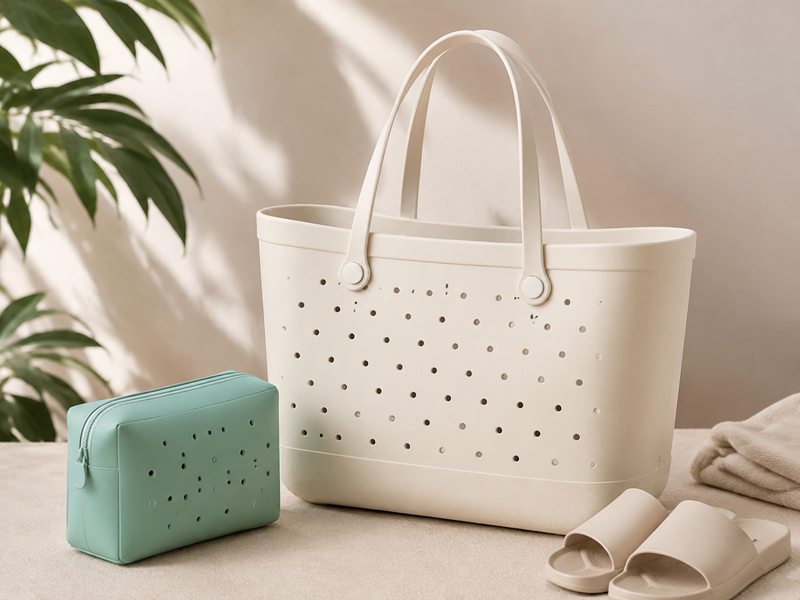
A polished EVA case can look reassuringly simple: a shaped shell, a zipper, a handle, and a soft interior. Under that clean exterior, however, there may be EVA foam, polyester fabric, adhesive, ink, lining, an internal insert, coated zipper tape, metal fittings, and individual packaging. The four letters “EVA” describe only part of the product.
Custom EVA bags are generally safe for their intended use when the exact EVA grade, colorants, adhesives, linings, printed surfaces, zippers, hardware, and packaging are controlled together. Safety should be supported by a complete material specification, use-specific chemical requirements, physical performance checks, an approved sample, traceable production materials, and finished-product testing whenever the destination or application requires documented proof.
This is why two nearly identical cases can perform very differently. One may keep its shape, stay low in odor, and protect a device after repeated transport. Another may warp in a hot vehicle, release a strong adhesive smell, or allow the device to strike the zipper during a fall. The difference rarely comes from the word “EVA.” It comes from the details hidden behind it.
What Makes a Custom EVA Bag Safe?

A custom EVA bag is safe when its complete construction matches the intended use and is supported by traceable materials, relevant chemical tests, and physical performance checks. Safety depends on the EVA formulation, pigments, fabrics, adhesives, hardware, inner tray, exposure conditions, and production consistency—not simply on the three letters “EVA.”
The most common mistake is treating EVA as if it were a single, fixed material. In practice, two cases described as “EVA” can differ in hardness, density, vinyl acetate content, recycled content, pigments, processing aids, foam structure, lamination, odor, and heat resistance. Their linings, zipper tapes, printed graphics, glues, handles, metal fittings, and inner inserts may come from entirely different material families.
Intended use changes the required evidence. A molded case holding a sealed electronic device has different contact conditions from a children’s pencil case or a pouch that touches unpackaged food. The same construction may be acceptable for one use but poorly suited to another.
A credible safety assessment should cover four connected areas:
| Safety area | What must be checked | What can go wrong |
|---|---|---|
| Chemical composition | EVA, pigments, foam additives, glue, lining, hardware | Restricted substances or unwanted migration |
| Physical construction | Zipper, seams, handle, molded shell, edges, insert | Breakage, sharp exposure, poor protection |
| Intended exposure | Age group, skin contact, food contact, heat, sunlight | Wrong test conditions or unsupported claims |
| Production consistency | Material batches, approved sample, inspections, changes | Tested sample differs from delivered goods |
Words such as “non-toxic,” “food safe,” “child safe,” and “medical grade” should never stand alone. Each claim needs a defined use, named requirement, representative specimen, measurable limit, and record that connects the tested construction to production.
What Is EVA Material?
EVA is an ethylene-vinyl acetate copolymer. Ethylene contributes strength and chemical stability, while vinyl acetate gives the material greater softness, flexibility, and resilience than many rigid polyethylene products. By changing the formulation and foam structure, EVA can be made into flexible sheets, cushioning foam, molded shells, films, coatings, and impact-absorbing inserts.
Custom EVA cases often use more than the base copolymer. A finished shell may include pigments, fillers, crosslinking agents, foaming agents, stabilizers, processing aids, fabric laminates, inks, and adhesives. These substances influence odor, flexibility, color, surface finish, heat behavior, and chemical results.
The term “EVA” therefore identifies the main polymer family but does not reveal the complete recipe. Useful material records should identify the grade, source, color, hardness, thickness, density, recycled-content status, surface laminate, and relevant declarations. If the source or color formula changes, earlier results may no longer represent the new construction.
Why Is the Finished Bag Different?
A finished EVA bag is a multi-material product. Even when the molded shell meets the required chemical limits, the zipper pull, printed logo, lining, edge binding, handle, buckle, adhesive, metal fitting, or inner tray may introduce a separate concern.
Consider a children’s pencil case. Accessible components may include the EVA shell, polyester fabric, zipper tape, plastic puller, metal slider, printed graphic, woven label, and decorative badge. Testing only an unprinted piece of EVA would leave most of the finished construction unevaluated.
Physical design matters as well. A chemically acceptable case can still be unsuitable if a zipper pull detaches, a metal edge becomes exposed, a handle fails under load, or an insert presses against a fragile screen.
The complete specimen should therefore be reviewed as used—not as isolated raw material. The safest approach links a component list, approved sample, test plan, inspection standard, and change-control record to the same product code.
Does EVA Leach Chemicals?
EVA is not expected to release large amounts of its polymer structure during ordinary dry use. However, small substances associated with pigments, additives, residues, adhesives, coatings, or contamination may migrate under certain conditions. Migration depends on the complete formulation and the way the case is used.
Four conditions deserve particular attention:
| Condition | Why it matters |
|---|---|
| Higher temperature | Can increase molecular movement and migration |
| Longer contact | Gives transferable substances more time to move |
| Fatty or oily contact | May extract substances differently from water |
| Worn or damaged surfaces | Can expose layers that were previously covered |
Direct food contact requires much stronger evidence than carrying sealed containers. In the United States, 21 CFR 177.1350 permits specified EVA copolymers under prescribed composition, extraction, food-type, time, and temperature conditions. It does not approve every foamed EVA case.
A migration result is meaningful only when the test medium, temperature, duration, contact area, specimen, and intended use are aligned. Testing a raw sheet cannot automatically support a claim for a printed, laminated, or glued finished surface.
Do EVA Bags Contain BPA or Phthalates?
BPA is not a structural building block of the EVA copolymer. Phthalate plasticizers are also generally not required to make EVA flexible in the way they have often been used in flexible PVC. These characteristics can simplify material selection, but they do not prove that every finished EVA bag is BPA-free or phthalate-free.
Unwanted substances can come from colorants, recycled feedstock, flexible plastic fittings, coatings, inks, adhesives, or cross-contamination. A zipper pull described only as “soft plastic,” for example, may not have the same composition as the molded shell.
For covered children’s toys and child-care items in the United States, eight specified phthalates are restricted above 0.1%, equal to 1,000 ppm, in accessible plasticized components. The legal classification and accessible component list must be established before testing.
A strong BPA-free or phthalate-free claim should be supported by:
- A complete material and component list
- Written declarations linked to the selected materials
- Laboratory results where the claim or destination requires them
- Photographs or descriptions identifying tested components
- Change control for colorants, plastic fittings, inks, and recycled content
Does EVA Give Off Microplastics?
EVA does not “give off” microplastics in the same way a material releases a gas or vapor. Small particles may form when the surface is cut, abraded, cracked, weathered, or repeatedly rubbed. The more accurate concern is physical particle shedding rather than emission.
A new molded case used indoors is unlikely to behave like an exposed foam product that is scraped, crushed, or left outdoors for years. Particle formation becomes more plausible when the material experiences strong abrasion, ultraviolet exposure, high heat, damaged edges, or repeated flexing after aging.
| Condition | Likely particle concern | Practical control |
|---|---|---|
| Smooth laminated shell | Lower direct abrasion of EVA | Inspect lamination and edge sealing |
| Exposed cut-foam insert | Possible loose particles at cavity edges | Clean cutting, vacuuming, rub inspection |
| Outdoor UV exposure | Greater risk of surface aging | UV-aware materials and aging checks |
| Tool contact | Scraping or puncture may damage foam | Add protective liners or rigid dividers |
| Repeated cavity removal | Local rubbing around tight areas | Adjust clearance and inspect wear zones |
There is no universal shedding figure for custom EVA bags. Any numerical claim would require a defined method, particle-size threshold, use simulation, collection procedure, and reporting basis.
Are Recycled EVA Grades Equally Safe?
Recycled EVA can be suitable for many protective cases, but it should not be assumed to perform identically to controlled virgin material. Source variation may affect color, odor, hardness, foam structure, contamination risk, molding behavior, and long-term consistency.
The word “recycled” also needs clarification. Material may come from clean production scrap, post-industrial leftovers, or mixed post-use sources. These streams do not offer the same traceability. A declared recycled percentage alone says little about the quality or chemical history of the feedstock.
For a recycled EVA project, useful controls include source identification, agreed recycled percentage, batch traceability, hardness and density checks, odor assessment, chemical screening where relevant, heat-forming trials, and comparison with an approved reference.
Applications involving young children, direct food contact, frequent skin contact, or demanding chemical limits require especially careful review. Recycled content can support environmental goals, but the environmental claim and the safety claim should each have their own evidence.
Is Odor a Safety Warning?
A strong odor is a useful quality warning, but it is not a reliable toxicity test. Some noticeable smells can come from volatile processing residues without exceeding a regulated limit, while certain restricted substances may be present without a detectable smell.
Odor should still be investigated because it affects first impressions and may signal incomplete conditioning, unsuitable glue, poor storage, damp packaging, contamination, or inconsistent materials. Closed molded cases can concentrate odors during storage and transport.
A practical internal scale can help keep assessments consistent:
| Score | Practical description | Suggested action |
|---|---|---|
| 0 | No noticeable odor | Accept |
| 1 | Very slight odor at close distance | Record and compare |
| 2 | Noticeable after opening, fades quickly | Condition and reassess |
| 3 | Clear odor that remains in the case | Investigate material or glue |
| 4 | Strong odor during normal handling | Hold the batch |
| 5 | Severe or irritating odor | Reject and investigate immediately |
This is a comparative quality tool, not a legal safety test. Samples should be assessed after consistent packaging, storage, opening, and ventilation conditions. If the odor remains unusual, chemical work may be needed to identify the source.
What Are the Disadvantages of EVA Material?
EVA combines low weight, cushioning, flexibility, and moldability, but it has limitations. Understanding them early helps prevent claims or structures that the material cannot reliably support.
| Limitation | Possible result | Design response |
|---|---|---|
| Heat sensitivity | Warping, softening, pressure marks | Heat-aging trial and storage guidance |
| Compression set | Insert loses recovery after long loading | Select suitable density and cavity support |
| UV aging | Fading, brittleness, surface change | UV-aware formulation or outer laminate |
| Abrasion | Scuffs or particle shedding | Fabric cover, coating, or protective divider |
| Chemical sensitivity | Swelling, staining, adhesive failure | Test oils and cleaning agents used in service |
| Dimensional variation | Tight fit or uneven zipper alignment | Tolerances, fixtures, and fit inspection |
| Difficult material separation | Recycling challenges in laminated cases | Reduce mixed layers where practical |
| Tooling requirement | Added development cost and revision time | Confirm dimensions before opening molds |
EVA is also not automatically puncture-proof, flame-resistant, antistatic, sterile, or fully waterproof. Each additional function needs a suitable construction and, where appropriate, a defined performance test.
For fitted cases, one of the greatest practical limitations is dimensional sensitivity. A small change in shell depth, insert compression, or zipper tension can affect closure. Real packed-item trials are therefore more valuable than judging only an empty shell.
What Is the History of EVA Safety Concerns?
EVA has been used commercially for decades in footwear, sports products, packaging, protective foam, films, adhesives, and consumer goods. Early material discussions often concentrated on flexibility, cushioning, weight, and heat-forming performance. Safety reviews later became more detailed as chemical restrictions and product-specific duties expanded.
The concern has not generally been that all EVA is inherently unsafe. Attention has shifted toward formulation details, processing residues, additives, recycled content, direct-contact migration, children’s exposure, volatile odor, and environmental particle release.
This development explains why older statements such as “EVA is non-toxic” are no longer enough for a serious custom project. Modern evaluation asks which EVA grade is used, what else is added, which components are accessible, how the item is handled, and whether the supporting records match the finished construction.
The history is therefore a move from material-name confidence toward product-specific evidence. That change benefits well-controlled projects because it separates carefully developed cases from products relying only on a generic material label.
EVA vs PVC: Which Is Safer?
EVA is often preferred when flexibility, cushioning, low weight, and reduced reliance on added plasticizers are important. Its polymer backbone does not contain chlorine, and softness can be achieved through its copolymer structure. PVC can provide excellent clarity, durability, surface finish, and resistance to many substances, but flexible PVC may require plasticizers.
Neither material is automatically safe or unsafe. Phthalate-free PVC formulations exist, while an EVA case can still contain unsuitable pigments, glue, recycled feedstock, or noncompliant accessories. The finished formulation and exposure conditions remain decisive.
| Comparison | EVA | Flexible PVC |
|---|---|---|
| Main structure | Ethylene-vinyl acetate copolymer | Polyvinyl chloride |
| Flexibility | Built partly through copolymer composition | Often adjusted with plasticizers |
| Cushioning | Well suited to foam and molded protection | Less commonly selected for thick cushioning |
| Transparency | Usually limited in foamed structures | Often offers high clarity |
| Weight | Commonly lightweight | Frequently heavier at similar thickness |
| Heat response | Can soften or distort | Depends strongly on formulation |
| Chemical review | Additives, pigments, foam chemistry, recycled content | Plasticizers, stabilizers, pigments, coatings |
| Best evidence | Exact formulation and finished-component tests | Exact formulation and finished-component tests |
For molded protective cases, EVA often offers a practical balance of cushioning, shape, weight, and design freedom. For transparent cosmetic or display bags, PVC may offer visual advantages. The safer selection is the one whose formulation, components, intended use, test results, and production records support the required function.
Which Type of EVA Bag Fits Each Use?
The right EVA bag is selected by the packed item’s weight, fragility, shape, exposure, handling frequency, and required level of protection. Molded cases suit delicate equipment, reinforced structures suit tools, lightweight designs suit children’s accessories, and cleanable interiors suit organized kits. No single EVA construction performs best in every use.
Selection should begin with the item inside the bag, not the appearance of an existing case. Record the item’s dimensions, packed weight, vulnerable areas, loose accessories, surface sensitivity, and removal direction. Then consider how the case will be carried, stored, cleaned, stacked, dropped, or exposed to heat and moisture.
Construction changes should follow the main risk. Crush risk calls for shell support; impact risk calls for controlled cushioning; scratch risk calls for a soft lining; puncture risk calls for rigid separation; water exposure calls for protected seams and closures. Adding more foam without identifying the hazard can increase size while providing little additional protection.
EVA and PEVA should also be distinguished. Molded protective cases commonly use foamed EVA, while many lunch bags use PEVA film as a cleanable inner lining. PEVA is polyethylene-vinyl acetate, and its thin-film structure serves a different purpose from a molded EVA shell. The names sound similar, but their construction and expected performance are not interchangeable.
| Use | Preferred structure | Main design concern | Suitable checks |
|---|---|---|---|
| Electronics | Molded shell with fitted insert | Impact, static, moisture, surface damage | Packed drop, fit, compression, lining rub |
| Tools | Reinforced shell with organized cavities | Weight, puncture, oil, handle strength | Load, handle pull, abrasion, chemical contact |
| Children’s accessories | Lightweight case with controlled attachments | Restricted substances, small parts, sharp edges | Chemical, tension, edge, closure checks |
| Wrapped food and lunchware | Insulated carrier with cleanable lining | Leakage, odor, stains, hygiene | Leak, wipe, odor, insulation checks |
| Direct food contact | Verified contact layer | Migration under intended conditions | Composition records and migration testing |
| Medical-kit transport | Organized, cleanable protective case | Fit, identification, cleaning compatibility | Packed drop, wipe, label, fit checks |
| Outdoor equipment | UV-aware shell and protected closure | Heat, sunlight, rain, dirt | Heat aging, UV exposure, spray testing |
| Presentation kit | Precisely fitted tray with refined lining | Appearance, abrasion, removal experience | Fit, color transfer, rub, opening checks |
Which Type of EVA Bag Protects Best?
A molded EVA case with a fitted inner tray generally provides the strongest protection for a fragile, shape-specific item. The shell helps resist crushing and distributes external force, while the tray limits internal movement. This combination works well for meters, cameras, optical equipment, portable devices, presentation sets, and precision instruments.
Protection depends on the interaction between several parts:
- The outer shell controls shape and distributes pressure.
- The EVA core provides flexibility and impact absorption.
- The surface fabric resists abrasion and supports appearance.
- The inner tray holds the packed item in a defined position.
- The lid pad controls vertical movement.
- The zipper and binding keep both shell halves aligned.
- The handle carries the complete packed load.
A harder shell is not always safer. Excessive rigidity can transfer impact energy inward, while a very soft shell may collapse under stacking pressure. The correct structure balances shell stiffness, insert compression, cavity clearance, and packed weight.
The case should be tested with the real item or a dimensionally accurate substitute. Empty-case drops mainly reveal damage to the bag itself; they do not prove protection of the contents.
| Hazard | Design response | Verification |
|---|---|---|
| External crushing | Molded ribs, supported edges, controlled shell hardness | Packed compression test |
| Drop impact | Cushioning beneath corners and vulnerable zones | Multi-orientation packed drop |
| Internal collision | Separate cavities and accessory pockets | Shake and drop inspection |
| Surface scratching | Soft, colorfast lining | Dry and damp rub checks |
| Button pressure | Local clearance or protective recess | Closed-case contact inspection |
| Accidental opening | Reliable zipper, puller, and end stops | Zipper cycling and loaded carry |
Are EVA Cases Safe for Electronics?
EVA cases can safely carry electronics when they control impact, movement, surface contact, static sensitivity, moisture, and heat. A well-fitted case protects the device without pressing on its screen, controls, connectors, camera lens, antenna, or ventilation areas.
The insert should support structurally strong areas rather than delicate features. Cables, chargers, adapters, and spare batteries need separate storage so they cannot strike the main device. A mesh lid pocket may be convenient, but heavy accessories placed directly above a screen can create damage during a drop.
Standard EVA should not be assumed to provide electrostatic discharge protection. Bare circuit boards, sensors, semiconductor components, and other static-sensitive items may require dissipative or conductive materials supported by electrical-resistance testing. An ordinary black foam is not necessarily antistatic simply because of its color.
Other practical checks include:
- Lining rub against painted, polished, coated, or optical surfaces
- Adhesive residue after heat exposure
- Odor after the closed case has been stored
- Condensation risk when equipment is packed warm
- Cable pressure against ports and plugs
- Battery separation and ventilation where required
- Operation of the zipper when every accessory is loaded
If the case includes charging, lighting, heating, tracking, or another powered function, the complete product may require additional electrical review.
Are EVA Cases Suitable for Tools?
EVA cases are suitable for hand tools, measuring instruments, repair kits, drill accessories, and service equipment when the structure is designed for concentrated weight, sharp edges, abrasion, and exposure to workshop substances.
The handle system deserves special attention. The packed load should be calculated from the tool set, accessories, insert, and case—not from the empty shell. Handle position should also follow the loaded center of gravity. A strong handle placed off-center can still make the case tilt and place uneven stress on its attachments.
Sharp tools should not rely on soft foam alone. Blades, drill bits, pointed jaws, and unfinished metal edges may need rigid dividers, protective caps, dense local reinforcement, or puncture-resistant panels. Each tool should have a clear cavity so it cannot collide with another item.
Workshop exposure can affect more than the EVA shell. Oil, grease, cutting fluid, alcohol, and cleaning agents may stain fabric, soften print, weaken glue, or swell other plastics. Representative samples should be exposed to the actual substances expected during use.
A practical tool-case review should include loaded carrying, handle pull, cavity retention, repeated opening, abrasion, puncture risk, zipper operation, and inspection after drops. Bare steel tools should be dry before storage because an enclosed case can trap moisture and encourage corrosion.
Are EVA Bags Safe for Children?
EVA bags can be suitable for children when the finished design is reviewed for its intended age, accessible components, chemical limits, detachable parts, cords, sharp edges, and foreseeable misuse. Material identity alone cannot support a child-safety claim.
A children’s pencil case, accessory pouch, toy carrier, and nursery item may fall under different requirements. Classification depends on intended use, age grading, design, presentation, and how the item is reasonably expected to be used.
Chemical work may need to cover more than the EVA shell. Accessible components can include:
- Printed or coated fabric
- Zipper tape and plastic pullers
- Metal sliders and rivets
- Decorative badges
- Flexible labels
- Cord ends
- Buckles and strap adjusters
- Adhesives and surface graphics
For covered children’s toys and child-care items in the United States, eight specified phthalates are restricted above 0.1%, or 1,000 ppm, in accessible plasticized components. CPSC guidance explains the covered substances and product scope.
Physical checks should include tension on zipper pulls and decorations, accessible sharp edges, cord length, seam security, and the possibility of small parts detaching. A bright appearance or soft hand feel should never replace measurable component and construction controls.
Is EVA Suitable for Food Contact?
Certain EVA formulations can be suitable for direct food contact under prescribed conditions, but an assembled EVA bag should not automatically be described as food safe. The exact contact surface, formulation, food type, temperature, duration, and repeated-use conditions determine what evidence is needed.
There are three different situations:
| Food-use condition | Contact level | Main control |
|---|---|---|
| Sealed containers inside a carrier | No intended direct contact | Cleanability, odor, leakage, insulation |
| Wrapped fruit or packaged snacks | Limited indirect contact | Lining composition and hygiene |
| Unpackaged food touching the lining | Direct contact | Food-contact records and migration work |
In the United States, 21 CFR 177.1350 permits specified EVA copolymers under defined composition and extraction conditions. This does not mean that any EVA foam, adhesive, ink, or laminate is approved for every food and temperature.
The surface touching food must be identified. In many insulated lunch bags, that surface is a PEVA film or another lining rather than the molded EVA core. Testing should cover the actual contact layer in its finished state, including any coating, seam treatment, or print that may touch food.
For carriers holding sealed lunch boxes, practical concerns include odor, stain resistance, wipeability, seam leakage, insulation, and moisture trapped beneath removable inserts.
Can EVA Cases Hold Medical Kits?
EVA cases can carry first-aid products, diagnostic accessories, test kits, portable care equipment, and organized consumables. Their main strengths are impact protection, fitted storage, low weight, visual organization, and the ability to separate components.
The case’s function must be described accurately. A protective carrier is not automatically sterile, antimicrobial, disinfectable, or medical grade. It also does not serve as a sterile barrier unless the entire barrier construction has been designed and validated for that purpose.
Cleaning compatibility is often more important than decorative appearance. If the case will be wiped with alcohol, peroxide, diluted bleach, detergent, or another agent, the following parts should be checked:
- Outer fabric and molded shell
- Printed or embossed logo
- Inner lining
- Adhesive and laminated layers
- Elastic straps
- Mesh pockets
- Labels and identification panels
- Zipper and coated hardware
The internal layout should support the kit’s workflow. Frequently used items need easy access, clean and used items may require separation, and small components should remain visible. If a device has a screen, sensor, tube, or calibrated fitting, the insert should prevent pressure and movement.
Where the case forms part of a regulated medical product configuration, the organization responsible for the complete kit should define traceability, labeling, cleaning, transport, and verification requirements.
How Do Heat and Sun Affect EVA?
Heat can soften EVA, alter molded dimensions, increase compression marks, weaken adhesives, and change zipper alignment. Sunlight can fade the exterior, age exposed foam, degrade printed graphics, and reduce flexibility over time. The complete bag may fail before the base EVA because laminates, inks, glue, or elastic components respond differently.
A closed vehicle is a demanding environment. Dark cases exposed through a window can become much hotter than the surrounding air. If the case is tightly packed or stacked while warm, temporary deformation may become a permanent fit problem.
Heat verification should use the finished, packed case. After exposure, inspect:
| Area | What to inspect |
|---|---|
| Molded shell | Warping, shrinkage, soft spots, pressure marks |
| Zipper path | Waviness, difficult closure, misaligned edges |
| Lamination | Bubbles, peeling, wrinkles |
| Adhesive | Odor, movement, residue, bond failure |
| Inner tray | Cavity distortion and reduced retention |
| Logo | Cracking, color change, lifting |
| Packed item | Pressure marks, fit changes, transferred color |
Outdoor use may also require ultraviolet aging and colorfastness work. A general statement such as “heat resistant” should be replaced with defined exposure conditions and recorded acceptance criteria.
Are EVA Bags Waterproof or Water-Resistant?
Most zippered or sewn EVA bags are water-resistant rather than waterproof. The EVA panel may resist water, but the complete enclosure still has possible leakage paths at needle holes, binding seams, zipper teeth, zipper ends, handle attachments, and ventilation openings.
Different constructions support different claims:
| Construction | Realistic performance |
|---|---|
| Standard molded case with coil zipper | Protection from light splashes |
| Case with coated zipper and covered seams | Improved rain resistance |
| Welded body with protected closure | Stronger resistance to water entry |
| Tested sealed enclosure | May support a defined waterproof claim |
| Case with drainage holes | Cannot be waterproof, even if panels resist water |
A spray test should define water direction, duration, pressure, sample position, and whether the case is stationary or moving. Absorbent indicators placed inside can help reveal entry at corners, seams, and zipper ends.
Rain resistance and immersion resistance are not equivalent. A case that protects electronics during a short walk in rain may fail if placed in standing water. Likewise, a waterproof outer shell provides little value if water enters through an ordinary zipper.
An IP rating should not be used unless the exact finished enclosure has been tested under the relevant method. For most custom EVA bags, a narrow statement tied to an agreed spray or rain test is more credible and easier to reproduce in production.
Which Safety Standards Apply?
The applicable requirements depend on the bag’s destination, intended age, contact conditions, electrical features, packed contents, and safety claims. REACH, CPSIA, food-contact rules, RoHS, Proposition 65, and general product-safety laws address different risks. No single “EVA certificate” covers every country, component, or use.
An adult tool case, a children’s pencil case, a lunch carrier, and a powered temperature-control case may use similar EVA shells while falling under different requirements. Classification should take place before sampling because it influences material selection, component testing, labels, technical records, packaging information, and laboratory cost.
Legal requirements, voluntary standards, retailer specifications, and internal performance criteria should be kept separate. A zipper-cycle test may be commercially important without being required by law. A restricted-substance limit may be legally mandatory in one destination but requested only by contract in another.
The test plan should follow the complete bill of materials. EVA foam, surface fabric, lining, zipper tape, plastic pullers, metal sliders, printed graphics, adhesives, handles, and inner trays may require different test groups. Testing one unprinted EVA sheet cannot support every component in the finished case.
| Product condition | Main requirements to review | Evidence commonly needed |
|---|---|---|
| Adult-use EVA case in the US | Applicable CPSC rules, state chemical duties, substantiated claims | Material records, risk review, relevant test reports |
| Children’s EVA item in the US | CPSIA/CPSC rules based on legal classification | Accepted-lab reports, CPC, tracking information |
| General consumer case in the EU | GPSR, REACH, traceability duties | Risk assessment, technical file, material declarations |
| Direct food-contact lining | US FDA or EU food-contact requirements | Composition records, migration results, declaration |
| Case with powered functions | Electrical-product rules and RoHS where applicable | Component records, electrical and chemical reports |
| California distribution | Proposition 65 exposure review | Chemical data, exposure assessment, warning decision |
| Retailer-restricted substance list | Contractual limits beyond basic legal duties | Test report covering the named substances and methods |
Who Sets the Safety Requirements?
National and regional authorities establish legal requirements. In the United States, CPSC oversees many consumer-product duties, FDA covers food-contact uses, and state authorities may impose additional chemical or warning obligations. In the European Union, REACH, GPSR, food-contact measures, and sector-specific rules may apply together.
The organization responsible for placing the finished product into distribution must define its intended use and claims. A laboratory can test a named specimen against selected methods, but it does not decide whether the product is a toy, child-care item, medical device accessory, food-contact material, or electrical product.
The production facility’s role is to provide traceable material information, follow the approved specification, submit representative specimens, control critical changes, and maintain inspection records. Legal classification should be confirmed by the responsible commercial entity, with specialist advice where the product has unusual functions.
Before development begins, record:
- Destination countries and sales channels
- Intended age and user group
- Direct, indirect, or no food contact
- Skin-contact duration
- Integrated lights, chargers, batteries, or heating
- Cleaning chemicals and use environment
- Proposed safety and performance claims
- Retailer or licensing-program requirements
These details prevent irrelevant testing while reducing the risk of missing a requirement that later forces material replacement.
Which Rules Apply in the US?
There is no single federal rule written specifically for every EVA bag. Applicability follows product classification and intended use. A general adult electronics case may need different documentation from a children’s pencil case, lunch carrier, or powered protective enclosure.
CPSC requirements may cover general-use or children’s products, depending on the product and applicable rule. A General Certificate of Conformity may be required for certain non-children’s products subject to a CPSC-enforced rule. Children’s products subject to covered rules generally require a Children’s Product Certificate.
Food-contact requirements become relevant when an EVA component, lining, coating, or film is intended to touch food. State duties may also apply. California Proposition 65, for example, addresses exposure to listed chemicals rather than granting a universal material approval.
As of July 8, 2026, importers of most regulated consumer products must electronically file certificate data with U.S. Customs and Border Protection through the CPSC eFiling system. The CPSC certificate guidance notes this current requirement. Covered entries should therefore have accurate product identification, rule citations, production details, test information, and responsible-party records ready before import filing.
A test protocol for the United States should state the product classification, accessible components, federal rules, state destinations, methods, limits, and certificate duties.
Which Rules Apply in the EU?
A general consumer EVA bag distributed in the European Union may fall under the General Product Safety Regulation and REACH, with additional rules depending on its intended use.
The General Product Safety Regulation requires covered consumer goods to be safe and supported by appropriate technical documentation. It also strengthens traceability, incident handling, online sales information, and the requirement for a responsible economic operator established in the EU. Regulation (EU) 2023/988 should be reviewed against the finished product and distribution arrangement.
REACH can affect substances in EVA, coatings, pigments, inks, adhesives, textiles, metals, zipper components, and plastic fittings. Two REACH areas are often confused:
- Annex XVII contains legally adopted restrictions with substance-specific conditions.
- The Candidate List contains substances of very high concern that may trigger information and notification duties.
When a Candidate List substance is present in an individual article above 0.1% by weight, Article 33 communication duties may apply. Additional SCIP notification duties may also arise for relevant EU entities. The current ECHA Candidate List should be checked because substances can be added.
Food-contact, toy, electrical, packaging, and national requirements may sit beside GPSR and REACH. A declaration saying only “EU compliant” is too vague to establish which obligations were evaluated.
When Does CPSIA Apply?
CPSIA-related duties depend on whether the finished bag is legally classified as a children’s product and which CPSC rules apply. CPSC defines a children’s product as one designed or intended primarily for children 12 years of age or younger.
Classification may consider size, colors, graphics, age grading, advertising, packaging, expected use, and whether comparable products are commonly recognized as being for children. A cartoon graphic alone does not decide the result, but the complete presentation can influence it.
Children’s products subject to covered rules generally require third-party testing by a CPSC-accepted laboratory and certification through a CPC. The certificate must identify the product, applicable rules, responsible U.S. entity, record keeper, production location and date, testing location and date, and accepted laboratory.
Phthalate restrictions do not apply to every children’s bag in exactly the same way. They specifically cover children’s toys and child-care articles as legally defined. For covered accessible plasticized components, eight specified phthalates are restricted above 0.1%, equal to 1,000 ppm. CPSC phthalate guidance provides the substance list, definitions, exemptions, and certification details.
Other reviews may include lead content, lead in surface coatings, small parts, tracking labels, sharp edges, cords, or mechanical hazards, depending on classification and design.
When Is Food-Contact Testing Required?
Food-contact evaluation is required when an EVA component, film, lining, coating, or printed surface is intended to touch food. Holding sealed containers is different from holding unpackaged fruit, sandwiches, or confectionery directly against the lining.
In the United States, 21 CFR 177.1350 permits specified ethylene-vinyl acetate copolymers for food-contact uses under prescribed composition and extraction conditions. The provision considers the type of food and intended time and temperature conditions. It does not approve all EVA foam, pigments, glues, prints, or laminated structures.
In the EU, Regulation (EC) No 1935/2004 requires food-contact materials not to release constituents at levels harmful to health or cause unacceptable changes in food composition, taste, or odor. Plastic food-contact materials may also fall under Regulation (EU) No 10/2011, which includes permitted substances, specific migration limits, and an overall migration limit of 60 mg/kg of food or 10 mg/dm² of contact material. The European Commission’s official food-contact overview explains these requirements.
The specimen should represent the finished contact layer. The protocol must define food simulant, contact area, duration, temperature, repeated-use condition, and whether hot, fatty, acidic, aqueous, or dry food is involved.
When Does RoHS Matter?
RoHS restricts hazardous substances in electrical and electronic equipment placed into EU distribution. A passive EVA case does not automatically fall under RoHS merely because it carries a laptop, camera, meter, or medical instrument.
RoHS becomes more relevant when the case includes a charging circuit, light, heating element, powered cooling feature, display, alarm, tracker, or another electrical function. It may also matter when the case is supplied as a component of electrical equipment rather than as an independent passive accessory.
The EU RoHS Directive restricts ten substances in homogeneous materials:
- Lead
- Mercury
- Cadmium
- Hexavalent chromium
- PBB
- PBDE
- DEHP
- BBP
- DBP
- DIBP
The maximum concentration is generally 0.1% by weight in homogeneous material, while cadmium is generally limited to 0.01%, subject to scope, exclusions, and exemptions. The European Commission’s RoHS information should be checked when electrical functions are included.
Some retail programs request RoHS screening for passive cases as a contractual chemical-control measure. That request can be followed, but it should not be confused with a confirmed legal scope decision.
Do REACH and Prop 65 Differ?
REACH and California Proposition 65 differ in chemical lists, legal purpose, thresholds, evidence, and required action. A result prepared for one should not automatically be used to claim compliance with the other.
REACH may restrict the presence or use of certain substances and may create information or notification duties for Candidate List substances in articles. The analysis often begins with material composition and concentration.
Proposition 65 requires a clear and reasonable warning before knowingly and intentionally exposing anyone in California to a listed chemical unless the exposure is exempt or falls below an applicable safe-harbor level. It is exposure-based rather than a simple universal content limit. OEHHA explains the business requirements, while the current chemical list should be checked for every assessment.
| Issue | REACH | Proposition 65 |
|---|---|---|
| Location | European Union | California |
| Main focus | Substance restrictions, authorization, communication | Exposure warning |
| Chemical lists | Annex XVII and Candidate List, among others | California-listed carcinogens and reproductive toxicants |
| Threshold approach | Substance-specific limits and 0.1% information trigger where applicable | Exposure level and safe harbor where established |
| Common evidence | Composition data, declarations, component tests | Chemical data plus exposure assessment |
| Result | Restriction, information, notification, or other duty | Warning decision or documented exemption basis |
A “REACH pass” does not prove that no Proposition 65 warning is needed. Likewise, a Proposition 65 assessment does not establish compliance with REACH restrictions.
Which Documents Prove Compliance?
Reliable evidence connects the finished product to its materials, intended use, applicable requirements, representative specimens, and actual production. No single document proves every aspect.
| Document | What it supports | What it does not prove |
|---|---|---|
| Bill of materials | Component identity and source | Chemical compliance by itself |
| Technical data sheet | Hardness, density, thickness, physical properties | Finished-case safety |
| Safety data sheet | Workplace handling and chemical information | Finished-product approval |
| Material declaration | Declared substance content | Independent verification |
| Laboratory report | Results for named specimens and methods | Untested colors or changed components |
| CPC | Certification to cited U.S. children’s rules | Requirements not listed on the certificate |
| GCC | Certification to cited general-use rules | Universal consumer-product approval |
| Food-contact declaration | Suitability under stated contact conditions | Uses outside those conditions |
| REACH declaration | Status against a named list and issue date | Future Candidate List updates |
| RoHS declaration | Restricted-substance status for stated components | Confirmation that product is legally in scope |
| GPSR technical file | Risk assessment, product identity, traceability | Laboratory proof unless reports are included |
| Proposition 65 assessment | Warning decision based on exposure assumptions | Other state or federal duties |
| Approved sample record | Construction, appearance, dimensions, components | Future output if substitutions occur |
Check report dates, laboratory identity, specimen photographs, color, component descriptions, test methods, reporting limits, legal references, and issue dates. Records should be maintained in English where U.S. certification rules require it and retained for the periods applicable to the product.
When Is Third-Party Testing Needed?
Independent testing is required when a law or certification rule demands an accepted laboratory. It is also prudent when chemical declarations are incomplete, the product involves children or direct food contact, a retail program has strict substance limits, or a safety claim carries significant exposure risk.
Third-party testing should be considered when:
- A new EVA source or recycled formulation is introduced
- Pigments, inks, adhesives, lining, zipper, or hardware change
- Several colors use different formulations
- A children’s product requires CPSC-accepted laboratory results
- Direct food-contact migration must be demonstrated
- A distributor requires REACH, RoHS, or restricted-substance reports
- Existing reports do not identify the exact component or color
- A failed result requires replacement material and confirmation
The test plan should identify the destination, product classification, component groups, substances, methods, limits, sample quantity, and certificate purpose before specimens are submitted.
A laboratory report represents only the tested samples. Its value depends on whether production uses the same materials and construction. Approved-material lists, incoming inspection, retained samples, batch records, and written change approval are therefore essential. Testing establishes evidence; controlled production keeps that evidence relevant.
How Does a Factory Verify Safety?

A factory verifies safety by linking the intended use to approved materials, representative samples, relevant tests, controlled production, and traceable inspection records. The process should cover the EVA shell, fabric, lining, adhesives, zipper, hardware, inner tray, protective performance, packaging, and every critical change made before shipment.
Safety verification should begin before the first mold or sample is developed. The packed item’s dimensions, weight, fragile areas, destination, age group, contact conditions, cleaning method, storage environment, and required claims determine what must be checked.
A good control plan separates three different concerns:
- Chemical suitability of materials and accessible components
- Physical safety and protection during normal use
- Consistency between the approved sample and delivered units
These concerns are connected but cannot replace one another. A case may pass restricted-substance testing yet fail to protect its contents. It may survive a packed drop but use an unapproved zipper pull. It may also pass every sample-stage check and still create risk if materials are changed during production.
| Stage | Main activity | Evidence created |
|---|---|---|
| Requirement review | Define use, destination, contents, claims, and risks | Project specification |
| Material selection | Approve EVA, fabric, lining, glue, zipper, and hardware | Bill of materials and material records |
| Sample development | Check fit, appearance, function, and construction | Sample report and revision record |
| Laboratory work | Test relevant chemical or physical properties | Reports linked to named specimens |
| Pre-production approval | Seal the final reference and acceptance criteria | Approved sample and specification |
| Incoming inspection | Verify received materials against approval | Batch inspection record |
| First-piece check | Confirm setup before larger output | First-piece approval |
| Inline inspection | Detect repeated defects while correction is possible | Process inspection record |
| Finished inspection | Check dimensions, fit, function, and appearance | Finished-goods report |
| Packing review | Confirm labels, protection, cartons, and quantities | Packing and shipment record |
How Does the Sample Process Reduce Risk?
A custom sample reveals problems that drawings cannot show. Zipper tension, shell recovery, cavity pressure, handle balance, lining friction, opening angle, and removal comfort can only be judged properly with a physical case.
The sample should be evaluated with the actual packed item or an accurate substitute. Every intended accessory should be loaded because cables, chargers, tools, manuals, and spare parts affect fit, weight distribution, lid pressure, and internal movement.
A practical sample review should include:
- Outer and inner dimensions
- Packed-item clearance
- Contact with buttons, screens, lenses, and connectors
- Zipper opening and closing under full load
- Handle balance and carrying comfort
- Movement during shaking
- Lining abrasion and color transfer
- Odor after the case remains closed
- Logo size, position, and durability
- Packaging fit and carton protection
Comments should be measurable. “Make the insert looser” leaves room for interpretation. “Add 2 mm clearance around the charging connector” provides a controllable instruction.
After revisions, the approved sample should be dated, photographed, signed, and sealed. Its bill of materials, dimensions, colors, logo process, insert construction, zipper, lining, and packaging should be recorded. A visually approved sample without written specifications is difficult to reproduce consistently.
What Does Incoming EVA Inspection Check?
Incoming inspection confirms that the delivered EVA matches the material approved during sampling. The check should identify the material code, batch, source, color, thickness, hardness, density, surface condition, odor, lamination, and supporting records.
Hardness and thickness should be measured at several mapped locations. One reading near an easy-to-reach edge cannot represent an entire sheet or molded shell. A practical inspection may use five or more measurement areas, including the center, sides, and structurally important zones.
The inspection should also look for:
- Color difference under controlled lighting
- Surface dents, scratches, contamination, or discoloration
- Uneven foam cells or visible voids
- Bubbles, wrinkles, or separation in laminated layers
- Excessive odor after opening the material packaging
- Moisture damage caused by poor storage
- Incorrect sheet width, length, or thickness
- Material labels that do not match the purchase record
When molded shells arrive as semi-finished components, inspectors should also check shape, depth, edge quality, symmetry, trimming, and recovery after stacking.
Rejected materials should be identified and isolated. They should not remain beside approved stock where they could be used accidentally.
Which Chemical Tests May Be Needed?
The chemical test list depends on destination, intended age, accessible components, direct-contact conditions, material declarations, and the claims printed on the product or packaging.
Depending on the project, the protocol may include specified phthalates, lead, cadmium, other regulated metals, azo colorants, polycyclic aromatic hydrocarbons, restricted flame retardants, REACH substances, or chemicals relevant to California Proposition 65. Direct food contact may require migration work under defined time and temperature conditions.
Testing should follow the component structure:
| Component | Possible concern | Testing approach |
|---|---|---|
| EVA shell | Additives, pigments, recycled content | Test approved color or justified material group |
| Printed fabric | Colorants, coatings, heavy metals | Test finished printed surface |
| Zipper tape | Dyestuffs and restricted chemicals | Include each materially different tape |
| Plastic puller | Phthalates or other plastic additives | Test accessible plastic component |
| Metal slider | Lead, cadmium, nickel where relevant | Test finish and base material as required |
| Adhesive | Restricted chemicals and migration | Review declaration and test if exposure warrants |
| Inner lining | Skin or food contact | Test actual finished contact surface |
| Decorative badge | Mixed plastic, coating, or metal | Evaluate as a separate accessible component |
“Full REACH testing” is an imprecise phrase. Reports should name the substances, methods, reporting limits, tested components, and Candidate List or restriction-list date.
BPA, formamide, and other chemicals should be included only when material composition, destination rules, intended use, or a specific claim makes them relevant. Adding every familiar chemical name creates cost without guaranteeing that the important risks have been covered.
Which Physical Tests Protect the Contents?
Physical testing should reproduce the forces the packed case is likely to experience. The correct program depends on content weight, fragility, carrying method, storage, transport, and expected opening frequency.
| Test | Setup that must be defined | What should be inspected |
|---|---|---|
| Packed drop | Height, surface, orientations, drop count | Shell, zipper, insert, contents, closure |
| Compression | Load, duration, direction, packed state | Permanent deformation and pressure transfer |
| Shake or vibration | Frequency, duration, loaded compartments | Internal movement and accessory collision |
| Handle pull | Packed weight, load, duration, cycles | Webbing, anchors, seams, deformation |
| Zipper cycling | Cycle count, speed, loaded or empty state | Slider wear, teeth, curve, end stops |
| Seam strength | Seam location and applied force | Stitch breakage and fabric tearing |
| Abrasion | Contact surface, load, cycle count | Exterior wear and lining damage |
| Colorfastness | Dry or damp rubbing method | Staining and color transfer |
| Water spray | Direction, duration, pressure, case position | Ingress at seams, corners, and zipper |
| Heat aging | Temperature, duration, packed condition | Warping, glue failure, odor, fit change |
Acceptance criteria should be written before testing. “No damage” is too broad. A practical record should state whether minor surface marks are permitted, whether the zipper must continue working, how much permanent deformation is acceptable, and what constitutes damage to the packed item.
Safety-critical results should be separated from cosmetic defects. A logo scratch and a detached handle do not carry the same consequence.
How Are Hardness and Thickness Checked?
Hardness affects flexibility, shell recovery, hand feel, impact response, and resistance to crushing. Thickness affects protection, internal volume, weight, molding depth, and zipper alignment. They should be controlled together.
EVA foam hardness is often measured using a Shore durometer, but the scale must be identified. Results from Shore A, C, and other scales are not directly interchangeable. Sample thickness, conditioning, instrument position, dwell time, and backing surface should remain consistent.
A useful inspection record includes:
| Measurement item | What to record |
|---|---|
| Instrument | Model, scale, and calibration status |
| Sample condition | Temperature, conditioning time, and stacking method |
| Measurement areas | Center, sides, corners, and critical support zones |
| Results | Minimum, maximum, average, and approved limits |
| Batch identity | Material code, lot number, color, and receipt date |
| Decision | Accepted, isolated, conditionally approved, or rejected |
Thickness should be checked on raw material and, where important, on the finished molded shell. Heat forming stretches and compresses material, so deep walls and corners may not retain the original sheet thickness.
Touch alone cannot distinguish small hardness changes reliably. Instrument readings provide evidence when two batches look similar but behave differently during forming or use.
How Are Molded Shape and Fit Checked?
Molded shape should be checked against approved drawings, defined dimensions, and the sealed reference sample. Important measurements may include exterior length, width, depth, corner radius, zipper path, hinge position, logo placement, cavity size, and shell alignment.
The case should first be placed on a flat surface. Rocking, twisting, uneven edges, or a lid that lifts at one corner can indicate warping. Both shell halves should align without forcing the zipper.
Fit checks should use the actual packed item. Inspectors should confirm that:
- The item enters and leaves the cavity without damage
- Buttons, screens, lenses, and connectors are not compressed
- Accessories remain in their assigned compartments
- The lid pad does not create excessive pressure
- The zipper closes smoothly with the case fully loaded
- The product does not move excessively during shaking
- The handle position keeps the loaded case balanced
- Normal product-size variation remains within the cavity allowance
A case can meet its outer dimensions and still fit poorly. Inner dimensions, insert compression, zipper tension, and the position of the contents must be evaluated as one system.
How Is the Inner Tray Tested?
The inner tray should retain the packed item without creating pressure damage, abrasion, difficult removal, or accessory collision. Its performance depends on cavity size, foam density, wall thickness, fabric covering, adhesive, and lid clearance.
Retention should be checked in several orientations. Turn the closed case upright, sideways, and upside down, then reopen it and inspect movement. A shake test can reveal loose accessories that appear secure when the case remains flat.
Removal comfort matters in daily use. Finger notches should be large enough for practical access, and deep cavities should not grip delicate products too tightly. Pull tabs may help where the product has smooth sides or a close fit.
Other checks include:
- Abrasion on painted or polished surfaces
- Color transfer from dark lining
- Glue odor or residue
- Delamination after heat exposure
- Cavity distortion after prolonged loading
- Pressure marks on screens or soft coatings
- Sharp cut edges
- Loose particles after die cutting
- Pocket sagging when loaded
- Elastic straps losing retention
The tray must be tested together with the lid storage. A charger in a mesh pocket may strike the main device during impact unless padding or separation controls its movement.
How Is Bulk Consistency Controlled?
Bulk consistency begins with a locked bill of materials and a sealed approved sample. Material codes, color references, dimensions, logo methods, zipper types, inner construction, packaging, and acceptance limits should be fixed before larger output begins.
The first completed unit from the production setup should be inspected before work continues. This check confirms mold condition, trimming, lamination, sewing, zipper alignment, insert fit, logo placement, and overall dimensions.
Inline inspection should focus on repeated defects that can spread quickly:
- Shells formed too shallow or too deep
- Fabric wrinkles around corners
- Uneven trimming
- Zipper waves or high closing resistance
- Misaligned front and back shells
- Incorrect insert cavities
- Glue marks or delamination
- Crooked logos
- Weak handle attachments
- Mixed material batches
Finished inspection may use an agreed AQL sampling plan, but safety-critical characteristics should have separate acceptance rules. Product fit, exposed sharp edges, critical attachments, and required chemical controls should not be treated as ordinary cosmetic defects.
Every critical substitution should require written approval. A similar-looking EVA sheet, zipper pull, adhesive, or lining may have different hardness, composition, odor, or performance.
How Long Do Testing and Sampling Take?
A custom EVA sample commonly requires about 5–7 working days after dimensions, materials, colors, and construction are confirmed. A simple style using available materials may be assessed for a 2–3 day schedule. New molds, deep forming, complex inserts, unusual laminations, or several revisions require additional time.
The full schedule may include:
| Activity | What affects timing |
|---|---|
| Technical review | Completeness of drawings and packed-item data |
| Material sourcing | Custom color, thickness, fabric, or recycled content |
| Mold development | Size, depth, texture, logo relief, and revisions |
| First sample | Construction complexity and insert design |
| Revision | Number and type of changes |
| Laboratory work | Test list, specimen quantity, and method duration |
| Final approval | Speed of fit, color, logo, and packaging decisions |
| Bulk output | Quantity, colors, materials, and production load |
Bulk bag production commonly takes about 20–30 working days after final approval and material readiness. Third-party testing, special materials, tooling changes, or a large SKU split may extend the schedule.
Testing should be planned before the final sample is approved. Discovering a chemical or physical failure after material preparation can force replacement, resampling, and another laboratory submission.
How Do Tests Affect Price and Lead Time?
Testing adds cost through laboratory fees, additional specimens, component separation, preparation, destructive testing, and possible retesting. The effect depends more on the number of distinct materials and claims than on the exterior size of the case.
A single-color adult case may require fewer chemical groups than a children’s design using several plastic decorations, printed colors, coated metal parts, and flexible zipper pullers. Different pigments may require separate testing when they use different formulations.
Physical testing also consumes samples. Drop, compression, handle-pull, zipper-cycle, heat-aging, and abrasion work may leave units unsuitable for presentation or delivery. The sample quantity should include these destructive uses.
Costs should be separated clearly:
- Mold and insert tooling
- Development samples
- Chemical testing
- Physical testing
- Additional test specimens
- Inspection requirements
- Special packaging
- Retesting after changes or failure
Early testing protects both time and cost. Replacing one zipper pull during sampling is manageable. Replacing it after thousands of finished cases have been assembled can affect materials, labor, packaging, reports, and the shipment date.
How Do You Choose the Best EVA Bag Manufacturer?
Choose an EVA bag factory by checking its experience with molded structures, custom inserts, material control, testing, tooling, and repeatable production. The strongest option is not always the lowest quote. It is the facility that understands the packed product, identifies risks early, develops a reliable sample, and keeps approved materials unchanged through delivery.
A conventional sewing workshop may produce attractive fabric bags but still struggle with molded EVA. EVA cases require control of lamination, heat forming, mold depth, shell recovery, trimming, zipper curves, binding tension, inner-tray fit, and dimensional consistency. These skills should be assessed separately from general bag-sewing experience.
The review should follow the actual project. A presentation case for cosmetics, a protective electronics enclosure, and a heavy tool carrier need different hardness, cavity support, handle reinforcement, testing, and documentation. Relevant experience is more valuable than a large gallery of unrelated products.
A practical scorecard can keep the decision balanced:
| Evaluation area | Suggested weight | What to verify |
|---|---|---|
| Technical understanding | 25% | Structure, EVA properties, molding, insert, packed-item risks |
| Quality and traceability | 20% | Material control, inspection stages, records, change approval |
| Sample capability | 15% | Fit accuracy, revision speed, workmanship, approval process |
| Testing support | 15% | Correct test selection, specimen control, report matching |
| Capacity and schedule | 10% | Equipment, staffing, production plan, peak-season control |
| Commercial clarity | 10% | Tooling, unit cost, packaging, testing, payment, delivery terms |
| Communication | 5% | Clear technical feedback, written confirmation, response speed |
A high score in one area should not hide a critical weakness elsewhere. Fast sampling has limited value if the final material source changes. A strong shell is not enough if the inner tray damages the packed product. A valid laboratory report is not useful when it covers a different color or component.
What Should an EVA Factory Understand?
An experienced EVA factory should understand both the case and the item carried inside it. Development begins with packed dimensions, weight distribution, fragile zones, accessories, handling frequency, storage conditions, and removal direction.
Its technical team should be able to discuss:
- EVA hardness, density, thickness, and recovery
- Heat-forming depth and material stretching
- Fabric lamination and surface wrinkles
- Mold shrinkage and dimensional allowance
- Corner radius and wall-angle limitations
- Zipper curvature and closing resistance
- Binding tension and shell alignment
- Handle position and loaded balance
- Insert compression and cavity clearance
- Adhesive, lining, and surface compatibility
- Carton pressure during storage and transport
Listen to the type of feedback provided. “We can make it” offers little technical value. A stronger response explains that a deep cavity may require a larger corner radius, a heavy accessory should be moved closer to the handle centerline, or a screen needs additional lid clearance.
The team should also understand claim boundaries. It should not describe every EVA case as food safe, medical grade, waterproof, antistatic, or suitable for children without reviewing the exact construction and intended use.
Which Factory Records Should You Review?
Ask for records connected to the proposed product rather than collecting unrelated certificates. The strongest evidence links materials, samples, tests, inspections, and production batches to the same model.
| Record | What it shows | What to check |
|---|---|---|
| Bill of materials | Every approved component | Codes, colors, sources, revision date |
| Material data sheet | Physical properties of EVA and other materials | Grade, hardness, density, thickness |
| Material declaration | Declared chemical content | Product code, issue date, covered substances |
| Laboratory report | Results for named specimens | Photos, color, method, limit, laboratory |
| Mold drawing | Tooling dimensions and structure | Outer size, cavity, depth, logo, revision |
| Approved sample record | Final appearance and construction | Date, signatures, photographs, change status |
| Incoming inspection | Verification of received materials | Batch, readings, decision, inspector |
| First-piece approval | Setup before larger output | Mold, zipper, insert, dimensions, logo |
| Inline inspection | Control during assembly | Defects found, quantities, corrective action |
| Finished inspection | Final conformity | Sampling plan, defect classes, result |
| Change record | Approval of substitutions or revisions | Reason, risk review, retesting decision |
A safety data sheet can support chemical handling and storage, but it is not proof that the assembled case meets finished-product requirements.
Records should be clear enough to trace a delivered carton back to the order, approved construction, material batch, and inspection result. If documentation exists only as generic files without product codes or dates, its practical value is limited.
How Many QC Stages Are Needed?
A custom EVA project should normally have at least six control gates: incoming materials, first-piece setup, inline work, finished goods, packing, and pre-shipment release. Complex or safety-sensitive designs may need additional checks after molding, logo application, insert assembly, or laboratory testing.
| Control gate | Critical checks |
|---|---|
| Incoming materials | EVA hardness, thickness, color, odor, fabric, zipper, records |
| Molded shells | Shape, depth, wrinkles, recovery, trimming, dimensions |
| First completed unit | Fit, zipper path, handle, logo, insert, appearance |
| Inline work | Repeated defects, alignment, sewing, glue, component use |
| Finished goods | Dimensions, closure, packed fit, workmanship, function |
| Packing | Polybag, labels, accessories, cartons, quantity, protection |
| Pre-shipment release | Approved sample, reports, inspection status, carton marks |
The number of inspectors matters less than where and how they work. Final inspection alone cannot correct hundreds of shells formed with the wrong hardness or cavity depth. Early detection prevents repeated defects from spreading through the order.
An agreed AQL plan may be used for general workmanship and appearance. Critical characteristics may require tighter inspection or complete checking. These can include packed-item fit, exposed sharp edges, required labels, model identity, key attachments, and components linked to chemical testing.
Inspection records should show defect type, quantity, location, corrective action, and reinspection result—not simply “passed.”
Can the Factory Develop Custom Molds?
A capable EVA factory should be able to translate product data into a mold that supports the required shape, depth, zipper path, logo, texture, and internal clearance. Tooling should begin only after critical dimensions and packed-item details are confirmed.
The mold review should cover:
- Finished exterior dimensions
- Internal cavity dimensions
- Front and back shell depth
- Corner and edge radius
- Wall angle for forming and release
- Material thickness before forming
- Expected stretching in deep areas
- Zipper and binding allowance
- Hinge location and opening behavior
- Embossed or debossed logo depth
- Surface texture
- Trimming line
- Dimensional tolerances
A 3D file is useful, but the physical product should still be checked. CAD data may omit rubber feet, cable loops, protective caps, flexible buttons, or size variation between product batches.
Confirm tooling ownership, mold storage, maintenance, modification charges, and reuse conditions in writing. If several sizes are planned, determine whether they need separate molds or can share parts of the construction.
The first molded shell is a trial, not final approval. It still needs fit checks, dimensional measurements, zipper assembly, surface review, and packed testing.
Can the Factory Customize Inner Inserts?
A strong EVA project often depends more on the inner insert than the outer shell. The insert controls movement, protects vulnerable areas, organizes accessories, and shapes the opening experience.
| Insert type | Suitable use | Main concern |
|---|---|---|
| Die-cut EVA foam | Tools, cables, durable equipment | Cut-edge quality and cavity clearance |
| Molded EVA tray | Shape-specific products and presentation kits | Tooling accuracy and forming depth |
| PU or PE foam | Delicate devices needing cushioning | Compression recovery and surface contact |
| Fabric-covered foam | Premium presentation | Wrinkles, glue, color transfer |
| Thermoformed tray | Defined product cavities | Material selection and edge finish |
| Mesh pockets | Manuals, cables, flat accessories | Sagging and impact against main item |
| Elastic straps | Flexible accessory storage | Stretch loss and attachment strength |
| Removable dividers | Multi-use cases | Stability and user adjustment |
Insert development should use actual contents or accurate models. Every item needs a defined location, and heavy accessories should not sit above delicate surfaces unless a protective divider controls movement.
Check finger access, removal direction, pressure zones, cavity depth, color transfer, abrasion, adhesive bonding, and movement during shaking or dropping. A beautiful tray that makes the product difficult to remove will create frustration during daily use.
If product dimensions may vary, the cavity should include a controlled allowance rather than matching one sample so tightly that later units no longer fit.
What Should You Confirm Before a Sample?
Confirm the technical and commercial details before sample work begins. Missing information usually returns later as revision cost or schedule delay.
The approval list should include:
- Product drawings, photographs, and physical samples
- Maximum packed dimensions and total weight
- Fragile surfaces, controls, and connectors
- Every accessory placed inside
- Exterior dimensions and shape
- EVA hardness, thickness, density, and surface fabric
- Shell color and Pantone reference
- Inner lining and insert structure
- Zipper type, color, and opening direction
- Handle, strap, buckle, and hardware
- Logo file, size, position, and process
- Packaging, label, barcode, and carton requirements
- Destination countries and intended age
- Required chemical and physical tests
- Quantity by color, size, and model
- Sample approval criteria
- Required shipment date
Also define the purpose of each sample. A structural sample may use temporary colors to confirm fit. A presentation sample may focus on appearance. A testing sample should use final materials and construction.
Approval should state whether the sample is accepted for dimensions, materials, color, function, testing, or all of these areas.
Which Project Details Should You Send?
Complete project information allows the factory to recommend a suitable construction and provide a more accurate quotation.
| Project detail | Information to provide |
|---|---|
| Packed item | Dimensions, weight, photos, drawings, or physical unit |
| Accessories | Quantity, dimensions, weight, and preferred positions |
| Fragile zones | Screen, lens, control, connector, sharp edge, painted surface |
| Use conditions | Indoor, outdoor, vehicle, workshop, rain, heat, dust |
| Carrying method | Hand carry, shoulder strap, luggage, stacking, wall display |
| Protection need | Impact, crush, scratch, puncture, moisture, organization |
| Appearance | Colors, texture, lining, zipper, hardware, logo |
| Intended use | Adult, child, food contact, electronics, tool, medical kit |
| Destination | Countries and retailer requirements |
| Quantity | Total units and split by size, color, or model |
| Packaging | Polybag, gift box, sleeve, insert card, barcode, export carton |
| Schedule | Sample approval date, testing window, shipment date |
Photographs should include several angles and a scale reference. Dimensions should identify whether they are maximum product measurements or preferred inner-cavity dimensions.
If the physical product cannot be sent, a 3D-printed model or accurately weighted dummy may improve fit and drop evaluation.
How Do You Compare EVA Bag Prices?
Compare quotations using the same specification. A lower unit figure may reflect thinner EVA, lower-density inserts, basic zippers, fewer reinforcements, simpler packaging, or excluded testing.
Build a comparison sheet that separates recurring and one-time charges:
| Cost area | Details to compare |
|---|---|
| EVA shell | Size, thickness, hardness, density, laminate |
| Exterior | Fabric type, color, texture, printing, coating |
| Zipper | Brand or grade, size, slider, puller, opening length |
| Interior | Lining, insert material, pockets, straps, dividers |
| Reinforcement | Handle anchors, hinge, corners, load-bearing areas |
| Logo | Embossing, printing, embroidery, rubber patch, metal badge |
| Tooling | Outer mold, tray mold, cutting die, logo mold |
| Testing | Chemical, physical, specimen quantity, retesting |
| Packaging | Polybag, box, labels, insert card, export carton |
| Quantity | Total units and SKU split |
| Delivery | Trade term, port, packing volume, shipment method |
Ask whether the mold charge includes trials and modifications. Confirm whether sample fees, testing, inner trays, packaging, and export cartons are included.
Standard custom bag programs often begin around 500 units per design. An order of 200–300 units may be assessed for simpler projects. Lower quantities can carry higher unit costs because tooling, setup, material preparation, and inspection are divided across fewer units.
The best comparison considers delivered value: protection, defect risk, report validity, packaging efficiency, and the likelihood that repeat orders will match the first production.
What Warning Signs Should You Avoid?
Be cautious when an EVA factory provides an instant quote without asking for packed dimensions, weight, use, insert structure, or destination. A fast figure based only on an exterior photograph is likely to rely on assumptions.
Other warning signs include:
- Every material is described only as “EVA”
- Safety claims are made without named tests
- Reports do not match the proposed color or component
- The physical packed item is never requested
- No final approved sample is retained
- Material substitutions do not require written approval
- Mold ownership and modification charges are unclear
- The quote omits the insert, packaging, testing, or tooling
- Only finished goods are inspected
- Critical dimensions have no tolerance
- An unusually short schedule leaves no time for mold trials
- Recycled content has no traceable source
- Failed tests are treated as paperwork rather than material problems
- Repeat-order consistency cannot be explained
A reliable EVA partner should be comfortable discussing limitations. It should explain which design features may wrinkle, which accessories can damage the main item, which claims require testing, and which changes may affect cost or timing.
Jundong supports molded EVA cases, fitted inserts, custom logos, packaging, sample development, and destination-specific testing coordination. With more than 20 years of bag experience, an 18,000 m² facility, over 600 employees, and more than 80 quality-control personnel, projects can be reviewed from the packed product through final inspection. Send dimensions, weight, quantity, intended use, destination, and reference files to info@jundongfactory.com for a project assessment.