 Skip to content
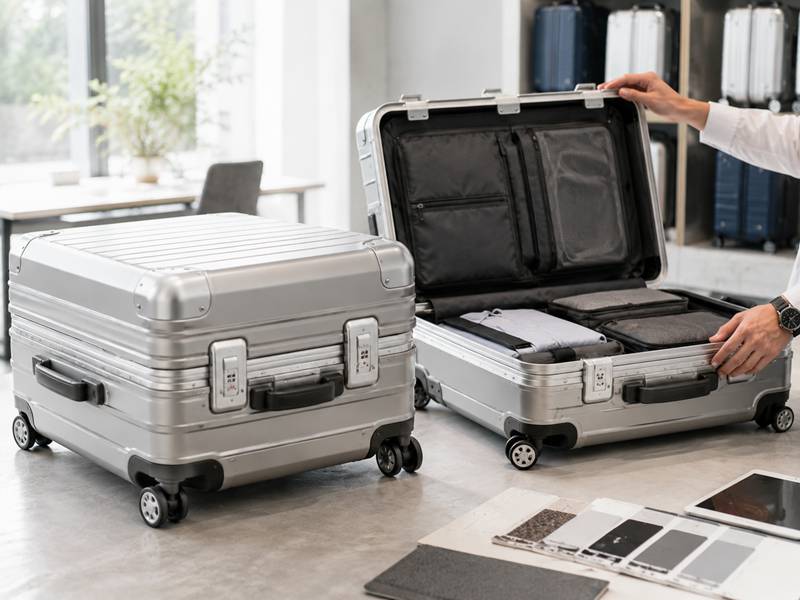
A zipperless suitcase can create an immediate impression that an ordinary hard-shell case often struggles to match. The exterior looks cleaner, the frame feels structural, and closing two solid latches gives the traveler a very different experience from pulling a zipper around three sides of a case. That difference is valuable—but it is only the visible part of the decision.
Once the zipper disappears, the engineering changes. The shell needs better dimensional stability. The frame must stay aligned. Both latches need consistent closing force. Hinges must carry repeated opening loads. The sealing profile has to meet correctly. Extra hardware can increase empty weight. And if the product is intended to expand, the structure becomes considerably more complicated.
For that reason, zipperless luggage is not automatically superior. It performs best when a collection is built around security, rigid protection, distinctive styling and a more premium travel experience. Conventional zippered luggage remains highly competitive when low weight, flexible packing, easy expansion and tighter cost control matter more. A strong product decision comes from comparing complete structures—not simply choosing between a zipper and two locks.
Imagine two 20-inch cases sitting side by side. One closes in five seconds with a zipper. The other closes with two precise clicks. The second may look more expensive before anyone checks the price tag. But the real test begins after it is fully packed, dropped, rolled across rough flooring and opened hundreds of times. That is where attractive industrial design either becomes a dependable travel product—or an expensive after-sales problem.
What Is Zipperless Luggage?

Zipperless luggage is a hard-sided travel case that replaces the long perimeter zipper with a rigid frame, hinges, and mechanical latch locks. The change affects far more than opening style. It influences shell stiffness, finished weight, frame alignment, packing tolerance, water resistance, lock serviceability, impact behavior, and the way the case feels when opened and closed.
A good zipperless suitcase should therefore be treated as an integrated mechanical product rather than a normal suitcase with the zipper removed.
What Does Zipperless Luggage Mean?
The term usually describes luggage in which the two main shell halves are connected and secured without a zipper running around the opening.
A conventional hard-shell suitcase often consists of:
- front and rear molded shells;
- zipper tape around the perimeter;
- one or two sliders;
- a fixed combination lock;
- hinges or flexible joining sections;
- trolley system;
- spinner wheels;
- handles;
- lining and dividers.
A zipperless design changes the central closure architecture. It usually combines:
- two rigid shell halves;
- a structural perimeter frame;
- fixed hinges;
- two or more latch locks;
- sealing or cushioning material between frame edges;
- rigid attachment areas around locks and hinges.
That difference changes the way forces travel through the case.
With a zipper design, the zipper tape creates a flexible connection around most of the opening. Minor movement between the two halves can often be absorbed by the tape and surrounding construction.
With a frame-and-latch design, the opening is much less flexible. The two halves must return to a controlled position before the latches can engage correctly.
This is why a zipperless case can look cleaner and more precise, but also demands tighter control of several parts.
A few millimeters of unwanted movement in a soft zipper construction may not be immediately noticeable. The same variation around a rigid frame can make one corner sit higher, make one latch harder to close, or create an uneven seam.
For luggage development, the main structure should therefore be reviewed as a complete combination of shell, frame, lock, hinge, wheels, trolley, handles, lining, weight, dimensions, packing protection, and transport performance. These are also the key areas identified in Jundong’s documented luggage project requirements.
| Structure Area | Zippered Luggage | Zipperless Luggage |
|---|---|---|
| Main closure | Zipper tape + slider | Frame + latches |
| Opening flexibility | Higher | Lower |
| Alignment sensitivity | Lower | Higher |
| Expansion design | Easier | More complex |
| Main closure wear | Slider, chain, tape | Lock, hinge, frame |
| Overpacking tolerance | More forgiving | More limited |
| Visual structure | Softer perimeter | Cleaner rigid edge |
| Hardware content | Lower | Usually higher |
| Empty-weight control | Easier | More demanding |
The important detail is that “no zipper” does not mean “simpler.”
In many cases, it means fewer flexible parts but more precision-sensitive rigid parts.
How Does a Zipperless Closure Work?
A zipperless suitcase usually works through four interacting elements:
the shell, the frame, the hinges, and the latches.
The shell forms the main body. The frame follows the opening edge and gives the closure a controlled shape. Hinges keep the two halves connected and guide the opening movement. Latches pull the frame together and hold it closed.
When the case is shut, the process looks simple:
- The two halves move together.
- The frame edges meet.
- The sealing surfaces contact.
- The latch hooks engage.
- The locks hold the latches in position.
The engineering challenge is keeping all five steps consistent after repeated use.
If the shell becomes slightly distorted, the frame may no longer meet evenly.
If the hinge position changes, one latch may align while the other sits too far away.
If the seal is too thick, both locks may require excessive closing force.
If the case is packed above its intended level, clothing can push the shell outward and increase pressure on the latches.
That is why closing a frame case once on a workbench proves very little.
A more useful sample review checks the same suitcase under several conditions:
| Condition | What to Observe |
|---|---|
| Empty | Basic frame alignment |
| Lightly packed | Normal closing feel |
| Normally packed | Real-use latch engagement |
| Near intended capacity | Frame pressure and shell movement |
| After repeated opening | Lock consistency |
| After transport stress | Post-impact alignment |
The two latches should also feel reasonably similar.
If the first closes with one finger while the second requires strong downward pressure, the issue may come from frame geometry rather than the lock itself.
This is one of the reasons zipperless products need closer dimensional control. A latch is not only a security component. It is also an indicator of whether several surrounding parts are working together correctly.
What Changes When the Zipper Is Removed?
Removing the perimeter zipper changes five important areas at once.
The first is structural flexibility.
A zipper chain can tolerate some movement between the front and rear sections. A rigid frame has much less tolerance for uneven deformation.
The second is weight.
A frame, hinges, latch bodies, lock mechanisms, fasteners, and local reinforcement usually add more mass than zipper tape and sliders.
The third is packing behavior.
A zippered suitcase can usually tolerate slightly uneven packing because the closure can flex around the contents. A frame case requires the edges to come back into alignment.
The fourth is repair.
A damaged zipper and a damaged frame create very different service requirements. Zipper repair usually involves tape, slider, chain, or stitching. Frame-case service may involve locks, hinges, corner joints, fasteners, or frame replacement.
The fifth is appearance.
A zipper normally sits between the two shell halves and becomes visually secondary. A frame becomes part of the design language.
This is one reason zipperless luggage often feels more technical or premium even before the case is opened.
The trade-off is that visible structure also exposes quality more clearly.
An uneven frame joint is difficult to hide.
A weak latch immediately feels cheap.
Loose hardware is more noticeable.
A clean mechanical design therefore creates a higher expectation for execution.
What Is the History of Zipperless Luggage?
Mechanical suitcase closures existed long before modern zipper luggage became dominant.
Traditional trunks and early rigid travel cases commonly used:
- solid bodies;
- hinged lids;
- metal edge protection;
- mechanical clasps;
- external locks.
Those products were built around rigidity because the materials and travel conditions of the time favored strong boxes over lightweight flexible cases.
As modern travel changed, luggage became lighter and more mobile.
Textile luggage and zipper closures became popular because zippers provided several practical benefits:
lighter construction, easier access, flexible shapes, simpler expansion, and more forgiving packing.
The rise of molded hard-shell luggage later created an interesting combination.
The body became rigid again, but many products kept the flexible perimeter zipper.
Modern zipperless luggage takes another step by returning to a rigid closing system while keeping contemporary features such as:
- four-wheel spinner systems;
- telescopic trolley handles;
- molded polymer shells;
- organized interiors;
- integrated combination locks;
- lightweight component engineering.
This history explains why modern frame luggage often feels more like a piece of equipment than a soft travel case.
The user does not simply pull a zipper.
The lid rotates around fixed hinges. The frames meet. The locks engage with a mechanical click.
That tactile sequence becomes part of the travel experience.
For a premium collection, this can be valuable because the closure itself communicates construction.
But the historical comparison also highlights an important challenge: old trunks could achieve rigidity by being heavy.
Modern luggage cannot rely on that solution.
It has to balance rigidity with airline handling, carry comfort, wheel performance, and acceptable empty weight.
That makes weight engineering much more important than it appears from the outside.
What Types of Zipperless Luggage Are Available?
Zipperless luggage is not one single structure.
The same closing concept can be used across several product directions.
The most common categories include:
Carry-on frame luggage
Usually developed with strong attention to weight, trolley comfort, overhead-bin dimensions, and organized interiors.
Medium checked luggage
Often allows slightly more structural weight and may place greater emphasis on capacity and impact resistance.
Large checked luggage
Requires careful control of frame straightness because longer edges can experience more movement under load.
Premium polymer-shell frame luggage
Uses a molded shell combined with a visible metal frame and latch locks.
Metal-bodied luggage
Uses metal as a major exterior structural material rather than only around the opening.
Zipperless luggage sets
Usually coordinate two or three sizes with the same shell styling, hardware, color, wheels, and interior treatment.
Even within one category, specifications can differ substantially.
A strong initial development sheet should define more than suitcase size.
| Specification | What Should Be Confirmed |
|---|---|
| Overall dimensions | Complete size including wheels |
| Target empty weight | Finished assembled weight |
| Shell | Material, thickness, finish |
| Frame | Profile, finish, joint structure |
| Locks | Type, quantity, position |
| Hinges | Quantity and mounting |
| Wheels | Diameter, housing, wheel type |
| Trolley | Stages, tube structure, handle |
| Carry handles | Position and reinforcement |
| Interior | Dividers, straps, pockets |
| Logo | Method, size, position |
| Packing | Protection, carton, labels |
This is particularly important when working from a reference photo.
A photo can communicate shape and styling very well.
It cannot reliably show shell thickness, lock construction, internal reinforcement, frame profile, trolley tube structure, wheel assembly, or finished weight.
Those items need separate confirmation.
Is Zipperless Luggage Always Hard Shell?
For the type of luggage most people mean by “zipperless suitcase,” the structure is almost always rigid or semi-rigid.
The reason is mechanical.
Latch locks need stable positions.
A rigid frame needs predictable geometry.
Hinges need solid mounting locations.
A soft textile body changes shape too much to support the same closing behavior efficiently.
This does not mean every hard-shell suitcase is suitable for a frame closure.
The shell still needs to match the frame system.
Important variables include:
- shell stiffness;
- shell thickness;
- edge geometry;
- mounting strength;
- local reinforcement;
- hinge support;
- lock support;
- frame connection method.
Different hard-shell materials also behave differently under impact and repeated stress.
A material that flexes and rebounds may interact with a rigid frame differently from a more rigid metal body.
That becomes especially important around corners and lock positions.
If the shell flexes but the frame does not, the joint between them must tolerate that movement.
If both are very rigid, impact energy may be transferred more directly into corners, hinges, wheels, or fasteners.
This is why the outer shell should never be selected only by appearance.
Jundong’s luggage guidance also separates hard-shell material feasibility from other luggage categories and states that ABS/PC construction should be confirmed according to project capability rather than assumed automatically.
What Should Be Checked Before Choosing a Zipperless Structure?
A zipperless design becomes much easier to evaluate when six practical priorities are fixed first.
1. Target empty weight
If lightweight travel is central to the product, frame, lock, wheel, and trolley weight need to be controlled early.
Trying to remove weight after the first sample usually leads to compromises.
2. Intended suitcase size
A 20-inch carry-on and a large checked case should not automatically use identical frame assumptions.
Longer edges can create different stiffness and alignment behavior.
3. Packing style
A traveler who prefers structured packing may accept a fixed rigid closure easily.
A traveler who regularly overpacks may find a zipper more forgiving.
4. Expansion requirement
If expansion is essential, decide it before structural development starts.
Adding it late can affect the frame, shell depth, interior, and overall weight.
5. Service strategy
Consider whether locks, wheels, handles, or trolley components can be replaced.
A travel case that can be serviced has a different long-term value from one where a small hardware failure requires replacing the entire product.
6. Retail position
The construction should support the expected selling level.
A visible metal frame creates a strong impression, but it also raises expectations for wheels, handles, interior finish, shell surface, lock action, and packing.
A zipperless suitcase makes the most sense when all of these elements support the same product direction.
What Makes a Good Zipperless Suitcase Feel Different?
The difference is usually noticeable before any technical specification is read.
A good frame case opens smoothly without twisting.
Both halves remain stable.
The hinges move without looseness.
The frame edges meet cleanly.
The latches close with similar force.
The combination dials feel precise.
The suitcase rolls quietly.
The trolley extends without excessive side movement.
The interior feels appropriate for the exterior.
These details create the impression of quality because the user experiences them physically.
A poor frame case can look excellent in a photograph and still feel disappointing within thirty seconds.
That makes physical sampling particularly important.
A sample should confirm material, size, structure, logo, and packing before bulk production rather than serving only as a visual reference. Jundong’s documented sampling process follows this same principle.
For zipperless luggage, the sample is where the real product becomes visible.
The shell color may attract attention first, but the frame alignment, lock action, wheel movement, trolley stability, finished weight, and closing behavior determine whether the design is ready to become a reliable travel product.
Zipper vs Zipperless Luggage: Which Is Better?

Zipperless luggage is usually stronger in rigid closing feel, structural appearance, and perceived security, while zippered luggage is usually easier to keep light, flexible, expandable, and cost-efficient. Neither structure is universally better. The stronger choice depends on finished weight, packing habits, travel frequency, closure reliability, repair strategy, target retail level, and whether the tested sample performs well after repeated loading, rolling, opening, and impact.
| Comparison | Zippered Luggage | Zipperless Luggage |
|---|---|---|
| Main closure | Zipper tape + sliders | Rigid frame + latches |
| Empty-weight potential | Usually better | Often heavier |
| Expansion | Easy to integrate | More difficult |
| Overpacking tolerance | More forgiving | More sensitive |
| Closing feel | Flexible | Precise and mechanical |
| Security perception | Depends strongly on zipper and lock | Often stronger |
| Main wear areas | Slider, chain, tape, stitching | Latches, hinges, frame |
| Alignment sensitivity | Lower | Higher |
| Repair focus | Zipper replacement or slider repair | Lock, hinge, frame parts |
| Exterior style | Familiar | More structural and premium |
| Development difficulty | Mature construction | Tighter dimensional control |
How Secure Are TSA Latch Locks?
TSA-compatible latch locks can provide a clean and convenient closure, but the security of the suitcase should never be judged by the lock body alone.
A latch works together with its hook, mounting base, frame profile, shell reinforcement, hinge position, fasteners, and combination mechanism. If any of these areas are weak or misaligned, a visually substantial lock can still perform poorly.
A useful sample check includes several conditions:
- close both locks with the case empty;
- repeat the test after normal packing;
- check closing force when the suitcase is close to its intended capacity;
- twist the shell gently and confirm that the latch remains engaged;
- repeat opening and closing to check spring return;
- inspect whether the lock housing begins to move around its mounting location;
- retest after transport-related impact.
Both latches should also feel similar. If one closes easily while the other requires noticeably more downward pressure, the problem may come from frame alignment rather than the latch itself.
“TSA-compatible” should therefore be understood as an inspection-access feature, not a statement that the suitcase cannot be forced open.
What Is the Failure Rate of Latch Locks?
There is no reliable universal percentage that represents all luggage latch locks.
A percentage becomes meaningful only when the test conditions are known. A result from one prototype opened 100 times cannot be compared directly with multiple locks taken from several production batches and tested after impact.
The basic calculation is simple:
Observed failure rate = failed units ÷ tested units × 100
The difficult part is defining failure correctly.
A latch may fail because it:
- no longer closes;
- opens unexpectedly;
- becomes difficult to release;
- develops excessive movement;
- loses spring force;
- shifts on the frame;
- becomes difficult to reset;
- still works but requires excessive closing pressure.
For a new custom design, create a written test plan instead of accepting a general percentage.
For example, a project may specify repeated opening cycles, loaded closing checks, impact followed by lock operation, and inspection across several finished units. The exact cycle count should be agreed according to the intended use and quality level.
Test records should identify sample quantity, component version, operating cycles, test conditions, and failure mode. Without that information, a very low percentage can sound impressive while providing little evidence.
Which Is More Durable?
Durability depends on which component reaches its limit first.
A zippered suitcase may develop wear in the slider, zipper chain, tape, surrounding stitching, or lock connection. A zipperless case removes those particular closure components but introduces greater dependence on latches, hinges, frame joints, and dimensional alignment.
So removing the zipper does not remove mechanical risk. It relocates it.
Consider two possible failures.
A heavily packed zippered case may place high tension on the zipper chain. If the slider, chain, tape, and stitching are properly selected, the case may tolerate substantial repeated use.
A frame case avoids zipper tension, but an impact near one corner may shift the frame enough that one latch no longer meets its hook correctly.
The better comparison therefore covers the entire suitcase:
| Area | What to Check |
|---|---|
| Shell | Cracking, permanent deformation, recovery |
| Frame | Straightness, corner joints, gaps |
| Locks | Engagement and release |
| Hinges | Movement and mounting |
| Wheels | Rotation, wobble, housing strength |
| Trolley | Extension, locking, side movement |
| Handles | Mounting and return |
| Interior | Divider and strap attachment |
Luggage quality control should follow the actual construction rather than applying one identical inspection method to every style. Jundong’s product guidelines likewise identify structure-specific checks for luggage, including shell, wheels, trolley, lining, closure, packing protection, and transport-related performance.
Are Zipperless Suitcases Heavier Than Zippered Ones?
They often are, although the difference depends on the complete component specification.
A zipper closure mainly adds zipper tape, sliders, reinforcement, and related stitching. A zipperless structure usually adds a frame, latch housings, hinges, fasteners, and reinforcement around the lock and hinge positions.
Those parts can increase finished empty weight.
But it is a mistake to blame every extra gram on the frame.
A luggage weight budget should separate the main component groups:
| Component | Main Weight Variables |
|---|---|
| Shell | Material, thickness, molding design |
| Frame | Profile, wall section, overall size |
| Locks | Housing size and quantity |
| Hinges | Size and number |
| Wheels | Diameter, housing structure |
| Trolley | Tube dimensions and stages |
| Carry handles | Hardware and reinforcement |
| Interior | Dividers, straps, pockets, padding |
| Decorative parts | Plates, trims, metal details |
Weight should be set as a design target before sampling.
For example, if two carry-on concepts differ by 500–800 g, that difference can be meaningful to a traveler working within an airline baggage allowance. It can also change how heavy the case feels when lifting it into an overhead compartment.
Reducing weight late in development is risky because the easiest components to thin are often structural components.
Which Offers More Packing Space?
A zipperless case does not automatically have less internal volume, but it is usually less forgiving when contents rise above the closing line.
A zipper can flex around soft contents. A rigid frame must return to a defined position so the latch hooks can engage.
This makes usable capacity different from calculated capacity.
Two suitcases with similar external dimensions may provide different practical space because of:
- trolley channels;
- wheel housings;
- frame depth;
- shell curvature;
- divider thickness;
- compression panels;
- hinge construction;
- interior pockets.
A realistic comparison uses the same packing load in both prototypes.
For example, pack each case with:
two pairs of trousers, five shirts, underwear, a toiletry bag, one pair of shoes, a light jacket, and several small travel items.
Then compare:
how much unused space remains, whether the divider closes easily, whether the shell needs to be compressed, whether both latches engage without force, and whether the suitcase closes in one attempt.
This type of physical comparison is more useful than relying only on advertised liters.
Can Zipperless Luggage Have Expandable Features?
Yes, but expansion is easier to engineer into zippered luggage.
A conventional expandable case can place an additional zipper around a fabric gusset. Opening that zipper increases the depth while retaining the original shell construction.
A fully framed suitcase cannot copy the same method without introducing either a zipper or another movable structure.
Three approaches are possible.
A fixed-depth design keeps the construction completely zipperless. It is mechanically simpler and usually easier to control.
A hybrid design uses latch locks for the main opening and a zipper only for expansion. It provides additional capacity but is no longer completely zipper-free.
A mechanical expanding structure can retain the zipperless concept, but it introduces additional moving components, tolerances, weight, and testing requirements.
Expansion also changes the physics of the suitcase.
Increasing depth moves the load farther from the trolley and wheel centerline. That can affect stability, handling, and pressure on the frame.
For this reason, expansion should be included in the first design brief. Adding it after the shell, frame, and interior have already been confirmed can require substantial structural changes.
Which Handles Travel Damage Better?
Airports expose luggage to several different forces, and closure type protects against only some of them.
A suitcase may experience:
- corner drops;
- flat-side compression;
- vibration;
- dragging;
- wheel impacts;
- trolley bending;
- abrasion;
- stacking pressure;
- sudden loading around handles.
A rigid frame can help the opening maintain shape, but an impact can also deform the frame or shift the relationship between the latch and hook.
A zippered structure can tolerate more movement, although a heavily filled case can place considerable tension on the chain and surrounding tape.
After impact, appearance should not be the only inspection criterion.
A better check is functional:
- Open both latches or sliders.
- Close the suitcase again.
- Compare closing force with the pre-impact condition.
- Inspect all corners.
- Roll the case in several directions.
- extend and retract the trolley.
- Lift the case by each handle.
- inspect the interior attachments.
A frame can remain visually acceptable while shifting only a few millimeters. That small dimensional change may still be enough to make one latch difficult to close.
How Long Does Zipperless Luggage Last?
No responsible lifespan can be stated for all zipperless suitcases.
Four international trips per year and forty international trips per year create completely different wear.
Service life is influenced by:
travel frequency, packing weight, road surface, airport handling, humidity, storage, wheel construction, trolley structure, lock design, frame alignment, and replacement-part availability.
For long-term performance, identify the components most likely to wear before the shell itself.
These often include:
wheels, wheel housings, trolley mechanisms, carry handles, latches, and fasteners.
This has an important cost implication.
A very expensive frame brings limited long-term value if the wheels become loose early. Likewise, an excellent shell cannot compensate for a trolley that develops excessive movement.
A stronger product balances the complete component system instead of concentrating the budget on the most visible element.
Serviceability also deserves attention. Replaceable wheels, locks, handles, or trolley components can extend useful life without replacing the entire suitcase.
When Is Zipperless Luggage the Better Choice?
Zipperless construction is a strong choice when the product is intended to communicate precision, rigid protection, mechanical security, and a more distinctive exterior.
It is especially suitable when these priorities are important:
- clean perimeter design;
- visible structural hardware;
- premium closing experience;
- strong security perception;
- rigid packing style;
- differentiated travel collections.
A zipper remains highly practical when other priorities dominate:
- lower empty weight;
- easy expansion;
- flexible packing;
- greater tolerance for overpacking;
- simpler construction;
- tighter cost control.
The decision becomes easier when several targets are written down before the first sample:
| Development Target | Why It Matters |
|---|---|
| Maximum empty weight | Prevents an unnecessarily heavy case |
| Intended suitcase size | Influences frame stiffness |
| Required capacity | Affects shell and interior design |
| Expansion needed or not | Determines closure architecture |
| Travel frequency | Guides component quality |
| Retail level | Determines finish and hardware expectations |
| Repair strategy | Influences component selection |
| Packing protection | Reduces transit scratches and damage |
The strongest luggage is not the one with the most expensive closure. It is the one in which shell, frame or zipper, locks, wheels, trolley, handles, interior, weight, and packing have been designed to support the same travel experience.
Is Zipperless Luggage Better for Retail Brands?

Zipperless luggage can be a stronger retail product when security, structural appearance, premium hardware, and product differentiation matter more than minimum weight or easy expansion. It is not automatically more profitable. The design works best when the added frame, locks, packaging, and after-sales requirements create enough visible and functional value to support a higher retail price and a clear reason for travelers to choose it.
Why Are Brands Choosing Zipperless Designs?
The biggest attraction is that zipperless luggage looks and feels different without requiring travelers to learn an entirely new product category.
Most hard-shell suitcases still share a familiar structure: molded shell, perimeter zipper, spinner wheels, telescopic handle, and an integrated combination lock. Changing the perimeter opening to a rigid frame immediately alters the visual identity.
The difference can be seen before the suitcase is opened.
A visible frame creates a sharper edge around the case. Metal hardware introduces contrast against PC or other molded shells. Two latch locks create symmetry. When the case closes, the traveler gets two distinct mechanical clicks instead of pulling a slider around the entire perimeter.
That interaction matters because travel products are judged through touch as much as appearance.
A well-developed zipperless case can create value through:
- cleaner exterior lines;
- less visible textile zipper tape;
- mechanical opening and closing;
- stronger security perception;
- distinctive hardware;
- more structured shell alignment;
- easier differentiation between standard and premium collections.
The important word is well-developed.
Adding a frame to an otherwise ordinary suitcase does not automatically create a premium product. If the wheels are noisy, the trolley feels loose, the locks close unevenly, or the lining feels inexpensive, the strong exterior may actually make those weaknesses more noticeable.
The frame raises expectations for everything around it.
Who Is Zipperless Luggage Best For?
Zipperless designs work best when the intended traveler values structure and precision more than flexible packing.
A compact business carry-on is a good example. The suitcase may be used for short trips, organized clothing, electronics, and hotel-to-airport travel. A rigid frame, restrained exterior, smooth wheels, and organized interior can fit that use very naturally.
Frequent travelers may also appreciate a closure that removes the long perimeter zipper from the main opening, especially if past luggage problems have involved damaged sliders or zipper chains.
Design-conscious travelers are another strong fit. For them, frame profile, shell color, latch shape, wheel design, and hardware finish can carry almost as much importance as internal capacity.
The structure is less suitable for certain habits.
A traveler who regularly sits on a suitcase to close it is probably better served by a more forgiving zippered design.
Someone who considers expansion essential may also prefer a zipper because additional depth is easier to integrate without introducing complex moving frame parts.
The fit can be viewed simply:
| Travel Preference | Better Fit |
|---|---|
| Structured packing | Zipperless |
| Frequent overpacking | Zipper |
| Premium mechanical feel | Zipperless |
| Lowest practical empty weight | Zipper |
| Easy expansion | Zipper |
| Clean rigid exterior | Zipperless |
| Flexible closing | Zipper |
| Strong hardware visibility | Zipperless |
This is why closure choice should follow the intended travel experience rather than lead it.
Does Zipperless Luggage Support Premium Positioning?
Yes, but only when the rest of the suitcase supports the same level of expectation.
A frame is visually expensive.
Even when someone does not know the exact component cost, exposed metal, rigid joints, integrated latches, and clean shell edges often communicate more engineering than a normal zipper opening.
That can support a higher perceived value.
However, premium positioning is created by consistency between components.
Consider what happens when the suitcase is handled for the first time.
The traveler closes the latch.
Then pulls the trolley.
Then rolls the case.
Then opens the interior.
Every step either reinforces or weakens the original impression.
| Component | Strong Execution | Weak Execution |
|---|---|---|
| Frame | Even gaps, clean corners | Visible misalignment |
| Locks | Similar closing force | One side harder to close |
| Shell | Controlled surface finish | Waves, scratches, uneven color |
| Wheels | Quiet, smooth rotation | Noise, drag, wobble |
| Trolley | Stable extension | Excessive lateral play |
| Handles | Firm return | Loose movement |
| Interior | Structured and clean | Thin lining, weak stitching |
| Packing | Protected finish | Scratches before first use |
The exterior therefore cannot carry the whole product.
A $200-looking frame combined with $60-level mobility components creates a mismatch that travelers notice quickly.
A stronger approach is to allocate cost according to what people repeatedly touch: locks, handles, trolley grip, wheels, interior dividers, and the main opening.
Will Travelers Pay More?
They may pay more when the higher price is connected to improvements they can see, feel, or understand.
A frame by itself is rarely enough.
A stronger value proposition usually combines several upgrades:
- rigid latch closure;
- refined shell finish;
- quieter wheels;
- more stable trolley;
- organized interior;
- improved handle feel;
- better packing protection;
- replaceable service parts where practical.
Cost mathematics becomes important here.
Suppose a frame-based structure increases landed cost by $8 per unit compared with a comparable zippered design.
If the desired gross margin is 60%, maintaining that margin would require approximately:
Required retail increase = $8 ÷ (1 − 0.60) = $20
This is an illustrative calculation, not a retail benchmark.
It shows why component decisions cannot be evaluated only by factory cost.
An $8 structural upgrade may need to create around $20 of perceived retail value merely to preserve the same gross-margin percentage.
The same calculation can be applied to any design change:
Required retail price = Landed cost ÷ (1 − Target gross margin)
If landed cost is $45:
at 50% margin, the calculated retail price is $90.
At 60%, it becomes $112.50.
At 65%, it becomes about $128.60.
The commercial challenge is therefore not simply reducing cost. It is making sure each added dollar creates enough visible or functional improvement to support the intended retail price.
What Are the Main Sales Advantages?
One important advantage is product separation.
A conventional hard-shell collection can easily become visually crowded because many competing products use similar shell forms, wheels, and zipper layouts.
A frame case gives the collection another recognizable visual code.
The second advantage is demonstration.
Mechanical products often communicate well through physical interaction.
Opening two latches, showing the rigid frame, closing the case, and hearing the lock click creates a much clearer demonstration than saying the suitcase uses “premium hardware.”
The third advantage is assortment structure.
Zipperless luggage does not have to replace a successful zippered line. It can sit above it.
For example:
| Collection | Closure | Main Role |
|---|---|---|
| Essential | Standard zipper | Accessible travel basics |
| Core | Upgraded zipper | Everyday travel |
| Premium | Frame + latch | Higher structural value |
| Signature | Customized frame system | Distinctive flagship design |
This approach can protect the role of each product rather than forcing one construction across all sizes and prices.
Another advantage is storytelling around security.
A rigid closure gives more visible substance to discussions about latches, frame construction, and access control. That story is easier to communicate than an invisible material upgrade hidden inside the shell.
There can also be value in coordinated sets.
If 20-inch, 24-inch, and 28-inch cases share the same frame finish, lock styling, wheel design, and shell treatment, the family resemblance becomes strong even across different dimensions.
What Are the Commercial Risks?
The main risk is that the structure adds cost faster than it adds perceived value.
A frame can increase:
- component cost;
- assembly time;
- hardware weight;
- alignment sensitivity;
- packing protection;
- carton dimensions;
- replacement-part requirements;
- inspection workload.
Weight deserves particular attention.
Consider a carry-on that moves from 2.9 kg to 3.5 kg after adopting a heavier frame and upgraded hardware.
The increase is:
(3.5 − 2.9) ÷ 2.9 × 100 = 20.7%
A 20.7% increase in empty weight is significant even if the suitcase looks more premium.
The traveler effectively loses 0.6 kg of usable baggage allowance before packing anything.
Another concern is transit protection.
Exposed frame edges, polished locks, and decorative hardware can be more vulnerable to scratches than a simple zipper edge. Better protective sleeves, films, corner protection, or carton construction may therefore be needed.
After-sales planning also changes.
A zipper case may need slider or chain repair. A frame case may require replacement locks, hinges, wheels, trolley parts, or frame-related work.
Instead of tracking one combined return number, it is more useful to separate issues by component:
| Return Reason | Useful Metric |
|---|---|
| Lock problem | Lock-related returns ÷ units sold |
| Wheel problem | Wheel-related returns ÷ units sold |
| Trolley problem | Trolley-related returns ÷ units sold |
| Frame alignment | Frame-related returns ÷ units sold |
| Shell damage | Shell-related returns ÷ units sold |
This makes later product revisions much more precise.
Packaging should also be finalized early. Jundong’s documented luggage requirements treat packing, transport testing, shell structure, wheels, trolley, lining, weight, and after-sales considerations as connected parts of the same custom program.
When Should a Brand Keep Zippered Luggage?
A zipper is still the better solution for many products.
It should be seriously considered when low empty weight is one of the main promises.
A lightweight carry-on can benefit more from saving 500–800 grams than from gaining a metal frame, especially when travelers frequently lift the case onto trains, buses, stairs, or overhead compartments.
Expansion is another strong reason.
A secondary zipper and fabric gusset provide additional depth with relatively simple construction. Achieving the same convenience while staying fully zipperless can require more complicated mechanical solutions.
Price-sensitive collections can also benefit from the mature zipper structure.
A reliable zipper system can deliver strong everyday performance without the additional cost of frame profiles, multiple latch assemblies, and more complex alignment.
Zippers are also more tolerant of slightly uneven packing.
If the intended user frequently fills the suitcase to its limit, that flexibility may create a better real-life experience than a rigid opening.
A practical decision can be made with eight specifications:
| Requirement | If This Matters Most |
|---|---|
| Lowest empty weight | Consider zipper |
| Expansion | Consider zipper |
| Flexible packing | Consider zipper |
| Lower structural complexity | Consider zipper |
| Rigid closing feel | Consider zipperless |
| Visible hardware value | Consider zipperless |
| Security perception | Consider zipperless |
| Distinctive premium exterior | Consider zipperless |
The strongest retail collection does not need to declare one closure the winner.
It can use each structure where it works best.
A lightweight 20-inch zippered case may be the right everyday travel product, while a 20-inch frame carry-on can serve a more design-led premium role. A large checked case may require another decision because frame length, weight, impact exposure, and packing pressure all increase with size.
This is also why custom luggage should be reviewed as a full system rather than by closure alone. Material, structure, dimensions, logo, hardware, packing, quantity, and delivery requirements all influence feasibility and cost. Jundong’s project guidelines use that same product-specific approach instead of assuming every luggage style can share identical construction, pricing, or quality controls.
A zipperless design becomes commercially strong when the frame creates enough extra value to justify its weight, cost, and complexity. When it does not, a well-engineered zipper remains the smarter choice.
Which Type of Zipperless Luggage Is Best for Custom Projects?

The best zipperless luggage is not defined by one shell material or one lock style. A successful design balances shell stiffness, frame weight, latch performance, wheel quality, trolley stability, usable capacity, finished weight, visual identity, and transport protection. For most custom programs, these parts should be selected together because changing one specification can directly affect weight, durability, closing force, cost, and long-term service performance.
PC Shell vs Aluminum Frame: Which Is Better?
PC shell and aluminum frame are often placed side by side as if they were competing choices, but they usually perform different jobs.
Polycarbonate, or PC, is commonly used for the main shell. Aluminum is often used around the opening as the structural frame. A zipperless suitcase can therefore use both a PC shell and an aluminum frame at the same time.
The more useful comparison is between:
- PC or PC-based molded shell with an aluminum frame;
- full or predominantly aluminum-body construction;
- other hard-shell constructions combined with a metal frame.
For a travel collection where empty weight matters, a molded shell with an aluminum frame is often easier to balance than a predominantly metal-bodied case.
A full metal exterior can create stronger rigidity and a distinctive premium appearance, but it usually requires more careful weight management. Metal also reacts differently to impact: instead of flexing and recovering like some polymer shells, it may retain dents or visible deformation.
| Design Priority | PC Shell + Aluminum Frame | Predominantly Aluminum Body |
|---|---|---|
| Weight control | Easier | More difficult |
| Color flexibility | High | More limited |
| Molded texture | Easy to create | Limited |
| Impact behavior | Can flex and recover | More rigid, denting possible |
| Premium appearance | Strong | Very strong |
| Surface marks | Depends on finish | Scratches/dents may be visible |
| Complex shell styling | Easier | More restricted |
| Large-size weight control | More manageable | Requires closer attention |
Material should also be confirmed according to actual production feasibility. Jundong’s documented luggage scope treats ABS/PC hard-shell construction as a project-specific item rather than assuming every reference design can be reproduced with any shell material.
For a new collection, the better sequence is usually:
first set the target weight and retail position, then decide shell construction, and only after that finalize the frame profile and hardware.
Are Aluminum Frame Bags Fully Waterproof?
No aluminum-frame suitcase should be described as fully waterproof simply because it does not use a perimeter zipper.
Removing the long zipper eliminates one possible water-entry path, but many other joints remain.
Water can potentially enter around:
- frame joints;
- corner connections;
- hinge areas;
- latch mounting positions;
- trolley openings;
- carry-handle mounts;
- wheel housings;
- rivets and screws;
- imperfectly compressed seals.
A frame can use a rubber or elastomer sealing strip between the two closing surfaces. When properly designed, this can provide useful resistance against rain, splashes, and short exposure to wet conditions.
However, the final result depends on several details.
The sealing strip must compress evenly. The frame should remain straight. Corner joints need close fit. Latches need sufficient and reasonably even closing pressure. Any deformation after impact can also change seal contact.
This is why waterproof claims should come from actual finished-product testing rather than from frame material alone.
A practical specification should separate different levels of water exposure:
| Exposure | Relevant Concern |
|---|---|
| Light rain | Surface and frame sealing |
| Airport ramp rain | Longer exposure around joints |
| Water splashes | Seal and hardware openings |
| Standing water | Bottom joints and wheel areas |
| Immersion | Requires a fundamentally different protection level |
Travel luggage is generally designed around normal weather exposure, not prolonged immersion.
If stronger water resistance is important, it should be included in the development specification and verified using an agreed test method before any performance claim is used.
What Type of Frame Should You Choose?
Frame selection affects weight, stiffness, appearance, closing precision, and how the suitcase responds after impact.
A heavier frame is not automatically better.
If the frame section is unnecessarily thick, the suitcase gains weight that produces little additional value during normal use. If it is too light, longer edges may become easier to distort, especially on larger checked sizes.
Four areas deserve close attention.
Profile geometry
The cross-section determines how the two halves meet and how the sealing strip is positioned.
Wall section
Thicker material generally adds stiffness and weight. The optimum thickness depends on suitcase size and overall construction.
Corner connection
Corners are critical because several forces meet there. Poor connections can cause visible gaps or alignment changes.
Surface finish
Anodized, brushed, painted, or other metal finishes react differently to abrasion and handling. A beautiful sample should also be evaluated after repeated use, not only when freshly assembled.
For a coordinated luggage set, the same frame should not automatically be scaled across every size without review.
A 20-inch carry-on has much shorter frame spans than a 28-inch checked suitcase. The larger product carries more clothing and experiences higher bending loads.
A useful sample inspection measures:
- frame gap at several locations;
- corner fit;
- left/right latch closing force;
- flatness after normal packing;
- alignment after drop or compression testing.
The important result is not that the frame feels “strong.” It is that it remains aligned enough for all related components to continue working correctly.
Which Lock System Is Best?
The best lock system combines secure engagement, smooth operation, stable mounting, and practical replacement.
Lock selection should not be made only from photographs or housing size.
A large latch can still perform poorly if the internal hook is weak or if it engages only shallowly with the frame.
Important details include:
Engagement depth
The hook should enter the receiving section securely enough to maintain closure under normal travel loads.
Closing force
Both sides should close with similar effort. Large differences can indicate frame or hinge alignment problems.
Spring return
The latch should return cleanly after opening and should not gradually feel sluggish after repeated operation.
Combination mechanism
Number wheels should index clearly without excessive looseness.
Mounting method
The lock body should remain stable after repeated closing and travel-related impact.
Serviceability
A lock that can be replaced without damaging the shell or frame is easier to support over the life of the suitcase.
A useful approval sheet can include:
| Lock Check | Desired Result |
|---|---|
| Empty-case closing | Smooth |
| Loaded closing | No excessive force |
| Left/right consistency | Similar feel |
| Combination dial | Clear indexing |
| Latch return | Positive |
| Mounting | No looseness |
| Frame engagement | Full contact |
| Post-impact operation | Still functional |
A TSA-compatible latch adds travel-inspection access, but it should not be treated as proof of overall suitcase strength. Lock performance still depends on the frame, fasteners, shell support, and correct assembly.
What Wheels and Trolley Handles Work Best?
A beautiful zipperless case can quickly feel disappointing if the wheels are noisy or the trolley shakes.
These components often experience more movement than the frame itself, so their specification deserves equal attention.
For wheels, important variables include:
- single vs double-wheel construction;
- diameter;
- tread material;
- bearing or axle design;
- housing structure;
- rotation resistance;
- noise;
- replaceability.
Larger wheels can improve movement over joints, paving, and rough floors, but they also increase projection from the shell.
That matters when external dimensions are tight.
The trolley system should be evaluated for:
- number of extension stages;
- tube dimensions;
- tube material;
- handle width;
- locking button;
- side-to-side movement;
- mounting inside the shell;
- intrusion into internal packing space.
A stable trolley does not need to be completely rigid. Small operating clearance is necessary for telescoping sections to move.
The concern is excessive play that creates a loose feeling or becomes worse under load.
During sampling, test the suitcase in realistic conditions:
roll it fully packed, turn it through 360 degrees, pull it on two wheels, move it across tile joints, extend and retract the trolley repeatedly, and check whether the wheel housings remain stable after impact.
For long-term use, replaceable wheels and accessible hardware can also reduce the cost of after-sales service.
How Should Size and Weight Be Planned?
Size should be defined from the complete finished suitcase, not only the molded shell.
Wheels, fixed handles, corner components, and other protruding parts can increase actual exterior dimensions.
This is particularly important for carry-on designs.
Airline size rules vary, so there is no single carry-on dimension that can be described as universally accepted. The intended routes or airline groups should be reviewed before final dimensions are fixed.
A practical development sheet can include:
| Specification | What to Control |
|---|---|
| Overall height | Include wheels |
| Overall width | Include fixed projections |
| Overall depth | Include frame and handles |
| Shell-only size | Useful for structural control |
| Empty weight | Measure finished case |
| Internal depth | Deduct trolley intrusion |
| Wheel projection | Include in exterior size |
| Expansion depth | Record separately if used |
Weight deserves the same attention.
Suppose a design target is 3.2 kg and the first sample comes out at 3.7 kg.
The overage is:
(3.7 − 3.2) ÷ 3.2 × 100 = 15.6%
That is not a small deviation.
Trying to remove 500 g after completion can force unwanted changes to shell thickness, frame section, trolley tubes, interior dividers, or wheel structure.
A better method is to establish a weight budget before sampling and assign approximate limits to the shell, frame, locks, trolley, wheels, handles, and interior.
Which Interior Structure Works Best?
The interior should support the intended packing style without adding unnecessary weight or reducing usable capacity.
A common zipperless suitcase layout uses two shell halves:
one side with a full divider, the other with compression straps or a compression panel.
More advanced designs may include:
- dual full dividers;
- adjustable compression boards;
- mesh storage pockets;
- removable organizers;
- small accessory pockets;
- wet/dry sections where appropriate;
- shoe compartments;
- concealed document pockets.
More features do not automatically create a better interior.
Every extra divider adds fabric, zipper, sewing, weight, and thickness.
A lightweight carry-on may benefit more from a clean compression panel than from five separate pockets.
Interior layout should also account for trolley intrusion.
The trolley tubes often create two raised channels inside the rear shell. Organizers designed without considering those channels can waste space.
A useful sample test is to pack real travel items and observe whether the dividers help compress clothing or simply occupy capacity.
Strap anchor positions should also be checked under load. These attachment areas experience repeated pulling and can become weak locations if reinforcement is inadequate.
How Can Logo and Color Be Customized?
Zipperless luggage offers several strong identity areas because the shell, frame, locks, handles, and interior can work together visually.
Possible treatments include:
- custom shell color;
- contrasting frame finish;
- metal badge;
- molded logo;
- printed mark;
- embossed-style treatment where suitable;
- branded lining;
- woven interior label;
- customized handle detail;
- coordinated lock and hardware finish.
Logo size needs restraint.
A frame already creates a strong exterior visual line. A very large badge can compete with that structure rather than improve it.
For premium luggage, smaller and more precise applications often feel more considered.
Color should also be reviewed on the actual material.
The same reference color can look different on a glossy PC shell, textured molded surface, anodized metal frame, painted lock housing, and woven lining.
That is why color matching should be approved by component rather than assuming one digital color value will appear identical everywhere.
What Packaging Is Needed for Retail?
Zipperless luggage needs packing that protects both the shell and exposed hardware.
Frames and latches can develop cosmetic marks if they rub against cartons, accessories, or other luggage during transport.
Protection may include:
- protective film on selected metal surfaces;
- non-woven or PE/OPP protective bags where appropriate;
- corner protection;
- wheel protection;
- internal paper or foam support where needed;
- suitable corrugated cartons;
- SKU labels;
- barcodes;
- carton marks.
For multi-size or multi-color programs, carton identification becomes especially important because closed boxes may look nearly identical.
Packing should be confirmed early because it can affect cost, MOQ, lead time, storage, labeling, and transport. Jundong’s documented project rules also require barcode, SKU, FBA, warning, and carton information to be provided or confirmed rather than invented during production.
For zipperless luggage, the best custom structure is therefore not simply the most rigid shell or the largest latch. It is the combination in which shell, frame, locks, wheels, trolley, interior, dimensions, weight, visual details, and packing all support the same travel experience.
How Do You Develop Custom Zipperless Luggage?
Custom zipperless luggage should be developed as a complete mechanical system rather than as a hard-shell suitcase with the zipper removed. Shell geometry, frame profile, latch position, hinge alignment, wheels, trolley, interior layout, finished weight, logo treatment, and packing protection all influence one another. A reliable program normally moves through feasibility review, specification confirmation, sampling, loaded testing, revision, approval, bulk control, and final inspection.
How Does a Factory Review a Custom Design?
Development usually starts with one of four references: a photo, physical sample, sketch, or technical drawing.
A reference image is useful for appearance, but it does not reveal enough information to build an accurate suitcase. Two products can look almost identical while using different shell thicknesses, frame profiles, lock structures, trolley tubes, wheel housings, and internal reinforcement.
The first review should therefore break the suitcase into separate specifications.
A practical development sheet normally includes:
| Item | What Needs to Be Confirmed |
|---|---|
| External size | Height, width, depth including wheels |
| Target weight | Finished empty weight |
| Shell | Material, thickness, surface finish |
| Frame | Profile, finish, corner structure |
| Locks | Quantity, position, latch type |
| Hinges | Quantity, location, mounting |
| Wheels | Diameter, single/double, replaceability |
| Trolley | Stages, tube size, handle width |
| Carry handles | Position, structure, reinforcement |
| Interior | Divider, straps, pockets |
| Logo | Size, location, method |
| Packing | Protection, carton, labels |
| Quantity | Planned first run |
| Timing | Required completion date |
The next step is identifying conflicts before sampling.
For example, a very low target weight may conflict with a heavy frame and oversized locks. A completely zipper-free design may conflict with a conventional expansion gusset. A very slim suitcase may conflict with a deep trolley mechanism.
These issues are much easier to resolve before the first sample than after shell, frame, and hardware have already been selected.
For luggage projects, Jundong’s documented development scope also treats shell structure, wheels, trolley, lining, closure, size, weight, packing protection, transport testing, and after-sales risk as separate items rather than one general suitcase specification.
What Should You Send a Luggage Factory?
A factory can begin an initial review with surprisingly little information, but accurate costing and sampling require more detail.
The most useful starting package is:
- reference photo or drawing;
- planned size;
- preferred shell style;
- zipperless or hybrid closure requirement;
- logo artwork;
- approximate quantity;
- color direction;
- packing requirements;
- destination;
- required completion date.
If the product is intended to compete at a certain retail level, target empty weight and intended retail price are also valuable.
Weight should not be left until the end.
Suppose a 20-inch design is intended to finish at 3.2 kg. If the first sample reaches 3.8 kg, the difference is 0.6 kg.
That is:
0.6 ÷ 3.2 × 100 = 18.75% above target
Removing nearly 19% of excess weight after the sample is complete can force changes to the shell, frame, trolley, wheels, or interior.
The same principle applies to cost.
If a target cost is known only after a premium lock, thick frame, upgraded trolley, and complex interior have already been selected, large revisions may be required.
For a clearer quotation, Jundong’s documented project information includes product type, size, material, logo artwork, quantity, packing, delivery deadline, and destination.
How Is a Custom Luggage Sample Made?
Sampling is the stage where an attractive concept becomes a physical travel product.
The work normally begins with component selection and dimensional confirmation.
The shell needs to match the intended frame. The frame needs to match the hinge and latch positions. The lock hook needs adequate engagement. Wheel housings need secure mounting. Trolley components need to fit inside the shell without consuming excessive usable space.
The first sample should verify more than appearance.
At minimum, record:
- finished external dimensions;
- finished empty weight;
- frame gap;
- lock alignment;
- latch closing force;
- trolley movement;
- wheel rotation;
- handle operation;
- internal capacity;
- logo position;
- packing method.
It is also important to pack the sample before approval.
An empty zipperless case can close perfectly because no internal force is pushing the two halves outward.
The same case may behave differently after being filled with clothing.
A useful test is to pack the suitcase to approximately the intended normal travel load, close both latches, and compare the closing force with the empty condition.
If one side becomes noticeably harder to close, examine the frame, shell stiffness, hinge position, and packing layout before blaming the latch itself.
Jundong’s standard sampling reference is usually 5–7 days, while some simpler styles may be completed in 2–3 days. Complex luggage structures should still be assessed according to the actual specification rather than assuming the shortest time applies.
What Should a Zipperless Luggage Sample Test?
A zipperless sample should be evaluated under real operating conditions, not only photographed and measured.
A practical review can cover four groups.
Appearance
Check shell finish, frame color, lock position, wheel alignment, logo location, interior stitching, and packing quality.
Dimensions
Measure overall height, width, depth, wheel projection, handle projection, and finished weight.
Function
Operate locks, hinges, wheels, trolley, carry handles, dividers, and compression systems.
Stress
Repeat opening, loaded closing, rolling, vibration, impact, and packing tests according to the intended use.
A useful inspection sheet can look like this:
| Test Area | What to Check |
|---|---|
| Frame | Straightness and equal gaps |
| Lock | Repeated engagement |
| Hinge | Smooth opening |
| Shell | Permanent deformation |
| Wheel | Rotation and wobble |
| Trolley | Extension and lateral play |
| Handle | Mounting and return |
| Interior | Seam and anchor strength |
| Loaded closure | Closing force |
| Packing | Surface protection |
| Carton | Movement and compression |
The sequence matters.
A latch may work perfectly before a drop test. What matters is whether it still works afterward.
The same applies to wheels and trolley components.
Testing should therefore include post-stress functional checks, not only pass/fail inspection of each component before stress.
How Does the Factory Test Frames and Latch Locks?
Frame and latch performance should be evaluated together because one can make the other appear defective.
A lock may be perfectly functional but difficult to close because the frame is slightly twisted.
Frame inspection can include:
- straightness along long edges;
- corner fit;
- left/right symmetry;
- hinge alignment;
- frame gap consistency;
- seal compression;
- condition after impact.
Latch inspection can include:
- hook engagement depth;
- closing force;
- release force;
- spring return;
- combination-dial movement;
- mounting stability;
- operation after repeated use;
- operation after impact.
If the design uses two latches, their closing force should feel broadly consistent.
That does not require them to be mechanically identical to the gram, but one side should not close effortlessly while the other requires heavy pressure.
A practical loaded test is especially valuable.
Pack the suitcase close to normal capacity, lay it flat, close both latches, then repeat with the case standing upright.
If performance changes significantly with orientation, inspect shell movement and frame geometry.
For later production, lock model, frame profile, latch position, and key dimensions should be recorded in the approved specification rather than relying only on the physical sample.
How Is Sample-to-Bulk Consistency Controlled?
Consistency starts before production begins.
The approved sample should become a measurable reference.
For zipperless luggage, useful records include:
- shell material and color;
- shell thickness;
- frame model and finish;
- frame gap reference;
- lock model;
- latch location;
- hinge location;
- wheel specification;
- trolley specification;
- external dimensions;
- finished weight tolerance;
- interior layout;
- logo size and position;
- packing instructions.
Incoming components can then be checked against those references before assembly.
During production, alignment-sensitive parts deserve additional attention.
A small variation in hinge placement can affect the opposite latch. A slightly different frame section can change closing pressure. Wheel mounting can alter stance and overall height.
Finished inspection should therefore check both appearance and function.
Jundong’s documented quality process covers incoming materials, components, logo, assembly or sewing, function, finished goods, packing, and pre-shipment checks. Approved samples and production details are used as references rather than treating quality as an absolute zero-risk promise.
This is particularly important for frame luggage because visual consistency alone does not prove mechanical consistency.
How Much Does Custom Zipperless Luggage Cost?
There is no useful universal unit price without a confirmed specification.
A lightweight 20-inch PC frame case with standard wheels and locks can have a very different cost from a 28-inch design with upgraded frame finish, customized latch hardware, premium trolley, complex interior, and stronger packing protection.
The main cost drivers are:
| Cost Area | Main Variables |
|---|---|
| Shell | Material, thickness, size |
| Frame | Profile, metal use, finish |
| Locks | Quantity, structure, finish |
| Wheels | Diameter, housing, quality |
| Trolley | Tube structure and stages |
| Handles | Hardware and reinforcement |
| Interior | Dividers, straps, pockets |
| Logo | Method and number of positions |
| Packing | Film, bags, protection, cartons |
| Quantity | Component purchasing efficiency |
| Testing | Required test scope |
| Timing | Material and production schedule |
For luggage specifically, Jundong’s documented cost focus includes wheels, trolley, shell, lining, and outer-carton protection.
A useful way to reduce cost is not to downgrade every component equally.
Protect the components that influence daily travel most strongly—wheels, trolley, locks, shell, and handles—and simplify decorative or interior elements where they add less value.
For example, removing an unnecessary interior pocket may have little effect on use. Reducing lock quality can create much larger after-sales risk.
What Is the MOQ for Custom Zipperless Luggage?
Jundong’s standard MOQ is usually 500 pieces per design. Selected simpler styles may be reviewed at 200–300 pieces, depending on the project.
Zipperless luggage should still be reviewed according to its actual component structure.
Special shell colors, customized frame finishes, lock hardware, trolley systems, wheels, and packing materials may each have their own purchasing requirements.
A low first quantity can therefore become difficult when several custom components are combined in one design.
This is why MOQ should be confirmed after the main specifications are clear.
MOQ and sample fee should also be kept separate.
MOQ relates to bulk production quantity.
Sample fee covers development work such as material preparation, component sourcing, logo work, assembly, and revision.
According to Jundong’s documented policy, sample fees can be refunded or deducted when the bulk order reaches 2,000 pieces.
How Long Does the Custom Process Take?
The development timeline depends on how close the design is to an existing structure.
A straightforward project using confirmed components can move relatively quickly.
A new shell, unusual frame, custom lock, special trolley, new color combination, or repeated sample revisions will require more time.
Jundong’s standard references are:
| Stage | Standard Reference |
|---|---|
| Sampling | Usually 5–7 days |
| Simple styles | Some may take 2–3 days |
| Bulk production | Usually 20–30 days |
| Shipping | Depends on route and method |
These timings should be viewed as operating references rather than fixed promises for every design.
A launch schedule should also include time for:
sample review, revision if needed, final approval, packing confirmation, production, inspection, and transportation.
The biggest scheduling mistake is treating sample completion as sample approval.
Receiving a sample on day seven does not mean production should begin on day eight.
If weight, frame alignment, lock force, wheel noise, or interior layout needs correction, a second sample or component revision may save far more time than rushing into bulk production.
How Do You Choose the Best Luggage Factory?
The strongest factory is usually the one that asks the most useful technical questions before quoting.
For zipperless luggage, look for discussion around:
- target empty weight;
- shell material;
- frame structure;
- latch alignment;
- hinge position;
- wheel specification;
- trolley dimensions;
- usable interior space;
- expansion requirement;
- packing protection;
- sample testing;
- replacement parts;
- bulk consistency.
A quotation that arrives quickly but ignores these areas may still require major revision later.
A more useful partner should be able to turn the approved sample into clear production references and inspection criteria.
Jundong is a Guangdong-based custom bag factory with more than 20 years of OEM/ODM experience, 600+ employees, approximately 18,000㎡ of production space, and 80 QC inspectors. Its documented workflow covers development, sampling, bulk production, quality checks, packing, and delivery.
For a new zipperless luggage project, the most useful starting information is a reference image, dimensions, target weight, preferred shell and frame direction, logo artwork, quantity, packing needs, and required completion date.
Those details make it possible to evaluate feasibility before committing to a sample—and make the sample much more useful once it is produced.