 Skip to content
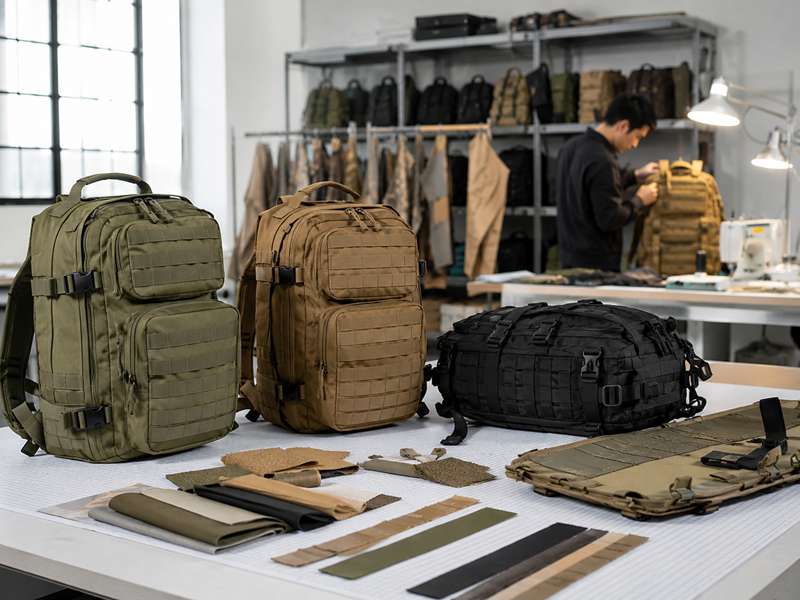
A tactical backpack is one of those products that can look nearly identical in two quotations while being very different once it is loaded, carried, opened hundreds of times, or produced in several thousand pieces. Fabric denier is only one variable. MOLLE spacing, webbing strength, seam construction, zipper grade, shoulder-strap anchoring, foam density, buckle fit, bottom reinforcement, internal layout, coating, color control, and packing specifications all influence how the finished pack performs.
The best tactical backpack production partner is the one that can translate the intended use into controlled materials, structure, reinforcement, hardware, sampling, inspection, and repeatable bulk output. Commercial private-label projects often need flexible OEM development, while U.S. defense programs may require domestic textile sourcing. Price matters, but only after every factory is quoting against the same technical specification and quality level.
That distinction matters more than it first appears. A $0.80 saving on a pack can disappear quickly when straps twist, webbing rows shift, zippers become inconsistent, cartons contain mixed colors, or a second production run no longer matches the approved sample.
The strongest sourcing decisions therefore begin long before the first price comparison. They begin by defining what the pack must carry, how it will be used, which components cannot fail, what must be documented, and which details must stay consistent when production moves from one sample to thousands of units.
Who Are the Best Tactical Backpack Manufacturers?

The best tactical backpack manufacturers are not simply the companies with the most recognizable names or the lowest unit prices. The right source depends on what the pack must do, where it will be sold or deployed, how much customization is required, and whether domestic-content rules apply. Military programs, private-label tactical collections, law-enforcement equipment, outdoor packs, emergency kits, and branded wholesale all require different production routes.
A useful comparison therefore starts by separating established tactical brands, U.S. military-focused producers, custom OEM/ODM factories, and wholesale channels.
For a proprietary backpack, look closely at fabric control, MOLLE construction, shoulder-harness engineering, reinforcement, zippers, buckles, sampling, bulk consistency, QC depth, packaging, capacity, and communication. For covered U.S. defense procurement, Berry Amendment requirements can become a decisive filter before price is considered.
| Production Route | Examples | Strongest Fit | Main Consideration |
|---|---|---|---|
| U.S. military-focused producer | Eagle Industries, Mystery Ranch military line, Tactical Tailor | Defense, professional tactical equipment | Domestic sourcing and technical requirements |
| Tactical performance brand | Eberlestock, 5.11 Tactical | Established branded gear | Limited control over proprietary product design |
| Wholesale tactical brand | Condor, 5.11, Maxpedition | Dealer and retail resale | Products normally follow existing brand specifications |
| Custom OEM/ODM factory | Jundong and qualified bag factories | Proprietary tactical backpacks and private label | Sample and specification control are essential |
| Berry-qualified production | Verified U.S. programs | Covered U.S. DoD textile procurement | Must be documented for the exact item |
The important distinction is simple: the best-known tactical brand is not automatically the best place to develop your own backpack. Likewise, a large bag facility is not automatically suited to demanding tactical construction.
The intended project should decide the shortlist.
Military Pack Leaders
Several established U.S. names provide useful benchmarks for military pack construction.
Eagle Industries states that its gear is Berry Compliant and made in the United States. Its positioning is closely connected with military and professional equipment rather than ordinary lifestyle backpacks.
Mystery Ranch also maintains a dedicated military pack line. Its published military documentation for products such as the Jump Mountain Ruck identifies the pack as Berry Compliant and describes U.S.-based design, sourcing, and construction.
Tactical Tailor provides another useful technical benchmark. Its Rhino Ruck is listed at 5,050 cubic inches, uses 1000D CORDURA nylon, and includes integrated rigging features, RTO access, seven external pockets, and a 3,400-cubic-inch main compartment.
Eberlestock approaches tactical load carriage through several pack sizes and architectures. Its Halftrack is a 42L three-day pack with MOLLE webbing, hydration capacity, a radio rack, and a frame, while the Operator is a 67L load-carrying tactical pack intended for extended field use.
These names are useful because they reveal how professional packs are differentiated by actual function.
A military-style product should be evaluated through details such as:
- loaded capacity
- harness structure
- frame integration
- MOLLE placement
- communication routing
- hydration routing
- compression
- modular attachment
- external pocket access
- reinforcement
- abrasion exposure
- field repair considerations
A 25L patrol pack does not need the same structure as a 60L+ ruck. Adding thicker fabric everywhere may only make a smaller pack heavier without improving the areas that actually receive load.
For commercial product development, the value of studying established military lines is not to copy them. It is to understand what changes when a backpack moves from tactical styling to functional tactical construction.
OEM Tactical Backpack Factories
Private-label development requires a different capability.
Instead of selecting an existing SKU, the project may begin with a sketch, reference sample, technical drawing, 3D concept, or existing backpack that needs substantial modification.
That creates a much longer list of technical decisions:
- 600D, 900D, 1000D, nylon, or polyester
- coating and backing
- finished dimensions
- capacity
- MOLLE layout
- laser-cut or webbing attachment system
- main compartment structure
- laptop or hydration section
- foam thickness
- shoulder-strap profile
- sternum strap
- removable waist belt
- compression straps
- zipper size and opening route
- buckle construction
- hook-and-loop areas
- logo process
- labels
- retail packing
A factory that only asks for quantity and logo is unlikely to have enough information to quote a complex pack accurately.
Jundong’s documented tactical capability covers Oxford, nylon, polyester, webbing, mesh, foam padding, metal hardware, and buckles. Tactical development specifically includes MOLLE systems, reinforcement, pocket layout, load-bearing areas, abrasion resistance, zippers, hook-and-loop sections, colors, branding, and functional organization.
Its operation includes more than 600 employees, approximately 18,000 m² of production space, a development team, design team, professional sample room, production team, and 80 QC inspectors.
Those numbers matter most when they are connected to execution.
A 600-person facility is not automatically better than a 100-person specialist workshop. The more useful test is whether the operation can move the same technical information through development, sampling, sewing, inspection, and packing without losing critical details.
For a serious tactical program, ask the factory to explain where it would control:
- shoulder-strap anchoring
- carry-handle reinforcement
- MOLLE alignment
- compression-strap attachment
- zipper-end reinforcement
- bottom stress areas
- webbing shade consistency
- hardware substitution
- dimensional tolerance
- packing by SKU
The response should be specific to the backpack, not a generic quality statement.
Berry-Compliant Programs
Berry compliance deserves its own sourcing route because it can eliminate otherwise capable overseas facilities from certain U.S. defense programs.
DFARS 225.7002 implements Berry Amendment restrictions covering specified clothing, textiles, fabrics, fibers, yarns, and related items for applicable Department of Defense acquisitions, subject to defined exceptions. The DFARS clause also specifically addresses certain items of individual equipment in Federal Supply Class 8465 that contain covered textile materials.
For this reason, a pack should not be described as Berry Compliant merely because it is sewn in the United States.
The documentation may need to go deeper into textile origin and individual components.
A serious review can include:
| Item to Verify | Why It Matters |
|---|---|
| Finished item | Compliance relates to the actual contracted product |
| Main fabric | Textile origin can be critical |
| Lining | Often overlooked in sourcing records |
| Webbing | A major textile component in tactical packs |
| Binding | Used throughout internal and external seams |
| Hook-and-loop | May form part of the textile bill |
| Thread | Should be reviewed where applicable |
| Cut-and-sew location | Establishes where assembly occurs |
| Subcontract work | Helps maintain traceability |
| Contract clause | Determines what requirement actually applies |
Eagle Industries explicitly states that its gear is Berry Compliant and U.S.-made. Mystery Ranch documentation for military packs such as the Jump Mountain Ruck also identifies Berry-compliant U.S. sourcing and construction.
These are useful reference sources where domestic-content requirements apply.
For ordinary outdoor, tactical lifestyle, security, emergency-response, hunting, or commercial private-label programs, Berry compliance may not be required at all. Adding it unnecessarily can restrict material choices and alter cost substantially.
The procurement contract should determine whether this requirement belongs in the specification.
Wholesale Tactical Brands
Wholesale and custom production solve different commercial needs.
Brands such as 5.11 Tactical and Condor operate dealer programs. 5.11 currently provides a formal dealer application route, while Condor gives approved dealers access to its tactical gear lines, including bags and backpacks.
Condor currently lists a $1,000 initial minimum order value and $250 minimum for later orders, with a handling fee if the later minimum is not reached.
Eberlestock also accepts applications from U.S. and international dealers. Maxpedition maintains dealer and wholesale inquiry channels as well.
That route is appropriate when:
- an established brand name matters
- an existing backpack already fits the sales channel
- product development is unnecessary
- fast assortment building is more important than design ownership
Custom production becomes more attractive when the product itself needs to become proprietary.
That can include:
- exclusive dimensions
- custom silhouettes
- proprietary pocket architecture
- unique MOLLE layout
- brand-specific colors
- custom patches
- private labels
- custom hangtags
- dedicated packaging
- exclusive accessory combinations
The decision is less about wholesale price versus factory price and more about control.
With branded wholesale, the retailer sells an existing product. With OEM development, the brand owns much more of the finished product direction.
China vs USA
Country alone is a poor way to judge a tactical backpack project.
The comparison becomes useful only after commercial and technical requirements are defined.
| Requirement | Guangdong OEM Route | U.S. Tactical Production |
|---|---|---|
| Proprietary development | Strong | Strong |
| Wide trim sourcing | Strong | Depends on facility |
| Multi-SKU private label | Strong | Available |
| Custom retail packing | Strong | Available |
| Berry requirement | Not applicable for required U.S. origin | Potential fit when documented |
| High-volume commercial production | Often efficient | Depends on capacity and cost |
| Domestic U.S. sourcing | No | Yes where verified |
| Import freight | Required | Not for domestic U.S. delivery |
| Custom color development | Strong | Available |
| Product revision support | Depends on factory | Depends on facility |
A Guangdong factory may be particularly practical for a commercial tactical collection containing several colors, multiple capacities, custom molded patches, branded packaging, and repeated seasonal production.
A U.S. source can become the logical choice when domestic origin is required or when program structure favors local production.
The calculation should include more than EXW unit price.
Consider:
unit cost + packaging + inspection + freight + duty exposure + inventory lead time + replenishment speed + rejected-goods risk + emergency airfreight risk.
A $1.00 difference in unit price may be far less important than a three-week delay on a national product launch.
Likewise, paying more for a domestic route makes little commercial sense if domestic sourcing provides no actual benefit to that particular program.
Factory Comparison
A shortlist becomes much easier to manage when everyone is quoting the same specification.
Use a weighted score instead of deciding from a product photograph and quotation.
| Area | Suggested Weight | What to Examine |
|---|---|---|
| Tactical construction | 18% | MOLLE, straps, reinforcement, load structure |
| Material control | 14% | Fabric, coating, webbing, color consistency |
| Sample execution | 14% | Dimensions, function, sewing, appearance |
| QC depth | 14% | Incoming, inline, functional, finished inspection |
| Development ability | 12% | Pattern revisions, component advice, documentation |
| Cost | 10% | Same specification compared side by side |
| Capacity | 6% | Ability to support expected volume |
| Delivery control | 5% | Production planning and material timing |
| Packing accuracy | 4% | SKU, labels, cartons, accessories |
| Communication | 3% | Technical clarity and revision control |
For a 10,000-piece commercial order, capacity and consistency may deserve more weight. For a new technically complex pack, development and sampling may deserve more. For covered U.S. defense procurement, domestic-content requirements can become a pass/fail condition rather than a weighted factor.
The quotation itself should also be normalized.
For example, these two lines are not sufficient:
Factory A: 1000D tactical backpack — $18.20
Factory B: 1000D tactical backpack — $16.70
The $1.50 difference tells almost nothing until the following are compared:
| Detail | Factory A | Factory B |
|---|---|---|
| Fiber | ? | ? |
| Fabric construction | ? | ? |
| Coating | ? | ? |
| Lining | ? | ? |
| Webbing width | ? | ? |
| Zipper size | ? | ? |
| Buckle grade | ? | ? |
| Foam | ? | ? |
| Reinforcement | ? | ? |
| MOLLE construction | ? | ? |
| Logo | ? | ? |
| Packing | ? | ? |
A lower quotation can come from a genuinely more efficient operation. It can also come from lighter material, simpler hardware, less reinforcement, fewer inspection steps, or missing packaging requirements.
Until those variables are visible, the prices are not truly competing with each other.
Best Fit
The most dependable tactical backpack source is usually the one that matches the exact commercial task rather than the company with the loudest reputation.
For established branded inventory, dealer programs from names such as 5.11, Condor, Eberlestock, or Maxpedition can be practical.
For demanding U.S. military programs, facilities with documented U.S. textile sourcing and Berry-qualified products deserve priority where the contract requires it.
For proprietary commercial tactical backpacks, the priority shifts toward development control, material sourcing, sampling, structural execution, repeatability, QC, cost management, and scalable production.
Before making the final selection, try to reach a clear yes on these ten items:
- The intended load and use are understood.
- The exact fabric is defined.
- MOLLE or laser-cut construction is documented.
- Critical stress areas are identified.
- Zippers, buckles, and webbing are specified.
- The sample can be revised technically, not only cosmetically.
- The approved version can be converted into controlled production instructions.
- Inspection covers function as well as appearance.
- Packing and SKU requirements are confirmed before production.
- Price is based on the same specification being compared elsewhere.
When those ten items are controlled, the choice becomes much less subjective. The project is no longer selecting a company because its sample looks tactical; it is selecting a production system capable of repeating the required backpack at scale.
What Makes a Tactical Backpack Factory Reliable?

A reliable tactical backpack factory is one that can reproduce an approved design consistently across hundreds or thousands of pieces—not simply produce one attractive sample. The strongest signs are controlled materials, experienced pattern development, secure load-bearing construction, accurate MOLLE layouts, defined component specifications, multi-stage inspection, realistic production planning, clear defect handling, and traceable sample-to-bulk records.
Tactical backpacks place more stress on production control than ordinary daypacks. Shoulder straps carry concentrated loads, compression straps pull against body panels, MOLLE webbing must stay aligned, zippers run around loaded compartments, and buckles repeatedly transfer tension through narrow attachment areas.
A good-looking sample can hide many of these weaknesses.
For this reason, reliability should be judged through the entire production chain:
material → cutting → reinforcement → sewing → hardware → function → inspection → packing
Jundong’s quality approach follows the same logic: inspection begins with incoming materials and continues through cut parts, branding, sewing, function, finished goods, packaging, and pre-shipment review rather than relying only on a final check.
A practical factory review should therefore focus on evidence rather than broad claims such as “heavy duty,” “military grade,” or “premium quality.”
| Area | What Should Be Verified | Why It Matters |
|---|---|---|
| Shell fabric | fiber, denier, coating, color | affects weight, abrasion, sewing |
| Webbing | width, thickness, material, shade | affects MOLLE and load transfer |
| Shoulder straps | anchor structure, foam, adjustment | major load-bearing area |
| Zippers | size, slider, puller, installation | frequent-use failure area |
| Buckles | fit, webbing compatibility, operation | controls adjustment and retention |
| MOLLE | spacing, alignment, attachment | determines modular usability |
| Bottom | fabric layers, reinforcement, seam layout | high abrasion and load area |
| Sample control | approved version and specification | protects bulk consistency |
| QC | incoming, inline, functional, final | catches problems before packing |
| Packing | SKU, labels, quantity, cartons | protects downstream delivery |
Tactical Experience
Experience matters because tactical construction is not simply an ordinary backpack with extra webbing sewn onto the front.
The most important difference is how force moves through the product.
Take a shoulder strap as an example. A thick padded strap may look strong from the outside, but the real performance depends on how far the anchor extends into the back panel, how many material layers support it, where reinforcement is placed, and how the sewing spreads load.
The same applies to:
- carry handles
- sternum straps
- waist belts
- compression straps
- D-rings
- MOLLE rows
- buckle tabs
- heavily loaded side pockets
- bottom corners
Jundong’s documented tactical development criteria specifically include MOLLE systems, webbing, reinforcement, pocket layout, load-bearing areas, abrasion resistance, zippers, buckles, hook-and-loop areas, colors, branding, and functional organization.
Its inspection guidance also notes that load performance cannot be judged from fabric thickness alone. Webbing, seam structure, reinforcement, bottom materials, hardware, and overall design all contribute.
This distinction is important when comparing two 1000D packs.
Both may use similar-looking shell fabric, yet one may have shoulder anchors extended deep into reinforced back panels while the other ends the strap at a narrow seam. One may reinforce the carry handle across several layers while another attaches it directly to the outer shell.
The fabric description may be identical. The service life may not be.
A technically experienced team should be able to explain where the pack carries force and how those areas are reinforced without relying on vague language.
Factory or Trading Company
Direct factory cooperation becomes more valuable as the design becomes more technical.
If an existing backpack only needs a printed logo, the production structure may be relatively simple. A completely new tactical pack is different because structural changes are connected.
For example:
- A larger rear compartment changes the back-panel pattern.
- The altered panel may shift shoulder-strap positions.
- New strap positions can affect reinforcement.
- Reinforcement may interfere with hydration routing.
- The revised opening can affect lining and binding patterns.
- Those changes can alter sewing time and cost.
When several departments must respond to each revision, shorter communication between development, pattern making, sampling, production, and inspection helps reduce mistakes.
Jundong’s documented setup includes product development, design, a professional sample room, production, foreign-trade sales, and quality inspection teams. The facility has more than 600 employees, approximately 18,000 m² of production space, and 80 QC inspectors.
Scale alone is not enough, however.
A smaller specialist facility can outperform a larger general bag plant when its technical control is stronger.
The better evaluation is to establish who controls each critical step.
| Task | What Should Be Clear |
|---|---|
| Pattern development | Who changes dimensions and structure? |
| Material sourcing | Who approves fabric and trims? |
| Sample revision | Who records changes? |
| Component substitution | Who has authority to approve it? |
| Bulk instructions | Which version is released to production? |
| Inline inspection | Who checks early output? |
| Defect correction | Who decides corrective action? |
If nobody can explain these responsibilities clearly, problems become difficult to trace later.
Production Standards
A reliable factory should be able to convert product expectations into measurable specifications.
“Strong zipper,” “thick fabric,” and “good MOLLE” are not useful production standards because different people can interpret them differently.
A stronger specification looks like this:
| Component | Weak Description | Controlled Description |
|---|---|---|
| Shell | 1000D | fiber + denier + finish + coating + color |
| Webbing | heavy duty | material + width + thickness + color |
| Foam | thick foam | material + thickness + density direction |
| Zipper | quality zipper | size + type + slider + puller |
| MOLLE | standard | row layout + spacing + stitch position |
| Buckle | strong buckle | size + material + approved reference |
| Logo | rubber patch | artwork + dimensions + color + location |
| Packing | individual bag | polybag + label + SKU + carton quantity |
The approved sample should then be checked against these details.
A physical sample is useful for appearance, hand feel, proportion, and construction reference, but it cannot record every hidden specification. Two black webbings can look similar while differing in thickness or stiffness. Two shell fabrics may have similar surfaces but different backing or coating.
That becomes especially important when a repeat order is placed months later.
“Make it the same as last time” is risky if the original material, zipper, hardware, foam, and packing instructions were never properly recorded.
Before bulk production, the practical goal is to create one controlled version containing:
approved sample + material references + component details + dimensions + logo file + packaging instructions + revision record
The fewer details left to memory, the easier it becomes to maintain consistency.
Quality Control
Final inspection alone is too late for many tactical backpack defects.
Consider MOLLE placement. If the webbing rows are positioned incorrectly during sewing, inspecting the issue after 3,000 completed backpacks does not solve the production loss. The same applies to wrong webbing color, incorrect zipper direction, missing reinforcement, or misplaced shoulder anchors.
Inspection needs to happen while correction is still practical.
A useful control sequence can look like this:
| Stage | Main Checks |
|---|---|
| Incoming | fabric, color, webbing, zipper, buckle |
| Cutting | dimensions, matched pieces, direction |
| Branding | logo size, position, color |
| Early sewing | reinforcement, pocket position, MOLLE |
| Assembly | straps, zippers, buckles, compartments |
| Functional check | opening, adjustment, pocket usability |
| Finished check | shape, dimensions, workmanship |
| Packing | SKU, labels, accessories, quantities |
| Pre-shipment | cartons, carton marks, final quantities |
Jundong’s recorded QC process covers incoming material, cut pieces, logo application, sewing, function, finished pieces, packaging, and pre-shipment review. Its documented concerns include material color or thickness variation, misplaced logos, zipper problems, uneven stitching, weak straps, incorrect compartments, mixed SKU packing, label errors, and shipment quantity mistakes.
Tactical packs also need product-specific checks.
Jundong identifies MOLLE, webbing, buckles, reinforcement, functional sections, and color as important bulk-production controls for tactical bags.
A useful factory discussion should therefore go beyond:
“Do you have QC?”
More useful information is:
- At what stage is MOLLE alignment checked?
- When are zipper and buckle functions tested?
- Are early production pieces compared with the approved sample?
- How are material substitutions controlled?
- How are SKU packing errors prevented?
- What happens when an inline defect is discovered?
The detail in these responses reveals far more than a generic inspection certificate.
Warranty Terms
There is no universal tactical backpack warranty period.
Current established tactical brands illustrate the difference. 5.11 publishes a limited lifetime warranty for many products covering qualifying defects in materials or workmanship, with exclusions such as misuse and extended wear. Eberlestock currently states that its gear carries a lifetime warranty against defects in materials and workmanship under normal use. Condor currently states that gear is covered for up to one year.
This variation is useful when planning a private-label line.
A brand offering a long warranty should build that promise into the product before launch rather than treating warranty as an after-sales sentence.
Longer coverage may justify greater attention to:
- zipper selection
- shoulder anchors
- carry handles
- webbing attachment
- buckle durability
- abrasion areas
- reinforcement
- spare components
- repairability
For bulk orders, defect handling should also be agreed clearly.
Useful commercial terms include:
| Item | What Should Be Defined |
|---|---|
| Production defect | What qualifies? |
| Normal wear | What is excluded? |
| Claim period | How long can claims be submitted? |
| Evidence | Photos, samples, quantity records |
| Remedy | Repair, replacement, credit, other solution |
| Repeated defect | How is a systemic issue handled? |
| Freight | Who handles transport cost? |
| Modification | Are altered products excluded? |
The purpose is not to create an unrealistic guarantee.
It is to make responsibility predictable before goods are shipped.
Project-Specific Testing
Testing should be connected to the intended use and the claim being made.
A commercial 20L tactical-style daypack does not automatically need the same validation as a 60L equipment rucksack. Likewise, a pack holding emergency medical tools may need different evaluation from one carrying laptops and everyday gear.
Possible areas include:
- fabric abrasion
- seam performance
- strap loading
- handle loading
- zipper cycling
- buckle operation
- webbing strength
- colorfastness
- coating performance
- water resistance
- dimensional stability
- finished-pack loading
The test method and pass requirement should be defined before testing begins.
This prevents vague claims from turning into technical misunderstandings.
For example:
“Water-resistant” does not automatically mean waterproof.
“Heavy duty” does not define a load capacity.
“Military grade” does not identify one universal backpack specification.
“Carries 40 kg” should not be used without a defined test and supporting result.
Jundong’s documented policy keeps testing and compliance tied to the destination, intended use, and specific project requirements rather than treating every bag as if it automatically carries the same documents or performance claims.
A reliable tactical backpack factory is therefore not the one that promises everything.
It is the one that can clearly show what has been specified, what has been tested, what has been approved, how it will be inspected, and how the same construction will be repeated when the order moves from one sample to full-scale production.
Which Type of Tactical Backpack Fits Your Project?

The right tactical backpack starts with load, carry time, access frequency, equipment dimensions, environment, and expected service life. Capacity alone is not enough. Two 30L packs can behave very differently when one carries clothing and electronics while the other carries dense tools, radios, medical equipment, or ammunition. Structure, harness geometry, pocket placement, reinforcement, fabric, hardware, and weight distribution should follow the actual load.
A practical design brief should define five things before materials are selected:
- what must be carried;
- approximate loaded weight;
- how long the pack will normally be worn;
- which items require immediate access;
- which equipment must attach outside the main compartment.
Once those details are clear, it becomes much easier to select capacity, MOLLE coverage, shoulder construction, back padding, zipper configuration, compression straps, internal dividers, and reinforcement.
Jundong’s tactical bag capability covers Oxford, nylon, polyester, webbing, mesh, foam padding, metal hardware, and buckles. Product development can include MOLLE systems, reinforcement, pocket layouts, load-bearing areas, abrasion zones, zippers, hook-and-loop sections, colors, logos, and functional organization.
A useful rule is to avoid making every component heavier simply because the product is tactical. Extra fabric, webbing, foam, buckles, and reinforcement increase empty weight and sewing complexity. Strong construction should be concentrated where force, abrasion, and repeated movement actually occur.
Tactical Backpack Types
Capacity gives a useful starting reference, but the intended load should determine the final structure.
| Tactical Pack Type | Practical Capacity | Typical Design Priorities |
|---|---|---|
| Compact EDC Pack | 15–22L | low weight, fast access, daily organization |
| Patrol Pack | 20–30L | hydration, MOLLE, comfort, quick-access pockets |
| Assault Pack | 28–40L | modular attachment, compression, reinforcement |
| 3-Day Pack | 35–50L | clothing, hydration, equipment, longer carry |
| Medical Pack | 20–40L | full opening, removable organizers, fast identification |
| Communication Pack | Project-specific | cable routing, radio retention, ventilation |
| Equipment Pack | 35–55L | stronger bottom, hardware, organized heavy items |
| Large Rucksack | 50–80L+ | load transfer, frame, waist belt, compression |
These numbers should be treated as design references rather than fixed industry rules. A 30L medical pack may require considerably more pattern work than a 40L general-purpose pack because internal access and equipment retention are more complex.
The equipment list should come before the pocket list.
For example, if the pack needs to hold:
- a 330 × 250 × 45 mm device;
- two 1L hydration bottles;
- four removable pouches;
- a folded jacket;
- radio equipment;
- a first-aid module;
those items should be arranged physically or digitally before the final dimensions are frozen.
This prevents a common development mistake: designing an attractive external shape first and then trying to force the equipment into the remaining internal space.
Backpacks also need enough usable depth. Increasing width or height alone may create a large stated capacity without creating practical storage for bulky equipment.
MOLLE History
MOLLE stands for Modular Lightweight Load-carrying Equipment. The U.S. Army describes it as a modular system designed to let Soldiers tailor load placement to mission needs. Current Army documentation describes large and medium rucksacks together with mission-specific modular sets, including rifleman and medic configurations.
The commercial value of the concept is straightforward: one base pack can support different external pouch arrangements instead of permanently fixing every accessory to the body.
That makes MOLLE useful for:
- medical kits;
- emergency equipment;
- hunting accessories;
- communication gear;
- utility pouches;
- bottle holders;
- tool modules;
- detachable admin pockets.
Modularity should still serve a purpose.
Covering every exterior panel with webbing increases sewing operations, material usage, weight, and visual density. A cleaner commercial design may need MOLLE only on the front lower panel and side sections.
Large load-carrying systems also show why modularity should be connected to real equipment needs. U.S. Army MOLLE systems have included different rucksack sizes and mission-specific modules rather than treating every load as one universal configuration.
For private-label development, the useful principle is not “add as much MOLLE as possible.” It is place modular attachment where users are actually likely to use it.
MOLLE vs Laser-Cut
Traditional MOLLE uses sewn webbing rows. Laser-cut construction uses precisely cut slots in a suitable reinforced or laminated panel.
Both can work well, but they create different products.
| Detail | Sewn MOLLE | Laser-Cut Panel |
|---|---|---|
| Appearance | traditional tactical | cleaner technical look |
| External bulk | higher | lower |
| Sewing operations | more | fewer on attachment panel |
| Material requirement | webbing + body fabric | suitable reinforced panel |
| Weight potential | generally higher | can be lower |
| Repair | webbing can often be repaired locally | depends on panel structure |
| Development focus | spacing and stitch accuracy | material integrity and cut geometry |
| Style | classic military | modern tactical/outdoor |
Traditional webbing is often appropriate for rugged designs where visible modular construction is part of the product identity.
Laser-cut systems can suit collections seeking a flatter, more modern appearance.
The weak link in laser-cut construction is often not the cutting accuracy but the material surrounding the slot. Repeated attachment and removal of pouches loads the edges of the openings. If the panel is too soft, poorly laminated, or inadequately reinforced, deformation can develop around frequently used slots.
Sample inspection should therefore include repeated pouch installation and removal rather than checking appearance only.
For traditional MOLLE, inspect:
- webbing width;
- row spacing;
- horizontal alignment;
- vertical stitch position;
- edge reinforcement;
- symmetry between left and right panels.
Even small visual deviations become obvious when several rows run across a large front panel.
600D vs 1000D Oxford
Choosing between 600D and 1000D should be based on the load and abrasion environment rather than the assumption that the larger number is automatically better.
Jundong uses multiple Oxford constructions for functional bags, including 600D, 900D, 1000D, and 1680D depending on product requirements. Tactical bags may combine Oxford with nylon, polyester, webbing, mesh, foam, and hardware.
| Design Factor | 600D Direction | 1000D Direction |
|---|---|---|
| Empty weight | lower | higher |
| Fabric bulk | moderate | heavier |
| Sewing difficulty | lower | greater |
| Commercial daypack | often suitable | may be unnecessary |
| Heavy equipment | needs engineered reinforcement | often more suitable |
| Shipping weight | lower | higher |
| Material consumption cost | generally lower | generally higher |
| Structural feel | moderate | firmer/heavier |
Denier describes yarn linear density. It does not describe the complete performance of the finished textile.
CORDURA Classic illustrates this clearly: the brand offers several yarn sizes, including 330D, 500D, 700D, and 1000D, and those fabrics can also use different woven constructions and finishes.
So two fabrics described simply as “1000D” should not automatically be considered equivalent.
A better material specification should record:
- fiber;
- denier;
- weave or construction;
- coating or laminate;
- finished weight where relevant;
- color;
- surface texture;
- approved sample reference.
For a 22L commercial patrol backpack carrying moderate everyday equipment, a well-engineered 600D structure may keep weight and cost under control.
For a 45L equipment pack repeatedly exposed to rough surfaces and heavier loads, increasing fabric durability in high-wear areas can make more sense.
It is also possible to mix constructions. The body does not always need the same fabric as the bottom or reinforcement panels.
Nylon vs Polyester
Nylon and polyester can both be used successfully in tactical backpacks. Selection should consider abrasion exposure, weight, hand feel, color requirements, coating, price position, and availability rather than relying on the fiber name alone.
Jundong lists nylon, polyester, and Oxford among the material directions used for tactical bags.
A practical comparison looks like this:
| Factor | Nylon | Polyester |
|---|---|---|
| Technical pack positioning | strong | strong |
| Hand feel | often smoother | varies widely |
| Abrasion-oriented applications | commonly selected | depends on construction |
| Commercial cost control | varies by grade | often practical |
| Color availability | broad | broad |
| Coated versions | available | available |
| Lightweight technical options | strong | available |
The fabric grade matters more than the generic fiber label.
CORDURA, for example, offers high-tenacity nylon constructions intended for bags, packs, luggage, and technical applications, including lighter constructions developed for products where weight reduction matters.
That highlights an important development principle:
Do not compare “nylon” against “polyester” without comparing the actual textile.
Ask for physical samples and compare:
- hand feel;
- stiffness;
- thickness;
- backside coating;
- surface texture;
- color;
- folding behavior;
- sewing behavior;
- finished appearance.
A premium tactical collection may justify a more technical textile. A promotional or commercial program may be better served by a controlled polyester or Oxford construction with the correct reinforcement.
Material should fit the product position rather than becoming an expensive feature that the final use never requires.
Zippers, Buckles and Webbing
These components occupy relatively little surface area but have an outsized effect on daily use.
Jundong’s component guidance notes that zippers affect opening smoothness, durability, appearance, and use, while webbing and straps directly influence load-bearing, comfort, and long-term performance.
For zippers, confirm:
- zipper size;
- coil or molded teeth;
- single or double sliders;
- slider finish;
- puller design;
- opening direction;
- tape color;
- curved opening performance.
Large main compartments often benefit from double sliders because access can begin from either side.
Smaller admin pockets may not need the same zipper size as the main compartment. Using oversized zippers everywhere adds weight and cost without automatically improving the product.
For buckles and adjusters, check that webbing width matches the component. A 25 mm adjuster should work properly with the selected 25 mm webbing thickness and surface finish—not merely fit through the opening.
For webbing, specify:
- 20/25/38/50 mm width where appropriate;
- fiber type;
- thickness;
- stiffness;
- weave;
- shade;
- tensile requirement if defined;
- stitching location.
Color matching also deserves attention. A black shell combined with three visibly different shades of black across webbing, zipper tape, mesh, and buckles can make a premium pack look inexpensive even when every component is technically functional.
Stress-Point Reinforcement
A strong tactical backpack distributes load through the product rather than concentrating force at small attachment areas.
Jundong’s inspection guidance identifies handles, shoulder straps, waist belts, bottoms, webbing, D-rings, buckles, zipper surroundings, side connections, bottom seams, reinforced stitching, corners, and heavy-load areas as relevant stress locations. It also notes that load performance depends on the combined structure rather than fabric thickness alone.
The highest-priority areas usually include:
| Area | Main Failure Risk | Practical Control |
|---|---|---|
| Shoulder anchor | seam tearing | extend load into reinforced back panel |
| Carry handle | concentrated pull | reinforce across wider structure |
| Compression strap | shell distortion | anchor into reinforced seam |
| Bottom corner | abrasion + load | stronger material/layering |
| D-ring | local tearing | backing reinforcement |
| Buckle tab | repeated tension | secure webbing anchoring |
| MOLLE rows | pulled stitching | correct stitch layout |
| Zipper end | stress concentration | secure termination |
| Waist belt | heavy lateral force | broad structural connection |
Reinforcement should be designed around load paths, not around the number of bartacks visible on the outside.
During sample review, load the pack realistically.
Do not only fill it with soft fabric to make it look full for photographs. Use weights or representative equipment distributed in the same locations expected during real use.
Then:
- lift it repeatedly from the top handle;
- wear it by both shoulder straps;
- tighten compression straps;
- adjust sternum and waist straps;
- load side pockets;
- attach modular pouches;
- inspect seams after repeated movement.
Early warning signs include fabric puckering around anchors, visible seam distortion, webbing rotation, stitch elongation, asymmetric straps, zipper waviness, and bottom-panel deformation.
Those small changes are valuable during sampling because they show where reinforcement or pattern geometry may need adjustment before bulk production.
The right tactical backpack is therefore not simply the strongest-looking design. It is the product in which capacity, material, harness, modular attachment, hardware, reinforcement, and empty weight are balanced around the actual equipment being carried.
A 20L patrol pack should not be engineered like a 70L rucksack. A medical pack should not be organized like an EDC daypack. A commercial tactical collection does not need every feature found on military load-carriage equipment.
The most efficient design uses durability where it matters, removes unnecessary weight where it does not, and converts the intended use into measurable construction before sampling begins.