 Skip to content
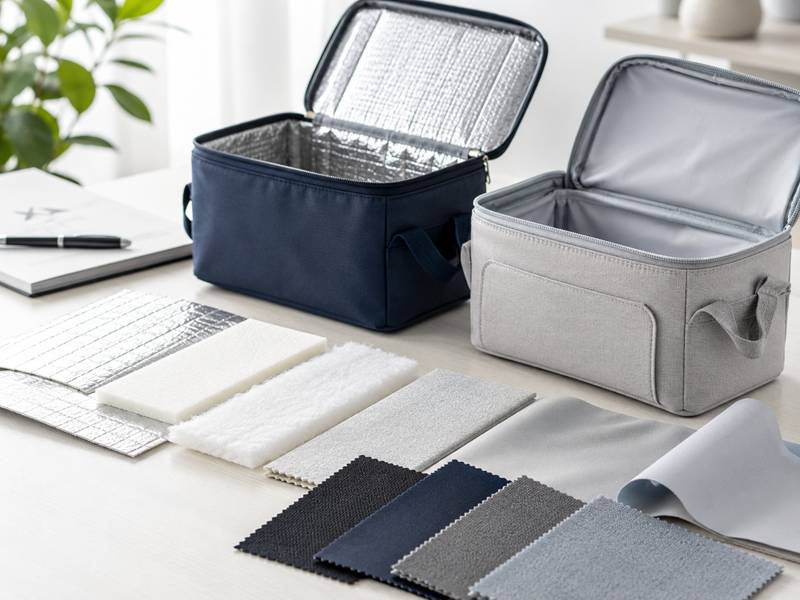
The material people notice first on a lunch bag is rarely the material doing most of the insulating.
A silver interior may immediately look “thermal.” A thick Oxford exterior may make the bag feel durable. A soft neoprene body may feel warmer and more substantial than thin polyester. But none of these visual impressions alone tells you how well the finished bag will control heat transfer.
A well-developed insulated lunch bag is a layered structure. The exterior handles wear, color, printing and appearance. The middle foam slows heat movement and gives the bag shape. The inner liner helps manage moisture, cleaning and the internal surface. The zipper, opening, seams and overall construction then determine how effectively those materials work together.
Most custom insulated lunch bags use polyester, Oxford fabric or nylon as the outer shell, EPE foam as the main insulation layer, and PEVA or aluminum foil as the inner lining. Neoprene can also be used for softer insulated styles. There is no single best material: insulation thickness, bag size, opening structure, liner, ice packs, carrying time and use conditions all affect performance.
That distinction becomes important once a project reaches sampling.
Two lunch bags can have the same external dimensions, the same printed logo and almost the same appearance, yet feel completely different in use. One may stand upright and hold boxed meals neatly. Another may collapse when half empty. One liner wipes clean easily; another traps liquid around stitched corners. One accepts a frozen gel pack without taking away too much usable space; another looks generous outside but feels unexpectedly small inside.
The differences are often hidden between the exterior fabric and the lining.
Understanding those hidden layers before approving a sample can prevent expensive changes after production has already been prepared.
What Insulation Materials Are Used in Lunch Bags?

An insulated lunch bag is usually built as a multi-layer structure, not from one “thermal fabric.” The visible outer textile, the hidden foam layer, and the inner lining each perform different jobs. In most soft lunch bags, the insulation system combines an outer shell such as polyester, Oxford fabric or nylon, a middle layer such as EPE foam, and an inner surface such as PEVA or aluminum foil. Neoprene can also be used when a softer, more flexible structure is preferred.
A practical way to specify the product is to separate the construction into three layers:
| Layer | Common Material | Main Function | What Should Be Confirmed |
|---|---|---|---|
| Outer shell | Polyester | Color, printability, abrasion protection | Fabric weight, coating, print effect |
| Outer shell | Oxford fabric | Structure, durability, firmer hand feel | Denier, coating, stiffness |
| Outer shell | Nylon | Lightweight feel, abrasion resistance | Fabric weight, finish, cost |
| Insulation core | EPE foam | Thermal resistance, cushioning, shape | Thickness, density, compression |
| Inner lining | PEVA | Easy cleaning, interior barrier | Thickness, odor, seam construction |
| Inner lining | Aluminum foil | Reflective thermal appearance | Lamination, flexibility, seam durability |
| Alternative body | Neoprene | Softness, elasticity, light insulation | 3–8 mm thickness, sewing, printing |
The most important detail is that these materials are not interchangeable.
PEVA is not a substitute for EPE foam. Polyester is not the main insulation layer. Aluminum foil alone does not determine how long food stays cold. The finished performance comes from the material combination, insulation thickness, bag volume, seams, opening design, zipper, ice packs and actual conditions of use.
For a custom lunch bag, it is therefore much more useful to write:
600D polyester + 5 mm EPE foam + PEVA lining
than simply:
600D insulated lunch bag.
The first specification gives enough information to begin evaluating the structure. The second only describes what the outside looks like.
What Does Each Bag Layer Do?
The outer shell mainly protects the insulated structure and creates the visual identity of the bag.
Polyester is frequently used because it offers relatively controlled material cost, many color choices and good compatibility with printing. It works well for lunch bags that need multiple colors, promotional graphics or a lighter overall construction. Jundong’s material records list polyester among the common fabrics used for cooler and lunch bag projects.
Oxford fabric usually gives a stronger, more structured appearance. It is useful when the bag should hold its shape better or when the intended use involves more abrasion, repeated handling or larger capacity.
Nylon is another option when a lighter, smoother or more technical outer surface is preferred.
None of these outer fabrics should automatically be treated as waterproof. Water resistance depends on the coating, seam structure, zipper, binding and how the complete bag is assembled.
The middle layer is where much of the insulation effect comes from.
EPE foam is commonly used because it combines several functions:
- slows heat transfer;
- adds cushioning around containers;
- helps the side walls maintain shape;
- gives the bag a fuller hand feel;
- supports the liner.
This layer is normally hidden between the exterior textile and inner lining.
The inner layer then affects cleaning, moisture handling and the overall experience when the bag is opened.
PEVA is often selected because it provides a smoother interior that can be easier to wipe clean. Aluminum foil gives the familiar reflective appearance associated with thermal bags. Jundong’s material documentation separates these functions clearly: PEVA is used as an easy-clean lining, while EPE foam works as insulation, cushioning and structural support.
That distinction is especially useful during sampling.
A bag may use high-quality outer fabric and still feel poorly developed if the liner wrinkles heavily or the foam shifts around the corners.
The three layers should therefore be checked as one finished structure.
EPE Foam vs EVA Foam: Which Is Better?
EPE foam is one of the most practical insulation materials for soft lunch bags because it offers a useful balance of insulation, cushioning, flexibility and cost.
It can be cut into panels and placed between the outer shell and liner without turning the bag into a hard case. That makes it suitable for products that should remain soft enough to carry comfortably and pack into cartons efficiently.
EVA foam can be firmer and denser depending on formulation. It may provide stronger shape retention in some constructions, but it can also increase stiffness, weight and development cost.
The choice should therefore be based on the finished product rather than the foam name.
The main variables are:
| Variable | Why It Matters |
|---|---|
| Foam thickness | Affects thermal resistance and internal capacity |
| Foam density | Changes firmness and compression behavior |
| Bag dimensions | Larger bags need more structural control |
| Wall shape | Flat walls and curved walls behave differently |
| Sewing method | Thick foam creates more seam bulk |
| Carton packing | Thicker walls increase packed volume |
| Target feel | Soft lunch tote vs structured cooler |
| Cost | Material use and sewing difficulty both matter |
A useful example is a compact lunch bag with an external width of 260 mm.
If the insulation is increased from 5 mm to 8 mm, the extra 3 mm on both sides uses another 6 mm of internal width unless the outer dimensions are enlarged.
That may sound insignificant, but it becomes important when a food container is already 220–230 mm wide.
The same thickness change also affects depth and height.
This is why insulation should not be increased after the dimensions have already been approved without checking the internal space again.
For daily lunch bags, moderate EPE thickness is often more practical than simply selecting the thickest possible foam.
For larger picnic coolers, greater wall thickness may make more sense because the internal volume, carrying time and load are higher.
PEVA vs Aluminum Foil: What Is the Difference?
PEVA and aluminum foil are both common inner materials, but they create different product characteristics.
PEVA is often preferred when the interior should feel smooth, clean and easy to wipe.
This is especially useful in:
- school lunch bags;
- office lunch totes;
- meal prep carriers;
- soft coolers;
- picnic bags.
Spilled sauce, condensation or moisture is common in these products. A smooth liner can make cleaning much easier.
Aluminum foil is often used when a reflective thermal appearance is desired. When the bag is opened, the silver surface immediately communicates “cooler” or “insulated” to the user.
That visual effect can be useful in promotional and value-oriented products.
However, the interior appearance should not be confused with the insulation level.
A foil-lined bag with very thin foam can perform worse than a PEVA-lined bag with a better-designed insulation structure.
The construction should be evaluated across several areas:
| Detail | PEVA | Aluminum Foil |
|---|---|---|
| Wipe-clean surface | Usually strong | Depends on finish |
| Reflective appearance | Low | High |
| Soft hand feel | Usually higher | More technical |
| Folding | Depends on thickness | Depends on laminate |
| Corner construction | Needs seam review | Needs seam review |
| Food-related claims | Documentation required | Documentation required |
| Leak resistance | Depends on structure | Depends on structure |
Jundong’s material requirements specifically state that leak resistance cannot be assumed from the liner alone, and that food-related use must be reviewed according to the selected material and project requirements.
That becomes important when the product is expected to hold loose ice, melted water or unsealed liquids.
A sewn liner may still allow liquid to pass through needle holes or seam joins.
If stronger leak resistance is required, the sample should be checked carefully at:
- bottom corners;
- side seams;
- zipper ends;
- binding;
- liner joints;
- pocket attachment areas.
A simple water test on the finished sample can reveal problems that are impossible to see from a material swatch.
Is Neoprene an Insulation Fabric?
Neoprene is often used when a lunch bag needs to feel softer and more flexible than a conventional foam-lined cooler.
It can provide light insulation while also offering elasticity and cushioning.
Common project thicknesses may include 3 mm, 5 mm, 7 mm and 8 mm, depending on the design. Jundong’s material records note that thickness affects cost, hand feel, protection, insulation feel and sewing difficulty.
The differences become obvious in the finished product.
A 3 mm neoprene lunch bag can feel:
- light;
- soft;
- flexible;
- easy to fold.
A 7–8 mm construction can feel:
- thicker;
- more padded;
- more structured;
- harder to fold;
- bulkier at the seams.
Neoprene works particularly well for compact lunch totes, bottle holders and promotional products where softness and portability matter.
For example, someone taking lunch to an office may want to fold the empty bag into a backpack after eating. A soft neoprene construction can support that use better than a rigid cooler.
But neoprene should not automatically be chosen when longer cooling performance is required.
A large outdoor cooler may need a more conventional outer-shell + foam + liner construction because the bag must also manage larger volume, heavier loads and more demanding carrying conditions.
It is also important not to assume that every neoprene construction is completely waterproof. Finished resistance depends on seams, zipper design and assembly. Jundong’s material rules specifically avoid presenting neoprene as automatically waterproof or capable of a fixed cooling duration.
Are Polyester and Oxford Insulation Materials?
Polyester and Oxford fabric are normally outer-shell materials rather than the main insulation core.
Their main jobs are:
- protecting the foam;
- carrying the color;
- supporting logo decoration;
- resisting abrasion;
- creating the desired visual style;
- helping the bag hold its shape.
A common custom specification may look like this:
600D polyester / 5 mm EPE / PEVA
Another design may use:
Oxford fabric / 8 mm EPE / aluminum foil
These two structures can look similar in a product photograph but feel very different once handled.
The first may be lighter and easier to fold.
The second may feel firmer and more structured.
The fabric itself also affects how the cooler bag performs during repeated use.
A very light exterior may reduce weight but provide less structural support.
A heavier Oxford textile can increase durability but may also add material cost and stiffness.
This is why exterior fabric should be chosen together with the foam thickness.
The same principle applies to coating.
A polyester fabric with a coating can provide a stronger water-resistant feel than an uncoated version, but the finished bag still depends on the seams and zipper.
The coating should therefore be stated separately in the specification instead of assuming that “polyester” or “Oxford” automatically defines water resistance.
How Should the Material Stack Be Specified?
A good lunch bag specification should define the materials from the outside inward.
For example:
Outer: 600D polyester
Insulation: 5 mm EPE foam
Inner: PEVA
Closure: zipper
Capacity: 8 L
Use: daily lunch and ice pack
Internal requirement: two food containers + one gel pack
This makes it much easier to evaluate whether the materials fit the actual use.
A weaker specification might simply say:
“8 L insulated lunch bag, polyester.”
That leaves too many important details open.
The insulation layer is unknown.
The liner is unknown.
The foam thickness is unknown.
The usable internal dimensions are unknown.
And if those details are decided later, the price and finished dimensions may change.
The material stack also affects packing.
Thicker foam usually means the bag does not compress as tightly.
If one carton previously held 40 pieces, a thicker structure may reduce the number that fit into the same carton size. That can affect shipping volume even if the unit weight changes only slightly.
For larger orders, that difference deserves attention.
What Should Be Checked Before Approving Materials?
Material approval should include more than looking at swatches.
For insulated lunch bags, the finished sample should be checked for:
- exterior hand feel;
- fabric color;
- coating;
- foam thickness;
- wall firmness;
- usable internal dimensions;
- liner odor;
- liner wrinkles;
- zipper operation;
- corner construction;
- cleaning access;
- loaded shape;
- ice-pack fit.
The bag should be loaded with the intended containers before approval.
That simple test often reveals problems early.
For example:
A lunch bag may look large enough when empty but become too tight once a 5 mm foam structure has been added.
A PEVA liner may look smooth before assembly but wrinkle heavily around the base.
A zipper may operate perfectly on an empty bag but become difficult to close after rigid containers are loaded.
The sample is therefore the stage where the material stack should be verified as a working product rather than as separate pieces of fabric.
For cooler bags, Jundong’s sample controls specifically include the insulation layer, liner, leak-resistant structure, capacity, cleaning and zipper performance.
Once these details are confirmed, the approved structure can be used as the production reference.
That is much more reliable than selecting materials independently and expecting them to work together automatically.
Which Insulation Is Best for Each Cooler Bag?

The best insulation depends on how the bag will actually be used. A compact lunch tote, a meal-prep carrier, a family picnic cooler and a delivery bag do not face the same thermal load, carrying weight or opening frequency. In practice, insulation should be selected together with capacity, liner, zipper design, cleaning requirements, outer fabric and target cost rather than choosing one foam for every style.
For most soft cooler projects, a useful starting structure is:
Outer shell + insulation core + inner liner
Common combinations include polyester or Oxford fabric outside, EPE foam in the middle, and PEVA or aluminum foil inside. Neoprene is more suitable when softness, elasticity and foldability are part of the design. Jundong’s cooler-bag material records list polyester, Oxford, nylon, PEVA, aluminum foil, EPE foam and neoprene among the main options for these products.
The table below gives a practical starting direction.
| Cooler Bag Type | Main Use | Recommended Starting Structure | Main Risk to Check |
|---|---|---|---|
| Daily lunch bag | School, office, commute | Polyester/Oxford + EPE + PEVA | Internal space after insulation |
| Meal prep bag | Multiple food containers | Structured shell + EPE + PEVA | Container fit and wall stability |
| Picnic cooler | Family, outdoor use | Oxford/polyester + stronger insulated structure | Loaded weight and handle strength |
| Delivery cooler | Repeated opening | Durable shell + EPE + easy-clean liner | Heat loss at opening |
| Promotional lunch bag | Events, gifts, campaigns | Polyester or neoprene | Cost, logo result, packing volume |
| Premium retail cooler | Long-term reusable product | Refined shell + controlled foam + clean liner | Shape, zipper and finishing consistency |
Daily Lunch Bags
Daily lunch bags need balance more than maximum thickness.
The product usually has to carry food containers, one drink and perhaps an ice pack while still fitting comfortably inside a backpack, office drawer or school locker. If the walls become too thick, the outside dimensions may look generous while the usable inside becomes unexpectedly tight.
A practical structure often starts with:
- polyester or Oxford outer fabric;
- EPE foam insulation;
- PEVA lining;
- compact zipper opening;
- short handle or adjustable strap.
EPE works well here because it provides insulation, cushioning and shape without forcing the product into a rigid-case structure. PEVA is useful when the interior needs to be wiped frequently after condensation or spills.
For this type of bag, several details matter more than simply increasing wall thickness.
Internal dimensions
The food box should fit with enough clearance to insert and remove it without dragging heavily against the liner.
Ice-pack space
If the design is intended to be used with a gel pack, that space should be reserved during development rather than added later.
Opening geometry
A very large lid can make packing easy but exposes more internal air every time the bag is opened.
Cleaning
Deep liner folds and inaccessible bottom corners can make a compact lunch bag difficult to maintain.
A daily lunch bag is therefore best developed around the actual food container and ice-pack dimensions rather than around an exterior size alone.
Meal Prep Bags
Meal prep bags need more structural planning because they often carry several rigid containers instead of one lunch box.
This creates different pressure inside the bag.
If three or four containers are stacked, the lower walls and base experience more continuous load. If the insulation is too soft, the body may collapse inward. If it is too thick, the containers may no longer fit as intended.
A practical meal-prep structure usually benefits from:
- a firmer outer textile;
- EPE insulation;
- easy-clean PEVA liner;
- controlled divider layout;
- wide but well-structured zipper access.
The most important issue is usable capacity.
External dimensions do not equal internal dimensions.
Outer fabric, insulation, lining, seam allowance and reinforcement all consume space. If a container is 200 mm wide, designing an internal cavity of only 202–204 mm leaves almost no practical clearance after sewing variation and liner folds are considered.
Meal-prep samples should therefore be checked with the intended container set.
A good test sequence is simple:
- Load all intended containers.
- Add the planned ice pack.
- Close the zipper without forcing it.
- Carry the bag fully loaded.
- Leave it loaded for several hours.
- Check whether the walls recover after unloading.
- Inspect liner pressure areas.
- Repeat opening and closing.
This reveals whether the insulation is supporting the product or simply consuming space.
Picnic Cooler Bags
Picnic cooler bags generally need stronger structure because the internal volume and loaded weight are much higher.
A bag filled with drinks, food containers and several ice packs can become several times heavier than the empty product. Once that happens, insulation is only one part of the design.
The outer shell needs to support the load.
Oxford fabric or durable polyester is often a practical direction because these materials can provide a firmer body and support larger soft-cooler designs. The insulation may use EPE foam, while PEVA or foil-type lining can be selected according to cleaning and interior appearance.
The most important checks are:
- wall stability;
- bottom structure;
- handle attachment;
- shoulder strap reinforcement;
- zipper opening;
- liner seams;
- corner construction.
A common mistake is upgrading the insulation while leaving the carrying system unchanged.
That can create a bag that feels thermally substantial but becomes uncomfortable or unstable once loaded.
For picnic use, the insulation and the load-bearing structure should be developed together.
The opening also deserves attention.
A large U-shaped lid is convenient because food and drinks are easy to access, but every full opening exchanges a large volume of air. The design therefore needs to balance access with thermal control.
Delivery Cooler Bags
Delivery cooler bags have one of the most demanding use patterns because they may be opened repeatedly throughout the day.
This changes the insulation logic.
A thicker foam wall can slow heat entering through the body, but it cannot completely compensate for frequent large openings.
For delivery use, opening design can be just as important as insulation thickness.
Compare two structures:
Structure A
Thicker insulation
- large full-width opening
- frequent complete opening.
Structure B
Moderate insulation
- smaller controlled opening
- shorter access time.
In repeated-use conditions, Structure B may perform more consistently because it reduces air exchange during each stop.
Jundong’s production guidance specifically identifies the lining, insulation layer and opening structure as important cooler-bag control areas.
Delivery cooler development should therefore review:
- lid size;
- zipper path;
- opening time;
- divider arrangement;
- liner cleaning;
- handle position;
- repeated compression;
- wall recovery.
The interior also needs to tolerate frequent wiping.
Bottom corners and seam joins are particularly important because moisture and residue can collect there after repeated loading.
For this type of product, the best insulation system is the one that supports the daily operating routine rather than the one with the thickest wall.
Promotional Lunch Bags
Promotional lunch bags usually need controlled cost, visible branding and efficient packing.
The product may be distributed at corporate events, schools, exhibitions, campaigns or gift programs, so the specification often needs to balance insulation with logo impact and carton volume.
Two structures are especially practical.
Polyester-based construction
This works well when the design needs:
- large printed logos;
- several colors;
- simple sewing;
- controlled material cost;
- familiar cooler-bag appearance.
A common direction is polyester outer fabric with EPE insulation and PEVA or foil lining.
Neoprene construction
This is useful when softness and foldability are more important.
Neoprene can provide light insulation while also creating a flexible, compact bag. Jundong’s material records show common neoprene project thicknesses such as 3 mm, 5 mm, 7 mm and 8 mm, depending on the design. Thickness affects hand feel, structure, sewing difficulty and cost.
For high-volume promotional programs, carton efficiency deserves attention.
Increasing wall thickness may reduce the number of bags packed per carton. That may increase freight volume even when each individual unit only becomes slightly heavier.
It is therefore useful to compare:
unit cost + packing volume + logo result
rather than only material price.
Premium Retail Coolers
Premium cooler bags need more than thicker insulation.
A product can use substantial foam and still feel inexpensive if the zipper is rough, the liner wrinkles heavily or the handles distort under load.
A premium structure normally depends on several details working together:
- refined outer fabric;
- consistent wall structure;
- carefully selected insulation;
- smooth liner assembly;
- higher-quality zipper;
- reinforced handles;
- clean edge finishing;
- stable loaded shape.
The insulation should support the appearance rather than overpower it.
For example, adding excessive thickness to a compact premium lunch tote can make the seams bulky and corners visually heavy. A slightly thinner but better-controlled construction may feel cleaner and more refined.
This is why premium development should be assessed as a complete product.
Several details are particularly useful during sample review:
| Detail | What to Check |
|---|---|
| Side walls | Do they remain even and flat? |
| Corners | Are they bulky or distorted? |
| Liner | Does it wrinkle excessively? |
| Zipper | Does it move smoothly around curves? |
| Handle | Does the bag remain balanced when loaded? |
| Base | Does it sag with food and ice packs? |
| Foam | Does it recover after compression? |
A premium cooler should feel controlled both empty and loaded.
School vs Office Lunch Bags
School and office products may use similar insulation materials, but the priorities are not identical.
A school lunch bag often needs:
- lightweight construction;
- easy cleaning;
- compact dimensions;
- simple zipper operation;
- durable handles;
- visible name-label or logo area.
An office lunch tote may place more emphasis on:
- appearance;
- hand feel;
- neutral styling;
- slim dimensions;
- portability after lunch.
For school use, PEVA lining can be particularly practical because spills are common and frequent wiping is expected.
For office use, a softer neoprene design may make sense when the empty bag should fold into a backpack after lunch.
The insulation choice should therefore follow the daily routine, even when the two products have similar capacities.
Soft Cooler vs Structured Cooler
The difference between a soft cooler and a more structured cooler is not simply insulation thickness.
A soft cooler prioritizes flexibility.
It may use lighter outer fabric, softer foam or neoprene. It can compress for storage and usually occupies less space when empty.
A structured cooler places more emphasis on:
- shape retention;
- wall stability;
- load support;
- upright presentation.
That may require a firmer exterior, more controlled foam and stronger base construction.
Neither is automatically better.
A soft structure is useful for commuting, gifts and foldable lunch products.
A structured design is more practical for meal prep, larger picnic use or products that need strong retail presentation.
How Should the Final Choice Be Made?
The fastest way to choose insulation is to define the product in this order:
1. What goes inside?
List the food containers, bottles, cans and ice packs.
2. How large is the load?
A 5-liter lunch bag and a 20-liter picnic cooler should not be treated the same.
3. How often will it be opened?
Repeated opening can reduce thermal stability quickly.
4. How should it be cleaned?
If frequent wiping is expected, liner access becomes important.
5. Does the bag need to fold?
If yes, very rigid insulation may work against the design.
6. How important is loaded shape?
Meal prep and picnic products often need stronger wall control.
7. What is the intended cost level?
Thicker foam, heavier exterior fabric, upgraded zipper, custom hardware and premium packing can all increase cost. Jundong’s material records note that material type, thickness, coating, lining, padding, hardware and quantity all influence the finished unit cost.
A useful specification might therefore read:
Daily lunch bag
Polyester outer
- EPE insulation
- PEVA lining
- space for one food box and one ice pack
- compact zipper opening.
Or:
Family picnic cooler
Oxford outer
- stronger insulated wall structure
- PEVA/foil interior
- reinforced handles
- structured base
- larger zipper opening.
That level of detail produces a far more reliable product than simply requesting “the best insulation.”
For custom cooler bags, the best insulation is the one that matches capacity, opening frequency, load, cleaning, carrying style and cost without sacrificing usable internal space. The correct structure should be proven in the finished sample before production, especially for larger, multi-container or repeated-use designs.
How Does Insulation Affect Cooling Performance?

Cooling performance depends on the whole insulated structure, not on one material or one foam thickness. EPE foam, PEVA or foil lining, the outer shell, zipper, seams, opening size, bag capacity, ice-pack use and test conditions all influence how quickly heat enters the bag. A thicker wall can improve thermal resistance, but poor closure design or frequent opening can reduce much of that advantage.
For this reason, it is more useful to evaluate an insulated lunch bag as a complete system:
outer shell + insulation + liner + closure + internal volume + cold source + actual use
The same 5 mm EPE structure can behave very differently in a compact lunch tote and a large picnic cooler. The same bag can also show different results depending on whether it contains chilled food, room-temperature food, one ice pack or several ice packs.
What matters is not only how much insulation is inside the walls, but how effectively the entire structure slows unwanted heat transfer during use.
Foam Thickness
Foam thickness is one of the most important variables because it affects both thermal resistance and physical structure.
EPE foam is commonly used in cooler and lunch bags as an insulation, cushioning and supporting layer. Its thickness influences performance, cost and the way the finished bag holds its shape.
Increasing insulation thickness can improve thermal potential because heat must travel through a thicker barrier. But there are practical tradeoffs.
Thicker walls can also:
- reduce usable internal space;
- increase seam bulk;
- make zipper installation more difficult;
- reduce foldability;
- increase carton volume;
- change the finished hand feel;
- raise material consumption.
Consider a simple example.
A lunch bag is designed with an external width of 260 mm.
If the insulation changes from 5 mm to 8 mm, each side becomes 3 mm thicker. Without changing the external dimensions, approximately 6 mm of internal width can be lost across the two side walls.
The same effect appears in depth.
If the bag is already designed tightly around rigid containers, a seemingly small thickness change can create real fit problems.
| Foam Change | Added Thickness per Wall | Approx. Internal Width Lost Across Two Walls |
|---|---|---|
| 3 mm → 5 mm | 2 mm | 4 mm |
| 5 mm → 8 mm | 3 mm | 6 mm |
| 5 mm → 10 mm | 5 mm | 10 mm |
These figures only show the dimensional effect. They do not predict cooling hours.
That distinction is important.
A thicker foam structure may improve insulation, but a bag with poor zipper closure, large openings or weak seam control may still underperform compared with a better-balanced construction.
The correct thickness should therefore be tested in the finished sample, not selected only from a material chart.
Liner Performance
The inner liner affects cleaning, moisture handling and how the insulated structure behaves inside the bag.
PEVA is commonly used as an easy-clean liner for lunch bags and cooler bags. Aluminum foil is often used where a reflective thermal interior is preferred. EPE foam usually sits behind these materials and performs more of the insulation and cushioning work.
The liner is important, but it should not be mistaken for the entire insulation system.
A shiny foil interior may look highly insulated, yet the finished bag can still lose heat quickly if:
- the foam is too thin;
- the zipper opening is large;
- the seams are poorly controlled;
- the lid does not close closely;
- the bag is opened frequently.
PEVA also does not automatically make a bag leakproof.
Leak resistance depends on how the liner is joined, how corners are constructed and whether liquid can pass through stitched areas. Jundong’s material guidance specifically notes that leak resistance depends on structure and workmanship rather than lining material alone.
During sample evaluation, the liner should be checked at:
- bottom corners;
- side seams;
- zipper ends;
- binding edges;
- pocket attachment areas;
- places where several layers overlap.
These areas often reveal more about real usability than the large flat surface in the middle of the bag.
Zippers and Openings
The zipper and opening design have a large effect on thermal stability because every opening allows warm air to enter and cool air to escape.
A well-insulated wall cannot completely compensate for repeated full opening.
This is why the same bag may behave very differently depending on how it is used.
Compare two designs:
Design A
Large U-shaped lid
Easy loading
Large exposed opening
Design B
Shorter top zipper
Smaller exposed area
More restricted access
Design A may be more convenient for meal containers.
Design B may reduce air exchange during quick access.
Neither is automatically better.
The correct opening depends on the product.
A meal-prep carrier may need a wide opening because several containers must be loaded horizontally.
A school lunch bag may work better with a smaller top opening because access is simpler.
A delivery cooler may need an opening that allows fast repeated access without exposing the entire interior.
Jundong’s cooler bag production guidance specifically identifies lining, insulation layer and opening structure as important control areas during sewing and assembly.
The zipper itself also deserves attention.
Check:
- whether it closes completely;
- whether foam crowds the zipper line;
- whether the slider moves smoothly around corners;
- whether the lid is pulled out of shape when loaded;
- whether the zipper ends leave obvious gaps.
A small closure problem repeated along a large opening can have more practical impact than increasing foam by several millimeters.
Seam Construction
Insulation works best where the wall construction is continuous.
Seams interrupt that continuity.
In the flat center of a side panel, the structure may be:
outer fabric
- EPE foam
- liner.
At a sewn edge, these materials are compressed, folded, stitched or bound.
This creates a different local structure.
That does not mean seams are a defect. Soft bags require them.
It means seam placement and assembly quality matter.
Useful sample checks include:
- whether foam reaches close enough to panel edges;
- whether large gaps exist between insulation pieces;
- whether corners become excessively compressed;
- whether lining seams distort the wall;
- whether foam moves during repeated handling.
For insulated bags, these hidden construction details are difficult to evaluate after the product has been fully closed.
They are easier to control during assembly.
This is one reason in-process inspection is useful: problems can be identified before all pieces are completed. Jundong’s production procedures include checks on materials, cut dimensions, stitching, zipper operation, lining and padding during production.
Bag Size and Internal Volume
A larger cooler is not simply a larger version of a small lunch bag.
Internal volume changes the thermal situation.
A compact lunch tote may hold one meal box, a drink and one ice pack.
A picnic cooler may hold several liters of food, drinks and air.
The larger the internal space, the more important it becomes to control:
- insulation continuity;
- lid size;
- opening frequency;
- load distribution;
- cold-source placement.
Bag shape matters as well.
A tall narrow bag and a wide shallow bag can have similar volume but very different opening areas.
A wide lid exposes a large section of the interior each time it is opened.
A narrow top opening exposes less area but may make loading harder.
This is why capacity should be discussed together with opening geometry rather than treated as a separate specification.
When comparing two cooler designs, record both:
external dimensions
and
usable internal dimensions
The difference can be substantial once insulation, lining and seams are included.
How Long Does a Lunch Bag Stay Cold?
A fixed number of cooling hours should not be promised without testing the actual construction.
Jundong’s material guidance specifically states that cooling performance depends on materials, insulation, structure, ice packs, test conditions and use.
Several variables can change the result:
| Variable | Why It Changes Performance |
|---|---|
| Starting food temperature | Colder contents begin with less heat |
| Ice-pack quantity | More stored cooling capacity |
| Insulation thickness | Changes thermal resistance |
| Bag volume | Changes the internal thermal load |
| Fill level | Changes the amount of air inside |
| Ambient temperature | Higher surrounding temperature increases heat load |
| Opening frequency | Repeated opening increases air exchange |
| Opening duration | Longer exposure adds more heat |
| Zipper structure | Affects closure quality |
| Test location | Indoor and outdoor conditions can differ greatly |
This is why a statement such as:
“This bag keeps food cold for 8 hours.”
is incomplete unless the test conditions are known.
A much stronger evaluation records the conditions behind the result.
For example:
Bag size
Foam thickness
Liner material
Starting food temperature
Ice-pack size and quantity
Ambient condition
Opening schedule
Temperature measurement times
Then the same method can be used to compare Sample A and Sample B.
Without that consistency, two cooling tests may look scientific while measuring different situations.
Controlled Cooling Tests
A useful cooling test should keep as many variables as possible constant.
For example:
Sample A: 5 mm EPE
Sample B: 8 mm EPE
To compare them fairly, keep the following the same:
- bag dimensions;
- outer fabric;
- liner;
- contents;
- starting temperature;
- ice-pack quantity;
- ice-pack position;
- room conditions;
- opening times;
- measurement intervals.
Only then does the test provide useful information about the insulation change.
If Sample B uses twice as much ice, a colder starting temperature and fewer openings, better results cannot be attributed to thicker foam alone.
A practical test record might look like this:
| Test Record | Sample A | Sample B |
|---|---|---|
| Bag size | Same | Same |
| Foam | 5 mm EPE | 8 mm EPE |
| Liner | PEVA | PEVA |
| Ice packs | Same | Same |
| Contents | Same | Same |
| Starting temperature | Same | Same |
| Opening schedule | Same | Same |
| Test environment | Same | Same |
The temperature results can then be compared under repeatable conditions.
The objective is not to create the highest possible number.
It is to identify which construction performs better for the intended product.
Ice Packs
Ice packs can make a major difference because the bag itself does not create cold.
The insulation slows heat entering from outside.
The ice pack provides a cold thermal mass inside.
These functions work together.
A bag with good insulation but no cold source can only slow warming.
That is why many lunch bags perform much better when used with properly frozen gel packs.
Ice-pack position can also affect use.
Possible positions include:
- bottom;
- side wall;
- top of food containers;
- dedicated internal pocket.
The correct arrangement depends on the product layout.
For a meal-prep bag, the design should reserve space for both food containers and gel packs.
If increasing insulation thickness leaves no practical space for the cold source, the design may become less effective in normal use even though the wall itself is better insulated.
Testing should therefore use the same ice-pack layout expected in actual use.
Fill Level
How full the bag is can also influence practical performance.
An almost empty cooler contains more internal air than a well-packed one.
Every time the bag is opened, part of that air can be replaced by warmer surrounding air.
A well-packed bag also places more chilled thermal mass inside the insulated space.
This is another reason cooling-time claims should not be separated from the loading condition.
For product testing, define the fill condition clearly:
25% full
50% full
75% full
or a specific set of containers.
The most useful condition is usually the one closest to normal use.
What Should Be Verified in the Sample?
Before approving an insulation structure, check the bag as a working product.
A practical review should include:
- Measure external dimensions.
- Measure usable internal dimensions.
- Confirm insulation thickness.
- Check liner construction.
- Load the intended containers.
- Add the intended ice packs.
- Close the zipper fully.
- Carry the bag loaded.
- Repeat opening and closing.
- Perform a controlled cooling test.
- Inspect foam recovery afterward.
- Check liner corners and seams.
For cooler bags, Jundong’s sampling guidance specifically focuses on insulation layer, lining, leak-resistant structure, capacity, easy cleaning and zipper performance.
The strongest insulation design is therefore not simply the thickest one.
It is the structure that keeps the required contents cold under the intended conditions while preserving usable capacity, cleanability, carrying comfort, zipper function and production consistency.
How Do You Develop a Custom Insulation Structure?
A custom insulation structure should be developed around the bag’s actual contents, usable capacity, carrying time, opening frequency, cleaning method and required thermal performance. The most reliable approach is to define those conditions first, then combine the outer shell, insulation core, liner, closure and structural details into one testable product. For cooler bags, insulation thickness, lining, leak-resistant construction, capacity and zipper performance should all be confirmed before bulk production.
A cooler bag is not improved simply by adding thicker foam.
Changing the insulation can affect:
- internal dimensions;
- bag stiffness;
- zipper alignment;
- corner thickness;
- sewing difficulty;
- loaded shape;
- carton volume;
- unit cost.
For example, moving from 5 mm to 8 mm foam adds only 3 mm per wall, but opposing walls can consume about 6 mm of additional internal width. In a compact lunch bag designed around rigid containers, that difference may determine whether the intended box fits comfortably or presses against the zipper.
A good development process therefore works from use conditions toward construction, rather than starting with a material name.
Define the Use First
Before deciding on foam, determine exactly what the finished bag is expected to do.
The requirements for an office lunch tote can be very different from those for a family picnic cooler or meal-delivery bag.
Useful details include:
- intended food or beverage type;
- number and size of containers;
- ice-pack dimensions;
- required usable capacity;
- approximate carrying duration;
- expected ambient conditions;
- how often the bag will be opened;
- whether the interior needs frequent wiping;
- whether the empty bag should fold flat;
- expected loaded weight.
Consider two products with the same 10-liter nominal capacity.
One may hold two meal containers and stay closed during a morning commute.
The other may hold drinks and snacks and be opened every 20 minutes during an outdoor event.
They should not automatically use the same insulation structure.
The first design may prioritize compact dimensions and easy cleaning. The second may require more attention to opening geometry, wall stability and insulation continuity.
This is why cooler-bag material planning should be linked to product use, function, quantity, appearance and delivery requirements rather than selecting materials separately.
Choose the Material Stack
Once the use is clear, the material stack can be planned from outside to inside.
A common soft lunch bag may use:
600D polyester + EPE foam + PEVA lining
A more structured picnic cooler may use:
Oxford fabric + thicker EPE + PEVA or foil lining
A compact flexible lunch tote may use:
Neoprene body + zipper closure
Each construction creates a different balance of thermal resistance, appearance, shape and cost.
The outer textile should be selected for:
- abrasion level;
- desired hand feel;
- color;
- printing or embroidery;
- structural support;
- coating requirements.
The insulation layer should be selected for:
- thickness;
- density;
- compression recovery;
- thermal resistance;
- wall firmness;
- sewing feasibility.
The inner liner should be selected for:
- cleanability;
- flexibility;
- odor;
- seam construction;
- moisture exposure;
- documentation requirements for food-related use.
EPE foam is commonly used for insulation, cushioning and structural support, while PEVA is commonly used as an easy-clean lining. Aluminum foil may be used where a reflective inner surface is preferred. These materials generally work together rather than replacing one another.
Select the Insulation Thickness
The best insulation thickness is not simply the thickest available option.
The correct thickness should provide enough thermal resistance without making the bag unnecessarily bulky, expensive or difficult to use.
Several factors need to be reviewed together:
| Design Factor | Why It Matters |
|---|---|
| Bag volume | Larger internal spaces may need stronger thermal control |
| Container size | Thick walls reduce usable space |
| Carrying time | Longer use may justify stronger insulation |
| Opening frequency | Frequent opening increases heat exchange |
| Ice packs | Cold-source volume must be reserved |
| Foldability | Thick walls reduce compression |
| Wall stability | Larger bags may need more structure |
| Shipping volume | Thicker products may reduce units per carton |
| Sewing | Thick corners and zipper areas become harder to assemble |
Suppose a lunch bag is planned around a food box measuring 220 × 160 × 75 mm.
The internal space should not be designed at exactly those dimensions.
Clearance is needed for:
- liner folds;
- seam tolerances;
- foam compression;
- easy insertion;
- an ice pack;
- normal production variation.
A useful sample may therefore need several millimeters of extra clearance around the container rather than a perfect theoretical fit.
If the foam thickness is increased later, the internal space should be measured again.
Otherwise, the change can solve one problem while creating another.
Plan the Usable Internal Capacity
External dimensions can be misleading in insulated bags.
A cooler measuring 300 mm wide outside does not provide 300 mm of usable internal width because the shell, foam, liner and seams all occupy space.
For container-based designs, usable dimensions should be treated as a separate specification.
A useful record includes:
| Measurement | Example |
|---|---|
| External width | 300 mm |
| External depth | 220 mm |
| External height | 240 mm |
| Insulation | 8 mm EPE |
| Internal usable width | To be confirmed in sample |
| Largest container | 260 × 180 mm |
| Ice pack | 200 × 100 × 15 mm |
This approach is far more practical than relying only on stated liter capacity.
Two bags can both be labeled 12 L yet fit very different containers because their shapes, openings and wall thicknesses differ.
For meal prep products in particular, actual container dimensions should be tested physically.
Design the Opening Carefully
The opening is one of the most important parts of an insulated bag.
A large U-shaped zipper makes loading easier but exposes more of the interior each time the lid is opened.
A short top zipper limits exposure but may make large containers difficult to insert.
The right structure depends on how the product will be used.
For a school lunch bag:
a compact top opening may be enough.
For a meal-prep carrier:
a wider opening may be needed so containers can be loaded flat.
For repeated delivery use:
fast access may matter more than a visually minimal zipper.
The opening should therefore be reviewed for both usability and thermal control.
Check:
- zipper length;
- zipper curve;
- foam clearance around the zipper;
- opening width;
- lid stiffness;
- end gaps;
- ease of closing when fully loaded.
Cooler-bag sewing controls place particular attention on lining, insulation and opening structure because these details directly affect the finished function.
Develop the Liner Structure
The liner should be designed as a functional interior, not simply as a decorative inner layer.
For lunch bags, PEVA is commonly selected because it can provide a smooth, wipe-clean surface.
But cleanability depends on the construction as much as the material.
Pay close attention to:
- bottom corners;
- side joins;
- zipper ends;
- binding;
- folded sections;
- pocket attachment areas.
A liner with many deep folds may trap crumbs or liquid.
A very tight liner may pull the outer body out of shape.
A liner that is too loose can create excessive wrinkling and reduce the perceived quality of the product.
Leak resistance must also be treated separately.
A PEVA liner does not automatically make a sewn bag leakproof. Stitched seams and needle holes can still allow liquid movement depending on the construction. Jundong’s cooler-bag material rules specifically state that leak resistance depends on structure and workmanship rather than the liner name alone.
If liquid retention is important, it should be tested on the finished sample.
Build a Functional Pre-Production Sample
The pre-production sample should reproduce the intended production structure as closely as practical.
For an insulated bag, it should confirm:
- outer textile;
- insulation type;
- insulation thickness;
- liner;
- dimensions;
- usable capacity;
- zipper;
- handles;
- shoulder strap;
- logo;
- labels;
- packing.
Jundong’s standard sampling time is usually 5–7 days, while selected simple styles may take 2–3 days. Sample fees can be refunded or deducted when the bulk order reaches 2,000 pieces.
The sample should then be tested as a working bag rather than inspected empty.
A practical sequence is:
- Measure the external size.
- Measure usable internal space.
- Confirm insulation thickness.
- Load the intended food containers.
- Add the intended ice packs.
- Close the zipper fully.
- Carry the bag at normal loaded weight.
- Open and close it repeatedly.
- Check liner access for cleaning.
- Inspect wall recovery after unloading.
This process exposes issues that drawings cannot show.
Test Cooling Under Repeatable Conditions
If cooling performance is important, test the actual sample using a repeatable method.
The following variables should remain consistent when comparing two constructions:
- bag dimensions;
- food or test load;
- starting temperature;
- ice-pack quantity;
- ice-pack position;
- ambient condition;
- opening schedule;
- measurement intervals.
For example:
| Test Variable | Sample A | Sample B |
|---|---|---|
| Insulation | 5 mm EPE | 8 mm EPE |
| Bag size | Same | Same |
| Liner | PEVA | PEVA |
| Ice packs | 2 | 2 |
| Starting temperature | Same | Same |
| Opening schedule | Same | Same |
| Ambient condition | Same | Same |
Only then can the effect of the insulation change be judged fairly.
If one sample uses more frozen packs or fewer openings, the results cannot be attributed to foam thickness alone.
Fixed cooling-hour claims should therefore be based on defined test conditions rather than assumptions. Cooling performance varies with structure, insulation, ice packs, environment and use.
Review Food-Related Requirements
If the bag will carry food, clarify whether the liner is expected to contact food directly or whether food will remain inside sealed containers.
That distinction matters.
A lunch tote carrying closed boxes has different material-contact conditions from a liner intended to hold unpackaged food or loose ice.
Before materials are locked, define:
- direct or indirect contact;
- destination country;
- liner specification;
- temperature exposure;
- cleaning method;
- required test documents.
PEVA should not automatically be described as food-safe simply because it is used in a cooler bag.
Food-related statements need supporting material and testing confirmation for the actual project. Jundong’s compliance rules require these claims to be based on appropriate documentation rather than applied to every cooler product automatically.
This is best resolved before sampling rather than after production.
Lock the Approved Construction
Once the sample has passed functional review, the essential construction should be frozen for production.
The approved specification should record:
- outer material;
- color;
- coating;
- insulation type;
- insulation thickness;
- liner;
- dimensions;
- zipper;
- handles;
- logo;
- label position;
- packing.
Changes after this stage should be treated carefully.
For example, changing:
5 mm EPE → 8 mm EPE
may require more than purchasing different foam.
It can affect:
pattern dimensions
→ seam bulk
→ zipper alignment
→ internal capacity
→ loaded shape
→ carton packing.
The physical approved sample and written production specification should therefore be used together.
A photo cannot show foam density or hand feel accurately. A written sheet cannot fully show the finished shape.
Together, they create a more reliable reference.
Control the Structure During Production
Consistency should be checked while the bags are being assembled, not only after everything has been packed.
Useful checks include:
- correct exterior fabric;
- correct foam thickness;
- insulation panel size;
- liner material;
- zipper placement;
- seam quality;
- handle attachment;
- logo position;
- finished dimensions;
- packing labels.
For cooler bags, insulation coverage deserves particular attention.
If foam panels are cut too small, gaps may develop around edges or corners.
Once the liner is completely closed, those hidden areas become difficult to inspect without damaging the product.
In-process inspection therefore helps catch structural issues earlier. Jundong’s production controls include material, cut-piece dimensions, stitching, zipper operation, lining and padding checks during production.
The best custom insulation structure is ultimately the one that survives this complete path:
defined use → material stack → thickness selection → usable-capacity check → functional sample → controlled thermal test → approved specification → production control.
When these steps are handled together, insulation stops being a hidden material detail and becomes a measurable part of how the finished cooler bag performs.
How Do You Choose the Best Cooler Bag Manufacturer?

The best cooler bag factory is not simply the one offering the thickest foam or the lowest unit cost. It should be able to translate a use scenario into a stable combination of outer fabric, insulation, liner, zipper, seams, capacity and packing. A strong choice becomes easier when material advice, sample development, bulk consistency, inspection and documentation can all be checked before the order is released.
For insulated bags, the difficult part is usually hidden inside the product.
Two quotations may both describe:
600D polyester + EPE foam + PEVA lining
yet produce noticeably different finished bags because of differences in foam thickness, liner quality, seam construction, zipper opening, pattern accuracy and assembly control.
A useful comparison should therefore go beyond the quotation sheet.
| Area to Compare | What to Check | Why It Matters |
|---|---|---|
| Insulation | Type, thickness, placement | Affects thermal resistance and structure |
| Liner | PEVA, foil, thickness, seams | Affects cleaning and internal finish |
| Outer fabric | Type, weight, coating | Affects durability and appearance |
| Pattern | External and usable internal size | Determines container fit |
| Opening | Zipper path, lid size, end gaps | Influences access and heat exchange |
| Sample | Actual production materials | Reduces sample-to-bulk differences |
| QC | Material, sewing, zipper, insulation checks | Helps catch defects before packing |
| Testing | Project-specific documents | Important for food-related or regulated use |
| Packing | Folding and carton quantity | Can affect freight volume |
| MOQ | Quantity per design and color | Affects feasibility and unit cost |
What Should a Cooler Bag Factory Know About Insulation?
A capable cooler bag factory should understand that insulation cannot be selected separately from the rest of the design.
Changing foam from 5 mm to 8 mm, for example, can affect:
- usable internal dimensions;
- corner thickness;
- zipper position;
- wall stiffness;
- sewing difficulty;
- folded volume;
- carton quantity.
The factory should therefore ask what the bag needs to carry before finalizing the wall structure.
Useful information includes:
- container dimensions;
- ice-pack dimensions;
- expected capacity;
- carrying duration;
- opening frequency;
- cleaning requirements;
- desired foldability;
- loaded weight.
This is especially important because PEVA, aluminum foil and EPE do not perform the same job.
EPE is commonly used for insulation, cushioning and structural support. PEVA is commonly used as an easy-clean liner. Aluminum foil may be selected for a reflective thermal interior. These materials are often combined rather than treated as alternatives to one another.
The discussion should also include the opening.
A large U-shaped lid may be ideal for meal containers but exposes more internal space each time it is opened. A smaller opening may control air exchange better but reduce accessibility.
A good factory should be able to explain these tradeoffs instead of simply recommending “more insulation.”
What Is the MOQ for Custom Cooler Bags?
MOQ should be reviewed together with material availability, color quantity, logo process, liner, packing and production setup.
At Jundong, the standard MOQ is usually 500 pieces per design. Selected simple styles may be reviewed at 200–300 pieces depending on the material, logo, packing, available materials and production schedule.
The quantity becomes more complicated when one design is divided into many colors.
For example:
500 pieces in one color
is operationally very different from:
500 pieces divided into 10 colors
because the second project creates only 50 pieces per color.
That can increase:
- material preparation;
- color control;
- logo setup;
- production changeovers;
- packing complexity;
- inspection work.
Special materials can also create their own purchasing minimums.
A project using a standard black polyester outer with a common PEVA liner is usually easier to organize than one requiring custom-dyed exterior fabric, a special liner color and several custom trim colors.
For this reason, MOQ should be discussed per design, color and specification, not only as one total number.
A lower quantity is most practical when:
- the construction is simple;
- standard materials are available;
- the logo method is straightforward;
- there are few colors;
- packing is simple.
Jundong’s order policy follows this same logic: lower quantities are reviewed case by case rather than treated as the default for every style.
How Do Materials Affect Custom Cooler Bag Price?
Cooler bag cost is built from more than the outer fabric.
The main variables usually include:
- bag dimensions;
- outer textile;
- fabric weight;
- coating;
- insulation type;
- insulation thickness;
- liner;
- zipper;
- webbing;
- handles;
- shoulder strap;
- reinforcement;
- logo method;
- packing;
- quantity;
- testing requirements.
Material thickness deserves special attention because it can affect both production cost and freight.
Suppose a bag changes from 5 mm to 8 mm insulation.
The material use increases, but that is not the only effect.
The thicker walls may also:
- create bulkier seams;
- reduce foldability;
- require larger cartons;
- reduce pieces per carton.
The difference in freight can therefore become meaningful on larger orders.
A more useful cost comparison looks at the complete construction.
| Specification Change | Likely Cost Effect |
|---|---|
| Thicker insulation | More material and greater packing volume |
| Heavier Oxford shell | Higher fabric use and stronger structure |
| Upgraded PEVA | Liner cost and specification change |
| Larger zipper | More component cost and sewing |
| Padded handle | Extra materials and labor |
| Custom hardware | Tooling or setup may apply |
| Multiple colors | More material and production setup |
| Retail box | Higher packing cost and carton volume |
| Chemical testing | Additional cost and time may apply |
Jundong’s pricing rules similarly identify material, size, structure, logo, hardware, packing, quantity, lead time and testing as factors that can affect the final quotation.
The most economical specification is therefore not always the one using the cheapest foam.
Removing an unnecessary pocket, simplifying a custom zipper pull or reducing excessive color variations may save cost while preserving the insulation structure that actually affects use.
What Should You Send for a Factory Quote?
A reference photo alone rarely provides enough information for an accurate cooler bag quotation.
A useful RFQ should contain the details that determine material consumption and production complexity.
At minimum, prepare:
- product photo, sketch or drawing;
- external dimensions;
- intended use;
- container dimensions if known;
- outer fabric preference;
- insulation preference or required performance;
- liner preference;
- logo artwork;
- quantity;
- number of colors;
- packing requirements;
- destination;
- required delivery timing;
- any testing requirements.
For insulated products, one additional detail is extremely useful:
What must fit inside?
A statement such as:
“8-liter lunch bag”
is less useful than:
“Must fit two containers measuring 210 × 150 × 60 mm and one 200 × 100 × 15 mm ice pack.”
The second description allows the internal structure to be developed around real objects.
It also makes it easier to check whether foam thickness is reducing too much usable capacity.
Jundong’s project review process similarly uses size, material preference, logo artwork, quantity, packing requirements, delivery timing and destination to prepare a more accurate quotation.
If the insulation structure has not yet been decided, the intended use can be provided instead.
That creates room to compare several practical constructions before sampling.
Which Details Should Be Approved Before Production?
The safest time to lock the cooler bag structure is after the functional sample has been reviewed and before production materials are prepared.
The approved specification should identify:
- outer material;
- color;
- coating;
- insulation type;
- insulation thickness;
- liner;
- external dimensions;
- usable internal dimensions;
- zipper;
- handle;
- shoulder strap;
- pockets;
- logo;
- labels;
- packing.
For cooler bags, the sample should also confirm insulation, liner, leak-resistant structure, capacity, cleaning access and zipper operation.
It is important to record thickness numerically.
Writing:
“thick insulation”
is too vague.
Writing:
“5 mm EPE foam”
creates a clear production reference.
The same applies to liner and outer fabric.
Instead of:
“silver lining”
record the actual approved liner specification.
Instead of:
“black Oxford”
record the exact approved textile, coating and color reference when applicable.
Changes after sample approval should be reviewed carefully.
For example:
5 mm foam
→ changed to 8 mm
→ reduced internal space
→ altered corner bulk
→ possible zipper adjustment
→ changed carton packing.
A change that sounds small can therefore affect several parts of the product at once.
The physical sample and written specification should be used together because neither one can fully replace the other.
How Does a Factory Control Bulk Quality?
Good bulk control starts with the approved materials and continues through cutting, sewing, insulation assembly, liner installation, finished inspection and packing.
For cooler bags, the most useful checks are those connected directly to structure and use.
At material receipt, verify:
- outer fabric;
- color;
- coating;
- foam;
- liner;
- zipper;
- webbing;
- labels.
During cutting, verify:
- panel dimensions;
- foam dimensions;
- orientation;
- consistency between sets.
During sewing and assembly, check:
- foam placement;
- seam alignment;
- liner assembly;
- zipper installation;
- handle attachment;
- corner structure;
- opening shape.
Jundong’s production controls include checks during the process for materials, cut-piece dimensions, stitching, zipper operation, lining, padding and packing details instead of relying only on a final inspection.
That matters especially for insulation because the foam becomes hidden after the liner is closed.
If the foam is:
- too short;
- incorrectly positioned;
- inconsistent in thickness;
- compressed excessively around a seam;
the finished product may still look acceptable from the outside.
Early inspection makes those issues much easier to correct.
Finished cooler bags should then be checked for:
- dimensions;
- usable capacity;
- zipper operation;
- handle strength;
- liner appearance;
- logo position;
- overall shape;
- packing accuracy.
Jundong operates with 600+ employees, approximately 18,000 m² of production space and 80 QC inspectors, with quality checks carried out across multiple stages.
For recurring programs, the approved sample should remain the reference for later production runs.
This is particularly important for insulation thickness, liner appearance and zipper construction because small substitutions can noticeably change the feel and performance of the finished bag.
How Should the Final Factory Decision Be Made?
A practical selection can be made by comparing five areas rather than relying on price alone.
Product understanding
Can the team explain why one insulation structure fits the intended use better than another?
Sample accuracy
Does the sample use the intended materials, thickness and construction rather than temporary substitutes?
Technical communication
Are external dimensions and usable internal dimensions discussed separately?
Production control
Are foam, liner, zipper and sewing checked while the product is being assembled?
Commercial fit
Can MOQ, packing, lead time and cost support the planned program?
A lower quotation can become expensive if the insulation needs to be changed after sampling, the internal capacity is wrong, or bulk goods do not follow the approved structure.
For custom cooler bags, the strongest choice is therefore the factory that can turn the required capacity, cooling use, material stack, sample and production specification into one repeatable finished product—and show clearly how those details will be controlled before the order moves into full production.