 Skip to content
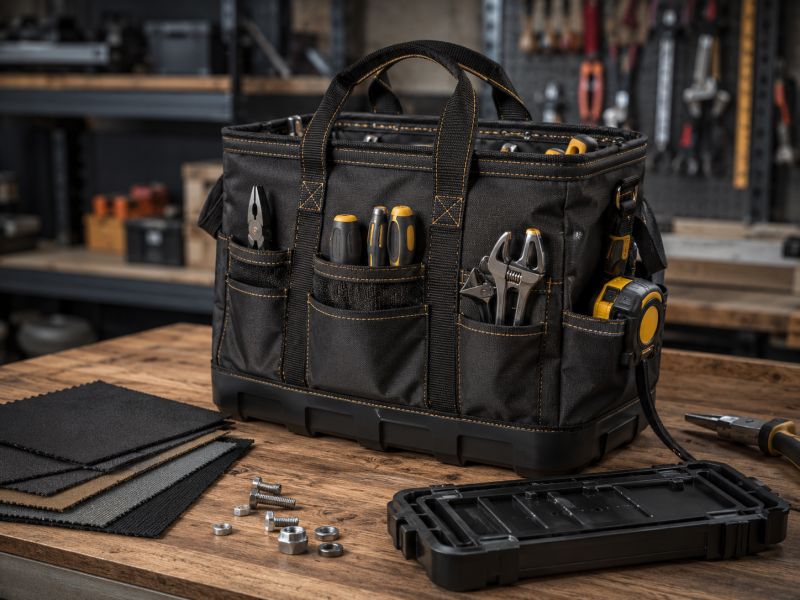
A heavy duty tool bag looks simple from the outside. A few pockets, a strong handle, a zipper, a logo, and maybe a hard base. Easy, right?
Not really.
For a hardware brand, a tool bag is not just a bag. It becomes part of the user’s working day. It sits on concrete floors. It carries pliers, screwdrivers, drills, fasteners, measuring tapes, sharp metal parts, and accessories that do not treat fabric gently. It may be dragged across a worksite, thrown into a van, opened dozens of times a day, and still expected to keep its shape.
That is why the real value of a heavy duty tool bag is hidden in the structure. Fabric decides how the bag handles abrasion. The bottom decides whether it stands, sags, or wears through. Pocket layout decides whether a technician can find the right tool fast. Handles, straps, zippers, and stitching decide whether the bag feels reliable after months of use.
A good heavy duty tool bag for hardware brands should balance fabric strength, bottom stability, pocket usability, carrying comfort, brand presentation, and repeatable bulk quality. Oxford, canvas, nylon, PVC-coated fabric, reinforced panels, PE board, molded bases, rubber feet, bar-tack stitching, wide openings, and trade-specific pockets all affect how the bag performs in real use. Before bulk production, brands should confirm tool type, expected loading weight, bag size, bottom structure, pocket layout, logo method, packing style, sample approval rules, and inspection standards.
This guide is written for hardware brands, workwear labels, industrial distributors, tool kit programs, and private label teams that want more than a ready-made bag with a printed logo. It will help you plan a tool bag that matches your tools, your users, and your sales channel.
What Makes a Heavy Duty Tool Bag Different From a Regular Work Bag?
A heavy duty tool bag is built for weight, abrasion, sharp edges, repeated access, and rough surfaces. A regular work bag may carry notebooks, clothing, small devices, or daily items. A tool bag must carry metal tools and accessories while keeping its pockets, base, handles, and seams stable. The difference is not only thicker fabric. It is the full structure: fabric grade, bottom support, pocket design, zipper strength, handle reinforcement, and quality control during bulk production.
The mistake many brands make is treating a tool bag like a general tote with extra pockets. That approach may look acceptable in a photo, but it can fail quickly in daily use. A screwdriver tip can push through a weak lining. A heavy drill can deform a soft base. A narrow handle can cut into the hand. A poorly placed pocket can make the whole bag lean to one side.
A heavy duty tool bag should be planned from the inside out. Start with the tools. What will users carry every day? Are the tools long, sharp, heavy, greasy, or easy to lose? Will the bag sit inside a van, on a workshop bench, on wet ground, or at a retail shelf? These details change the structure.
The best design is not always the heaviest design. A very thick fabric with too many pockets may become expensive, bulky, and uncomfortable. A lighter structure with smart reinforcement in the right places may perform better. That is where experience matters. A tool bag should be strong where stress happens, simple where extra weight adds no value, and clear enough for users to organize tools without thinking too much.
For hardware brands, this difference matters because the bag carries your name. If it breaks, feels cheap, or becomes annoying to use, the user does not blame the fabric. They blame the brand.
Who Needs Custom Heavy Duty Tool Bags?
Custom heavy duty tool bags are useful for hardware brands, tool brands, electrical brands, workwear labels, construction teams, industrial distributors, maintenance service companies, chain retailers, and private label operators. Some need tool bags as retail products. Some need them for tool kits. Others use them for worksite teams, service programs, equipment packaging, or branded accessory lines. The right design depends on the user, the tools, and the sales channel.
A hardware retail brand may want a clean shelf-ready product with strong logo visibility, barcode labels, hangtags, and a balanced price. A tool brand may care more about long-term user experience and product reviews. A construction service company may prefer practical strength, easy access, and simple packing. An electrical brand may need compact pockets for pliers, screwdrivers, testers, tapes, and small parts.
Private label teams often think in product lines. They may need a small technician pouch, a medium open-top tote, a large contractor bag, and a tool backpack under one brand style. In that case, fabric color, logo placement, zipper style, and label format must stay consistent across sizes.
Project teams care about delivery and clarity. They need samples that can be reviewed by multiple departments. They need dimensions, pocket details, material choices, logo position, and carton information to be confirmed before bulk work starts.
At Jundong, tool and industrial bags sit within a broader bag development system. The team supports material selection, structure advice, custom logo options, sampling, quality checks, packing, and export-ready preparation. This matters for hardware projects because a tool bag is rarely just one decision. It is a chain of decisions that must work together.
Which Fabric Is Best for Heavy Duty Tool Bags?

The best fabric for a heavy duty tool bag depends on tool weight, abrasion risk, brand style, cleaning needs, target price, and expected use. Oxford fabric is practical for many tool bags because it offers durability and stable appearance. Canvas gives a classic hardware look. Nylon can support strength with lower weight. PVC-coated fabric improves wipe-clean and water-resistant performance. Reinforced panels can be added where tools create high stress.
There is no single best fabric for every tool bag. A bag for light household tool kits does not need the same fabric as a contractor bag used on job sites. A retail hardware brand may need a fabric that looks strong but still keeps the unit cost controlled. A premium workwear brand may prefer canvas or heavier textured fabric because the hand feel supports the brand image.
Here is a practical comparison:
| Fabric Type | Best Use | Main Strength | What To Watch |
|---|---|---|---|
| 600D Oxford | Light to medium tool bags | Cost control, clean appearance | May need reinforcement for heavier tools |
| 900D Oxford | General heavy duty bags | Better abrasion resistance | Slightly higher cost and weight |
| 1000D Oxford | Worksite bags, contractor bags | Stronger structure and durability | May feel stiffer |
| 1680D Oxford | Premium heavy duty designs | High-strength look and feel | Higher cost, not always needed |
| Canvas | Hardware, lifestyle, rugged retail lines | Classic texture and brand feel | May need coating or lining for dirt resistance |
| Nylon | Lightweight professional bags | Strength-to-weight balance | Cost varies by grade |
| PVC-coated fabric | Wet, dusty, or dirty work settings | Easy to clean, water-resistant surface | Can feel less natural than woven fabric |
The fabric choice should also consider stitching. A strong fabric does not help if the seams are weak. If the bag carries heavy tools, the fabric around handles, bottom corners, side pockets, and zipper ends should be reviewed carefully.
For many hardware brand projects, a mixed structure works well. Use a durable main fabric, then add reinforced panels at stress zones. This gives better value than simply making the whole bag extremely heavy.
Oxford vs Canvas vs Nylon Tool Bags: Which Type Works Better?
Oxford works well for practical custom tool bags that need durability, stable cost, and broad use. Canvas is better when the brand wants a rugged, classic, or workshop-inspired look. Nylon can work well when the design needs lighter weight, strength, and a more technical feel. The better choice depends on the brand image, tool weight, use scene, and target price.
Oxford is often the most flexible option for bulk tool bag programs. It comes in different grades, supports many colors, works well with printing or patches, and can be combined with lining, padding, and reinforced bottom structures. For hardware brands building a practical product line, Oxford is usually easy to scale.
Canvas has a different appeal. It feels more traditional, warmer, and closer to old workshop culture. It can work well for hardware stores, lifestyle tool kits, garden tools, craft tools, automotive accessories, and premium gift sets. But canvas must be planned carefully if the bag will face oil, moisture, or rough ground. Coating, lining, or bottom reinforcement may be needed.
Nylon is useful where performance and weight balance matter. It can fit technician bags, compact tool organizers, field service kits, or more technical product lines. The challenge is that nylon quality varies widely. The chosen grade, weave, coating, and reinforcement plan matter more than the word “nylon” itself.
A simple way to choose:
| Need | Better Direction |
|---|---|
| Cost-controlled heavy duty bag | Oxford |
| Classic hardware brand style | Canvas |
| Lighter professional structure | Nylon |
| Easy-clean worksite surface | PVC-coated fabric |
| Premium rugged appearance | 1680D Oxford or heavy canvas |
| Strong retail value with controlled cost | Oxford with reinforced panels |
The final choice should not be made by fabric name alone. Ask what the bag needs to survive. Then choose the material.
How Should the Bottom of a Heavy Duty Tool Bag Be Designed?

The bottom of a heavy duty tool bag should be designed around load, ground contact, tool shape, and bag stability. Light tool bags may use double-layer fabric with binding. Medium bags often need a PE board or padded base. Stronger worksite bags may use rubber bottoms, molded bases, rubber feet, or corner reinforcement. The goal is to prevent sagging, abrasion, moisture damage, and shape collapse.
The bottom is where many tool bags fail first. It carries the full weight. It touches rough surfaces. It receives impact when users drop tools inside. It also decides whether the bag can stand upright when open.
A soft bottom may be enough for a small tool pouch or light retail kit. It keeps the bag flexible, lighter, and easier to pack. But once the tool load increases, the base needs more support. A PE board can help the bag keep its shape. EVA padding can add cushioning. Rubber feet can reduce direct abrasion. A molded base can offer stronger support for professional use, though it may increase cost and shipping volume.
The corner area deserves special attention. Corners receive pressure from both tool weight and ground friction. Binding tape, extra fabric layers, bar-tack stitching, and careful sewing alignment can help reduce early wear.
For brand teams, the bottom is not the place to save blindly. If the main failure risk sits at the base, a slightly better bottom structure can protect the full product value. A poor base may make a good-looking bag feel weak within the first week of use.
Hard Bottom Tool Bags vs Soft Bottom Tool Bags: Which One Should Brands Choose?
Soft bottom tool bags are lighter, more flexible, and often better for simple kits or cost-sensitive programs. Hard bottom tool bags offer better shape, stability, moisture protection, and abrasion resistance. Brands should choose based on tool weight, worksite conditions, retail price, shipping plan, and user expectations. A hard base is worth considering when the bag must stand upright or carry heavy metal tools.
Here is a practical comparison:
| Bottom Type | Best For | Advantage | Limitation |
|---|---|---|---|
| Soft fabric bottom | Light tools, gift kits, simple retail bags | Lightweight, lower cost, easy packing | Less stable under heavy load |
| Double-layer bottom | Medium tool bags | Better wear resistance without much cost increase | Still may sag with heavy tools |
| PE board bottom | General heavy duty bags | Holds shape, practical cost | Needs clean fixing and proper lining |
| EVA padded bottom | Technician bags, tool kits | Cushioning, softer feel | Less rigid than hard plastic |
| Rubber bottom | Worksite and outdoor use | Better floor protection, moisture resistance | Heavier and more costly |
| Molded plastic base | Professional tool bags | Strong standing structure | Higher development and packing cost |
A hard bottom is especially useful when users need fast access. If the bag collapses every time they reach inside, it slows them down. It also looks messy in retail photos and product videos.
But a hard bottom is not always the right. For a compact tool organizer that needs to fold or fit inside another kit, a softer structure may be better. For e-commerce shipping, a molded base may increase carton size. For entry-level retail, the extra cost may not match the expected price.
The best decision is not “hard or soft.” It is “what level of base support matches the user and the sales plan?”
How Should Pocket Design Match Electricians, Mechanics, Contractors, and Technicians?

Pocket design should match the trade, tool size, access frequency, and weight balance. Electricians often need narrow slots, plier pockets, tape holders, and small accessory sections. Mechanics may need deeper pockets, wrench storage, and wipe-clean areas. Contractors often prefer larger main compartments, exterior quick-access pockets, and strong handles. Technicians may need compact zipped sections and organized small-tool access.
Many product listings promote pocket count as if more always means better. That is not true. A bag with 40 poorly planned pockets can feel worse than a bag with 18 well-sized pockets.
Electricians often use long, narrow tools. Screwdriver slots should not be too loose. Plier pockets need enough depth. Tape measure holders should sit in a fast-access area. Small parts such as connectors, bits, and fasteners need zipped or covered storage.
Mechanics may carry heavier metal tools, oily parts, and accessories that can stain fabric. Deeper pockets, stronger lining, and easy-clean surfaces help. If tools are wide or heavy, pocket stitching must be reviewed carefully.
Contractors need flexibility. They may carry a mix of tape, knives, drills, gloves, fasteners, and accessories. A wide mouth opening can be more valuable than too many small pockets. Exterior quick-access areas help, but overloading the outside can make the bag unbalanced.
Technicians often move between locations. They may prefer compact order, lighter structure, and secure zipped pockets. For field service teams, the bag should not spill parts in a vehicle or while walking.
Good pocket design starts with a tool list. Without that, the layout becomes guesswork.
How Many Pockets Should a Custom Tool Bag Have?
A custom tool bag should have enough pockets to organize the user’s core tools without adding unnecessary weight, cost, or confusion. The right number depends on the tool list, tool size, access frequency, and bag type. Small pouches may need 6–12 pockets. Medium tool totes may need 15–30. Large professional bags may need more, but each pocket should have a clear purpose.
Pocket quantity affects production time and cost. Every extra pocket means more cutting, sewing, alignment, inspection, and sometimes extra reinforcement. This is why a serious tool bag project should not begin with “we want as many pockets as possible.”
A better method is to group tools:
| Tool Group | Pocket Design Idea |
|---|---|
| Screwdrivers | Narrow vertical slots |
| Pliers | Deeper reinforced pockets |
| Tape measure | Clip holder or outer pocket |
| Small fasteners | Zipper pocket or mesh pocket |
| Drill bits | Covered small compartments |
| Wrenches | Wider pockets with depth |
| Gloves | Open side pocket |
| Documents or cards | Flat inner pocket |
Pocket placement is just as important as quantity. Heavy tools should not all sit on one side. Quick-use tools should be reachable. Sharp tools should not rub against weak lining. Small parts should not fall out when the bag is moved.
For a new project, brands can send a tool list, reference photo, or current product problem to info@jundongfactory.com. A structure review can then match pocket count, pocket depth, opening style, and reinforcement to the actual use.
What Handle, Strap, Zipper, and Hardware Details Affect Durability?

Handle, strap, zipper, and hardware details affect how long a heavy duty tool bag feels reliable. Wider webbing, padded handles, reinforced stitching, bar-tacks, strong D-rings, stable hooks, heavy-duty zippers, larger pullers, and edge binding all help reduce stress failure. These small details matter because users often judge tool bag quality by how it feels when fully loaded.
The handle is a high-risk area. When the bag is lifted, most stress moves to the handle anchor. If the webbing is too narrow, the hand feels pressure. If the stitching area is too small, tearing risk increases. A handle that continues down the side panel can spread force better than a short handle stitched only at the top.
Shoulder straps need the same thinking. A wide strap and shoulder pad improve comfort. Metal hooks may feel stronger, but the full system matters: hook, D-ring, stitching, webbing, and connection panel must work together. One strong part cannot save a weak anchor.
Zippers are often overlooked. Tool bags can be stiff when loaded, so a weak zipper may jam or split. A larger zipper, clean sewing line, and easy-grip puller can improve daily use. For open-top designs, a metal frame or reinforced mouth can help the bag stay open.
Hardware should match the product level. A premium contractor bag should not use weak-looking fittings. A budget tool kit does not need expensive metal everywhere. The goal is balanced durability.
How Can Hardware Brands Add Logo, Color, and Private Label Details?
Hardware brands can add identity through logo placement, color matching, woven labels, rubber patches, PVC patches, embroidery, screen printing, heat transfer, custom zipper pullers, branded webbing, hangtags, barcode labels, and retail packing. The best branding plan protects visibility without placing logos in high-abrasion zones. A strong logo method should match fabric texture, use scene, and retail position.
Logo placement should be decided early. On a tool bag, the most visible area is not always the safest area. A logo near the bottom may look good in a flat design file, but it can wear faster if the bag rubs against the ground or tools. A front upper panel, patch area, handle wrap, woven label, or side panel may work better.
Different logo methods suit different styles:
| Logo Method | Best For |
|---|---|
| Screen printing | Simple logos, larger quantities, clean cost |
| Heat transfer | Multi-color logos, smooth graphic effects |
| Embroidery | Canvas or premium rugged styles |
| Woven label | Clean brand detail, repeated use |
| Rubber/PVC patch | Strong hardware or workwear look |
| Metal plate | Premium retail positioning |
| Custom puller | Subtle brand detail |
| Branded webbing | Product line consistency |
Color also matters. A hardware brand may need black, grey, red, yellow, navy, or custom Pantone matching. The color should work with dirt, dust, and daily handling. Very light colors may look attractive in photos but show stains faster.
Private label details are not decoration only. They help the product feel owned, planned, and ready for retail.
What Is the Sample Process for Custom Heavy Duty Tool Bags?
The sample process for custom heavy duty tool bags usually starts with project review, tool list study, material selection, structure planning, pattern making, first sample, revision, logo approval, pre-production confirmation, and bulk production. A good sample process should test the real decisions: fabric, bottom, pockets, handles, zipper, logo, packing, and usability. The clearer the input, the faster the sample can move.
A useful sample process often follows this path:
- Share reference photos, target size, tool list, and use scene.
- Review fabric, lining, bottom structure, and pocket needs.
- Confirm logo method, color, label, and packing direction.
- Make the first sample.
- Review shape, pocket use, carrying comfort, and logo effect.
- Revise details if needed.
- Approve the pre-production sample before bulk work.
The sample should not be judged only by appearance. Fill it with tools. Lift it. Open and close the zipper. Check whether long tools fit. See whether the bag stands. Review whether outer pockets pull out of shape. Check if the logo is visible when the bag is filled.
Jundong supports project evaluation, material selection, product design, pattern making, sample revision, logo sample approval, and pre-production sample preparation. For early review, brands can send tool type, estimated loading weight, target size, reference images, logo file, quantity, and packing request to info@jundongfactory.com.
How Long Does a Custom Tool Bag Order Take?
Custom tool bag timing depends on structure complexity, material availability, logo method, sample revisions, order quantity, packing needs, and inspection requirements. Simple samples can move faster, while hard bottoms, many pockets, special fabrics, custom hardware, or retail packing may need more time. Bulk timing should include material preparation, cutting, sewing, inspection, packing, and shipment planning.
For planning, brands should avoid treating the sample as a formality. The sample is where many risks are found early. Pocket size, bottom stiffness, logo placement, handle comfort, and zipper movement are all easier to fix before bulk production.
A practical timing plan may look like this:
| Stage | What Happens | Planning Note |
|---|---|---|
| Project review | Size, tools, fabric, logo, packing | Clear input saves time |
| Sample making | Pattern, cutting, sewing, logo trial | Complex structures take longer |
| Sample revision | Adjust pockets, bottom, handle, logo | Allow time for real testing |
| Pre-production sample | Final approved reference | Used to guide bulk work |
| Bulk production | Material, cutting, sewing, inspection | Quantity and complexity matter |
| Packing and shipment | Labels, cartons, export preparation | Retail packing needs earlier planning |
For Jundong projects, standard quantity is usually 500 pcs per design. Some simple styles may be arranged at 200–300 pcs with a higher unit cost because the full production process still applies. Sampling is usually 5–7 days, and some simple styles can be faster. Bulk production is usually around 20–30 days, depending on the actual project.
How Does a Factory Control Quality for Bulk Tool Bag Orders?
Bulk tool bag quality is controlled through material checks, cutting accuracy, sewing review, pocket measurement, handle strength review, bottom structure check, zipper testing, logo position review, packing inspection, carton mark confirmation, and final inspection. The goal is to keep the approved sample and bulk goods consistent. For heavy duty bags, quality control must focus on stress areas, not only appearance.
A tool bag can look fine at first glance but still fail in use. That is why inspection should focus on practical risk.
Key checks may include:
| Check Area | What To Review |
|---|---|
| Fabric | Color, texture, coating, defects |
| Cutting | Size accuracy, panel direction |
| Stitching | Clean seams, stitch density, skipped stitches |
| Pockets | Width, depth, placement, symmetry |
| Handles | Stitching, reinforcement, comfort |
| Bottom | Board position, rubber base, corners |
| Zipper | Smooth movement, end strength |
| Logo | Position, color, alignment, adhesion |
| Packing | Labels, polybags, cartons, SKU sorting |
For heavy duty tool bags, handle and bottom checks are especially important. These areas carry the highest stress. Pocket checks are also critical because small size changes can make tools fit poorly.
Jundong’s internal capability includes an 80-person quality team, incoming material inspection, in-process checks, final inspection, functional testing, durability testing, load and stress review, and inspection report preparation. That type of process helps brands reduce the gap between sample approval and bulk delivery.
What Price Factors Affect Heavy Duty Tool Bags?
Heavy duty tool bag price is affected by fabric grade, lining, bottom structure, pocket quantity, zipper length, hardware, webbing, reinforcement, logo method, packing style, order quantity, and inspection needs. The lowest price is not always the safest plan. A smarter approach is to protect the stress areas that affect product life, then simplify less critical decorative details.
The biggest cost drivers are usually fabric, labor, structure, and components. A tool bag with many pockets requires more cutting and sewing. A molded base costs more than a soft fabric bottom. Metal hardware often costs more than plastic hardware. A rubber patch may cost more than a simple print. Retail packing adds labor and materials.
Here is a simple cost view:
| Cost Factor | Why It Matters |
|---|---|
| Fabric grade | Affects durability, weight, and appearance |
| Bottom structure | Affects stability and material cost |
| Pocket quantity | Adds sewing time and inspection work |
| Zipper and hardware | Affects daily use and perceived value |
| Reinforcement | Protects stress areas |
| Logo method | Changes cost and brand feel |
| Packing | Affects retail readiness and logistics |
| Quantity | Higher quantity usually improves unit cost |
Cost control should not mean weakening the product. For example, reducing one decorative pocket may be safer than reducing handle reinforcement. Choosing a practical Oxford grade with reinforced bottom panels may offer better value than using expensive fabric everywhere.
For price review, it helps to share a target quantity, expected tool load, material preference, logo method, and packing request. With those details, the design can be adjusted without guessing.
Why Work With a Custom Tool Bag Factory Instead of a Promotional Platform?
A promotional platform is useful for ready-made bags with simple logo decoration. A custom tool bag factory is better when the product needs fabric selection, bottom design, pocket planning, handle reinforcement, logo placement, sample revision, quality checks, packing support, and repeatable bulk production. Hardware brands need structure, not just decoration, when the bag must carry real tools.
A ready-made promotional option can work for light giveaways. It is fast, simple, and easy to understand. But it may limit fabric choice, bottom structure, pocket placement, logo method, and size control. If the bag is used only once at an event, that may be enough.
A hardware brand usually needs more. The bag may be sold as a product, included with tool kits, used by service teams, or placed in retail channels. In these cases, small details affect long-term value. If the bottom sags, pockets are too shallow, or handles feel weak, the brand loses trust.
A custom factory can review the whole product from concept to bulk order. The discussion can include tool list, load, fabric, bottom support, pocket logic, zipper, handle, logo, packaging, and inspection. That is the difference between placing a logo on a bag and developing a tool bag that feels right in the user’s hand.
For Jundong, the value is not only making bags. It is helping brands turn a rough idea, reference photo, or tool list into a product that can be sampled, reviewed, improved, packed, and delivered for real business use.
What Should Brands Send Before Requesting a Custom Tool Bag Sample?
Before requesting a custom tool bag sample, brands should send the bag style, reference photo, target size, tool list, expected loading weight, preferred fabric, bottom requirement, pocket needs, logo file, quantity, packing style, target delivery time, and destination country. Clear project details help the factory suggest better materials, avoid wrong structures, and prepare a more accurate sample.
Here is a practical checklist:
| Information | Why It Helps |
|---|---|
| Bag type | Tool tote, pouch, backpack, roll, or organizer |
| Reference photo | Shows shape, style, and structure direction |
| Tool list | Defines pocket and loading needs |
| Tool dimensions | Prevents pockets from being too small |
| Expected weight | Guides bottom, handle, and stitching |
| Fabric preference | Helps balance cost and strength |
| Bottom request | Soft, reinforced, PE board, rubber, molded base |
| Logo file | Confirms branding method and placement |
| Quantity | Supports price and production planning |
| Packing request | Helps plan labels, cartons, and retail needs |
If the project is still early, that is fine. A reference photo, tool type, size target, and quantity are enough to start the first review. More details can be refined during sampling.
A well-planned tool bag does not happen by accident. Fabric, bottom, pockets, handles, logo, and packing all need to support the same goal: a tool bag that looks right, works well, and represents the brand every time it is carried.
For custom heavy duty tool bag projects, project details can be sent to info@jundongfactory.com for review.
Common Project FAQs
1. What fabric works best for heavy duty tool bags?
Definitely—fabric choice should start with tool weight, daily use, and brand position, not only fabric thickness. For most custom heavy duty tool bags, Oxford fabric is a practical choice because it gives stable strength, clean appearance, and good cost control. 600D Oxford can work for lighter tool kits or entry-level retail designs. 900D or 1000D Oxford is better for work bags that need stronger abrasion resistance. 1680D Oxford creates a more premium and tough look, especially for hardware brands that want a stronger retail impression.
Canvas is another strong option when the design needs a classic workshop feel. It looks natural, solid, and close to traditional hand-tool culture. Nylon can be useful when the bag needs a lighter structure with good strength. PVC-coated fabric works well when the bag may face dust, oil, moisture, or frequent wiping.
The smartest choice is often a mixed structure. Use a durable main fabric, then add reinforcement at the bottom, handle area, side panels, and pocket openings. This keeps the bag strong where it matters without making the whole product too heavy or too costly.
2. Is a hard bottom always better for a heavy duty tool bag?
Sure—not always, but a hard bottom is often worth considering when the bag must carry heavier tools or stand upright during use. A soft bottom works for light tool kits, simple work pouches, or low-weight retail sets. It keeps the bag flexible, lighter, and easier to pack. But once the bag carries metal tools, drills, wrenches, pliers, and fasteners, the base starts to take serious pressure.
A hard bottom can help the bag keep its shape, reduce sagging, protect tools from rough floors, and make access easier. PE board is a common solution for stable shape at a practical cost. EVA padding adds cushioning. Rubber bottoms and molded bases provide stronger floor protection and better worksite performance, but they also increase cost, weight, and sometimes carton size.
For hardware brands, the decision should be based on real use. If the bag will sit on concrete floors, service vans, workshops, or damp jobsite ground, stronger bottom support can protect the product experience. If the bag is for a light promotional kit or simple accessory set, a soft or double-layer fabric bottom may be enough.
3. How many pockets should a custom tool bag have?
Of course—the right pocket count depends on the tools, not on a fixed number. A small technician pouch may only need 6–12 pockets. A medium tool tote may need 15–30 pockets. A large contractor bag can have more, but every pocket should serve a clear use. More pockets can look attractive in product photos, yet poor pocket planning can make the bag harder to use.
Pocket layout should follow tool type, size, access frequency, and weight balance. Screwdrivers need narrow vertical slots. Pliers need deeper reinforced pockets. Tape measures may need a clip holder or outer quick-access pocket. Small parts need zipped or covered storage. Wrenches need wider pockets with enough depth. Gloves, manuals, and flat items need simple open or flat pockets.
Too many pockets can also raise cost because each pocket adds cutting, sewing, positioning, and checking time. A better method is to start with a real tool list. Once the tool list is clear, pocket depth, pocket width, opening angle, elastic loops, mesh sections, and zipper pockets can be planned with much less guesswork.
4. What should hardware brands confirm before making a tool bag sample?
Absolutely—brands should confirm the real use before asking for a sample. A tool bag sample is not just a visual mockup. It should test the fabric, bottom, pocket layout, handle strength, zipper movement, logo effect, and packing style. Before sampling, the most useful details are bag type, reference photo, target size, tool list, estimated loading weight, preferred fabric, bottom requirement, pocket needs, logo file, quantity, packing style, target delivery time, and destination country.
A clear tool list is especially helpful. It tells the factory whether the bag needs deep pockets, long narrow slots, a wide main compartment, reinforced side walls, a stronger handle system, or a more stable bottom. Without this information, the sample may look good but fail in real use.
A good sample should be filled, lifted, opened, zipped, carried, and reviewed from a user’s angle. If the bag leans, collapses, feels too heavy, or has pockets that do not fit the tools, the structure should be adjusted before bulk production. Early correction is always easier than fixing a problem after production starts.
5. How long does it take to make custom heavy duty tool bags?
Certainly—timing depends on structure, material, logo method, quantity, packing, and sample revisions. For Jundong projects, the standard starting quantity is usually 500 pcs per design. Some simple styles may be arranged at 200–300 pcs, but the unit cost will usually be higher because material preparation, cutting, sewing, checking, and packing still follow a full process. Sampling is usually around 5–7 days, and some simple styles can be faster. Bulk production is usually around 20–30 days, depending on the final design and order details.
A simple open-top Oxford tool tote with printed logo will usually move faster than a multi-pocket contractor bag with hard bottom, rubber patch, branded pullers, padded handle, inner lining, and retail packaging. More structure means more checking. More pockets mean more sewing. Custom hardware or special materials can also add time.
The best way to protect timing is to prepare clear files early. Send the reference image, size, logo file, tool list, quantity, packing needs, and delivery target before sample work starts. Clear input helps reduce repeated changes and makes the schedule easier to control.
6. Can Jundong help improve an existing tool bag design?
Definitely—an existing design can often be improved by reviewing the weak areas instead of changing everything. Many brands already have a tool bag style, but they may face issues such as bottom sagging, handle tearing, zipper stress, shallow pockets, poor tool fit, weak lining, logo wear, or high unit cost. A factory review can compare the current sample with the intended use and suggest practical changes.
For example, if the bottom loses shape, a PE board, rubber feet, or extra bottom layer may help. If the handle feels weak, wider webbing, longer handle extension, bar-tack stitching, or extra reinforcement panels can be added. If pockets look good but do not hold tools well, the pocket depth, opening width, and angle can be adjusted. If the cost is too high, some decorative pockets or complex trims can be simplified while keeping key stress areas strong.
This kind of review is useful for growing brands that want to upgrade from a basic tool bag into a stronger retail-ready product. It is also useful when preparing a new version for different users, such as electricians, mechanics, technicians, or contractor teams.
7. What logo method is best for custom heavy duty tool bags?
Sure—the best logo method depends on fabric texture, brand style, use scene, and budget. Screen printing works well for simple logos and larger quantities. Heat transfer can show richer color details on suitable surfaces. Embroidery feels strong on canvas or premium rugged styles. Woven labels are clean and durable. Rubber or PVC patches are popular for workwear and hardware-style products because they look strong and hold brand identity well. Metal plates can create a higher-end retail feel, but they should be used only where the structure supports them.
Logo placement matters as much as logo method. A logo placed too close to the bottom may rub against floors, tools, or work surfaces. A front upper panel, side panel, woven label position, patch area, handle wrap, or zipper puller may be safer. If the bag will be photographed for retail, the logo should remain visible when the bag is filled, not only when it lies flat.
For private label tool bag lines, small brand details can make a big difference. Matching zipper pullers, webbing color, hangtags, barcode labels, and carton marks can make the product feel more complete and easier to manage across different styles.
8. How can brands control cost without weakening a heavy duty tool bag?
Of course—cost control should protect the stress areas first, then simplify less critical details. For heavy duty tool bags, the areas that usually need protection are the bottom, handles, shoulder strap connection, pocket openings, zipper ends, and high-friction corners. Reducing strength in these areas may lower cost slightly, but it can create after-sales trouble and hurt the brand.
A better cost plan is to adjust details that do not affect core use. For example, a brand may reduce one decorative pocket, change a metal logo plate to a rubber patch, choose a practical Oxford grade instead of an overbuilt fabric, or use a PE board bottom instead of a molded base when the use scene does not require it. The goal is not to make the cheapest bag. The goal is to make the right bag for the price level.
Quantity also affects unit cost. At 500 pcs or more, pricing usually becomes more competitive because material purchasing and production setup are more efficient. For smaller quantities, the unit cost is usually higher, even if the bag looks simple, because the same preparation steps are still needed.
9. How does Jundong check quality for heavy duty tool bag orders?
Absolutely—quality checking should follow the product’s real risk areas, not just the surface appearance. For heavy duty tool bags, Jundong can review incoming materials, fabric color, cutting accuracy, stitching, pocket size, handle strength, bottom structure, zipper movement, logo position, packing style, carton marks, and final goods before shipment. The company has 80 quality control staff and a quality process that covers material, production, and finished goods checking.
For tool bags, handle and bottom areas deserve extra review because they carry the highest stress. Pocket size should also be checked because a small measurement difference can make a screwdriver slot too tight or a wrench pocket too shallow. Zippers need smooth movement, especially when the bag is filled. Logo placement should match the approved sample so the brand look stays consistent.
A good quality process also compares bulk goods with the approved sample. This helps reduce the risk of sample-to-production differences. For brands planning repeat orders, stable checking standards are especially valuable because future batches need to match the first approved version.
10. Why should a hardware brand work with a custom tool bag factory instead of choosing a ready-made promotional bag?
Certainly—a ready-made promotional bag can work for light giveaways, but a hardware brand usually needs more control over structure, materials, pockets, bottom support, logo placement, and packing. A tool bag that carries real tools must be planned around load, abrasion, daily access, and user habits. A standard stock bag may not match those needs.
A custom factory can review the project from the user’s angle. What tools will go inside? How heavy is the load? Should the bag stand upright? Will users need quick access? Should the bottom be soft, reinforced, rubber, or molded? Where should the logo sit so it stays visible and avoids abrasion? What packing style is needed for retail, e-commerce, distributor programs, or team supply?
This level of control helps brands create a more useful product, not just a branded item. It also supports repeat orders and product line growth. Once the fabric, bottom, pocket layout, logo method, and packing standard are approved, the same logic can be used for small pouches, medium totes, large contractor bags, or tool backpacks. For project review, brands can send details to info@jundongfactory.com.