 Skip to content
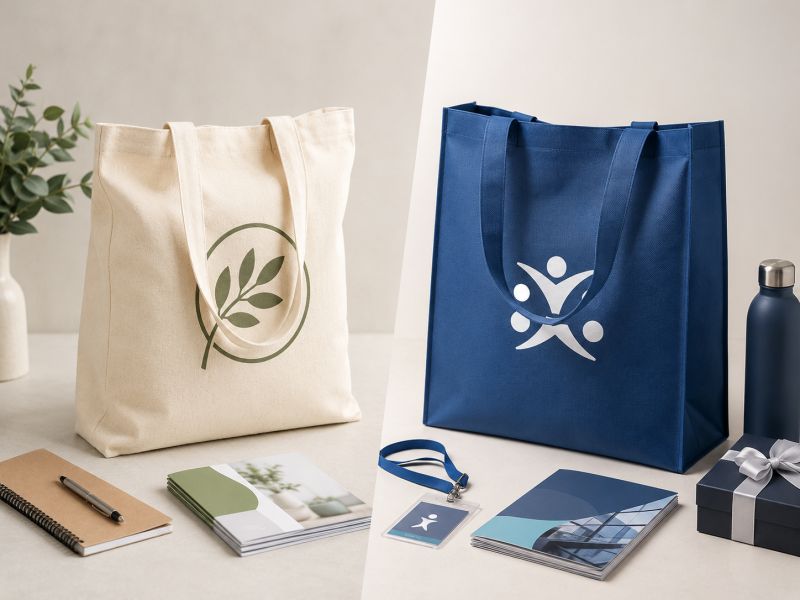
A promotional bag looks simple until the wrong one arrives.
The logo is too small. The handle feels weak. The fabric does not match the brand mood. The bag is too thin for the gift set. The event team wants 10,000 pieces, but the unit cost climbs too high. The brand team wants something people will keep, but the bag feels like a one-day handout.
That is why the choice between custom printed canvas bags and non-woven bags matters.
This is not only a material decision. It is a campaign decision. A canvas tote can make a brand feel more thoughtful, retail-ready, and long-lasting. A non-woven bag can help an event cover more people with a lighter cost and faster distribution. Both can work well. Both can fail if they are used in the wrong setting.
Canvas bags are better for promotional campaigns that need a stronger reusable feel, higher perceived value, better load support, and a more lifestyle-ready look. Non-woven bags are better for high-volume giveaways, trade shows, conferences, school events, supermarket promotions, and cost-sensitive programs. The right choice depends on quantity, logo design, event use, packing method, delivery date, and how long the bag should stay in use after the campaign.
For brands, retailers, event teams, schools, and promotional product teams, the best bag is not always the more expensive one. It is the one that matches the job. A campaign bag must carry the items, show the logo clearly, arrive on time, fit the budget, and make the brand look right in real life.
What Is the Difference Between Canvas and Non-Woven Bags?
Canvas bags are usually made from woven cotton or cotton-blend fabric, giving them a thicker hand feel and stronger daily-use value. Non-woven bags are commonly made from bonded polypropylene fibers, making them lightweight, cost-friendly, and practical for large event distribution. Canvas feels more like a retail product. Non-woven feels more like an efficient promotional carrier.
The easiest way to compare them is by asking: should the bag feel like a gift, or should it help distribute campaign materials at scale?
Canvas bags are often chosen when the bag itself becomes part of the brand experience. Think bookstores, lifestyle shops, campus stores, fashion labels, wellness brands, museum shops, and corporate gift sets. The material feels more natural. It hangs better on the shoulder. It photographs well. It also gives a simple logo more value.
Non-woven bags are often chosen when the goal is reach. Trade shows, conferences, charity walks, supermarket events, school orientation packs, and city campaigns often need a bag that is lightweight, printable, easy to pack, and more friendly to the budget. In these cases, the bag does not need to feel like a premium retail item. It needs to perform smoothly across a large event.
Here is a simple comparison:
| Factor | Canvas Bags | Non-Woven Bags |
|---|---|---|
| Best use | Premium promo, retail gift, campus store, bookstore, brand merchandise | Trade show, conference, giveaway, school event, supermarket promo |
| Feel | Natural, thicker, more retail-ready | Lightweight, practical, event-friendly |
| Cost level | Usually higher | Usually lower |
| Reuse value | Stronger for daily use | Better for short to mid-term event use |
| Logo style | Great for simple logos, embroidery, labels, clean artwork | Great for large logos, event slogans, sponsor marks |
| Load support | Better for books, apparel, gift sets, heavier items | Good for brochures, samples, documents, light gifts |
| Brand image | More premium | More practical |
| Packing | Heavier, may need more carton space | Lighter, easier for bulk packing |
Neither material wins every time. A strong campaign starts by matching the material to the real use.
Which Bag Is Better for Promotional Campaigns?

Canvas bags are better when the campaign needs higher perceived value, longer reuse, stronger carrying, and a cleaner retail-style look. Non-woven bags are better when the campaign needs large quantity, lower unit cost, fast handout, and simple logo visibility. The better choice depends on the campaign goal, not only the bag material.
For a trade show where every visitor receives a brochure, notebook, pen, catalog, and small product sample, non-woven bags often make sense. They are light, easy to carry in bulk, and large enough for logo display. They help an event team put something in many hands without overloading the budget.
For a lifestyle brand launch, a bookstore event, a fashion retail gift, or a campus shop item, canvas usually carries more value. People may use it after the event. They may bring it to class, the grocery store, the office, or weekend errands. That repeated use can make the logo work for weeks or months, not only for the event day.
The wrong choice often comes from focusing on cost too early. A cheaper bag that gets thrown away after one use may not be the best value. A more premium bag may also be wasteful if the event only needs a quick giveaway for thousands of visitors.
A useful decision path looks like this:
| Campaign goal | Better option | Reason |
|---|---|---|
| Reach more people at a lower unit cost | Non-woven | Good for high-volume distribution |
| Create a gift people may keep | Canvas | Better perceived value |
| Hold books or heavier items | Canvas | Stronger fabric and structure |
| Pack brochures and light samples | Non-woven | Practical and cost-friendly |
| Support a retail or lifestyle image | Canvas | Better texture and photo appeal |
| Prepare a fast event handout | Non-woven | Easy to pack and distribute |
| Build a gift set for VIP guests | Canvas | Feels more considered |
| Support supermarket or public campaign use | Non-woven | Works well for large coverage |
A good factory team should not push one material for every project. It should help match the bag to the campaign purpose, logo, load, schedule, and cost target.
When Should Brands Choose Canvas Bags?
Brands should choose canvas bags when the bag needs to feel reusable, thoughtful, durable, and aligned with a stronger visual identity. Canvas works well for retail gifts, bookstore programs, campus stores, lifestyle brands, fashion campaigns, wellness events, and corporate gift sets where the bag should be kept after the campaign.
Canvas has a simple strength: it does not feel temporary.
That matters for brands that care about perception. A heavy paper catalog inside a weak bag creates friction. A nice gift packed inside a thin event tote can make the whole set feel less valuable. A canvas tote, even with a clean one-color logo, can lift the perceived quality of the entire campaign.
Canvas is also better for quiet branding. Not every campaign needs a huge logo. Many lifestyle and retail teams prefer a smaller logo, woven label, embroidery, or tone-on-tone design. Canvas supports that style well because the material already has character. The bag can look useful without shouting.
Typical canvas bag uses include:
| Use scene | Why canvas works |
|---|---|
| Bookstore promotions | Stronger for books and heavier paper items |
| Campus stores | Good for daily use and student lifestyle |
| Retail gifts | Feels more like merchandise |
| Fashion and lifestyle campaigns | Better visual match |
| Wellness and beauty gift sets | Soft, natural, clean look |
| Museum or cultural shops | Works well with artwork and limited editions |
| Corporate welcome kits | Better perceived value for staff or partners |
For canvas, small details matter. Fabric weight changes the feel. Handle length changes comfort. Bottom gusset changes capacity. Stitching changes strength. Logo placement changes the whole look.
A 6 oz or 8 oz canvas tote may work for a light campaign gift. A 10 oz or 12 oz canvas bag may be better for bookstore, retail, or repeated carrying. If the bag will hold books, apparel, bottles, or gift boxes, it is worth checking handle stitching and bottom structure before bulk production.
For a custom canvas tote project, brand teams can send the target size, logo file, preferred fabric weight, quantity, packing style, and delivery date to info@jundongfactory.com for early material and sample review.
When Should Event Teams Choose Non-Woven Bags?

Event teams should choose non-woven bags when the campaign needs large quantity, controlled cost, light weight, easy packing, and strong logo exposure. Non-woven bags are practical for trade shows, conferences, school events, charity programs, supermarket activities, public campaigns, and fast-moving giveaways.
Non-woven bags win when the job is simple: give every attendee a useful carrier without making the bag the most expensive part of the event.
For conferences, exhibitions, and school activities, the contents are often light: brochures, notebooks, cards, small gifts, sponsor leaflets, badges, or sample packs. In these cases, non-woven bags do the job well. They provide a broad print area, are easy to stack, and help event staff distribute materials quickly.
They also work well when multiple sponsor logos are involved. A large front print area can hold event names, sponsor marks, dates, or short messages. For simple artwork, screen printing on non-woven bags can be very efficient.
Non-woven is also a smart choice when storage and shipping space matter. These bags are often lighter than canvas bags, so they can be easier to move and prepare before an event. For large programs with several venues, this can make planning smoother.
Still, non-woven has limits. It should not be treated as a heavy-duty daily tote. If the bag needs to hold thick books, glass bottles, heavy retail products, or premium gift sets, canvas may give safer results. If the artwork has tiny text, gradients, or fine details, a sample print is useful before production.
A non-woven bag is not a “lesser” bag. It is the right tool for the right task. For high-volume campaigns, the practical choice often creates the better result.
Canvas vs Non-Woven: Price and Quantity Guide
Non-woven bags usually offer better unit cost for high-volume promotional projects, while canvas bags usually cost more because the fabric, sewing, weight, and finish feel more substantial. Quantity, material weight, size, print colors, handle style, packing method, and schedule all affect the final price.
Many teams ask, “Which one is cheaper?” A better question is, “Which one gives the right value for this campaign?”
A non-woven bag may be the better value for a one-day expo with 8,000 visitors. A canvas tote may be the better value for a retail gift that people use for a year. Cost should be judged against use time, brand value, and event purpose.
Main price factors include:
| Price factor | Why it matters |
|---|---|
| Material type | Canvas is usually heavier and more costly than non-woven |
| Fabric weight | Thicker material raises cost but improves feel and strength |
| Bag size | Larger panels use more material |
| Gusset | Adds capacity but also material and sewing |
| Handle length | Longer or wider handles add material |
| Print colors | More colors may increase setup and production cost |
| Print area | Larger artwork can affect cost and hand feel |
| Packing | Individual bags, labels, sets, or carton sorting all affect labor |
| Quantity | Larger orders usually spread setup cost better |
| Delivery date | Tight schedules may limit material and process choices |
For many simple custom bag styles, a usual starting quantity is around 500 pieces per design. For some simple structures, 200–300 pieces may be possible, but smaller runs often carry a higher unit cost because material buying, setup, and production steps still need to be arranged.
This is why early cost planning matters. A team can lower cost by simplifying size, reducing print colors, choosing a standard handle, using one material color, or adjusting packing. A team can raise value by using better fabric, a cleaner logo method, stronger stitching, or better retail presentation.
The best price plan is not the cheapest plan. It is the plan that protects the event, supports the brand, and avoids regret after delivery.
Which Bag Gives Better Logo Printing Results?
Canvas bags usually work better for premium logo styles such as screen print, embroidery, woven labels, or patches. Non-woven bags work well for large, simple, high-visibility prints used in events and giveaways. The best logo result depends on artwork detail, print size, bag color, material texture, and campaign style.
The material surface changes how the logo appears.
Canvas has texture. That texture gives the bag warmth, but it also means very small letters, thin lines, and complex gradients need careful review. Simple artwork often looks best: a bold logo, clean slogan, line illustration, or limited-color graphic. Embroidery can add value on heavier canvas, while woven labels can create a subtle retail feel.
Non-woven bags have a smoother event-style print surface. They are good for big logos, sponsor lists, public event names, and simple campaign messages. The design should stay clear and readable. Tiny QR codes, fine text, and complicated shading may not always be ideal.
Here is a quick logo planning table:
| Logo need | Better option | Notes |
|---|---|---|
| Simple one-color logo | Both | Screen print often works well |
| Premium small brand mark | Canvas | Embroidery or woven label can work |
| Large event slogan | Non-woven | Big print area is useful |
| Multiple sponsor logos | Non-woven | Keep spacing clean |
| Retail-style logo | Canvas | Smaller, cleaner branding feels better |
| Full-color artwork | Depends | Test with heat transfer or other methods |
| Tiny text or QR code | Needs testing | Always check clarity before bulk production |
| Tone-on-tone look | Canvas | Good for subtle branding |
Logo placement is just as important as logo process. A large logo placed too low may look awkward when the bag is filled. A small logo placed too high may disappear under the handle. A sponsor layout with too many marks can feel crowded.
Before production, it is safer to confirm logo size, print position, print color, artwork file quality, and a sample if the project is brand-sensitive. This is where real factory support helps. Jundong can review logo placement, print proportion, color matching, and sample approval before bulk production.
Which Bag Is More Durable for Reuse?
Canvas bags are usually more durable for repeated daily carrying, especially when the bag needs to hold books, apparel, gift boxes, or heavier retail items. Non-woven bags are durable enough for many event uses, but they are better for light to moderate loads and shorter use cycles.
Durability is not only about fabric. It is also about sewing, handle attachment, bottom shape, and how the bag is used.
A canvas bag with poor stitching can still fail. A non-woven bag with a suitable structure can perform well for the right contents. This is why professional review should look at the whole bag, not only the material name.
For canvas bags, the main durability checks include handle stitching, seam strength, fabric weight, bottom support, and shrinkage or color stability if washing is expected. For bookstore and campus use, handle stress matters because books place pressure in one area. For retail gift sets, the base structure matters because boxes can create sharp pressure.
For non-woven bags, key checks include material thickness, handle sealing or stitching, print adhesion, side seam strength, and whether the bag can hold the planned contents during event distribution. If the event kit contains brochures only, the requirement is very different from a kit with drink bottles or boxed samples.
A simple load test before production can prevent big problems later. Put the real items into the bag. Carry it by hand and shoulder. Check how the handle pulls. Check whether the front print bends badly. Check whether the bottom distorts. This takes minutes, but it can protect the whole campaign.
For large orders, do not approve only from a flat photo. Test the filled bag.
How to Choose Size, Handle, and Fabric Weight

The right promotional bag size should match the items inside, the way people carry it, and the brand impression you want to create. Canvas bags need careful fabric weight and handle planning. Non-woven bags need practical size, print area, and packing efficiency. A bag that is too small, too thin, or awkward to carry can hurt the campaign experience.
Start with the contents. What will go inside?
A trade show bag may need to hold brochures, folders, notebooks, pens, and small samples. A campus tote may need to hold books and daily items. A retail gift bag may need to hold folded apparel, beauty sets, accessories, or gift boxes. A supermarket promotion bag may need a wider base.
Common planning details include:
| Detail | What to check |
|---|---|
| Width and height | Must fit the largest item |
| Bottom gusset | Helps hold boxes, books, or retail goods |
| Handle drop | Short handle for hand carry, longer handle for shoulder carry |
| Fabric weight | Affects cost, feel, and strength |
| Print area | Must stay visible when the bag is filled |
| Bag color | Affects logo contrast |
| Packing method | Affects storage, distribution, and carton planning |
| Carton quantity | Matters for event delivery and venue handling |
Handle length deserves more attention than many teams give it. A short handle may look neat but can be uncomfortable when the bag is full. A long handle may be better for shoulder carrying but can make the bag look less structured. For campus and retail projects, shoulder comfort often matters more. For quick handout events, a standard hand-carry length may be enough.
Fabric weight also changes the message. A thin canvas tote can still work for light gifting, but a heavier canvas tote feels more like a keepable product. A thinner non-woven bag may work for brochures, while a thicker non-woven option may be better for shopping and repeated event use.
If the bag must fit a product set, share the product sizes before sampling. Guessing the size from a photo often leads to mistakes.
How Does the Factory Sample Process Reduce Risk?
The sample process reduces risk by confirming material, size, logo effect, handle comfort, sewing quality, packing style, and real loading before bulk production. A sample is not only a small version of the order. It is the place where unclear details become visible and fixable.
Many campaign problems start with assumptions.
The team assumes the logo file is clear enough. The designer assumes the print size will look balanced. The event team assumes the bag can hold all materials. The retail team assumes the fabric color will match the brand mood. The warehouse team assumes the carton packing will fit the venue schedule.
Sampling turns those assumptions into real checks.
A strong sample process can include:
| Sample step | What it confirms |
|---|---|
| Material sample | Fabric feel, thickness, color, texture |
| Color sample | Brand color direction |
| Logo sample | Print clarity, size, position, process |
| First sample | Bag shape, size, handle, sewing |
| Revised sample | Adjusted details after review |
| Pre-production sample | Final approved reference for bulk |
| Packing sample | Polybag, label, hangtag, carton plan |
For simple printed bags, sample timing is often around 5–7 days after details are confirmed. Some simple styles may move faster, depending on material and print needs. Bulk production often takes around 20–30 days for many standard projects, but the real schedule depends on quantity, material, artwork, packing, and order season.
The sample stage is also the best time to remove waste. Maybe the bag does not need a heavier fabric. Maybe the logo should be 15% larger. Maybe the handle should be longer. Maybe one print color can replace two. Small changes before production can save cost and improve the final result.
For campaign-sensitive projects, send the event date early. A factory can only protect the schedule when it knows the real deadline.
What Quality Checks Matter Before Promotional Bag Shipment?

Promotional bag quality checks should cover material, color, size, logo placement, print clarity, sewing, handle strength, load performance, packing, labels, carton marks, and final shipment preparation. For campaign orders, quality is not only about the bag. It is also about whether the right goods arrive correctly packed and ready to distribute.
A campaign order has no patience for confusion.
If the wrong sponsor logo is packed into the wrong carton, the event team loses time. If bag colors vary too much, the brand display looks messy. If handles are weak, people remember the failure, not the logo. If carton marks are unclear, the venue team may open the wrong cartons first.
Useful checks include:
| Check area | What to review |
|---|---|
| Material | Thickness, texture, shade, defects |
| Size | Width, height, gusset, handle drop |
| Logo | Position, color, clarity, adhesion |
| Sewing | Seam line, handle attachment, loose threads |
| Load | Real content test and stress check |
| Packing | Individual packing, sets, labels, sorting |
| Carton | Carton quantity, mark, destination, item code |
| Final review | Photos, reports, shipment readiness |
For canvas bags, inspect stitching, fabric marks, handle pull, logo alignment, and bag shape after filling. For non-woven bags, inspect material consistency, edge strength, print condition, handle sealing or sewing, and stacked packing.
Quality control should not happen only at the end. Incoming material inspection, in-process checks, and final inspection each catch different risks. A final inspection cannot fully fix a wrong fabric choice. A logo check after all bags are packed may be too late. Good control starts early.
This is where a factory with an internal quality team is valuable. Jundong works with multiple inspection stages, covering material, production, finished goods, load checks, and packing preparation for custom bag projects.
What Should Send for a Fast Quote?
For a fast quote, send the bag type, material preference, target size, handle length, quantity, logo file, print size, print position, color options, packing needs, campaign date, and destination country. The clearer the starting details, the easier it is to recommend the right material, sample path, and cost plan.
A clear brief does not need to be complicated. Even early-stage projects can start with a reference image and basic use details.
Here is a practical checklist:
| Information | Example |
|---|---|
| Bag type | Canvas tote, non-woven tote, shopper bag |
| Use scene | Trade show, retail gift, school event, bookstore, corporate kit |
| Quantity | 500 pcs, 2,000 pcs, 10,000 pcs |
| Size | Width x height x gusset |
| Material | Canvas weight or non-woven thickness if known |
| Handle | Short hand carry or shoulder carry |
| Logo | AI, PDF, SVG, or high-resolution file |
| One side, two sides, size, colors | |
| Color | Natural, black, custom Pantone, mixed colors |
| Packing | Bulk pack, individual polybag, hangtag, barcode label |
| Deadline | Event date and delivery date |
| Destination | Country, port, warehouse, or venue |
If you are not sure whether canvas or non-woven is better, share the campaign purpose and target budget. A good development team can help compare both options before sampling.
For custom printed canvas bags or non-woven promotional bags, project details can be sent to info@jundongfactory.com. Clear starting information helps the team review material, logo, size, packing, sample timing, and production path faster.
Why Work With a Custom Bag Factory Instead of a Promotional Catalog?

A promotional catalog is useful when the project only needs a standard item with a simple logo. A custom bag factory is better when the project needs material advice, size changes, logo testing, private label details, packing control, quality checks, and repeat-order stability. The more the bag represents your brand, the more factory-level planning matters.
A catalog often starts with a product code. A factory starts with the project.
That difference is big.
For a simple event handout, a ready style may be enough. But once a team needs custom size, different fabric weight, matched brand colors, special handle length, retail packing, carton sorting, private label tags, multi-location delivery, or future repeat orders, a deeper production path becomes safer.
A factory can help with such as:
- Should we use canvas or non-woven for this campaign?
- Can we lower the cost without making the bag look weak?
- Will the logo look better with screen print, heat transfer, embroidery, or label?
- Can the bag carry the actual gift set?
- Can the packing match event distribution?
- Can we keep the same style for repeat orders?
- Can we adjust the product for another campaign next season?
Jundong is based in Guangdong and works across many custom bag types, including tote bags, backpacks, beach bags, travel bags, cooler bags, lifestyle bags, drawstring bags, makeup bags, clear bags, fireproof bags, tactical bags, belt bags, wallets, EVA bags, luggage, and leather goods. For promotional bag projects, that wider experience helps when one campaign grows into a full product line.
A good campaign bag does more than carry items. It carries the brand’s decision-making. The material, print, size, handle, packing, and delivery plan all say something about how prepared the brand is.
Canvas or non-woven?
The best choice is the one that fits the campaign in the real world.
For premium, reusable, retail-style campaigns, choose canvas. For high-volume, cost-controlled, event-ready distribution, choose non-woven. For projects that sit between the two, compare both with a sample and a clear cost plan before production.
FAQs
1. Are canvas bags better than non-woven bags for promotional campaigns?
Certainly, canvas bags are better when the campaign needs a stronger reusable feel, higher perceived value, and longer brand exposure. They are especially suitable for retail gifts, bookstore promotions, campus store programs, lifestyle brand events, corporate kits, and projects where the bag should still be used after the event ends.
The real value of a canvas bag is not only the fabric. It is the message it sends. A canvas tote feels more like a product people may keep. It can carry books, apparel, gift boxes, beauty sets, and daily items with better comfort than many lightweight event bags. For brands that care about how the bag looks in photos, on shelves, or in daily use, canvas often gives a cleaner and more confident result.
That said, canvas is not always the best fit. If the project needs 10,000 or 30,000 pieces for a one-day trade show, non-woven bags may control cost better. A good decision starts with the campaign goal. If the bag should feel like a gift, canvas is usually the stronger choice. If the bag mainly needs to distribute light materials at scale, non-woven may be more practical.
2. Are non-woven bags still a good choice for large promotional giveaways?
Absolutely, non-woven bags are still one of the most practical choices for large promotional giveaways, especially when the project needs high quantity, simple logo display, light weight, and controlled unit cost. They work well for trade shows, conferences, school events, charity programs, supermarket activities, and public campaigns.
Non-woven bags are often used because they solve a very real event problem: many people need a carrier, but the bag cannot consume too much of the total budget. They are easy to stack, pack, move, and distribute. For brochures, leaflets, notebooks, pens, badges, small samples, and sponsor materials, a non-woven tote can perform very well.
The key is to avoid treating every non-woven bag as the same. Material thickness, handle type, side seam, print area, bag size, and packing method can all change the final result. If the bag will hold heavier items, choose a stronger structure or review canvas as an alternative. If the logo has thin lines or small text, request a print sample before production. Non-woven bags are not a weak option. They are a smart option when the project needs reach, speed, and cost balance.
3. Which bag is better for trade shows, canvas or non-woven?
Sure, non-woven bags are usually better for standard trade show giveaways, while canvas bags are better for VIP kits, premium booth gifts, and brand merchandise. The right choice depends on who receives the bag, what goes inside, and how long you want the bag to stay in use after the event.
For general trade show traffic, non-woven bags often make sense. They are light, practical, and cost-friendly for large visitor numbers. They also offer a broad front area for event names, booth logos, sponsor marks, or simple slogans. If the contents are brochures, notebooks, badges, small catalogs, or light product samples, non-woven bags can do the job well.
Canvas bags are stronger when the event gift needs to feel more valuable. If the bag is for key accounts, media guests, staff welcome packs, university partners, or retail-style booth sales, canvas gives a more polished result. It can hold heavier items and may be reused after the show, which extends brand exposure beyond the event hall.
A useful method is to split the project. Use non-woven bags for mass distribution and canvas bags for selected gift sets. This keeps the budget under control while still giving high-value contacts a better experience.
4. How do I choose between canvas and non-woven bags based on budget?
Of course, budget should be judged together with quantity, use time, logo needs, and brand position. Non-woven bags usually give better cost control for high-volume campaigns, while canvas bags can give better long-term value when the bag is meant to be reused many times.
A low unit price does not always mean a better project result. If a non-woven bag is handed out once and then thrown away, its brand exposure may be short. If a canvas bag is used for months, the cost per use may become much lower than it looks at first. This is why the best budget choice depends on what the campaign expects from the bag.
Here is a simple way to think about it:
| Project condition | Better fit |
|---|---|
| Large event giveaway | Non-woven |
| Tight unit cost target | Non-woven |
| Retail gift or brand merchandise | Canvas |
| Heavy contents | Canvas |
| Short-term public campaign | Non-woven |
| Long-term brand visibility | Canvas |
| VIP gift set | Canvas |
| Simple sponsor logo handout | Non-woven |
Before quoting, size, material weight, logo colors, print area, handle length, packing request, and delivery date should be reviewed together. A factory can often adjust details to control cost without making the bag look cheap.
5. What affects the price of custom printed canvas bags and non-woven bags?
Definitely, the final price is shaped by material, size, fabric weight, quantity, logo process, print colors, handle style, packing method, and delivery schedule. Two bags may look similar in a photo but cost very differently once the details are checked.
For canvas bags, fabric weight has a big effect. A light canvas tote may be suitable for simple handouts, while a heavier canvas tote feels better for retail, bookstore, campus, and gift projects. Stronger handles, bottom gussets, lining, inside pockets, embroidery, woven labels, and individual packing can also raise cost.
For non-woven bags, thickness, lamination, print size, bag structure, handle attachment, and quantity are key factors. A very simple non-woven tote for brochures will cost less than a laminated non-woven shopping bag with full-color artwork and custom packing.
The usual starting quantity for many simple custom bag projects is around 500 pieces per design. Some simple styles may be arranged at 200–300 pieces, though the unit cost is usually higher because material purchasing and production steps still need to be prepared. Larger orders often give better unit cost. For a faster and more accurate quote, send the bag size, quantity, artwork, material preference, packing needs, and delivery deadline.
6. Do canvas bags print better than non-woven bags?
In many cases, canvas bags give a more premium logo effect, especially for clean brand marks, embroidery, woven labels, and simple screen printing. Non-woven bags print well for large event logos, sponsor marks, campaign names, and simple high-visibility artwork.
Canvas has a natural woven texture. This texture can make the bag feel warm and more retail-ready, but it also means very tiny text or detailed gradients need careful review. A simple logo often looks stronger on canvas than an overly complicated design. Embroidery, woven labels, and patches can also make a canvas tote feel more like brand merchandise rather than a basic giveaway.
Non-woven bags are better when the design needs to be bold and readable from a distance. Large logos, event names, dates, short slogans, and sponsor layouts can work well. The design should avoid too many small details. If QR codes or fine text are needed, test the print size before confirming production.
For both materials, logo size and placement matter as much as the print method. A good factory will review artwork proportion, bag color, print area, and sample results before bulk production. This step helps avoid a common problem: the logo looked fine on the screen, but not balanced on the finished bag.
7. How long does it take to make custom printed canvas or non-woven bag samples?
Usually, simple printed bag samples take about 5–7 days after the main details are confirmed. Some simple styles may move faster, around 2–3 days, when the material is available and the print method is straightforward. Bulk production for many standard custom bag projects often takes about 20–30 days, depending on quantity, material, artwork, packing, and order season.
The sample stage should not be rushed without reason. This is where the team checks real fabric feel, bag size, handle length, logo placement, print color, sewing, and packing method. A sample can reveal problems that a digital mockup cannot show. For example, the handle may feel too short, the logo may need to move higher, the fabric may look too thin, or the bag may not hold the intended contents well.
If the project has a fixed event date, share the delivery deadline at the beginning. A good factory can then work backward from that date and suggest a safer schedule. For brand-sensitive projects, a logo sample or pre-production sample is worth the extra step. It reduces the risk of mistakes before large production begins.
8. What information should I send to get a fast quote for custom promotional bags?
Yes, a fast quote starts with clear project details: bag type, material preference, size, quantity, logo file, print position, color options, packing method, delivery date, and destination country. Even if the project is still early, a reference image and basic use scene are enough to begin review.
The most helpful details include:
| Information to send | Why it helps |
|---|---|
| Bag type | Confirms canvas tote, non-woven tote, shopper bag, or another style |
| Use scene | Helps match material and structure |
| Quantity | Affects cost and production planning |
| Size | Confirms material use and packing |
| Logo file | Helps review print method and clarity |
| Bag color | Affects logo contrast |
| Print size | Changes cost and visual balance |
| Handle length | Affects comfort and use |
| Packing request | Affects labor, labels, and carton planning |
| Delivery deadline | Helps check schedule risk |
| Destination | Helps review export and shipment needs |
If you are not sure which material fits your campaign, send the project goal and target budget. The team can compare canvas and non-woven options before sampling. For early review, project details can be sent to info@jundongfactory.com.
9. Can one campaign use both canvas bags and non-woven bags?
Certainly, using both materials in one campaign can be a very smart plan. Non-woven bags can cover mass distribution, while canvas bags can be used for VIP gifts, retail packs, staff kits, partner gifts, or higher-value sets. This helps control cost without lowering the whole campaign experience.
Many campaigns have different audience levels. Not every person needs the same bag. A trade show visitor may only need a light carrier for brochures. A key account may receive a better gift set. A campus event may give non-woven bags to general participants and canvas bags to speakers, staff, or bookstore retail programs. This layered approach makes the project feel more thoughtful.
The main thing is to keep the design system consistent. Use matching colors, similar logo placement, shared tag style, or related artwork so both bags feel connected. The material can change, but the brand should still look unified.
Packing also needs planning. If two bag types ship together, carton marks, item codes, color labels, and distribution lists should be clear. This avoids confusion at the event site. A mixed-material campaign can work very well when the planning is done early.
10. Why should we work with a custom bag factory instead of choosing a standard promo item?
Of course, a standard promo item can work when the project only needs a ready-made bag with a simple logo. A custom bag factory is the better choice when your team needs material advice, size changes, logo testing, sample adjustment, private label details, quality checks, packing control, and repeat-order stability.
A standard catalog often starts with a fixed product. A factory starts with the use case. That difference matters when the bag needs to match a brand, fit a product set, meet a delivery deadline, or support a long-term program. With factory support, you can compare canvas and non-woven materials, adjust handle length, test print position, change fabric weight, match brand colors, plan packing, and check quality before shipment.
Jundong is based in Guangdong and works with many custom bag types, including tote bags, backpacks, beach bags, travel bags, cooler bags, lifestyle bags, drawstring bags, makeup bags, clear bags, fireproof bags, tactical bags, belt bags, wallets, EVA bags, luggage, and leather goods. The team supports design review, sampling, logo processes, inspection, packing, and export-ready delivery.
If the bag is only a giveaway, a standard item may be enough. If the bag represents your brand in front of thousands of people, factory-level planning is the safer path.