 Skip to content
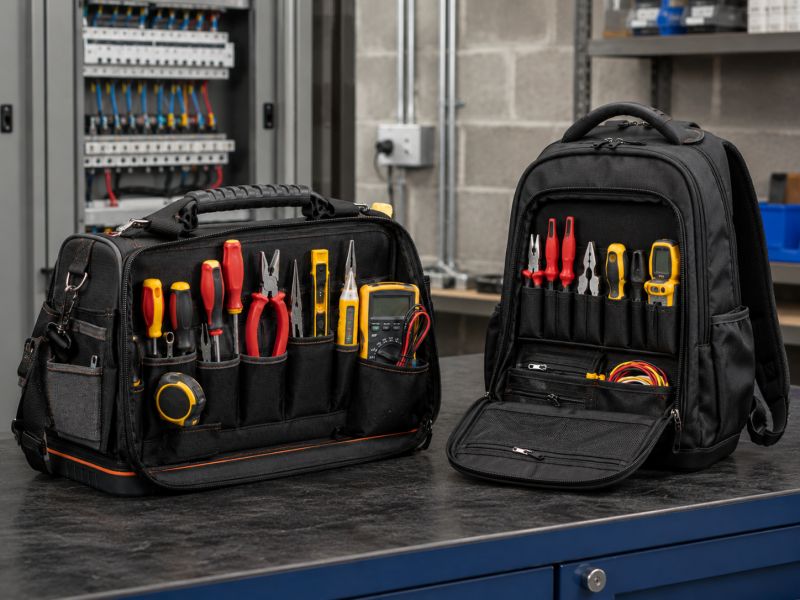
A tool bag can look strong in photos and still slow people down on site. That is the part many brands miss.
Electricians and technicians do not use tool bags like weekend users. They open the bag dozens of times a day. They move between service vans, ladders, workshops, apartments, machine rooms, electrical panels, rooftops, and unfinished job sites. A poorly planned bag makes every small task harder. The screwdriver is buried. The meter gets knocked by pliers. Small parts mix together. The bottom bends. The bag falls sideways. The shoulder strap digs into the body before lunch.
For professional users, structure is not decoration. It is daily workflow.
A better tool bag starts with a simple idea: tools should be easy to see, easy to reach, safe to carry, and ready for repeated use. That means pocket layout, opening shape, bottom support, meter protection, material choice, stitching strength, and weight balance must work together.
The best tool bags for electricians and technicians are not simply larger bags with more pockets. They are built around real tool lists, daily work habits, carrying distance, worksite surfaces, and quick access. For custom tool bag projects, brands should review pocket layout, meter protection, stand-up shape, reinforced bottom, weight balance, material strength, logo position, sample testing, and bulk consistency before approving production.
This guide is written for hardware brands, tool distributors, repair service companies, industrial teams, and private label operators that want more than a standard stock bag. If the goal is to create a tool bag that people will actually use every day, the structure must come before the style.
What Makes A Tool Bag Easier To Use Every Day?
A daily-use tool bag becomes easier to use when it reduces searching, protects key tools, stands stable on rough surfaces, carries weight without twisting, and keeps small parts under control. For electricians and technicians, the best structure is usually not the largest one. It is the one that matches tool size, tool frequency, movement distance, and the real work scene.
A common mistake is to judge a tool bag by capacity alone. Capacity matters, but only after the layout makes sense. A deep main compartment may hold many tools, but if users have to dig with one hand while holding a cable, flashlight, ladder, or service sheet with the other, the bag is not helping.
Think about a normal service call. A technician may need a screwdriver, pliers, tape measure, utility knife, tester, marker, tape, fasteners, and a few spare parts. These tools are used in different rhythms. Some are picked up every few minutes. Some are used only once. Some must stay protected. A good bag separates these behaviors.
A better daily-use structure often includes:
| Daily Need | Helpful Structure |
|---|---|
| Fast access | Wide opening, visible tool slots, exterior pockets |
| Tool protection | Padded meter zone, inner sleeves, separated compartments |
| Stability | Flat reinforced bottom, stand-up body, structured side panels |
| Small parts control | Zipper pockets, mesh pockets, removable pouches |
| Carry comfort | Padded handle, shoulder strap, balanced loading area |
| Longer service life | Strong fabric, reinforced stitching, durable hardware |
For custom projects, the goal should not be “How many pockets can we add?” The better is: “Which tools must be reached first, protected most, and carried most often?”
That one can change the whole design.
Who Uses Electrician and Technician Tool Bags?
Electrician and technician tool bags are used by people who carry working tools in active job settings. This includes electricians, maintenance workers, HVAC technicians, telecom installers, facility service teams, machine repair staff, construction crews, and field engineers. Each group carries a different tool mix, so the bag should match the user, not just the product name.
A bag called an “electrician tool bag” may not work for every electrician. A residential electrician, a solar installation crew, and an industrial maintenance team may all use different tool sets. One may need a compact open-top bag. Another may prefer a backpack. Another may need a heavy-duty tote with a wide base and multiple vertical slots.
The same applies to technicians. A telecom technician may carry cable tools, testers, connectors, and small parts. An HVAC technician may carry gauges, meters, hand tools, hoses, and service accessories. A facility repair team may need a flexible structure for mixed tools rather than a single trade layout.
For brands and project teams, this means the target user group should be defined before the sample starts. A bag designed for “technicians” in general can become too broad. A bag designed for “field technicians who visit several sites per day and carry testers, hand tools, tape, and parts” becomes much more practical.
Useful user groups to define early:
- Electricians
- Electrical maintenance teams
- HVAC technicians
- Telecom installers
- Facility repair teams
- Construction site workers
- Equipment service teams
- Home service technicians
- Industrial maintenance crews
- Hardware kit users
The more specific the user group, the easier it becomes to plan pocket layout, fabric strength, carrying method, bottom support, and branding style.
Which Type of Tool Bag Fits Different Work Scenarios?

The right tool bag type depends on how far the user moves, how heavy the tools are, how often the bag is opened, and where the work happens. Open-top bags suit quick access. Backpacks suit mobile work. Pouches suit small tools. Rolling bags suit heavier loads. One brand may need several styles for different users.
No single tool bag type solves every job. This is why strong tool brands often develop a small product family instead of relying on one model.
Here is a practical comparison:
| Type of Tool Bag | Best For | Main Advantage | Possible Limitation |
|---|---|---|---|
| Open-top tool bag | Fast repair, van service, workshops | Tools are easy to see and grab | Less secure during long travel |
| Tool backpack | Mobile technicians, stairs, buildings | Hands-free carrying | Access may be slower than open-top |
| Tool pouch | Small tools, ladder work, quick tasks | Lightweight and close to body | Limited capacity |
| Heavy duty tote | Worksites, mixed tools, rough use | Strong storage and stable opening | Can become heavy |
| Rolling tool bag | Heavy tools, long walking distance | Less shoulder strain | Not ideal for stairs or mud |
| Compact service bag | Light repair kits, small jobs | Easy to carry and store | Not suitable for large tool sets |
For many brands, the smartest plan is not to ask, “Which one is best?” It is better to ask, “Which users do we serve, and how many work scenes should our line cover?”
For example, a hardware brand may start with one 16-inch open-top tool bag for electricians, then add a backpack for mobile technicians and a small pouch for add-on sales. This creates a more complete product line and gives distributors more options.
If your team is planning a custom tool bag series, you can send the work scene, tool list, reference style, and quantity plan to info@jundongfactory.com for structure review.
How Should Pocket Layout Be Designed For Real Tools?
Pocket layout should be designed from real tool sizes, not from a fixed pocket count. A practical layout considers tool length, handle width, weight, usage frequency, and access angle. Screwdrivers, pliers, meters, tape measures, drill bits, markers, knives, and small parts all need different storage logic.
Many tool bags fail because the pockets look good when empty. The problem appears only after real tools go in.
A screwdriver slot may be too shallow. A pliers pocket may be too narrow. A meter pocket may sit beside heavy tools. A zipper pocket may be hard to open when the bag is full. The bag may have thirty pockets, yet users still throw tools into the main compartment because the pockets are not sized correctly.
A better pocket plan usually starts with three layers:
| Pocket Zone | Tools | Design Notes |
|---|---|---|
| Fast-access outer zone | Tape measure, marker, utility knife, common screwdriver | Easy to reach without opening the whole bag |
| Organized inner zone | Pliers, screwdrivers, wrench, tester, small hand tools | Vertical slots and visible handles help speed |
| Protected zone | Multimeter, tester, glasses, delicate parts | Padded, separated, or zippered area |
Tool frequency also matters. A tool used every few minutes should not sit under a flap or behind a zipper. A tool used once per job can be placed deeper inside. Sharp tools need safer pockets. Heavy tools should sit lower and closer to the center to reduce imbalance.
Pocket depth is another detail worth checking. If a pocket is too deep, the handle disappears and the user has to pull everything out. If it is too shallow, tools fall when the bag moves. The right depth lets the tool stay stable while leaving enough handle exposed.
For custom samples, one simple test helps a lot: fill the bag with the real tool set, then ask someone to pick ten common tools in order. If they hesitate, dig, or move other tools aside too often, the layout needs revision.
Why Do Electrician Tool Bags Need A Meter Protection Zone?

Electrician tool bags need a protected meter zone because meters and testers are more delicate than common hand tools. A multimeter, voltage tester, or diagnostic device should not be pressed against pliers, blades, drill bits, or metal hardware. A separate padded space helps reduce impact, scratches, and tool damage.
This is one of the details that separates a general tool bag from an electrician-focused tool bag.
Electricians often carry a mix of hard, sharp, heavy, and sensitive tools. Pliers and screwdrivers can handle rough contact. Meters and testers should not be treated the same way. When all tools are dropped into one large compartment, delicate devices take the risk.
A meter protection zone can be designed in several ways:
- Padded inner compartment
- Zippered side pocket
- Elastic fixing strap
- Soft lining
- Divider panel
- Separate tester sleeve
- Raised pocket away from bottom impact
- Small cable or probe storage beside the meter area
The protection level should match the tool value and work scene. A small service bag for light home repair may need only a simple padded pocket. A professional electrician bag for daily field work may need a stronger compartment with better side support.
The meter zone should also be easy to reach. Protection is useful only if the user actually uses the pocket. If the compartment is hidden too deep or becomes tight after other tools are loaded, people will stop using it.
For private label tool bags, this section is also a strong selling feature. End users may not describe it in technical terms, but they understand the feeling: “My tester has a safe place.”
Is A Stand-Up Tool Bag Better For Jobsite Access?
A stand-up tool bag is often better for jobsite access because it keeps tools visible, stable, and easier to reach. When a bag collapses, users spend more time digging and tools may spill or hide under each other. A structured body helps the bag stay open during active work.
This does not mean every tool bag must be rigid. It means the bag should hold its working shape after tools are loaded.
A tool bag that looks neat when empty may fold inward once it carries weight. This blocks inner pockets and makes tools harder to see. On a worksite, that small inconvenience repeats all day.
A stand-up structure often depends on several parts working together:
| Structure Detail | Why It Matters |
|---|---|
| Wide base | Helps the bag stay stable on the floor |
| Reinforced side panels | Reduces collapse when loaded |
| Structured opening | Keeps the top open for faster access |
| Strong bottom support | Carries weight and keeps shape |
| Balanced pocket placement | Prevents one side from pulling the bag over |
Stand-up bags are especially useful near electrical panels, service vans, workshops, ladders, and machine rooms. The user can place the bag down, see the tool handles, grab what is needed, and move on.
There is still a balance to keep. If the structure is too stiff, the bag may become bulky and harder to pack. If it is too soft, it loses shape. For many custom projects, semi-structured construction works well: firm enough to stand, flexible enough to carry.
What Bottom Structure Works Best For Heavy Duty Tool Bags?
The best bottom structure for heavy duty tool bags depends on weight, surface, water exposure, and cost target. Common options include padded fabric bottoms, PE board reinforcement, PVC-coated bottoms, molded plastic bases, rubber feet, and abrasion-resistant panels. For rough daily work, the bottom should protect both the tools and the bag shape.
The bottom is one of the most abused areas of a tool bag. It touches concrete, dust, van floors, wet ground, metal scraps, workshop oil, and rough outdoor surfaces. Yet many product discussions focus only on the outer fabric.
That is risky.
A weak bottom can create several problems:
- The bag sags when loaded.
- Tools press into the floor.
- Corners wear out early.
- Moisture reaches the inner compartment.
- The bag tips over more easily.
- The brand receives complaints after repeated use.
Here is a simple bottom structure guide:
| Bottom Option | Strength | Best Use |
|---|---|---|
| Fabric bottom with padding | Basic | Light tool bags, lower weight |
| PE board inside bottom | Medium | Better shape support and cost control |
| PVC-coated bottom | Medium | Dust and moisture resistance |
| Rubber feet | Medium | Reduces floor contact on dry surfaces |
| Molded plastic base | High | Wet floors, heavy tools, rough sites |
| Extra abrasion panel | Medium to high | Worksites with repeated dragging |
A molded base gives strong protection, but it may increase cost, weight, and mold planning. A reinforced fabric bottom with PE board may be enough for mid-weight tool bags. A PVC-coated bottom can help with dirt and moisture, especially for technicians moving between indoor and outdoor sites.
The right choice should come from expected tool weight and use scene. A small service bag does not need the same bottom as a heavy-duty electrician tote. A professional worksite bag should not use the same bottom as a light promotional item.
How Do Material, Stitching, Zippers, and Hardware Affect Service Life?

Material, stitching, zippers, and hardware decide whether a tool bag can handle repeated weight, friction, opening, pulling, and field use. Fabric alone is not enough. Stress areas, handles, shoulder straps, zippers, rivets, bar-tacks, binding, and bottom corners must be matched to the real load.
A tool bag is a stress product. Every day, tools pull against the seams. Handles take repeated lifting. Zippers meet dust and pressure. Hardware carries weight. Bottom corners scrape against floors. If one part is weak, the whole product feels weak.
Common material choices for tool bags include 600D, 900D, and 1680D Oxford, along with polyester or nylon options. Heavier fabric can improve abrasion resistance and shape, but it also affects price, weight, and sewing difficulty. The best choice is not always the thickest. It is the one that fits the target user and expected load.
Stitching deserves close attention. Reinforced bartacks at handle bases, shoulder strap anchors, pocket openings, and side stress areas can reduce early damage. Binding tape around raw edges can help the bag keep a clean structure. Rivets may add strength and visual toughness, but they should be placed where they support function, not only style.
Zippers and pulls should also match the job. A small zipper may work on a light pouch, but not on a heavy tool bag that gets opened with dirty gloves. Wider zipper tape, stronger teeth, and easy-grip pulls can improve user experience.
Hardware should be checked as a complete system. D-rings, swivel hooks, buckles, strap adjusters, and handle webbing need to work together. A strong strap with weak hardware still creates risk.
Before bulk production, practical checks should include:
- Loaded carry test
- Handle pull test
- Shoulder strap stress review
- Zipper opening test
- Pocket stitching review
- Bottom corner wear check
- Logo durability check
- Packing compression review
This is where a factory with in-house sampling and quality inspection can add real value. The sample should not only look correct. It should survive the way people will use it.
Open-Top Tool Bag vs Tool Backpack: Which Is Better?

Open-top tool bags are better for fast access when tools need to stay visible. Tool backpacks are better for mobile technicians who walk between sites, climb stairs, or need hands-free carrying. Neither style is always better. The right choice depends on work distance, tool load, access speed, and user habits.
This comparison is useful because many teams try to choose one style too early.
An open-top tool bag is often the better option for:
- Service vans
- Workshops
- Electrical panels
- Quick repair calls
- Jobs where tools stay close
- Users who need instant visibility
Its main value is speed. Users can see tool handles, grab what they need, and return tools quickly. The downside is that tools may be less secure during long-distance movement.
A tool backpack is often better for:
- Building-to-building service
- Stairs and elevators
- Rooftop work
- Mobile maintenance
- Longer walking distance
- Technicians carrying laptops, meters, or documents with tools
Its main value is movement. Users can keep both hands free. The downside is that tool access may be slower, especially if the internal layout is not well planned.
For brands, the smartest strategy may be to offer both. A tool backpack can target mobile service teams, while an open-top bag can target electricians and repair workers who prioritize quick access. A pouch or small parts bag can support add-on sales.
The better is not “Which bag wins?” It is “Which job does each bag serve?”
How Should A Custom Tool Bag Project Start?
A custom tool bag project should start with a tool list, user group, work scene, target size, carrying method, preferred material, pocket needs, bottom structure, logo file, quantity plan, packing request, and destination country. A reference photo helps, but it should not replace real usage details.
Many projects start with a message like: “Can you make this tool bag?”
That is a useful start, but it is not enough for a strong result. Two bags may look similar from the outside while serving completely different users. The structure depends on what will go inside, how often it will be used, how far it will be carried, and what budget the brand needs to maintain.
A good project brief can be simple:
| Detail To Share | Why It Helps |
|---|---|
| Tool list | Helps plan pocket size and layout |
| Tool dimensions | Prevents pockets from being too tight or too deep |
| User group | Guides carrying style and comfort needs |
| Work scene | Helps choose bottom, fabric, and protection |
| Target bag size | Controls capacity and shipping volume |
| Preferred fabric | Helps match cost and durability |
| Logo method | Affects panel planning and production process |
| Quantity | Helps estimate material and cost direction |
| Packing style | Supports retail, shipment, or project use |
For early-stage ideas, even a rough tool list and a reference photo can help. The first review can focus on feasibility: Is the structure suitable? Is the fabric strong enough? Does the logo position conflict with function? Does the bottom need more support?
For project review, details can be sent to info@jundongfactory.com. Clear starting information makes sampling faster and reduces avoidable changes later.
How Long Does Sampling and Bulk Production Usually Take?
Sampling time for custom tool bags often depends on structure, material, logo method, and revision needs. For many custom bag projects, sample development can usually be arranged in about 5–7 days, and some simple styles may be faster. Bulk production often takes about 20–30 days after sample approval, depending on order details.
A tool bag sample is not only a visual sample. It is a working model. It should confirm size, pocket layout, handle strength, bottom support, zipper use, logo position, and real tool fit.
A practical timeline may look like this:
| Stage | Typical Focus |
|---|---|
| Project review | Tool list, structure, material, logo, quantity |
| First sample | Size, pattern, pocket layout, main function |
| Sample revision | Pocket adjustment, stitching, logo, comfort |
| Pre-production sample | Final reference before bulk production |
| Bulk production | Cutting, sewing, inspection, packing |
| Shipment preparation | Carton marks, labels, documents, delivery plan |
Not every project needs many revisions. Simple styles may move quickly. Complex tool bags with many pockets, molded bottom parts, special hardware, or strict retail packing may need more time.
The best way to shorten the timeline is not to rush sewing. It is to prepare clearer information at the start. Tool sizes, pocket needs, logo artwork, material preference, and packing details help the factory make better decisions earlier.
Fast sampling is useful. Accurate sampling is better.
How Can A Tool Bag Factory Support Brands Before Bulk Orders?
A tool bag factory can support brands before bulk orders through structure review, material sourcing, pattern making, sample revision, logo placement, load testing, quality inspection, packing planning, and export coordination. This support helps turn a rough concept into a product that can be repeated with stable quality.
This is where a real factory differs from a simple product catalog.
A catalog can show existing styles. A factory can adjust the product. That difference matters for tool bags because structure directly affects daily use. A pocket that is 2 cm too narrow may fail. A bottom that is too soft may sag. A logo placed over a pocket may reduce function. A strap anchor without enough reinforcement may create complaints.
Useful factory support may include:
- Material selection advice
- Pocket structure adjustment
- Pattern and size development
- Handle and strap reinforcement
- Bottom construction review
- Logo position planning
- Zipper and hardware matching
- Sample revision
- Functional inspection
- Packing and carton mark planning
For established brands, the concern is often not “Can you make one?” It is “Can you repeat it across orders?” Repeatability depends on pattern control, material consistency, sample records, inspection steps, and clear production communication.
For growing brands, the concern is often “Can this become a series?” A factory can help adjust one base structure into different sizes, colors, pocket layouts, and packaging styles.
That is why custom tool bag development should be treated as a product project, not just a bag order.
What Mistakes Should Brands Avoid Before Approving A Tool Bag Sample?
Before approving a tool bag sample, brands should avoid judging only the outside appearance. A sample should be checked with real tools, full weight, actual carrying movement, zipper use, pocket access, meter protection, bottom support, logo placement, packing style, and carton details. Small mistakes become expensive after bulk production.
A beautiful sample can still fail in daily use. That is why approval should be practical.
Common mistakes include:
| Mistake | Why It Creates Risk |
|---|---|
| Counting pockets without measuring tools | Tools may not fit or may sit too deep |
| Ignoring meter protection | Sensitive devices may be damaged |
| Choosing a soft bottom for heavy tools | Bag may sag, tip, or wear quickly |
| Not testing with real weight | Carry comfort may be misleading |
| Placing logo over function areas | Branding may interfere with pockets |
| Forgetting zipper stress | Zipper may feel tight when loaded |
| Ignoring small parts storage | Users may complain about messy interiors |
| Approving color without material check | Bulk color may not match expectations |
| Skipping packing review | Retail or shipment issues may appear later |
A strong sample review should include three simple actions.
First, load the bag with the real tool set. Do not use paper filler. Second, carry it the way users will carry it: by hand, on shoulder, on back, or from van to worksite. Third, open and close every pocket, zipper, flap, and strap under loaded conditions.
If the sample passes only when empty, it is not ready.
What Should Brands Send For A Custom Tool Bag Quote?
For a custom tool bag quote, brands should send the bag style or reference photo, tool list, tool sizes, target user group, preferred material, pocket layout ideas, bottom structure request, logo artwork, quantity, color plan, packing needs, and delivery country. Better details lead to better structure advice and faster sampling.
A clear request does not need to be complicated. It only needs to show how the bag will be used.
Here is a helpful checklist:
- Bag style or reference image
- Tool list
- Tool dimensions or photos
- Target user group
- Daily use scene
- Preferred size
- Fabric or durability target
- Pocket layout request
- Meter or tester protection need
- Bottom structure preference
- Carrying method
- Logo artwork
- Quantity
- Packing method
- Destination country or region
If the project is still early, send what you have. A reference photo, tool list, target size, and quantity are enough to begin the first review.
Jundong supports custom tool bags, tool backpacks, work pouches, industrial equipment bags, and related worksite carry solutions. For custom structure review or sample planning, project details can be sent to info@jundongfactory.com.
Closing Section
A tool bag for electricians and technicians should make work feel smoother, not heavier. The right structure saves time, protects tools, reduces mess, and helps professional users trust the product after repeated use.
For brands, distributors, and service teams, the best product decision starts before the sample. Define the user. List the tools. Choose the work scene. Match the structure to the job. Then check the sample with real tools, real weight, and real movements.
That is how a custom tool bag becomes more than a container.
It becomes part of the way people work.
FAQs About Custom Tool Bags for Electricians and Technicians
1. What is the best tool bag structure for electricians?
Certainly, the best tool bag structure for electricians is usually a stable, easy-access design with vertical tool slots, a protected meter area, a reinforced bottom, and clear small-parts storage. Electricians do not only carry tools; they carry tools that are used in different rhythms during the day. A screwdriver, pliers, voltage tester, tape measure, utility knife, marker, electrical tape, and connectors should not all fall into one deep compartment.
For many electrician tool bags, an open-top structure works well because users can see the tools quickly. However, if the work requires walking between buildings, climbing stairs, or carrying more sensitive testing devices, a tool backpack may be better. The right structure depends on the work scene.
A practical electrician tool bag should include at least three storage zones: fast-access pockets for tools used often, protected pockets for meters and testers, and closed pockets for small parts. The bottom should be firm enough to stand on concrete or workshop floors without folding inward. Handles and shoulder straps should also be reinforced because electricians often carry heavy mixed tools.
For custom projects, brands should start with the real tool list. A bag that fits ten common electrician tools well is often more useful than a bag with thirty pockets that do not match actual tool size.
2. Is an open-top tool bag or a tool backpack better for technicians?
Sure, an open-top tool bag is better for fast access, while a tool backpack is better for mobile technicians who need hands-free carrying. Neither structure is always better. The right choice depends on how far the user walks, how heavy the tools are, and how often tools need to be taken out.
An open-top tool bag is very practical for electricians, repair workers, and service teams who work near a van, workbench, electrical panel, or fixed job area. The biggest advantage is visibility. Users can look down, see the tool handles, grab what they need, and put tools back quickly. This makes daily work faster and less frustrating.
A tool backpack is better when technicians move from floor to floor, walk through large buildings, enter service areas, or carry a laptop, meter, documents, and tools together. It spreads weight across the back and frees both hands, which can be helpful in stairs, elevators, rooftops, and large facility spaces.
For a brand product line, both styles can work together. The open-top bag can serve fast-access jobs, while the backpack can serve mobile field work. This gives distributors and service teams more choices instead of forcing one style to fit every user.
| Work Scene | Better Style | Why It Works |
|---|---|---|
| Van service | Open-top bag | Fast tool visibility |
| Building maintenance | Backpack | Easier movement |
| Ladder work | Pouch or compact bag | Lighter and closer to body |
| Heavy tool load | Heavy duty tote | Stronger structure |
| Multi-site repair | Backpack | Hands-free carrying |
3. How many pockets should an electrician tool bag have?
Of course, the right pocket number depends on the tool list, not a fixed number. A bag with 18 well-sized pockets can be more useful than a bag with 40 pockets that are too narrow, too deep, or placed in the wrong areas. For electricians and technicians, pocket logic matters more than pocket count.
The best way to plan pocket quantity is to group tools by use. Fast-use tools need open or semi-open pockets. Sensitive tools need padded or separated areas. Small parts need zippered, mesh, or removable storage. Long tools need vertical slots that keep handles visible. Heavy tools should sit lower and closer to the center to keep the bag balanced.
A typical electrician bag may need screwdriver slots, pliers pockets, tape measure clip, knife pocket, tester sleeve, meter compartment, drill bit pocket, marker sleeve, electrical tape holder, and small connector storage. However, if the target user is a light service technician, fewer pockets may be better because the bag stays lighter and easier to manage.
The pocket test should happen during sampling. Fill the bag with real tools, then check whether each tool can be seen, reached, removed, and returned without moving too many other items. If users still throw tools into the main compartment, the pocket plan is not working.
4. Why does a tool bag need a reinforced bottom?
Definitely, a reinforced bottom is one of the most useful features in a heavy duty tool bag because it helps the bag keep shape, stand better, resist abrasion, and protect tools from rough floors. Tool bags often sit on concrete, van floors, wet surfaces, dusty workshops, and unfinished work areas. A weak bottom wears out quickly and makes the bag feel unstable.
Many complaints about tool bags start from the bottom. When the bottom is too soft, the bag sags after tools are loaded. Tools press into the floor. The corners wear. The bag may tip over. Moisture and dirt can also move into the inner compartment more easily.
Different bottom structures can be used depending on price target and work scene:
| Bottom Type | Suitable Use | Main Benefit |
|---|---|---|
| Padded fabric bottom | Light tool bags | Simple and cost-friendly |
| PE board bottom | Medium-duty bags | Better shape support |
| PVC-coated bottom | Indoor and outdoor service | Helps resist dirt and moisture |
| Molded plastic base | Heavy-duty work | Stronger floor protection |
| Rubber feet | Workshop and dry floor use | Less direct floor contact |
| Abrasion panel | Rough site use | Better wear resistance |
For electrician and technician bags, the bottom should be reviewed with real tool weight. A structure that feels fine when empty may fail when loaded. This is why the bottom is not a small detail; it affects daily use, product life, and brand reputation.
5. Do electrician tool bags need a separate pocket for meters and testers?
Absolutely, electrician tool bags should usually include a separate protected pocket for meters, testers, and diagnostic tools. These items are more delicate than pliers, screwdrivers, hammers, and drill bits. If they are placed in the same main compartment as heavy metal tools, they can get scratched, pressed, or damaged during transport.
A good meter pocket does not need to be complicated, but it must be planned. It can be padded, zippered, elastic-fixed, or separated by a divider. For higher-end professional bags, the meter area can also include a soft lining, probe pocket, cable storage, or raised position away from bottom impact.
The key is balance. The meter should be protected, but still easy to reach. If the pocket is too hidden or too tight, users may stop using it and place the tester somewhere else. That defeats the purpose of the structure.
For brands targeting electricians, this feature can make the bag feel more professional. It shows that the product was not only made as a generic tool carrier. It was planned around electrical work. That difference can help the product stand out in retail, online listings, and professional tool programs.
6. What materials are best for heavy duty tool bags?
Certainly, heavy duty tool bags often use strong polyester or nylon fabrics such as 600D, 900D, or 1680D Oxford, depending on the target price, weight, and durability level. However, the best material is not always the thickest one. A good tool bag also needs reinforced stitching, strong webbing, durable zippers, reliable hardware, and a bottom structure that matches the load.
For light service bags, 600D polyester may be enough when the tool load is not too heavy. For electrician and technician bags used every day, stronger fabric and better reinforcement may be needed. 1680D Oxford can give a tougher feel and better abrasion resistance, but it may raise cost and weight. A balanced material plan is often better than simply choosing the heaviest option.
Key areas should be reviewed carefully:
| Area | What To Check |
|---|---|
| Outer fabric | Abrasion resistance and hand feel |
| Lining | Visibility, smoothness, and protection |
| Webbing | Handle and strap strength |
| Stitching | Bar-tack and stress-area reinforcement |
| Zipper | Smooth opening under load |
| Hardware | D-rings, hooks, buckles, and strap parts |
| Bottom | Shape support and floor protection |
A strong fabric with weak stitching is still risky. A strong strap with weak hardware is also risky. For custom tool bags, all parts should work as one system.
7. How can brands control tool bag cost without making the product feel cheap?
Sure, tool bag cost can be controlled by matching materials, structure, pocket count, hardware, logo method, and packaging to the real use scene. Cutting cost in the wrong area can make the bag look cheaper or fail faster. The smarter way is to protect the features users notice most and simplify areas that do not affect daily performance.
For example, if the target user carries heavy tools, do not reduce bottom support or handle reinforcement first. Those areas affect product life. Instead, review whether every pocket is needed, whether the logo method can be simplified, whether the packaging can be more efficient, or whether one base structure can support several colors or sizes.
Cost control should be based on priorities:
| Keep Strong | Can Be Adjusted |
|---|---|
| Handle and strap reinforcement | Decorative trim |
| Bottom support | Non-critical pocket count |
| Main fabric strength | Complex color blocking |
| Zipper quality | Extra logo positions |
| Stress-area stitching | Premium retail box |
For many projects, the most practical cost plan is to create a “good, better, best” version. The good version covers core function. The better version adds stronger fabric or more refined pockets. The best version may include molded bottom, upgraded hardware, and richer branding details.
Jundong can review your reference style, target quantity, material preference, and budget direction to suggest a structure that feels solid without adding unnecessary cost.
8. How long does a custom tool bag sample and bulk order usually take?
Generally, custom tool bag samples can often be arranged in about 5–7 days, while some simple styles may be faster. Bulk production commonly takes about 20–30 days after sample approval, depending on the structure, material, order quantity, logo method, packing requirements, and production schedule.
A tool bag sample should not be treated as only a visual model. It should confirm the real working details: size, pocket layout, zipper movement, handle comfort, bottom support, logo placement, and actual tool fit. If the bag has many pockets, reinforced panels, molded bottom parts, custom hardware, or special packaging, extra review time may be needed.
A common project flow looks like this:
| Stage | Main Work |
|---|---|
| Project review | Tool list, reference photo, quantity, material direction |
| First sample | Pattern, shape, pocket layout, main structure |
| Sample adjustment | Pocket size, logo, stitching, comfort details |
| Pre-production approval | Final confirmation before bulk production |
| Bulk production | Cutting, sewing, inspection, packing |
| Shipment preparation | Carton marks, labels, documents, delivery plan |
The best way to save time is to send clear details at the start. A tool list, target size, logo file, preferred material, quantity, packing request, and destination country can reduce back-and-forth communication and help the sample move faster.
For sample planning, project details can be sent to info@jundongfactory.com.
9. What should brands check before approving a tool bag sample?
Absolutely, brands should check a tool bag sample with real tools, real weight, and real carrying movement before approval. A sample that looks good when empty may not work well after tools are loaded. The most practical review covers pocket fit, tool access, meter protection, bottom stability, shoulder comfort, zipper movement, stitching strength, logo position, and packing details.
A good sample review should feel like a short field test. Put in the actual tools. Carry the bag by hand, shoulder, or back. Place it on the floor. Open every zipper. Take out common tools. Put them back. Check whether the bag tips, twists, collapses, or becomes hard to close.
Useful sample review checklist:
| Review Item | What To Look For |
|---|---|
| Pocket fit | Tools should not be too tight or too loose |
| Tool visibility | Handles should be easy to see |
| Meter pocket | Tester should be protected and easy to reach |
| Bottom | Bag should stand and resist sagging |
| Carry comfort | Handle and strap should feel stable |
| Zipper | Should open smoothly when loaded |
| Logo | Should not block pockets or seams |
| Packing | Should match retail or shipment needs |
If the sample is approved only by photos, hidden issues may appear during use. Physical testing is safer, especially for heavy duty tool bags.
10. What information should we send to start a custom tool bag project?
Of course, the fastest way to start a custom tool bag project is to send a reference image, tool list, tool sizes, target user group, preferred bag type, material idea, logo artwork, quantity, packing request, and destination country. These details help the factory review structure, suggest suitable materials, and prepare a sample plan with fewer delays.
A simple request can still be very useful. You do not need a perfect technical drawing at the beginning. A photo, rough dimensions, and a clear tool list are enough to start the first review. If you already have an existing sample, send photos from the front, back, side, inside, bottom, handle, and pocket areas. This helps the team understand both appearance and structure.
Helpful starting details include:
| Detail | Why It Matters |
|---|---|
| Reference photo | Shows target style |
| Tool list | Guides pocket planning |
| Tool size | Helps avoid wrong pocket depth |
| User group | Guides carrying method |
| Work scene | Helps choose bottom and fabric |
| Logo artwork | Affects panel and print planning |
| Quantity | Helps review material and cost |
| Packing need | Supports retail or project delivery |
| Destination | Helps plan carton and export details |
For early projects, send what you have. The first step is not to make everything perfect. It is to confirm whether the structure, material, and sample direction are practical for your product plan.