 Skip to content
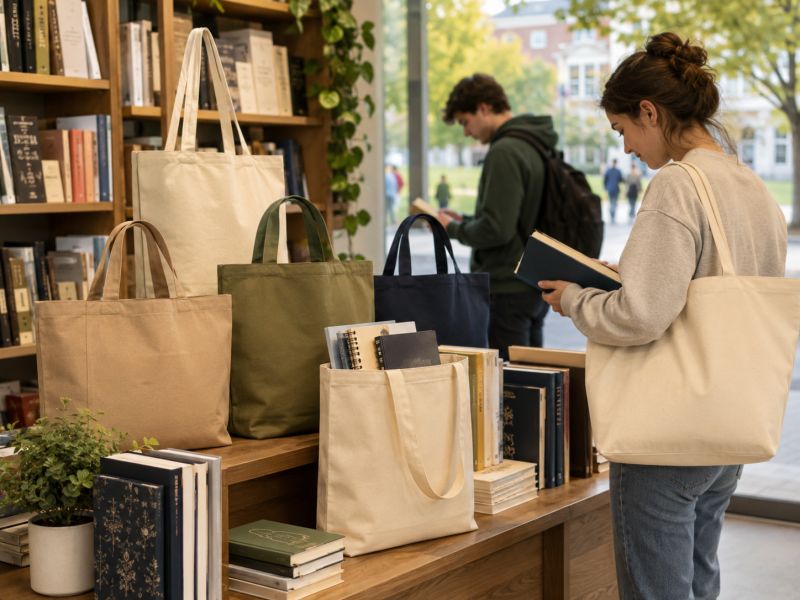
A good canvas tote bag does more than carry books. In a bookstore or campus store, it can sit beside the register, hang on a display wall, hold textbooks, support a reading event, become part of a student welcome kit, or turn into a small retail product that people keep using long after the first purchase.
That is why the right bag should not be chosen only by appearance. A nice graphic can attract attention, but the real value comes from size, comfort, fabric strength, print clarity, packing details, and repeat order stability. A tote that looks beautiful but cannot carry two hardcovers will not satisfy readers. A campus bag with short handles may look neat on a shelf, but students may ignore it if they cannot carry it on the shoulder. A printed design may look strong on a screen, but thin lines may disappear on rough canvas if no print test is done.
For bookstores, campus stores, libraries, school shops, university merchandise teams, and reading campaign planners, canvas totes sit between product, packaging, and brand merchandise. They need to feel useful, look right, and match the purpose of the project.
Canvas tote bags for bookstores and campus stores should be planned around book weight, shoulder comfort, artwork clarity, retail packing, and repeat order control. A strong project usually starts with the right size, suitable canvas weight, reinforced handles, clear logo or artwork printing, sample approval, quality inspection, and packing details such as hangtags, barcode labels, SKU sorting, and carton marks.
Jundong supports custom canvas tote projects for retail, school, event, private label, and OEM/ODM needs. With in-house project review, design support, sampling, quality checks, packing support, and export experience, the team helps turn a rough idea into a production-ready tote bag that fits the way bookstores and campus stores actually use it.
Why Do Bookstores and Campus Stores Use Canvas Tote Bags?
Bookstores and campus stores use canvas tote bags because they are useful, visible, and easy to connect with a brand story. They can carry books, notebooks, gifts, apparel, stationery, and event materials while also showing a store logo, school name, reading slogan, campus icon, or artwork. A well-planned canvas tote can work as a shopping bag, retail item, student gift, alumni product, or campaign bag.
A bookstore tote has a different job from a normal giveaway bag. It often needs to support heavier items, such as hardcovers, art books, textbooks, planners, or gift sets. This means the bag must feel stronger than a thin event tote, especially around the handles and seams.
For campus stores, the use scene is even wider. A student may use the same tote for notebooks in the morning, a hoodie from the campus shop in the afternoon, and groceries or personal items after class. That daily movement makes comfort and durability very practical concerns.
There is also a brand side to this product. A reading quote, school logo, campus building sketch, mascot, or bookstore illustration can make the tote feel collectible. People do not throw away a tote that feels meaningful. They carry it, photograph it, and reuse it.
That is where bookstores and campus stores can gain more value from a custom tote. It is not only a container. It becomes a product that travels with the reader.
What Size Canvas Tote Bag Works Best for Books?

The best canvas tote size depends on what the bag needs to carry. Small totes work for light book purchases or gift items. Standard sizes are better for daily bookstore sales. Larger or gusseted totes work better for textbooks, folders, laptops, apparel, and gift bundles. For campus stores, a slightly larger size with shoulder handles usually gives better daily use value.
Size is often the first decision, but it is also one of the easiest to underestimate. A tote that looks large in a product photo may feel too narrow when a hardcover book is placed inside. A bag that fits a notebook may not fit a laptop sleeve. A tote that works for one paperback may not work for a campus store order that includes a hoodie, bottle, and welcome booklet.
For book-related use, the opening width matters as much as the height. Books have hard edges. If the bag opening is too tight, users need to force the book into the bag, which makes the product feel poorly planned.
A gusset can make a major difference. Flat totes are simple and easy to store. They are good for light items and simple event use. Gusseted totes have side or bottom depth, which allows the bag to hold thicker books, boxed gifts, apparel, or mixed store items with better shape.
Here is a practical size planning table:
| Use Scene | Suggested Bag Direction | Best For |
|---|---|---|
| Light book purchase | Small flat tote | One or two books, postcards, small gifts |
| Daily bookstore sale | Standard flat or small gusset tote | Books, journals, stationery, gift items |
| Campus store use | Standard or larger shoulder tote | Folders, apparel, bottles, notebooks |
| Textbook and laptop use | Larger gusset tote | Textbooks, laptop sleeve, daily student items |
| Retail gift set | Custom size tote | Book bundles, branded kits, seasonal sets |
A good rule is simple: decide what the bag must carry before deciding how it should look. Design follows use, not the other way around.
For a new bookstore or campus store project, sharing the item list with Jundong helps the team review size, gusset, fabric weight, handle length, and packing method before sampling.
Which Handle Is Better: Short Handle vs Shoulder Handle?
Short handles work for light retail bags, gift bags, and hand-carry use. Shoulder handles are usually better for bookstores and campus stores because books, laptops, bottles, and personal items can become heavy. Wider or reinforced handles improve comfort and help the tote feel more reliable. For daily campus use, shoulder-friendly handles are often the safer choice.
Handles look simple, but they decide whether a tote becomes a favorite bag or a product people stop using. A short handle may look clean on a shelf. It may also reduce material cost slightly. But once the bag is filled with books, hand carry becomes less comfortable.
Campus users often need their hands free. They may be holding coffee, a phone, keys, or another bag. A long shoulder handle makes the tote easier to carry across classrooms, dorms, libraries, bookstores, buses, and sidewalks.
The handle drop should be reviewed before sampling. If it is too short, the bag cannot sit comfortably on the shoulder. If it is too long, the bag may hang too low and feel awkward when walking. A good handle is not only about length. Width, fabric thickness, stitching, and attachment position also matter.
For heavier book loads, reinforced stitching is worth reviewing. Cross stitching or box stitching at the handle joint can reduce stress at the connection area. For retail programs, this small detail can make the bag feel better in hand and lower the risk of handle complaints.
| Handle Choice | Better Use | Notes |
|---|---|---|
| Short self-fabric handles | Light gift and counter sales | Clean look, less shoulder comfort |
| Long self-fabric handles | Bookstores and campus daily use | Good balance of appearance and comfort |
| Wider canvas handles | Heavier books and laptops | Better pressure distribution |
| Webbing handles | Stronger support needs | Sportier look, strong feel |
| Reinforced stitching | Retail and repeat programs | Better for load stress |
A bookstore tote is often judged the moment a reader fills it with books. If the handle feels weak, the whole product feels weak.
What Type of Canvas Is Best for Bookstore Totes?

The best canvas depends on weight, use, and desired feel. Light canvas can work for simple events. Medium canvas is often suitable for bookstore retail and campus store programs. Heavier canvas is better for textbooks, laptops, and long-term use. Natural canvas suits literary designs, while colored canvas can work well for school merchandise and private label collections.
Canvas weight is not only a technical detail. It affects how the bag feels, folds, stands, prints, ships, and sells. A lighter canvas tote can be easy to fold and budget-friendly for large event use. A heavier tote may cost more, but it can feel more like a retail product.
Bookstores often need balance. If the tote is too thin, it may not support books well. If it is too heavy, the cost and shipping weight may rise. The right choice depends on the project goal.
A reading campaign may only need a simple lightweight tote. A campus store retail line may need a stronger bag with better structure. A premium bookstore may prefer a heavier natural canvas with clean artwork and a refined handle finish.
| Canvas Direction | Best Use | Side Benefit |
|---|---|---|
| Light canvas | Events, simple giveaways | Lower cost, easy folding |
| Medium canvas | Bookstore retail, campus shops | Balanced feel and cost |
| Heavy canvas | Textbooks, laptops, premium retail | Stronger feel and longer use |
| Natural canvas | Literary artwork, vintage style | Warm, classic look |
| Colored canvas | School and brand merchandise | Strong identity and shelf impact |
| Recycled cotton canvas | sustainability programs | Better story for responsible projects |
Before sampling, it is worth reviewing three things together: fabric weight, print method, and expected load. A thicker canvas may hold shape better, but the surface texture can affect fine artwork. A lighter canvas may print clearly, but may not feel strong enough for textbooks.
Jundong can help compare canvas options based on the intended use, design style, quantity, and target cost.
How Should Logos, School Names, and Artwork Be Printed?
Logos, school names, and artwork should be printed based on design complexity, fabric color, order quantity, and the desired finish. Screen printing works well for simple logos and bold artwork. Heat transfer suits colorful graphics. Embroidery works for smaller premium marks. Woven labels can support private label programs. Print size, color, placement, and sample approval should be checked before bulk work starts.
A bookstore tote often carries more personality than a plain retail bag. It may show a literary quote, a line drawing of a storefront, a reading campaign message, or artwork created for a specific season. Campus stores may use school names, department names, mascots, building icons, or alumni graphics.
That makes print planning very important. A design that looks perfect on a digital mockup may change once applied to canvas. Canvas has texture. It absorbs ink differently from smooth plastic or coated fabric. Thin lines, small letters, and low-contrast colors can lose clarity if not reviewed carefully.
Screen printing is often a strong choice for simple, bold artwork. It is cost-friendly for larger quantities and works well for logos, slogans, and solid-color graphics. Heat transfer is useful when the artwork has more colors or gradients. Embroidery gives a premium feel, but it is usually better for smaller logos rather than large book-themed graphics. Woven labels can work well for private label programs where the brand wants a subtle, repeatable identity marker.
Dark canvas needs extra attention. White or light artwork may need a test to check coverage. Fine serif type, small campus names, or detailed building sketches should be reviewed at real print size, not only on screen.
Practical print checks before sample approval:
| Print Detail | Why It Matters |
|---|---|
| Logo size | Prevents weak visibility or oversized graphics |
| Print position | Keeps artwork balanced when the bag is filled |
| Line thickness | Helps small details stay clear |
| Fabric color | Affects contrast and ink appearance |
| Print method | Impacts cost, feel, and durability |
| Artwork version | Prevents wrong school name or event mark |
| Sample photo approval | Reduces surprises before bulk work |
For bookstore and campus projects, print is not decoration only. It is the reason many people choose the bag.
How Do Canvas Totes Become Retail-Ready Products?
A canvas tote becomes retail-ready when it is easy to display, scan, sort, pack, and reorder. Bookstores and campus stores may need hangtags, barcode stickers, SKU labels, folded packing, paper card inserts, color sorting, artwork grouping, carton marks, and clean records for future restocking. These details help the tote move from production to shelf with fewer problems.
There is a big difference between a tote used as a simple event handout and a tote sold in a bookstore. A retail tote needs to look presentable before the user even unfolds it. It may need a hangtag that explains the design. It may need a barcode for checkout. It may need SKU labels so staff can separate colors, graphics, or campus editions.
For campus stores, sorting becomes even more important. One project may include several school names, department versions, colorways, or event dates. If packing is not planned early, the store team may spend hours sorting cartons later.
Retail packing also affects the first impression. A folded tote with a neat paper band may look more giftable. A loose tote in a carton may work for low-cost events but may not feel right for premium bookstore shelves.
Useful retail details include:
| Detail | Why It Helps |
|---|---|
| Hangtag | Adds product story and brand identity |
| Barcode sticker | Supports store checkout |
| SKU label | Helps separate design versions |
| Individual packing | Keeps items clean during transport |
| Paper card or belly band | Improves shelf presentation |
| Carton mark | Helps warehouse and store sorting |
| Reorder record | Keeps future batches consistent |
This is where a factory team with packing and export experience can add real value. The bag itself is only one part of the project. The way it arrives also matters.
How Does the Custom Canvas Tote Bag Process Work?
A custom canvas tote project usually starts with requirement review, size and material suggestions, artwork checking, sample making, sample revision, pre-production approval, bulk work, quality inspection, packing, and shipment preparation. The best process keeps every key detail visible before production, especially size, canvas weight, handle length, print placement, color, packing, and carton sorting.
The process should feel clear, not complicated. Most problems happen when a project moves too fast without confirming small details. A tote may seem simple, but bookstore and campus projects often involve design approvals, school names, special dates, retail labels, and fixed launch schedules.
A practical process can look like this:
| Step | What Happens |
|---|---|
| 1. Requirement review | Confirm use scene, quantity, design, and timing |
| 2. Size and material check | Match canvas, size, gusset, and handle to use |
| 3. Artwork review | Check logo size, print method, and placement |
| 4. Sample making | Create sample for size, fabric, print, and handle review |
| 5. Sample revision | Adjust details before final approval |
| 6. Pre-production approval | Confirm all details before bulk work |
| 7. Bulk work | Follow approved sample and project file |
| 8. Quality inspection | Check material, stitching, print, size, and packing |
| 9. Packing and sorting | Pack by color, design, SKU, or delivery request |
| 10. Shipment preparation | Prepare cartons, labels, and export support |
Jundong’s team can support product review, design development, material sourcing, logo method selection, sampling, quality checking, packing, and delivery coordination. For teams planning a new retail or campus project, project details can be sent to info@jundongfactory.com for review.
How Long Do Custom Canvas Tote Bags Take?

Custom canvas tote timing depends on design, material, print method, sample changes, order quantity, packing needs, and delivery plan. For many projects, sampling usually takes about 5–7 days, while simple styles may be faster. Bulk work often takes around 20–30 days after approval. Seasonal bookstore launches and campus events should be planned early.
Timing matters because bookstore and campus projects often connect to real dates. A new semester starts on a fixed day. A book fair has a fixed opening. An alumni event cannot wait for delayed tote bags. A store launch loses impact if the merchandise arrives late.
The sample stage should not be rushed blindly. It is where size, handle comfort, print clarity, and material feel are checked. A fast sample is useful, but an accurate sample is more useful. If the first sample reveals that the handle is too short or the print is too small, that revision can save a much larger problem later.
A practical timeline may look like this:
| Stage | Typical Timing |
|---|---|
| Project review | 1–2 working days after clear details |
| Sample making | Usually 5–7 days |
| Simple sample option | Some styles may be faster |
| Sample revision | Depends on changes |
| Bulk work | Often around 20–30 days after approval |
| Packing and sorting | Depends on SKU and label needs |
| Shipping | Depends on destination and method |
For campus store seasons, it is safer to start planning before the order becomes urgent. When time is tight, simplify the structure, reduce artwork versions, use proven materials, and confirm packing rules early.
How Much Do Custom Canvas Tote Bags Cost?
Custom canvas tote cost depends on canvas weight, bag size, gusset structure, handle type, print method, print color count, print area, quantity, packing style, labels, barcode needs, and shipping method. A larger quantity usually gives better unit cost. For many projects, 500 pcs per design is more cost-friendly, while some simple styles can start from 200–300 pcs with a higher unit cost.
Price is not one number pulled from the air. It is built from choices. A flat natural canvas tote with one-color printing will not cost the same as a heavy gusseted tote with shoulder handles, colorful artwork, hangtag, barcode sticker, and individual packing.
Many teams ask for a low unit price first, then later add a thicker fabric, bigger print, custom packing, and multiple artwork versions. That can create confusion. A better way is to decide what the tote must do, then adjust the specification to fit the target cost.
Key cost factors include:
| Factor | How It Affects Cost |
|---|---|
| Canvas weight | Heavier fabric usually costs more |
| Bag size | Larger bags need more material |
| Gusset | Adds material and sewing work |
| Handle type | Wider or stronger handles may cost more |
| Print method | Different methods have different setup and unit costs |
| Print colors | More colors can raise cost |
| Quantity | Larger runs usually reduce unit cost |
| Packing | Retail packing adds labor and materials |
| Labels and barcode | Needed for store-ready programs |
| Shipping method | Air, express, and sea have different cost structures |
For a better quote, send size, fabric idea, logo file, print size, quantity, packing request, and destination country. That gives the factory enough information to review the real project, not just a rough guess.
Factory vs Promotional Product Platform: Which Is Better for Bulk Custom Totes?
A promotional product platform can work for simple ready-stock tote orders. A factory is usually better for custom bookstore and campus store projects that need special sizing, fabric choice, handle changes, artwork review, retail packing, multi-design sorting, private label details, repeat order control, and sample-to-bulk consistency. The right choice depends on how much control the project needs.
If the goal is a quick, simple tote with a basic logo, a platform may be convenient. Many platforms are built for speed and preset options. That can work well when the design is simple and the product does not need many changes.
But bookstores and campus stores often need more control. A school may need a specific bag size for welcome kits. A bookstore may want a natural canvas tote with an off-center illustration. A library program may need several artwork versions packed separately. A campus shop may need barcode labels and carton marks by SKU.
That is where a direct factory path becomes useful. The team can review the structure, make size adjustments, suggest fabric, test logo placement, arrange samples, and prepare packing rules before bulk work starts.
| Project Need | Platform May Work | Factory Is Better |
|---|---|---|
| Simple logo on preset tote | Yes | Also possible |
| Custom size | Limited | Stronger fit |
| Special handle length | Limited | Better control |
| Fabric weight choice | Limited | More flexible |
| Multi-artwork sorting | Sometimes difficult | Easier to plan |
| Retail packing | Limited options | More detailed support |
| Private label details | Often limited | Stronger fit |
| Repeat order consistency | Varies | Easier to manage |
For larger campus store or bookstore programs, control is often worth more than a quick catalog option.
Who Should Read This Canvas Tote Bag Guide?
This guide is useful for bookstore owners, campus store teams, university merchandise planners, library program teams, school gift teams, alumni product teams, reading campaign organizers, retail brands, private label operators, and event project teams. It is especially useful when the tote must carry books, support branding, look good in-store, and be reordered with consistent quality.
The best reader for this guide is not someone looking for a random tote bag. It is someone responsible for a project that needs to work in real life.
A bookstore owner may care about artwork, shelf appeal, and whether readers will pay for the tote. A campus store team may care about school color, handle comfort, SKU labels, and steady restocking. A library program team may need budget control, event timing, and clear print. A private label operator may care about repeatability, packing, and long-term product expansion.
The same tote can serve different roles:
| Reader Type | Main Concern |
|---|---|
| Bookstore team | Artwork, retail feel, book capacity |
| Campus store team | School identity, comfort, restocking |
| Library program team | Event timing, budget, print clarity |
| Alumni team | Gift value, brand meaning, quality feel |
| Private label team | Repeatability, packing, SKU control |
| Event team | Deadline, logo visibility, easy distribution |
When the project is more than a simple giveaway, planning early saves time later.
What Should You Send for a Fast Project Review?

For a fast review, send your tote size, reference photo, canvas weight preference, handle length, logo file, artwork size, print position, quantity, color options, packing request, delivery date, and destination country. If the project is still early, a reference image, intended use, target quantity, and logo file are enough to begin the first review.
A clear inquiry does not need to be perfect. It only needs to help the project team understand the use scene. The more specific the starting information is, the faster the team can suggest size, fabric, handle, print method, packing, and production path.
Useful details to prepare:
| Detail to Send | Why It Helps |
|---|---|
| Use scene | Bookstore retail, campus shop, event, gift, or kit |
| Bag size | Helps review capacity and material use |
| Reference photo | Shows style direction quickly |
| Canvas weight | Helps match strength and cost |
| Handle length | Affects comfort and daily use |
| Logo file | Needed for print review |
| Artwork size | Helps estimate print method and cost |
| Quantity | Affects unit cost and production plan |
| Color options | Helps review dyeing or stock material choices |
| Packing request | Helps plan retail or event delivery |
| Delivery date | Helps check schedule |
| Destination country | Helps review shipping path |
If you already have a complete design, send it with the expected quantity and packing details. If you only have a rough idea, send a reference image and describe what the tote needs to carry. Jundong can review the project and help turn it into a practical sample plan.
For custom canvas tote bag projects for bookstores, campus stores, libraries, school shops, or retail programs, project details can be sent to info@jundongfactory.com.
FAQs About Canvas Tote Bags for Bookstores and Campus Stores
1. What size canvas tote bag is best for bookstore and campus store use?
Certainly. For bookstore and campus store use, the best canvas tote size should be chosen around what the bag needs to carry, not only how it looks on a product photo. A small tote can work for paperbacks, bookmarks, postcards, and light gift items. A standard tote is usually better for daily bookstore sales because it can hold books, journals, stationery, and small merchandise without looking too bulky. For campus stores, a slightly larger tote is often more practical because students may carry folders, notebooks, a hoodie, a bottle, or even a laptop sleeve.
A useful way to plan size is to separate “book purchase use” from “daily campus use.” Bookstore shoppers may only need the tote for a few books. Students may use it all day. That changes the size decision.
| Use Scene | Practical Bag Direction | Why It Works |
|---|---|---|
| Small book purchase | Compact flat tote | Easy to fold and store |
| Daily bookstore sales | Standard flat or small gusset tote | Fits books and small gifts |
| Campus store items | Larger shoulder tote | Better for folders and apparel |
| Textbooks and laptops | Large gusset tote | More space and better shape |
| Gift set packing | Custom size tote | Matches bundled products |
If the bag must hold thick books or mixed items, a gusset is worth considering. Jundong can review your item list, reference photo, size target, and quantity, then suggest a practical tote size before sample work starts.
2. Which canvas weight should we choose for bookstore tote bags?
Sure. Canvas weight should match the use scene, brand feel, and target cost. Lightweight canvas can work for simple events, reading campaigns, and high-volume giveaways. Medium-weight canvas is often a balanced option for bookstore retail and campus store programs because it feels stronger without becoming too heavy. Heavy canvas is better when the tote needs to carry textbooks, laptops, or premium retail merchandise.
The mistake many teams make is choosing canvas only by price. A very thin tote may lower unit cost, but it may not give the right feeling for a bookstore product. On the other side, a very heavy tote may feel premium, but it can raise material cost, carton weight, and shipping cost. The smarter decision is to match fabric with the real use.
Natural canvas works well for literary artwork, vintage-style bookstore graphics, and reading themes. Colored canvas works better when school colors or strong brand identity matter. Recycled cotton canvas can support projects connected with sustainability, campus awareness programs, or responsible retail collections.
For a new project, it helps to share how the tote will be used: retail sale, student welcome kit, library event, alumni gift, or store merchandise. With that information, Jundong can compare fabric options, print suitability, structure, and cost before making a sample.
3. Do bookstore canvas totes need a gusset?
Definitely. A gusset is not required for every bookstore tote, but it can make the bag much more useful when the contents are thick, heavy, or mixed. A flat tote is simple, light, easy to stack, and often cost-friendly. It works well for one or two books, event materials, postcards, journals, or simple store merchandise. A gusseted tote gives the bag more depth, which helps when the user needs to carry textbooks, boxed gifts, apparel, water bottles, stationery sets, or multiple books at once.
For campus stores, a gusset is often a smart upgrade. Students rarely use a tote for one item only. They may add a notebook, hoodie, charger, bottle, and book in the same bag. A flat tote can hold these items, but it may bulge and lose shape. A gusseted tote usually looks cleaner when filled.
The best choice depends on the project goal:
| Bag Structure | Better For | Main Benefit |
|---|---|---|
| Flat tote | Light book sales and events | Lower cost and easy storage |
| Bottom gusset tote | Books, gifts, apparel | Better capacity and shape |
| Side gusset tote | Larger retail items | Easier loading and fuller volume |
| Full gusset tote | Campus kits and bundles | Stronger product presentation |
If the tote will be sold as merchandise, a gusset can also improve shelf appeal. It helps the bag look more valuable, especially when paired with a hangtag, paper band, or folded retail packing.
4. Which handle length is better for canvas tote bags used by students?
Absolutely. For students, shoulder handles are usually better than short handles because campus life involves movement. A student may carry books, a laptop sleeve, water bottle, sweater, notebooks, keys, and phone at the same time. If the tote can only be held by hand, it becomes less convenient. A shoulder-friendly handle gives the user more freedom and makes the tote more likely to be used every day.
Short handles still have a place. They can work for small bookstore gift bags, light retail products, or counter sales where the user only carries the bag for a short distance. But for campus stores, school shops, and university merchandise, a long handle is often the safer choice.
The handle should not only be long enough. It should also feel comfortable. A very narrow handle can press into the shoulder when the tote is heavy. A wider handle spreads pressure better. Reinforced stitching at the handle joint also matters because books create concentrated weight.
Before sample approval, it is wise to check:
- Handle drop
- Handle width
- Stitching style
- Handle material
- Load feel when filled
- Shoulder comfort on real use
A tote may look simple, but the handle decides whether people keep using it. For bookstore and campus projects, comfort is not a luxury detail. It is part of the product value.
5. How should we print school names, bookstore logos, or artwork on canvas totes?
Of course. The print method should match the artwork style, fabric color, quantity, and expected finish. Screen printing is a strong choice for simple logos, school names, reading slogans, and bold artwork. Heat transfer can work better for colorful graphics, detailed illustrations, or designs with more color variation. Embroidery feels premium, but it is usually better for smaller marks rather than large artwork. Woven labels are useful for private label collections or subtle brand identity.
Bookstore and campus tote artwork often includes details that need careful checking: serif fonts, thin lines, campus building sketches, mascots, event dates, department names, or literary quotes. These may look clean on a screen, but canvas texture can reduce sharpness. That is why real-size artwork review is important.
Dark canvas also needs extra attention. Light ink on dark fabric may need testing to check coverage. If the artwork has small text, it should be enlarged enough to stay readable after printing.
A good print review should confirm:
| Print Detail | What To Check |
|---|---|
| Logo size | Clear but not oversized |
| Print position | Balanced when bag is filled |
| Line thickness | Not too thin for canvas |
| Color contrast | Readable on chosen fabric |
| Print method | Suitable for artwork and quantity |
| Artwork version | Correct school name or store logo |
For projects with multiple designs, each version should be checked separately. One wrong date, logo, or campus name can affect the entire shipment.
6. How can canvas tote bags become retail-ready for bookstore shelves?
Certainly. A canvas tote becomes retail-ready when it is easy to display, scan, sort, store, and reorder. A tote made for a bookstore shelf or campus store counter needs more than good stitching and printing. It may need a hangtag, barcode label, SKU sticker, folded packing, paper band, color sorting, carton mark, or design-version separation. These details help store teams receive the products faster and place them into the sales area with fewer extra steps.
A bookstore may sell tote bags next to bestsellers, journals, gifts, stationery, or seasonal displays. A campus store may need different versions for schools, departments, alumni events, sports teams, or orientation programs. Without clear packing, staff may need to open every carton and sort by hand. That wastes time and increases the risk of mistakes.
Retail-ready planning should be discussed before bulk work begins. The packing style affects labor, carton size, shelf presentation, and cost. A loose-packed tote may be fine for giveaways. A folded tote with a hangtag and barcode may be better for store sale.
Useful retail details include:
- Hangtags for design story or brand message
- Barcode labels for checkout
- SKU stickers for stock control
- Individual packing for clean delivery
- Paper bands for better shelf display
- Carton marks for warehouse sorting
- Reorder records for future batches
Jundong can support packing and label planning based on the store, event, or retail program requirements.
7. How long does it take to make custom canvas tote bags?
Yes, and timing should be planned around the launch date, not only the production date. For many custom canvas tote projects, sample work usually takes about 5–7 days after the main details are clear. Some simple styles may be faster. Bulk work often takes about 20–30 days after sample approval, depending on quantity, fabric, print method, packing style, and project complexity.
Bookstore and campus store projects often have fixed deadlines. A new semester, book fair, school event, alumni weekend, or store launch cannot easily move. That is why timing should include sample review, possible sample adjustment, bulk work, packing, inspection, and shipping.
A practical timeline may look like this:
| Stage | Common Timing |
|---|---|
| Project review | 1–2 working days after clear details |
| Sample work | Usually about 5–7 days |
| Simple sample option | Some styles may be faster |
| Sample changes | Depends on revision details |
| Bulk work | Often about 20–30 days after approval |
| Packing and sorting | Depends on SKU and label needs |
| Shipping | Depends on destination and method |
If the schedule is tight, the safest way is to simplify the tote structure, use a proven fabric, reduce print versions, and confirm packing early. Clear files and fast approvals also help keep the project moving.
8. What affects the price of custom canvas tote bags?
Sure. The price of a custom canvas tote bag depends on material, size, structure, handle, print, packing, quantity, and shipping. A small flat tote with one-color printing will not cost the same as a heavy gusseted tote with shoulder handles, colorful artwork, hangtags, barcodes, and individual packing. That is why a meaningful quote needs real project details.
The biggest cost factors are usually fabric weight, bag size, print method, and order quantity. Heavier canvas uses more material. Larger bags use more fabric and may increase carton volume. More print colors or larger print areas can raise setup and unit cost. Retail packing also adds materials and labor.
Quantity matters as well. For many tote projects, 500 pcs per design gives better unit cost. Some simple styles can be discussed from 200–300 pcs, but the unit price is usually higher because material purchase, setup, labor, sampling, and production steps still remain.
| Cost Factor | Why It Matters |
|---|---|
| Canvas weight | More fabric strength, higher material use |
| Bag size | Larger size means more material |
| Gusset | Adds sewing and fabric |
| Handle type | Wider or stronger handles may cost more |
| Print method | Different setup and unit costs |
| Print colors | More colors may increase cost |
| Packing | Retail packing adds labor and materials |
| Quantity | Larger volume usually improves unit cost |
| Shipping | Method and destination affect total cost |
To receive a clearer quote, send size, fabric preference, logo file, print size, quantity, packing request, delivery date, and destination country.
9. Is it better to work with a factory or a promotional product platform?
Definitely. A promotional product platform can be useful for simple preset totes, especially when the project only needs a quick logo print on a standard blank bag. A direct factory path is usually better when the project needs custom sizing, specific canvas weight, handle changes, retail packing, private label details, multi-design sorting, sample approval, or long-term reorder consistency.
Bookstores and campus stores often need more than a preset item. A store may need a tote that fits a specific book bundle. A campus shop may need school-color fabric, shoulder handles, barcode labels, and different artwork versions. A library program may need clean packing by event date. These details are easier to control when the production team can review the structure and sample before bulk work.
A direct factory path also helps when the project may grow later. If the first tote sells well, the store may want another color, a seasonal design, a larger size, or a matching pouch. Keeping records for size, material, print position, packing, and carton marks makes repeat orders more stable.
The better choice depends on control needs:
| Need | Preset Platform | Direct Factory |
|---|---|---|
| Simple logo tote | Works well | Also possible |
| Custom size | Limited | Stronger |
| Special handle | Limited | Better control |
| Retail packing | Often basic | More detailed |
| Multi-design order | Can be harder | Easier to plan |
| Repeat consistency | Varies | Easier to manage |
For retail-style bookstore and campus programs, the factory route often gives stronger control from sample to shipment.
10. What information should we send before starting a custom canvas tote project?
Absolutely. A clear project brief helps the factory review size, material, handle, print, packing, cost, and timing much faster. You do not need to prepare a perfect technical file at the beginning. A reference image, use scene, target quantity, logo file, and delivery date are already enough to start a useful review.
For a bookstore tote, it helps to explain what the bag needs to carry: one book, several hardcovers, a gift set, stationery, apparel, or a campus kit. For a campus store tote, share whether the bag will be sold in-store, used for orientation, packed with merchandise, or reordered by season.
The most useful starting details are:
| Detail | Why It Helps |
|---|---|
| Use scene | Matches the bag to real use |
| Size target | Helps review capacity and cost |
| Reference photo | Shows style direction |
| Canvas weight | Helps match feel and strength |
| Handle length | Affects comfort |
| Logo or artwork file | Needed for print review |
| Quantity | Affects unit cost and schedule |
| Packing style | Helps plan retail or event delivery |
| Delivery date | Helps check timing |
| Destination country | Helps review shipping path |
If some details are not ready, that is fine. Send what you have. Jundong can help review the project, suggest a practical canvas tote structure, and prepare the next step. Project details can be sent to info@jundongfactory.com.