 Skip to content
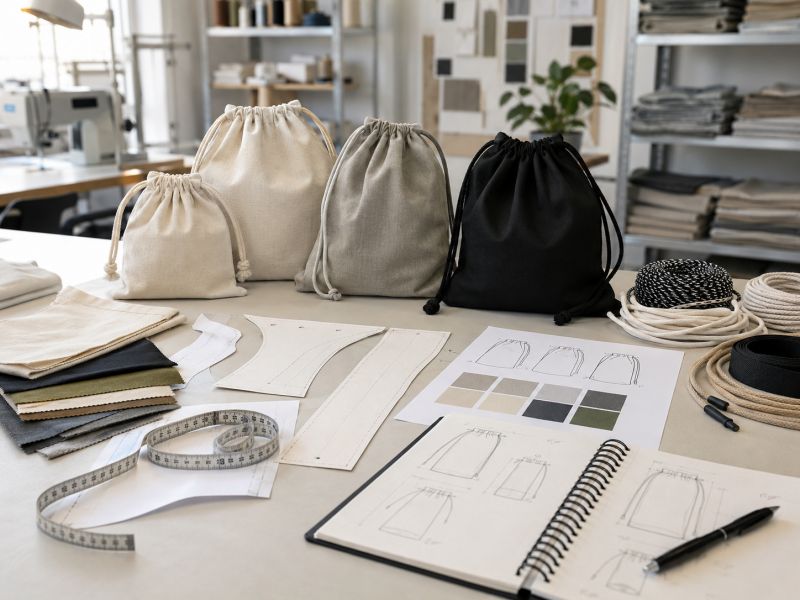
A fabric drawstring bag looks simple until it needs to fit a real product, carry a real logo, match a real deadline, and come out the same across a bulk order. That is where many projects start to go wrong.
A bag can look perfect in a flat photo and still fail in use. The bottle set may push against the side seams. The shoe pair may need more bottom depth. The cord may feel rough when pulled. The logo may sit too close to the gathered top. The fabric may look premium in a swatch but become too thick after folding. Small pattern choices can change the final result more than many teams expect.
For custom orders, a fabric drawstring bag pattern is not just a sewing shape. It is the plan behind product fit, cutting size, seam allowance, drawstring channel, bottom structure, fabric behavior, logo area, label position, packing method, and repeat order control.
To develop a fabric drawstring bag pattern for custom orders, start with the product size and use scene, then confirm the finished bag size, cutting size, fabric type, drawstring channel, cord style, bottom structure, logo placement, sample checks, and packing method. A good pattern should help the product fit well, close smoothly, show the logo clearly, support bulk production, and reduce avoidable sample changes.
This is why serious brand, retail, event, school, travel, beauty, and private label projects should treat pattern development as a working step, not a formality. The goal is not only to make one nice sample. The goal is to create a bag that can be sampled, checked, packed, shipped, reordered, and used with confidence.
Jundong works with fabric bags, drawstring bags, tote bags, travel bags, cooler bags, makeup bags, backpacks, clear bags, tactical bags, wallets, EVA bags, luggage, leather goods, and many other custom soft goods. For drawstring bag projects, the strongest results often come from early review: size, fabric, cord, logo, sample, packing, and order planning all need to speak to each other before bulk work begins.
What Is a Fabric Drawstring Bag Pattern in Custom Orders?
A fabric drawstring bag pattern is the working structure used to turn a bag idea into a physical sample and a repeatable bulk product. It includes the finished size, cutting panels, seam allowance, drawstring channel, cord opening, bottom shape, logo area, label position, and packing reference. In custom orders, the pattern connects design intent with real production, cost, quality checks, and future reorder stability.
Many people think a pattern only means the outside shape of a bag. Others think it means the printed design on the fabric. In custom bag development, it is broader than both.
A pattern tells the sample room how the fabric should be cut, where the folds go, how much seam allowance is needed, how the cord moves, where the stress areas sit, and how the finished bag should be measured. It also helps the project team understand whether the bag can be made at the target quantity, with the selected fabric, within the expected cost level.
For a simple flat drawstring pouch, the pattern may only need two panels, side seams, a top channel, and a cord path. For a lined gift pouch, the pattern may include outer fabric, lining fabric, channel pieces, turning space, label placement, and a cleaner inner finish. For a backpack-style drawstring bag, the pattern must include shoulder cord length, bottom loops, side seam strength, and carrying comfort.
This is the difference between “a bag that can be sewn” and “a bag that can be repeated.” One sample can be adjusted by hand. A bulk order needs a stable pattern, clear measurements, approved materials, and repeatable steps.
Why Should Pattern Development Start With the Product Inside?
Pattern development should start with the product inside the bag because the product controls the real width, height, depth, opening size, fabric strength, and closing space. Cosmetics, shoes, apparel, jewelry boxes, bottles, event kits, and travel items all sit differently inside a drawstring bag. When the product is reviewed first, the final bag has a better chance of fitting, closing, packing, and presenting well.
A common mistake is starting with a standard size. A team may say, “We need a 25 x 30 cm drawstring bag.” That sounds clear, but it may not be enough.
What is going inside? A folded T-shirt? A pair of shoes? A skincare bottle set? A candle? A school welcome kit? These products need different shapes even if the flat bag size looks similar.
A skincare set may need soft fabric and enough vertical room so the bottles do not hit the drawstring channel. A shoe bag may need extra width and a softer surface to avoid scratches. A jewelry pouch may need a clean small opening and a better handfeel. An event kit may need lighter fabric, quick packing, and clear logo visibility.
Product-fit planning should review:
| Product Detail | Pattern Impact |
|---|---|
| Width | Controls bag width and side pressure |
| Height | Controls finished height and closure space |
| Thickness | Decides whether a flat or gusset bottom is better |
| Surface finish | Helps choose lining, fabric softness, and packing style |
| Weight | Affects seam strength and cord choice |
| Use scene | Decides whether appearance, cost, strength, or speed matters more |
The product inside should be tested early, not after the logo is approved and the fabric is ordered. This simple step can prevent many problems that would otherwise appear during sample review.
If the project is still early, a product photo, size, target quantity, and use scene are enough for a first review. Jundong can help check whether a flat pouch, gusset bottom bag, lined pouch, dust bag, or backpack-style drawstring bag is more practical. Project details can be sent to info@jundongfactory.com.
How Do Finished Size and Cutting Size Affect the Pattern?
Finished size is the bag size after sewing. Cutting size is the fabric size before sewing. The cutting size must allow for seam allowance, top folding, drawstring channel height, bottom structure, fabric thickness, lining, and possible shrinkage. If the cutting size is planned poorly, the finished bag may become smaller than expected, close badly, distort the logo, or fail product-fit testing.
This is where many custom drawstring bag projects become confusing. A finished bag size and a usable inner size are not always the same.
For example, a 25 x 30 cm finished fabric drawstring bag does not mean it can hold a 25 x 30 cm product comfortably. The side seams reduce width. The drawstring channel uses height. A thick product needs more ease. If the bag is lined, the inside space may shrink slightly. If the fabric is thick canvas, folded edges may create extra bulk.
The drawstring channel is especially easy to overlook. If the top channel takes 3 cm of height, that part cannot be treated as full storage space. If the product reaches too close to the top, the bag may close with an awkward bulge.
Bottom design also changes the pattern. A flat bottom is simple and cost-friendly, but it may not fit boxed products well. A gusset bottom gives more depth. A round bottom suits bottles, jars, or cylindrical gifts. A boxed bottom can help the bag stand, but it needs more careful sewing and size control.
| Size Area | Why It Matters |
|---|---|
| Finished width | Affects product fit and front logo space |
| Finished height | Affects product coverage and closure room |
| Seam allowance | Controls strength and final size accuracy |
| Drawstring channel | Affects cord movement and usable height |
| Bottom gusset | Adds volume for thicker products |
| Fabric thickness | Changes folding bulk and seam pressure |
| Lining allowance | Affects inner space and finished shape |
| Shrinkage review | Helps protect size consistency |
A reliable pattern should define both cutting size and finished size. It should also state how the bag is measured. Flat measurement, filled measurement, and closed-bag appearance can all look different.
For approval, the sample should be tested with the real product inside. Close the bag. Open it again. Fold it as it will be packed. If the bag feels tight, bulky, or visually off-balance, the pattern still needs work.
Which Type of Drawstring Bag Pattern Fits Your Project?

The best drawstring bag pattern depends on what the bag needs to do. A flat drawstring bag works well for light gifts and simple packaging. A gusset bottom bag gives more volume. A lined pouch feels more refined. A dust bag protects shoes, handbags, and apparel. A backpack-style drawstring bag works for schools, sports, events, and campaigns where people carry the bag after receiving it.
Choosing the right type should not start with what looks nice in a catalog. It should start with use.
Is the bag only packaging, or will people carry it daily? Does the product need soft protection? Does the bag need to stand? Will it be folded into a retail box? Does the logo need to stay visible after closure? Will the same style be repeated in several sizes?
| Bag Type | Best Fit | Pattern Notes |
|---|---|---|
| Flat drawstring bag | Small gifts, jewelry, light items | Simple structure, easy packing |
| Gusset bottom bag | Shoes, cosmetics, boxed sets | More depth, better product fit |
| Round bottom pouch | Bottles, jars, candles | Better for round items |
| Lined pouch | Premium gifts, retail sets | Cleaner inside, better feel |
| Double drawstring bag | Apparel, gifts, general packaging | Easier to open and close |
| Dust bag style | Shoes, handbags, garments | Soft protection and logo display |
| Backpack drawstring bag | Events, schools, sports programs | Needs cord and stress review |
| Mini pouch | Jewelry, samples, small accessories | Small size accuracy matters |
A one-day event project may choose a lightweight polyester backpack drawstring bag because it is useful, easy to distribute, and cost-efficient. A beauty brand may choose a cotton or satin pouch because the handfeel supports a more refined product image. A shoe brand may need a dust bag that is wide enough and soft enough. A retail gift set may need a gusset bottom so the product sits better.
There is no single best structure. The right choice is the one that matches the product, order size, packing method, brand level, and future reorder plan.
Which Fabric Works Best for Custom Drawstring Bag Patterns?
The best fabric depends on use, product weight, handfeel, print method, budget, and expected order life. Cotton is soft and natural. Canvas adds strength and body. Polyester is light and stable for events. RPET fabric suits reusable programs. Satin and velvet create a more refined gift feel. Non-woven fabric works for cost-sensitive short-term use. Each fabric changes the pattern because it folds, sews, prints, and closes differently.
Fabric is not just a surface choice. It changes the whole structure.
A cotton drawstring pouch feels friendly and natural, but it may need shrinkage review and careful size control. Canvas gives a stronger body, but folded channels can become thick. Polyester is often stable for event and sports use. Satin gives a smooth gift effect, but it needs clean stitching and careful heat control. Velvet feels rich, but pile direction and pressure marks need attention. RPET fabric is often used for reusable brand programs and projects that want a more responsible material story.
| Fabric | Common Use | Pattern Review |
|---|---|---|
| Cotton | Gift bags, cosmetics, natural packaging | Soft feel, shrinkage and print review |
| Canvas | Reusable retail bags, lifestyle packaging | Thick seams, stronger body |
| Polyester | Events, sports, promotions | Light, stable, easy to handle |
| RPET fabric | Reusable brand programs | Material story and repeat use |
| Satin | Jewelry, beauty, gift sets | Smooth surface, clean stitching |
| Velvet | Premium pouches | Pile direction and pressure marks |
| Non-woven | Short-term giveaway projects | Cost-friendly, simple structure |
| Nylon | Travel, outdoor, storage | Durable, light, technical look |
Fabric also affects logo work. Screen print may suit cotton and canvas. Heat transfer can work well on polyester. Embroidery can look premium but may pull thin fabric. Woven labels are useful when the fabric surface is not ideal for printing. Rubber patches or PVC patches can suit sport and outdoor styles.
The more expensive fabric is not always the better choice. For a large event, a simple polyester bag with a clean logo may be smarter than a premium fabric that breaks the budget. For a retail beauty set, a soft cotton, satin, or velvet pouch may help the product feel more complete.
How Should Drawstring Channel and Cord Details Be Designed?

The drawstring channel and cord details decide how the bag opens, closes, hangs, and feels in the hand. The pattern should define channel height, cord diameter, cord material, opening position, cord length, cord end treatment, and whether the bag uses one cord, two cords, or a backpack-style structure. If this area is poorly designed, the bag may look acceptable but feel frustrating to use.
The cord is the part people touch first. That makes it more than a small accessory.
A cord that is too thick may jam inside the channel. A cord that is too thin may feel weak. A channel that is too narrow may slow down packing and daily use. A channel that is too wide may make the top look loose. A cord that is too short may be hard to tie. A cord that is too long may look messy.
Common choices include cotton cord, PP cord, polyester cord, ribbon, flat webbing, and braided rope. Each gives a different feel.
| Cord Detail | What to Review |
|---|---|
| Cord diameter | Must match channel width |
| Cord material | Affects handfeel, strength, and look |
| Cord length | Affects tying and closure |
| Cord end | Knot, heat cut, plastic tip, or metal tip |
| Channel height | Controls smooth pulling |
| Opening position | Side pull, center pull, or double pull |
| Stress area | Needed for backpack-style bags |
For backpack-style drawstring bags, the cord also works as the shoulder strap. This means the bottom loop, side seam, cord length, and stress areas need more review. A lightweight gift pouch may only need smooth closure, but a school or sports bag needs stronger structure.
During sample review, pull the cord several times. Open and close the bag with the real product inside. Watch whether the fabric gathers smoothly or twists. A good drawstring bag should feel easy, not just look neat.
How Do Logo Placement and Printing Area Affect the Pattern?
Logo placement must be reviewed before sampling because the drawstring channel, side seams, bottom gusset, and gathered top all affect the visible area. A logo placed too high may disappear into folds. A logo placed too low may bend around the bottom. A large print may be interrupted by seams. A safe logo area should be planned with the pattern, not added as an afterthought.
A drawstring bag is not a flat poster. It changes shape when it is filled, pulled closed, folded, packed, and carried.
A logo that looks centered on a flat drawing may look low when the product is inside. A logo that looks bold on the artwork may feel crowded after the top is gathered. A logo close to the side seam may lose balance after sewing. A bottom gusset may reduce the flat front area more than expected.
Logo method matters too.
| Logo Method | Best Use | Pattern Concern |
|---|---|---|
| Screen print | Simple solid-color logos | Needs flat print area |
| Heat transfer | Richer color or detail | Needs fabric heat review |
| Embroidery | Premium texture | May pull thin fabric |
| Woven label | Subtle brand mark | Needs clear label position |
| Rubber or PVC patch | Sport or outdoor style | Adds weight and thickness |
| Metal plate | Premium look | Needs stronger attachment area |
For real approval, check the logo on a physical sample. Put the product inside. Close the bag. Fold it the way it will be packed. Then decide if the logo still looks clean.
For custom logo drawstring bags, Jundong can help review artwork size, logo position, print method, fabric match, and sample result before bulk work begins. Project files can be sent to info@jundongfactory.com.
What Is the Sample Process for Custom Fabric Drawstring Bags?

The sample process usually starts with product details, then moves into pattern review, fabric selection, logo planning, first sample, product-fit testing, revision, and final sample approval. A good sample should confirm size, structure, fabric feel, cord movement, logo placement, packing method, and bulk readiness. The goal is not to make one attractive sample, but to confirm a product that can be repeated.
A clear sample process reduces confusion and protects the schedule.
| Step | What Happens | Why It Matters |
|---|---|---|
| Project review | Product, use scene, quantity, deadline | Sets direction |
| Size planning | Finished size and cutting size | Prevents fit problems |
| Fabric choice | Material, weight, color, handfeel | Controls look and cost |
| Pattern setup | Panels, channel, bottom, seam | Builds the sample base |
| Logo review | Size, method, placement | Protects brand display |
| First sample | Physical sample made | Allows real testing |
| Sample check | Fit, cord, seam, print, packing | Finds issues early |
| Revision | Adjust size, structure, logo, or fabric | Improves bulk readiness |
| Final sample | Approved reference | Locks the standard |
The first sample does not have to be perfect. Its job is to show what should be adjusted.
A pouch may need 1 cm more width after real product testing. A canvas bag may need a wider drawstring channel because the top fold is thick. A satin pouch may need a different print method. A backpack-style drawstring bag may need stronger bottom loops.
Sample review should be a practical conversation. What worked? What felt wrong? What needs to change before the order moves forward? This kind of review makes bulk work safer.
How Long Does Pattern Development and Sampling Usually Take?
Sampling time depends on project clarity, fabric choice, logo method, structure, and revision needs. A simple flat drawstring pouch with ready artwork usually moves faster. A lined pouch, custom color, special fabric, multi-size set, complex logo, retail packing, or backpack-style structure needs more review. Clear product size, reference images, artwork, quantity, packing details, and deadline can shorten the process.
Timing is often less about sewing speed and more about decision speed.
A simple polyester event bag with one-color print may be straightforward. A satin cosmetic pouch with lining, woven label, custom color, and gift packing needs more review. A shoe dust bag needs real size testing. A backpack drawstring bag needs cord and stress checks.
Jundong’s usual sample timing is around 5–7 days for many custom bag projects, and some simple styles may move faster when details are ready. Bulk timing is usually planned after the approved sample, material status, logo method, quantity, and packing plan are confirmed. Standard bulk work is often easier to plan when the order reaches 500 pieces per design, while some simple styles may be reviewed at 200–300 pieces.
Before asking for a quote, prepare:
| Information | Why It Helps |
|---|---|
| Product size | Helps decide true bag size |
| Reference photo | Shows style direction |
| Fabric idea | Helps estimate cost and structure |
| Logo file | Helps review print or label method |
| Quantity | Affects material planning and unit cost |
| Color versions | Affects material and print setup |
| Packing method | Affects labor and carton planning |
| Destination country | Helps review shipping and labels |
| Target date | Helps plan sample and bulk schedule |
Good preparation helps the project move faster and reduces wrong assumptions.
What Should Teams Check Before Approving a Sample?

Before approving a sample, teams should check finished size, product fit, opening width, cord length, cord movement, seam strength, logo placement, print color, fabric handfeel, bottom shape, lining, label position, packing method, and carton marks. The sample should be reviewed the way the finished order will be used, packed, shipped, and displayed.
Approving a sample by appearance alone is risky.
A sample can look nice on a desk but fail during packing. The product may be hard to insert. The cord may not close smoothly. The logo may shift after the bag is filled. The fabric may wrinkle after folding. The label may sit in the wrong place. The carton mark may not match warehouse rules.
Use this review list before approval.
| Review Item | What to Check |
|---|---|
| Finished size | Measure width, height, and bottom |
| Product fit | Test with the real item |
| Opening width | Check packing speed and ease |
| Cord length | Confirm tying and closure |
| Cord movement | Pull open and closed several times |
| Seam strength | Check side seam and channel stitching |
| Logo position | Review flat, filled, and closed views |
| Print color | Compare with approved reference |
| Fabric handfeel | Confirm fit with brand level |
| Bottom shape | Check volume and folding |
| Lining | Review inner finish |
| Label position | Confirm brand, care, or barcode label |
| Packing method | Test fold, bagging, and set packing |
| Carton mark | Confirm SKU, color, size, and destination |
For larger projects, the approved sample should be recorded with photos, measurements, material reference, logo file, packing photo, and carton mark format. This protects repeat orders.
A sample is not truly approved until it can be used as a clear reference for the next step.
Factory vs Promotional Platform: What Is the Difference?
A promotional platform is useful for simple logo bags, quick online orders, and existing styles. A factory development partner is better for projects that need product-fit review, fabric selection, pattern work, sample revision, logo placement planning, multi-size development, packing rules, and repeat order records. The right choice depends on whether the bag is a short-term giveaway or part of a long-term product plan.
Online platforms can be practical for simple event bags. Fixed style, fixed size, simple logo, quick order. That works for some projects.
But many custom fabric drawstring bag projects need more control. A skincare brand may need soft packaging that protects bottles. A shoe brand may need multiple dust bag sizes. A school program may need sorting by color, grade, or kit. A retail team may need hangtags, barcode labels, and carton rules. A travel brand may need a full set of matching pouches.
Here is the practical difference.
| Project Need | Platform Style | Factory Development Style |
|---|---|---|
| Product fit | Limited to existing sizes | Size can be adjusted |
| Fabric choice | Standard list | Material can match project use |
| Logo placement | Basic upload area | Safe logo area can be reviewed |
| Sample revision | Limited flexibility | Changes can be planned |
| Multi-size set | Less flexible | Size grading can be built |
| Packing rules | Simple bulk packing | Labels, cartons, sets, and SKU support |
| Repeat order | Reorder same style | Project records support consistency |
For one-time giveaway work, speed may lead the choice. For retail, private label, brand packaging, and recurring programs, pattern control matters more.
What Information Should You Send for a Custom Drawstring Bag Pattern?
To start a custom fabric drawstring bag pattern review, send the product to be packed, product size, target bag size, reference photo, fabric idea, structure preference, logo file, logo method, quantity, color versions, packing method, delivery country, and target date. If not all details are ready, a product photo, size, use scene, and expected quantity are enough for a first review.
A strong inquiry does not need to be long. It needs to be clear.
| Detail | Example |
|---|---|
| Product to pack | Shoes, cosmetics, candle, jewelry, event kit |
| Product size | Length, width, height, or diameter |
| Target bag size | Finished size if known |
| Reference photo | Existing bag, sketch, or mood image |
| Fabric idea | Cotton, canvas, polyester, satin, velvet, RPET |
| Structure | Flat, gusset, lined, dust bag, backpack style |
| Logo file | PDF, SVG, AI, PNG, or clear artwork |
| Logo method | Print, embroidery, woven label, patch |
| Quantity | By size, color, or design |
| Color versions | Fabric color and logo color |
| Packing | Individual, set pack, bulk pack |
| Destination | Country, region, or warehouse |
| Target date | Needed delivery timing |
If the project is early, do not wait until everything is final. Early review can prevent the wrong structure, wrong fabric, or wrong size from moving too far.
For custom fabric drawstring bag projects, details can be sent to info@jundongfactory.com. A clear starting file helps the team suggest a practical size, fabric, cord, logo method, packing plan, and sample route.
Why Work With Jundong for Fabric Drawstring Bag Pattern Development?
Jundong supports fabric drawstring bag pattern development through project review, material selection, structure planning, pattern making, sample work, logo placement, quality checks, packing support, and export-ready production. This helps brand, retail, event, school, travel, beauty, and private label projects move from idea to sample, and from sample to stable bulk orders with clearer control.
Jundong is based in Guangdong, China, with more than 20 years of experience in bag development, production, and export projects. The team works with tote bags, backpacks, beach bags, travel bags, cooler bags, lifestyle bags, drawstring bags, makeup bags, clear bags, fireproof bags, tactical bags, belt bags, wallets, EVA bags, luggage, leather goods, and other soft goods.
The company has a foreign trade team, product development team, design support, sample room, 600+ employees, around 18,000 square meters of factory space, professional equipment, and 80 quality inspectors. These resources allow the team to support projects from early review to sample adjustment, production, checking, packing, and shipment preparation.
For fabric drawstring bags, the real value is in the early details. Does the product fit the size? Does the fabric match the use? Is the cord smooth? Is the logo in a safe area? Can the sample be repeated? Are labels, packing, and carton marks clear?
A good pattern turns a simple bag into a controlled custom product. It helps the product fit better, the logo look cleaner, the sample move faster, the order pack more smoothly, and repeat orders stay closer to the approved standard.
That is why pattern development matters. It protects the project before the bulk order begins.
FAQs About Fabric Drawstring Bag Pattern Development
1. What size should a custom fabric drawstring bag be?
Definitely, the best size should start from the product going inside, not from a random standard bag size. A good custom fabric drawstring bag needs enough width for easy insertion, enough height for closing space, and enough depth if the item is thick, boxed, or irregular. For example, a jewelry pouch may only need a compact flat structure, while a shoe dust bag or cosmetic gift set often needs more width, bottom space, or softer fabric.
A practical way to plan size is to measure the product first, then add space for seams, fabric thickness, and the drawstring channel. The top channel usually takes usable height away from the bag, so the finished bag should be taller than the product. If the item is thick, a gusset bottom can make the bag easier to pack and better looking after closure.
| Product Type | Pattern Direction |
|---|---|
| Jewelry or small gifts | Flat pouch, soft fabric, small opening |
| Shoes or apparel | Wider bag, dust bag style, soft touch |
| Cosmetics or bottles | Extra height, careful logo area |
| Event kits | Light fabric, fast packing, visible logo |
| Retail gift sets | Gusset bottom, cleaner finish, better presentation |
The safest method is to send the product size, product photo, target use, and expected quantity before sampling. Jundong can review the size direction and help avoid a bag that looks fine on paper but feels too tight in real use.
2. Do I need a flat drawstring bag or a gusset bottom drawstring bag?
Sure, the choice depends on product thickness and how the bag should look when filled. A flat drawstring bag is suitable for light items, small gifts, jewelry, simple apparel, promotional inserts, and items that do not need much depth. It is easier to cut, easier to sew, and usually more cost-friendly. A gusset bottom drawstring bag is better when the product has volume, such as shoes, cosmetic sets, candles, boxed gifts, bottles, or retail kits.
The biggest difference is not only capacity. It is also the finished shape. A flat bag may look clean when empty, but it can bulge when holding a thick product. A gusset bottom creates more room, so the product sits more naturally. This can improve appearance, packing speed, and user experience.
Flat bags are often used for short event programs, light packaging, and simple brand gifts. Gusset bottom bags are often chosen for retail packaging, product sets, premium gifts, and projects where the bag needs to look balanced after filling.
If cost is the main concern, flat structure may be enough. If presentation and product fit matter more, gusset bottom is worth reviewing. A sample test with the real product is the best way to decide.
3. Which fabric is better for custom drawstring bag patterns?
Absolutely, fabric choice should match the product, use scene, brand feeling, logo method, and budget. Cotton is soft and natural, suitable for gift bags, cosmetic pouches, and lifestyle packaging. Canvas has more body and strength, making it good for reusable packaging and retail programs. Polyester is light, stable, and practical for events, schools, sports, and campaigns. Satin and velvet create a more refined gift feeling, while RPET fabric works well for reusable programs.
The fabric changes the pattern. Canvas needs more room at folded areas because it is thicker. Satin needs cleaner stitching because the surface shows flaws more easily. Velvet needs attention to pile direction and pressure marks. Polyester is easier for fast bulk handling, but the print method should match the fabric surface.
| Fabric | Best Use | Pattern Concern |
|---|---|---|
| Cotton | Gifts, cosmetics, natural packaging | Shrinkage and soft shape |
| Canvas | Reusable retail bags | Thick seams and channel space |
| Polyester | Events, sports, schools | Light structure and logo clarity |
| Satin | Jewelry, beauty, gifts | Clean sewing and heat control |
| Velvet | Premium pouches | Pile direction and pressure marks |
| RPET | Reusable projects | Material consistency and finish |
A better fabric is not always the most expensive one. It is the one that fits the product and use logic. Jundong can help compare fabric options based on product size, logo method, target quantity, and packing needs.
4. How should logo placement be planned on a fabric drawstring bag?
Of course, logo placement should be planned before sample making, not added after the bag pattern is finished. A drawstring bag changes shape when it is filled and pulled closed. The top area gathers into folds, the side seams reduce the flat space, and the bottom structure may bend the lower print area. If the logo is placed too high, it may disappear into the gathered top. If it is too low, it may curve around the bottom or look unbalanced when the bag is packed.
The safest logo area is usually below the drawstring channel and above the lower fold or bottom gusset. For a flat pouch, the logo can sit more centrally. For a gusset bottom bag, the logo area should be checked after the product is inside. For a backpack-style drawstring bag, the cord path and side movement also need review.
Different logo methods need different planning. Screen printing needs a flat surface. Heat transfer needs fabric heat review. Embroidery needs enough fabric strength. Woven labels need a clean sewing position. Rubber patches or PVC patches need enough support from the fabric.
The logo should be checked on a physical sample in three conditions: flat, filled, and closed. That is how brands can see the real display effect before bulk work starts.
5. How long does it take to develop a fabric drawstring bag sample?
Certainly, sample timing depends on how clear the project details are and how complex the bag is. A simple flat fabric drawstring bag with ready artwork, common fabric, and one-color logo can usually move faster. A lined pouch, custom dyed fabric, multi-size set, gusset bottom structure, premium fabric, complex logo, or retail packing plan needs more review before the sample is correct.
For many custom bag projects, Jundong’s sample time is usually around 5–7 days. Some simple styles may move faster when the product size, artwork, fabric direction, and packing request are already clear. If the first sample needs changes, revision time depends on what needs to be adjusted. A small logo position change is usually easier than a full pattern size change or fabric replacement.
To make sampling smoother, prepare product size, target bag size, reference photo, logo file, quantity, color versions, fabric idea, packing method, destination country, and target delivery date. The clearer the starting file, the fewer assumptions need to be made.
A sample should not be rushed only for speed. It should prove that the bag fits, closes, looks right, and can be repeated.
6. What should be checked before approving a custom drawstring bag sample?
Definitely, sample approval should go beyond appearance. The sample should be tested with the real product inside, closed with the selected cord, folded as planned, and checked against the final packing method. A bag that looks good when empty may feel too tight, close poorly, hide the logo, or become wrinkled after packing. This is why a sample review should be practical, not just visual.
Key checks include finished size, product fit, opening width, drawstring length, cord movement, seam strength, logo position, print color, fabric handfeel, bottom shape, lining condition, label placement, packing method, and carton mark format.
| Check Item | What To Review |
|---|---|
| Product fit | Does the real product go in easily? |
| Closure | Does the cord pull smoothly? |
| Logo view | Does it look right when filled and closed? |
| Seam strength | Are side seams and channel seams secure? |
| Fabric feel | Does it match the product value? |
| Packing | Can it fold, pack, and ship as planned? |
| Labels | Are brand, barcode, or care labels in the right place? |
For larger projects, approved sample photos, measurements, fabric reference, logo file, and packing details should be saved. This helps keep later orders close to the approved standard.
7. Can one drawstring bag pattern be used for several sizes or SKUs?
Yes, one base pattern can often be developed into several sizes, colors, or versions, but it should not be scaled blindly. A small jewelry pouch, medium cosmetic bag, and large shoe dust bag may share a similar style, yet each size needs its own review for fabric behavior, logo proportion, cord length, opening width, and packing method. Enlarging a pattern without adjustment can make the logo look too small, the cord too short, or the bottom shape too weak.
For multi-size programs, size grading should be planned clearly. The team should decide which details stay the same and which details change. For example, the fabric and logo method may stay consistent, while the bag width, height, cord length, label position, and carton quantity may change by size.
This is especially useful for retail sets, travel pouch collections, shoe dust bag programs, cosmetic kits, school projects, and private label packaging. A controlled pattern family helps the whole product line look consistent while still fitting different items.
Jundong can help review multi-size drawstring bag projects by checking size logic, material use, logo proportion, packing order, and repeat order records.
8. What is the usual order quantity for custom fabric drawstring bags?
In many custom bag projects, the standard starting quantity is usually around 500 pieces per design. For some simple styles, 200–300 pieces may be reviewed, but the unit cost will often be higher because material purchasing, cutting, printing, sewing, checking, and packing steps still need to be arranged. When the quantity reaches 500 pieces or more, the cost structure is usually more efficient.
Quantity affects more than price. It also affects material sourcing, print setup, production planning, packing labor, and delivery scheduling. A small trial order may be useful for a new brand launch or first test run. A larger order is usually better for cost control, stable fabric purchasing, and repeat planning.
| Quantity Stage | Practical Meaning |
|---|---|
| 200–300 pcs | Possible for some simple styles, higher unit cost |
| Around 500 pcs | More practical starting level for many custom projects |
| 1,000 pcs and above | Better for cost planning and material use |
| Repeat orders | Stronger consistency when sample records are saved |
The best quantity depends on the bag style, fabric, logo method, and project goal. Instead of only asking for the lowest number, it is better to ask which quantity gives the best balance between test risk, unit cost, and long-term plan.
9. How can packaging and carton marks affect a drawstring bag order?
Absolutely, packaging and carton marks should be discussed early because they affect packing speed, warehouse handling, delivery accuracy, and repeat order control. A drawstring bag order may need individual polybags, set packing, bulk packing, hangtags, barcode labels, color stickers, size labels, destination labels, or carton marks. If these details are left until the end, the product may be ready but the shipment can still slow down.
For simple giveaway bags, bulk packing may be enough. For retail programs, individual packing, barcode stickers, hangtags, or display-ready packaging may be needed. For school, event, or multi-location programs, color sorting, SKU labels, carton marks, and destination grouping can save a lot of time after arrival.
Carton marks should match the packing list. They can include style name, color, size, quantity, carton number, destination, and any warehouse reference. This seems like a small detail, but it matters when many cartons arrive together.
Clear packing rules also support repeat orders. When photos and carton mark formats are saved, the next batch can follow the same method with less confusion. For teams managing several colors, sizes, or delivery points, this early planning is especially useful.
10. Why work with Jundong for fabric drawstring bag pattern development?
Sure, Jundong is suitable for fabric drawstring bag projects that need more than a simple logo-on-bag order. The team can support product size review, fabric selection, pattern work, sample adjustment, logo placement, quality checks, packing details, and export-ready production. This is helpful for brands, retail teams, school programs, event projects, travel products, beauty packaging, and private label lines that need a stable result.
Jundong is based in Guangdong, China, with more than 20 years of experience in bag development and production. The company works with tote bags, backpacks, beach bags, travel bags, cooler bags, lifestyle bags, drawstring bags, makeup bags, clear bags, fireproof bags, tactical bags, belt bags, wallets, EVA bags, luggage, leather goods, and other soft goods. The factory has 600+ employees, around 18,000 square meters of space, product development and design support, a sample room, professional equipment, and 80 quality inspectors.
For fabric drawstring bags, that means the project can be reviewed from more than one angle: product fit, material choice, cord movement, logo safety area, sample readiness, packing method, and repeat order records. This makes the process clearer and helps reduce avoidable mistakes before bulk work starts.
Project details can be sent to info@jundongfactory.com for review.