 Skip to content
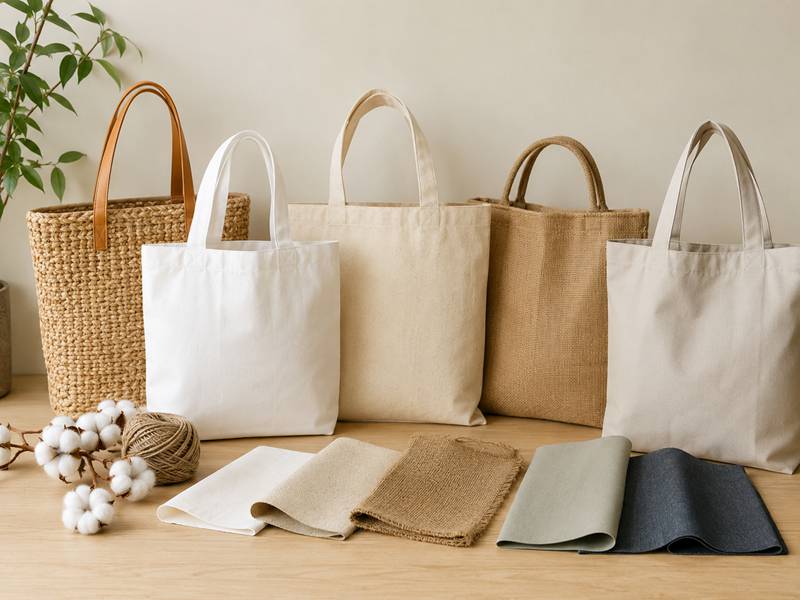
A tote bag may look like one of the simplest products in a bag collection, yet small material differences can completely change its appearance, strength, print quality, packing volume, and cost. Two products described as “cotton canvas totes” may use different fabric weights, handle constructions, internal finishes, and reinforcement methods. One stays flat and stable when filled; the other stretches at the top seam after several uses.
Tote bags are commonly made from canvas, cotton, polyester, nylon, Oxford fabric, RPET, jute, non-woven polypropylene, PU, leather, or PVC. The right material depends on load, structure, water exposure, print method, retail position, expected reuse, budget, and packaging. A complete specification also defines fabric weight, weave, coating, lining, handles, reinforcement, hardware, and testing—not merely the fiber name shown on a quotation.
Material selection is therefore not a matter of choosing between “cotton” and “polyester” from a swatch card. The intended contents, carrying frequency, logo artwork, cleaning needs, retail presentation, and delivery plan must work together. Most problems begin when one of those details remains undefined until production has already started.
What Are Tote Bags Made Of?

Tote bags are made from canvas, cotton, polyester, nylon, Oxford fabric, RPET, jute, non-woven polypropylene, PU, leather, PVC, or blended textiles. The correct choice depends on the intended load, required structure, moisture exposure, cleaning needs, artwork method, expected reuse, packing volume, and cost. Handles, lining, reinforcement, coating, thread, and hardware also affect the finished product.
A tote is rarely made from one material alone. A cotton canvas body may use polyester lining, cotton webbing handles, reinforced polyester thread, a nylon zipper, a metal snap, and an internal PE board. Each component performs a different task.
For example, “canvas tote bag” leaves too many details open. A production-ready description would be closer to:
- Finished size: 38 × 42 × 10 cm
- Outer body: 10 oz cotton canvas
- Lining: 210D polyester
- Handles: 30 mm cotton webbing, 65 cm long
- Closure: No. 5 nylon zipper
- Reinforcement: Cross stitching at handle bases
- Logo: Two-color screen print, 20 × 18 cm
- Packing: One piece per recycled polybag
- Intended contents: Books and daily essentials
This description allows the material, structure, sewing, artwork, and packing to be evaluated together. Without these details, two visually similar totes may differ greatly in strength, hand feel, print clarity, and cost.
| Material | Common Specification | Main Character | Suitable Uses | Details to Confirm |
|---|---|---|---|---|
| Cotton Canvas | 6–16 oz | Natural, textured, structured | Retail, books, merchandise | Weight, shrinkage, weave |
| Cotton Sheeting | 4–8 oz | Soft, light, foldable | Events, gifts, packaging | Opacity, shrinkage, handle support |
| Polyester | 210D–600D or heavier | Light, durable, easy-care | Travel, sports, events | Denier, coating, colorfastness |
| Oxford Fabric | 300D–900D or heavier | Firm, abrasion-resistant | Utility, outdoor, work totes | Backing, coating, seam strength |
| Nylon | Denier-based | Light, smooth, tear-resistant | Foldable, travel, outdoor | Coating, heat sensitivity |
| RPET | Project-specific | Depends on weave and finish | Retail, merchandise, campaigns | Recycled content and documents |
| Jute | Woven natural fiber | Coarse, firm, rustic | Gifts, food retail, hospitality | Odor, shedding, lamination |
| Non-Woven PP | About 60–120 GSM | Light, economical | Events and retail handouts | Weight, seam and handle method |
| PU | Thickness-based | Structured, consistent | Fashion, office, gifting | Backing, peel strength, edge finish |
| Genuine Leather | Hide and thickness-based | Natural grain, premium feel | Fashion and long-term use | Variation, grading, care |
| PVC | About 0.2–0.5 mm | Clear, wipeable, flexible | Stadium, beach, display | Thickness, odor, temperature behavior |
These figures are development references rather than fixed rules. Yarn, weave density, coating, finishing, and testing methods can make two fabrics with the same stated weight behave differently.
What Is Tote Bag Fabric Called?
There is no single textile officially called “tote bag fabric.” The trade name changes according to fiber content, weave, weight, thickness, backing, coating, and surface finish.
Frequently used names include:
- Cotton canvas
- Polyester canvas
- Cotton sheeting
- Cotton twill
- Polyester Oxford
- Nylon Oxford
- RPET Oxford
- Jute or burlap
- Non-woven polypropylene
- Transparent PVC
- PU leather
- Microfiber leather
- Genuine leather
A material description should be specific enough to reproduce. “Cotton” is incomplete because it could refer to thin sheeting, twill, duck canvas, brushed cotton, or a blended construction. “Polyester” could mean lightweight 210D fabric, firm 600D Oxford, ripstop, felt, or coated canvas.
Useful descriptions include:
- 8 oz natural cotton canvas
- 12 oz dyed cotton canvas
- 300D polyester with PU backing
- 600D RPET Oxford fabric
- 90 GSM non-woven polypropylene
- Laminated natural jute
- 0.3 mm transparent PVC
- Textured PU with woven backing
The same name can still produce different results between fabric mills. Before production, confirm the physical swatch, hand feel, color, weight, surface, and backing. If the exact textile is unknown, a physical reference or close-up photographs taken under natural light can help identify suitable constructions.
Which Materials Are Most Common?
Canvas and cotton are common for lifestyle, bookstore, apparel, museum, retail, and merchandise totes. Their woven surfaces provide a familiar textile feel and work with screen printing, embroidery, transfers, patches, and woven labels.
Polyester is widely used for travel, sports, events, outdoor activities, and foldable designs. It can be developed in light or firm constructions and can receive coatings for moisture resistance. Nylon offers a smoother feel and good tear resistance, making it suitable for packable and lightweight products.
Other materials serve more focused uses:
- Oxford fabric supports firmer utility and outdoor styles.
- RPET supports projects requiring recycled polyester.
- Jute creates coarse natural texture.
- Non-woven polypropylene suits lightweight distribution.
- PU and leather support structured fashion products.
- PVC and TPU create transparent or wipeable designs.
Common specifications provide a useful starting reference:
| Application | Material Option | Common Specification |
|---|---|---|
| Lightweight giveaway | Cotton sheeting | 4–6 oz |
| General promotional tote | Cotton or canvas | 6–8 oz |
| Retail merchandise | Cotton canvas | 8–12 oz |
| Books and heavier daily use | Cotton canvas | 12–16 oz |
| Foldable travel tote | Polyester or nylon | 210D–420D |
| Utility tote | Polyester Oxford | 600D or heavier |
| Event handout | Non-woven PP | 70–100 GSM |
| Firmer non-woven tote | Non-woven PP | 100–120 GSM |
| Transparent tote | PVC | 0.2–0.5 mm |
A commonly available textile may reduce material preparation time, but availability alone should not decide the product. Structure, artwork, expected use, cleaning, and packing still need to match.
Is Canvas the Same as Cotton?
Canvas and cotton are related but not identical terms. Cotton is a fiber. Canvas is a strong plain-woven construction that may use cotton, polyester, hemp, linen, or blended yarns. “Cotton canvas” is therefore more precise than using “canvas” or “cotton” alone.
Cotton sheeting is generally softer and lighter. Cotton canvas is denser and usually provides more body. The difference becomes clear when comparing fabric weight:
| Canvas Weight | Approximate GSM | General Feel | Common Direction |
|---|---|---|---|
| 6 oz | 203 GSM | Light and flexible | Events and packaging |
| 8 oz | 271 GSM | Light-to-medium | Promotional and retail |
| 10 oz | 339 GSM | Substantial | Lifestyle merchandise |
| 12 oz | 407 GSM | Firm | Books and daily carry |
| 16 oz | 542 GSM | Heavy and dense | Structured, reinforced styles |
The conversion is approximate because ounce specifications may be measured before or after finishing. Washing, dyeing, coating, and fabric moisture can also affect the measured result.
Heavier canvas provides more body but creates trade-offs:
- Greater raw-material consumption
- Higher product weight
- Larger folded volume
- More difficult sewing around thick seams
- Greater needle and thread requirements
- Increased freight weight
- More visible creasing after folding
Strength also depends on construction. An 8 oz tote with extended webbing handles and reinforced seams may carry more reliably than a 12 oz tote with short attachment areas. If the intended working load is 8 kg, the sample can be screened at an agreed 10–12 kg load to inspect handle elongation, seam movement, fabric tearing, and bottom distortion.
Are Tote Bag Fabrics Natural or Synthetic?
Tote bags can use natural fibers, synthetic fibers, or blends. Cotton, linen, hemp, and jute are natural. Polyester, nylon, polypropylene, PVC, and PU are synthetic. RPET is recycled polyester, so it remains a synthetic material even though recovered plastic is used as its feedstock.
Natural fibers often provide:
- A soft or textured hand feel
- A casual lifestyle appearance
- Good ink absorption
- Natural shade variation
- Breathability
They may also absorb moisture, shrink, crease, fade, or show differences between dye lots.
Synthetic materials often provide:
- Lower weight
- Easier cleaning
- Better moisture handling
- Strong abrasion resistance
- Greater compatibility with coatings
- More consistent color
They may require attention to heat sensitivity, coating adhesion, odor, surface peeling, or dye migration during printing.
Blended textiles can balance selected properties. Cotton-polyester canvas may retain a woven lifestyle appearance while improving dimensional stability. Recycled cotton may be blended with polyester because shortened recycled cotton fibers often need support from stronger yarns.
Sustainability wording should match the actual material and supporting records. These terms should not be treated as interchangeable:
| Term | What It Describes |
|---|---|
| Natural | Fiber source |
| Recycled | Recovered feedstock |
| Organic | Controlled agricultural production |
| Reusable | Intended repeated use |
| Biodegradable | Breakdown under defined conditions |
| Certified | Verified against a named standard |
A natural-looking tote is not automatically organic or certified. An RPET tote does not automatically carry a specific recycled-content certificate. Claims printed on hangtags or packaging should be confirmed before materials are ordered.
What Are Linings and Handles Made Of?
The lining may use polyester, nylon, cotton, PEVA, PVC, velvet, or another coated textile. Its purpose can include hiding internal seams, supporting pockets, protecting contents, adding color, improving cleanability, or creating a more finished interior.
| Lining Material | Main Benefit | Suitable Direction | Detail to Check |
|---|---|---|---|
| Polyester | Light and clean | Retail and daily totes | Weight and colorfastness |
| Nylon | Smooth and durable | Travel and outdoor | Coating and seam behavior |
| Cotton | Natural interior feel | Canvas and lifestyle totes | Shrinkage and staining |
| PEVA | Wipeable surface | Food and wet-item use | Odor and seam construction |
| PVC | Strong moisture barrier | Wet or transparent designs | Flexibility and cold behavior |
| Velvet | Soft surface | Gifts and delicate contents | Abrasion and lint |
An unlined tote may be preferable when low weight, easy folding, and lower cost matter. A lining becomes valuable when it supports internal pockets, hides reinforcement, or protects the contents.
Handles may be made from body fabric, cotton webbing, polyester webbing, nylon webbing, PU, leather, rope, or padded tubing. Width and length influence comfort and material consumption.
| Intended Use | Handle Width Reference | Construction Direction |
|---|---|---|
| Lightweight handout | 20–25 mm | Basic fabric or webbing handle |
| Everyday retail tote | 25–38 mm | Folded fabric or woven webbing |
| Larger carrying style | 38–50 mm | Wider webbing with reinforcement |
| Fashion tote | Project-specific | PU, leather, padded, or mixed material |
Two 60 cm handles require approximately 1.2 meters of handle material before attachment allowance. Increasing each handle to 80 cm raises the total to 1.6 meters, about 33% more. This affects trim consumption, sewing, packing, and cost.
Handle strength depends on more than width. Attachment length, stitch pattern, reinforcement layers, thread, seam allowance, and the body fabric around the attachment zones must all support the intended load.
Do Coatings Change Material Performance?
Coatings can change moisture resistance, stiffness, stain handling, fraying, cleaning, print adhesion, and folding behavior. Polyester and Oxford fabrics may use PU or PVC backing. Canvas may receive wax, acrylic, or water-repellent treatments. Jute may be laminated to reduce shedding and add structure.
| Finish | Main Effect | Possible Trade-Off |
|---|---|---|
| PU Backing | Water resistance and light structure | May peel if poorly bonded |
| PVC Backing | Stronger barrier and stiffness | Added weight and odor |
| Water-Repellent Finish | Helps water bead on the surface | Performance may reduce with wear |
| Waxed Finish | Water resistance and aged appearance | Marks, heat sensitivity |
| Jute Lamination | Less shedding, cleaner interior | Changes flexibility and composition |
| Acrylic Finish | Added body and surface control | May affect hand feel |
| Anti-Stain Finish | Easier surface cleaning | Must suit the textile and intended use |
Water-resistant and waterproof are not the same. A coated body may handle splashes, while water can still enter through:
- An open top
- Standard zipper teeth
- Needle holes
- Unsealed seams
- Uncoated pockets
- Handle attachment areas
A stronger water-protection design may need seam sealing, welded construction, covered zippers, roll-top closure, or an internal waterproof compartment. Those changes affect equipment, sewing, flexibility, appearance, and cost.
Coatings can also affect artwork. Heat transfer temperatures may damage some backing materials. Screen-print inks may need adhesion testing. Heavy embroidery can puncture a coated textile many times and reduce local water resistance. The artwork trial should therefore use the actual approved fabric.
What Is the History of Tote Bag Materials?
Early tote-style bags were practical carriers made from strong woven cloth. Canvas was well suited to repeated handling because it could be cut, sewn, reinforced, repaired, and reused. The focus was carrying performance rather than fashion.
As tote bags became common in retail, publishing, museums, apparel, events, and gifting, lighter cotton fabrics offered easier printing and more efficient folding. Leather versions developed into structured daily accessories, while jute became associated with food retail, natural products, and gift presentation.
Synthetic textiles expanded the category further:
- Polyester and nylon enabled lightweight and foldable totes.
- Oxford fabric supported utility and outdoor structures.
- Non-woven polypropylene supported high-volume distribution.
- PVC and TPU created clear and wipeable designs.
- PU and microfiber leather provided consistent fashion surfaces.
- RPET introduced recycled-polyester options in several constructions.
The modern tote is no longer defined by one material. It can be a lightweight event carrier, a reinforced book bag, a transparent stadium tote, a structured fashion accessory, or a documented recycled-material product. Its performance comes from the complete combination of fabric, handles, reinforcement, artwork, lining, closure, and packing.
Which Type of Tote Bag Material Is Best?

The best tote material is the one that matches the expected load, carrying frequency, structure, moisture exposure, artwork, cleaning method, packing plan, and cost target. Canvas works well for structured retail designs, cotton suits lighter products, polyester supports foldable and easy-care styles, RPET provides recycled-polyester options, while PU and leather suit refined collections.
No single textile performs best in every tote. A bookstore carrier, trade-show handout, fashion accessory, beach tote, and grocery bag may share the same basic shape, yet their material requirements are very different.
Material should be selected after defining:
- Finished dimensions
- Intended contents
- Expected working load
- Carrying frequency
- Required structure
- Handle length and width
- Exposure to rain, spills, or sand
- Cleaning method
- Artwork size and process
- Expected reuse
- Individual packing
- Carton limits
- Required material documents
- Cost target
The outer textile is only one part of the decision. Handle construction, seam allowance, thread, reinforcement, lining, closure, and bottom structure can have a greater effect on performance than adding another 2 oz of fabric weight.
| Intended Use | Strong Starting Options | Useful Specification | Main Risk to Review |
|---|---|---|---|
| Lightweight event handout | Cotton, polyester, non-woven PP | 4–8 oz cotton or 70–100 GSM PP | Handle attachment |
| Paid retail merchandise | Cotton canvas, twill, structured polyester | 8–12 oz canvas | Shape and finish |
| Books and daily carrying | Heavy canvas, Oxford fabric | 12–16 oz canvas or 600D Oxford | Seam distortion |
| Foldable travel tote | Polyester, nylon, RPET | 210D–420D | Tear resistance |
| Beach and outdoor tote | Coated polyester, nylon, PVC, TPU | Coating and easy-clean interior | Water entry through seams |
| Fashion tote | Heavy canvas, PU, leather | Lining, edge finish, hardware | Surface consistency |
| Natural gift presentation | Jute, canvas, cotton | Lamination or lining as needed | Odor and fiber shedding |
| Recycled-material program | RPET, recycled cotton blend | Verified composition and records | Unsupported claims |
| Grocery use | Canvas, polyester, non-woven PP | Wide handles and reinforced bottom | Concentrated load |
| Clear stadium or display tote | PVC, TPU | About 0.2–0.5 mm | Cold cracking and scratching |
The correct option should also fit production quantity. A material that works well for a sample may be difficult to source consistently across several colors or repeated orders. Stock availability, dye-lot control, minimum fabric quantity, cutting yield, and preparation time should be reviewed before approval.
Which Material Fits Retail Totes?
Retail totes need to feel intentional, not temporary. Cotton canvas, cotton twill, structured polyester, PU, microfiber leather, and genuine leather are reliable starting options. The choice depends on selling position, visual style, expected use, and how the product will be displayed and packed.
For canvas retail designs, fabric weight changes both appearance and cost:
| Retail Direction | Material Reference | Result |
|---|---|---|
| Soft lifestyle tote | 6–8 oz cotton | Relaxed, foldable shape |
| General merchandise | 8–10 oz canvas | Balanced weight and structure |
| Premium canvas tote | 10–12 oz canvas | More substantial hand feel |
| Book or work tote | 12–16 oz canvas | Firm body and stronger structure |
| Lightweight travel retail | 210D–420D polyester or nylon | Compact and easy to fold |
| Structured fashion tote | PU, microfiber leather, leather | Clean shape and refined finish |
A paid retail product receives close inspection. Small construction faults can reduce perceived value even when the textile itself is acceptable:
- Twisted or uneven handles
- Wavy top edges
- Visible lining above the opening
- Misaligned artwork
- Uneven stitch distance
- Poorly finished internal seams
- Scratched hardware
- Pressure marks on PU
- Strong odor after unpacking
- Inconsistent color across panels
Retail packing must be planned with the material. Heavy canvas can develop hard fold lines. PU may show pressure marks if packed too tightly. Leather needs protection from rubbing and moisture. Structured designs may require tissue, paper inserts, handle wrapping, or larger individual bags.
Carton efficiency should not be ignored. A tote that folds to twice the thickness of another design can significantly increase shipping volume. In a simplified calculation, adding 2 mm to the folded thickness of 500 totes measuring 38 × 42 cm can add approximately 0.16 m³ before compression:
38 cm × 42 cm × 0.2 cm × 500 = 159,600 cm³
Actual carton volume depends on compression, folding direction, handles, hardware, and packing materials, but the calculation shows why structure and freight should be considered together.
What Works for Promotional Bags?
Promotional totes need clear artwork, reliable construction, controlled cost, convenient distribution, and dependable delivery. Cotton, lightweight canvas, polyester, RPET, and non-woven polypropylene are frequently used because they can support several price and performance levels.
The intended campaign life should be defined first:
| Campaign Use | Material Direction | Construction Priority |
|---|---|---|
| One-day event | 70–90 GSM non-woven PP | Low weight and clear artwork |
| Multi-day conference | 90–120 GSM non-woven PP or polyester | Strong handles and seam control |
| Membership gift | 8–10 oz canvas or RPET | Better hand feel and repeated use |
| Brand merchandise | 10–12 oz canvas or structured polyester | Appearance and durability |
| Outdoor event | Coated polyester or RPET | Moisture resistance |
| Premium corporate gift | Heavy canvas, PU, or mixed materials | Refined logo and packing |
A low fabric price does not guarantee a low completed cost. Artwork setup, handle construction, individual packing, carton quantity, sorting, destination labels, and delivery method all contribute.
For large event quantities, several details deserve early confirmation:
- Number of artwork colors
- Print area
- Artwork on one or both sides
- Individual packing or bulk packing
- Pieces per carton
- Maximum carton weight
- Event or department sorting
- Barcode or name labels
- Delivery locations
- Required arrival date
Screen printing is efficient for bold artwork and limited colors. Heat transfer supports more detailed graphics but adds transfer material and heat-press work. Embroidery creates texture but can distort lightweight panels. Woven labels or patches can produce a cleaner result on coarse textiles.
A promotional tote should also be tested with the actual event contents. A conference bag carrying brochures, a bottle, and a notebook creates different stress from a lightweight retail handout. Reinforcement should match what will be placed inside.
Which Material Is Best for Heavy Loads?
Heavy-load totes often use 12–16 oz canvas, 600D or heavier Oxford fabric, reinforced polyester, or another dense woven textile. However, carrying capacity cannot be determined from fabric weight alone.
A dependable heavy-load structure combines:
- Strong outer fabric
- Suitable seam allowance
- Reinforced top edge
- Wide handles
- Long handle attachment area
- Cross stitching or bar tacks
- Strong thread
- Reinforced gusset corners
- Bottom support where needed
- Balanced bag dimensions
Handle width affects comfort and load distribution:
| Use | Handle Width Reference | Construction |
|---|---|---|
| Light contents | 20–25 mm | Basic fabric or webbing |
| Everyday use | 25–38 mm | Folded fabric or woven webbing |
| Heavier contents | 38–50 mm | Wide webbing with reinforcement |
| Large utility tote | 40–50 mm or more | Extended webbing and strong seams |
A short handle tab sewn only to the upper edge concentrates force in a small area. Webbing that extends farther down the body spreads the load across a larger section. A boxed bottom may add capacity but also creates additional force at the gusset corners.
Testing should use representative contents. If the tote is expected to carry 8 kg, a development sample may be screened at an agreed 10–12 kg load, using a 1.25–1.5 safety factor. The procedure can include:
- Static holding for an agreed time
- Repeated lifting
- Short walking test
- Handle pull inspection
- Seam movement inspection
- Bottom distortion review
- Closure operation under load
After testing, inspect thread breakage, stitch opening, fabric tearing, handle elongation, top-edge deformation, and permanent bottom sagging. The test method should be recorded so repeated orders can be checked under the same conditions.
A bottom board can improve shape and distribute dense contents. Possible materials include PE board, cardboard, foam-laminated board, or removable inserts. The choice affects moisture handling, folding, product weight, and packing.
Which Materials Are Water-Resistant?
Polyester, nylon, Oxford fabric, PVC, TPU, and coated textiles provide stronger moisture resistance than untreated cotton or jute. PVC and TPU are easy to wipe, while coated polyester or nylon offers lower weight and better folding.
Water behavior should be described by the complete tote:
| Construction | Relative Moisture Protection | Suitable Use |
|---|---|---|
| Untreated cotton | Low | Dry daily use |
| Untreated canvas | Low | Retail and lifestyle use |
| Water-repellent canvas | Light splash protection | Short outdoor exposure |
| PU-coated polyester | Moderate | Travel, event, beach use |
| PVC-backed Oxford | Moderate to strong | Utility and outdoor use |
| Solid PVC or TPU | Strong surface barrier | Clear and wet-item totes |
| Coated body with sealed seams | Stronger overall protection | Specialized wet conditions |
A water-resistant fabric does not automatically create a waterproof bag. Moisture can enter through:
- Open top
- Standard zipper teeth
- Needle holes
- Unsealed seams
- Pocket openings
- Handle attachment stitching
- Uncoated lining
- Drainage holes
The required performance should be defined clearly. These needs are not the same:
- Easy to wipe clean
- Resistant to light splashes
- Suitable for brief rain exposure
- Able to separate wet swimwear
- Able to contain leaking items
- Fully waterproof during prolonged exposure
A beach tote may only need easy cleaning, drainage, and a wipeable base. A wet-swimwear tote may need a separate waterproof compartment. A travel tote may need a covered zipper and coated body but not welded seams.
Coatings introduce other considerations. Heavy backing may make the product stiff, retain fold marks, or create odor after unpacking. Heat transfer and embroidery should be tested because high temperatures and repeated needle holes can affect coated surfaces.
When Is Jute a Good Choice?
Jute is a strong visual choice when natural texture is central to the design. It suits food retail, hospitality gifts, seasonal hampers, gardening programs, natural product collections, wineries, farm shops, and rustic event packaging.
Its coarse surface creates both character and limitations. Fine text, thin lines, gradients, and small artwork may lose clarity. Better artwork options include:
- Bold screen printing
- Large lettering
- Simple one- or two-color graphics
- Woven labels
- Cotton canvas artwork panels
- Leather patches
- Rubber or silicone patches
- Embroidered patches sewn onto the body
Jute may be used raw, laminated, lined, or combined with another textile:
| Jute Construction | Benefit | Detail to Review |
|---|---|---|
| Raw Jute | Natural texture and breathability | Shedding and moisture |
| Laminated Jute | Firmer shape and cleaner interior | Creasing and material composition |
| Jute with Cotton Lining | Softer interior | Added sewing and shrinkage |
| Jute with PEVA Lining | Wipeable interior | Odor and seam construction |
| Jute with Canvas Panels | Cleaner artwork and reinforcement | Color and shrinkage |
| Jute with Webbing Handles | Improved comfort and strength | Attachment construction |
Natural odor and shade variation should be checked before approval. Packing jute while damp can create serious odor or mildew risk, so material storage, ventilation, and carton conditions matter.
Jute should not be selected only because it is plant-based. Lamination, lining, handles, artwork, and packing materials form part of the complete product. Any environmental wording should match the actual construction.
Who Should Choose RPET?
RPET suits retail collections, merchandise, travel products, events, and corporate programs that require recycled polyester as part of the material specification. It can be woven into plain fabric, Oxford, ripstop, felt-like textiles, or other structures, so recycled content alone does not define performance.
RPET may be useful when a tote needs:
- Recycled-polyester content
- Consistent colors
- Lightweight construction
- Foldability
- Coating options
- Easy cleaning
- Screen printing or heat transfer
- Repeated production potential
The specification should still define:
- Recycled percentage
- Fabric weight or denier
- Weave
- Backing or coating
- Color
- Hand feel
- Abrasion performance
- Artwork method
- Handle composition
- Lining composition
- Required documents
A 210D RPET tote and a 600D RPET Oxford tote are very different products. The first may be lightweight and packable. The second may be firmer and better suited to repeated travel or utility use.
Recycled-content documents should be confirmed for the actual textile and order. A fabric described as RPET does not automatically mean the finished tote carries a specific certification. Handles, thread, coating, lining, zippers, foam, and packing may use different materials.
The strongest RPET program treats recycled content as one verified feature within a well-developed product. Appearance, strength, color, artwork, sewing, packing, and useful life still require the same level of review as any other custom tote.
How Do Tote Bag Materials Compare?
Tote materials should be compared by fabric construction, weight, strength, structure, moisture behavior, cleaning, artwork quality, packing volume, and cost. Canvas offers body and a natural feel; polyester provides low weight and easier care; jute creates coarse texture; RPET supports recycled-content programs; PU and leather give a more refined appearance.
A fair comparison must use the same tote dimensions, handle structure, lining, closure, artwork, and working load. Comparing a 16 oz canvas tote with a thin polyester handout only proves that the two products were developed for different uses.
Before selecting a textile, compare these details:
- Fiber composition
- Fabric weight, denier, or thickness
- Weave density
- Coating or backing
- Tear behavior
- Seam slippage
- Water absorption
- Cleaning method
- Shrinkage
- Colorfastness
- Artwork compatibility
- Folded thickness
- Material availability
- Required supporting documents
- Expected useful life
The table below uses a relative scale from 1 to 5. A higher number indicates a stronger tendency in that area, not a laboratory rating.
| Material | Structure | Foldability | Moisture Handling | Fine Artwork | Easy Cleaning | Natural Feel |
|---|---|---|---|---|---|---|
| Cotton Sheeting | 2 | 5 | 1 | 5 | 3 | 5 |
| Cotton Canvas | 4 | 3 | 2 | 4 | 3 | 5 |
| Polyester | 3 | 5 | 4 | 4 | 5 | 1 |
| Oxford Fabric | 4 | 3 | 4 | 3 | 5 | 1 |
| Jute | 4 | 2 | 1 | 2 | 2 | 5 |
| RPET Fabric | 3–4 | 4 | 3–4 | 3–4 | 4 | 1 |
| Non-Woven PP | 2 | 5 | 3 | 4 | 4 | 1 |
| PU | 5 | 1 | 4 | 3 | 4 | 1 |
| Genuine Leather | 5 | 1 | 2–3 | 3 | 2 | 5 |
A useful comparison sample should be tested under the intended conditions. For example:
- Fill each tote with the same contents.
- Use the same working load.
- Carry each design for the same distance.
- Inspect handle elongation and seam movement.
- Apply the same artwork at the same size.
- Fold and pack the products in the same carton style.
- Check appearance after unpacking.
- Perform agreed cleaning or surface-wipe trials.
- Compare product weight and folded thickness.
- Record visible changes after testing.
This method reveals the practical differences that cannot be seen from a fabric swatch alone.
Cotton vs Canvas: Which Is Stronger?
Cotton and canvas are not equal categories. Cotton identifies a fiber. Canvas describes a strong woven construction that may use cotton, polyester, hemp, linen, or blended yarns. A useful comparison is therefore cotton sheeting versus cotton canvas.
Cotton sheeting is generally lighter, softer, and easier to fold. Cotton canvas uses a denser construction and usually provides more structure. Common specifications include:
| Material | Common Weight | Approximate GSM | General Use |
|---|---|---|---|
| Cotton Sheeting | 4 oz | 136 GSM | Lightweight packaging |
| Cotton Sheeting | 6 oz | 203 GSM | Events and light carrying |
| Cotton Canvas | 8 oz | 271 GSM | Promotional and retail |
| Cotton Canvas | 10 oz | 339 GSM | Lifestyle merchandise |
| Cotton Canvas | 12 oz | 407 GSM | Books and daily use |
| Heavy Canvas | 16 oz | 542 GSM | Structured carrying |
Heavier canvas normally resists shape distortion better, but finished strength still depends on:
- Yarn quality
- Weave density
- Seam allowance
- Thread
- Stitch density
- Handle construction
- Reinforcement
- Bag dimensions
- Load distribution
A 12 oz canvas body can still fail if narrow handles are sewn into a small upper seam. An 8 oz tote with extended webbing and reinforced stitching may perform more reliably.
Cotton fabrics also require shrinkage and color review. A sample can be measured before and after the agreed cleaning method. If a tote measures 38 × 42 cm before washing and 37 × 40.8 cm afterward, shrinkage can be calculated:
Width shrinkage:
(38 − 37) ÷ 38 × 100 = 2.63%
Height shrinkage:
(42 − 40.8) ÷ 42 × 100 = 2.86%
This difference can affect artwork placement, pocket alignment, and finished dimensions. Pre-washed canvas or adjusted patterns may be considered when washing is part of the intended use.
For carrying strength, use a completed sample rather than fabric alone. If the planned working load is 8 kg, an agreed screening load of 10–12 kg can reveal seam opening, handle elongation, and bottom distortion before production.
Canvas vs Polyester: Which Lasts Longer?
Canvas and polyester age differently. Canvas often becomes softer and develops visible wear. Polyester absorbs less moisture, dries faster, and usually handles repeated folding more effectively. Useful life depends on fabric weight, weave, coating, stitching, cleaning, sunlight exposure, and the objects carried.
Canvas may be more suitable when the design needs:
- Natural texture
- Firm body
- Substantial hand feel
- Screen printing
- Embroidery
- A casual retail appearance
- Visible aging as part of the style
Polyester may be more suitable when the design needs:
- Lower weight
- Compact folding
- Easier cleaning
- Better moisture resistance
- Bright colors
- Outdoor use
- Travel use
- Coating or backing
The word “polyester” is still too broad for an accurate comparison. A 210D foldable textile behaves very differently from 600D Oxford fabric.
| Polyester Construction | Structure | Common Direction |
|---|---|---|
| 210D Polyester | Light and flexible | Foldable travel totes |
| 300D Polyester | Light-to-medium | Events and retail |
| 420D Polyester | Medium | Travel and sports |
| 600D Oxford | Firm | Outdoor and utility |
| 900D Oxford | Heavy | Reinforced work totes |
Canvas may perform well with dense, heavy contents because of its body and seam-holding ability. Polyester Oxford may resist abrasion and damp conditions more effectively. Neither result is guaranteed by the fiber name.
Useful durability checks include:
- Dry and wet rubbing
- Repeated folding
- Seam slippage
- Handle pull
- Surface abrasion
- Coating adhesion
- Color transfer
- Cleaning trial
- UV exposure where relevant
- Loaded carrying
Packing also changes the result. Heavy canvas can hold hard fold lines. Coated polyester may crease or show backing damage if compressed too tightly. Carton configuration should be tested with the approved sample instead of being decided after production.
Jute vs RPET: Which Fits Eco Programs?
Jute and RPET support different sustainability stories. Jute is a plant-based fiber with coarse natural texture. RPET is recycled polyester made with recovered plastic feedstock. Choosing between them requires more than comparing the words “natural” and “recycled.”
Jute offers:
- Visible natural texture
- Firm shape
- Strong visual identity
- Good suitability for food retail and gifting
- Simple material communication
- Breathability when unlaminated
Its limitations can include:
- Fiber shedding
- Natural odor
- Moisture absorption
- Shade variation
- Coarse printing surface
- Difficult cleaning
- Lower folding efficiency
RPET offers:
- Recycled-polyester content
- Several weave options
- Better color consistency
- Easier cleaning
- Coating compatibility
- Lightweight construction
- Cleaner artwork reproduction
- Stronger folding performance
Its limitations can include:
- Dependence on supporting documents
- Synthetic coating or backing
- Mixed-material components
- Heat sensitivity during printing
- Variation in hand feel between constructions
The complete material composition should be recorded:
| Component | Jute Tote Example | RPET Tote Example |
|---|---|---|
| Outer Body | Natural jute | 600D RPET Oxford |
| Lining | Cotton or PEVA | Polyester |
| Handles | Cotton webbing | RPET or polyester webbing |
| Coating | Lamination if required | PU backing |
| Thread | Polyester | Polyester |
| Artwork | Screen print or patch | Screen print or transfer |
| Packing | Paper band or polybag | Polybag or recycled-content bag |
Laminated jute is not the same as raw jute because the additional layer changes flexibility, cleaning, disposal, and material claims. RPET content does not mean every component is recycled.
For either material, confirm:
- Fiber composition
- Recycled percentage where relevant
- Certification needs
- Coating
- Handle composition
- Lining
- Artwork method
- Expected reuse
- Care instructions
- Packaging wording
A durable tote used repeatedly offers a stronger practical result than a poorly constructed item chosen only for its material story.
Leather vs PU: Which Looks More Premium?

Genuine leather provides natural grain, variation, aging, and a distinctive hand feel. PU offers more consistent color and texture, easier cleaning, and greater control across large quantities. Either can look refined when the pattern, reinforcement, stitching, edges, lining, and hardware are handled well.
Genuine leather requires careful grading because hides are not uniform. Natural marks, grain direction, thickness, and shade differences affect cutting yield. Large tote panels may be harder to match than small wallet components.
Important leather details include:
- Leather type
- Thickness
- Temper and softness
- Grain
- Color consistency
- Panel matching
- Edge paint
- Lining
- Reinforcement
- Care instructions
PU is created with a surface layer over a woven, knitted, or microfiber backing. Its quality depends on more than appearance.
Important PU details include:
- Surface thickness
- Backing construction
- Peel strength
- Flex resistance
- Colorfastness
- Odor
- Cold behavior
- Scratch resistance
- Edge finishing
- Packing pressure
| Feature | Genuine Leather | PU |
|---|---|---|
| Surface | Natural variation | More consistent |
| Aging | Develops patina | Depends on surface quality |
| Color Control | More difficult | Easier |
| Cutting Yield | Lower due to hide defects | More predictable |
| Cleaning | Needs suitable care | Usually easier to wipe |
| Large-Panel Consistency | More difficult | Easier |
| Edge Treatment | Edge paint or turned edge | Edge paint, turned edge, or folded |
| Cost | Higher | More controllable |
A poorly finished leather tote can look less refined than a well-developed microfiber or PU design. Straight stitching, balanced handles, smooth edge paint, stable reinforcement, and suitable hardware have a major effect on appearance.
Packing requires equal attention. PU can develop pressure marks, while leather can suffer scratches or color transfer. Handle wrapping, tissue, protective sleeves, and suitable carton pressure may be needed.
Woven vs Non-Woven: What Changes?
Woven fabric is made by interlacing yarns. Non-woven fabric is formed by bonding or entangling fibers without a conventional weave. This difference affects seam strength, useful life, appearance, folding, and cost.
Canvas, cotton twill, polyester Oxford, nylon, jute, and many RPET fabrics are woven. Their yarn structure generally supports repeated flexing, stronger stitching, and more detailed construction.
Non-woven polypropylene is lightweight and easy to cut. It works well for event handouts, retail packaging, exhibitions, and short promotional programs.
| Non-Woven Weight | General Structure | Suitable Direction |
|---|---|---|
| 60–70 GSM | Very light | Simple packaging |
| 75–90 GSM | Light | Event handouts |
| 90–100 GSM | Medium | Promotional totes |
| 100–120 GSM | Firmer | More substantial carrying |
GSM does not determine strength by itself. Handle attachment and seam construction still matter. Non-woven totes may be assembled through sewing or ultrasonic bonding. Each method creates different seam behavior.
Woven textiles generally offer:
- Better seam holding
- Longer useful life
- Greater structure options
- More reinforcement choices
- Better support for pockets and zippers
- More premium hand feel
Non-woven textiles generally offer:
- Lower weight
- Efficient cutting
- Easy folding
- Controlled cost
- Fast event distribution
- Simple screen printing
A non-woven tote should not be expected to perform like heavy canvas. It should be developed for a defined load and service period. For event use, test it with brochures, bottles, samples, or other planned contents.
Seams, top edges, handle length, and bonding width should be inspected after loaded carrying. Whitening, fiber separation, seam tearing, or handle stretching indicate that the construction needs adjustment.
Which Material Prints Best?
Smooth cotton sheeting and fine-weave canvas provide excellent surfaces for screen printing, heat transfer, and selected direct-print methods. Polyester supports bright graphics but requires heat and dye-migration control. Jute favors bold artwork, while PU and leather often work better with embossing, debossing, patches, or metal details.
| Material | Suitable Artwork Methods | Details to Check |
|---|---|---|
| Cotton Sheeting | Screen print, transfer, digital print | Ink penetration and shrinkage |
| Cotton Canvas | Screen print, embroidery, transfer | Texture and small details |
| Polyester | Screen print, transfer, sublimation | Dye migration and heat |
| RPET | Screen print, transfer, embroidery | Coating and adhesion |
| Jute | Simple screen print, patch | Coarse surface |
| Non-Woven PP | Screen print, transfer | Heat sensitivity |
| PU | Screen print, embossing, metal plate | Adhesion and surface damage |
| Leather | Embossing, debossing, foil, metal plate | Grain variation |
| PVC | Screen print, UV print, insert | Adhesion and scratching |
Screen printing works well for solid colors and bold artwork. Large print areas may feel heavier and can crack if the ink layer does not suit the textile.
Heat transfer supports fine detail, gradients, and multiple colors. Temperature, pressure, and dwell time must suit the fabric and backing. Excessive heat can cause shine, shrinkage, color change, or coating damage.
Embroidery adds texture and durability but increases panel stiffness. Dense stitching can pucker lightweight cotton, distort coated polyester, or create many needle holes in water-resistant fabric.
Sublimation works on suitable polyester fabrics and becomes part of the textile surface. It is not suitable for ordinary cotton and works best on light-colored polyester unless a specialized construction is used.
For coarse jute, small lettering and thin lines should be enlarged or simplified. A smooth cotton panel, woven label, leather patch, or rubber patch can provide cleaner detail.
Artwork approval should check:
- Size
- Position
- Color
- Fine-line clarity
- Adhesion
- Stretch behavior
- Rub resistance
- Heat marks
- Puckering
- Surface damage
- Appearance after folding
The most reliable method is to produce the artwork on the approved textile rather than judging it only from a screen image.
How Do Materials Affect Custom Tote Bag Price?
Material affects far more than the fabric charge. Weight, width, coating, lining, print compatibility, cutting loss, sewing time, packing volume, and testing all influence the final unit price. Two totes with the same dimensions may differ substantially in cost because one uses stock fabric and simple printing, while the other requires custom dyeing, reinforced handles, a lining, and individual packaging.
The most useful way to assess price is to separate it into measurable parts:
| Cost element | Main variables |
|---|---|
| Main fabric | Fiber, weight, weave, usable width, finish, color |
| Fabric consumption | Bag size, gusset, handles, pockets, cutting loss |
| Decoration | Method, colors, print area, stitch count, setup |
| Construction | Lining, zipper, seams, reinforcement, internal features |
| Accessories | Webbing, hardware, labels, closures, packaging |
| Order quantity | Setup allocation, material minimums, production efficiency |
| Logistics | Folded thickness, carton volume, gross weight, destination |
A lower fabric price does not always create a lower finished price. A fabric that frays heavily, prints poorly, or needs extra reinforcement can create additional work elsewhere.
Does Fabric Weight Change Price?
Fabric weight changes material consumption, sewing requirements, bag structure, and freight weight. Cotton and canvas are commonly specified in ounces per square yard or grams per square meter. Polyester and Oxford cloth are often described by denier, although denier measures yarn thickness rather than finished fabric weight.
Common canvas conversions are shown below:
| Canvas specification | Approximate weight |
|---|---|
| 4 oz | 136 GSM |
| 6 oz | 203 GSM |
| 8 oz | 271 GSM |
| 10 oz | 339 GSM |
| 12 oz | 407 GSM |
| 16 oz | 542 GSM |
Heavier is not automatically better. A 16 oz canvas may feel luxurious, but it can be unnecessarily stiff for a foldable event tote. An 8 oz or 10 oz construction may provide a better combination of shape, print quality, comfort, and shipping efficiency.
Consider a flat tote measuring 38 × 42 cm with two 70 × 2.5 cm handles. The simplified fabric calculation below illustrates how weight changes consumption:
- Two body panels: approximately 0.319 m²
- Handles: approximately 0.035 m²
- Seam, cutting, and placement allowance: approximately 12%
- Estimated total fabric area: approximately 0.397 m²
| Fabric weight | Approximate fabric weight per tote* | Approximate fabric weight per 1,000 totes* |
|---|---|---|
| 203 GSM | 81 g | 81 kg |
| 271 GSM | 108 g | 108 kg |
| 339 GSM | 135 g | 135 kg |
| 407 GSM | 162 g | 162 kg |
- Illustrative calculation before labels, thread, ink, packaging, and accessories. Actual consumption depends on usable fabric width, marker layout, shrinkage, defects, and handle construction.
Moving from 8 oz to 12 oz canvas in this example adds roughly 54 kg of main fabric per 1,000 pieces. It may also require:
- Stronger needles and heavier thread
- More pressing effort around folded seams
- Larger carton volume if the fabric resists compression
- Wider seam allowances to control thick edges
- Longer handling time at boxed corners and reinforced openings
Fabric width matters as much as GSM. A slightly more expensive roll can produce a lower finished cost if its usable width permits a more efficient cutting layout. Stripe direction, one-way graphics, visible weave variations, or flaw avoidance may increase waste. For this reason, price should be calculated from actual marker consumption rather than body dimensions alone.
Shrinkage must also be considered. If a cotton panel shrinks from 42 cm to 40.8 cm after washing, the shrinkage is:
[
\frac{42-40.8}{42}\times100=2.86%
]
A pre-washed tote may require oversized cutting, washing, drying, reshaping, and pressing. These stages add value when a stable washed appearance is required, but they also increase consumption and processing time.
How Do Coatings and Linings Add Cost?
Coatings and linings change both the material structure and the number of production steps. A lined tote requires more than a second layer of cloth: the lining must be cut, assembled, attached, turned, aligned, and secured at the opening. Internal pockets and zipper compartments add further components and sewing operations.
| Construction | What it adds | Cost influence |
|---|---|---|
| Unlined body | Main fabric and basic seams | Lowest complexity |
| PU-coated fabric | Surface treatment and controlled handling | Low to moderate |
| Laminated fabric | Film layer, bonding, thicker cutting stack | Moderate |
| Full lining | Extra cloth, cutting, sewing, turning | Moderate to high |
| Padded lining | Foam or batting plus quilting or fixation | High |
| Waterproof seam treatment | Tape, equipment, slower operation | High |
A coating may provide water resistance, easier cleaning, or additional stiffness. However, coated fabric can require special handling:
- Needle holes may remain visible after sewing.
- Excessive heat can mark or distort the surface.
- Folding can create whitening on certain finishes.
- Ink and adhesive compatibility must be checked.
- Repeated creasing may weaken inexpensive coatings.
- Odor and surface tack should be assessed before packing.
“Water-resistant” and “waterproof” should not be treated as equal specifications. A coated polyester body can resist light rain while water still enters through the zipper, needle holes, or unsealed seams. Fully sealed construction requires more specialized materials and processes.
A lining can improve the interior appearance, hide raw seams, protect printed fabric, and support pockets. Its cost depends on:
- Fiber and fabric weight
- Solid color or custom-printed design
- Number and size of pockets
- Zipper length and grade
- Binding or turned-seam construction
- Whether the lining is loose, fitted, or bonded
- Alignment requirements between interior and exterior panels
Color availability also matters. A stock black polyester lining is generally easier to source than a specially dyed lining matched to a seasonal color. Custom dyeing may introduce fabric minimums, laboratory color approval, and additional lead time.
For a cleaner structure without a full lining, bound internal seams can be considered. Binding adds tape and sewing time but may cost less than constructing a complete interior layer. The right choice depends on the expected appearance, load, retail position, and desired lifespan.
Which Logo Process Fits Each Material?
Decoration cost depends on the fabric surface, artwork, number of colors, image size, and required durability. A method that works beautifully on smooth cotton may lose detail on coarse jute. One that looks sharp on polyester may require low-temperature processing to prevent heat marks.
| Logo method | Suitable materials | Main cost drivers | Important checks |
|---|---|---|---|
| Screen printing | Cotton, canvas, non-woven PP, some polyester | Number of colors, setup, coverage | Ink adhesion, opacity, registration |
| Heat transfer | Cotton, canvas, polyester | Film area, artwork detail, press time | Edge adhesion, heat sensitivity |
| DTF transfer | Cotton, canvas, blends, polyester | Printed area, white ink, pressing | Stretch, hand feel, wash resistance |
| Sublimation | Light-colored polyester | Printed area and panel size | Color shift, ghosting, base color |
| Embroidery | Canvas, Oxford, PU patches | Stitch count, size, thread colors | Puckering, backing, needle marks |
| Woven label | Most sewn constructions | Label size, colors, folding style | Edge finish, placement |
| Rubber patch | Canvas, polyester, PU | Mold, size, colors, sewing | Weight, edge lifting |
| Embossing | PU, leather | Die, pressure, logo area | Depth, heat response, consistency |
Screen printing is often economical for bold artwork with a limited number of colors. Each color usually requires its own screen and print pass. A two-color logo therefore carries more setup and handling than a one-color design. Large solid areas also consume more ink and may need extra curing time.
A four-color image is not always four simple print passes. Gradients, fine lines, halftones, and exact color registration may require more careful separation and testing. On dark canvas, an underbase may be needed before the visible color is applied.
Heat transfer can reproduce small details and multiple colors without separate screens for every shade. Yet cost is influenced by the total transfer area, not only the visible artwork. A 25 × 30 cm graphic usually costs more than a small chest-style mark, even if both use the same colors.
Embroidery is calculated largely through stitch count. A dense 10 cm logo may cost more than a wider design with open lettering. Heavy embroidery can also pull lightweight fabric out of shape. Backing, thicker panels, or a sewn patch may be required to keep the surface flat.
Before approving any decoration, check:
- Logo dimensions in millimeters
- Pantone or approved color reference
- Position measured from finished seams
- Print appearance over the fabric texture
- Resistance to rubbing, folding, and light moisture
- Surface condition after heat pressing
- Color migration on polyester
- Interior marks caused by embroidery backing
Reducing a logo by a few centimeters, simplifying a color, or moving it away from a seam can sometimes lower cost without weakening visual impact.
Do Handles and Hardware Affect Price?
Handles influence fabric use, sewing time, comfort, load performance, and packing volume. A tote with short self-fabric handles is constructed differently from one with long cotton webbing straps, PU shoulder handles, or adjustable polyester webbing.
| Handle choice | Material use | Sewing needs | Suitable use |
|---|---|---|---|
| Self-fabric handles | Cut from main cloth | Folding and edge sewing | Coordinated retail totes |
| Cotton webbing | Purchased by length | End reinforcement | Canvas and cotton styles |
| Polyester webbing | Purchased by length | Heat-cut edges, reinforcement | Outdoor and utility totes |
| Rope handles | Rope, eyelets, end fittings | Hardware installation | Gift and beach totes |
| PU handles | Cut parts, edge finishing | Layering and attachment | Structured fashion styles |
| Adjustable strap | Webbing, slider, rings | Multiple attachment parts | Convertible totes |
Increasing each handle from 55 cm to 75 cm adds 40 cm of webbing per tote because there are two handles. Across 5,000 pieces, that equals 2,000 additional meters of webbing. The change may look small on one bag but becomes significant at volume.
Handle width also affects comfort and appearance:
- 20–25 mm works well for lightweight contents.
- 25–38 mm suits many everyday totes.
- 38–50 mm distributes pressure more effectively for heavier loads.
The attachment method is equally important. A simple rectangular stitch takes less time than a box-X pattern or multiple bartacks. Suppose four bartacks require eight seconds each. The reinforcement alone represents about 32 seconds per tote, or roughly 44 machine hours across 5,000 pieces, before handling time is included.
Hardware creates additional material and installation costs. Common examples include:
- Magnetic snaps
- Zippers and pullers
- Rivets
- D-rings
- Swivel hooks
- Metal eyelets
- Strap adjusters
- Bottom feet
- Base boards
Hardware color matching can affect both price and lead time. Standard nickel, black, or antique brass finishes are easier to arrange than a specially plated color. Metal thickness and plating quality also influence resistance to scratching, corrosion, and deformation.
A zipper is not a single cost item. Price changes with chain material, gauge, length, tape color, puller style, open-end or closed-end construction, and testing requirements. A recessed zipper panel usually needs more sewing than a zipper attached directly at the top edge.
These details can also affect freight. Thick rope handles, rigid base inserts, and metal fittings reduce compressibility. If an added 2 mm of packed thickness is applied to 500 flat totes measuring 38 × 42 cm, the theoretical extra volume is approximately:
Actual carton compression will differ, but the calculation shows why small structural changes can influence shipment volume.
How Does Quantity Change Unit Cost?
Quantity changes how fixed preparation costs are distributed. Artwork setup, cutting templates, color development, material booking, line preparation, and inspection records may be required whether an order contains 300 pieces or 3,000 pieces.
Assume combined setup costs are $150. The allocation would look like this:
| Quantity | Setup allocation per tote |
|---|---|
| 300 | $0.500 |
| 500 | $0.300 |
| 1,000 | $0.150 |
| 2,000 | $0.075 |
| 5,000 | $0.030 |
This table is illustrative rather than a quotation, but it demonstrates why small runs often carry a higher unit price.
Material minimums have an even greater effect. Stock canvas may be available in common colors, while a custom Pantone shade may require an entire dye lot. If the fabric minimum exceeds the amount needed for the tote quantity, there are several possible approaches:
- Increase the tote quantity.
- Select a stock shade close to the desired color.
- Reserve excess cloth for a repeat run.
- Use color through printing, lining, or trim.
- Accept a surcharge for unused material.
Higher volume can also improve cutting efficiency. A complete fabric lay permits better marker planning and reduces the effect of roll ends. Longer production runs create steadier sewing rhythm and fewer changeovers. Packaging materials can also be ordered closer to their most efficient quantities.
However, the lowest unit price is not always the lowest total cost. Excess stock may create storage fees, color-aging concerns, outdated artwork, or unsold inventory. Quantity should be based on realistic distribution plans, not unit price alone.
For repeat programs, consistency deserves special attention. Fabric produced in different dye lots can show slight shade variation. If exact color continuity is essential, ordering enough material for the planned program—or retaining an approved shade standard—can prevent costly mismatches later.
A dependable price comparison should use the same specification for every option:
- Finished dimensions and gusset
- Fabric composition and weight
- Stock or custom color
- Handle material, width, and length
- Stitch and reinforcement method
- Logo size and decoration process
- Pockets, lining, closures, and hardware
- Folding and packaging method
- Inspection and testing needs
- Delivery location and shipment method
Without these details, two unit prices may describe visibly different products.
What Is the Best Cost-to-Life Balance?
The best value comes from matching material strength and construction to the intended use. Paying for unnecessary weight can waste material and freight. Choosing cloth that is too light can lead to torn seams, distorted handles, poor print retention, and a short usable life.
A practical measurement is cost per expected use:
The following indexed example shows how this can change the evaluation:
| Tote type | Cost index | Planned uses | Cost index per use |
|---|---|---|---|
| 90 GSM non-woven PP | 100 | 4 | 25.0 |
| 6 oz cotton | 165 | 15 | 11.0 |
| 10 oz canvas | 250 | 50 | 5.0 |
| 600D polyester | 290 | 70 | 4.1 |
These figures are a planning example, not a durability guarantee. Real service life depends on construction, load, care, environment, and frequency of use. The table illustrates why the lowest initial cost may not provide the strongest long-term value.
Cost-to-life evaluation should include:
- Expected carrying weight
- Frequency of use
- Exposure to moisture, dirt, or sunlight
- Handle comfort under load
- Seam and attachment strength
- Print resistance to rubbing and folding
- Cleaning requirements
- Failure rate during testing
- Carton efficiency and freight weight
- Desired appearance after repeated use
For event distribution, a lightweight non-woven or polyester tote may be entirely appropriate. For books, groceries, or daily retail use, a reinforced canvas or Oxford structure may perform better. For premium gift presentation, the tactile quality of washed cotton, dense canvas, jute, or well-finished PU may carry more value than weight alone.
A cost-effective specification often comes from selective reinforcement. Instead of making the entire tote heavier, strength can be added where stress concentrates:
- Reinforce handle attachment areas.
- Use stronger webbing with a medium-weight body.
- Add a base insert for shaped loads.
- Bind seams that experience repeated abrasion.
- Increase stitch density at the opening.
- Select a stronger lining only where interior protection is needed.
Testing should reflect real use. If the planned working load is 8 kg, a screening test might use 10–12 kg to create a safety margin of approximately 1.25 to 1.5 times. The test method, holding period, movement cycle, and acceptance criteria should be agreed in advance. Passing a static hanging test does not necessarily prove that handles will withstand repeated lifting and walking.
Material cost is therefore only one part of tote pricing. The strongest commercial result comes from controlling fabric consumption, decoration, construction time, accessories, packing volume, and usable life together. A clearly defined tote can then be priced on what it truly needs—without paying for hidden complexity or removing features that protect its appearance and performance.
How Does a Tote Bag Manufacturer Develop a Custom Sample?
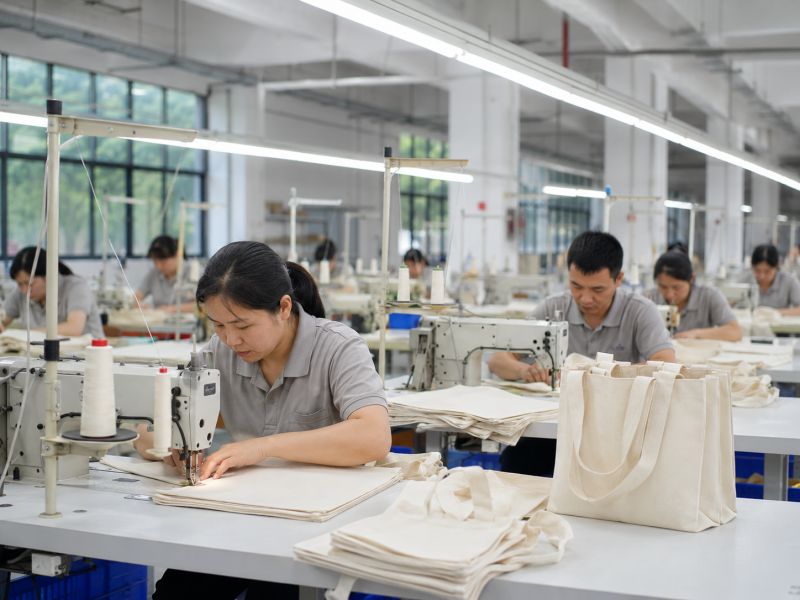
A custom tote sample is developed by converting the design into measurable specifications, selecting workable materials, creating the pattern, assembling the first piece, and checking its dimensions, appearance, carrying strength, decoration, and usability. A successful sample should do more than look attractive—it must also prove that the design can be repeated consistently during bulk production without unexpected changes in cost, quality, or timing.
What Should the Factory Review First?
The first review determines whether the proposed tote can be made reliably. Dimensions, intended contents, fabric, handles, logo artwork, internal features, expected quantity, packaging, and required delivery date should be considered together. A design can look simple in a drawing while containing structural conflicts that only become visible during pattern development.
The review should establish seven essentials:
- What will the tote carry?
- What is the expected working load?
- Which dimensions are finished measurements?
- How should the bag feel when empty?
- Which areas need structure or reinforcement?
- Which decorative details must remain visually exact?
- How will the tote be folded, packed, transported, and displayed?
Intended use has a direct effect on construction. A lightweight giveaway tote carrying brochures does not need the same handle attachment as a grocery tote expected to hold 8 kg. A premium retail tote may need a lining, recessed zipper, internal pocket, base insert, and carefully controlled top edge.
Common design conflicts discovered during the first review include:
| Design detail | Possible production issue | Practical adjustment |
|---|---|---|
| Large print crossing a side seam | Distorted or interrupted artwork | Print panels before sewing or move the graphic |
| Thick canvas with a narrow folded handle | Excessive seam thickness | Use webbing or modify the folding structure |
| Zipper fitted into a shallow opening | Poor access and difficult sewing | Increase opening depth or use a recessed panel |
| Embroidery above an internal pocket | Backing remains visible inside | Add lining or change the decoration position |
| Long shoulder handles on light fabric | Fabric distortion at attachment | Add reinforcement patches |
| Rigid base in a foldable tote | Higher packing volume | Use a removable or thinner insert |
| Logo close to the top seam | Inconsistent placement after folding | Increase clearance from the seam |
The development route also depends on what needs to be proven. A logo strike-off checks color and detail. A material swatch checks texture and shade. A structure sample checks proportions and function. A pre-production sample confirms the complete tote using approved components and processes. Treating these as separate approval stages can prevent a decorative revision from delaying structural work.
Do Brands Need a Tech Pack?
A tech pack is strongly recommended because it turns visual ideas into measurable instructions. It does not need to be complicated, but it should define the finished tote clearly enough that another technician could inspect it without relying on verbal explanations.
A useful tote tech pack includes:
| Section | Required information |
|---|---|
| Product drawing | Front, back, side, top, and interior views |
| Finished dimensions | Width, height, depth, gusset, and opening |
| Handles | Length, drop, width, thickness, spacing, and attachment |
| Main fabric | Fiber composition, construction, weight, color, and finish |
| Interior | Lining, pockets, binding, zipper, and base support |
| Decoration | Artwork size, color reference, process, and location |
| Hardware | Zipper type, puller, snap, ring, rivet, and finish |
| Stitching | Seam type, reinforcement, thread color, and visible stitch |
| Labels | Main label, care label, country label, and placement |
| Packaging | Folding, polybag, tissue, hangtag, barcode, and carton |
| Inspection | Measurement tolerances, test load, and visual criteria |
Finished dimensions must be clearly separated from cutting dimensions. The pattern technician needs to add seam allowances, folds, turnings, and shrinkage compensation. If a drawing lists a 38 × 42 cm body without stating whether those are cut or finished measurements, the completed tote may be smaller than expected.
Handle length should also be defined carefully. “70 cm handles” may refer to:
- Total cut length
- Finished sewn length
- Exposed length between attachment seams
- Vertical handle drop from the top edge
- Measurement taken along the outer or inner curve
The clearest specification records both finished handle length and vertical drop. Attachment spacing should also be measured from stable landmarks such as the side seam or bag centerline.
Artwork files should be supplied as editable vector PDF, EPS, or SVG whenever possible. The file should include exact dimensions, approved colors, print position, and any minimum line thickness. Raster images can become blurred when enlarged, while thin lettering may fill with ink on coarse canvas.
A complete tech pack also needs revision control. Each update should carry a date or revision code. If the handle changes from 65 cm to 72 cm, the drawing, measurement table, bill of materials, and written approval should all show the same revision. Mixed files are a frequent cause of incorrect samples.
How Are Fabric and Color Approved?
Fabric approval should cover more than a color photograph. Composition, weight, weave, usable width, hand feel, surface texture, shrinkage, coating, opacity, and decoration compatibility all affect the finished tote.
A fabric approval record should identify:
- Fiber composition
- Fabric weight in GSM or oz/yd²
- Weave or knit construction
- Roll width and usable cutting width
- Surface finish or coating
- Approved face and reverse sides
- Shrinkage after the agreed treatment
- Dry and wet rubbing performance
- Print, transfer, or embroidery compatibility
- Approved physical swatch
Fabric weight can be checked through a measured cut piece:
[
\text{GSM}=\frac{\text{Weight in grams}}{\text{Area in square meters}}
]
For example, a 20 × 20 cm fabric piece has an area of 0.04 m². If it weighs 12 g:
[
12 \div 0.04 = 300\text{ GSM}
]
This calculation helps confirm whether the received cloth matches the intended specification. Several pieces should be checked because weight can vary across a roll or between dye lots.
Color should be approved with a physical standard whenever possible. A Pantone reference provides direction, but screen appearance can differ because of display settings, ambient light, fiber type, weave, and finish. Dyed cotton canvas, polyester webbing, PU trim, and printed ink may not appear identical even when they target the same color code.
Color evaluation is more dependable under controlled lighting:
| Light source | Approximate condition | What it helps reveal |
|---|---|---|
| D65 | Daylight, about 6500K | Overall shade and undertone |
| TL84 | Store lighting, about 4000K | Appearance under many retail lights |
| Warm light | About 2700–3000K | Red, yellow, and brown color shifts |
A shade that matches under daylight but changes under store lighting has metamerism. This is particularly important when the body, webbing, zipper tape, and printed logo use different material types.
Instrumental color readings can support visual approval. If ΔE00 values are specified, the acceptance limit should be agreed before dyeing. A value below 1 indicates an extremely close instrumental match, while a value between 1 and 2 is often visually close. Texture and gloss can still affect perception, so numbers should support—not replace—a signed physical swatch.
Decoration should be tested on the actual cloth. The same ink may appear bright on white cotton, dull on natural canvas, and slightly shifted on coated polyester. A print strike-off should confirm color, opacity, edge detail, hand feel, and adhesion before the complete sample is assembled.
How Long Does the Sample Process Take?
A simple tote can sometimes be completed in two to three working days when stock materials, clear artwork, and basic construction are used. A standard custom sample usually takes five to seven working days after specifications and available materials are confirmed. Complex structures, custom-dyed fabric, molded accessories, special hardware, or several decoration processes may require seven to fifteen working days.
Courier transit and approval time are separate from workshop time.
| Stage | Main work | Approximate time* |
|---|---|---|
| File review | Dimensions, materials, construction, artwork | 0.5–1 day |
| Material confirmation | Swatches, stock check, trim matching | 1–3 days |
| Pattern development | Panel shapes, seam allowances, handle placement | 0.5–2 days |
| Logo preparation | Screen, transfer, embroidery file, or embossing die | 1–3 days |
| Cutting and sewing | First physical piece | 1–3 days |
| Inspection | Measurements, appearance, function, and load checks | 0.5–1 day |
| Revision | Pattern or construction adjustment | 1–5 days |
- Some stages can run at the same time. Custom dyeing, specially plated hardware, or molded parts can extend the schedule.
The timing usually begins after four items are confirmed:
- Dimensions and structure
- Material direction
- Usable artwork
- Sample payment or formal authorization
Fast sampling is realistic when decisions are clear. It becomes difficult when fabric is selected after pattern cutting, artwork changes after printing, or handle length changes after assembly.
A well-managed first round should focus on major decisions: proportion, structure, material, handle comfort, and logo scale. Minor color or packaging changes can often be handled afterward. Trying to perfect every detail before confirming the basic structure may create unnecessary revisions.
Revision instructions should be measurable. “Make the handle slightly longer” is open to interpretation. “Increase finished handle length from 65 cm to 72 cm while keeping 18 cm attachment spacing” is much safer.
What Should a Custom Sample Test?
A sample should be tested against its intended use, not only inspected visually. Important checks include finished measurements, handle comfort, seam security, load performance, zipper movement, color transfer, print durability, shrinkage, water resistance, and packing condition.
A practical inspection record may include:
| Test item | Example method | What to observe |
|---|---|---|
| Dimensions | Measure flat without stretching | Width, height, gusset, handle drop |
| Static load | Suspend agreed weight for 30–60 minutes | Seam opening, distortion, handle movement |
| Lift cycle | Repeatedly lift the loaded tote | Attachment damage and stitch breakage |
| Zipper cycle | Open and close repeatedly | Snagging, tooth separation, puller failure |
| Print rub | Rub with dry and damp white cloth | Ink transfer, cracking, surface wear |
| Handle pull | Apply controlled force to each attachment | Fabric tearing and stitch movement |
| Water spray | Expose coated exterior to light spray | Surface absorption and seam leakage |
| Wash or shrinkage | Use agreed care method | Dimensional and color change |
| Folding test | Fold and unfold repeatedly | Coating whitening, print cracking |
| Metal detection | Scan finished piece when required | Broken needle or metal contamination |
Test levels should reflect the planned working load. If the tote is expected to carry 8 kg, an agreed screening load of 10–12 kg creates a safety factor of approximately 1.25 to 1.5. The holding time, lifting cycles, and acceptable deformation should be documented in advance.
Load testing must examine the entire carrying system:
- Main fabric tensile strength
- Handle material
- Stitch type
- Thread strength
- Reinforcement size
- Distance from attachment to fabric edge
- Gusset and bottom seam construction
A heavy canvas body does not guarantee a strong tote if narrow handles are attached with a single stitch line. Likewise, strong webbing may tear through lightweight fabric unless the load is spread through reinforcement.
Functional checks should imitate daily use. Fill the tote with objects similar in shape and weight to its intended contents. Carry it by hand and over the shoulder. Check whether the opening collapses, the handles twist, the zipper scratches the hand, or the base sags excessively.
Packaging should also be tested. Fold the tote as planned, place it in its intended bag or box, and leave it packed long enough to identify crease marks, coating adhesion, hardware impressions, or transfer between printed surfaces.
How Is Bulk Quality Matched to the Sample?
Bulk quality is matched through a sealed reference sample, approved material swatches, a fixed bill of materials, measurement tolerances, first-piece approval, in-line checks, and pre-shipment inspection. The approved sample should be signed or labeled with its revision code and kept in a condition that allows direct comparison.
The sealed reference should confirm:
- Finished appearance
- Construction and seam method
- Main fabric and lining
- Approved colors
- Handle dimensions and attachment
- Decoration size and position
- Hardware and zipper
- Labels and packaging
- Measurement table
- Accepted tolerances
A handcrafted development sample may include temporary materials or individually adjusted details. For this reason, a pre-production sample made from actual bulk materials is often more important than the first prototype. It confirms that the selected cloth, ink, webbing, hardware, and sewing methods can be repeated at volume.
The first 20 to 50 completed pieces can be checked before the line reaches full speed. Early inspection can reveal handle misalignment, seam tension, print movement, or size drift while correction is still manageable.
Illustrative tolerances for a medium textile tote may include:
| Feature | Possible tolerance* |
|---|---|
| Body width and height | ±5 mm |
| Gusset depth | ±5 mm |
| Handle length or drop | ±5 mm |
| Logo dimensions | ±2 mm |
| Logo position | ±3–5 mm |
| Fabric weight | ±5% |
| Stitch density | According to approved seam record |
- Actual tolerances depend on size, fabric, construction, decoration, and agreed quality level.
Textile products should be measured flat, without tension, using the same method each time. If one inspector measures from outer seam to outer seam while another measures inside the seam line, the records will not be comparable.
For pre-shipment inspection, an agreed sampling plan may use Critical 0, Major 2.5, and Minor 4.0 as starting values. The selected inspection level and defect definitions should be written into the order terms. A crooked logo may be major for a premium retail tote, while a small removable thread might be classified as minor.
Photographs are helpful, but physical references remain important for fabric texture, softness, coating, embroidery depth, and subtle color differences.
What Should Brands Send for a Quote?
An accurate quote requires enough information to calculate fabric consumption, decoration, sewing operations, accessories, packing volume, and production time. A reference photo alone rarely defines the tote completely.
The most useful development pack contains:
| Information | Details to provide |
|---|---|
| Product image or drawing | Front, back, side, interior, and special details |
| Finished size | Width × height × depth or gusset |
| Intended use | Expected contents and working load |
| Material | Composition, weight, finish, and preferred color |
| Handles | Material, width, length, drop, and attachment |
| Decoration | Process, artwork size, colors, and position |
| Interior | Lining, pockets, dividers, and base insert |
| Closures | Zipper, snap, hook-and-loop, or open top |
| Quantity | Total pieces and quantity per color or design |
| Packaging | Folding, individual bag, hangtag, barcode, and carton |
| Quality needs | Load test, colorfastness, compliance, inspection level |
| Delivery | Country, postal code, required date, and shipping term |
Editable vector artwork should be included for logos. If final artwork is unavailable, provide the approximate print dimensions and number of colors so decoration cost can be estimated more accurately.
Quantity should be separated by color and design. Three colors at 500 pieces each are not calculated in the same way as one color at 1,500 pieces because each color may require separate fabric booking, print setup, cutting control, and packing identification.
A complete quote should clarify:
- Unit price at the requested quantities
- Sample charge and revision conditions
- Decoration setup charges
- Material or color minimums
- Sample and bulk lead times
- Packaging included in the unit price
- Shipping term, such as EXW, FOB, CIF, or DDP
- Quote validity
- Items not included, such as testing, freight, duty, or tax
The most dependable custom sample begins with measurable information and ends with a sealed physical reference. When the drawing, materials, tolerances, test methods, and packaging are approved together, the sample becomes a practical control tool for cost, timing, appearance, and repeatable bulk quality.