 Skip to content
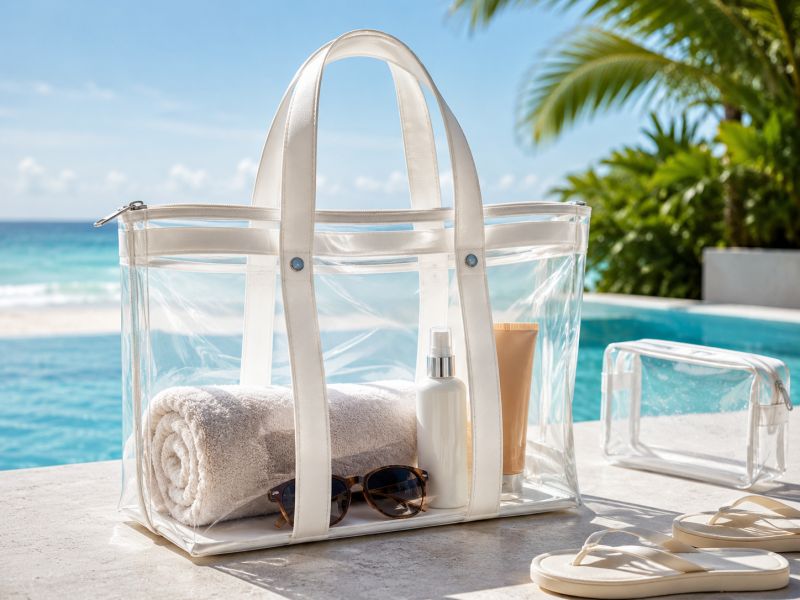
A waterproof PVC bag can look easy to develop, but the real quality is decided before the first sample is made. The material may look clear and clean. The logo may look sharp. The shape may look perfect in a product photo. But once the bag meets wet towels, sunscreen, pool water, sand, heat, and daily carrying weight, every weak detail becomes visible. Loose stitching, thin PVC, foggy transparency, sticky print, sharp edges, weak handles, or a zipper that lets water in can turn a good-looking product into a complaint after launch.
A waterproof PVC bag should specify the exact material type, thickness, transparency, softness, seam method, closure, handle reinforcement, logo process, size, inner layout, packing method, sample checks, and QC rules. A beach tote may only need splash resistance and easy cleaning, while a swimming bag may need welded seams, a roll-top closure, or a waterproof zipper.
Think of a resort gift shop preparing a summer launch. The team approves a clear tote from a photo, adds a logo, and asks for “waterproof PVC.” The sample looks fine on the desk. Then someone fills it with a wet towel and a water bottle. The bottom bends, the zipper opening leaks, and the handle pulls against the side panel. Nothing was “wrong” with PVC. The problem was that the product was never specified for the way people would actually use it.
What Does Waterproof Mean?
Waterproof is one of the most misunderstood words in beach and pool bag development. PVC material does not absorb water like cotton, canvas, or untreated fabric, so it is naturally suitable for wet surroundings. But a finished bag is not judged by the main panel alone. Water can enter through stitched seams, zipper teeth, handle holes, snap positions, bottom corners, pocket openings, and poorly sealed folds.
A PVC beach tote may be perfect for towels, sunscreen, sunglasses, swimwear, and poolside use even if it is not fully sealed. It can be easy to wipe, resistant to splashes, and strong enough for daily summer carrying. A swimming dry bag, however, has a different job. It needs to protect dry clothing, phones, wallets, or personal items near water, so the seam method and closure must be much more controlled.
The first specification should not be “waterproof PVC bag.” It should describe the real use: splash-resistant beach tote, wet swimsuit pouch, poolside zip bag, dry-storage swim bag, or water-sport roll-top bag. Once the use is clear, material thickness, seam method, closure, handle structure, and testing method become much easier to decide.
| Water Protection Level | What It Really Means | Suitable Product Type | Structure To Review |
|---|---|---|---|
| Wipe-clean | Water stays on the surface and can be wiped away | Clear beach tote, cosmetic pouch, resort gift bag | PVC surface, thickness, odor, scratch marks |
| Splash-resistant | Light water contact is acceptable | Pool tote, beach carry bag, event clear bag | Bound seams, zipper quality, bottom strength |
| Wet-item friendly | Can carry damp swimwear or towels | Swim pouch, wet/dry organizer, pool kit bag | Inner pouch, coated pocket, closure, lining |
| Water-blocking | Designed to reduce water entry | Swim storage bag, outdoor pool bag | Sealed seams, roll-top, waterproof zipper |
| Dry-storage | Built to help keep contents dry near water | Dry bag, boating pouch, water sport bag | Welding, closure folds, leak checks |
The safest product language is honest product language. If a bag is made for poolside carrying, say it is water-friendly, splash-resistant, or easy to clean. If it is made to help keep contents dry, then the design must support that promise through sealed construction, not just PVC material.
Is PVC Always Waterproof?
PVC as a sheet material is highly resistant to water because water does not soak into it. That makes it very useful for beach bags, pool bags, clear totes, cosmetic pouches, travel pouches, and wet-area accessories. But after the material becomes a bag, every construction detail changes the result.
A stitched PVC bag usually has tiny needle holes along the seam. These holes may be harmless for a beach tote used around towels and sunscreen, but they are not suitable for a bag expected to protect dry clothing from water exposure. A regular zipper is another weak area. It keeps items inside and improves privacy, but water may still pass through the zipper teeth or the side opening.
Handle attachment also matters. If webbing, rope, PU, or PVC handles are sewn onto the panel, the attachment area must hold the expected load. Wet towels, bottles, sandals, and toiletries can become surprisingly heavy. If the handle area pulls too hard on the PVC panel, distortion or tearing can appear after repeated use.
A simple way to check the difference:
| Bag Detail | Good For Splash Use | Needed For Stronger Water Protection |
|---|---|---|
| Main material | Clear PVC, frosted PVC, colored PVC | PVC, TPU, or coated waterproof material |
| Seam | Stitched and bound seam | Welded or sealed seam |
| Top opening | Open top, snap, regular zipper | Roll-top or waterproof zipper |
| Handle | Sewn webbing, rope, PVC, PU | Reinforced anchors with water-entry review |
| Bottom | Boxed or gusseted bottom | Fewer seam openings and stronger corner control |
PVC is a strong starting material, but it cannot carry the whole performance promise alone. The bag must be designed for the level of water contact it will face.
Waterproof PVC vs Water-Resistant Bags
A waterproof PVC bag and a water-resistant PVC bag can look almost the same in photos, yet they behave differently in daily use. The difference is not only material. It is the way the bag is joined, closed, reinforced, and tested.
A water-resistant PVC bag is suitable when the main goal is easy cleaning and protection from light splashes. This type is common for beach totes, pool bags, transparent event bags, cosmetic pouches, travel organizers, and summer gift bags. It may use standard stitching, edge binding, regular zippers, or snap closures. It can handle damp surroundings, but it should not be presented as a sealed product.
A waterproof structure is needed when the bag is expected to block water from entering. That may require high-frequency welding, heat-sealed seams, roll-top closure, waterproof zipper, fewer stitch lines, and controlled bottom corners. This structure is more technical and often less soft or open than a casual tote.
| Feature | Water-Resistant PVC Bag | Waterproof Structure |
|---|---|---|
| Main purpose | Carry items around wet environments | Reduce water entry into the bag |
| Common shape | Tote, pouch, pool bag, clear shoulder bag | Roll-top bag, sealed pouch, dry-storage bag |
| Seam method | Stitching, binding, folded edge | Welding or sealing |
| Closure | Open top, snap, regular zipper | Roll-top, waterproof zipper |
| Best use | Towels, sunscreen, swimwear, sandals | Dry clothes, phone pouch, swim storage |
| Cost direction | More flexible | Usually higher |
| Visual feeling | Casual, retail-friendly, easy to use | More protective, sometimes more technical |
The right choice depends on what the end user expects. A resort tote does not always need full sealing. It needs to look clean, feel comfortable, stand up to wet surroundings, and carry daily pool items. A swimming dry-storage bag has a stricter job and must be built differently from the start.
What Is The Difference Between A Beach Bag And A Pool Bag?
A beach bag and a pool bag are close relatives, but they do not handle the same environment. A beach bag usually deals with sand, towels, sunscreen, sandals, hats, books, snacks, and larger personal items. It often needs a wider opening, larger body, stronger handles, and material that can be cleaned quickly after contact with sand or water.
A pool bag usually deals with wet tiles, lockers, swimwear, chlorine water, shampoo bottles, goggles, key cards, and changing-room use. It may need a cleaner shape, better wet/dry separation, stronger zipper control, and smaller internal pockets for personal items. For resort, spa, swim school, or hotel use, the pool bag often needs to look more polished and less casual than a large beach tote.
| Detail | Beach Bag | Pool Bag |
|---|---|---|
| Main use | Outdoor beach carrying | Poolside and changing-room use |
| Common contents | Towels, sandals, sunscreen, hat, snacks | Swimwear, towel, goggles, toiletries, key card |
| Capacity | Usually larger | Medium size is often easier to use |
| Opening | Wide opening is useful | Zipper or partial closure is often helpful |
| Material focus | Easy cleaning, sand control, strong body | Wet/dry storage, wipe-clean lining, privacy |
| Main stress area | Handles and bottom | Zipper, wet pocket, inner layout |
| Style direction | Bright, relaxed, summer feeling | Clean, neat, resort or swim-focused |
This difference should shape the specification. A beach bag may need a large gusset and reinforced handles. A pool bag may need a wet pocket, zip compartment, or removable pouch. A beach bag can be more open. A pool bag may benefit from controlled storage. If one product needs to serve both scenes, the structure should be tested with both dry and wet contents.
Why Do Seams And Closures Matter?
Seams and closures decide whether a PVC bag performs as expected. The PVC panel may block water well, but water will look for easier paths. Those paths are usually stitch holes, zipper openings, bottom seams, corner folds, handle attachment areas, and inner pocket lines.
Stitching is strong and useful for many beach and pool bags, especially when paired with binding and reinforcement. It gives a clean shape and allows more design flexibility. But stitching creates needle holes. For a splash-resistant tote, this may be acceptable. For dry protection, it is not enough.
Welding joins suitable materials without sewing holes, which improves water control. It is often used for dry bags, wet pouches, and more technical waterproof structures. But welding is not automatically better for every product. It can change the appearance, hand feel, edge shape, and cost. Some styles with decorative trim, complex pockets, curved panels, or soft lifestyle shapes may still need stitching or mixed construction.
Closures should be selected with the same care:
| Closure Type | Best Use | Limitation |
|---|---|---|
| Open top | Large beach tote, resort gift bag | No top protection |
| Magnetic snap | Light pool tote, quick access bag | Limited water control |
| Regular zipper | Privacy, secure storage, daily use | Not fully sealed |
| Waterproof zipper | Better water control | Higher cost and needs careful testing |
| Roll-top | Dry-storage and water sport use | More technical look and slower access |
A strong closure is only useful if the rest of the structure supports it. A waterproof zipper on a stitched bag with many needle holes may not create real dry protection. A roll-top bag with weak side seams may still fail. Seams, closure, bottom, and handle attachments should be reviewed as one system.
Which Use Case Needs Full Sealing?
Full sealing is needed when the bag is expected to help keep contents dry in wet conditions. This includes swim storage bags, water sport pouches, boating accessories, phone and wallet pouches, wet/dry organizers, and compact dry bags for clothes or personal items. These products need fewer water paths, sealed seams, stronger closure control, and practical testing.
Full sealing is usually not necessary for a casual clear beach tote, resort welcome bag, sunscreen pouch, summer retail bag, stadium-style clear tote, or poolside gift bag. These products need water-friendly surfaces, easy cleaning, strong handles, good visual quality, and stable logo performance. Adding a fully sealed structure may raise cost, reduce softness, and make the bag less convenient without improving the actual user experience.
| Use Scene | Full Sealing Needed? | Better Direction |
|---|---|---|
| Carrying towels to the beach | No | Splash-resistant PVC tote |
| Holding sunscreen and sunglasses by the pool | No | Clear or frosted pool bag |
| Storing wet swimsuit after swimming | Sometimes | Wet pouch or wet/dry pocket |
| Protecting a phone near water | Yes | Sealed pouch or dry-storage structure |
| Carrying dry clothes for water sports | Yes | Welded dry bag with roll-top closure |
| Resort gift with logo | Usually no | Premium PVC tote with clean trim |
| Swim club kit bag | Depends on contents | Wet/dry layout with stronger zipper |
A practical rule is to separate “wet-friendly” from “dry-protective.” Wet-friendly means the bag can live around water. Dry-protective means the bag is built to help prevent water entry. These are different product promises and should not be mixed casually.
For brand planning, the best result usually comes from matching the claim to the construction. A stylish PVC beach tote can be honest, useful, and reusable without pretending to be a dry bag. A swimming dry bag can be protective and technical without trying to look like a fashion tote. The clearer the role, the better the product feels in real use.
How Should The Bag Be Built?
A waterproof PVC beach or pool bag should be built from the inside out: what it carries, how wet it gets, how often it is reused, how it is held, how it is closed, and how it looks after packing. A clear PVC tote for towels and sunscreen does not need the same structure as a swim dry bag for clothes, phones, or valuables. Shape matters, but use comes first.
A strong structure usually starts with six physical details: top opening, seam method, handle strength, bottom support, wet-item storage, and edge finish. If one of these details is weak, the whole bag can feel less reliable even when the main PVC material is correct.
| Structure Area | What To Decide | Why It Matters |
|---|---|---|
| Top opening | Open, zipper, snap, drawstring, roll-top | Controls access, privacy, and water entry |
| Main seam | Stitched, bound, welded, mixed | Affects strength and water control |
| Handle | Webbing, PVC, rope, PU, shoulder strap | Affects comfort and load capacity |
| Bottom | Flat, gusseted, boxed, reinforced | Affects standing shape and carrying stability |
| Inner layout | Wet pouch, dry pocket, divider, bottle holder | Helps separate damp and dry items |
| Edge finish | Binding, folded edge, welded edge | Affects touch, appearance, and durability |
| Packing shape | Flat, lightly stuffed, protected, nested | Affects marks, wrinkles, and final opening feel |
A beach and pool bag is used harder than it may look. A towel becomes heavier when damp. Sunscreen leaves oily marks. Sand scratches clear panels. A water bottle pushes against the bottom. Flip-flops can create pressure marks inside the bag. If the structure is only planned from a front-view sketch, these real-use problems may not appear until after launch.
For transparent PVC bags, construction quality is more visible than on fabric bags. Uneven seams, dusty corners, wavy edges, glue marks, and poorly aligned stitching are easy to notice because the material does not hide them. This is why clear PVC products need clean cutting, neat assembly, controlled handling, and careful packing.
A good structure should pass four practical checks:
| Check | What It Shows |
|---|---|
| Filled carry check | Whether handles pull, twist, or distort the side panels |
| Wet-item check | Whether damp towels or swimwear affect shape and storage |
| Opening check | Whether zipper, snap, or roll-top works naturally |
| Packing check | Whether clear panels show scratches, pressure marks, or sticking |
The best-built PVC bag is not always the most complex one. It is the one where the structure matches the promise. A resort tote should feel clean, comfortable, and reusable. A pool pouch should keep small items organized. A swim dry bag should reduce water entry through the right seam and closure. Each product needs its own structure logic.
How To Choose A Waterproof Bag?

Choose a waterproof bag by starting with water exposure, not appearance. The first decision is whether the bag only needs to live around water, carry wet items, or help keep contents dry. These are different uses and should lead to different structures.
A poolside tote used for towels, sunscreen, sunglasses, and sandals can use PVC panels, reinforced handles, clean binding, and a practical closure. It does not need to behave like a dry bag. A swim storage bag for dry clothing, wallet, or phone needs much stronger water control, usually with fewer stitch paths and a more protective closure.
| Use Scene | Better Structure | Main Detail To Watch |
|---|---|---|
| Beach retail tote | Open or snap-top PVC tote | Handle strength and bottom support |
| Resort pool bag | Frosted or clear PVC with clean trim | Appearance, privacy, and zipper quality |
| Swim kit bag | Wet/dry pocket with stronger closure | Inner separation and damp-item control |
| Water sport pouch | Welded pouch or roll-top bag | Seam sealing and closure folds |
| Event clear bag | Clear PVC with set size and strap | Logo visibility and panel cleanliness |
| Travel pool pouch | Zippered PVC pouch | Scratch marks and packing shape |
A useful selection method is to list the real contents before choosing the structure. For example, a bag designed for one towel, sunscreen, flip-flops, and a water bottle needs more bottom support than a light gift pouch. A bag meant for goggles, swimwear, and shampoo needs inner separation. A bag meant for dry clothing near water needs a more protective opening.
Three simple product checks help avoid wrong choices:
| Product Check | What To Ask Internally |
|---|---|
| Carry check | Will the handles stay comfortable with wet towels and bottles? |
| Water check | Is the product meant for splashes, wet items, or dry storage? |
| Reuse check | Will the bag still look clean after sand, sunscreen, and packing? |
A clear PVC tote may be the best choice for a bright summer retail line. A frosted PVC pouch may be better for spa or resort use. A roll-top dry bag may be best for swimming or water sports. The right bag is the one that matches the user’s real environment.
What Is The Best Waterproof Bag For Swimming?
The best waterproof bag for swimming depends on whether the goal is to carry wet items, separate damp and dry items, or protect dry contents. These three needs are often confused, but they require different structures.
For wet swimsuits, a small PVC pouch or inner wet pocket can work well. For towels, goggles, shampoo, and clothing, a pool bag with divided storage is more useful. For valuables or dry clothing near water, a roll-top or welded structure is usually safer than a regular stitched tote.
| Swimming Need | Better Product Direction | Key Structure |
|---|---|---|
| Wet swimsuit after swimming | PVC wet pouch | Water-friendly lining and easy cleaning |
| Goggles, cap, small toiletries | Zippered pool pouch | Small compartments and smooth zipper |
| Towel and pool accessories | Medium pool tote | Strong handles and stable bottom |
| Wet and dry separation | Dual-compartment swim bag | Separate wet zone and dry zone |
| Dry clothes near water | Roll-top dry-storage bag | Welded seams and fold closure |
| Phone, wallet, key card | Sealed small pouch | Strong closure and water-entry control |
Swimming products should also be tested with realistic weight. A wet towel, shampoo bottle, and flip-flops create more pressure than a flat sample suggests. If the bag is too soft, the bottom may sag. If the handle is narrow, it may feel uncomfortable. If the zipper is too light, it may jam when the bag is full.
For swim clubs, resorts, and active summer programs, the most useful structure is often a wet/dry layout. The outside can still look clean and simple, but the inside should help keep damp items away from personal items. A removable pouch is especially useful because it can be taken out, cleaned, and dried separately.
Which Closure Is Better: Zipper vs Roll-Top?
A zipper is better for easy access, daily use, privacy, and a clean lifestyle look. A roll-top is better when water control matters more than quick opening. The right closure depends on whether the product is a beach tote, pool pouch, swim kit bag, or dry-storage item.
A regular zipper gives structure and keeps items from falling out. It is useful for pool bags, travel pouches, cosmetic bags, small wet pockets, and clear shoulder bags. But a regular zipper should not be treated as a sealed closure. Water can pass through the zipper teeth, side gaps, or stitch lines around the zipper.
A roll-top closure works by folding the opening several times and fastening it with a buckle. This reduces water entry better than a regular zipper and is common for dry bag styles. The trade-off is that it looks more technical and takes more time to open. It may not suit a relaxed resort tote or polished pool gift.
| Closure Type | Best Use | Main Advantage | Main Limitation |
|---|---|---|---|
| Open top | Beach tote, resort gift bag | Fast access, relaxed style | No top protection |
| Snap | Light pool tote | Simple and clean | Limited water control |
| Regular zipper | Pool pouch, tote, travel bag | Privacy and secure storage | Not fully sealed |
| Waterproof zipper | Higher water control | Cleaner than roll-top | Higher cost and careful testing needed |
| Roll-top | Swim dry bag, water sport bag | Stronger water control | More technical look |
Closure choice should match the product promise. A neat zipper is better than an unnecessary roll-top when the product is meant for a clean poolside look. A roll-top is better than a normal zipper when the product must help keep contents dry near water.
Do Beach Bags Need Welded Seams?
Most beach bags do not need welded seams. A stitched and bound PVC tote can work well for splash resistance, easy cleaning, and everyday beach use. Welded seams become useful when the product needs stronger water control, reduced seam leakage, or dry-storage performance.
Welding joins suitable materials without needle holes. This improves water control, but it also affects shape, texture, appearance, and cost. It is not automatically the best option for every PVC bag. Many beach and pool styles need fabric binding, handles, pockets, trim, or curved construction that may be better supported by stitching or mixed techniques.
| Product Type | Welded Seams Needed? | Better Direction |
|---|---|---|
| Open beach tote | Usually no | Stitched panels with strong binding |
| Clear pool tote | Usually no | Clean stitching, reinforced handle area |
| Wet swimsuit pouch | Sometimes | Welding or coated inner pocket |
| Dry-storage swim bag | Usually yes | Welded seams with roll-top or waterproof zipper |
| Water sport bag | Often yes | Sealed body and stronger closure |
| Resort gift tote | Usually no | Premium trim, neat edge finish, good packing |
If welding is used, the sample should be reviewed for both strength and appearance. Welding marks can be visible on transparent material. The seam should look even, flat, clean, and strong without burn marks, bubbles, weak bonding, or uneven edges.
For many beach totes, better results come from strong stitching, correct binding width, reinforced corners, and smart packing rather than welding. A product should not be overbuilt if the user does not need that level of protection.
How Should Handles Be Reinforced?
Handles should be reinforced based on expected load. A PVC beach or pool bag often carries damp towels, bottles, sunscreen, sandals, cosmetics, and personal items. These contents create pulling force on the handle area, especially when the bag has a large body or clear side panels.
Common handle choices create different looks and performance:
| Handle Type | Visual Feel | Good Use | Detail To Watch |
|---|---|---|---|
| Webbing handle | Sporty, strong, practical | Beach totes, swim bags | Stitch strength and anchor size |
| PVC handle | Clean, transparent, modern | Clear totes, event bags | Edge comfort and pulling stress |
| Rope handle | Relaxed beach style | Summer totes, resort lines | End fixing and wet-use behavior |
| PU handle | More polished | Spa, resort, lifestyle bags | Colorfastness and water marks |
| Shoulder strap | Travel-friendly | Crossbody pool bags | Hardware strength and side tabs |
Reinforcement can be done through wider anchor patches, double stitching, bartacks, double-layer panels, rivets, longer webbing insertion, or larger stress zones. On clear PVC, reinforcement remains visible, so it should look deliberate and clean. A large patch may improve strength, but if it looks messy through the panel, it can hurt the product appearance.
Useful handle tests include:
| Test | What To Check |
|---|---|
| Loaded carry | Handle comfort and side-panel distortion |
| Hang test | Whether anchor stretch under weight |
| Pull test | Stitching strength and PVC tearing risk |
| Wet towel test | Extra weight from damp contents |
| Comfort check | Whether the handle cuts into the hand |
| Repeated use check | Stitch holes, twisting, and panel stress |
A handle that works on an empty sample may not work on a filled bag. This is especially true for large beach totes. The handle should be tested with real contents, not only checked by appearance.
What Size Works For Pool Use?
A pool bag should hold the essentials without becoming bulky in lockers, changing rooms, hotel areas, or poolside seating. Medium size often works better than an oversized beach tote because pool use needs control, not just capacity.
A practical pool bag may need space for a towel, swimsuit, goggles, sunscreen, key card, small toiletries, and a water bottle. For swim training, it may need stronger compartments. For resort use, it may need a cleaner shape and a more polished exterior. For family use, it may need larger capacity and stronger handles.
| Use Type | Size Direction | Structure Need |
|---|---|---|
| Single swimmer | Compact to medium | Wet pouch and small dry pocket |
| Resort pool guest | Medium | Clean shape, towel space, zipper or snap |
| Family pool day | Large | Wider base, stronger handles, more pockets |
| Swim club kit | Medium to large | Compartments and durable closure |
| Spa or beauty pool set | Small to medium | Polished look and gift-ready packing |
| Travel pool pouch | Compact | Foldability and easy cleaning |
Size should be reviewed by contents. A product listed only as “large tote” is not specific enough. It is better to define how many towels, bottles, pouches, or accessories should fit. A bag that looks well-proportioned when empty may become too small once a towel and water bottle are added.
A useful check is to fill the sample with the exact items expected in use, then review:
| Filled Sample Detail | What It Reveals |
|---|---|
| Top opening | Whether items can be placed in and removed easily |
| Bottom width | Whether the bag stands or collapses |
| Handle length | Whether it can be carried by hand or shoulder |
| Inner pockets | Whether small items are easy to find |
| Overall bulk | Whether it fits lockers, shelves, or carton packing |
For pool use, balance is more important than maximum size. A bag that carries well and stores neatly will often be used more than a larger bag that feels awkward.
Which Inner Structure Helps Wet Items?
Wet items need separation, easy cleaning, and airflow. A simple open PVC tote can carry a wet towel, but it does not keep damp items away from phones, wallets, key cards, books, cosmetics, or dry clothing. Inner structure can improve the experience without changing the outside design too much.
Useful wet-item features include:
| Inner Feature | Good For | Design Detail |
|---|---|---|
| Wet pocket | Swimsuit, small towel | Use water-friendly lining or PVC |
| Removable pouch | Wet items, cosmetics, toiletries | Easy to clean and dry separately |
| Mesh pocket | Goggles, sunscreen, swim cap | Adds visibility and airflow |
| Dry zip pocket | Phone, wallet, key card | Keep away from wet area |
| Bottle sleeve | Water bottle, sunscreen bottle | Reduces shifting inside the bag |
| Bottom insert | Shape support | Should resist moisture and bending |
| Divider | Wet/dry separation | Should not trap odor or water |
A removable pouch is often more practical than a fixed wet pocket when the product will carry swimsuits or small wet items often. It can be removed, cleaned, dried, and used separately. It also adds perceived value without making the main bag too complicated.
Mesh pockets help airflow but may not suit every visual style. For a swim club or sporty pool product, mesh is useful. For a spa or resort product, a smoother frosted PVC pouch may look better. The inner structure should match both function and style.
For clear PVC bags, inside details are visible. This can be attractive if the layout is clean, but messy if there are too many pockets, seams, labels, and zippers. A neat internal plan makes the bag more useful while keeping the transparent appearance clean.
How Do Logo And Style Affect Specs?

Logo and style affect more than the front view of a waterproof PVC beach or pool bag. They influence material choice, panel size, surface finish, print method, trim color, zipper type, handle material, packing style, and even how the bag should be checked before bulk work. On transparent and semi-transparent materials, every visual detail becomes more exposed. The contents inside the bag, the light around it, and the surface reflection can all change how the logo looks.
PVC is smooth, glossy, flexible, and sometimes transparent. That makes it attractive for beach and pool products, but it also means the logo cannot be planned the same way as on canvas or polyester. A logo that looks strong on a flat design file may become too large after the bag is filled with towels. A white print may disappear against pale contents. A large black logo may look clean on screen but feel heavy on a summer product. Metallic details may look premium, but only if the attachment and surface behavior are checked carefully.
Style also affects function. A bold clear tote with color webbing can feel playful and easy to carry. A frosted PVC pool bag with a small logo can feel more private and refined. A roll-top swim bag with a rubber patch may look sportier and more technical. These visual choices are not just decoration; they guide the material, construction, and sample checks.
The most useful logo and style decisions should be made before sampling:
| Style Detail | What To Specify | Why It Matters |
|---|---|---|
| Logo process | Screen print, UV print, patch, woven label, metal plate | Affects look, durability, cost, and surface behavior |
| Logo size | Small, medium, large, full front, repeated pattern | Affects balance and readability on clear material |
| Logo position | Front panel, pocket, handle, trim, pouch, label | Affects visibility, stress areas, and production accuracy |
| PVC surface | Clear, frosted, tinted, glossy, matte | Changes contrast, privacy, and premium feeling |
| Trim color | Webbing, zipper tape, binding, rope, PU | Connects the bag with the brand’s color system |
| Hardware | Buckle, ring, zipper puller, snap, plate | Affects wet-use durability and visual level |
| Packing | Flat, shaped, tissue-protected, individual bag | Protects clear surfaces and logo finish |
A strong PVC bag style does not usually come from adding more details. It comes from making the right details work together. Transparent material already carries visual movement because the contents are visible. If the logo, trim, and hardware are too busy, the bag can look crowded after it is filled. A cleaner specification often creates a more expensive-looking result.
Which Logo Process Works On PVC?
Several logo methods can work on PVC, but each one has limits. The right method depends on the PVC surface, logo color, logo size, order quantity, artwork complexity, and how the bag will be packed and used. For beach and pool products, logo durability should be checked against moisture, friction, folding, sunscreen residue, and pressure during packing.
Common logo choices include screen printing, UV printing, heat transfer, PVC patch, rubber patch, woven label, metal plate, and hangtag support. Direct printing is common for simple logos and clean graphics. Patches and labels add texture when the material surface or product style needs more depth.
| Logo Method | Good Use | Best Match | What To Check |
|---|---|---|---|
| Screen printing | Simple logos, solid colors, larger front graphics | Clear PVC, frosted PVC, colored PVC | Ink adhesion, edge clarity, drying, sticking after packing |
| UV printing | Detailed graphics, sharper color effects | PVC, EVA, selected smooth surfaces | Surface compatibility, scratch resistance, color accuracy |
| Heat transfer | Certain multi-color visuals | Selected materials after testing | Heat reaction, peeling, flexibility |
| PVC patch | Sporty or waterproof-feel branding | Pool bags, swim bags, outdoor-style bags | Thickness, attachment, edge finish |
| Rubber patch | Strong tactile branding | Sport, resort, swim, outdoor styles | Color match, sewing or bonding method |
| Woven label | Clean private-label look | Webbing, pocket edge, trim area | Stitching position and label scale |
| Metal plate | Premium accent | Resort or lifestyle pool bags | Weight, corrosion review, attachment marks |
| Hangtag | Retail presentation | Most bag types | Paper quality, string, barcode, packing position |
Screen printing is often practical for clean PVC beach totes because it keeps the product light and direct. UV printing can create sharper visual effects, especially when the artwork has more detail. A patch may look more premium or sporty, but it adds thickness and attachment work. A metal plate can look elevated, but it should be placed where it will not scratch the PVC surface or feel too heavy.
The logo should be tested on the exact material, not just a similar clear sheet. PVC softness, surface finish, and thickness can all change the result. After printing, the sample should be packed for several days and reopened to check whether the logo sticks, transfers, scratches, or leaves marks on another panel.
How Big Should The Logo Be?
Logo size should be planned with the bag filled, not empty. This is especially important for clear PVC bags because the contents become the background. Towels, swimwear, bottles, sunscreen, sandals, and cosmetic pouches all change the logo’s contrast. A logo that looks balanced on an empty sample may look crowded once real items are inside.
For a beach tote, a medium front logo often works better than a full-panel print. It gives visibility without blocking the transparent effect. For a frosted pool bag, a smaller logo can feel cleaner and more refined. For a swim pouch, a centered logo or side label may be easier to control. For a resort or spa product, a small logo with better trim often looks more premium than a large print.
| Bag Style | Suggested Logo Direction | Reason |
|---|---|---|
| Clear beach tote | Medium front logo or lower-corner logo | Keeps visibility without fighting the contents |
| Frosted pool bag | Small to medium logo | Feels cleaner and more private |
| Swim pouch | Centered print or small patch | Easy to read on smaller surface |
| Resort gift bag | Small logo with refined trim | More reusable and less promotional |
| Event clear bag | Clear front placement | Fast recognition and simple layout |
| Sport swim bag | Patch or bold print | Stronger identity and active feeling |
Logo position should avoid high-stress areas such as fold lines, bottom corners, handle anchors, zipper curves, and welded seams. These areas can bend, pull, or distort during use. Printing across them may cause cracking, peeling, or uneven appearance. A good logo position should stay visible while avoiding physical stress.
A simple visual check works well: fill the bag with the real items expected for use, place it under natural light, and view it from about one meter away. The logo should be clear, balanced, and easy to recognize without making the bag feel messy. If it only looks good when the bag is empty, the logo size still needs adjustment.
What Colors Look Best On Clear PVC?
Logo color on clear PVC is tricky because the background changes all the time. A white logo may look fresh, clean, and summery, but it can disappear against a white towel or pale swimsuit. A black logo stays readable, but it may feel too strong for a soft poolside look. Navy, cream, silver, gold, and tone-on-tone colors can work well when they match the trim and product mood.
The safest color choice depends on the PVC color, trim, and likely contents. If the bag will carry colorful towels or swimwear, white or cream can look bright. If the product has navy webbing or black zipper tape, a matching dark logo can feel more structured. If the bag is frosted, metallic or muted colors may look more polished.
| Logo Color | Visual Feeling | Works Well With | Risk To Watch |
|---|---|---|---|
| White | Clean, summer, fresh | Clear PVC, tinted PVC, bright trim | Can disappear against pale contents |
| Black | Strong, clear, graphic | Clear PVC, bold trim, event styles | Can feel heavy on soft designs |
| Navy | Resort, coastal, premium | White, cream, blue, natural trim | Needs enough contrast |
| Cream | Soft, warm, lifestyle | Frosted PVC, rope, natural trim | May be too subtle |
| Silver | Cool, clean, modern | Frosted PVC, clear PVC, grey trim | Shine may vary by light |
| Gold | Premium, gift-like | Frosted PVC, warm trim, spa styles | Too much can look overdone |
| Bright color | Playful, seasonal | Youth, festival, swim programs | Color consistency needs review |
| Tone-on-tone | Minimal, refined | Frosted or tinted PVC | Readability may be lower |
Color should also be reviewed under different lighting. Poolside light is bright and reflective. Indoor retail light can make clear PVC look warmer or cooler. A logo that looks perfect in the sample room may look weaker outdoors or inside a hotel shop.
If the bag is transparent, the contents should be part of the color test. Place towels, swimwear, bottles, and pouches inside the sample. A logo color that stays readable across several content combinations is safer than one that only works on an empty bag.
When Should You Use Binding Or Trim?
Binding and trim should be used when the bag needs cleaner edges, stronger seams, better shape, color contrast, or a more finished look. PVC edges can feel sharp or unfinished if left too simple. Binding covers the edge, improves hand feel, adds color, and can help stabilize the shape.
For large beach totes, trim is often essential. Wide PVC panels need support, especially around the top edge, side seams, bottom corners, and handle areas. Webbing or fabric binding can make the bag feel stronger and more comfortable. For pool bags, trim can also control privacy and style. A frosted PVC bag with soft webbing and a small logo may look more refined than a fully clear bag with a large print.
| Trim Type | Visual Effect | Best Use | What To Check |
|---|---|---|---|
| Fabric binding | Clean edge, color control | Beach totes, pool bags | Even width, colorfastness, wet-use behavior |
| Webbing | Strong, sporty, practical | Larger totes, swim bags | Stitching strength and handle connection |
| PU trim | More polished | Resort, spa, lifestyle styles | Wet marks, color transfer, peeling |
| Rope handle | Relaxed beach feeling | Summer totes, resort bags | End fixing and comfort |
| Colored zipper tape | Simple color detail | Pouches, pool bags, travel bags | Color match and zipper smoothness |
| Rubber patch | Strong identity | Sporty and outdoor-feel bags | Patch thickness and attachment |
| Clear welded edge | Minimal, technical | Waterproof pouches, dry bags | Welding line appearance |
Trim should not be chosen only from color cards. It needs to be checked with the PVC material, zipper, logo, and packing method. Some beautiful trims can absorb moisture, stain when wet, or transfer color onto clear PVC under pressure. If the bag will sit in a hot container, a car trunk, or a sealed polybag, color transfer and sticking should be checked during sample review.
A good trim plan can reduce the need for oversized logo printing. For example, a clear PVC tote with navy webbing, a small white logo, and a matching zipper can feel complete without heavy graphics. Trim carries a lot of style when used with restraint.
How Can A Custom Bag Keep Brand Style?
A PVC beach or pool bag keeps a strong brand style when material, shape, trim, logo, closure, hardware, and packing all feel like they belong together. The goal is not to add every possible custom detail. The goal is to create a product that people recognize, use, and want to keep.
A bright swim brand may use tinted PVC, bold webbing, a large but clean logo, and a sporty zipper puller. A resort brand may use frosted PVC, soft handles, a small logo, and calm trim colors. A beauty or spa line may choose a semi-transparent pouch, gold or cream logo, smooth zipper, and set packing. A water sport line may prefer roll-top closure, welded seams, rubber patch, and stronger buckles.
| Brand Direction | Material Choice | Logo Style | Trim / Hardware |
|---|---|---|---|
| Resort pool | Frosted PVC, soft tint | Small logo, soft contrast | PU trim, soft webbing, clean zipper |
| Beach lifestyle | Clear or tinted PVC | Medium logo, bright color | Rope, webbing, colored binding |
| Swim sport | PVC-coated fabric, TPU, thicker PVC | Rubber patch or bold print | Strong webbing, buckle, waterproof zipper |
| Beauty pool set | Frosted PVC or clear pouch | Delicate print or label | Smooth zipper, small puller, neat packing |
| Event summer kit | Clear PVC | Simple readable logo | Cost-controlled binding and strap |
| Premium travel pouch | TPU or soft PVC | Small print or metal accent | Refined zipper and clean edge finish |
Style should also consider reuse. A bag with a giant logo may work for a one-time event, but a cleaner design may be carried longer after the original campaign. For beach and pool products, reuse is valuable because the bag appears in real outdoor scenes, hotel rooms, gyms, lockers, and travel photos. The more natural it feels, the longer it stays in use.
The sample should be reviewed like a real finished product, not only as a prototype. Fill it, carry it, zip it, place it near water, pack it, reopen it, and photograph it in a bright setting. Check whether the logo still feels right, whether the trim still matches the material, whether the clear surface remains clean, and whether the product still looks like part of the same collection.
A well-planned PVC bag does not need to shout. When the logo scale, material clarity, trim color, closure, and packing all support one visual direction, the product feels more complete and more trustworthy in the user’s hand.
How Does A Factory Review The Project?

A waterproof PVC beach or pool bag can be reviewed accurately only when the product idea is connected with real details: size, material, logo, quantity, closure, use scene, packing, delivery plan, and testing needs. A clear reference photo is useful, but it cannot replace full specifications. The more precise the starting information is, the fewer revisions happen later.
A good review should not start with a fast price guess. PVC bags are affected by material thickness, transparency, odor control, trim, stitch method, zipper type, welding needs, logo process, packing, and order quantity. A small change in any one of these details can change cost, sample timing, and production method.
For example, a clear open-top tote with one-color printing may be reviewed quickly. A frosted PVC pool bag with waterproof zipper, wet pocket, reinforced webbing handles, custom zipper puller, hangtag, barcode, and carton marks needs a more careful check. Both products may be called “PVC pool bags,” but the work behind them is not the same.
The best review process usually follows this order:
| Review Step | What Gets Checked | Why It Matters |
|---|---|---|
| Product use | Beach, pool, swim, resort, event, spa, travel | Defines waterproof level and structure |
| Size and capacity | Length, width, height, gusset, expected contents | Controls material use and load strength |
| Material | PVC, TPU, clear mesh, webbing, trim, lining | Affects look, touch, cost, and durability |
| Closure | Open top, snap, zipper, waterproof zipper, roll-top | Controls access and water protection |
| Construction | Stitched, bound, reinforced, welded | Affects strength and leakage risk |
| Logo | Artwork, color, position, process | Affects sample result and long-term appearance |
| Packing | Polybag, hangtag, barcode, retail set, carton | Affects presentation and delivery quality |
| Quantity | Per design, per color, per size | Affects unit cost and production plan |
| Delivery needs | Destination, deadline, shipping method | Affects schedule and packing choices |
| Quality needs | Function checks, logo checks, packing checks | Keeps approved sample and bulk order aligned |
A serious review should feel practical. It should help the brand decide what must be fixed, what can be adjusted, and which features are worth the cost. A good sample is not just a pretty prototype. It is a production reference.
What Should You Send For Review?
To review a waterproof PVC bag properly, send a reference photo or sketch, target size, material direction, logo artwork, quantity, color plan, packing needs, use scene, delivery deadline, and destination. If the product has wet/dry storage needs, mention exactly what should stay dry and what may get wet.
A useful project brief can be simple. It does not need to be a perfect technical file. The important thing is that it shows the real product expectation.
Recommended details to prepare:
| Detail | Example |
|---|---|
| Product type | Clear beach tote, pool pouch, swim dry bag, wet/dry organizer |
| Use scene | Resort shop, swim club, beach retail, hotel gift, summer event |
| Size | 40 × 15 × 35 cm, or target capacity details |
| Material | Clear PVC, frosted PVC, tinted PVC, TPU, PVC-coated fabric |
| Thickness | Light, medium, heavy, or reference sample thickness |
| Closure | Open top, snap, regular zipper, waterproof zipper, roll-top |
| Handle | Webbing, PVC, rope, PU, shoulder strap |
| Logo | Vector file, color, position, size |
| Quantity | Total quantity and color split |
| Packing | Individual polybag, hangtag, barcode, set packing, carton marks |
| Delivery | Target date, destination country or port |
| Special notes | Odor concern, transparency level, water test, retail display need |
The most helpful detail is the use scene. If the bag is for hotel poolside gifting, comfort and appearance may matter more. If it is for swim training, wet storage and durability matter more. If it is for a beach retail line, shelf look, handle comfort, and repeat use matter more.
A reference photo can start the discussion, but it should not be treated as the full instruction. Photos do not show thickness, odor, inside structure, seam method, load strength, or packing rules. Those details must be added before the quote and sample can become reliable.
How Does The Sample Process Work?
The sample process should confirm the material, size, structure, logo, closure, handle strength, packing direction, and overall appearance before bulk work starts. For waterproof PVC bags, the sample should also be checked with realistic items, wet-use conditions, folded packing, and logo durability.
A sample is not only for looking at the outside shape. It should be treated as a working product. Fill it with towels, swimwear, bottles, sandals, sunscreen, or the intended kit items. Open and close the zipper. Pull the handles. Place it on a wet surface. Check whether the bottom bends. Pack it for a few days, then reopen it and review marks, smell, logo sticking, and panel deformation.
A practical sample review may include:
| Sample Check | What To Look For |
|---|---|
| Material | Thickness, clarity, softness, smell, surface marks |
| Size | Fits towels, bottles, swimwear, or retail set items |
| Shape | Stands well, folds well, or keeps intended form |
| Seams | Neat stitching, binding, welding, corner strength |
| Closure | Smooth zipper, snap strength, roll-top folding, water control |
| Handles | Comfort, pulling strength, anchor distortion |
| Logo | Color, position, adhesion, scratch resistance, scale |
| Inner layout | Wet pocket, dry pocket, pouch, bottle holder, divider |
| Packing | Folding marks, pressure marks, polybag size, carton fit |
| Real use | Filled carry test, wet surface check, cleaning check |
If the first sample needs changes, that is normal. Useful changes may include a thicker panel, softer trim, smaller logo, different zipper, stronger handle attachment, larger gusset, improved wet pocket, or better packing support. What matters is that each revision moves the product closer to real use and stable production.
For custom bag projects, a sample should become the approved reference. Once approved, size, material, color, logo, structure, packing, and major workmanship details should be recorded clearly. This keeps bulk production aligned with what was accepted.
How Long Does Sampling Take?
Sampling usually takes about 5–7 days for many custom bag styles, while simpler structures may take around 2–3 days. More complex waterproof PVC bags may need extra time because material sourcing, welding tests, zipper selection, logo testing, special packing, or multiple compartments can affect development speed.
The timing depends on complexity. A simple clear PVC tote with one logo is faster than a swim dry bag with welded seams and a custom closure. A frosted PVC pool bag with inner wet pouch, custom webbing, color-matched zipper, and special tags needs more preparation.
Common timing factors:
| Factor | Effect On Sampling |
|---|---|
| Material availability | Special color, thickness, or TPU may need sourcing time |
| Structure complexity | Wet/dry compartments or roll-top designs take longer |
| Logo process | Multi-color or special logo needs testing |
| Closure choice | Waterproof zipper or custom puller needs review |
| Trim selection | Webbing, rope, PU, and binding colors need matching |
| Packing request | Retail set, barcode, or box sample may add time |
| Revision needs | Changes after first sample add extra days |
A rushed sample can create expensive mistakes. If the bag is for a seasonal launch, event, resort opening, or retail campaign, the schedule should include time for at least one careful review. It is better to spend a few extra days checking material and structure than to discover problems after bulk production has started.
For clear PVC, timing should also include logo and packing checks. A logo may look fine after printing but show sticking after being pressed in packing. A clear panel may look fine flat but show marks after carton pressure. These are small checks, but they protect the final product experience.
What QC Checks Matter For PVC Bags?
PVC bag quality checks should focus on material condition, transparency, odor, cutting accuracy, seam strength, logo adhesion, zipper function, handle pulling, edge finish, water-related structure, packing marks, barcode accuracy, carton marks, and approved sample consistency. For clear materials, visual cleanliness is especially important because flaws are easy to see.
The main purpose of quality control is to make sure the bulk order follows the approved sample and recorded specifications. It cannot fix unclear instructions. Before production, the approved sample, artwork, size chart, material card, packing rules, and special notes should be clear.
Important checks for PVC beach and pool bags:
| Check Area | What To Inspect |
|---|---|
| Material | Thickness, color, transparency, odor, scratches, fogging |
| Cutting | Panel size, edge cleanliness, shape consistency |
| Stitching | Straight lines, stitch density, loose threads, skipped stitches |
| Binding | Smooth edges, even width, no twisting |
| Welding | Seam strength, flatness, no weak bonding or burn marks |
| Zipper | Smooth opening, correct length, puller quality, color match |
| Handles | Pull strength, attachment neatness, comfort |
| Logo | Position, color, adhesion, clarity, scratch resistance |
| Structure | Bottom shape, gusset, pockets, lining, opening |
| Water-related use | Splash control, wet pocket behavior, closure function |
| Packing | Polybag, hangtag, barcode, SKU label, carton mark, quantity |
| Bulk consistency | Match approved sample and production file |
For transparent bags, cleanliness is a major detail. Dust, glue marks, scratches, and fingerprints are easier to notice than on fabric. Cutting and stitching must be neat because there is less surface texture to hide small errors.
For pool and beach use, handle strength deserves special attention. Wet towels and bottles add more weight than many teams expect. A filled-carry test can reveal stretching, side-panel pulling, stitch-hole stress, or uncomfortable handles. If the bag is meant to be reused, this check is not optional.
Packing inspection is also part of quality. Clear bags can be damaged by pressure, poor stacking, or sharp accessories inside the carton. The packing method should protect the surface and keep the shape stable until the product is opened.
How Do Price And MOQ Work?
Price depends on material, thickness, size, structure, closure, logo method, trim, hardware, packing, quantity, schedule, and testing needs. MOQ is usually reviewed per design, with many custom bag projects starting around 500 pcs. Simpler styles may be reviewed at 200–300 pcs case by case, while low-unit-price basic bags may need 1000 pcs or more.
A price discussion should not be based on size alone. A small bag with welded seams, waterproof zipper, and complex logo may cost more than a larger open tote with simple stitching. The cost is created by both material usage and production difficulty.
Main cost drivers:
| Cost Driver | Why It Changes Price |
|---|---|
| Material type | PVC, TPU, coated fabric, mesh, webbing all differ |
| Thickness | Heavier material increases material cost and weight |
| Size | Larger panels use more material and affect packing |
| Structure | Pockets, gussets, welding, dividers, and trims add work |
| Closure | Regular zipper, waterproof zipper, roll-top, snap differ |
| Handle | Webbing, rope, PU, PVC, detachable strap affect cost |
| Logo | One-color print, multi-color, patch, label, metal plate differ |
| Packing | Polybag, hangtag, barcode, box, set packing add cost |
| Quantity | Higher quantity can spread setup and production preparation |
| Timeline | Rush needs may affect scheduling and options |
| Testing | Special tests or third-party checks may add cost |
MOQ is not only a number. It is linked to material purchasing, setup, cutting, printing, labor arrangement, packing preparation, and production efficiency. If a project uses custom color PVC, special trim, custom zipper pullers, or printed packaging, the practical starting quantity may be higher than a very simple clear bag.
For early planning, it helps to separate must-have features from adjustable features:
| Must-Have | Can Be Reviewed |
|---|---|
| Product size | Small size changes for material use |
| Main use scene | Closure upgrade or simplification |
| Logo position | Logo size or process |
| Material appearance | Thickness or softness |
| Launch timing | Packing complexity |
| Quantity target | Color split and SKU plan |
This makes cost control easier. Instead of weakening the whole product, the team can adjust the details that influence price most while keeping the product value intact.
How Can A Factory Reduce Bulk Order Risk?
Bulk order risk is reduced through clear specifications, realistic sampling, approved reference samples, material confirmation, logo testing, production records, in-process inspection, packing checks, and open communication before issues become expensive. For PVC beach and pool bags, risk control starts before the quote and continues until shipping.
Common risks include unclear waterproof expectations, wrong thickness, weak handles, poor zipper choice, visible scratches, logo sticking, packing marks, odor after sealed storage, color mismatch, and carton labeling errors. These problems are easier to prevent than to fix later.
A practical risk-control flow:
| Stage | Risk Control Action |
|---|---|
| Before quote | Define use, size, material, logo, packing, quantity |
| Before sample | Confirm structure, closure, handle, logo process |
| Sample review | Fill, carry, wet-check, pack, reopen, photograph |
| Before bulk | Approve sample, material card, artwork, packing rule |
| During production | Check material, cutting, stitching, logo, assembly |
| Before packing | Inspect finished shape, zipper, handle, logo, cleanliness |
| Packing stage | Check polybag, hangtag, barcode, carton mark, quantity |
| Before shipment | Review carton condition, packing list, delivery details |
For PVC bags, small visual issues can feel bigger because the material is clear. That is why cleanliness, storage, and handling matter. Workers should avoid unnecessary scratches, dust, and pressure marks. Printed panels should be dried and protected properly before packing.
The best way to reduce risk is to make the approved sample meaningful. It should not be approved only because it looks good in a photo. It should be approved after real filling, carrying, opening, closing, packing, and surface checks. When that sample becomes the production reference, quality has a clearer target.
Jundong supports custom bag projects with material review, sample development, bulk production, multi-stage quality checks, and packing support. For a waterproof PVC beach or pool bag, the most useful first step is to send a reference photo or sketch, target size, material preference, logo file, quantity, packing needs, deadline, and destination. These details help the team review the structure and give practical suggestions before the sample starts.
Closing Section
A waterproof PVC bag succeeds when every visible and hidden detail works together. The material must suit the use. The thickness must match the size. The closure must match the water expectation. The handles must match the load. The logo must match the surface. The packing must protect the clear panels. The sample must be tested like a real product, not just approved from a clean front view.
For beach and pool brands, the best specification is not the most complicated one. It is the one that makes the product honest, useful, attractive, and repeatable. A resort tote can be splash-resistant and elegant. A swim dry bag can be sealed and technical. A clear beach bag can be open, bright, and easy to clean. Each one can perform well when the structure matches the promise.
Before starting a custom PVC beach or pool bag, prepare these details:
| Send This | Why It Helps |
|---|---|
| Reference image or sketch | Shows the expected shape and style |
| Size and capacity | Helps estimate material use and structure |
| Use scene | Defines waterproof level and inner layout |
| Material preference | Starts PVC, TPU, frosted, clear, or tinted review |
| Logo file | Helps select printing, label, or patch process |
| Quantity and color split | Helps review MOQ and cost |
| Packing needs | Helps protect the surface and prepare retail details |
| Deadline and destination | Helps check production and delivery plan |
If your team is preparing a beach, pool, swim, resort, or summer retail program, Jundong can review the product details and help turn the idea into a practical sample. You can send your reference photo, size, logo, quantity, packing needs, and deadline to info@jundongfactory.com for project review.
The full Blog content has now been completely output.