 Skip to content
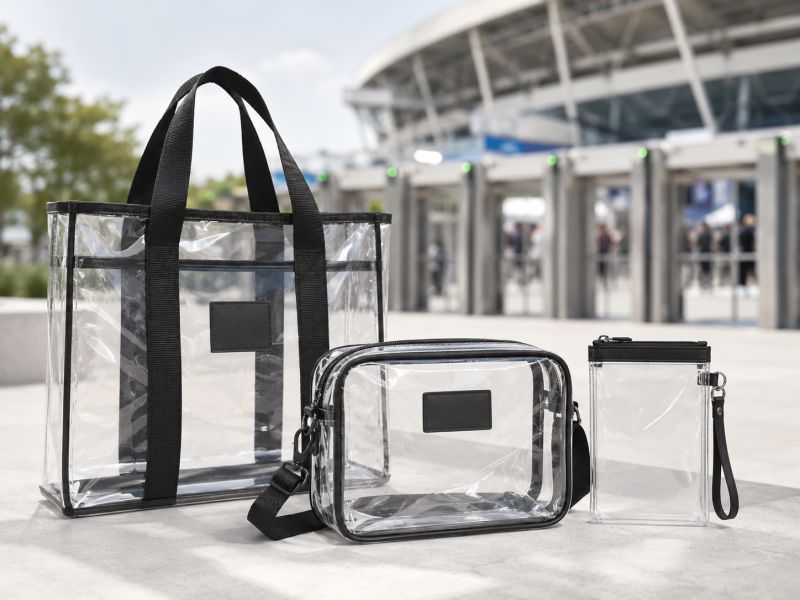
A clear stadium bag looks simple until it reaches the gate. Then every inch, seam, strap, print, zipper, and color choice starts to matter. A brand may see a transparent tote as a useful event giveaway. A school may see it as a practical spirit item. A stadium program may see it as a faster security tool. A retail team may see it as a product with strong seasonal demand. But the entrance staff sees something else first: can the contents be checked quickly, and does the bag match the venue’s policy?
Clear PVC bags for events and stadiums should be planned around size, transparency, structure, logo placement, and actual venue requirements. Common stadium-friendly dimensions include 12″ x 6″ x 12″, while some venues use 12″ x 12″ x 6″. Clear plastic, vinyl, or PVC is often accepted, but tinted panels, large prints, oversized pockets, and blocked visibility may create risk.
That is why a “clear bag” should never be developed by appearance alone. A slightly deeper gusset can turn a compliant-looking tote into a rejected bag. A large front logo can make the contents harder to inspect. A soft PVC panel may look nice in a photo but collapse after repeated use. A stiff panel may stand well but crack or smell stronger if the material choice is wrong.
The better approach is to treat the bag as a small product-development project: first confirm the venue type, then control size, material thickness, visibility, logo process, strap strength, edge binding, packaging, and sample approval. The following guide walks through the decisions that matter before a custom clear bag reaches a sports venue, concert entrance, school event, festival, or branded retail shelf.
What Are Stadium Clear Bag Rules?
Stadium clear bag rules usually control three things: material, size, and visibility. Many venues allow clear plastic, vinyl, or PVC bags around 12″ x 6″ x 12″, while some use 12″ x 12″ x 6″. Small non-clear clutches are often limited to about 4.5″ x 6.5″. For branded event bags, size, logo area, tint, pockets, and hardware should be checked before production.
Clear bag rules are not just about making a bag transparent. They are about making entry faster, easier, and more predictable. A gate team has only a short moment to see what is inside a bag. If the bag is too large, too dark, too heavily printed, or filled with layered pockets, the clear material no longer does its job.
For sports teams, schools, festivals, and event programs, this turns a simple product into a risk-control item. A bag may look attractive in a mockup, but it still needs to work at the entrance. If guests are stopped because the gusset is too wide, the logo covers half the front panel, or the material looks tinted instead of clear, the product can create the opposite feeling it was meant to deliver.
The safest planning starts with the strictest likely use. If the bag is for one stadium, use that venue’s latest public rule. If the bag will be used across many venues, keep the design conservative: clear front and back panels, controlled depth, small logo, simple pocket layout, and trim that does not block the view.
Here is a practical rule map for early design review:
| Rule Area | Common Reference | What It Means In Product Design |
|---|---|---|
| Clear bag size | 12″ x 6″ x 12″ or 12″ x 12″ x 6″ | Keep finished height, width, and depth within the target venue limit |
| Small clutch size | Around 4.5″ x 6.5″ or 6.5″ x 4.5″ | Non-clear small bags are usually treated separately from clear totes |
| Material wording | Clear plastic, vinyl, or PVC | Smooth clear PVC is usually safer than tinted or patterned material |
| Logo area | Some venues limit logo size | Keep branding compact and away from main visibility zones |
| Hardware and trim | Should not conceal the bag | Avoid wide opaque patches, large buckles, or heavy decorative panels |
| Pocket layout | Varies by venue | Fewer pockets usually means quicker inspection |
| Freezer bag option | One-gallon clear plastic bag | Shows that simplicity and visibility are key goals |
The detail many teams miss is finished size. A design drawing may show 12″ x 6″ x 12″, but the real bag can change after binding, sewing, filling, packing, and relaxing from carton compression. Clear PVC also behaves differently from fabric. A gusset can expand when items are placed inside. A soft panel can bow outward. A thick panel can hold shape but may feel stiff. For this reason, clear stadium bags should be checked empty and filled before approval.
Another detail is logo coverage. Branding is important, but stadium-friendly clear bags need visual space. A small logo on one side can work well. A full front print, dark sponsor block, wide colored panel, or repeated pattern can make the bag harder to inspect. For programs involving several sponsors, the smarter method is often to use smaller logo placement, strap details, hangtags, or packaging instead of covering the main clear panel.
This is also where packaging matters. Clear PVC scratches more easily than many woven fabrics. If bags are stacked without protection, printed panels may rub, transfer, or leave marks. A stadium bag that looked clean at sample stage can arrive with scuffs if packing is rushed. Good planning checks the product and the way it travels.
Why Did Clear Bag Rules Become Common?
Clear bag rules became common because large venues needed a faster way to check personal items during crowded entry times. At a stadium, thousands of people may arrive during the same 60–90 minute window. If every backpack or handbag needs to be opened, searched, and repacked, the gate slows down quickly.
Clear bags solve part of that problem by making contents visible before the bag is opened. Security staff can see a phone, wallet, keys, sunglasses, small pouch, or light jacket in seconds. The rule also helps guests know what to prepare before leaving home.
For a branded event product, the real purpose behind the rule should guide the design. The bag should not only be transparent in name; it should support quick visual checking. Wide dark trim, heavy prints, multiple front pockets, and tinted PVC can reduce that benefit. A simple clear body with neat binding and a compact logo often works better than a complicated style with more decoration.
This does not mean the bag has to look plain. Trim color, strap design, zipper puller, woven side label, hangtag, and neat packing can still create a polished look. The difference is that these details should support the clear function, not fight against it.
What Size Do Stadiums Allow?
Many stadiums allow clear plastic, vinyl, or PVC bags up to 12″ x 6″ x 12″. Some venues use 12″ x 12″ x 6″. In real design work, the order of the numbers matters less than the finished height, width, and depth staying within the venue’s allowed dimensions.
A practical stadium clear tote should not be planned exactly at the maximum limit unless there is a strong reason. Clear PVC bags can look larger when filled. A 6″ gusset may spread outward. Handle stitching can pull the top panel wider. A zipper edge can add small but visible size. These small changes may not matter in casual use, but at a strict entrance they can matter.
For safer bulk planning, the design team should build in a small margin below the policy limit. For example, instead of pushing every side to the maximum, keep the body slightly tighter and use the inner shape wisely. A clean rectangular structure, moderate gusset, smooth zipper opening, and stable handle drop can give enough capacity without making the bag look oversized.
The sample should be measured in three ways: flat on the table, standing empty, and lightly filled. If the filled shape exceeds the intended depth, the gusset or material stiffness should be reviewed before moving ahead.
What Are Common Bag Measurements?
Common clear stadium bag measurements include 12″ x 6″ x 12″, 12″ x 12″ x 6″, one-gallon clear freezer bag formats, and small clutch sizes around 4.5″ x 6.5″ or 6.5″ x 4.5″. These numbers appear often, but each venue can write the rule in its own way.
For product planning, every measurement should be labeled clearly. Is 12″ the width or height? Is 6″ the side depth or bottom gusset? Is the size measured from seam to seam, outside edge to outside edge, or after filling? These details need to be written into the specification before sampling.
A clean spec should include body width, body height, bottom depth, side gusset, handle drop, shoulder strap length, zipper opening, pocket dimensions, logo size, and carton packing direction. For clear bags, it should also show where the transparent viewing space remains open.
This kind of detail helps avoid common mistakes. A front logo may be approved at 5″ wide, then look too large once placed on a smaller crossbody panel. A bag may be called 12″ tall, but the binding pushes it slightly higher. A drawstring bag may measure fine when flat, then bulge after filling. Measurements should match real use, not only the artwork.
Is There A Size Limit?
Yes, clear stadium bags usually have a size limit, and it should be treated seriously. The most common large clear bag limits are around 12″ x 6″ x 12″ or 12″ x 12″ x 6″, while non-clear small clutches are often much smaller. A bag larger than the allowed size may be refused even if it is fully transparent.
For event programs, “a little bigger” is not always better. Extra capacity may seem helpful, but size is one of the first things gate staff can judge. If the bag looks too deep or bulky, it can attract extra checking or rejection. This is why a stadium-focused bag should be useful but controlled.
The best way to gain capacity is not simply to enlarge the bag. It is to use space better. A rectangular body with a stable bottom can hold essentials more neatly than a soft oversized pouch. A zipper that opens wide makes packing easier without adding size. A strap that carries weight well makes the bag feel more useful without changing the allowed body.
For school, concert, festival, or team programs, the size decision should begin with what people actually carry: phone, wallet, keys, sunglasses, small cosmetic pouch, ticket items, and maybe a light cloth item. If the bag is meant to hold heavy bottles, cameras, tablets, or bulky clothing, it may no longer match the spirit of stadium clear bag rules.
How Strict Is The Policy?
Clear bag policy can be very strict, especially at professional sports venues, large concerts, and high-attendance events. A bag may be rejected for being too large, not clear enough, too heavily printed, too dark, too decorated, or built with too many hidden compartments.
Strictness also changes by event. A regular school sports day may feel easier than a professional football game. A music festival may focus on speed and safety. A concert at a major stadium may follow the venue’s standard rules even if the event itself is not a sports event. For this reason, the safest wording is always: check the target venue before final design approval.
The real risk is not only entry refusal. It is confusion. If a group receives branded clear bags and some guests cannot bring them inside, the product creates complaints. If retail shoppers think a bag is stadium-ready but later discover it fails a local venue rule, the brand loses trust. If staff must explain unclear size or logo decisions on event day, the program becomes harder to manage.
A stricter policy does not mean the design must be boring. It means the design needs discipline. Keep the body visibly clear. Keep the size under control. Keep the logo compact. Avoid dark tint when stadium use is the priority. Avoid hidden pockets if fast inspection matters. Test the filled sample, not only the empty product photo.
Before bulk production, use this quick review list:
| Review Item | Safer Choice | Higher-Risk Choice |
|---|---|---|
| Body size | Below the venue limit | Exactly at the maximum or slightly over |
| Main material | Clear PVC or vinyl-style clear sheet | Smoke tint, color tint, frosted finish |
| Logo | Small, one-side placement | Large full-panel print |
| Pockets | One simple pocket or none | Several layered pockets |
| Trim | Narrow or moderate binding | Wide opaque panels |
| Hardware | Small functional parts | Large buckles or decorative plates |
| Sample check | Filled and measured | Only checked empty |
| Packing | Protected from scratches | Stacked tightly with print contact |
A clear stadium bag should make the entrance easier, not more uncertain. When size, material, logo, and structure are planned from the beginning, the final product feels more reliable for sports events, school programs, concerts, festivals, and brand activations.
Which Clear Bag Type Works Best?

The right clear bag shape depends on how people move, what they carry, where the bag will be checked, and how the brand wants to appear. Clear totes fit stadium giveaways and sports retail. Crossbody bags suit concerts and travel. Backpacks hold more but need stricter structure review. Drawstring bags are lighter for schools, races, and large event packs.
A clear bag should be chosen from the user’s real day, not from a flat product photo. A fan walking into a football game has different needs from a volunteer at a school sports day. A concert visitor wants hands-free movement. A retail shopper may care more about zipper quality, trim color, and how the product looks when worn. A staff kit may need stronger straps and more inner space. These details change the right shape.
The main styles used for clear stadium and event programs are PVC tote bags, clear crossbody bags, clear backpacks, clear drawstring bags, and small transparent pouches. Each one has a different strength. A tote is easy to inspect and easy to brand. A crossbody bag feels more personal and practical. A backpack has better capacity, but extra pockets and straps can add policy risk. A drawstring bag is simple, light, and useful for large group distribution.
The wrong choice usually comes from focusing only on appearance. A clear backpack can look attractive, but it may be too large or too complex for some venue entrances. A thin drawstring bag may look affordable, but the bottom corners can tear if users carry bottles or heavy items. A crossbody bag can feel premium, but a small front panel gives less room for a logo. A tote gives more print space, but weak handle stitching can damage the whole experience.
Use this practical comparison before starting sample work:
| Clear Bag Style | Better For | Usual Capacity | Main Strength | Main Risk |
|---|---|---|---|---|
| Clear PVC Tote | Stadiums, sports retail, fan gifts, school events | Medium | Easy viewing, strong logo area | Handle stress, gusset size |
| Clear Crossbody | Concerts, travel, festivals, lifestyle programs | Small to medium | Hands-free use, stylish shape | Limited logo space, strap pull |
| Clear Backpack | Staff kits, school programs, longer events | Medium to large | More carrying room | Extra pockets, size review |
| Clear Drawstring Bag | Races, school days, festivals, group packs | Light to medium | Easy handout, light weight | Bottom seam and cord pressure |
| Clear Travel Pouch | Beauty, travel, accessories, VIP kits | Small | Clean packing, easy sorting | Zipper and scratch control |
For a stadium-focused program, simpler usually means safer. For a lifestyle or retail program, finish and comfort matter more. For schools and events, cost, packing speed, and durability often become the key concerns.
PVC Tote Bags Vs Crossbody Bags
PVC tote bags work well when the product needs clear visibility, easy carrying, and a large logo area. They are often suitable for stadium giveaways, sports team shops, university events, sponsor packs, and fan merchandise. A tote gives enough room for a phone, wallet, keys, sunglasses, small pouch, light scarf, and event materials without feeling too complicated.
The main advantage of a clear tote is its open viewing area. A front and back PVC panel can be checked quickly at the gate. The large body also gives more room for branding, but the logo should still stay controlled. If the front print becomes too large, the tote may lose its clear function.
The weak area is usually the handle and upper edge. A clear tote may be carried by hand for hours, filled with personal items, or pulled from a seat. Thin webbing, weak stitching, or poor binding can make the product feel low-grade. For a better tote, check handle drop, webbing width, stitch strength, top edge reinforcement, bottom gusset, and whether the bag stands neatly when filled.
Clear crossbody bags fit a different user. They are better for concerts, travel, festivals, city events, and brand programs where people want hands-free movement. A crossbody bag feels easier to wear in a crowd. It also looks more like a lifestyle accessory than an event giveaway.
The trade-off is space. A crossbody bag has a smaller panel, so logo placement must be more careful. The shoulder strap also pulls on the side seams. If the PVC is too soft or the stitching area is not reinforced, the bag can twist, sag, or deform after use. A good crossbody sample should be tested while worn, not only checked flat on a table.
Clear Backpacks Vs Clear Drawstring Bags
Clear backpacks are useful when people need more capacity, but they require more careful review. They may be suitable for school programs, team staff, security staff, training kits, or longer events where users carry notebooks, uniforms, light apparel, water bottles, or work items. The extra space can be helpful, but it also creates more inspection concerns.
A backpack usually has more panels, pockets, zippers, straps, and stress areas than a tote or crossbody bag. Every extra pocket adds another layer. Every zipper adds labor and a possible failure area. Every strap attachment needs reinforcement. This does not mean clear backpacks are a bad choice. It means they should be planned as a more structured product, not as a simple transparent bag.
The first sample should be checked with realistic loading. Put common items inside and look at the filled shape. Does the front pocket block too much visibility? Does the bottom sag? Do the straps pull the back panel out of shape? Is the zipper smooth around the corner? Does the backpack look too bulky for the target venue? These checks matter before a large order starts.
Clear drawstring bags are simpler and lighter. They are common for races, school events, music festivals, volunteer kits, sponsor gifts, and group activities. They are easy to fold, ship, and hand out. A carton can hold many units, and event staff can distribute them quickly.
The risk is load strength. Drawstring bags are not ideal for heavy items unless the corners, bottom seam, cord channel, and material thickness are reviewed carefully. If the PVC is too thin, the cord may pull against the upper edge and create tearing. If the bottom seam is weak, sharp items or bottles may push through. For a clean program, match the drawstring style with light contents and simple use.
Which Type Fits Events Best?
For stadium seating, a compact clear tote or crossbody bag is usually the most practical. The tote gives more room and better visibility. The crossbody bag keeps hands free in crowded spaces. For concerts and festivals, crossbody and drawstring styles often feel more comfortable because visitors walk, stand, dance, and move between areas.
For school events, the decision often depends on age group and use time. A clear drawstring bag can work for one-day activities, sports days, camps, or student packs. A clear backpack may work better for staff kits, longer programs, or reusable school gear. If children will use the bag, edge softness, cord safety, zipper smoothness, and material smell should be checked carefully.
For retail and fan stores, a clear tote or crossbody bag often gives stronger perceived value. Shoppers usually compare finishing details: trim color, zipper, handle, strap feel, logo print, hangtag, and packing. A bag intended for paid sale should not feel like a disposable giveaway. It needs cleaner sewing, better edge binding, stronger PVC, and more careful packing to avoid scratches.
For beauty, travel, and VIP kits, smaller transparent pouches or clear travel bags may be more suitable. They can hold cosmetics, skincare, tickets, wristbands, travel bottles, or small event items. The key detail is zipper quality. A pouch is opened and closed often, so a rough zipper can make the whole product feel poor even if the material looks good.
The table below gives a quick direction:
| Event Need | Better Style | Design Notes |
|---|---|---|
| Stadium fan giveaway | Clear tote | Moderate size, small logo, reinforced handles |
| Concert entry bag | Crossbody | Adjustable strap, easy zipper, compact body |
| School sports day | Drawstring | Light contents, strong corners, simple packing |
| Staff or volunteer kit | Clear backpack | Strong straps, controlled pockets, durable zipper |
| Retail fan product | Tote or crossbody | Better trim, hangtag, barcode, clean packing |
| Beauty or travel kit | Clear pouch | Smooth zipper, scratch protection, neat logo |
| Race or festival pack | Drawstring | Lightweight, fast distribution, carton efficiency |
The better event bag is the one that makes the day easier. It should pass the entrance smoothly, carry what users need, show the brand clearly, and avoid complaints after distribution.
Who Needs Custom Stadium Bags?
Custom stadium bags are useful for sports teams, schools, universities, music festivals, concert organizers, event agencies, fan clubs, travel programs, beauty brands, retail teams, and gift companies. They can be used as fan merchandise, guest entry bags, sponsor gifts, staff kits, student packs, VIP sets, travel pouches, or retail accessories.
Sports teams often need clear bags for fan shops, season-ticket gifts, sponsor campaigns, or game-day promotions. For this use, size and visibility are important, but the product also needs a strong visual identity. Team colors can be shown through trim, zipper, webbing, hangtag, or compact logo placement rather than covering the whole clear panel.
Schools and universities often need transparent bags for sports events, campus activities, camps, and student groups. These programs usually care about durability, cost control, and easy distribution. A drawstring or tote style may work better than a complex backpack if the purpose is simple event access.
Music festivals and concerts need bags that feel easy to wear. A crossbody bag or drawstring bag often fits this environment because people move for hours. Comfort matters more than large capacity. The strap should not cut into the shoulder, and the bag should not bounce too much while walking.
Retail and lifestyle brands may choose clear bags because transparency gives a modern look and shows contents clearly. For these projects, finish quality becomes more important. The product may need custom trim colors, zipper pullers, hangtags, barcodes, and protective packing. A scratchy PVC surface or rough stitching will be noticed quickly when the bag is displayed or sold.
Beauty and travel brands often use clear pouches for kits, trial sets, or travel-friendly packing. These are not always stadium products, but they share the same material concerns: clarity, smell, zipper quality, print durability, and scratch control.
How Should Capacity Be Planned?
Capacity should be planned around real items, venue limits, and wearing comfort. A clear stadium bag does not need to carry everything. It should carry the essentials clearly and neatly: phone, wallet, keys, sunglasses, small cosmetics, tickets, light fabric, and small personal items. Overbuilding the bag can create size risk and make inspection slower.
A useful way to plan capacity is to create an item list before confirming size. For example, a stadium tote may need to hold a phone, wallet, keys, lip balm, sunglasses case, folded scarf, and small snack if allowed. A concert crossbody may only need phone, wallet, keys, ID, and lipstick. A school drawstring bag may hold a T-shirt, wristband, leaflet, and water bottle if permitted by the event.
Depth is often the most sensitive measurement. A bag that looks acceptable from the front can become too bulky from the side. A 6″ depth may be the limit for many stadium-style rules, so the gusset should be checked after filling. If the contents push the side outward, the finished bag may look larger than the written spec.
Strap comfort also affects capacity. A tote with thin handles may be fine when empty but uncomfortable when filled. A crossbody bag with narrow webbing may dig into the shoulder. A drawstring bag with thin cords may pull hard against the upper corners. Capacity is not only about inner space; it is about how the bag carries weight.
During sample review, test the bag in four conditions: empty, lightly filled, fully filled for normal use, and packed in its final packaging. Check whether the shape changes, whether the logo remains visible, whether the main panel stays clear, whether the zipper opens smoothly, and whether the strap hold firm.
A better capacity plan creates a bag that feels useful without looking oversized. That is the sweet spot for stadiums, concerts, schools, festivals, and branded events.
How Should Transparency Be Controlled?
Transparency should be controlled through material choice, sheet thickness, color tone, surface clarity, logo coverage, pocket structure, trim width, odor control, and sample testing with real items inside. A clear stadium bag should let staff see the contents quickly from the front, back, and side. If the bag is tinted, cloudy, heavily printed, or blocked by pockets, the clear function becomes weaker.
A transparent bag is not automatically suitable for events just because the main panel is made from PVC. Clear materials behave differently after cutting, stitching, folding, printing, stacking, and long-distance shipping. A panel may look bright under studio lighting but appear cloudy in a shaded entrance line. A bag may look fully clear when empty, then become hard to inspect when filled with a wallet, phone, keys, cosmetics, scarf, or small pouch.
For stadium and event use, visibility should be treated as a product function. The goal is not only a clear look; the goal is fast inspection. The front panel, back panel, and side gusset should keep enough open viewing space. The logo should not sit across the main inspection area. Pockets should not create too many layers. Binding and trim should support the structure without turning the bag into a mostly opaque product.
Thickness is another key detail. Thin PVC may save weight and cost, but it can wrinkle easily, pull near stitch holes, or look less premium after packing. Thicker PVC gives stronger structure and better shape, but it can feel stiff, increase weight, and create more sewing difficulty. The best choice depends on bag size, expected load, climate, structure, and quality level.
Odor also belongs in transparency control because clear PVC bags are often sealed in cartons or individual polybags. If the material smell is strong when opened, the product can feel lower grade even if the clarity is acceptable. For school events, beauty programs, retail displays, and indoor event packs, smell can create immediate complaints. Material selection, printing, drying time, and packing method should all be reviewed before bulk production.
A practical transparency review should include these checks before approval:
| Transparency Item | Safer Direction | Higher-Risk Direction |
|---|---|---|
| Main Panel | Clear, smooth, low haze | Frosted, cloudy, scratched, grainy |
| Color Tone | Nearly colorless or very light tone | Smoke, dark tint, strong colored tint |
| PVC Thickness | Matched to size and load | Too thin for structure or too stiff for use |
| Logo Coverage | Small and controlled | Large solid print across the front |
| Pockets | Simple layout | Multiple overlapping clear layers |
| Trim Width | Narrow or moderate | Wide opaque borders blocking visibility |
| Odor | Checked after sealed packing | Strong smell after opening |
| Filled Shape | Measured with real contents | Checked only when empty |
The simplest way to judge a clear bag is to fill it, stand two or three steps away, and look through it. If the contents are easy to identify and the bag still looks neat, the design is moving in the right direction. If the bag becomes dark, crowded, wrinkled, or visually blocked, adjust the material, logo, pocket layout, or trim before moving forward.
PVC Vs TPU Vs Clear Mesh
PVC is commonly used for clear stadium bags, transparent totes, crossbody bags, cosmetic pouches, travel pouches, and event bags because it gives clear visibility, easy cleaning, and strong water-resistant appearance. It also works well with stitching, binding, zippers, webbing, and common logo methods when the material specification is selected correctly.
TPU is often considered for projects that need a softer feel, better flexibility, or a more refined hand touch. It may feel more premium than standard PVC, especially for travel, beauty, and higher-quality transparent pouches. However, it usually comes with higher material cost and still needs sample testing for transparency, stitching behavior, logo adhesion, and final packing.
Clear mesh is lighter and more flexible, but it is not the same as a smooth clear sheet. Mesh may work for beach, sport, laundry, and utility-style bags, where breathability and drainage are useful. For stadium use, it needs careful review because venue wording often refers to clear plastic, vinyl, or PVC. A mesh structure may be visible, but it may not always match the expected look of a clear stadium bag.
A simple comparison helps early material selection:
| Material | Main Strength | Better Use | Watch Carefully |
|---|---|---|---|
| PVC | Clear look, easy cleaning, stable cost | Stadium totes, crossbody bags, pouches | Odor, thickness, cold feel, stitch holes |
| TPU | Softer hand feel, flexible finish | Premium pouches, travel, beauty programs | Cost, logo method, sample confirmation |
| Clear Mesh | Lightweight, breathable | Beach, sport, utility bags | Venue acceptance, see-through level |
For stadium-focused bags, smooth clear PVC is usually the safest starting option. For lifestyle or retail programs, TPU may be considered if the budget supports a better feel. For sports utility or beach use, clear mesh can work, but it should not be promoted as a universal substitute for stadium clear PVC.
How Thick Should Clear PVC Be?
Clear PVC thickness should be chosen by bag size, load, structure, season, and quality target. A small pouch can use lighter material than a tote with handles. A crossbody bag with a shoulder strap needs stronger stress areas than a flat pouch. A backpack with zippers and pockets needs more structure than a simple drawstring bag.
If PVC is too thin, the bag may wrinkle, stretch, collapse, or tear near stitching holes. The bottom may sag when filled. The side panels may bow outward and make the bag look larger than planned. Logo printing may also look uneven if the material moves too much during handling.
If PVC is too thick, the product can feel hard, stiff, and less comfortable. Thick material may also be harder to sew cleanly, especially around curved corners, zipper areas, folded edges, and strap attachments. In colder environments, stiff PVC may feel even harder. This is why thickness should not be selected only by “thicker is better.”
For clear stadium bags, thickness should be checked with the final shape. A tote needs the body to stand neatly but still feel comfortable to carry. A crossbody bag needs enough body to hold shape without pulling the side seams. A drawstring bag needs flexibility so the cord can close smoothly. A pouch needs a soft but stable sheet so the zipper does not wave or twist.
Sample checking should include flat measurement, filled shape, folding marks, stitch-hole strength, zipper smoothness, and hand feel. The material should also be packed in the same way as the final order, then reopened to check whether it leaves pressure marks, white fold lines, surface sticking, or strong smell.
Is Tinted PVC Risky?
Tinted PVC can be risky when the product is intended for stadium entry or strict event access. Light blue, smoke gray, light pink, or other transparent colors may look attractive in photos, but the deeper the tint, the harder it becomes to see contents quickly. If the bag also has a large logo, dark trim, or layered pockets, visibility can drop even more.
Tinted material may still work for beach bags, cosmetic pouches, travel organizers, lifestyle accessories, or retail collections where style is more important than venue access. The issue is not whether tinted PVC is useful. The issue is whether it matches the intended environment. Stadium and concert entry usually need a more conservative design.
A clear stadium bag should look obviously transparent at first glance. If staff need to look twice to understand what is inside, the design may be too dark or too visually busy. Smoke tint can make small items harder to recognize. Colored PVC can change the appearance of contents. Frosted or matte clear sheets can reduce sharpness even if the material is technically translucent.
When a brand wants color, safer options include colored binding, colored webbing, zipper tape, puller details, hangtag, or small side label. These elements can carry identity while leaving the main panels clear. This approach keeps the bag visually branded without turning the transparent body into a design risk.
Do Prints Block Visibility?
Prints can block visibility when they cover too much of the clear panel, use dense ink, sit in the main inspection area, or combine with pockets and dark trim. A small logo can work well. A full front graphic, repeated pattern, large sponsor block, or thick opaque print can make the bag harder to inspect.
Logo placement should be planned with the filled bag in mind. A mark that looks reasonable on an empty sample may cover important items once the bag is used. For example, a front-center print may sit directly over a wallet or pouch. A large white logo may look clean but still hide contents. A black or dark logo may stand out strongly but reduce the see-through area.
For multi-logo event programs, it is better to avoid filling the whole front panel with sponsor marks. Logos can be moved to a controlled side zone, arranged on a small patch, printed on trim, placed on a strap label, added to a hangtag, or shown on packaging. The product still carries brand value, but the clear body remains easier to inspect.
Print method also affects the result. Screen printing is useful for simple solid logos. UV printing can show sharper details and multiple colors. Both should be tested on the selected PVC sheet. The sample should be rubbed lightly, folded near the print area if relevant, packed for several days, and reopened to check for sticking, transfer, scratches, or edge cracking.
A practical print review can follow this table:
| Print Detail | Better For Stadium Use | More Risk |
|---|---|---|
| Logo Size | Small to moderate | Oversized front graphic |
| Ink Style | Light coverage, clean edge | Thick solid block |
| Position | Corner, side, trim, label | Center of main viewing area |
| Color | Clear contrast without heavy coverage | Dark dense print over contents |
| Multi-Logo Use | Hangtag, trim, packaging support | Full-panel sponsor wall |
| Sample Test | Filled view plus rub check | Digital mockup only |
A good logo should be seen, but the contents should still be seen faster.
Why Does Odor Control Matter?
Odor control matters because clear PVC bags are often opened in public, retail, school, office, or event environments. A strong plastic smell can make the product feel cheap, even when the design and logo are correct. For beauty, travel, school, and indoor event programs, odor can affect the first impression within seconds.
PVC smell can come from the material, printing ink, adhesive, packing method, or rushed sealing after production. If bags are stacked tightly and packed before the print fully stabilizes, the smell can stay inside the polybag or carton. Warm shipping conditions can make the smell stronger when the carton is opened.
Odor should be checked during sample review and again before bulk packing. A good method is to pack the sample in the proposed final packing, leave it sealed for several days, then open it in a normal room. If the smell is too strong, the material, ink, drying time, packing ventilation, or individual packing method should be adjusted.
Odor expectations should also match the product use. A one-day outdoor giveaway may tolerate a mild PVC smell more than a beauty gift set or indoor retail product. A pouch placed near cosmetics, skincare items, or travel products needs cleaner material selection and better packing control. A school program may need extra care because products may be distributed in classrooms, offices, or indoor sports areas.
Odor cannot be solved by appearance. It needs material review, production timing, and packing discipline. The better the product is expected to feel, the earlier smell control should be discussed.
How Should Samples Be Tested?
Samples should be tested in real use conditions before bulk production. For a clear stadium bag, the sample should not only be photographed empty. It should be filled, carried, opened, zipped, folded, packed, reopened, and viewed under different lighting. This gives a much clearer idea of how the product will perform after delivery.
Start with visibility. Fill the bag with common items: phone, wallet, keys, sunglasses, small pouch, folded fabric, and event materials. Look through the front, back, and side panels. Check whether the logo, pocket, trim, or tint blocks the view. If the contents are hard to recognize, the design needs revision.
Next, check shape. Measure the bag flat, standing, and filled. Pay attention to the side depth. A clear tote may look within the required size when empty but become too bulky after filling. A crossbody bag may twist when worn. A backpack may sag at the bottom if the material or sewing is too soft.
Then review surface and packing. Clear PVC can show scratches more easily than many fabrics. Stack the sample with its final packing method. Check whether the printed area transfers, whether panels stick together, whether folding creates white lines, and whether the bag smells strong after being sealed.
A simple sample checklist can prevent many bulk issues:
| Sample Test | What To Check |
|---|---|
| Empty View | Shape, clarity, trim width, logo balance |
| Filled View | Contents visibility, side depth, panel distortion |
| Carry Test | Handle pull, strap comfort, seam stress |
| Zipper Test | Smooth opening, puller strength, corner movement |
| Print Test | Scratch resistance, adhesion, transfer after packing |
| Odor Test | Smell after sealed storage |
| Packing Test | Scuffs, fold marks, sticking, carton pressure |
| Final Size | Flat size and filled size |
A clear bag is ready for bulk production only when it looks clean, carries well, stays within the planned size, keeps contents visible, and survives packing without obvious marks.
How Do Logo Rules Affect Design?

Logo rules affect clear stadium bag design through size, placement, ink coverage, print method, trim width, and how much of the transparent panel remains open for inspection. A compact logo on one side is usually safer than a large full-front graphic. Some venue policies refer to logo areas around 4.5″ x 3.4″, so stadium-focused bags should keep branding clear but controlled.
A clear bag has two jobs at the same time. It must help people enter an event smoothly, and it must still carry brand identity. These two needs can easily conflict. A large sponsor graphic may look strong in a digital mockup, but once the bag is filled with a phone, wallet, keys, sunglasses, and a small pouch, that same graphic can make the contents harder to see.
For stadium and event use, logo design should begin with visibility. The main front and back panels should stay mostly open. Logo position should not sit across the most important viewing area. Dense ink should be used carefully. Dark colors, large white blocks, metallic inks, reflective prints, and full-pattern graphics can all reduce the clear function.
Some venues allow a logo on one side only. Some also mention a maximum logo area. Some require the bag to remain clear from top to bottom, with only a limited border or trim. Because each venue may write its policy differently, a design intended for many stadiums should take the conservative path: smaller logo, one-side placement, clean transparent body, narrow or moderate trim, and no pattern covering the panel.
The logo should also match the material. PVC is smooth and non-porous, so logo adhesion needs testing. A print that works well on canvas may not perform the same way on PVC. Ink may scratch, peel, transfer during packing, or crack near folded areas if the process is not matched correctly. Screen printing and UV printing are common for clear bags, while woven labels, hangtags, zipper pullers, and trim details can carry identity without covering the transparent panel.
A useful design review should include the following checks before the sample is approved:
| Logo Decision | Safer Direction | Higher-Risk Direction |
|---|---|---|
| Logo Size | Compact mark, controlled area | Large solid front graphic |
| Placement | One side, corner, side zone, trim, label | Across the main viewing area |
| Ink Coverage | Light to medium coverage | Dense ink block or repeated pattern |
| Logo Color | Clear contrast without overblocking | Dark full-panel color block |
| Process | Tested screen print or UV print | Unchecked ink on PVC |
| Extra Branding | Hangtag, strap label, zipper puller | Full printed panel |
| Trim | Narrow or moderate border | Wide opaque border |
| Sample Review | Filled bag plus rub test | Empty mockup only |
The strongest design is not always the loudest one. For clear stadium bags, good branding should be recognized quickly, but the contents should still be visible even faster.
What Logo Size Is Safer?
A safer logo size is compact, easy to read, and kept away from the main inspection area. Some stadium-related policies mention logo sizes around 4.5″ tall by 3.4″ wide, and some allow logos only on one side of the clear bag. This gives brand teams a practical direction: keep the mark visible, but do not let it dominate the transparent panel.
The most common mistake is scaling the logo from a normal tote bag or retail pouch without adjusting for clear-bag rules. A 6″ or 8″ wide logo may look balanced on canvas, but on a clear stadium tote it can cover too much of the view. Once personal items are inside, the front panel becomes visually busy. Large graphics then make the bag look less open.
Logo size should be reviewed in real use, not only on artwork. Print the proposed size on a sample, fill the bag, and view it from a few steps away. Can the brand still be recognized? Can the contents still be seen? Does the logo sit over the area where users usually place wallets, phones, or small pouches? If visibility drops too much, reduce the logo or move it to a corner.
For multi-sponsor events, avoid stacking several large marks across the front panel. A cleaner option is one main logo on the bag and additional sponsor identity on the hangtag, insert card, packaging sticker, carton label, or event kit card. This keeps the product useful at the entrance while still supporting brand exposure.
Which Logo Process Works Best?
The best logo process for clear PVC bags depends on artwork detail, order quantity, color count, PVC thickness, durability needs, and desired look. Screen printing is practical for simple one-color or few-color logos. UV printing can support finer detail and richer graphics. Woven labels, hangtags, zipper pullers, and strap details can add identity without blocking transparency.
Screen printing often works well when the artwork is clean, bold, and not too detailed. It can keep cost under control for larger runs and create a crisp visual effect on a flat PVC panel. However, screen printing still needs ink adhesion testing. PVC surface treatment, ink type, drying time, and packing method all affect the final result.
UV printing can show more detail and stronger color effects, especially for logos with gradients, small letters, or multi-color artwork. It can also work on selected smooth surfaces such as PVC and EVA. The trade-off is that the printed layer should be checked for scratch resistance, flexibility, edge cracking, and whether it feels too raised on the panel.
Not every logo has to be printed on the clear panel. A woven label on the side seam, a small patch on the binding, a custom zipper puller, or a branded hangtag may look more refined and reduce visibility risk. For premium event kits or retail programs, this layered branding can feel more polished than one large front print.
Before choosing the process, prepare the logo file in vector format when possible. Confirm final size, color code, placement, and whether the logo must match a strict brand standard. A logo that is easy to approve on screen can still change slightly on clear PVC, so sample confirmation is essential.
Screen Printing Vs UV Printing
Screen printing is usually better for simple logos, solid colors, bold text, and higher-volume clear bag programs. UV printing is usually better for multi-color artwork, finer detail, small graphics, and more visual complexity. Both can work on clear PVC, but both need sample testing for adhesion, scratch resistance, color accuracy, and packing safety.
Screen printing is often chosen for stadium totes, drawstring bags, and simple transparent event bags because it is direct and stable when the print area is flat. A one-color logo in white, black, navy, red, or another brand color can look clean on clear PVC. It also works well when the logo does not require small gradients or photographic detail.
The limitation of screen printing is detail. Very small letters may fill in. Fine lines may lose sharpness. Multiple colors need better alignment control. Large solid ink areas may block visibility and may feel heavy on a clear panel. If the design requires a big filled block, review whether the bag still looks acceptable for stadium use.
UV printing gives more freedom for detailed artwork. It can be useful for special campaign graphics, multi-color icons, and small decorative elements. The concern is surface behavior. On flexible PVC, the print should be checked after bending, rubbing, packing, and unpacking. If the printed layer cracks at a fold, scratches too easily, or sticks to another panel, the process needs adjustment.
| Logo Need | Screen Printing | UV Printing |
|---|---|---|
| Simple one-color logo | Strong fit | Works, but may be unnecessary |
| Multi-color artwork | Possible with limits | Stronger option |
| Fine detail | Limited | Better |
| Large solid print | Possible, but visibility risk | Possible, still visibility risk |
| Cost control | Often stronger | Usually higher |
| Surface testing | Needed | Needed |
| Flexible PVC areas | Check ink stretch and rubbing | Check cracking and scratch resistance |
For clear stadium bags, the decision should not be “Which print looks stronger?” It should be “Which print stays clear, durable, and practical after filling, carrying, packing, and event use?”
Where Should Logos Be Placed?
Logos should be placed where they can be seen without blocking the main clear viewing area. Safer locations include the upper corner, lower corner, side seam area, trim section, small front pocket zone, strap label, zipper puller, hangtag, or packaging. Full-center placement can work only when the logo is small and the ink coverage stays light.
For a clear tote, the front lower corner often works well because the upper viewing area remains open. The upper center can also work if the logo is compact. A large middle-front logo is riskier because personal items often sit behind it. If the bag is filled with a wallet or pouch, the logo and the object can visually merge into a blocked area.
For a crossbody bag, the logo must consider how the bag sits on the body. A mark that looks centered on a flat sample may tilt when worn. The strap can pull one side upward, changing the visual balance. Place the logo after checking the worn position, not just the flat drawing.
For clear backpacks, the front pocket creates another layer of material. If the logo sits on that pocket, it may block more than expected. If the backpack has multiple pockets, keep the logo small and avoid placing it over the most layered area. Large front prints on clear backpacks can make inspection slower.
For drawstring bags, avoid placing the logo too close to the cord channel if the material wrinkles heavily when closed. A lower or central compact print may look better, but the filled-bag view should be checked. If the drawstring bag is used for light event kits, a simple logo and clean trim often work best.
How Can Branding Stay Visible?
Branding can stay visible without covering the whole clear panel by using several smaller details: a compact printed logo, colored binding, custom webbing, zipper puller, woven side label, hangtag, barcode label, insert card, or branded packaging. This approach keeps the clear body open while still making the product feel finished.
A clear bag does not have to rely on one oversized logo. In fact, large graphics can make the product less suitable for stadium use. A better method is to build identity through controlled details. Trim can match the team color. The zipper puller can carry a small mark. The strap can use custom woven webbing. A side label can show the brand name. A hangtag can tell the event story. The packaging can hold more visual information than the bag itself.
This layered method is also helpful when several sponsors are involved. Instead of crowding the clear panel with many logos, keep the main bag clean and place partner marks on a hangtag, insert card, or outer packaging. The product remains useful, and the sponsor information still appears in a more organized way.
Retail teams can also use packaging to raise perceived value. A simple clear PVC tote with clean stitching, neat binding, a small logo, a hangtag, and a barcode sticker can look more professional than a heavily printed bag with weak finishing. For event giveaways, a simple OPP bag and carton sorting may be enough. For store programs, hangtags and barcodes may be necessary.
How Should Logo Samples Be Checked?
Logo samples should be checked for size, placement, color, clarity, adhesion, scratch resistance, print transfer, packing safety, and filled-bag visibility. A logo should not be approved only from a digital file or flat photo. Clear PVC changes the way ink looks because the background is not fixed; the logo is seen over whatever the user places inside.
Start with the logo size. Measure it on the physical sample. Then fill the bag with common items and check whether the logo blocks too much. View the bag in daylight, indoor lighting, and shaded light. A logo may look clean in a studio photo but too heavy in a dim entry area.
Next, check adhesion and rubbing. Lightly rub the printed area with normal handling pressure. Open and close the bag. Bend the panel slightly if the logo sits near a flexible area. Pack the sample in the intended way for several days, then reopen it. Check whether the logo sticks to another panel, transfers ink, scratches, or leaves marks.
Finally, confirm the sample as a production reference. The approved version should include logo size, position, color, process, material, trim, zipper, strap, and packing method. During bulk work, the team should check logo position, color difference, blurring, peeling, patch placement, label matching, and packaging consistency.
| Logo Sample Check | What To Review |
|---|---|
| Size | Width, height, and relation to clear panel |
| Placement | Corner, center, side, strap, trim, pocket |
| Visibility | Filled bag view from front, back, and side |
| Color | Match to brand color within practical limits |
| Edge Clarity | Small text, lines, and sharp corners |
| Adhesion | Rubbing, bending, and handling |
| Packing Safety | Transfer, sticking, scratches, pressure marks |
| Bulk Reference | Same logo standard used for production checks |
For clear stadium bags, logo approval is not just a design step. It protects entry use, brand image, and bulk consistency at the same time.
How Does A Factory Develop Bulk Orders?

A factory develops bulk clear bag orders by turning the idea into controlled specifications: size, material, thickness, transparency, logo, trim, strap, zipper, packing, quantity, deadline, and target venue rules. The sample should confirm real use, not only appearance. Bulk production should follow the approved sample, inspection checklist, and packing plan.
Clear PVC bags can look easy from the outside, but a bulk order has many small decisions hidden inside. A tote with the same outer size can feel completely different depending on PVC thickness, binding width, handle reinforcement, zipper quality, stitch spacing, print coverage, and carton packing. A small crossbody bag may pass a photo review but fail after filling because the strap pulls the panel out of shape. A clear backpack may look practical but become too complex for fast stadium inspection if it has many pockets.
For a , the factory process should reduce uncertainty step by step. The first step is not “How much is this bag?” The first step is “What exactly needs to be made, used, checked, packed, and delivered?” Without that information, any price is only a rough guess. The same clear tote can be made as a low-cost event handout, a retail-quality fan item, a school activity bag, a beauty travel pouch, or a premium branded stadium accessory. Each version needs a different material, structure, and inspection level.
A serious factory review usually starts with a reference photo or drawing, then turns it into a working specification. The team should confirm whether the bag is for one venue or many venues, whether it needs to follow a specific stadium rule, whether the logo should be small and safe or more decorative, whether the bag will be sold or given away, and whether retail packaging is needed. These details shape the whole product.
The development stage should also identify risk early. Clear PVC can show scratches. Printed logos can transfer if packed too soon. Thin panels can stretch at handle . Thick panels can feel stiff in cold weather. Dark trim can reduce visibility. A large logo can make the bag less suitable for stadium entry. None of these issues are surprising when the factory checks them before bulk production. They become expensive only when they are discovered after thousands of units are made.
| Development Step | Decision | Factory Review |
|---|---|---|
| Use Scenario | Stadium, concert, school, retail, festival | Policy risk, carrying habits, durability need |
| Size | Target outer dimensions and capacity | Finished size, gusset, tolerance, filled shape |
| Material | PVC, TPU, clear mesh, trim fabric | Thickness, clarity, odor, flexibility, strength |
| Logo | Size, color, placement, file type | Process fit, print adhesion, visibility impact |
| Structure | Tote, crossbody, backpack, drawstring | Sewing difficulty, stress , inspection speed |
| Packing | OPP, tag, barcode, carton, display | Cost, labor, delivery, warehouse handling |
| Quantity | Trial order, bulk order, repeat order | MOQ, material buying, line planning |
| Deadline | Event date, launch date, shipping window | Sample time, production time, transport plan |
Jundong is a Guangdong-based custom bag factory with experience in OEM and ODM bag projects. For clear bags, the development work should never stop at “transparent material plus logo.” It should check the full path from design idea to sample, from approved sample to bulk production, and from finished product to event or retail use.
What Specs Should You Send?
For a clear PVC bag inquiry, should send a reference photo or drawing, target size, bag type, material preference, logo file, logo size and position, order quantity, packing method, target venue or event type, deadline, and destination. If the bag must follow a stadium rule, include that rule before sampling starts.
A clear and useful inquiry does not need to be perfect. Many start with only an idea, a competitor photo, or a hand sketch. That is fine. What matters is whether the factory receives enough information to understand the project direction. A simple message such as “We need 1,000 clear stadium bags with logo” is a start, but it is not enough for accurate development. The factory still needs to know size, shape, logo details, material thickness, strap style, packing, and timing.
For working on sports events, concerts, school programs, festivals, or brand campaigns, the most important detail is the use environment. A bag for a one-day giveaway may use a simpler structure. A bag for retail sale needs better finish, more stable packing, and stronger visual presentation. A bag for staff kits may need stronger straps and better load performance. A bag for stadium entry needs conservative size and clear visibility.
A good specification also prevents misunderstandings between design, sourcing, factory, and management teams. When everyone sees the same size, logo size, trim color, strap length, zipper type, and packing request, the sample process becomes faster and cleaner.
| What To Send | Helpful Detail |
|---|---|
| Reference Image | Front, side, inside, strap, pocket, zipper, trim |
| Target Size | Width, height, depth, handle drop, strap length |
| Bag Type | Tote, crossbody, backpack, drawstring, pouch |
| Material Idea | PVC thickness, TPU option, clear mesh, trim material |
| Logo File | AI, PDF, SVG, or high-resolution artwork |
| Logo Position | Front, corner, strap, pocket, tag, zipper puller |
| Color Request | Clear panel tone, trim color, zipper color, webbing color |
| Quantity | Per design, per color, per logo version |
| Packing | OPP bag, hangtag, barcode, carton mark, gift packing |
| Event Rule | Stadium size rule, logo limit, transparent policy |
| Deadline | Sample date, bulk delivery date, event date |
| Destination | Country, city, warehouse, forwarder, trade term |
The more specific the inquiry, the more useful the first reply will be. If some details are not decided, the can say so clearly. For example: “We are not sure whether to use 0.3 mm or 0.5 mm PVC. Please advise based on stadium giveaway quality.” That kind of message allows the factory to provide practical direction instead of guessing.
How Does The Sample Process Work?
The sample process turns a clear bag idea into a physical product for checking size, transparency, logo, stitching, strap strength, zipper function, smell, and packing. Regular sampling usually takes 5–7 days, while simple styles may take 2–3 days. Complex structures, special logo methods, or custom packaging may need more time.
A clear bag sample should be judged with the same seriousness as a fabric backpack or travel bag sample. It is not only a visual mockup. It is a test of material, cutting, stitching, print, structure, and use. The sample should show whether the bag can hold its shape, whether the PVC is clear enough, whether the logo is too large, whether the zipper opens smoothly, and whether the handle reinforcement feels strong.
The first sample may not be perfect. That is normal in custom work. The purpose of the first sample is to expose decisions before bulk production. Maybe the front logo needs to be reduced. Maybe the trim should be narrower. Maybe the PVC should be thicker. Maybe the shoulder strap needs stronger webbing. Maybe the carton packing should avoid folding marks. These changes are much easier to make during sampling than after mass production.
For stadium-focused products, one of the most useful sample checks is the filled-bag test. Put common items inside and look at the product from the front, back, and side. Does the logo block too much? Does the gusset expand past the target size? Does the bag still look clean? Can the contents be identified quickly? This test is simple, but it catches problems that flat product photos often hide.
The sample approval should also include a written confirmation. should not approve only by saying “Looks good.” The approved sample should be tied to clear details: final size, PVC thickness, trim color, logo size, logo process, zipper, strap, stitching, label, packing, carton quantity, and any tolerance that matters.
| Sample Check | What To Review | Why It Matters |
|---|---|---|
| Size | Empty size and filled shape | Prevents policy and capacity problems |
| Transparency | Front, back, side view with contents | Keeps the bag easy to inspect |
| Material | Thickness, softness, odor, scratches | Affects feel, quality, and complaints |
| Logo | Size, color, adhesion, position | Protects visibility and brand display |
| Sewing | Stitch spacing, edge binding, stress | Controls durability |
| Zipper | Opening, puller, track smoothness | Affects daily use |
| Strap | Length, comfort, load pull | Prevents deformation and breakage |
| Packing | Folding, stacking, print transfer | Protects product during shipping |
For a , the biggest value of sampling is confidence. A good sample does not only show what the product looks like; it proves that the order can move into bulk production with fewer surprises.
What Affects Clear Bag Price?
Clear bag price is affected by size, PVC thickness, material grade, structure, zipper, strap, trim, logo method, color count, packing, quantity, inspection needs, and delivery plan. A larger or thicker bag uses more material. A complex crossbody or backpack needs more sewing time. Retail packaging, barcode labels, and custom tags also change cost.
The cheapest clear bag is not always the lowest-risk choice. A low-cost material may look acceptable in the first photo but create odor, cracking, cloudiness, or weak sewing later. A cheaper zipper may save a little money but hurt the user experience every time the bag opens. A thin strap may reduce cost but make the product feel disposable. For event giveaways, cost control matters. For retail products or repeat programs, the balance between cost and use quality matters even more.
Price also changes with order quantity. Higher quantities usually help spread setup, printing, material sourcing, and line preparation costs across more units. Lower quantities can still be reviewed for some simple styles, but the unit price may be higher because many fixed steps remain the same: material sourcing, sample work, cutting, printing setup, QC, packing, and export preparation.
Logo is another cost driver. A one-color screen print on a simple flat panel is usually easier to control than a multi-color detailed print. UV printing can be useful for complex artwork, but it may cost more. A rubber patch, woven label, metal puller, or special tag can improve perceived value, but each added element affects material sourcing, labor, MOQ, sample time, and packing.
Packing should not be ignored in price planning. For a large event handout, a simple OPP bag and carton mark may be enough. For retail, the may need hangtags, barcode stickers, inner labels, shelf-ready packing, or color boxes. These details add cost, but they also reduce warehouse confusion and improve retail presentation.
| Cost Factor | Lower-Cost Direction | Higher-Cost Direction |
|---|---|---|
| Size | Small pouch or compact tote | Large tote, backpack, wide gusset |
| Material | Standard clear PVC | Premium TPU or thicker PVC |
| Structure | Simple tote or drawstring bag | Multi-pocket backpack or shaped crossbody |
| Logo | One-color small print | Multi-color large print or custom patch |
| Trim | Standard webbing and zipper | Custom color, custom puller, special hardware |
| Packing | Bulk carton or simple OPP | Retail tag, barcode, gift box, set packing |
| Quantity | Higher order quantity | Low quantity with full customization |
| Inspection | Standard production checks | Extra testing or third-party inspection |
A practical quote should explain the cost structure instead of only giving a number. who understand what drives price can make smarter decisions. For example, if the budget is tight, the factory may suggest keeping the logo smaller, using standard trim colors, simplifying the pocket, or choosing a more efficient packing method. These changes can reduce cost without damaging the main purpose of the bag.
How Long Does Production Take?
Standard bulk production for custom bags usually takes around 20–30 days after sample approval and material confirmation. Simple clear bag styles may move faster when materials and trims are available, while complex structures, custom colors, detailed printing, retail packaging, or tight peak-season schedules may require more time.
Lead time should be counted from the right starting . Many count from the day they first ask for a quote, but production does not truly start until the sample, material, logo, quantity, packing, and order details are approved. If artwork changes, color changes, size changes, or packaging changes after approval, the schedule may need to be adjusted.
For event and stadium projects, timing is often fixed. The game day, concert date, school opening, festival weekend, or retail launch will not wait for late production. This means the development calendar should leave space for sampling, sample revision, bulk production, inspection, packing, shipping, customs, and local delivery. A bag finished at the factory is not the same as a bag delivered to the event warehouse.
A safer schedule for a custom clear bag project often looks like this:
| Stage | Typical Time Direction | Action |
|---|---|---|
| Initial Review | 1–3 days depending on details | Send size, logo, quantity, packing, deadline |
| Sampling | Usually 5–7 days; simple styles may be 2–3 days | Confirm material, logo, trim, structure |
| Sample Revision | Depends on change level | Give clear comments with photos or notes |
| Bulk Preparation | After sample and order approval | Confirm final quantity, packing, payment, shipping |
| Bulk Production | Usually 20–30 days | Track production and inspection plan |
| Shipping | Depends on method and destination | Choose express, air, sea, rail, or forwarder plan |
The most common timing mistake is leaving sampling too late. When rush the sample stage, they may approve a bag without checking filled shape, logo coverage, zipper smoothness, odor, or packing. That can create problems later. A few extra days spent on sample review can protect the whole order.
Another timing issue is packaging. Retail tags, barcode labels, printed inserts, color boxes, or special carton marks need artwork and approval. If the bag is ready but the packaging file is late, the shipment can still be delayed. That is why packing should be discussed at the same time as the bag design, not after production is almost finished.
For urgent event programs, should send the event date clearly. A factory can then judge whether the project is realistic, whether the sample can be simplified, whether available materials can be used, and which shipping method makes sense. It is better to adjust the design early than to discover later that the deadline cannot support the original idea.
How To Choose A Clear Bag Manufacturer?
Choose a clear bag manufacturer by checking real custom experience, material knowledge, sample ability, logo process control, clear PVC handling, QC steps, packaging support, MOQ clarity, communication speed, and project review logic. The right factory should help reduce risk from sample to bulk, not only offer a low unit price.
Clear bags require a different review mindset from fabric bags. Fabric can hide some marks, but clear PVC shows scratches, dust, fingerprints, print transfer, uneven stitching, and cloudy areas more easily. The manufacturer needs to understand how transparent material behaves during cutting, sewing, printing, folding, packing, and shipping. A factory that treats clear PVC like ordinary fabric may miss details that notice immediately when the cartons arrive.
A good manufacturer should also talk about limits. If a logo is too large for a stadium-focused design, the factory should say so. If a tinted panel may create entry risk, the factory should explain it. If a low quantity will make the unit price high, that should be clear. If the requested deadline is too tight for the structure, the factory should suggest a simpler style or available material. Honest review is more useful than easy promises.
For larger , factory scale and process control matter. A small workshop may handle a simple sample, but repeat programs need stable communication, production planning, QC, packing, and shipping coordination. Jundong supports custom bag projects with product development, sampling, bulk production, quality control, packaging, and delivery review. The standard MOQ is usually 500 pcs per design, selected simple styles may be reviewed at 200–300 pcs, and sample fees can be refunded or deducted when the bulk order reaches 2000 pcs.
When comparing manufacturers, should not look only at the product photo. Ask how the factory checks PVC clarity. Ask how logo adhesion is tested. Ask whether the filled sample will be reviewed. Ask what happens if the first sample needs adjustment. Ask how carton packing prevents print transfer and panel scratches. These reveal whether the factory understands the product or only follows a picture.
| Manufacturer Check | Why It Matters |
|---|---|
| Clear Bag Experience | PVC has visibility, odor, scratch, and packing risks |
| Sample Room | Custom structure needs physical review before bulk |
| Material Advice | Thickness and clarity affect quality and cost |
| Logo Process | Print adhesion and coverage affect durability and compliance |
| QC Team | Clear bags show defects more easily than many fabric bags |
| Packing Support | Prevents scratches, folding marks, and warehouse confusion |
| MOQ Clarity | Avoids wrong expectations before development |
| Communication | Reduces delay during artwork, sampling, and revision |
| Project Review | Helps match product to event, venue, and budget |
A reliable clear bag manufacturer should make the feel more informed after the first discussion. The conversation should become more specific: size, material, thickness, print method, packing, lead time, and risk control. If the only response is a price without asking about the project, the may not be getting enough support.
For brands, schools, event agencies, retailers, and sports programs, the goal is not just to receive clear bags. The goal is to receive clear bags that fit the event, represent the brand, pass practical use, and arrive in time. That is the difference between simple sourcing and real product development.
If you are planning a clear PVC bag program for stadiums, concerts, schools, festivals, sports teams, retail shelves, or branded events, prepare the basic details first: reference photo, target size, logo file, quantity, packing request, target venue rules, deadline, and destination. With those details, Jundong can review the structure, material, logo method, sample plan, and bulk production direction more accurately. For project review, you can send your details to info@jundongfactory.com.
A clear bag may look like a small product, but the right development work can protect the whole program. Good size control helps the bag fit stadium rules. Good transparency helps users pass inspection with less stress. Good logo planning keeps the brand visible without blocking contents. Good sampling catches problems before bulk production. Good factory communication turns the idea into a product that can be packed, shipped, used, and reordered with confidence.
How To Build A Retail Branding Program?
A retail canvas bag program should start with use, not decoration. Decide what the bag should carry, how it should be reused, how it should look with the product line, and how many versions are needed. Then confirm size, fabric, logo method, labels, packing, sample, bulk quality checks, and reorder rules.
A strong retail canvas bag program is usually built in stages. First, define the role of the bag. Is it packaging, merchandise, gift with purchase, event item, limited drop, or reusable shopping tote? Second, choose a structure that fits the role. Third, confirm artwork and materials through samples. Fourth, lock the packing and carton plan. Finally, keep clear records so future orders can repeat the same quality.
The best programs feel simple from the outside but are well planned inside. A bag may look like “natural canvas with black logo,” yet the real work includes fabric weight, handle drop, logo position, color approval, inner label, hangtag, barcode, folding method, carton marks, and delivery schedule.
| Program Area | What To Decide Early |
|---|---|
| Bag role | Packaging, gift, merchandise, event, limited release |
| Main use | Books, cosmetics, apparel, groceries, gift sets, daily carry |
| Size | Width, height, gusset, handle drop |
| Material | Cotton canvas, organic canvas, recycled blend, washed canvas |
| Logo | Print, embroidery, patch, woven label, transfer |
| Retail detail | Hangtag, care label, barcode, product sleeve |
| Packing | Flat fold, individual bag, gift packing, carton sorting |
| Quantity | Per design, per color, per store, per campaign |
| Quality check | Fabric, logo, stitching, handle, stain, packing |
| Reorder record | Approved sample, color card, label file, carton data |
A good retail program does not need too many versions at the beginning. One strong size, one clear fabric, one proven handle structure, and one or two colorways can be safer than launching six versions before the structure is tested. Once the first order performs well, seasonal colors, artwork collaborations, upgraded labels, or limited versions become easier to add.
What Should Brands Prepare?
A clear retail canvas bag request should include size, canvas preference, logo artwork, logo placement, quantity, color plan, handle style, expected use, packing needs, destination, and timeline. These details help avoid vague estimates and make sampling more accurate.
Useful starting details include:
| Detail | Example |
|---|---|
| Bag role | Gift tote, bookstore tote, grocery tote, merchandise tote |
| Finished size | 38 × 42 cm flat tote, or 35 × 40 × 10 cm gusset tote |
| Canvas direction | Natural cotton canvas, 12 oz canvas, washed canvas, organic canvas |
| Handle | Cotton webbing, self-fabric handle, shoulder drop, short hand carry |
| Logo file | Vector file, Pantone color, print size, placement |
| Logo method | Screen print, embroidery, woven label, patch, full-color print |
| Use load | Light gift items, books, grocery goods, boxed set |
| Packing | OPP bag, hangtag, barcode sticker, carton mark |
| Quantity | 500 pcs, 1,000 pcs, 5,000 pcs, split by color |
| Schedule | Sample date, launch date, delivery deadline |
| Destination | Warehouse, forwarder, port, store distribution |
A photo or sketch is helpful, but it should not be the only detail. A picture does not show finished dimensions, canvas weight, print method, handle drop, packing style, or load requirement. If the retail team is still unsure, it is better to prepare two or three directions for comparison.
For example:
| Option | Structure | Use |
|---|---|---|
| Cost-controlled | 10 oz canvas, one-color screen print, simple handle | Event or light retail |
| Standard retail | 12 oz canvas, cotton webbing, woven label, hangtag | Store gift or reusable tote |
| Premium | Heavy canvas, embroidery or patch, inner label, refined packing | Merchandise or limited release |
This type of comparison makes decisions faster. It also helps keep cost, style, and use aligned from the beginning.
How To Plan Multi-SKU Orders?
Multi-SKU canvas bag orders should be planned with clear color codes, artwork files, label rules, packing lists, carton marks, and quantity split per version. A multi-SKU project can look simple at the design stage but become confusing during production and packing if each version is not clearly controlled.
Common multi-SKU formats include:
| Multi-SKU Type | Example |
|---|---|
| Same bag, different colors | Natural, black, navy, olive |
| Same bag, different artwork | Seasonal slogans or artist graphics |
| Same structure, different sizes | Small gift tote and large shopping tote |
| Different logo placements | Front print, side label, pocket embroidery |
| Retail set program | Tote plus pouch, dust bag, or gift sleeve |
| Store or region version | Different label or barcode per destination |
The biggest risks are mix-ups. A black tote may need white print, while a natural tote uses black print. One color may need a different barcode. One region may need a different hangtag. One store set may need special carton sorting. These details must be locked before packing begins.
A practical multi-SKU control sheet should include:
| Control Item | What It Prevents |
|---|---|
| SKU code | Confusion between versions |
| Color name and color standard | Fabric mismatch |
| Logo file name | Wrong artwork use |
| Print color | Incorrect ink setup |
| Label file | Wrong woven label or care label |
| Hangtag version | Wrong story, price, or barcode |
| Quantity per SKU | Overproduction or shortage |
| Carton quantity | Packing and warehouse errors |
| Carton mark | Store or destination confusion |
| Final photo record | Helps future reorder |
For a first multi-SKU run, fewer versions can reduce risk. A good approach is to keep the same size and structure, then vary fabric color or artwork. Once the process is stable, later programs can include more sizes, labels, and packaging types.
When Should Packaging Be Added?
Packaging should be planned before sampling when the tote will be sold, gifted, barcoded, shipped to stores, or packed into product sets. Packaging affects folding, presentation, carton size, labeling, warehouse handling, and final cost. Adding packaging late can create delays and extra adjustments.
Retail canvas bags can use different packing methods:
| Packing Method | Best Use | Notes |
|---|---|---|
| Bulk pack | Events, internal use, low-cost programs | Lower packing cost, less retail polish |
| Individual OPP bag | Clean storage and distribution | Good for e-commerce and store handling |
| Hangtag only | Merchandise or gift tote | Adds product identity |
| Barcode sticker | Retail checkout and warehouse use | Needs accurate SKU control |
| Paper sleeve | Folded tote display | Clean shelf presentation |
| Gift packing | Holiday sets, premium campaigns | Higher presentation value |
| Carton sorting by SKU | Multi-store or multi-color programs | Reduces warehouse confusion |
Packing also changes how the tote behaves after delivery. A heavily folded canvas tote may show crease marks. A stiff handle may not fold neatly into a small bag. A structured bottom may increase carton space. A hangtag may bend if the packing method is too tight.
Packaging should be checked with the sample. Fold the tote the same way it will be shipped. Add the hangtag, barcode, OPP bag, or sleeve. Then review whether the tote still looks good when opened. If the first impression matters, packing cannot be treated as an afterthought.
Do Limited Bags Create Demand?
Limited canvas bags can create demand when the design has clear value: seasonal color, artist artwork, special logo, store anniversary, collaboration, membership access, holiday gift set, or limited packaging. Scarcity alone is not enough. The bag still needs to look good, feel useful, and connect naturally with the retail story.
A limited tote works best when it has one strong reason to exist:
| Limited Bag Theme | How It Creates Interest |
|---|---|
| Seasonal color | Easy to collect and rotate |
| Artist artwork | Adds cultural and visual value |
| Store anniversary | Creates memory and occasion |
| Holiday gift set | Adds gift appeal |
| Member-only tote | Supports loyalty feeling |
| Local city edition | Connects to place and community |
| Product launch tote | Extends campaign identity |
| Small collection series | Encourages repeat interest |
The design should avoid looking like a leftover logo bag with a new date added. A limited tote should feel intentional. That may come from a special canvas color, label, woven patch, inside tag, numbered hangtag, or artwork tied to the campaign.
Quantity planning also matters. If the quantity is too low, stores may run out before the program builds visibility. If it is too high, the limited idea loses energy and inventory may sit too long. A practical approach is to start with one strong version, then review sell-through, reuse feedback, and social visibility before planning the next release.
How To Choose A Factory?
Choose a production partner that can review the full canvas bag project, not just accept artwork and print it. Retail canvas bags need material advice, logo process review, sampling, handle and seam control, packing support, quality checks, and bulk consistency. The right partner should help prevent problems before production, not only fix them after they appear.
Important capabilities to check:
| Capability | Why It Matters |
|---|---|
| Canvas material knowledge | Helps match weight, texture, color, and use |
| Logo process options | Allows print, embroidery, labels, patches, or transfer review |
| Sample support | Confirms real fabric, logo, handle, and packing |
| Handle and seam review | Protects carrying performance |
| Packaging support | Helps with hangtags, barcodes, OPP bags, carton marks |
| Multi-SKU handling | Reduces color, label, and packing mix-ups |
| Quality inspection | Checks logo clarity, stitching, stains, size, packing |
| Bulk timing control | Supports launch schedules |
| Clear communication | Reduces late changes and unclear approvals |
For retail tote projects, a low price alone is not enough. The bag may be visible in public, sold as merchandise, included in gift sets, or used across stores. Poor fabric, weak handles, wrong logo placement, or messy packing can reduce the value of the whole campaign.
Jundong supports custom bag projects from material review and sampling to bulk production, quality checks, labeling, packaging, and delivery planning. Standard MOQ is usually 500 pcs per design, with some simple styles reviewed at 200–300 pcs depending on the project. For low-unit-price basic styles, 1000 pcs or more may be more practical. Sampling usually takes 5–7 days, while some simple styles may take 2–3 days. Bulk production usually takes 20–30 days after approval.
What Makes Reorders Easier?
Reorders become easier when the first order has clear records: approved sample, fabric details, color standard, logo file, stitch method, handle drop, label placement, packing method, carton information, and inspection notes. Without records, a reorder can look similar but feel different.
Useful reorder records include:
| Record | Why It Helps |
|---|---|
| Approved sample | Physical reference for future orders |
| Fabric weight and color | Keeps hand feel and appearance consistent |
| Logo file and print size | Prevents artwork changes by mistake |
| Print color standard | Supports closer color matching |
| Handle drop and width | Keeps carry feel the same |
| Stitch and seam details | Maintains structure |
| Label and tag files | Keeps retail identity consistent |
| Packing photo | Repeats folding and presentation |
| Carton mark | Helps warehouse handling |
| QC notes | Prevents repeated issues |
Reorders are also easier when the first design avoids unnecessary complexity. If the tote uses a special fabric that is hard to source, a custom webbing color with high material requirements, or too many label variations, repeat orders may be slower. A clean structure with well-documented details is easier to repeat and scale.
A strong retail canvas bag program should think beyond the first shipment. If the tote performs well, future orders may add new colors, artwork, store editions, gift packaging, or seasonal tags. Good records make these updates smoother without losing the original quality.
Closing: Make The Canvas Bag Worth Carrying Again
A retail canvas bag does more than move products from one place to another. It carries a logo into everyday life. That only happens when the bag feels useful, looks right, and holds up after the first use. A strong canvas bag program connects fabric, logo, handles, labels, packing, and bulk control into one clear product experience.
The most successful retail totes usually share the same qualities:
- The size fits real products and daily use.
- The canvas feels appropriate for the brand level.
- The logo method suits the artwork and fabric.
- The handles feel comfortable under load.
- The seams and bottom support the expected contents.
- The label and hangtag add retail polish.
- The packing protects presentation and sorting.
- The sample proves both appearance and function.
- The bulk order follows the approved standard.
- The reorder file is clear enough for future programs.
A canvas tote should not feel like a random add-on. It should feel like it belongs to the store, the product line, and the person carrying it. When that happens, the bag becomes more than packaging. It becomes something people keep.
For a practical custom retail canvas bag review, prepare the tote size, canvas direction, logo artwork, logo process, handle style, expected use, quantity, packing needs, destination, and timeline. Jundong can review these details and suggest a realistic structure, sample direction, packing plan, and bulk production route based on the project requirements.