 Skip to content
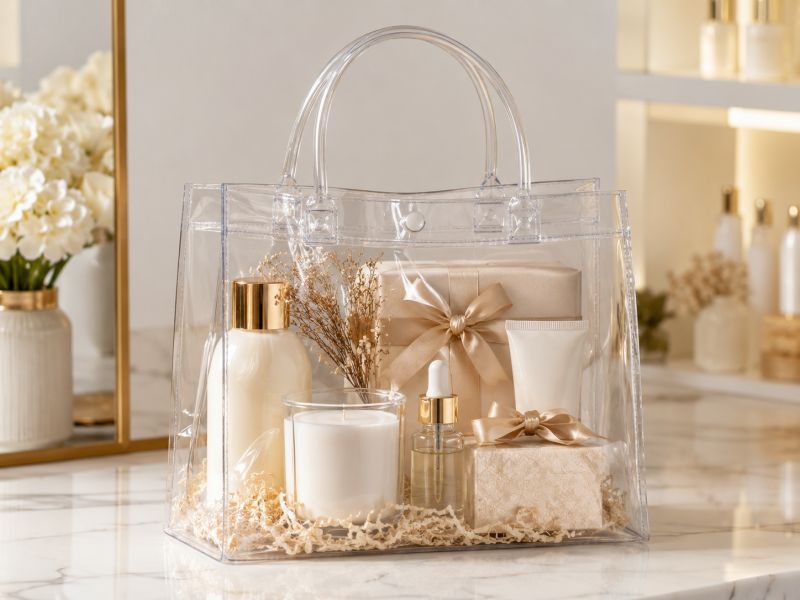
Transparent packaging can make a gift set feel easier to understand before anyone opens it. That sounds simple, but in retail gifting, event giveaways, beauty sets, travel kits, candy bundles, holiday packs, and promotional sets, “easy to understand” can quietly decide whether a product is picked up or ignored. A transparent PVC bag shows color, shape, quantity, product mix, and perceived value at once. It can turn the items inside into the main visual, while the bag itself adds structure, handle function, branding space, and reusable value.
Clear packaging helps sell more when the gift set inside is visually attractive, well arranged, easy to recognize, and strong enough to carry the product story without being hidden. Transparent PVC bags work best for beauty sets, travel kits, seasonal gifts, event packs, candy sets, small accessories, and branded bundles where visibility, neat structure, logo placement, and reusable value increase perceived quality.
But transparency is honest. It shows the good, and it also exposes weak arrangement, messy filling, poor color matching, cheap inserts, crooked labels, and loose products. A clear bag is not a magic cover. It is closer to a window display. If the products inside look organized, the whole set feels more valuable. If the inside looks random, the packaging may reduce confidence.
A beauty brand once places three small products into a frosted box and another three into a clear PVC pouch. Same products, same cost level, same outer label. The clear pouch gets more attention because people can see the colors and understand the set instantly. That is the real reason behind this topic: not whether transparent bags look nice, but when they make the product easier to choose.
What Are Transparent PVC Bags For Gift Sets?
Transparent PVC bags for gift sets are clear flexible bags designed to display, hold, protect, and present several products as one complete gift pack. They can be made as clear tote bags, zipper pouches, gusseted bags, snap-button bags, drawstring bags, cosmetic pouches, travel pouches, or small display bags. Their main value is simple: they let people see what is inside while still giving the set structure, carrying function, logo space, and a more finished look.
For gift sets, the bag is not just outer packing. It becomes part of the product presentation. A skincare set, candy set, travel kit, beach kit, stationery pack, or seasonal bundle may contain several small items. Without structure, those items can look loose or unfinished. A transparent PVC bag turns them into one arranged set. The contents become visible, the product count becomes clearer, and the gift feels easier to understand before opening.
The strongest clear PVC gift bag is planned around the actual items inside. Size, depth, handle, zipper, base shape, material thickness, logo position, insert card, and surface protection all affect the final look. A bag that looks fine when empty may look crowded, loose, wrinkled, or unbalanced once filled. This is why a clear gift bag should be reviewed with the real product layout, not only a drawing.
Transparent PVC is useful because it combines display and function. Compared with thin disposable wrapping, it can feel stronger and more reusable. Compared with a closed paper bag, it shows the gift immediately. Compared with a rigid clear box, it can feel softer, lighter, and easier to keep after opening.
A well-planned transparent PVC gift bag usually needs these details:
| Detail | Why It Matters | Practical Direction |
|---|---|---|
| Material | Affects clarity, hand feel, softness, cost, and durability | PVC is common; TPU or clear mesh may be reviewed for special needs |
| Thickness | Affects stiffness, surface feel, reuse, and product support | Light sets can use softer material; reusable pouches need stronger feel |
| Size | Controls whether the set looks full, tight, or empty | Measure the full product layout, not only single item size |
| Depth | Decides whether bottles, boxes, or soft goods sit naturally | Use gusset or side depth for thicker sets |
| Bottom | Affects standing display and product stability | Flat bottom or gusseted bottom helps upright sets |
| Closure | Keeps the set secure and affects reuse | Zipper, snap, drawstring, or open top should match the contents |
| Handle | Changes carrying comfort and gift impression | Webbing, PVC, rope, or reinforced handle can be selected by weight |
| Logo | Creates recognition without blocking the contents | Keep logo clear but avoid covering the main product view |
| Insert card | Adds color, information, and structure | Useful when products need a clean background |
| Packing | Protects the clear surface during transport | Scratch prevention is important for glossy clear panels |
The most important idea is controlled visibility. Clear does not mean everything should be shown without planning. It means the best parts of the gift set should be easy to see. A good clear bag guides the eye toward the product, the color story, the quantity, and the brand mark. A poor clear bag exposes disorder.
What Are The Uses Of Clear Gift Bags?
Clear gift bags are used to turn several products into one visible, easy-to-understand set. They help show product color, quantity, shape, size, and arrangement. They are often used for beauty sets, skincare minis, perfume samples, bath products, candy packs, stationery bundles, event kits, resort amenities, beach gifts, hair accessories, and seasonal product packs.
The most common use is visual display. When a gift set is hidden, people need to read or guess what is inside. When the contents are visible, the value can be understood faster. A five-piece beauty set looks fuller when all five items can be seen. A candy pack looks richer when the colors show through. A travel kit looks more useful when each item is visible.
Another use is product grouping. Many gift sets include several small SKUs: one main product, two small accessories, one card, and one decorative filler. A clear PVC bag keeps everything together and makes the set look intentional instead of random. This is especially useful for retail shelves, holiday campaigns, event handouts, and gift counters where the set must look organized at a glance.
Clear gift bags also support checking during packing. Since the items are visible, staff can confirm content count, color mix, label direction, insert placement, and product position without opening every pack. This matters for multi-SKU gift sets because one missing or misplaced item can affect the whole presentation.
Common uses include:
Beauty mini kits with clear zipper pouches.
Skincare trial sets with front-facing bottles.
Perfume sample sets with an inner card.
Candy and snack gifts with visible color mix.
Stationery sets with pens, notebook, stickers, and clips.
Resort amenity kits with toiletries and travel items.
Beach packs with sunscreen, comb, small towel, or pouch.
Event gift sets with branded daily-use items.
Kids’ gift packs with small toys, cards, and accessories.
Holiday bundles with ribbon, color insert, and seasonal products.
Clear gift bags also work well when the package has a second life. A zipper pouch can later hold makeup, cables, travel bottles, hair clips, stationery, or small personal items. When the bag can be reused, the gift set feels less disposable and more practical.
Why Do They Use A Transparent Bag?
Transparent bags are used because they make the product easier to see, easier to understand, and easier to judge before opening. For gift sets, this matters because people often decide quickly whether a set feels suitable, complete, attractive, and worth choosing. A clear PVC bag reduces that hesitation by showing the real items inside.
The first reason is instant recognition. A closed bag may look nice, but it hides the product. A transparent bag shows the number of items, colors, bottle shapes, packaging design, and use scene in seconds. For beauty, candy, travel, wellness, stationery, and seasonal gifts, this fast recognition can make the set more attractive.
The second reason is trust. Clear packaging feels more open because the contents are visible. People can see the real product size and quantity instead of relying only on printed descriptions. This is especially useful when the set includes multiple pieces or when the visible product itself has strong appeal.
The third reason is decoration without heavy printing. Many gift sets already contain color and texture. A pink skincare tube, gold cap, pastel candy, folded towel, mini bottle, or colorful stationery item can become part of the visual design. The transparent bag acts like a frame. It does not need to cover everything with artwork.
The fourth reason is practical handling. Clear bags help teams check packing accuracy, arrange products faster, and spot missing items before shipment. For gift sets with several components, this can reduce avoidable mistakes.
A transparent bag is a good choice when:
The products look attractive together.
The gift set has several visible pieces.
The color combination supports the theme.
The product count helps increase perceived value.
The set should feel practical after opening.
The bag itself can be reused.
The visual message should be understood quickly.
A transparent bag is less suitable when:
The inner products do not look consistent.
Labels cannot face forward.
Small items slide into corners.
The set needs a surprise reveal.
The surface may easily show scratches from rough handling.
The products need more protection than a flexible bag can provide.
Transparency is powerful, but it is honest. It improves strong product presentation and exposes weak arrangement. The better the inner layout, the better the clear bag performs.
What Makes PVC Bags Different From Paper Gift Bags?
PVC bags and paper gift bags create very different impressions. Paper gift bags hide the contents and rely on outer artwork, paper texture, foil, embossing, ribbon, and color. PVC bags show the contents and let the products become part of the visual display. The better choice depends on whether the gift should be revealed later or understood immediately.
Paper gift bags are excellent when the goal is surprise, boutique feeling, full-surface printing, or a more formal handover. A thick paper bag with good handles and finishing can feel elegant. It can carry strong seasonal graphics, luxury colors, and decorative effects. But it does not show the products unless a window is added.
Transparent PVC bags are better when the products themselves are visually attractive. A beauty set with clean bottles, a candy pack with strong colors, a travel kit with useful items, or a stationery bundle with coordinated pieces may not need to be hidden. Showing them can make the set feel clearer and more generous.
PVC also has practical advantages for certain gift categories. It resists light moisture better than ordinary paper. It can be wiped more easily. It can be made into zipper pouches, clear totes, snap bags, or travel organizers. It can also stay useful after the gift is opened.
The difference can be viewed like this:
| Feature | Transparent PVC Bag | Paper Gift Bag |
|---|---|---|
| Product visibility | High | Low unless window is added |
| Reuse potential | Strong when built as pouch or tote | Usually lower after creasing or tearing |
| Moisture resistance | Better for light moisture exposure | Weaker unless laminated or treated |
| Main visual driver | Contents plus logo | Outer artwork and finishing |
| Suitable products | Beauty sets, travel kits, candy, event gifts, beach kits | Boutique gifts, luxury wrapping, hidden surprise |
| Main risk | Shows messy layout or scratches | Hides product value before opening |
| Best design role | Display plus storage | Decorative outer presentation |
PVC does not replace paper in every situation. It solves a different need. If the products inside are the strongest visual asset, PVC can make the set feel more direct and practical. If the gift experience depends on mystery, paper may still be stronger.
There is also a middle path. A gift set can use clear PVC with a printed insert card, colored trim, frosted panel, paper sleeve, or partial printed area. This gives visibility while still controlling the design. For example, a clear front with a colored back card can make products pop while hiding the less attractive backside. A frosted PVC section can create privacy while still giving a soft preview.
The smartest choice is not based only on material preference. It should come from the product story. If the product deserves to be seen, clear PVC gives it a stage. If the reveal matters more, paper may carry the experience better.
Which Gift Sets Work Best With Clear Packaging?
Gift sets work best with clear packaging when the contents are visually strong, neatly arranged, and easy to understand from the outside. Beauty minis, skincare kits, perfume samples, bath sets, candy bundles, travel toiletries, stationery sets, hair accessories, beach packs, resort kits, and seasonal bundles are strong matches.
Clear packaging works especially well when the set has one or more of these qualities:
Attractive product colors.
Clean labels or recognizable shapes.
Multiple pieces that show value.
A clear seasonal theme.
A practical after-use scenario.
Consistent packaging style across all items.
Enough structure to keep items in place.
Beauty and skincare sets are a strong fit because bottles, tubes, caps, and labels often look good together. A transparent pouch can show the full set while still feeling useful after opening. Travel kits also work well because a clear pouch naturally matches toiletries, small bottles, combs, razors, cotton pads, or mini containers.
Candy and snack sets benefit from color and abundance. If the product colors are bright and arranged well, the clear bag adds energy without heavy decoration. Stationery sets benefit because pens, stickers, notebooks, clips, and cards can be displayed together as a complete kit.
Seasonal gift sets can also perform well in clear PVC. A holiday set with red ribbon, gold card, and visible products can feel festive quickly. A summer set with sunscreen, towel, and beach accessories can feel fresh and useful. A Valentine’s or Easter set can use color directly through the bag.
Gift sets that need extra care include:
Products with very different packaging styles.
Fragile items that need rigid protection.
Items with uneven shapes that do not sit well.
Products with labels facing different directions.
Sets with too much empty space.
Items that scratch the PVC from inside.
Products that should stay hidden until opened.
Before choosing clear packaging, place the real items in the intended arrangement and view them from the front. A good clear-bag layout should pass these checks:
The main item is visible within three seconds.
The product count feels clear.
The set looks full but not crowded.
Colors feel intentional.
Labels face the right direction.
No item falls into an awkward corner.
The bag shape supports the products.
The front area still has room for logo or label.
If the set looks good before the bag is made, clear PVC can strengthen it. If the layout already feels messy on the table, a transparent bag will not fix it. The inner arrangement should be improved first.
Are Transparent PVC Bags Reusable?
Transparent PVC bags can be reusable when the material, stitching, zipper, handle, edge binding, and structure are designed for repeated handling. A thin clear bag may only work as light gift packing, while a stronger PVC pouch or tote can become a makeup bag, travel organizer, toiletry pouch, beach bag, stationery case, or small storage pouch.
Reuse depends on how the bag is built. A reusable pouch should not only look good on the first day. It should open smoothly, hold shape reasonably well, feel comfortable in hand, and resist normal handling. The zipper should not jam. The seams should not pull apart. The handle should not twist or feel sharp. The edge binding should feel clean.
Reusable clear bags are especially suitable for:
Beauty and skincare travel sets.
Hotel or resort amenity kits.
Beach and summer gift packs.
Hair accessory sets.
Stationery and school gift sets.
Event kits with small daily-use items.
Wellness or spa sets.
Cosmetic trial kits.
The expected second use should guide the specification. A beauty pouch may need a smooth zipper and soft but stable PVC. A beach kit may need a stronger handle and more flexible volume. A stationery pouch may need a flatter structure and a neat zipper line. A candy gift bag may not need heavy durability if it is mainly for display and gifting.
Several details affect reuse:
PVC thickness should match the weight and use.
The zipper should open and close smoothly.
The handle or puller should feel comfortable.
Seams should be even and secure.
Edges should not feel rough.
The logo should not peel easily during normal use.
The bag should not deform badly after packing.
Surface scratches should be reduced through protective packing.
A reusable clear bag adds value because it stays with the recipient. It can remain on a desk, in a suitcase, in a bathroom, or inside a handbag. For brands, this extends the visible life of the package beyond the first unboxing moment.
Still, reuse should be realistic. Not every transparent bag needs to be built like a heavy travel case. Overbuilding can add unnecessary cost and weight. The right goal is balanced durability: strong enough for the intended after-use, but not heavier or more expensive than the gift set requires.
A clear gift bag feels most successful when it works in two moments: first, it makes the set look attractive before opening; second, it remains useful after the products are removed. When both moments are considered early, transparent PVC packaging becomes more than a display tool. It becomes part of the product experience.
When Does Clear Packaging Help Sell More?

Clear packaging helps sell more when the product inside already has visual strength: good color, clear shape, neat labels, useful quantity, and a clean arrangement. It works best when visibility makes the gift set easier to understand in three seconds. If the inner layout looks rich, tidy, and practical, a transparent PVC bag can make the set feel more complete, more honest, and easier to choose.
Transparent PVC bags are strongest when they reduce hesitation. A person can see the real products, count the pieces, compare colors, understand the use scene, and judge gift value without opening anything. For beauty sets, travel kits, candy gifts, event packs, resort amenities, stationery sets, beach kits, and seasonal collections, this visible clarity can make the difference between “nice package” and “I know exactly why this set is useful.”
But clear packaging is not automatically better. It rewards discipline. A transparent bag shows the full product layout, but it also shows empty space, crooked labels, scratched bottles, poor color matching, loose fillers, and weak inner support. When the contents are not ready to be shown, a closed box, paper sleeve, frosted panel, or partial-clear design may work better.
The main value of clear PVC packaging comes from four practical areas:
It shows real product value instead of hiding it.
It helps the gift set look fuller when the layout is balanced.
It supports faster product recognition on shelf, counter, event table, or online photo.
It adds possible reuse when made as a zipper pouch, tote, toiletry bag, or organizer.
The strongest clear gift set presentation usually has these features:
One main product is easy to identify.
Small items support the main product instead of looking scattered.
Labels face forward.
Colors feel planned.
The bag looks filled but not crowded.
The front panel stays smooth.
The logo does not block the most attractive part.
The base, zipper, or insert card keeps the set in place.
A good way to judge clear packaging is to build the filled layout first. Put the actual products in the intended order, check the front view from about one meter away, then ask: can the set be understood without explanation? If yes, transparent PVC may strengthen the gift. If not, the layout, bag depth, insert card, or closure should be adjusted before production.
| Clear Packaging Situation | Likely Result | Better Direction |
|---|---|---|
| Products have strong colors and neat labels | Higher visual pull | Keep print simple and let products show |
| Set includes several small items | Value looks clearer | Use insert card or divider to keep order |
| Products are plain but useful | May need support | Add color card, ribbon, or printed backing |
| Items are different shapes | Can look rich or messy | Use gusset, tray, or structured layout |
| Gift set has much empty space | Looks less valuable | Reduce bag size or add inner support |
| Product colors clash | Looks unplanned | Use frosted panel or stronger insert color |
| Set needs surprise | Full clarity may weaken effect | Use paper sleeve, tinted PVC, or partial window |
| Surface may scratch easily | Display may suffer | Add individual protection and careful carton packing |
| Bag will be reused | Perceived value rises | Improve zipper, handle, seams, and edge finish |
Clear packaging sells the set only when it improves the first impression. It should make the contents look easier to understand, not just easier to see.
When Should The Product Stay Visible?
The product should stay visible when the visible contents increase confidence. This happens when the gift set has attractive colors, clean labels, recognizable shapes, useful pieces, or a strong seasonal theme. Beauty minis, skincare bottles, fragrance samples, candy, travel items, stationery, hair accessories, bath products, and beach kits often benefit because the products themselves help create desire.
A transparent bag works especially well when product quantity is part of the value. A five-piece skincare kit, three-bottle travel set, six-color candy pack, or stationery bundle feels more complete when all items are visible. The viewer does not need to rely on a printed list. The package shows the set directly.
Visibility is also useful when products have clear front-facing designs. Bottles, tubes, pouches, boxes, cards, and small accessories should be arranged so the most recognizable side faces outward. If labels turn sideways or small items sink to the bottom, the clear bag loses its advantage.
A product should stay visible when:
The main item can be recognized within a few seconds.
The set looks better as a group than as hidden items.
The product colors support the gift theme.
The package needs to show quantity clearly.
The set will be displayed on shelf, counter, event table, or product photo.
The bag will also serve as a reusable pouch or tote.
The product should be partly covered or hidden when:
The contents are visually inconsistent.
The layout cannot stay neat during transport.
Labels are not aligned.
Small pieces move too freely.
The gift depends on surprise.
The product surface may be scratched by contact.
There is too much empty space in the bag.
Clear packaging should not expose every detail blindly. It should highlight the details that make the set look more desirable. In some cases, a semi-clear structure works better than full transparency. A frosted PVC panel, tinted material, printed back card, or lower printed band can keep the product visible while hiding visual clutter.
A strong test is simple: place the filled sample on a table, take one front photo, and view it at thumbnail size. If the product type and value still feel clear, the visibility is working. If the set looks confusing, the bag needs better structure or a more controlled viewing area.
Why Does Visibility Build Faster Interest?
Visibility builds faster interest because people notice color, shape, quantity, and purpose before they read detailed text. A transparent PVC bag lets the gift set communicate through the real products. This is especially useful in busy retail areas, gift counters, event tables, hotel welcome desks, holiday displays, trade booths, and product photos where attention is short.
A closed package asks people to imagine what is inside. A transparent package removes that delay. Someone can see a skincare set, candy bundle, travel kit, stationery pack, or bath set instantly. That speed helps the gift feel easier to evaluate.
There are three layers of fast interest:
Recognition: the viewer understands what the set is.
Value reading: the viewer sees how many pieces are included.
Emotional pull: the colors, shapes, and arrangement create attraction.
For example, a clear pouch with three travel-size bottles, a comb, and a small towel tells a practical story immediately. A candy gift bag with bright colors looks abundant without heavy decoration. A beauty set with aligned tubes and jars can feel polished because the real packaging is visible.
Visibility also reduces doubt. The recipient can see product size, color, and content. This matters for gift sets because the person selecting the gift may be choosing for someone else. When the contents are visible, the set feels safer and easier to judge.
But faster interest only happens when the view is clean. If the transparent bag shows products at random angles, loose inserts, or empty corners, the viewer may understand the set quickly but judge it poorly. Clear packaging should not simply reveal the contents; it should organize the first impression.
A clear PVC gift set can build stronger interest when these details are controlled:
The tallest item stays at the back.
Smaller items sit in front without blocking key labels.
The logo is visible but does not cover the main product.
The insert card gives a clean background.
The bottom helps products stand.
The closure does not distort the front panel.
The surface stays free from obvious scratches and dust.
Visibility is powerful because it shortens the path from seeing to understanding. But the package must still make the set look intentional.
How Does Clear Packaging Improve Shelf Appeal?
Clear packaging improves shelf appeal by turning the contents into the main display. Instead of relying only on outer artwork, the set shows its real colors, shapes, textures, and quantity. A transparent PVC bag can make a gift set look fuller, fresher, and easier to compare when the structure holds the products in a clean front view.
Shelf appeal depends on the relationship between the bag and the contents. A flat clear bag may work for slim stationery or mask sets. A zipper pouch with side depth may work better for cosmetics, travel toiletries, or small tools. A clear tote with a gusseted bottom may suit larger gift packs, beach sets, resort kits, and seasonal bundles.
The shape should support how the set will be displayed:
Upright on a shelf.
Hanging on a hook.
Stacked in a display tray.
Placed on an event table.
Shown in product photography.
Packed inside an outer box.
If the set needs to stand, bottom structure matters. A gusseted bottom, box bottom, or inner support card can help the bag stay stable. If the set will hang, the handle, hang hole, or header card should be strong and balanced. If the set will be photographed, the front panel should remain smooth and reflective glare should be controlled.
Transparent PVC has a glossy surface, which can look clean and bright under good lighting. But it can also show defects more clearly. Scratches, dust, fingerprints, pressure marks, and wrinkles are easier to notice than on fabric or paper. This makes packing protection very important.
A shelf-ready clear PVC gift bag should be checked for:
Smooth front panel.
Clean corners.
Clear product view.
Stable base.
Even handle position.
Straight zipper line.
Logo alignment.
No obvious surface marks.
Products facing the right direction.
Insert card not bending.
The bag should also look consistent across a full display. One good sample is not enough. When 20 or 50 pieces sit together, small inconsistencies become easier to see. The product layout, bag shape, logo position, and packing method should be stable across the whole run.
Shelf appeal is not about making everything loud. It is about making the gift set easy to notice and easy to understand while still looking neat.
Who Should Use Transparent Gift Bags?
Transparent gift bags are suitable for brands and product teams that want the contents to become part of the presentation. They are especially useful for beauty, skincare, fragrance, travel, wellness, candy, stationery, kids’ gifts, resort amenities, beach kits, lifestyle accessories, event packs, and seasonal collections.
Beauty and skincare lines often use clear PVC pouches because bottles, tubes, jars, and labels already have strong visual identity. A clear pouch allows those details to be seen together. It can also become a makeup pouch or travel organizer after opening, which adds practical value.
Travel and resort sets are another strong fit. A transparent toiletry pouch can hold mini bottles, combs, wipes, towels, razors, or spa items. Clear material naturally fits the idea of travel convenience and bathroom organization. For beach or poolside sets, PVC also gives a more water-friendly feeling than paper.
Candy and snack gift sets benefit from color. The contents create the decoration. A transparent bag can show abundance without requiring heavy printing. Stationery and kids’ sets benefit in a similar way because the visible mix of pens, stickers, cards, toys, or clips can make the pack feel more playful.
Event and promotional programs use clear bags because the set can be checked and handed out quickly. If the contents include several small items, staff can see whether each pack is complete. The recipient also understands the set immediately.
Transparent bags may not be ideal for brands that depend on mystery, surprise, or a luxury reveal. A perfume gift box, jewelry set, or high-end handover pack may require a closed structure, textured paper, rigid box, or soft pouch. In those cases, clear PVC can still be used as an inner organizer, but full visibility may not be the main presentation.
Transparent gift bags are a strong fit when the project needs:
Fast product recognition.
Visible product quantity.
Reusable value.
Light moisture resistance.
Easy packing checks.
Seasonal color display.
Event-ready handover.
Clean product photography.
A more practical gift feel.
The best use is not based only on product category. It is based on whether the contents look strong enough to be shown.
Do Clear Bags Work Better For Seasonal Gifts?
Clear bags often work very well for seasonal gifts because seasonal value is visual. Holiday colors, ribbons, limited-edition labels, candy mixes, pastel themes, summer accessories, skincare minis, and event items can be understood faster through transparent PVC. The package does not need to explain the theme heavily when the contents already show it.
For Christmas sets, visible red, gold, green, silver, ribbon, candy, or festive insert cards can create a holiday feeling immediately. For Valentine’s Day, pink, red, heart-shaped items, beauty minis, and decorative fillers show the mood quickly. For Easter, pastel candy, toys, stationery, and spring colors can work well in a clear bag. For summer, sunscreen, towels, combs, goggles, beach accessories, and toiletry items naturally match a clear tote or pouch.
Seasonal packaging also needs practical timing. Many seasonal programs have fixed launch dates. A clear PVC gift bag may need sample review, logo testing, material confirmation, insert card checking, packing trial, and bulk production time. If the project waits too long, there may be less room for adjustment.
Seasonal clear bags should be planned with these details:
Will the set be displayed upright or flat?
Will the products stay in place after transport?
Does the color card match the season without making the set too busy?
Can the bag surface stay clean during packing?
Will the handle or zipper deform in cartons?
Is the logo still visible in product photos?
Can the same bag support several seasonal product mixes?
Will barcode, hangtag, or SKU label placement affect the front view?
A common seasonal mistake is making the bag too large to fit several possible sets. This may seem flexible, but it can make smaller sets look empty. Another mistake is putting too much print on the clear panel, which blocks the seasonal products that should be visible.
For seasonal work, clear PVC bags are strongest when they let the product colors create the theme while the bag structure keeps everything tidy. A small insert card, colored zipper, ribbon, trim, or hangtag can add seasonal feeling without covering the contents.
A transparent bag can also support repeat seasonal use. The same pouch structure may be used for summer, holiday, Valentine’s, or travel sets by changing product colors, insert cards, zipper tape, or logo color. This can keep the overall packaging system consistent while allowing each season to feel different.
Clear bags work better for seasonal gifts when the products inside are visually ready, the launch timing is managed early, and the packing method protects the final display. When those details are controlled, transparent PVC packaging can make seasonal sets feel brighter, clearer, and easier to choose.
Which Structure Works Best For Gift Sets?
The best structure for a transparent PVC gift set depends on five practical factors: product size, total filled weight, display direction, closure need, and after-use value. A clear tote works well for larger sets that need a hand-carry gift feel. A zipper pouch works better for small items that need secure storage. A gusseted base helps upright display, while a flat pouch suits slim products.
Structure decides whether a transparent bag looks polished or messy. Clear material shows everything, so the bag shape must guide the products into a clean front view. If the bag is too wide, the contents slide around and the set looks empty. If the bag is too tight, the PVC wrinkles, the zipper feels strained, and the front panel loses its clean look. If the base is too soft, bottles fall forward. If the handle is too weak, the whole set feels less reliable.
For gift packaging, structure should be developed from the filled layout first. Place the real products in the intended order, then check width, height, depth, total weight, label direction, color balance, and how the set should sit in retail display or gift presentation. Only after that should the bag shape be confirmed.
A strong structure should achieve these results:
The main item can be seen first.
The products stay in position during handling.
The clear front panel remains smooth.
The bag looks filled but not crowded.
The logo has its own clean area.
The closure works without pressure.
The handle matches the filled weight.
The package can survive carton packing without deformation.
For transparent PVC gift sets, “empty bag appearance” can be misleading. Many clear bags look nice before filling. The real test begins after the actual products are placed inside. Bottles may press against the zipper. Small items may sink to the bottom. A soft base may collapse. A handle may cover the front logo. These problems are easier to prevent during structure planning than after the sample is finished.
| Product Situation | Better Structure | Why It Works |
|---|---|---|
| Beauty bottles, tubes, jars | Zipper pouch with side depth | Keeps products together and supports reuse |
| Candy or snack gifts | Clear tote or drawstring bag | Shows color, quantity, and festive feeling |
| Travel toiletry kits | Gusseted zipper pouch | Holds small items securely and feels useful later |
| Resort welcome sets | Clear tote with handle | Easy to carry and simple to hand out |
| Stationery packs | Flat zipper pouch | Keeps slim items aligned and visible |
| Hair accessories | Snap bag or zipper pouch | Prevents loose items from falling out |
| Beach or summer kits | Clear tote with wider base | Gives space for bulkier items and towel-like products |
| Seasonal bundles | Gusseted bag with insert card | Helps the set stand and show the theme clearly |
Good structure should not overbuild the bag. A small candy set does not need a heavy zipper pouch. A premium toiletry kit should not use a thin open-top sleeve. A clear gift bag works best when structure, material thickness, closure, handle, and packing method match the real use.
PVC Tote Bag Vs PVC Zipper Pouch

A PVC tote bag works best when the gift set needs a clear hand-carry presentation, larger display area, and stronger gift feeling. A PVC zipper pouch works best when the products are smaller, loose, travel-related, or intended for reuse. Both structures can look premium, but they solve different display and handling needs.
A clear PVC tote usually gives more front display space. It works well for beauty gift boxes, beach kits, resort packs, holiday candy, event sets, and lifestyle bundles. The handle makes the set feel ready to give, and the open or semi-open structure can make loading easier. If the bag includes a bottom gusset, it can stand better and show the contents more clearly.
A zipper pouch feels more compact and practical. It is a better fit for cosmetics, skincare minis, toiletries, accessories, cables, hair tools, stationery, and small wellness items. The zipper keeps items from falling out, and the pouch can be kept after opening. For many beauty or travel sets, this after-use value makes the whole gift feel more thoughtful.
The main difference is control. A tote gives a wider visual stage, but items may need an insert card, divider, or bottom support to stay neat. A zipper pouch gives stronger containment, but the opening must be wide enough for easy product loading and removal.
Use a clear tote when:
The set contains larger or taller items.
The package should feel like a gift carrier.
The products need a larger front view.
Easy handout is important.
A handle is part of the presentation.
Use a zipper pouch when:
Small items must stay secure.
The set should be reused.
The products need cleaner storage.
Travel or beauty function matters.
The package should feel compact and finished.
A tote and a pouch can also be combined in one product line. For example, a larger holiday set may use a clear tote, while a travel-size version uses a clear zipper pouch with the same trim color and logo style. This keeps visual consistency while giving each set the right structure.
Which Handle Type Feels More Premium?
A handle feels more premium when it looks balanced, feels comfortable, and supports the filled weight without pulling the PVC out of shape. Clear PVC handles look minimal and clean. Webbing handles feel stronger. Rope handles add gift style. Reinforced handles are safer for heavier beauty, resort, beach, or event sets.
The handle changes how the package feels before the products are even opened. A thin handle on a heavy set can make the bag feel weak. A bulky handle on a small pouch can look out of scale. A handle that folds across the front can block the product display. For clear gift packaging, the handle should support both function and appearance.
Common handle choices include:
Clear PVC handle for a simple, integrated look.
Polyester webbing handle for stable strength and color matching.
Nylon webbing handle for a smoother, durable feel.
Cotton webbing handle for a softer lifestyle style.
Rope handle for holiday, boutique, or gift-focused sets.
Die-cut handle for lightweight flat packaging.
Detachable strap for travel pouch or event kit use.
The handle should be chosen after the filled weight is known. A small candy bag may need only a simple soft handle. A skincare gift set with bottles may need stronger webbing and reinforced stitching. A beach kit may need a wider handle because the set may include towel, sunscreen, and personal items.
Handle attachment also matters. Stitching, rivets, heat bonding, reinforced patches, and edge binding affect how the bag carries weight. For transparent PVC, stress marks around the handle area can be visible. If the attachment pulls too hard on the front panel, the bag may look distorted even if it does not break.
A good handle should pass several practical checks:
Lift the filled sample 20–30 times.
Hold the filled bag for several minutes.
Check whether the handle cuts into the hand.
Check whether the front panel bends.
Check whether the stitches remain even.
Check whether the logo area stays clean.
Check whether the handle blocks the product view.
For gift sets, the handle should feel effortless. It should not draw attention because of weakness, twisting, poor proportion, or uncomfortable touch. The best handle quietly supports the whole presentation.
How To Choose The Right Bag Size?
The right bag size should make the gift set look complete, stable, and easy to handle. It should not squeeze the products, but it should not leave large empty areas either. Size should be based on the full product layout, not only the dimensions of a single item.
A transparent PVC bag is less forgiving than an opaque bag. Empty corners can be seen. Overfilled areas can be seen. Crooked labels can be seen. This makes size planning especially important.
Start with the actual products placed in their final display order. Measure the full width, total height, and maximum depth after the items are arranged. Then allow space for seams, zipper movement, handle placement, insert card, and natural product tolerance.
A practical size review should include:
Front width after all items are arranged.
Height of the tallest item.
Depth of the thickest product layer.
Extra space needed for zipper or snap closure.
Space for insert card or backing board.
Logo area that will not be blocked.
Room for easy loading during packing.
Carton space after the bag is filled.
For small pouches, a slight clearance around the product helps prevent pressure marks. Around 10–15 mm extra space on each side may be enough for slim sets, depending on material and closure. For thicker gift sets, depth is more important than width. If depth is too tight, the front PVC panel will bulge and the zipper may feel stressed.
Oversizing is also risky. A larger bag may seem safer, but it can make the gift look less valuable. If the products occupy only half the bag, the set may feel unfinished. Transparent packaging should look intentionally filled.
A useful test is to make a paper mock-up before sampling. Fold a simple mock-up with the target width, height, and depth. Place the products inside or against it. This quick step can reveal whether the front view looks balanced before material is cut.
For multi-version gift sets, one bag size may need to support several product combinations. In that case, use an insert card, inner sleeve, or small divider to keep each version looking full and aligned. Otherwise, the smallest version may look empty while the largest version feels tight.
The right size should create this result:
Products sit naturally.
The front panel stays clean.
The closure opens and closes smoothly.
The set looks rich but not forced.
The logo remains readable.
The bag can be packed without crushing.
The final display looks consistent across many pieces.
Is A Gusseted Bottom Better?
A gusseted bottom is better when the gift set needs depth, upright display, and a fuller front view. It gives bottles, boxes, candy packs, folded towels, and mixed items more room to sit naturally. For transparent PVC gift bags, a gusset often improves both structure and presentation.
Flat bags are useful for slim items. Face masks, stationery, cards, hair clips, stickers, and small textile sets may look clean in a flat zipper pouch. But when the set includes thick or round items, a flat bag may bulge, tilt, or collapse. A gusset creates space without forcing the front and back panels to stretch too much.
A gusseted structure can help with:
Upright shelf display.
Better product spacing.
Reduced front-panel distortion.
Improved filling speed.
More stable bottom support.
Richer visual volume.
Cleaner product photography.
There are several gusset choices:
Bottom gusset for standing.
Side gusset for added depth.
Box bottom for stronger shape.
Soft gusset for flexible packing.
Reinforced base for heavier sets.
A bottom gusset is usually the most useful for gift sets that stand on a shelf or table. It gives the package a base and helps the products face forward. A side gusset is useful when the products are thick but the set does not need a very structured bottom. A box-style base gives a neater retail look but may require more material and more careful packing.
The trade-off is cost and carton volume. More depth usually means more material, more finishing work, and larger shipping space. For light and flat sets, this may not be needed. For beauty, travel, resort, and seasonal sets, the added structure can be worth it because it improves the final look.
A gusseted bottom should be tested with real products. Check whether the bag stands, whether the bottom corners pull evenly, whether the products remain forward-facing, and whether the bag still fits the planned carton. The best gusset is not the deepest one. It is the one that gives the gift set stable shape without wasting space.
Which Closure Keeps Gift Sets Secure?
The best closure depends on the product size, weight, movement, and intended reuse. Zippers are strongest for reusable pouches and loose small items. Snap buttons work for simple gift kits. Drawstrings feel soft and seasonal. Open-top totes are easy to load and hand out, but they need better product arrangement to stay neat.
A closure should protect the contents without making the set difficult to use. For transparent PVC bags, the closure also affects appearance. A crooked zipper line, oversized snap, loose drawstring, or stretched top edge can make the front view look less polished.
Common closure choices include:
Zipper closure for cosmetics, toiletries, stationery, and travel sets.
Snap-button closure for simple light gift packs.
Drawstring closure for soft seasonal or candy sets.
Open top for tote-style event or resort packs.
Flap closure for a cleaner front view.
Hook-and-loop closure for practical kits, though less refined for premium gifts.
A zipper gives the strongest feeling of finished function. It keeps small items secure and supports reuse. However, zipper quality matters. The zipper should move smoothly, the opening should be wide enough, and the filled products should not press against the slider. For beauty sets with bottles, the zipper position should be reviewed carefully so the products can go in and out easily.
Snap closures are simple and clean. They work well for flat or semi-flat gift bags. They are less suitable for many loose small items because the opening may still allow movement. Drawstrings are good for seasonal gifts, candy, and soft items. They create a gift-like feeling but may not give the cleanest front display.
Open-top totes are convenient, especially for event handout, retail gift-with-purchase, or resort welcome sets. They are easy to load and carry. But the products inside should be supported with an insert card, tissue, divider, or stable base so they do not look random.
A good closure should pass these checks:
Does it keep all items inside during normal handling?
Can the bag be opened without force?
Does the closure distort the clear front?
Does it scratch or press against the products?
Does it support reuse after opening?
Does it match the value of the gift set?
Can it be packed without bending or marking the PVC?
For clear gift sets, closure choice is not only about security. It affects the way the package feels in hand, how the set looks from the front, how fast it can be packed, and whether the bag remains useful later. A well-chosen closure makes the product feel complete; a poor one makes even a good set feel unfinished.
The best structure is the one that keeps the contents visible, stable, and easy to use from the first display to the final unboxing. For transparent PVC gift packaging, that usually means building the bag around the real product layout, not forcing the products into a generic clear bag.
How To Custom Transparent PVC Bags?

Custom transparent PVC bags should be developed around the real gift set, not around an empty bag shape. The process should start with product layout, filled weight, visibility goal, material thickness, closure, handle, logo position, and packing method. When these details are checked early, the finished bag can look clean, hold products securely, and support repeat use after opening.
Clear PVC packaging is different from opaque fabric or paper packaging because nearly every detail stays visible. The surface condition, stitching line, zipper tape, edge binding, product direction, insert card, and even the empty space inside the bag can affect the final impression. A small design gap becomes obvious once the bag is filled.
A good custom clear bag usually starts with six practical checks:
What items will go inside?
How should the front view look?
Will the bag stand, hang, lie flat, or be carried?
Does the set need a zipper, snap, drawstring, or open top?
Where should the logo sit without blocking the best product view?
How will the bag be protected from scratches during packing and transport?
For gift sets, the inner layout often decides the bag structure. A beauty set with bottles may need side depth and a smooth zipper. A candy gift may need a simple tote or drawstring style. A travel kit may need a pouch that opens wide enough for easy use. A seasonal pack may need an insert card to create a stronger color background.
Custom work also means balancing look, cost, and function. A thicker PVC can feel stronger, but it may increase weight and carton space. A large logo may improve recognition, but it may cover the visible products. A zipper adds reuse value, but it needs good quality and correct opening size. A gusset improves standing display, but it uses more material.
| Custom Detail | What To Confirm | Why It Matters |
|---|---|---|
| Product layout | Front view, height order, product direction | Keeps the set visually clean |
| Size | Width, height, depth, product clearance | Prevents tight fit or empty-looking space |
| Material | PVC, TPU, clear mesh, trims | Affects clarity, feel, cost, and use |
| Thickness | Soft, medium, or firmer hand feel | Affects support, reuse, and shape |
| Transparency | Clear, tinted, frosted, semi-clear | Controls how much product is shown |
| Closure | Zipper, snap, drawstring, open top | Affects security and reuse |
| Handle | PVC, webbing, rope, strap | Affects carrying comfort and filled strength |
| Logo | Process, color, position, size | Should be visible without hiding products |
| Insert card | Color, thickness, size, message | Supports layout and display |
| Packing | Individual protection, carton quantity, labels | Reduces scratches, pressure marks, and mix-ups |
A strong sample should be tested with the real products inside. Empty-bag approval is not enough for transparent gift packaging. The filled sample should show whether the size is right, the closure works smoothly, the handle feels secure, the logo stays visible, and the surface remains clean after basic handling.
What Is The Best Material For Clear Bags?
The best material for clear bags depends on the product weight, desired clarity, hand feel, usage scene, logo process, and expected reuse. PVC is widely used for transparent gift bags because it offers clear visibility, flexible structure, stable customization, and practical cost control. TPU or clear mesh may be considered for special projects that need a different touch, softness, or style.
PVC works well for clear tote bags, cosmetic pouches, travel pouches, gift set bags, event bags, and transparent display bags. It can be used with trims such as webbing, nylon, polyester binding, zippers, handles, and straps. It also supports common logo methods when the surface and artwork are reviewed correctly.
TPU may be considered when a softer touch or upgraded feel is preferred, though cost, availability, clarity, and processing need to be checked. Clear mesh is not fully transparent like PVC, but it gives a more breathable and sporty look. It can suit event, stadium, travel, beach, and casual gift programs where full clarity is not the only goal.
The material should match the use:
PVC for clear gift totes, pouches, beauty kits, travel kits, and retail gift packaging.
TPU for softer-touch or upgraded transparent projects.
Clear mesh for breathable, lightweight, sportier clear bags.
PVC with fabric trims for better structure and stronger color control.
Frosted PVC for a softer look with partial privacy.
Tinted PVC for seasonal or brand color direction.
Material selection should not be based only on transparency. Several details also matter:
Does the material hold shape after filling?
Does it feel too stiff or too soft?
Does it show scratches easily?
Does it have noticeable odor after opening?
Will the logo process stay clean on the surface?
Will the material suit the product category?
Will the packed bags arrive without deformation?
For beauty and gift sets, odor control deserves attention. Clear PVC bags are often placed close to skincare, cosmetics, accessories, candy packaging, or fabric items. A sample should be opened and aired, then checked for smell before moving into larger production.
The best material is the one that makes the gift set look clean, supports the product weight, matches the expected hand feel, and arrives in good condition after packing.
Which PVC Thickness Should You Choose?
PVC thickness should be chosen by product weight, bag size, structure, stiffness, display need, and reuse expectation. A light gift wrapper can use softer material, while a reusable cosmetic pouch or clear tote needs stronger thickness. Too thin may look weak and wrinkle easily. Too thick may feel heavy, stiff, and more costly.
Thickness affects more than durability. It changes how the bag feels, how the front panel sits, how the zipper moves, how the seams hold, how the handle area behaves, and how many pieces fit into a carton. For clear gift packaging, thickness also affects the visual result because a weak front panel may wrinkle around the products.
A practical thickness review should look at the filled bag, not just the material sheet. Place the real products inside and check:
Does the front panel stay smooth?
Does the base hold the products?
Does the zipper close without pressure?
Does the handle pull the panel out of shape?
Does the bag feel reusable or disposable?
Does the material show stress marks after bending?
Does it still look clean after packing?
Different gift sets need different material behavior:
Light candy gifts need enough clarity and a soft feel, but not heavy stiffness.
Beauty sample sets often need medium support and a smooth front view.
Travel toiletry pouches need better strength, zipper stability, and repeated-use comfort.
Beach or resort kits may need stronger handles and flexible volume.
Stationery pouches may need a flatter, neater structure.
Seasonal bundles may need enough stiffness to support a good display photo.
A thicker material can improve firmness, but it should not make the bag hard to use. A clear zipper pouch that feels too stiff may be uncomfortable to open and close. A clear tote that is too thin may collapse and make the products look messy. The correct thickness sits between appearance, function, packing, and budget.
For multi-item gift sets, test the sample after filling, lifting, opening, closing, and repacking. This shows whether the selected thickness works under real use, not only under desk review.
What Logo Process Works On PVC?
Logo work on PVC should be planned according to surface type, logo size, color, position, quantity, and product visibility. Screen printing, UV printing, woven labels, rubber patches, zipper pull logos, hangtags, and insert-card printing can all work in the right situation. The best choice is the one that keeps the brand visible without covering the products inside.
On transparent PVC, logo placement is more sensitive than on opaque fabric. A large logo may hide the most attractive product. A light logo may disappear against mixed-color contents. A dark logo may look strong but too heavy. A logo placed too low may be blocked by bottles or folded items. A logo placed too high may compete with the zipper or handle.
Common logo options include:
Screen printing for simple logos and clean color blocks.
UV printing for sharper detail or special visual effects when suitable.
Woven label on trim, side seam, or handle area.
Rubber patch for a more dimensional look.
Heat-applied label for selected designs after testing.
Hangtag for flexible branding without marking the clear panel.
Insert-card printing when the bag should stay visually clean.
Embossed or debossed trim details for a subtle effect on non-clear parts.
Logo planning should start with a filled front view. The product layout decides the best branding area. If the products are the main attraction, the logo can stay small and clean. If the clear bag itself is part of the product line, the logo may be placed on the front panel, zipper pull, webbing handle, or side trim.
Several checks are useful before approval:
Is the logo readable after the bag is filled?
Does the logo color work against the visible contents?
Does the print sit flat on the clear surface?
Does it rub off during normal handling?
Does it remain clear in product photography?
Does it block the main product label?
Does the same logo position work across different gift set variations?
A clear bag does not need a large logo to feel branded. A well-positioned logo, matching trim color, clean insert card, and consistent zipper tape can create stronger recognition than oversized print.
How Does A Factory Review A Design?
A transparent PVC bag design is reviewed by checking product fit, material behavior, structure, closure, handle, logo, packing, quantity, and timing. The goal is to find practical risks before sample making. A clean sketch can look easy, but the filled bag may reveal problems with depth, zipper pressure, handle stress, product shifting, or surface marks.
For gift sets, the design review should begin with the products inside. A product list alone is not enough. A front-view layout is more useful because it shows how the set should appear when finished. Product dimensions, filled weight, label direction, and packing sequence help decide the correct bag structure.
A useful review usually includes:
Bag style: tote, zipper pouch, drawstring, snap bag, or gusseted bag.
Product size: width, height, thickness, and total filled weight.
Material: PVC, TPU, clear mesh, or mixed material.
Thickness: desired softness, stiffness, and reuse level.
Transparency: clear, frosted, tinted, or partial clear.
Trim: webbing, nylon, polyester binding, zipper tape, rope, or strap.
Logo: process, size, color, artwork file, and placement.
Insert card: size, card thickness, color, and product support role.
Packing: empty bag packing or pre-filled gift set packing.
Quantity: pieces per design and number of versions.
Timing: sample date, approval date, and delivery need.
The review should also include risk checks. For example, a zipper pouch may need a wider opening if bottles are thick. A tote may need reinforced handles if the set is heavy. A full clear front may need an insert card if the items look too scattered. A printed logo may need testing if the material surface is very smooth.
A practical design review should lead to clear decisions:
Bag size is based on real product layout.
Material thickness supports the expected weight.
Closure matches the product movement.
Handle attachment supports carrying.
Logo does not block the key view.
Packing protects the clear surface.
The sample can test the main risks before larger production.
Photos, sketches, product dimensions, and logo files make the review much more accurate. If products are still under development, a temporary layout with estimated sizes can be used first, then adjusted when final product samples are ready.
How Long Does Sampling Take?
Sampling time depends on bag structure, material availability, logo process, trim selection, and revision needs. Simple clear bag samples may move faster, while custom zipper pouches, gusseted bottoms, special trims, printed panels, thicker PVC, insert cards, or multi-piece gift set layouts usually need more time for proper checking.
For many custom bag projects, sample development is commonly planned around several working days. Simple styles may be faster when material and trims are ready. More detailed structures need extra time because the sample must confirm fit, appearance, function, and packing behavior.
Sampling should not only confirm the empty bag shape. For transparent gift packaging, it should confirm the filled presentation. The real gift set should be placed inside so that material clarity, front balance, product spacing, zipper movement, handle strength, logo visibility, and surface condition can be reviewed together.
A sample review should check:
Does the bag fit the real products?
Is the front view clean?
Does the material thickness feel right?
Is the transparency suitable?
Does the bag have noticeable odor after unpacking?
Are seams and edge binding neat?
Does the zipper open and close smoothly?
Can the handle support the filled weight?
Does the logo sit in the correct place?
Does the bag stand, hang, or lie flat as intended?
Does the packing method protect the clear surface?
Revisions are normal. The first sample may show that the gusset needs more depth, the logo should move, the zipper opening should be wider, the insert card should be firmer, or the handle should be reinforced. These changes are easier and safer at sample stage than during bulk production.
For projects with a seasonal launch or event date, sampling should start early enough to allow one review cycle. Waiting until the schedule is tight often leads to rushed decisions. Clear PVC bags need time for material checking, logo testing, filled review, and packing protection. A small adjustment can make the final set look much better.
The best sample is not just one that looks attractive on a desk. It should work with real products, real handling, real packing, and the real display scene. When the sample passes those checks, the custom transparent PVC bag is much closer to being ready for production.
How To Custom Transparent PVC Bags?
Custom transparent PVC bags should be developed from the actual gift set layout, not from an empty bag drawing. The best result comes from checking product size, filled weight, visible front view, PVC thickness, closure, handle, logo position, insert card, and packing protection before the sample is made. Clear material leaves little room for hiding mistakes, so the design needs to be practical from the beginning.
A clear PVC bag may look simple, but once products are placed inside, many details become obvious. A pouch that looks clean when empty may wrinkle around bottles. A front logo may disappear behind colorful items. A zipper may feel smooth when empty but become tight when the bag is filled. A handle may look elegant but pull the clear panel out of shape after carrying. These are not small details. They affect how the gift set looks in a photo, on a shelf, at an event table, or in someone’s hand.
The customization work should start with the products inside. For a beauty mini set, the bag may need a stable base, smooth zipper, and clean front panel. For a candy gift, the clear body may need enough volume to show color and quantity. For a travel kit, the pouch should open easily and feel useful after the set is opened. For a holiday bundle, a colored insert card may create a stronger seasonal background while still keeping products visible.
A useful custom review often includes:
Product list and size of each item.
Total filled weight.
Front-view layout.
Bag width, height, and depth.
Clear, frosted, tinted, or mixed material direction.
PVC thickness and desired hand feel.
Closure style: zipper, snap, drawstring, flap, or open top.
Handle or strap type.
Logo artwork, size, color, and position.
Insert card, hangtag, barcode, or label needs.
Empty-bag packing or pre-filled gift set packing.
Carton quantity, SKU separation, and delivery timing.
Transparent PVC packaging works best when each decision supports the final display. A stronger material is useful only if the set needs structure or reuse. A large logo is useful only if it does not cover the most attractive products. A gusset is useful only if the products need depth or upright display. A zipper is useful only if the bag should stay secure and be kept after opening.
| Custom Detail | What To Check | What Can Go Wrong If Ignored |
|---|---|---|
| Product layout | Front direction, height order, color balance | The set may look messy or incomplete |
| Bag size | Width, height, depth, clearance | Too tight causes wrinkles; too large looks empty |
| PVC thickness | Softness, stiffness, support, reuse | Too thin feels weak; too thick may feel heavy |
| Transparency | Clear, frosted, tinted, semi-clear | Full clarity may expose clutter |
| Closure | Zipper, snap, drawstring, open top | Items may fall out or the opening may feel tight |
| Handle | Material, length, attachment strength | Filled bag may distort or feel uncomfortable |
| Logo | Size, color, process, location | Logo may block products or become unreadable |
| Insert card | Size, color, support role | Products may lack structure or background |
| Packing | Surface protection, carton layout | Clear panels may scratch or deform |
A strong clear PVC gift bag should work in three moments: when it is first seen, when it is picked up, and when it is opened. If the bag looks attractive but does not carry well, the experience feels weak. If it carries well but hides the product, it loses the advantage of transparency. If it looks good at sample stage but arrives scratched, the final display suffers. Custom work should connect all these steps.
What Is The Best Material For Clear Bags?
The best material for clear bags depends on the product weight, desired clarity, softness, structure, reuse goal, logo method, and packing condition. PVC is a common choice for transparent gift bags because it offers clear visibility, flexible shaping, printable surface options, and practical cost control. TPU or clear mesh can be considered when the project needs a softer feel, different texture, or a sportier direction.
PVC is widely used for clear totes, cosmetic pouches, toiletry pouches, seasonal gift bags, event kits, and transparent display bags. It can be paired with webbing, nylon tape, polyester binding, zipper tape, rope handles, snap buttons, and printed inserts. This makes it suitable for many gift set formats, from lightweight candy bags to reusable beauty pouches.
TPU may be considered for a softer-touch clear pouch or a more upgraded hand feel, but the cost, clarity, material supply, and production behavior should be reviewed before approval. Clear mesh is not fully transparent like PVC, but it gives airflow, texture, and a casual look. It can work for beach kits, stadium-style bags, sport sets, or summer gift packs.
Material choice should be based on the product and the display goal:
PVC works well when clear visibility and structure are important.
Frosted PVC works well when the set needs softness and partial privacy.
Tinted PVC works well for seasonal color or stronger visual identity.
TPU may work when a softer hand feel is desired.
Clear mesh works when breathability and sport style matter more than full clarity.
PVC with fabric trims works when structure and color control are needed.
For beauty, skincare, candy, and gift sets, odor control should be checked. Clear plastic packaging is often close to products with fragrance, creams, food wrappers, or fabric items. The sample should be opened, aired, and reviewed for smell before moving to larger production. A strong odor can weaken the experience even when the bag looks clean.
Surface condition is another key part of material selection. Clear panels show scratches, dust, fingerprints, pressure marks, and creases more easily than opaque materials. If the project needs a very clean retail display, packing protection should be planned together with the material.
The best material is not always the thickest or most expensive one. It is the material that gives the right clarity, hand feel, structure, logo effect, and arrival condition for the specific gift set.
Which PVC Thickness Should You Choose?
PVC thickness should be selected according to filled weight, bag size, structure, desired hand feel, display style, and reuse expectation. A lightweight candy or stationery gift may use softer PVC, while a beauty pouch, toiletry kit, beach pack, or reusable clear tote needs stronger support. The correct thickness should be judged with real products inside the bag.
Thickness affects many details at once. It changes how the front panel sits, how much the bag wrinkles, how the zipper moves, how the seams behave, how the handle pulls, and how the bag feels after opening. A thin PVC bag may reduce cost, but it can look weak when filled. A thicker PVC bag may feel stronger, but it can increase weight, carton volume, and stiffness.
A practical thickness check should include:
Does the front panel stay smooth after filling?
Does the base hold the products naturally?
Does the bag stand or sit as intended?
Does the zipper close without pressure?
Does the handle area pull or distort?
Does the bag feel useful after the gift is opened?
Does the material show stress marks after bending?
Does the packed bag keep shape after carton compression?
For clear gift sets, the filled sample is more reliable than material numbers alone. A small zipper pouch may need a flexible feel, while a large tote may need firmer PVC to prevent collapse. A flat pouch may need enough stiffness to keep stationery aligned. A gusseted beauty bag may need enough structure to support bottles without making the opening too rigid.
Use softer PVC when:
The set is light.
The bag should feel flexible.
The package is mainly for short-term display.
The products are flat or slim.
Use firmer PVC when:
The set includes bottles, jars, or thicker items.
The bag should stand better.
The handle area needs support.
The bag should be reused.
The display needs a smooth front shape.
A balanced thickness gives the bag a clean look without making it feel overbuilt. For many gift projects, the smartest approach is to test one or two material options with the same filled layout. The difference becomes clear once the products are inside.
What Logo Process Works On PVC?
Logo work on PVC should be planned around the filled front view. The logo should be visible, clean, and durable, but it should not block the product display. Screen printing, UV printing, woven labels, rubber patches, zipper-pull logos, hangtags, and insert-card printing can all work depending on the bag style and artwork.
Transparent material changes how a logo looks. A logo printed on clear PVC does not sit on a solid background unless a white base or color block is added. Products behind the logo can affect readability. A light logo may disappear against pale products. A dark logo may look too heavy. A large logo may cover the most attractive bottle, candy, towel, or accessory inside.
Screen printing can work well for simple logos, one-color marks, and clean shapes. UV printing can help with sharper details or stronger visual effects when the surface and artwork suit it. Woven labels are useful when the logo should not be printed directly on the clear panel. They can be placed on binding, side trim, handles, or zipper areas. Hangtags and insert cards give flexibility when the clear bag should stay visually open.
Good logo placement options include:
Small front logo near the upper or lower area.
Woven label on side seam or binding.
Logo on webbing handle.
Logo on zipper pull.
Printed insert card behind the products.
Hangtag attached to handle or zipper.
Rubber patch on a colored trim area.
Logo planning should be tested after filling the bag. The product layout may cover the logo, or the logo may hide the product. A design that looks good on a flat file can behave differently with real items inside.
A logo approval check should include:
Is the logo readable when the bag is filled?
Does the color stand out against the visible contents?
Does the logo block the hero product?
Is the print clean on the PVC surface?
Does the logo rub, peel, or scratch during normal handling?
Does the logo still look clear in product photos?
Can the same logo position work across different set versions?
For transparent gift bags, a smaller and better-placed logo often looks more refined than a large front print. The best result usually comes from balancing the brand mark with the products inside.
How Does A Factory Review A Design?
A transparent PVC bag design is reviewed by checking the real gift set layout, size, filled weight, material, thickness, closure, handle, logo, packing, quantity, and timing. The goal is to find risks before sample making, especially because clear packaging shows fit and finish problems more easily than opaque materials.
A drawing alone does not show how a clear bag will behave. Products may move inside. A bottle may press against the zipper. A handle may block the front view. A logo may disappear behind colorful contents. A flat bag may bulge when filled. These issues can be predicted earlier if the review starts from the actual product set.
A complete design review should cover:
Bag style: tote, zipper pouch, drawstring bag, snap bag, gusseted bag, or flat pouch.
Product details: item size, item count, total filled weight, and display direction.
Material: PVC, TPU, clear mesh, frosted PVC, tinted PVC, or mixed trims.
Thickness: desired softness, stiffness, and reuse level.
Structure: flat, side gusset, bottom gusset, box bottom, or reinforced base.
Closure: zipper, snap, drawstring, flap, or open top.
Handle: clear PVC, webbing, rope, strap, die-cut, or reinforced handle.
Logo: artwork file, size, process, color, and location.
Insert support: card, tray, divider, backing board, or decorative filler.
Packing: individual protection, pre-filled set packing, barcode, carton marks, SKU sorting.
Timing: sample deadline, review cycle, launch date, and delivery plan.
The review should also identify what should be tested in the sample. If the gift set is heavy, handle strength must be checked. If the clear front must look spotless, surface protection must be checked. If the bag is reusable, zipper and seam durability should be reviewed. If the set contains several small items, product shifting should be checked.
A good review creates practical decisions, not vague approval. It should clarify the bag size, material direction, thickness, closure, logo location, sample target, and packing method before production work begins. This reduces back-and-forth and makes the first sample closer to the final goal.
How Long Does Sampling Take?
Sampling time depends on the bag structure, material availability, trim selection, logo process, and revision needs. Simple clear bag styles may move faster when materials and trims are ready. More detailed pouches with custom thickness, zipper, gusset, special handle, printed logo, insert card, or complex gift set layout need more time for proper review.
A sample is not only a shape test. For transparent PVC gift bags, it should prove that the filled set looks right and works properly. The sample should be checked with real products inside, because empty-bag approval can hide fit problems.
A sample should confirm:
Bag size and product fit.
PVC clarity and hand feel.
Thickness and shape support.
Surface condition.
Odor after opening.
Logo position and color.
Zipper or closure movement.
Handle strength with filled weight.
Stitching and edge binding.
Product arrangement after light handling.
Standing, hanging, or flat display performance.
Individual packing protection.
After the first sample, small changes are common. The bag may need more depth. The zipper opening may need to be wider. The logo may need to move. The handle may need reinforcement. The insert card may need to be thicker. The PVC may need a different hand feel. These changes are much easier at sample stage than after bulk work starts.
For seasonal gift sets or event programs, sample timing should be planned early. A clear bag project often needs time for sample making, review, revision, logo checking, packing trial, and production preparation. If the schedule is too tight, there may be less room to improve the final display.
A practical sample review can be done in this order:
Check the empty bag first.
Load the real products.
View the front from one meter away.
Open and close the closure several times.
Lift the filled bag repeatedly.
Place it upright or flat as intended.
Take a product photo.
Pack and unpack it once.
Check for surface marks, product shifting, and shape change.
The best sample should not only look good for one photo. It should hold the products naturally, open smoothly, carry safely, show the logo clearly, protect the visible surface, and support the intended gift presentation. When the sample passes these checks, the transparent PVC bag is much closer to production-ready.
What Affects Price, MOQ And Bulk Quality?
Price, MOQ, and bulk quality are affected by PVC thickness, bag size, structure, logo process, closure, handle strength, packing method, quantity, and delivery timing. A simple clear gift bag may look easy, but the final cost changes quickly when the bag needs stronger material, better zipper, reinforced seams, custom trims, printed logo, insert card, or retail-ready packing.
For transparent PVC gift bags, the most common mistake is comparing only unit price without checking what is included. Two clear bags may look similar in a photo, yet differ in thickness, clarity, zipper smoothness, edge finish, odor control, scratch protection, logo durability, and carton packing. These details are not decoration. They decide whether the final gift set looks clean when it reaches the shelf, event table, warehouse, or gift counter.
A practical cost review should separate visible details from hidden production details. Visible details include size, logo, handle, zipper, trim color, and insert card. Hidden details include material loss, edge finishing, labor time, packing protection, quality inspection, and carton volume. A clear PVC bag with a neat front panel and smooth zipper usually needs more control than a loose thin wrapper.
MOQ also has a practical reason. Custom clear bags need material preparation, cutting setup, logo setup, sample review, production arrangement, inspection, and packing. Very small quantities can make unit cost much higher because the setup work is spread across fewer pieces. For simple styles, lower quantities may be reviewed, but more customized structures usually need a more realistic order volume to keep cost and quality stable.
Bulk quality should not be judged only after all goods are finished. For clear PVC packaging, problems are easier to prevent during material checking, cutting, logo testing, stitching, zipper assembly, handle reinforcement, and packing. Once scratched, deformed, or poorly packed, clear material is harder to hide than fabric or paper.
| Cost Factor | What Changes | Why It Matters |
|---|---|---|
| PVC thickness | Material cost, hand feel, stiffness | Affects durability, reuse, and structure |
| Bag size | Material use and carton volume | Oversized bags cost more and may look empty |
| Gusset depth | Cutting and sewing work | Helps display but increases material and packing space |
| Zipper | Cost, function, reuse | Poor zipper quality weakens the whole pouch |
| Handle | Material and reinforcement work | Must match filled weight |
| Logo process | Setup, color, position, testing | Must stay clear on transparent surface |
| Insert card | Printing and packing labor | Helps visual control and product explanation |
| Individual packing | Protection and labor | Reduces scratches, dust, and pressure marks |
| Quantity | Setup cost distribution | Higher quantity usually supports better unit cost |
| Delivery timing | Production planning | Rushed work may limit material and process choices |
The goal is not to make the most expensive clear bag. The goal is to make a clear bag that matches the product value, display need, quantity plan, and final use. A low-cost event gift may need a clean and simple clear tote. A premium beauty kit may need a zipper pouch with stronger PVC, better trim, a refined logo, and protective packing. Both can be right when the specification matches the purpose.
Why Does PVC Bag Price Change?
PVC bag price changes because each specification affects material use, labor, setup, packing, and inspection. Size, thickness, structure, zipper type, handle material, logo color, edge binding, insert card, and quantity all influence the final cost. Even a small change in depth, thickness, or packing style can affect the total budget.
The largest cost drivers are usually material, structure, and labor. A thin flat clear sleeve uses less material and has fewer finishing steps. A gusseted zipper pouch uses more PVC, more cutting, more sewing or binding, and more assembly work. If the bag includes reinforced handles, custom zipper pulls, colored trims, or printed panels, the cost moves higher.
Logo also affects price. A small one-color logo is usually easier to manage than a large multi-color design. Printing on transparent PVC needs attention because the surface is smooth and reflective. Ink color, opacity, position, and adhesion should be tested. A logo that looks strong on white paper may look weaker on a clear surface because the products behind it affect how the color appears.
Packing can also change cost. Clear PVC surfaces may need individual protection to avoid scratches and pressure marks. If the bag is part of a gift set, the packing method may include insert card placement, product loading, barcode label, hangtag, SKU sorting, carton marking, or FBA-style preparation. These steps add work, but they also protect the final display.
A useful way to control cost is to decide which details truly matter:
If display is the priority, invest in better clarity, front structure, and insert support.
If reuse is the priority, invest in zipper, stitching, and edge finish.
If event distribution is the priority, keep the structure simple and easy to pack.
If premium gifting is the priority, refine trim, handle, logo scale, and surface protection.
Price should always be reviewed with the filled set in mind. A cheaper empty bag may become expensive if it causes product shifting, poor display, high damage rate, or slow packing.
How Does MOQ Work For Custom Orders?
MOQ for custom transparent PVC bags depends on style complexity, material availability, logo setup, trim sourcing, and production arrangement. A common custom project may start around 500 pieces per design. Simple styles may sometimes be reviewed at 200–300 pieces, while very low-cost basic styles or special material projects may need higher quantity to keep production practical.
MOQ exists because custom bags require preparation before the first finished piece appears. Material must be purchased or allocated. Cutting patterns must be prepared. Logo screens, print settings, or labels may need setup. Zippers, handles, binding, and trims need matching. Workers need clear production instructions. Inspection and packing rules also need to be arranged.
For transparent PVC bags, MOQ can be affected by:
Material thickness and color availability.
Clear, frosted, tinted, or printed PVC options.
Custom zipper tape or zipper pull.
Special handle color or webbing.
Logo process and number of colors.
Bag size and cutting efficiency.
Insert card or private label packing.
Whether the project uses one design or several versions.
The number of SKUs inside each gift set.
MOQ should also be understood together with unit cost. A very small quantity can look safe at first, but the unit price may become high because setup cost is divided across fewer pieces. A more realistic quantity can often make the cost structure healthier, especially when the same bag design will support seasonal programs, gift sets, or repeat product lines.
For a first run, some teams use one structure and one color trim to reduce risk. After feedback, the next order may expand into more colors, printed insert cards, or different product combinations. This staged method keeps the first project controlled while leaving room for future versions.
When asking for a quote, the most useful details are:
Bag style or reference photo.
Target size.
PVC thickness or expected hand feel.
Logo file and logo position.
Quantity per design.
Gift set content and filled weight.
Packing method.
Delivery deadline and destination.
With these details, the project can be reviewed more accurately, and MOQ can be discussed in a practical way.
What QC Checks Matter Most?
The most important QC checks for transparent PVC gift bags include material clarity, thickness, surface scratches, odor, cutting accuracy, seam strength, edge binding, zipper movement, handle attachment, logo position, print adhesion, product fit, and packing protection. Clear material makes small defects more visible, so early checking is especially important.
For transparent bags, appearance and function are connected. A scratch on the front panel affects display. A weak zipper affects reuse. A crooked logo affects brand impression. A tight size affects product loading. A weak handle affects carrying confidence. A poor packing method can damage the surface before the bag ever reaches the final destination.
Key checks should happen in stages:
Material stage: Check clarity, thickness, softness, odor, surface marks, and color consistency.
Cutting stage: Check panel size, corner shape, gusset accuracy, and cutting edge.
Logo stage: Check artwork size, position, color, clarity, adhesion, and alignment.
Assembly stage: Check stitching, binding, zipper, snaps, drawstring, handle, and reinforcement.
Filled sample stage: Check product fit, front view, standing, carrying, and closure.
Packing stage: Check dust protection, scratch prevention, carton quantity, barcode, label, and carton marks.
Transparent PVC bags should also be checked under real light. A panel may look clean in dim light but show scratches under bright retail lighting. A logo may look visible on an empty bag but become unclear after products are placed behind it. A zipper may work when empty but become tight when the bag is filled.
For gift sets, one of the most useful checks is a filled-set review. Put the actual products into the sample and examine it from the front, side, and top. Then lift it, shake it lightly, place it upright, lay it flat, and repack it. This simple review can reveal many problems before a full run begins.
| Check Item | What To Inspect | Why It Matters |
|---|---|---|
| PVC clarity | Transparency, tint, cloudiness | Affects product display |
| Surface condition | Scratches, dust, pressure marks | Clear panels show defects easily |
| Odor | Smell after opening | Important for beauty, gifts, and enclosed packing |
| Logo | Position, color, adhesion | Affects first impression |
| Zipper | Smoothness and strength | Supports reuse and closure |
| Handle | Pulling strength and comfort | Protects carrying experience |
| Stitching | Evenness and strength | Supports durability |
| Edge binding | Clean finish and no sharp feel | Improves touch and appearance |
| Filled fit | Product position and space | Controls final presentation |
| Carton packing | Compression and protection | Helps bags arrive clean |
Bulk quality comes from prevention, not correction. Once clear PVC is scratched, bent, or poorly printed, it is difficult to make it look new again. That is why material handling, production inspection, and packing protection should be part of the project from the beginning.
How Should Gift Sets Be Packed?
Gift sets should be packed in a way that protects the clear bag surface, keeps the products in position, prevents crushing, and supports fast checking after arrival. For transparent PVC packaging, the packing method is part of the final appearance. Poor packing can cause scratches, dents, pressure marks, bent handles, shifted products, and wrinkled insert cards.
The first packing decision is whether the bag will be shipped empty or pre-filled. Empty bags are easier to stack, but they still need surface protection. Pre-filled gift sets need more space, stronger carton planning, and sometimes inner support to keep products from moving.
For empty transparent PVC bags, common packing concerns include:
Do the bags stick together?
Will the front panel scratch during stacking?
Will handles bend or press into the PVC?
Will zippers create pressure marks?
Should each bag have individual poly protection?
How many pieces should go into each carton?
For pre-filled gift sets, additional concerns include:
Will bottles shift during transport?
Will caps scratch the clear panel?
Will insert cards bend?
Will heavy items press against the zipper?
Will the gift set stay upright in the carton?
Can warehouse staff identify each SKU quickly?
Clear bags often benefit from individual protection. A thin poly sleeve, tissue layer, or protective film can help reduce surface marks. For higher-value gift sets, carton dividers or controlled stacking may be useful. For multi-SKU projects, outer labels and carton marks should be planned clearly so the correct set reaches the correct channel.
Packing should also match the sales channel. A retail store may need hangtags, barcode labels, shelf-ready cartons, or clean outer packaging. An event program may need easy-count cartons and quick distribution. An e-commerce program may need extra surface protection and scannable labels. A gift set going to multiple regions may need clear SKU separation.
A good packing review should check the full route: from production line to carton, from carton to warehouse, from warehouse to shelf or event table. The clear bag should still look clean after that journey.
Where Can Clear Plastic Bags For Packaging Be Sourced?
Clear plastic bags for packaging can be sourced from stock packaging sellers, trade platforms, local packaging distributors, or custom bag factories. The right source depends on the project. Stock sellers are suitable for simple off-the-shelf needs. A custom factory is more suitable when the gift set needs a specific size, PVC thickness, logo, zipper, handle, structure, insert card, packing method, or repeat order control.
For small personal use, ready-made clear bags may be enough. For a brand gift set, event program, retail pack, beauty kit, or seasonal launch, a stock size often creates problems. The bag may be too loose, too tight, too thin, too cloudy, or not strong enough for the filled weight. Logo placement may also be limited.
A custom route gives more control over:
Exact size and depth.
PVC thickness and transparency.
Tote, pouch, gusset, or drawstring structure.
Zipper, snap, handle, and trim color.
Logo process and location.
Insert card and label style.
Packing method and carton markings.
Sample review before bulk production.
Repeat order consistency.
When choosing a source, the project team should look beyond product photos. Ask whether the team can review the gift set layout, suggest material thickness, make a sample, test logo placement, check filled weight, plan carton packing, and control surface scratches. These are the details that decide whether the final package looks clean after production and transport.
A useful sourcing checklist includes:
Can the bag be made to the exact product set size?
Can the clear material be reviewed before production?
Can a filled sample be checked?
Can the logo be tested on PVC?
Can zipper and handle strength be reviewed?
Can individual packing protect the clear surface?
Can cartons be marked by SKU or project?
Can repeat orders follow the approved sample?
Jundong supports custom clear bags as part of its broader custom bag work, including material review, structure development, logo process, sampling, bulk production, quality checks, and packing support. For a clear PVC gift set project, sharing the product layout, size, logo, quantity, and packing needs will make the review more accurate.
Start A Clear PVC Gift Bag Project With Better Details
A transparent PVC gift bag works best when it is developed around the real gift set, not around a generic bag shape. The strongest projects begin with a clear front-view layout, real product dimensions, filled weight, display purpose, logo plan, and packing needs. Once those details are known, material thickness, structure, closure, handle, logo process, and carton packing can be reviewed with fewer guesses.
For brand gift sets, the clear bag should do three jobs at once:
Show the right products clearly.
Keep the set neat during handling.
Add enough reusable value to feel worthwhile.
If the gift set already has strong colors, attractive bottles, clean labels, or a well-planned seasonal theme, transparent PVC can make it easier to notice and easier to understand. If the inside layout is still uncertain, the bag structure should not be rushed. A small adjustment in depth, insert card, zipper position, or logo scale can change the final look more than expected.
Before requesting a quote, prepare these details:
Reference photo or sketch.
Target bag style: tote, zipper pouch, drawstring, snap bag, or gusseted bag.
Product dimensions and total filled weight.
Preferred clear, frosted, tinted, or colored trim direction.
Logo file and logo position.
Quantity per design.
Packing style: empty bags, pre-filled sets, barcode, hangtag, individual poly, or carton marks.
Delivery schedule and destination.
Testing or special requirements, if any.
With this information, Jundong can review the project more practically and suggest a clear PVC bag solution that fits the gift set, cost target, and display purpose. For custom transparent PVC bags for gift sets, project details can be sent to info@jundongfactory.com for material, sample, logo, and packing review.
The full blog content has now been completely delivered.