 Skip to content
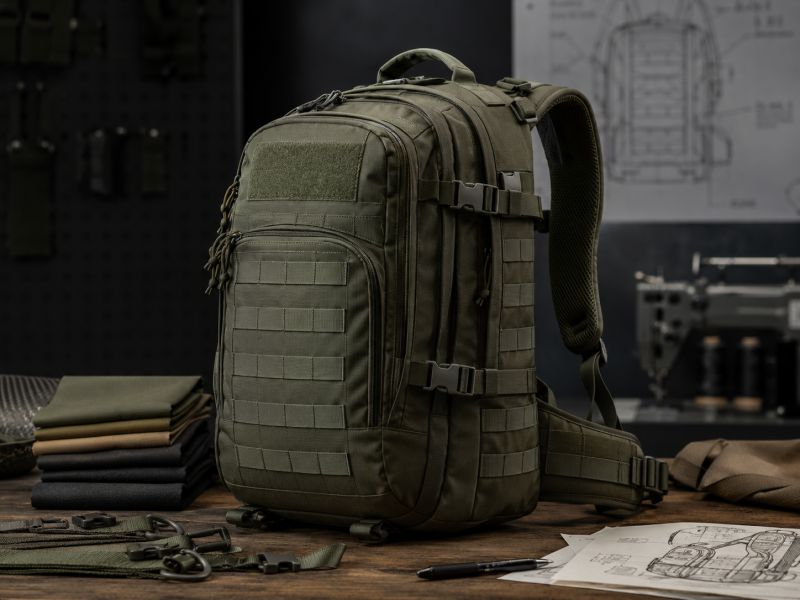
What Makes A Tactical Backpack Brand-Ready?
A tactical backpack becomes brand-ready when it can support real use, clear product positioning, repeatable production, and stable quality. For outdoor gear brands, this means the backpack needs more than a military-style look. It should have a clear target use, suitable fabric, practical MOLLE areas, balanced load support, reliable hardware, useful compartments, and packaging that fits the sales channel.
A brand-ready tactical backpack starts with one simple decision: what is this pack supposed to do?
A pack for EDC users is not the same as a pack for camping, patrol, hiking, emergency kits, tool carry, or outdoor retail sets. If the use is unclear, the design usually becomes crowded. Too many straps, too many pockets, too much webbing, too much weight. The result looks busy but does not carry a clear product promise.
Outdoor gear brands often come to a factory with reference images. That is normal. A good reference image helps explain the visual direction. But a photo does not show load pressure, internal structure, fabric thickness, seam strength, packaging needs, or how the product will behave after daily use.
The smart step is to turn that visual direction into a working product plan.
For a tactical backpack project, Jundong usually reviews product use, size, fabric, structure, MOLLE placement, trims, logo method, packing style, quantity, and delivery timeline before sampling. This keeps the project grounded. It also helps avoid the common mistake of building a pack that looks strong but becomes too heavy, too expensive, or too hard to repeat in bulk.
From Outdoor Use To Product Line Planning
A single tactical backpack can become part of a wider outdoor gear line.
A brand may begin with a 25L day pack, then add a 35L camping pack, a compact sling, a hydration-compatible pack, or a gear pouch series using the same fabric, colour, logo position, and packaging style.
This is where early planning matters. If the first pack has a clear design system, later products can follow the same visual language. MOLLE spacing, buckle colour, label style, zipper puller shape, lining colour, and carton label format can all support brand recognition.
The earlier these details are planned, the easier it becomes to build a product family instead of a one-time backpack.
What Do Outdoor Gear Brands Really Need?
Most outdoor gear brands do not only need a backpack. They need a product that can be explained, photographed, shipped, stocked, reviewed, and reordered.
That means the design must work for both the end user and the sales channel.
| Brand Need | What It Means In Development |
|---|---|
| Clear product use | EDC, hiking, camping, utility, emergency, travel, tool carry |
| Stable visual identity | Colour, logo method, trim colour, packaging style |
| Real carrying comfort | Shoulder straps, back panel, chest strap, waist belt |
| Useful organisation | Compartments, admin panel, laptop sleeve, hydration pocket |
| Strong stress areas | Handle, shoulder strap root, MOLLE ends, bottom panel |
| Repeatable production | Approved sample, material records, QC checklist, packing rules |
The stronger the product plan, the easier it is for the factory team to turn the idea into a sample, then turn the sample into repeatable goods.
Why Tactical Style Alone Is Not Enough
Tactical style is easy to copy. Real tactical function is harder.
A backpack can have camouflage fabric, side straps, and webbing, but still fail if the fabric is too soft, the webbing is weak, or the shoulder strap stitching is not reinforced.
This matters because outdoor users are practical. They notice whether a zipper pulls smoothly with gloves. They notice whether the pack stands well when loaded. They notice if the back panel feels hot after a long walk. They notice if side pockets block MOLLE use.
A strong product is built around these small moments.
For brand projects, the goal should not be “make it look tactical.” The better goal is “make it useful, strong, comfortable, repeatable, and easy to explain.”
How Does MOLLE Design Affect Backpack Function?
MOLLE affects how users attach extra pouches, tools, bottles, first aid kits, and gear modules to a tactical backpack. In custom development, MOLLE should be planned by position, spacing, sewing strength, fabric stability, and real use. Poor MOLLE design can make a backpack look tactical but perform badly when accessories are attached.
MOLLE is often treated like a visual feature, but for serious outdoor gear projects, it is a load and access system.
The right is not “Can we add MOLLE?”
The better is “Where should MOLLE be placed, what will hang from it, and can that area carry pull without deforming the panel?”
A front panel full of webbing may look strong, but it can make the pack heavier and less flexible. Side MOLLE may help attach pouches, but it can interfere with bottle pockets or compression straps. Shoulder strap MOLLE can hold small tools or a radio clip, but it needs careful spacing and reinforcement.
Laser-cut MOLLE can look clean and modern, but the base fabric and backing structure must be suitable.
For brand projects, MOLLE should be developed as part of the whole pack, not added at the end. It connects with fabric selection, panel shape, lining support, sewing process, and intended accessories.
What Is MOLLE In Backpack Development?
MOLLE is a modular attachment system. On backpacks, it usually appears as rows of sewn webbing or laser-cut slots that allow users to attach compatible pouches and accessories.
For outdoor use, it can support first aid pouches, tool pouches, bottle holders, small utility pockets, or gear clips.
In factory development, MOLLE needs more than correct appearance. The panel behind it must be stable enough. The stitching must hold. The spacing should fit common accessories. The edge areas should not twist under load.
If a brand wants MOLLE to be functional, it should be checked during sampling with real or reference accessories.
Which MOLLE Layout Works Best?
The best MOLLE layout depends on the backpack use.
A compact EDC pack may only need front MOLLE and small side attachment zones. A camping or utility pack may need larger front and side MOLLE areas. A more technical pack may combine front MOLLE, side compression straps, and removable pouches.
A practical layout usually follows three rules:
| MOLLE Area | Best Use | Development Note |
|---|---|---|
| Front panel | Pouches, patches, small gear | Needs panel support and clean spacing |
| Side panel | Bottle pouch, tool pouch, compression support | Must not fight side pockets |
| Shoulder strap | Small clip-on items | Keep light and comfortable |
| Waist belt | Small gear access | Only useful when belt is part of load design |
| Laser-cut panel | Clean tactical look, lighter surface | Needs strong base material and backing |
The best layout is not always the one with the most MOLLE.
It is the one that gives users useful attachment options without making the pack heavy, stiff, or visually overloaded.
Webbing MOLLE Vs Laser-Cut MOLLE
Webbing MOLLE has a classic look and works well for heavy-duty styles. It can be strong, easy to understand, and suitable for rugged outdoor packs. The trade-off is weight and sewing time.
Laser-cut MOLLE looks cleaner and can reduce bulk. It is often used for a modern tactical appearance. However, it needs suitable fabric, proper backing, and careful cutting. If the material is too soft or the structure is not supported, the slots can stretch or deform.
For private label projects, the choice should match the brand position. A rugged utility line may prefer webbing MOLLE. A sleek urban tactical line may prefer laser-cut panels. A hybrid layout can also work well.
When Can MOLLE Become A Risk?
MOLLE becomes a risk when it is designed only for appearance.
Common problems include uneven spacing, weak webbing ends, poor panel support, overloading, blocked pockets, and inconsistent sewing in bulk orders.
Another risk is cost. MOLLE adds fabric, webbing, sewing labour, inspection time, and sometimes backing materials. If the target price is tight, it may be smarter to use fewer MOLLE areas but make them truly functional.
A clean, strong, limited MOLLE layout often works better than a crowded one that looks impressive but does not help the user.
Which Fabric Is Best For Custom Tactical Backpacks?

The best fabric for a custom tactical backpack depends on the target use, weight, durability, hand feel, price level, and brand position. 600D polyester Oxford is practical for many outdoor and promotional tactical styles, while 900D, 1000D, 1680D, nylon, ripstop, or coated fabrics may fit stronger, heavier, or more premium projects.
Many people choose tactical backpack fabric by one number: the denier. Higher D sounds stronger, so it feels safer.
But fabric choice is not that simple.
A heavier fabric can improve abrasion resistance and structure, but it can also make the backpack less comfortable for long walks. A lighter fabric can improve daily use, but it may not hold shape well under heavy gear.
The right fabric is a balance between strength, weight, look, cost, sewing behaviour, and user expectation.
For an outdoor retail line, the pack should feel strong in the hand and comfortable on the back. For a tool or utility pack, the fabric may need more body and better abrasion resistance. For a brand selling through online channels, the fabric also needs to photograph well and match the claimed use.
Jundong can work with common bag materials such as polyester Oxford, nylon Oxford, canvas, PVC, TPU, PU, leather and other soft goods materials depending on the project. For tactical backpacks, fabric review usually also includes lining, coating, webbing, zipper, buckle, foam, mesh, and reinforcement materials.
What Is The Best Material For A Tactical Backpack?
There is no single best material for every tactical backpack.
The best material is the one that fits the product use and price position. For many brand projects, 600D polyester Oxford is a practical starting option. For stronger outdoor or utility packs, 900D, 1000D, 1680D, nylon Oxford, ripstop nylon, or reinforced coated fabrics may be reviewed.
A premium tactical backpack may use stronger nylon-based fabric, structured foam, quality webbing, durable buckles, and reinforced stress areas.
A lighter outdoor tactical pack may use a lower-weight fabric with selective reinforcement instead of making the whole pack heavy.
The smartest fabric plan is not always the strongest fabric everywhere. It is often the right fabric in the right place.
600D, 900D, 1000D And 1680D Options
Different fabrics solve different problems. That is why tactical backpack fabric should be selected by use, not only by number.
| Fabric Option | Common Strength | Best Fit | Watch Carefully |
|---|---|---|---|
| 600D Oxford | Practical, cost-friendly, widely used | Outdoor retail, EDC, promo tactical lines | May need reinforcement for heavy loads |
| 900D Oxford | Stronger hand feel | Mid-level tactical backpacks | Cost and weight increase |
| 1000D Fabric | Rugged, firm, strong visual value | Heavy-duty, utility, tactical-style packs | Can feel heavy for long carry |
| 1680D Oxford | Thick, durable, structured | Tool, utility, reinforced panels | Less flexible, higher material cost |
| Ripstop Fabric | Tear-control texture, lighter look | Hiking, outdoor, travel tactical styles | Needs correct coating and strength review |
A good fabric choice should support the product story. If the product is sold as a heavy-duty utility pack, the fabric should feel firm and reliable. If the product is sold as an outdoor day pack, weight and comfort may matter more.
Nylon Vs Polyester Oxford
Nylon often has a strong, premium feel and good abrasion performance, but it can cost more.
Polyester Oxford is widely used, stable, practical, and cost-friendly. For many outdoor gear lines, polyester Oxford gives a good balance between price and durability. For higher-end tactical lines, nylon or selected reinforced fabrics may be better.
The decision should not be made by material name alone.
A well-constructed polyester pack can outperform a poorly designed nylon pack. Structure, sewing, reinforcement, webbing, zipper choice, and sample testing matter just as much.
Coating, Water Resistance And Hand Feel
Coating can improve water resistance and fabric body, but it also affects hand feel, weight, smell, cost, and sewing behaviour.
PU coating is common. PVC or TPU coating may be reviewed for selected needs. For outdoor backpacks, brands often ask for water-resistant fabric, but it is important to separate water-resistant fabric from a fully waterproof bag.
A tactical backpack with water-resistant fabric can handle light rain or splashes better, but seams, zippers, stitching holes, and openings still affect real performance.
If a project needs higher water protection, that should be reviewed from the full structure, not only from the fabric.
How Fabric Choice Affects Price
Fabric affects price through material cost, waste rate, sewing difficulty, coating, colour minimums, and reinforcement needs.
A heavier material may also increase shipping weight. A special colour may require more planning. A premium fabric can improve product value, but it should match the retail position.
If you already have a target price, quantity, and product use, Jundong can help review practical fabric options before sampling. Send reference photos, size, quantity, target use, and logo needs to info@jundongfactory.com for a project review.
How Should Load Design Be Planned?
Load design should be planned around how the backpack carries weight, not only how many litres it holds. A strong tactical backpack needs comfortable shoulder straps, stable chest and waist support, a structured back panel, reinforced handle areas, strong bottom panels, reliable webbing, and stress-area stitching that can handle loaded use.
Capacity is easy to write on a product sheet. Carry comfort is harder to build.
Two backpacks can both be 30L, but one feels balanced and the other pulls badly on the shoulders. The difference often comes from pattern shape, strap angle, foam thickness, back panel support, load position, and reinforcement at stress areas.
Outdoor gear brands should think about how the backpack behaves when loaded.
Does the weight sit close to the back? Do the shoulder straps twist? Does the chest strap sit at a natural height? Does the bottom sag? Does the handle feel secure when lifting a full pack? Does the side compression system help control the load or only add decoration?
A good sample should be reviewed with real weight inside.
Empty backpacks can be misleading. A pack may look perfect on a table and feel wrong once filled.
Shoulder Straps, Chest Straps And Waist Belts
Shoulder straps carry most of the daily load. Their width, foam, curve, webbing connection, bartack position, and root reinforcement all affect comfort and strength.
For tactical backpacks, shoulder straps often need thicker padding and stronger webbing than simple school or lifestyle packs.
Chest straps help keep shoulder straps stable, especially during movement.
Waist belts can transfer some load away from the shoulders, but they only work well when planned with the back panel and pack size. A thin fashion-style belt will not do much for a heavy pack.
Back Panel Support And Breathability
The back panel decides how the backpack feels after 30 minutes, not just after 30 seconds.
Foam thickness, mesh texture, airflow channel, stiffness, and panel shape all affect comfort.
For outdoor use, a breathable back panel can improve wearing experience, but too much soft foam may reduce structure. A firmer back panel can support weight, but may feel hot or stiff if poorly designed.
The right choice depends on whether the product is for EDC, hiking, camping, tool carry, or tactical-style retail.
Bottom, Handle And Stress Point Reinforcement
Stress areas are where backpacks often fail.
For tactical backpacks, these usually include shoulder strap roots, handle ends, MOLLE webbing ends, side compression strap ends, bottom corners, zipper ends, and waist belt joins.
Reinforcement can include extra fabric layers, webbing backing, bartack stitching, binding, stronger thread, or adjusted pattern shapes.
These details are not always visible in product photos, but they decide whether the backpack can survive real use.
How Long Can A Heavy-Load Backpack Stay Stable?
There is no honest universal number.
Stability depends on fabric, structure, load weight, use pattern, stitching, hardware, and how the user carries the pack.
Instead of promising a fixed lifespan, a serious project should review intended load, use scene, stress areas, and sample test results.
For brand projects, the better goal is consistency: build a sample that performs well, record the material and construction details, and use that approved sample as the production reference for bulk orders.
What Types Of Tactical Backpacks Fit Outdoor Brands?

Outdoor brands can develop tactical backpacks for EDC, hiking, camping, emergency kits, travel, tools, hydration, laptop carry, or utility gear. The right type depends on product position, target user, carrying weight, compartment needs, MOLLE level, fabric choice, and sales channel. A clear use scene helps keep the pack practical instead of overbuilt.
Tactical backpack is a broad term. That is useful for search visibility, but risky for product planning.
A brand should not develop “a tactical backpack” in a vague way. It should develop a pack for a clear use scene.
For example, an EDC tactical backpack should not look too bulky if users carry it to work. A hiking tactical pack should not be overloaded with heavy front webbing. A utility pack needs stronger compartments and reinforced seams. A hydration-compatible pack needs internal sleeve planning and tube routing. A laptop tactical pack needs protection, not just a sleeve added at the end.
The more specific the use, the easier it is to choose the right MOLLE layout, fabric, pocket system, zipper level, back panel, and packing method.
EDC Tactical Backpacks
EDC tactical backpacks are often compact, clean, and practical. They may include front MOLLE, admin pockets, a laptop sleeve, side pockets, and hidden storage.
The key is balance.
If the design is too aggressive, it may lose daily-use appeal. If it is too soft, it may lose tactical value. For many outdoor lifestyle brands, the best EDC tactical pack sits between rugged and urban. It looks ready for movement, but not too heavy for office, travel, car use, or everyday carry.
Useful EDC features may include:
| Feature | Why It Helps |
|---|---|
| 20L–30L capacity | Enough for daily gear without looking oversized |
| Admin pocket | Keeps small tools, pens, cables, and cards organised |
| Laptop sleeve | Helps expand use into work and travel |
| Light MOLLE area | Adds tactical value without too much weight |
| Side pockets | Useful for bottles or compact gear |
| Clean logo area | Helps the brand stay visible but not loud |
Hiking And Camping Tactical Packs
Hiking and camping tactical packs need more attention to load support, back comfort, water resistance, side compression, and gear attachment.
MOLLE can be useful, but too much webbing increases weight. A smart layout uses MOLLE where it helps, not everywhere.
For hiking and camping, the user may carry clothing, food, bottles, tools, small first aid items, a flashlight, rope, a rain cover, or outdoor accessories. The backpack should control the load close to the body. Side compression straps can help reduce shaking. A breathable back panel can improve comfort. Bottom reinforcement can help when the pack is placed on rough ground.
A hiking tactical backpack should not feel like a hard box on the back. It should move with the user while still protecting the gear.
Utility And Emergency Packs
Utility and emergency packs often need strong internal organization. Users may carry tools, first aid items, outdoor accessories, safety kits, or heavier small items.
These packs benefit from clear compartments, strong zippers, reinforced handles, and easy access.
For emergency kits, the design should make items easy to find quickly. For utility packs, the pocket structure should match the tools or accessories. For outdoor safety programs, colour, label, insert card, and packing method may also matter because the pack may be part of a larger kit.
A heavy utility pack needs more than thick fabric. It needs strong pocket roots, reinforced bottom, stable zipper paths, and stitching that can survive repeated opening and loading.
Laptop, Hydration And Tool Carry Options
A laptop sleeve, hydration sleeve, and tool zone all need different structures.
A laptop sleeve needs padding and fit. A hydration sleeve needs hanging and tube routing. A tool zone needs stronger pockets and easy access.
Mixing all three is possible, but the layout must be planned carefully. If the laptop sleeve blocks the hydration sleeve, or the tool zone makes the back panel uncomfortable, the design may look complete but feel poor in use.
For multi-function tactical backpacks, the best approach is to decide which function is primary and which functions are secondary. The main function should get the strongest structure. Secondary functions should support the pack without making it bulky.
What Can Brands Learn From Military Backpack Requirements?
Many people search for what elite units or military groups use. That curiosity is useful, but outdoor brands should not copy blindly.
Military pack choices often depend on mission, supply system, load, environment, and unit needs. A retail outdoor pack has different goals: comfort, cost, visual appeal, shipping weight, user reviews, and repeat sales.
The better approach is to learn from military-style requirements without copying them directly.
Outdoor brands can take useful ideas such as strong stress areas, modular attachment, reliable hardware, organised access, and load stability. Then those ideas should be adjusted for outdoor users, product pricing, packaging, online photos, and brand style.
How Can Compartments Improve Gear Access?
Compartments improve tactical backpack value when they help users find gear quickly, separate clean and dirty items, protect devices, and control load balance. More pockets do not always mean better design. The best compartment layout should match the use scene, reduce confusion, support packing habits, and avoid adding unnecessary weight or sewing complexity.
A tactical backpack is not a suitcase with shoulder straps. It is worn on the body, moved through outdoor spaces, opened in different positions, and often used with one hand.
That means compartment planning should think about real movement.
Can the user reach small gear without fully opening the bag? Can wet or dirty items stay away from clothing? Can a laptop sit safely without pressing into the back? Can tools stay upright? Can the main compartment open wide enough? Can side pockets still work when MOLLE pouches are attached?
Good organisation feels simple. Poor organisation feels like too many small places to lose things.
Main Compartment And Front Admin Panel
The main compartment should match the core carrying need. For EDC and travel, it should hold clothing, a notebook, tech accessories, or daily gear. For outdoor use, it may need space for layers, food, safety items, or gear modules.
A front admin panel is useful for smaller items. It can hold pens, keys, flashlight, cables, cards, tools, and accessories.
The risk is overdesign. Too many small pockets increase sewing time and may confuse users. For brand projects, the admin panel should be designed around the target user, not copied from a random reference pack.
Side Pockets, Hidden Pockets And Quick Access
Side pockets are often used for bottles, umbrellas, tools, or small outdoor gear. But on tactical backpacks, side pockets must be planned together with side MOLLE and compression straps.
If all three are placed without a clear plan, they fight each other.
Hidden pockets can add value for travel, outdoor safety, and EDC use. Quick-access pockets are useful for phones, glasses, passports, first aid items, or small tools. These details can improve reviews because users feel the pack was designed for real life.
Laptop Sleeve, Hydration Sleeve And Tool Zones
A laptop sleeve should not just be a flat pocket. It needs fit, padding, and a secure top edge. If the backpack is also used for outdoor activity, the sleeve should not make the back panel uncomfortable.
A hydration sleeve needs a hanger, tube route, and exit opening. It also needs enough internal space so the bladder does not fight other items.
Tool zones need stronger pocket construction. Elastic alone may not be enough for heavier items. Reinforced stitching, binding, webbing loops, or layered pocket walls may be needed.
When Are Too Many Pockets A Problem?
Extra pockets become a problem when they add cost without improving use.
A backpack with too many pockets can become heavy, expensive, hard to inspect, and confusing for users. It may also reduce the usable space inside the main compartment.
For outdoor gear brands, pocket planning should follow function first. If a pocket solves a real packing problem, keep it. If it only makes the product look more complex, review whether it is worth the cost.
A clean, clear layout often sells better than a pack that tries to do everything.
How Does A Factory Develop A Custom Tactical Backpack?
A custom tactical backpack is developed by turning the brand idea into a workable sample. The process usually starts with reference photos, size, capacity, target use, fabric direction, MOLLE needs, logo method, quantity, packing, and delivery plan. The factory then reviews structure, materials, trims, sewing feasibility, sample details, and bulk production risk.
A strong project does not begin with the, “How much is this backpack?”
It begins with enough detail to understand what the backpack should become.
A picture may show style. A tech pack may show structure. A physical sample may show size and feeling. A target price may show what level of fabric and trims is practical. A sales channel may show what packing and labelling are needed.
When these details are shared early, the factory can give better suggestions. When they are missing, the price may be inaccurate, the sample may go in the wrong direction, and the project may take longer.
What Should Send First?
A practical first message should include the details that shape cost and development.
| Detail To Send | Why It Matters |
|---|---|
| Reference photo or sketch | Shows style direction |
| Size or capacity | Affects pattern, material use, and carry design |
| Target use | EDC, hiking, camping, emergency, tool, travel |
| Fabric idea | Helps review strength, weight, cost, and look |
| Logo file and position | Affects process, cost, and sample review |
| Quantity | Affects material planning and unit cost |
| Packing needs | Polybag, hangtag, barcode, retail label, carton mark |
| Destination and deadline | Helps review delivery plan |
A complete inquiry does not need to be perfect. It only needs to be clear enough for the project to be reviewed.
How Are Structure And Materials Reviewed?
The review usually begins with use and size. A 20L EDC tactical pack and a 45L camping pack should not share the same structure. The larger pack needs more support, stronger stress areas, and better load control.
After that, fabric and trims are reviewed together. Fabric affects shape and strength. Webbing affects MOLLE and straps. Buckles affect use and durability. Zippers affect access and user experience. Foam affects comfort. Lining affects inside finish and structure.
This is why a lower-cost fabric change can sometimes create bigger problems than expected. It may affect the hand feel, shape, stitching, MOLLE stability, and even product photos.
How Long Does Sampling Usually Take?
For Jundong, sampling usually takes 5–7 days for many custom bag projects. Some simple styles may take 2–3 days, depending on material availability, structure, logo method, and development difficulty.
A tactical backpack may need more careful review if it has many compartments, MOLLE, special fabric, foam back panel, custom buckles, embroidery, patches, or complex packing needs.
Sampling should not be rushed blindly. A fast sample is useful only when it checks the right details. For tactical backpacks, the sample should be reviewed for size, carrying feel, MOLLE spacing, fabric, zipper direction, pocket access, logo position, and stress areas.
What Should Be Checked Before Approval?
Before approving a tactical backpack sample, review it as if it were already in the hands of a user.
Check the carrying feel with weight inside. Open and close all zippers. Attach sample pouches to MOLLE areas. Test side pockets. Review shoulder strap comfort. Look at the back panel. Check logo placement. Confirm fabric colour under natural light. Review packaging and label needs.
The approved sample should become the reference for bulk orders. If the sample is approved too casually, later changes can create delays, cost changes, or inconsistent production.
What Affects Tactical Backpack Price?
Tactical backpack price is affected by fabric, size, structure, MOLLE area, hardware, zipper level, webbing, reinforcement, foam, logo method, label, packaging, quantity, and delivery needs. A lower unit price is possible when the design is simplified wisely, but cutting the wrong detail can damage strength, comfort, or brand value.
Price should not be treated as a single number. It is the result of many design choices.
A tactical backpack with heavy fabric, many pockets, full MOLLE, custom pullers, thick foam, strong buckles, and retail packaging will cost more than a simple outdoor day pack. That does not mean one is better than the other. It means they serve different product positions.
The right cost plan protects the product’s most important features and removes details that do not add enough value.
Fabric, Size And Structure
Fabric affects both material cost and production difficulty. Size affects material use. Structure affects cutting, sewing, assembly time, and inspection.
A larger backpack with more panels, curved shoulder straps, shaped back panel, internal dividers, and reinforced bottom will naturally cost more than a simple flat pack.
If a brand needs to reduce cost, the first step should not be to weaken stress areas. A better approach may be simplifying pocket structure, reducing unnecessary MOLLE, choosing a practical fabric, or adjusting packaging.
MOLLE, Hardware And Reinforcement
MOLLE adds webbing or cutting process, sewing time, inspection needs, and sometimes backing materials.
Hardware also matters. Buckles, D-rings, sliders, zipper pulls, compression straps, and chest strap components all affect cost and function.
Reinforcement is not the best place to cut blindly. Removing bartacks or backing from stress areas may reduce cost slightly, but it can create bigger problems in real use.
Logo, Label And Packaging
Logo method affects both appearance and cost. Common choices may include screen printing, heat transfer, embroidery, rubber patch, woven label, leather patch, metal plate, or other project-based options.
Packaging also affects cost. A simple polybag is different from a retail hangtag, insert card, barcode label, FBA label, gift box, or multi-SKU carton plan.
For outdoor gear brands, packaging is not just protection. It is part of channel readiness.
Sample, MOQ And Bulk Quantity
Jundong’s standard MOQ is usually 500 pcs per design. Some simple styles may be reviewed at 200–300 pcs based on the project. Low-cost basic items may require higher quantities to keep the unit price practical.
Sample fees can be refunded or deducted when the order reaches 2000 pcs. Bulk production usually takes 20–30 days after details are confirmed, while shipping time depends on destination, method, carton size, weight, and trade terms.
For a practical quote, send your reference photo, size, fabric idea, logo, quantity, packing needs, and delivery destination to info@jundongfactory.com.
Why Does Sample Approval Matter Before Bulk Orders?
Sample approval matters because the sample becomes the production standard for fabric, structure, MOLLE layout, logo position, colour, load feel, packaging, and quality checks. For tactical backpacks, approving a sample too quickly can lead to bulk problems in stress areas, compartment fit, webbing position, or carrying comfort.
A sample is not just a display piece.
It is the bridge between idea and production.
For tactical backpacks, a sample should prove that the pack can hold gear, carry weight, show the brand clearly, and be repeated with stable quality. The more complex the pack, the more important sample approval becomes.
A good sample approval process protects both sides. It helps the brand avoid surprises and helps the factory produce according to clear standards.
MOLLE Position And Webbing Strength
MOLLE should be checked with real use in mind. Attach pouches if possible. Review spacing, sewing, webbing tension, and panel support.
If the MOLLE looks correct but bends badly when loaded, the structure may need adjustment. If the spacing is inconsistent, accessories may not attach smoothly. If the webbing ends are weak, they may fail in real use.
Load Fit And Wearing Comfort
Load fit should be checked with weight inside the pack.
A backpack may look balanced when empty, but shoulder strap angle, back panel stiffness, side compression, and bottom structure only show their real value when loaded.
Wear the sample. Lift it by the handle. Tighten the chest strap. Try the waist belt if included. Walk with it. Open it while loaded. These simple checks reveal many problems early.
Logo, Color And Material Records
Logo, colour, and material should be recorded clearly after sample approval. For brand projects, these details protect consistency.
A small colour difference may matter when products are sold as a series. A logo position shift may affect product photos. A webbing colour mismatch may make the pack look cheaper. A lining change may affect the final feel.
Good records help bulk orders follow the approved sample instead of relying on memory.
Sample-To-Bulk Consistency Rules
Sample-to-bulk consistency needs clear production references. These can include the approved sample, fabric records, trim records, logo artwork, measurement notes, packing rules, and inspection checklist.
For tactical backpacks, special attention should be given to MOLLE spacing, stress-area stitching, shoulder strap roots, zipper paths, back panel, bottom corners, and logo position.
The goal is not to make one good sample. The goal is to make the approved design repeatable.
How Is Bulk Quality Controlled?
Bulk quality for tactical backpacks should be controlled from materials to packing, not only at the final inspection table. Important checks include fabric and trim review, MOLLE spacing, sewing quality, bartack strength, zipper function, buckle performance, load areas, logo placement, label accuracy, packing rules, and carton marks.
A tactical backpack has more failure risks than a simple tote or drawstring bag.
It has more panels, more webbing, more buckles, more zippers, more stress areas, and more user contact areas. If one detail is not controlled, the whole product can feel unreliable.
That is why bulk quality should be checked in stages. Waiting until finished goods are packed is too late. By then, a wrong MOLLE spacing, weak shoulder strap root, incorrect lining, or poor zipper path may already affect hundreds or thousands of pieces.
For serious brand projects, quality control should protect function, appearance, consistency, and packing accuracy at the same time.
Incoming Fabric And Trim Checks
Bulk quality starts before sewing.
Fabric should be checked for colour, texture, coating, thickness, defects, and basic hand feel. Webbing should be checked for width, colour, tension, and surface quality. Buckles, zippers, sliders, pullers, mesh, foam, lining, labels, and patches should match the approved sample or confirmed records.
This step is especially important for tactical backpacks because small changes can affect the whole product.
A softer fabric may change the pack shape. A thinner webbing may weaken MOLLE. A different buckle may change the wearing feel. A zipper puller that looks fine may not feel right with gloves or outdoor use.
Sewing, Bartack And Stress Point Inspection
Sewing is where many tactical backpack risks appear.
Stress areas should be checked carefully, including shoulder strap roots, handles, MOLLE ends, compression strap joins, waist belt joins, bottom corners, and zipper ends.
Bartack stitching is often used to reinforce high-pull areas. But it should be placed where it helps, not randomly added for appearance. The stitch position, thread tension, needle holes, and fabric layers all matter.
A strong-looking stitch is not enough. It needs to be clean, stable, and consistent across bulk production.
Zipper, Buckle And Load Function Review
Zippers should open smoothly, follow the correct curve, and not catch lining or binding. Buckles should close securely and release smoothly. Sliders should hold webbing without slipping too easily.
For tactical backpacks, these parts are not decoration. Users touch them every day.
A poor zipper can make the whole pack feel cheap. A weak buckle can damage trust. A slipping strap can make the load unstable. A rough zipper path can create bad reviews even if the fabric is strong.
Functional checks should be simple but strict: open, close, pull, adjust, load, and repeat.
Packing, Label And Carton Mark Checks
Packing mistakes can hurt brand projects even when the backpack itself is well made.
Wrong barcode, wrong SKU, wrong colour label, missing insert card, mixed carton, or unclear carton mark can create warehouse delays, retail problems, or e-commerce receiving issues.
For tactical backpack projects, packing checks may include polybag size, warning label if required by the project, hangtag, insert card, retail label, FBA label, carton mark, PO number, destination label, and quantity per carton.
Quality is not finished when the backpack passes sewing inspection. It is finished when the right product is packed the right way for the right channel.
What Packaging Do Outdoor Gear Brands Need?

Outdoor gear brands may need simple polybags, hangtags, insert cards, barcode labels, SKU labels, FBA labels, retail-ready packaging, multi-SKU packing rules, and clear carton marks. Good packaging protects the backpack, supports brand presentation, reduces receiving mistakes, and helps the product move smoothly through warehouses, retail channels, or online fulfilment.
Packaging is easy to ignore during early development. Many teams focus on fabric, MOLLE, logo, and compartments first.
That is understandable.
But packaging becomes important the moment the product leaves the factory. A backpack may be sold online, displayed in a retail store, shipped to a warehouse, sent to a brand event, or packed as part of an outdoor kit. Each channel has different needs.
A strong packaging plan does not need to be complicated. It needs to be clear, accurate, and matched to the sales route.
Polybag, Hangtag And Insert Card
A polybag is the most common basic packing method. It protects the backpack from dust and handling marks during storage and shipping.
Hangtags help explain brand identity, product name, material, use scene, or care information. Insert cards can show product features, warranty notes, packing lists, QR codes, or brand story.
For tactical backpacks, an insert card can be useful if the product includes MOLLE, removable straps, hidden pockets, hydration routing, or special use instructions. Good product communication can reduce confusion after purchase.
Barcode, SKU And Retail Label
Barcode and SKU labels are important for retail, warehouse, and e-commerce orders.
If a project has multiple colours, sizes, or versions, labels must be planned early. A black 30L pack and a black 35L pack may look similar in cartons. Without clear labels, mistakes become easy.
Retail labels should match the channel requirements. Some brands need outer polybag labels. Some need hangtag barcodes. Some need carton-level SKU marks. Some need mixed carton control.
These details may look small, but they protect order accuracy.
FBA And Multi-SKU Packing Rules
For e-commerce fulfilment, packing rules should be confirmed before bulk packing begins.
FBA or similar warehouse projects may need specific labels, polybag requirements, carton marks, shipment labels, and SKU separation. Multi-SKU orders need clear packing plans so the warehouse can receive the goods correctly.
A good packing rule should include:
| Packing Detail | Why It Matters |
|---|---|
| SKU code | Prevents colour and model mix-ups |
| Barcode position | Helps warehouse scanning |
| Polybag size | Protects product and improves packing efficiency |
| Carton quantity | Affects storage, shipping, and receiving |
| Carton mark | Helps identify PO, SKU, destination, and quantity |
| Mixed carton rule | Reduces warehouse confusion |
| Insert card rule | Keeps brand communication consistent |
Carton Marks For Bulk Shipments
Carton marks help identify what is inside each carton. They can include item name, SKU, colour, quantity, carton number, gross weight, net weight, carton size, destination, PO number, and handling marks.
For large orders, carton mark accuracy is not optional. It affects receiving, warehouse sorting, and delivery tracking.
Outdoor gear brands with multiple products should build a simple carton mark rule and keep it consistent across repeat orders.
How To Choose A Tactical Backpack Factory?
A good tactical backpack factory should understand MOLLE, fabric choice, load design, sampling, stress-area sewing, quality checks, logo methods, packaging, and repeat orders. The best partner is not simply the one with the lowest price, but the one that can help turn a product idea into a stable, functional, and repeatable backpack line.
Choosing a factory for tactical backpacks is different from choosing a seller of ready-made bags.
A ready-made seller may offer existing styles. That can work for simple needs. But if your brand needs a custom structure, private label finish, special fabric, unique MOLLE layout, packaging rules, or multi-SKU order control, you need deeper project support.
The factory should be able to talk about product use, not only price. It should ask about size, carrying weight, target user, fabric, logo, packing, quantity, and delivery plan. Those are not delays. They are signs that the project is being reviewed seriously.
Jundong is a Guangdong-based custom bag factory with 20+ years of OEM/ODM experience. The factory supports custom bag projects across materials, design, sampling, production, quality checks, packaging, labelling, and delivery. For tactical backpack projects, this means the review can cover not only how the pack looks, but how it will be developed and repeated.
Who Makes The Best Tactical Backpacks For Brand Projects?
The best tactical backpacks for brand projects are usually made by teams that understand both product function and production control.
A strong factory should be able to explain why one MOLLE layout works better than another, why one fabric fits the target price better, why a stress area needs reinforcement, and why some pocket ideas may add cost without improving use.
A good tactical backpack is not only designed once. It must be produced again and again with stable quality.
That is why the “best” factory is not always the loudest one. It is the one that can help reduce development risk, keep sample details recorded, and control bulk consistency.
Who Understands MOLLE And Load Design?
A factory that understands MOLLE and load design will not treat webbing as decoration.
It will review panel support, spacing, sewing strength, accessory use, and bulk consistency. It will also look at load structure: shoulder straps, back panel, chest strap, waist support, handle, bottom, and compression straps.
This is important because MOLLE and load areas often carry pull. If these areas are weak, the pack may fail even if the main fabric looks durable.
Do They Support OEM And ODM Projects?
OEM projects usually follow the brand’s existing design, drawings, or samples. ODM projects may need more development support from idea to sample.
For tactical backpacks, both paths can work.
If the brand already has a tech pack, the factory should review feasibility and cost. If the brand only has reference photos and a concept, the factory should help turn that idea into size, fabric, structure, and sample details.
The more custom the project is, the more important development communication becomes.
Are They Strong In Sampling And QC?
Sampling shows whether the factory can understand the project. Quality control shows whether it can repeat the project.
Both are necessary.
A sample can look nice but be difficult to produce in bulk. A factory with strong project review will think about production while developing the sample. This helps reduce later changes.
For tactical backpacks, sampling and QC should pay close attention to MOLLE, webbing, zipper routes, shoulder strap roots, back panel, bottom structure, logo position, and packing rules.
Is The Factory Suitable For Long-Term Supply?
A long-term supply relationship needs more than one successful order.
It needs stable materials, clear records, repeatable quality, packaging accuracy, and communication that helps solve problems before they become expensive.
For outdoor gear brands, long-term supply may also mean developing new sizes, colours, pouches, duffel bags, tool bags, or travel packs in the same product family.
If you plan to build a tactical backpack line instead of only one style, choose a factory that can support future development, not only the first quote.
What Should Send For A Quote?
For a practical tactical backpack quote, send a reference photo or tech pack, size, capacity, target use, fabric idea, colour, MOLLE needs, logo method, quantity, packing requirements, destination, and delivery deadline. The more clearly the project is described, the more accurate the review, sample direction, cost estimate, and lead time plan can be.
A short message can start the project, but a clear message saves time.
When a factory receives only “How much for this backpack?” with one photo, the price can only be rough. Tactical backpacks have too many variables: fabric, size, MOLLE, foam, lining, zipper, buckle, logo, packaging, quantity, and shipment.
A better inquiry helps the factory give useful advice instead of guessing.
Reference Photo Or Tech Pack
A reference photo helps show style direction. A tech pack is even better if available. It may include measurements, materials, construction notes, artwork, logo position, colour codes, and packing details.
If there is no tech pack, a sample or marked-up image can also work.
The goal is to show what you want clearly enough for the factory team to review structure and cost.
Size, Capacity And Target Use
Size and capacity affect almost every part of the backpack.
A 20L daily tactical pack and a 45L camping pack need different fabric weight, back support, pocket layout, and stress reinforcement.
Target use also matters. Tell the factory whether the pack is for EDC, hiking, camping, travel, emergency kits, tool carry, retail, or promotional outdoor programs.
Fabric, Color And Logo Needs
If you already know the fabric, share it. If not, share the expected feel and use.
For example: rugged but not too heavy, premium outdoor feel, cost-friendly retail line, water-resistant daily pack, or heavy-duty utility pack.
Logo files should ideally be provided in editable format. Logo position and process should also be discussed early because embroidery, rubber patch, woven label, heat transfer, screen printing, and metal plate options all affect appearance and cost.
Quantity, Packing And Delivery Deadline
Quantity affects MOQ review, material planning, and unit price. Jundong’s standard MOQ is usually 500 pcs per design, while some simple styles may be reviewed at 200–300 pcs depending on the project.
Packing affects cost and lead time. Delivery deadline affects production planning and shipping method.
A complete RFQ should include destination country or port, expected delivery date, and whether you plan to use your own forwarder.
To start a review, send your tactical backpack reference, size, quantity, logo, packing needs, and delivery plan to info@jundongfactory.com.
FAQ For Custom Tactical Backpack Projects
What Is The Best Fabric For Tactical Backpacks?
The best fabric depends on the product use, weight target, price level, and brand position. 600D Oxford is a practical choice for many outdoor and EDC tactical backpacks. 900D, 1000D, 1680D, nylon Oxford, ripstop, or coated materials may be reviewed for heavier or more premium projects.
The smartest choice is not always the thickest fabric. A heavy material may improve durability but reduce comfort. A lighter material may improve daily use but need reinforcement in stress areas. For most brand projects, the best fabric plan combines suitable main fabric with stronger support at high-pull zones.
Is MOLLE Necessary For Outdoor Backpacks?
MOLLE is useful when the backpack needs modular pouches, gear attachment, outdoor tools, or tactical visual identity. It is not necessary for every outdoor backpack.
For some hiking or travel packs, too much MOLLE adds weight and cost without improving use. For utility, emergency, tactical-style retail, or gear carry packs, MOLLE can add strong value.
The best choice depends on the user, product story, and expected accessories.
Can I Customize The MOLLE Layout?
Yes, MOLLE layout can usually be customized based on the backpack structure, intended use, fabric, and accessory needs.
Custom options may include front MOLLE, side MOLLE, shoulder strap MOLLE, waist belt MOLLE, laser-cut panels, patch areas, or removable pouch systems.
However, MOLLE should be reviewed carefully during sampling. Spacing, sewing strength, panel support, and accessory fit all affect real performance.
How Long Does A Tactical Backpack Sample Take?
Sampling usually takes 5–7 days for many custom bag projects. Some simple styles may take 2–3 days if materials and structure are straightforward.
A tactical backpack with complex MOLLE, custom compartments, thick foam, special fabric, logo patches, or retail packaging may need more time.
The goal is not only speed. A good sample should help confirm size, fabric, MOLLE layout, pocket function, logo position, carrying feel, and production feasibility.
What Is The MOQ For Custom Tactical Backpacks?
Jundong’s standard MOQ is usually 500 pcs per design. Some simple styles may be reviewed at 200–300 pcs depending on materials, structure, logo method, and packing needs.
Low-cost basic styles or special material projects may require higher quantities to keep production practical.
MOQ exists because custom production involves material purchasing, cutting, sewing setup, logo process, packing preparation, and quality control.
Can You Make Private Label Tactical Backpacks?
Yes, Jundong supports private label tactical backpack projects, including custom logo, colour, fabric, MOLLE layout, compartments, labels, hangtags, insert cards, barcode labels, retail packing, and carton marks.
Private label projects should prepare logo files, brand colour direction, packing needs, and expected sales channel. This helps align the backpack design with the brand’s product position.
How Do You Control Load-Bearing Quality?
Load-bearing quality is controlled through structure review, fabric and webbing selection, stress-area reinforcement, sewing inspection, bartack checks, zipper and buckle review, and sample approval.
For tactical backpacks, important stress areas include shoulder strap roots, handles, MOLLE webbing ends, side compression strap joins, bottom corners, and waist belt joins.
A loaded sample review is recommended before approval because empty backpacks do not show real carrying behaviour.
Are Tactical Backpacks Waterproof?
Most tactical backpacks are water-resistant, not fully waterproof, unless they are developed with a special waterproof structure.
Water-resistant fabric can help with light rain or splashes, but seams, zippers, stitching holes, openings, and pocket structures affect actual protection.
If the project requires stronger water protection, the full structure should be reviewed, including fabric coating, seam design, zipper choice, flap design, and intended use.
Can You Support FBA Or Retail Packaging?
Yes, packaging can be reviewed based on the sales channel. Options may include polybag, hangtag, insert card, barcode label, SKU label, FBA label, retail label, carton mark, and multi-SKU packing rules.
For e-commerce and retail projects, packing details should be confirmed before bulk production. This helps reduce receiving issues, SKU mix-ups, and warehouse delays.
What Files Are Needed For OEM/ODM Development?
Useful files include reference photos, sketches, tech packs, measurements, logo artwork, colour direction, material idea, packing requirements, quantity, and delivery plan.
For OEM projects, existing drawings or physical samples are helpful. For ODM projects, a clear concept, target user, size, function needs, and brand direction can be enough to start a review.
What Backpack Do Navy SEALs Use, And Should Outdoor Brands Copy It?
Many people search this because elite-use gear feels trustworthy. But outdoor brands should not blindly copy what a military unit may use.
Military backpack choices depend on mission, environment, supply system, load, and special requirements. Outdoor retail products need a different balance of comfort, cost, appearance, packaging, and daily usability.
The better approach is to learn from military-style principles: strong stress areas, modular attachment, durable fabric, load control, and reliable access. Then adapt those ideas to the target user and brand position.
What Brand Backpack Does The Military Use, And What Should Outdoor Brands Learn From It?
Military users may use different packs depending on country, unit, mission, contract, and supply channel. There is no single backpack brand that represents every military need.
For outdoor gear brands, the useful takeaway is not the logo on the pack. It is the design logic behind serious gear: dependable fabric, strong stitching, modular carry, reinforced handles, practical access, and stable load support.
A strong brand product should borrow the discipline of tactical gear, then reshape it for real outdoor consumers.