 Skip to content
Target Keywords: school drawstring bags,student kit bags,custom drawstring bags,bulk school bags,drawstring backpack factory,school supply kit bags,back to school drawstring bags,drawstring bag cord size,standard drawstring bag size,best fabric for drawstring bags
20 Tag Keywords: School Drawstring Bags, Student Kit Bags, Custom Drawstring Bags, Bulk School Bags, School Supply Bags, Back To School Bags, Drawstring Backpack Factory, Student Giveaway Bags, Education Program Bags, Charity School Kits, Cord Safety, Drawstring Bag Size, Drawstring Pouch Size, Polyester Drawstring Bags, Canvas Drawstring Bags, School Logo Bags, OEM Drawstring Bags, Private Label School Bags, Bulk Bag Packing, Sample Approval
School drawstring bags look simple until they are used for real student kits. A bag that works for a one-day event may fail when it carries notebooks, pencil cases, water bottles, sports clothes, or donation supplies. For schools, education brands, NGOs, retailers, and program teams, the real work is not only choosing a drawstring bag. It is choosing the right fabric strength, finished size, cord thickness, logo method, packing rule, and bulk quality standard before the order starts. A smart design can stay light, affordable, easy to distribute, and strong enough for daily student use.
School drawstring bags for student kits should be planned around fabric strength, standard bag size, pouch capacity, cord thickness, cord length, logo placement, packing rules, and bulk quality control. For custom projects, teams should review the student age group, kit contents, target quantity, budget, deadline, and destination before confirming a sample and moving into bulk production.
What Are School Drawstring Bags For Student Kits?
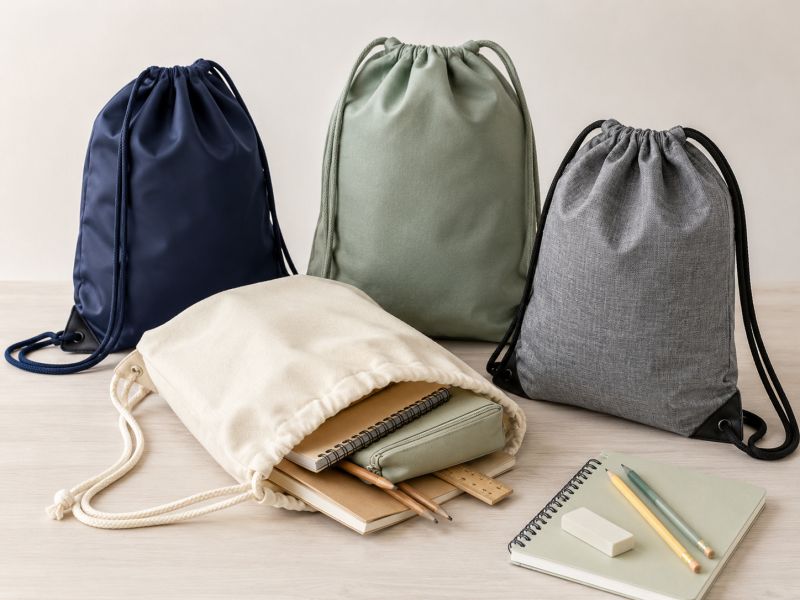
School drawstring bags for student kits are lightweight bags used to hold school supplies, books, activity items, welcome packs, charity kits, or event materials. Unlike simple giveaway bags, they must be planned around load, age group, cord comfort, fabric strength, logo visibility, and distribution needs. For larger programs, the bag becomes part of the kit experience, not just a carrier.
A student kit bag often has a very practical job. It may need to hold notebooks, pencils, a ruler, a T-shirt, a small water bottle, classroom sheets, sports items, or retail bundle products. If the bag is too small, the kit looks poorly planned. If the fabric is too weak, the bottom corners and cord may fail. If the cord is too thin or too long, it may feel uncomfortable or create avoidable risk for younger users.
This is why school drawstring bags should be treated as a project item. The best result comes from matching the bag to the real use: school supply kits, back-to-school packs, education events, NGO donations, university welcome bags, book fairs, sports days, summer camps, or retail school bundles.
Why Student Kit Bags Are Different From Simple Promo Bags
A simple promo bag is often made for quick visibility. It may only carry a flyer, a small gift, or a light event item. A student kit bag usually works harder. It may be used during transport, distribution, classroom use, and sometimes for weeks or months after the event.
That changes the design logic. The fabric needs better tear resistance. The cord needs smoother movement. The opening should not be too tight. The logo should not crack after folding or light washing. The packed goods should fit without forcing the seams.
For school programs, the bag is often handled by many people before it reaches the student: packing staff, warehouse teams, volunteers, teachers, parents, and students. A small design issue can multiply quickly when the order is large.
Who Uses Them In School And Education Programs?
School drawstring bags are widely used by education groups, public school programs, private schools, universities, charities, sports clubs, book fair organizers, event agencies, corporate social responsibility teams, and retailers selling school supply bundles.
Each group has a different priority. A school may care more about durability and safe cord length. A charity program may need low weight, easy packing, and clear carton marks. A retail brand may want stronger fabric, private label packaging, barcode labels, and better logo finish. A university welcome pack may need a cleaner look and a larger print area.
The same product name can hide very different requirements. That is why the first step should not be “send the cheapest option.” It should be “what will the bag carry, who will use it, and how will it be packed and delivered?”
What Should A Student Kit Bag Carry?
A school kit drawstring bag may carry different items depending on the project purpose. The bag should be sized around the real contents, not just a catalog dimension. If the kit includes rigid folders or A4 papers, height and width matter. If the kit includes a bottle or shoes, depth and corner stress become more important. If it is shipped in bulk, foldability and carton volume also matter.
| Kit Type | Common Contents | Bag Planning Focus |
|---|---|---|
| Back-to-school kit | Notebooks, pencils, ruler, folders | Size, seam strength, logo area |
| Charity school kit | Stationery, hygiene items, light clothing | Capacity, packing count, cost control |
| Sports day kit | T-shirt, cap, water bottle, towel | Fabric strength, cord comfort, moisture handling |
| University welcome pack | Brochure, notebook, hoodie, gifts | Brand look, bigger size, premium finish |
| Retail school bundle | School supplies packed for sale | Barcode, SKU label, clear packing rules |
Which Fabric Works Best For School Drawstring Bags?

The best fabric for school drawstring bags depends on use, budget, logo method, and expected carrying load. 210D polyester is light and cost-friendly for event giveaways. 420D or 600D polyester gives better daily-use strength. Canvas and cotton feel more natural, while RPET can support eco-positioned programs when documents are reviewed. Fabric choice affects cost, printing, packing, and durability.
Fabric is the first decision because it controls much more than appearance. It affects how the bag feels in the hand, how it folds into cartons, how well the logo prints, how much weight the seams can handle, and how the bag performs after repeated opening and closing.
For student kits, the safest fabric decision is not always the thickest fabric. A heavy canvas bag may feel premium, but it can increase shipping weight and cost. A very light polyester bag may save budget, but it may not be suitable for heavier kits. The right choice comes from the expected load and how long the bag needs to be used.
What Is The Best Fabric For Drawstring Bags?
For school kit use, polyester is usually the most practical fabric because it balances weight, cost, printing, colour options, and bulk packing efficiency. 210D polyester works for light student giveaways. 420D and 600D polyester are better for stronger school bags. Canvas and cotton are useful when the program wants a softer, more natural feel.
There is no single best fabric for every order. A school charity pack and a retail education gift set should not use the same specification by default. The best fabric is the one that fits the kit weight, logo effect, target price, delivery schedule, and packing method.
A simple rule works well: if the bag is for light handout items, choose lighter fabric. If the bag must carry books, shoes, or repeat-use supplies, move toward stronger polyester or canvas. If the brand story matters, consider canvas, cotton, or RPET with proper material review.
210D Polyester For Light Student Giveaways
210D polyester is common for lightweight drawstring bags because it is easy to fold, easy to print, and practical for large-volume distribution. It is suitable for simple school events, activity packs, welcome gifts, and short-term student giveaways.
The main advantage is cost and packing efficiency. Large orders can be packed into smaller cartons compared with heavier fabrics. This matters when bags are shipped to multiple schools, warehouses, or program sites.
The limitation is load strength. If the kit includes heavy books, shoes, or bottles, 210D may not be the safest long-term choice unless the structure is reinforced and the expected load is controlled. It is best used where the bag is light, simple, and budget-sensitive.
420D And 600D Polyester For Better Daily Use
420D and 600D polyester offer a stronger option for student kit bags that need more durability. They hold shape better, feel more substantial, and work well for school supplies, sports items, and daily student use.
600D polyester is especially common for custom drawstring bags that need better seam strength and a more confident hand feel. It can support screen printing, heat transfer, woven labels, and some patch options depending on design.
These fabrics are not always expensive in the way people expect. Because they reduce the risk of weak seams, torn corners, and poor user experience, they can be a better long-term choice for programs where the bag is part of the brand image.
Canvas, Cotton, And RPET For Brand Programs
Canvas and cotton are useful when the bag should feel more natural or retail-friendly. They are often chosen for school bookstores, education brands, museums, camps, or premium welcome kits. The look is softer and warmer than polyester, especially for simple printed logos.
RPET can be considered when the program has an eco-positioned story. However, material claims should be supported with proper documentation based on the order requirement. It is better to review this before sampling, especially when labels, hangtags, or public claims will mention recycled content.
How Fabric Choice Affects Cost, Logo, And Packing
Fabric affects unit cost, but it also affects hidden costs. Thicker fabric increases material usage and sometimes carton volume. Natural fabric may need more careful handling. Coated polyester may affect print adhesion. Dark fabric may need different print layers for logo clarity.
The packing method also changes. A soft 210D bag can be folded very compactly. A 600D bag may need more carton space. Canvas may wrinkle if compressed too tightly. For orders going into retail, e-commerce, charity kits, or school district distribution, these details should be decided before sampling.
What Size Should A Student Kit Drawstring Bag Be?

A school drawstring bag should be sized around the student kit contents, not only a standard catalog size. Common sizes include small pouches for stationery, mid-size bags for school supplies, and larger drawstring backpacks for books, shoes, clothes, or welcome packs. The right size should balance capacity, student comfort, fabric usage, packing volume, and shipping cost.
Size is one of the fastest ways to create either a good kit experience or a frustrating one. A bag can be nicely printed and still fail if the opening is too narrow for notebooks, if the height is too short for folders, or if the bag becomes bulky and costly to ship.
For school use, it is helpful to think in three levels: pouch size, standard school bag size, and large kit size. Each one serves a different purpose.
What Is The Standard Size Of A Drawstring Bag?
A common standard drawstring backpack size is around 13 × 16 inches or 14 × 17 inches. Smaller bags may be used for stationery or event gifts, while larger sizes such as 16 × 18 inches can work better for sports items, thicker kits, or welcome packs.
The “standard” size is only a starting reference. A bag for a school supply kit should be checked against real contents. For A4 documents or folders, width and height need to allow easy loading. For shoes or clothing, the bag may need more room and stronger lower corners.
What Size Drawstring Pouch Should I Use?
A drawstring pouch is usually smaller than a drawstring backpack. It works well for pencil sets, small activity kits, craft items, hygiene packs, or small school gifts. Common pouch sizes may sit around 6 × 8 inches, 8 × 10 inches, or 10 × 12 inches, depending on what goes inside.
For student kits, use a pouch only when the contents are small and light. If the kit includes notebooks, folders, water bottles, or clothing, a pouch will feel too small and may create pressure on the seams. In that case, a drawstring backpack is usually the better structure.
How To Match Bag Size With Student Kit Contents
The best way to choose size is to list the exact items before confirming the sample. A notebook, pencil case, ruler, and folder may need a taller and flatter bag. A T-shirt, cap, and bottle may need more soft volume. A retail school supply bundle may need a neater shape for display or barcode packing.
A simple test is to place all kit items on a table and measure their natural stacked size. Then add enough space for easy loading, closing, and student handling. A bag that only fits when forced is not truly the right size.
If you are preparing a school kit program, send Jundong the planned contents, target size, logo artwork, quantity, packing needs, deadline, and destination at info@jundongfactory.com. The team can review whether the bag size and structure are practical before sampling.
When Bigger Size Increases Cost And Shipping Volume
A bigger bag is not always better. It uses more fabric, longer cord, larger print area, and often larger cartons. If the bag is much bigger than the contents, it may look empty and less organized.
For large programs, even a small size increase can affect total cost. One extra inch in width or height may not seem important on one bag, but it becomes real material usage across thousands of pieces. Bigger folded size can also reduce carton quantity and increase freight cost.
The goal is not to make the biggest bag. The goal is to make a bag that fits the kit comfortably without wasting fabric, carton space, or budget.
How Should Cord Safety Be Reviewed?
Cord safety should be reviewed through cord thickness, length, softness, knot finish, drawstring channel, bottom reinforcement, and student age group. The cord should open smoothly, feel comfortable on the shoulder, and stay secure during use. For younger students, cord design should be checked more carefully, and testing or compliance needs should be reviewed based on the target country and project requirements.
Cord safety is not only about the cord itself. It is about the full system: cord, channel, eyelets, bottom loops, stitching, knots, and how the student will use the bag. A cord that looks fine on a sample table may feel too rough or too long when carried by a child.
For school programs, cord design should be discussed early. It affects comfort, cost, appearance, packing, and inspection. It also affects how easy the bag is to open and close when many kits are packed quickly.
What Size Cord For Drawstring Bag Projects?
A common cord thickness for drawstring bags is often around 4 mm to 6 mm, depending on fabric weight, bag size, load, and comfort needs. Smaller pouches can use thinner cords, while larger school drawstring backpacks often need a stronger and more comfortable cord.
Cord size should match the bag. A thin cord on a large school bag may dig into the shoulder and feel cheap. A thick cord on a small pouch may look bulky and make the opening harder to close. The cord channel must also be sized correctly so the cord moves smoothly without jamming.
For student kits, cord size should be confirmed together with the final bag size and expected load. If the kit is heavier, comfort matters more than saving a few cents on cord material.
Cord Length, Thickness, And Hand Feel
Cord length should allow the bag to close fully and sit comfortably when carried. If the cord is too short, the opening may not close well. If it is too long, it may hang awkwardly or create extra handling risk, especially for younger students.
Hand feel also matters. A rough cord may scratch skin or damage clothing. A very soft cord may feel better but may stretch or lose shape depending on material. Polyester cord, nylon cord, cotton rope, and PP cord each have different feel, cost, and finish.
Cord ends should be managed carefully. Knots, heat-sealed ends, plastic tips, or sewn finishes may be used depending on cord material and style. The goal is to reduce fraying and keep the cord secure after repeated use.
Smooth Drawstring Channel And Easy Opening
A good drawstring channel should let the cord move smoothly. If the channel is too narrow, the bag becomes hard to open. If the stitching is uneven, the cord may catch. If the fabric is too soft without proper folding, the channel may twist after use.
During sample review, open and close the bag several times. Do not only look at it once. A school kit bag may be opened and closed many times by students, teachers, volunteers, and packing teams. Smooth movement is a real usability detail.
The channel width should match cord thickness. If the cord is 5 mm, the channel should leave enough room for smooth sliding after sewing tolerance. If the channel is too tight, the bag may pass visual inspection but fail in daily handling.
Reinforced Corners, Eyelets, And Bottom Loops
The bottom cord take a lot of stress. When the bag is worn, the load pulls down through the cord into the lower corners. Weak stitching, poor eyelets, or thin fabric can cause tearing.
For stronger student kit bags, bottom corners may need reinforcement patches, bartack stitching, better eyelets, or stronger loops. The right method depends on fabric and budget. A lightweight giveaway bag may use a simpler finish, while a repeat-use school bag should receive stronger construction.
This is one of the small details that separates a basic giveaway bag from a serious school kit bag. It is not always visible in product photos, but it becomes obvious after real use.
When Student Age Group Changes Cord Design
Younger students need more careful review. Their shoulders are smaller, their handling is rougher, and long cords may be less suitable. For older students, capacity and style may matter more, but comfort still matters when the bag carries books or sports items.
Age group should be shared before sampling. It can influence cord length, cord thickness, bag size, warning label needs, and testing review. Broad safety claims should not be made without checking the project details, target country, and intended use.
For school kits used by mixed age groups, a practical design usually avoids very long loose cords, sharp trims, weak knots, and oversized openings. The goal is simple: make the bag easy to use, comfortable to carry, and realistic for the intended program.
Which Logo Method Is Best For School Drawstring Bags?

The best logo method for school drawstring bags depends on fabric, artwork detail, colour count, order quantity, budget, and use. Screen printing is practical for simple school logos. Heat transfer works well for colourful graphics. Woven labels, rubber patches, and private label details can improve brand value when the bag is part of a retail, education, or sponsor program.
A school drawstring bag often carries more than one identity. It may show a school logo, sponsor logo, charity name, program theme, mascot, event graphic, or retail label. The logo should look clear, but it also needs to survive folding, packing, and normal use.
Choosing a logo method only by appearance is risky. The same artwork can look different on 210D polyester, 600D polyester, canvas, or cotton. Fabric texture, coating, colour, and print position all affect the final result.
Screen Printing For Simple School Logos
Screen printing is a practical choice for simple logos, one-colour artwork, school names, slogans, and sponsor marks. It works well when the design is clean and the order quantity is suitable.
The benefit is stable cost and good visibility. The limitation is fine colour gradients and complex artwork. On textured fabric, very small letters may lose sharpness. Before sampling, confirm logo size, colour, position, and fabric colour.
Screen printing is often a good option for large school programs because it keeps the bag clean and recognizable without making the cost too heavy. It is especially useful for simple logos on polyester or canvas drawstring bags.
Heat Transfer For Colourful Graphics
Heat transfer is useful for colourful school graphics, mascots, activity themes, and event artwork. It can show more detail than basic screen printing and often works well on polyester fabrics.
The sample should check adhesion, edge clarity, colour brightness, and how the logo looks after folding. A colourful logo can look great on a digital file but become too large, too stiff, or too glossy on the final bag if not reviewed properly.
For student kit bags, heat transfer works best when the design needs strong visual impact. It is a good choice for sponsor events, sports days, school clubs, camps, and programs that use full-colour artwork.
Woven Labels And Rubber Patches For Private Label Projects
Woven labels, rubber patches, and stitched brand details can make a drawstring bag feel more developed. They are useful for school retail programs, private label lines, university stores, museum education shops, and brand-led kits.
These details add cost and may affect MOQ, but they can improve perceived value. They are best used when the bag is more than a giveaway and needs to support a brand story.
For example, a simple screen print may be enough for a charity distribution bag. But a university welcome pack or retail school bundle may benefit from a woven label, inner label, hangtag, barcode label, or custom polybag.
What To Check Before Logo Sampling
Before logo sampling, check the artwork file, colour reference, print size, placement, fabric colour, and packing method. If the logo crosses a seam or sits too close to the drawstring channel, production may be harder and the look may become less clean.
A good sample should show not only whether the logo is attractive. It should show whether the logo is practical for bulk production.
The best logo review includes three checks: how it looks from normal viewing distance, how it feels after folding, and whether the position stays consistent during production. For large school programs, even small logo shifts can become noticeable when bags are lined up for packing or distribution.
How Do Custom School Drawstring Bag Orders Work?
Custom school drawstring bag orders usually start with a reference photo, size idea, fabric preference, logo artwork, target quantity, packing method, deadline, and destination. The factory then reviews material, structure, cord design, logo process, sample feasibility, cost, and production timing. A sample helps confirm the specification before bulk goods are produced and packed.
The process should feel simple, but it should not be careless. School kit orders often have fixed dates: school opening, charity delivery, seasonal campaign, retail launch, sports event, or warehouse arrival. A missed detail can delay packing or create extra cost.
A practical order flow moves from idea to sample, then from approved sample to bulk production. Each step should reduce uncertainty.
From Reference Photo To Sample
A reference photo is enough to begin discussion, but it is not enough for final pricing. The factory still needs finished size, material preference, logo artwork, quantity, packing needs, deadline, and destination.
Sampling usually confirms fabric hand feel, bag size, cord length, cord movement, logo effect, seam strength, and packing style. For simple drawstring bags, sampling may be faster than complex bags, but timing still depends on material, logo method, and sample room schedule.
A good sample should not be treated as a decoration. It is a working proof. It tells the team whether the bag can carry the kit, whether the logo works on the chosen fabric, and whether the cord and bottom corners are strong enough for the intended use.
From Approved Sample To Bulk Production
Once the sample is approved, the sample becomes the reference for bulk production. At this stage, details should be frozen: fabric, colour, size, cord, logo, stitches, packing, labels, carton marks, and inspection standards.
Changing details after approval may affect cost and schedule. That is why a careful sample review saves time later. The goal is not only to make one good sample. The goal is to make a sample that can be repeated in bulk.
For school kit programs, sample approval should include both product review and packing review. A bag may look correct, but if the packing method is unclear, later sorting and delivery may still become messy.
What A Factory Checks Before Production
Before production, a responsible factory checks whether the material is available, the logo method is suitable, the cord design is practical, the packing rule is clear, and the production time fits the delivery plan.
Jundong is a Guangdong-based custom bag factory with 20+ years of OEM/ODM experience, supporting custom, private label, and OEM/ODM bag projects. The factory has 600+ employees, an 18,000㎡ production area, and 80 QC inspectors. For school drawstring bag projects, the team can review material, structure, logo, packing, and delivery details before sampling and bulk production.
This review step is useful because school drawstring bags often look simple, but the actual program may involve several colours, different logos, mixed cartons, destination labels, or kit packing. Checking these details before production helps avoid last-minute confusion.
What Affects The Price Of School Drawstring Bags?
The price of school drawstring bags is mainly affected by fabric type, finished size, cord material, eyelets or loops, stitching strength, logo method, colour quantity, packing style, order quantity, deadline, and shipping plan. A lower unit cost is possible when the structure is clear and the order is planned early, but reducing cost should not make the bag too weak for student use.
Price should be viewed as a design result, not just a number. A bag with thin fabric, short stitching time, simple cord, and one-colour printing will cost less. A stronger bag with 600D fabric, reinforced corners, colourful logo, private label packing, and multi-destination sorting will naturally cost more.
The better is not “what is the cheapest drawstring bag?” It is “what is the right specification for this student kit, and where can cost be reduced without causing problems?”
Fabric, Size, Cord, Logo, And Packing
Five details shape most of the cost:
| Cost Factor | Why It Matters | How To Review It |
|---|---|---|
| Fabric | Controls strength, feel, print effect, and material cost | Match fabric to kit load and use time |
| Size | Controls fabric usage, cord length, and carton volume | Test with real kit contents |
| Cord | Affects comfort, safety review, and durability | Check thickness, length, and finish |
| Logo | Affects setup, sample review, and unit cost | Choose method by artwork and fabric |
| Packing | Affects labour, labels, carton marks, and delivery | Confirm single bag, full kit, SKU, or retail needs |
A clean specification usually gives a cleaner quote. If the size, fabric, logo, packing, and quantity are unclear, the quote can only be a rough reference. For serious projects, it is better to define the use first, then build the cost around that use.
Why Small Orders Have Higher Unit Cost
Small orders often have higher unit cost because setup work is spread across fewer pieces. Material sourcing, cutting, logo preparation, sample review, packing setup, and communication time still exist even when the quantity is low.
Jundong’s standard MOQ is usually 500 pcs per design. Some simple styles may be reviewed at 200–300 pcs case by case. Some low-unit-price basic bags may need 1000 pcs or more. Sample fees can be refunded or deducted when the bulk order reaches 2000 pcs.
This is not only a factory rule. It is how custom production works. The more details an order has, the more setup work it needs. The quantity must be enough to make that setup reasonable.
How To Control Cost Without Weakening The Bag
Cost can often be controlled by simplifying the logo, choosing a practical fabric, reducing unnecessary size, keeping colour options focused, and confirming packing rules early.
The wrong way is to cut the fabric too thin or ignore reinforcement at stress . That may reduce the quote but increase the risk of complaints. For school kits, a slightly better cord or stronger lower corner can be worth much more than it costs.
If your team has a target budget, send the expected quantity, kit contents, size idea, logo file, packing needs, and destination to info@jundongfactory.com. Jundong can suggest practical options based on the program use and cost target.
What Should Check Before Approving A Sample?
A school drawstring bag sample should be checked for fabric strength, finished size, carrying comfort, cord length, knot security, bottom reinforcement, logo position, colour accuracy, opening smoothness, and packing method. Sample approval should not only focus on appearance. It should confirm whether the bag can carry the planned student kit and be repeated consistently in bulk production.
A sample is where many future problems become visible. If the bag opening feels tight, it will slow down kit packing. If the cord is too thin, it may feel uncomfortable. If the logo is too close to the drawstring channel, it may wrinkle. If the lower corners are weak, the bag may look fine when empty but fail after loading.
For student kit projects, a sample should be tested with real contents whenever possible. Put the notebooks, pencils, folder, bottle, T-shirt, or activity items inside. Close the bag. Carry it. Open it again. This simple test often gives more useful information than looking at the bag on a desk.
Fabric Strength And Colour
Fabric should be checked for thickness, hand feel, colour match, coating, surface texture, and cutting stability. For school programs, colour often needs to match a school identity, sponsor colour, or campaign theme. A small colour difference may not matter for a single event, but it can look messy when thousands of bags are displayed or distributed together.
If the bag uses polyester, check whether the material feels too thin for the load. If it uses canvas or cotton, check whether the fabric is too heavy, too soft, or too easy to wrinkle for the packing method. If it uses RPET, review whether the material claim and document needs are clear before labels or hangtags are produced.
Finished Size And Carrying Comfort
Finished size should be measured after sewing, not only estimated from cutting size. Sewing allowance, folding, and drawstring channel construction can all reduce usable space. For school kit bags, the difference between “looks big enough” and “fits comfortably” can be important.
Carrying comfort should also be tested. Put in the planned kit contents and carry the bag on both shoulders. Check whether the cord sits too high, hangs too low, or digs into the shoulder. A bag used by students should feel easy, not forced.
Cord Length, Knots, And Bottom Reinforcement
Cord length should be checked after the bag is closed and worn. The cord should not be so short that the opening cannot close properly. It should not be so long that it hangs awkwardly. Knots should stay secure, and cord ends should be finished in a way that reduces fraying.
Bottom reinforcement deserves close attention. The lower corners carry much of the bag load when the cord is used as shoulder straps. Check stitching density, bartack positions, eyelets, loops, or reinforcement patches based on the chosen structure.
Logo Position And Packing Rule
Logo position should be checked while the bag is flat, loaded, and folded. A logo may look centered when the bag is empty but shift visually when filled. It may also wrinkle if placed too close to the opening channel or lower fold line.
Packing should be confirmed with the sample. Will each bag be folded? Will it go into an OPP bag? Will it include a hangtag, barcode, SKU label, warning label, or carton mark? If student supplies are packed together with the bag, the sample should show how the kit will be arranged.
How Is Bulk Quality Controlled For Student Kit Bags?
Bulk quality for student kit bags should be controlled through incoming material checks, cutting review, sewing inspection, logo inspection, cord and corner checks, finished size measurement, packing count review, SKU separation, and carton mark confirmation. Large school programs need process control, not only final inspection, because small mistakes can multiply quickly across thousands of bags.
The challenge with drawstring bags is that they look simple. That simplicity can make people underestimate them. But in bulk production, the same small issue repeats again and again if it is not caught early. A cord that is 2 inches too long, a logo that shifts slightly, or a weak bottom loop can become a large problem when the order is for many cartons.
Quality control should follow the approved sample and written production details. The approved sample shows the target. The written details make sure each department understands the target the same way.
Incoming Fabric And Trim Check
Before cutting, fabric and trims should be checked. Fabric colour, width, texture, coating, and defects can affect the final bag. Cord, eyelets, labels, and packaging materials should also match the approved standard.
For school projects with several colours, colour separation is important. Dark blue, navy, royal blue, and school blue can easily create confusion if records are not clear. Colour cards, material swatches, and approved sample photos help reduce mistakes.
Cutting, Sewing, Logo, And Cord Inspection
Cutting should follow the confirmed size and tolerance. If cutting is not stable, finished bag size will vary. Sewing should be checked around side seams, top channels, bottom corners, and cord attachment.
Logo inspection should check placement, colour, clarity, adhesion, and consistency. For screen printing, ink coverage matters. For heat transfer, edge bonding matters. For woven labels or patches, stitching alignment matters.
Cord inspection should not be skipped. The cord should slide smoothly, close properly, sit evenly, and stay secure at the bottom. When the bag is loaded, the cord system should hold the weight in a balanced way.
Packing Count, SKU, And Carton Mark Review
Packing mistakes are one of the most common problems in school kit programs. The bag itself may be correct, but the wrong colour, wrong label, wrong count, or wrong carton mark can create delivery issues.
If the order has multiple colours, sizes, logos, or destinations, packing rules should be written clearly. Cartons should show useful marks such as item name, colour, quantity, PO number, destination, and carton number when required.
A clear packing plan is especially useful for school districts, charity programs, retail warehouses, and event distribution teams. It helps the final recipient sort the goods without opening every carton.
When Needle Control May Be Requested
For selected projects, needle control or metal checking may be requested, especially when the bags are for children’s programs or stricter retail channels. This should be discussed before production because it affects process planning and inspection records.
Needle control should not be described as automatic for every order unless it is part of the confirmed requirement. A practical approach is to review the target use, age group, destination, and channel needs, then decide whether additional checks should be added.
How Should School Kit Bags Be Packed For Distribution?
School kit bags can be packed as single empty bags, grouped by colour, packed with student supplies, prepared with retail labels, or sorted by destination. The best packing method depends on how the bags will be distributed after arrival. Clear packing rules help reduce warehouse confusion, volunteer sorting time, retail receiving issues, and school delivery mistakes.
Packing is not the final detail. For school kit projects, packing is part of the product plan. If thousands of bags arrive in mixed colours without clear labels, the distribution team may lose hours sorting. If barcodes are missing for retail goods, the warehouse may reject or delay receiving. If cartons are too heavy, handling becomes harder.
The best time to discuss packing is before sampling, not after bulk production. A sample can show the bag, but it can also show the folding method, label placement, polybag size, and kit arrangement.
Single Bag Packing Vs Full Kit Packing
Single bag packing means each drawstring bag is folded and packed alone, often in an OPP bag or bulk carton. This works well when the bags will be filled later by schools, charities, or event teams.
Full kit packing means the bag is packed together with student supplies or prepared as a ready-to-distribute set. This needs more planning. The order must define what goes into each kit, how items are arranged, whether the bag is packed inside or outside, and how the final kit is labeled.
For charity or school distribution, full kit packing can save time at the destination. For retail programs, it may improve shelf presentation. But it may also increase labour, packing material, carton size, and inspection needs.
Barcode, SKU, FBA, And Retail Labels
Retail and e-commerce projects often need barcode labels, SKU labels, FBA labels, hangtags, inner labels, or carton marks. These details should be reviewed before production because label size, label position, and packing method can affect both appearance and receiving.
For school programs with different grades, colours, or kit versions, SKU management becomes important. A Grade 1 blue bag and a Grade 3 blue bag may look similar, but the contents or labels may be different. Clear SKU rules prevent mix-ups.
Labels should be treated as part of the order specification, not an afterthought. Wrong labels can create more trouble than a small sewing defect because they affect receiving, sorting, inventory, and delivery.
Multi-Colour And Multi-Destination Packing Rules
Many school kit projects are not one colour, one logo, and one destination. They may include multiple school colours, sponsor logos, language versions, grade levels, warehouse addresses, or event dates.
A good packing rule should define quantity per carton, colour separation, logo version, destination label, carton numbering, and packing list format. This helps the receiving team know exactly what is inside without guessing.
If bags are going to several schools or warehouses, each destination should have clear carton marks and quantity records. This is where a factory with real project experience can save a lot of back-and-forth before shipment.
What Should You Send To A Drawstring Bag Factory?
To get a practical quote for school drawstring bags, send the bag size, fabric preference, logo file, target quantity, student kit contents, age group, packing method, deadline, destination, and any testing or label needs. These details help the factory review cost, sample timing, bulk production, packing rules, and delivery options more accurately.
A clear request saves time for both sides. If only a photo is sent, the factory can give a rough direction, but not a reliable quote. A drawstring bag may look simple, yet the final price can change with fabric, size, cord, logo, label, packing, quantity, and deadline.
The more complete the information, the faster the project can move from idea to sample. This is especially important for school programs with fixed delivery windows.
Bag Size, Fabric, Logo, And Quantity
The first group of information is the product specification. Send the finished size, or at least a reference size. Share the fabric you prefer, such as 210D polyester, 420D polyester, 600D polyester, canvas, cotton, or RPET. If you are not sure, explain the use and expected load.
Logo files should be clear. Vector files are best when available. If not, send the best artwork you have and specify the required logo colour, position, and size. Quantity should be listed by colour and logo version when there are several designs.
Student Kit Contents And Target Age Group
The contents matter because they control size, strength, and cord comfort. A bag for pencils and flyers is different from a bag for notebooks, shoes, bottles, or clothing.
Age group also matters. Younger students may need a smaller, softer, and more carefully reviewed cord design. Older students may need more space and stronger fabric. If the bag is for mixed ages, share the youngest age group so the design can be reviewed more carefully.
Packing, Deadline, Destination, And Testing Needs
Packing details should include whether bags are packed empty, individually packed, grouped by colour, packed with supplies, or prepared for retail. Also share any barcode, SKU, hangtag, FBA, carton mark, or destination label needs.
Deadline and destination help review production and shipping timing. Bulk production usually takes 20–30 days after sample approval, while sampling usually takes 5–7 days for many standard bag projects. Simple styles may be faster, but timing should still be confirmed based on material, logo, and factory schedule.
Testing and compliance needs should be shared early. Requirements may vary by target country, user age group, channel, and product claim. It is better to review them before material, labels, and packaging are finalized.
For a faster project review, send your size, fabric idea, logo, quantity, packing method, deadline, and destination to info@jundongfactory.com.
FAQs About Custom School Drawstring Bags
How Much Weight Can School Drawstring Bags Hold?
The carrying weight depends on fabric, size, seam strength, cord thickness, and bottom reinforcement. A light 210D polyester bag is suitable for simple giveaways or light kits, while 420D, 600D, or canvas options are better for heavier student supplies. The safest approach is to test the sample with the real kit contents before approval.
Can Drawstring Bags Be Packed With Student Supplies?
Yes, drawstring bags can be packed with student supplies when the packing rule is clear. The project should define the item list, packing order, label needs, carton count, and inspection method. Full kit packing may save time for schools, charities, or retail teams, but it can increase labour, carton volume, and checking requirements.
Do School Drawstring Bags Need Inner Pockets?
Not always. Many school drawstring bags work well with a simple main compartment. Inner pockets may be useful for higher-value welcome packs, retail kits, or student programs that include cards, keys, small devices, or ID items. However, pockets increase sewing time, cost, and inspection needs, so they should be added only when they support real use.
Is Polyester Or Canvas Better For School Kits?
Polyester is often better for large school kit programs because it is light, cost-friendly, easy to print, and efficient to pack. Canvas feels more natural and premium, but it is usually heavier and may increase cost and carton volume. For daily-use student kits, 420D or 600D polyester often gives a practical balance between strength and budget.
How Long Does Sampling Usually Take?
Sampling usually takes 5–7 days for many standard custom bag projects. Simple styles may take 2–3 days when materials and logo details are easy to confirm. More complex structures, special fabrics, private label details, or multiple logo methods may take longer. Sampling time should always be confirmed after reviewing the design details.
What Is The MOQ For Custom School Drawstring Bags?
Jundong’s standard MOQ is usually 500 pcs per design. Some simple styles may be reviewed at 200–300 pcs case by case. Very low-cost basic styles may require higher quantities, such as 1000 pcs or more, because setup work needs to be spread across enough pieces.
How Long Does Bulk Production Usually Take?
Bulk production usually takes 20–30 days after sample approval, depending on fabric, quantity, logo method, packing requirements, and factory schedule. Shipping time should be calculated separately. If the project has a fixed school opening date, charity delivery date, or retail launch window, the schedule should be reviewed as early as possible.
Can You Support Private Label Packaging?
Yes, private label packaging can be supported based on project requirements. Options may include custom hangtags, woven labels, wash labels, barcode labels, SKU labels, OPP bags, carton marks, gift packing, or retail-ready packing. These details should be confirmed before bulk production because they affect cost, lead time, and inspection.
What Details Help The Factory Quote Faster?
A clear quote needs bag size, fabric preference, logo artwork, quantity, colour breakdown, kit contents, packing method, deadline, destination, and any testing or label needs. A reference photo is helpful, but it should be supported with these details. The more complete the request, the faster the cost and sample plan can be reviewed.
How Can We Reduce Bulk Order Mistakes?
Bulk mistakes can be reduced by approving a clear sample, freezing the specification, using colour and material records, confirming logo files, writing packing rules, checking carton marks, and keeping SKU details organized. For school kit programs, packing accuracy is just as important as product quality because many bags may go to different schools, warehouses, or event locations.