 Skip to content
Makeup Bag Styles: What Sells, What Works, and How to Develop the Right Style for Your Line
A makeup bag looks simple until it has to do real work.
That is where many beauty teams get stuck. They start with a broad idea—something clean, stylish, useful, and easy to brand. Then the real show up. Should it be soft or structured? Small enough for daily carry, or large enough for a travel set? Better in PU, nylon, canvas, or clear PVC? Should it open flat, stand upright, hang, or hold brushes separately? One wrong choice can make the bag feel cheap, awkward, bulky, hard to clean, or simply mismatched to the products inside.
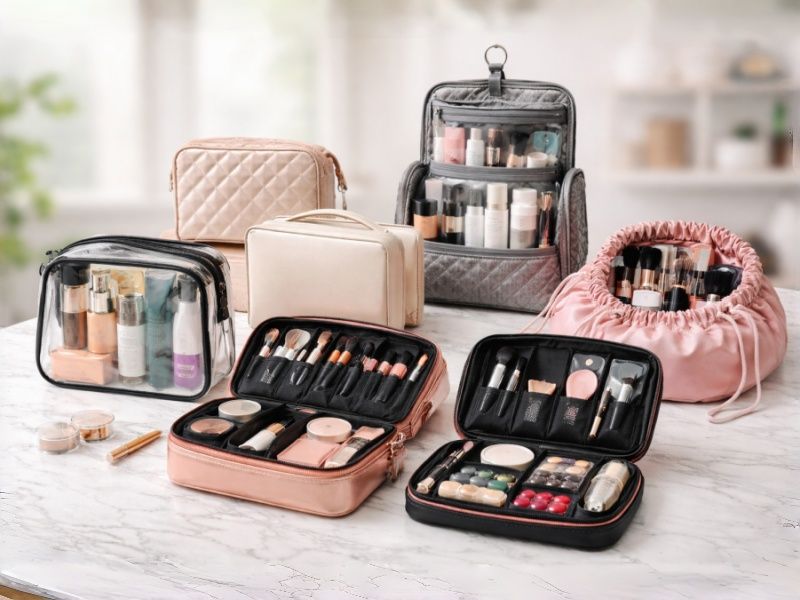
Recent beauty-bag roundups keep highlighting a handful of formats again and again: train cases, lay-flat drawstring bags, clear cases, hanging organizers, and structured travel-ready cosmetic cases. At the same time, air travel rules still shape what many people expect from a good travel beauty bag, especially when liquids must follow TSA’s 3-1-1 rule for carry-on screening.
The best makeup bag styles are the ones that match the real use scene. Daily-use styles usually work best when they are compact, easy to open, and simple to clean. Travel styles need better organization, leak control, and clearer separation between bottles, brushes, and powders. Retail and private label programs usually need more than a pretty shape. They need a style that fits the product set, target price, branding method, packing plan, and repeat-order stability. A good makeup bag is not just a pouch. It is a product decision.
That is why makeup bag styles should be evaluated like a real product category, not like an accessory added at the end. Good development starts with the end use, then moves backward into material, structure, logo method, sample review, and bulk feasibility. This is also where a factory with broad bag experience becomes useful. Jundong works across soft bags, structured cases, travel organizers, private label programs, and custom logo projects, which makes it easier to match a beauty bag concept with the right structure instead of forcing every idea into the same template.
What Are the Main Makeup Bag Styles People Look For Today?
The main styles getting the most attention today are zip pouches, structured box bags, train cases, hanging makeup bags, clear cosmetic bags, lay-flat drawstring bags, brush bags, and travel makeup organizers. The reason is simple: each one solves a different problem. Some help with visibility, some improve portability, some protect fragile products better, and some are easier to pack for travel. Current tested lists from beauty and travel publishers repeatedly surface these same formats, even when the brand names change.
The mistake is treating all of these as minor style variations. They are not. A zip pouch is usually the most flexible and price-friendly choice, but it can become messy fast if the product mix includes brushes, compacts, or leak-prone items. A structured box bag gives better shape retention and shelf presence. A train case adds stronger organization and a more premium feel, but it also uses more material and can become bulky if the proportions are wrong.
A clear makeup bag wins on visibility and travel convenience. It lets users see contents instantly and often feels more practical for airport use, beach use, and quick daily access. A hanging style is different. It solves the “small hotel bathroom” problem. It is not only a storage piece; it becomes a temporary organizer once opened. That makes it appealing for longer trips and bundled beauty kits.
Then there is the lay-flat drawstring style, which has become more visible because it changes the access experience. Instead of digging into a deep pouch, the user opens the bag and sees nearly everything at once. This is helpful for fast routines, shared counters, backstage use, and people who carry many small items.
Here is a practical comparison:
| Style | Best For | Strength | Risk if Chosen Wrong |
|---|---|---|---|
| Zip Pouch | Daily carry, entry-price lines | Simple, flexible, easy to brand | Can feel generic |
| Structured Box | Premium daily use, gift sets | Better shape and shelf look | Can feel bulky |
| Train Case | Travel, full beauty routines | Strong organization | Higher material use |
| Clear Bag | Travel, visibility, compliance-friendly use | Easy to see and wipe | Can feel less premium if material is poor |
| Hanging Bag | Long trips, bathroom use | Better access in small spaces | Too many pockets can add clutter |
| Lay-Flat Drawstring | Fast routines, wide product mix | Full visibility when open | Less structured when closed |
| Brush Bag | Tool storage, artist use | Protects slim tools | Too limited for general use |
The right style starts with the use scene, not the sketch.
Which Makeup Bag Style Is Best for Daily Use, Travel, Retail, and Private Label Programs?
The best style depends on what the bag is supposed to do after it is sold. Daily-use bags usually perform best when they are compact, soft enough to fit inside a handbag, and easy to clean. Travel styles need more internal organization, better leak control, and often a more stable shape. Retail gift sets usually need a stronger visual presence. Private label lines need a style that can be repeated, adjusted, and priced correctly across multiple launches.
For daily use, the safest choice is often a medium zip pouch or a soft structured cosmetic case. People using the bag every day do not want a product that fights them. They want something that opens quickly, holds the usual essentials, and does not waste space. This is where smooth zipper travel, a wipe-clean lining, and a stable base matter more than fancy construction.
For travel, the needs shift. Capacity becomes less important than control. A bag that holds everything but lets powder break, lets bottles tip over, or forces the user to unpack the entire bag to find one item is not a good travel bag. Travel styles work better when they separate categories: liquids, brushes, palettes, and skin-care minis. Hanging formats, train cases, and clear top-compartment designs tend to work better here because they reduce search time and improve layout.
For retail gift sets, visual discipline becomes more important. A bag sitting beside skincare, makeup brushes, or fragrance miniatures has to look intentional. It has to support the story of the set. A flat pouch may work for a low-price promotion. A structured case works better when the goal is to make the whole set feel more complete and more giftable.
For private label, repeatability matters. That means the best style is often not the most complicated one. It is the one that can be sampled cleanly, costed clearly, packed efficiently, and reordered without constant correction. At this stage, style selection is also a margin decision. Sometimes the style with the most visual appeal is not the style with the healthiest long-term structure.
Makeup Bag vs Cosmetic Bag vs Toiletry Bag: What Is the Real Difference?
A makeup bag usually focuses on color cosmetics and small beauty tools. A cosmetic bag is often used as a broader term and may overlap heavily with makeup bags. A toiletry bag is usually larger, more water-resistant, and better suited for bottles, tubes, and wet-environment use. In short: makeup bags lean toward access and organization for smaller items; toiletry bags lean toward capacity, moisture resistance, and travel practicality.
In real sourcing work, this difference matters because these categories are often mixed together too early. A team asks for a “makeup bag,” but the reference photos show a hanging dopp-style organizer. Or they ask for a “toiletry bag,” but the planned contents are mostly lipsticks, compacts, brow pencils, and brushes. The result is a bag that technically works, but feels wrong in daily use.
A true toiletry bag usually needs stronger moisture resistance, larger compartments, and more tolerance for bottle height, leakage risk, and bathroom handling. The hardware, lining, and shape should reflect that. A makeup bag, by contrast, usually benefits from softer compartment logic, smaller tool storage, more careful interior finish, and a more appearance-driven silhouette.
This is not just a naming issue. It affects cost and performance. Overbuilding a makeup bag like a toiletry bag can add unnecessary bulk and material cost. Underbuilding a toiletry bag like a slim makeup pouch can lead to leakage, distortion, and poor user experience.
A simple comparison helps:
| Term | Typical Contents | Typical Build Focus |
|---|---|---|
| Makeup Bag | Lipsticks, palettes, brushes, compacts | Small-item access, shape, layout |
| Cosmetic Bag | Broader beauty mix | Flexible; depends on use scene |
| Toiletry Bag | Bottles, tubes, grooming items | Water resistance, capacity, wet-use practicality |
When naming a project, it helps to define the actual contents first. The right product name usually becomes obvious after that.
Why Do Clear, Structured, and Travel-Friendly Makeup Bag Styles Keep Growing in Demand?
These styles keep growing because they solve practical frustrations fast. Clear bags improve visibility. Structured bags protect shape and make the contents feel more orderly. Travel-friendly styles respond to how people actually pack now: smaller routines, more movement, and more pressure to stay organized in limited space. Official TSA carry-on rules also keep clear, easy-access liquid organization relevant for travel use.
The rise of clear bags is easy to understand. People like seeing what they packed without opening every compartment. That matters in airports, shared bathrooms, gym lockers, and rushed mornings. Clear bags also communicate honesty in design. Nothing is hidden. This makes them attractive for travel kits, beach beauty sets, and simple beauty programs built around convenience.
Structured styles respond to a different frustration: soft bags that collapse into themselves. A well-shaped cosmetic case feels easier to use because it holds its form, stands better on a counter, and gives each item a clearer place. This is one reason structured cases often feel more premium even before the logo is added.
Travel-focused beauty bags have also become more specialized. Tested roundups keep favoring features such as wraparound zippers, removable dividers, brush holders, wipe-clean interiors, hanging hooks, and clear top sections. That does not mean every bag needs every feature. It means people are now quicker to notice whether a bag supports the routine it claims to support.
There is also a pricing angle. Some styles create a stronger value impression without needing expensive decoration. A clean structured case with tidy internal organization can feel worth more than a soft pouch with a complex print. For brands trying to balance perceived value and cost discipline, that matters.
If your line needs a travel-ready makeup bag style with stronger organization, better material matching, and a cleaner brand presentation, Jundong can help turn a concept into a workable sample path. You can reach the team at info@jundongfactory.com.
How Do You Choose the Right Makeup Bag Style by Material, Closure, and Interior Layout?
The right choice comes from balancing use scene, product type, cleaning needs, and price level. Material affects touch, weight, wipeability, and shape retention. The closure affects access and daily convenience. The interior layout decides whether the bag feels calm or chaotic after one week of use. Good style selection is rarely about one feature. It is about how these three decisions work together.
Start with material. If the bag will be used around liquids, makeup residue, or frequent travel, easy-clean materials matter. That can mean coated fabric, nylon with wipeable lining, PU for a smoother premium look, or clear PVC for visibility-focused travel use. Canvas can work well for lifestyle or giftable beauty lines, but it usually needs careful lining decisions or it may absorb stains and feel harder to maintain.
Then look at closure behavior. A standard top zipper is simple and low-risk. A U-shape or wraparound zipper improves visibility, which is useful when the bag has more products inside. Double zippers can also help wider opening behavior, but only if the zipper path is clean and the corners are engineered well. A bad zipper path can ruin an otherwise strong style.
The interior layout is where many projects either become more useful or more annoying. Too many compartments can create clutter. Too few compartments turn the inside into a pile. The best layouts usually follow a clear logic:
- main cavity for larger items
- slim pockets or elastic loops for pencils and brushes
- separate area for bottles or leak-risk items
- lining that is easy to wipe after powder or foundation spills
There is also a strong link between product mix and layout. A lip-focused set does not need the same interior as a skincare-and-makeup travel kit. A brush-heavy routine may need a flap or sleeve. A gift set with a mirror may need a firmer front panel. Good layout design starts with the actual contents, not a generic “more pockets is better” mindset.
Here is a quick material guide:
| Material | Best For | Main Benefit | Watch-Out |
|---|---|---|---|
| Nylon | Travel, active use | Light, durable, wipe-friendly | Can feel plain if finishing is weak |
| PU | Premium retail lines | Cleaner surface, polished look | Needs good edge and stitch control |
| Canvas | Casual, lifestyle, promo sets | Natural handfeel, print-friendly | Stain risk if lining is poor |
| Clear PVC | Visibility, travel kits | Easy to see and wipe | Needs good thickness and clean seams |
| Neoprene | Soft protective use | Cushioned feel, modern look | Can add thickness |
Who Needs Custom Makeup Bag Styles, and When Does Custom Development Make More Sense Than Stock Styles?
Custom development makes the most sense when the bag has to do more than hold products. It becomes the better choice when a beauty line needs brand identity, product fit, gift-set coordination, seasonal launch timing, or a specific retail look that stock styles cannot deliver cleanly. The teams that benefit most are beauty brands, promotional programs, boxed sets, event projects, boutique retail lines, and any label trying to build repeat recognition through shape, color, and finish.
Stock styles are useful when speed matters most and the goal is simple decoration. They are often fine for trial runs, urgent promotions, or low-complexity projects. The problem comes when a brand expects a stock bag to communicate something unique. In most cases, it cannot. It can carry a logo, but it rarely carries a distinct visual language.
Custom work makes more sense when the bag is part of the product story. That may mean:
- a shape designed around a brush set
- a train case built around a travel routine
- a gift bag sized to fit exact SKU combinations
- a seasonal color program tied to the launch palette
- a premium line that needs cleaner material and hardware decisions
There is also a commercial reason to go custom. Distinct structure can reduce direct comparison. Once the bag becomes specific to your line, it is harder to reduce the conversation to a generic unit price comparison. That can protect positioning and help create stronger long-term recognition.
That said, custom work is not always the smart first move. If the structure is too ambitious, the minimums, tooling, correction rounds, or lead time may stop the project from moving smoothly. The better path is often to customize selectively: keep the structure practical, then differentiate through proportion, material, lining, color, zipper pull, label type, and packaging details.
This is where a broad factory partner matters. Jundong can support soft cosmetic bags, travel organizers, structured cases, custom branding details, and sample-stage refinement across multiple materials. For a beauty line that wants something more specific than a stock pouch, that flexibility matters.
How Does a Custom Makeup Bag Project Move from Sample to Bulk?
A good custom makeup bag project usually follows a simple path: brief, design confirmation, material review, first sample, revisions, pre-production approval, then bulk. The steps are not complicated. What matters is how clearly each step locks the next one. Most bulk problems begin because something that looked “close enough” during the sample stage was never defined tightly enough before production started.
A workable process usually looks like this:
- Concept intake This is where the style direction gets clarified. Size, target contents, material preference, logo method, price direction, and planned quantity should all be discussed early.
- Structure and material proposal The factory team turns the idea into something buildable. That may mean adjusting panel shape, opening angle, base depth, zipper path, or handle placement. Material options should be reviewed at the same time, not later.
- First sample The first sample is not only for appearance. It should be checked for opening behavior, standing stability, interior logic, proportion, logo balance, and whether the target products actually fit the bag correctly.
- Revision rounds This stage matters more than many teams expect. Good revision work often decides whether the project feels finished or amateur. Small changes in height, gusset depth, lining color, or pocket placement can change the whole experience.
- Pre-production approval Once the structure and appearance are locked, a pre-production sample should confirm the version that bulk will follow.
- Bulk and packing control Production is only half the job. Packing method, shape protection, tissue or polybag use, barcode position, carton marks, and shipping-friendly arrangement all affect the final result.
For beauty bag projects, the sample review should always check these seven things:
| Check Item | Why It Matters |
|---|---|
| Real fill test | Confirms actual capacity |
| Zipper path | Affects ease of use every day |
| Base stability | Stops tipping on counters |
| Lining wipeability | Matters after spills |
| Logo proportion | Changes first impression |
| Pocket usefulness | Stops “empty feature” problems |
| Packing shape retention | Protects arrival condition |
At Jundong, this kind of work benefits from in-house development support, sampling capability, broad material handling, and a quality-focused workflow shaped around repeated review before bulk. If you already have sketches, reference photos, or target dimensions, you can send them to info@jundongfactory.com for a more practical evaluation.
How Long Does Custom Makeup Bag Development Take, and What Affects the Price?
Custom makeup bag development time depends on style complexity, material sourcing, logo method, revision rounds, and order quantity. Simple projects can move quickly. More structured or higher-detail projects need more time because the bag has more decisions to lock before bulk. Price works the same way. It is shaped less by the idea itself and more by what the idea requires in material, labor, organization, trim, and packing.
A practical timeline often looks like this:
| Stage | Typical Pace |
|---|---|
| Brief review and quotation | A few days |
| Material and detail confirmation | Several days to 1 week |
| First sample | About 1–3 weeks |
| Revisions | Depends on number of changes |
| Pre-production approval | About several days |
| Bulk | Depends on quantity, complexity, and schedule |
The first big price driver is structure. A flat pouch is cheaper to build than a shaped train case with dividers, brush slots, and reinforced panels. The second is material. PU, canvas, nylon, neoprene, clear PVC, specialty linings, and custom hardware all move cost in different ways. The third is logo method. A simple woven label is not the same cost as a metal plate, embossed patch, or multi-step print finish.
Then comes quantity. Smaller runs usually carry higher unit cost because the development work, sourcing effort, and production setup do not disappear just because the order is small. This is why small test orders can still make sense, but they should not be judged by the same unit-cost expectations as larger runs.
Packing also changes cost more than many teams expect. A bag packed flat in a polybag is one thing. A structured bag protected for gift presentation or e-commerce arrival is another. Insert cards, hangtags, tissue wrapping, color boxes, and barcode handling all add work.
A simple cost view:
| Cost Driver | Effect on Unit Price |
|---|---|
| More panels and structure | Higher |
| Better lining and trim | Higher |
| Complex logo method | Higher |
| Smaller quantity | Higher |
| Simpler pouch format | Lower |
| Standard trim choices | Lower |
| Larger repeat runs | Lower |
The best way to control price is not to strip the bag down blindly. It is to remove the features that do not improve real use. That may mean cutting decorative compartments, simplifying the outer panel shape, switching the lining, or using one strong logo application instead of three weaker ones.
For teams planning a new makeup bag style, the strongest first move is usually to define the target contents, target look, approximate quantity, and intended price band before sampling starts. That makes the whole process cleaner.
FAQ Section — Top 10 FAQs About Makeup Bag Styles
1) What makeup bag style is best for daily use?
The best daily-use style is usually a medium zip pouch or a small structured cosmetic case. The reason is simple: daily routines reward speed. People want a bag that opens quickly, fits the products they actually use every day, and does not take over their handbag, work tote, or vanity space. A style can look beautiful in photos and still feel annoying in real life if it is too deep, too floppy, or too hard to wipe clean after a few weeks of use.
For daily use, the smartest styles usually have three things in common. First, they are compact enough to carry without feeling bulky. Second, they open wide enough that products are easy to find. Third, they use materials and linings that can handle powder dust, foundation marks, and lipstick smudges without looking tired too soon. That is why slim pouches, softly structured zip cases, and upright boxy shapes tend to do well in this category. Tested beauty-bag roundups also keep favoring compact cases with smooth zipper access, organized interiors, and wipe-friendly surfaces because those details improve the routine, not just the look.
A practical rule helps here: if the bag is for touch-ups and everyday carry, it should stay simple. If it is trying to hold a full-face setup, skincare, and tools all at once, it stops being a daily bag and starts behaving like a travel organizer. That mismatch is where frustration begins.
If a brand is developing a daily beauty pouch, it is usually better to keep the structure clean, light, and repeatable, then create distinction through material, proportion, zipper pull, lining color, and logo placement rather than adding too many internal features. That kind of restraint often makes the product feel more polished.
2) Which makeup bag style works best for travel and flights?
For travel, the best style is rarely the smallest one. It is the one that gives control. A good travel makeup bag should help separate liquids from powders, keep brushes from getting crushed, and allow fast access when someone is unpacking in a cramped hotel bathroom or moving through airport security. That is why hanging bags, structured train cases, clear compartment bags, and wide-opening cosmetic cases keep appearing in current travel-tested recommendations.
Air travel adds one more layer. TSA’s liquids rule still limits carry-on liquids, aerosols, gels, creams, and pastes to containers of 3.4 ounces or 100 milliliters, and they must fit into one quart-size bag per passenger. That does not mean every makeup bag needs to be fully clear, but it does mean that clear pouches, removable liquid sections, or layouts that let users separate liquid items quickly are still very useful.
A good flight-friendly style usually includes:
- a shape that opens wide without collapsing
- a wipe-clean lining
- a clear or easy-access section for liquids
- enough organization to stop product shifting
- a size that fits neatly into carry-on packing
The biggest mistake is choosing a travel bag based only on capacity. A bag that “fits everything” can still perform badly if items pile up, leak into one another, or require a full unpack just to reach one product. Travel bags work best when they reduce friction. That is the real job.
3) What is the difference between a makeup bag, a cosmetic bag, and a toiletry bag?
A makeup bag usually focuses on color cosmetics and small beauty tools. A cosmetic bag is often a broader term and can overlap with makeup bags a lot. A toiletry bag is usually larger, more moisture-aware, and better suited for bottles, tubes, and personal-care items used in wet environments. In practice, the difference is not just wording. It changes how the bag should be built. Sources comparing these categories tend to describe makeup bags as smaller and more beauty-specific, while toiletry bags are typically larger and more practical for grooming and travel-size bottles.
This matters because many projects start with the wrong reference language. A team says they want a “makeup bag,” but the products inside include cleanser, shampoo bars, and skincare bottles. Or they ask for a “toiletry bag,” but the intended contents are mostly lipsticks, compacts, and brushes. That confusion leads to overbuilt or underbuilt products.
Here is the easiest way to separate them:
| Bag Type | Typical Contents | Best Build Direction |
|---|---|---|
| Makeup Bag | Lipsticks, compacts, concealer, brushes | Smaller scale, easier access, neater layout |
| Cosmetic Bag | General beauty mix | Flexible; depends on product mix |
| Toiletry Bag | Bottles, tubes, hygiene items | More capacity, more wipeability, more wet-use practicality |
When in doubt, define the contents first. Once the item mix is clear, the right category usually becomes obvious. That single step prevents a lot of bad decisions later.
4) Are clear makeup bags really better, or are they just a trend?
Clear makeup bags are not automatically better. They are better for certain use scenes. Their strongest advantage is visibility. People can see what is inside immediately, which makes them practical for travel, gym use, beach kits, touch-up kits, and any routine where speed matters. Travel and beauty roundups continue to highlight clear cases because they reduce digging, speed up unpacking, and help people organize products by type.
For flights, clear sections can be even more useful because liquid items often need to be separated quickly. TSA’s liquids rule keeps that behavior relevant. A fully clear bag is not required in every case, but a clear pouch, clear top, or removable transparent section can make travel smoother.
That said, clear bags also have trade-offs. Low-grade clear material can wrinkle badly, feel sticky over time, show scratches, or look less premium than coated fabric, nylon, or PU. They also expose everything visually, which some users like and others dislike. So the better question is not “Are clear bags better?” It is “Are clear bags better for this product line and this routine?”
They usually work best when the goal is:
- fast visual access
- travel convenience
- simple organization
- easy wipe-down after spills
They are usually less ideal when the goal is:
- a softer luxury look
- a more private or elevated appearance
- a heavily branded exterior story
In other words, clear is a tool, not a universal upgrade.
5) Which materials work best for different makeup bag styles?
The best material depends on what the bag needs to do after it is sold. A material that looks great in a studio sample can fail quickly in daily use if it stains easily, loses shape, or becomes hard to clean. That is why material choice should always follow the use scene, not just the mood board.
Here is a practical material comparison:
| Material | Best For | Strength | Watch-Out |
|---|---|---|---|
| Nylon | Travel, active daily use | Lightweight, durable, wipe-friendly | Can feel plain if finishing is weak |
| PU | Polished retail lines, gift-ready styles | Cleaner surface, stronger visual finish | Needs careful edge and stitch control |
| Canvas | Casual beauty pouches, lifestyle collections | Natural look, print-friendly | Can stain if lining and finish are weak |
| Clear PVC | Travel kits, visibility-focused organizers | Easy to see, easy to wipe | Can wrinkle or look cheap if gauge is poor |
| Neoprene | Soft protective cases | Cushioned feel, modern look | Adds thickness and can shift style perception |
Beauty and travel recommendations keep favoring materials that are easy to wipe clean and interiors that help contain leaks or powder mess, because real-life performance matters more than the initial unboxing look.
For beauty kits with bottles or cream products, lining matters just as much as the shell. A pretty outer fabric cannot fix an inner surface that traps residue. For gift sets or retail presentations, PU and structured fabric combinations often create a stronger value impression. For more casual styles, nylon or canvas can work very well, but only when the lining and construction support the intended use.
When a project is being customized, material decisions should be locked early. This is where many sample rounds either get cleaner or more expensive.
6) How big should a makeup bag be?
The right size is the size that matches the real routine, not the imagined one. People often overestimate how much space they need. That leads to bulky bags that look underfilled, shift around in luggage, and feel less convenient than expected. On the other side, a bag that is too small may technically close, but it creates stress every time someone packs it.
A small makeup bag usually works best for daily essentials and touch-ups. A medium size tends to work for short trips or balanced routines. Larger formats make more sense when the bag needs to hold palettes, bottles, brushes, and skincare together. Brand guides and travel-size references often suggest that medium formats are the most versatile for general travel, while smaller ones are better for quick carry and larger ones suit longer trips or fuller routines.
Instead of choosing size by guesswork, review these five things:
- What exact items will go inside?
- Will brushes be stored loose or in sleeves?
- Do bottles need to stand upright?
- Is the bag meant for handbag carry, suitcase packing, or counter display?
- Should it still look good when half full?
That last one matters. A bag can have enough volume and still feel visually wrong. Good size planning is not only about fitting products. It is also about proportion, silhouette, and how the bag behaves when packed lightly, fully, or somewhere in between.
For custom work, sending a simple fill list or even a photo of the planned contents often saves more time than sending ten reference bags.
7) What interior layout works best inside a makeup bag?
The best interior layout is the one that keeps the bag easy to use after the first week, not just on the day it arrives. Many bags look organized when empty. Fewer still stay organized when filled with real products, handled quickly, and packed by someone who is in a hurry. That is why the strongest interior layouts are usually based on clear logic, not maximum complexity.
A good beauty-bag interior often includes:
- one main space for larger items
- one or two slim pockets for pencils or mascara
- brush protection if tools are part of the routine
- a wipe-clean lining
- enough separation to stop leaks or powder transfer, but not so many divisions that the inside feels crowded
Current tested bag roundups keep favoring layouts with brush holders, removable dividers, hanging compartments, and wide openings, but the deeper pattern is not “more features.” The deeper pattern is better access. People like interiors that reduce rummaging and make product categories easier to see.
The most common mistake is over-design. Too many pockets can become dead space. Tiny compartments that look impressive in photos may only fit a narrow set of products. Elastic loops can also become useless if they are sized for one item type and nothing else. Good layout design should feel helpful, not bossy.
A smart development method is to group contents by behavior:
- messy items
- fragile items
- long slim tools
- quick-reach essentials
Once that logic is clear, the layout usually becomes much more natural.
8) Should a makeup bag be soft or structured?
Neither is universally better. A soft bag is usually lighter, easier to pack into another bag, and often more forgiving for daily carry. A structured bag tends to stand better, protect shape better, and create a cleaner presentation on a vanity or in a gift set. The right choice depends on where the bag will live and how it will be used.
Soft bags work well when flexibility matters. They fit more easily into totes, suitcases, and crowded drawers. They can also feel more casual and approachable. That makes them strong candidates for everyday pouches, promotional beauty kits, and lighter travel use.
Structured styles work better when the bag needs to deliver more order and presence. Travel beauty cases, train cases, and boxed sets often benefit from reinforcement because structure improves access and helps the bag hold its silhouette. Travel and beauty review lists continue to favor structured or semi-structured cases for long trips and fuller beauty routines because they make packing and retrieval easier.
A useful way to decide is this:
- choose soft when packability matters most
- choose structured when visibility, stability, and presentation matter most
For custom projects, hybrid solutions are often the most practical. A bag can stay soft overall while using a reinforced base, cleaner top opening, or lightly structured front and back panels. That gives better usability without turning the product into a bulky case.
If a collection needs help balancing softness, structure, and retail feel, Jundong can review the concept and suggest a more workable direction. Contact: info@jundongfactory.com.
9) How does a custom makeup bag sample process usually work, and what should be prepared first?
A clean sample process usually begins long before the first physical bag is made. The most useful first step is not “make a sample.” It is define the brief clearly enough that the first sample has a real chance of being right. That means size direction, target contents, style references, material preference, logo method, approximate quantity, and intended price level should all be discussed at the start.
A practical sample flow usually looks like this:
- concept and reference review
- size and structure proposal
- material and trim selection
- first sample
- revision round or rounds
- pre-production approval
- bulk preparation
The strongest sample reviews do not stop at appearance. They check:
- how the zipper opens
- whether the base stands well
- whether the lining feels right
- whether bottles or compacts actually fit
- whether the logo scale feels balanced
- whether the bag still looks good when partly filled
This is where many projects either become efficient or expensive. When details such as opening angle, pocket depth, or lining finish are left vague, corrections usually multiply later. Bag-development guides and tested travel-bag roundups keep reinforcing the same indirectly: function matters as much as shape, especially when products need to stay organized and easy to reach.
For a smoother start, prepare at least three things: a reference image set, a basic fill list, and a rough priority order for what matters most—appearance, organization, packability, or presentation. That alone can shorten the path meaningfully.
10) What affects the price, MOQ, and lead time of a custom makeup bag?
The biggest factors are structure, material, trim, logo method, quantity, and packing method. People often assume price is mainly about size, but size alone rarely tells the full story. A small structured case with dividers, a reinforced base, metal trim, and custom packaging can cost more than a larger soft pouch with a simple print.
Here is a practical view:
| Factor | What Usually Happens |
|---|---|
| More structure | Higher labor and material use |
| Clear compartments or special pockets | More complexity |
| Premium surface finish | Higher material cost |
| Metal plates / advanced logo details | More trim and setup cost |
| Small runs | Higher unit cost |
| Simple repeated styles | Better cost stability |
| Gift-ready packaging | Extra packing cost and time |
Lead time also moves with complexity. A simple pouch with common material and a straightforward logo usually develops faster than a multi-compartment train case or a travel style with clear sections, brush holders, and packaging inserts. Small runs are flexible in one sense, but they can still carry higher unit costs because the development work, sourcing effort, and production setup do not disappear just because the quantity is lower.
Travel-related requirements can also shape the brief. If the bag is meant to support flight routines, the layout may need to separate liquid items in a way that works with TSA’s carry-on rules, which adds decision early in development.
The cleanest way to control cost is not to remove features blindly. It is to remove the features that do not improve real use. That could mean simplifying panel shape, reducing decorative pockets, changing trim, or switching to a more efficient lining. Done well, that protects both usability and value perception.
For teams planning a custom beauty-bag style, sending target size, intended contents, quantity estimate, and reference photos to info@jundongfactory.com is usually the fastest way to get a more realistic direction.
Let's work together
With over 10 years of OEM/ODM bag industry experience, I would be happy to share with you the valuable knowledge related to leather products from the perspective of a leading supplier in China.

Factory catalogue
Table of Contents
Latest blogs


Make A Sample First?
If you have your own artwork, logo design files, or just an idea, please provide details about your project requirements, including preferred fabric, color, and customization options, we’re excited to assist you in bringing your custom bag designs to life through our sample production process.