 Skip to content
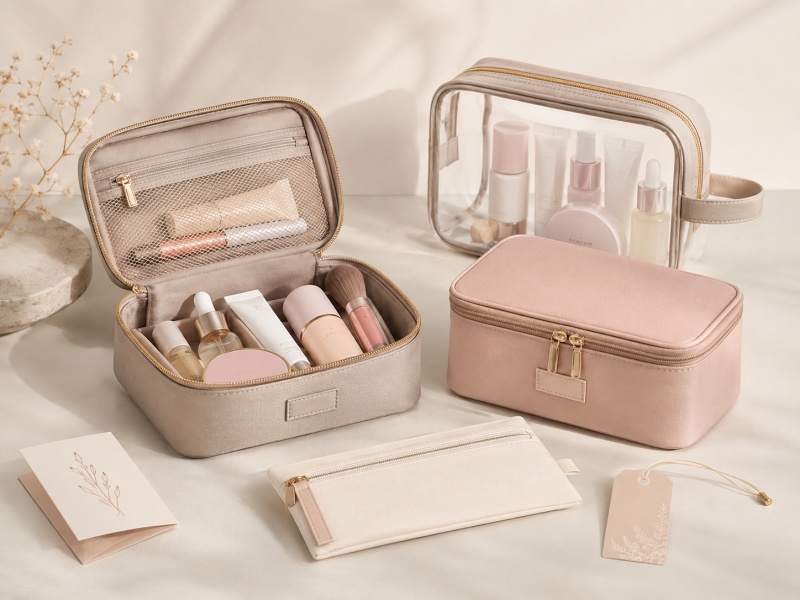
Small travel cosmetic bags look simple at first. A zipper pouch. A soft handle. A neat logo. Maybe a clear window. Maybe a wipeable lining. But for beauty brands, this small item often carries more responsibility than it seems. It may hold a new skincare trial set. It may support a holiday gift box. It may become part of a private label launch, a hotel amenity kit, a subscription box, or a retail-ready makeup set.
The real value is not only the bag itself. It is how the bag makes the beauty products feel more complete.
A small pouch can make mini bottles look more organized. A well-planned inner pocket can stop lip products from rolling around. A clean logo position can make the set look branded without feeling crowded. A simple barcode label can help the warehouse receive the right color, size, and SKU faster. A wipeable lining can make daily use easier after powder, cream, or liquid touches the inside.
Travel cosmetic bags help beauty brands package small skincare, makeup, and beauty tools in a cleaner and more organized way. The right bag should match real product dimensions, support clear logo placement, protect the contents, fit retail or online packing needs, and stay consistent from sample to bulk production. For beauty sets, the best travel cosmetic bag is not just cute or portable. It is sized, structured, branded, tested, and packed for the full product journey.
This is where many beauty accessory projects succeed or fail. A bag can look good in a photo but fail when loaded with real tubes, jars, brushes, sachets, and cards. A sample can look fine on the desk but lose shape after packing. A logo can look elegant on a flat panel but become hidden after the pouch is filled. These are not small details for a beauty brand. They affect how the product looks online, how it arrives at retail, how it feels during unboxing, and how long the end user keeps it.
Jundong works from Guangdong with custom bag programs for beauty, lifestyle, travel, promotional, and retail projects. For travel cosmetic bags, the goal is simple: help brands turn small products into cleaner, more useful, more brand-ready sets with practical sampling, stable production, and export-ready packing support.
What Are Travel Cosmetic Bags for Beauty Brands?
Travel cosmetic bags for beauty brands are small custom pouches or organizers made to hold skincare, makeup, beauty tools, toiletry items, samples, or gift set products. Unlike a normal personal makeup pouch, a brand-focused travel cosmetic bag must consider product fit, logo position, material feel, inner structure, retail label, barcode, packing direction, SKU control, and bulk consistency. It is both a useful storage item and part of the brand presentation.
For a beauty brand, a travel cosmetic bag is rarely “just a bag.” It may be the outer carrier for a skincare set. It may be the reusable item inside a gift box. It may be a promotional item for a new product launch. It may be part of a travel retail set near an airport counter. It may also become a small paid accessory that supports a wider product line.
That is why the planning should begin with the products that go inside. What will the pouch hold? Bottles? Cream tubes? Lip gloss? Compact powder? Makeup brushes? Beauty sponges? A care card? A barcode label? A mini mirror? These details decide the shape more than a trend photo does.
A useful travel cosmetic bag usually needs three layers of thinking.
The first layer is product fit. The bag should hold the items without squeezing them or leaving too much empty space.
The next layer is user experience. The person opening the pouch should see the contents quickly, reach them easily, and keep them organized.
The last layer is business use. The bag should support logo work, packing, carton planning, labels, color versions, repeat orders, and stable bulk output.
When these three layers work together, a small cosmetic bag becomes a practical branded product. When one layer is ignored, the result may still look nice, but it can create problems during packing, shipping, retail display, or daily use.
Why Do Small Cosmetic Bags Work Better for Beauty Sets?
Small cosmetic bags work well for beauty sets because they make mini products feel complete, organized, and easier to present. Beauty sets often include small bottles, tubes, jars, lip products, samples, and tools. A large pouch can make these items look loose or unfinished. A well-sized small travel bag reduces empty space, supports cleaner packing, improves gift set value, and helps brands create a more polished product experience.
Small size has a hidden power in beauty packaging. It gives small products a stronger visual frame.
Many beauty products used in travel sets are not large. A serum bottle may be 10ml or 15ml. A cream tube may be 30ml. A cleanser may be travel-sized. A lip product, mini mascara, or compact powder does not need a large toiletry case. If these items are placed inside a bag that is too big, the set may look weak, even if the products are good.
A better-sized pouch can make the same products feel more valuable. It holds them close enough to feel like a planned set. It reduces movement during transit. It also helps the user understand the purpose of the set faster.
Small travel cosmetic bags are especially useful for:
| Beauty Set Type | Why a Small Bag Works |
|---|---|
| Skincare trial set | Keeps mini bottles and tubes together |
| Makeup starter kit | Organizes daily-use items in one pouch |
| Holiday gift set | Adds reusable value to seasonal packaging |
| Subscription box add-on | Fits small products without increasing box size too much |
| Hotel amenity kit | Keeps toiletry items neat and easy to carry |
| Influencer PR kit | Makes the set more photo-friendly |
| Travel retail set | Supports compact shelf and luggage use |
Still, small does not mean tight. A pouch that is too small creates another problem. Zippers may pull, corners may stretch, and the bag may lose shape after loading. A good size gives products room to sit naturally while still looking neat.
For beauty brands, this is the key idea: the bag should make the set feel fuller, not forced.
Which Type of Travel Cosmetic Bag Fits Your Beauty Products?

The right type of travel cosmetic bag depends on the shape, number, weight, and display needs of the beauty products inside. Flat zipper pouches are good for samples and slim items. Box cosmetic bags work better for bottles and jars. Clear PVC pouches show product visibility. PU pouches give a more premium feel. Multi-compartment organizers are better for tool kits, brush sets, and larger travel collections.
A beauty brand should not choose a bag type only because it looks nice in a catalog. The better choice starts with the product mix.
If the set includes sachets, lip products, and flat samples, a flat zipper pouch may be enough. It is slim, easy to pack, and cost-friendly. If the set includes jars, mini bottles, or larger tubes, a box-shaped bag may hold the items more naturally. If the set needs a clean, modern, visible look, a clear PVC or TPU pouch may work well. If the brand wants a softer premium feeling, PU, quilted fabric, or textured fabric may be a better direction.
Here is a simple guide:
| Type of Bag | Best Fit | Notes for Beauty Projects |
|---|---|---|
| Flat zipper pouch | Samples, lip products, sachets | Easy to pack, good for simple sets |
| Box cosmetic bag | Bottles, tubes, jars | Better shape and standing structure |
| Clear PVC pouch | Travel kits, visible product sets | Good for showing contents |
| PU cosmetic bag | Premium skincare or gift sets | Stronger brand feel |
| Nylon travel pouch | Travel retail and daily use | Light, practical, easy to clean |
| Hanging toiletry bag | Larger care sets | Better for travel and bathroom use |
| Brush pouch | Makeup tools and brushes | Helps protect bristles and handles |
| Drawstring beauty pouch | Soft gift packaging | Simple, light, relaxed style |
The wrong type can create avoidable problems. A flat pouch may not work well for glass jars. A box bag may feel bulky for sachets. A clear pouch may look modern, but it also exposes every detail inside, so product arrangement matters more.
Brands often ask which type is best. A better way to think about it is: which type makes your product set easiest to understand, easiest to use, and easiest to pack?
If you already have product dimensions, product photos, and a packing idea, Jundong can review the structure and suggest a practical travel cosmetic bag direction before sampling. Project details can be sent to info@jundongfactory.com.
How to Choose the Best Size for Travel Cosmetic Bags?
The best size for a travel cosmetic bag is not the smallest size. It is the size that fits the real beauty products cleanly after loading. Brands should check product height, width, thickness, quantity, zipper opening, packing direction, insert cards, inner pockets, and final bag shape. A good size avoids squeezing, empty space, zipper stress, and poor display after the set is packed.
Size planning should begin with real items, not only an expected bag measurement.
A beauty set may include one cleanser, one toner, one cream tube, one mini jar, two lip products, and one card. On paper, the total dimensions may look simple. In real packing, the bottle cap, tube thickness, label direction, and zipper opening all change the result.
Three checks matter most.
The first check is loading space. Can the products fit without pushing against the zipper or side seam?
The second check is visual balance. Does the bag still look clean and shaped after the products are inside?
The third check is handling. Can the user open the bag, take items out, and put them back without frustration?
Here are details brands should confirm early:
| Detail to Confirm | Why It Matters |
|---|---|
| Product dimensions | Prevents wrong bag size |
| Number of items per set | Controls inner layout |
| Product weight after loading | Affects zipper, seams, and handle |
| Standing or flat packing | Changes bag structure |
| Opening style | Affects access and usability |
| Card or insert size | Prevents bending or crowding |
| Logo position | Keeps branding visible |
| Barcode and label needs | Supports retail and warehouse use |
| Carton quantity | Helps shipping planning |
One common mistake is approving a sample before testing the real products inside. The pouch may look perfect when empty but become lumpy, tight, or unbalanced after loading.
For custom travel cosmetic bags, size should be confirmed with a real loading test. Put the actual products inside. Close the zipper. Hold the pouch. Place it flat. Stand it up if needed. Put it into the intended gift box or shipper. This simple test can prevent expensive changes later.
How Does Better Organization Improve User Experience?
Better organization improves travel cosmetic bags by helping users see, separate, protect, and access beauty products more easily. Inner pockets, mesh sections, elastic loops, brush slots, clear compartments, and wide openings can reduce mess and improve daily use. The best structure is not always the most complex one. It should match the exact products inside and support a cleaner, more natural user experience.
Beauty products have different shapes. This is why a cosmetic bag without planning often becomes messy.
Small tubes slide under larger bottles. Lip products fall to the bottom. Brushes touch cream jars. Powder cases rub against hard caps. Sachets bend. If the pouch is used for travel, the items move even more.
Better organization solves these small problems before they become annoying.
For skincare sets, inner elastic loops may help keep bottles standing. A divider can separate soft tubes from jars. A wipeable lining can protect the inside if liquid leaks.
For makeup sets, brush slots can protect bristles. A mesh pocket can hold sponges or smaller tools. A wider opening helps the user see everything faster.
For retail gift sets, the inside may stay simple. Too many compartments can increase cost and make packing slower. A clean main compartment with one pocket may be enough.
Good structure should serve the product, not decorate the bag.
This is an area where brands should be careful. More pockets can sound better, but they may not add value. If a brand is selling a three-piece skincare travel set, a complex organizer may feel heavy and overpriced. If the brand is selling a professional makeup tool set, a simple pouch may feel under-designed.
The best structure comes from the product story. What does the user do with the set? Travel? Daily makeup? Gym bag use? Hotel stay? Gift opening? Influencer filming? Retail shelf display? The structure should match that moment.
Which Material Is Best for Custom Travel Cosmetic Bags?

The best material for custom travel cosmetic bags depends on brand style, product weight, cleaning needs, target price, logo method, and packing plan. PU works well for premium beauty sets. PVC or TPU supports clear visibility. Nylon and polyester are practical for travel use. Canvas and cotton fit natural beauty lines. rPET can support eco-minded product programs. The right material should match both the brand image and the real use case.
Material choice shapes the whole feeling of the bag. It affects handfeel, price, weight, structure, print result, cleaning, and packing volume.
A soft cotton pouch may feel natural and warm, but it may not be the best option for liquid skincare unless the lining is planned well. A clear PVC pouch can show the products beautifully, but it also makes packing tidiness more visible. PU can create a refined look, but the logo method and surface texture need to be tested. Nylon is light and useful for travel, but the final look depends heavily on fabric density, lining, zipper, and color.
A practical material decision often looks like this:
| Brand Direction | Possible Material Choice | Why It Works |
|---|---|---|
| Clean beauty | Cotton, canvas, rPET | Soft, natural, simple look |
| Premium skincare | PU, textured PU, quilted fabric | Better handfeel and brand presence |
| Youth makeup | PVC, TPU, printed polyester | Colorful, visible, playful |
| Travel retail | Nylon, polyester, coated fabric | Light, strong, practical |
| Gift sets | Velvet, satin lining, quilted fabric | Better unboxing feeling |
| Tool-style beauty set | Neoprene, padded polyester | More protection and structure |
Brands should also think about the inside. For beauty products, the lining matters. Powder, cream, liquid, and oil can touch the interior surface. A wipeable inner layer can make the bag more useful and reduce negative user feedback.
How Should Beauty Brands Plan Logo and Private Label Details?
Beauty brands should plan logo and private label details by matching the logo method with the material, bag size, surface texture, and final use. Small travel cosmetic bags need clean logo placement, not oversized branding. Screen print, heat transfer, embroidery, woven labels, embossed logos, rubber patches, metal plates, zipper pull logos, and inner labels can all work, but each method should be tested on the selected material before bulk production.
A travel cosmetic bag is a small surface with a big branding job. The logo needs to be visible, but not loud. It should look intentional, not squeezed onto the bag.
For flat pouches, the front panel often works well for a printed logo or woven label. For PU bags, embossed, debossed, or metal plate logos can create a more premium feeling. For canvas or cotton, embroidery or woven labels can fit a natural beauty style. For PVC bags, logo position should be tested because transparency can change how the artwork looks.
Logo decisions should consider these details:
| Logo Method | Good For | Watch Out For |
|---|---|---|
| Screen print | Simple artwork, flat surfaces | Needs color and rub test |
| Heat transfer | Detailed logo, smoother finish | Must match material surface |
| Embroidery | Fabric bags, natural look | May not suit tiny text |
| Woven label | Clean beauty, lifestyle style | Needs proper placement |
| Embossed logo | PU and leather-like materials | Subtle, may need enough surface area |
| Rubber/PVC patch | Sporty or youth style | Adds weight and cost |
| Metal plate | Premium skincare sets | Needs strong fixing and scratch check |
| Zipper pull logo | Small brand detail | Works best with good hardware planning |
Private label details do not stop at the logo. Hangtags, inner labels, care labels, barcode stickers, color labels, and insert cards all affect the final brand experience.
A common issue is label conflict. The logo may look good on the sample, but later the barcode label or hangtag covers it. This can be avoided by planning logo, hangtag, barcode, and packing direction together.
What Packing Details Make Cosmetic Bags Cleaner for Retail and Shipping?
Cleaner packing comes from planning how each cosmetic bag will be labeled, protected, counted, sorted, and received. Beauty brands should confirm polybag size, hangtag position, insert card direction, barcode label, SKU sticker, color label, carton quantity, carton marks, and packing photos before bulk delivery. Good packing reduces confusion, protects the product, improves retail readiness, and helps warehouse teams handle multi-color or multi-set orders faster.
Packing is where many beauty projects become either smooth or messy.
A pouch can be beautifully made, but if the packing is unclear, the brand still faces problems. Wrong barcode. Mixed colors. Unclear carton marks. Labels covering the logo. Insert cards bent inside the pouch. Different SKUs placed in the same carton without clear separation. These issues cost time after delivery.
Cleaner packing is not about using more packaging. It is about using the right packing.
For beauty brands, the most useful packing details often include:
| Packing Detail | Why It Matters |
|---|---|
| Individual polybag | Keeps each bag clean during transit |
| Hangtag | Supports retail display and brand story |
| Insert card | Adds product or brand information |
| Barcode label | Helps retail and warehouse scanning |
| SKU sticker | Reduces sorting mistakes |
| Color label | Helps manage multi-color sets |
| Carton mark | Supports receiving and stock control |
| Master carton quantity | Helps freight and storage planning |
| Packing reference photo | Keeps bulk packing consistent |
| Gift box or kit packing | Supports higher-end beauty sets |
Brands selling through online channels, retail chains, subscription boxes, or travel retail should take packing seriously. The pouch is only one part of the full product flow. It must move from production to carton, warehouse, shelf, unboxing, and daily use.
A good packing plan also improves communication. Once the packing photo and carton mark format are approved, the team has a clear reference for bulk orders and repeat orders.
For beauty brands planning multi-color or multi-SKU cosmetic bag projects, Jundong can help review packing details before bulk production. Send your packing needs and quantity plan to info@jundongfactory.com for a practical review.
How Does the Sample Process Reduce Bulk Order Risk?

The sample process reduces bulk order risk by testing the travel cosmetic bag before large-scale production starts. A useful sample should confirm material, color, size, logo method, zipper feel, lining, inner structure, product fit, packing method, and final appearance after loading. Beauty brands should test real bottles, tubes, jars, brushes, labels, and insert cards inside the sample before approving bulk production.
A sample is not only a preview. It is a risk filter.
For travel cosmetic bags, the sample process should test both appearance and function. Does the pouch look right? Does the zipper run smoothly? Does the logo sit in the right place? Does the lining match the use case? Does the bag keep its shape after loading? Can the products fit with the insert card? Does the bag pack well into the gift box or master carton?
A practical sample process may include:
- Project brief review Product use, quantity, target style, material idea, logo file, packing needs, and target timeline.
- Material and structure advice Select fabric, lining, zipper, trim, and structure based on product fit and brand style.
- Pattern making Build the shape and size based on real measurements.
- First sample Check overall size, shape, function, and material feel.
- Logo sample check Test logo method, size, color, position, and durability.
- Loading test Place real beauty products inside the bag and check shape, zipper, structure, and usability.
- Packing test Check polybag, hangtag, barcode, insert card, carton quantity, and packing direction.
- Pre-production sample Confirm final details before bulk production.
Jundong usually supports sample development in about 5–7 days, and some simple styles may be sampled in 2–3 days depending on material and structure. This is useful when brands need to prepare for seasonal beauty sets, launch kits, retail programs, or campaign deadlines.
Skipping sample tests may seem faster, but it can create bigger delays later. The best time to find a size problem is before bulk production, not after cartons are packed.
What MOQ, Sample Time, and Lead Time Should Brands Expect?
For custom travel cosmetic bags, MOQ, sample time, and lead time depend on material, structure, logo method, color, quantity, packing, and order complexity. A practical starting MOQ is usually 500 pcs per design. For simple styles, 200–300 pcs may be arranged depending on project details. Sample time is usually 5–7 days, while bulk production often takes about 20–30 days after sample approval.
MOQ should be understood as part of the production reality, not just a number.
Smaller quantities can work for simple projects, but the unit cost is usually higher. Material sourcing, pattern making, logo setup, sample work, cutting, sewing, inspection, and packing still require a full process. When the quantity is low, those costs are spread across fewer pieces.
Once the quantity reaches around 500 pcs per design, pricing usually becomes more competitive because material use, production planning, and labor arrangement become more efficient.
Here is a practical planning table:
| Project Detail | Typical Planning Direction |
|---|---|
| Standard MOQ | Usually 500 pcs per design |
| Simple style quantity | 200–300 pcs may be possible |
| Sample time | Usually 5–7 days |
| Fast sample option | Some simple styles may take 2–3 days |
| Bulk lead time | Usually 20–30 days after sample approval |
| Cost factor | Material, logo, structure, lining, packing, quantity |
| Best for testing | Simple structure, standard material, clear logo method |
| Best for better price | Stable quantity and repeatable design |
Brands should also plan time for review and revision. A sample may need small changes to size, logo position, inner pocket, lining, or packing. If the delivery date is fixed, such as a holiday gift set or retail launch, the timeline should include approval time, not only production time.
If your project has a target launch date, it is better to share that date early. Jundong can then review whether the sample and bulk schedule fit the project timeline.
Travel Cosmetic Bags vs Regular Makeup Pouches: What Is the Difference for Brands?
Travel cosmetic bags for beauty brands are planned around product sets, branding, packing, and bulk consistency, while regular makeup pouches are usually made for general personal storage. A brand-ready travel cosmetic bag needs product fit testing, logo planning, retail label space, SKU control, carton planning, material matching, and sample-to-bulk quality control. The difference is not only the style. It is the full project purpose.
A regular makeup pouch can be simple. It holds daily items. It may not need a barcode. It may not need a product loading test. It may not need to match a skincare line or retail campaign.
A travel cosmetic bag for a beauty brand has a larger job. It supports a product set. It carries a logo. It may sit inside a gift box. It may be scanned into a warehouse. It may be shipped across countries. It may be used in photos, videos, and online product listings.
Here is the practical difference:
| Item | Brand Travel Cosmetic Bag | Regular Makeup Pouch |
|---|---|---|
| Main use | Beauty set, travel kit, retail program | Personal storage |
| Size logic | Based on actual product loading | Based on general use |
| Logo planning | Must match brand style | Often simple or decorative |
| Packing | May need barcode, hangtag, SKU label | Often simple packing |
| Quality control | Sample-to-bulk consistency matters | Less strict |
| Repeat order | Often needed | Not always |
| Project risk | Higher if details are missed | Lower |
This is why beauty brands should not choose only from stock-style options if the pouch is part of a product launch or retail set. A custom approach helps the bag match the product, not the other way around.
How Does a Cosmetic Bag Factory Control Quality from Sample to Bulk?
A cosmetic bag factory controls quality from sample to bulk by locking approved specifications and checking materials, color, cutting, stitching, zipper function, logo position, lining, size, packing, and carton marks during production. For beauty brands, quality control should focus on consistency, cleanliness, shape, logo clarity, and packing accuracy, because these details affect retail appearance and end-user trust.
Bulk quality is not created at the end. It starts before production.
The approved sample should become the main reference. Material, color, size, logo placement, zipper type, lining, pocket position, stitching style, label position, and packing method should be recorded clearly. If the bulk team does not follow the approved sample, small differences can spread across thousands of pieces.
For travel cosmetic bags, useful checks include:
| Quality Check | What to Review |
|---|---|
| Material check | Fabric, PU, PVC, lining, handfeel, thickness |
| Color check | Main material, zipper, trim, label |
| Cutting check | Size accuracy and panel shape |
| Stitching check | Straight lines, seam strength, corner finish |
| Zipper check | Smooth opening and closing |
| Logo check | Position, clarity, color, durability |
| Inner structure check | Pockets, loops, dividers, lining |
| Cleanliness check | Threads, marks, glue, dust |
| Packing check | Polybag, hangtag, barcode, carton mark |
| Final check | Sample-to-bulk consistency |
Jundong has a production base of about 18,000 square meters, more than 600 team members, and around 80 quality inspection staff. For custom bag projects, this kind of internal quality support matters because the product is not only judged by one sample. It is judged by how close the bulk order stays to that approved sample.
For beauty brands, consistency protects more than the product. It protects the way the brand is seen.
How to Work with a Custom Cosmetic Bag Factory for a Beauty Project?

To work smoothly with a custom cosmetic bag factory, beauty brands should prepare product dimensions, reference images, target size, material direction, logo file, color needs, inner structure ideas, packing requirements, barcode or label details, estimated quantity, deadline, and shipping destination. Clear project information helps the factory give better suggestions, faster samples, more accurate pricing, and fewer changes before bulk production.
A strong project starts with clear details.
You do not need to have every technical decision ready. A good factory can help refine material, size, structure, logo method, and packing. But the more clearly you describe your beauty set, the easier it is to avoid wrong assumptions.
Before requesting a quote or sample, prepare these details if possible:
| What to Send | Why It Helps |
|---|---|
| Product photos | Shows the style and use case |
| Product dimensions | Helps confirm bag size |
| Quantity per set | Helps plan inner space |
| Logo file | Allows logo method review |
| Preferred material | Helps estimate cost and structure |
| Color request | Supports material and zipper matching |
| Inner structure idea | Helps confirm pockets or dividers |
| Packing needs | Supports barcode, hangtag, carton plan |
| Estimated quantity | Helps MOQ and price review |
| Target delivery date | Helps timeline planning |
| Shipping destination | Helps packing and export planning |
For a beauty brand, the best custom travel cosmetic bag project is not rushed from artwork to bulk production. It moves through a clear path: concept review, material advice, sample making, real loading test, packing confirmation, production, inspection, and delivery.
Jundong supports custom bag programs for beauty, personal care, travel, retail, promotional, and private label projects. If you are planning a travel cosmetic bag for skincare sets, makeup kits, beauty gift boxes, hotel amenity kits, or retail-ready product lines, send your project details to info@jundongfactory.com. A clear early review can save time, reduce risk, and help the final product feel more complete.
FAQs About Custom Travel Cosmetic Bags for Beauty Brands
FAQ 1: What size travel cosmetic bag is best for a beauty gift set?
Certainly — the best size is the one that fits the real beauty products cleanly after loading, not simply the smallest or most popular size. For a beauty gift set, the pouch should hold bottles, tubes, jars, lip products, brushes, sachets, and insert cards without squeezing the contents or leaving the inside looking empty. A travel cosmetic bag that looks perfect when empty may change shape once skincare bottles or makeup tools are placed inside, so size testing should always happen with the actual products.
For small skincare sets, brands often need a compact box-shaped pouch with enough depth for mini bottles and cream tubes. For lip kits, sachets, flat samples, or small makeup items, a flat zipper pouch may be more practical. If the pouch needs to stand inside a gift box or retail display, the bottom width, side panel, and zipper opening become more serious details.
A useful size review should include product height, cap width, tube thickness, total weight, insert card size, and packing direction. The goal is simple: the bag should close smoothly, hold the set neatly, and still look attractive after loading.
| Product Set Type | Practical Bag Direction |
|---|---|
| Mini skincare set | Small box pouch with depth |
| Lip product set | Flat zipper pouch |
| Makeup brush set | Long pouch with brush slots |
| Travel toiletry set | Wider pouch with easy-clean lining |
| Gift set with card | Pouch with enough flat space for insert |
The safest method is to create a sample and test the real products inside before approving bulk production. This small step can prevent wrong sizing, zipper stress, poor shape, and packing delays later.
FAQ 2: Which material works best for custom travel cosmetic bags?
Of course — the best material depends on brand style, product weight, cleaning needs, logo method, target price, and packing plan. PU can work well for premium skincare gift sets. PVC or TPU is useful when brands want product visibility. Nylon and polyester are strong choices for travel and daily use. Cotton, canvas, and rPET can fit natural beauty or eco-minded collections. The material should support the brand’s look while still working well in real use.
Beauty products are different from many other items because powder, cream, oil, and liquid may touch the inside of the pouch. This makes lining selection very important. A beautiful outer fabric can still disappoint users if the inside stains easily or absorbs residue. For many skincare and makeup sets, a wipeable lining is more practical than a purely decorative interior.
Material choice also affects the logo result. Screen printing may work well on flat fabric or PVC surfaces. Embossing can look refined on PU. Woven labels feel natural on canvas or cotton. Metal plates can help premium beauty sets feel more polished, but they add cost and require secure fixing.
| Brand Style | Suitable Material Direction | Useful Note |
|---|---|---|
| Clean beauty | Cotton, canvas, rPET | Natural look, consider wipeable lining |
| Premium skincare | PU, quilted fabric, textured PU | Better handfeel and refined logo options |
| Youth makeup | PVC, TPU, printed polyester | Colorful and visible |
| Travel retail | Nylon, polyester | Lightweight and practical |
| Gift set | Velvet, PU, satin lining | Better unboxing feel |
A smart material decision balances appearance, durability, cleaning, logo clarity, and packing volume. It should never be chosen from a photo alone.
FAQ 3: Can travel cosmetic bags be used as retail packaging for beauty products?
Absolutely — travel cosmetic bags can work very well as reusable retail packaging when the size, structure, label placement, and packing details are planned early. For beauty brands, a cosmetic bag can do more than hold products. It can become part of the set’s perceived value, support cleaner product presentation, and stay with the end user long after the skincare or makeup items are finished.
This is especially useful for travel kits, holiday gift sets, mini skincare sets, subscription boxes, hotel amenity kits, and promotional beauty campaigns. A pouch adds function, while a paper box or disposable sleeve usually disappears after opening. That reusable value can make the set feel more complete.
However, retail packaging needs more planning than a simple pouch. Barcode labels, SKU stickers, hangtags, insert cards, color labels, and carton marks should be confirmed before bulk packing. If these details are added at the end, they may cover the logo, bend inside the pouch, or create warehouse sorting mistakes.
A retail-ready pouch should be easy to scan, easy to count, easy to sort, and clean when opened. If the product will be sold through online platforms, chain stores, beauty retailers, subscription boxes, or travel retail counters, packing rules matter as much as bag style.
The best setup is to test one complete packed sample: pouch, products, label, barcode, insert card, polybag, and carton direction. This gives the team a clear reference before bulk production starts.
FAQ 4: How do we choose between a flat pouch, box pouch, clear pouch, or multi-compartment cosmetic bag?
Definitely — choose the bag type by product shape and user behavior, not only by appearance. A flat pouch works best for slim products such as sachets, lip products, sample cards, small makeup items, or flat beauty tools. A box pouch is better for bottles, jars, tubes, and skincare sets that need more depth. A clear PVC or TPU pouch works well when product visibility matters. A multi-compartment bag is better for brush sets, makeup tools, and larger travel collections.
The wrong structure can make a good beauty set feel awkward. For example, glass jars inside a flat pouch may press against the zipper and distort the shape. A large box pouch used for flat sachets may look half empty. A clear pouch may look modern, but it also exposes every packing detail inside, so product arrangement needs to be tidy.
Brands should think through how the end user opens and uses the set. Is it a one-time gift? A daily makeup pouch? A bathroom travel kit? A retail bundle? A professional beauty tool case? Each use case needs a different structure.
| Bag Type | Best Use | Watch Carefully |
|---|---|---|
| Flat zipper pouch | Samples, lip kits, small items | Avoid overloading thick products |
| Box pouch | Skincare bottles and jars | Confirm depth and zipper opening |
| Clear pouch | Product visibility and travel kits | Internal packing must look clean |
| Multi-compartment bag | Brushes, tools, larger sets | Cost and packing time may increase |
| Drawstring pouch | Soft gift sets | Less protection for fragile items |
A structure review before sampling helps avoid a common mistake: choosing a bag that looks good but does not work well once products are inside.
FAQ 5: What logo method is best for private label travel cosmetic bags?
Sure — the best logo method depends on the material, bag size, brand style, artwork details, and expected use. Screen printing is practical for clean artwork on fabric, PVC, or polyester surfaces. Heat transfer can handle more detailed designs. Embroidery works well on canvas, cotton, and fabric pouches. Embossed or debossed logos suit PU and leather-like materials. Woven labels feel clean and natural. Metal plates can create a premium look for skincare gift sets.
Small travel cosmetic bags need careful logo proportion. A logo that looks good on a tote bag may feel too large on a compact pouch. For beauty sets, logo placement should feel calm, clean, and intentional. It should not fight with the zipper, hangtag, barcode label, or insert card.
Brands should also consider how the bag looks after loading. A front logo may look centered when empty, but once bottles are inside, the surface may curve slightly. This can affect logo visibility. For transparent pouches, background products can also influence how easy the logo is to read.
| Logo Method | Best Fit | Practical Note |
|---|---|---|
| Screen print | Simple logos | Cost-friendly and clean |
| Heat transfer | Detailed artwork | Good for smooth surfaces |
| Embroidery | Fabric pouches | Strong texture, not ideal for tiny letters |
| Woven label | Natural or lifestyle look | Good for subtle branding |
| Embossed logo | PU bags | Refined but more subtle |
| Metal plate | Premium sets | Higher cost, stronger visual weight |
Before bulk production, a logo sample should be checked for size, position, color, rub resistance, and final look on the selected material.
FAQ 6: What MOQ should beauty brands expect for custom travel cosmetic bags?
Certainly — a practical starting MOQ for custom travel cosmetic bags is usually 500 pcs per design, while some simple styles may be arranged at 200–300 pcs depending on material, structure, logo method, and packing needs. Smaller quantity can help with trial projects, but the unit cost is usually higher because the same development, material preparation, cutting, sewing, inspection, and packing steps still need to happen.
MOQ should not be viewed only as a number. It is connected to the way materials are sourced and production is arranged. A simple flat pouch in standard fabric may be easier to handle at a lower quantity than a special PU bag with custom lining, metal logo plate, unique zipper pull, and gift box packing.
For many beauty brands, 500 pcs per design is a balanced starting. It allows better material use, smoother production planning, and more competitive pricing. For a first test, 200–300 pcs may be possible for simple designs, but brands should expect a higher unit price.
| Quantity Level | Better For | Cost Note |
|---|---|---|
| 200–300 pcs | Simple trial styles | Higher unit cost |
| 500 pcs | Standard starting plan | More balanced pricing |
| 1,000 pcs+ | Retail launches or repeat orders | Better cost efficiency |
| Multi-SKU orders | Color or set expansion | Packing rules must be clear |
If your team is testing a new beauty set, it is better to simplify the first structure, confirm real demand, then improve materials, packing, or color versions in repeat orders.
FAQ 7: How long does sampling and bulk production usually take?
Of course — sampling usually takes about 5–7 days after the main details are confirmed, and some simple styles may be sampled in 2–3 days. Bulk production usually takes about 20–30 days after the final sample is approved. The exact timeline depends on material availability, logo method, structure complexity, packing requirements, order quantity, and revision speed.
A simple flat zipper pouch with standard material and a printed logo can move faster than a multi-compartment cosmetic bag with special lining, custom zipper pull, metal logo, and retail gift box packing. The more customized the bag is, the more time should be allowed for material sourcing, sample adjustment, logo testing, and final approval.
Brands should also remember that approval time is part of the schedule. If the sample arrives and the team needs one week to review it internally, that week affects the launch timeline. For seasonal gift sets, holiday campaigns, hotel kits, or retail programs, this planning matters.
A practical timeline may look like this:
| Step | Usual Timing |
|---|---|
| Project review | 1–2 days |
| Sample making | 5–7 days |
| Simple sample option | 2–3 days when conditions allow |
| Sample review and revision | Depends on brand team speed |
| Bulk production | 20–30 days after approval |
| Packing and shipment preparation | Based on order and shipping method |
The safest approach is to share your target delivery date at the beginning. A factory can then check whether the sample, revision, bulk production, inspection, and packing schedule can support that date.
FAQ 8: What packing details should be confirmed before bulk production?
Absolutely — brands should confirm polybag size, hangtag position, barcode label, SKU sticker, color label, insert card direction, carton quantity, carton marks, and packing reference photos before bulk production. For travel cosmetic bags used in beauty sets, packing is not a final small step. It affects retail readiness, warehouse receiving, online fulfillment, gift set presentation, and product protection during shipment.
A common mistake is leaving packing details until the bags are finished. This can create problems such as labels covering the logo, wrong color sorting, mixed SKUs, unclear carton marks, bent insert cards, or repacking after delivery. These issues waste time and can make an otherwise well-made product feel poorly managed.
For beauty brands with multiple colors, sizes, or set versions, packing rules should be written clearly. Each color may need a separate SKU sticker. Each set may need its own barcode. Some retail channels may require specific label placement. Some online channels may need polybag warnings or carton labels.
| Packing Detail | Why It Matters |
|---|---|
| Individual polybag | Keeps each pouch clean |
| Hangtag | Supports retail display |
| Barcode label | Helps scanning and stock control |
| SKU sticker | Prevents color or style mix-ups |
| Insert card | Adds brand or product details |
| Carton mark | Helps warehouse receiving |
| Packing photo | Gives bulk packing a clear reference |
Before bulk production, one fully packed sample should be approved. It should include the pouch, products if needed, labels, tags, polybag, and carton direction. This creates a clear standard for the whole order.
FAQ 9: How can beauty brands reduce risk before placing a bulk order?
Definitely — the best way to reduce risk is to test the sample with real products, confirm all specs in writing, approve logo details, review packing, and check the final pre-production sample before bulk work begins. A travel cosmetic bag may look simple, but small mistakes in size, lining, logo position, zipper opening, or packing can affect the whole beauty set.
The first risk is product fit. If the actual bottles, tubes, jars, brushes, or cards are not tested inside the sample, the final pouch may be too tight or too loose.
The second risk is logo execution. A logo may look clear in a digital file but appear too small, too large, too light, or poorly placed on the selected material.
The third risk is packing. A pouch can pass product inspection but fail retail preparation if barcode labels, SKU stickers, or carton marks are unclear.
The fourth risk is sample-to-bulk drift. The approved sample should be used as the production reference, and key details should be recorded: material, color, size, zipper, lining, stitching, logo, labels, and packing.
A simple risk control checklist:
| Risk Area | What to Check |
|---|---|
| Size | Test real products inside |
| Material | Confirm handfeel, thickness, lining |
| Logo | Check position, color, durability |
| Zipper | Test smooth opening and closing |
| Structure | Review pockets, loops, dividers |
| Packing | Approve labels, tags, carton marks |
| Bulk quality | Compare production with approved sample |
If the project involves a fixed launch date, send the project brief early to info@jundongfactory.com so the structure, sampling, MOQ, and timeline can be reviewed before decisions become rushed.
FAQ 10: Why work with a custom bag factory instead of choosing stock cosmetic pouches?
Certainly — stock cosmetic pouches can be useful for very simple needs, but custom travel cosmetic bags give beauty brands better control over size, material, logo, structure, packing, SKU planning, and repeat order consistency. If the pouch is part of a skincare set, makeup kit, retail bundle, hotel amenity program, or private label launch, a custom direction usually creates a cleaner and more complete product experience.
Stock pouches often force the product to fit the bag. Custom pouches allow the bag to fit the product. This difference matters when the set includes bottles, tubes, jars, brushes, cards, labels, or specific gift box dimensions.
A custom project also helps brands control visual identity. Material color, zipper color, logo method, lining, label, hangtag, insert card, and carton mark can all follow the brand’s plan. This is hard to achieve with generic ready-made pouches.
Another advantage is consistency. If a beauty brand plans repeat orders, seasonal colors, or product line extensions, a custom file helps keep size, pattern, material, logo, and packing details more stable over time.
| Stock Pouch | Custom Travel Cosmetic Bag |
|---|---|
| Faster for simple use | Better for brand sets |
| Limited size choices | Built around product dimensions |
| Basic logo options | More logo and label control |
| Less packing control | Retail and SKU packing can be planned |
| Harder to repeat exactly | Easier repeat order consistency |
For beauty brands that want a pouch to feel like part of the product, not an afterthought, custom development is usually the stronger route.