 Skip to content
Cosmetic Bag Lining Options: A Practical Guide for Custom Makeup Bags
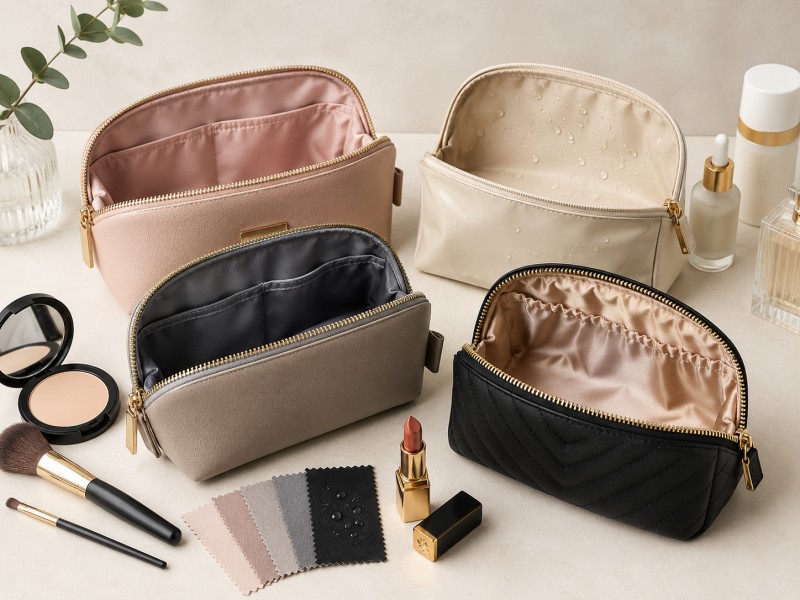
A cosmetic bag may look beautiful from the outside, but the inside decides whether people keep using it. That is why lining matters so much. A good lining can make a makeup pouch easier to clean, more comfortable to use, better protected against spills, and more aligned with the beauty products it carries.
For beauty brands, this is not a small detail. A foundation bottle can leak. A lipstick cap can come loose. Loose powder can stain the corners. A travel-size toner can spill inside a suitcase. If the lining is wrong, the bag may still look fine in photos, but the user experience can fail quickly.
That is where material selection becomes a real project decision.
Polyester, nylon, PU-coated fabric, PVC, TPU, PEVA, satin, cotton, and rPET can all be used as cosmetic bag lining. But each one fits a different purpose. Some are better for large promotional orders. Some feel more premium. Some are easier to wipe clean. Some are better for travel toiletry bags. Some support eco-focused beauty collections. Some look nice but are not ideal for wet use.
Here is the quick way to think about it.
The best cosmetic bag lining depends on the use scene, outer material, cleaning need, target price, brand style, and expected order size. Polyester works well for cost-friendly bulk cosmetic bags. Nylon and coated fabric suit travel makeup bags. PVC, TPU, and PEVA support wipe-clean or water-resistant interiors. Satin and printed lining create a more refined opening feel for beauty gift sets. For custom projects, lining should be reviewed together with zippers, pockets, logo method, packing, sample testing, and bulk quality control.
What Is the Best Lining for Cosmetic Bags?
The best lining for cosmetic bags is the one that matches the real use of the bag. Polyester is practical for large orders. Nylon gives better wear resistance. PU-coated fabric helps with wipe-clean needs. PVC, TPU, and PEVA are useful for toiletry and travel styles. Satin works better for gift sets. rPET supports eco-positioned projects.
A cosmetic bag is not just a small pouch. It may be used on a bathroom counter, inside a handbag, in a suitcase, on a retail shelf, or as part of a beauty gift set. Each situation creates different pressure on the lining.
For everyday makeup pouches, the lining should be smooth, light, and not too expensive. Polyester or nylon is often enough. These materials are stable, easy to source, and friendly for color matching.
For travel cosmetic bags, the lining needs to handle moisture and movement. Bottles move during transport. Powder can break. Cream and liquid products may leak. In this case, coated nylon, PVC, TPU, or PEVA can be better choices.
For premium beauty sets, the lining becomes part of the brand experience. A satin lining, printed lining, or soft-touch polyester can make the bag feel more finished when opened. It may not be the most water-resistant choice, but it can support a more polished presentation.
For a custom project, the right is not “Which lining is best?” The better is: “What should this bag do after the user opens it, fills it, carries it, cleans it, and reuses it?”
That thinking leads to better product decisions.
Which Cosmetic Bag Lining Types Should Beauty Brands Compare?
Beauty brands should compare lining by function, feel, cleanability, cost, and production stability. Common choices include polyester, nylon, PU-coated polyester, PVC, TPU, PEVA, satin, cotton, and rPET. Each option has a different role. A clear comparison helps teams avoid choosing lining based only on appearance.
| Lining Type | Best Use | Main Value | What To Check |
|---|---|---|---|
| Polyester Lining | Daily makeup bags, bulk orders | Cost stable, color flexible | Not strong enough for wet-use needs |
| Nylon Lining | Travel pouches, organizer bags | Smooth, light, durable | Thickness and coating quality |
| PU-Coated Polyester | Wipe-clean makeup bags | Better stain resistance | Coating feel and long-term peeling risk |
| PVC Lining | Toiletry bags, clear bags | Strong moisture resistance | Odor, stiffness, folding marks |
| TPU Lining | Premium clear or wet-use bags | Softer than PVC, better handfeel | Higher cost and material availability |
| PEVA Lining | Lightweight toiletry interiors | Easy-clean, flexible | Durability under repeated use |
| Satin Lining | Gift sets, premium pouches | Smooth and refined look | Not ideal for wet or heavy-use bags |
| Cotton Lining | Natural style bags | Soft and casual | Stains more easily |
| rPET Lining | Eco-positioned programs | Supports sustainability story | Source and batch consistency |
Polyester lining is often the safe starting choice. It is practical, easy to match, and suitable for many promotional cosmetic bags, private label pouches, and retail accessory sets.
Nylon lining works well when the bag needs a smoother inner surface and better wear resistance. It is a good fit for travel makeup bags, toiletry pouches, and organizer-style designs.
PVC, TPU, and PEVA are more functional. They are often used when the bag needs better moisture handling or a wipe-clean surface. They can be useful for travel kits, skincare bottle sets, and clear cosmetic bags.
Satin and printed lining are more emotional choices. They help the bag feel more designed. This matters when the cosmetic bag is part of a launch set, limited collection, holiday gift, or premium brand program.
rPET lining is useful when the beauty brand wants a more responsible material story. But it should not be chosen only for wording. The team should confirm source, color, handfeel, and long-term supply before locking the design.
Waterproof vs Water-Resistant vs Wipe-Clean Lining: What Is the Difference?
Wipe-clean lining means the surface can be cleaned more easily after makeup stains or light spills. Water-resistant lining helps reduce moisture problems. Waterproof material blocks water better, but it does not make the whole cosmetic bag fully waterproof. Seams, zippers, stitching, binding, and structure still matter.
This difference is one of the most common sources of confusion in cosmetic bag projects.
A wipe-clean lining is helpful when the user deals with powder, lipstick, foundation, cream blush, or skincare residue. The goal is not to hold water like a dry bag. The goal is to make the inside easier to maintain.
A water-resistant lining is useful for light moisture. It can help when a bag sits near a sink, carries skincare bottles, or goes into a suitcase with travel-size liquids. But water resistance has limits.
A waterproof material, such as certain PVC, TPU, or coated fabrics, can resist water more strongly. But if the seams are stitched, water can still pass through needle holes. If the zipper is standard, liquid can still enter or leak out. If the edge binding is not designed for wet use, the full bag may not perform as expected.
| Term | What It Means | Better For |
|---|---|---|
| Wipe-Clean | Surface can be wiped more easily | Makeup stains, powder, lipstick marks |
| Water-Resistant | Reduces light moisture impact | Travel pouches, daily skincare bags |
| Waterproof Material | Material has stronger water blocking | Toiletry bags, wet-use interiors |
| Leak-Reducing Design | Material plus seam and zipper planning | Liquid skincare sets, bottle kits |
This is why a professional sample review should include more than material selection. The team should check seams, zipper type, pocket placement, folding method, and how the bag performs after packing.
If your project includes liquid products, skincare bottles, travel toiletry items, or bathroom use, share those details before sampling. A small design adjustment early can prevent a big problem later. Jundong can review lining direction, structure, and sample testing needs at info@jundongfactory.com.
How Should a Factory Match Lining With Outer Material?
A factory should match lining with outer material by looking at structure, feel, sewing behavior, use scene, and brand style. The outer material creates the first impression. The lining controls the inside experience. A good custom cosmetic bag needs both parts to work together.
A PU leather cosmetic pouch with a rough or loose lining can feel unfinished. A soft canvas makeup bag with stiff PVC inside may feel awkward unless the structure is planned well. A clear TPU bag with the wrong inner trim can look messy. A premium gift pouch with a cheap-feeling lining may reduce the value of the whole set.
Good lining selection starts with compatibility.
| Outer Material | Suitable Lining Direction |
|---|---|
| Canvas | Polyester, cotton, printed polyester |
| PU Leather | Satin, polyester, soft nylon |
| Nylon | Nylon, coated polyester, PU-coated fabric |
| PVC / TPU | PVC, TPU, PEVA, smooth polyester |
| Velvet | Satin, soft polyester |
| rPET Fabric | rPET or recycled polyester |
| Oxford Fabric | Polyester, nylon, coated fabric |
| Neoprene | Smooth polyester, nylon, coated lining |
| Leather | Satin, microfiber, soft nylon |
The lining also affects bag shape. A thin lining may make the bag collapse. A thick lining may make the bag harder to turn, stitch, or fold. A coated lining may add structure, but it can also show creases if packed too tightly.
For multi-pocket cosmetic bags, lining must work with dividers, brush slots, mesh panels, elastic loops, and zipper pockets. If the lining is too stiff, small compartments can become difficult to sew. If it is too soft, the pockets may not hold their shape.
A good factory does not choose lining in isolation. It checks the full structure.
That includes outer fabric, lining, interlayer, zipper, slider, binding, handle, pocket design, logo position, hangtag, barcode label, and final packing method.
When Should You Choose PVC, TPU, or PEVA Lining for Makeup Bags?
PVC, TPU, and PEVA lining are good choices when the cosmetic bag needs a more wipe-clean, water-resistant, or travel-friendly interior. PVC is often more cost-friendly. TPU usually feels softer and more refined. PEVA is light and flexible for certain toiletry or easy-clean designs.
These materials often enter the conversation when a brand wants a cosmetic bag that can handle skincare bottles, damp items, bathroom counters, or travel packing.
PVC lining is a practical option for clear cosmetic bags, toiletry pouches, and cost-controlled wet-use designs. It can be easy to clean and offers stronger moisture resistance than regular woven lining. The tradeoff is handfeel. Some PVC can feel stiff, and lower-grade PVC may have odor or folding marks.
TPU lining is often chosen for a softer, more flexible feel. It can look cleaner and more refined in premium clear or water-resistant designs. It is usually more expensive than PVC, so it should be used where the product value supports the cost.
PEVA lining can be useful when the project needs a lightweight, flexible, easy-clean interior. It may be suitable for some travel toiletry bags or soft cosmetic pouches. The key is testing durability and stitch behavior before bulk production.
Before choosing PVC, TPU, or PEVA, check these details:
| Check Item | Why It Matters |
|---|---|
| Thickness | Affects structure, cost, and sewing |
| Odor | Very noticeable in closed cosmetic bags |
| Flexibility | Affects folding and daily use |
| Surface feel | Affects perceived quality |
| Folding marks | Affects packed appearance |
| Sewing effect | Affects edge finish and durability |
| Heat sensitivity | Affects storage and transport |
| Transparency | Critical for clear cosmetic bags |
These details should be confirmed during sample development, not after bulk materials arrive.
How Does Lining Affect Cosmetic Bag Price, MOQ, and Lead Time?
Lining can affect cosmetic bag price, MOQ, sample time, and delivery planning. The material type, thickness, coating, color, print, source, and order size all matter. A simple stock polyester lining is faster and more cost-stable. A custom color, printed lining, or special coated lining needs more planning.
Many teams focus on outer material when estimating cost. But lining can also move the price.
A basic polyester lining may be easy to source. A standard black or beige lining can often be arranged faster. A custom Pantone lining may need dyeing or special sourcing. A printed lining adds artwork setup, color matching, print testing, and possible waste.
A coated lining may improve cleaning performance, but coating quality changes the price. A cheap coating may feel sticky, crack, peel, or create odor. A better coating improves user experience but can raise material cost.
| Cost Factor | How It Affects the Project |
|---|---|
| Material type | Base price changes by lining choice |
| Thickness | More structure may increase cost |
| Coating | Better wipe-clean function can cost more |
| Custom color | May need special sourcing or dyeing |
| Printed lining | Adds setup and color control |
| Eco material | May need source confirmation |
| Small quantity | Material waste has stronger cost impact |
| Multi-color order | More matching and production control needed |
MOQ is also affected by lining. If the lining is a common stock material, the project may be easier to start. If the lining is custom dyed, printed, or specially coated, the starting quantity may be higher.
Lead time can change too. Standard materials are faster. Custom lining needs more confirmation. Printed lining needs artwork checking. Eco materials may need source review. For repeat orders, the team should also check whether the same lining can be sourced again.
For reference, many custom bag projects move more smoothly when the lining is approved at the same time as outer fabric, logo method, zipper, and packing plan. If you already have a size, quantity, and target use, Jundong can help review a practical lining direction before sample work begins. You can send details to info@jundongfactory.com.
How Can Custom Lining Improve Brand Presentation?
Custom lining can improve brand presentation by making the inside of the cosmetic bag feel intentional. Lining color, printed patterns, satin texture, inner labels, contrast design, and pocket layout can all support the brand story. The inside should not feel like an afterthought.
The moment a user opens a cosmetic bag, the lining becomes visible. That moment matters.
For a clean beauty brand, a soft beige, cream, olive, or recycled-look lining may fit better than shiny black polyester. For a bold color cosmetics brand, a printed lining or contrast lining may create stronger visual memory. For a luxury skincare set, satin or soft-touch lining can make the pouch feel more gift-ready.
Custom lining can support:
- Brand color matching
- Seasonal collection design
- Logo repeat pattern
- Limited edition launches
- Holiday gift sets
- Subscription box items
- Retail shelf presentation
- Private label programs
Dark lining can hide stains better. This is practical for everyday makeup bags. Light lining looks clean and premium, but it may show marks faster. Printed lining adds personality, but pattern scale should be checked against the bag size. A large print may look great on a fabric roll but messy inside a small pouch.
Inner labels also matter. A woven label, care label, or small brand tag can make the inside feel complete. But placement should not scratch makeup items or interfere with pockets.
A well-designed lining does not need to be loud. It simply needs to feel right when the user opens the bag.
What Lining Works Best for Travel Cosmetic Bags and Toiletry Bags?
Travel cosmetic bags and toiletry bags need lining that handles moisture, movement, bottles, compartments, and repeated packing. Coated nylon, PVC, TPU, PEVA, and coated polyester are common choices. The best option depends on whether the bag is for makeup, skincare, shower items, brushes, or mixed travel storage.
Travel use is harder on cosmetic bags than daily use. The bag may sit inside a suitcase. It may be squeezed between clothes. It may carry skincare, shampoo, lotion, sunscreen, perfume, razors, brushes, and makeup. One bottle leak can ruin the user experience.
For soft travel makeup pouches, coated polyester or coated nylon can offer a good balance. They are lighter than many plastic linings but easier to clean than basic fabric lining.
For toiletry bags, PVC, TPU, and PEVA are stronger candidates. These linings are better for damp-use situations and easier to wipe after spills.
For hanging toiletry bags, lining must work with multiple pockets, transparent panels, mesh sections, elastic loops, and hook placement. If the lining is too heavy, the bag may pull down. If it is too weak, pockets may tear during use.
For makeup brush bags, smooth lining is better. Rough lining can catch powder and brush hairs. If brush slots are added, the lining should be easy to stitch cleanly and firm enough to hold the slots.
| Travel Use | Better Lining Direction |
|---|---|
| Small makeup pouch | Polyester, nylon, PU-coated polyester |
| Skincare bottle bag | Coated nylon, TPU, PEVA |
| Toiletry bag | PVC, TPU, PEVA |
| Hanging toiletry bag | Coated polyester, PVC pocket panels |
| Brush organizer | Smooth nylon, polyester, coated lining |
| Clear travel pouch | PVC or TPU |
| Premium travel beauty case | Soft nylon, satin, TPU, microfiber |
Travel bags also need smart organization. Inner pockets, bottle loops, mesh panels, removable pouches, and wipeable panels can matter more than lining alone. The best travel cosmetic bag uses lining as part of the whole storage system.
How Should Teams Approve Lining Before Bulk Production?
Teams should approve cosmetic bag lining through a sample review that checks material, color, thickness, handfeel, coating, odor, stitching, pockets, cleaning, and packing results. A lining name alone is not enough. The approved sample should become the reference for bulk production.
A common mistake is approving the outside of the bag quickly while treating the inside as minor. That can create problems later.
The lining may look darker in bulk. It may feel thinner. It may crease after packing. It may not match the zipper tape. It may stain more easily than expected. The coating may smell stronger after the bag is packed in a polybag. These problems are easier to fix during sampling than after production starts.
Use this checklist before approval:
| Review Item | What To Confirm |
|---|---|
| Material name | Polyester, nylon, PVC, TPU, PEVA, satin, rPET, etc. |
| Color | Match with outer fabric, zipper, binding, logo |
| Thickness | Check structure and sewing suitability |
| Handfeel | Smooth, soft, firm, coated, or premium feel |
| Odor | Especially for coated or plastic lining |
| Wipe-clean test | Check makeup marks, powder, cream, light spills |
| Water test | For travel or toiletry styles |
| Stitching | Look at seams, corners, and pocket edges |
| Pocket shape | Confirm brush slots, mesh panels, zipper pockets |
| Print effect | Check lining print scale and color |
| Folding result | Check creases after packing |
| Photo record | Keep visual reference for repeat orders |
| Pre-production sample | Confirm before bulk cutting |
For larger programs, the team should also record material source, color code, batch reference, and approved sample photos. This helps repeat orders stay closer to the original.
When the same cosmetic bag is reordered months later, these records matter. They protect color consistency, handfeel, and structure.
Why Work With a Custom Cosmetic Bag Factory for Lining Selection?
Working with a custom cosmetic bag factory helps brands connect lining selection with structure, sampling, logo work, packing, quality checks, and delivery planning. The value is not only sewing. It is the ability to turn a design idea into a stable, repeatable product.
A cosmetic bag lining decision touches many parts of the project.
If the lining is too thin, the bag may lose shape.
If the lining is too stiff, the corners may not turn cleanly.
If the lining is too light, stains may show quickly.
If the lining is too heavy, shipping and folding may be affected.
If the lining color is not checked with the zipper, the product may look mismatched.
If the lining is printed, the artwork scale must fit the real bag size.
This is why a development partner with material sourcing, pattern work, sampling, logo methods, QC, and packing experience can save time.
For custom cosmetic bag projects, Jundong can support:
- Material and lining selection
- Structure review
- Size and pocket layout adjustment
- Pattern making
- Sample development
- Logo placement and method review
- Zipper, puller, label, and trim matching
- Individual packing, hangtags, labels, and carton marks
- Quality checks before shipment
- OEM, ODM, private label, and long-term repeat orders
This matters for beauty brands that need more than a basic pouch. It matters for travel sets, skincare kits, retail cosmetic bags, gift-with-purchase programs, subscription boxes, and seasonal launches.
The best time to discuss lining is before the sample is made. Send the bag size, outer material idea, product use, quantity, logo plan, and packing needs to info@jundongfactory.com. A practical lining review can help the sample move in the right direction from the start.
FAQ About Cosmetic Bag Lining Options
1. What is the best lining for cosmetic bags?
The best lining for cosmetic bags depends on how the bag will be used, not on one single material name. For most custom makeup bags, polyester, nylon, PU-coated polyester, PVC, TPU, PEVA, satin, and rPET are the most common lining choices. Each one solves a different need.
For a daily makeup pouch, polyester lining is often a smart choice. It is stable, cost-friendly, easy to match with many outer fabrics, and suitable for large quantity programs. If the bag is used for travel, nylon or PU-coated polyester can offer a better balance of durability, smooth touch, and easy cleaning. If the bag needs to carry skincare bottles, toiletry items, or wet-use products, PVC, TPU, or PEVA lining may work better because these materials are easier to wipe and more moisture-friendly.
For a beauty gift set, the “best” lining may not be the most waterproof one. A satin lining, printed polyester lining, or tone-on-tone inner fabric may create a better opening experience. That matters when the cosmetic bag is part of a skincare launch, fragrance set, holiday kit, or retail display.
Here is a practical way to choose:
| Bag Purpose | Recommended Lining |
|---|---|
| Daily makeup pouch | Polyester, nylon |
| Travel cosmetic bag | Nylon, PU-coated polyester |
| Toiletry bag | PVC, TPU, PEVA |
| Premium beauty gift | Satin, printed polyester |
| Eco-positioned project | rPET, recycled polyester |
| Cost-sensitive large order | Polyester lining |
A good lining should match the outer material, zipper, pocket structure, logo method, packing style, and target price. If the bag needs to hold liquid products or travel-size bottles, share that detail before sampling. The lining should be tested with the real use scene, not chosen only from a swatch card.
2. Which cosmetic bag lining is easiest to clean?
Definitely, PVC, TPU, PEVA, and PU-coated polyester are usually easier to clean than plain woven lining. These lining options are often chosen when the inside of the cosmetic bag may touch foundation, lipstick, loose powder, skincare cream, sunscreen, or travel toiletry products.
A wipe-clean lining does not mean the bag will never get dirty. It means the surface is easier to clean after normal makeup stains. For example, if powder spills inside a polyester lining, it may stick between fabric fibers. If the same powder lands on a smooth coated lining, it is usually easier to shake out or wipe with a damp cloth. If foundation touches plain cotton lining, it can absorb quickly. If it touches PVC, TPU, PEVA, or coated polyester, the stain may be easier to remove before it dries.
Still, cleanability depends on more than the material name. Surface texture, coating quality, color, seam design, and pocket shape all matter. A smooth dark lining usually hides stains better than a light-colored fabric lining. But a light satin lining may look more premium for a gift set. That is why cleaning needs should be balanced with brand presentation.
For easy-clean cosmetic bag projects, check these details during sample review:
| Check Detail | Why It Matters |
|---|---|
| Surface smoothness | A smoother surface is easier to wipe |
| Color depth | Dark lining hides stains better |
| Coating quality | Poor coating can peel or feel sticky |
| Seam corners | Stains often collect in corners |
| Inner pockets | More pockets mean more cleaning areas |
| Odor | Coated materials should be checked after packing |
For beauty brands, the most practical choice is often PU-coated polyester for soft pouches, PVC or TPU for toiletry bags, and PEVA for lightweight easy-clean interiors. A simple wipe test during sampling can save a lot of trouble before production.
3. Is waterproof lining necessary for every makeup bag?
Of course not. Waterproof lining is useful for certain cosmetic bags, but it is not needed for every project. A daily makeup pouch, gift-with-purchase bag, or fabric cosmetic pouch may only need a smooth, neat, and cost-stable lining. For travel toiletry bags or skincare bottle kits, stronger moisture protection becomes more useful.
Many teams make the mistake of asking for “waterproof lining” when they actually need “wipe-clean lining.” These are not the same. Wipe-clean lining helps users clean makeup stains. Water-resistant lining helps reduce light moisture problems. Waterproof material blocks water better. But even if the material itself resists water, the whole bag may not be fully waterproof.
Why? Because liquid can still pass through stitching holes, zipper gaps, seam corners, or weak binding. A fully wet-use bag needs more than a waterproof inner material. It needs structure planning.
| Need | Better Direction |
|---|---|
| Makeup powder and lipstick stains | Wipe-clean lining |
| Daily skincare pouch | Water-resistant lining |
| Travel toiletry kit | PVC, TPU, PEVA, coated lining |
| Liquid bottle set | Lining plus seam and zipper review |
| Bathroom-use pouch | Moisture-friendly lining and smart structure |
For many cosmetic bags, a water-resistant or wipe-clean lining is more practical than a heavy waterproof material. Waterproof materials can add cost, stiffness, odor risk, or folding marks. They are excellent when needed, but not always the best choice.
A better approach is to start with use. Will the bag sit in a bathroom? Will it carry shampoo, toner, or sunscreen? Will it be sold as a premium makeup pouch? Will it be used once as a promotional gift or kept for daily travel? Once the use scene is clear, lining selection becomes much easier.
4. PVC vs TPU vs PEVA lining: which one should we choose?
Certainly, PVC, TPU, and PEVA can all be useful for cosmetic bag lining, but they fit different project goals. PVC is practical and cost-friendly for clear bags and toiletry pouches. TPU feels softer and more refined, often better for higher-end clear or water-resistant designs. PEVA is lightweight and flexible, suitable for some easy-clean travel interiors.
PVC is a common choice when the bag needs a clear panel, stronger moisture resistance, or a more structured inner surface. It is often used in transparent cosmetic bags, travel toiletry bags, and simple wet-use pouches. Its main advantage is function at a manageable cost. The tradeoff is that some PVC can feel stiff, show folding marks, or carry odor if the material grade is not well chosen.
TPU is usually softer and more flexible than PVC. It can feel cleaner and more upscale, especially in premium travel beauty kits or clear cosmetic bags. It may also create a better handfeel when the user opens and folds the pouch. The tradeoff is price. TPU usually costs more and may need more careful sourcing.
PEVA is often selected when the project needs a lightweight, flexible, easy-clean lining. It can work well in soft toiletry bags or certain travel pouches. But it should be tested for durability, stitching behavior, and long-term use.
| Material | Main Strength | Watch Carefully |
|---|---|---|
| PVC | Cost-friendly, moisture-resistant, clear options | Stiffness, odor, folding marks |
| TPU | Softer, better feel, premium clear look | Higher cost, supply stability |
| PEVA | Light, flexible, easy-clean | Durability, seam strength |
For high-volume promotional toiletry bags, PVC may be enough. For premium beauty travel kits, TPU may be worth the upgrade. For lightweight travel organizers, PEVA may be a good fit. The best decision comes from sample testing, not from material names alone.
5. How does lining affect cosmetic bag price?
Absolutely, lining can affect the final price more than many teams expect. The cost is not only about the lining material itself. Thickness, coating, color, printing, waste rate, sewing difficulty, MOQ, and repeat order stability can all change the total project cost.
A standard polyester lining is usually the most cost-stable option. It is easy to source, easy to cut, and suitable for many cosmetic bag styles. A coated polyester lining costs more, but it may improve wipe-clean performance. PVC, TPU, and PEVA can increase function, but the price depends on thickness, clarity, flexibility, and material grade. Satin lining may not be expensive in every case, but it can require more care during sewing and packing because marks and wrinkles may show more easily.
Custom lining also affects cost. If a brand wants a custom color lining, printed lining, logo repeat pattern, or eco-positioned rPET lining, the project may need extra material sourcing, print setup, sample testing, and color checking.
| Price Factor | Why It Changes Cost |
|---|---|
| Lining type | Different materials have different base prices |
| Thickness | Thicker lining may improve feel but adds cost |
| Coating | Better cleanability usually costs more |
| Custom color | May need dyeing or special sourcing |
| Printed lining | Adds artwork setup and print testing |
| Small quantity | Material waste has stronger cost impact |
| Eco material | Source review may be needed |
| Complex pockets | More sewing time and more lining use |
The lowest lining price is not always the best business choice. If the lining makes the bag hard to clean, too soft, too noisy, or mismatched with the outer material, the finished bag may feel cheap even when the outside looks good.
A practical cost review should compare three things: product positioning, expected use, and order quantity. For example, a promotional pouch may need a simple polyester lining. A skincare travel kit may need coated nylon or PEVA. A premium gift set may need satin or printed lining. Matching the lining to the project avoids both overbuilding and underbuilding the bag.
6. Can cosmetic bag lining be customized with color, print, or logo?
Sure. Cosmetic bag lining can often be customized with color, print, logo patterns, contrast effects, and inner labels. This is a strong option for beauty brands that want the inside of the bag to feel as intentional as the outside.
Custom lining color is the simplest upgrade. A brand can match the lining with its main color, seasonal collection color, outer fabric, zipper tape, or packaging tone. For example, a soft beige lining may fit a clean skincare brand. A bold pink lining may fit a color cosmetics launch. A black lining may be better for daily makeup use because it hides stains better.
Printed lining can create a stronger brand memory. A small repeat pattern, logo mark, floral print, ingredient-inspired pattern, or limited-edition graphic can make the bag feel more special. However, printed lining needs careful review. The print scale must match the bag size. A large pattern may look nice on a flat fabric sheet but feel messy inside a small makeup pouch.
Inner branding options include:
| Custom Detail | Best Use |
|---|---|
| Solid brand color lining | Clean brand identity |
| Printed lining | Seasonal sets, limited editions |
| Logo repeat pattern | Gift sets, retail pouches |
| Contrast lining | More visual impact |
| Woven inner label | Subtle brand detail |
| Care label | Product information and care |
| Dark lining | Daily makeup use |
| Light lining | Premium display feel |
Custom lining can affect MOQ, sample time, and price. Stock colors are faster. Printed or dyed lining needs more planning. If the project has a launch date, confirm lining early with outer material, zipper, logo, and packing style. If you want help reviewing custom lining direction, Jundong can compare options based on size, use, quantity, and brand style at info@jundongfactory.com.
7. What lining works best for travel cosmetic bags and toiletry bags?
For travel cosmetic bags and toiletry bags, the best lining should handle moisture, movement, bottles, compartments, and repeated packing. Coated nylon, PU-coated polyester, PVC, TPU, and PEVA are often stronger choices than plain fabric lining for travel use.
Travel puts more pressure on a cosmetic bag than daily desktop use. The bag may be squeezed inside a suitcase, carried through airports, placed near a bathroom sink, or filled with skincare, shampoo, sunscreen, toothpaste, makeup brushes, and small bottles. If one bottle leaks, the lining becomes the first protection layer.
For soft travel makeup pouches, coated polyester or coated nylon can be a good balance. They are lighter than plastic-style lining and more wipe-friendly than plain fabric. For toiletry bags, PVC, TPU, or PEVA often work better because they are easier to wipe and more suitable for damp items.
For hanging toiletry bags, lining choice becomes more technical. The bag may include mesh pockets, transparent panels, elastic loops, bottle compartments, and a hook. The lining must be strong enough for stitching and flexible enough to fold.
| Travel Bag Type | Recommended Lining |
|---|---|
| Small travel makeup pouch | Polyester, nylon, coated polyester |
| Skincare bottle pouch | Coated nylon, PEVA, TPU |
| Toiletry bag | PVC, TPU, PEVA |
| Hanging toiletry bag | Coated polyester, PVC pocket panels |
| Makeup brush bag | Smooth nylon, polyester, coated lining |
| Clear travel pouch | PVC or TPU |
| Premium travel beauty case | Soft nylon, satin, TPU |
Do not choose lining only because it sounds “waterproof.” Check the full structure. Zipper, seams, inner pockets, corner stitching, handle position, and folding method all affect travel performance. A travel cosmetic bag should be judged as a storage system, not just a pouch with lining.
8. How should we approve cosmetic bag lining before bulk production?
A smart approval process should confirm lining material, color, thickness, handfeel, coating, odor, stitching, pocket shape, cleaning performance, and packing result before bulk production starts. The lining name alone is not enough.
This is where many projects lose control. The sample may look good outside, so the team approves quickly. Later, the bulk order arrives with a lining that feels thinner, smells stronger, creases more, or does not match the zipper color. These problems are frustrating because they are usually easy to catch earlier.
During sample approval, review the lining under real use conditions. Put makeup items inside. Try a light wipe-clean test. Check corners where powder can collect. Close the zipper and smell the bag after it has been packed in a polybag. Fold the bag the way it will be packed for shipping. Look at whether the lining pulls, wrinkles, or affects the bag shape.
A useful approval checklist:
| Review Item | What To Check |
|---|---|
| Material | Polyester, nylon, PVC, TPU, PEVA, satin, rPET |
| Color | Match outer fabric, zipper, trim, logo |
| Thickness | Structure, weight, sewing behavior |
| Handfeel | Smooth, soft, firm, coated, premium |
| Odor | Especially after packing |
| Wipe-clean test | Powder, lipstick, foundation, cream |
| Water test | Needed for travel or toiletry styles |
| Stitching | Corners, seams, pocket edges |
| Print effect | Scale, color, repeat layout |
| Packing result | Folding marks and shape recovery |
For repeat orders, keep the approved sample, photos, material reference, and color notes. This makes the next order easier to match. It also reduces back-and-forth when the same cosmetic bag is reordered months later.
9. What are the most common lining mistakes in custom cosmetic bags?
The most common lining mistakes include choosing only by appearance, ignoring cleaning needs, confusing water-resistant with fully waterproof, using lining that is too thin, forgetting pocket structure, and failing to confirm bulk consistency before production.
These mistakes sound small, but they can change the whole product experience.
A beautiful light lining may look great in photos but stain quickly after daily makeup use. A heavy PVC lining may resist moisture but make a soft pouch feel stiff. A printed lining may look creative but become messy if the print scale is too large. A thin polyester lining may save cost but cause the bag to collapse. A coated lining may seem practical but smell unpleasant if the material is not checked after packing.
Here are frequent mistakes and how to avoid them:
| Mistake | Better Practice |
|---|---|
| Choosing lining only by color | Review use, cleaning, structure, and cost |
| Calling all coated lining waterproof | Check seams, zipper, and structure |
| Using light lining for heavy makeup use | Consider darker lining or wipe-clean coating |
| Ignoring odor | Test after polybag packing |
| Not checking print scale | Approve printed lining on real sample size |
| Using lining that is too thin | Check shape and pocket support |
| Forgetting zipper color match | Compare lining, zipper tape, and trim together |
| Skipping cleaning test | Test powder, cream, lipstick, and light spills |
| No material record | Keep approved sample and reference notes |
The safest approach is not to choose the most expensive lining. It is to choose the most suitable lining. The bag should look right, feel right, clean well enough, fit the target price, and remain stable when produced again.
That is how a small inner detail becomes a serious product decision.
10. How long does it take to confirm lining and make a cosmetic bag sample?
In many custom cosmetic bag projects, lining can be confirmed quickly when the material is standard and available. Sample making commonly takes about 5–7 days after key details are clear, and some simple styles may move faster. Bulk production often takes about 20–30 days, depending on material, order size, structure, and packing needs.
Timing depends on how complex the lining decision is.
If the project uses stock polyester lining in a common color, the process is usually smooth. If the project needs custom lining color, printed lining, TPU, PVC, PEVA, rPET, special coating, or multi-style matching, more time may be needed for sourcing and testing.
A practical timeline may look like this:
| Stage | What Happens |
|---|---|
| Lining direction | Choose material based on use and target price |
| Material checking | Confirm color, thickness, coating, handfeel |
| Sample making | Build the first sample with selected lining |
| Sample review | Check look, function, cleaning, pockets, packing |
| Revision if needed | Adjust lining, structure, color, or details |
| Pre-production sample | Confirm before bulk cutting |
| Bulk production | Follow approved sample and material record |
The faster route is not always the safest route. If the cosmetic bag will be part of a launch kit, holiday set, retail program, or repeat order plan, it is better to confirm lining properly before production.
To speed things up, prepare these details before requesting a sample:
- Bag size
- Outer material idea
- Use scene
- Quantity
- Lining preference
- Logo method
- Pocket needs
- Packing style
- Target delivery date
A clear brief helps the factory suggest lining faster and reduces sample revisions. For projects that need lining advice, sample planning, or private label support, you can send the details to info@jundongfactory.com.
Let's work together
With over 10 years of OEM/ODM bag industry experience, I would be happy to share with you the valuable knowledge related to leather products from the perspective of a leading supplier in China.

Factory catalogue
Table of Contents
Latest blogs


Make A Sample First?
If you have your own artwork, logo design files, or just an idea, please provide details about your project requirements, including preferred fabric, color, and customization options, we’re excited to assist you in bringing your custom bag designs to life through our sample production process.