 Skip to content

How to Choose Wheels, Trolley Handles, Zippers, and Stress Points?
A suitcase can look excellent on a showroom table and still become a warranty problem after a few trips. The reason is simple: luggage does not fail evenly. Load, vibration, impact, twisting and repeated movement concentrate around a relatively small group of components—wheels, trolley systems, zippers, carrying handles, corners and the structures holding them in place.
That makes hardware selection much more than choosing an attractive wheel or specifying a well-known zipper name. A 20-inch cabin case weighing 3 kg empty has very different structural demands from a 28-inch expandable case that may carry more than 20 kg when packed. The same wheel construction, trolley tube or zipper system cannot automatically be transferred from one design to another.
The practical approach is to define the finished luggage first: size, expected packed weight, travel frequency, terrain, shell construction, expansion function, desired weight, expected service life and acceptable after-sales risk.
Choose luggage wheels, trolley handles, zippers and reinforced load areas as one connected system. Match wheel construction to loaded weight and road conditions, handle strength to case size and leverage, zipper structure to opening length and packing pressure, and reinforcement to the forces entering each attachment area. Then verify the complete assembled suitcase under loaded rolling, repeated handle operation, zipper cycling and impact-related checks before mass production.
This is also why the approved sample should never be treated as a visual sample only. For luggage, the sample should confirm wheel behavior, trolley operation, case structure, lining, dimensions, weight and transport protection before the construction is locked for larger production.
A wheel may look perfect and still loosen from its housing. A trolley may extend smoothly and still flex too much under a fully packed case. A zipper may feel excellent when the suitcase is empty but become difficult to close after the expansion panel is filled.
Those are the differences that separate an attractive sample from a durable travel product.
What Determines the Best Hardware for Custom Luggage?
The best hardware is not the most expensive wheel, the thickest trolley tube, or the largest zipper. It is the combination that matches the suitcase size, expected packed weight, travel frequency, body construction, opening design, handling conditions, target product weight, and expected service life. Wheels, trolley handles, zippers, carry handles, fasteners, and reinforced areas should be selected as one connected structure and confirmed on a loaded finished sample.
For custom luggage development, body structure, wheels, trolley handles, zippers, dimensions, weight, packaging, transportation checks, and after-sales risk all need to be considered together.
A component that works well on a compact cabin case may behave very differently on a large expandable suitcase. This is why a hardware specification should start with the complete travel product rather than a parts catalog.
A practical specification usually needs these numbers before hardware is finalized:
| Item | What Should Be Defined | Why It Matters |
|---|---|---|
| External size | Length × width × height | Affects leverage, ground clearance, component spacing |
| Empty weight | kg | Determines how much weight is already carried by the hardware |
| Expected packed weight | kg | Directly affects wheels, trolley, handles, zipper pressure |
| Wheel diameter | mm | Affects obstacle crossing and ground clearance |
| Trolley extension | mm | Longer extension increases bending leverage |
| Zipper size | Chain specification | Affects closing strength, weight, and appearance |
| Main opening length | mm | Longer openings create more zipper movement and load exposure |
| Expansion depth | mm | Changes usable volume and possible packing pressure |
| Travel frequency | Trips/use cycles | Helps define the required durability level |
| Packing method | Retail box, polybag, carton protection | Influences transport damage risk |
These details make hardware selection measurable instead of relying on vague terms such as “heavy duty,” “premium,” or “strong.”
Which Parts Fail First in Luggage?
The parts most likely to develop problems are usually those that move repeatedly, carry concentrated loads, protrude from the body, or connect a rigid component to a thinner surrounding structure.
For luggage, the areas deserving the closest attention include wheel assemblies, trolley rails, carry-handle attachments, zipper systems, corners, expansion seams, and the structures hidden behind them.
The visible failure is not always the real starting location.
A wheel may tilt because the caster housing has loosened. A trolley may feel unstable because its lower bracket has moved. A zipper may separate because the slider has widened even though the chain itself is still intact.
The failure path often looks like this:
external force → moving part → mounting area → reinforcement → suitcase body
This distinction is important. Replacing a wheel with a more expensive version will not solve a weak wheel mount. A stronger zipper cannot compensate for poor zipper-end construction. A thicker aluminum trolley tube will still feel unstable if the lower fixing structure moves.
A useful failure review can be organized like this:
| Visible Problem | Possible Root Cause |
|---|---|
| Wheel leans outward | Housing movement, weak mount, axle wear |
| Wheel becomes noisy | Tread wear, alignment, bearing or axle wear |
| Case pulls sideways | Uneven wheel height, caster resistance, alignment |
| Trolley shakes | Tube clearance, bushing wear, weak mounting |
| Trolley jams | Bent tube, poor alignment, lock interference |
| Main zipper splits | Slider deformation, excess lateral pressure, wrong chain/slider match |
| Zipper feels heavy | Tight curves, seam tension, poor alignment |
| Corner deforms | Impact concentration, weak internal reinforcement |
| Carry handle loosens | Weak attachment, insufficient backing area |
This is why inspection should follow the structure behind the component rather than stopping at what can be seen from the outside.
Why Are Wheels, Handles, and Zippers Stress Areas?
These parts experience different kinds of force, and the force constantly changes during travel.
Wheels carry vertical load while also absorbing vibration, side force, shock, and directional changes.
Trolley handles experience pulling, pushing, bending, twisting, repeated extension, and repeated locking.
Carry handles experience concentrated lifting loads.
Zippers experience friction during opening and lateral pressure when a packed case pushes outward.
The important difference is static load vs dynamic load.
Take a suitcase packed to 20 kg. If it stands perfectly level on four spinner corners, the load may appear to be approximately 5 kg per corner.
Real use is not that simple.
When the case crosses a raised joint, one or two wheels may temporarily carry a much larger share of the load. When the case is tilted, the load shifts again. When it drops from a curb, wheel impact is much higher than the standing load.
The same logic applies to the trolley. A 20 kg suitcase does not create only a 20 kg downward force. When the handle is fully extended and the case changes direction quickly, leverage increases the bending demand on the rails and their mounting structure.
This is why hardware cannot be selected only by the nominal suitcase weight.
The complete movement of the loaded case matters.
Softside vs Hardside: What Changes?
Softside and hard-shell luggage may use similar-looking wheels and trolley systems, but the way force travels through the body is different.
Softside luggage may depend on:
- outer fabric;
- structural board;
- webbing;
- stitched reinforcement;
- piping;
- binding;
- internal support panels;
- bottom plates.
A wheel housing on soft luggage needs to transfer load through a flexible body without stretching fabric, distorting the bottom, or pulling through the internal support.
Hard-shell luggage relies more heavily on:
- molded shell geometry;
- mounting holes;
- internal brackets;
- screws or rivets;
- backing plates;
- rigid corner structures.
With a rigid shell, force can become concentrated around small fixing areas.
That creates different warning signs.
| Softside Warning Sign | Hard-Shell Warning Sign |
|---|---|
| Fabric stretching | Stress whitening |
| Stitch elongation | Fine cracks |
| Board movement | Mounting-hole deformation |
| Bottom sagging | Local indentation |
| Housing rotation | Shell fracture around caster |
| Reinforcement shifting | Fastener pull-through |
Expandable luggage adds another structural challenge.
The body may be rigid, but the expansion gusset and zipper form a flexible section around the perimeter. When heavily packed, outward pressure can concentrate on the main closure and expansion seams.
For this reason, softside and hard-shell luggage should not be treated as the same construction with different outer materials. Jundong’s luggage scope also distinguishes the production logic of these structures and requires hard-shell material capability to be confirmed according to the specific project.
How Do Size and Load Affect Component Choice?
Suitcase size affects hardware selection because larger cases generally provide more packing volume, create longer structural spans, and increase leverage on wheels and trolley systems.
But size alone is not enough.
Consider two 24-inch cases:
| Specification | Case A | Case B |
|---|---|---|
| External size | 24″ class | 24″ class |
| Empty weight | 3.2 kg | 4.1 kg |
| Expected packed load | 12 kg | 20 kg |
| Expansion | No | Yes |
| Travel frequency | Occasional | Frequent |
| Surface | Airport / hotel | Airport / street / rail |
| Wheel demand | Moderate | High |
| Trolley demand | Moderate | High |
| Zipper pressure | Moderate | Higher |
Both have the same nominal size, but their component requirements should not be identical.
Packed weight influences:
- wheel tread compression;
- axle loading;
- caster swivel resistance;
- housing stress;
- trolley bending;
- carry-handle load;
- zipper pressure;
- shell or body deformation.
Case dimensions also affect leverage.
A taller suitcase places the trolley grip farther from the lower mounting area. A wider case changes the spacing between wheel corners. A deeper expandable case changes weight distribution and can make steering feel different after packing.
This means the first hardware discussion should include at least:
size + empty weight + expected packed weight + expansion + travel frequency
Without these values, a component recommendation is little more than a guess.
What Type of Hardware Fits Each Luggage Use?
Different luggage programs need different priorities.
A lightweight cabin case may place strong emphasis on low component weight, quiet rolling, smooth steering, and compact trolley installation.
A large checked suitcase may place more emphasis on impact resistance, wheel-mount strength, trolley rigidity, and zipper stability under packing pressure.
| Luggage Use | Wheel Priority | Trolley Priority | Zipper Priority | Reinforcement Priority |
|---|---|---|---|---|
| 18–20″ cabin luggage | Lightweight, quiet | Compact | Smooth frequent opening | Low-weight local support |
| 22–24″ travel luggage | Stable steering | Controlled movement | Durable main closure | Balanced structure |
| 26–28″ checked luggage | Load and impact durability | Higher rigidity | Pressure resistance | Wheel and trolley mounts |
| Large expandable luggage | Loaded stability | Strong base mount | Expansion stability | Zipper gusset and corners |
| Business luggage | Quiet movement | Low play | Refined operation | Repeated-use durability |
| Kids luggage | Easy steering | Suitable grip height | Low opening force | Secure attachment |
| Frequent-travel luggage | Wear resistance | High-cycle operation | Long-term smoothness | Repairable, reinforced structure |
This is also why heavier hardware is not always better.
A large wheel housing may improve durability but reduce internal packing space.
A thicker trolley can add stiffness but increase suitcase weight.
An oversized zipper may improve the visual impression of strength while adding unnecessary bulk.
The stronger design is the one that achieves the required durability without wasting weight or space.
When Should Components Be Upgraded?
A component should be upgraded when the present specification no longer fits the expected use or when testing reveals that the current construction is close to its limit.
Common triggers include:
- suitcase size increases;
- expected packed weight increases;
- expansion is added;
- travel frequency increases;
- warranty expectations become stricter;
- wheel noise needs to be reduced;
- steering needs to improve;
- trolley movement becomes excessive;
- zipper pressure becomes difficult to control;
- existing products show repeated failures in the same location.
The upgrade should target the actual weak area.
If a wheel is wearing quickly but the housing remains stable, the wheel material or geometry deserves attention.
If the wheel itself is intact but the housing moves, strengthening the tread will not fix the problem.
If the trolley tubes remain straight while the base moves inside the case, the lower mounting structure is the priority.
If the zipper chain remains intact while separation begins immediately behind the slider, chain size alone may not be the cause.
A useful upgrade review can therefore follow this order:
| Step | What to Check |
|---|---|
| 1 | Where does the failure first appear? |
| 2 | Is the moving part damaged or only its mount? |
| 3 | Is deformation temporary or permanent? |
| 4 | Does the problem appear empty or only under load? |
| 5 | Does it appear after repeated use? |
| 6 | Can reinforcement solve it without adding unnecessary weight? |
| 7 | Does the revised sample still fit the target cost and dimensions? |
| 8 | Does the change affect another component? |
Sampling is especially important here because an approved luggage sample should establish far more than appearance. It can confirm final structure, zippers, hardware, functional performance, packaging direction, and the standard to be followed during larger production.
A hardware upgrade is complete only when the revised suitcase performs better as a whole.
A larger caster that forces the shell shape to change may create a new structural issue. A stiffer trolley may occupy more interior space. A heavier zipper may alter seam flexibility. Extra reinforcement may increase product weight.
The goal is not to make every component as strong as possible.
The goal is to make the complete suitcase strong enough in the right places, light enough where weight matters, and stable enough to reproduce consistently from approved sample to mass production.
Which Luggage Wheels Should You Choose?
The right luggage wheel depends on the complete case: loaded weight, wheel diameter, tread material, single or double spinner structure, caster geometry, axle quality, wheel housing, mounting method, road conditions, noise target, and intended travel frequency. A wheel that feels smooth when spun by hand may behave very differently once a fully packed suitcase is rolled over joints, ramps, rough pavement, and repeated direction changes.
For luggage development, wheels should be treated as part of the body structure rather than as a replaceable decorative accessory. Jundong’s luggage specification records wheels together with trolley handles, body structure, lining, dimensions, weight, transport checks, and after-sales risk because these items influence one another.
Before selecting a wheel, define at least these values:
| Item | What to Confirm | Why It Matters |
|---|---|---|
| Suitcase size | External dimensions | Influences wheel proportion and leverage |
| Empty case weight | kg | Part of the load already carried |
| Expected packed weight | kg | Main input for wheel loading |
| Wheel diameter | mm | Affects obstacle crossing |
| Wheel width | mm | Affects stability and contact |
| Wheel layout | 2-wheel / 4-wheel spinner | Changes force direction |
| Spinner design | Single / double | Changes weight and contact structure |
| Tread material | TPU / PU / TPE / other | Influences wear, noise, damping |
| Housing material | Project-specific | Influences impact resistance |
| Mounting method | Screw / rivet / integrated structure | Influences serviceability and strength |
| Travel environment | Airport / street / rail / mixed | Changes abrasion and impact |
| Test condition | Loaded weight + distance/cycles | Makes performance measurable |
A useful wheel specification is therefore not “premium silent wheel.” It is closer to:
“Double-spinner wheel for a 24-inch loaded case, low-noise tread, stable 360° rotation, controlled side play, reinforced housing, and no structural loosening after the agreed loaded rolling test.”
That is much easier to sample, compare, and reproduce.
2-Wheel vs 4-Wheel: Which Is Better?
Two-wheel luggage and four-wheel spinner luggage create different load paths.
A two-wheel case normally moves while tilted. Part of the load is supported through the trolley grip, while the two wheels carry most of the rolling load.
A four-wheel spinner usually moves upright. The wheels support the full case during normal rolling, while the trolley is used mainly for steering rather than carrying a portion of the weight.
Two-wheel construction can offer several practical advantages:
- larger wheels can be integrated more easily;
- wheels can sit deeper inside the body;
- fewer caster assemblies are exposed;
- rough pavement may be easier to cross;
- total component count can be lower.
Four-wheel spinners provide a different travel experience:
- 360° movement;
- easier sideways movement;
- less need to tilt the suitcase;
- easier movement through airports and narrow aisles;
- lower steering effort on smooth floors.
The disadvantage is exposure.
Spinner casters usually project below the suitcase. During baggage handling, a protruding caster may receive side impact that a deeply recessed two-wheel system would partially avoid.
That is why wheel-count comparison should include housing design and mounting strength.
For a project mainly intended for airports, hotels, business travel, and retail travel sets, four-wheel spinners often fit the intended experience well.
For cases expected to spend more time on rough streets, train platforms, or uneven outdoor surfaces, larger two-wheel construction can still be highly practical.
Single vs Double Spinner Wheels?
Double spinners use two rolling wheels at each corner. Single spinners use one.
The extra wheel does not automatically mean double the durability.
A double-spinner assembly introduces more parts:
- two treads;
- additional axle structure;
- more dimensional alignment requirements;
- wider caster geometry;
- slightly higher component weight.
The benefit is that the contact area is distributed across two wheels and the case can feel more planted during upright rolling.
But several issues need to be controlled.
If one wheel sits slightly lower than the other, the pair may not share load evenly.
If the two wheels are not aligned, rolling resistance increases.
If one wheel has more lateral movement, noise and wear can become uneven.
Single spinners can be lighter and mechanically simpler. A well-designed single caster with strong housing, good tread material, correct axle tolerance, and stable mounting can outperform a poorly aligned double caster.
For side-by-side sample review, record the same conditions for both options:
| Comparison | Single Spinner | Double Spinner |
|---|---|---|
| Loaded case mass | Same test condition | Same test condition |
| Start-up effort | Record | Record |
| Straight tracking | Record | Record |
| 360° steering | Record | Record |
| Corner vibration | Record | Record |
| Noise | Record | Record |
| Housing movement | Record | Record |
| Tread wear | Record | Record |
| Weight added to case | Record | Record |
This comparison often reveals whether the more complex wheel actually produces a meaningful improvement.
Which Wheel Material Is Best?
TPU and PU are commonly considered where abrasion resistance, elasticity, noise reduction, and rolling feel matter. Other wheel constructions may use TPE, TPR, nylon-based parts, polypropylene cores, or combinations of hard inner structures with softer running surfaces.
The material name alone is not enough.
Two wheels both described as “TPU” can perform very differently because of:
- hardness;
- formulation;
- tread thickness;
- core material;
- wheel diameter;
- molding consistency;
- bonding quality;
- operating temperature;
- axle structure.
The key trade-off is usually between softness and structural stability.
A softer tread can:
- absorb vibration;
- reduce rolling noise;
- improve feel on smooth floors.
If it is too soft for the load, it may:
- deform more;
- increase rolling resistance;
- develop flat spots;
- heat more during continuous rolling.
A harder tread can:
- hold shape better under load;
- roll efficiently on smooth surfaces;
- resist deformation.
But excessive hardness may:
- transmit more vibration;
- create more audible noise;
- make floor joints feel harsher.
A practical material review can use this table:
| Property | Too Low | Too High |
|---|---|---|
| Hardness | Excessive compression | More vibration |
| Elastic recovery | Flat spots | Usually less concern |
| Abrasion resistance | Fast wear | Usually beneficial |
| Tread thickness | Shorter wear life | More size and weight |
| Core stiffness | Poor stability | Greater shock transfer |
| Damping | More noise | Higher rolling resistance if excessive |
The best material therefore depends on how the finished suitcase is positioned.
For cabin luggage, low noise and smooth movement may receive higher priority.
For large checked luggage, load stability, impact tolerance, and wear resistance may carry more weight.
What Is the Lifespan of TPU Spinner Wheels?
TPU spinner wheels should not be described with a universal lifespan such as three, five, or ten years.
Wheel life depends heavily on actual use.
The same wheel could perform very differently in these two situations:
A case used for two international trips per year on mostly smooth airport floors.
A case used every week across airports, rail stations, pavements, hotel entrances, and curb edges.
The second product may experience many times more rolling distance, direction changes, impact, and abrasion.
TPU wheel life is influenced by:
- packed suitcase mass;
- wheel diameter;
- tread hardness;
- tread thickness;
- wheel-core design;
- caster alignment;
- axle quality;
- pavement roughness;
- travel frequency;
- storage temperature;
- chemical exposure;
- side impact.
Instead of estimating years, define a repeatable endurance condition.
After testing, compare:
- tread thickness loss;
- cracking;
- peeling;
- flat spots;
- wheel deformation;
- increase in side play;
- swivel resistance;
- rolling noise;
- housing movement.
If two wheel options are tested on the same loaded suitcase, the comparison becomes meaningful.
For example:
Wheel A may remain very quiet but show faster tread wear.
Wheel B may show less wear but create more vibration.
Neither is automatically better. The intended travel experience determines which compromise is more acceptable.
How Do Wheel Size and Bearings Matter?
Wheel diameter directly affects how easily a suitcase passes over small obstacles.
Consider a floor joint or raised threshold.
A smaller wheel meets the obstacle at a steeper angle. More horizontal force is required to climb over it.
A larger wheel approaches the same obstacle more gradually, so movement generally feels smoother.
This creates a simple trade-off:
| Smaller Wheel | Larger Wheel |
|---|---|
| Lower component height | Better obstacle crossing |
| Compact appearance | Smoother movement |
| Less ground clearance | More ground clearance |
| Easier to integrate | Takes more structural space |
| More sensitive to joints | Less sensitive to joints |
Wheel width also matters.
A wider wheel can improve stability, but it adds size and may increase friction depending on tread material and geometry.
The axle or bearing system affects rotation.
Some luggage casters use bearings. Others use bushings, molded rotating parts, or combinations.
The finished behavior matters more than the word “bearing.”
A good rotating system should maintain:
- low resistance;
- stable alignment;
- limited side movement;
- smooth operation under load;
- consistent behavior across all four corners.
A wheel that spins for several seconds in the air may look impressive, but that does not prove how it behaves under a 15–25 kg loaded case.
The loaded suitcase is the meaningful test unit.
Why Does Wheel Housing Design Matter?
Wheel housing is one of the most important and most overlooked parts of luggage construction.
The force path is roughly:
floor → tread → wheel core → axle → caster → housing → fastener → reinforcement → suitcase body
A failure can start anywhere along this path.
If the tread is excellent but the housing bends, the wheel still fails.
If the housing is strong but the mounting area cracks, the wheel still fails.
If both remain intact but the internal reinforcement shifts, the wheel can begin leaning.
Important housing details include:
- material stiffness;
- wall thickness;
- caster geometry;
- mounting footprint;
- number of fasteners;
- distance between fasteners;
- internal backing area;
- replaceability.
A wider mounting footprint usually distributes force more effectively than concentrating it around one small fixing location.
For hard-shell luggage, inspect:
- stress whitening;
- fine cracks around holes;
- indentation;
- loose screws;
- shell deformation.
For softside luggage, inspect:
- fabric stretching;
- board movement;
- screw pull-through;
- bottom distortion;
- shifting reinforcement.
Jundong’s luggage QC scope treats wheels, trolley systems, body structure, dimensions, and transport protection as related inspection areas rather than isolated components.
How to Test Luggage Wheels for Weight Durability?
A useful wheel test starts with a fully assembled suitcase loaded to an agreed project mass.
Simply placing weight on one loose wheel does not reproduce actual travel behavior.
The complete case should be evaluated for:
- rolling endurance;
- caster swivel;
- straight tracking;
- surface transitions;
- wheel attachment;
- vibration;
- noise;
- wear.
A practical test record can include:
| Test Data | Record |
|---|---|
| Case size | mm / inch class |
| Empty mass | kg |
| Loaded test mass | kg |
| Wheel diameter | mm |
| Wheel width | mm |
| Wheel construction | Single / double |
| Tread material | Confirmed material |
| Surface | Smooth / textured / mixed |
| Test distance or cycles | Defined before testing |
| Direction changes | Recorded |
| Initial side play | Measured or reference sample |
| Final side play | Compare after test |
| Initial noise | Record |
| Final noise | Record |
| Housing condition | Before / after |
| Tread condition | Before / after |
A simple static calculation is useful only as a starting reference.
For a 20 kg suitcase standing evenly on four spinner corners:
20 kg ÷ 4 = 5 kg static load per corner.
But real travel never maintains perfect four-corner distribution.
Crossing a threshold can temporarily load one or two corners far more heavily. Turning creates side load. Dropping the case creates impact load.
Therefore, the static calculation should never be used as the final wheel-strength requirement.
After the rolling test, inspect the suitcase rather than stopping when the machine stops.
Useful acceptance criteria may include:
- no wheel detachment;
- no cracked housing;
- no severe tread separation;
- no missing fasteners;
- no obvious permanent lean;
- all casters continue rotating;
- no serious increase in steering resistance;
- no structural cracking around the mount.
Exact test load, distance, and acceptance limits should be established for the individual luggage program.
When Is a Wheel Sample Ready for Production?
A wheel sample is ready only when both the component specification and the assembled luggage performance have been confirmed.
The approved reference should lock:
- wheel material;
- diameter;
- width;
- hardness if specified;
- single or double construction;
- wheel color;
- housing shape;
- axle structure;
- mounting method;
- fasteners;
- swivel behavior;
- visible clearance;
- acceptable movement;
- sound level or sound comparison;
- loaded rolling behavior.
Do not approve only one loose wheel.
The suitcase uses four corners that must work together.
Before approval, compare all wheel positions for:
- equal height;
- consistent contact with the floor;
- similar swivel resistance;
- similar sound;
- similar lateral movement;
- stable straight tracking.
Then complete the agreed rolling and load checks.
After testing, inspect the wheel housing and internal reinforcement.
A wheel that still rotates while its mounting structure has moved should not be considered ready.
A case that rolls well while empty but pulls sideways when loaded also needs correction.
A sample can be used to confirm not only appearance but also structure, hardware, zippers, functional performance, and suitability for larger production. Once approved, those details become an important physical reference for production and inspection.
The strongest wheel choice is therefore not simply the softest, largest, quietest, or most expensive option.
It is the wheel system that maintains smooth steering, stable alignment, acceptable noise, controlled wear, and secure mounting under the real loaded conditions the suitcase is expected to face.
How Do You Choose Trolley Handles?
Choose a luggage trolley handle by looking at the complete telescopic assembly: tube layout, aluminum alloy and temper, tube profile, wall thickness, extension length, overlap between sections, guide bushings, locking pins, grip structure, lower brackets, and the way the assembly is fixed into the suitcase. A good trolley should extend smoothly, lock securely, resist excessive twisting, and remain stable after repeated operation with a loaded case.
The visible grip is only a small part of the structure. Most failures begin lower down—in the telescopic tubes, guide sleeves, locking holes, brackets, screws, or the body material surrounding the trolley mount.
That is why comparing trolley handles only by “aluminum vs iron” or “two-stage vs three-stage” gives very little useful information.
For an actual luggage specification, these details are much more valuable:
| Specification | What Should Be Confirmed | Why It Matters |
|---|---|---|
| Tube layout | Single / dual tube | Affects torsional stability and interior space |
| Number of telescopic sections | 2-stage / 3-stage | Affects packed height and extension |
| Aluminum alloy | Confirm alloy and temper | Influences strength, finish and weight |
| Tube profile | Round / rectangular / shaped | Influences bending and anti-rotation behavior |
| Wall thickness | Confirmed dimension | Influences stiffness and weight |
| Full extension | mm | Controls grip height and leverage |
| Section overlap | mm at each lock position | Influences stability |
| Lock positions | Number and height | Affects usability and tube engagement |
| Tube clearance | Controlled specification | Affects wobble and smoothness |
| Lower mounting | Bracket / plate / structure | Carries bending load into the body |
| Grip construction | Material and attachment | Affects comfort and structural feel |
| Functional test | Load + cycles + inspection | Confirms assembled performance |
The goal is not to make the trolley as rigid or heavy as possible. It should be strong enough for the intended suitcase while remaining smooth, reasonably lightweight, and repeatable from the approved sample into larger production.
Single-Tube vs Dual-Tube Handles?
A single-tube trolley uses one central telescopic column. A dual-tube trolley uses two parallel rails connected by the grip.
Neither construction is automatically superior.
Single-tube structures can reduce internal obstruction and component weight. This can be useful in compact cabin luggage where interior packing space matters.
Dual-tube structures usually make torsional movement easier to control because steering force is transmitted through two rails rather than one central column. They also create a wider top support for placing a backpack or business bag over the extended grip.
The design differences are practical:
| Design Factor | Single Tube | Dual Tube |
|---|---|---|
| Internal space occupied | Lower | Higher |
| Component count | Lower | Higher |
| Total trolley weight | Often lower | Often higher |
| Resistance to twisting | Highly design-dependent | Usually easier to control |
| Rail alignment | Simpler | Both rails must stay parallel |
| Grip support | Central | Supported at both sides |
| Installation width | Narrower | Wider |
| Interior organization | More flexible | Two channels occupy space |
A dual-tube handle can still feel loose if the two rails have excessive clearance or weak lower brackets.
A single tube can feel very stable if its cross-section, wall thickness, guide system, and base structure are engineered well.
For 26–28-inch luggage, the larger body and higher possible packed weight usually make torsional control more important. For compact 18–20-inch luggage, saving weight and interior space may carry more value.
The decision should therefore be based on loaded suitcase behavior rather than rail count alone.
Which Aluminum Alloy Is Best for Trolley Handles?
There is no single aluminum grade that automatically makes the best luggage trolley.
For telescopic tubes, strength depends on alloy + temper + cross-section + wall thickness + tube dimensions + unsupported length.
6061 and 6063 are useful examples.
Hydro describes 6061-T6 as a structural alloy with good strength and toughness. Its published extrusion data lists minimum tensile and yield properties around 42 ksi and 38 ksi respectively for certain 6061-T6 products. Hydro describes 6063 as especially suitable where extrudability and high-quality surface finish matter, with good response to anodizing. (Hydro)
This does not mean every high-end luggage trolley should automatically use 6061.
A trolley needs more than high material strength.
It also needs:
- accurate extrusion dimensions;
- smooth anodized surfaces;
- predictable telescoping clearance;
- good straightness;
- controlled wall thickness;
- stable lock-hole geometry;
- low unnecessary weight.
Consider two hypothetical tubes.
Tube A uses a stronger alloy but has thin walls, long unsupported extension, and poor guide clearance.
Tube B uses a lower-strength alloy but has a better profile, greater section stiffness, more tube overlap, and tighter dimensional control.
Tube B may feel more stable in the finished suitcase.
This is why alloy name alone should never be used as the durability specification.
A better line on the technical sheet would be:
Aluminum telescopic tube, confirmed alloy and temper, specified wall thickness, approved cross-section, controlled straightness, anodized finish, and tested in the assembled loaded case.
How Do Tube Profile and Wall Thickness Affect Strength?
The shape of the tube strongly affects stiffness.
Two tubes with the same material and similar weight can behave differently if their cross-sections are different.
Rectangular or shaped profiles can provide better resistance against movement in a selected direction than a simple round tube. They can also help prevent rotation between telescoping sections.
Wall thickness matters, but increasing it is not always the most efficient way to improve stability.
Trolley stiffness can also be improved by changing:
- outside dimensions;
- profile geometry;
- corner radius;
- section overlap;
- guide-bushing length;
- spacing between dual rails.
Increasing wall thickness adds material throughout the complete tube length. Changing cross-section geometry can sometimes improve stiffness with a smaller weight penalty.
For lightweight luggage, this matters because trolley weight directly affects the empty weight printed on the product specification.
A useful comparison should therefore record both tube weight and loaded stiffness, not wall thickness alone.
How Many Handle Heights Are Needed?
A trolley should provide enough grip positions for comfortable use without sacrificing structural stability.
Two or three locking positions can work well depending on suitcase height and intended use.
Adding more locking positions is not automatically better.
Every additional lock position requires:
- accurate holes or locking features;
- sufficient overlap between tube sections;
- reliable pin engagement;
- consistent left/right synchronization on dual-tube systems.
The highest extension deserves particular attention.
As the handle extends, the lever arm becomes longer.
The relationship is straightforward:
bending moment = applied force × distance from the fixing area
For illustration, if a lateral steering force of 40 N acts 0.9 m above the lower support, the idealized bending moment at that support is about:
40 N × 0.9 m = 36 N·m
If the same force acts at 1.0 m:
40 N × 1.0 m = 40 N·m
That is about an 11% increase in bending moment simply from the longer lever arm.
Actual travel produces more complex dynamic forces, but the calculation explains why a trolley often feels less rigid at maximum extension.
When setting grip heights, check:
- suitcase body height;
- wheel height;
- desired hand position;
- full extension;
- overlap between sections;
- rail stiffness;
- lock engagement.
The tallest position should still retain enough tube engagement to control movement.
Why Do Trolley Handles Wobble?
A telescopic trolley cannot have zero clearance.
One tube needs enough space to slide inside another without binding.
The real issue is whether the movement is controlled.
Common causes of excessive wobble include:
- excessive clearance between tubes;
- insufficient overlap;
- worn or undersized guide bushings;
- thin tube walls;
- long maximum extension;
- loose lower brackets;
- inaccurate rail alignment;
- inconsistent extrusion dimensions.
The location of movement provides useful diagnostic information.
If the tubes move inside each other but the base remains fixed, inspect tube clearance and guide bushings.
If the whole trolley assembly moves relative to the suitcase, inspect lower brackets, screws, backing plates, and body reinforcement.
If one side of a dual-tube trolley moves more than the other, check rail dimensions, bushings, lock components, and installation alignment.
If wobble increases noticeably after cycling, wear is developing somewhere in the system.
A simple inspection can divide movement into three areas:
| Location | What Movement Suggests |
|---|---|
| Grip and upper tube | Telescopic clearance |
| Between tube sections | Bushing or dimensional issue |
| Entire assembly at case body | Mounting or reinforcement issue |
This is much more useful than describing the trolley simply as “loose.”
When Is Handle Play a Quality Problem?
Some movement is normal in telescopic luggage handles.
It becomes a quality issue when it affects control, locking, extension, alignment, or long-term stability.
Warning signs include:
- obvious increase in movement after cycling;
- left and right rails behaving differently;
- locking pins failing to engage completely;
- grip twisting during steering;
- tubes contacting each other during extension;
- scraping or metallic noise;
- trolley binding after loading;
- movement at the lower mounting area.
A very tight new trolley is not automatically better.
If clearance is too small, minor tube deformation, dust, or dimensional variation can make the handle difficult to extend.
A better target is controlled clearance.
During sample review, compare the trolley at every lock position:
| Check | Lowest Position | Middle Position | Full Extension |
|---|---|---|---|
| Side movement | Record | Record | Record |
| Front/back movement | Record | Record | Record |
| Lock engagement | Check | Check | Check |
| Extension effort | Check | Check | Check |
| Rail alignment | Check | Check | Check |
| Noise | Check | Check | Check |
Then repeat the same inspection after functional cycling.
The change from before testing to after testing is often more informative than the original feel of the new trolley.
How Should Handle Mounts Be Reinforced?
The lower mounting structure carries a large part of the trolley load.
The force path is approximately:
hand → grip → telescopic tubes → lower bracket → fasteners → reinforcement → suitcase body
A strong aluminum tube attached to a weak base will still produce an unstable suitcase.
For softside luggage, the lower trolley assembly may interact with structural boards, fabric, bottom reinforcement, and internal support pieces.
For hard-shell luggage, force may be transferred through molded brackets, screws, backing plates, and the shell itself.
Good mounting design should spread load over a useful area instead of concentrating it around one small screw position.
Important details include:
- bracket width;
- bracket material;
- number of fixing positions;
- screw spacing;
- backing-plate dimensions;
- distance from shell edges;
- internal board stiffness;
- connection with the bottom structure.
After loaded testing, inspect the hidden mounting area.
Look for:
- loose screws;
- elongated fixing holes;
- cracked brackets;
- board deformation;
- shell whitening;
- local shell cracking;
- trolley movement relative to the case.
If the tubes remain straight but the base has shifted, increasing aluminum tube strength will not solve the actual weakness.
Jundong’s documented luggage development scope therefore treats trolley handles together with body structure, dimensions, wheels, and transportation checks rather than as an isolated component.
How Are Trolley Handles Tested?
A meaningful trolley test should reproduce the actions that occur during travel:
- extend;
- lock;
- pull;
- steer;
- retract;
- repeat.
Large luggage brands use repeated loaded testing rather than relying only on appearance. Samsonite states that pull handles and other handles are subjected to repeated lifting and jerking to evaluate durability, while Travelpro describes loaded handle-strength testing over several thousand cycles and testing fully extended trolley handles with loaded luggage. (Samsonite)
For a custom luggage program, the exact test load and number of cycles should be defined according to the intended suitcase rather than copied blindly from another case.
A practical test record can include:
| Test Item | What to Record |
|---|---|
| Case size | 20″, 24″, 28″, etc. |
| Empty weight | kg |
| Loaded test weight | kg |
| Trolley type | Single / dual tube |
| Telescopic stages | 2 / 3 |
| Full extension | mm |
| Lock positions | Number |
| Extension cycles | Defined test quantity |
| Loaded pulling | Weight + distance/time |
| Steering check | Left/right movement |
| Grip condition | Cracking or loosening |
| Tube condition | Bending or scratching |
| Lock operation | Before/after |
| Handle play | Before/after |
| Mounting structure | Before/after |
After the test, do not check only whether the trolley still goes up and down.
Inspect whether:
- every locking position still works;
- tubes remain straight;
- rails remain parallel;
- operating force has changed;
- wobble has increased;
- the grip has loosened;
- lower brackets have moved;
- screws remain secure;
- surrounding shell or board shows damage.
Sampling should confirm functional details such as zippers, hardware, handles, structure, and overall suitability before larger production, and the approved sample becomes an important later inspection reference.
The right trolley handle is therefore not simply the one with thicker aluminum or the least movement when new. It is the assembly that provides comfortable grip height, controlled telescopic clearance, secure locking, adequate stiffness, stable mounting, reasonable weight, and consistent performance after repeated loaded operation.
Which Zipper System Is Best for Luggage?
The best luggage zipper system is the one that remains smooth, aligned, and securely closed when the case is fully packed—not simply the zipper that feels strongest when held in the hand.
For luggage, the specification should cover the chain type, chain size, slider, puller, tape, sewing position, opening geometry, number of sliders, lock interface, expansion structure, and reinforcement around the zipper ends and corners. These details affect opening smoothness, service life, appearance, cost, and how the suitcase behaves under packing pressure. Jundong’s documented material requirements likewise treat zipper type, size, slider, puller, opening direction, water-resistant construction, and single- or double-slider configuration as separate decisions.
A useful zipper specification starts with the finished case:
| Design Input | Why It Changes the Zipper Decision |
|---|---|
| 20″ cabin vs 28″ checked case | Larger openings usually experience more load and longer travel paths |
| Softside vs hard shell | Surrounding structure transfers tension differently |
| Expandable vs fixed depth | Expansion can increase outward pressure on the closure |
| Main closure vs front pocket | Main openings generally need more robust construction |
| Single vs dual sliders | Changes access, locking, and slider interaction |
| Straight vs curved opening | Tight curves increase operating resistance |
| Frequent vs occasional travel | Repeated cycles increase wear on chain and slider |
| Lock interface | Slider geometry must match the intended locking arrangement |
| Water-resistant requirement | Coated or sealed constructions can increase operating resistance |
This is why “use No. 8 zipper” or “use YKK” is still incomplete. The chain may be excellent while the wrong slider, tight sewing radius, insufficient tape support, or weak zipper-end construction creates the actual failure.
Coil vs Molded vs Metal Zippers?
Coil zippers are often practical for luggage because the continuous coil structure bends easily around long curved openings. YKK describes its standard coil construction as more flexible than metal and VISLON® molded-element zippers, and offers standard coil sizes including #2, #3, #5, #8, #10, and #45. (YKK Fastening)
That flexibility is valuable on suitcase perimeter openings, where the chain may travel around several corners.
Metal and molded constructions bring different characteristics:
| Zipper Type | Main Advantage | Main Concern in Luggage |
|---|---|---|
| Coil | Flexible around curves; lightweight | Slider compatibility, abrasion, lateral pressure |
| Molded teeth | Defined appearance; rigid element geometry | Curved openings and application suitability |
| Metal | Premium visual feel | Weight, flexibility, finish wear |
| Coated coil | Cleaner water-resistant appearance | Higher operating resistance may occur |
| Specialized luggage coil | Designed around luggage use | Cost and availability |
One important detail is that material category alone cannot determine suitability. For example, YKK explicitly states that its standard VISLON® molded zipper is not recommended for luggage, bags, or boots. (YKK Fastening)
So “molded teeth are stronger” is not a safe rule.
For a conventional zippered suitcase with long curves, coil construction is often the more practical starting direction. For fashion-led cases, rigid closures, specialty designs, or decorative openings, other constructions can be evaluated separately.
What Zipper Size Should You Choose?
Zipper size refers to chain width. YKK explains that larger size numbers correspond to wider zipper chains, while its standard coil line includes several sizes from #2 through #10 and beyond. (YKK Fastening)
For luggage, do not choose size from suitcase dimensions alone.
The selection should consider:
| Position | Main Requirement |
|---|---|
| Main perimeter closure | Load, long opening, repeated use |
| Expansion zipper | Flexibility plus packing pressure |
| Front compartment | Smooth frequent operation |
| Internal divider | Lightweight operation |
| Mesh pocket | Low weight and low operating force |
A large checked suitcase may justify a larger main chain than a small internal pocket, but simply fitting the largest possible zipper everywhere adds weight, stiffness, and cost without necessarily improving durability.
A stronger specification links chain size to:
opening length + packed pressure + curve geometry + slider design + seam construction
Another overlooked issue is chain-to-slider matching. A #8 chain does not become a #8 system merely because an unrelated #8 slider can physically be installed. Slider geometry needs to match the specific chain construction.
During sampling, confirm the exact chain and slider combination rather than allowing them to be treated as interchangeable components.
Which Zipper Type Fits Checked Luggage?
Checked luggage needs a closure that remains stable when the suitcase is heavily packed, compressed during handling, repeatedly opened, and moved through long curved sections.
For a zippered checked case, the main closure deserves attention in six areas: chain, slider, tape, sewing, corners, and zipper ends.
The main chain should remain flexible enough to follow the case perimeter without creating excessive drag. Slider operation should remain smooth under realistic packed conditions. Tape width and stitching should transfer force into the surrounding body without tearing or excessive distortion.
For abrasion-intensive luggage applications, YKK offers its RC Racquet Coil zipper specifically for luggage and backpacks and states that its construction is designed where abrasion resistance is required. (YKK Fastening)
The key is to test the zipper on the complete packed suitcase.
An empty 28-inch case may close effortlessly. Fill it near its intended test load and the situation changes: the front and rear sections can pull away from each other, corner tension increases, and the slider sees more lateral force.
If the main closure becomes dramatically harder to operate after packing, investigate the case structure before simply increasing zipper size.
What Are the Best Heavy-Duty Luggage Zipper Brands?
YKK is one of the most established options for luggage, particularly because it offers luggage-specific constructions such as RC coil zipper rather than treating every zipper family as suitable for travel cases. (YKK Fastening)
SBS is another established zipper producer with a dedicated luggage offering covering nylon, plastic, metal, recycled, water-resistant zippers, sliders, and pullers. (SBS Zipper)
But a brand name should be the beginning of the specification, not the end.
A proper comparison should look like this:
| Specification | Option A | Option B |
|---|---|---|
| Brand | Confirm | Confirm |
| Product series | Confirm | Confirm |
| Chain type | Coil / other | Coil / other |
| Size | Confirm | Confirm |
| Slider model | Confirm | Confirm |
| Puller | Confirm | Confirm |
| Tape color | Confirm | Confirm |
| Opening layout | Confirm | Confirm |
| Abrasion need | Confirm | Confirm |
| Packed-case test | Record | Record |
| Availability | Confirm | Confirm |
| Cost effect | Record | Record |
This avoids a common mistake: comparing one premium luggage-specific zipper against another brand’s basic general-purpose zipper and concluding that the difference comes only from the logo.
Compare equivalent constructions first.
Are YKK Zippers Standard for Premium Wholesale Luggage?
YKK is widely recognized and has dedicated luggage products, but it should not be described as a mandatory universal standard for every premium suitcase.
Its catalog itself demonstrates why specification matters. YKK offers a standard coil family in multiple sizes, a luggage-focused RC coil zipper for abrasion-intensive applications, and many other specialized constructions. At the same time, it explicitly marks some products, such as standard VISLON®, as not recommended for luggage or bags. (YKK Fastening)
So the useful requirement is not simply:
“YKK zipper.”
It is:
“YKK + exact product series + chain size + slider + puller + color + opening configuration.”
When YKK is specified for a premium line, that complete reference should appear in the approved sample and production specification.
When another established zipper source is acceptable, define equivalent performance requirements and require approval before substitution.
This matters especially for repeat orders. Changing only the slider or chain source can alter opening force, appearance, and long-term behavior even when both pieces are described using the same nominal size.
How Do Sliders and Pullers Affect Durability?
Many zipper failures blamed on the “teeth” actually involve the slider.
The slider controls how the two sides of the chain engage. If its internal geometry wears or spreads under lateral pressure, the chain may begin separating immediately behind it even though the coil itself is undamaged.
A slider should therefore be evaluated for:
| Detail | What to Check |
|---|---|
| Chain compatibility | Correct match with the specified zipper |
| Opening force | Smooth without excessive looseness |
| Lateral stability | No obvious spreading under load |
| Dual-slider consistency | Both sliders feel similar |
| Lock compatibility | Correct position and geometry |
| Finish | No sharp edges or unstable plating |
| Puller attachment | Secure connection |
| Puller weight | Not unnecessarily heavy |
The puller matters too.
A large metal puller may create a premium appearance, but excessive weight can cause more movement, impact the shell repeatedly, or create additional force on the slider connection.
Custom pullers should also be checked for grip comfort, logo clarity, corner sharpness, plating consistency, and whether two pullers can sit neatly together at the lock position.
Jundong’s documented zipper specifications include both slider and puller, and production records are intended to preserve zipper and hardware details after sample approval.
Do Anti-Burst Zippers Reduce Failure Risk?
Reinforced or anti-burst zipper constructions can reduce the risk of chain separation, but “anti-burst” should never be interpreted as “impossible to burst.”
A suitcase closure works as a system:
body → zipper tape → stitching → chain → slider → zipper ends
Strengthening only one link can move failure somewhere else.
If the chain resists greater lateral force but the sewing thread, tape, or surrounding fabric does not, the next failure may become a torn seam rather than a separated zipper.
For an expandable suitcase, test the main and expansion closures separately. Expansion changes the geometry of the case and can significantly alter outward tension around the perimeter.
A useful packed-case evaluation should observe:
| Condition | Warning Sign |
|---|---|
| Full closure | Excessive slider force |
| Packed pressure | Chain begins opening behind slider |
| Corners | Local distortion |
| Zipper tape | Wrinkling or stretching |
| Stitching | Elongated needle holes |
| Zipper ends | Concentrated tearing |
| Expansion seam | Uneven tension |
The label “anti-burst” has less value than a recorded test showing how the actual suitcase behaves at the agreed packed condition.
Why Do Luggage Zippers Split?
A split zipper usually has several possible causes, and identifying the location helps narrow them down.
If the chain opens directly behind the slider, investigate slider wear, slider deformation, or chain-to-slider compatibility.
If the same corner repeatedly becomes difficult, inspect sewing radius, alignment, and local case tension.
If the tape tears while the chain remains engaged, the weakness may be in the sewing or surrounding body rather than the zipper itself.
Common failure paths include:
| Symptom | Likely Area to Investigate |
|---|---|
| Opens behind slider | Slider geometry or wear |
| Difficult at one corner | Curve radius or alignment |
| Entire closure feels tight | Packed pressure or seam geometry |
| Tape tears | Stitching or reinforcement |
| Puller breaks | Puller material or connection |
| Two sliders feel different | Slider inconsistency |
| Expansion zipper distorts | Gusset tension |
| Chain damages locally | Abrasion or impact |
This is why replacing a #5 chain with a larger size without diagnosing the failure can waste cost and leave the original problem unresolved.
How Should Zippers Be Tested?
Zipper evaluation should combine repeated cycling with packed-case operation.
The approved sample should be checked empty first, then loaded to the agreed project condition. Cycle the entire opening, including every corner, rather than moving the slider only along a short straight section.
Record:
| Test Item | What to Inspect |
|---|---|
| Full open/close cycling | Smoothness and consistency |
| Corner cycling | Drag or misalignment |
| Packed closure | Increase in operating force |
| Dual-slider operation | Matching behavior |
| Lock positioning | Alignment |
| Expansion cycling | Gusset distortion |
| Post-cycle chain | Damage or separation |
| Slider | Wear or spreading |
| Tape | Stretching or tearing |
| Stitching | Loose or elongated stitches |
During production, zipper specification should be checked before assembly, and zipper smoothness should continue to be monitored during in-process inspection. Jundong’s documented QC process includes incoming verification of zipper specifications and in-process checking of zipper operation.
The strongest luggage zipper system is therefore not defined by one chain size or one famous name. It is the combination of chain, slider, puller, tape, sewing geometry, reinforcement, and packed-case performance that continues to work smoothly after repeated use—and can be reproduced consistently from the approved sample into full production.
How Should Luggage Stress Points Be Reinforced and Tested?
Luggage stress areas should be reinforced according to the way force enters and travels through the case. Wheel mounts, trolley bases, carry-handle attachments, zipper ends, corners, expansion seams, and bottom structures need local reinforcement that spreads force into a wider area instead of concentrating it around one screw, stitch line, or thin shell section. The finished suitcase should then be checked under loaded rolling, lifting, pulling, zipper cycling, and impact-related conditions.
A suitcase can use thick fabric, a rigid shell, strong wheels, and a large zipper but still fail if these parts are connected poorly. Load performance depends on the whole structure—hardware, webbing, stitching, bottom material, reinforcement, and product design—not just one material thickness.
The most useful way to evaluate reinforcement is to follow the load path:
external force → component → fixing area → reinforcement → surrounding body
If movement, cracking, tearing, or deformation appears anywhere along this path, simply upgrading the visible component may not solve the problem.
Where Are the Main Luggage Stress Points?
The highest-stress areas are usually where a small component transfers a relatively large force into the suitcase body.
These areas commonly include:
- spinner wheel housings;
- wheel mounting holes;
- trolley lower brackets;
- trolley upper guides;
- top carry-handle attachments;
- side carry-handle attachments;
- zipper start and stop positions;
- tight zipper corners;
- expansion-gusset ends;
- bottom corners;
- shell corners;
- side-to-bottom connections;
- frame or board transitions.
Different forces act on each area.
| Area | Main Force | Common Warning Sign |
|---|---|---|
| Wheel corner | impact, vibration, vertical load | housing movement, cracking |
| Trolley base | bending, pulling, twisting | looseness, board deformation |
| Carry handle | repeated lifting | stitch elongation, mount movement |
| Zipper end | concentrated opening force | tearing, distortion |
| Zipper corner | bending and lateral tension | difficult operation |
| Expansion seam | outward packing pressure | seam stretching |
| Bottom area | loaded standing and impact | sagging, deformation |
| Case corner | drop and collision | shell cracking, fabric damage |
These locations should be marked during sample development rather than discovered only after travel-use complaints.
How Do You Reinforce Luggage Stress Points Effectively?
Effective reinforcement does three things:
- spreads force over a larger area;
- reduces local movement;
- keeps the surrounding material from tearing or deforming.
Depending on the construction, reinforcement can use backing plates, structural boards, extra fabric layers, webbing, molded brackets, local patches, wider seam allowances, bar tacks, box stitching, or stronger fastener layouts.
The key is targeted reinforcement.
Adding heavy reinforcement everywhere increases weight and may reduce usable interior space. It can also create an abrupt transition between a very rigid area and a flexible area, causing stress to move to the edge of the reinforcement.
A better approach is to identify where load actually enters the body.
For example, a carry-handle webbing section can extend farther into a softside case so lifting force is distributed through a larger section of the body rather than stopping near the visible seam.
For a spinner wheel, a wider internal backing plate can spread caster load beyond a small group of mounting screws.
The reinforcement should then be checked after realistic loading because changing one location can shift force somewhere nearby.
How Should Wheel Mounts Be Reinforced?
Spinner wheel mounts need to withstand more than downward suitcase weight.
During actual travel they receive:
- vertical loading;
- sideways steering force;
- vibration;
- sudden impact;
- twisting as the caster rotates;
- shock when crossing thresholds.
A strong wheel housing with a weak mounting area can still produce wheel failure.
Important details include:
- housing footprint;
- internal backing area;
- fastener quantity;
- fastener spacing;
- distance from the shell edge;
- reinforcement-board shape;
- shell or fabric thickness;
- accessibility for replacement.
For hard-shell luggage, avoid concentrating several mounting holes too close to a thin or sharply curved shell area. After testing, inspect around the holes for whitening, fine cracks, indentation, or permanent distortion.
For softside luggage, inspect whether the internal board has moved, the outer fabric has stretched, or fasteners are pulling through the reinforcement.
A useful post-test check is simple: hold the case body firmly and move each caster by hand. Any new movement between the housing and the suitcase deserves investigation even if the wheel itself still turns normally.
Luggage QC should examine wheels together with the body and transport protection, rather than treating the caster as an isolated part.
How Should Trolley Mounts Be Reinforced?
Trolley systems create leverage because the hand applies force far above the lower mounting area.
The longer the extension, the greater the bending effect at the base.
For this reason, trolley reinforcement should focus on both the upper guide structure and the lower fixing area.
Useful construction methods may include:
- wide lower brackets;
- rigid internal plates;
- structural boards;
- molded support parts;
- multiple fixing locations;
- reinforced bottom assemblies.
The two rails also need to stay parallel.
If one mounting side shifts slightly, the trolley may begin sticking even when neither tube is visibly bent.
After loaded pulling tests, inspect:
- lower bracket movement;
- screw loosening;
- board cracking;
- shell deformation;
- rail misalignment;
- lining abrasion around the trolley channel.
A trolley that still extends but develops much more movement after testing should not be treated as unchanged. Increased play can be an early indicator of mounting deterioration.
How Should Zipper Ends and Corners Be Reinforced?
Zipper ends and corners deserve extra attention because opening force and packed pressure can concentrate in these locations.
On a long suitcase perimeter, the slider travels through several directional changes. Tight curves increase resistance. If sewing tension is uneven, one corner may become noticeably harder to operate than the rest.
Useful reinforcement can include:
- secure zipper-end stitching;
- backing tape;
- additional fabric layers;
- stable seam allowance;
- controlled curve radius;
- local binding;
- gusset reinforcement.
Expandable luggage needs particularly careful treatment where the expansion panel begins and ends.
These areas repeatedly move between compressed and expanded conditions. When the case is fully packed, the gusset can pull unevenly against the main body and zipper tape.
A practical check is to compare zipper operation under three conditions:
| Condition | What to Observe |
|---|---|
| Empty case | baseline smoothness |
| Normally packed | change in operating force |
| Expanded / higher load | distortion, seam movement |
If one corner suddenly becomes difficult only after loading, the issue may be geometry or surrounding tension rather than the zipper chain itself.
Which Stitching Methods Protect Load Points?
The correct stitch pattern depends on how force is applied.
Common reinforcement methods include:
- multiple parallel stitch rows;
- box stitching;
- box-X stitching;
- bar tacks;
- reinforced seam overlaps;
- folded webbing anchors.
But stitch pattern alone does not determine strength.
Also check:
- thread strength;
- stitch density;
- seam allowance;
- fabric tear resistance;
- distance from the cut edge;
- webbing thickness;
- number of fabric layers.
A dense stitch pattern too close to a fabric edge can actually weaken the area by creating a line of perforations.
For handle or webbing attachments, spreading stitches across a wider area can be more effective than concentrating many stitches in one small location.
Bulk production records should therefore specify the approved reinforcement pattern rather than leaving operators to interpret a reference photo. Production data can include sewing notes, zipper and hardware specifications, and QC inspection items so the confirmed structure can be repeated consistently.
What Should a Custom Luggage Sample Verify?
A luggage sample should be treated as a working travel case, not only as an appearance sample.
It should confirm:
| Area | What to Verify |
|---|---|
| Case dimensions | external size and usable capacity |
| Empty weight | final product weight |
| Wheels | alignment, noise, rotation, housing stability |
| Trolley | locking, extension, play, mounting |
| Zipper | smoothness, corners, packed operation |
| Carry handles | comfort and attachment |
| Body | shape and structural stability |
| Lining | fit, clean assembly |
| Reinforcement | wheel, trolley, zipper, handle areas |
| Packaging | internal protection and outer carton |
| Loaded use | rolling, lifting, pulling |
The approved sample should establish the physical details that later production follows. Jundong’s documented sampling scope includes structure, zipper, hardware, functional performance, packaging direction, and the production standard—not appearance alone.
For larger or more complex luggage programs, a pre-production sample is especially useful because it confirms the final version before the main run begins.
Which Factory Tests Matter Before Bulk Production?
Testing should reflect the actual failure risks of the suitcase.
Useful checks can include:
- loaded wheel rolling;
- caster swivel cycling;
- trolley extension cycling;
- loaded trolley pulling;
- carry-handle lifting;
- zipper opening cycles;
- packed zipper operation;
- expansion cycling;
- drop or impact checks;
- dimension inspection;
- carton and packing review.
The test record should state:
what was tested + applied load + duration or cycles + test condition + pass/fail rule
Avoid vague records such as “wheel test passed.”
A more useful record would identify the case size, loaded mass, distance or cycle count, surface condition, and what was inspected afterward.
Possible pass conditions can include:
- no wheel detachment;
- no structural cracking;
- no significant housing movement;
- trolley continues locking at each position;
- no permanent tube deformation;
- zipper remains operable;
- no major seam tearing;
- no loose fasteners.
The exact loads and cycle counts should be defined according to the specific luggage project rather than copied automatically from another product.
Testing scope, third-party inspection, and related costs should also be confirmed before execution.
How Long Does the Sample Process Take?
Jundong’s standard sampling time is generally 5–7 days, while some simple styles may be completed in 2–3 days. More complex luggage can require additional time because wheels, trolley systems, body structure, zipper installation, lining, and reinforcement need to work together.
The sample process can include:
- material preparation;
- pattern or structure preparation;
- cutting;
- body assembly;
- zipper installation;
- trolley installation;
- caster installation;
- lining;
- finishing;
- functional inspection.
If the first sample shows wheel misalignment, excessive trolley movement, or zipper tension, correcting these details before approval is usually more valuable than pushing the original schedule.
A delayed reference sample costs far less than correcting hundreds of finished cases.
How Do Components Affect Custom Luggage Price?
Reinforcement affects cost through both materials and assembly time.
Typical cost drivers include:
| Change | Cost Effect |
|---|---|
| Larger backing plate | more material |
| Heavier caster housing | component cost |
| Extra trolley bracket | material and assembly |
| More complex stitching | longer sewing time |
| Custom zipper specification | chain and slider cost |
| Additional reinforcement layers | material and labor |
| Performance testing | testing cost |
| Replacement-friendly design | additional component planning |
The strongest cost-control method is not removing reinforcement indiscriminately.
It is deciding which areas genuinely need higher durability and which areas can remain lighter.
For example, increasing reinforcement around wheel mounts may provide more value than increasing thickness across an entire shell.
Similarly, upgrading the trolley mounting structure may solve a recurring problem without changing the visible handle.
Price should therefore be reviewed together with material, structure, hardware, testing, packaging, quantity, and delivery requirements rather than as a single component calculation.
What Should You Send a Luggage Factory for Review?
A clear starting specification helps identify high-load areas before sampling begins.
Useful information includes:
- suitcase size;
- reference photo or existing case;
- softside or hard-shell structure;
- expected packed weight;
- wheel preference;
- trolley configuration;
- zipper specification;
- expansion requirement;
- reinforcement concerns;
- target product weight;
- quantity;
- packaging method;
- delivery timing;
- requested durability tests.
If an existing product has already developed problems, photos or videos of the failed area are especially useful.
Instead of writing “wheel is weak,” show whether the tread wore out, the housing cracked, or the mount loosened.
Instead of writing “trolley is bad,” show whether the tube bent, the lock failed, or the base moved.
That information makes it much easier to improve the correct part of the structure.
The strongest luggage reinforcement plan is not the one with the most extra material. It is the one that keeps wheel mounts stable, trolley bases rigid, zipper areas controlled, handle attachments secure, and the surrounding body free from progressive movement or cracking after realistic loaded use.
Let's work together
With over 10 years of OEM/ODM bag industry experience, I would be happy to share with you the valuable knowledge related to leather products from the perspective of a leading supplier in China.

Factory catalogue
Table of Contents
Latest blogs


Make A Sample First?
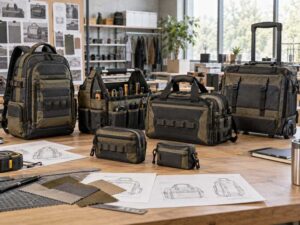
If you have your own artwork, logo design files, or just an idea, please provide details about your project requirements, including preferred fabric, color, and customization options, we’re excited to assist you in bringing your custom bag designs to life through our sample production process.