 Skip to content
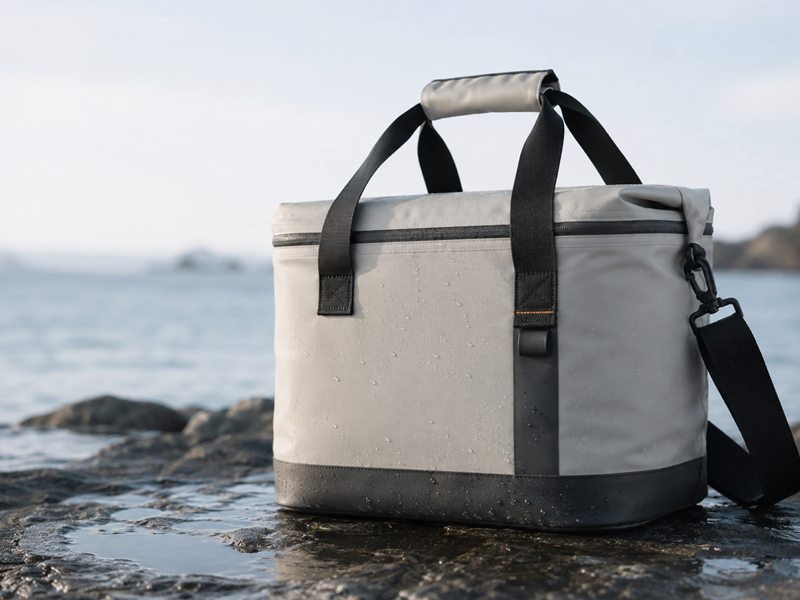
The most expensive fabric is not automatically the smartest choice for a cooler bag. A heavy waterproof laminate can perform beautifully on a rugged outdoor soft cooler but feel unnecessarily stiff on a compact lunch bag. A lightweight polyester shell can be completely suitable for office lunches, promotional programs and retail sets, yet become the wrong choice when the bag needs to handle loose ice, repeated outdoor use or constant wet contact.
The real decision is about matching fabric construction to the job the cooler must perform.
For most cooler bags, coated Oxford and polyester offer the strongest balance of water resistance, durability, printability and cost. TPU-coated or laminated fabrics are better suited to higher-performance soft coolers that need flexibility and stronger moisture protection, while PVC-coated materials work well for robust wet-use constructions. Nylon, RPET and neoprene also fit specific applications when weight, recycled content, softness or appearance matters more.
A good cooler therefore starts with a simple exercise: imagine the bag after six months of real use, not when it is sitting perfectly clean on a sample table. Will it be thrown into a car trunk? Filled with ice packs every morning? Carried through rain? Wiped down daily? Folded flat between uses? Dragged across campsite ground?
Those details change the material decision far more than a fabric name ever will.
What Makes a Fabric Best for Cooler Bags?
The best cooler bag fabric is not simply the material that blocks the most water. It must work with the insulation, liner, seams, zipper, handles, logo process and intended carrying conditions. A small lunch bag may perform better with coated polyester or 420D–600D Oxford, while a large outdoor soft cooler may justify a heavier coated textile or TPU-based construction. Choosing correctly means defining what the bag will actually face before selecting the fabric.
A useful material decision starts with six practical requirements:
- how much water exposure the exterior will receive;
- whether the inside must handle condensation, spills or loose ice;
- how much weight the bag will carry;
- how often it will be opened, folded and cleaned;
- how much insulation and usable internal capacity are needed;
- how the logo and exterior appearance should look after repeated use.
These requirements matter because the same material can perform very differently in two cooler designs. A 600D Oxford shell used with adequate insulation, a suitable liner and reinforced seams may be an excellent choice for a picnic cooler. The same shell does not automatically make a cooler suitable for holding melting ice. Likewise, TPU may provide a stronger moisture barrier, but using it on a lightweight promotional lunch bag may increase cost without creating meaningful value.
What Does Waterproof Mean for a Cooler Bag?
For cooler bags, “waterproof” should describe the behavior of the completed construction rather than the name of one fabric.
There are at least four different moisture conditions to consider:
- rain hitting the outer surface;
- condensation forming around cold bottles or ice packs;
- accidental liquid spills inside the compartment;
- melted ice remaining in the bag for an extended period.
A bag that handles the first two conditions well may still leak under the fourth.
This is especially important with woven outer materials such as polyester, nylon and Oxford. The textile itself may receive a PU, PVC or other coating that improves moisture resistance, but sewing creates needle holes. Zipper tapes, corner seams and handle attachment areas can also interrupt the barrier.
A practical specification should therefore describe the expected exposure.
For example:
| Intended Use | More Useful Requirement |
|---|---|
| Office lunch bag | Exterior resists splashes; liner handles condensation |
| School lunch cooler | Wipe-clean inside; ice-pack use; light rain exposure |
| Picnic cooler | Repeated outdoor use; wet bottles; stronger bottom |
| Delivery cooler | Frequent cleaning; repeated opening; moisture-resistant interior |
| Outdoor soft cooler | Higher water exposure; stronger seam and closure control |
| Loose-ice cooler | Internal liquid containment must be specifically evaluated |
This wording prevents the common mistake of paying for an expensive outer fabric while leaving the actual leakage areas unchanged.
Waterproof vs Water-Resistant: What Is the Difference?
Water resistance describes a material or construction that can slow water penetration under limited exposure. Stronger waterproof performance requires a more complete barrier, including appropriate coatings, joins, seams and closures.
Polyester, nylon and Oxford should not be classified by fiber name alone.
For example, Oxford commonly used in cooler bags may include 210D, 420D, 600D, 900D, 1000D or 1680D constructions. Higher denier usually creates a heavier, more structured textile, but denier does not tell you how well the final bag handles water. Coating and construction still matter.
A useful comparison is:
| Material Construction | Exterior Moisture Control | Structure | Flexibility | Relative Cost |
|---|---|---|---|---|
| Uncoated polyester | Low | Low–Medium | High | Low |
| Coated polyester | Medium–High | Medium | High | Low–Medium |
| Coated 600D Oxford | Medium–High | Medium–High | Medium | Low–Medium |
| Heavier coated Oxford | Medium–High | High | Medium–Low | Medium |
| Coated nylon | Medium–High | Medium | High | Medium–High |
| PVC-coated textile | High | High | Medium | Medium |
| TPU-coated or laminated textile | High | Medium | High | Higher |
The table is best used as a screening tool rather than a laboratory rating. Coating thickness, backing construction and seam method can change the finished result considerably.
Is Waterproof the Same as Leakproof?
No. A cooler can use a strong waterproof textile and still leak.
The large body panels are often not the first failure area. Moisture tends to find smaller construction weaknesses such as:
- bottom corners;
- stitched liner seams;
- zipper ends;
- binding joints;
- webbing attachment areas;
- folded liner corners;
- joins between different materials.
Consider a coated fabric panel with excellent surface resistance. Once that panel is stitched to another panel, hundreds of needle penetrations may appear along the seam. Under light rain, this may never become noticeable. If water remains against the seam inside the bag, the condition is much more demanding.
The intended cooling method therefore matters.
A cooler designed around sealed ice packs may not need to contain free-moving water. A fishing or camping cooler designed for loose ice requires much stronger attention to liner joins, corners and closures.
For sample evaluation, it is useful to separate three checks:
| Check | What It Shows |
|---|---|
| Exterior wetting | How the shell handles rain and splashes |
| Internal liquid check | Whether liner joins allow seepage |
| Loaded movement check | Whether pressure and carrying expose weak seams |
That provides far more useful information than looking at a fabric swatch and calling it waterproof.
Which Fabric Properties Matter Most?
Water resistance is only one part of a successful cooler material specification.
For a commercial cooler bag, the following properties should normally be reviewed together.
Moisture resistance
The required level should match actual exposure. A commuter lunch bag and a boating cooler should not share the same performance target.
Abrasion resistance
Bottom panels, corners and lower sidewalls often wear first. Delivery and outdoor coolers normally need more abrasion control than gift-oriented lunch bags.
Structure
Some products need a soft body that collapses easily. Others need enough stiffness to hold their shape after loading.
Oxford is often useful when more structure is needed. 600D can provide a practical balance, while 1000D or 1680D may be considered for stronger wear resistance or reinforcement areas, with additional weight and cost.
Flexibility
The material should remain comfortable to handle when the bag is opened, folded or compressed. TPU and selected nylon constructions can be attractive where softer handling is important.
Cleanability
Coolers encounter food, condensation, drinks, dirt and oils. Both the exterior and liner should be evaluated for wiping rather than judged only by appearance.
Logo compatibility
The outer material also acts as a branding surface. A smooth polyester panel may accept certain printing methods more easily than a heavily textured or coated technical fabric.
Low-temperature behavior
Cold conditions can change material stiffness. This deserves attention in coolers used with significant ice loads or in colder environments.
Weight
Heavy materials, thick insulation, large zippers and reinforced hardware can add weight quickly. A rugged appearance is useful only if the bag remains comfortable to carry.
A simple use-based comparison illustrates the trade-offs:
| Requirement | Lunch Bag | Delivery Cooler | Outdoor Soft Cooler |
|---|---|---|---|
| Exterior moisture resistance | 4/5 | 4/5 | 5/5 |
| Abrasion resistance | 3/5 | 5/5 | 5/5 |
| Low weight | 5/5 | 3/5 | 3/5 |
| Easy cleaning | 5/5 | 5/5 | 5/5 |
| Strong structure | 3/5 | 5/5 | 4/5 |
| Internal leak control | 3/5 | 4/5 | 5/5 |
| Premium hand feel | 3/5 | 2/5 | 4/5 |
These are relative development priorities, not formal laboratory scores.
How Does Fabric Affect Insulation?
The outer fabric influences protection and construction, but the insulation layer usually has a greater effect on cold retention.
A cooler may use:
- polyester or Oxford exterior;
- EPE foam as the insulating core;
- PEVA as an easy-clean liner;
- aluminum foil-type material for a thermal interior appearance.
These materials normally work together.
Increasing the exterior fabric from 600D to 1680D can make the bag feel more rugged, but that change alone does not guarantee substantially longer cold retention. Insulation thickness, opening size, zipper design and how often the bag is opened can have much greater influence.
This is an important cost-control issue. Spending more on a heavier shell while keeping thin insulation may improve appearance and abrasion resistance but do little for temperature performance.
When cooling performance matters, evaluate the complete wall structure rather than focusing only on the exterior textile.
Why Does Fabric Weight Matter?
Heavier fabric can improve structure and wear resistance, but it also changes carrying comfort, sewing difficulty, packing volume and cost.
Oxford provides a good example.
| Oxford Specification | General Character | Common Cooler Direction |
|---|---|---|
| 210D | Light, flexible | Light promotional applications |
| 420D | Light–medium | Compact lunch coolers |
| 600D | Medium, structured | Everyday and picnic coolers |
| 900D | Stronger structure | Outdoor or heavier-use designs |
| 1000D | Heavy-duty feel | Reinforced applications |
| 1680D | Dense, heavy structure | High-wear sections |
The denier number should not be treated as a quality ranking.
Using 1680D across a small lunch bag may add weight and stiffness that the design does not need. Using lighter material in the body and reinforcing only the base or high-wear zones can sometimes produce a more balanced construction.
Material efficiency is often achieved by strengthening the places that actually experience stress.
How Does Fabric Affect Logo Quality?
A cooler bag fabric is also a visual surface, and coating, texture and flexibility can influence the finished logo.
Before approving a decoration method, consider:
- whether the surface is smooth or textured;
- whether a coating affects ink adhesion;
- whether the panel will fold repeatedly;
- whether the logo sits near a seam;
- whether fine details can reproduce clearly;
- whether the surface will be cleaned frequently.
A large one-color logo on coated polyester may be relatively straightforward. A detailed multi-color graphic on textured heavy Oxford requires more evaluation. PVC and TPU surfaces can support branding, but the process should match the exact film or coating.
A useful sample check includes:
- color accuracy;
- edge sharpness;
- adhesion;
- cracking after flexing;
- position relative to seams;
- resistance to normal wiping.
This matters because a technically strong cooler can still look poor at retail if the logo begins lifting or cracking after repeated use.
How Long Should Waterproof Performance Last?
There is no single service-life figure that can be guaranteed from a fabric name.
Long-term moisture resistance depends on how the bag is used and stored.
Common stress factors include:
- repeated folding;
- abrasion;
- direct sunlight;
- contact with oils;
- strong cleaning chemicals;
- prolonged wet storage;
- low temperatures;
- seam tension;
- heavy loading.
Failure often begins locally rather than across the whole fabric.
For example:
- coating may wear at fold lines;
- the base may abrade before side panels;
- liner corners may crease;
- zipper tape may allow water through;
- attachment seams may become stressed from heavy loads.
This means durability testing should concentrate on the actual high-stress areas of the design.
A lunch cooler may need repeated zipper and handle checks. A delivery cooler deserves more attention around the base, liner and strap connections. An outdoor cooler needs stronger evaluation of abrasion, wet storage, cold exposure and loaded carrying.
What Is the Best Balance of Performance and Cost?
The best material is the least complicated construction that reliably meets the intended use.
That does not mean choosing the cheapest textile. It means avoiding performance that adds expense but delivers little practical value.
For example:
- A promotional lunch cooler may use coated polyester rather than TPU.
- A daily picnic bag may use 600D Oxford rather than 1680D across every panel.
- A premium outdoor cooler may justify TPU because flexibility, moisture control and tactile quality are part of the product position.
- A recycled-content collection may use coated RPET while keeping the insulation and liner structure similar to a conventional cooler.
- A compact soft lunch bag may use 3–5 mm neoprene where softness and flexibility matter more than rigid construction.
The final material choice should therefore be reviewed together with outer dimensions, usable capacity, insulation, liner, seam construction, zipper, branding and expected load.
That is when the phrase “best waterproof fabric” becomes useful: not as a single material recommendation, but as the fabric that fits the complete cooler design with the fewest unnecessary compromises.
Which Waterproof Fabrics Are Best for Cooler Bags?

For most cooler bags, coated polyester and 600D Oxford offer the best balance of water resistance, durability, appearance and cost. PVC-coated fabrics suit rugged wet-use designs, while TPU-coated or laminated textiles fit higher-performance soft coolers where flexibility and stronger moisture control matter. Nylon works well for lightweight premium designs, RPET supports recycled-content collections, and neoprene suits soft compact coolers.
The right choice depends on what the cooler actually needs to survive. A lunch bag carried from home to an office has very different requirements from a 30-liter camping cooler filled with cans and ice. The useful comparison is therefore not simply “Which material is the most waterproof?” It is “Which construction delivers enough moisture protection without adding unnecessary weight, stiffness or cost?”
For a first material screening, the differences can be organized like this:
| Fabric Direction | Water Protection Potential | Structure | Flexibility | Cost Direction | Common Fit |
|---|---|---|---|---|---|
| Coated polyester | Medium–High | Soft–Medium | High | Low–Medium | Lunch bags, promotion, retail |
| 600D coated Oxford | Medium–High | Medium | Medium | Low–Medium | Picnic, everyday, delivery |
| 900D–1680D Oxford | Medium–High | High | Lower | Medium–Higher | High-wear zones, rugged coolers |
| Coated nylon | Medium–High | Soft–Medium | High | Medium–Higher | Lightweight premium designs |
| PVC-coated textile | High | Medium–Firm | Medium | Medium | Wet-use and rugged constructions |
| TPU-coated/laminated textile | High | Medium | High | Higher | Premium technical soft coolers |
| Coated RPET | Depends on coating | Soft–Medium | High | Medium | Recycled-content collections |
| Neoprene | Limited as a complete barrier | Soft | Very High | Medium | Compact lunch and bottle coolers |
These are design directions rather than fixed test ratings. Coating specification, backing, thickness, seams, liner and zipper can change the result substantially.
Is Coated Polyester Best for Everyday Cooler Bags?
Coated polyester is often the most practical material for everyday insulated bags because it keeps the construction relatively light while providing a broad choice of colors, surface finishes and decoration methods.
It is especially suitable for:
- office lunch bags;
- school lunch coolers;
- corporate gift programs;
- grocery coolers;
- promotional food-and-drink bags;
- lightweight retail collections.
Polyester is also useful when the exterior needs a large printed logo or seasonal artwork. Its relatively controlled cost makes it easier to allocate more of the budget to insulation, liner quality, zipper performance or packaging instead of spending heavily on the shell alone.
The coating matters. Plain polyester should not automatically be treated as waterproof. Moisture resistance depends on coating, liner, seams, zipper and overall construction.
A practical specification should therefore include more than “polyester.” It should identify:
- fabric construction or denier;
- coating or backing;
- required color;
- surface texture;
- logo method;
- expected abrasion;
- use environment.
For many everyday coolers, this material delivers enough external protection without making the bag unnecessarily rigid.
Is Oxford Fabric Best for Custom Cooler Bags?
Oxford is one of the strongest all-round choices when a cooler needs more body, wear resistance and structural stability than a lightweight polyester shell.
Common specifications can include 210D, 420D, 600D, 900D, 1000D and 1680D, depending on the construction. 600D is often a useful middle ground because it provides a noticeable structure without pushing weight and material cost as high as heavier options. 1000D and 1680D can offer stronger abrasion resistance and a firmer feel, but they also increase weight and cost.
A simple selection guide:
| Oxford Specification | General Feel | Useful Direction |
|---|---|---|
| 210D | Light and flexible | Light promotional coolers |
| 420D | Light–medium | Compact lunch bags |
| 600D | Balanced structure | Picnic, retail, delivery |
| 900D | More rugged | Outdoor-oriented designs |
| 1000D | Heavy-duty feel | High-wear construction |
| 1680D | Dense and substantial | Reinforcement and demanding use |
Higher denier should not be treated as automatically “better.”
A 1680D exterior across a small lunch cooler can make the product heavy and stiff without adding much real value. It may be more efficient to use 600D on the body and strengthen the bottom or high-wear zones separately.
Oxford is commonly combined with coatings, lining, EPE, foam, webbing and hardware, making it particularly adaptable to structured cooler designs.
When Is Nylon a Better Choice?
Nylon becomes attractive when the cooler should feel lighter, smoother and more refined.
Compared with standard polyester, it is commonly chosen for applications where hand feel, appearance and abrasion resistance deserve more emphasis. It can work particularly well for:
- commuter lunch coolers;
- travel-oriented cooler bags;
- compact cooler backpacks;
- premium lifestyle collections;
- lightweight outdoor designs.
Nylon is generally positioned above ordinary polyester in cost. Its surface can feel smoother, and the finished bag may have a more technical appearance. Jundong’s material records also note that nylon is usually lighter and smoother than standard polyester, while color, coating and thickness should be confirmed before production.
The key is not to compare “nylon” and “polyester” as if each were one fixed material.
Performance changes with:
- denier;
- yarn construction;
- weave;
- coating;
- lamination;
- backing;
- finish.
A well-specified coated polyester can outperform a poorly chosen nylon in a particular cooler. Nylon earns its place when the design genuinely benefits from lower weight, smoother handling or a more premium textile appearance.
PVC vs TPU: Which Is Better?
PVC and TPU are both relevant when the product needs a stronger moisture barrier than a conventional coated woven shell, but they create different handling and cost characteristics.
PVC is useful where the design calls for:
- strong surface water resistance;
- easy wiping;
- robust structure;
- controlled material cost;
- wet-use capability.
TPU becomes more attractive where the cooler needs:
- greater flexibility;
- softer hand feel;
- a more refined technical appearance;
- compatibility with selected welded constructions;
- stronger performance in higher-spec applications.
Jundong’s material guidance notes that TPU usually costs more than standard PVC, while its flexibility and hand feel may be more suitable for higher-requirement projects.
A direct comparison:
| Detail | PVC | TPU |
|---|---|---|
| Cost direction | Lower–Medium | Higher |
| Flexibility | Medium | High |
| Hand feel | Firmer | Softer |
| Water barrier potential | High | High |
| Easy cleaning | Strong | Strong |
| Technical appearance | Medium–High | High |
| Welding use | Suitable in compatible structures | Suitable in compatible structures |
| Cold-condition behavior | Needs review | Often attractive for demanding use |
Thickness and formulation can change these characteristics significantly.
PVC also needs attention to softness, transparency where applicable, odor, cold behavior, sewing response and decoration compatibility. It should not automatically be described as food-safe or environmentally preferable without supporting material information.
For a rugged cooler where cost control matters, PVC may be the more sensible choice. For a premium soft cooler where flexibility is part of the product experience, TPU may justify the additional expense.
Is RPET Suitable for Waterproof Cooler Bags?
RPET can work well as a cooler bag outer shell when recycled-content material is part of the product concept.
It is commonly used in similar ways to polyester and can be combined with a suitable coating, insulation and liner. Its moisture resistance should still be judged from the full construction rather than the recycled content itself.
A common structure may include:
- coated RPET exterior;
- foam insulation;
- PEVA or foil-type liner;
- zipper closure;
- sewn or reinforced seams.
RPET is particularly suitable for:
- reusable lunch bags;
- grocery coolers;
- corporate gift programs;
- seasonal retail collections;
- sustainability-focused product lines.
The important distinction is documentation. RPET should not automatically be described as GRS-certified. If GRS or another material document is required, availability should be confirmed for the actual project and supply chain.
A recycled textile still needs to meet the same practical standards as conventional polyester:
- stable color;
- suitable coating;
- acceptable abrasion;
- clean logo reproduction;
- consistent hand feel;
- repeatable production quality.
Sustainability value does not replace functional performance.
When Does Neoprene Make Sense?
Neoprene suits cooler designs where softness, stretch and cushioning are more important than a rigid shell.
It is commonly useful for:
- compact lunch bags;
- bottle sleeves;
- drink coolers;
- wine carriers;
- promotional food-and-drink products;
- soft protective cases.
Common project thicknesses may include 3 mm, 5 mm, 7 mm and 8 mm. Increasing thickness changes more than insulation feel; it also affects cost, flexibility, cushioning and sewing difficulty.
| Thickness | General Effect |
|---|---|
| 3 mm | Light, flexible, compact |
| 5 mm | Balanced softness and cushioning |
| 7 mm | More padded and structured |
| 8 mm | Thick feel, higher volume and sewing difficulty |
These thicknesses should be reviewed against the actual product rather than treated as fixed performance grades.
Neoprene is attractive for a soft, tactile lunch cooler that needs to fold easily and feel comfortable to carry. It is less appropriate when the core requirement is containing substantial melted ice.
In that situation, the liner and seam construction become more important than the neoprene body itself.
Which Fabric Is Best for High-Wear Areas?
The best material for the main body does not always have to be the best material for the bottom.
Coolers frequently wear fastest at:
- bottom corners;
- lower sidewalls;
- handle attachment areas;
- zipper ends;
- shoulder strap connection points.
Instead of upgrading every panel to a heavier material, selective reinforcement can create a better balance of durability, weight and cost.
For example:
- 600D Oxford body + heavier bottom panel;
- coated nylon body + reinforced base;
- polyester body + Oxford bottom;
- TPU body + reinforced wear zones.
This approach is especially useful for delivery, picnic and outdoor coolers.
It can also improve appearance. A lighter main body keeps the product less bulky, while stronger materials are placed only where the physical stress occurs.
The most expensive construction is not always the most durable one. Strength comes from locating reinforcement correctly.
Which Fabric Is Best for Logo Printing?
Polyester and Oxford are often practical choices when large printed graphics are important because they provide familiar textile surfaces for many decoration methods.
However, the exact finish still matters.
Logo performance can be affected by:
- coating type;
- surface texture;
- fabric density;
- print size;
- number of colors;
- location;
- repeated folding;
- cleaning frequency.
Heavy textured Oxford may reduce the sharpness of very fine artwork. PVC and TPU can also support branding, but ink or applied decoration should be tested against the exact surface.
A useful sample review includes:
| Logo Check | What to Look For |
|---|---|
| Color | Match approved reference |
| Edges | Clean detail and no bleeding |
| Adhesion | No lifting |
| Flex test | No premature cracking |
| Position | Correct distance from seams |
| Wipe test | No obvious transfer |
| Bulk consistency | Stable size and placement |
Logo selection should happen at the same time as fabric selection. Changing the exterior material late can affect both appearance and decoration method.
Which Fabric Gives the Best Value?
For many cooler projects, 600D coated Oxford or coated polyester gives the strongest cost-to-performance balance.
They are versatile enough for large quantities, accommodate a variety of branding methods and work well with common insulation and liner structures.
TPU becomes more valuable when the design needs higher flexibility, stronger water control or a premium technical feel. PVC makes sense when robust wet-use performance and easy cleaning matter. Nylon fits lightweight refined products. RPET supports recycled-content positioning. Neoprene works when softness is central to the design.
A practical selection matrix looks like this:
| Product Type | Strong Starting Material |
|---|---|
| Everyday lunch cooler | Coated polyester / 420D–600D Oxford |
| Retail picnic cooler | 600D Oxford |
| Delivery cooler | 600D–900D Oxford with reinforced zones |
| Lightweight premium cooler | Coated nylon |
| Rugged wet-use cooler | PVC-coated textile |
| Premium soft cooler | TPU-coated or laminated textile |
| Recycled-content cooler | Coated RPET |
| Soft bottle/lunch cooler | 3–5 mm neoprene |
The final material should still be reviewed together with insulation, liner, zipper, load, size and expected water exposure.
That combination matters more than choosing the material with the most impressive specification on paper.
How Do Cooler Bag Materials Work Together?

A cooler bag performs well only when the outer shell, insulation, liner, seams and closure are designed as one system. The exterior protects the bag from abrasion and outside moisture. The insulation slows heat transfer. The inner liner manages condensation, spills and cleaning. Seams connect those layers without creating unnecessary weak spots, while the zipper controls one of the largest areas of air exchange.
This is why choosing a “waterproof fabric” alone does not determine how long a cooler stays cold or whether melted ice will leak.
A practical three-layer cooler construction often looks like this:
| Layer | Main Function | Common Options | What Can Go Wrong |
|---|---|---|---|
| Outer shell | Abrasion, appearance, outside moisture | Polyester, Oxford, nylon, RPET, PVC/TPU-coated textile | Surface wear, coating damage, poor logo adhesion |
| Insulation | Slow heat transfer, add cushioning | EPE foam or other suitable foam | Too thin, compressed areas, gaps at corners |
| Inner liner | Moisture control, cleaning | PEVA, foil-type lining, suitable TPU film | Seam leakage, wrinkles, punctures |
| Closure | Reduce air exchange | Coil zipper, heavier zipper, waterproof-style zipper | Air leakage, water entry, difficult operation |
| Seam system | Join panels and control leakage | Sewing, welding, mixed construction | Needle holes, weak corners, incomplete welds |
The most effective design is not necessarily the one using the most expensive material in every layer. It is the construction in which each layer has a clear job and the interfaces between those layers are properly controlled.
Outer Fabric vs Lining: Which Stops Water?
The outer shell mainly protects against moisture coming from outside the cooler. The liner deals with moisture generated or spilled inside it.
That distinction sounds simple, but it changes material selection completely.
A coated 600D Oxford exterior may handle:
rain;
wet car floors;
splashes;
damp grass;
surface dirt.
The inner compartment may face much harsher conditions:
condensation from cold cans;
water dripping from ice packs;
food spills;
melted ice;
frequent wiping.
The outer fabric therefore does not always need to form a liquid-tight container.
For a lunch bag carrying sealed food boxes and reusable ice packs, a coated textile shell combined with an easy-clean liner can be entirely appropriate.
A cooler designed for loose ice is different. If two or three liters of meltwater can collect inside the compartment, the liner and its seams become part of a liquid containment system.
This is why the intended cooling method should be defined early:
| Cooling Method | Internal Moisture Demand |
|---|---|
| Chilled food only | Low |
| Frozen gel packs | Low–Medium |
| Frozen bottles | Medium |
| Bagged ice | Medium–High |
| Loose ice | High |
| Repeated commercial wet use | High |
The higher the internal liquid exposure, the more attention should move from the outer shell toward liner seams, corners, opening design and joining method.
PEVA vs TPU: Which Lining Is Better?
PEVA is a practical choice for many lunch and conventional cooler bags because it creates a flexible, smooth surface that is relatively easy to wipe clean. It can be combined with foam insulation and textile outer shells without making the construction excessively heavy.
TPU becomes more interesting when flexibility, stronger moisture containment or a more technical welded structure is required.
The difference is not simply “basic versus premium.” The joining process matters.
A PEVA liner in a conventional sewn lunch cooler may be completely suitable when the contents are sealed containers and ice packs.
A large outdoor cooler designed for loose ice may need a different liner and seam strategy because water pressure remains against the bottom and corners for longer periods.
| Design Factor | PEVA | TPU |
|---|---|---|
| Flexibility | Good | Very good |
| Easy-clean surface | Good | Good |
| Cost direction | Lower | Higher |
| Everyday lunch cooler | Very suitable | Often unnecessary |
| Higher liquid exposure | Depends on seams | Strong potential |
| Welded structure | Depends on exact construction | Often considered |
| Premium tactile feel | Moderate | Higher |
| Material thickness | Must be confirmed | Must be confirmed |
Thickness should never be ignored.
Two PEVA liners made from different thicknesses may feel, fold and sew differently. The same applies to TPU films. Very thin liners can wrinkle or become easier to damage during assembly. Excessively heavy liners can make corners bulky and harder to form.
The best liner thickness is therefore linked to bag size, seam method, expected cleaning and internal water exposure.
Are PEVA Cooler Bag Liners FDA Food Safe?
PEVA should not be described as automatically food-safe simply because it is widely used inside cooler and lunch bags.
The first detail to establish is whether food actually touches the liner.
Consider three different situations:
A lunch bag carries sealed food containers.
A grocery cooler carries wrapped or packaged food.
A liner is intended to touch unpackaged food directly.
These applications should not automatically share the same material requirement.
If food-contact documentation is needed, the exact PEVA formulation, intended use and required test documents should be confirmed before production.
Useful information to define includes:
whether direct food contact occurs;
type of food carried;
temperature conditions;
cleaning method;
destination requirements;
required documentation or testing;
whether printing is applied to the contact surface.
For many ordinary lunch bags, food remains inside containers and the liner mainly handles condensation and spills.
That is very different from specifying a liner for direct food contact.
The safest product description is therefore based on verified material documentation rather than using “FDA food safe” as a generic characteristic of PEVA.
Which Material Provides the Best Thermal Insulation?
The insulation core usually has a much greater influence on thermal performance than the exterior fabric.
Changing an outer shell from 600D Oxford to 1680D Oxford may increase structure and abrasion resistance, but it does not automatically create a major improvement in cold retention.
The insulation layer is responsible for slowing heat transfer through the walls.
EPE foam is commonly used in cooler bags because it can provide:
thermal resistance;
cushioning;
shape;
structural support.
The liner and shell then protect that core and help create a usable finished product.
A simplified wall may be:
Oxford outer shell
→ EPE insulation
→ PEVA liner.
A different construction might use:
TPU-coated outer material
→ thicker insulation
→ suitable moisture-control liner.
The second structure may perform better, but not simply because TPU is present. Foam thickness, zipper design, overall volume and seam construction can change the result dramatically.
Cold retention should therefore be considered as:
Insulation + Closure + Surface Area + Internal Load + Environment
rather than:
Outer Fabric = Number of Cold Hours
Why Does Insulation Thickness Matter?
Increasing insulation thickness can reduce heat transfer, but it also changes the physical proportions of the cooler.
Suppose a rectangular bag has exterior dimensions of 30 × 20 × 25 cm.
If insulation thickness increases substantially on every wall, the usable compartment becomes smaller even though the exterior dimensions remain unchanged.
This affects:
food container fit;
number of cans;
bottle orientation;
internal dividers;
perceived capacity.
Thicker walls also increase bulk during shipping.
A very simple comparison shows the trade-off:
| Insulation Direction | Cold-Retention Potential | Internal Capacity | Folding | Finished Bulk |
|---|---|---|---|---|
| Thin | Lower | Higher | Easier | Lower |
| Medium | Balanced | Balanced | Moderate | Moderate |
| Thick | Higher potential | Lower | Harder | Higher |
The insulation should therefore be selected together with the required internal volume.
If a cooler needs to hold 12 cans, develop around the actual cans—not only around an exterior dimension.
Physical fit testing during sampling is one of the simplest ways to catch capacity mistakes.
Where Does Heat Enter a Cooler Bag?
Heat does not enter only through the large wall panels.
Several smaller areas can significantly affect performance:
zipper opening;
lid perimeter;
seams;
corners;
handle attachment areas;
compressed insulation;
areas where foam is interrupted.
The zipper is particularly important because the lid may represent one of the largest breaks in the insulated enclosure.
A cooler with very thick walls but a loose zipper can lose some of the expected benefit.
Insulation can also be unintentionally compressed during sewing. If a thick foam layer becomes thin around corners or seam allowances, those areas may become easier paths for heat transfer.
This is sometimes called a thermal bridge: one small area transfers heat more easily than the surrounding insulated wall.
For that reason, checking insulation continuity can matter as much as checking nominal foam thickness.
Why Do Seams and Corners Leak First?
Water usually looks for the easiest route through the bag.
Large coated panels may resist moisture well. The more vulnerable areas are where materials are joined.
Common locations include:
bottom corners;
vertical liner seams;
zipper ends;
binding joints;
handle attachment areas;
folded corners.
Traditional sewing creates needle holes. Under light moisture exposure, these may cause no practical problem.
Under continuous liquid pressure, the situation changes.
Imagine 1–2 liters of melted ice sitting in the bottom of the cooler. Water remains in contact with the same seam for hours. Movement while carrying also pushes liquid into corners.
A more demanding leak test should therefore focus on those areas rather than simply wetting the center of a fabric panel.
A practical sequence can include:
- Fill the compartment with a controlled amount of water.
- Leave the bag upright for a defined period.
- Inspect bottom and side seams.
- Lift and carry the bag.
- Apply gentle pressure to the walls.
- Tilt the cooler when the intended use makes this relevant.
The test condition should match what the cooler is expected to do in real use.
Are Waterproof Cooler Bags RF Welded?
Some higher-water-control cooler bags use RF welding, but not every waterproof-style cooler needs this construction.
RF welding joins compatible thermoplastic materials through heat generated within the material interface. Unlike conventional sewing, it can create a continuous bonded joint without rows of needle punctures through the seam.
This makes it useful for selected PVC- and TPU-related constructions.
Possible cooler structures include:
sewn shell + sewn liner;
sewn shell + welded liner;
welded coated body;
mixed welded and sewn construction.
The choice depends on the material, geometry and required liquid resistance.
Welding also affects design freedom.
Rounded corners, thick reinforcement, webbing attachment and complex pocket structures can make construction more complicated. Some components may still need stitching even when major body panels are welded.
A welded cooler should therefore not be imagined as a bag with absolutely no sewing anywhere.
The important detail is where the liquid barrier is created.
RF Welding vs Sewing: Which Is Better?
If direct liquid containment is the main requirement and the material is compatible, welding can provide a significant advantage because it avoids stitched perforations along the welded joint.
Sewing remains more versatile.
It works with a much wider selection of textile materials and is well suited to lunch bags, picnic coolers, promotional products and many delivery designs.
| Construction | Sewing | RF Welding |
|---|---|---|
| Material flexibility | Very broad | Requires compatible materials |
| Needle holes | Present | Not present in welded seam |
| Complex pockets | Easier | More limited |
| Decorative textile construction | Excellent | Less flexible |
| Liquid containment | Depends on seam | Strong potential |
| Equipment complexity | Lower | Higher |
| Production cost | Usually lower | Usually higher |
| Best fit | Everyday coolers | Higher moisture-control designs |
A welded seam is also not automatically perfect.
Weld width, material cleanliness, pressure, temperature-related settings, overlap and corner design can affect the joint.
For this reason, the sample should be tested as a completed product.
How Do Zippers Affect Cooling and Leakage?
The zipper performs two jobs at once: it closes the cooler mechanically and limits the movement of air and moisture through the opening.
A standard coil zipper may be completely suitable for a lunch bag.
A more demanding soft cooler may use a heavier or waterproof-style zipper to improve closure performance.
But stronger sealing introduces another trade-off.
Highly sealed zippers can require more pulling force.
If opening becomes too difficult, the user experience suffers.
The zipper specification should therefore consider:
opening force;
zipper size;
slider quality;
puller size;
corner radius;
water exposure;
frequency of opening.
The zipper path also affects thermal performance. A large U-shaped opening gives excellent access to food and drinks but creates a larger interruption in the insulated body.
A smaller opening may retain cold more efficiently but make packing inconvenient.
The best design balances accessibility and containment.
How Should the Layers Be Checked Before Production?
A finished sample should be evaluated as a complete thermal and moisture system.
The most useful checks include:
| Area | Practical Check |
|---|---|
| Outer shell | Wet exposure and abrasion |
| Insulation | Thickness and continuity |
| Internal capacity | Test with actual cans, bottles or containers |
| Liner | Cleaning, corners and wrinkles |
| Bottom | Water and loaded-weight observation |
| Seams | Leak inspection |
| Zipper | Repeated opening and closure |
| Handles | Loaded carrying |
| Logo | Flexing and wiping |
| Overall cooling | Controlled comparative test |
For temperature testing, keep the conditions consistent.
Use the same:
cooler size;
contents;
starting temperature;
number of ice packs;
outside temperature;
test duration;
opening frequency.
Otherwise, comparing two constructions becomes unreliable.
The most important principle is simple: cooler performance is created by the complete wall, seam and closure system. A stronger outer fabric cannot compensate for poor insulation, and thicker foam cannot compensate for a badly designed opening.
The materials work best when each layer is selected for a specific job—and the finished bag is tested under conditions that resemble how it will actually be used.
Which Fabric Is Best for Each Cooler Bag Type?
The best fabric changes with the cooler’s size, carrying load, moisture exposure, insulation level and expected service frequency. A compact lunch bag usually benefits from lighter coated polyester or 420D–600D Oxford, while delivery and outdoor coolers need stronger abrasion resistance and more stable structure. Premium soft coolers may justify TPU-based constructions when flexibility, wet-use performance and refined hand feel matter more than keeping material cost low.
A useful starting comparison is:
| Cooler Type | Strong Starting Fabric | Structure Level | Water Exposure | Cost Direction |
|---|---|---|---|---|
| Lunch bag | Coated polyester / 420D–600D Oxford | Light–Medium | Low–Medium | Lower |
| Picnic cooler | 600D Oxford | Medium | Medium | Low–Medium |
| Delivery cooler | 600D–900D Oxford | Medium–High | Medium–High | Medium |
| Outdoor cooler | Coated Oxford / nylon / PVC | Medium–High | High | Medium–Higher |
| Promotional cooler | Polyester / light Oxford / neoprene | Light–Medium | Low–Medium | Lower |
| Premium soft cooler | TPU-coated or laminated textile | Medium | High | Higher |
The table should be treated as a design starting point. The same fabric can behave very differently depending on coating, insulation, liner, zipper and seam construction.
Which Fabric Works for Custom Lunch Bags?
For compact lunch bags, coated polyester and 420D–600D Oxford are usually the most practical choices.
The priorities are different from those of a rugged outdoor cooler. A lunch bag normally needs to be light enough for daily carrying, easy to wipe, visually clean and large enough to hold food containers after the insulation is installed.
Important requirements usually include:
- moderate splash resistance;
- low finished weight;
- smooth zipper operation;
- stable printing surface;
- easy-clean liner;
- enough insulation without excessive wall thickness;
- compact storage after use.
Coated polyester works particularly well when strong colors, printed graphics or a lighter structure are important.
420D or 600D Oxford creates more body and can make the bag feel stronger without becoming excessively heavy.
A practical construction may be:
coated polyester or 600D Oxford + EPE foam + PEVA liner
For lunch bags carrying sealed meal boxes and gel packs, a highly technical welded shell is often unnecessary. The more useful investment may be better liner construction, stronger handle attachment and sufficient internal dimensions.
Capacity should be checked after the insulation is added.
For example, if a rectangular lunch bag has an exterior size of 26 × 18 × 20 cm, thick walls reduce the usable compartment on all sides. A lunch container that appears to fit the exterior dimensions may not fit the finished interior.
That is why a physical fit check with actual lunch boxes, bottles and ice packs is more useful than relying only on liters.
Which Fabric Works for Picnic Cooler Bags?
Picnic coolers usually carry more food, bottles and ice packs than lunch bags, so the fabric needs more structure and abrasion resistance.
600D coated Oxford is often one of the strongest starting choices for this category.
It offers a practical balance between:
- durability;
- structure;
- printability;
- manageable weight;
- material cost;
- reinforcement compatibility.
The most vulnerable areas are often the bottom, lower corners and handle connections.
Instead of using a very heavy fabric across the entire cooler, a more efficient design can use:
- 600D Oxford on the body;
- heavier Oxford or coated reinforcement on the bottom;
- webbing reinforcement through handle areas;
- thicker insulation around the main compartment;
- PEVA or foil-type liner inside.
This creates strength where the cooler actually receives stress.
A picnic cooler may be carried across:
- parking areas;
- grass;
- beaches;
- campsites;
- concrete floors;
- car trunks.
The bottom therefore deserves more attention than decorative upper panels.
For a medium-capacity picnic bag carrying 12–24 cans, the loaded weight can become far greater than the empty bag suggests. Handle construction, stitching and base reinforcement should be evaluated while the sample is fully loaded.
A beautiful cooler that sags heavily when filled will feel poorly engineered even if the fabric itself is durable.
Which Fabric Works for Delivery Cooler Bags?
Delivery coolers require stronger construction because the same bag may be opened, closed, loaded, carried and wiped many times in one working day.
The exterior should resist abrasion and maintain its shape under repeated handling.
600D or 900D coated Oxford is often a practical direction because it offers enough body for larger structures while remaining compatible with reinforced sewing, webbing and external pockets.
For more demanding wet-use conditions, PVC-coated sections or other easy-clean surfaces may also be considered.
Important construction areas include:
- reinforced base;
- strong carrying handles;
- shoulder-strap attachment;
- large zipper opening;
- internal dividers;
- easy-clean liner;
- insulation continuity;
- corner reinforcement.
A delivery cooler frequently spends time on vehicle floors, counters, loading areas and pavement. Bottom wear can therefore develop faster than sidewall wear.
The lid also receives heavy use.
If the zipper is opened 20–50 times during a busy route, smooth operation and slider durability become as important as the fabric denier.
For delivery use, a slightly heavier shell can be worthwhile if it improves shape retention and reduces abrasion.
However, weight should still be controlled. A cooler that is already heavy before food is loaded becomes tiring during repeated carrying.
The best construction keeps the shell strong while avoiding unnecessary material on low-stress panels.
Which Fabric Works for Outdoor Coolers?
Outdoor soft coolers need to deal with a more demanding combination of moisture, abrasion, temperature change and heavier loads.
Suitable exterior directions can include:
- 600D–1000D coated Oxford;
- coated nylon;
- PVC-coated textile;
- TPU-coated or laminated fabric.
The final selection depends on whether the cooler is intended for casual recreation or more demanding camping, fishing or boating use.
For moderate outdoor use, coated Oxford can offer a very good cost-to-durability balance.
For wetter conditions, PVC-coated material provides a stronger moisture barrier and easy-clean surface.
For a higher-end soft cooler, TPU can provide greater flexibility and a more refined technical feel.
The exterior is only one part of the design.
Outdoor models may also need:
- thicker insulation;
- reinforced bottom;
- stronger webbing;
- large carry handles;
- shoulder strap;
- durable zipper;
- reduced-seam or welded construction;
- external tie-down areas.
A common mistake is increasing fabric denier while leaving the zipper, base and handle attachments unchanged.
That creates a strong shell around weaker components.
A better approach is to identify stress zones.
For example:
| Area | Common Stress |
|---|---|
| Bottom | Ground abrasion and load |
| Lid | Frequent opening |
| Handles | Vertical carrying load |
| Strap anchors | Pulling force |
| Corners | Impact and seam concentration |
| Zipper ends | Repeated tension |
Material weight should be increased where those stresses occur.
Which Fabric Works for Promotional Cooler Bags?
Promotional coolers usually need strong visual impact, controlled cost and efficient packing rather than extreme outdoor performance.
Coated polyester, lightweight Oxford and neoprene are often suitable choices.
The most successful material depends on the shape and distribution method.
Coated polyester works well when the design needs:
- bright colors;
- large printed logos;
- lightweight construction;
- compact packing;
- controlled unit cost.
Lightweight Oxford makes sense when a slightly more structured feel is desired.
Neoprene suits small soft lunch coolers, bottle sleeves and drink carriers where a flexible tactile feel adds perceived value.
For high-volume promotional projects, unnecessary complexity can quickly increase cost.
A useful structure often keeps:
- panel count low;
- hardware minimal;
- logo placement flat;
- insulation practical;
- packaging compact.
Large external pockets, multiple zippers, metal components and thick reinforcement can add cost without improving the main promotional purpose.
The goal should still be a product people continue using.
A cooler that feels too thin, has weak handles or cannot fit normal food containers may be discarded quickly.
Simple does not mean disposable.
A better promotional cooler combines modest material cost with useful capacity and clear branding.
Which Fabric Works for Premium Soft Coolers?
Premium soft coolers usually benefit from stronger moisture control, higher-quality tactile materials and better hardware.
TPU-coated or laminated textile becomes particularly relevant here.
Compared with standard PVC, TPU generally costs more, but its flexibility and hand feel can suit higher-spec designs where the material itself contributes to the product experience.
Suitable premium directions can include:
- TPU-coated textile;
- TPU-laminated fabric;
- coated nylon;
- selected heavy coated Oxford.
The premium feel should come from the complete construction rather than from one expensive fabric.
Important details include:
- smooth zipper operation;
- clean seam geometry;
- balanced handle placement;
- strong webbing;
- shaped bottom;
- controlled foam thickness;
- neat liner installation;
- precise logo execution.
A cooler can use premium TPU and still feel disappointing if the zipper is difficult to operate or the internal capacity is too small.
For premium soft coolers, usable capacity is particularly important.
Thicker insulation creates strong walls but can reduce internal space dramatically.
If a model is presented as a 20-can cooler, that capacity should be checked with the intended can size, ice-pack arrangement and realistic packing method.
“20 cans” without considering insulation and cooling media can be misleading during development.
Which Fabric Works for Cooler Backpacks?
Cooler backpacks place additional demands on the outer textile because the entire load sits against the back and shoulders.
Coated Oxford and nylon are commonly useful directions.
Oxford provides structure and abrasion resistance.
Nylon can reduce weight and create a smoother, more refined feel.
Important areas include:
- shoulder-strap reinforcement;
- back padding;
- bottom structure;
- zipper access;
- liner support;
- handle attachment;
- insulation compression.
The back panel needs special attention.
Thick insulation combined with thick back padding can make the cooler bulky. Thin padding may feel uncomfortable when bottles or meal containers press against the back.
For a cooler backpack, external comfort and internal thermal structure need to be developed together.
A strong fabric alone cannot solve poor weight distribution.
Which Fabric Works for Cooler Beach Bags?
Cooler beach bags need moisture resistance but also deal with sand, wet towels and repeated outdoor placement.
Suitable directions may include:
- coated Oxford;
- polyester;
- PVC;
- TPU;
- selected neoprene.
A cooler beach tote may prioritize appearance and lighter weight, while a dedicated beach soft cooler may require stronger water control and reinforcement.
Useful features include:
- wipe-clean bottom;
- sand-resistant exterior;
- strong handles;
- easy-access opening;
- external wet pocket;
- corrosion-conscious hardware selection;
- easy-clean liner.
A PVC-coated bottom paired with a textile upper body can sometimes provide a good balance between beach durability and carrying comfort.
The entire bag does not always need to use the same material.
Mixed-material construction can solve different needs more efficiently.
How Does Fabric Choice Affect Price?
Fabric affects the final cost through more than the material price per meter.
Different fabrics change cutting, sewing, reinforcement, printing, welding, packing and shipping.
For example:
- heavier Oxford increases material weight;
- TPU can require more specialized processing;
- thick coated fabric can slow sewing;
- custom color can affect material sourcing;
- thicker structures may increase carton volume;
- special surfaces can require different logo methods.
A simple cost comparison can be expressed like this:
| Design Change | Likely Cost Effect |
|---|---|
| Polyester → 600D Oxford | Small–Moderate increase |
| 600D → 1000D/1680D Oxford | Moderate increase |
| Standard coated textile → PVC-coated structure | Moderate increase |
| PVC → TPU | Moderate–High increase |
| Standard liner → higher-spec liner | Moderate increase |
| Thin → thicker insulation | Material + packing volume increase |
| Sewing → specialized welded structure | Process cost increase |
| Standard logo → multiple logo positions | Decoration cost increase |
Actual pricing still depends on size, quantity, coating, liner, insulation, zipper, hardware, packaging and testing requirements.
The most efficient material plan usually comes from strengthening the areas that matter instead of upgrading everything.
For example:
- use 600D Oxford on the main body;
- reinforce only the base;
- keep secondary pockets lighter;
- choose insulation based on real cooling needs;
- reserve TPU for styles that truly benefit from it.
That approach controls weight and cost while keeping the finished cooler aligned with its intended use.
How Should a Factory Develop a Custom Waterproof Cooler Bag?

A custom waterproof cooler bag should be developed from its intended use backward—not from a fabric swatch forward. Capacity, water exposure, cooling method, carry weight, cleaning frequency, liner construction, insulation, zipper, logo, packaging and required delivery date should be defined before the sample is finalized. A strong development process turns these requirements into measurable specifications that can be checked again during bulk production.
A practical development sequence is:
Use condition → Capacity → Outer fabric → Liner → Insulation → Seam method → Closure → Carry system → Logo → Sample → Functional checks → Production specification → Bulk QC
Skipping one of these stages often creates expensive revisions later.
For example, selecting thick insulation before confirming usable internal capacity may create a cooler that looks correct externally but cannot hold the intended bottles or meal boxes. Choosing a TPU shell before confirming whether welding is actually required may add cost without solving a real performance need. Selecting a logo method before the coating is known can create adhesion or cracking problems.
What Should You Send a Cooler Bag Factory?
A clear development brief saves time and reduces unnecessary sample revisions.
The most useful information includes:
- reference image, drawing or existing sample;
- external dimensions;
- expected internal capacity;
- intended contents;
- whether the cooler uses gel packs, bagged ice or loose ice;
- preferred outer fabric;
- liner preference;
- insulation target;
- zipper style;
- handle or shoulder-strap requirements;
- logo artwork;
- quantity per design and color;
- packing method;
- destination;
- required delivery date;
- any testing or material-document requirements.
Capacity should be described in a way that can be physically checked.
Instead of writing:
“Medium cooler bag”
use something closer to:
“Designed for 12 standard cans plus two flat ice packs.”
or:
“Must fit two meal-prep containers measuring 220 × 160 × 60 mm plus one 500 ml bottle.”
That immediately gives the development team something measurable.
The same applies to waterproof performance.
Instead of:
“Must be waterproof”
specify:
“Exterior should resist rain and wet ground contact; liner will carry sealed ice packs.”
or:
“Internal compartment must be evaluated for loose-ice meltwater.”
Those two products may require completely different seam and liner constructions.
How Should the Material Construction Be Selected?
The material system should be selected around the expected stress rather than appearance alone.
Start by identifying where failure is most likely.
For a lunch cooler:
- zipper wear;
- liner staining;
- handle stitching;
- corner abrasion.
For a delivery cooler:
- base wear;
- repeated opening;
- liner cleaning;
- strap stress;
- insulation compression.
For an outdoor soft cooler:
- wet ground;
- heavy loads;
- melted ice;
- repeated flexing;
- zipper tension;
- abrasion.
Once the stress areas are clear, each layer can be assigned a job.
| Requirement | Possible Construction Direction |
|---|---|
| Lightweight lunch cooler | Coated polyester + EPE + PEVA |
| Everyday picnic cooler | 600D Oxford + EPE + PEVA/foil-type lining |
| Delivery cooler | 600D–900D Oxford + stronger base + thicker insulation |
| Recycled-content cooler | Coated RPET + EPE + suitable liner |
| Rugged wet-use cooler | PVC-coated textile + moisture-control liner |
| Premium soft cooler | TPU-coated/laminated shell + stronger insulation + compatible seam system |
These combinations are starting directions rather than fixed formulas.
The final choice also depends on size, color, MOQ, logo, packaging and target cost.
When Should a Custom Sample Be Made?
A sample should be made after the key specifications are stable enough to make the prototype meaningful.
Sampling too early often creates repeated revisions because basic decisions are still moving.
Before starting the sample, confirm at least:
- size;
- capacity;
- main fabric;
- coating;
- liner;
- insulation;
- zipper;
- handle system;
- logo;
- color;
- packaging direction.
The first physical sample should then be treated as a functional prototype rather than a display piece.
For a normal custom bag project, Jundong’s standard sampling period is usually around 5–7 days, while selected simple styles may be completed in 2–3 days. Complex materials, special decoration, custom components or special packaging can take longer.
A rushed sample that has not resolved the key construction details often creates more delay later than a properly prepared sample.
What Should the Sample Verify?
A cooler bag sample should verify both appearance and use.
The following checks are particularly useful:
| Area | What Should Be Verified |
|---|---|
| External dimensions | Width, height, depth |
| Internal dimensions | Actual usable space |
| Capacity | Fit with real cans, bottles or food boxes |
| Outer shell | Color, coating, texture, stiffness |
| Insulation | Thickness and continuity |
| Liner | Corners, wrinkles, wipe-clean surface |
| Zipper | Opening width and smooth operation |
| Handles | Balance under load |
| Shoulder strap | Length, comfort, attachment strength |
| Logo | Size, color, location, adhesion |
| Leakage | Appropriate to intended use |
| Packing | Folded size, deformation and carton efficiency |
The sample should be loaded with the actual or equivalent contents.
For example, if the cooler is intended for 24 cans, place 24 cans inside together with the expected cooling media.
Then evaluate:
- whether the zipper closes easily;
- whether the sides bulge;
- whether handles remain balanced;
- whether the bottom deforms;
- whether internal capacity matches the advertised use.
This simple test often exposes more useful information than measuring the empty bag alone.
How Should Waterproof Performance Be Tested?
The test method should match the intended exposure.
A single spray test cannot prove every type of waterproof performance.
Different checks may include:
- exterior spray exposure;
- wet-surface contact;
- water placed against selected seams;
- internal liner fill;
- upright leak observation;
- tilt testing;
- gentle compression;
- repeated flexing after wet exposure.
The test record should include basic conditions such as:
- water volume;
- exposure duration;
- bag orientation;
- whether pressure was applied;
- starting temperature;
- whether ice was used;
- acceptance criteria.
For example:
Test A: Exterior Rain Resistance
Spray the closed cooler from several directions for a defined period and inspect whether moisture penetrates the outer structure.
Test B: Internal Leak Check
Add a controlled quantity of water to the liner, leave the bag upright, then inspect bottom seams and corners.
Test C: Loaded Movement Check
Carry or gently compress the filled cooler to determine whether leakage appears only under movement.
These tests help separate surface water resistance from true liquid containment.
How Should Leak Resistance Be Checked?
Leak checks should focus on joins rather than only the center of a material panel.
The most sensitive areas often include:
- bottom corners;
- vertical liner seams;
- zipper ends;
- welded overlaps;
- drain areas;
- liner folds.
A useful inspection sequence is:
- Visually inspect the liner before adding water.
- Add a defined water volume.
- Leave the bag stationary for a set period.
- Check the bottom exterior.
- Lift and carry the cooler.
- Apply light pressure where appropriate.
- Recheck all seams.
- Record where seepage first appears, if any.
For loose-ice designs, testing with meltwater is more meaningful than a quick spray.
For normal lunch bags using sealed ice packs, a less demanding leak target may be entirely appropriate.
The acceptance criterion should be agreed before the test begins.
How Is Sample-to-Bulk Consistency Controlled?
The approved sample should be converted into written production specifications.
Without that step, the sample becomes a visual reference but leaves too much room for interpretation.
Important details should include:
- outer fabric code;
- denier or weight;
- coating;
- liner specification;
- foam type and thickness;
- zipper size;
- slider and puller;
- webbing width;
- handle length;
- logo dimensions;
- logo position;
- color reference;
- finished dimensions;
- stitch construction;
- reinforcement;
- packaging.
A production sheet can then be used during cutting, assembly and inspection.
Cooler bags deserve special attention in several areas:
Insulation placement
Foam should remain continuous and should not be excessively compressed around corners.
Liner consistency
Wrinkles, folds and seam positions can affect both appearance and cleaning.
Handle reinforcement
Large coolers can become heavy quickly once loaded.
Zipper installation
An incorrectly installed zipper may distort the opening or increase operating force.
Logo placement
Even a technically good cooler can look inconsistent if branding shifts between units.
The approved sample should therefore become both a visual reference and a measurable production standard.
What Is the MOQ for TPU Cooler Bags?
There is no separate fixed MOQ simply because TPU is used.
For Jundong projects, the standard starting quantity is usually 500 pcs per design. Selected simple styles may be reviewed at 200–300 pcs case by case, although that should not be treated as a default quantity.
TPU projects can be affected by:
- film or coated-fabric purchasing quantity;
- custom color;
- thickness;
- lamination;
- welding requirements;
- logo process;
- number of colors;
- special zipper;
- packaging.
A standard-color TPU material may be easier to arrange than a custom Pantone TPU laminate.
Likewise, a simple sewn TPU cooler is very different from a fully developed welded soft cooler with technical zipper and reinforced webbing.
When quantity is limited, simplifying custom components can sometimes make the project easier to evaluate.
What Affects Custom Cooler Bag Price?
The price of a custom cooler is created by the complete construction.
Main cost drivers include:
| Cost Area | Main Variables |
|---|---|
| Outer fabric | Material, denier, coating, color |
| Liner | PEVA, foil-type lining, TPU or other option |
| Insulation | Material and thickness |
| Size | Total material consumption |
| Structure | Compartments, pockets, bottom reinforcement |
| Zipper | Type, size and length |
| Handles | Webbing, padding and reinforcement |
| Logo | Method, colors, size, positions |
| Labor | Sewing complexity or welding |
| Packaging | Polybag, labels, boxes, inserts |
| Quantity | Material efficiency and line setup |
| Testing | Required checks or third-party services |
| Delivery | Deadline and transport method |
These factors are also part of Jundong’s documented pricing logic.
A more effective cost reduction usually comes from removing low-value complexity instead of downgrading the main functional material.
For example:
- simplify an external pocket;
- reduce decorative hardware;
- use one logo position instead of three;
- optimize dimensions for fabric yield;
- reinforce only high-wear areas;
- use a standard zipper where a technical zipper is not required.
This keeps the cooler functional while controlling cost.
What Is the Lead Time for Bulk Orders?
Jundong’s regular bulk production period is usually around 20–30 days, depending on the project.
The actual schedule can change with:
- custom fabric;
- custom Pantone color;
- TPU or PVC sourcing;
- welding;
- special zipper;
- printed accessories;
- multi-color orders;
- retail packaging;
- testing;
- order quantity;
- current production loading.
Shipping time should be planned separately.
For a launch date, the safer approach is to work backward:
Required arrival date → shipping time → inspection/packing → production → material preparation → sample approval
That timeline is far more reliable than treating the production period as the entire project duration.
How Should Cooler Bag Factories Be Compared?
A useful comparison should be based on equivalent specifications rather than unit price alone.
Two cooler bags of the same size may have very different constructions.
One quote might include:
600D Oxford + 5 mm insulation + PEVA lining.
Another might use:
210D polyester + 2 mm insulation + foil-type lining.
The lower price is not necessarily better value because the products are not equivalent.
Before comparing quotations, align at least:
- fabric;
- coating;
- insulation;
- liner;
- zipper;
- reinforcement;
- logo;
- packaging;
- quantity;
- testing;
- lead time.
Also pay attention to how clearly technical details are explained.
A strong development team should be able to explain why a specific material, thickness or seam method is being proposed.
What Should Be Confirmed Before Ordering?
Before moving into bulk production, the final specification should answer these practical items:
- What exact outer fabric is approved?
- What coating or lamination is used?
- What liner is approved?
- What insulation thickness is approved?
- Is the cooler intended for ice packs or loose ice?
- Which seams are sewn and which are welded?
- What zipper is used?
- How will leak resistance be checked?
- What is the final usable capacity?
- What logo process is approved?
- What is the quantity per color?
- What packaging is required?
- What is the production period?
- Are any tests or documents required?
- Which approved sample will serve as the production reference?
Once these details are locked, the project moves from an attractive concept into a repeatable product specification.
That is the real purpose of custom cooler development: not simply producing one good-looking sample, but creating a design that can be reproduced consistently at scale.