 Skip to content
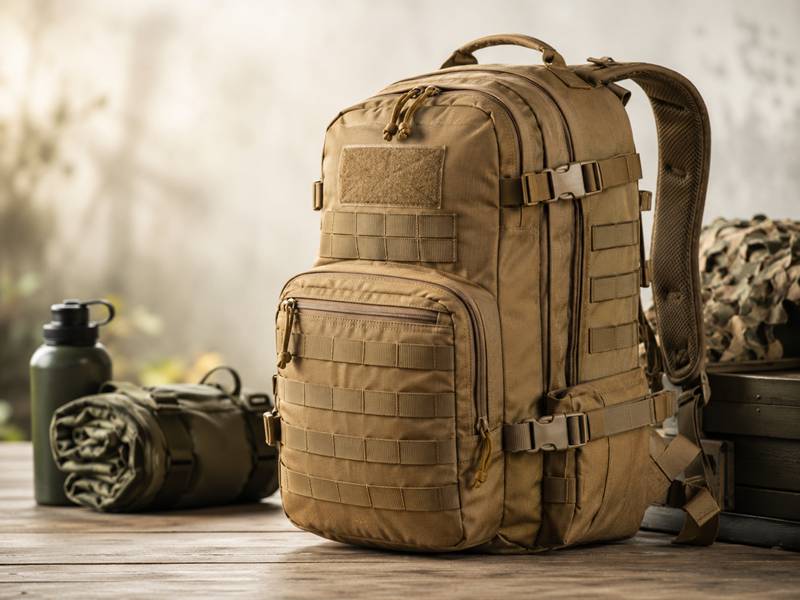
“Military backpack” sounds like one product category until two packs are placed side by side. One may be a compact 20–30 L pack built around mobility and rapid access. Another may be a 50 L or larger load-carrying system with a substantial harness, waist support, compression straps, reinforced attachment areas, and a very different internal structure. Both may use dark colors, camouflage, heavy webbing, and rugged buckles, yet they are not designed for the same job.
This is why terms such as rucksack, ruck, assault pack, patrol pack, field pack, MOLLE pack, and ALICE pack should not be treated as interchangeable styling names. Each term carries clues about how a pack is expected to work.
A military backpack is most commonly called a rucksack, often shortened to “ruck.” Smaller mission-oriented designs are often called assault packs or patrol packs, while field pack is a broader historical and functional term. MOLLE and ALICE describe load-carrying systems rather than one universal backpack shape. The most accurate name depends on capacity, load, duration of use, access, attachment system, and carrying structure.
That distinction becomes especially important when a tactical pack moves from an idea into a physical product. Fabric denier alone cannot determine performance. A 1000D shell with weak shoulder-strap anchoring can fail sooner than a carefully engineered lighter construction. A large pack with poor load transfer can feel uncomfortable even when the sewing looks clean. A MOLLE panel can appear correct in a photograph while being poorly spaced for actual pouch attachment.
The most useful way to understand military-style packs is therefore to stop looking at them as “rugged backpacks” and start looking at them as load-carrying systems built around a defined use.
What Is a Military Backpack Called?
A military backpack is most commonly called a rucksack, often shortened to ruck, but that is only the starting term. Smaller equipment-carrying packs may be called assault packs or patrol packs, while field pack is a broader name used across different equipment generations. In British military usage, Bergen is also used for a military rucksack. MOLLE and ALICE, meanwhile, describe load-carrying systems rather than one universal backpack shape.
The distinction matters when a tactical bag is being developed from a sketch, sample, or reference photograph. “Military backpack” tells very little about the finished construction. A compact pack carrying essentials for a short period may need rapid compartment access and modular attachment. A larger ruck carrying dense equipment over distance needs much more attention to harness geometry, waist support, compression, back structure, and reinforcement.
A useful working classification looks like this:
| Common Term | What It Usually Describes | Main Design Emphasis |
|---|---|---|
| Rucksack / Ruck | Medium-to-large load-carrying pack | Load transfer, harness, capacity |
| Assault Pack | Compact mission-oriented pack | Mobility, access, organization |
| Patrol Pack | Short-duration field pack | Essentials, modular storage |
| Field Pack | General field load pack | Depends on equipment system |
| MOLLE Rucksack | Modular load-carrying ruck | Attachment, load configuration |
| ALICE Pack | Older U.S. load-carriage pack | External frame and supported load |
| Bergen | British term for military rucksack | Load carriage and field use |
These names should guide development, but they should not replace a proper specification. Capacity, dimensions, intended packed weight, compartment layout, harness structure, webbing, materials, hardware, and intended use still need to be defined separately.
What Is a Rucksack or Ruck?
A rucksack is the broadest professional term for a backpack designed to carry a substantial equipment load. In military conversation it is frequently shortened to ruck, and “rucking” refers to moving while carrying such a load.
What separates a ruck from an ordinary backpack is not one fixed capacity. The more useful distinction is its load-carrying architecture.
As packed weight increases, several components become structurally connected:
- shoulder straps carry and stabilize part of the load;
- the hip or waist system can help transfer load;
- the back structure controls shape;
- compression straps reduce movement inside the pack;
- upper attachment areas resist pull from the shoulder harness;
- bottom panels support concentrated weight;
- webbing and hardware connect adjustable structures;
- reinforcement controls high-load seam areas.
This is why specifying only “1000D rucksack” is incomplete. Fabric denier tells nothing about whether the shoulder anchors are properly reinforced, whether the pack sags away from the back, or whether the waist system transfers load effectively.
Official U.S. Army development reflects this distinction. The Army’s MOLLE 4000, for example, was described as a 4,000-cubic-inch mid-sized rucksack, developed with attention to frame and harness configuration rather than simply bag volume. Four thousand cubic inches is about 65.5 liters, illustrating how military terminology can be tied to an actual load-carrying system rather than a fashion silhouette.
For commercial development, it is useful to define a ruck with several separate specifications:
| Specification | Why It Matters |
|---|---|
| External dimensions | Controls overall physical size |
| Usable capacity | Defines storage volume |
| Intended packed load | Determines structural demand |
| Harness type | Influences carrying comfort |
| Waist support | Influences load transfer |
| Back structure | Controls shape and stability |
| Compression layout | Controls load movement |
| Bottom construction | Affects sagging and abrasion |
| Reinforcement areas | Supports repeated loading |
A 50-liter pack filled mainly with clothing can impose less structural stress than a smaller pack filled with dense equipment. For that reason, liters and load weight should never be treated as the same specification.
What Is an Assault Pack?
An assault pack is normally a smaller, more mobile pack intended to carry essential equipment without the volume of a larger rucksack. The U.S. Army’s official MOLLE description distinguishes the Assault Pack from the system’s rucksacks, confirming that the terms are not interchangeable.
The construction priorities are usually different as well.
A larger ruck is heavily concerned with sustained load carriage. An assault-style pack tends to place more emphasis on:
- quick access;
- compact profile;
- internal organization;
- hydration provision;
- external attachment;
- compression;
- mobility;
- frequently used equipment.
A well-designed compact pack may therefore be more complicated to pattern than its size suggests.
Imagine a 28-liter tactical pack containing a main compartment, hydration sleeve, admin section, front utility compartment, internal mesh pockets, side compression, external modular webbing, identification panel, sternum strap, waist stabilization, and several equipment loops.
There is very little unused surface left.
Adding another pocket can interfere with a zipper. Adding a large patch can consume modular attachment space. Increasing depth can shift packed weight farther away from the body. Putting thick foam everywhere can improve the appearance of structure while increasing weight and reducing usable internal volume.
For an assault-style project, an equipment map is often more useful than beginning with pocket count.
| Intended Contents | Possible Structure |
|---|---|
| Hydration reservoir | Internal sleeve + hose exit |
| Documents | Flat protected sleeve |
| Small equipment | Organizer panel |
| First-aid items | Dedicated fast-access area |
| Outer layer | Larger flexible compartment |
| External accessories | Modular webbing zones |
| Frequently used items | Accessible front/side storage |
The goal is not to create the pack with the greatest number of visible features. It is to make each compartment earn the space, weight, and sewing time it consumes.
What Is a Patrol or Field Pack?
A patrol pack generally refers to a smaller field pack intended to support shorter-duration activity. A U.S. Marine Corps training document describes its patrol pack as suitable for sustaining an individual for 24–48 hours, equipped with Pouch Attachment Ladder System webbing for external pouches and capable of attaching to the main pack. That is a useful example of how a patrol pack sits below the larger main carrying system rather than simply being another name for it.
The term should still not be treated as a universal 24–48-hour dimensional standard. Different organizations and commercial designs use different capacities and configurations.
Field pack is even broader. It may refer to a pack developed for carrying field equipment without identifying one precise modern configuration.
For product development, “patrol pack” should therefore be treated as an intended-use description that still needs technical definition.
For example:
“30 L patrol pack” leaves many unresolved details.
Does it use a full clamshell opening or a conventional panel opening?
Does it have a hydration sleeve?
Is the waist strap removable?
Are side pockets designed for bottles, equipment, or modular pouches?
How much of the front surface requires attachment webbing?
Does the pack need a structured back panel?
Should the main compartment remain mostly open or include organization?
Even the external proportions influence function.
| 30 L Body Shape | Practical Effect |
|---|---|
| Tall and narrow | Controls overall width |
| Wide and shallow | Broad access, lower projection |
| Short and deep | More rearward projection |
| Compartment-heavy | Strong organization, less open volume |
| Single-main-cavity | Greater flexibility for bulky contents |
The name establishes the category. The pattern, dimensions, and intended contents establish the actual product.
Are MOLLE and ALICE Backpack Types?
MOLLE and ALICE are often spoken about as backpack types, but technically they refer to larger load-carrying equipment systems.
MOLLE means Modular Lightweight Load-Carrying Equipment. The U.S. Army describes the MOLLE system as containing two rucksacks along with mission-specialized sets and other components. Its purpose is to allow equipment components to be configured according to different load sizes and placement requirements.
The familiar rows of webbing used for attaching compatible pouches are associated with PALS — Pouch Attachment Ladder System. Current U.S. military documentation still uses the term MOLLE/PALS for configurable pouch and accessory attachment.
This distinction matters when developing a commercial tactical pack.
There are three different claims:
1. It looks MOLLE-inspired.
The pack has horizontal tactical-style webbing.
2. It uses a functional PALS-style attachment layout.
Spacing and stitching are developed to support modular pouch attachment.
3. It belongs to or conforms to a specified military equipment system.
That requires a much more specific technical basis.
Those statements should not be treated as equivalent.
For a commercial product, useful modular webbing requires attention to:
- webbing width;
- row spacing;
- vertical stitch intervals;
- backing reinforcement;
- panel curvature;
- zipper interference;
- compression-strap interference;
- available attachment channels.
A front panel can look convincingly tactical while still being inconvenient for attaching pouches.
ALICE means All-Purpose Lightweight Individual Carrying Equipment. U.S. Army historical reporting states that ALICE was adopted in 1973 and that MOLLE was intended to replace it in the early 2000s. ALICE became strongly associated with its framed rucksack, which is why “ALICE pack” remains widely recognized terminology.
For a new tactical collection, choosing between “MOLLE style” and “ALICE style” should therefore begin with structure rather than appearance:
| Design Need | More Relevant Direction |
|---|---|
| Modular external pouches | MOLLE/PALS-style structure |
| Modern configurable exterior | MOLLE-inspired pack |
| Traditional external-frame character | ALICE-inspired rucksack |
| Compact short-use pack | Assault/patrol format |
| Larger sustained load | Rucksack format |
What Is the History of Military Backpacks?
The history of military backpacks is largely the history of improving load carriage.
Pack systems have evolved because more equipment does not simply require a larger fabric container. Increasing weight creates problems with balance, fatigue, access, body fit, equipment organization, and structural durability.
ALICE became an important U.S. military load-carriage system after its adoption in 1973. It used a load-carrying approach strongly associated with an external-frame rucksack. MOLLE followed later as a more modular system and was intended to replace ALICE in the early 2000s.
The evolution continued rather than stopping with MOLLE.
The Army’s MOLLE 4000 development is a useful example. It was created as a mid-sized rucksack, built around user requirements and tested before field distribution. Army development reporting describes changes involving the frame, harness, removable components, and field evaluation—showing how military pack development remains an iterative physical process.
The U.S. Marine Corps also treats the pack as a complete carrying system. Its current instructional material covers different torso configurations, hip-belt setup, pack features, hydration integration, and attachment of an assault pack. That illustrates an important design reality: the main bag, harness, adjustment system, and auxiliary pack have to work together.
British terminology adds another useful example. Official UK material uses Bergen as a term for a military rucksack, showing why terminology changes with region and service tradition.
For a new commercial tactical project, the historical progression can be simplified into five design priorities:
| Earlier Concern | Modern Development Concern |
|---|---|
| Carry equipment | Carry and organize equipment |
| Increase capacity | Control capacity and packed weight |
| Add shoulder straps | Develop complete harness geometry |
| Add external storage | Build configurable modular attachment |
| Use stronger fabric | Engineer the entire load path |
That last distinction is especially important.
A modern tactical rucksack is not defined by camouflage, heavy fabric, or rows of webbing. Those features are visible. The more important work happens underneath: where the shoulder straps enter the body, how compression controls the load, how reinforcement distributes force, whether equipment remains accessible when the pack is full, and whether the approved construction can be reproduced consistently.
So when deciding what to call a military-style backpack, start with function:
Shorter-duration, compact equipment carry: Assault Pack or Patrol Pack
Larger load over distance: Rucksack or Ruck
General field-use terminology: Field Pack
Modular attachment configuration: MOLLE/PALS-style Pack
Older U.S. framed load-carriage style: ALICE Pack
British military terminology: Bergen
The name then becomes useful rather than decorative—it tells the design team what kind of load-carrying problem the product is expected to solve.
Which Type of Military Backpack Fits Each Use?
The right military-style backpack depends on five things: how long it will be carried, what goes inside, how dense the load is, how often equipment must be accessed, and how much body movement is required. Compact assault or patrol packs favor mobility and organization. Larger rucksacks favor capacity, compression, load transfer, and structural support. Capacity alone is never enough to make the decision.
For product development, a useful starting reference is:
| Intended Use | Practical Starting Type | Common Capacity Direction* | Main Design Priority |
|---|---|---|---|
| Essential gear for several hours | Assault pack | 15–25 L | Fast access, low bulk |
| Day-use tactical equipment | Assault / patrol pack | 20–35 L | Organization, mobility |
| Outdoor day use | Tactical backpack | 25–40 L | Comfort, storage, versatility |
| Training and weighted carry | Rucksack | 30–50 L+ | Stability, reinforcement |
| Extended equipment carry | Larger rucksack | 45–70 L+ | Harness, compression, load transfer |
| Emergency / rescue equipment | Modular tactical pack | Project-specific | Equipment visibility and access |
| Radio / medical / tool kit | Purpose-built pack | Project-specific | Exact compartment fit |
| Modular pouch program | MOLLE-style pack | Project-specific | Attachment layout |
- These capacities are useful planning references, not universal military classifications. Final dimensions should be based on the equipment list, packed weight, body fit, and intended use.
Assault Pack vs Rucksack: What Is Different?
An assault pack and a rucksack may share Oxford fabric, webbing, compression straps, reinforced stitching, and tactical colors, but the design priorities are different.
An assault pack is generally built around mobility. A rucksack is more heavily influenced by sustained load carriage.
That difference changes nearly every part of the construction.
| Design Detail | Assault-Style Pack | Larger Rucksack |
|---|---|---|
| Capacity | Usually lower | Usually higher |
| Access | Faster, more compartmentalized | Often larger main-volume access |
| Body depth | More controlled | Can be deeper |
| Internal organization | Often higher | Depends on intended load |
| Shoulder system | Moderate load focus | Greater load support |
| Waist structure | Light or removable on some styles | More important |
| Frame support | Often none or light internal support | More likely |
| Compression | Useful | Often critical |
| External attachment | Common | Common |
| Packed stability | Important | Critical |
| Bottom reinforcement | Moderate to strong | Usually more substantial |
| Load lifters | Sometimes used | More relevant on larger systems |
One of the easiest mistakes is to create an assault pack by simply shrinking a rucksack.
That rarely works well.
A smaller tactical pack needs to use its available surface more efficiently. If the main body is only 45 cm tall, every zipper, MOLLE row, compression strap, hook-and-loop panel, side pocket, and logo competes for space.
For example, imagine a compact pack with:
- 28 L capacity;
- two front compartments;
- four rows of modular webbing;
- side compression straps;
- bottle pockets;
- a hydration sleeve;
- internal organizer;
- large rubber patch;
- padded shoulder straps;
- removable waist strap.
Each feature sounds reasonable individually. Together, they can make the pack too thick, too heavy, or difficult to operate.
The rucksack has a different problem. As size increases, the issue becomes less about fitting another pocket and more about controlling weight.
A large ruck needs to keep the load from shifting away from the body. That usually places more emphasis on:
- compression;
- back stiffness;
- shoulder anchor strength;
- hip support;
- reinforcement;
- bottom structure;
- frame compatibility;
- load-lifter geometry.
This is why the best starting design is not simply “small pack” or “large pack.” It is the carrying task.
Which Type Is Best for Short Missions?
For shorter-duration use, an assault-style or patrol-style pack usually makes the most sense because it can keep essential equipment close to the body without adding unnecessary bulk.
The important word is essential.
A short-use pack becomes inefficient when every possible feature is added simply because it looks tactical.
Before deciding how many pockets are needed, divide the intended contents into access groups.
| Access Level | Example Contents | Better Storage Position |
|---|---|---|
| Immediate | First aid, gloves, flashlight, documents | Front / top access |
| Frequent | Batteries, tools, snacks, communication items | Organizer / secondary compartment |
| Main | Clothing, hydration, larger gear | Main compartment |
| External | Additional pouches, accessories | MOLLE-style attachment |
| Protected | Electronics, documents | Internal padded or flat sleeve |
This approach usually produces a more useful structure than deciding “six pockets would look good.”
A 22–30 L patrol-style pack may not need a large waist belt if the intended packed weight is modest. But once dense equipment is added, a stabilizing waist strap or stronger back structure may become valuable even though the liter capacity has not changed.
The type of contents matters more than the headline volume.
For example:
A 25 L pack filled with clothing may remain light.
A 25 L pack filled with batteries, tools, radios, or dense emergency equipment can become very heavy.
The outside dimensions may be identical, but the second design requires greater attention to:
- shoulder strap reinforcement;
- webbing anchors;
- bottom panel;
- zipper stress;
- foam density;
- buckle strength;
- seam construction.
Short-duration designs also benefit from a disciplined external profile.
If modular pouches are likely to be added, the base pack should not already be excessively deep. A body that is 20 cm deep before accessories are attached can become uncomfortable or unstable after several external pouches are loaded.
A compact pack should stay compact even after it becomes functional.
When Is a Large Rucksack Better?
A larger rucksack is the better choice when the load moves beyond essential day-use equipment and begins to include clothing, additional water, tools, bulky protective gear, shelter-related items, or other equipment required for extended use.
At that stage, the development priority changes.
The question is no longer just:
“How much can the bag hold?”
It becomes:
“How can that load be carried without excessive movement, sagging, or concentrated pressure?”
A larger ruck often needs more attention in these areas:
- shoulder strap width and curvature;
- upper strap anchoring;
- waist or hip support;
- back-panel stiffness;
- load lifters;
- compression straps;
- side stabilization;
- bottom construction;
- frame sheet or frame;
- reinforcement at stress transitions.
Volume can increase quickly when bag dimensions change.
For a simplified rectangular comparison:
| Approx. Internal Size | Theoretical Volume |
|---|---|
| 45 × 28 × 18 cm | 22.7 L |
| 50 × 30 × 20 cm | 30.0 L |
| 55 × 32 × 22 cm | 38.7 L |
| 60 × 35 × 24 cm | 50.4 L |
| 65 × 38 × 26 cm | 64.2 L |
Real usable capacity will differ because backpacks are not perfect rectangular boxes. Curved panels, padding, seams, pocket construction, back systems, and internal dividers all consume space.
Still, this calculation illustrates an important design effect: adding only a few centimeters to several dimensions can substantially increase volume.
More volume often encourages more loading.
That additional weight then affects the harness.
This is why a 55–65 L rucksack cannot simply be treated as a 30 L tactical backpack with larger pattern pieces.
The bottom may need greater support. Shoulder anchors may need additional backing. Compression may need to work across several zones. The waist structure may need to become more substantial.
For heavier-use designs, the pack should also be reviewed while loaded.
An empty sample can hide several problems:
- excessive backward pull;
- bottom sagging;
- poor shoulder angle;
- unstable side movement;
- ineffective compression;
- waist belt sitting too high or too low.
A larger rucksack should therefore be judged in the condition in which it will actually be used—not only while sitting empty on a sample table.
How Do Capacity and Load Change the Design?
Capacity and load are related, but they are not the same technical requirement.
Capacity tells you how much physical space exists.
Load tells you how much force the construction must manage.
A common mistake is assuming that a larger pack always needs stronger construction and a smaller pack always needs lighter construction.
In reality, equipment density changes everything.
Consider three 30 L packs:
| Contents | Approx. Density Direction | Structural Demand |
|---|---|---|
| Clothing and soft gear | Low | Moderate |
| Outdoor mixed equipment | Medium | Moderate to high |
| Tools / electronics / batteries | High | High |
All three can have the same outer dimensions.
The third pack may create much greater stress at the shoulder anchors, bottom seams, compression straps, and zipper areas.
For tactical bag development, Jundong’s documented inspection focus includes MOLLE structure, webbing, reinforcement positions, buckles, pockets, and functional organization. Load-bearing inspection also includes shoulder straps, waist belts, webbing, D-rings, buckles, zipper areas, bottom seams, reinforcement seams, corners, and heavy-load zones.
Several physical relationships are useful to understand.
First, depth affects balance.
If a pack becomes deeper, part of the load moves farther away from the back. That increases leverage against the shoulder system.
For example:
A 35 L pack that is tall and relatively shallow may keep weight closer to the torso.
Another 35 L pack that gains much of its volume through depth may feel more rear-heavy even though both are listed at the same capacity.
Second, pocket position affects weight distribution.
A large front pocket is useful for access, but dense objects placed there move weight farther from the body.
Heavy items are generally easier to control when kept closer to the back structure.
Third, external pouches change the effective dimensions.
A nominal 30 L MOLLE pack can become substantially wider or deeper once utility pouches are attached.
That means MOLLE layout should be developed together with realistic pouch use rather than treated as decoration.
Fourth, internal dividers reduce usable open volume.
A highly organized 30 L tactical pack may carry less bulky equipment than a simple 30 L rucksack because foam panels, organizers, sleeves, and partitions consume internal space.
For product specification, four figures are therefore more useful than capacity alone:
- external dimensions;
- usable internal volume;
- intended packed weight;
- expected equipment distribution.
When these are defined together, material and reinforcement decisions become much more accurate.
Why Do Frames and Harnesses Matter?
The frame and harness determine how a loaded pack interacts with the body.
They are especially important as load and carrying duration increase.
A frame or internal support structure helps the body of the pack resist collapse. The harness then controls how that structure connects to the shoulders, chest, waist, and back.
A successful system needs those elements to work together.
Shoulder straps deserve more attention than simply choosing “thick padding.”
Their performance depends on:
- width;
- curvature;
- foam density;
- foam thickness;
- outer fabric;
- mesh;
- binding;
- upper attachment position;
- reinforcement;
- adjustment webbing;
- buckle position.
A strap that is too straight may press into the neck.
A strap that is too soft may compress heavily under load.
A strap that is too thick may feel bulky without improving load control.
A strap that is wide but poorly anchored can still fail.
The waist structure has its own role.
On lighter packs it may mainly stabilize movement.
On larger rucksacks it can become a major part of load transfer.
Its effectiveness depends on:
- vertical position;
- width;
- stiffness;
- foam;
- curvature;
- buckle size;
- adjustment direction;
- connection to the pack body.
Back structure also needs balance.
Too little stiffness can allow heavy contents to bulge against the body or make the pack collapse away from the back.
Too much stiffness adds weight and can reduce flexibility.
Different construction levels may include:
| Support Level | Possible Construction | Suitable Direction |
|---|---|---|
| Light | Foam padding only | Compact day pack |
| Moderate | Foam + PE support sheet | General tactical backpack |
| Stronger | Structured sheet + reinforcement | Medium rucksack |
| High | Internal / external frame system | Larger load-carrying rucksack |
The chosen structure should follow expected load rather than appearance.
Compression straps are part of the same system.
Their purpose is not merely to create a tactical look. They help reduce internal movement and keep the load closer to the pack body.
A partially filled 45 L pack without effective compression can allow contents to move away from the back. Good compression can stabilize that load and reduce shifting during movement.
Load lifters can also become relevant on larger packs.
Their geometry depends on the relationship between shoulder height and the upper structure of the pack. Simply adding two straps at the top does not guarantee useful load control.
The larger the intended load, the more important real physical evaluation becomes.
A useful sample review can include:
- empty fit;
- lightly loaded fit;
- intended-load fit;
- shoulder pressure;
- waist position;
- pack movement during walking;
- zipper access under load;
- compression effectiveness;
- bottom deformation;
- strap and webbing behavior.
The final choice between an assault pack, patrol pack, tactical backpack, and large rucksack should therefore come from the actual carrying task.
A 25 L assault-style pack can be excellent for fast access and compact equipment.
A 35 L tactical backpack can provide more flexibility for day-use and modular organization.
A 45–55 L rucksack may suit longer-duration equipment carry.
A 60 L+ design may provide the volume required for extended loads, but it also brings greater responsibility for harness geometry, compression, reinforcement, and weight management.
The most successful design is not the one with the highest capacity, thickest fabric, or greatest number of MOLLE rows. It is the pack whose volume, packed weight, access, attachment system, and carrying structure remain balanced when the product is actually loaded and used.
What Makes a Custom Tactical Bag Different?

A custom tactical bag is defined less by its military appearance than by how well material, load structure, MOLLE webbing, compartments, hardware, reinforcement, carrying comfort, and branding work together. A strong design remains practical after it is loaded, compressed, opened repeatedly, fitted with external pouches, and carried for extended periods. Jundong’s tactical bag scope includes Oxford, nylon, polyester, webbing, mesh, foam padding, metal hardware, and buckles, with MOLLE, reinforcement, pocket layout, abrasion resistance, color, and functional organization treated as key development areas.
Two backpacks can both use 1000D fabric and look nearly identical in photographs, yet behave very differently in real use. One may keep its shape and carry well; the other may sag, twist, develop stress around shoulder anchors, or become difficult to access after loading.
The difference usually comes from details that are less visible:
| Design Area | What Actually Matters |
|---|---|
| Outer fabric | Fiber, denier, coating, hand feel, abrasion exposure |
| MOLLE webbing | Width, spacing, alignment, stitch security |
| Shoulder straps | Shape, foam, attachment, reinforcement |
| Back structure | Support, padding, ventilation, load position |
| Bottom | Abrasion, sagging, seam loading |
| Pockets | Equipment fit, opening size, access |
| Compression | Load stabilization |
| Hardware | Strength, operation, weight, finish |
| Logo | Position, attachment, material compatibility |
| Internal layout | Real usable space, not just pocket count |
A tactical bag therefore should not be developed as a normal backpack with extra webbing added at the end. Its structure needs to be planned from the intended use outward.
Military Backpack vs Tactical Backpack
Military backpacks and tactical backpacks can share many features, but they are not automatically the same product.
A military pack may be developed around a specific institutional specification, equipment system, required construction, or test procedure. A commercial tactical backpack usually takes useful ideas from professional load-carrying equipment and adapts them for outdoor, rescue, emergency, work, training, or retail applications.
Common shared features include MOLLE-style webbing, compression straps, reinforced handles, hook-and-loop areas, heavy-duty zippers, muted colors, and organized compartments.
The important distinction is specification versus appearance.
A backpack does not become military-spec simply because it uses camouflage fabric or 1000D Oxford. If a product has not been developed and tested against a defined military requirement, terms such as tactical backpack, MOLLE-style backpack, or military-style rucksack are generally more accurate.
Jundong’s documented tactical line includes tactical backpacks, tactical sling bags, MOLLE system bags, utility pouches, emergency bags, first-aid bags, and outdoor rescue bags. Its documented focus is MOLLE layout, webbing, reinforcement, pockets, abrasion, buckles, color, logo, and functional compartments.
That is a practical distinction because commercial programs usually need the useful functions of tactical equipment without making unsupported claims about military qualification.
Fabric Denier Options
For tactical bags, Jundong’s documented material options include 600D, 900D, and 1000D Oxford, together with nylon, polyester, coated fabric, webbing, mesh, foam padding, metal hardware, and buckles.
Denier is often misunderstood.
A higher denier usually means a heavier yarn, but denier alone does not tell you the finished fabric’s abrasion resistance, tear behavior, coating performance, weight, flexibility, or long-term durability.
Two fabrics both described as “600D Oxford” can feel noticeably different because of:
fiber composition, weave density, coating, backing, yarn quality, finishing, and finished fabric weight.
A practical comparison is:
| Fabric Direction | Feel / Structure | Weight Direction | Practical Use |
|---|---|---|---|
| 600D Oxford | Moderate structure | Lower | Day packs, general tactical styles |
| 900D Oxford | Firmer and more substantial | Medium | Outdoor and tactical packs |
| 1000D Oxford | Heavy, structured | Higher | Abrasion-intensive areas |
| Nylon | Often smoother and flexible | Depends on construction | Outdoor and tactical applications |
| Polyester | Stable and cost-efficient | Depends on construction | General functional packs |
The strongest fabric is not automatically the best choice.
A compact 22 L pack made entirely from very heavy fabric may become unnecessarily stiff. It may also weigh more before any equipment is loaded.
A more balanced construction may use a lighter main shell while adding stronger material or reinforcement at:
bottom panels, strap anchors, high-abrasion corners, webbing backing, and equipment-contact areas.
Jundong’s material guidance specifically notes that thickness influences hand feel, structure, weight, and cost, while load performance depends on fabric together with webbing, stitching, reinforcement, and hardware.
Best Materials for Tactical Bags
There is no single best tactical bag material because the correct choice depends on the intended load, abrasion exposure, total weight target, stiffness, moisture exposure, and required appearance.
Oxford fabric works well where a more structured, abrasion-oriented construction is required.
Nylon can be useful where lighter weight, flexibility, and outdoor use are important.
Polyester can provide practical color control and cost efficiency for many tactical-style products.
Mesh may be used in selected back panels, pockets, or internal areas where airflow or visibility is useful.
Foam padding helps with shoulder comfort, back support, shape, or equipment protection.
Webbing, buckles, D-rings, zippers, and other hardware are not secondary accessories. In many tactical designs they form part of the working structure.
Jundong’s material documentation emphasizes that material selection should connect directly with use, structure, logo method, cost, quantity, and delivery requirements.
A useful way to choose is to start with the intended function:
| Requirement | Material Direction |
|---|---|
| Lower finished weight | Avoid unnecessarily heavy shell construction |
| High abrasion exposure | Stronger Oxford / reinforced abrasion zones |
| Better structural shape | Firmer shell + foam or support layer |
| Heavy external attachments | Reinforced webbing backing |
| Outdoor moisture exposure | Review coating, seams and zipper construction |
| Dense equipment | Strengthen load paths and bottom areas |
| Strong visual identity | Choose surfaces compatible with logo process |
Water resistance also needs careful wording.
A coated fabric may resist water, but a complete bag also contains seams, needle holes, zippers, openings, bindings, and connection areas. Jundong’s material guidance specifically notes that water resistance depends on the complete material-and-structure combination rather than the textile alone.
MOLLE Logo Branding
A tactical pack can carry custom branding while retaining useful MOLLE areas, but the position and process need to be planned together.
Suitable approaches can include embroidery, woven labels, rubber patches, PVC patches, reflective printing, silicone patches, or a dedicated hook-and-loop identity area. Jundong’s documented logo capability includes these methods, and rubber/PVC patches are specifically suitable for tactical, outdoor, and backpack applications.
The common mistake is making the logo so large that it reduces the useful attachment area.
For example, if a front panel has four MOLLE rows and a large patch covers the middle two rows, a significant portion of the modular surface is lost.
A better layout might separate the functions:
| Front Area | Function |
|---|---|
| Upper panel | Identity patch or logo |
| Center | Main modular attachment |
| Lower panel | Additional attachment or utility pocket |
| Side panels | Compression or accessory attachment |
Branding also affects sewing.
A rubber or PVC patch adds thickness. Embroidery introduces dense stitching. A woven label requires a clean attachment edge. Hook-and-loop panels need backing support if they are large.
Logo inspection should therefore check size, position, color, clarity, attachment, patch thickness, and bulk consistency. Jundong’s QC procedures cover these factors rather than treating branding as a simple visual add-on.
Military Camouflage Matching
Camouflage requires more control than simply selecting “green,” “desert,” or “woodland.”
The supplied Jundong facts confirm custom color development and the use of color references, but they do not state that every named military camouflage pattern can automatically be reproduced. Each pattern should therefore be reviewed according to artwork, authorization, fabric, printing method, repeat, quantity, and required color accuracy.
For a camouflage program, the following information makes development far more reliable:
| Information | Why It Matters |
|---|---|
| Original artwork | Controls pattern accuracy |
| Physical swatch | Gives a real visual reference |
| Color standard | Controls individual colors |
| Pattern repeat | Controls scale |
| Print direction | Controls orientation |
| Base fabric | Changes texture and color |
| Coating requirement | Can affect appearance |
| Approved sample | Becomes bulk reference |
Pattern scale is especially important.
A camouflage repeat designed at 60 cm can look very different on a 30 cm front panel than it does on a large fabric sheet. Different cutting positions may also cause every finished backpack to show a slightly different section of the pattern.
That is normal for many repeated prints, but it should be understood before production.
If exact motif placement matters, the cutting plan may need additional control, which can increase material waste and labor.
Color also changes after printing onto different fabric surfaces. A design printed on polyester may not appear identical when applied to another Oxford construction because texture, coating, base color, and ink interaction affect the result.
Jundong’s material rules require color differences to be managed through approved color cards, samples, or another confirmed reference. They also note that custom colors and special-pattern materials can influence cost, sourcing, and lead time.
For proprietary camouflage, authorization should be confirmed before development proceeds.
Reinforcement Points
Reinforcement is one of the biggest differences between a tactical bag that merely looks rugged and one designed for repeated load.
A pack rarely fails in the middle of an untouched panel.
Failures are more likely to appear where force is concentrated:
shoulder strap attachments, carry handles, compression straps, waist-belt connections, D-rings, buckle anchors, webbing rows, zipper ends, side connections, bottom seams, and corners.
Jundong’s load-bearing inspection specifically covers these areas and states that carrying strength depends on the complete construction rather than outer fabric thickness alone.
Consider a shoulder strap.
If the strap is sewn onto the outer panel with little internal backing, the surrounding fabric may gradually distort even if the strap itself is made from excellent webbing.
A stronger solution can connect the strap into a larger internal reinforcement area so the load is distributed over more fabric.
The same principle applies to MOLLE rows.
Webbing that is only visually attached to a thin front panel can pull or distort under attached pouch weight. A functional modular area needs suitable base material, controlled stitch intervals, and enough backing structure.
Bottom reinforcement deserves equal attention because dense equipment creates both downward force and abrasion.
A practical load path can be thought of as:
contents → bottom/body structure → reinforcement → shoulder/waist connections → straps → wearer
Every connection along that route matters.
Jundong’s sewing inspection for tactical and load-bearing products focuses on reinforced shoulder straps, bottoms, stress areas, consistent stitching, seam integrity, zipper sewing, and structural symmetry.
More reinforcement is not always better, however.
Excess layers can create extremely thick seam intersections. Too many bar tacks can stiffen the wrong location. Oversized reinforcement pieces increase both material consumption and weight.
The better approach is targeted reinforcement.
Strengthen the parts that carry force. Keep low-stress areas lighter where possible. Choose webbing, foam, hardware, stitching, and backing materials as parts of one connected structure.
That produces a tactical bag that does not simply look strong while sitting empty. It remains stable when loaded, compressed, fitted with accessories, carried, opened repeatedly, and used in the conditions it was designed for.
How Does a Factory Develop Custom Tactical Bags?
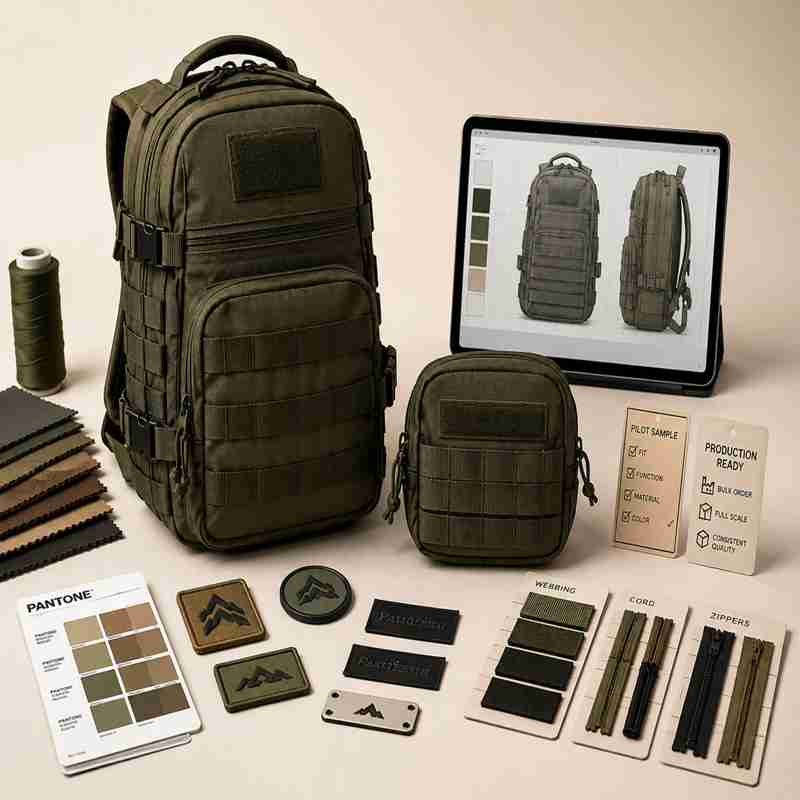
A custom tactical bag normally moves through requirement review, structure planning, material selection, pattern making, physical sampling, loaded-use checks, revision, final approval, bulk preparation, production inspection, and packing control. For tactical backpacks, rucksacks, assault packs, and MOLLE bags, the critical work is done before quantity production begins: capacity, equipment placement, webbing, reinforcement, harness geometry, hardware, zippers, logo, and packing all need to work as one product.
A practical development sequence looks like this:
| Stage | Main Work | What Needs to Be Locked |
|---|---|---|
| Requirement review | Use, capacity, equipment, quantity | Product direction |
| Structure planning | Compartments, opening, MOLLE, harness | Functional layout |
| Material planning | Outer fabric, lining, foam, webbing | Weight, feel, durability |
| Component selection | Zippers, buckles, D-rings, hook-and-loop | Function and appearance |
| Pattern making | Convert dimensions into sewable panels | Shape and construction |
| First sample | Cutting, logo, sewing, assembly | Physical feasibility |
| Loaded review | Carrying, access, compression, attachments | Real-use performance |
| Revision | Correct dimensions and construction | Final details |
| PP sample | Confirm production-ready version | Bulk reference |
| Quantity production | Cutting, sewing, assembly, packing | Repeatability |
| Inspection | Materials through shipment preparation | Consistency |
For tactical bags specifically, Jundong’s documented development focus includes MOLLE systems, webbing, reinforcement areas, buckles, pockets, and functional divisions.
Do Factories Provide OEM for Military Assault Packs?
Yes. Assault packs, tactical rucksacks, MOLLE backpacks, utility pouches, tactical waist packs, emergency bags, and similar functional designs can be developed through OEM or ODM programs.
There are two common starting situations.
The first is a fully defined project. It may already include:
- technical drawings;
- exact dimensions;
- material specifications;
- zipper and buckle references;
- stitch details;
- MOLLE layout;
- logo artwork;
- packaging information;
- physical reference sample.
In this case, development focuses on reproducing the intended structure accurately and checking whether every component is practical for stable production.
The second situation is more common: there may be a reference photograph, an existing bag, target capacity, logo, intended use, and several requested changes.
That requires more development before sewing begins.
For an assault-style pack, the early specification should normally establish:
| Item | Information Needed |
|---|---|
| Overall size | Height × width × depth |
| Capacity | Approximate usable liters |
| Intended contents | Equipment type and dimensions |
| Main opening | Panel, clamshell, top opening |
| Compartments | Quantity and use |
| MOLLE areas | Front, sides, waist, shoulder |
| Harness | Shoulder width, foam, sternum strap |
| Waist system | None, webbing, padded, removable |
| Back structure | Foam, support sheet, frame direction |
| Outer fabric | Oxford, nylon, polyester |
| Hardware | Buckles, sliders, D-rings |
| Logo | Patch, embroidery, label, print |
| Packing | Individual bag, labels, carton rules |
Jundong’s documented tactical capability includes 600D, 900D, and 1000D Oxford, nylon, polyester, coated fabric, webbing, mesh, foam padding, metal hardware, and buckles.
The objective is not simply to reproduce the outside appearance. The structure must be clear enough to be made repeatedly without relying on interpretation at the sewing stage.
What Should You Send Before Development?
A strong starting package reduces unnecessary revisions later.
It does not need to be complicated, but several details make a major difference:
- reference photographs from front, back, side, and inside;
- physical sample where available;
- overall dimensions;
- intended capacity;
- intended equipment;
- preferred fabric;
- required color;
- logo artwork;
- order quantity;
- packing format;
- required completion date;
- destination;
- special performance requirements.
Jundong’s documented project review covers product type, reference photo or sample, size or capacity, material, color, logo artwork, logo process, quantity, packaging, target price, intended use, delivery timing, special functions, and document requirements before sampling.
For tactical bags, equipment dimensions are particularly useful.
If a side pocket needs to hold an object measuring 160 × 75 × 45 mm, state that measurement.
If a hydration sleeve is required, define the reservoir size.
If the main compartment must accommodate a medical insert, tool roll, radio kit, or electronics case, provide its dimensions.
“Large front pocket” is difficult to develop accurately.
“Front pocket must hold an insert measuring 280 × 180 × 65 mm” is far more useful.
The same principle applies to external attachment. Instead of asking for “more MOLLE,” define where accessories are expected to sit and which parts of the pack must remain clear for zippers, compression straps, or branding.
How Does the Custom Development Process Work?
Once the main specification is clear, development moves from drawings and measurements into a physical construction.
A practical sequence is:
requirement review → material confirmation → pattern making → cutting → logo preparation → sewing → assembly → inspection → physical review → revision
Pattern making is especially important for tactical designs because many components compete for limited space.
Consider a front panel that contains:
- three MOLLE rows;
- one vertical zipper;
- a utility compartment;
- two compression straps;
- a hook-and-loop area;
- one rubber patch.
Moving one element can affect several others.
For example, increasing the front pocket by 30 mm may require:
- a different zipper length;
- relocated webbing;
- longer side gussets;
- changed compression-strap position;
- additional fabric;
- altered carton dimensions.
This is why isolated changes often create secondary changes elsewhere.
A revision record should therefore be precise.
| Area | Clear Revision |
|---|---|
| Main body | Reduce depth from 220 to 200 mm |
| Front pocket | Increase opening by 25 mm |
| MOLLE | Move top row down 15 mm |
| Shoulder strap | Increase width from 65 to 70 mm |
| Waist strap | Make removable |
| Bottom | Add internal reinforcement layer |
| Logo | Reduce patch width by 20 mm |
| Buckle | Change from 25 mm to agreed alternative |
Instructions such as “make it stronger,” “make the pocket bigger,” or “make it more tactical” leave too much room for interpretation.
The sample process documented by Jundong includes material preparation, pattern making, cutting, logo work, sewing, assembly, finishing, inspection, and shipment of the sample for review.
What Should a Tactical Bag Sample Verify?
A tactical sample should be evaluated as a working bag, not as an empty display piece.
The first check is dimensions. Overall size, compartment size, strap length, MOLLE position, webbing width, pocket openings, and logo placement should match the approved specification.
The second check is equipment fit.
Put the intended items inside.
A radio pocket may look correct until the radio is inserted. A tool compartment may be wide enough but too shallow. A hydration sleeve may fit the reservoir but make hose routing awkward.
The third check is loaded access.
Fill the bag to its intended working condition and then test:
- main zipper opening;
- front pockets;
- side pockets;
- internal organizers;
- compression straps;
- buckles;
- removable components.
A zipper that runs smoothly on an empty pack can become difficult when the compartment is under pressure.
MOLLE areas should also be checked using actual compatible pouches where practical.
Look for:
- usable spacing;
- straight alignment;
- clear attachment channels;
- interference from zippers;
- interference from compression straps;
- sufficient panel support.
Harness review should include the bag under realistic load.
Check whether the shoulder straps sit naturally, whether the back stays stable, whether the waist structure sits in the intended position, and whether the load pulls noticeably away from the body.
Jundong’s tactical sample requirements specifically include MOLLE, webbing, reinforcement, buckles, pockets, and functional organization.
How Long Does Sampling Take?
Jundong’s normal sampling time is generally 5–7 days, while some simple styles may be completed in 2–3 days. More complicated products may require additional time for materials, pattern work, special logo processes, custom components, or revisions.
A tactical backpack often contains significantly more operations than a basic backpack.
For example, additional time may be needed for:
| Detail | Why It Takes Longer |
|---|---|
| Multiple compartments | More patterns and sewing |
| Several MOLLE panels | More positioning and stitching |
| Complex shoulder harness | Additional foam and assembly |
| Custom camouflage fabric | Material preparation |
| Rubber/PVC patch | Tooling or patch development |
| Custom metal parts | Component preparation |
| Reinforced bottom | More layers and sewing |
| Special packing | Additional confirmation |
| Several colors | More material coordination |
| Revision cycles | New patterns or reconstruction |
The fastest first sample does not necessarily produce the shortest development period.
Suppose one project is sewn in three days but needs three structural revisions.
Another takes six days initially but has more complete dimensions, component decisions, and equipment information before cutting.
The second project may reach approval sooner overall.
For time-sensitive launches, preparation before sampling often saves more time than rushing the sewing stage.
What Is the Lead Time for Bulk Tactical Bags?
Jundong’s normal bulk production time is generally 20–30 days, depending on structure, quantity, materials, logo process, packing, inspection requirements, and production scheduling.
This production time should be separated from transport time.
A more realistic planning sequence is:
sample development + sample approval + production + inspection + packing + freight
Several tactical details can increase production workload:
- multiple MOLLE rows;
- complex front panels;
- padded harness construction;
- several compression straps;
- multiple zipper compartments;
- reinforced bottoms;
- custom patches;
- special hardware;
- several colorways;
- mixed-SKU packing.
The effect is easy to understand at sewing level.
A simple backpack body may use relatively few major panels.
A tactical model can contain dozens of smaller pieces:
front pockets, pocket gussets, zipper covers, MOLLE webbing, compression anchors, internal dividers, hydration sleeves, shoulder components, foam pieces, back panels, reinforcement pieces, and hardware attachments.
Every additional component must be cut, positioned, sewn, checked, and kept consistent across the production quantity.
Jundong’s production documentation notes that quantity, complicated structures, special materials, logo methods, packaging, multi-SKU programs, PP samples, inspection requirements, and production loading can all affect the final schedule.
One of the most effective ways to protect delivery timing is to lock fabric, colors, hardware, logos, labels, and packing before production begins.
How Is Sample-to-Bulk Quality Controlled?
The approved sample needs to become a production standard.
That means the confirmed product should be translated into clear records covering:
- final dimensions;
- materials;
- colors;
- webbing;
- MOLLE placement;
- pockets;
- shoulder construction;
- reinforcement;
- zippers;
- buckles;
- hardware;
- logo;
- labels;
- packing.
For large or complicated projects, a pre-production sample can provide another confirmation before quantity production. Jundong’s documented PP sample procedure covers final material, color, size, structure, logo, packaging, labels, carton marks, production direction, and inspection requirements.
Inspection should then begin with incoming materials rather than waiting until the finished backpacks are complete.
A practical control sequence is:
| Stage | Tactical Bag Checks |
|---|---|
| Incoming material | Fabric color, thickness, coating |
| Components | Zippers, webbing, buckles, hardware |
| Cutting | Dimensions, direction, defects |
| MOLLE | Spacing, alignment, stitching |
| Logo | Size, position, color, attachment |
| Sewing | Stitch quality, symmetry, reinforcement |
| Function | Zippers, buckles, pockets, adjustment |
| Load areas | Shoulder anchors, handles, bottom |
| Finished goods | Dimensions, shape, cleanliness |
| Packing | SKU, labels, carton quantity |
Jundong’s documented QC process covers incoming materials, cutting, logo work, sewing, function, load-bearing structures, finished goods, packing, and shipment preparation.
Early inspection matters because tactical bag defects often multiply.
If the wrong webbing width is discovered before cutting and sewing, the problem is relatively contained.
If it is discovered after 1,000 finished packs are complete, correction becomes much more difficult.
The same applies to MOLLE positioning, logo placement, fabric color, buckle specifications, and reinforcement.
A reliable tactical bag development process therefore works in one direction:
define the use → define the equipment → build the structure → make the sample → load and test it → revise it → lock the approved version → control production against that version.
The result should not simply resemble the approved sample when empty. It should keep the same dimensions, materials, organization, attachment layout, carrying structure, and functional behavior when produced in quantity.
How Do You Choose the Best Tactical Bag Manufacturer?

Choose a tactical bag factory by checking product experience, material control, MOLLE accuracy, reinforcement methods, sampling capability, load-related inspection, bulk consistency, MOQ, lead time, and packing control. Price matters, but a lower quotation has little value if webbing spacing shifts, shoulder anchors weaken, colors vary, hardware changes, or the final quantity no longer matches the approved sample.
A useful comparison should look beyond product photos:
| Area | What to Verify | Why It Matters |
|---|---|---|
| Tactical experience | Rucksacks, assault packs, MOLLE bags, utility pouches | Reduces structural mistakes |
| Material knowledge | 600D/900D/1000D Oxford, nylon, polyester | Helps balance weight, durability and cost |
| MOLLE/webbing | Layout, spacing, reinforcement | Controls modular usability |
| Load structure | Shoulder straps, bottom, waist structure | Supports heavier use |
| Sample control | Physical sample + revision records | Defines the final construction |
| QC | Material, sewing, function, load areas | Reduces bulk inconsistency |
| MOQ | Quantity per design/color | Affects commercial feasibility |
| Lead time | Material through packing | Protects launch timing |
| Packing | Labels, SKU, carton rules | Prevents receiving errors |
Who Is the Right Factory for Your Project?
The right factory should understand tactical bags as functional carrying equipment, not simply backpacks with camouflage fabric and extra webbing.
A useful evaluation begins with the products already handled. Tactical backpacks, assault-style packs, rucksacks, MOLLE bags, utility pouches, emergency bags, first-aid bags, and outdoor rescue bags all contain different structural requirements.
Jundong’s documented tactical capability includes tactical backpacks, sling bags, waist bags, MOLLE system bags, utility pouches, emergency bags, first-aid bags, and outdoor rescue bags. Common materials include 600D/900D/1000D Oxford, nylon, polyester, PVC-coated fabric, webbing, mesh, foam padding, metal hardware, and buckles.
A capable production partner should be comfortable discussing details such as:
- MOLLE placement;
- shoulder-strap anchoring;
- back padding;
- waist support;
- bottom reinforcement;
- zipper construction;
- compression straps;
- buckle selection;
- hook-and-loop areas;
- compartment dimensions;
- load concentration;
- logo position.
A simple test is to provide one reference image and explain the intended use.
If the discussion immediately moves to fabric color and logo without asking about capacity, load, compartments, reinforcement, or equipment layout, the evaluation is probably too shallow.
Scale can also become important for repeat programs. Jundong operates an approximately 18,000㎡ facility with 600+ employees and 80 QC inspectors, supported by development, design, sample, production, and inspection teams.
Those numbers matter most when they support stable execution from approved sample to repeated production.
What Is the MOQ for Custom Tactical Rucksacks?
Jundong’s standard MOQ is generally 500 pieces per design. Selected simpler styles may be reviewed at 200–300 pieces, depending on the structure and project conditions.
For tactical rucksacks, MOQ should not be viewed as one isolated number.
A 500-piece order may have very different production complexity depending on how it is divided.
| Order Structure | Production Complexity |
|---|---|
| 500 pcs / 1 color / 1 design | Relatively straightforward |
| 500 pcs / 2 colors | More material separation |
| 500 pcs / 5 colors | Higher color and cutting control |
| 500 pcs / several sizes | More SKU management |
| 500 pcs / custom camouflage | Special material preparation |
| 500 pcs / several logo versions | More branding control |
Material minimums can also influence the final quantity.
A special color may require a dyeing minimum. A custom camouflage print may need a certain fabric order. Custom webbing, molded patches, metal components, or special buckles can each introduce their own minimum production requirements.
Jundong’s documented material rules specifically note that special materials may have independent purchasing or dyeing minimums.
For that reason, it is more useful to define:
quantity per design + quantity per color + material requirement + logo version + packing format
before deciding whether the intended order size is practical.
This becomes especially important when developing several tactical models at the same time. Five models at 100 pieces each are operationally very different from one model at 500 pieces.
What Affects Custom Tactical Bag Price?
The price of a tactical backpack is usually determined by material consumption, structure, sewing operations, hardware, webbing, reinforcement, branding, quantity, and packing.
Size matters, but complexity can matter just as much.
A 25 L tactical backpack with four compartments, several MOLLE zones, a padded harness, removable waist structure, rubber patch, compression straps, and multiple internal organizers can require more labor than a much larger but simpler rucksack.
The main cost drivers are:
| Cost Factor | Why It Changes Price |
|---|---|
| Fabric | Different constructions and deniers cost differently |
| Bag dimensions | Larger patterns consume more material |
| Compartments | More pieces, zippers and sewing |
| MOLLE rows | Additional webbing and positioning work |
| Reinforcement | More fabric layers and stitching |
| Shoulder system | Foam, mesh, webbing and assembly |
| Buckles / hardware | Component quality and quantity |
| Zippers | Size, length and number |
| Logo method | Patch, embroidery, label or print |
| Custom colors | Additional material preparation |
| Quantity | Spreads setup costs differently |
| Packing | Labels, inserts, cartons and sorting |
Jundong’s material guidance states that material type, thickness, coating, lining, padding, hardware, and quantity can all affect cost. Custom colors, special-pattern materials, special packaging, testing documents, and longer material sourcing can also influence the project.
Cost reduction should therefore be selective.
For example, removing decorative MOLLE rows may reduce sewing without affecting load strength.
Reducing unnecessary internal dividers may simplify both pattern making and assembly.
Using heavier fabric only on abrasion zones may make more sense than increasing the denier across every panel.
The goal is not simply to remove material. It is to remove cost that adds little functional value while protecting the areas responsible for carrying load.
Which QC Checks Matter Most?
Tactical bags should be inspected through several production stages because many defects become expensive once the entire quantity is complete.
Jundong’s documented QC flow covers incoming materials, cut pieces, logo application, sewing, function, load-bearing areas, finished goods, packing, and shipment preparation.
For tactical products, the following checks deserve particular attention:
| Stage | Key Tactical Checks |
|---|---|
| Material | Color, thickness, coating, webbing, hardware |
| Cutting | Dimensions, direction, defects |
| MOLLE | Alignment, spacing, stitch positions |
| Sewing | Stitch consistency, reinforcement, symmetry |
| Logo | Size, position, color, attachment |
| Hardware | Buckles, sliders, D-rings, zipper pulls |
| Function | Pockets, zippers, straps, compression |
| Load areas | Shoulder anchors, handles, bottom |
| Finished product | Dimensions, shape, cleanliness |
| Packing | SKU, labels, quantity, carton marks |
Incoming material inspection is especially important.
Two batches both described as “1000D Oxford” may still differ in color, coating, thickness, texture, or hand feel.
Jundong’s incoming inspection includes fabric color, thickness, texture, coating, zipper specification, webbing width and thickness, hardware color, buckle quantity, and packing materials before production begins.
MOLLE alignment also deserves dedicated inspection.
If webbing rows drift during sewing, attached pouches may no longer sit evenly. A difference that looks minor when the pack is empty can become obvious once accessories are fitted.
Sewing inspection should then focus on strap anchors, bottom reinforcement, stress areas, seam consistency, zipper installation, and symmetry. Jundong specifically treats tactical and other load-bearing bags as products requiring closer attention around stress locations.
How Should Load-Bearing Points Be Verified?
Load-bearing areas should be evaluated according to the expected load path, rather than judging strength from fabric denier alone.
In a tactical backpack, force commonly passes through:
contents → bag body → bottom and reinforcement → shoulder or waist connections → webbing and hardware → wearer
Weakness at any connection can affect the whole system.
Important areas include:
- upper shoulder-strap anchors;
- carry handles;
- waist-belt attachments;
- compression-strap anchors;
- D-rings;
- buckle connections;
- MOLLE webbing;
- zipper ends;
- side seams;
- bottom corners;
- bottom seams;
- internal heavy-equipment areas.
Jundong’s documented load inspection covers handles, shoulder straps, waist belts, webbing, D-rings, buckles, zipper areas, bottom stitching, reinforcement seams, stress corners, and other heavy-load areas. It also states that carrying performance depends on fabric, stitching, webbing, reinforcement, bottom materials, hardware, and structure working together.
When a specific load claim is required, the testing conditions should be agreed before production.
For example:
| Test Item | Example Definition |
|---|---|
| Test weight | Defined kg load |
| Load placement | Even or equipment-specific |
| Method | Static suspension / lifting cycle / carrying |
| Duration | Defined time |
| Cycle count | Agreed number of repetitions |
| Pass condition | No seam opening or hardware failure |
Without these details, a claim such as “supports 30 kg” is incomplete.
A more reliable specification defines how the load will be tested and what constitutes failure.
This also makes sample review more meaningful because the exact same method can be repeated on future production runs when necessary.
What Should You Confirm Before Bulk Production?
Before bulk production begins, the product should be sufficiently complete that no major structural decision remains open.
For a tactical rucksack, the final confirmation should cover:
- dimensions;
- usable capacity;
- outer material;
- fabric color;
- coating;
- lining;
- MOLLE layout;
- webbing width;
- pocket dimensions;
- shoulder straps;
- waist structure;
- back padding;
- reinforcement;
- zipper specifications;
- buckles;
- D-rings;
- hook-and-loop panels;
- logo size and placement;
- camouflage or print reference;
- packing;
- labels;
- SKU rules;
- carton marks.
The approved sample should then become the physical reference.
For larger, complex, multi-color, or private-label programs, a pre-production sample can provide another control step. Jundong’s documented procedure uses the PP sample to confirm final material, color, dimensions, structure, logo, packing, labels, carton marks, production method, and QC focus before the bulk run follows that version.
A useful final confirmation sheet can look like this:
| Item | Final Status |
|---|---|
| Fabric | Approved |
| Color | Approved against reference |
| MOLLE layout | Approved |
| Buckles | Approved |
| Shoulder structure | Approved |
| Logo | Size and position approved |
| Packing | Approved |
| Labels | Approved |
| PP sample | Signed / confirmed |
| QC focus | Recorded |
Late changes should be treated carefully.
Changing the fabric after cutting may create waste.
Moving a logo after production begins may require rework.
Changing a buckle can alter the webbing width.
Changing pocket depth can affect the pattern, zipper length, and material consumption.
Jundong’s documented production procedure states that material, logo, color, structure, or packing changes after production begins should be reviewed because they may affect cost, timing, material use, and consistency.
A strong tactical bag project therefore reaches bulk production with one clear reference:
the approved product, the approved materials, the approved construction, and the approved packing method.
That is a much stronger basis for choosing the right tactical bag manufacturer than price alone.