 Skip to content
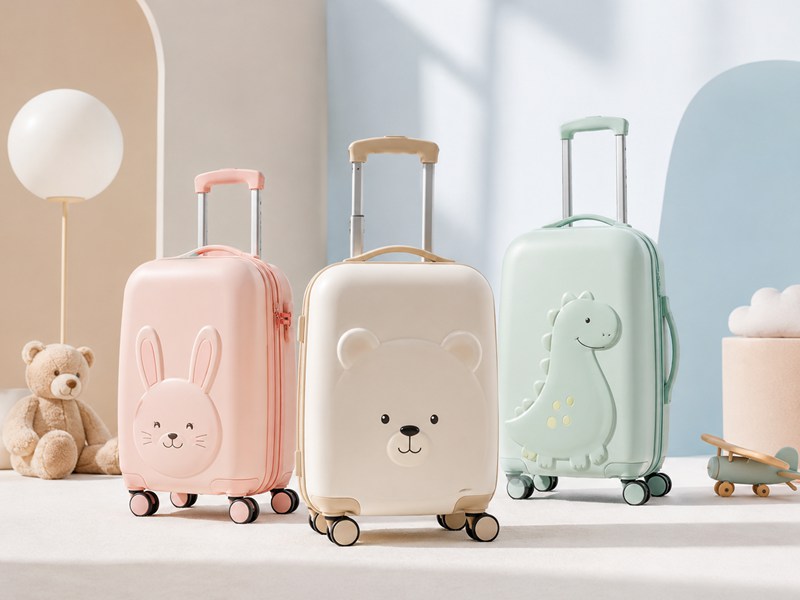
Children’s luggage has to pass two tests long before it reaches a laboratory. First, a child must want to use it. Then an adult must believe it is safe, light, durable and worth carrying through an airport. A bright animal face may create the first reaction, but repeat sales depend on what sits behind that face: a stable wheelbase, secure components, controlled materials and a structure that still works after the case is packed.
Well-designed kids’ luggage begins with the child’s age, strength, coordination and intended use. The strongest products combine verified materials, rounded components, manageable empty weight, stable wheels, suitable handle heights and clearly tested load limits. Colors, characters and molded shapes are then developed around that structure. This keeps visual appeal from introducing unnecessary weight, loose decorations, unstable balance or unverified safety claims.
The failures that cause complaints are rarely visible in a rendering. They appear when a wheel loosens on a terminal floor, a short child cannot control a tall handle, a ride-on case tips during a turn, or a beautiful coating does not match the material listed in the test report. Those risks can be reduced before the first production order—but only when safety and usability lead the design.
What Makes Kids’ Luggage Safe?

Safe kids’ luggage combines correct product classification, destination-specific rules, age-appropriate geometry, stable construction, durable moving parts, controlled materials, traceable production, and clear instructions. ASTM F963 does not automatically apply to every children’s suitcase. Testing must reflect the finished item—including its colors, coatings, wheels, zipper pulls, straps, decorations, packaging, and any ride-on function—not merely an early display sample.
Which Safety Rules Apply?
The correct safety route depends on five facts that should be settled before artwork or tooling is approved:
- Where will the luggage be sold?
- What age group is it intended for?
- Is it only used to store and transport belongings?
- Can a child sit, ride, scoot, pull, or play on it?
- Does it include lights, sounds, magnets, batteries, cords, detachable figures, or other play features?
A suitcase designed primarily for children may be legally treated as a children’s product even when it is not a toy. Once a ride-on seat, play function, sound module, detachable character, or similar feature is added, toy rules may also apply.
| Destination and use | Likely safety route | Main records to prepare |
|---|---|---|
| US children’s suitcase without play use | CPSIA and applicable CPSC rules | Age assessment, component records, laboratory reports, CPC, tracking label |
| US ride-on or play-focused luggage | CPSIA, applicable CPSC rules, ASTM F963-23 | Toy classification, applicable ASTM sections, laboratory reports, CPC, warnings |
| EU children’s suitcase without play use | GPSR, REACH, applicable national rules | Risk assessment, technical records, traceability, instructions, chemical evidence |
| EU ride-on or play-focused luggage | Current toy rules during the transition, followed by Regulation (EU) 2025/2509 | Toy safety assessment, relevant EN tests, declaration, CE marking, technical file |
| Other destinations | Local product, chemical, labeling, and testing rules | Destination-specific test plan and supporting records |
In the United States, a product designed or intended primarily for children aged 12 or younger is classified as a children’s product. Applicable safety rules generally require third-party testing through a CPSC-accepted laboratory and a Children’s Product Certificate.
For the European Union, Regulation (EU) 2023/988 on general product safety has applied since December 13, 2024. It covers design, composition, packaging, instructions, foreseeable use, traceability, and risks to vulnerable users, including children.
The EU Toy Safety Regulation entered into force on January 1, 2026, but becomes fully applicable on August 1, 2030, after a 54-month transition. Children’s brands developing long-life programs should consider the future chemical and digital traceability requirements now, especially if the same design will remain in circulation for several seasons.
A report prepared for one destination should not be presented as universal approval. The US, EU, UK, Canada, Australia, and other regions define children’s products, toys, chemical restrictions, certificates, and label responsibilities differently.
Is It a Children’s Product?
Classification is based on the product’s real identity, not simply the wording printed on a label.
For the US, the CPSC considers four major factors:
- The stated intended use, including the age shown on the product
- How the item is presented through packaging, displays, images, and promotional language
- Whether the public commonly recognizes it as intended primarily for children aged 12 or younger
- The product characteristics, skills, interests, and play behavior associated with the intended age
A small suitcase with preschool graphics, a child-height trolley, an age recommendation of “3+,” and packaging showing a young child pulling it will probably be treated as a children’s product. Printing “family luggage” on the carton is unlikely to override those characteristics.
Toy classification requires an additional decision: is the product intended for play?
A conventional wheeled case used only to hold clothing may be a children’s product without being a toy. A case promoted for sitting, riding, scooting, racing, or imaginative play has a much stronger toy identity. The following features deserve special review:
- A shaped riding seat
- Footrests or riding grooves
- Steering handles or horns
- A tow strap intended to pull a seated child
- Wheels arranged for recreational movement
- Sound, light, or electronic play functions
- Removable dolls, figures, or toy accessories
- Packaging showing riding or play as a primary activity
One model can also contain more than one regulated component. For example, the suitcase body may function as luggage while a removable character-shaped accessory functions as a toy. The age grade, warnings, tests, and technical records should account for the complete set.
A written classification record should include product drawings, intended age, packaging images, proposed claims, use scenarios, foreseeable misuse, and the reason for the chosen category. This prevents a late change in artwork or advertising from creating a different legal obligation after production has started.
Do Kids’ Suitcases Need ASTM Testing?
Not every children’s suitcase needs ASTM F963 testing. ASTM F963-23 is mandatory in the United States for products that meet the definition of a children’s toy. A standard children’s suitcase without a play function may still be subject to CPSIA requirements, but it does not become a toy merely because it is colorful or child-sized.
ASTM F963-23 became the mandatory US toy safety specification on April 20, 2024. For toys intended primarily for children aged 12 or younger, applicable sections must be tested by a CPSC-accepted third-party laboratory and cited in the CPC. The standard itself covers toys intended for children under 14, although US third-party testing and CPC duties are tied to products primarily intended for ages 12 and under.
For ride-on luggage, the review can include:
- Material quality and cleanliness
- Lead and relevant soluble elements
- Applicable phthalate restrictions
- Small parts
- Sharp edges and sharp tips
- Projections and exposed fasteners
- Folding and hinge hazards
- Cords, straps, and elastics
- Stability and overload performance
- Wheel, tire, and axle safety
- Holes, clearances, and moving mechanisms
- Packaging film
- Age grading and warnings
ASTM F963 specifically addresses stability and overload for ride-on toys. It also requires wheels, tires, and axles to remain free from laceration, puncture, and ingestion hazards before and after applicable use-and-abuse procedures. A ride-on suitcase should therefore be assessed as a load-bearing structure, not as ordinary luggage with a child sitting on top.
The phrase “ASTM certified” is too vague for a technical review. A useful test record should identify:
- Exact model and colorway
- Intended age
- ASTM revision
- Sections assessed
- Sections considered inapplicable and why
- Sample photographs
- Component and material identification
- Test dates and results
- Laboratory name and CPSC acceptance details
- Any deviations, failures, or corrective work
US chemical limits also depend on classification and component accessibility:
| Requirement | Limit | Scope |
|---|---|---|
| Total lead in accessible substrates | Maximum 100 ppm | Children’s products |
| Lead in paint or similar coatings | Maximum 90 ppm | Children’s products and certain other covered items |
| Eight regulated phthalates | Maximum 0.1% each, equal to 1,000 ppm | Accessible parts of children’s toys and child-care articles |
| Small-part restriction | Tested with the specified small-parts cylinder | Certain products intended for children under 3 |
| Tracking information | Permanent and legible where practicable | Children’s products and packaging |
Testing should be based on production-equivalent samples. Changing pink ink to metallic gold, replacing a PVC wheel cover, adding a rubber zipper pull, switching adhesive, or using a new shell resin can alter the chemical evidence. A passed blue sample does not automatically cover every other color and decoration.
What Do Eco-Friendly and Chemical-Free Claims Mean?
“Chemical-free” is not a suitable description for children’s luggage. Every textile, polymer, coating, ink, adhesive, and metal consists of chemicals. A reliable claim identifies the material, substance, test scope, percentage, or production method being discussed.
Better wording may include:
- Shell fabric contains 30% recycled polyester by product weight
- Main textile is made from certified recycled polyester
- No PVC is specified in the bill of materials
- Accessible plasticized components were tested for regulated phthalates
- Paint and coatings comply with the applicable lead limit
- No intentionally added PFAS is specified for designated textile treatments
- Packaging is made with a stated percentage of recycled paper
Each statement needs its own evidence.
| Claim | Useful supporting evidence | Common weakness |
|---|---|---|
| Recycled polyester | Fiber certificate, transaction record, composition test, weight calculation | Calling the entire suitcase recycled when only the outer textile is recycled |
| PVC-free | Approved material list, written specification, component review, risk-based testing | Ignoring zipper coatings, labels, trims, prints, and wheel parts |
| Phthalate compliant | Report identifying tested components and regulated substances | Testing one fabric while leaving soft plastic details unexamined |
| No intentionally added PFAS | Material specification, treatment disclosure, written declarations, suitable screening | Presenting a screening result as proof of absolute absence |
| Non-toxic | Competent evidence covering the stated human and environmental scope | Using the term without defining exposure, substances, or test method |
| Recyclable | Evidence that the assembled product can enter an established collection and recovery system | Confusing recycled content with end-of-life recyclability |
A recycled shell fabric does not make a complete suitcase recyclable. Luggage often combines polyester, foam, lining, thread, zipper tape, metal sliders, adhesives, wheels, axles, handles, coatings, labels, and reinforcement boards. These materials can be difficult to separate.
Chemical control should therefore follow the component list rather than the finished appearance. Higher-risk areas often include:
- Soft PVC decorations
- Rubber-like zipper pulls
- Printed character coatings
- Metallic inks and glitter
- Artificial leather trims
- Adhesives
- Wheel compounds
- Plated metal parts
- Water-, stain-, or oil-resistant textile treatments
- Foam and molded handle grips
The US Federal Trade Commission states that a non-toxic claim needs reliable evidence supporting safety for both people and the environment unless the wording clearly limits the claim. It also warns that “free-of” statements can mislead when the named substance was never associated with the product or when a substitute creates a similar risk.
For EU toy programs intended to continue beyond 2030, material planning should also consider Regulation (EU) 2025/2509. The new rules expand controls for harmful substances and introduce a digital product passport. Early material mapping will reduce the need to rebuild documentation close to the application date.
What Hazards Should Design Prevent?
A safe suitcase must remain safe during foreseeable rough treatment. Children pull cases sideways, sit on products not promoted as seats, lift them by extended trolley handles, drag them over curbs, wrap straps around objects, and continue using damaged wheels. Safety work must account for these behaviors.
| Hazard | Where it often begins | Design control | Verification |
|---|---|---|---|
| Tip-over | High seat, narrow wheel track, raised center of gravity | Low seating surface, stable wheel spacing, controlled steering geometry | Stability tests in loaded and ride-on conditions |
| Structural collapse | Thin shell, weak internal bridge, poorly supported seat | Reinforced load path from seat to base and wheel structure | Overload and repeated-use procedures |
| Wheel detachment | Weak axle retention, brittle hub, loose fastener | Secure axle system, protected fastener, suitable wheel compound | Running test followed by pull and visual checks |
| Handle collapse | Weak locking pins, thin tubes, poor button engagement | Positive locking, protected release, adequate tube overlap | Extension cycles and loaded pulling |
| Pinched fingers | Trolley gaps, folding parts, shell hinges | Shielded clearances, controlled movement, protected joints | Accessibility and pinch-area review |
| Sharp edges | Broken shell, exposed axle, metal burrs | Rounded geometry, deburring, covered hardware | Inspection before and after drop or abuse procedures |
| Small detached parts | Decorative eyes, hubcaps, zipper caps, badges | Integral shapes, secure attachment, larger components | Torque, tension, impact, and small-parts checks |
| Strap entanglement | Long tow strap or shoulder strap | Removable or stowable strap, controlled length, clear instructions | Length measurement and attachment testing |
| Entrapment | Locking lid or space large enough to enclose the head | Non-locking closure and suitable ventilation where relevant | Confined-space assessment |
| Chemical exposure | Coatings, soft plastics, ink, glue, plated hardware | Controlled material list and component traceability | Risk-based laboratory testing |
| Packaging suffocation | Large thin plastic bag or film | Suitable thickness, perforation, warning, or alternative packing | Film measurement and packaging review |
For ASTM-covered toys, certain plastic film must have an average thickness above 0.03175 mm or meet the required perforation condition. Small parts are assessed with a specified cylinder representing the expanded throat of a child under three; an item that fits completely inside can present a choking risk.
A ride-on load claim must be supported by more than a single static test on one new sample. The test plan should record:
| Test data | What should be stated |
|---|---|
| Claimed rider mass | Maximum kilograms and pounds |
| Test load | Applied mass and its relationship to the claimed limit |
| Sample count | Number of units tested |
| Load location | Exact position on the seat or shell |
| Stability setup | Wheel direction, surface, slope, and luggage fill |
| Wheel endurance | Load, distance or cycles, speed, surface, and turning pattern |
| Handle endurance | Pulling load, extension position, angle, and cycles |
| Drop work | Height, orientation, load, number of drops, and floor type |
| Acceptance criteria | No collapse, release, hazardous edge, detached small part, or loss of required function |
There is no single universal ride-on capacity for all children’s luggage. The allowable load depends on shell geometry, material, internal reinforcement, wheelbase, axle construction, seat area, and the tested age group. Copying a 35 kg or 50 kg claim from another design is unsafe because two similar-looking cases may transfer loads through completely different structures.
How Are Labels and Warnings Decided?
Warnings should describe residual risks that remain after practical design controls have been completed. They should never be used to justify an unstable seat, detachable wheel, exposed sharp edge, or weak handle.
A ride-on model may need information covering:
- Intended age
- Maximum rider weight
- One child at a time
- Correct sitting direction
- Adult supervision
- Use on level ground
- Keep away from stairs, escalators, traffic, slopes, and water
- Do not lift or pull the case by the trolley handle while a child is seated
- Stow or control the tow strap when it is not in use
- Stop using the product if the shell, wheels, axles, handle, or strap is damaged
The exact wording, language, location, and symbol size should come from the applicable rule and the product’s own risk assessment. A generic warning copied from another suitcase may omit a hazard created by a different wheel layout, closure, or riding position.
Safety information should be coordinated across all touchpoints:
| Location | Suitable information |
|---|---|
| Permanent product label | Model, batch code, production date or code, responsible company, weight limit where needed |
| Exterior hangtag | Age, main warning, maximum rider mass, intended use |
| Packaging | Product identity, age grade, warnings, contact details, traceability |
| Instructions | Safe use, prohibited use, inspection, cleaning, maintenance, storage |
| Online listing | Product identifier, responsible contact, required warnings, accurate use images |
| Shipping carton | Style, color, quantity, batch, destination label, handling information |
For US children’s products, tracking information must be visible, legible, and permanently attached to the product and packaging where practicable. It should allow the responsible parties to identify the company, production location and date, batch or run, and source.
The CPC is separate from the sewn label or printed warning. It should identify the product, applicable safety rules, responsible certifying entity, production location and date, testing location and date, and the CPSC-accepted laboratory used. A laboratory report supports the certificate but does not replace it.
For EU distance sales, the GPSR requires the offer to display product identification, contact information for the responsible parties, an EU-based responsible person when required, and relevant warnings in a language understood in the destination country. Safety details should therefore be prepared alongside packaging and product photography, not added after stock is ready.
Finally, every approved label should carry a controlled version number. Artwork, test reports, instructions, technical records, and the physical product must describe the same age, load, materials, accessories, and intended use. That consistency is what turns a passed sample into a traceable, defensible children’s luggage program.
How Light Should Kids’ Luggage Be?
Kids’ luggage should be light enough to remain controllable after packing while retaining sufficient strength around the wheels, handle and shell. There is no single legal empty-weight limit. The appropriate figure depends on the child’s age, case size, wheel system, materials, capacity and whether the product is intended for pulling, pushing, carrying or riding.
Empty weight is only one part of the experience. A suitcase weighing 1.8 kg may appear ideal until 5 kg of toys, shoes and books are added. The loaded case can then become difficult to start, stop, turn or lift. Larger interiors often encourage heavier packing, so volume and weight must be planned together.
The complete assembly should be weighed, including:
- Shell or textile body.
- Trolley tubes and internal frame.
- Wheel blocks and axles.
- Carry handles.
- Zippers and hardware.
- Lining and dividers.
- Reinforcement boards.
- Decorative components.
- Labels and included accessories.
Removing structural material solely to reach a lighter number can create cracks, trolley movement or unstable rolling. Weight reduction should come from efficient construction, not from weakening the areas that receive the greatest stress.
The following figures can be used as initial design benchmarks. They are not legal limits and should be adjusted after physical testing.
| Intended Age | Common Format | Initial Empty-Weight Benchmark | Main Concern |
|---|---|---|---|
| 3–5 years | 14–16 inch or compact ride-on | 1.5–2.2 kg | Stability and adult carrying |
| 5–8 years | 16–18 inch rolling case | 1.8–2.8 kg | Handle reach and turning control |
| 8–12 years | 18–20 inch compact case | 2.2–3.2 kg | Overpacking and lifting |
| Multiple ages | Coordinated size collection | Set by each size | Clear size and age distinction |
A ride-on case with a structural seat cannot be judged against the same benchmark as a soft rolling bag. The stronger design is the one that meets its intended use with the least unnecessary mass—not simply the lowest number on a scale.
Which Size Fits Each Age Group?
Age is a useful starting factor, but body height, arm reach, coordination and packing needs provide a better fit. A short child may struggle with a suitcase that forces the pulling arm too high or too far behind the body. A case that looks proportionate in a studio can feel oversized once it is packed.
Useful starting directions include:
- Ages 3–5: Compact 14–16 inch cases or ride-on structures with low seats and wide wheel spacing.
- Ages 5–8: Approximately 16–18 inches with reachable trolley settings and controlled turning.
- Ages 8–12: Approximately 18–20 inches, provided the loaded weight remains manageable.
Dimensions should include wheels, carry handles and molded decorations. Animal ears, horns and exposed wheel blocks can add several centimeters without increasing usable capacity.
A full-size cardboard mock-up helps verify proportions before tooling. It can reveal whether the handle is reachable, whether the case clears the child’s heel and whether the body appears too deep when viewed from the side.
What Is a Practical Empty Weight?
For many compact children’s cases, an empty weight of approximately 1.5–3 kg is a useful starting benchmark. The correct figure depends on size, wheel count, trolley construction and material. Ride-on products may need additional structure, while simple soft-sided cases may remain lighter.
Weight should be reviewed at three stages:
- Early estimate: Calculate the expected mass of the shell, trolley, wheels, lining and hardware.
- Complete sample: Weigh the fully assembled case with every decorative and packaging component included.
- Packed test: Add a realistic travel load and evaluate pulling, turning, stopping and short lifts.
A 150-gram saving is not valuable if it causes wheel-housing cracks or handle movement. Conversely, heavy metal badges, oversized zipper pulls and unnecessary internal boards can add mass without improving performance. Weight control works best when every component earns its place.
What Is the Weight Capacity of Ride-On Luggage?
Ride-on luggage has no universal maximum rider weight. The published limit must come from the specific shell, seat, wheelbase, axles and attachment system. It should be supported by static loading, repeated stress and movement tests.
Existing products illustrate the difference between designs:
| Product Example | Published Rider Limit | Published Age Information |
|---|---|---|
| Stokke JetKids BedBox | 35 kg / 77 lb | Intended for young children |
| Trunki Ride-On Suitcase | 50 kg / 110 lb | Commonly presented for ages 3–6 |
These values belong only to those products. They should not be copied onto a new case without evidence.
Three loads should be recorded separately:
- Maximum rider weight.
- Maximum luggage contents.
- Structural test load.
The structural test load is normally higher than the published limit. Stability during turns, axle fatigue and shell deformation remain important even when the case survives a static load.
Which Materials Keep Luggage Lightweight?
Material density matters, but thickness and structure often matter more. A low-density resin may need thicker walls, while a stronger resin can sometimes achieve the required performance with less material.
| Material | Approximate Density | Main Strength | Main Consideration |
|---|---|---|---|
| Polypropylene | 0.90–0.91 g/cm³ | Low density and flexibility | Needs controlled rib and wall design |
| ABS | 1.04–1.08 g/cm³ | Crisp molding and practical cost | Grade and low-temperature impact matter |
| Polycarbonate | 1.20–1.22 g/cm³ | Strong impact performance | Higher material cost and scratch control |
| Molded EVA | Varies by foam structure | Light, shaped and protective | Tooling and surface finish |
| Polyester/Oxford | Specified by fabric weight | Flexible and suitable for pockets | Requires frame and seam reinforcement |
| Nylon | Specified by fabric weight | Light feel and abrasion resistance | Cost, coating and color consistency |
A heavier resin does not automatically create a heavier case. Shell thickness, ribs, trolley placement and wheel-block geometry determine the final result.
For soft luggage, fabric weight should be considered together with coating, lining, reinforcement and frame weight. A light outer fabric attached to a heavy internal board does not create a truly light suitcase.
Hard Shell vs Soft Luggage
Hard-shell luggage offers a clean graphic surface, wipeable exterior and better protection against crushing. Molded shapes can support animals, vehicles and character-based forms. The areas around wheel housings, carry handles and zipper curves need careful reinforcement because these zones receive repeated impact and pulling stress.
Soft luggage can offer lower mass, flexible packing and easy-access pockets. It also works well for coordinated collections that include backpacks, duffels and lunch bags. Its main risks are seam stress, fabric abrasion, frame movement and deformation when overfilled.
The choice should follow the intended experience:
| Priority | Better Starting Direction |
|---|---|
| Sculpted animal shape | Molded hard shell or EVA |
| Large printed character artwork | Hard shell or printable textile |
| Exterior pockets | Soft construction |
| Flexible storage | Soft construction |
| Wipe-clean surface | Hard shell |
| Lower tooling commitment | Soft construction |
| Ride-on use | Purpose-built structural shell |
| Matching travel collection | Either, depending on the wider line |
Neither structure is automatically superior. The better option is the one that supports the desired appearance, weight, durability, packing method and price position without forcing unnecessary compromises elsewhere.
How Do Capacity and Weight Balance?
A larger interior can make a suitcase look more valuable, but it can also reduce child control. More capacity encourages heavier packing and may require a deeper shell, longer zippers, larger lining panels and stronger support. The result can be harder to turn and more likely to tip.
Capacity should begin with a packing test rather than a liter target. Prepare a realistic list for the intended trip:
- Two or three clothing changes.
- Sleepwear.
- One pair of shoes.
- Toiletries.
- A book or tablet.
- A small toy.
- Travel snacks where appropriate.
Pack the sample, close it without excessive zipper tension and record the total weight. Then test pulling, four-wheel pushing, turning, stopping and lifting.
Interior compression straps and divided compartments can improve usable space without increasing external depth. Heavy items should sit low and close to the wheels. When organization reduces movement inside the case, rolling stability can improve even though the measured capacity remains unchanged.
Which Wheels and Handles Work Best?

The best system matches the child’s height, luggage size, packed weight, and travel surface. Two recessed wheels suit pulling and rougher floors; four spinners suit upright movement through airports and hotels. Ride-on cases need a wider, highly stable wheel layout. Handles should lock securely, fit smaller hands, avoid pinch gaps, and offer at least two practical grip heights.
What Type of Wheels Works Best?
No single wheel works equally well on polished airport floors, carpet, paving stones, curbs, and sloped walkways. Wheel selection should begin with the intended travel setting and the way the child will move the case.
For lightweight cabin luggage used mainly indoors, compact polyurethane spinner wheels can provide smooth movement and low noise. For cases expected to cross paving joints, uneven sidewalks, or school corridors, larger recessed wheels usually offer better obstacle clearance and impact protection.
Ride-on luggage has different needs. Its wheels carry both the luggage and the seated child, while also controlling side movement and tipping. A compact spinner copied from a standard suitcase may rotate too freely, allow unexpected sideways movement, or place excessive stress on an exposed caster housing.
| Wheel design | Best use | Main advantage | Main concern |
|---|---|---|---|
| Two recessed wheels | Pull-along cabin cases and rougher travel surfaces | Protected structure and good straight-line control | Case must be tilted while pulling |
| Four single spinners | Airports, hotels, and smooth indoor floors | Easy turning and upright movement | Exposed housings receive more impact |
| Four twin-wheel spinners | Larger cases requiring smoother load distribution | Better balance and rolling continuity | More parts, added weight, and more debris traps |
| Wide fixed ride-on wheels | Sit-on and tow-along cases | Predictable direction and improved stability | Larger wheel area can reduce internal space |
| Partly recessed ride-on wheels | Compact ride-on shells | Better impact protection | Wheel wells require careful internal reinforcement |
Wheel diameter strongly affects real use. A small wheel may look neat but can stop abruptly at a lift gap or paving joint. A larger wheel crosses obstacles more easily, although it takes up more space and adds weight.
The following dimensions are useful as early development references rather than universal requirements:
| Product format | Initial wheel diameter | Practical consideration |
|---|---|---|
| Small preschool pull case | 40–50 mm | Compact, but best for smooth floors |
| General children’s cabin case | 50–60 mm | Better balance between weight and obstacle clearance |
| Larger pull-along case | 60–75 mm | Improved movement over carpet and paving joints |
| Ride-on case | Determined by load, seat height, and wheel track | Stability matters more than visual compactness |
The wheel tread should provide enough grip without making the case difficult to pull. Hard plastic wheels are inexpensive and light, but they can be noisy and transmit vibration into the shell. Polyurethane or suitable TPE treads generally provide quieter movement and better shock absorption. The exact hardness should be selected after loaded rolling, temperature, abrasion, and floor-marking checks.
Two Wheels vs Four Wheels
Two-wheel cases remain a strong choice when low weight, straight tracking, and protection from impact are priorities. Their wheels are usually recessed into the lower corners, allowing the shell and wheel housing to share the load. This structure is less exposed when cartons are dropped, cases strike curbs, or luggage moves through sorting systems.
A child must tilt a two-wheel case before pulling it. That transfers part of the packed mass to the hand and arm. If the case is too deep, too heavily packed, or fitted with a handle that is too short, it may strike the child’s heel or twist behind the body.
Four-wheel spinners remain upright. The child can push the case beside the body, pull it diagonally, or turn it in a narrow space. This can reduce arm strain on smooth floors, particularly when the packed case is difficult to tilt.
The weakness is exposure. Spinner casters extend below and beyond the shell corners, placing the fork, swivel stem, and mounting plate in direct contact with impacts. They may also change direction on slopes or rotate sideways when the case is pulled too quickly.
| Decision factor | Two wheels | Four spinners |
|---|---|---|
| Empty weight | Usually lower | Usually higher |
| Rough-floor movement | Better with larger recessed wheels | Depends heavily on diameter and caster quality |
| Upright movement | Limited | Excellent |
| Straight tracking | Strong | Can wander if swivel resistance is too low |
| Stability on a slope | More predictable when resting on feet | Can roll in several directions |
| Internal space | Wheel wells may reduce lower-corner space | External casters preserve more interior volume |
| Impact protection | Wheels are partly shielded | Casters are more exposed |
| Repair complexity | Fewer moving components | More wheel and swivel components |
A small case does not automatically need four wheels. When the packed weight is modest and travel includes sidewalks, station platforms, or older hotel carpets, two well-designed wheels can be easier for a child to control than four very small spinners.
Four-wheel systems work best when wheel alignment, swivel resistance, housing strength, and handle height are developed together. Adding spinners to a shell designed for recessed wheels can raise the case, alter its center of gravity, and weaken the lower corners.
Are Spinner Wheels Easy for Children?
Spinner wheels are easy for children on smooth, level floors when the case is light, the handle suits the child’s height, and each caster turns with similar resistance. They are less predictable on carpet, slopes, paving joints, and crowded walkways.
A spinner should rotate freely enough to align with the direction of movement, but not so freely that the case changes direction after a light touch. Uneven swivel resistance is especially noticeable on a small suitcase. If one caster is tighter than the others, the case may drift, shake, or require repeated correction.
Important details include:
- Consistent swivel force across all four casters
- Limited side-to-side wobble
- Adequate caster offset for self-alignment
- Wheel tread that grips without dragging
- Matching wheel height across all corners
- Secure mounting with no visible shell distortion
- Enough clearance to prevent the tread rubbing against the fork
- A wheel diameter suited to floor gaps and carpet depth
Twin-wheel spinners distribute the load across two narrower wheels at each corner. They can roll smoothly and remain more stable if one tread crosses a small joint. However, the gap between the wheels can trap hair, thread, grit, and carpet fibers. Eight treads also add parts, weight, and inspection work.
A useful child-handling trial should include more than walking in a straight line. Children should be observed while:
- Pushing the case beside the body
- Pulling it behind the body
- Turning through 90 and 180 degrees
- Moving from hard flooring onto carpet
- Crossing a lift gap or door threshold
- Stopping on a slight slope
- Changing hands
- Walking at slow and hurried speeds
The suitcase should not repeatedly hit the child’s ankles, rotate unexpectedly, or require excessive wrist force. If a spinner feels effortless when empty but unstable when packed, the wheel system has not been evaluated under the more important condition.
For ride-on luggage, unrestricted spinner movement needs particular caution. A seated child creates a higher and more mobile center of gravity. Sideways caster rotation can make direction changes abrupt. Fixed or directionally controlled wheels are often more suitable unless the complete ride-on structure has been verified for stability, steering behavior, overload, and foreseeable misuse.
Are Spinner Wheels Durable Enough for Wholesale Distribution?
Spinner wheels can withstand large-volume distribution when the caster housing, axle, tread, mounting plate, shell corner, and packing method are developed as one structure. A high-quality tread alone cannot compensate for a weak mounting area.
The most common failures are rarely caused by the visible wheel surface alone:
| Failure | Likely cause | Improvement |
|---|---|---|
| Wheel becomes noisy | Worn bushing, debris, rough axle surface, or tread damage | Better axle finish, controlled clearance, sealed structure where suitable |
| Caster wobbles | Excessive swivel clearance or loose stem | Tighter assembly control and secure retention |
| Wheel stops turning | Hair, thread, grit, or fork deformation | Better clearance, guarded hub, stronger fork |
| Tread develops a flat area | Poor compound recovery or prolonged concentrated load | Suitable tread material and packed-storage evaluation |
| Wheel detaches | Weak axle end, loose fastener, or brittle hub | Positive axle retention and post-running pull check |
| Housing separates | Thin shell corner or small mounting area | Larger load-spreading plate and local reinforcement |
| Shell cracks around caster | Impact load concentrated at screw positions | Rounded reinforcement and wider load transfer |
| One corner sits lower | Uneven caster height or housing deformation | Height control and loaded level inspection |
The mounting area deserves as much attention as the wheel. Spinner forces are transferred through a relatively small shell section. During a side drop, the impact does not travel vertically through the wheel; it bends the caster and pulls against the corner. A thin hard shell can crack around screw bosses even when the caster itself remains intact.
Soft luggage needs a firm internal baseboard or corner reinforcement to prevent the mounting plate from twisting the fabric. Hard luggage needs suitable wall thickness, rib placement, boss geometry, and fastener support. Sharp changes in shell thickness should be avoided because they can concentrate stress.
Distribution packaging also affects wheel life. A tightly packed carton can place continuous pressure on protruding spinners. If the carton has insufficient clearance, external compression may bend a caster before the case is opened. Protective wheel spacing, molded corner supports, or a carton designed around the finished wheel envelope can reduce this risk.
A useful wheel validation record should state measurable conditions:
| Test item | Details that should be recorded |
|---|---|
| Loaded running | Total load, distance or cycles, speed, floor surface, and turning pattern |
| Rough-surface travel | Obstacle height, spacing, speed, and load |
| Swivel endurance | Rotation cycles, vertical load, and permitted looseness |
| Wheel pull | Force direction, force level, duration, and result |
| Side impact | Impact location, energy or drop condition, and shell condition |
| Temperature exposure | Temperature, time, load, and tread recovery |
| Carton compression | Stack load, duration, carton condition, and caster clearance |
| Final inspection | Noise, wobble, height variation, cracks, loose fasteners, and rolling resistance |
There is no meaningful “passed wheel test” without the load, travel distance, surface, speed, sample count, and acceptance criteria. A wheel that survives smooth drum running may still fail at a doorway threshold or after a side drop.
For repeat programs, wheel assemblies should retain a clear component code. Quietly replacing a wheel compound, axle, bearing, or mounting plate can change noise, rolling resistance, strength, and chemical evidence even if the new part looks identical.
Why Does Kids’ Luggage Tip Over?
Children’s luggage tips when its center of gravity moves beyond the support area formed by the wheels and feet. A narrow wheel track, tall handle, deep front pocket, raised seat, uneven packing, or freely rotating casters can all reduce stability.
The basic relationship is simple: tipping becomes more likely when sideways pulling force multiplied by handle height exceeds the restoring effect created by total weight and half the wheel-track width. A taller handle improves posture, but it also creates more leverage on the case. Handle height and wheel spacing must therefore be considered together.
Frequent causes include:
- Heavy items packed near the top
- A deep front pocket loaded away from the wheel center
- A water bottle attached to one side
- A small backpack looped over the extended handle
- Decorative molded parts adding weight to the front
- Narrow casters positioned too close together
- A seat placed high above the axle line
- Unequal wheel height
- A loose trolley system that allows the case to twist
- Spinner wheels turning sideways on a slope
A four-wheel case should be checked with the casters facing forward, sideways, inward, and outward. Because spinner forks rotate, the effective footprint can change slightly with their direction. Stability should also be assessed with an empty case, evenly packed case, poorly distributed load, extended handle, retracted handle, open front pocket, and any approved accessory attached.
For a ride-on model, the seated child is not a fixed load. Children lean, turn, lift their feet, pull the strap, and shift weight while moving. A static upright load does not recreate these actions. The structure should be evaluated during mounting, sitting, leaning, towing, turning, stopping, and crossing small floor joints.
The following design choices usually improve stability:
- Wider left-to-right wheel spacing
- Longer front-to-back wheelbase
- Lower seat position
- Low placement of heavier reinforcement
- Shallow exterior pockets
- Controlled caster movement
- Balanced shell decoration
- Firm trolley mounting
- Clear restriction on attaching extra bags
- Wheel brakes where appropriate and practical
A wider base can increase the outer dimensions, while a lower seat may reduce interior capacity. These trade-offs should be settled during structural development rather than after the mold or shell pattern is approved.
How Long Should the Handle Be?
The correct measurement is the grip height from the floor when the handle is locked, not simply the length of the aluminum tubes. A suitable height lets the child pull the case with the shoulder relaxed, elbow slightly bent, wrist close to neutral, and case far enough behind to avoid heel contact.
The following figures can guide early prototypes, but physical fit trials remain essential because children of the same age can differ greatly in height and arm length:
| Intended age | Approximate child height | Useful extended grip height |
|---|---|---|
| 3–5 years | 95–115 cm | 55–70 cm from floor |
| 6–8 years | 115–135 cm | 65–80 cm from floor |
| 9–12 years | 135–155 cm | 75–90 cm from floor |
| Shared child-and-adult use | Mixed | Multi-stage handle with child and adult positions |
A handle that is too short makes the child lean sideways or pull the suitcase too close to the feet. A handle that is too long raises the pulling force, makes steering less precise, and increases leverage on the trolley mount.
Two or three locking heights are often more useful than one fully extended position. Each height should lock positively; a handle that can only be used fully extended does not serve shorter children well.
Grip dimensions also matter. As an early reference, a children’s grip may use approximately:
- 90–120 mm usable grip width
- 22–30 mm grip thickness or equivalent shaped profile
- Rounded edges
- A soft-touch area that does not become sticky
- A release button that cannot be pressed accidentally during normal pulling
A single-tube trolley saves weight and interior space, but it can twist more easily when the case turns. A double-tube system offers stronger rotational control and supports a wider grip, although it adds components and occupies more space inside the case.
Aluminum tubes are often selected for lower weight and corrosion resistance. Steel can provide greater stiffness at a smaller section but adds weight and requires suitable surface protection. Performance depends on wall thickness, tube overlap, locking-pin engagement, guide-bushing quality, and mounting—not material name alone.
The trolley handle should never be treated as a lifting bar for a seated child unless that use has been deliberately designed and verified. Ride-on instructions should clearly separate towing use from lifting use.
How Are Trolley Handles Tested?
A trolley handle should be checked for extension life, locking reliability, pulling strength, twisting, lifting, impact, rattle, corrosion, and safe collapse. Testing must use the final case structure because the tube assembly can survive while its mounting plate tears away from the shell.
Important checks include:
- Repeated extension and retraction at every locking height
- Lock-pin engagement on both sides
- Loaded pulling at realistic handle angles
- Side-to-side twisting
- Forward and backward bending
- Loaded case lifting where this use is permitted
- Button operation after dust and temperature exposure
- Drop and impact work with the handle retracted
- Misuse checks with the handle extended
- Inspection for sharp edges after damage
- Pinch-gap review during collapse
- Noise and looseness after endurance work
| Handle area | What to inspect |
|---|---|
| Grip | Cracks, sharp seams, rotation, button exposure, and comfort |
| Release button | Accidental operation, return force, sticking, and finger access |
| Locking pins | Full engagement, equal movement, wear, and deformation |
| Inner and outer tubes | Bending, scratching, excessive looseness, and edge quality |
| Guide bushings | Wear, noise, jamming, and uneven movement |
| Lower mounting | Cracks, loose fasteners, pulled fabric, or distorted shell |
| Handle opening | Finger clearance, trim security, and water or debris entry |
| Retracted position | Complete seating and protection from impact |
Testing records should state the packed load, handle height, pull angle, cycle count, applied force, test speed, sample quantity, and permitted movement after completion. “No breakage” is not enough if the handle becomes difficult to extend, develops excessive wobble, or fails to lock consistently.
The trolley should also be inspected during production. Tube scratches, burrs, weak rivets, misaligned lock holes, poorly seated bushings, and uneven left-right engagement can appear during assembly even when the approved sample performed well.
For large repeat orders, useful inspections include:
- Confirming the handle component code
- Measuring extended and retracted height
- Checking every locking position
- Pulling the grip to confirm engagement
- Comparing side movement with the approved sample
- Verifying mounting fasteners
- Extending and retracting selected units repeatedly
- Recording defects by production batch
The strongest wheel-and-handle system is not necessarily the heaviest. Good performance comes from correct geometry, controlled materials, secure load transfer, suitable testing, and consistent assembly. When these elements are developed together, children can move the case comfortably while the luggage remains stable, quiet, and dependable throughout repeated travel.
How Can Cute Design Stay Practical?

Cute kids’ luggage stays practical when the character, colors, and decorative details are built around safe structure, low weight, easy cleaning, stable wheels, comfortable handles, and efficient packing. The strongest designs create recognition through silhouette, graphics, and a few controlled details. They do not rely on fragile protrusions, heavy accessories, or decorations that interfere with opening, riding, pulling, or storage.
What Is the History of Kids’ Luggage Design?
Early children’s suitcases were largely smaller versions of adult cases. The proportions changed, but the product still looked formal: rectangular bodies, simple handles, metal closures, and limited interior organization.
Printed graphics later became the main way to make luggage more appealing to children. Characters, animals, vehicles, and bright color combinations could be added without changing the basic structure. This kept development relatively simple while helping the suitcase feel more personal.
Molded shells introduced stronger visual identities. A shell could become an animal face, vehicle front, spaceship, or fantasy character. Ride-on luggage then moved the category beyond storage by turning the suitcase into part of the travel experience.
Current designs often combine several ideas:
| Design stage | Main feature | Practical strength | Common weakness |
|---|---|---|---|
| Scaled-down adult case | Smaller size and simple colors | Familiar structure and efficient packing | Limited emotional appeal |
| Printed character case | Surface artwork on a standard body | Strong visual identity without major structural changes | Print wear or artwork misalignment |
| Molded character shell | Raised eyes, ears, faces, or vehicle forms | Highly recognizable from a distance | Added tooling, weight, and protrusions |
| Ride-on case | Seat and tow function | Keeps younger children engaged during travel | Higher structural and safety demands |
| Modern collection | Coordinated sizes, colors, prints, and accessories | Easier line expansion and visual consistency | Too many details can increase complexity |
The important development is not that children’s luggage has become cuter. It is that appearance now has to work across travel, storage, cleaning, photography, packaging, and repeated use.
A character face that looks charming in a drawing may become distorted when wrapped around a curved shell. Ears that look small on a screen may add 40 mm to carton width. A decorative horn may block stacking. A large rubber badge may shift the case’s balance. These effects should be studied before the visual direction is approved.
Which Themes Appeal to Children?
Themes work when children can recognize them quickly and imagine a story around them. Animals, transport, space, fantasy, nature, sports, food, and simple character faces remain flexible because they can be interpreted across several ages and styles.
The visual treatment should change with the intended age. A preschool child may respond to a large friendly face and bold color blocks. An older child may prefer a cleaner graphic, smaller character placement, personalization, or a more mature color combination.
| Intended age | Visual direction | Useful details | Details to use carefully |
|---|---|---|---|
| 3–5 years | Large face, simple shapes, strong contrast | Friendly eyes, rounded forms, easy character recognition | Small removable decorations and complex patterns |
| 6–8 years | Adventure, animals, vehicles, fantasy, space | Story scenes, badges, name areas, coordinated lining | Designs that feel too young after one season |
| 9–12 years | Cleaner graphics and personal expression | Initials, patches, subtle icons, darker accent colors | Oversized cartoon faces and toy-like proportions |
| Shared sibling line | Common theme with age-adjusted styling | Same character in simple and mature versions | Identical styling across every age |
Themes should not depend entirely on short-lived visual trends. A luggage program can take months to develop, approve, produce, ship, and distribute. If the concept relies on a very narrow trend, its appeal may weaken before repeat stock is needed.
A stronger collection usually has three visual levels:
- A recognizable main shape or color
- A theme-specific graphic or character
- Small details that reward closer inspection
For example, a dinosaur case does not need large plastic spikes on every edge. A green shell, illustrated face, scale pattern, and softly molded ridge may communicate the idea with less weight and fewer snag risks.
Color also affects how long the design remains attractive. Very pale colors can show conveyor marks, wheel dust, and handprints quickly. Large white areas may require more frequent cleaning. Deep colors can hide dirt but may show scratches if the shell surface is glossy.
Artwork trials should be reviewed under indoor light, daylight, and retail lighting. Curved shells should be viewed from the front, sides, and three-quarter angles because the eyes or mouth may look correctly aligned from one direction but distorted from another.
How Do Brands Win Parent Approval?
Children may react first to the character, but parents usually notice weight, control, durability, cleaning, storage, and whether the child can actually manage the case. The exterior creates interest; daily usability determines whether the product is recommended, returned, or used again.
Practical approval often depends on the following details:
- The empty case is light enough for the intended child
- Wheels move smoothly without drifting
- The trolley handle has a suitable child-height position
- The case does not strike the child’s heels
- Zippers can be reached and operated by smaller hands
- The opening stays controlled while packing
- The lining can be wiped clean
- The exterior does not collect dirt easily
- The case fits the stated travel use
- The name label is useful but does not expose personal details unnecessarily
- The child can identify the case without oversized fragile decoration
- Replacement wheels or handles can be considered for long-life programs
A useful design review should compare child appeal with adult concerns:
| Child notices | Parent checks | Design response |
|---|---|---|
| Character face | Will it crack or peel? | Protect graphics and avoid fragile projections |
| Bright color | Will it show dirt? | Select cleanable surfaces and balanced color placement |
| Ride-on function | Is it stable and controlled? | Use verified wheel spacing, load structure, and warnings |
| Decorative zipper pull | Can it detach? | Use secure, suitably sized components |
| Light or sound | Can the battery be reached? | Use protected compartments and applicable safety controls |
| Plush detail | Can it be cleaned? | Keep fabric panels removable or limited to protected areas |
| Personalization | Is private information visible? | Use an inside name label or covered identification window |
The child trial should use a realistically packed case. An empty sample can make weak wheels, poor balance, and short handle geometry difficult to notice.
Useful trial activities include:
- Packing clothing and a favorite toy
- Opening and closing the case without adult help
- Pulling the case for several minutes
- Moving from tile to carpet
- Crossing a doorway threshold
- Turning in a narrow aisle
- Lifting the case over a small step
- Storing it under a seat or in a luggage area
- Wiping away common dirt
- Checking whether decorations catch on clothing or furniture
Cute design becomes more convincing when parents do not have to choose between appearance and sensible use.
Can Hardshells Use Custom Designs?
Hardshell luggage can carry custom colors, all-over graphics, printed films, direct printing, molded textures, raised forms, badges, and custom tooling. The right process depends on shell material, artwork complexity, order size, expected wear, surface texture, and the desired visual depth.
| Decoration method | Suitable for | Visual effect | Main control |
|---|---|---|---|
| Screen printing | Logos and simple graphics | Clean, solid color areas | Ink adhesion and registration |
| UV digital printing | Detailed multicolor artwork | High detail and flexible artwork placement | Scratch resistance and adhesion |
| Heat-transfer decoration | Repeating patterns and character graphics | Smooth, integrated appearance | Temperature control and curved-surface distortion |
| Printed film under a clear layer | Premium all-over graphics | Artwork receives added surface protection | Film alignment and forming consistency |
| Molded texture | Scales, fur patterns, waves, or geometric themes | Durable visual depth without separate parts | Tooling accuracy and clean release |
| Raised molded character form | Faces, ears, vehicle shapes, themed shells | Strong three-dimensional identity | Weight, nesting, balance, and impact resistance |
| Sewn or attached badge | Logo, name, or small character detail | Tactile and easy to recognize | Attachment strength and edge design |
Surface graphics are often more practical than added components. A printed ear cannot snag. A molded line can suggest a mouth without adding a separate plastic piece. Texture can create depth without adhesives or detachable details.
The shell artwork should be mapped onto the final three-dimensional form. A flat drawing does not show how vacuum forming, shell curvature, zipper depth, corner radii, and trolley openings will affect the image.
Important artwork controls include:
- Eye spacing and facial symmetry
- Graphic position relative to shell ribs
- Distance from zipper tape and edge binding
- Logo clearance around handles and locks
- Color consistency between front and back shells
- Pattern alignment across curved surfaces
- Print adhesion after flexing and temperature exposure
- Scratch visibility on dark and glossy colors
- Artwork position after trimming
- Correct direction when the case is standing and lying open
Material selection also matters. ABS, PC, ABS/PC combinations, EVA, and fabric-covered structures respond differently to printing, forming, impact, heat, and surface treatment. Artwork should not be finalized until the shell structure and decoration process are confirmed.
A physical decorated sample remains essential. A digital image can show color placement but cannot reveal surface feel, gloss difference, edge lifting, distortion, or how quickly the design marks during handling.
Which Cute Details Add Risk or Weight?
Decorative details become problematic when they change the outer dimensions, raise the center of gravity, create a detachable part, interfere with movement, or make cleaning difficult.
| Decorative detail | Added concern | More practical treatment |
|---|---|---|
| Large ears or horns | Snagging, carton space, breakage | Lower-profile molded forms or printed shapes |
| Plastic eyes or noses | Detachment and impact damage | Printed, embroidered, or integral molded features |
| Long tails | Entanglement and dirt collection | Short padded tail or graphic tail |
| Metal charms | Noise, scratches, small-part risk | Printed emblem or secured larger zipper pull |
| Glitter | Surface shedding and difficult cleaning | Glitter-effect print beneath a protective layer |
| Sequins | Detachment and abrasion | Printed reflective pattern |
| Plush exterior panels | Dirt, moisture, and drying time | Small removable accent or protected fabric area |
| Rubber badges | Added mass and possible separation | Thin bonded badge with verified attachment |
| Lights and sounds | Battery access, added weight, added records | Use only when the play value justifies the complexity |
| Oversized zipper pulls | Swinging impact and snagging | Rounded pull sized for a child’s hand |
| Detachable character | Lost parts and possible toy obligations | Integrated character or separately assessed accessory |
| Top-mounted decoration | Higher center of gravity | Place decorative mass closer to the shell center |
A decoration mass limit can prevent artwork from quietly making the case too heavy. If the target empty weight is 1.8 kg and decoration is limited to 5%, the decorative allowance is 90 g. That allowance must cover badges, molded additions, special pulls, plush panels, lights, and related attachment parts.
Outer dimensions need the same discipline. If a 300 mm-wide case receives a 20 mm ear on each side, the packed width can increase from 300 mm to 340 mm. That is a 13.3% increase before protective packing is added. Across several hundred units, a small decorative decision can noticeably increase carton volume and freight use.
Cute details should therefore pass four checks:
- Does the detail change the empty weight?
- Does it increase packed dimensions?
- Can it detach, crack, snag, or expose an edge?
- Does it make cleaning, stacking, or opening more difficult?
If the feature does not improve recognition or play value enough to justify those effects, graphics or molded texture may communicate the same idea more efficiently.
Are Ride-On Designs Right for Every Age?
Ride-on luggage is most relevant to younger children who enjoy play during waiting and walking periods. It is not automatically suitable for every age, body size, travel setting, or suitcase shape.
Age alone is not enough. The design should also consider child height, rider mass, balance, leg position, ability to follow instructions, seat dimensions, wheelbase, steering behavior, and the strength of the complete load path.
| Age group | Likely use preference | Design focus |
|---|---|---|
| 3–5 years | Riding, towing, and strong character play | Low seat, stable wheel spacing, simple instructions, adult control |
| 6–8 years | Mixed riding and independent pulling | Comfortable grip height, sufficient leg clearance, controlled movement |
| 9–12 years | More independent travel and upright rolling | Lighter structure, mature graphics, spinner control, interior organization |
A ride-on shell carries loads differently from a conventional case. The rider’s mass travels through the seat, shell, internal reinforcement, base, axles, and wheels. Strengthening only the top surface may leave the lower shell or wheel mounts vulnerable.
The child also creates moving forces. Leaning during a turn, pulling on the tow strap, placing both feet on one side, or sitting off-center can create greater instability than a static vertical load.
Ride-on development should address:
- Maximum rider mass in kilograms and pounds
- One-child use
- Seat direction
- Seat width and surface grip
- Foot and leg clearance
- Wheel-track width
- Front-to-back wheel spacing
- Steering behavior
- Tow-strap position and storage
- Stability with empty and packed luggage
- Overload and repeated-use performance
- Wheel and axle retention
- Sharp edges after impact
- Finger access around wheels and closures
- Clear restrictions for stairs, escalators, slopes, roads, and water
A conventional suitcase should not display a child sitting on it unless the structure has been developed and verified for that use. Images can create an expected function even when the written instructions say otherwise.
Ride-on designs also need realistic adult handling. A parent may attempt to pull the seated child quickly, lift the case while occupied, attach the strap to another bag, or use it on a sloped station platform. Design and instructions should address foreseeable behavior rather than ideal behavior alone.
How Do Licensed Characters Change the Project?
Licensed characters require more than placing approved artwork on a shell. The character’s proportions, expression, colors, logo use, legal text, territory, packaging, and presentation may all require approval from the rights holder.
Before development begins, the project should confirm:
- Written authorization to use the character
- Approved territory and sales channels
- Product category covered by the license
- Permitted age group
- Current style guide
- Approved character poses
- Logo placement and clear space
- Required legal lines
- Color references
- Packaging rules
- Approval stages
- Expiration or launch dates
- Rules for leftover stock, samples, and rejected goods
A common approval sequence includes:
| Stage | Items reviewed |
|---|---|
| Concept | Product type, theme, age, size, and proposed function |
| Artwork | Character pose, facial expression, colors, logos, and pattern |
| Structure | Shell shape, molded features, handle, wheels, and opening |
| Decorated sample | Proportions, print alignment, color, texture, and finish |
| Packaging | Product name, legal line, warnings, barcodes, and character use |
| Approved reference | Final specifications for production comparison |
| Shipment sample | Confirmation that finished units follow the approved reference |
Character faces need tighter visual control than general patterns. Small changes to eye height, pupil direction, mouth curve, or color can make a familiar character look incorrect.
Useful controls may include:
- Agreed Pantone references
- An agreed color-difference tolerance suitable for the material
- Defined eye spacing
- Centerline references for facial placement
- Approved print scale
- Registration tolerance
- Gloss or matte reference
- Shell texture reference
- Approved physical sample
- Controlled artwork version number
Different materials can display the same color differently. A Pantone reference printed on paper may not look identical on ABS, PC film, polyester lining, rubber badges, and zipper tape. Approval should compare the assembled product rather than isolated swatches alone.
Protected characters should never be reproduced from online images or unofficial artwork. Low-resolution files can create incorrect outlines, colors, or facial details, while unapproved use creates legal and commercial risk.
The most effective licensed luggage keeps the character recognizable without sacrificing the product’s function. A carefully placed face, controlled shell color, themed lining, and two or three signature details often create a stronger result than covering every surface with decoration.
Cute design stays practical when every visual feature earns its place. The case should still be light, stable, cleanable, easy to pull, efficient to pack, and durable after the novelty of the character has worn off.
How Does a Factory Develop a Custom Line?
A custom kids’ luggage line is developed by turning the brand concept into controlled dimensions, materials, components, artwork, safety requirements, samples, and production records. The strongest process locks the intended age, product use, destination country, weight target, wheel and handle structure, decoration method, packaging, quantity, and launch date before the approved sample becomes the reference for every finished unit.
Who Needs a Custom Luggage Factory?
A custom luggage factory is most valuable when an existing suitcase cannot meet the required size, appearance, structure, age suitability, licensed artwork, wheel performance, packaging, or distribution plan.
Not every project needs a completely new structure. Some lines can begin with an existing luggage body and customize the exterior color, lining, zipper pulls, logo, and packaging. Others require new shell forming, custom molds, reinforced ride-on construction, special wheel spacing, child-height trolley positions, or a unique interior.
| Custom level | What changes | Suitable situation | Main development work |
|---|---|---|---|
| Artwork customization | Print, logo, color, label, packaging | Existing structure already meets the intended use | Artwork setup, color matching, print adhesion |
| Component customization | Wheels, trolley, zipper, lining, pulls, handles | A standard body needs a distinct finish or improved function | Component matching and structural checks |
| Structural customization | Dimensions, opening, pockets, reinforcement, wheel layout | Existing cases do not meet the required use | Pattern, shell, base, and load-path development |
| New molded platform | Custom shell shape, character form, ride-on body | The product identity depends on a unique silhouette | Tooling, forming trials, load work, decoration trials |
| Multi-SKU line | Shared structure with several sizes, colors, or characters | A coordinated collection is required | Common-component planning and SKU control |
A fully custom route is often justified when the project includes:
- A licensed character or protected visual identity
- A shape that must be recognizable from a distance
- A ride-on or tow-along function
- A defined maximum rider load
- A strict empty-weight target
- A child-specific handle height
- Special carry-on dimensions
- Coordinated cases, backpacks, and accessories
- Retail-ready packaging
- Several colors or character versions
- Repeat orders requiring consistent components
- Destination-specific laboratory testing
A shared structural platform can reduce unnecessary complexity. For example, three character designs may use the same shell size, wheel housing, trolley, zipper, lining construction, and carton while changing only the print, shell color, zipper pull, and packaging artwork.
This approach improves consistency and makes replacement parts, repeat orders, testing, and inspection easier. However, it only works when every character can use the same geometry without distorting the artwork or adding unstable decorative features.
What Should the Factory Review First?
The first review should determine whether the concept can become a stable, lightweight, safe, and commercially practical product. Artwork alone is not enough. The factory needs the use conditions, age, dimensions, load, materials, quantity, packaging, destination, and delivery date.
A useful brief should contain:
| Required input | Why it matters |
|---|---|
| Intended age | Affects dimensions, handle height, warnings, parts, and safety route |
| Product use | Separates standard luggage, ride-on, tow-along, and play-focused designs |
| Destination country | Determines testing, labeling, language, and document needs |
| Target dimensions | Controls capacity, carry-on suitability, tooling, and carton size |
| Empty-weight goal | Guides shell, trolley, wheel, lining, and decoration choices |
| Packing capacity | Helps balance interior volume with child handling |
| Maximum rider mass | Required for any ride-on structure |
| Initial quantity by design | Affects materials, decoration method, tooling, and unit cost |
| Artwork files | Needed for print scale, color, placement, and licensing review |
| Preferred materials | Influences weight, appearance, cleaning, strength, and chemical checks |
| Packaging format | Affects protection, carton volume, labels, and presentation |
| Launch date | Determines whether tooling, approvals, testing, and shipping are realistic |
| Cost target | Helps the design team prioritize features and materials |
The review should also identify conflicts. Common examples include:
- A large interior volume with a very low empty-weight goal
- A narrow body with a wide ride-on seat
- Small spinner wheels intended for uneven outdoor surfaces
- A tall handle combined with narrow wheel spacing
- Heavy three-dimensional decoration on a lightweight shell
- A licensed face placed across a deep curved area
- A low cost target combined with new molds and many custom components
- Several colors with only a small quantity for each version
- A fixed launch date without time for licensed approval or laboratory work
Finding these conflicts early protects the concept. Resolving them after tooling or after the first decorated sample is slower and more expensive.
The factory should then create a preliminary specification covering:
- Overall length, width, and height
- Interior capacity
- Empty-weight goal
- Intended packed load
- Rider load where applicable
- Shell or fabric structure
- Wheel type and diameter
- Wheel-track width
- Trolley type and locking heights
- Carry-handle construction
- Zipper size and opening path
- Lining and pocket arrangement
- Logo and artwork method
- Color references
- Labels and warnings
- Packing method
- Required test scope
This specification becomes the link between the visual concept and the physical product.
What Does the Sample Process Verify?
A sample should verify structure, dimensions, appearance, movement, assembly, and packing—not merely show the correct color and logo. A beautiful sample with weak wheel mounts, an unsuitable handle height, or excessive empty weight is not ready for approval.
Different sample stages serve different purposes:
| Sample stage | Main purpose | Items to verify |
|---|---|---|
| Material trial | Confirm materials and colors | Shell sheet, fabric, lining, wheel tread, hardware, ink, coating |
| Structural sample | Check dimensions and construction | Size, opening, reinforcement, wheel layout, trolley position |
| Decorated sample | Review visual identity | Print, logo, shell color, character proportions, texture |
| Functional sample | Test real handling | Rolling, turning, handle positions, zipper access, balance |
| Ride-on sample | Verify load-bearing design | Seat, wheelbase, axle, stability, towing, rider position |
| Packaging sample | Protect the finished product | Wheel clearance, carton fit, labels, inserts, presentation |
| Approved reference | Control bulk production | Final materials, dimensions, colors, workmanship, accessories |
For hardshell luggage, the sample should be measured after forming and trimming. Heating and forming can change shell depth, corner shape, rib definition, artwork position, and wall distribution. A flat material sheet does not prove how the finished shell will perform.
For soft luggage, pattern accuracy affects more than appearance. Panel dimensions can change capacity, zipper tension, trolley alignment, base shape, and whether the case stands upright.
The functional review should use realistic packed weight. Important checks include:
- Does the case stand level?
- Do all wheels touch the floor evenly?
- Does the case drift while moving?
- Can the intended child reach the handle?
- Does the handle lock at each approved height?
- Does the case strike the child’s heels?
- Can smaller hands operate the zipper pulls?
- Does the opening remain controlled while packing?
- Are the lining and pockets easy to clean?
- Do decorative details catch on clothing or furniture?
- Does the print remain aligned across curved surfaces?
- Is the actual empty weight within the approved limit?
- Does the packed case fit the proposed carton?
Ride-on samples need additional work. The seated load must travel through the shell, internal support, base, axles, wheels, and mounting areas. A reinforced top alone is insufficient.
The ride-on review should include sitting position, off-center loading, turning, towing, leaning, mounting, stopping, and movement over small floor joints. The maximum rider claim should not be approved until the complete structure has been tested under the applicable protocol.
Revisions should be documented rather than communicated only through chat messages. Each revision record should state:
- Sample version
- Date
- Requested change
- Dimension before and after
- Material change
- Color change
- Artwork version
- Weight effect
- Cost effect
- Test effect
- Approval status
The approved physical sample should be supported by a specification sheet, component list, artwork files, color standards, packing instructions, and signed revision record. The physical sample alone cannot describe hidden reinforcement, material grade, or carton details.
How Long Does Sampling Take?
Standard bag sampling usually takes about 5–7 days after the design details and materials are confirmed. Selected simple styles may be completed in 2–3 days. Complex molded shells, new tooling, licensed approvals, special components, ride-on structures, or repeated engineering revisions require more time.
The sampling clock should begin only when the key inputs are ready. An inquiry date is not the same as a confirmed sampling date.
| Project type | Working time after confirmation | Main condition |
|---|---|---|
| Existing structure with logo or color change | 2–3 days for selected simple styles | Materials and artwork already available |
| Standard custom luggage sample | 5–7 days | Construction, colors, components, and artwork confirmed |
| Complex soft luggage structure | Longer than standard | New pattern, reinforcement, or multiple revisions |
| New molded hardshell | Project-specific | Tooling, forming, artwork, and material trials required |
| Ride-on luggage | Project-specific | Load structure and safety work required |
| Licensed character luggage | Project-specific | Rights-holder approval controls the timing |
Courier time, laboratory work, tooling, and approval waiting periods are separate from sample-making time.
The main delays often come from:
- Incomplete dimensions
- Low-resolution artwork
- Unconfirmed Pantone colors
- Unavailable special trims
- Repeated changes to shell shape
- Changing wheel or trolley specifications
- New molds
- Licensed-character approval
- Packaging artwork not ready
- Adding safety tests after the sample is completed
- Changing quantity or destination country late
A faster process does not mean skipping review stages. It means preparing complete information, using confirmed materials, limiting avoidable revisions, and separating critical changes from optional styling preferences.
A useful schedule includes decision dates as well as work dates:
- Brief confirmed
- Preliminary specification approved
- Materials confirmed
- Sample work begins
- First sample completed
- Review comments returned
- Revised sample completed
- Approved reference signed
- Packaging confirmed
- Laboratory sample submitted
- Production release issued
If the launch date is fixed, the schedule should be planned backward from the required arrival date. Bulk production, inspection, laboratory testing, carton preparation, inland transport, air or sea transit, customs clearance, and distribution all need separate time allowances.
What Affects MOQ and Price?
MOQ and price are shaped by the structure, material commitments, tooling, decoration, components, SKU split, testing, packing, and production efficiency.
For Jundong bag projects, the standard MOQ is generally 500 pieces per design. Selected simple styles may be reviewed at 200–300 pieces. When a bulk order reaches 2,000 pieces, the sample fee may be refunded or deducted according to the confirmed terms.
These figures should still be confirmed for the actual project because molded shells, specialized wheels, custom materials, and unique hardware may have higher component commitments.
A total quantity should always be separated by design, size, and color. Five hundred pieces divided among five characters is very different from five hundred pieces of one character. Each version may require separate printing, color matching, labels, cartons, and line setup.
| Cost factor | Why it changes the quotation |
|---|---|
| Existing vs new structure | New patterns, molds, or tooling add development cost |
| Shell or fabric material | Thickness, grade, finish, and minimum material commitment differ |
| Wheel system | Twin spinners, bearings, custom colors, and ride-on axles add parts |
| Trolley system | Tube material, locking positions, grip, and mounting affect cost |
| Artwork method | Screen print, digital print, transfer, film, or molded texture use different processes |
| Number of designs | Each design requires setup, inspection, labels, and records |
| Lining and pockets | More panels, zippers, elastic, and sewing time increase work |
| Decorative components | Badges, ears, tails, lights, and custom pulls add material and assembly |
| Packaging | Polybags, printed boxes, inserts, tags, and retail displays have different costs |
| Testing | Laboratory fees depend on destination, classification, materials, and test scope |
| Carton volume | Protruding wheels and decorations can increase freight use |
| Delivery method | Air and sea transport have different cost and timing effects |
A complete quotation should identify:
- Product size
- Material and thickness
- Wheel and trolley specification
- Logo or decoration method
- Lining and interior structure
- Quantity per design
- Individual packing
- Carton quantity and dimensions
- Sample fee
- Tooling or mold fee
- Laboratory testing inclusion or exclusion
- Trade term
- Production timing
- Quotation validity
The lowest unit cost does not always create the lowest total project cost. A weaker caster housing, unstable trolley, poor print adhesion, or oversized carton can create returns, repacking, replacement parts, and delayed launches.
Price comparison is only useful when the specifications are identical. A quotation based on a 50 mm PU spinner should not be compared directly with one using a smaller hard-plastic wheel. The same applies to shell thickness, trolley grade, lining, reinforcement, packing, and testing.
How Is Bulk Quality Controlled?
Bulk quality is controlled by comparing materials, components, assembly, appearance, function, labels, and packing against the approved reference and written specification.
A sound control process begins before cutting, forming, or assembly. Incoming materials should be checked for identity, color, thickness, finish, defects, and documentation. Wheels, trolley handles, zippers, hardware, lining, labels, and packaging should match the approved component codes.
| Control stage | Main checks |
|---|---|
| Incoming materials | Material identity, color, thickness, finish, defects, and records |
| Pre-production review | Approved sample, specification, artwork, labels, packing, and test needs |
| First-piece check | Dimensions, weight, construction, print position, and component matching |
| Inline inspection | Assembly quality, reinforcement, zipper path, wheel and trolley installation |
| Functional inspection | Rolling, swivel, handle locking, zipper operation, standing balance |
| Appearance inspection | Shell finish, print, scratches, stains, color, and symmetry |
| Final inspection | Quantity, workmanship, dimensions, function, labels, and accessories |
| Packing inspection | Polybag, insert, tags, carton fit, wheel clearance, carton marks |
| Shipment release | Inspection result, test documents, packing list, and approved status |
Critical luggage checks include:
- Wheel rotation and noise
- Caster height consistency
- Axle and wheel retention
- Trolley extension and retraction
- Locking-pin engagement
- Grip security
- Shell cracks and stress marks
- Stitching and reinforcement
- Zipper alignment and movement
- Carry-handle attachment
- Actual empty weight
- Overall dimensions
- Print position and adhesion
- Color consistency
- Label correctness
- Carton protection
Jundong operates with 80 QC inspectors across incoming, inline, finished-product, packing, and shipment stages. The exact inspection level and AQL should be agreed for each project rather than presented as one fixed rule for every product.
Any component change should follow written approval. A wheel, lining, adhesive, zipper, ink, shell sheet, or trolley may look similar while performing differently. Unapproved substitution can affect strength, color, chemical evidence, rolling performance, and repeat-order consistency.
When third-party testing is required, the tested unit should represent the final production materials and construction. A development sample made with temporary components may not support the finished shipment.
How Do You Choose the Right Factory?
The right luggage factory should be able to explain how the design will carry load, how the wheels and trolley are mounted, which parts need reinforcement, what the sample must verify, how changes are recorded, and how finished units will be inspected.
Useful evidence includes:
- A dedicated development and sample team
- Experience with soft, EVA, hardshell, carry-on, and children’s luggage
- Clear material and component specifications
- Physical samples showing relevant structures
- Wheel, trolley, zipper, drop, and packing procedures
- Multi-stage quality records
- Approved-sample control
- Batch and component traceability
- Written revision handling
- Destination-specific test coordination
- Realistic sampling and production timing
- Capacity for repeat orders
- Clear handling of defects and corrective work
A factory should also ask difficult questions early. If a ride-on concept is accepted without discussing rider load, wheel spacing, stability, age, warnings, or testing, the review is incomplete. If a very low empty weight is accepted without discussing shell, trolley, wheel, and reinforcement trade-offs, the weight claim may not be realistic.
Jundong supports custom luggage development with more than 20 years of OEM and ODM experience, an approximately 18,000 m² facility, more than 600 employees, dedicated development and sample teams, and 80 QC inspectors. Standard bag samples usually take 5–7 days after confirmation, while bulk production generally takes 20–30 days for standard projects.
For a technical review, send the intended age, reference images, dimensions, materials, artwork, quantity by design, packaging needs, destination country, and required arrival date to info@jundongfactory.com. A complete brief makes it easier to identify the right structure, realistic cost, sample route, and production schedule before unnecessary tooling or revisions begin.