 Skip to content
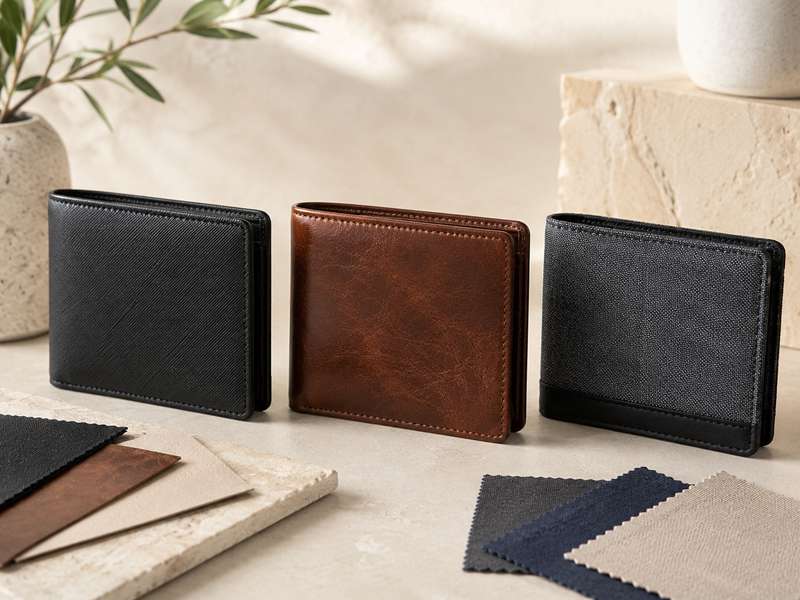
A wallet is small, but it is one of the easiest accessories to judge by touch. People notice the surface before they read any product details. They feel the edge when they open it. They notice whether cards slide smoothly or get stuck. They see whether the logo looks pressed, printed, stitched, or attached with care. They also feel the thickness after the wallet is filled. This is why material choice matters so much in a wallet line. PU, genuine leather, and fabric are not just different surfaces. They create different product stories, different costs, different durability risks, and different daily-use experiences.
Custom wallets should choose material by product position and use scene. Genuine leather fits premium, classic, and gift-ready lines. PU works well for color-rich, cost-controlled, and fashion-led projects. Fabric fits lightweight, travel, casual, sport, and function-focused designs. The best choice depends on hand feel, wallet type, card slot structure, logo method, edge finish, durability needs, MOQ, and sample performance.
A wallet can fail in quiet ways. A card slot that is 1 mm too tight can annoy people every day. A fold line that is too thick can make the wallet bulky in a pocket. A PU surface can look smooth at first but crack if the fold area is weak. A leather wallet can look beautiful but vary too much in grain if the material is not selected carefully. A fabric wallet can feel fresh and light but may fray at the edges without proper binding. The right material is not the most expensive one. It is the one that fits the structure, the price level, and the way the wallet will be used.
What Material Should You Choose?

Choose genuine leather when the wallet needs a premium touch, natural grain, gift value, and long-term use. Choose PU when the wallet needs flexible colors, smooth surfaces, and controlled cost. Choose fabric when the wallet needs light weight, travel function, sport styling, or casual daily use. The best material is not the most expensive one; it is the one that fits the wallet type, structure, logo method, edge finish, and daily handling.
Wallet material affects far more than appearance. It changes how the wallet folds, how thick it becomes after cards are inserted, how the card slots hold tension, how the edges feel in hand, how the logo appears, and how the product looks after daily use. A wallet is touched closely every day, so small issues become easy to notice: peeling corners, stiff folds, loose slots, rough edges, uneven grain, weak lining, or a logo that fades too soon.
A material should be selected together with the wallet structure. A slim cardholder needs a firm but thin material. A bifold needs a clean fold line. A long wallet needs stable panels. A zip wallet needs material that can handle zipper sewing without waves. A passport holder needs a larger surface that stays flat. If the material and structure do not match, the wallet may look attractive when empty but feel bulky, soft, or awkward in use.
A useful material review should focus on these details:
Hand feel
The surface should match the product’s price level. Wallets are held often, so touch matters as much as look.
Thickness
A wallet usually uses layered construction. Even a 0.2–0.4 mm difference in material thickness can change the final bulk after several slots are stacked.
Fold behavior
The material should open and close smoothly without deep cracking, heavy wrinkles, or stiffness at the spine.
Card slot tension
Cards should slide in and out easily while staying secure after repeated use.
Edge finish
The material should support the planned edge method, such as painted edge, folded edge, stitched edge, or fabric binding.
Logo result
Embossing, debossing, print, foil, woven label, patch, or metal detail should sit cleanly on the surface.
Color consistency
Outer material, lining, thread, edge paint, zipper tape, and logo color should stay visually aligned.
| Material | Best Fit | Visual Feel | Main Risk | Sample Check |
|---|---|---|---|---|
| Genuine leather | Premium cardholders, bifolds, passport holders, gift wallets | Natural, rich, classic | Grain variation, higher cost, thickness control | Leather grade, fold line, edge paint |
| PU leather | Fashion wallets, color sets, gift accessories | Smooth, clean, color-flexible | Peeling, cracking, odor, weak backing | Fold test, surface rub, corner wear |
| Microfiber leather | Higher-grade leather-like wallets | Stable, refined, smooth | Higher cost than basic PU | Thickness, logo clarity, folding |
| Synthetic leather | Mid-level wallet lines | Consistent, controlled | Quality varies by grade | Hand feel, backing, abrasion |
| Canvas | Casual wallets, coin pouches, natural-style items | Textured, relaxed, warm | Fraying, staining, soft structure | Binding, lining, fabric weight |
| Nylon / polyester | Travel wallets, sport cardholders, utility pouches | Light, durable, easy-care | Less classic for leather lines | Zipper sewing, patch logo, lining |
| RPET fabric | Recycled-material small goods | Practical, fabric-like | Needs strength and material proof | Surface, stitching, documentation |
Material selection should not stop at swatches. A flat swatch does not show folded thickness, card slot grip, edge paint behavior, zipper tension, or how the logo looks on the finished piece. A real sample should be filled, folded, rubbed lightly, opened repeatedly, and placed in its planned packaging before approval.
PU vs Genuine Leather vs Fabric
PU, genuine leather, and fabric each create a different wallet experience. Genuine leather brings natural touch, classic value, and a more premium feel. PU brings smooth surfaces, many colors, and more flexible cost control. Fabric brings light weight, casual function, and better fit for travel, sport, campus, or outdoor-light use.
Genuine leather is often stronger for classic bifolds, premium cardholders, passport holders, and gift sets. It feels warmer in hand and can develop a natural character over time. The main concerns are thickness, leather grade, visible grain variation, cutting loss, edge finishing, and surface marks. If the leather is too thick, the wallet becomes bulky after cards are inserted. If it is too soft, slots may lose shape.
PU is useful for color-rich wallet lines, seasonal accessories, vegan-style collections, and lower-cost leather-like designs. It can support smooth, pebbled, saffiano-style, metallic, matte, or embossed surfaces. The main concerns are fold cracking, surface peeling, odor, backing strength, logo adhesion, and edge behavior. PU should always be tested at the fold line, card slot opening, flap edge, and corners.
Fabric works best when the product should feel lighter and more functional. Nylon, polyester, canvas, RPET, and coated fabrics can work for zip wallets, coin pouches, card wallets, passport organizers, and travel small goods. The main concerns are edge fraying, weak card slot tension, lining movement, and soft panels. Fabric often needs binding, interlining, or reinforced seams to feel finished.
A simple material match can be planned like this:
Classic daily wallet
Genuine leather or microfiber leather.
Fashion color cardholder
PU, microfiber leather, or coated synthetic material.
Travel wallet
Nylon, polyester, canvas, or coated fabric.
Gift wallet set
Genuine leather, PU, or microfiber leather with stronger packaging.
Casual coin pouch
Canvas, nylon, PU, or mixed material.
What Is A PU Leather Wallet?
A PU leather wallet is made with a polyurethane-coated surface attached to a backing layer. It is designed to look and feel similar to leather, but it is not genuine leather. It is a synthetic leather-like material used for wallets that need a smooth surface, flexible color choices, and more controlled cost.
PU leather can be used for cardholders, bifold wallets, zip wallets, coin pouches, long wallets, passport holders, and gift wallets. It can create many surface effects, such as smooth PU, pebbled PU, saffiano-style PU, matte PU, metallic PU, soft-touch PU, and embossed PU. This makes it useful when a wallet line needs several colors or a cleaner, more consistent surface than natural leather can offer.
The quality difference between PU materials can be large. A wallet made with better PU can look clean and hold shape well. A wallet made with weak PU may peel, crack, smell strong, or show pressure marks quickly. The backing layer is especially important. A poor backing can make the surface wrinkle, stretch, or break at fold areas.
A PU wallet sample should be checked in real use:
Fold the wallet repeatedly and check the spine.
Insert and remove cards from each slot.
Rub corners lightly to check surface wear.
Smell the material after unpacking.
Check whether the surface peels near stitched areas.
Test embossing, printing, or patch attachment.
Review edge paint or folded edge behavior.
Place the wallet in packaging and check pressure marks.
PU can work well when selected and tested carefully. It is not a shortcut material; it still needs proper structure, stitching, lining, and finishing.
Is PU Leather A Legit Leather?
PU leather is a legitimate wallet material, but it is not genuine leather. It should be described clearly as PU leather, synthetic leather, leather-like material, or vegan-style material depending on the product direction and local wording needs. Clear material naming protects trust and avoids confusion.
PU leather is widely used because it offers many colors, smooth surface control, leather-like texture, and flexible pricing. It can be suitable for fashion wallets, gift cardholders, retail accessories, colorful collections, and animal-free material directions. It can also work with several logo methods, such as debossing, printing, heat transfer, woven labels, rubber patches, metal plates, or foil effects, depending on the surface.
PU is strongest when the product goal is:
Color flexibility.
Clean and consistent surface.
Smooth leather-like look.
Lower material cost than many genuine leather options.
Seasonal color development.
Vegan-style positioning.
Gift and accessory programs.
PU is weaker when the wallet is expected to offer natural grain, long-term patina, heritage leather feeling, and premium aging. In those cases, genuine leather or higher-grade microfiber leather may fit better.
A good PU wallet should still feel well built. Clean stitching, stable slot tension, neat edges, suitable lining, controlled fold behavior, and a balanced logo make a bigger difference than the material name alone.
Which Material Fits Your Brand?
The right wallet material should match the product’s style, price level, selling scene, color plan, and daily-use promise. Genuine leather fits classic, premium, gift-ready, corporate, and heritage-style wallet lines. PU fits fashion, color-driven, vegan-style, cost-controlled, and seasonal lines. Fabric fits travel, sport, outdoor-light, campus, casual, and utility wallets.
The wallet type should guide the material choice:
Slim cardholder
Needs firm material, clean slot tension, and low bulk. Genuine leather, microfiber leather, selected PU, and reinforced fabric can all work.
Bifold wallet
Needs a smooth fold line and stable inner structure. Genuine leather, microfiber leather, and higher-quality PU are common options.
Long wallet
Needs stable panels and good lining. Genuine leather, PU, microfiber leather, and reinforced fabric can work depending on style.
Zip wallet
Needs material that handles zipper sewing smoothly. PU, leather, nylon, canvas, and polyester are possible choices.
Passport holder
Needs larger flat panels that do not warp. Genuine leather, PU, coated fabric, canvas, and nylon can all work with proper support.
Coin pouch
Needs strong lining and zipper quality. PU, canvas, nylon, and genuine leather can work depending on the look.
A material should also match the logo method. Genuine leather usually works well with embossing, debossing, foil stamping, and metal details. PU can work with debossing, printing, heat transfer, patches, or metal plates. Fabric often works best with woven labels, embroidery, rubber patches, printed labels, or heat transfer.
A practical material choice should feel natural within the full collection. If the wider line includes leather bags and belts, genuine leather or microfiber leather may keep the look connected. If the line focuses on bold colors and seasonal refresh, PU may be easier. If the line focuses on travel and light carry, fabric may feel more honest and useful.
What Type Of Wallet Material Lasts?
Wallet durability depends on material grade, thickness, fold control, slot structure, edge finish, stitching, lining, and daily care. Genuine leather can last long and age naturally when the grade and construction are good. High-grade PU and microfiber leather can also perform well. Fabric wallets can last when seams, binding, lining, and stress areas are reinforced.
Wallets face repeated stress in small areas:
Fold line
The spine of a bifold opens and closes often. This area needs the right softness and thickness.
Card slots
Cards create pressure, friction, and stretching. Slots should stay secure without becoming loose.
Corners
Corners rub against pockets, handbags, counters, and hands.
Edges
Painted edges, folded edges, bound edges, and stitched edges wear differently.
Zipper area
Zip wallets need smooth zipper sewing and strong tape alignment.
Coin pocket
Coins create rubbing and pressure inside the wallet.
Lining
Thin lining can tear or twist after repeated card or coin use.
For genuine leather, leather grade and thickness matter. Good leather can age beautifully, but poor thickness control can make the wallet bulky or weak. For PU, fold durability and backing strength are critical. For fabric, edge binding and internal reinforcement are often more important than the fabric name.
A practical durability test should include:
Insert cards into every slot and remove them repeatedly.
Fold and open the wallet many times.
Check the corners after light rubbing.
Inspect edge paint or binding after handling.
Open and close the zipper several times.
Fill the wallet and check final thickness.
Place it in a pocket or bag to check comfort.
A lasting wallet should not only survive storage. It should stay comfortable and neat during real daily use.
Is Genuine Leather Worth It?
Genuine leather is worth it when the wallet needs premium touch, natural character, long-term use, and gift value. It is especially suitable for classic bifolds, cardholders, passport holders, corporate gifts, and leather goods collections where material quality is part of the product identity.
Genuine leather offers several advantages:
Natural grain and texture.
Richer hand feel.
Stronger premium perception.
Better aging character when properly selected.
Good fit for embossing or debossing.
Strong gift value.
Long-term collection consistency.
However, genuine leather also needs careful control. It may have natural marks, grain differences, and shade variation. These are part of natural material behavior, but they should be managed through material selection and cutting. Leather also needs correct thickness. A wallet is layered, so overly thick leather can make a bifold or cardholder uncomfortable after filling.
A genuine leather wallet should review:
Leather type and grade.
Panel thickness.
Skiving at fold areas.
Card slot structure.
Edge paint or folded edge.
Embossing pressure.
Stitching density.
Lining and cash pocket material.
Color variation tolerance.
Packing protection.
Genuine leather does not automatically make a better wallet. It becomes valuable when material grade, pattern, edge, stitching, logo, and lining all support the product. Poor construction can waste good leather. Good construction can make genuine leather feel worth the higher cost.
Do Fabric Wallets Work?
Fabric wallets work well when the product needs light weight, travel function, sport styling, casual texture, or easier daily care. They are suitable for card wallets, passport holders, zip pouches, coin wallets, campus wallets, outdoor-light accessories, recycled-material small goods, and travel organizers.
Fabric wallets serve a different purpose from classic leather wallets. They are not trying to create natural leather aging. They are designed to feel light, useful, casual, and practical. Nylon and polyester can support travel and sport use. Canvas gives a natural, textured look. RPET can support a recycled-material direction when documentation is available. Coated fabric can add water resistance or easier cleaning.
Fabric wallets need good structure to avoid looking weak. Common structure needs include:
Binding around edges to stop fraying.
Lining to improve inner finish.
Interlining to support larger panels.
Reinforced card slots to keep tension.
Smooth zipper tape to avoid waves.
Patch or label placement that does not distort the fabric.
Stronger seam control at corners.
Fabric wallets work especially well for:
Travel card wallets.
Passport organizers.
Zip coin pouches.
Outdoor-light wallets.
Sport and gym accessories.
Campus card cases.
Recycled-fabric small goods.
Casual gift sets.
A fabric wallet should look intentional, not like a cheap replacement for leather. With the right fabric weight, binding, lining, zipper, and logo detail, fabric can create a strong and useful wallet that fits modern daily carry.
Which Wallet Type Works Best?

The best wallet type depends on what it needs to hold, how slim it should feel, where it will be carried, and which material will be used. Cardholders work for minimal carry. Bifold wallets suit classic daily use. Long wallets give more storage and gift value. Zip wallets protect coins and small items. Passport holders fit travel and premium sets.
Wallet type should be decided before material, logo, and packaging. A cardholder needs slot tension. A bifold needs a clean fold line. A long wallet needs stable panels. A zip wallet needs smooth zipper sewing. A passport holder needs a larger flat body that does not warp. If the structure and material do not match, the finished wallet may become too bulky, too soft, too stiff, or hard to use.
A wallet also needs to be judged after filling. Many samples look neat when empty, but the real shape appears after cards, cash, coins, receipts, or travel documents are inserted. A 1 mm change in slot width, a 0.3 mm change in material thickness, or one extra layer of lining can change the whole hand feel. For small leather goods, “thin but strong” is usually harder than “thick and solid.”
A practical wallet line often starts with a few focused types instead of too many styles at once:
Cardholder
Good for slim carry, color testing, gift add-ons, and modern daily use.
Bifold wallet
Good for classic leather goods collections and stronger everyday function.
Zip wallet
Good for coins, small items, travel, and secure storage.
Long wallet
Good for premium presentation, handbag carry, and organized storage.
Passport holder
Good for travel sets, corporate gifts, and larger logo presentation.
Coin pouch
Good for small accessories, gift sets, seasonal colors, or add-on sales.
| Wallet Type | Common Closed Size | Common Capacity | Good Material Fit | Main Risk |
|---|---|---|---|---|
| Cardholder | 10–11 × 7–8 cm | 2–6 cards | Leather, PU, microfiber, fabric | Slots too tight or too loose |
| Bifold wallet | 10.5–12 × 8.5–9.5 cm | 4–8 cards, folded cash | Leather, PU, microfiber | Thick fold after filling |
| Long wallet | 18–20 × 9–10.5 cm | 8–12 cards, cash, receipts | Leather, PU, microfiber, lined fabric | Panel warping and heavy bulk |
| Zip wallet | 10–20 × 8–10.5 cm | Cards, coins, cash | PU, leather, nylon, canvas | Zipper waves and corner tension |
| Passport holder | 10–11 × 14–15 cm | Passport, cards, tickets | Leather, PU, canvas, nylon | Large panel softness |
| Coin pouch | 8–12 × 7–10 cm | Coins, keys, small items | PU, leather, canvas, nylon | Zipper stress and lining wear |
A strong wallet type is not the one with the most slots or decoration. It is the one that fits its daily role, feels comfortable when filled, and stays neat after repeated handling.
What Is A Custom Wallet?
A custom wallet is developed around a chosen size, material, structure, color, logo method, card slot layout, lining, edge finish, packaging, and quantity. It is not simply a ready-made wallet with a logo added to the surface. A proper custom wallet should be planned from pattern to sample, then checked again after cards, cash, coins, or travel documents are inserted.
A custom wallet usually includes several linked decisions:
Wallet type
Cardholder, bifold, long wallet, zip wallet, passport holder, coin pouch, key wallet, or travel wallet.
Outer material
Genuine leather, PU, microfiber leather, synthetic leather, canvas, nylon, polyester, RPET, or mixed material.
Inside structure
Card slots, cash pocket, coin pocket, zipper pocket, hidden slot, ID window, passport sleeve, divider, or RFID layer.
Detail treatment
Stitching color, edge paint, folded edge, fabric binding, lining, hardware, zipper puller, snap, or logo plate.
Logo method
Embossing, debossing, foil stamping, printing, heat transfer, woven label, rubber patch, metal plate, or embroidery.
Packaging
OPP bag, gift box, paper sleeve, hangtag, barcode label, retail card, tissue wrap, or carton mark.
The value of a custom wallet is control. The product can match a wider leather goods line, gift program, retail display, or seasonal collection. The material, logo, thickness, stitching, and packaging can all be adjusted to fit the final product position.
A clear custom wallet brief should not only say “wallet.” It should define the carry need. For example, “slim cardholder for 4 cards,” “bifold wallet for 6 cards and folded cash,” or “zip wallet for coins and cards” gives a much clearer development direction.
Bifold vs Cardholder
Bifold wallets and cardholders are both core wallet types, but they serve different habits. A bifold wallet is more classic and carries more: cards, folded cash, receipts, and sometimes an ID window. A cardholder is slimmer, lighter, and more modern for people who carry fewer items.
A bifold wallet usually has these features:
4–8 card slots
One or two cash compartments
Closed size around 10.5–12 × 8.5–9.5 cm
Folded structure with a central spine
More material layers than a cardholder
Stronger gift value than very slim styles
The main challenge is thickness. A bifold wallet may look fine when empty, then become too bulky after 6–8 cards and cash are added. Material thickness needs careful control. Leather, PU, and microfiber leather should be skived or selected at the right thickness. Slot design should reduce unnecessary layers.
A cardholder usually has these features:
2–6 card slots
Slim profile for pocket carry
Closed size around 10–11 × 7–8 cm
Little or no cash storage
Simple front and back panel structure
Good fit for color testing or entry-level wallet lines
The challenge is slot tension. If slots are too tight, cards become difficult to remove. If they are too loose, cards may slip out. Cardholders also show stitching accuracy clearly because the product surface is small. A slightly crooked stitch line or uneven logo position becomes obvious.
| Feature | Bifold Wallet | Cardholder |
|---|---|---|
| Carry capacity | Medium | Low to medium |
| Thickness risk | Higher | Lower |
| Best daily use | Cards plus cash | Cards only or minimal cash |
| Material demand | Good fold control | Good slot tension |
| Gift value | Strong | Good as add-on |
| Structure difficulty | Medium | Simple-looking but precise |
| Common issue | Bulky spine | Loose or tight slots |
For a focused wallet line, bifold and cardholder styles can share the same material and color story. The cardholder gives a slimmer option, while the bifold provides a more classic daily piece.
Long Wallet vs Zip Wallet
Long wallets and zip wallets offer more storage than compact cardholders or bifolds. A long wallet feels organized, elegant, and gift-ready. A zip wallet feels secure, practical, and useful for coins, receipts, small items, and travel. Both types need more structure control because they have larger panels and more internal layers.
A long wallet usually includes:
8–12 card slots
Cash compartments
Receipt space
Sometimes a zipper coin pocket
Larger surface for logo or material texture
Closed size around 18–20 × 9–10.5 cm
The main challenge is panel stability. A long wallet has more surface area than a bifold. If the material is too soft, the body may bend or warp. If the material is too thick, the wallet may feel heavy and stiff. Genuine leather, PU, microfiber leather, and lined fabric can all work, but the lining and internal panels need enough support.
A zip wallet usually includes:
Full or partial zipper closure
Card slots
Coin pocket
Cash space
Small-item storage
Better security for travel or handbag carry
The main challenge is zipper control. The zipper should run smoothly without waves, especially near corners. The material around the zipper must not pull, twist, or pucker. The zipper puller should feel comfortable and match the product level. A low-quality zipper can make the whole wallet feel weak, even when the outer material is good.
| Feature | Long Wallet | Zip Wallet |
|---|---|---|
| Main value | Organized storage | Secure closure |
| Good for | Handbag carry, gifts, premium sets | Coins, travel, small items |
| Main risk | Panel warping | Zipper waves |
| Material fit | Leather, PU, microfiber, lined fabric | PU, leather, nylon, canvas |
| Logo space | Larger front panel | Front panel or zipper puller |
| Packing need | Often gift-ready | Often needs shape protection |
Choose a long wallet when the product should feel elegant, spacious, and display-friendly. Choose a zip wallet when function, storage security, and small-item carry matter more.
Which Brand Is Best For Leather Wallets?
The best leather wallet brands usually share the same qualities: clear material identity, controlled thickness, neat stitching, smooth edges, practical card layout, balanced logo size, and packaging that fits the product value. The useful approach is not to copy famous designs, but to study why some wallets feel better in hand and age better over time.
Strong leather wallet references often have several visible traits:
Material feels right for the price level.
Card slots hold cards securely without fighting the hand.
The wallet does not become too bulky after filling.
Edges feel smooth, not rough or sticky.
Stitching stays even around corners and slots.
Logo size feels balanced with the wallet surface.
Lining does not pull out or wrinkle.
Packaging protects the wallet and supports gift value.
A leather wallet can look impressive in a photo but still fail in daily use. The best references should be checked through real handling:
Open and close the wallet.
Insert cards into each slot.
Check the filled thickness.
Feel the edges with fingers.
Look at the fold line.
Check how the logo sits on the material.
Review how the wallet is packed.
There is no single best brand for every wallet direction. A classic heritage wallet, a slim modern cardholder, a travel zip wallet, a fashion-color wallet, and a fabric utility wallet need different design choices. The better question is which reference style matches the intended product role.
For development, study construction rather than surface decoration. Look at slot count, fold thickness, edge method, leather thickness, stitch distance, lining stability, logo scale, and packing. These details are what make a wallet feel well made.
Which Type Fits Leather Goods Lines?
A leather goods line usually works best with a focused wallet set instead of too many unrelated styles. Cardholder, bifold wallet, zip wallet, and passport holder can cover most daily, gift, and travel needs while keeping material, color, logo, and packaging consistent.
A practical leather goods wallet set can be built like this:
Cardholder
A slim entry piece. Good for testing material, color, logo, and packaging. Works well as an add-on item.
Bifold wallet
A classic daily wallet. Strong for leather goods collections, gift programs, and higher perceived value.
Zip wallet
A functional piece. Good for coins, cards, receipts, small items, and travel.
Passport holder
A travel or gift piece. Offers larger logo area and a more premium presentation.
Coin pouch
A small accessory. Useful for seasonal colors, gift sets, and lighter price levels.
Key wallet
A practical add-on for leather goods collections, especially when matched with wallets and small pouches.
A good wallet line should feel connected through material and detail. The same black leather, brown PU, or canvas texture can appear across several wallet types. The same logo method can create consistency. The same packaging style can make the collection feel complete.
The selection depends on the final product direction:
Classic leather goods line
Cardholder, bifold wallet, passport holder.
Fashion accessories line
Cardholder, long wallet, zip wallet, coin pouch.
Travel collection
Passport holder, zip wallet, fabric cardholder.
Gift set
Bifold wallet, cardholder, key wallet, gift box.
Casual lifestyle line
Fabric wallet, PU cardholder, coin pouch.
Minimal carry line
Slim cardholder, money clip wallet, compact bifold.
The goal is not to include every wallet type. The goal is to choose a set that feels useful, visually connected, and easy to repeat in future colors or materials.
Best Wallet For Daily Use
The best wallet for daily use is slim, durable, easy to open, and organized enough for essential cards and cash. It should not feel bulky after filling. Cards should slide in smoothly. The surface should handle hand oils, pocket friction, handbag movement, and repeated folding.
For many daily users, cardholders and slim bifolds are the most practical choices. A cardholder works well for 3–6 cards and minimal cash. A bifold works better for 4–8 cards, folded bills, receipts, and ID. A zip wallet works when coins or small items are important. A long wallet usually suits handbag carry more than pocket carry.
A daily wallet should be tested with real contents:
4–8 cards
Folded cash
Transit card or ID
Receipts
Coins if the design includes a coin pocket
Passport if it is a travel wallet
Keys or small items if it is a pouch-style wallet
Useful daily wallet details include:
Rounded or softened corners
Sharp corners wear faster and may feel uncomfortable in pocket carry.
Controlled thickness
A wallet should be checked after filling, not only when empty.
Smooth card access
Card slots should not be too tight.
Stable lining
The inside should not twist when cards are removed.
Good fold behavior
A bifold should close naturally after use.
Clean edge finish
Edges should feel smooth against the hand.
Balanced logo
A daily wallet is used often, so the logo should feel natural rather than loud.
A wallet becomes a daily favorite when it removes friction. It opens easily, cards are easy to reach, the thickness feels right, and the material still looks good after use.
History Of Wallet Design
Wallet design has changed with the way people carry money, cards, IDs, travel documents, and small essentials. Earlier wallets were built mainly for coins and paper money. Later, card slots became more important as bank cards, ID cards, and transit cards became part of daily life. Today, many wallets are slimmer because people carry less cash, while travel wallets and zip wallets still serve people who need extra storage.
This history helps explain why different wallet types still exist. A bifold is not outdated; it remains useful for people who carry cash and cards. A cardholder is not too simple; it fits minimal carry. A long wallet is not only decorative; it keeps bills and receipts flat. A zip wallet is not only casual; it protects coins and small items. A passport holder is not only for travel; it can also become a premium gift item.
Modern wallet design tends to move toward clearer roles:
Slim daily card carry.
Classic leather gift wallet.
Secure zip storage.
Travel organization.
Fashion-color accessories.
Vegan-style materials.
Lightweight fabric function.
Premium passport sets.
A successful wallet does not need to follow one fixed tradition. It needs to match how people carry things today. Some people want the thinnest possible cardholder. Others want a classic bifold with cash space. Some want a zip wallet for travel. Others want a gift-ready leather passport holder. The best wallet type is the one that serves its use clearly and feels good every time it is opened.
How Do Materials Affect Price?
Materials affect wallet price through surface grade, thickness, usable cutting area, layer count, edge finish, lining, logo method, zipper, hardware, packaging, quantity, and inspection work. Genuine leather usually raises cost because of material grade, sorting, cutting loss, and edge work. PU can help control cost, but fold strength and backing quality must be tested. Fabric can look economical, yet binding, lining, and reinforcement may add hidden work.
A wallet is small, but it is not a one-layer product. A cardholder may contain several stacked slots. A bifold may include outer material, inner panels, folded cash pocket, card slots, lining, edge finish, stitching, logo, and packaging. A zip wallet adds zipper tape, puller, coin pocket lining, corner tension, and more sewing control. A long wallet or passport holder uses larger panels, so warping, softness, and inner support become more important.
Material cost is only the visible part. The real cost comes from how that material behaves after cutting, folding, stitching, pressing, painting, packing, and daily handling. A cheaper material may become expensive if it causes high defect rates, uneven edges, poor logo results, strong odor, or repeated sample revisions. A higher-grade material may be worth using if it reduces defects, improves hand feel, and supports stronger retail value.
The main cost drivers usually include:
Material grade
Genuine leather, microfiber leather, PU, canvas, nylon, polyester, RPET, and coated fabrics all sit at different cost levels. Even within one material type, grade changes touch, strength, color, surface stability, and final appearance.
Usable yield
Natural leather may have grain variation, scars, wrinkles, or shade differences, so visible panels need careful selection. PU and fabric rolls are more consistent, but printed, textured, or directional materials can still create cutting loss.
Thickness control
Wallets need thin layers, but not weak layers. A 0.2–0.4 mm thickness difference can make a cardholder or bifold feel much bulkier after slots are stacked.
Structure complexity
More card slots, hidden pockets, zipper pockets, coin compartments, RFID layers, snaps, dividers, and large panels add material, sewing, and checking time.
Edge finish
Painted edges, folded edges, burnished-style finishing, stitched edges, and fabric binding all carry different time and cost requirements.
Logo process
Debossing, embossing, foil stamping, printing, woven labels, rubber patches, metal plates, embroidery, and heat transfer each need different setup and surface compatibility checks.
Packing style
A wallet in a basic OPP bag has a different full cost from a wallet with gift box, paper sleeve, barcode, hangtag, tissue wrap, retail card, and carton labeling.
Quantity
Higher quantity can spread setup work more efficiently. Smaller runs may work for simple designs, but custom materials, custom hardware, special colors, or gift packaging usually need more planning.
| Cost Area | Cost-Control Direction | Higher-Cost Direction | What To Check Before Approval |
|---|---|---|---|
| Outer material | Standard PU, basic canvas, polyester | Genuine leather, microfiber leather, premium PU | Surface strength, smell, touch, color |
| Leather yield | Small panels, simple cuts | Premium visible panels, grain matching | Cutting loss and shade consistency |
| Thickness | Simple low-layer design | Multi-slot, padded, reinforced structure | Filled thickness and fold comfort |
| Edge finish | Simple stitching or folded edge | Multi-coat edge paint, polished edge | Smoothness, cracking, peeling |
| Logo | Simple print or woven label | Embossing mold, metal plate, patch | Material fit and logo durability |
| Lining | Basic lining | Custom color, printed lining, thicker lining | Inner strength and bulk |
| Hardware | No metal trim or simple zipper | Branded puller, metal plate, snap, zip-around | Weight, finish, smooth use |
| Packaging | OPP bag | Gift box, barcode, sleeve, tissue wrap | Protection, carton volume, display feel |
A good wallet cost plan does not remove every detail. It removes the wrong details. For example, a premium leather cardholder may not need a zipper or metal plate, but it does need good leather thickness, neat slot tension, and clean edges. A PU fashion wallet may not need expensive leather, but it does need good backing, strong fold performance, and a logo process that stays clean. A fabric travel wallet may not need premium hardware, but it does need binding, lining, and zipper quality.
What Affects Wallet Price?
Wallet price is affected by the full specification, not only the material name. Two wallets can use the same outer size but have very different costs if one has four card slots and simple stitching while the other has twelve slots, a zipper coin pocket, RFID layer, metal logo, custom lining, edge paint, and gift box packaging.
The most important cost factors include:
Material type
Genuine leather usually costs more than standard PU or fabric. Microfiber leather often costs more than basic PU but can offer a more refined and stable feel. Canvas, nylon, and polyester can be cost-friendly, but binding and lining still matter.
Wallet size
A cardholder uses less material than a long wallet or passport holder. Larger panels also need better stability, so lining or interlining may be required.
Layer count
Each card slot adds material, seam length, and thickness. A wallet with 8–12 slots is not only “a little more” than a 4-slot design. It can change sewing time, fold thickness, and inspection requirements.
Edge treatment
Painted edges may need several coats, drying time, smoothing, and checking. Folded edges may need skiving and careful sewing. Fabric binding needs straight application and strong seam control.
Logo setup
Embossing and debossing may need molds. Metal plates and rubber patches may need custom tooling. Woven labels, printed logos, or heat transfer may be more efficient for some designs, depending on the surface.
Hardware
Zippers, snaps, metal plates, corner protectors, key rings, and custom pullers add both material cost and inspection work.
Packaging
Gift boxes, sleeves, barcode labels, hangtags, and retail cards can improve presentation but also affect carton size, packing time, and shipping volume.
A simple price comparison:
| Wallet Style | Cost Sensitivity | Key Cost Drivers |
|---|---|---|
| Cardholder | Low to medium | Material grade, slot count, edge finish, logo |
| Bifold wallet | Medium | Fold structure, slot layers, leather/PU thickness, lining |
| Long wallet | Medium to high | Large panels, inner structure, lining, packaging |
| Zip wallet | Medium to high | Zipper, puller, coin pocket, seam control |
| Passport holder | Medium | Panel stability, material thickness, logo, packing |
| Gift set wallet | High | Wallet + box + sleeve + label + presentation details |
Cost becomes easier to control when the wallet has a clear role. A slim daily cardholder should not be overloaded with unnecessary layers. A gift wallet should not save too much on packaging or edge finish. A travel zip wallet should protect zipper and lining quality before adding decorative trims.
How Does Leather Grade Matter?
Leather grade affects touch, durability, appearance, cutting yield, edge finish, logo result, and price. A higher-grade leather can give richer texture and stronger value, but it may also require more careful cutting, sorting, and thickness control. Natural leather is not fully uniform, so planning must allow for grain, shade, and surface differences.
Several leather factors matter in wallet development:
Surface quality
Visible panels should be selected carefully. Natural marks can be acceptable in some styles, but large defects, heavy scars, or inconsistent grain may not suit premium wallets.
Thickness
Wallet leather is usually thinner than bag leather. If it is too thick, the wallet becomes bulky when filled. If it is too thin, card slots, corners, and fold areas may weaken.
Temper
Soft leather feels comfortable but may lose structure. Firmer leather keeps shape but can feel stiff. The right balance depends on wallet type.
Finish
Smooth, pebbled, coated, corrected grain, and other finishes create different touch, appearance, and care needs.
Cutting area
The most visible parts, such as front panel, back panel, and card slot faces, may need cleaner leather areas. This can increase cutting loss.
Logo performance
Embossing or debossing depends on leather firmness, surface finish, heat, pressure, and thickness. Some leather holds a crisp logo better than others.
Leather can increase perceived value when the design supports it. A genuine leather cardholder with clean stitching and smooth edge paint can feel strong even with a simple structure. A poorly planned leather wallet, however, can still feel bulky, uneven, or hard to use.
A practical leather wallet review should include:
Closed and opened thickness.
Fold line softness.
Card slot tension.
Edge paint adhesion.
Logo depth and clarity.
Natural grain tolerance.
Visible panel selection.
Packaging protection.
Genuine leather is not only a material upgrade. It is a detail-control upgrade.
Does PU Lower Cost?
PU can lower material cost compared with many genuine leather options, but it does not automatically make the whole wallet low-cost. The final cost still depends on PU grade, backing, thickness, texture, lining, slot structure, edge finish, logo process, packaging, and order quantity.
PU helps control cost in several ways:
Roll material consistency
PU is usually supplied in rolls, so visible surface selection can be more predictable than natural leather.
Color flexibility
PU can offer many colors and textures, which helps fashion, gift, and seasonal wallet lines.
Lower material waste
Compared with natural leather, PU often creates less sorting loss, especially for small wallet panels.
Flexible surface styles
Smooth, pebbled, saffiano-style, matte, metallic, printed, or embossed PU can create many looks without changing to genuine leather.
However, weak PU can create problems that increase real cost:
Cracking at fold lines.
Peeling near corners.
Strong odor after unpacking.
Weak backing around card slots.
Poor edge paint adhesion.
Surface marks from pressure.
Logo fading or poor adhesion.
A PU wallet should be tested at the most stressed areas:
Bifold spine.
Card slot openings.
Flap edge.
Corners.
Zipper seam.
Pressed logo area.
Packing pressure areas.
PU works best when the design values color, surface consistency, and cost control. It should not be chosen only because it is cheaper. A better PU grade may cost more at material level, but it can reduce complaints, improve touch, and make the finished wallet feel more stable.
When Is Fabric More Practical?
Fabric is more practical when the wallet needs light weight, casual use, travel function, sport styling, outdoor-light performance, or easier daily care. Nylon, polyester, canvas, RPET, coated fabrics, and mixed materials can work well for card wallets, passport holders, zip pouches, coin pouches, and small travel organizers.
Fabric can reduce the formal feeling of a wallet and make it more functional. It works especially well when the product includes zipper pockets, webbing loops, binding, rubber patches, woven labels, printed patterns, or lightweight construction.
Fabric is often practical for:
Travel card wallets
Light, compact, and easy to place in bags or pockets.
Passport holders
Nylon, polyester, or canvas can keep the product lighter than leather versions.
Coin pouches
Fabric works well with zippers and casual use.
Campus wallets
Lightweight fabric styles can handle color, graphics, and simple branding.
Outdoor-light wallets
Coated fabric, ripstop-style materials, or canvas can support more active use.
Recycled-material small goods
RPET fabric can support a responsible material direction when proper documentation is available.
The hidden cost of fabric wallets is structure. Fabric may need binding to prevent fraying, interlining to support panels, lining to improve inside feel, and reinforced stitching around stress areas. A fabric wallet that looks simple may still require many detail decisions.
Common fabric wallet cost areas:
Binding tape.
Interlining.
Lining.
Zipper tape.
Woven label or patch.
Reinforced corners.
Extra stitching.
Fabric wallets should not look like cheaper substitutes for leather. They should feel intentionally light, useful, and practical.
How To Control Bulk Cost?
Bulk cost can be controlled by simplifying structure, choosing suitable materials, limiting color splits, using practical logo methods, and matching packaging to the product level. The goal is not to remove quality. The goal is to avoid unnecessary complexity while keeping the details that protect daily use.
Useful cost control methods include:
Limit first-run colors
Two to four colors are easier to manage than a wide color set. Fewer colors can reduce material separation, trim matching, and packing complexity.
Use one material family
The same PU, leather, fabric, lining, and thread system across cardholder and bifold styles can keep the collection cleaner and production easier.
Control card slot count
A 4-slot cardholder or 6-slot bifold may be more practical than adding too many slots. More slots mean more layers, thickness, and sewing time.
Choose logo method by material
Debossing may work well on leather or PU. A woven label may work better on fabric. A metal plate should be used only when it truly improves the product.
Keep hardware purposeful
Snaps, zipper pullers, metal plates, and rings should add function or value. Decorative hardware can raise cost without improving use.
Match packaging to the product
A gift box makes sense for premium leather wallets. Basic OPP or paper sleeve may be enough for simple cardholders.
Approve details early
Late changes to color, logo, edge paint, lining, or packaging can add sample time and material preparation work.
A focused first run might include:
One cardholder and one bifold.
Two or three colors.
One outer material family.
One logo method.
One edge finish.
One packaging style.
This approach keeps the product line clean, reduces unnecessary cost, and allows later expansion into zip wallets, passport holders, new colors, or upgraded packaging.
What MOQ Should You Plan?
MOQ should be planned by design, material, color, logo method, and packaging. A simple cardholder in available material is easier to start than a long wallet with custom leather color, metal logo, printed lining, edge paint, and gift box. The more customized the wallet becomes, the more quantity matters.
Several MOQ areas should be reviewed:
Per design
Each wallet type has its own pattern, cutting, sewing, and setup work.
Per color
Each color may require separate leather, PU, fabric, lining, thread, edge paint, zipper, or packaging preparation.
Per logo process
Embossing molds, metal plates, rubber patches, woven labels, or custom pullers may have setup requirements.
Per packaging style
Gift boxes, printed sleeves, barcode labels, and paper cards may have their own minimums.
Per material
Custom leather color, custom PU texture, special fabric, or RPET documentation may affect quantity planning.
For Jundong, the standard MOQ is usually 500 pcs per design. Some simple styles may be reviewed at 200–300 pcs depending on material, structure, and project details. Sample fees can be refunded or deducted when the order reaches 2000 pcs.
A practical MOQ plan for a first wallet collection may look like this:
| Launch Plan | Structure | Color Count | Recommended Direction |
|---|---|---|---|
| Simple test | Cardholder only | 1–2 colors | Use available PU, leather, or fabric |
| Core wallet set | Cardholder + bifold | 2–3 colors | Share material and logo method |
| Gift-ready set | Bifold + cardholder + box | 1–2 colors | Focus on packaging and edge finish |
| Travel set | Passport holder + zip pouch | 2 colors | Use fabric or mixed material |
| Expanded line | 3–5 wallet types | 3–5 colors | Best after first structure is stable |
A smaller start can work when the design is simple and materials are available. A more complex custom wallet line needs stronger quantity planning because materials, trims, logo setup, and packing all need coordination.
How Should a Logo and Details Work?

A wallet logo should feel natural on the material, fit the surface size, survive daily handling, and support the product’s overall value. Details such as card slots, stitching, lining, edges, zipper, snaps, and packaging matter just as much as the outer material. A strong wallet is judged at close distance, so every small detail should feel clean, practical, and intentional.
Wallets are different from larger bags because the usable logo space is limited. A logo that looks balanced on a tote or backpack may feel too large on a cardholder. A logo that looks clear on smooth PU may disappear on pebbled leather. A printed mark that looks sharp on a flat panel may wear faster near a fold line. This is why logo placement and detail testing should happen on a real sample, not only on a flat artwork file.
The most common logo methods for wallets include embossing, debossing, foil stamping, screen printing, heat transfer, woven label, rubber patch, leather-like patch, metal plate, embroidery, and laser-style marking where suitable. The right method depends on material, wallet type, surface texture, product position, color, and daily friction.
Wallet details should be reviewed in layers:
Outer presentation
Logo position, material surface, stitching, edge finish, hardware, color, and front panel balance.
Inside function
Card slots, cash pocket, coin pocket, lining, dividers, zipper, snap, ID window, and slot tension.
Touch and handling
Edge smoothness, fold thickness, zipper pull, card access, corner feel, and closing comfort.
Packing condition
Gift box, paper sleeve, OPP bag, barcode, hangtag, tissue wrap, and whether the wallet surface is protected during storage and shipping.
A wallet does not need many decorative elements to feel premium. It needs the right elements in the right place. A small debossed logo on leather can look stronger than a large print. A woven label on fabric can feel cleaner than a forced embossing. A metal plate can lift a structured wallet but may feel too heavy on a slim cardholder. The best detail is not always the most expensive one; it is the one that fits the material and use.
| Detail Area | What To Check | Why It Matters |
|---|---|---|
| Logo size | Width, height, spacing from edge | Small wallets can feel crowded quickly |
| Logo method | Emboss, print, patch, metal, label | Each material reacts differently |
| Card slots | Count, depth, tension, opening width | Controls daily comfort |
| Stitching | Distance, straightness, thread color | Visible on small surfaces |
| Edge finish | Paint, fold, bind, stitch | Strong effect on hand feel |
| Lining | Strength, color, movement, seam finish | Seen and touched every time |
| Hardware | Zipper, puller, snap, plate | Adds function and visual weight |
| Packaging | Box, sleeve, bag, barcode, carton mark | Protects surface and presentation |
Which Logo Method Is Best?
The best logo method depends on wallet material, surface texture, wallet size, color, and daily handling. Genuine leather often works well with embossing, debossing, foil stamping, and metal details. PU can support debossing, printing, heat transfer, patches, and metal plates when the surface is suitable. Fabric wallets usually work better with woven labels, embroidery, rubber patches, printed labels, or heat transfer.
A wallet logo should usually stay controlled in size. On a cardholder, a logo around 15–35 mm wide often feels cleaner than a large front mark, depending on artwork shape. On a bifold or long wallet, the front panel gives more space, but the logo still needs to avoid fold areas, edges, and high-friction corners. For passport holders or long wallets, the logo can be slightly larger, but it should still leave enough blank space to keep the product refined.
Logo methods should be chosen by how the wallet will be used:
Embossing / debossing
Good for leather, PU, and microfiber leather when the material holds pressure well. It creates a subtle, tactile effect.
Foil stamping
Good for gift wallets, leather-like surfaces, and refined front panels. Gold, silver, or tonal foil needs surface testing.
Screen printing
Useful for simple logos and clear color marks. Rub resistance should be checked carefully.
Heat transfer
Can work on selected PU and fabric surfaces. Useful for sharp logo color, but bending and adhesion need testing.
Woven label
Good for fabric wallets, casual wallets, and small leather-like items when a stitched label feels more natural.
Rubber patch
Good for travel, sport, and casual wallets. It adds texture and can handle more active styling.
Metal plate
Works well on structured wallets, long wallets, or gift pieces. It can feel premium but adds weight and cost.
Embroidery
Better for fabric and selected soft materials. It may add bulk on very slim wallets.
Logo approval should include a real sample check. The same logo can look sharp on smooth PU, softer on pebbled leather, raised on a rubber patch, or quiet on woven fabric. Material texture decides the final effect.
Embossing vs Printing
Embossing presses the logo into the material. Printing places ink or color on the surface. Embossing feels more tactile and subtle, while printing gives stronger visibility and more color freedom. The better choice depends on the material, product style, and how much friction the logo area will face.
Embossing works well when the wallet should look quiet, classic, and refined. It is often used on genuine leather, PU, and microfiber leather. The result depends on material thickness, surface finish, pressure, temperature, and logo detail. A thick line logo usually works better than very thin lines. Small letters can become unclear if the material is too soft or too textured.
Printing works better when the logo needs color or high contrast. It can be useful on PU, fabric, lining, or event-style wallets. The risk is wear. A wallet is touched often, carried in pockets, placed in bags, and rubbed by hands. A printed logo should be checked for rubbing, bending, and adhesion, especially near edges or fold lines.
Foil stamping sits between these two feelings. It adds metallic shine and can make a gift wallet feel more polished. But foil should be tested because some surfaces do not hold it cleanly, and very shiny foil can look too loud on a small wallet.
A practical choice can follow this logic:
Use embossing or debossing for subtle leather goods style.
Use foil stamping for gift-ready or more refined presentation.
Use printing when clear color visibility matters.
Use woven labels or patches when the material surface is not suitable for pressing.
Use metal plates only when the wallet structure can carry the weight and visual detail.
| Method | Best Material Fit | Visual Result | Main Risk |
|---|---|---|---|
| Embossing | Leather, PU, microfiber | Subtle, tactile | Blurry on soft or textured surfaces |
| Debossing | Leather, PU, microfiber | Clean recessed mark | Needs right pressure |
| Foil stamping | Leather-like surfaces | Metallic, gift-ready | Poor adhesion on unsuitable finishes |
| Printing | PU, fabric, lining | Clear color logo | Rub wear |
| Woven label | Fabric, casual PU, small goods | Soft and practical | Stitching placement matters |
| Rubber patch | Fabric, sport, travel wallets | Textured and durable | Can feel too casual |
| Metal plate | Structured PU or leather wallets | Premium, visible | Adds weight and setup work |
How To Plan Card Slots?
Card slots should be planned around real card thickness, finger access, material stretch, layer count, and filled-wallet thickness. A wallet can look clean when empty but become uncomfortable after cards are inserted. Slot planning is one of the most important parts of wallet development because it directly affects daily use.
Common slot planning directions:
Slim cardholder
Usually 2–6 slots. Best for minimal daily carry. Slot tension must be accurate because there is little extra structure.
Classic bifold
Usually 4–8 slots plus cash pocket. Good for daily use but easy to become bulky if the material is too thick.
Long wallet
Usually 8–12 slots, sometimes more. Needs stable lining and careful layer control.
Passport holder
Usually 2–6 card slots plus passport sleeve and ticket pocket. Larger panels need support.
Zip wallet
May include 4–8 slots plus coin pocket. Zipper space and card slot access should not fight each other.
The most common card slot problem is wrong tension. Tight slots make cards hard to remove. Loose slots make cards feel unsafe. Fabric slots may stretch if not reinforced. PU slots may tear or peel if the material is weak near the opening. Leather slots may feel stiff at first but soften with use. This is why slot testing should use real cards, not only paper templates.
Practical slot checks:
Insert a standard card into every slot.
Pull cards out repeatedly.
Check whether the slot edge bends or stretches.
Fill all slots and close the wallet.
Measure thickness after filling.
Shake lightly to see if cards slip.
Check whether stitching cuts into the slot opening.
Check if corners press against the outer surface.
Adding more slots can make the wallet look functional, but it can also make it too thick. A well-planned 6-slot bifold can feel better than a 10-slot wallet that becomes bulky and hard to close.
What Details Feel Premium?
Premium wallet details are usually quiet, precise, and comfortable. Clean edges, even stitching, balanced thickness, smooth card access, stable lining, refined logo, and suitable packaging create a stronger impression than extra decoration. A wallet is held close to the hands and eyes, so small mistakes are easy to notice.
Details that improve the final feel include:
Smooth edge finish
Painted edges should be even and not sticky. Folded edges should not look thick. Fabric binding should be straight.
Consistent stitching
Thread spacing should stay even, especially around card slots, corners, zipper seams, and front panels.
Balanced thickness
The wallet should be checked after cards and cash are inserted. A premium wallet should not become awkwardly thick.
Controlled logo scale
A small, well-placed logo often looks more refined than a large mark on a limited surface.
Stable lining
The inner material should not wrinkle, twist, or pull out when cards are used.
Good zipper and puller
For zip wallets, the zipper should move smoothly and the puller should feel comfortable.
Clean card slot opening
Slot edges should feel smooth and should not scratch cards or fingers.
Color harmony
Outer material, thread, lining, edge paint, hardware, and logo should feel connected.
Packaging that protects
Gift boxes, sleeves, tissue, or OPP bags should prevent surface marks and support the product level.
Premium is not one expensive detail. It is the combined result of small details that do not cause friction. A wallet that opens smoothly, feels clean at the edge, holds cards correctly, and looks balanced after daily use will feel stronger than one overloaded with decoration.
Do Linings And Edges Matter?
Linings and edges matter because they affect both durability and touch. A wallet is opened, closed, filled, and handled often. The inside is visible every day. The edge is touched every time the wallet is held. Weak lining or poor edge finish can quickly make the product feel unfinished, even if the outer material looks good.
Lining needs depend on wallet type:
Bifold wallet
The lining should stay flat inside the cash pocket and should not add too much bulk.
Cardholder
Some designs use the same material inside, while others need thin lining to control thickness.
Long wallet
Larger panels need stable lining to reduce wrinkling or warping.
Zip wallet
The lining should handle coins, receipts, and zipper movement without tearing.
Passport holder
The lining should support larger flat panels and keep the passport sleeve neat.
Fabric wallet
Interlining may be needed to give structure and improve card slot tension.
Edge methods also vary by material:
Genuine leather
Can use painted edge, folded edge, stitched edge, or selected natural-style finishing depending on leather type.
PU
Can use folded edge, painted edge, or stitched edge, but adhesion and cracking should be tested.
Microfiber leather
Can support clean edges or painted edges depending on grade and structure.
Canvas / fabric
Usually needs binding, folded edge, or stitched finishing to prevent fraying.
Nylon / polyester
Often works with binding, heat cutting where suitable, stitching, or folded seam construction.
Edge testing should include rubbing, bending, and touch checking. If the edge paint cracks after folding, the material or process needs adjustment. If fabric binding curves badly, the pattern or stitching needs review. If the edge feels sharp or sticky, the wallet will not feel premium in hand.
How To Test Wallet Samples?
Wallet samples should be tested with real contents and repeated handling. A sample that looks good empty may become thick, uneven, hard to close, or uncomfortable after cards and cash are inserted. Sample testing should review function, touch, appearance, logo, edge, and packaging together.
A practical sample test should include:
Card insertion
Place real cards into every slot. Pull them out repeatedly and check tension.
Filled thickness
Fill all planned compartments and measure how thick the wallet becomes.
Fold behavior
Open and close bifolds many times. Watch the spine, corners, and card slot layers.
Edge feel
Rub the edges lightly with fingers. Check smoothness, cracking, peeling, or fraying.
Logo durability
Touch, rub lightly, and check if printing, foil, patch, or plate stays secure.
Lining movement
Pull lightly at cash pocket, card slots, coin pocket, and corners. Check for twisting or wrinkles.
Zipper function
For zip wallets, open and close repeatedly. Check waves, puller comfort, and corner tension.
Pocket or bag carry
Place the filled wallet in a pocket, handbag, pouch, or backpack compartment to check comfort and thickness.
Packing check
Put the wallet into its planned packaging. Check pressure marks, color transfer, fit, and presentation.
A sample review table can help keep approval clear:
| Sample Area | Test Method | What Should Pass |
|---|---|---|
| Card slots | Insert and remove cards repeatedly | Secure but easy access |
| Fold line | Open and close many times | No heavy cracking or stiffness |
| Edge | Rub and bend lightly | Smooth, clean, no peeling |
| Logo | Rub and inspect | Clear, aligned, secure |
| Zipper | Open and close repeatedly | Smooth and not wavy |
| Lining | Pull pockets lightly | Stable and neat |
| Filled shape | Add cards, cash, coins | Not too bulky or distorted |
| Packaging | Pack as planned | No surface marks or pressure damage |
Sample approval should be written clearly. Useful notes include logo size, logo position, slot depth, edge paint color, thread color, lining type, material thickness, zipper type, hardware finish, packaging method, and acceptable tolerance. Clear sample approval helps keep later production close to the final confirmed wallet.
How to Work With a Wallet Factory?

Working with a wallet factory should start with a clear product brief, real-use details, and a sample plan. A wallet may look simple from the outside, but it includes material thickness, card slot tension, fold line, edge finish, lining, logo method, stitching, zipper, packaging, and final inspection. Small decisions can change the whole hand feel.
A custom wallet project works best when the design is reviewed as a daily-use item, not only as a flat product image. The wallet needs to be filled, folded, opened, touched, packed, and checked under real conditions. A cardholder that looks perfect when empty may become too tight after cards are inserted. A bifold may feel clean in photos but too bulky in a pocket. A zip wallet may look polished but fail if the zipper curves with waves. A passport holder may need hidden support so the larger panels stay flat.
The best working process is not complicated, but it must be specific. Before sampling, the main details should be clear: wallet type, closed size, open size, material, number of slots, cash pocket, coin pocket, logo method, lining, edge finish, color, packing, quantity, and timeline. These details help reduce rough estimates and repeated sample changes.
A practical wallet project usually follows this path:
Product review
Confirm wallet type, use scene, size, material direction, logo placement, color plan, and quantity.
Material matching
Review genuine leather, PU, microfiber leather, synthetic leather, fabric, lining, zipper, thread, edge paint, hardware, and packaging.
Pattern development
Plan card slot width, pocket depth, fold allowance, seam allowance, corner shape, zipper path, and overall thickness.
Sample making
Create a real wallet for checking hand feel, function, appearance, logo, edges, and packing.
Sample revision
Adjust slot tightness, material thickness, fold behavior, logo size, lining, zipper movement, edge finish, or color.
Approval lock
Confirm the final sample, material records, color references, trims, packing method, quantity split, and inspection focus.
Bulk production
Follow the approved sample and check material, cutting, logo, sewing, card slots, edges, lining, zipper, dimensions, and packing.
A wallet is a small product with many details. A difference of 1–2 mm in slot depth, a 0.2–0.4 mm change in material thickness, or a slightly different logo position can affect comfort, appearance, and repeat consistency.
| Stage | What To Confirm | Why It Matters |
|---|---|---|
| First review | Wallet type, size, material, logo, quantity, packing | Gives the project a clear starting direction |
| Material review | Outer material, lining, zipper, thread, hardware, edge method | Controls touch, cost, durability, and appearance |
| Structure review | Slot count, pocket depth, fold line, panel shape | Affects daily use and final thickness |
| Sample check | Cards, cash, zipper, fold, edge, logo, lining | Finds issues before bulk production |
| Approval lock | Final sample, color, material, trims, packing | Keeps later pieces close to the confirmed version |
| QC check | Stitching, slot tension, logo, edge, lining, packing | Protects final consistency |
| Packing review | Box, sleeve, OPP bag, barcode, carton mark | Reduces display and delivery problems |
The most useful factory communication is specific, visual, and measurable. Instead of saying “make it premium,” it is better to say “use smoother edge paint, tonal stitching, debossed logo, 6 card slots, black microfiber lining, and gift box packing.”
How To Choose A Wallet Factory?
A wallet factory should be chosen by small goods experience, material knowledge, sample accuracy, detail control, and repeat production stability. Wallets are not large products with wide surfaces that can hide small flaws. Every stitch, edge, slot, fold, and logo is close to the hand and easy to inspect.
Important review areas include:
Small goods experience
Wallets, cardholders, passport holders, coin pouches, key wallets, and zip cases require fine cutting and accurate sewing. A team familiar with small items will usually understand card slot tension, fold thickness, edge painting, lining control, and compact packing better.
Material knowledge
The team should understand how genuine leather, PU, microfiber leather, synthetic leather, canvas, nylon, polyester, RPET, lining, zipper, thread, and hardware behave in small layered products.
Pattern control
A wallet pattern must balance slot depth, seam allowance, fold space, corner shape, and final thickness. A pattern that ignores material thickness can create a bulky or stiff wallet.
Logo process experience
Wallets may use embossing, debossing, foil stamping, screen print, heat transfer, woven label, rubber patch, metal plate, or embroidery. Each method behaves differently on leather, PU, and fabric.
Edge control
Good edge work is one of the easiest ways to judge wallet quality. Painted edges should be smooth. Folded edges should not feel thick. Fabric binding should stay straight. PU edges should not crack or peel after folding.
Useful sample feedback
A strong team should be able to point out risks before making a sample: too many slots, material too thick, logo too close to an edge, zipper path too tight, lining too weak, or PU unsuitable for repeated folding.
QC ability
Wallet checking should cover surface marks, color, material thickness, logo position, stitch spacing, slot tension, edge finish, lining, zipper movement, measurement, packing, and carton marks.
For Jundong, standard MOQ is usually 500 pcs per design. Some simple styles can be reviewed at 200–300 pcs depending on material, structure, and project details. This makes it possible to review simple cardholders or compact wallets more flexibly while keeping more complex designs planned with stronger quantity support.
Who Makes Quality Leather Wallets?
Quality leather wallets are made by teams that understand leather behavior, pattern balance, card slot construction, edge finishing, and bulk consistency. A good leather wallet is not defined by leather alone. It also depends on thickness, cutting, lining, stitching, fold comfort, logo pressure, and how the wallet feels when filled.
A quality leather wallet usually has these visible and tactile signs:
Balanced thickness
The wallet should not feel bulky after cards and cash are inserted. A slim cardholder should stay clean and flat. A bifold should close naturally without forcing the fold.
Clean fold line
The spine should open and close smoothly. If leather is too thick or too stiff at the fold, the wallet may feel hard and awkward.
Stable card slots
Cards should slide in smoothly and stay secure. Slot edges should not stretch too much or scratch cards.
Smooth edges
Painted edges should be even, not sticky, cracked, or rough. Folded edges should not create heavy corners.
Even stitching
Stitches should stay straight around card slots, corners, and outer panels. Thread tension should not pull the material out of shape.
Good lining
The inside should stay neat after cards are used. Lining should not wrinkle, shift, or pull out easily.
Correct logo pressure
Embossing or debossing should be clear without damaging the material. Foil should not flake. Metal plates should sit flat.
Careful leather selection
Natural leather may show grain variation, but visible panels should be selected with care. The front and back should feel visually balanced.
The true test is repeat consistency. One sample can be made carefully by hand, but the larger order needs stable material selection, cutting rules, stitching control, edge checking, and final inspection. A reliable leather wallet should feel close to the approved sample across the full order, not only in the first piece.
What To Send For Custom Review?
A useful wallet review request should include clear product details, not only one reference image. A front photo can show the general look, but it does not show material thickness, inside slot layout, lining, edge method, logo size, zipper type, packing style, or quantity by color.
A strong brief should include:
Reference images
Send front, back, inside, side, edge, zipper, logo, and packing reference when available. For a wallet, inside photos are very important because most structure details sit inside.
Wallet type
Cardholder, bifold, long wallet, zip wallet, passport holder, coin pouch, key wallet, or travel organizer.
Size
Closed size, open size, thickness target, slot width, pocket depth, and zipper length if known.
Material preference
Genuine leather, PU, microfiber leather, synthetic leather, canvas, nylon, polyester, RPET, coated fabric, or mixed materials.
Inside structure
Number of card slots, cash pocket, coin pocket, zipper pocket, hidden pocket, ID window, passport sleeve, divider, or RFID layer.
Logo file
Vector artwork is preferred. Include logo size, placement, color, and preferred method if already decided.
Color plan
Black, brown, tan, navy, gray, beige, custom shades, Pantone reference, swatch photos, or seasonal colors.
Quantity
Quantity per wallet type and per color. For example: 500 pcs black cardholder and 500 pcs brown bifold.
Packaging
OPP bag, paper sleeve, gift box, hangtag, barcode, retail card, tissue wrap, carton label, or mixed-SKU packing.
Timeline
Sample deadline, launch date, event date, warehouse arrival target, or shipping window.
A clear request could read like this:
“We are developing a custom bifold wallet. Closed size is about 11 × 9 cm. We need 6 card slots, one cash pocket, black PU and genuine leather options, tonal stitching, debossed front logo, and gift box packing. First order target is 500 pcs per color. Please review material options, sample timing, price factors, and edge finish.”
| Detail Sent | What It Helps Review | Risk If Missing |
|---|---|---|
| Wallet type | Pattern and structure | Wrong style direction |
| Size | Material use and thickness | Rough price only |
| Material | Touch, cost, durability | Wrong sample result |
| Slot layout | Daily use and layer count | Wallet may become bulky |
| Logo file | Method, size, position | Logo cost unclear |
| Color plan | Material and trim matching | Later timing changes |
| Quantity | MOQ and price planning | Unit cost too rough |
| Packing | Presentation and carton size | Extra cost added later |
| Timeline | Sample and production schedule | Launch timing pressure |
The clearer the review request, the faster the project can move from idea to sample without repeated guessing.
How Long Does A Sample Take?
Wallet sample timing depends on material availability, structure complexity, logo method, color matching, packaging, and revision needs. At Jundong, regular sampling usually takes 5–7 days after key details are clear. Some simple styles may take 2–3 days when materials and trims are available. More complex wallets may take longer if custom leather, special PU, embossing mold, metal logo, printed lining, custom box, or zip-around structure is involved.
Simple samples are usually faster when they use available materials, standard thread, simple logo, and basic packaging. A cardholder with 4 slots is usually easier than a long wallet with 12 slots, coin pocket, custom lining, metal logo, and gift box.
Sample timing is affected by:
Material readiness
Available PU, leather, fabric, lining, zipper, and thread can move faster. Custom colors, rare textures, or special trims need more time.
Pattern difficulty
A simple cardholder needs fewer layers. A bifold needs fold control. A long wallet needs panel stability. A zip wallet needs zipper curve control.
Logo setup
Printing may move faster than a custom metal plate. Embossing or debossing may need a mold and test pressure.
Edge method
Painted edges, folded edges, binding, and stitched edges each need different work.
Color matching
Outer material, lining, thread, zipper tape, edge paint, logo, and packaging should be reviewed together.
Revision level
Changes to slot depth, fold thickness, logo position, material, lining, or zipper may require another sample round.
A wallet sample should be reviewed with real contents:
Insert cards into all slots.
Add folded cash.
Add coins if there is a coin pocket.
Open and close the wallet many times.
Check the fold line.
Check edge smoothness.
Check logo clarity and position.
Open and close zipper repeatedly.
Place the wallet into its planned packaging.
Take photos under normal lighting.
Good revision notes are measurable. Instead of “make it more premium,” use notes like: reduce material thickness, increase card slot opening by 2 mm, move logo down 5 mm, change thread to tonal color, smooth edge paint, improve zipper curve, or use firmer lining.
What Is The Wallet Process?
A custom wallet process usually moves from brief review to material selection, pattern making, logo testing, sample creation, revision, approval, material preparation, production, inspection, packing, and shipment planning. Each step protects one part of the final result.
A practical wallet process looks like this:
- Product brief Confirm wallet type, size, use scene, material, logo, color, quantity, packing, and timeline.
- Feasibility review Check whether the structure, material, logo method, edge finish, and quantity match the project direction.
- Material and trim selection Choose outer material, lining, zipper, snap, hardware, thread, edge paint, woven label, patch, or packaging material.
- Pattern development Create pattern based on slot count, cash pocket, fold allowance, seam allowance, corner shape, zipper path, and material thickness.
- Logo test Test embossing, debossing, printing, foil stamping, heat transfer, woven label, patch, or metal detail on actual material.
- Sample making Make a real wallet to check size, hand feel, function, logo, edge, lining, and packing.
- Sample revision Adjust slot depth, edge finish, logo scale, material thickness, fold behavior, lining, zipper, or color.
- Final approval Confirm the sample and record all details.
- Bulk preparation Prepare material, trims, color references, cutting rules, logo tools, packing materials, and inspection focus.
- Production and inspection Cut, sew, finish edges, apply logo, install hardware, check function, pack, and inspect.
- Packing and shipment Pack according to approved rules and prepare carton marks, packing list, labels, and shipment details.
| Step | Main Focus | Key Detail |
|---|---|---|
| Brief | Direction | Type, size, material, quantity |
| Feasibility | Practical review | Structure, cost, sample risk |
| Material | Touch and strength | Leather, PU, fabric, lining |
| Pattern | Fit and use | Slots, fold, pocket depth |
| Logo | Visual detail | Method, size, position |
| Sample | Real check | Fill, fold, touch, pack |
| Revision | Improvement | Measurable changes |
| Approval | Locking details | Final sample and records |
| Production | Consistency | Follow approved sample |
| Inspection | Function and finish | Slots, edges, logo, packing |
The approved sample should become the main production reference. It should include all confirmed details: material, color, thickness, logo, slot layout, lining, edge finish, zipper, hardware, packaging, and tolerance.
How Is Quality Controlled?
Wallet quality control should begin before cutting and continue through material checking, logo application, sewing, edge finishing, lining, slot testing, zipper function, measurements, packing, and carton marks. A wallet is used at close distance, so small defects can be noticed quickly.
Important quality checks include:
Material surface
Check color, texture, thickness, scratches, stains, marks, grain, coating, and odor.
Cutting
Check panel direction, size, edge cleanliness, visible surface selection, and alignment.
Card slots
Check slot width, depth, tension, opening shape, stitching, and card access.
Fold line
Check whether bifolds open and close naturally without heavy stiffness or cracking.
Edges
Check painted edge smoothness, folded edge thickness, binding straightness, and peeling risk.
Stitching
Check straight lines, thread color, stitch spacing, seam tension, and corner control.
Logo
Check position, size, pressure, color, depth, adhesion, alignment, and surface damage.
Zipper and hardware
Check zipper smoothness, puller strength, snap function, plate attachment, and metal finish.
Lining
Check wrinkles, twisting, seam finish, pocket strength, and color match.
Measurements
Check closed size, open size, thickness, slot depth, logo position, and overall shape.
Packing
Check OPP bag, box, sleeve, barcode, hangtag, SKU separation, carton marks, and surface protection.
Jundong has 80 QC inspectors and uses multi-stage checks. For wallet projects, this matters because many issues are easier to correct during production than after final packing. Leather shade should be checked before cutting. Logo pressure should be checked before applying to all pieces. Slot tension should be checked during sewing. Packaging should be checked before cartons are sealed.
| QC Area | What To Check | Why It Matters |
|---|---|---|
| Material | Color, surface, odor, thickness | Protects first impression |
| Cutting | Size, direction, panel quality | Keeps shape consistent |
| Card slots | Tension, depth, opening | Controls daily use |
| Fold | Spine comfort and closing | Affects pocket feel |
| Edge | Paint, fold, binding | Affects hand feel |
| Stitching | Straightness, spacing, tension | Controls appearance and strength |
| Logo | Position, clarity, durability | Protects visual identity |
| Zipper | Smooth movement and alignment | Affects function |
| Lining | Strength and neatness | Protects inside quality |
| Packing | Box, label, carton mark | Supports display and delivery |
Quality control is not only about removing defective pieces. It is about keeping the whole order close to the approved sample.
When To Start Bulk Production?
Bulk production should start only after the final sample, material, color, logo, structure, packaging, quantity, and delivery timing are approved. Starting too early can create rework, wasted materials, or inconsistent details. Starting too late can compress production and shipping time.
At Jundong, bulk production usually takes 20–30 days after key details are approved. Shipping time is separate and depends on destination, carton size, weight, order quantity, trade terms, and transport method.
Before bulk production starts, confirm:
Final sample
Wallet size, material, slot layout, fold line, edge finish, lining, logo, zipper, hardware, and packing.
Material record
Outer material, lining, thread, edge paint, zipper, snap, label, patch, metal plate, and trims.
Color reference
Approved swatch, sample photo, color note, and tolerance.
Logo details
Artwork, size, position, process, color, depth, or attachment method.
Quantity list
Quantity per style and per color.
Packing rule
OPP bag, gift box, sleeve, barcode, hangtag, tissue, carton mark, and SKU sorting.
Inspection focus
Card slot tension, edge finish, logo clarity, lining strength, zipper movement, material surface, and packing accuracy.
Timeline
Production start date, expected finish date, inspection time, packing time, and shipping plan.
A practical timeline can look like this:
| Stage | Common Timing | Notes |
|---|---|---|
| Simple sample | 2–3 days when materials are available | Best for simple cardholders or basic wallets |
| Regular sample | 5–7 days | Depends on logo, material, and structure |
| Revision | Based on change level | Slot, edge, logo, or lining changes may need extra time |
| Bulk production | Usually 20–30 days | Starts after key approvals |
| Inspection and packing | Based on quantity and packing | Gift boxes and labels need extra care |
| Shipment | Depends on method and destination | Plan separately from production time |
For a first wallet line, it is safer to begin with a focused structure, limited colors, one main material direction, and clear packaging. Once the first run is stable, it becomes easier to add new colors, zip versions, passport holders, upgraded leather, or gift sets.
A custom wallet is small, but it needs precise planning. The best results come when material, structure, logo, sample, edge finish, packaging, and inspection are all confirmed before production begins.