 Skip to content
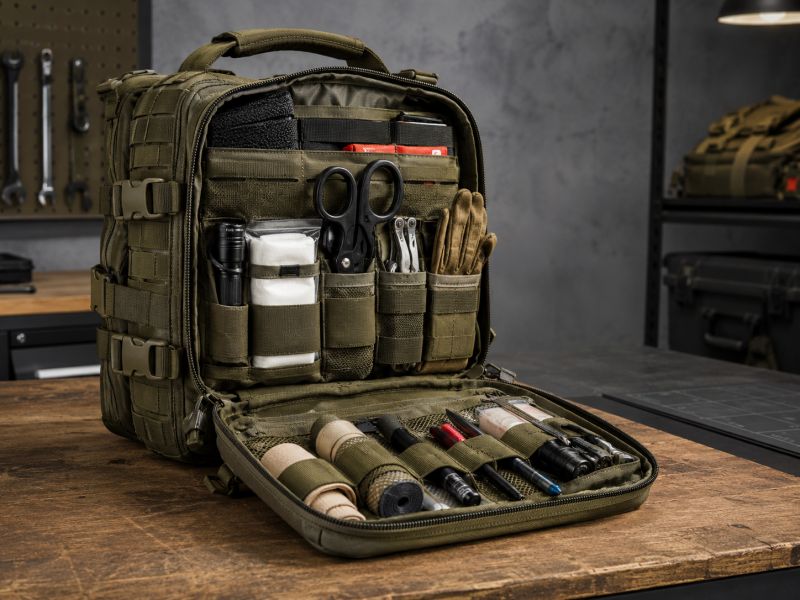
An emergency kit bag is usually judged in the wrong way. Many teams first ask how large it should be, how many pockets it has, or whether it looks tactical enough. Those details matter, but they are not the real starting place. The better starting place is much more practical: can the right item be found quickly when the user is tired, wet, rushed, wearing gloves, standing beside a vehicle, helping at an event, or moving through an outdoor setting?
A strong tactical gear bag for emergency kits is not just a bag with more compartments. It is a storage system that helps people act faster and stay organised under pressure. Medical supplies, lighting, tools, documents, food, water, chargers, radios, gloves, and personal items should not fight for space in one dark main compartment. The layout should guide the hand before the mind has time to panic.
Tactical gear bags for emergency kits should be designed around access, clarity, and movement. A good layout helps users separate medical items, lighting, tools, documents, water, communication gear, and personal supplies without wasting time searching. For rescue and preparedness projects, the bag is not only a container. It is an organized response system that must be easy to carry, easy to identify, and consistent in bulk production.
For emergency kit brands, outdoor gear companies, safety programs, schools, event teams, and private label projects, this changes the way the bag should be developed. Fabric, lining colour, zipper pullers, MOLLE panels, inner mesh pockets, label windows, elastic loops, insert cards, and carton marks all become part of the same goal: make the kit easier to prepare, easier to use, and easier to repeat in larger orders.
What Is A Tactical Gear Bag For Emergency Kits?
A tactical gear bag for emergency kits is a structured bag designed to store, separate, identify, and carry emergency supplies for rescue, preparedness, outdoor safety, vehicle kits, school programs, workplace plans, or private label kit projects. It may use MOLLE panels, clear pockets, elastic loops, labels, reinforced handles, and durable fabric so items stay visible, stable, and quick to reach.
A regular bag holds things. An emergency kit bag helps users find things when time matters.
That difference sounds small until the kit is used in real life. A dark duffel with one large compartment may work for storage, but it becomes frustrating when a user needs gloves, flashlight, gauze, scissors, tape, power bank, ID card, or radio quickly. A better design reduces decision time. The bag tells the user where to look.
This is why the topic should not be treated as only a product style. It is also a layout decision, a safety program decision, a packing decision, and a repeat-order decision. If the same emergency kit bag needs to be produced for 500, 1000, or 5000 sets, every pocket, label, colour, and packing rule should be clear enough to repeat.
For Jundong, this type of project is usually reviewed through intended use, kit contents, bag size, material, inner layout, logo method, label needs, packaging, quantity, and delivery plan. The earlier these details are shared, the easier it is to turn a rough idea into a sample that can become a stable bulk product.
Rescue Use Vs Preparedness Use
Rescue use and preparedness use are related, but they are not the same.
A rescue gear bag often focuses on fast response. It may need medical zones, tool zones, gloves, scissors, trauma-style pouches, reflective details, strong handles, and quick access. The user may be moving quickly, working outdoors, or helping others.
A preparedness bag often focuses on readiness before an event happens. It may be used for home kits, car kits, school kits, workplace kits, camping kits, community programs, or event safety packs. The user may not be a trained responder, so the layout must be easy to understand.
The design should match the use.
| Use Type | Main Need | Layout Focus |
|---|---|---|
| Rescue gear bag | Fast action | Quick access, clear zones, strong handles |
| Home preparedness bag | Easy family use | Simple labels, visible pockets, balanced weight |
| Car emergency kit | Compact storage | Heat-aware material, flat packing, fast grab |
| School safety kit | Group access | Clear labels, content card, colour zones |
| Event safety kit | Public setting support | Easy carry, visible ID, front quick pocket |
| Outdoor emergency pack | Movement and weather | Water-resistant fabric, MOLLE, reinforced base |
A kit bag can serve more than one use, but it should still have a primary role. If everything is treated as equally important, the layout becomes crowded.
What Should Be In A Tactical Go Bag?
A tactical Go Bag usually holds supplies that help users move, communicate, stay visible, treat minor injuries, manage basic tools, and handle short-term disruption. Common categories include first aid items, gloves, flashlight, batteries, power bank, radio, whistle, emergency blanket, water, compact food, multi-tool, tape, document pouch, personal medication, and basic hygiene items.
For a bag factory, the important part is not deciding the medical or survival content for the user. That should depend on the project owner, local rules, training level, target setting, and intended use. The factory’s role is to design a bag that stores the planned items clearly and safely.
This means the Go Bag layout should be built around categories:
| Category | Suggested Bag Area |
|---|---|
| First aid supplies | Front quick-access pocket or red-labelled inner zone |
| Lighting | Elastic loops or small top pocket |
| Tools | Reinforced pocket or side pouch |
| Communication | Padded pocket or easy-access compartment |
| Documents | Flat waterproof-style pouch or zip pocket |
| Water and food | Main compartment or side section |
| Personal items | Separated zip pouch |
| Batteries and chargers | Mesh pocket or labelled small pouch |
The goal is not to fill every corner. The goal is to make the most important items easy to reach.
What Are The 5 P’s Of Emergency Preparedness?
The 5 P’s are often used as a simple way to think about emergency readiness: People, Prescriptions, Papers, Personal needs, and Priceless items. For bag layout planning, they are useful because they turn a long supply list into human-friendly zones.
People means the kit should match who will use it. A family kit, school kit, outdoor team kit, and workplace kit may need different capacity and labels.
Prescriptions means small, sensitive, or personal medical items may need separated pockets. The bag should help keep them visible but protected.
Papers means documents, ID copies, emergency contacts, maps, or instruction cards may need a flat, easy-to-find pocket.
Personal needs means hygiene items, chargers, eyeglasses, child items, or comfort items may need their own zone.
Priceless items means small valuables or important personal items may need a secure zip pocket.
This is where bag design becomes more than storage. A good emergency kit layout helps users remember what matters.
What Makes An Emergency Kit Bag Project-Ready?
An emergency kit bag becomes project-ready when the layout, materials, trims, labels, logo, packing method, and quantity are clear enough for sample development.
A rough concept may begin with “We need an emergency Go Bag.” A project-ready brief says more: 30L backpack, orange lining, front medical pocket, elastic loops for flashlight and scissors, side MOLLE pouch, reflective strip, woven logo patch, content checklist card, barcode label, 500 pcs, packed one piece per polybag and outer carton by SKU.
That level of detail allows the factory team to review cost, sample time, material suitability, and production risk.
It also prevents a common mistake: approving a bag that looks useful when empty but does not fit the planned kit contents after packing.
How Should An Emergency Kit Bag Be Laid Out?
An emergency kit bag should be laid out by priority, visibility, weight, and use scene. Fast-access items belong near the front or top. Heavy items should sit closer to the body or lower center. Small supplies need mesh, elastic, or zip pockets. Labels, colour zones, and clear windows help users find items faster during rescue or preparedness use.
A good layout removes confusion.
That does not mean adding as many pockets as possible. Too many pockets can create a new problem: the user forgets where things are stored. In bulk projects, too many small pockets also increase sewing time, inspection work, and cost.
The best layout usually has a clear hierarchy. Urgent items go where the hand naturally reaches first. Heavy items are placed where they do not pull the bag out of balance. Small items are fixed or visible. Important documents stay flat. Wet or dirty items stay separated if needed. The bag opens wide enough to show the kit without everything falling out.
This is why layout should be discussed before sampling, not after. Once the pattern, zipper path, pocket sizes, and panel structure are built, late changes can affect cost, timing, and production consistency.
What Should Go In The Fast-Access Zone?
The fast-access zone should hold items that may be needed first. Depending on the kit, this may include gloves, flashlight, small first aid pouch, scissors, tape, whistle, emergency contact card, radio, or compact tool.
For a backpack, fast-access zones often include the top pocket, front pocket, or outer pouch. For a duffel, it may be an end pocket or top-opening panel. For a waist bag or sling, it may be the front zip pocket.
The fast-access zone should not be too deep. If users need to dig, it is not truly fast access.
Useful fast-access features include:
| Feature | Why It Helps |
|---|---|
| Wide zipper opening | Easier to see and grab items |
| Bright lining | Improves visibility in low light |
| Elastic loops | Holds tools in fixed positions |
| Mesh pocket | Shows contents quickly |
| Label patch | Helps identify the zone |
| Large zipper puller | Easier with gloves or cold hands |
Which Items Need Separate Pockets?
Separate pockets are useful for small, sensitive, sharp, dirty, or frequently used items.
Batteries should not float around with medical supplies. Scissors or tools should not damage soft items. Documents should not bend inside a crowded main compartment. Personal medication should be easy to locate. Small items like tape, pins, cable, charger, or whistle need a fixed place.
The goal is not to over-separate everything. The goal is to prevent the items most likely to get lost, damaged, or urgently needed from disappearing inside the bag.
For brand projects, removable pouches can be a good solution. They allow the main bag to stay simple while giving certain categories their own modules.
How Should Heavy Items Be Positioned?
Heavy items should be positioned close to the body and low enough to keep the bag stable. If heavy items sit too far from the back, the pack can pull on the shoulders. If they sit too high or loose, the bag may feel unstable.
For backpack-style emergency kits, heavier water, tools, power banks, or compact supplies usually work better near the back panel or lower main compartment. For duffel-style bags, weight should be spread evenly so the bag does not twist when carried by the handle.
The structure should support the load. That may require stronger fabric, reinforced bottom, webbing handles, padded shoulder straps, or extra stitching at stress areas.
When Does A Layout Become Too Complicated?
A layout becomes too complicated when it looks organized on paper but slows the user down in real life.
Warning signs include too many tiny pockets, unclear zones, similar-looking pouches, hidden items without labels, hard-to-open zippers, and compartments that block each other.
Complexity also affects production. Each pocket needs cutting, sewing, inspection, and cost. Each label needs placement control. Each insert or pouch needs packing control.
For emergency kit bags, simple and clear often works better than complex and impressive.
If a layout cannot be explained in one quick product photo or one insert card, it may need to be simplified.
Which Bag Type Works Best For Emergency Kits?

The best bag type for an emergency kit depends on who uses it, where it is stored, how fast it must move, how heavy the contents are, and how the kit will be packed. Backpacks work well for hands-free carry. Duffel bags suit larger kits. Waist bags, sling bags, and pouches work well for compact or role-specific modules.
The bag type should be chosen after the kit contents are known.
This is a practical rule that saves a lot of trouble. If the bag is chosen first, the contents may not fit properly. If the contents are planned first, the bag can be built around them.
A home emergency kit may need a simple backpack or duffel. A vehicle kit may need a compact bag that fits under a seat or in the trunk. A rescue kit may need a backpack with fast access and MOLLE. A school or event kit may need labels, bright lining, and clear inventory card. A medical pouch may need elastic loops and a clamshell opening.
Backpack Vs Duffel Bag For Emergency Kits
Backpacks are useful when users need to carry the kit while keeping hands free. They are good for evacuation, outdoor programs, school kits, community response, camping, and mobile preparedness.
Duffel bags are useful when the kit is larger, stored in one location, or carried short distances. They offer wide access and can hold bulky items, but may be less comfortable for longer movement.
| Bag Type | Best For | Watch Carefully |
|---|---|---|
| Backpack | Hands-free movement, evacuation, outdoor use | Shoulder comfort, back panel, weight balance |
| Duffel bag | Larger kits, vehicle kits, team supplies | Handle strength, inner separation, heavy load |
| Sling bag | Fast access, compact field use | Limited capacity, one-shoulder load |
| Waist bag | Small first response items | Very limited space |
| Medical pouch | Category module inside a larger kit | Needs clear attachment or colour coding |
Waist Bag, Sling Bag, Or Medical Pouch?
Small formats work best when the kit has a narrow role.
A waist bag can carry gloves, tape, compact first aid items, or small tools. A sling bag gives quick front access and works well for lightweight rescue or event support. A medical pouch can be attached to a MOLLE bag or packed inside a larger emergency kit.
These smaller bags should not be overloaded. Once the contents become too heavy, a backpack or duffel becomes more practical.
What Type Of Bag Fits Car Emergency Kits?
A car emergency kit bag should be compact, durable, easy to store, and easy to grab. It may be placed in a trunk, under a seat, or in a vehicle storage area.
Useful design choices include flat shape, reinforced handle, water-resistant fabric, bright lining, clear label window, and simple inner separation. If the kit includes tools, jumper cables, reflective vest, flashlight, or first aid items, the internal structure should prevent hard items from damaging soft supplies.
For vehicle programs, packing size also matters because carton efficiency and shipping cost can change quickly when the bag becomes bulky.
Which Layout Fits Family, School, Or Event Kits?
Family kits should be easy for non-trained users to understand. Clear labels, colour zones, and content cards are helpful.
School kits may need group-use organization, inventory labels, and easy checking. Event kits often need quick access, visible identity, and lightweight carry.
For these projects, the bag should not feel too tactical or intimidating unless that is part of the brand direction. A preparedness bag can be strong and practical while still looking friendly and clear.
How Can Rescue Gear Stay Easy To Find?
Rescue gear stays easy to find when the bag uses visible zones, simple pocket logic, clear labels, bright lining, elastic fixing, mesh pockets, and glove-friendly openings. The layout should guide the user naturally: urgent items near the front, small items visible or fixed, documents flat, tools separated, and heavier items placed where they do not disturb carry balance.
The biggest problem with many emergency bags is not that they are too small. It is that everything disappears inside them.
A user opens the bag and sees black fabric, loose pouches, mixed items, cables, small tools, first aid supplies, folded papers, gloves, and bottles all competing for attention. That may be fine in storage. It is not fine in a rushed situation.
Good rescue gear layout works like a map. It does not need to be fancy. It needs to be obvious. If a new team member, family member, staff member, or volunteer can understand the bag in a few seconds, the layout is doing its job.
For custom emergency kit projects, visibility can be improved through lining colour, pocket material, zipper puller colour, printed inner labels, woven labels, PVC windows, transparent pouch covers, and replaceable content cards.
Clear Mesh Pockets And Transparent Windows
Mesh pockets help users see what is inside without opening every pocket. They work well for gloves, bandages, tape, cables, small tools, hygiene items, and personal supplies.
Transparent windows can be useful for label cards, content lists, ID panels, inspection records, or category names.
But visibility should be balanced with durability. Mesh pockets are helpful, but they are not ideal for sharp or heavy tools unless reinforced. Transparent PVC windows are useful, but they should be placed where they will not be scratched heavily during normal use.
For emergency kit bags, a good rule is simple: make small, soft, and category-based items visible; protect hard, sharp, or heavy items in stronger zones.
Elastic Loops For Tools And Small Supplies
Elastic loops are useful for items that need to stay fixed in one position. They can hold flashlight, scissors, penlight, marker, small tools, tourniquet-style items if required by the project owner, or compact supplies.
The challenge is tension.
If the elastic is too loose, items fall out. If it is too tight, users struggle to remove items quickly. If all loops are the same size, some items fit poorly.
For custom projects, elastic loop size should be tested with the actual or planned contents before sample approval. A small change in item diameter can make a loop feel wrong.
Color-Coded Zones And Label Panels
Colour is one of the easiest ways to make an emergency kit easier to understand.
A red zone can suggest medical supplies. Orange lining can improve visibility. Grey or black zones can hold tools. Blue or white labels can be used for documents, hygiene, or personal items depending on brand style.
Label panels also help. A small woven label, printed patch, rubber patch, or insert card pocket can tell users what belongs in each area.
For brand projects, colour and labels should be planned carefully. They affect the user experience, but they also affect production records, packing checks, and repeat orders.
Glove-Friendly Zippers And Pullers
In rescue, outdoor, vehicle, or event use, users may wear gloves or have wet hands. A tiny zipper puller may look neat in photos, but it can be frustrating in real use.
Larger pullers, cord pullers, rubber pull tabs, or shaped zipper pulls can improve access.
Zipper path also matters. A pocket that opens wide is easier to use than a tight corner pocket. A clamshell opening can make the full kit visible. A top opening can work well for quick grab items. The best option depends on the kit type and use scene.
How Does MOLLE Improve Emergency Kit Bags?
MOLLE improves emergency kit bags by allowing users to attach, remove, or rearrange pouches for medical supplies, tools, bottles, radios, gloves, or other role-based modules. It helps one base bag serve different rescue or preparedness needs. However, MOLLE should be used only where it improves access or expansion, not as decoration.
MOLLE can be powerful when the kit needs flexibility.
A school safety kit, vehicle kit, outdoor rescue pack, and event response bag may share the same base bag but need different add-on modules. MOLLE allows those modules to be attached outside or moved between bags.
But MOLLE is not always needed. It adds material, sewing time, inspection work, and cost. It can also make the bag look too aggressive for some family, school, corporate, or public-facing preparedness projects.
The right decision is not “MOLLE or no MOLLE.” The right decision is “What should be modular, and why?”
What Is MOLLE Used For In Rescue Bags?
In rescue bags, MOLLE can be used for detachable medical pouches, tool pouches, radio holders, glove pouches, flashlight holders, bottle pouches, or identification panels.
It can also allow teams to separate roles. One pouch may hold medical supplies. Another may hold tools. Another may hold communication items. This helps users grab a module without opening the whole bag.
For bulk projects, MOLLE placement should be consistent. If the spacing or stitching changes in production, attached pouches may not sit properly.
Detachable Pouches For Medical Or Tool Modules
Detachable pouches are useful when different users need different parts of the kit.
For example, a base emergency backpack may contain food, water, documents, and personal supplies. A detachable front pouch may contain first aid items. A side pouch may contain flashlight, gloves, or tools.
This structure helps the kit stay flexible. It also helps brands sell add-on modules or build different kit versions from the same base bag.
When developing detachable pouches, the attachment method, weight, zipper direction, label position, and user access should be checked during sampling.
Side MOLLE, Front MOLLE, And Patch Areas
Front MOLLE is useful for main add-on pouches. Side MOLLE can support bottles, small tool pouches, or radio-style pouches. Patch areas can hold ID labels, brand patches, or category marks.
A patch area may use hook-and-loop, woven patch, rubber patch, or printed label depending on the project.
For preparedness bags that should look more friendly, a small patch area may be better than full tactical webbing. For rescue or outdoor use, stronger MOLLE areas may make more sense.
When Is MOLLE Not Necessary?
MOLLE is not necessary when the bag has a fixed kit layout, simple family use, school use, corporate preparedness use, or retail packaging where simplicity matters more than modularity.
If all contents are already planned and do not need to move, fixed inner pockets may work better. They are lighter, cleaner, and often easier to inspect.
MOLLE should earn its place. If it does not improve the way the kit is used, stored, carried, or expanded, it may be unnecessary.
Which Materials Work Best For Preparedness Bags?
Preparedness bags work best with materials that balance durability, weight, water resistance, easy cleaning, shape support, and cost. Common options include 600D Oxford for practical kit bags, heavier Oxford fabrics for tool or rescue use, coated fabrics for better water resistance, bright lining for visibility, and reinforced panels for handles, base, and high-wear areas.
Material choice should always follow use.
A home emergency bag stored in a closet does not need the same fabric as an outdoor rescue gear bag dragged across wet ground. A car emergency kit may need compact shape and heat-aware material choices. A school or corporate kit may need clean appearance, clear labeling, and easy checking. A heavy tool or rescue kit needs stronger structure and reinforcement.
The fabric is only one part of the material system. Lining, mesh, elastic, webbing, zipper, buckle, foam, thread, label material, reflective trim, and reinforcement fabric all affect final use.
600D, 900D, 1000D, And 1680D Options
600D Oxford is a practical starting material for many emergency kit bags. It is widely used, cost-friendly, and suitable for many preparedness, outdoor, school, event, and private label projects.
900D or 1000D options can give a stronger hand feel and more rugged appearance. They may fit rescue, outdoor, or utility kits that carry heavier contents.
1680D Oxford is thicker and more structured. It can be useful for reinforced areas, tool kits, heavy-duty handles, bottom panels, or more rugged programs.
| Material Option | Best Fit | Watch Carefully |
|---|---|---|
| 600D Oxford | General emergency kits, school kits, retail kits | Add reinforcement for heavy contents |
| 900D Oxford | Stronger outdoor or preparedness bags | Higher cost and weight |
| 1000D Fabric | Rugged rescue or tactical-style projects | Can feel heavy for daily carry |
| 1680D Oxford | Tool zones, bottom panels, heavy-duty bags | Less flexible, higher material cost |
| Coated fabric | Water-resistant projects | Hand feel, smell, sewing, and cost |
| High-visibility lining | Fast item finding | Colour consistency in bulk |
Water-Resistant Fabric Vs Waterproof Structure
Water-resistant fabric can help protect contents from light rain, splashes, or damp environments. But it does not make the full bag waterproof.
A bag has seams, zipper paths, stitch holes, openings, and pockets. Water can enter through those areas. If a project needs stronger water protection, the full structure should be reviewed, including fabric coating, seam design, zipper type, flap coverage, and intended use.
For most emergency kit bags, water-resistant fabric is practical. Fully waterproof construction may increase cost and change the bag style.
The right wording and development target should be clear from the start.
Easy-Clean Lining And High-Visibility Interiors
Easy-clean lining is useful for emergency kits, safety programs, outdoor events, and public-use bags. It helps remove dust, dirt, or light surface marks.
High-visibility interiors are often underrated. A black exterior may look tactical, but a black interior can hide small items. Orange, grey, red, or other brighter lining colours can help users find supplies faster.
The lining should match the use and cost target. A bright lining may slightly change the product look and material planning, but it can improve user experience significantly.
Reflective Details, Reinforced Handles, And Bottom Panels
Reflective details can help with night use, vehicle kits, outdoor response, or event safety. They do not need to be excessive. A small reflective strip, puller, patch, or trim can be enough.
Handles and bottom panels need special care. Emergency kit bags often carry dense items: tools, water, batteries, power banks, documents, or grouped supplies. The bag may look small but become heavy quickly.
Reinforced handles, extra stitching, webbing support, and stronger bottom panels can prevent failure in real use.
How Should A Factory Develop A Custom Emergency Kit Bag?
A custom emergency kit bag should be developed from the planned contents, use scene, layout needs, material choice, label system, logo method, packing rule, quantity, and delivery plan. The factory should review whether the bag can hold the kit, keep urgent items accessible, carry weight safely, and be repeated consistently in bulk production.
A good project starts with what the kit must do.
Not every brand has a finished drawing. That is fine. Some projects begin with a reference photo. Some begin with a product list. Some begin with a target size. Some begin with a current sample that needs improvement.
The factory’s job is to help turn that input into a workable bag structure. This includes pattern, pocket layout, material suggestions, zipper direction, handle strength, label positions, packaging, and sample details.
For Jundong, emergency kit bag projects can be reviewed through design, materials, sampling, bulk production, quality checks, labels, packaging, and delivery needs. Standard MOQ is usually 500 pcs per design, while some simple styles may be reviewed at 200–300 pcs depending on the project.
How To Make An Emergency Kit Bag For A Brand Project
To make an emergency kit bag for a brand project, begin with the contents and use scenario. Then decide the bag type, size, carry method, inner zones, fast-access pocket, label system, material, logo, packaging, and carton rules.
A practical development path may look like this:
| Step | What To Decide |
|---|---|
| 1 | Who will use the kit |
| 2 | What contents must fit |
| 3 | Which items need fast access |
| 4 | Backpack, duffel, pouch, sling, or waist bag |
| 5 | Material, lining, zipper, handle, and webbing |
| 6 | Logo, labels, content card, and colour zones |
| 7 | Sample review with planned contents |
| 8 | Packing rules for bulk order |
This keeps the design useful and avoids random pocket building.
What Should Brands Send Before Sampling?
Before sampling, send reference photos, layout sketch, planned kit contents, target use, size, material preference, logo file, label needs, quantity, packing rule, destination, and delivery timeline.
If the contents are not final, send categories instead: first aid, lighting, tools, documents, water, communication, personal items, or school safety supplies.
Even a simple hand sketch can be useful if it shows which items need fast access and which items can stay in the main compartment.
How Are Layout, Fabric, And Use Reviewed?
Layout, fabric, and use should be reviewed together.
If the contents are heavy, the fabric, handle, straps, and bottom need support. If the kit needs quick response, the front pocket and labels matter. If it is a family preparedness kit, the layout should be simple. If it is for outdoor rescue, MOLLE, reflective trim, and reinforced areas may matter more.
The review should not only ask whether the bag can be made. It should ask whether the bag can be used, packed, checked, shipped, and reordered smoothly.
How Long Does A Custom Sample Usually Take?
For many custom bag projects, Jundong sampling usually takes 5–7 days. Some simple styles may take 2–3 days depending on materials, structure, logo method, and sample complexity.
Emergency kit bags with multiple compartments, elastic loops, clear windows, custom labels, MOLLE pouches, reflective trims, or retail packing details may need more careful sample review.
A fast sample is helpful, but only if it checks the right things.
What Should Be Checked Before Sample Approval?
Before approving the sample, place the planned contents inside the bag.
Check whether the main compartment fits the bulkier items. Check whether fast-access items are easy to reach. Check whether mesh pockets are visible. Check whether elastic loops hold items properly. Check whether the handle feels secure when loaded. Check whether the zipper opens smoothly. Check whether the label position makes sense.
Also check packing: polybag size, insert card, barcode label, carton quantity, SKU rule, and carton mark.
A sample should be approved as a working kit bag, not only as an empty bag.
What Affects Tactical Emergency Bag Price?
Tactical emergency bag price is affected by size, fabric, pocket quantity, layout complexity, MOLLE, elastic loops, mesh pockets, clear windows, zipper quality, handle strength, reinforcement, logo method, labels, insert cards, packaging, MOQ, sample needs, and bulk quantity. Cost can be controlled by simplifying unnecessary details while protecting function and strength.
Price is not just about fabric.
Two emergency kit bags may look similar from outside, but one may have ten inner pockets, clear windows, elastic boards, reinforced handles, and multi-SKU labels. The other may have one main compartment and two pockets. Their cost will not be the same.
The smartest cost control is not to remove important features. It is to remove features that do not help the user.
Size, Compartments, And Layout Complexity
Size affects fabric use and packing volume. Compartments affect cutting and sewing time. Complex layouts also increase inspection steps.
More pockets can be useful, but each pocket needs to earn its place.
If the kit contents are fixed, the layout can be designed around those items. If the contents may change, modular pouches may be better than too many fixed pockets.
Fabric, MOLLE, Zippers, And Reinforcement
Fabric affects material cost, weight, appearance, and durability. MOLLE adds webbing, sewing, and inspection work. Zippers affect user experience. Reinforcement affects strength and safety in loaded use.
For emergency kit bags, handles and zipper quality should not be treated as minor details. These are parts users touch first.
Logo, Labels, Insert Cards, And Packaging
Logo and label details can be simple or premium. Options may include woven label, rubber patch, embroidery, heat transfer, screen print, PVC patch, or printed insert card.
Packaging can also affect cost. A simple polybag is different from a retail-ready kit pack with barcode, content card, warning label if required, FBA label, SKU sticker, and carton-level packing rule.
MOQ, Sample Cost, And Bulk Quantity
Jundong’s standard MOQ is usually 500 pcs per design. Some simple styles can be reviewed at 200–300 pcs based on the project. Lower quantities may have higher unit cost because custom materials, cutting, sewing setup, logo process, and packing setup still need to be prepared.
Sample fees can be refunded or deducted when the order reaches 2000 pcs.
For a practical project review, send your bag reference, planned kit contents, size, logo, quantity, packing needs, and destination to info@jundongfactory.com.
Why Is Sample Approval Important For Kit Bags?

Sample approval is important because an emergency kit bag must be checked with planned contents, not only as an empty bag. The sample should confirm fit, access, pocket size, elastic tension, label clarity, zipper function, handle strength, carrying comfort, packing method, and repeatable production details before bulk order starts.
An empty emergency bag can look perfect on a table.
The real test begins when the kit contents go inside.
A pouch that looks roomy may not fit the planned item. An elastic loop may be too tight for a flashlight. A mesh pocket may hide the label when filled. A front pocket may become hard to close after gloves and tape are packed. A handle may feel fine when empty, then feel weak when the bag is loaded.
That is why sample approval should be treated as a working review, not a photo review. The sample should be packed, opened, carried, checked, and adjusted before it becomes the production reference.
Can The Bag Fit The Planned Kit Contents?
The first check is simple: does everything fit without forcing the bag out of shape?
Place the planned contents inside the sample. Check the main compartment, front pocket, side areas, inner mesh pockets, elastic loops, and detachable pouches.
If the bag bulges badly, the size may need adjustment. If the contents move too much, more fixing or separation may be needed. If the bag becomes hard to zip, the opening or pocket size may need review.
Fit is not only about capacity. It is about whether the contents sit in a usable way.
Are Fast-Access Items Easy To Reach?
Fast-access items should be reachable without emptying the bag.
Open the sample as a user would open it in a rush. Can the user find gloves, flashlight, small tool, first aid pouch, radio, document card, or other urgent items quickly? Can the zipper be pulled smoothly? Can the pocket open wide enough? Can the item be removed with one hand?
If the bag needs an instruction card just to explain where basic items are, the layout may be too complicated.
A good fast-access layout feels natural.
Are Labels, Colors, And Zones Clear?
Labels and colour zones should reduce confusion, not create decoration.
Check whether the label position is easy to see after packing. Review whether the colour coding makes sense. Check whether the inner lining gives enough contrast. Confirm whether content cards, patch areas, or clear windows are visible when the bag is full.
For school, event, company, or family preparedness programs, clear labels can make the bag usable by more people, not only trained users.
Can The Approved Sample Become A Bulk Standard?
The approved sample should become the standard for bulk production. That means the material, colour, lining, logo, pocket sizes, zipper direction, elastic tension, MOLLE spacing, label position, packing rule, and carton mark should be recorded clearly.
If the approved sample has unclear details, bulk production can become inconsistent.
For emergency kit projects, consistency matters because one order may include many bags, many kits, or several SKU versions. A small packing mistake can create big receiving problems later.
How Is Bulk Quality Controlled?
Bulk quality is controlled by checking materials, lining, trims, sewing, zippers, handles, straps, mesh pockets, elastic loops, MOLLE, labels, barcodes, packing rules, and carton marks across different production stages. For emergency kit bags, the goal is not only a good-looking bag, but a bag that can be packed, carried, identified, and repeated accurately.
Emergency kit bags have many small details.
A simple tote may only need fabric, handle, logo, and basic sewing checks. A tactical emergency bag may include several compartments, elastic loops, mesh panels, clear windows, MOLLE areas, label patches, insert cards, barcodes, and mixed carton rules.
That means quality should be controlled early, not only at the end.
If a mesh pocket is the wrong size, it should be caught before hundreds of pieces are finished. If a barcode label is placed on the wrong bag, it should be caught before cartons are sealed. If elastic tension is wrong, it should be caught during assembly, not after the full order is packed.
Fabric, Lining, And Trim Checks
Incoming material checks are the first line of control.
Fabric should be reviewed for colour, coating, thickness, texture, and visible defects. Lining should match the approved colour and feel. Mesh should be strong enough for its intended pocket use. Elastic should have the correct width and tension. Webbing, zippers, buckles, labels, patches, and pullers should match the confirmed sample.
For emergency kit bags, lining colour is especially important. A high-visibility interior only works if the colour stays consistent across production.
Zipper, Handle, Strap, And Seam Review
Zippers should open smoothly and follow the correct path. Handles should feel secure when loaded. Shoulder straps should sit comfortably if the bag is designed for carry. Seams should be clean and stable.
High-stress areas need extra attention:
| High-Stress Area | What To Check |
|---|---|
| Handle ends | Webbing strength, stitch density, reinforcement |
| Shoulder strap roots | Pull resistance, bartack placement, comfort |
| Bottom corners | Wear resistance, shape support |
| Zipper ends | Clean finish, smooth movement |
| MOLLE ends | Stitch strength, spacing, panel support |
| Side seams | Load stability and shape control |
A good kit bag should not only look tidy. It should feel safe when lifted, carried, opened, and packed.
Mesh Pocket, Elastic Loop, And MOLLE Inspection
Mesh pockets should be clean, visible, and securely sewn. Elastic loops should hold planned items without being too loose or too tight. MOLLE should have consistent spacing and strong stitching.
These details may seem small, but they are exactly what users notice first.
A loose elastic loop makes the bag feel unreliable. A tight loop slows access. A weak mesh pocket tears early. Uneven MOLLE makes add-on pouches sit poorly.
For repeat orders, these small details should be part of the inspection checklist.
Barcode, SKU, Packing, And Carton Mark Checks
Packing accuracy is part of quality.
Emergency kit projects often involve multiple colours, kit types, labels, content cards, or shipment destinations. A bag can be well made, but if the wrong barcode or SKU label is applied, the order can still create problems.
Packing checks may include:
| Packing Item | Why It Matters |
|---|---|
| Barcode label | Helps scanning and receiving |
| SKU label | Prevents model or colour mix-ups |
| Content checklist card | Helps users and kit programs verify contents |
| Insert card | Explains use, layout, or brand message |
| Polybag | Protects the bag during storage and shipment |
| Carton mark | Helps warehouse sorting and delivery |
| Mixed packing rule | Prevents kit version confusion |
The final product is not only the bag. It is the bag packed correctly.
What Packaging Do Emergency Kit Projects Need?

Emergency kit projects may need polybags, hangtags, instruction inserts, content checklist cards, label windows, barcode labels, SKU labels, carton marks, FBA labels, retail labels, school program labels, company project labels, or multi-kit packing rules. Good packaging keeps the order organised from factory floor to warehouse, retail shelf, event team, or end user.
Packaging is often discussed too late.
That is a mistake.
For emergency kit bags, packaging can affect how the product is received, stored, distributed, checked, and used. A private label kit may need retail-ready presentation. A school project may need clear kit identification. A company preparedness program may need department labels. An online order may need barcode and carton rules. A community relief program may need easy sorting by kit type.
Packaging should be planned with the bag, not after the bag is finished.
Polybag, Hangtag, And Instruction Insert
A polybag protects the bag from dust and handling during storage and shipment. It can be simple or printed depending on the brand direction.
A hangtag can show logo, product name, series name, material, or basic use information.
An instruction insert can explain the layout, suggested content categories, inspection date, or how to repack the bag after use. For emergency kit programs, this can be very useful because it helps different users understand the same layout.
Content Checklist Card And Label Window
A content checklist card helps users confirm what belongs in the kit.
This is especially useful for school, workplace, vehicle, outdoor, or community preparedness programs. The checklist can be placed inside the bag, attached to a pouch, or stored in a clear window.
A label window can also show kit type, department, family member name, vehicle number, event team, or SKU code.
For private label projects, the content card can also improve product experience and reduce confusion after delivery.
Barcode, SKU, And Multi-Kit Packing Rules
If the project has multiple versions, barcode and SKU planning is essential.
For example, one program may include a home kit, car kit, school kit, and outdoor kit. The bags may look similar but contain different layouts or labels. Without clear SKU control, packing mistakes become easy.
A good multi-kit packing rule should define bag version, label, quantity per carton, mixed carton rule, carton mark, barcode position, and shipment destination.
FBA, Retail, School, Or Corporate Packing Needs
Different channels need different packing details.
Retail may need hangtags, barcodes, product labels, and display-friendly folding. Online fulfillment may need polybag rules, barcode labels, carton labels, and SKU separation. School or company projects may need kit labels, department names, content cards, or distribution lists.
Packaging should support the way the kit will move after it leaves the factory.
How To Choose A Tactical Gear Bag Factory?
A good tactical gear bag factory should understand emergency kit layout, material choice, MOLLE structure, fast-access design, labels, sample review, bulk quality checks, and packing accuracy. The right partner should help turn kit contents and use scenarios into a practical bag that can be sampled, packed, shipped, and reordered with stable quality.
Choosing a factory for emergency kit bags is not the same as choosing a ready-made bag from a catalogue.
A ready-made option may work for simple use. But if the project needs custom compartments, labels, brand logo, content card, MOLLE pouch, colour zones, barcode packing, or different kit versions, deeper development support is needed.
The factory should ask about contents, use scene, weight, label needs, material, logo, quantity, packing, and delivery. These are useful. They show the project is being reviewed properly.
Jundong is a Guangdong-based custom bag factory with 20+ years of OEM/ODM experience, supporting custom bag projects from design, material review, sampling, bulk production, quality checks, packaging, labelling, and delivery.
Who Understands Emergency Kit Layout?
A strong factory understands that emergency kit layout is not just pocket quantity.
It should be able to discuss fast-access zones, mesh pockets, elastic loops, main compartment space, detachable pouches, labels, and packing rules. It should understand why a school kit, car kit, rescue kit, and outdoor kit may need different structures.
If the factory only asks for a photo and gives a price immediately, important details may be missed.
Do They Support OEM And ODM Projects?
OEM projects usually begin with existing samples, drawings, or clear specifications. ODM projects may begin with a concept, use scene, or rough reference.
Both can work for emergency kit bags.
If the brand already has a layout, the factory can review feasibility, material, structure, and cost. If the brand only has planned contents, the factory can help turn those contents into a sample direction.
Are They Strong In Sampling And QC?
Sampling confirms whether the idea works. Quality checks confirm whether the idea can be repeated.
For emergency kit bags, both are important.
A sample should be tested with planned contents. Bulk production should check pocket size, zipper function, elastic tension, MOLLE spacing, labels, barcodes, packing rules, and carton marks.
Strong QC is especially valuable when the project has multiple kit versions.
Can They Support Long-Term Kit Programs?
A long-term kit program may need repeat orders, updated contents, new labels, seasonal versions, different colours, or new bag sizes.
That requires stable records. Material records, logo records, layout notes, packing rules, and carton details should be saved for repeat production.
A good factory should not only make one order. It should help the product line stay consistent as the program grows.
What Should Send For A Quote?
For an accurate tactical emergency kit bag quote, send a reference photo or layout sketch, planned kit contents, use scenario, size, material needs, logo file, label requirements, quantity, packing rules, destination, and delivery deadline. The clearer the brief, the better the sample direction, cost review, and production plan.
A short inquiry can start the conversation.
But a clear inquiry saves time.
Emergency kit bags are full of variables. The price changes when the fabric changes, when the layout changes, when MOLLE is added, when elastic loops are needed, when labels are customized, or when packing rules become more complex.
If possible, prepare the project around the actual kit contents. This helps the factory review whether the bag size and layout are realistic.
Reference Photo Or Layout Sketch
A reference photo shows the preferred style. A layout sketch shows how the bag should work.
The sketch does not need to be beautiful. It only needs to show the main compartments, front pocket, inner pockets, MOLLE areas, label areas, or special access zones.
If you already have an existing sample, photos of the sample can also help.
Target Kit Contents And Use Scenario
Send the planned contents or at least the content categories.
For example: medical items, gloves, flashlight, radio, water, food, documents, charger, tools, hygiene items, or school safety items.
Also explain the use scenario: rescue, home preparedness, car kit, outdoor safety, school program, company project, event kit, or private label retail.
This helps decide bag type, size, fabric, and layout.
Size, Material, Logo, And Label Needs
Share the target size if known. If not, share the planned contents and preferred bag type.
Material direction can be described in simple words: rugged, lightweight, water-resistant, easy-clean, bright interior, heavy-duty, cost-friendly, or retail-ready.
Logo and label needs should be shared early because they affect sample process and cost. Options may include woven label, rubber patch, embroidery, screen print, heat transfer, printed insert card, or label window.
Quantity, Packing Rules, Destination, And Deadline
Quantity affects MOQ review and unit cost. Packing rules affect labour and carton planning. Destination affects shipment planning. Deadline affects production schedule.
Jundong’s standard MOQ is usually 500 pcs per design, while some simple styles may be reviewed at 200–300 pcs by project.
To start a practical review, send your reference, target contents, size, logo, quantity, packing needs, destination, and timeline to info@jundongfactory.com.
FAQ For Custom Tactical Emergency Kit Bags
What Is The Best Bag For An Emergency Kit?
The best bag depends on where the kit will be stored, who will use it, how heavy the contents are, and how fast items need to be reached.
Backpacks work well for hands-free carry and evacuation. Duffel bags fit larger kits and vehicle storage. Sling bags and waist bags fit compact fast-response use. Medical pouches work well as modules inside a larger kit.
The best choice is the one that matches the kit contents and use scene, not the one with the most pockets.
How To Organize A Tactical Backpack For Emergency Use?
Organize a tactical backpack by priority and visibility.
Urgent items should go in the front or top fast-access zone. Small items should be held in mesh pockets, elastic loops, or labelled pouches. Heavy items should sit close to the back panel or lower main compartment. Documents should stay flat. Tools should be separated from soft supplies.
A good layout should help users find important items within seconds.
What Is The Best Material For An Emergency Gear Bag?
600D Oxford is practical for many emergency kit bags because it balances cost, durability, and availability. Heavier options such as 900D, 1000D, or 1680D may be reviewed for rugged rescue, outdoor, or tool-heavy kits.
Material choice should also include lining, mesh, elastic, webbing, zipper, coating, reflective trim, and reinforcement.
The best material plan depends on the load, use scene, and product position.
Is MOLLE Useful For Emergency Kit Bags?
MOLLE is useful when the bag needs detachable pouches, tool modules, medical pouches, radio holders, bottle pouches, or flexible kit versions.
It is less necessary for simple family, school, or company preparedness bags where fixed pockets and clear labels may work better.
MOLLE should be used when it improves access or expansion, not just to make the bag look tactical.
Can I Customize Compartments And Labels?
Yes, compartments and labels can be customized based on planned kit contents, use scenario, brand style, and packing needs.
Options may include mesh pockets, elastic loops, zipper pouches, detachable pouches, label windows, printed inner labels, colour zones, hook-and-loop patches, content checklist cards, and barcode labels.
The layout should be tested during sampling with the planned contents.
How Long Does A Custom Emergency Bag Sample Take?
For many custom bag projects, sampling usually takes 5–7 days. Simple styles may take 2–3 days when materials and structure are straightforward.
Emergency kit bags with complex layout, MOLLE, clear windows, elastic panels, custom patches, reflective details, or special packing may need more review.
The sample should confirm real use, not only appearance.
What Is The MOQ For Custom Emergency Kit Bags?
The standard MOQ is usually 500 pcs per design. Some simple styles may be reviewed at 200–300 pcs based on material, structure, logo method, and packing needs.
More complex bags, special materials, custom labels, or low-cost target projects may require higher quantities for practical production.
MOQ should be reviewed with the project details rather than guessed from a photo.
Can You Make Private Label Emergency Kit Bags?
Yes. Private label emergency kit bags can include custom logo, fabric, colour, inner layout, MOLLE, labels, hangtags, content cards, barcode labels, retail packing, and carton marks.
For private label projects, it is helpful to provide brand style, target use, planned contents, quantity, and packing channel before sampling.
Are Emergency Gear Bags Waterproof?
Most emergency gear bags are water-resistant, not fully waterproof, unless the structure is specially developed for waterproof performance.
Water-resistant fabric can help with light rain or damp environments, but seams, zippers, stitch holes, and openings still affect protection.
If stronger water protection is required, the full structure should be reviewed before sampling.
Can You Support Barcode And Multi-SKU Packing?
Yes, barcode and multi-SKU packing can be reviewed for emergency kit projects.
Packing support may include barcode labels, SKU labels, content checklist cards, carton marks, mixed carton rules, FBA labels, retail labels, school project labels, or company program labels.
These details should be confirmed before bulk packing to reduce warehouse and distribution mistakes.