 Skip to content
A clear travel liquid bag looks simple until a traveler reaches airport security. Then every small detail starts to matter: size, transparency, zipper closure, bottle fit, and even where the logo is placed. For a person packing shampoo, toothpaste, sunscreen, perfume, or skincare, the concern is practical: “Will this bag pass smoothly?” For travel brands, beauty brands, hotel groups, airline programs, and retail teams, the concern goes further: “Can this clear toiletry bag work in real travel use, look good in a kit, carry our logo well, and stay consistent in repeat orders?”
A TSA quart size bag is commonly understood as a clear, resealable liquid bag close to one quart in capacity. In the travel goods field, common flat sizes are often around 6 x 9 inches or 7 x 8 inches, though the real target is not only the outside measurement. The bag should be clear, close properly, and hold travel-size containers of 3.4 oz / 100 ml or less. TSA states that liquids, aerosols, gels, creams, and pastes in carry-on luggage must follow the 3-1-1 rule: 3.4 oz or less per container, one quart-size clear plastic zip-top bag, and one bag per passenger.
For a brand project, the better is not “Can we copy a quart bag?” It is “Can we build a better clear travel pouch around the same packing logic?” A good TSA-style clear toiletry bag should be easy to inspect, easy to pack, pleasant to reuse, stable in bulk, and suitable for the final sales channel. That is where material choice, zipper strength, seam finish, gusset depth, logo position, label layout, and sample testing all become part of the decision.
What Is a TSA Quart Size Bag?
A TSA quart size bag is a small clear resealable bag used to hold carry-on liquids, gels, creams, aerosols, and pastes. It is designed around the TSA 3-1-1 liquid rule, which limits each container to 3.4 oz / 100 ml or less and generally allows one quart-size clear plastic zip-top bag per passenger. For product teams, it can also be developed as a reusable clear toiletry bag or travel liquid pouch.
A disposable zip-top bag may solve the basic travel need. It is light, cheap, and familiar. But it does not create much value for a travel brand, hotel amenity program, beauty set, or retail product line. It tears easily, looks plain, and gives little room for a stronger brand presentation.
A reusable clear toiletry bag can solve the same travel packing problem while offering a better product feel. It can be made from PVC, TPU, PEVA, or mixed materials. It can have a stronger zipper, cleaner seams, a small logo, and better retail packing. That makes it more suitable for private label travel accessories, cosmetic gift sets, hotel toiletry kits, and airline amenity sets.
The key is control. The bag should still feel close to quart size. If it becomes too large, too deep, or too opaque, it may no longer match the practical spirit of the rule. For brand projects, the design goal should be simple: keep the clear inspection function, improve the user experience, and make the product suitable for repeat use.
What Size Clear Bag Can Pass Airport Security?

A common TSA-style quart size clear bag is often around 6 x 9 inches or 7 x 8 inches, with a capacity close to one quart. The exact size can vary by product shape, but the bag should be clear, resealable, compact, and able to close after 3.4 oz / 100 ml containers are packed inside. The usable inner space matters as much as the outside dimensions.
Here is a practical size reference:
| Common Size | Metric Size | Typical Use |
|---|---|---|
| 6 x 9 inches | 15.2 x 22.9 cm | Flat clear liquid bag |
| 7 x 8 inches | 17.8 x 20.3 cm | Common quart-style travel pouch |
| About 1 quart | About 0.95 liter | Carry-on liquid packing |
| 3.4 oz bottle | 100 ml bottle | Travel-size liquid container |
For a retail product, a flat size alone can be misleading. Two bags with the same outside measurement may perform differently. Why? Because seam width, zipper position, material thickness, and bottom structure affect the real inner space.
A flat pouch may look neat and easy to pack. A gusseted pouch may hold bottles better, but the gusset must be controlled. If the bottom is too deep, the bag may look oversized and lose the compact “quart-size” feel. A small gusset can improve loading. A large gusset can create risk.
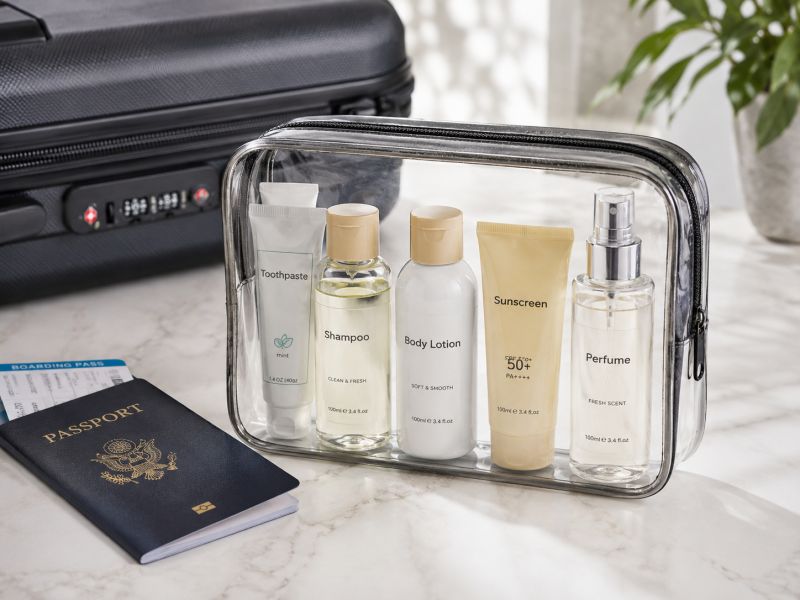
A strong design starts with real bottles. Test with 100 ml round bottles, flat cosmetic tubes, toothpaste, sunscreen tubes, mini perfume sprays, and small skincare jars. Load them into the sample. Close the zipper. Check the shape. If the bag bulges too much, the size may be technically correct but practically poor.
For custom sizing or bottle loading tests, Jundong can review the product list, target pouch size, material, logo area, and packing method before sample development. For early project review, you can contact info@jundongfactory.com.
How Does the TSA 3-1-1 Liquid Rule Affect Bag Design?
The TSA 3-1-1 rule affects more than the bottle size. It shapes the whole bag design. Each liquid container should be 3.4 oz / 100 ml or less, the items should fit inside one quart-size clear plastic zip-top bag, and each passenger is generally limited to one bag. A clear liquid pouch should make inspection easy, packing simple, and closure secure.
This rule gives product teams a clear design direction. The pouch should not hide the contents. It should not be hard to open. It should not force travelers to fight with the zipper. It should not look bulky after normal travel bottles are placed inside.
The zipper matters because the bag must close. A nice-looking pouch that cannot close when loaded will frustrate users. A zipper opening that is too narrow also makes packing harder. Travelers may need to place bottles one by one, adjust the direction, then flatten tubes before closing.
Transparency matters because security screening depends on visibility. A fully opaque cosmetic bag may be useful for daily storage, but it is not the right idea for liquid screening. If the design uses colored trim, printed panels, or a large logo, those areas should not block too much of the viewing area.
Product wording also needs care. It is safer to describe the product as a “TSA-style clear toiletry bag” or “clear liquid bag designed for 3-1-1 travel packing” rather than promising that every airport officer will accept it in every situation. This sounds more responsible and more professional.
Which Items Need to Fit Inside the Clear Liquid Bag?

A clear liquid bag should fit common travel-size toiletries such as shampoo, conditioner, toothpaste, lotion, sunscreen, perfume, liquid foundation, mascara, gel, cream, paste, aerosol products, and hand sanitizer. TSA includes liquids, aerosols, gels, creams, and pastes under its carry-on liquid rule, so product design should be tested with real mixed toiletry items, not only identical sample bottles.
The most common mistake in product development is testing the bag with neat empty bottles. Real travelers do not pack like a studio photo. They carry a mix of soft tubes, round bottles, small jars, spray bottles, and odd shapes. Toothpaste may press against the zipper. A sunscreen tube may take more space than expected. A small perfume bottle may be thick even when it is short.
For beauty brands, this matters even more. A skincare set may include cleanser, toner, serum, cream, sunscreen, and a small applicator. The pouch needs to hold the set without looking stressed. If the pouch is part of a retail kit, the inside layout also affects how the set looks when opened.
For hotel and airline kits, the loading may be simpler, but packing speed matters. If staff need too much time to insert each item, the pouch slows down the whole packing process. A small change in zipper opening or pouch height can save time during assembly.
A useful product test is simple:
| Item Mix | What to Check |
|---|---|
| Shampoo + conditioner + lotion | Bottle height and zipper closure |
| Toothpaste + sunscreen | Bulge and tube pressure |
| Perfume + cream jar | Thickness control |
| Full skincare mini set | Visual neatness and packing speed |
| Amenity kit items | Assembly efficiency |
The best clear liquid bag is not the one that holds the most. It is the one that holds the right items neatly and still feels compact.
Quart Size Bag vs Clear Toiletry Bag: Which One Should Brands Choose?
A disposable quart bag is enough for one-time travel, but a reusable clear toiletry bag is better for brands that want a product with stronger structure, better appearance, and longer use. PVC, TPU, and PEVA clear pouches can support logo placement, retail packing, and repeated handling while still following the clear liquid packing idea.
| Option | Best Use | Main Limit |
|---|---|---|
| Disposable zip-top bag | One-time travel | Weak structure, no brand feel |
| PVC clear toiletry bag | Cost-controlled travel kits | Odor and seam finish need control |
| TPU clear pouch | Premium travel sets | Higher material cost |
| PEVA clear bag | Lightweight programs | Softer shape |
| Gusseted clear pouch | Better bottle loading | Capacity must be managed |
A disposable bag is good for a traveler who only wants to pass security. It is not ideal for a company trying to create a product people keep. A reusable pouch has a better chance of staying in the suitcase, bathroom drawer, gym bag, or makeup kit.
For retail shelves, the clear toiletry bag has another advantage: it shows the product inside. A beauty set can display mini bottles. A hotel kit can look clean and organized. A travel kit can show its contents without opening the package.
For promotional use, the decision depends on budget and purpose. If the pouch is used for a short event, PVC may be enough. If it is part of a premium skincare kit, TPU may feel better. If the project wants a lighter, lower-odor direction, PEVA may be worth testing.
The right choice is not always the most expensive one. It is the one that matches the sales channel, target retail price, product weight, logo style, and expected use life.
Which Type of Material Is Best for Custom TSA-Style Clear Bags?
PVC is often used for clear toiletry bags because it is transparent, structured, and cost-friendly. TPU is softer and more flexible, suitable for higher-end travel sets. PEVA is lighter and often chosen for low-odor travel programs. The best material depends on the product level, budget, handfeel, transparency, durability, and packing needs.
PVC has a crisp look and can hold shape well. It works for clear cosmetic bags, toiletry pouches, gift sets, and retail travel accessories. The main thing to control is smell, softness, surface marks, and seam finish. Cheap PVC can make a product look lower-grade quickly.
TPU feels softer and more flexible. It is often used when the final product needs a nicer handfeel. It may suit premium travel accessories, beauty kits, and private label product lines where the pouch is meant to be reused many times. The cost is higher, but the product feel can be better.
PEVA can be a good direction for lightweight projects. It is often chosen when a softer, lower-odor material is preferred. It may not always hold shape like PVC, so the structure should be tested before bulk production.
EVA and semi-clear materials can work for structured storage pouches, but they should be used carefully if the product is presented as a clear liquid bag. If visibility is reduced too much, the pouch may no longer match the user’s expectation for airport liquid packing.
How Should Zipper, Seams, Gusset, and Logo Placement Be Designed?

A good TSA-style clear toiletry bag should have a wide zipper opening, smooth zipper puller, clean sealed or reinforced seams, controlled gusset depth, clear viewing panels, and logo placement that does not block inspection. These details decide whether the bag is easy to pack, pleasant to reuse, and stable enough for retail or travel kits.
The zipper is one of the first things users notice. A tight zipper makes even a nice pouch feel cheap. A wider opening helps travelers load bottles faster. For hotel kits or airline sets, it also helps staff pack more efficiently.
Seams decide durability. Poor edge sealing may crack, split, or look messy. This is especially visible on transparent bags because there is nowhere to hide rough workmanship. A clear pouch should look clean at the corners, along the zipper, and around the bottom.
Gusset depth needs balance. No gusset may limit bottle loading. Too much gusset may make the bag look larger than intended. A controlled bottom can improve capacity while keeping the compact travel-liquid feel.
Logo placement should be handled with restraint. A logo can be placed on the side, corner, trim, zipper puller, woven label, rubber patch, or small printed area. For a liquid pouch, the main viewing panel should stay clear. The product should look branded, not blocked.
For retail-ready programs, logo and packaging should be reviewed together. A hangtag, barcode label, insert card, or printed sleeve can sometimes carry more brand information than the pouch itself. This keeps the bag clean and inspection-friendly.
How Many 100 ml Bottles Fit in a Quart Size Bag?
Most quart-style clear bags can fit several 100 ml travel bottles, but the exact number depends on bottle shape, pouch size, material stiffness, zipper opening, and whether the bag is flat or gusseted. Instead of promising a fixed number, brands should test the pouch with the real bottle mix planned for travel, retail kits, or cosmetic sets.
A tall round bottle takes space differently from a flat tube. A cream jar may be short but thick. A toothpaste tube bends, but it can press against the zipper. A spray bottle may need extra headroom because of the cap.
Here is a practical test layout:
| Packing Mix | Fit Check |
|---|---|
| 3–4 round 100 ml bottles | Width, height, zipper closure |
| 5–6 slim bottles | Bottle direction and inner space |
| Bottles + toothpaste | Bulge and pressure |
| Bottles + jars | Thickness and corner stress |
| Full travel set | Final shape and visual neatness |
For product development, test photos are useful. Take photos of the empty sample, half-loaded sample, fully loaded sample, closed zipper, side profile, and packed retail version. This makes sample approval much clearer.
What Mistakes Cause Clear Liquid Bags to Fail in Real Travel Use?
Clear liquid bags often fail because they are too large, not transparent enough, hard to close, poorly sealed, overloaded, or designed with a logo that blocks visibility. Another common problem is using attractive product photos but skipping real bottle-loading tests. A travel pouch should work when filled, not only when empty.
One mistake is making the bag too generous. More space sounds useful, but the product can quickly lose the quart-size feel. If the pouch looks like a full-size toiletry organizer, travelers may worry about whether it fits the rule.
Another mistake is overprinting. A large logo may look strong in a product mockup, but it can reduce visibility. For liquid screening, clean panels are better. Branding can be placed with more care through trim color, puller design, hangtags, or small side placement.
A third mistake is weak structure. Transparent materials show stress clearly. Wrinkles, cracks, uneven seams, cloudy panels, and rough corners are easy to notice. In a retail kit, these flaws make the whole set feel lower quality.
A fourth mistake is forgetting packing. The pouch may be fine, but the final kit may not be. If labels wrinkle, bottle caps press into the clear panel, or the pouch deforms in the carton, the product may arrive looking less polished than expected.
Good product development checks the full chain: sample, loading, logo, retail packing, carton packing, and repeat order consistency.
When Do Travel Brands Need a Custom Clear Toiletry Bag Factory?

A travel brand needs a custom clear toiletry bag factory when the project requires a specific size, material, logo, zipper, packing method, retail presentation, or stable repeat order. Off-the-shelf bags may work for quick use, but custom production is better for private label travel kits, beauty sets, airline amenities, hotel programs, and retail travel accessories.
Custom support becomes useful when:
| Project Type | Why Custom Helps |
|---|---|
| Private label travel accessories | Brand size, material, and logo control |
| Airline amenity kits | Light weight, fast packing, clean look |
| Hotel toiletry sets | Organized presentation and repeated supply |
| Beauty gift sets | Better display and product protection |
| Retail travel kits | Barcode, label, hangtag, and shelf needs |
| Corporate travel gifts | Logo and packaging consistency |
| Subscription boxes | Kit fit and packing speed |
For brands that need clear travel pouches with logo, private label packing, or OEM/ODM development, send the size, bottle mix, logo file, target quantity, and packing idea to info@jundongfactory.com.
What Should Be Confirmed Before Requesting a Sample?
Before requesting a sample, confirm the target size, bottle count, material, zipper type, logo position, trim color, packaging, label needs, target quantity, delivery plan, and destination channel. A clear sample brief saves time, reduces changes, and helps the factory make a pouch closer to the final product from the beginning.
Here is a useful pre-sample checklist:
| Item to Confirm | Why It Matters |
|---|---|
| Target size | Controls quart-style proportion |
| Bottle count | Defines real usable space |
| Bottle size | Helps loading tests |
| Flat or gusseted shape | Affects capacity and appearance |
| Material | Affects clarity, handfeel, cost |
| Zipper type | Affects use and durability |
| Logo position | Affects visibility and branding |
| Packaging | Affects retail display and shipping |
| Label or barcode | Supports retail and warehouse handling |
| Target quantity | Affects cost and production planning |
A vague request like “We need a TSA bag” often leads to back-and-forth. A clear request like “We need a 7 x 8 inch clear PVC pouch for six 100 ml bottles, with a small side logo and hangtag packing” helps the project move faster.
How Does a Factory Control Quality from Sample to Bulk Production?
Quality control for clear toiletry bags should cover material clarity, odor, zipper movement, seam strength, edge finish, logo placement, bottle loading, packing method, carton labels, and final inspection. The approved sample should become the reference for bulk production, so the product does not drift in size, shape, material feel, or branding.
Clear bags leave little room for hidden mistakes. A dark fabric bag can hide some inner seam issues. A transparent pouch cannot. Every edge, corner, zipper line, heat seal, and printed logo becomes visible.
A practical control process should include:
| Stage | Check |
|---|---|
| Material arrival | Transparency, thickness, color, smell |
| Cutting | Size accuracy and panel cleanliness |
| Sewing or sealing | Edge finish and seam strength |
| Logo process | Position, size, color, adhesion |
| Loading test | 100 ml bottle fit and closure |
| Packing test | Retail look and carton protection |
| Final inspection | Appearance, function, labels, quantity |
Sample-to-bulk consistency matters for repeat orders. The first approved sample should lock key details: size, material, zipper, trim, logo, label, packing, carton mark, and inspection standard. If these details are not fixed, the next order may look slightly different. Small differences can become big problems when the product is sold under a brand name.
How Can a Clear Toiletry Bag Be Built for Long-Term Retail or Travel Programs?
A clear toiletry bag built for long-term use should be easy to repeat, easy to pack, easy to inspect, and easy to adjust for later product lines. The best projects document the approved size, material, zipper, logo, packaging, and inspection details so future orders can stay consistent while still allowing new colors, trims, or kit combinations.
For growing travel and beauty brands, one clear pouch can become a product family. A small quart-style pouch can be used for liquid packing. A larger toiletry pouch can be used for checked luggage. A flat clear pouch can be used for cosmetics. A gusseted pouch can be used for skincare sets. A matching opaque pouch can be used for non-liquid items.
This is where a factory with broad product coverage helps. If the first project works well, the same design language can extend into packing cubes, cosmetic bags, travel organizers, shoe bags, tote bags, gift pouches, or retail packaging bags. That makes the product line look more connected.
Long-term projects also benefit from better cost planning. Early samples may focus on appearance and function. Later repeat orders can improve packing speed, carton efficiency, material yield, label placement, and SKU management. That is how a simple clear pouch becomes a stable travel product program.
FAQ: TSA Quart Size Bag Dimensions, Clear Toiletry Bag Materials, and Custom Production
1. What size is a TSA approved quart size bag?
A TSA-style quart size bag is usually a clear, resealable pouch close to one quart in capacity, and common travel liquid bag sizes often sit around 6 x 9 inches or 7 x 8 inches.
Certainly, size matters. But for a reusable clear toiletry bag project, the outside dimensions are only the starting line. A pouch can look correct on paper but still feel wrong when real 100 ml bottles are packed inside. That is why travel liquid bag development should review flat size, inner usable space, zipper opening, material thickness, seam width, and whether the pouch can close smoothly after loading.
For travel brands, beauty sets, hotel amenities, airline kits, and retail travel accessories, the best size choice should come from the final use. A flat 6 x 9 inch clear bag may work well for simple liquid packing. A 7 x 8 inch pouch may give a more balanced look for mini skincare sets. A shallow gusset can help bottles sit better, but the bottom depth should not make the pouch look too large.
A practical review should test the pouch with actual items, not only empty bottles. Try shampoo, lotion, toothpaste, sunscreen, perfume spray, cream jar, and cosmetic tube samples. Close the zipper. Check the side shape. See if the pouch still looks neat. That small test often reveals more than a size chart.
| Size Reference | Common Use |
|---|---|
| 6 x 9 inches | Flat liquid pouch |
| 7 x 8 inches | Reusable clear toiletry bag |
| About 0.95 liter | Quart-style capacity target |
| 100 ml bottles | Standard travel liquid test item |
2. Is a reusable clear toiletry bag better than a disposable zip-top bag?
Absolutely, a reusable clear toiletry bag is often the better choice when the product needs stronger structure, a cleaner look, repeat use, and brand presentation beyond one trip.
A disposable zip-top bag is simple. It works for travelers who only need a quick solution before a flight. But it does not offer much product value for travel brands, beauty programs, airline kits, hotel sets, or retail shelves. It tears easily, wrinkles quickly, and gives very little room for a polished logo or packaging concept.
A reusable clear toiletry bag can be built with PVC, TPU, PEVA, or mixed materials. It can have a smoother zipper, stronger edges, a better handfeel, and a more attractive shape. It can also be designed with a small logo, zipper puller detail, hangtag, barcode label, or gift set insert. These details turn a simple liquid bag into a product people may keep in their suitcase, bathroom drawer, gym bag, or carry-on.
The key is not to overbuild it. A reusable pouch should still feel compact, transparent, and easy to inspect. If it becomes too bulky, too dark, or too heavily printed, it may lose its travel liquid packing purpose.
| Option | Best Fit | Main Concern |
|---|---|---|
| Disposable zip-top bag | One-time travel | Weak structure |
| PVC clear pouch | Cost-controlled kits | Odor and seam finish |
| TPU clear pouch | Premium travel sets | Higher unit cost |
| PEVA clear pouch | Lightweight programs | Softer body shape |
For retail-ready travel kits, reusable clear pouches usually create a stronger impression than disposable bags, especially when the product will be handled repeatedly before and after sale.
3. Which material works best for a custom TSA-style clear toiletry bag?
The best material depends on the product level: PVC is cost-friendly and structured, TPU feels softer and more premium, while PEVA is lighter and often chosen for lower-odor travel programs.
Of course, there is no single best material for every project. A low-cost promotional travel kit and a premium skincare gift set should not use the same material plan. The right material should match the final retail price, product weight, logo style, packing method, and expected use life.
PVC is one of the most common choices for clear cosmetic bags and toiletry pouches. It offers good transparency and a more defined shape. It is often suitable for retail travel accessories, beauty kits, hotel amenities, and event gift sets. The main details to control are smell, surface marks, softness, seam finish, and edge cleanliness.
TPU is softer and more flexible. It feels better in hand and can work well for premium travel sets, skincare kits, and higher-level private label programs. It usually costs more, but the finish can feel more refined.
PEVA is lighter and may suit travel programs where a softer, lower-odor direction is preferred. It may not hold shape as strongly as PVC, so sample testing becomes very useful.
| Material | Strength | Watch Carefully |
|---|---|---|
| PVC | Clear, structured, cost-friendly | Odor, seam finish, surface marks |
| TPU | Soft, flexible, premium feel | Cost, thickness control |
| PEVA | Lightweight, lower-odor direction | Shape stability |
| EVA / semi-clear material | More structure | Visibility may be reduced |
4. Can we add a logo to a TSA-style clear liquid bag?
Definitely, you can add a logo, but the best logo design should keep the main clear area visible, clean, and easy to inspect.
A clear liquid pouch has a different branding logic from a normal cosmetic bag. On a fabric pouch, a large front logo may look strong. On a clear travel liquid bag, the same logo may block visibility and make the pouch feel less travel-friendly. The goal is to show the brand without covering the contents too much.
Good logo options include a small side print, corner print, zipper puller logo, woven label on trim, rubber patch on the edge, printed hangtag, insert card, or outer retail packaging. These choices let the brand show clearly while keeping the clear panel useful.
Logo method depends on material and product level. Screen printing can work for simple clear pouches. Heat transfer may suit some logo styles. Rubber patches or woven labels can create a more dimensional feel. For premium sets, a custom zipper puller can make the product feel more complete without taking over the whole pouch.
| Logo Position | Best Use |
|---|---|
| Side corner print | Clean and subtle branding |
| Trim label | Keeps front panel clear |
| Zipper puller | Premium detail |
| Hangtag | Retail information |
| Insert card | Beauty or travel kit presentation |
| Small patch | Stronger brand feel |
Before sample approval, always check logo size on a loaded pouch, not only on a flat artwork file. Once bottles are inside, the clear panel changes shape slightly. A logo that looked perfect on a flat mockup may feel too large after packing.
5. How many 100 ml bottles can fit inside a quart size clear bag?
A quart-style clear pouch can usually fit several 100 ml travel bottles, but the real number depends on bottle shape, pouch size, material stiffness, zipper opening, and whether the bag is flat or gusseted.
Sure, people love a fixed number. But real packing is rarely that clean. Five slim bottles may fit better than three thick jars. A toothpaste tube may bend, while a round cream jar may take more depth. A perfume spray may be short but wide at the cap. So the smarter method is to test by bottle mix, not by bottle count alone.
For travel brands and beauty sets, this is where sample testing becomes very useful. The pouch should be tested with the actual planned items, including bottles, tubes, jars, sprays, and cards. Check whether the pouch closes smoothly, whether the zipper is under pressure, whether the sides bulge, and whether the final set still looks neat.
| Test Mix | What to Review |
|---|---|
| 3–4 round bottles | Height and zipper closure |
| 5–6 slim bottles | Width and layout direction |
| Bottles + toothpaste | Bulge and zipper pressure |
| Bottles + cream jar | Thickness and corner stress |
| Full skincare mini set | Final look and packing speed |
For a retail kit, the pouch should not just “fit everything.” It should look organized after packing. A pouch that barely closes may pass a desk test but fail in real use. A clean layout helps travelers, retail staff, and packing teams.
Jundong can help review the product mix before sampling. If you already have bottle sizes or a kit list, send the details to info@jundongfactory.com for a practical size and structure review.
6. What should we confirm before requesting a clear toiletry bag sample?
Before requesting a sample, confirm the target pouch size, material, bottle mix, zipper style, logo position, trim color, packing method, target quantity, and delivery plan.
Certainly, a clear sample brief saves time. A vague request like “We need a TSA bag” forces too many guesses. A clear request helps the factory build a sample closer to your final product from the first round.
Start with the product purpose. Is it for airport liquid packing, hotel toiletry sets, airline amenities, skincare gift sets, Amazon travel accessories, or corporate travel gifts? Each use may need a different material, opening size, logo position, and packaging plan.
Then define the loading. How many bottles should fit? Are they 100 ml round bottles, soft tubes, jars, spray bottles, or mixed shapes? Will the pouch be sold empty or packed with products? If it is packed with products, the pouch must be reviewed with the full set inside.
A clear sample brief can include:
| Detail | Why It Helps |
|---|---|
| Target size | Controls final pouch proportion |
| Bottle mix | Helps test real capacity |
| Material choice | Affects cost, handfeel, and clarity |
| Zipper color | Affects appearance and use |
| Logo file | Helps review print size |
| Packing method | Affects retail look and shipping |
| Target quantity | Helps plan cost and schedule |
7. What MOQ should we expect for custom clear toiletry bags?
For Jundong, the usual MOQ is 500 pcs per design, while some simple clear toiletry bag styles may be reviewed at 200–300 pcs depending on material, structure, logo method, and production schedule.
Of course, MOQ is not only a number. It is tied to material purchasing, cutting setup, logo setup, zipper and trim sourcing, sample confirmation, packing preparation, inspection, and production line planning. Even a simple clear pouch still needs material, labor, quality checks, packing, and export handling.
Smaller quantities can be useful for test programs, first launches, limited campaigns, or early retail validation. But smaller runs often carry a higher unit cost because many preparation steps remain the same. When quantity reaches 500 pcs or more, the cost structure usually becomes more comfortable.
Here is a practical way to think about quantity:
| Quantity Level | Best For | Cost Logic |
|---|---|---|
| 200–300 pcs | Simple style review or pilot run | Higher unit cost, limited flexibility |
| 500 pcs | Common starting level | Better balance of cost and setup |
| 1,000+ pcs | Retail or repeat program | Better material and packing efficiency |
| 3,000+ pcs | Large travel or beauty program | Stronger cost planning options |
If the product uses custom color, special zipper, printed packaging, custom puller, or multiple logo positions, MOQ may need to be reviewed again. The cleanest way is to share the pouch size, material, logo, packing, and target quantity together, so the project can be priced with fewer assumptions.
8. How long does sampling and bulk production take?
Jundong’s standard sampling time is usually 5–7 days, some simple styles may be completed in 2–3 days, and bulk production is usually 20–30 days after sample approval and material confirmation.
Absolutely, timing depends on project complexity. A simple clear PVC pouch with a standard zipper and one-color logo can move faster than a multi-material pouch with custom trim, special packaging, custom puller, and several sample changes.
The sample stage should not be rushed in the wrong way. For clear toiletry bags, the sample should confirm material clarity, smell, softness, zipper smoothness, seam finish, logo size, bottle loading, and packing style. A fast sample is useful only if it helps reduce risk before bulk production.
Bulk timing depends on several factors:
| Factor | Impact on Timing |
|---|---|
| Material availability | Special materials may take longer |
| Logo method | Printing, patch, or puller setup affects schedule |
| Quantity | Larger orders need more planning |
| Packing | Retail labels, cards, boxes, and barcodes add steps |
| Sample changes | More revisions extend approval time |
| Peak season | Production capacity may be tighter |
For brand launches, event dates, retail delivery windows, and seasonal programs, it is better to leave enough time for sample review and packing confirmation. A clear schedule helps avoid last-minute stress, especially when packaging, labels, and shipping documents are involved.
9. How does Jundong control quality for clear toiletry bags?
Jundong controls clear toiletry bag quality through material checks, sample confirmation, in-process inspection, final inspection, zipper and seam review, logo position control, packing checks, and shipment preparation.
Definitely, clear bags need careful inspection because defects are easier to see. On a dark fabric bag, some small inner seam issues may stay hidden. On a transparent pouch, every edge, corner, zipper line, printed logo, and heat-sealed area is visible. That is why quality control must begin before bulk production, not only at final inspection.
For clear travel liquid pouches, key checks include:
| Check Item | What It Protects |
|---|---|
| Material clarity | Clean appearance and content visibility |
| Odor review | Better user experience |
| Thickness check | Consistency and durability |
| Zipper test | Smooth opening and closing |
| Seam strength | Reduced splitting risk |
| Edge finish | Cleaner retail appearance |
| Logo position | Brand consistency |
| Bottle loading | Real travel use |
| Packing review | Better arrival condition |
For repeat orders, Jundong can help lock the approved sample details, including size, material, trim, zipper, logo, packing, carton mark, and inspection standard. This helps reduce product drift from one order to the next.
10. Why work with Jundong for custom TSA-style clear toiletry bags?
Jundong is a strong fit for custom TSA-style clear toiletry bags because it combines broad bag development experience, material support, sampling, logo work, quality control, packing, and export handling under one coordinated process.
Sure, a clear toiletry bag looks like a small product. But for a serious travel, beauty, hotel, airline, or retail program, it involves many connected decisions. The pouch must fit the right items, look clean, close smoothly, carry the logo well, pack efficiently, and stay consistent in repeat orders.
A strong clear toiletry bag project may include:
| Project Need | Jundong Support |
|---|---|
| Size development | Dimension review and structure advice |
| Material choice | PVC, TPU, PEVA direction review |
| Logo plan | Print, label, patch, puller, or packing ideas |
| Sample stage | Fast sample and revision support |
| Bulk order | Production and inspection control |
| Packing | Polybag, hangtag, label, box, or kit packing |
| Export | Shipping coordination and document support |
For brands building private label travel pouches, airline amenity bags, hotel toiletry sets, beauty travel kits, or retail-ready clear bags, Jundong can help turn a simple idea into a practical product plan. To review a custom project, send your size, material, logo, bottle mix, packing, and quantity details to info@jundongfactory.com.