 Skip to content
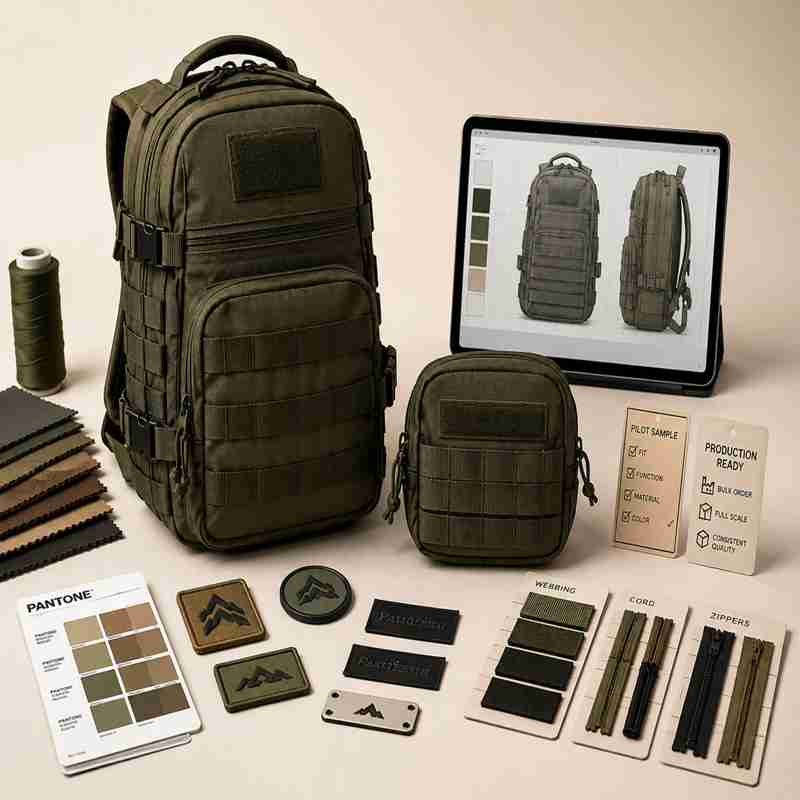
A MOLLE tactical bag can look strong in a sketch and still fail in sampling. The problem is rarely one dramatic mistake. It is usually a chain of small design gaps: webbing rows that do not align, PALS spacing that blocks pouch attachment, fabric that is too soft for loaded panels, bartacks that miss stress areas, zippers hidden behind attachment zones, or shoulder straps that feel fine when empty but painful when loaded. Before a sample is made, brands should review MOLLE layout, load path, material stiffness, hardware, access logic, logo placement, and tech pack details as one system.
MOLLE tactical bags should be fixed before sampling by checking webbing spacing, PALS grid alignment, bartack reinforcement, fabric support, load balance, zipper access, pouch compatibility, logo position, and tech pack clarity. These checks help reduce sample revisions, improve attachment function, control cost, and turn a tactical bag concept into a production-ready design.
What Makes MOLLE Tactical Bags Different From Regular Backpacks?
MOLLE tactical bags are different because the outer structure must support modular attachment, not only storage. The webbing or laser-cut panel must line up with pouches, resist pulling, stay flat under load, and avoid blocking pockets or zippers. A regular backpack may focus on comfort and capacity, but a MOLLE bag must also manage attachment compatibility, load movement, and reinforcement.
A regular backpack can still work if a front pocket is slightly moved or a decorative strap is not perfectly aligned. A MOLLE tactical bag is less forgiving. If the webbing spacing is wrong, a pouch may not attach. If the panel is too soft, it may sag. If the bartack is weak, the attachment area may pull open under load.
This is why MOLLE design should be reviewed as an engineering detail, not a styling detail. A clean tactical look is not enough. The bag must work with pouches, tools, straps, cords, and real carrying weight.
For brands, this changes the early development process. Before sampling, the team should not only ask, “Does it look tactical?” It should ask, “Can this MOLLE layout hold the intended accessories, stay aligned, and still allow the user to open the bag easily?”
Who Is This Guide For?
This guide is written for tactical gear brands, outdoor equipment teams, EDC brands, security programs, tool bag brands, private label teams, and product developers planning MOLLE backpacks, tactical pouches, sling bags, bags, medical bags, hydration bags, or modular outdoor bags.
It is especially useful when a design already exists, but the team wants to catch hidden mistakes before the first sample is made.
Why MOLLE Is Not Just Decorative Webbing
MOLLE webbing may look like rows of straps, but in real use it becomes an attachment system. Users expect pouches, holders, carabiners, straps, and accessories to fit securely.
When brands treat MOLLE as decoration, the problems show up fast. The rows may look neat in photos but fail with real pouches. The webbing may be too loose, too tight, too narrow, or sewn in the wrong position. A pouch may attach but tilt badly after loading.
A good MOLLE layout should be measured, tested, and reinforced. It should not be guessed from a reference photo.
MOLLE Tactical Bags Vs Standard Outdoor Backpacks
A standard outdoor backpack focuses on storage, comfort, weather resistance, and long carrying use. A MOLLE tactical bag must do those things while also supporting modular attachment.
This means the outer panels, stitching, webbing, buckles, shoulder system, and back structure carry extra responsibility. Once pouches are attached, the bag’s weight distribution changes. A design that feels comfortable when empty may feel unbalanced when loaded with a medical pouch, tool pouch, water bottle holder, or EDC accessory.
That is why MOLLE bags need earlier load planning than regular backpacks.
What Should A Brand Confirm Before Sampling?
Before sampling, a brand should confirm the use scenario, target load, bag size, MOLLE zones, PALS spacing, fabric choice, webbing width, bartack positions, zipper access, pocket layout, shoulder system, logo area, packaging needs, and tech pack details.
If the project is still unclear, the sample room has to guess. Guessing often creates delays, extra sample rounds, and cost changes.
Why Do MOLLE Tactical Bag Samples Often Need Revisions?

MOLLE tactical bag samples often need revisions because the first design focuses too much on appearance and not enough on function. Common causes include unclear use scenarios, incomplete tech packs, wrong webbing spacing, weak load planning, overdesigned tactical styling, and missing measurement details. These problems are easier to fix before sampling than after materials, cutting, sewing, and hardware decisions are already made.
Many tactical bag samples fail for a simple reason: the product was not defined clearly enough before development. A reference image may show the look, but it does not explain load, attachment needs, pouch size, user movement, zipper clearance, or production standards.
A MOLLE bag is built from connected decisions. Material stiffness affects MOLLE support. MOLLE placement affects pocket access. Pocket layout affects weight distribution. Weight distribution affects shoulder comfort. Shoulder comfort affects reviews and repeat orders. If one part is treated separately, the whole bag can feel wrong.
A strong pre-sampling review should catch the design errors that are expensive to fix later. It should help the brand decide what must stay, what should be simplified, and what needs testing before bulk production.
Unclear Use Scenario Before Design
A tactical backpack for outdoor hiking, an EDC sling bag, a bag, a medical pouch, and a tool pouch should not share the same layout logic.
If the use scenario is unclear, the design may become a visual mix of tactical elements without a strong purpose. It may have too many pockets, too much MOLLE coverage, poor access, heavy materials, and no clear load path.
Before sampling, the team should define what the bag will carry, how often it will be loaded, where the MOLLE pouches will attach, and how fast the user needs to access key items.
Missing Tech Pack Details
A tech pack should not only show the front view. It should explain size, materials, webbing width, PALS spacing, bartack positions, zipper type, hardware, lining, logo method, pocket dimensions, strap construction, packing method, and inspection focus.
When these details are missing, the sample team may still make a bag, but it may not be the bag the brand expected.
For MOLLE products, even small missing notes can cause problems. If the tech pack does not mark attachment areas, the webbing may shift. If it does not show bartack positions, reinforcement may be weak. If it does not show zipper clearance, pouches may block openings.
Wrong Webbing Spacing And Alignment
Webbing spacing is one of the first things to check. If the row spacing is wrong, common pouches may not attach properly. If the lines are not straight, the bag can look low quality even when the material is good.
Alignment also affects function. A small shift may make a pouch tilt, pull, or block another feature. On tactical bags, neatness is not only visual. It affects compatibility and trust.
Weak Load Planning
MOLLE adds external load. That load pulls on webbing, panel fabric, seams, shoulder straps, and the back structure.
If the design does not plan load balance early, the bag may lean forward, pull backward, sag at the front panel, or feel uncomfortable after pouches are attached. Shoulder straps, handle roots, D-rings, and chest straps should be reviewed with realistic weight, not only with an empty sample.
Overdesigned Tactical Appearance
More webbing does not always make a better tactical bag. Too much MOLLE can increase weight, cost, sewing time, and visual clutter. It can also make the product look too aggressive for EDC, outdoor retail, travel, or urban use.
Good tactical design is not about covering every surface with attachment rows. It is about placing the right attachment zones where they support real use.
How Can We Optimize Tech Packs To Avoid Sampling Delays?
A better tech pack reduces delays by removing guesswork. It should show front, back, side, bottom, inside layout, MOLLE zones, webbing spacing, material list, hardware list, logo process, stitching notes, load expectations, and packing requirements.
For MOLLE bags, mark the exact attachment area and explain which pouches or accessories should fit. Add close-up notes for bartacks, stress , zipper clearance, and pocket openings.
If the tech pack is not complete, the first sample becomes an experiment. If it is clear, the first sample becomes a real review piece.
What MOLLE Webbing Mistakes Should Brands Fix First?
Brands should first fix MOLLE webbing mistakes that affect compatibility, load strength, and access. The most important checks are PALS grid spacing, row alignment, bartack reinforcement, panel stiffness, slot stability, and whether attachment zones block zippers or pockets. These details decide whether the bag only looks tactical or actually works as modular gear.
MOLLE webbing is one of the easiest details to underestimate. A designer may focus on shape, colour, and pocket style, while the sample room focuses on construction. But the end user will test the MOLLE system with real pouches. If attachment fails, the product feels wrong immediately.
A professional MOLLE layout should be reviewed with measurements, not just the eye. The panel should stay flat. The rows should be parallel. Bartacks should be placed where load will pull. Zippers and pockets should still open after accessories are attached.
For brands developing private label tactical bags, this is where early review has the most value. Fixing webbing layout before sampling is much cheaper than rebuilding the whole front panel after the first sample fails.
Incorrect PALS Grid Spacing
PALS grid spacing is the foundation of MOLLE compatibility. If spacing is off, pouches may not thread correctly, may sit too loose, or may pull at an angle.
Before sampling, the design should mark webbing width, row spacing, usable slots, and attachment zones. If the bag needs to work with a specific pouch, that pouch size should be shared with the factory before sampling.
Do not rely only on visual similarity. A MOLLE panel can look right in a rendering and still fail when a real pouch is attached.
What Are The Quality Control Tolerances For PALS Grid Alignment?
PALS grid tolerance should be set according to the bag design, attachment type, material behavior, and target use. For custom projects, the most important rule is to define the acceptable measurement before production, not after inspection.
A practical QC plan should check row height, webbing width, spacing between rows, left-right alignment, bartack position, and slot opening consistency. The tolerance should be tight enough for pouch compatibility, but realistic enough for fabric sewing and material movement.
For high-load tactical projects, measurement records and sample approval photos are useful before bulk production.
Webbing Rows That Do Not Align
Misaligned rows make a MOLLE bag look careless. They also create attachment problems. If one row shifts slightly, the pouch may tilt or sit unevenly.
Alignment issues often come from unclear markings, fabric movement during sewing, loose webbing tension, or poor panel preparation. The fix starts before sewing: better pattern marks, stable material, correct webbing tension, and clear inspection steps.
Weak Bartack Reinforcement
Bartacks are small, but they decide whether MOLLE webbing can handle repeated pulling. Weak or misplaced bartacks can allow the webbing to lift, stretch, or tear from the panel.
Reinforcement should match the expected load. A lightweight EDC pouch and a heavy tool pouch should not be treated the same way.
Should We Use Automated Bartacking Machines For MOLLE Reinforcement?
Automated bartacking can improve consistency when the design requires repeated reinforcement at many MOLLE . It helps keep stitch density, length, and placement more stable than manual operation on large runs.
But machine use alone is not enough. The pattern, thread, fabric thickness, webbing quality, and operator setup still matter. The right decision depends on order quantity, load requirement, material thickness, and reinforcement layout.
For high-volume MOLLE projects, automated bartacking is often worth reviewing before sampling and bulk planning.
MOLLE Panels That Are Too Soft Or Too Stiff
A soft panel may sag when pouches are attached. A stiff panel may feel bulky, hard to sew, or uncomfortable against the body.
The best panel depends on use. A tactical backpack that carries heavy pouches needs stronger support. A lightweight EDC bag may need flexibility and comfort. Before sampling, the material structure should be matched to the expected load.
Attachment Areas That Block Zippers Or Pockets
A common mistake is placing MOLLE rows too close to zipper paths, flap openings, side pockets, or compression straps. The bag looks fine when empty, but once a pouch is attached, access becomes difficult.
This should be checked with real or sample pouches before final approval. If users cannot open the main compartment after attaching gear, the design needs to be adjusted.
Which Materials Work Best For MOLLE Tactical Bags?

The best materials for MOLLE tactical bags depend on load, use, structure, and price target. 600D, 900D, 1000D, and 1680D fabrics can all work, but they should be matched with webbing strength, lining, coating, hardware, and sewing method. A strong tactical bag is not simply made from the heaviest fabric; it needs balanced support, weight control, and repeatable production quality.
Material choice is one of the biggest design decisions before sampling. It affects how the bag stands, how MOLLE panels hold pouches, how the product feels when carried, how easily it can be sewn, and how much the final cost changes.
A common mistake is to choose material only by a competitor’s photo. Two bags may look similar online, but one may use soft polyester, another may use stiff nylon, and another may use laminated fabric with a reinforced panel. The visual difference may be small, but the performance difference can be large.
For MOLLE tactical bags, material should be selected together with webbing, thread, lining, buckles, zipper, foam, back panel, and reinforcement layers. If one part is too weak or too heavy, the full design loses balance.
600D, 900D, 1000D, And 1680D Fabric Choices
600D polyester or nylon can work well for lightweight tactical bags, EDC packs, promotional tactical styles, and outdoor utility bags where weight and cost need control. It is easier to sew and usually more flexible.
900D and 1000D fabrics are often chosen for stronger tactical backpacks, MOLLE pouches, tool-style bags, and outdoor gear bags. They offer better structure and abrasion resistance, but may increase weight and sewing difficulty.
1680D fabric can give a strong, heavy-duty feel, especially for reinforced panels, bases, tool zones, or premium tactical styles. But using it everywhere may make the bag too stiff or too heavy.
The right choice depends on how the bag will be used, not only how strong the fabric sounds.
Nylon Vs Polyester For Tactical Bag Projects
Nylon is often valued for strength, flexibility, and abrasion performance. Polyester is often chosen for cost control, colour stability, and wide availability. Both can be used for tactical bag projects if the structure is designed correctly.
The real is not simply “nylon or polyester?” It is “what load will this bag carry, what feel does the brand want, and what cost level does the project need?”
For a premium outdoor tactical backpack, nylon may be preferred. For a practical private label tactical bag with controlled cost, polyester Oxford may be the better direction. The decision should be made with the full project in mind.
Which Laser-Cut Laminates Prevent Slot Stretching On Tactical Backpacks?
Laser-cut MOLLE panels can create a clean, modern look and reduce bulky sewn webbing, but the laminate must resist slot stretching. If the top layer, backing layer, or bonding strength is not suitable, the slots may widen after repeated pouch attachment.
Good laser-cut MOLLE panels usually need a stable laminated structure, suitable fabric density, strong bonding, and clean cutting edges. The material should be tested with the intended pouch weight before bulk production.
Laser-cut panels are not automatically better than sewn webbing. They are better when the material, slot size, layer bonding, and load requirement match the design.
Fabric Stiffness And MOLLE Panel Support
MOLLE panels need enough stiffness to hold shape, but not so much stiffness that the bag becomes uncomfortable or difficult to pack.
A soft front panel may collapse after pouches are attached. A panel that is too stiff may pull away from the body, create awkward folds, or make the bag feel bulky. The best structure often comes from the right mix of outer fabric, backing layer, foam, lining, and reinforcement.
Before sampling, the team should define which areas need support and which areas need flexibility.
Webbing, Lining, Buckles, And Hardware Matching
A tactical bag can fail because of mismatched components. Strong fabric with weak webbing is not enough. Heavy-duty webbing with light buckles can also create problems. A good outer shell with thin lining may make the inside feel cheap.
Webbing width, thickness, hand feel, colour, and strength should be reviewed with the main fabric. Buckles, D-rings, hooks, zipper pullers, elastic cord, and ladder locks should match the expected load and product level.
A balanced material set usually performs better than one expensive material paired with several weak trims.
When Heavier Material Becomes A Design Problem
Heavy material can look impressive, but it can also create trouble. It may increase sewing difficulty, raise freight cost, reduce comfort, make the bag harder to fold, and push the product into a higher price level without adding enough real value.
For urban EDC, travel tactical, or retail outdoor programs, lighter and smarter construction may sell better than oversized heavy-duty styling.
Before sampling, brands should ask: will this material improve real use, or only make the bag sound stronger on paper?
How Should Load Balance Be Planned Before Sampling?
Load balance should be planned before sampling because MOLLE bags carry both internal items and external pouches. The design should review shoulder strap angle, back support, handle roots, chest strap, waist belt, panel strength, and weight movement after accessories are attached. A bag that feels stable when empty may become uncomfortable when loaded.
MOLLE changes how a tactical bag carries weight. A regular backpack usually keeps most weight inside the main compartment. A MOLLE bag may add pouches to the front, sides, shoulder strap, waist belt, or lower panel. That external load changes the centre of gravity.
This is why a tactical bag should not be judged only by empty shape. A sample must be checked with realistic weight. Add pouches. Fill compartments. Open zippers. Adjust straps. Carry it. Then the design starts to show the truth.
Load balance is also where many cost-saving mistakes become visible. Thin padding, narrow webbing, weak handle roots, light buckles, or poor strap angles may pass visual inspection but fail after use.
Shoulder Strap Angle And Padding
Shoulder straps should match the bag size, expected load, and user movement. If the angle is wrong, the bag may pull away from the back or press into the shoulders.
Padding should be firm enough to support weight, but not so thick that it feels bulky. For tactical bags, breathable back mesh, foam density, strap width, and stitch reinforcement all matter.
A good shoulder system is not just comfortable. It protects the brand from complaints after the first real trip, patrol, outdoor event, or workday use.
Handle Roots And Stress Areas
Handle roots are high-risk areas. They are pulled when the bag is lifted, dragged, hung, or moved quickly. If the handle root is not reinforced correctly, the bag may fail even when the body fabric is strong.
Stress areas include handle roots, shoulder strap ends, D-ring tabs, MOLLE attachment zones, bottom corners, zipper ends, and trolley sleeve seams.
Before sampling, these areas should be marked and reviewed for reinforcement. A clean outside appearance should never replace hidden strength.
Chest Strap, Waist Belt, And Back Panel Support
Chest straps and waist belts are not needed on every tactical bag, but they are useful when the bag is expected to carry heavier loads or stay stable during movement.
A back panel should support the bag without making it too stiff. For outdoor tactical backpacks, airflow and padding matter. For EDC bags, a lighter back structure may be enough. For tool or security use, more stability may be needed.
The key is to match the support system to the real load, not to copy a military-looking design without purpose.
Weight Distribution After Adding MOLLE Pouches
External pouches change balance. A front medical pouch, side bottle pouch, tool pouch, or radio pouch may pull the bag in a new direction.
Before approving the layout, attach sample pouches where users are likely to place them. Check whether the bag tilts, the shoulder strap twists, the zipper becomes blocked, or the front panel sags.
This is one of the most practical checks a brand can do before bulk production.
How Do You Test MOLLE Webbing Load-Bearing Capacity Before Mass Production?
MOLLE load-bearing capacity should be tested by attaching the intended pouch or weighted accessory, applying repeated pull force, checking bartack stability, reviewing webbing stretch, and inspecting panel deformation after load.
The test should not only check whether the webbing breaks. It should check whether the pouch stays stable, whether the slot stretches, whether stitching loosens, and whether the panel shape changes.
For stronger projects, sample records should include load condition, test time, visible result, and any revision made before bulk production.
Load Testing Before Sample Approval
Load testing should happen before final sample approval, not after bulk goods are finished. A simple load check can reveal weak straps, poor stitching, bad buckle choice, and uncomfortable carry angles.
A practical check may include filling the main compartment, attaching pouches, lifting by the handle, carrying by shoulder straps, opening zippers, shaking lightly, and checking stress areas afterward.
If your team already has expected load, pouch type, and use scenario, Jundong can review the design direction before sample development through info@jundongfactory.com.
What Pocket And Access Mistakes Hurt Tactical Bag Usability?

Pocket and access mistakes hurt tactical bag usability when the layout looks organised but slows down real use. Common problems include too many pockets, blocked main openings, poor medical or tool access, pouches covering zippers, and no clear priority for fast-use items. A tactical bag should help users reach gear quickly, not make them search through unnecessary compartments.
A tactical bag does not become better because it has more pockets. In many projects, too many pockets create more cost, more sewing work, more weight, and more confusion.
The best layout starts with user behaviour. What does the user need first? What must stay protected? What can sit in the main compartment? What needs external access? What should not be blocked by MOLLE pouches?
A good MOLLE tactical bag should feel controlled. Every pocket should have a reason. Every access should remain usable after the bag is loaded and after pouches are attached.
Too Many Pockets Without Real Use Logic
Too many pockets can make a tactical bag look feature-rich, but poor pocket logic makes it hard to use. Users may forget where items are stored, waste time opening compartments, or find that small pockets are too tight for real gear.
Before sampling, each pocket should be reviewed by item type: tools, first aid items, chargers, gloves, documents, hydration, radio, laptop, cables, or personal items.
If a pocket does not improve real use, it may be better to remove it and improve the main structure instead.
Main Compartment Access Problems
The main compartment should open easily even when the bag is partially loaded. If MOLLE pouches, compression straps, flap covers, or side panels make the opening awkward, users will notice quickly.
A common mistake is designing a strong front panel without checking how the main zipper opens after accessories are attached.
Access should be tested with loaded content, not an empty sample.
Medical, Tool, EDC, And Outdoor Layout Differences
A medical pouch needs fast visibility and organised slots. A tool tactical bag needs stronger pockets and stress control. An EDC tactical bag needs quick access and a cleaner profile. An outdoor tactical backpack may need hydration, clothing, snacks, weather gear, and external attachment.
These products should not share one layout template. The use scenario should decide pocket depth, opening angle, mesh use, elastic loops, divider strength, and MOLLE coverage.
Hidden Conflicts Between Pouches And Zippers
A pouch can be compatible with the MOLLE grid and still block the zipper. This is one of the easiest mistakes to miss during design review.
Before approval, attach pouches to the most likely positions and open every zipper. Check side pockets, front compartments, top openings, and compression straps.
If one added pouch makes the bag hard to open, the attachment zone should move.
Why Fast Access Matters In Tactical Bag Design
Fast access is not only for military-style use. It matters for outdoor gear, medical kits, work tools, emergency bags, camera gear, and travel EDC.
If users need to remove the bag, open three layers, move a pouch, and search through small pockets to reach one item, the design is working against them.
The strongest tactical layouts are easy to understand without instructions.
How Do Zippers, Buckles, And Trims Affect MOLLE Bag Performance?
Zippers, buckles, D-rings, hooks, pullers, elastic cords, and ladder locks affect MOLLE bag performance because they control access, adjustment, load stability, and daily handling. A strong fabric cannot save a weak buckle or poorly placed zipper. Before sampling, trims should be checked with the bag loaded, pouches attached, and straps adjusted for real use.
Trims are often treated as small details, but they shape the whole user experience. A zipper that catches lining makes the bag feel cheap. A buckle that slips under load makes the product feel unsafe. A D-ring placed at the wrong angle can twist the shoulder strap. A puller that is too small becomes hard to use with gloves.
For tactical bags, hardware should be selected by use, not only by appearance. Outdoor gear, tool bags, EDC bags, security bags, and medical bags all need different levels of strength and handling comfort.
The key is simple: test trims as part of the full bag, not as loose parts on a table.
Zipper Direction And Clearance
Zipper direction should match how users open the bag. A tactical backpack may need two-way opening. A medical pouch may need fast wide access. A tool-style bag may need a stronger zipper with better curve control.
Clearance is just as important. If MOLLE pouches, compression straps, flap covers, or corner seams block the zipper path, users will feel friction every time they open the bag.
Before sampling approval, open and close every zipper after the bag is filled and after common pouches are attached.
Buckle Strength And Placement
Buckles should match strap width, expected load, and adjustment frequency. A buckle that works on a lightweight travel bag may not suit a tactical bag with external pouches.
Placement also matters. If a buckle sits under the arm, presses against the body, blocks a pocket, or hits the floor when the bag is placed down, it creates daily irritation.
Good buckle design is quiet, secure, easy to adjust, and positioned where users naturally reach.
D-Rings, Hooks, Pullers, And Elastic Cord
Small trims can create big impressions. D-rings and hooks should not twist under load. Pullers should be easy to grip. Elastic cord should hold tension without looking messy. Cord locks should match the bag’s strength and visual level.
For tactical projects, these details should be reviewed together with glove use, outdoor use, fast access, and repeated adjustment.
A bag may pass visual review but fail in hand feel if small trims are poorly selected.
Trim Quality Under Repeated Load
Tactical bags are often opened, pulled, adjusted, attached, lifted, and dragged more often than casual bags. Repeated load can expose weak plastic, loose stitching, thin elastic, poor plating, or rough zipper teeth.
A practical sample test should include repeated zipper movement, strap adjustment, buckle opening, puller use, pouch attachment, and handle lifting.
This does not need to be complicated, but it does need to be done before bulk production.
Why Hardware Should Be Tested With A Loaded Bag
Hardware behaves differently when the bag is loaded. Zippers face pressure. Buckles carry tension. D-rings pull at new angles. Shoulder straps twist. MOLLE panels move.
Testing an empty sample is useful for appearance, but not enough for performance. A loaded check shows whether the product is ready for real use.
Where Should Logos Go On MOLLE Tactical Bags?
Logos on MOLLE tactical bags should be placed where they support brand visibility without blocking function, attachment zones, zipper access, or high-wear areas. Rubber patches, woven labels, embroidery, Velcro patches, screen printing, and heat transfer can all work, but the logo process should match the fabric, tactical style, order quantity, and durability target.
Branding a tactical bag is more delicate than branding a tote bag. Tactical users often prefer a clean, functional look. A logo that is too large may reduce professional appeal. A logo that is too small may not support retail display. A logo placed across MOLLE rows may break the attachment function.
A good logo plan should respect the bag’s structure. It should not fight with webbing, pockets, flaps, compression straps, or curved seams.
Before sampling, logo position should be marked on the actual bag pattern or digital layout, not only shown on a front-view mock-up.
Logo Placement Without Blocking MOLLE Function
The logo should not sit on active MOLLE slots unless it is intentionally designed as a removable patch or label area. Blocking usable webbing reduces the modular value of the bag.
Common safer areas include Velcro patch panels, clean upper pockets, side label zones, lower front panels, inner labels, puller branding, or removable hangtags.
If the product needs strong brand visibility, create a dedicated logo zone instead of sacrificing functional attachment space.
Rubber Patch, Woven Label, Embroidery, Or Velcro Patch
Rubber patches work well for rugged tactical styles and can add a strong branded look. Woven labels are lighter and cleaner. Embroidery can feel premium but may not suit every coated or thick fabric. Velcro patches are flexible because users can remove or replace them.
The right logo method depends on material, brand style, order quantity, cost target, and expected abrasion.
For MOLLE tactical bags, a logo process should be tested on the actual fabric before approval.
Brand Visibility Vs Tactical Appearance
Tactical products often need a balance between brand presence and low-profile appearance. A security bag, EDC backpack, outdoor survival bag, and military-style pouch may each need a different branding level.
Over-branding can make the bag look less serious. Under-branding can weaken retail identity.
A clean patch, tonal logo, small woven label, or removable Velcro badge may be more effective than a large front print.
Logo Durability On Rough Fabrics
Rough Oxford, nylon, coated fabric, and laminated panels can affect logo durability. Some surfaces do not hold fine printing well. Some embroidery may distort the fabric. Some patches may need stronger backing or edge sewing.
Logo durability should be checked for peeling, cracking, thread pull, edge lift, colour shift, and abrasion.
A beautiful logo sample is not enough if it cannot survive repeated handling.
When A Logo Area Should Be Moved Before Sampling
Move the logo area if it blocks webbing, sits on a fold line, covers a zipper path, crosses a curved seam, rubs against pouches, or falls on a high-stress panel.
The best time to change logo placement is before sampling. After tooling, patch size, embroidery file, printing plate, or pattern marks are confirmed, changes become slower and more expensive.
How Does A Better Tech Pack Reduce Sampling Mistakes?
A better tech pack reduces sampling mistakes by giving the factory clear instructions for size, materials, webbing layout, PALS spacing, bartack positions, hardware, pocket structure, load expectations, logo placement, packing, and inspection focus. For MOLLE tactical bags, reference photos are helpful, but they cannot replace measurements, function notes, material details, and attachment requirements.
A tech pack should turn a design idea into production language. Without it, the sample room may understand the look but miss the hidden rules.
For MOLLE projects, the hidden rules matter. Which pouches should fit? Which areas carry load? Which zippers must stay clear? Which panel needs stronger backing? Which stitches should be reinforced? Which logo area must remain flat? These details cannot be guessed from a front photo.
A clear tech pack also protects the brand during future production. Once the first sample is approved, the same file helps control repeat orders, colour versions, and bulk consistency.
What Details Should A Tactical Bag Tech Pack Include?
A tactical bag tech pack should include outer dimensions, capacity target, material list, fabric colour, lining, webbing width, MOLLE area, PALS spacing, bartack marks, zipper type, buckle type, shoulder strap structure, handle reinforcement, pocket dimensions, logo method, packing method, and inspection notes.
It does not need to be overly complicated, but it must remove the most expensive guesses.
For brands without a complete tech pack, a clear reference image plus marked changes can still help start the review. The key is to label what must be followed and what can be adjusted.
How To Mark MOLLE Webbing And Attachment Areas
MOLLE areas should be marked with exact width, row count, slot spacing, start and end positions, and whether the area is decorative or functional.
If the bag must support a specific pouch, include pouch size or reference. If the attachment zone should stay clear of a zipper, mark the clearance area. If a panel needs stronger backing, mark that layer in the material notes.
Clear marking saves sample time because the factory does not need to guess where function begins and decoration ends.
Which Measurements Should Be Fixed Before Sampling?
Key measurements include overall bag size, main compartment size, front panel size, webbing width, row spacing, zipper opening length, shoulder strap length, handle drop, pocket depth, laptop sleeve size if included, and carton or packing limits if important.
For tactical bags, small measurement differences can change function. A narrow zipper opening can hurt access. A short strap can limit fit. A shifted MOLLE row can reduce compatibility.
Fix the measurements that affect function first. Decorative measurements can be refined later.
Why Reference Photos Are Not Enough
Reference photos show style direction, but they do not define material thickness, load rating, webbing tension, pocket depth, zipper type, or internal structure.
A factory can copy a look and still miss the product intent. That is why marked photos, written notes, measurement tables, and material preferences are much more useful than a clean image alone.
Reference photos should start the conversation, not replace product development details.
How Golden Sample Records Support Bulk Production
A golden sample is the approved standard for bulk production. For MOLLE tactical bags, it should be supported by photos, measurements, material records, webbing layout, bartack positions, logo details, hardware list, packing method, and inspection checklist.
This record helps avoid drift between sample and bulk. It also helps when the same design is produced again in another colour, size, or order batch.
Jundong supports custom, private label, OEM, and ODM bag projects with sample development, material review, production planning, and quality checks. For MOLLE tactical bag briefs, teams can send design files, photos, target size, material ideas, quantity, and load needs to info@jundongfactory.com for review.
What Should A Factory Check During MOLLE Tactical Bag Sampling?

During MOLLE tactical bag sampling, the factory should check webbing spacing, bartack reinforcement, pouch attachment, loaded comfort, zipper movement, buckle strength, strap stability, stitching, edge finishing, packing shape, and sample records. A sample is not only a visual approval piece. It should prove that the MOLLE layout, materials, trims, and carrying system can work together in real use.
A tactical bag sample should never be approved only because it looks close to the design. For MOLLE projects, the most important problems often appear after loading, attaching pouches, pulling straps, opening pockets, and checking stress areas.
Sampling should be treated as a controlled review. The goal is not to make one nice-looking bag. The goal is to confirm whether the design can move into bulk production with clear standards.
The best sample review combines three views: appearance, function, and repeatability. Appearance checks whether the bag looks right. Function checks whether it works. Repeatability checks whether the factory can make the same result again.
Webbing Spacing And Bartack Review
The first check should be MOLLE webbing spacing and bartack placement. Rows should be straight, slot openings should be consistent, and reinforcement should sit where pulling force happens.
Bartacks should not be placed casually. They should support the attachment path, not only decorate the webbing. If a pouch pulls between two weak stitch areas, the webbing may lift after repeated use.
The sample should be measured and photographed. These records help the team compare future samples and bulk goods.
Loaded Fit And Carry Comfort
Loaded fit shows the truth. Add weight into the main compartment, attach pouches, adjust straps, and carry the bag for several minutes.
Check whether the bag pulls backward, leans forward, twists to one side, rubs the neck, presses the shoulders, or creates pressure at the lower back.
This is especially important for tactical backpacks, outdoor bags, tool bags, security bags, and medical packs. A product that feels fine when empty can feel very different after real loading.
Zipper, Buckle, And Strap Testing
Zippers should open smoothly when the bag is filled. Buckles should lock firmly and adjust without slipping. Shoulder straps should stay stable. Compression straps should not block important pockets.
Test these parts together. A zipper may work well before a pouch is attached, then become difficult to open after the MOLLE panel is loaded.
Small handling problems often become repeated complaints after launch.
Stitching, Reinforcement, And Edge Finishing
Check stitch density, seam straightness, thread trimming, binding tape, corner finishing, bottom reinforcement, and stress areas.
On MOLLE tactical bags, edges and corners receive more movement than many regular backpacks. The bag may be lifted, pulled, clipped, hung, dragged, packed tightly, or used outdoors.
Clean stitching is about more than appearance. It shows whether the factory can control construction details consistently.
Packing Shape And Sample Review Records
Packing should be reviewed during sampling, not after production. A tactical bag may be strong, but if it is folded badly, crushed in carton, or packed without shape support, the first impression suffers.
Sample records should include final sample photos, measurements, material cards, webbing notes, hardware details, logo method, packing style, carton plan, and inspection focus.
For larger projects, these records are what keep the approved sample from becoming only a memory.
What Affects Price, MOQ, And Lead Time?
Price, MOQ, and lead time for MOLLE tactical bags depend on material, webbing coverage, bartack quantity, hardware grade, pocket structure, lining, logo process, packaging, sample revisions, and bulk order size. A lower price can become expensive if weak materials, poor reinforcement, or unclear specifications create repeated sample changes or quality risks.
MOLLE tactical bags often require more labour than simple backpacks. Every row of webbing must be cut, positioned, sewn, checked, and reinforced. Every pouch area must stay aligned. Every bartack adds sewing time. Every extra pocket adds material, lining, zipper, binding, and inspection work.
This does not mean a MOLLE bag must always be expensive. It means the design should spend cost where function matters and remove details that add weight or labour without improving use.
A mature cost review should ask: which details protect the product experience, and which details only make the bag look busy?
Material, Webbing, Hardware, And Structure Costs
Main cost drivers include fabric type, lining, coating, foam, reinforcement layers, webbing amount, bartack quantity, zipper type, buckles, D-rings, hooks, shoulder strap structure, pocket count, logo method, and packing method.
A tactical backpack with full MOLLE coverage, padded laptop compartment, hydration pocket, chest strap, waist belt, rubber patch, strong buckles, and reinforced bottom will naturally cost more than a simple tactical-style daypack.
The right is not “How cheap can it be?” but “Which specifications match the product position and use?”
What Is The Cost Difference Between MIL-SPEC And Commercial MOLLE?
MIL-SPEC style requirements usually increase cost because they may involve stricter material choices, tighter spacing control, stronger webbing, more reinforcement, higher testing expectations, and more detailed inspection. Commercial MOLLE is often more flexible and can be adjusted for retail, outdoor, EDC, or promotional use.
Not every project needs MIL-SPEC-level construction. Many private label tactical bags perform well with commercial MOLLE if the spacing, reinforcement, material support, and load testing are planned properly.
For brand programs, the smart approach is to define real use first, then decide how close the product needs to be to military-style standards.
Why MOLLE Coverage Increases Labor Time
MOLLE coverage increases labour because webbing must be measured, aligned, held flat, sewn in rows, bartacked, and checked. Large MOLLE panels also increase the chance of visible alignment issues.
More coverage also means more inspection. If one row is crooked on a plain bag, it may be ignored. On a MOLLE bag, it is obvious.
To control labour, place MOLLE only where users need attachment. A cleaner layout may save cost and improve usability.
How Logo And Packaging Affect Cost
Logo process affects cost through setup, material, labour, and approval time. Rubber patches, woven labels, embroidery, Velcro patches, screen print, and heat transfer all have different cost logic.
Packaging also matters. A simple polybag is different from a dust bag, printed insert card, barcode label, carton mark, multi-SKU packing table, or retail-ready package.
Before quoting, logo and packaging should be discussed together with the bag design, not left to the end.
How Long Does Tactical Bag Sampling Take?
For Jundong, many bag samples take around 5–7 days after details are confirmed, while simpler styles may be faster. Complex MOLLE tactical bags may take longer if they involve special materials, heavy reinforcement, laser-cut panels, custom hardware, or several sample revisions.
Fast sampling is helpful, but speed should not replace careful review. A rushed sample that misses webbing layout, load testing, or pocket access may cost more time later.
How To Reduce Cost Without Weakening Function
Cost can be reduced by simplifying unnecessary pockets, reducing unused MOLLE coverage, choosing suitable materials, standardising hardware, keeping logo placement practical, improving carton efficiency, and avoiding overbuilt areas that do not improve real use.
But cost should not be reduced by weakening shoulder straps, handle roots, bartacks, zipper quality, stress panels, or load-bearing attachment zones.
The safest cost control keeps strength where users feel it and simplifies details they do not need.
How To Choose A Custom MOLLE Tactical Bag Factory?

Choose a custom MOLLE tactical bag factory by checking whether it understands PALS compatibility, webbing spacing, load planning, material stiffness, sample development, bartack reinforcement, tech pack review, and sample-to-bulk consistency. A good factory should ask about use, load, attachment needs, pouch size, logo process, packaging, quantity, and delivery plan before quoting.
For MOLLE tactical bags, “we can make it” is not enough. Many factories can sew a tactical-looking bag. Fewer can review whether the design will work after pouches are attached and weight is added.
A useful factory should catch issues before sampling: too much MOLLE, blocked zipper access, weak handle roots, wrong material stiffness, unclear tech pack, poor logo position, or unrealistic cost targets.
Jundong is a Guangdong-based custom bag factory with more than 20 years of experience in custom, private label, OEM, and ODM bag projects. The factory supports tactical bags, backpacks, travel bags, cooler bags, makeup bags, clear bags, EVA bags, luggage, leather goods, and more, with sample development, material review, production planning, and quality checks for global brand and project clients.
Do They Understand MOLLE And PALS Compatibility?
A factory should understand that MOLLE is a functional attachment system. It should review spacing, slot opening, webbing tension, reinforcement, panel support, and pouch fit.
If a factory treats MOLLE as decoration, the sample may look good but fail in use. Ask whether the factory can check attachment zones with real or reference pouches before approval.
Can They Review Design Before Sampling?
A strong factory should be able to review a design before making a sample. It should out risks such as blocked zipper paths, heavy material choices, weak reinforcement, overcomplicated pocket layout, poor shoulder strap angle, or unclear tech pack details.
This early review saves time. It also helps the brand avoid paying for a sample that was wrong before sewing even began.
Do They Ask About Use, Load, And Attachment Needs?
Good pre-sampling are a positive sign. The factory should ask what the bag will carry, how much weight it may hold, what pouches may attach, where it will be sold, what material level is expected, and how the product should be packed.
If the factory only asks for quantity and logo, it may miss the real product risks.
Can They Control Sample-To-Bulk Consistency?
MOLLE tactical bags need strong sample-to-bulk control. Webbing position, bartacks, material stiffness, pocket structure, hardware, logo, and packing should match the approved sample.
The factory should keep sample photos, measurements, material references, hardware details, packing notes, and inspection criteria. These records make repeat production more stable.
What Should Brands Send For A Practical Quote?
For a practical quote, send product photos, reference samples if available, size target, material preference, MOLLE zones, pouch compatibility needs, logo file, quantity, colour plan, packaging needs, load expectation, destination, and deadline.
If the design is not final, send what you have. Jundong can review the project direction and help clarify what should be confirmed before sampling. Project details can be sent to info@jundongfactory.com.
FAQs About MOLLE Tactical Bag Design Before Sampling
MOLLE tactical bag design should be checked before sampling because the most expensive mistakes often start in early planning. Brands usually ask about webbing spacing, fabric choice, load testing, laser-cut panels, bartack reinforcement, tech pack details, logo placement, sample timing, and factory support. Clear before sampling reduce revision rounds and help the final product work better in real use.
What Is The Biggest MOLLE Design Mistake?
The biggest MOLLE design mistake is treating MOLLE as decoration instead of a functional attachment system.
If webbing rows look tactical but do not match common pouch spacing, users will notice quickly. If attachment zones block zippers, pockets, or compression straps, the design becomes frustrating. If bartacks do not sit where pulling force happens, the MOLLE area may fail after repeated use.
The best starting rule is simple: every MOLLE zone should have a real use reason.
Is MOLLE Webbing Always Necessary On Tactical Bags?
No. MOLLE webbing is useful when the bag needs modular attachment, but it is not necessary on every tactical-style product.
Some EDC bags, outdoor daypacks, travel tactical bags, or urban utility bags may only need limited MOLLE zones. Too much webbing can increase weight, labour, cost, and visual clutter.
A cleaner design with fewer attachment areas may work better if the target user does not need full modular expansion.
Which Fabric Is Best For MOLLE Tactical Bags?
There is no single best fabric for every MOLLE tactical bag. 600D can work for lighter tactical or EDC styles. 900D and 1000D are common for stronger outdoor and tactical projects. 1680D can work well for reinforced panels or heavy-duty zones.
The best fabric depends on load, structure, price target, pouch attachment, stitching method, and comfort. Fabric should be selected with webbing, lining, hardware, and reinforcement together.
How Do You Check MOLLE Webbing Spacing?
MOLLE webbing spacing should be checked by measuring row height, webbing width, slot openings, row alignment, and attachment area position.
The best check is not only measurement. Attach the intended pouch or reference accessory to the panel and see whether it sits flat, stays stable, and avoids blocking zippers or pockets.
Measurement checks and pouch-fit checks should both happen before final sample approval.
What Tolerance Should PALS Grid Alignment Follow?
PALS grid tolerance should be defined before production based on the design, material, and intended attachment use. The tolerance should be tight enough for pouch compatibility but realistic for fabric sewing and material movement.
A practical inspection should review row spacing, left-right alignment, bartack position, slot consistency, and visual straightness.
For serious tactical projects, the approved sample should include clear photos and measurements so bulk goods can be checked against the same reference.
How Should MOLLE Load-Bearing Capacity Be Tested?
MOLLE load-bearing capacity should be tested by attaching the intended pouch or weighted accessory, applying repeated pull force, carrying the bag under load, and checking webbing, bartacks, fabric panel, and stitching afterward.
The test should look for more than breakage. Check webbing stretch, slot deformation, loose threads, panel sagging, pouch tilt, and stitch movement.
The goal is to confirm stable use, not just survive one pull.
Are Laser-Cut MOLLE Panels Better Than Sewn Webbing?
Laser-cut MOLLE panels can look cleaner and reduce bulk, but they are not always better. They need suitable laminated materials, strong bonding, clean slot edges, and load testing.
Sewn webbing may be better for heavy-duty styles, classic tactical looks, or projects where high load and repairability matter.
The choice should depend on use, weight, style, cost, and pouch attachment needs.
Should Brands Choose MIL-SPEC Or Commercial MOLLE?
Brands should choose based on real use, price target, and channel. MIL-SPEC-style construction may offer stricter material and reinforcement expectations, but it often increases cost and production control requirements.
Commercial MOLLE can work very well for outdoor retail, EDC, work gear, promotional tactical bags, and private label projects if spacing, reinforcement, material support, and load testing are controlled properly.
The smart choice is not the most expensive one. It is the one that matches the user.
Should A Factory Use Automated Bartacking For MOLLE?
Automated bartacking is useful when a MOLLE design has many repeated reinforcement and the order quantity supports machine setup. It helps improve stitch consistency, reinforcement shape, and placement repeatability.
However, automated bartacking does not replace good design. The fabric, webbing, thread, stitch location, and load requirement still need review.
For high-volume tactical bag projects, it is worth discussing before sampling.
How Can A Tech Pack Reduce Tactical Bag Sampling Delays?
A tech pack reduces sampling delays by making the product clear before cutting and sewing begin. It should include size, material, MOLLE zones, PALS spacing, bartack positions, pocket dimensions, zipper type, hardware, logo method, load requirement, packing, and inspection focus.
Without these details, the sample team must guess. Guessing usually leads to revisions.
A clear tech pack does not need to be fancy. It needs to be useful.
Can A Factory Help Improve A Tactical Bag Design Before Sampling?
Yes. A project-focused tactical bag factory can review structure, material, MOLLE layout, stitching, hardware, logo placement, packing, and sample risks before development begins.
This review can help remove unnecessary pockets, adjust webbing zones, improve strap comfort, strengthen stress areas, and reduce cost without weakening function.
For brands with only a reference image or early concept, this support is often very valuable.
What Should Brands Send Before Requesting A Sample?
Brands should send reference photos, target size, material preference, MOLLE zones, expected load, pouch compatibility needs, logo file, colour plan, quantity, packaging needs, destination, and deadline.
If there is already a tech pack, send it. If there is no tech pack yet, send marked photos and clear notes. The goal is to remove guesswork before the first sample is made.
Closing Note
A strong MOLLE tactical bag is not defined by how many webbing rows it has. It is defined by whether the attachment system works, the load feels stable, the materials support the structure, the zippers stay accessible, the trims survive repeated handling, and the approved sample can be repeated in bulk production.
Brands should fix design mistakes before sampling because that is when changes are still flexible. Once materials are cut, webbing is sewn, bartacks are placed, and hardware is fitted, even a small change can affect cost, timing, and production consistency.
For Jundong, a practical MOLLE tactical bag project starts with clear design review, material discussion, sample development, quality checks, and production planning. With more than 20 years of custom bag experience, Jundong supports tactical bags, backpacks, travel bags, cooler bags, EVA bags, leather goods, luggage, and many other custom soft goods for global brand and project clients.
If your team is developing MOLLE tactical bags, send your reference photo, target size, material idea, logo, quantity, packing needs, expected load, and delivery plan to info@jundongfactory.com. A clear pre-sampling review can help turn your concept into a stronger, cleaner, and more production-ready bag.