 Skip to content
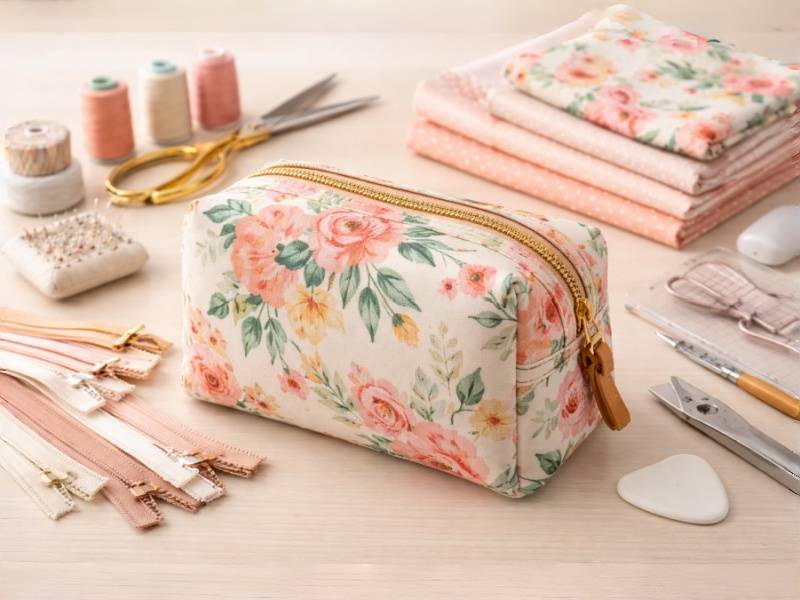
A zip makeup bag looks simple. That is exactly why so many people underestimate it.
From the outside, it is just a small pouch with a zipper. In real work, it is one of the clearest tests of whether a bag project has been thought through properly. A good one opens smoothly, stands the way it should, keeps its shape after repeated use, hides messy construction, and still looks neat when the lining is turned out and checked. A weak one does the opposite. The zipper waves. The corners collapse. The lining bunches. The seams twist. The pouch photographs well for one minute, then starts looking cheap in the hand.
That is why sewing a makeup bag with zipper is not only a beginner craft topic. It also sits right at the meeting of pattern logic, material choice, zipper selection, sample control, and production readiness. Even many simple pouch tutorials quietly rely on the same core principles used in commercial small-bag development: stabilize the zipper area, choose the right body, decide how much depth the bag needs, and build the order of assembly around the final use. Janome’s pouch tutorials repeatedly show that even small zip pouches depend on interfacing, clean layering, and controlled zipper installation, while Pellon’s own product guidance makes clear that the wrong stabilizer changes body and feel immediately.
To sew a makeup bag with zipper well, start by choosing the right pouch style, fabric, lining, and zipper size for the intended use. Cut the outer fabric and lining accurately, stabilize the outer panels, sew the zipper into the opening before closing the body, then stitch the sides and shape the base if you want more depth. The bag looks better and lasts longer when the zipper area is reinforced, seam allowances are controlled, corners are matched, and the lining is chosen to suit cosmetics, travel, or daily carry.
For a hobby sewer, that may be enough. For a label developing a private design, it is only the beginning. Once you add custom print, logo placement, washability, water resistance, premium pullers, or repeat-order consistency, the pouch becomes a much more serious product. So this guide does two jobs at once. It explains how to sew one well by hand and machine logic, and it also explains how to think about the pouch like a product that may later move into sample development and larger production runs.
What Is a Makeup Bag with Zipper, and Why Is It Still One of the Best Small Bag Styles for Everyday Use and Brand Projects?

A makeup bag with zipper is a compact pouch built to hold cosmetics, brushes, skincare, or small daily items with a secure zip closure. It stays popular because the format is simple, useful, easy to personalize, and highly adaptable. It can be flat, boxy, quilted, clear, coated, printed, or fully lined, which makes it suitable for gift sets, travel kits, promotional sets, retail collections, and private label accessories. Janome’s pouch tutorials also show why this format is so widely taught: it uses relatively few materials, but still teaches core bag-building skills.
There is also a practical reason this style lasts. It solves a real problem with very little wasted motion. A good zip pouch keeps many small items together, opens quickly, and takes up less room than a structured case. That balance of access, containment, and low material usage is hard to beat.
The style has a long everyday history because it sits between fashion and utility. It is less formal than a handbag, more contained than an open tote, and easier to adapt than a rigid cosmetic case. That is why the same construction family appears in sewing classes, quilt shops, travel accessories, beauty gift packs, hotel amenity kits, and branded merchandise programs. A small pouch is also an easy format for testing a print, a seasonal color, or a new trim direction before expanding into a full bag collection.
From a development perspective, it is one of the best “small-format” products because it exposes the truth quickly. A weak fabric choice becomes obvious. A poor zipper choice becomes obvious. Uneven sewing becomes obvious. That makes the zip makeup bag a smart first sample for new collections. It is small enough to move fast, but demanding enough to reveal whether the design language and construction logic are really working.
Which Style Works Better: Flat Makeup Bag vs Boxy Makeup Bag vs Gusseted Cosmetic Pouch?
The best style depends on what the pouch needs to hold. A flat pouch is easiest to cut and sew, easiest to pack, and best for slim items such as sheet masks, compact makeup, or travel documents. A boxy pouch adds depth and stands better on a table. A gusseted pouch sits in the middle, giving more usable volume without becoming as bulky as a full box form. Tutorials on boxed corners and flat-bottom zip bags show how a simple two-dimensional pouch can be turned into a three-dimensional bag by shaping the lower corners.
Here is the simple comparison:
| Style | Best for | Strength | Weak spot |
|---|---|---|---|
| Flat pouch | Light cosmetics, brushes, slim kits | Fast to sew, low bulk, easy mailing | Limited depth |
| Boxy pouch | Daily cosmetics, skincare, travel use | Better capacity, stands up well | Needs better corner control |
| Gusseted pouch | Mid-volume use, retail sets | Balanced shape and storage | Slightly more pattern work |
A lot of beginners choose flat because it feels safe. That is sensible. But a flat pouch is not always the best product. If the intended use includes bottles, soft tubes, or mixed-size items, the pouch may feel cramped even if the width looks generous on paper. This is one of the most common early design mistakes: using width to solve a problem that is really about depth.
Boxy and gusseted styles usually feel more premium because they hold a better silhouette. Janome’s boxed-corner guidance is useful here because it treats corner shaping as geometry, not guesswork. Once you understand the corner math, you stop “hoping” the bag will stand and start controlling how much volume it really has.
A useful rule is this: if the pouch is meant for travel, display, or vanity-top use, boxy often wins. If it is meant for sets, subscription boxes, insert packs, or easy storage, flat or lightly gusseted usually performs better.
What Fabric Is Best for a Makeup Bag with Zipper, and Which Lining and Interfacing Should You Use?

The best fabric is the one that matches the pouch’s job. For a soft casual pouch, cotton canvas, quilt cotton with added body, or light twill can work well. For a tougher everyday pouch, nylon or coated synthetics usually hold up better. For wipe-clean or splash-resistant projects, coated surfaces or vinyl-based materials make more sense, though highly water-resistant and waterproof materials often trade away softness and breathability. Sailrite’s fabric guidance notes that fully waterproof constructions are typically vinyl-based or laminated and that water resistance and breathability often pull in opposite directions. Pellon’s fusible fleece guidance also shows why body cannot be left to fabric alone: the stabilizer changes softness, loft, and shape retention in a major way.
The lining matters just as much as the shell. A pretty outer fabric can be ruined by a sticky lining, a noisy lining, or a lining that grabs brushes and pencils instead of letting them slide. For everyday cosmetic use, people usually want one of three feelings inside the bag: clean and crisp, soft and padded, or easy-wipe utility. That feeling is not determined by shell fabric alone. It comes from the full stack: outer, interfacing, fleece or foam if any, and lining.
Janome’s zip pouch projects repeatedly use interfacing or batting to stabilize the pouch body, and Pellon describes fusible fleece as adding softness, body, and stability. That tells you something important: if you use only a light outer fabric and no stabilizing layer, the pouch will often read as unfinished even when the sewing is technically correct.
A useful material map looks like this:
| Target feel | Outer fabric | Inner material | Result |
|---|---|---|---|
| Soft casual | Quilting cotton or soft canvas | Light interfacing or fusible fleece | Flexible, giftable, easy for small runs |
| Structured daily use | Canvas, twill, nylon | Midweight interfacing plus selective reinforcement | Better shape, cleaner edges |
| Wipe-clean utility | Coated fabric, laminated fabric, vinyl-based material | Smooth wipeable lining or simplified unlined logic | Easier care, more technical handling |
| Premium padded | Printed fabric, canvas, nylon | Fusible fleece or batting + lining | Fuller hand feel, better protection |
The mistake is to ask only, “What fabric should I use?” The better is, “What hand feel, shape, and cleaning behavior do I want after fifty uses?” That is where better pouches begin.
Which Zipper Type, Zipper Length, and Puller Work Best for a Makeup Bag?
For most makeup bags, coil zippers are the safest starting because they bend well around soft bag shapes and generally sew cleanly into pouches. Metal zippers can look richer, but they add weight and stiffness. VISLON® or molded plastic styles work when you want a chunkier or sportier look. YKK’s product catalog groups zipper options into metal, coil, and VISLON®, and its size listings show that smaller pouch-friendly formats commonly appear in sizes such as #3 and #5, while some molded options also go larger.
In practical pouch work, the zipper should match both the scale of the pouch and the mood of the product. A delicate printed cosmetic pouch with a heavy outdoor zipper often feels clumsy. A rugged travel wash bag with a tiny soft zipper may look underbuilt even before it fails.
Length matters too. The cleanest approach is usually to choose a zipper that matches the designed opening rather than cutting a random spare zipper and hoping it fits. Janome’s invisible zipper tutorial also reinforces a detail many beginners miss: the zipper area benefits from stabilization, and the zipper itself should suit the opening length. That principle applies well beyond garments.
The puller is not a minor detail. It changes the first impression of the pouch more than many people expect. A cord pull makes the pouch look casual. A metal pull can make it feel dressier. A branded pull tab can turn a very simple pouch into a more recognizable product. If the bag is meant for travel or wet-hand use, a larger pull often improves real usability.
One more note matters for beauty bags: water-related language is often used too loosely. A water-repellent zipper and a waterproof zipper are not the same thing. specifically describes as a waterproof zipper as a coil zipper family that maintains water-repellent performance. That difference matters if the pouch is being positioned for wet environments rather than normal vanity use.
How Do You Sew a Makeup Bag with Zipper Step by Step?
The core process is simple: prepare the panels, stabilize the outer pieces, install the zipper into the opening, assemble the shell, assemble the lining, then shape the body and finish the turn. Janome’s zip pouch instructions show this clearly by starting with interfacing on the wrong side of the outer fabric, then building the pouch around the zipper opening.
Start with the pattern. Decide the finished width, height, and depth before you cut. If you want a flat pouch, your pattern can stay simple. If you want a boxy pouch, decide the bottom depth first so your corners are intentional, not accidental. boxed-corner guidance is helpful here because it treats the conversion from flat panel to shaped base as controlled geometry.
Cut the outer fabric, lining, and stabilizing layers. Fuse the interfacing to the wrong side of the outer pieces. If you want a fuller, more padded hand, add fusible fleece or batting where appropriate. Then prepare the zipper opening. If the pouch is lined, many makers sew the zipper between the outer and lining so the tape is enclosed cleanly.
After the zipper is attached, close the pouch body. Sew the side seams with the zipper partially open so the bag can still be turned right side out later. This tiny habit prevents a surprising amount of frustration. Then shape the corners if you want a flat base or box form. Finally, turn, push out the corners carefully, press, and topstitch only where the design needs it.
A simple build sequence looks like this:
| Step | What happens | Why it matters |
|---|---|---|
| 1 | Draft size and depth | Controls real storage, not just appearance |
| 2 | Cut outer, lining, and support layers | Keeps panels balanced |
| 3 | Fuse interfacing or fleece | Adds body and zipper stability |
| 4 | Sew zipper into opening | Sets the top line of the pouch |
| 5 | Sew side and bottom seams | Forms the pouch body |
| 6 | Box corners or gussets if needed | Creates usable volume |
| 7 | Turn, press, finish | Improves shape and presentation |
If you are developing a custom beauty pouch and want help turning a rough sketch, reference photo, or first handmade sample into a cleaner production-ready version, send the details to info@jundongfactory.com.
How Do You Make a Zipper Makeup Bag Look More Premium, Hold Its Shape Better, and Last Longer?
A pouch starts to look premium when the structure feels intentional. That does not always mean “harder” or “thicker.” It means the body, zipper, seams, and lining all behave like they belong to the same product.
The first lever is shape discipline. A pouch that is too soft can look tired quickly. A pouch that is too stiff can feel cheap in a different way because it fights the hand and buckles at the seams. Pellon’s fleece guidance helps explain why support layers matter so much: they change softness, body, and stability all at once. The real skill is deciding where you need that support and where you do not.
The second lever is edge clarity. Clean zipper insertion, even seam allowance, matched corner shaping, and a lining that does not sag are what separate a neat pouch from a rushed one. Janome’s zipper and boxed-corner tutorials both back to this same truth: neatness is not a final decoration; it is built into the order of operations.
The third lever is thoughtful reinforcement. If the shell fabric is light, stabilize the zipper zone. If the base takes wear, reinforce the lower area. If the pouch is meant to stand up, support the bottom corners more deliberately. Sailrite notes that piping can add a sophisticated edge and also contribute structure and support, which is one reason it can lift a simple pouch when used carefully.
Then there is the visual layer. Premium does not require loud decoration. Often it comes from restraint: a good zipper pull, a better lining, a cleaner seam, a balanced print placement, or a base shape that stands without collapsing. For custom programs, this is where small upgrades such as woven labels, debossed patches, or a better zipper finish can matter more than adding more graphics.
What Are the Most Common Mistakes When Sewing a Makeup Bag with Zipper, and How Can You Avoid Them?

The most common mistake is not bad stitching. It is starting without deciding what the pouch is supposed to do.
A vanity pouch for daily cosmetics, a giveaway pouch, a travel wash bag, and a soft gift pouch may look similar in photos, but they do not ask the same things from the pattern. When people skip that early decision, they compensate later with thicker interfacing, a longer zipper, or a bigger cut size. That usually creates a bag that is larger, not better.
The second major mistake is failing to stabilize the zipper area. Janome’s invisible zipper instructions say it directly: add interfacing along the zipper edge so the installation stays stable and does not look distorted. That logic is just as useful in pouches. A wavy zipper almost always starts before the zipper is sewn in.
The third mistake is choosing support layers by guesswork. Pellon’s fusible fleece is designed to add body and stability, but not every pouch needs the same amount of loft. Too little support produces a limp bag. Too much produces thick seams, difficult turning, and bulky top edges.
Another repeat issue is poor corner logic. If you want a standing pouch, the corners need to be shaped consistently. Janome’s boxed-corner material is helpful because it frames the job as measurement and formula, not visual approximation. When corners are uneven, the pouch may still be usable, but it stops looking clean.
Last, many beginners do not test the real fill. They finish the pouch, admire it flat, and never check what happens when it is loaded with tubes, palettes, brush handles, or travel minis. That is the moment the flaws appear. A pouch should always be judged both empty and in use.
How Long Does It Take to Make a Makeup Bag Sample, and What Factors Usually Affect Price?
For a simple home sewer, a first rough sample can be made quickly. For a polished custom pouch, timing depends far more on material decisions, trim matching, branding details, and revision rounds than on sewing time alone.
That surprises many people. They assume a small pouch should move fast because it is small. Sometimes it does. But once you add printed fabric, color-matched zipper tape, special pullers, custom labels, lining approval, wash tests, or a revised pattern depth, the pouch stops being “small” in a development sense. It becomes a product with multiple moving parts.
Price follows the same logic. Fabric is only one piece. Cost also shifts with zipper type, lining choice, support materials, printing method, logo method, internal pockets, puller style, packaging, and how cleanly the pouch is designed for repeat sewing. A beautifully simple pouch can cost more than a larger one if it uses better trim and more exact finishing. A bigger pouch can cost less if the build is straightforward and the materials are standard.
There is also a difference between a proof-of-concept sample and a production-ready sample. The first is used to confirm size, silhouette, and direction. The second should confirm details that affect repeatability: seam order, material tolerance, zipper behavior, logo placement, and finishing consistency. Treating those as the same thing often leads to rework.
If your project already has target dimensions, fabric ideas, logo direction, and zipper preference, sending all of that together will shorten the sample cycle and reduce unnecessary revisions. For custom beauty pouches, travel kits, or toiletry bags, you can send the brief to info@jundongfactory.com.
When Should You Make It Yourself, and When Should You Move to Custom Production?
Make it yourself when the goal is to test shape, learn construction, validate proportions, or build a first visual sample. DIY is especially useful when you are still deciding whether the pouch should be flat or boxy, whether the zipper opening feels long enough, or whether the lining needs to be wipe-clean or soft.
Move to custom production when the project needs repeatability. That usually begins when color matching matters, logo placement matters, packaging matters, and the pouch has to look the same across a full run rather than in a single handmade piece.
There is a mindset change here. A handmade pouch is often judged by charm and individuality. A production pouch is judged by consistency. Those are not the same standard. In custom work, the right concern is not “Can this be sewn once?” but “Can this be sewn the same way again and again without the zipper shifting, the corners drifting, or the body changing from batch to batch?”
That is why many successful pouch programs begin with a handmade or studio sample, then move into a more disciplined sample stage before scaling. The earlier that shift happens, the easier it is to control material substitutions, trim alignment, and final feel.
If you already know the pouch is part of a larger collection, gift set, or branded accessories line, it usually makes sense to move out of pure DIY thinking earlier. At that stage, material selection, sample refinement, and production logic matter as much as sewing skill. For custom pouch development, sample refinement, or private label makeup bag projects, contact info@jundongfactory.com.
A zip makeup bag may be small, but it is not a small decision. Done casually, it becomes just another pouch. Done well, it becomes one of the most versatile and repeatable soft goods formats in a collection.
Top 10 FAQs About Sewing a Makeup Bag with Zipper
FAQ 1. What fabric is best for sewing a makeup bag with zipper?
The best fabric depends on how the pouch will be used, not just how it looks. If the bag is meant for light daily makeup, canvas, cotton twill, nylon, or quilted cotton with proper support are all workable choices. If the bag is expected to hold liquid items, travel often, or live inside a larger tote, the outer shell should usually move toward more durable or easier-to-clean materials. A pretty print alone does not make a good pouch. What matters is the full material combination: outer fabric, lining, interfacing, zipper, and seam construction.
For a soft and casual look, cotton-based shells work well, especially when paired with fusible fleece or a medium interfacing. For a more polished everyday pouch, canvas or nylon often gives a cleaner body and better wear resistance. If the pouch is likely to hold skincare tubes, foundation, or travel minis, many teams prefer a smooth lining that is easier to wipe and less likely to trap powder or spilled product in the weave.
A useful way to think about material choice is to ask three things early:
Will the pouch need shape?
Will it need easy cleaning?
Will it need to survive repeated travel?
If the is yes to all three, the pouch usually needs more than a decorative outer fabric. It needs a better-structured build. That is why two makeup bags in the same size can feel completely different in the hand. One may collapse, wrinkle, and stain quickly. The other may keep a neat shape and stay easier to maintain.
| Use Scene | Outer Fabric Direction | Lining Direction | Support Direction |
|---|---|---|---|
| Daily soft pouch | Cotton twill / light canvas | Smooth polyester lining | Light to medium interfacing |
| Travel pouch | Nylon / coated fabric / heavier canvas | Easy-wipe lining | Medium interfacing or fleece |
| Gift set pouch | Printed cotton / satin-look shell / canvas | Soft clean lining | Light support depending on look |
| Premium structured pouch | Canvas / nylon / layered fabric | Stable lining | Medium support + base reinforcement |
A good fabric choice does not just help the pouch look better on day one. It helps the product keep its shape, resist mess, and feel more intentional after real use.
FAQ 2. Which zipper type works best for a makeup bag?
For most makeup bags, a coil zipper is the safest and most versatile choice. It bends more easily, runs more smoothly around soft pouch shapes, and works well across flat, boxed, and lightly gusseted designs. That is why it remains the default choice for many cosmetic pouches. Metal zippers can look more premium, but they also add stiffness and weight. Molded plastic styles can work well for sporty or casual looks, though they can feel too bulky for smaller beauty pouches if the scale is not handled carefully.
The right zipper is not only about appearance. It also affects opening feel, stitch control, pouch flexibility, and long-term user experience. A zipper that is too heavy can distort a soft shell. A zipper that is too small may look underbuilt on a larger toiletry or travel makeup pouch. Even the puller matters more than many people expect. A good pull makes the pouch easier to use with one hand and can lift the overall look without changing the body pattern at all.
Here is the practical rule:
- Choose coil for most soft cosmetic pouches
- Choose metal when the design needs a dressier or more fashion-led look
- Choose molded plastic when the bag is more casual, sporty, or utility-driven
Zipper length should also be planned rather than guessed. A longer opening gives better access, but it also changes the top shape and sewing behavior. Shorter openings can look tidy, yet they may limit usability if the pouch is deep. For travel and vanity use, a pouch that looks compact but opens too narrowly often frustrates people quickly.
If the pouch is meant for repeated daily opening, trim quality becomes visible fast. A makeup bag can have nice fabric and good sewing, then still feel cheap because the zipper action is rough or noisy. That is why many strong pouch designs are remembered less for decoration and more for a zipper that feels clean and easy every single time.
FAQ 3. Do I need lining and interfacing, or can I sew a makeup bag without them?
A makeup bag can be sewn without lining or interfacing, but most good-looking and long-lasting versions use at least one of them, and often both. Lining helps hide seam allowances, makes the inside cleaner, and improves the feel when the pouch is opened. Interfacing gives the shell body, support, and zipper-area stability. Without these layers, many makeup bags look unfinished even if the outer stitching is technically correct.
That does not mean every pouch needs a thick padded build. A very simple giveaway pouch, a lightweight travel insert, or a minimalist flat zipper bag may use a lighter construction. But even then, some support around the zipper opening usually helps. The zipper is one of the first places where weak construction becomes visible. If the surrounding fabric is too soft, the opening may wave, stretch, or buckle.
Lining becomes even more important when the pouch is used for real cosmetics instead of dry accessories. Makeup spills, powder residue, and skincare smudges all collect inside the bag. A well-chosen lining can make the inside easier to wipe and more pleasant to use. It also helps the pouch feel “finished” when someone opens it, which matters more than many people think, especially for gift sets or branded accessories.
Here is a simple guide:
| Build Choice | Best For | Main Trade-Off |
|---|---|---|
| No lining, no interfacing | Very basic lightweight pouch | Can look flat, less refined |
| Lining only | Cleaner inside, simple soft pouch | Limited outer structure |
| Interfacing only | More shape, simplified inside | Raw inner finish unless bound |
| Lining + interfacing | Most balanced build | Slightly more sewing steps |
| Lining + fleece/support | Padded or premium-feel pouch | Thicker seams, more control needed |
If the goal is a pouch that feels better in the hand, photographs better, and holds up better over time, lining and support are usually worth it. They do more than improve appearance. They make the pouch feel deliberate.
FAQ 4. How do I keep the zipper area from getting wavy or uneven?
A wavy zipper usually starts before the zipper is sewn in. It often comes from unstable fabric, uneven feeding, poor pinning or clipping, stretching during installation, or using a zipper that does not match the pouch build. Many people blame the final topstitch, but the real problem often begins at material prep and zipper placement.
The first fix is stabilization. If the outer fabric is soft, slippery, loosely woven, or padded, the zipper area needs support. A strip of interfacing or a properly fused support layer near the opening can reduce distortion right away. The second fix is consistent seam allowance. When one side of the zipper is sewn slightly deeper than the other, the top line starts to twist, even if the difference looks small at the machine.
The third fix is to stop forcing the zipper into a pattern it does not suit. A light, flexible zipper works better with soft pouch shapes. A stiff zipper on a soft body can create drag and rippling. The fourth fix is slower handling. Many uneven zipper areas happen because the layers were not aligned carefully before sewing, or because the sewer pulled one layer more than the other while guiding the fabric.
Pressing also matters. A pouch can be technically sewn, but still look messy because the zipper seam was not pressed cleanly before final stitching. In small pouches, these small visual issues become highly visible because there is nowhere to hide them.
If a sample repeatedly shows zipper distortion, it is usually a sign to review the fabric-support combination, not only the sewing skill. That is often the difference between a pouch that looks homemade and a pouch that looks ready for sale.
FAQ 5. What size should a makeup bag be?
The right size depends on what the pouch needs to carry, not on a standard measurement. There is no single “best size” because a flat pouch for lipstick, compact powder, and a few brushes needs a very different volume from a travel pouch meant for skincare minis, small bottles, and full-face items. A pouch can look attractive in photos and still fail in use because the depth, opening width, or base shape was not planned around the real fill.
A good starting method is to group the intended contents into three tiers:
- Small essentials – lipstick, compact, concealer, mini brush
- Daily makeup set – foundation, palette, brushes, mascara, powder
- Travel or skincare set – tubes, bottles, patch packs, taller items
A flat pouch may work for tier one. Tier two often benefits from a boxy or gusseted form. Tier three usually needs not just more width, but also more height and depth. That is where many size decisions go wrong. People increase width because it is easier on paper, but the real problem is the bag does not have enough volume through the base.
A useful sizing table looks like this:
| Pouch Type | Typical Use | Suggested Shape Logic |
|---|---|---|
| Small touch-up pouch | Lip items, mini compact, a few tools | Flat or lightly gusseted |
| Daily makeup pouch | Mixed cosmetic set | Boxy or boxed-corner |
| Travel makeup pouch | Taller items, skincare minis | Boxy with stronger base |
| Set-in-bag insert | Organizer inside a tote or larger bag | Flat or slim gusset |
The opening also matters. A bag can technically hold the items but still feel frustrating if the zipper opening is too narrow for the hand to reach in comfortably. The best makeup bag size is not the one that maximizes capacity. It is the one that balances storage, visibility, access, and shape.
FAQ 6. Is a boxy makeup bag better than a flat zipper pouch?
A boxy makeup bag is usually better for capacity and tabletop use, while a flat pouch is often better for light carry, packing efficiency, and simple construction. Neither is universally better. The better choice depends on the product purpose, the target look, and how the pouch will be used once it leaves the sample table.
A flat zipper pouch is often the easiest place to start. It uses less pattern work, wastes less material, and packs easily into larger bags, travel kits, gift boxes, or subscription sets. It also works well for minimalist styles. The downside is simple: flat pouches reach their limit quickly once the contents become taller, wider, or more mixed in shape.
A boxy pouch gives more usable volume because it adds depth. It also tends to stand better on a vanity or bathroom counter. That makes it more practical for daily beauty use and more visually satisfying in retail presentation. The trade-off is that it requires better corner control, more thoughtful zipper planning, and stronger structure if the pouch needs to stand neatly without sagging.
There is also a middle path: a lightly gusseted pouch. This is often a smart direction when a project needs more room than a flat pouch but should not look too bulky. Many successful cosmetic pouches actually live in this in-between space because it gives better function without making the product feel oversized.
A good style choice should reflect the real contents, the intended visual feel, and the packaging logic around the pouch. If the bag is part of a branded set or private label project and you want help reviewing shape direction, size, logo placement, or trim options, you can share the brief with info@jundongfactory.com.
FAQ 7. How can I make a makeup bag look more premium without making it too complicated?
A makeup bag starts to look premium when the materials, trims, proportions, and finishing feel consistent with each other. It is rarely about adding more decoration. In fact, many pouches look cheaper after too many extra details are added without a clear reason. A better route is to improve the details that people actually notice in the hand: zipper feel, shape retention, edge neatness, lining quality, print placement, and logo execution.
The first upgrade is often better body control. A pouch that collapses too much can look weak, even when the fabric itself is nice. The second upgrade is a better zipper and puller. People interact with the zipper every single time they use the pouch, so this detail carries more weight than many assume. A third upgrade is a cleaner lining. A smooth lining with a nice hand can instantly improve the opening experience.
Branding should also be handled with restraint. A woven label, a debossed patch, a discreet metal plate, or a printed logo placed thoughtfully often works better than covering the bag in graphics. Premium does not always mean louder. Often it means more controlled.
Useful upgrade areas include:
| Upgrade Area | What It Changes |
|---|---|
| Better zipper and puller | Improves daily use and first impression |
| Improved interfacing/support | Helps the pouch keep shape |
| Cleaner lining choice | Makes the inside feel polished |
| Refined logo method | Improves brand perception |
| Better seam alignment | Makes the whole pouch look more professional |
| Thoughtful base shape | Improves both function and shelf look |
One of the strongest small-bag is this: people often read “quality” through tiny details. A neat zipper line and a balanced silhouette can make a simple pouch feel much more elevated than a crowded design with weak construction.
FAQ 8. How much does it cost to develop a custom makeup bag sample?
The cost of a custom makeup bag sample depends more on materials, trim choices, branding details, and revision rounds than on the pouch’s small size. Many people assume a cosmetic pouch should be cheap to develop because it is smaller than a backpack or travel bag. In reality, small bags often demand tighter visual control, and once custom features are added, the sample process can become surprisingly detailed.
The most common price drivers are outer fabric, lining, interfacing or padding, zipper type, puller, logo method, internal pockets, print setup, and packaging direction. A very simple pouch with common materials can be relatively straightforward. A pouch with custom print, branded zipper pull, color-matched trim, special lining, and a gift-ready look will naturally require more work.
There is also a major difference between an exploration sample and a production-ready sample. An exploration sample is meant to confirm shape, scale, and overall direction. A production-ready sample goes further. It should confirm the build, fit, finish, trim choice, and whether the pouch can be repeated cleanly. If these two stages are confused, cost and timing often feel unpredictable because too many decisions are still moving at once.
To make the sample process more efficient, it helps to prepare the brief clearly. Useful starting details include:
- Target size
- Preferred shape
- Fabric direction
- Lining preference
- Logo method
- Quantity plan
- Target use scene
- Packaging idea if available
When these details come together early, sample development becomes much smoother, and the pouch usually reaches the right direction with fewer correction rounds.
FAQ 9. How long does it take to make a custom makeup bag sample?
A simple makeup bag sample can move quickly, but real timing depends on how many decisions are already clear before development starts. If the pouch uses standard materials, a familiar shape, and a straightforward zipper setup, the process is naturally faster. If the project includes custom print, special trim, logo hardware, multiple compartments, color matching, or repeated revisions, the timeline becomes longer.
The key thing to understand is that sample timing is rarely determined by sewing time alone. The actual sewing of a small pouch may be relatively quick. What takes time is preparation and control: confirming materials, aligning trim colors, adjusting the pattern, reviewing the sample, updating details, and making sure the next version solves the right problem instead of creating a new one.
A common sample path looks like this:
| Stage | What Happens |
|---|---|
| Brief review | Size, shape, use, branding, and materials are discussed |
| Material confirmation | Shell, lining, zipper, and support directions are chosen |
| First sample | Basic form and key construction are tested |
| Review and revision | Shape, trim, logo, or details are adjusted |
| Final confirmation sample | Cleaner version prepared for next-stage approval |
A project moves faster when the target is specific. It slows down when teams change shape, material, logo placement, and packaging at the same time. That is not a problem, but it does mean the timeline should be viewed as a design cycle, not just a sewing task.
If you already have drawings, reference photos, dimensions, or a rough handmade version and want a cleaner custom sample, you can send the project details to info@jundongfactory.com for review.
FAQ 10. When should I stop doing DIY and move to a custom production partner?
DIY is ideal for early learning, rough shape testing, and first ideas. It usually stops being enough when the project needs repeatability, stable trim sourcing, consistent branding, and a finish that has to stay the same across a larger run. A handmade first sample can be extremely useful. It helps confirm whether the pouch should be flat or boxy, whether the opening feels wide enough, and whether the material direction feels right. But once the pouch becomes part of a collection, a gift set, a retail program, or a private label launch, a different level of control is needed.
The biggest difference is this: a handmade pouch is judged one piece at a time, while a developed custom pouch is judged by consistency. If the zipper line changes from batch to batch, the body loses shape, the logo shifts, or the lining behaves differently, the product quickly feels less reliable. That is when it makes sense to move from pure craft thinking into structured development.
A strong next step usually includes:
- Cleaning up the pattern
- Confirming the exact material stack
- Choosing the right zipper and puller
- Locking logo placement
- Reviewing sample revisions
- Checking how the pouch behaves when filled
- Preparing for repeatable construction
The earlier this transition is handled properly, the fewer avoidable issues appear later. If your makeup bag design is moving beyond hobby sewing and into a branded or volume-based project, it is often smarter to shift into proper custom development before small inconsistencies become expensive corrections. For makeup bags, toiletry pouches, travel sets, or private label cosmetic pouch projects, you can reach out at info@jundongfactory.com.