 Skip to content

A tote bag can be one of the simplest sewn products in a collection—and one of the easiest products to price incorrectly.
Two bags may both be described as “12 oz canvas totes,” yet one may use a flat body, standard handles and a single-color print, while the other adds a bottom gusset, reinforced handle joints, an inner pocket, zipper closure, two print locations, woven labels and individual retail packing. From a distance they may look similar. On a production sheet, they are completely different projects.
Custom tote bags do not have one fixed price. Cost is mainly determined by fabric type and weight, dimensions, construction, handle design, logo method, number of colors and print positions, accessories, packing, quantity, delivery schedule and freight. At 500 pieces, simple printed totes may sit in the low single-digit dollar area, while heavier or more developed retail styles can cost several dollars more per piece.
That difference becomes important very quickly. A $0.60 change sounds small during sampling. Across 10,000 bags, it becomes $6,000. Add another print position, heavier canvas and retail packing, and a project that looked simple at the concept stage can move thousands of dollars.
So before comparing numbers, it helps to understand exactly what is creating them.
How Much Does a Custom Tote Bag Cost?
A custom tote bag does not have one fixed price because the term “tote bag” can describe products with completely different materials, construction and branding requirements. A lightweight cotton event tote with one screen-printed logo may cost only a fraction of a heavy canvas retail tote with a gusset, zipper, inner pocket, woven label and individual packing. The useful number is therefore not an average price alone, but the cost of a clearly defined specification.
For commercial orders, the final unit cost is usually shaped by six areas: fabric, construction, branding, quantity, packing and delivery. If any of these changes, the quotation can change with it.
A bag that looks simple in a product photo may still contain many cost decisions. A difference of $0.30 per piece may appear insignificant at the sample stage, but across 10,000 pieces it becomes $3,000. A $0.80 difference becomes $8,000. That is why experienced sourcing teams normally spend more time defining the specification before negotiating the final number.
Tote Bag Price Structure
The most practical way to understand tote pricing is to divide the product into separate cost layers.
The first layer is the body material. Fabric type, fabric weight, color and finish determine how much textile is used and how the tote feels in the hand. Lightweight cotton, heavy cotton canvas, polyester, RPET, Oxford fabric, jute and other materials all behave differently in production.
The second layer is construction. A flat open-top bag is relatively straightforward. Adding side gussets, a bottom gusset, lining, pockets, reinforced handles, zipper closures or metal hardware adds material as well as cutting and sewing operations.
The third layer is branding. A one-color screen print on one side is very different from a four-color print on two sides, embroidery, a woven label or several branding elements used together.
The fourth layer is packing. Bulk carton packing costs less than individual retail packing with hangtags, barcodes, labels, insert cards or branded packaging.
The fifth layer is quantity. Larger runs usually allow fixed preparation work to be spread over more pieces.
The sixth layer is delivery. EXW, FOB, CIF and DDP quotations do not represent the same cost responsibility, so they should never be compared as though they are identical.
| Cost Area | Simpler Specification | More Developed Specification |
|---|---|---|
| Fabric | Lightweight cotton | Heavy canvas or selected specialty fabric |
| Body | Flat construction | Side or bottom gusset |
| Handle | Standard handle | Custom width, length or reinforcement |
| Closure | Open top | Zipper, snap or magnetic closure |
| Interior | Unlined | Lining and inner pocket |
| Logo | 1 color, 1 position | Multi-color, multiple positions |
| Label | None | Woven label, care label, hangtag |
| Packing | Bulk carton | Individual private-label packing |
The important part is not to remove every feature in order to reduce cost. The aim is to understand which features support the product’s purpose and which ones add cost without adding enough value.
What Does a 500-Piece Tote Project Really Cost?
Five hundred pieces is a useful reference quantity because it is large enough for genuine custom production while still being practical for a first commercial run.
Jundong’s standard MOQ is usually 500 pieces per design. Selected simpler styles may be reviewed at 200–300 pieces, while certain low-unit-cost basic products may require 1,000 pieces or more because fabric purchasing, printing preparation, cutting, sewing, packing and inspection still require a complete production cycle.
However, “500 custom totes” is still not a complete specification.
Consider three illustrative 500-piece projects.
| Specification | Project A | Project B | Project C |
|---|---|---|---|
| Use | Event giveaway | Brand merchandise | Retail collection |
| Fabric | Lightweight cotton | 10–12 oz canvas | Heavy canvas |
| Structure | Flat | Bottom gusset | Gusset + lining |
| None | None | Inner pocket | |
| Closure | Open | Open | Zipper |
| Logo | 1-color front print | 2-color front print | Front + back branding |
| Label | None | Woven label | Woven + care label |
| Packing | Bulk | Individual polybag | Retail packing |
Project A has relatively few production steps.
Project B uses more material and requires more developed branding.
Project C introduces additional sewing, accessories, labeling and packing.
Even if all three totes have similar outside dimensions, their costs should not be expected to be close.
This is why an offer that simply says “500 canvas bags: $X each” is not enough for a serious comparison. The fabric weight, dimensions, construction and included services must be visible.
A useful 500-piece RFQ should state:
- finished width and height;
- side or bottom gusset;
- fabric type;
- fabric weight;
- fabric color;
- handle width and length;
- handle material;
- inner pocket requirements;
- closure;
- logo process;
- logo size;
- number of colors;
- number of print positions;
- labels;
- packing;
- destination;
- required arrival date.
Once these details are defined, the cost becomes much easier to explain and compare.
How Quantity Changes Unit Cost
Quantity usually affects unit cost because several production expenses are not directly proportional to the number of finished bags.
Printing setup still needs to be prepared.
Cutting still needs to be organized.
Sewing instructions still need to be issued.
Packing requirements still need to be confirmed.
Inspection still needs to be arranged.
These activities exist whether the run is 200 pieces or 2,000 pieces.
A simple illustration shows why quantity can matter.
Suppose a project contains $400 of preparation and fixed handling before the variable cost of the tote itself.
| Quantity | Fixed Cost Spread per Piece |
|---|---|
| 200 pcs | $2.00 |
| 500 pcs | $0.80 |
| 1,000 pcs | $0.40 |
| 2,000 pcs | $0.20 |
| 5,000 pcs | $0.08 |
This is only a mathematical example, not a quotation, but it demonstrates the principle clearly.
The higher quantity does not eliminate setup work. It simply spreads that work over more pieces.
This is also why the lowest unit cost is not always the best commercial decision.
If an extra 3,000 pieces reduce the unit cost by $0.25, the additional production spend may still be much larger than the saving achieved on the original quantity.
The better decision depends on:
- expected sales or distribution volume;
- storage space;
- cash flow;
- seasonal demand;
- product life cycle;
- likelihood of repeat orders.
For a new design, 500–1,000 pieces may provide better inventory control even if the unit price is higher than a 5,000-piece run. For a proven recurring program, a larger run may create real efficiency.
Why Two Similar Tote Quotes Can Be Very Different
A large price gap does not automatically mean one company is expensive.
It often means the quotations are not describing the same bag.
Take the specification:
“40 × 35 cm canvas tote with logo.”
This description still leaves many unanswered details.
The canvas may be 6 oz, 8 oz, 10 oz, 12 oz or heavier.
The tote may be flat or gusseted.
The handles may be 50 cm or 70 cm long.
They may be standard sewn handles or reinforced at the stress areas.
The logo may be one color or five colors.
It may appear on one side or both.
Packing may be bulk or individual.
One quotation may include a woven label while another excludes it.
One may include export cartons while another treats packing separately.
One may be FOB while another is EXW.
A proper comparison therefore needs a specification table.
| Detail | Quote A | Quote B |
|---|---|---|
| Fabric | 12 oz canvas | Canvas |
| Size | 40 × 35 × 10 cm | 40 × 35 cm |
| Gusset | 10 cm | Not stated |
| Handle | 65 × 2.5 cm | Standard |
| Logo | 2-color front | 1-color front |
| 1 inner pocket | None | |
| Woven label | Included | Extra |
| Packing | Individual polybag | Bulk |
| Freight term | FOB | EXW |
At first glance, Quote A may appear higher.
Once the details are visible, it becomes clear that it also contains more product and more service.
The most useful comparison is therefore specification-to-specification, not price-to-price.
How Logo Printing Changes the Cost
Logo decoration can be a small part of the tote cost or one of the largest variables, depending on the artwork.
Screen printing works particularly well for clean graphics with a limited number of solid colors. Every additional color can add setup and printing work.
A four-color design is not simply a one-color design printed four times faster. Each color may require separate preparation and accurate registration.
Printing on the reverse side is another production location.
A small front logo and a large full-width graphic also use different amounts of ink and production time.
Before final pricing, confirm:
- logo method;
- artwork dimensions;
- number of colors;
- print position;
- one side or two sides;
- whether front and back artwork are identical;
- whether gradients are used;
- whether very fine details are present.
If a design contains many colors, gradients or photographic detail, screen printing may not be the most efficient process. Heat transfer or digital printing may provide a better result depending on the fabric and order.
For a premium canvas tote, embroidery may create a stronger tactile effect, but stitch count, logo size and fabric suitability need to be considered.
The cheapest decoration process is not always the best choice. The correct method should reproduce the artwork clearly, remain compatible with the fabric and still fit the intended budget.
Are Setup Charges Included?
Setup charges should always be clarified before comparing final numbers.
Depending on the decoration process, setup may include screen preparation, artwork separation, embroidery digitizing, test printing, tooling or other production preparation.
Some quotations include these charges in the unit rate.
Others list them separately.
Neither structure is automatically better.
The important thing is that the total cost is visible.
For example:
| Cost Item | Quote 1 | Quote 2 |
|---|---|---|
| Unit price | $3.40 | $3.55 |
| Setup | $150 | Included |
| Quantity | 500 | 500 |
| Product total | $1,700 | $1,775 |
| Setup total | $150 | $0 |
| Effective subtotal | $1,850 | $1,775 |
Quote 1 appears cheaper until setup is added.
Repeat orders should also be checked separately. Some preparation may not need to be recreated when artwork and specifications remain unchanged, while other work may still be required.
A useful commercial document should make it clear which fees are one-time, which fees repeat and which fees are already built into the unit price.
What Does Packaging Add?
Packaging can change both product cost and delivery cost.
The simplest option may be bulk packing in export cartons.
A more developed retail program may require:
- individual polybags;
- hangtags;
- woven labels;
- care labels;
- barcode labels;
- SKU labels;
- insert cards;
- branded sleeves;
- color boxes;
- gift boxes;
- destination carton marks.
Every one of these requires materials, handling and confirmation.
Packaging can also change carton dimensions.
This matters because freight is influenced by weight and volume.
For example, rigid presentation boxes may increase shipping volume significantly compared with flat polybag packing.
A premium package should therefore create enough commercial value to justify the additional material and logistics cost.
For retail, e-commerce and multi-SKU programs, packaging also supports warehouse accuracy. The wrong barcode, mixed color assortment or incorrect carton mark can create problems even when the tote itself is perfect.
Packing should therefore be confirmed before final production rather than treated as a last-minute detail.
Product Cost vs Landed Cost
Unit price is only one part of the final commercial cost.
Consider the difference between:
Factory product cost
and
landed cost at the destination.
A landed-cost calculation may include:
- tote unit price;
- logo setup;
- packing;
- sample development;
- testing or inspection;
- inland transportation;
- international freight;
- insurance where applicable;
- destination handling;
- duties and taxes where applicable.
This is why EXW, FOB, CIF and DDP numbers should not be placed in the same column without adjustment.
A lower EXW quotation may eventually create a higher delivered cost if inland transportation, export handling and international freight are added later.
Likewise, a higher FOB price may already include several steps that another quotation excludes.
For samples and urgent small shipments, courier services are often practical.
Urgent commercial quantities may justify air freight.
Large-volume tote programs are often more suitable for sea freight when the delivery schedule allows it.
The correct shipping method depends on carton volume, weight, destination, deadline and budget.
How to Compare the Final Price
Before selecting a quotation, place every offer into the same comparison structure.
The following checklist is usually enough:
| Check | What Must Match |
|---|---|
| Fabric | Type, weight, color and finish |
| Dimensions | Width, height and gusset |
| Handles | Width, length and reinforcement |
| Construction | Pocket, zipper, lining, base |
| Logo | Method, colors, size and positions |
| Labels | Woven, care, barcode, hangtag |
| Packing | Individual, bulk, retail or gift |
| Quantity | Per design and per color |
| Sample | Included or separate |
| Setup | Included or separate |
| Inspection | Internal or third-party |
| Trade term | EXW, FOB, CIF or DDP |
| Production time | Confirmed estimate |
| Freight | Included or excluded |
Once these items match, the final numbers become far more useful.
A 5% higher quotation can sometimes represent better value if it includes a heavier fabric, stronger handle construction, two print positions and individual packing.
A 10% lower quotation can be excellent if it genuinely comes from better production efficiency.
But the reason for the difference should be visible.
The strongest custom tote project is not built around finding the smallest number on a spreadsheet. It is built around defining exactly what the tote needs to do, removing unnecessary complexity, protecting the details that matter and then costing that specification consistently.
For projects that already have a reference image, drawing or existing sample, the most useful starting information is the finished size, preferred material, fabric weight, artwork, quantity, packing method, destination and required delivery date. With those details defined, the quotation can move from a rough estimate to a practical production cost.
What Affects Custom Tote Bag Price?
Custom tote bag price is shaped by much more than fabric and quantity. Two totes with the same outside dimensions can have very different costs if one uses heavier cloth, longer handles, a gusset, inner pocket, zipper, multi-color artwork, two print positions or retail-ready packing. The clearest way to control cost is to identify which specifications create real value, then avoid adding complexity that does not improve appearance, function or delivery.
For most custom tote projects, the largest cost variables are:
- fabric type;
- fabric weight;
- finished dimensions;
- gusset and internal structure;
- handle construction;
- logo process;
- number of logo colors;
- number of decoration positions;
- zipper, pockets and hardware;
- labels and hangtags;
- packing method;
- quantity per design and color;
- delivery schedule;
- freight method.
These variables interact with one another. A heavier fabric changes not only material consumption but also finished weight. A larger bag uses more cloth and may require stronger handles. A second printed side adds another production operation. A color box can increase both packing cost and shipping volume.
For this reason, controlling tote cost is rarely about changing one number. It is usually about making several specifications work together.
| Specification | Lower-Complexity Direction | Higher-Complexity Direction | Main Cost Effect |
|---|---|---|---|
| Fabric | Lightweight cotton | Heavy canvas | Material consumption |
| Body | Flat tote | Gusseted tote | Fabric + sewing |
| Interior | Unlined | Lining + pocket | Cutting + sewing |
| Closure | Open top | Zipper | Accessory + sewing |
| Handle | Standard | Long/reinforced | Fabric + reinforcement |
| Logo | 1 color, 1 side | Multi-color, 2 sides | Setup + print operations |
| Label | None | Woven/care labels | Label + attachment |
| Packing | Bulk | Individual retail packing | Material + labor |
| Quantity | Consolidated run | Many small color runs | Production efficiency |
Cotton vs Polyester: What Is the Cost Difference?
Cotton and polyester should not be compared only by fiber name. Weight, weave, finish, color, construction and printing method can create a larger cost difference than the fiber itself.
Cotton is commonly selected for lifestyle merchandise, bookstores, fashion collections, gift programs and retail totes because it provides a natural textile appearance and works well with many simple printing methods.
Polyester is often selected when low weight, foldability, stronger color options or certain transfer-printing methods are important.
A more useful comparison might be:
- 6 oz cotton vs lightweight polyester;
- 10 oz cotton canvas vs 300D polyester;
- 12 oz canvas vs coated polyester;
- conventional cotton vs RPET;
- stock fabric vs custom-dyed fabric.
These are much more meaningful than asking whether “cotton or polyester is cheaper.”
Fabric consumption also matters.
Consider a simple flat tote with a finished body around 40 × 35 cm.
Ignoring seam allowance, hems, handles and cutting waste for a moment, two flat body panels alone contain approximately:
40 cm × 35 cm × 2 = 2,800 cm²
That equals about 0.28 m² of fabric.
If the same tote moves from 280 gsm fabric to 340 gsm fabric, the weight of the body fabric rises by approximately 21%.
The finished product cost will not rise by exactly 21% because labor, printing and packing remain separate, but the calculation shows why fabric weight has a measurable effect.
Polyester may offer a cost advantage in some lightweight programs, while cotton or canvas may create stronger perceived value for retail merchandise.
The decision should therefore consider:
- appearance;
- hand feel;
- expected load;
- printing method;
- wash or care expectations;
- foldability;
- product positioning;
- freight weight.
A lower-cost material that weakens the desired appearance can be a false saving. At the same time, using heavy canvas for a one-day event may add cost with little practical benefit.
The right material is the one that performs the intended job without being unnecessarily over-specified.
Does Fabric Weight Change Price?
Fabric weight is one of the most important variables in canvas and cotton tote costing.
Heavier cloth usually means more fiber per square meter. That creates a direct increase in material use before sewing, printing or packing is considered.
A useful way to understand the difference is to compare fabric mass using the same tote area.
Suppose the main fabric requirement for a particular tote is approximately 0.50 m² after body panels, handles, gusset and practical cutting consumption are considered.
The approximate fabric weight would be:
| Fabric Weight | Approx. Fabric Mass for 0.50 m² |
|---|---|
| 180 gsm | 90 g |
| 240 gsm | 120 g |
| 280 gsm | 140 g |
| 340 gsm | 170 g |
| 400 gsm | 200 g |
This table does not represent a quotation because real consumption depends on pattern layout, seam allowance, handle construction and cutting efficiency. It does show why heavier cloth changes both material cost and shipping weight.
Fabric weight also affects how the product behaves.
Lightweight fabric usually:
- folds more easily;
- occupies less carton volume;
- weighs less;
- works well for event distribution;
- produces a softer structure.
Heavier canvas usually:
- feels more substantial;
- keeps its shape better;
- supports developed construction;
- works well for retail merchandise;
- can support heavier contents when combined with suitable sewing and handles.
Thicker material is not automatically stronger in every practical situation.
Handle joints and seams often carry more stress than the center of the fabric.
A heavy canvas body with weak handle attachment can still fail under load. A slightly lighter fabric with well-designed reinforcement may perform better.
When load-bearing matters, fabric should therefore be reviewed together with:
- handle width;
- handle attachment depth;
- stitch pattern;
- reinforcement;
- seam construction;
- bag width;
- gusset depth;
- expected contents.
Jundong treats fabric weight, handle construction and load-bearing as connected tote specifications rather than isolated details.
This is particularly important for bookstore bags, grocery merchandise, bottle sets and other applications where the tote may carry dense products.
How Do Size and Structure Affect Cost?
Size affects fabric consumption, but construction can have an even larger influence on sewing time.
A basic flat tote may consist of:
- front panel;
- back panel;
- top hems;
- two handles;
- side and bottom seams.
A more developed tote may add:
- side gussets;
- bottom gusset;
- separate bottom panel;
- lining;
- inner pocket;
- zipper pocket;
- zipper closure;
- magnetic snap;
- reinforcement panel;
- base board;
- metal fittings;
- piping;
- contrast panels.
Every added component creates more than material cost.
It can also create:
- another cutting pattern;
- another sewing step;
- additional alignment;
- more thread;
- more inspection areas;
- additional sample confirmation.
Consider two bags with the same 40 × 35 cm front dimensions.
| Feature | Flat Tote | Developed Tote |
|---|---|---|
| Front size | 40 × 35 cm | 40 × 35 cm |
| Gusset | None | 12 cm |
| Lining | None | Full lining |
| None | Inner pocket | |
| Closure | Open | Zipper |
| Handle | Standard | Reinforced |
| Label | None | Woven label |
| Packing | Bulk | Individual |
Looking only at the front dimensions makes the bags appear similar.
In production they are not.
Gussets require additional fabric or additional panel shaping.
Lining effectively introduces another internal textile construction.
A pocket needs its own fabric, cutting and attachment.
A zipper creates accessory cost and additional sewing.
Reinforcement adds material and stitch operations.
This is why reducing the outside size by 2 cm may save less than removing an unnecessary internal feature.
When cost needs to be controlled, structure should be reviewed feature by feature.
Ask:
- Does the tote really need a zipper?
- Does the pocket need to be zippered?
- Is full lining necessary?
- Does the base need reinforcement?
- Is a 12 cm gusset required, or would 8 cm work?
- Do handles need custom construction?
This approach usually protects the visible identity of the bag better than immediately switching to a much lighter fabric.
How Much Does Multi-Color Logo Printing Cost?
Logo cost depends on process, artwork size, number of colors, number of positions, material surface and quantity.
Screen printing is often efficient for clear designs with solid colors.
A one-color graphic may require one screen.
A two-color graphic may require two screens.
Four spot colors may require four individual color separations and accurate registration during printing.
The effect is especially noticeable on smaller runs because setup is distributed across fewer pieces.
A simple illustration makes this easier to understand.
Suppose setup for one print color is represented as a fixed cost of “S.”
For a 500-piece run:
one color = S ÷ 500 per piece
four colors = 4S ÷ 500 per piece
At 5,000 pieces, the same setup is spread across ten times as many finished bags.
The actual rate depends on the specific project, but the production logic is the same.
Multi-color artwork can also require more printing passes and more attention to registration.
For example, a four-color geometric logo with clear spot colors may still work well with screen printing.
A photograph or artwork with gradients, shadows and many blended colors is very different.
In that situation, heat transfer or digital printing may be more appropriate.
Jundong’s logo capability includes screen printing, heat transfer, digital printing, embroidery, woven labels and other branding methods. Its process guidance notes that screen printing works particularly well for clear solid-color artwork, while multi-color designs, gradients and fine detail may require another method.
This means cost control should not simply involve reducing the number of colors.
Sometimes changing the print technology preserves the artwork more effectively.
The logo review should consider:
- number of colors;
- gradients;
- line thickness;
- print size;
- fabric texture;
- fabric color;
- print position;
- quantity;
- expected visual effect.
Dark fabric can also affect printing requirements because some inks may need an underbase or additional work to achieve the intended appearance.
The same artwork may therefore cost and look different on natural cotton, black canvas and polyester.
How Much Extra Is Double-Sided Printing?
Printing on both sides usually means another decoration position.
It should not be assumed that a front-and-back print is included in the same price as a front-only design.
A second position can create:
- additional printing time;
- additional handling;
- another screen or artwork setup when the design differs;
- additional drying or curing;
- another inspection area.
If the same artwork appears on both sides, some setup may be shared, but the second print operation still exists.
If the front and back use different artwork, the preparation can become more involved.
The financial effect grows quickly with quantity.
Consider an illustrative additional print cost:
| Additional Cost per Tote | 500 pcs | 5,000 pcs | 20,000 pcs |
|---|---|---|---|
| $0.20 | $100 | $1,000 | $4,000 |
| $0.40 | $200 | $2,000 | $8,000 |
| $0.60 | $300 | $3,000 | $12,000 |
| $1.00 | $500 | $5,000 | $20,000 |
These figures are mathematical examples rather than production prices, but they show why decoration decisions should be made before final costing.
For a retail tote, printing both sides may create enough visual value to justify the cost.
For a high-volume event tote, a strong front graphic and clean reverse side may be more efficient.
Another option is combining a large front print with a small woven label or side label rather than repeating the same large artwork on the back.
Cost control becomes more effective when every decoration position has a clear visual purpose.
Does Packaging Increase Cost?
Packaging affects material cost, labor, carton efficiency and shipping volume.
A simple tote project may use:
- bulk packing;
- individual polybags;
- standard export cartons.
A retail or e-commerce project may add:
- woven labels;
- care labels;
- hangtags;
- barcode stickers;
- SKU labels;
- FBA labels;
- insert cards;
- branded polybags;
- sleeves;
- color boxes;
- gift boxes;
- destination labels;
- carton marks.
Each additional item has both a physical material cost and a handling cost.
For example, attaching a hangtag is not only the cost of printed paper. Someone must also:
- confirm the artwork;
- produce the tag;
- receive and count it;
- attach it in the correct location;
- ensure SKU information is correct;
- inspect the finished packing.
The same applies to barcodes and multi-SKU labels.
Packaging can also influence logistics significantly.
Consider 1,000 foldable totes.
If each tote can be packed flat into a thin polybag, carton utilization may be efficient.
If each one is placed in a rigid retail box, the shipment volume may increase substantially even though the tote itself has not changed.
Freight can therefore rise even when the product unit price changes very little.
Packing decisions should be based on the real distribution channel.
| Use | Practical Packing Direction |
|---|---|
| Event distribution | Bulk or simple individual packing |
| Corporate gifts | Individual presentation |
| Fashion retail | Private label + hangtag + barcode |
| E-commerce | SKU/barcode + protective compact packing |
| Gift set | Set packing or presentation box |
| Multi-store delivery | Store-specific carton marks |
Jundong can support polybags, hangtags, care labels, woven labels, barcodes, SKU labels, FBA labels, color boxes, gift boxes, carton marks and multi-SKU packing according to the confirmed project requirements.
Packing becomes even more important when several colors, sizes or destinations are involved.
A tote can be perfectly sewn and printed but still create serious problems if cartons contain the wrong color mix or incorrect barcode.
For this reason, packaging should be finalized before bulk packing starts.
How Quantity and SKU Count Change Cost
Total quantity alone does not tell the whole story.
A 5,000-piece order in one color is operationally different from a 5,000-piece order divided into ten colors.
Compare:
5,000 black totes
with:
10 colors × 500 pieces.
The second project may require:
- more fabric colors;
- separate material allocation;
- more cutting identification;
- additional line control;
- more SKU labels;
- separate packing;
- more carton marks;
- increased sorting work.
This is why quantity per design, color and artwork should be stated clearly.
The same applies to logo variations.
One body design with five different printed logos can create more setup than one design with one logo.
Larger quantities usually improve production efficiency, but fragmented quantities can reduce some of that advantage.
Which Changes Reduce Cost Without Making the Tote Look Cheaper?
The strongest cost reduction usually comes from removing hidden complexity rather than weakening visible quality.
Practical options can include:
- keep the selected canvas but simplify the inner pocket;
- keep reinforced handles but remove an unnecessary lining;
- reduce four spot colors to two where the identity still works;
- print one strong side instead of repeating artwork on both sides;
- use a woven label instead of a second large print;
- replace a rigid box with a sleeve or branded polybag;
- consolidate colors where possible;
- increase volume only when inventory planning supports it;
- use a standard zipper instead of custom hardware where appearance is not affected.
A change of fabric should often come later, especially when the textile hand feel is a major part of the product identity.
The most useful cost review asks three things about every specification:
Does it improve function?
Does it improve the visual identity?
Does it improve delivery or retail execution?
If the answer is no to all three, that feature is a strong candidate for simplification.
This approach produces a tote that feels intentionally designed rather than simply stripped down to reach a lower number.
Which Type of Tote Bag Is Best for Your Project?

The best tote is the one whose material, weight, structure, handle design and decoration method match the way it will actually be used. A trade-show giveaway, bookstore tote, fashion accessory, grocery bag and corporate gift should not share the same specification simply because they all have two handles. Start with load, frequency of use, appearance, print requirements, packing and target cost, then choose the construction.
A useful way to select a tote is to define the job before choosing the fabric. A bag that carries brochures for one afternoon has very different needs from a tote expected to hold books every week. A retail item also has to meet expectations for hand feel, stitching, shape retention, labels and presentation, while a high-volume campaign may place more weight on unit cost, print clarity and carton efficiency.
| Project Use | Practical Starting Direction | Main Details to Control |
|---|---|---|
| Trade show / event | Lightweight cotton or polyester | Print clarity, low weight, fast packing |
| Bookstore / museum | Mid-weight cotton or canvas | Handle strength, print quality, repeated use |
| Fashion merchandise | 10–16 oz canvas or developed textile | Hand feel, stitching, labels, structure |
| Grocery / membership program | Lightweight reusable textile | Cost, load, foldability, carton efficiency |
| Corporate gift | Mid-weight structured tote | Appearance, logo finish, presentation |
| E-commerce retail | Developed custom tote | SKU labels, packing, consistency |
| Seasonal promotion | Cost-controlled cotton/polyester | Quantity, lead time, artwork, packing |
| Sustainability-led collection | Verified organic or recycled material | Material documentation, claims, traceability |
Cotton vs Canvas Tote Bags
Cotton and canvas are often treated as two completely different materials, but canvas is a fabric construction that is frequently made from cotton. In practice, the useful comparison is usually lightweight cotton sheeting versus heavier cotton canvas.
Lightweight cotton works well when the tote needs to fold easily, pack efficiently and carry light to moderate contents. Common applications include conferences, exhibitions, book launches, museum events, campus activities and promotional programs. It is easy to print, relatively light in shipment and suitable for large-volume distribution.
Canvas is generally chosen when the tote itself needs more body, a stronger hand feel or a more retail-oriented appearance. It can support gussets, larger pockets, longer handles, embroidery, leather patches and other developed details more naturally than a very light fabric.
The difference becomes easier to see when fabric weight is included.
| Approx. Fabric Weight | General Feel | Common Direction |
|---|---|---|
| 120–180 gsm | Light, foldable | Event and giveaway totes |
| 180–240 gsm | Light-medium | Promotional and general-use totes |
| 240–340 gsm | Medium-structured | Merchandise and bookstore totes |
| 340–450+ gsm | Heavy, substantial | Premium canvas and developed retail totes |
These figures are selection references, not universal production limits. Weave, finishing, coating and fiber content can change how a fabric behaves even at the same gsm.
For repeated use, do not look at body fabric alone. Handle width, handle attachment and seam construction are just as important. A 400 gsm canvas body with weak handle stitching may perform worse than a 280 gsm tote with well-designed reinforcement.
For a bookstore project, for example, a 280–340 gsm canvas with handles sewn deeply into the body may be more sensible than a very light cotton tote because books create concentrated load. For a conference pack containing a notebook, badge and brochure, moving to heavy canvas may increase product and freight cost without creating meaningful value.
Cotton also responds well to screen printing, especially when the artwork uses clean solid colors. Canvas texture can become more visible through very fine lines, so artwork should be reviewed at actual print size rather than only on a screen.
The practical decision is therefore not “cotton or canvas?” but “how much structure, load capacity and hand feel does this project really need?”
Organic vs Recycled Tote Bags
Organic and recycled textiles support different product stories, and they should not be presented as interchangeable.
Organic cotton is generally selected when the focus is on fiber cultivation and textile sourcing. Recycled textiles focus on reducing virgin material use by incorporating reclaimed fiber or recycled polymer feedstock. RPET, for example, is commonly used when a lightweight synthetic construction and recycled-content direction are required.
A project should first define what the environmental claim needs to communicate. If the tote is part of a sustainability campaign, the exact fabric specification and supporting documentation matter more than broad phrases such as “green bag” or “eco tote.”
A simple decision table helps clarify the difference.
| Priority | Material Direction to Review |
|---|---|
| Natural hand feel | Cotton / cotton canvas |
| Organic-fiber story | Verified organic cotton |
| Recycled-content story | RPET or recycled textile |
| Lightweight and quick drying | Polyester / RPET |
| Rustic visual texture | Jute or selected natural blends |
| Heavy retail feel | Cotton canvas |
Material documentation should be confirmed before hangtags, packaging or product descriptions are finalized. If a collection uses a certified claim, the certificate scope, material source and relevant transaction documents should be checked for that exact project.
Cost should also be considered in context. Organic or recycled options can carry different material minimums, color limitations, lead times or documentation requirements. The cheapest fabric is not always the lowest total-cost option if it creates higher minimums or forces a construction that does not suit the intended use.
A recycled tote also still needs good design. If the handle is uncomfortable, the bag is awkward to pack, or the structure is unsuitable for the expected load, the material story alone will not create a successful product.
A useful review should include:
- fiber and fabric construction;
- gsm or oz weight;
- stock or custom color;
- print compatibility;
- expected load;
- packaging method;
- documentation requirements;
- order volume;
- intended product claims.
For projects where visual texture is important, request physical fabric swatches before the sample. Recycled fabrics can have different surface characteristics from conventional options, and those differences may affect print sharpness, color perception and hand feel.
The strongest material choice is one that supports the product function, appearance and communication at the same time.
Promotional vs Retail Tote Bags
Promotional and retail totes should be developed with different priorities.
A promotional tote is usually judged by how efficiently it communicates a message and performs during distribution. It may need to hold brochures, samples, event materials or light merchandise for a limited period. Cost, print area, packing efficiency and delivery timing often matter most.
A retail tote is part of the product collection itself. It may need to justify a selling price, survive repeated use and look consistent next to other branded items. Fabric hand feel, sewing, shape, labels, closures and packing usually receive more attention.
The difference can be illustrated with two 5,000-piece projects.
| Detail | Event Tote | Retail Tote |
|---|---|---|
| Fabric | 160–220 gsm cotton | 280–400 gsm canvas |
| Body | Flat | Flat or gusseted |
| Handles | Standard | Custom width/length |
| Closure | Open | Open, snap or zipper |
| Usually none | Optional inner pocket | |
| Logo | 1–2 color print | Print, embroidery or label |
| Labeling | Minimal | Woven/care labels |
| Packing | Bulk or simple individual | Retail-ready individual packing |
| Main Priority | Efficient distribution | Product value and consistency |
The event tote should not be overloaded with features that add sewing and packing work without improving use. A full lining, metal zipper and multiple pockets may look impressive in a concept file but add unnecessary cost if the tote is handed out for one-day use.
The retail tote has the opposite risk: reducing too many details can make it feel unfinished. If it sits on a shelf next to apparel, beauty products or accessories, small details such as handle proportion, stitch consistency and label placement become part of the perceived value.
Packing also changes significantly. Retail programs may require barcodes, SKU labels, woven labels, hangtags, inserts or destination-specific carton marks. Promotional distribution may only require a simple polybag or bulk carton.
The best way to avoid over- or under-specifying the tote is to define the channel first.
For an exhibition, ask how the bag will be distributed and what it must carry.
For retail, ask how it will be displayed, priced, scanned, packed and restocked.
For e-commerce, also consider the final parcel size. A rigid tote structure or large gift box can create a much higher fulfillment and freight footprint than a foldable textile pack.
When use, channel and presentation are defined early, cost decisions become much easier.
Lightweight vs Heavy-Duty Totes
Lightweight totes are not automatically low quality, and heavy-duty totes are not automatically premium. They solve different load and usage conditions.
A lightweight tote is often the right choice when it needs to:
- fold into a small space;
- travel in large quantities;
- carry light products;
- support a short-term campaign;
- remain inexpensive to distribute.
A heavy-duty tote becomes more appropriate when it needs to:
- carry books, bottles or dense merchandise;
- be reused frequently;
- keep a structured shape;
- support internal pockets or hardware;
- function as a retail accessory.
Fabric weight is only one part of durability. Stress normally concentrates at the handle attachment, side seams and base. Reinforcement should therefore be designed around the load path.
For example, increasing body fabric from 280 gsm to 400 gsm adds material, but if the handles are still attached with a shallow straight stitch, much of that extra weight may not improve real carrying performance.
A stronger construction can include:
- handles extending deeper into the body;
- box-and-cross stitching at handle joints;
- reinforced top hems;
- stronger side seams;
- reinforced bottom corners;
- wider handles for heavier contents.
Load expectations should be defined in practical terms. “Heavy-duty” is too vague by itself.
Useful details include:
- expected contents;
- approximate total load;
- frequency of use;
- whether the tote is carried by hand or over the shoulder;
- required handle length;
- whether the bag needs to stand upright;
- whether the base should be reinforced.
A 45 × 40 cm tote used for groceries creates different stresses from a 35 × 30 cm tote used for books, even if the fabric weight is identical.
The choice also affects freight. If a 400 gsm tote weighs 120 g more than a lighter alternative, 10,000 pieces add roughly 1,200 kg of product weight before cartons and packing are counted. That does not mean the heavier option is wrong, but the logistics effect should be understood before it is selected.
A good heavy-duty tote therefore combines suitable fabric with correct reinforcement rather than relying on thickness alone.
Standard vs Fully Custom Totes
A standard-style tote with customized artwork can be the most efficient solution when an existing shape already fits the project. A fully custom tote is more suitable when dimensions, materials, structure and presentation are part of the product identity.
The decision affects development time, flexibility and cost.
A standard route may use:
- established dimensions;
- existing handle proportions;
- stock fabric;
- stock colors;
- open-top construction;
- a printed logo;
- simple packing.
A fully custom route may include:
- custom dimensions;
- selected fabric weight;
- custom-dyed color;
- custom handle width and length;
- gussets;
- lining;
- pockets;
- zipper or snap closure;
- embroidery or patches;
- woven labels;
- retail packaging.
| Development Area | Standard Style | Fully Custom Style |
|---|---|---|
| Dimensions | Existing | Custom |
| Fabric | Stock | Selected/custom |
| Color | Stock | Custom or Pantone-led |
| Handle | Standard | Custom width/length |
| Structure | Simple | Gusset, lining, pockets |
| Closure | Open top | Zipper/snap/magnet |
| Branding | Multiple options | |
| Packing | Basic | Private-label / retail |
Standard styles are useful when speed and simplicity matter. They can reduce development decisions and allow more attention to artwork, quantity and delivery.
Fully custom development becomes valuable when the tote needs to communicate a specific design language or perform a specific function.
For example, a fashion collection may need an unusually long handle, custom-dyed canvas, an internal pocket and woven branding. A bookstore may need a deeper gusset and reinforced straps. A beauty launch may need a softer textile, precise color matching and a compact fold.
The mistake is assuming that fully custom means adding more features.
Good custom development is selective.
A zipper should be added because it improves security or product use.
A lining should be added because it improves structure, clean finishing or interior appearance.
A pocket should be added because the end user needs it.
A metal badge should be added because it supports the visual identity.
If these features do not improve function or perceived value, they only increase complexity.
The strongest way to choose between standard and fully custom is to identify the few details that define the product.
For one project, that may be fabric weight and print quality.
For another, it may be handle shape and custom color.
For another, it may be lining, closure and retail presentation.
Once those defining details are clear, the rest of the specification can remain simple.
A useful selection process is:
- Define the use.
- Define the expected load.
- Set the desired hand feel and structure.
- Confirm whether the tote is sold, gifted or distributed.
- Choose the fabric family.
- Choose the weight.
- Define handle proportions.
- Add only the structural features that improve function.
- Select the logo process after the fabric is confirmed.
- Define packing according to the sales or distribution channel.
This sequence avoids one of the most common development problems: selecting a fabric or decoration method too early, then trying to force the entire tote around that decision.
The best tote is not the most expensive, thickest or most complex version. It is the version where material, weight, handles, structure, branding and packing all make sense for the same use case.
How Does a Tote Bag Factory Quote a Project?

A reliable custom tote quote starts with a defined product specification, not simply a photo and quantity. Size, fabric, fabric weight, construction, handles, artwork, logo positions, packing, quantity, destination and delivery timing all affect the final cost. The more details confirmed before costing, the less likely the price is to change when sampling or bulk production begins.
A tote may look simple, but even a basic design contains several decisions that directly affect material use and production time.
Consider these two inquiries:
“500 canvas tote bags with logo.”
and:
“500 pcs, 38 × 42 × 10 cm, 12 oz natural canvas, 65 × 2.5 cm handles, one inner pocket, two-color front screen print, woven label, individual polybag, delivery to Los Angeles.”
The second request can be costed far more accurately because most of the variables are already defined.
A practical quotation normally needs to translate the design into several measurable areas:
| Costing Area | Details That Affect the Quote |
|---|---|
| Body | Width, height, gusset, shape |
| Fabric | Material, weight, finish, color |
| Handles | Material, width, length, reinforcement |
| Structure | Pocket, lining, zipper, base, closure |
| Artwork | Method, colors, size, positions |
| Labels | Woven label, care label, hangtag, barcode |
| Packing | Bulk, polybag, retail pack, gift pack |
| Quantity | Total, per color, per design |
| Timing | Sample date, production deadline |
| Destination | Country, city, warehouse or forwarder |
| Testing | Project-specific requirements where applicable |
A quotation becomes more stable when these details are agreed before sampling. If several items remain open, the first number should be treated as an estimate rather than a final production price.
What Is the Minimum Order Quantity for Custom Totes?
MOQ is closely connected to production efficiency rather than simply the physical size of the tote.
For Jundong custom bag projects, the standard MOQ is usually 500 pieces per design. Selected simple styles may be reviewed at approximately 200–300 pieces, while some low-unit-cost basic products may require 1,000 pieces or more.
Several production steps explain why.
Fabric still needs to be ordered or allocated.
Artwork still needs preparation.
Printing still requires setup.
Cutting still requires pattern planning.
A sewing line still needs production instructions.
Packing materials still need preparation.
Inspection still needs to be carried out.
These steps exist whether the order contains 200 pieces or 2,000.
Quantity should also be considered per design and per color, not only as a total.
Compare:
500 black totes
with:
5 colors × 100 pieces each
Both contain 500 finished bags, but the second version can involve more material colors, separate cutting identification, production sorting, SKU control and packing work.
The same issue appears with artwork.
One tote shape with five different logos is not operationally identical to one tote shape with one logo.
A useful quantity review therefore includes:
- total pieces;
- quantity per color;
- quantity per artwork;
- quantity per size if several sizes are involved;
- packaging differences between SKUs.
This becomes especially important in private-label collections, seasonal programs and multi-store orders.
If the desired quantity is below the normal production level, simplifying the design can sometimes help. A tote made from a readily available fabric, one stock color, one logo and simple packing is easier to review at a smaller volume than a custom-dyed tote with several colors, complex artwork and private-label packaging.
MOQ and sample cost should also be kept separate.
MOQ refers to the commercial production quantity. Sample cost covers development work such as material preparation, logo setup, sewing and sample revision.
At Jundong, sample fees can be refunded or deducted when the bulk order reaches 2,000 pieces.
That policy does not mean every sample is free, nor does it mean a 500-piece production run and a 2,000-piece production run have the same development economics.
What Information Does a Factory Need?
A complete tech pack is helpful, but it is not required to begin discussing a tote project.
Development can start from:
- a reference photo;
- an existing tote;
- a sketch;
- a design file;
- a technical drawing;
- a product link;
- logo artwork;
- dimensions;
- a material idea;
- a target cost;
- an intended use.
What matters is gradually turning that reference into measurable production information.
The following details have the largest effect on pricing.
| Information | Why It Matters |
|---|---|
| Finished size | Determines fabric consumption |
| Fabric | Affects appearance, feel and cost |
| Fabric weight | Changes material consumption and structure |
| Color | Stock and custom colors may differ in preparation |
| Handles | Length, width and material affect cost |
| Gusset | Changes capacity and fabric use |
| Adds cutting and sewing | |
| Closure | Zipper or snap adds components and labor |
| Logo artwork | Determines suitable decoration method |
| Logo position | Each position can add work |
| Quantity | Affects production efficiency |
| Packing | Affects labor, labels, cartons and freight |
| Destination | Needed for freight and trade-term review |
| Deadline | Determines production and shipping planning |
A useful tote inquiry might read:
“We need 2,000 canvas totes for a bookstore collection. Finished size 38 × 40 × 10 cm, approximately 12 oz canvas, natural color, long shoulder handles, one inner pocket, two-color screen print on the front, woven label inside and individual packing. Delivery is required in New York by November 15.”
That short description already allows meaningful review of material, structure, decoration, timing and logistics.
If the fabric is still undecided, describe the intended result instead.
For example:
“The tote needs to carry 4–5 books and should feel substantial but not overly stiff.”
This is often more useful than guessing a fabric weight.
A target cost can also help. It does not mean the design can automatically be produced at that amount, but it gives a practical boundary when reviewing material, construction and decoration options.
For example, if the initial design exceeds the intended budget, changes might include:
- adjusting fabric weight;
- simplifying the inner structure;
- changing the decoration method;
- reducing the number of print positions;
- changing the packing style;
- consolidating color variations.
The purpose is not simply to remove features. It is to preserve the details that define the tote while simplifying the areas with less value.
Are Setup and Screen Fees Included?
Setup charges can either appear separately or be included in the unit cost, depending on how the quotation is prepared.
For screen printing, preparation may involve:
- artwork checking;
- color separation;
- screen preparation;
- print registration;
- test printing;
- production setup.
If the design uses several spot colors, each color may require separate preparation.
If the reverse side uses different artwork, additional setup may also be required.
Other decoration methods have different preparation needs.
Embroidery may require digitizing.
Rubber or PVC patches may require tooling.
Metal branding can involve molds or dies.
Woven labels require their own production preparation.
Because of this, the phrase “logo included” is not detailed enough for a developed project.
A clearer quotation should identify:
| Decoration Detail | Example |
|---|---|
| Process | Screen print |
| Colors | 2 colors |
| Position | Front |
| Size | 20 × 18 cm |
| Setup | Included / separate |
| Repeat-order setup | Confirm separately |
Setup also affects how quotations should be compared.
Consider an illustrative calculation:
| Item | Option A | Option B |
|---|---|---|
| Unit price | $3.40 | $3.55 |
| Quantity | 500 | 500 |
| Product subtotal | $1,700 | $1,775 |
| Setup | $150 | Included |
| Comparable subtotal | $1,850 | $1,775 |
Option A initially appears less expensive, but the total changes after setup is included.
This example is only intended to show the calculation method. Actual setup costs depend on the specific process.
Repeat orders deserve the same attention.
If artwork, size, fabric and production details remain unchanged, certain preparation work may be reusable. Other processes may still require setup each time.
Before approving a quote, it is useful to distinguish:
- one-time charges;
- recurring charges;
- charges already included in the unit price.
That makes repeat-order budgeting much easier.
Does Bulk Ordering Include Free International Shipping?
Large quantity does not automatically mean free international shipping.
Freight has its own cost structure, based mainly on:
- carton dimensions;
- total carton count;
- gross weight;
- cargo volume;
- destination;
- shipping method;
- required arrival date;
- trade term.
Tote bags are relatively light, but thousands of pieces can occupy considerable volume.
This is especially true for:
- heavy canvas;
- structured designs;
- rigid inserts;
- individual boxes;
- gift packaging.
A foldable tote packed flat may use carton space efficiently. The same tote inside a rigid presentation box can occupy several times more volume.
Therefore, product cost and freight cost should normally be reviewed separately.
Common transport options include:
| Method | Often Suitable For |
|---|---|
| Express courier | Samples and small urgent shipments |
| Air freight | Time-sensitive commercial quantities |
| Sea freight | Larger commercial volumes |
| Rail | Selected Europe-bound projects |
| Appointed forwarder | Existing logistics arrangements |
Jundong can review EXW, FOB, CIF, DDP and other practical arrangements according to destination and project conditions. DDP is reviewed case by case rather than treated as automatically available for every shipment.
A freight estimate should not be treated as accurate before carton information is known.
For example, an early tote quote may estimate the finished bag dimensions but not the final carton size because bulk packing has not yet been confirmed.
Once the approved sample and packing method are available, carton quantity, carton dimensions and gross weight can be estimated much more reliably.
This is another reason packaging should be discussed early.
If the project switches from bulk packing to individual boxes after the production price has been approved, the freight structure may change significantly.
When comparing delivery offers, confirm whether the quoted amount covers:
- production only;
- export handling;
- ocean or air freight;
- destination delivery;
- duties;
- taxes;
- customs-related services.
“Shipping included” is useful only when the exact scope is clear.
How Does Sampling Work?
A tote sample is not only a visual prototype. It is the stage where the specification is checked before committing to bulk production.
A complete sample review may cover:
- finished dimensions;
- fabric type;
- fabric weight;
- fabric color;
- hand feel;
- gusset depth;
- handle width;
- handle length;
- handle position;
- handle reinforcement;
- pocket size;
- zipper operation;
- logo size;
- logo color;
- logo position;
- stitching;
- labels;
- packing.
For regular custom bag projects at Jundong, sampling usually takes approximately 5–7 days. Some simpler styles may be completed in approximately 2–3 days.
These times apply to normal sample development and should not be interpreted as a guarantee for every design. Special fabrics, custom hardware, complex decoration or material sourcing can add time.
The first sample may also require revision.
A sample should not be approved simply because it looks generally similar to a rendering.
Useful checks include:
| Area | What to Measure or Review |
|---|---|
| Size | Width, height, gusset |
| Fabric | Weight, texture, color |
| Handles | Length, width, symmetry |
| Sewing | Seam alignment, reinforcement |
| Logo | Size, location, color, clarity |
| Dimensions and position | |
| Closure | Function and alignment |
| Label | Content and placement |
| Packing | Fit and presentation |
If the tote must carry books, bottles or other dense items, the sample should also be evaluated under realistic load rather than only while empty.
Once the sample is approved, its confirmed details should become the production reference.
This reduces the risk of one specification being discussed during development and another interpretation being used during bulk work.
How Long Does Production Take?
Jundong’s regular bulk production time is usually approximately 20–30 days after the key details are confirmed and the project is ready for production.
This is production time, not total door-to-door lead time.
A realistic project schedule may include:
| Stage | Timing Consideration |
|---|---|
| Specification review | Depends on completeness of information |
| Material preparation | Stock vs custom material |
| Sampling | Usually 5–7 days for regular projects |
| Revision | Added if changes are required |
| Approval | Depends on review speed |
| Bulk production | Usually 20–30 days |
| Inspection & packing | Included in production planning |
| International freight | Depends on method and destination |
Suppose a launch requires the totes to arrive on October 1.
Working backward is safer than asking only, “Can production finish in September?”
The delivery plan needs to leave enough time for:
- sampling;
- revisions;
- material preparation;
- bulk production;
- packing;
- freight;
- destination handling.
Sea freight normally needs more time than air freight, while air freight costs more. An urgent order may therefore create a logistics cost even if the production cost itself remains unchanged.
Delivery risk also increases when important specifications are confirmed late.
Late changes to:
- fabric;
- artwork;
- labels;
- packing;
- carton marks;
- quantity;
- SKU distribution
can affect the schedule.
Early confirmation of these details usually gives production planning more stability.
What Should a Quote Include?
A useful custom tote quotation should make the main assumptions visible enough that another quotation can be compared against it.
The document does not need to be excessively long, but the important commercial and technical details should be clear.
A practical format includes:
| Quotation Item | What Should Be Stated |
|---|---|
| Product | Tote style |
| Size | Finished dimensions |
| Material | Fabric type |
| Weight | GSM or oz where relevant |
| Color | Natural, stock or custom |
| Handles | Material and dimensions |
| Structure | Gusset, pocket, closure |
| Logo | Process, colors, size, position |
| Quantity | Total and SKU split |
| Packing | Included packing method |
| Labels | Included or separate |
| MOQ | Applicable production quantity |
| Sample | Fee and estimated timing |
| Setup | Included or separate |
| Production | Estimated lead time |
| Testing | Included, optional or to be confirmed |
| Trade term | EXW, FOB, CIF, DDP or agreed term |
| Freight | Included or separate |
For retail, e-commerce and multi-destination projects, additional details may include:
- barcode format;
- SKU labels;
- care labels;
- hangtags;
- carton marks;
- PO numbers;
- packing quantity per carton;
- destination labels;
- split-shipment instructions.
Testing should also be handled carefully.
If a target country, retail chain or project requires specific testing, that requirement should be raised during quotation rather than after bulk production.
Testing and third-party inspection are not automatically included in every tote quotation. They need to be reviewed according to the project.
The same applies to freight.
A product quotation and a freight quotation are often most useful when shown separately, especially before the final carton dimensions are available.
One of the easiest ways to avoid late cost changes is to review the quotation against a final checklist before sampling:
Is the fabric clearly defined?
Is the size final?
Is the artwork final enough for costing?
Are all logo positions included?
Are pockets and closures included?
Is the packing method included?
Are labels included?
Is the quantity split clear?
Is the trade term stated?
Is freight included or separate?
Are testing requirements known?
Is the delivery date realistic?
When these details are visible, the quotation becomes more than a unit price. It becomes a working specification that connects product development, sampling, production, packing and delivery.
How Do You Choose the Best Tote Bag Manufacturer?
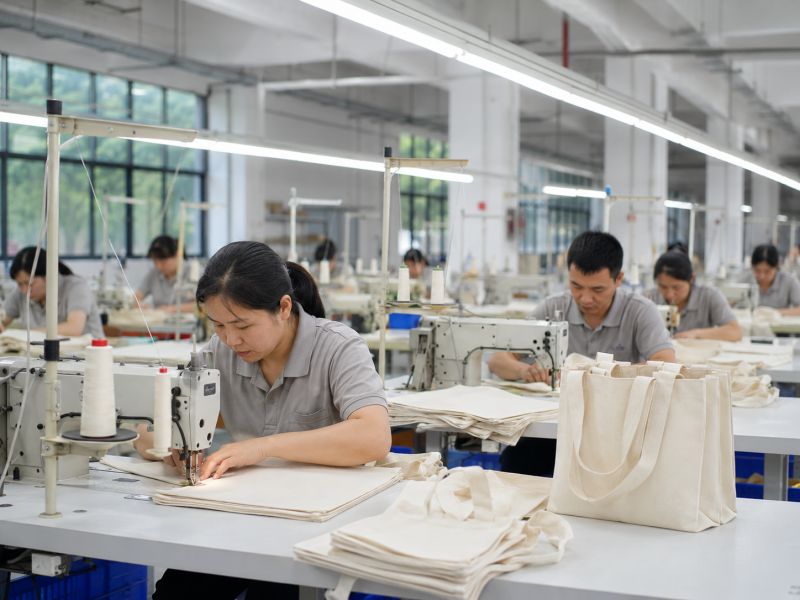
The strongest tote bag partner is not simply the one with the lowest quotation or the fastest sample. A better choice is the one that can reproduce the approved specification consistently across material, dimensions, printing, sewing, packing and delivery. For a 500-piece project, development flexibility may matter most. For 50,000 pieces, capacity, process control, SKU management and shipment planning become much more important.
A tote may look straightforward, but a commercial order can involve dozens of details:
- fabric composition;
- fabric weight;
- dye color;
- shrinkage or finishing;
- handle width and length;
- seam construction;
- reinforcement;
- logo color;
- logo position;
- print registration;
- pocket dimensions;
- zipper specification;
- woven labels;
- hangtags;
- barcodes;
- packing method;
- carton quantity;
- destination labels.
A capable factory should be able to discuss these details before production rather than discovering them after the order has started.
One of the most useful ways to evaluate a new production partner is to separate sample quality from production capability.
A good sample proves that one piece can be made correctly.
A good production system proves that hundreds or thousands of pieces can be made to the same approved standard.
That distinction becomes more important as quantity rises.
| Area to Review | Why It Matters |
|---|---|
| Material control | Prevents unexpected changes in weight, color or hand feel |
| Sample development | Confirms construction before larger commitment |
| Logo capability | Protects color, position and clarity |
| Sewing control | Supports consistent dimensions and strength |
| QC process | Detects issues before packing and shipment |
| Packing control | Prevents SKU, barcode and carton errors |
| Capacity | Helps support repeat orders and larger volumes |
| Communication | Reduces interpretation errors |
| Delivery planning | Connects production timing with freight timing |
The right choice is therefore project-specific. A highly efficient promotional tote facility may be excellent for 100,000 simple event bags but less suitable for a fashion tote with custom hardware and several internal details. A development-focused factory may be very strong for private-label retail work but unnecessary for a very basic one-color giveaway bag.
The first step is to match production capability to the actual tote being developed.
Factory vs Trading Company
A direct factory and a trading company can both be useful, but they operate differently.
A direct factory usually gives closer access to:
- sample development;
- fabric selection;
- sewing details;
- print setup;
- production scheduling;
- inspection;
- packing.
This can be especially valuable when the tote is fully customized.
If a sample needs a 2 cm longer handle, a deeper gusset or different reinforcement, direct communication with the development and production teams can reduce interpretation steps.
A trading company may provide advantages when a project covers several unrelated product categories or requires coordination across different factories.
The important issue is not the company label. It is production visibility.
Before sampling, confirm:
- where the tote will be produced;
- who controls material approval;
- who develops the sample;
- who manages artwork and logo approval;
- who performs in-process checks;
- who performs final inspection;
- who controls packing;
- who handles corrective action if the bulk order differs from the approved sample.
If these responsibilities are unclear before sampling, they are unlikely to become clearer once 10,000 pieces are in production.
It is also useful to look at the internal team structure.
A developed tote program may require coordination between:
sales → development → sample room → material sourcing → production → QC → packing → logistics
If one person is handling every stage without dedicated technical support, simple projects may still work well, but complex projects can become harder to control.
Another useful check is whether technical feedback is specific.
Compare these two responses:
“Yes, we can make it.”
versus:
“The 12 oz canvas is suitable for this structure, but the current 15 mm handle width may feel narrow for the expected load. We recommend 25 mm handles with reinforced attachment.”
The second response shows that the product has actually been reviewed.
That kind of practical feedback is often more valuable than a long list of generic capabilities.
China vs India vs Local Sources
Production location should be selected according to the product, quantity, material and delivery plan rather than country reputation alone.
China is often a strong option when the tote requires several components or deeper customization, such as:
- different textile types;
- lining;
- zippers;
- custom webbing;
- metal hardware;
- printed labels;
- woven labels;
- private-label packing;
- multi-SKU organization.
A developed supply chain can be useful when the tote moves beyond a simple cut-and-sew cotton bag.
India is widely associated with cotton, canvas, jute and textile-based programs and can be attractive when natural fibers, organic materials or textile sourcing are central to the project.
Local production in the US or Europe may make sense when:
- the quantity is relatively small;
- delivery is urgent;
- local origin is part of the product positioning;
- blank totes only need local decoration;
- international freight is not practical.
The decision becomes clearer when priorities are placed side by side.
| Project Priority | Production Direction Worth Reviewing |
|---|---|
| Complex custom structure | China |
| Cotton / canvas textile focus | China or India |
| Organic textile program | Certified textile facility |
| Fast domestic delivery | Local production |
| Small local print run | Domestic decorator |
| Multi-component private label | Experienced custom bag factory |
| Very high promotional quantity | High-capacity specialized operation |
Freight should also be included in the decision.
A unit cost that is $0.30 lower may lose its advantage if the project requires expensive air freight because the production schedule is too late.
The reverse can also happen.
A higher local product cost may still be commercially sensible when it avoids international freight, import lead time and excess inventory.
Consider the full timeline:
product development + sample approval + production + packing + freight + destination handling
rather than only:
production time.
For recurring programs, location can be evaluated differently again. If the design is stable and quantities are predictable, longer sea freight planning may be completely acceptable.
Which Source Fits Large Orders?
Large orders require more than sewing capacity.
The key issue is whether the production system can maintain the approved standard when volume increases.
A 300-piece sample run and a 50,000-piece rollout create very different management demands.
For larger quantities, review at least six areas.
1. Material consistency
Confirm how the fabric is controlled across the production run.
For example:
- Is the fabric weight defined?
- Is the color standard confirmed?
- Will several fabric lots be used?
- How will shade variation be reviewed?
- Are trims and webbing approved before cutting?
A small shade difference may be acceptable in some promotional programs but much more visible in a retail collection displayed side by side.
2. Sample-to-bulk consistency
The approved sample should become a working reference for:
- dimensions;
- construction;
- stitching;
- logo;
- labels;
- accessories;
- packing.
A useful production file should be specific enough that the sewing line and inspection team do not need to guess what was approved.
3. Inspection coverage
Final inspection alone is not enough for a large tote program.
Some problems are easier to catch earlier.
Fabric shade is easier to address before thousands of panels are cut.
Incorrect logo position is easier to correct before the full print run is completed.
Sewing problems are easier to control during production than after every tote has been packed.
A practical inspection flow may include:
incoming material → cutting → logo → sewing → function → finished product → packing → shipment
For a tote, finished checks can include:
- appearance;
- dimensions;
- color;
- logo;
- handles;
- stitching;
- zipper;
- lining;
- pockets;
- hardware;
- cleanliness;
- packing;
- quantity.
4. SKU control
Large orders often become complicated because of variation rather than total quantity.
Consider:
30,000 pieces in one color
versus:
30,000 pieces across 10 colors, 5 logos and 3 destinations.
The second order requires much more sorting, labeling and carton planning.
Ask how color, artwork, barcode and destination information will be separated during production and packing.
5. Packaging accuracy
Packing errors can create warehouse problems even when the tote itself is perfect.
Large programs may require:
- barcode labels;
- SKU labels;
- PO numbers;
- destination labels;
- carton marks;
- store-specific packing;
- mixed-carton rules;
- split shipments.
These instructions should be confirmed before bulk packing begins.
6. Capacity and schedule
Capacity should be discussed in relation to the actual style.
“We can make 100,000 bags per month” is not very useful if that figure refers to a simple product and the current tote has lining, pockets, custom handles and complex printing.
Ask for the planned lead time for the specific design, quantity and delivery date.
A credible schedule should consider material preparation, decoration, sewing, inspection and packing rather than only sewing time.
What Should Be Checked Before Sampling?
Sampling should begin after the basic commercial direction makes sense.
There is little value in developing a complicated prototype if the expected cost, quantity or delivery date is already unrealistic.
Before paying for a sample, confirm:
- approximate quantity;
- preferred material;
- target dimensions;
- intended use;
- artwork;
- required packing;
- delivery date;
- destination;
- approximate budget if available.
It is also useful to decide what the sample is meant to prove.
| Sample Check | What to Confirm |
|---|---|
| Shape | Overall proportion |
| Size | Width, height and gusset |
| Fabric | Weight, texture and color |
| Handles | Length, width and attachment |
| Structure | Pocket, lining and closure |
| Logo | Color, size, clarity and location |
| Sewing | Alignment and reinforcement |
| Function | Capacity, opening and carrying comfort |
| Labels | Position and content |
| Packing | Fit and presentation |
If the tote will carry heavy contents, load testing during sample review is useful.
If the tote will be sold at retail, look at it as a finished product rather than only as a sewing sample.
Place it on a shelf.
Fill it.
Carry it.
Check how the handles sit on the shoulder.
Look at the logo from normal viewing distance.
Inspect the inside.
Open and close the zipper repeatedly.
Fold it into the proposed packing.
These simple tests often reveal issues that are difficult to notice in a technical drawing.
Artwork should also be reviewed on the actual material.
A logo that looks sharp on a computer may lose fine detail on coarse canvas. A pale color may behave differently on dark fabric. Large screen prints can change the hand feel of lightweight textiles.
For unreleased designs, confidentiality can be discussed before sensitive artwork or new product files are shared.
How Do You Compare Two Quotes?
Comparing only unit price is one of the easiest ways to select two different products without realizing it.
The first step is to normalize the specification.
Create one comparison table and make every quotation fit the same fields.
| Item | Quote A | Quote B |
|---|---|---|
| Fabric | 12 oz cotton canvas | Cotton canvas |
| Size | 40 × 35 × 10 cm | 40 × 35 × 10 cm |
| Handle | 65 × 2.5 cm | 60 × 2.5 cm |
| Gusset | 10 cm | 10 cm |
| Included | Excluded | |
| Logo | 2-color screen print | 1-color screen print |
| Position | Front | Front |
| Woven label | Included | Extra |
| Packing | Individual polybag | Bulk |
| Sample | Separate | Included |
| Setup | Included | Separate |
| Trade term | FOB | EXW |
| Lead time | 25 days | 20 days |
In this example, Quote B might be lower, but it also contains less.
A useful comparison should cover five areas.
Product
Are fabric weight, dimensions, handles, gusset, pockets and closures identical?
Decoration
Are the logo method, colors, dimensions and positions identical?
Packing
Are polybags, labels, hangtags, barcodes and cartons included?
Commercial terms
Are both quotations EXW, FOB, CIF or DDP?
Execution
Is there a clear process for sample approval, production control, inspection and packing?
It can also help to use a simple weighted evaluation for important programs.
The figures below are only an example and can be adjusted according to the project.
| Area | Example Weight |
|---|---|
| Product development | 20% |
| Quality control | 20% |
| Cost | 20% |
| Delivery capability | 15% |
| Communication | 10% |
| Packaging / SKU control | 10% |
| Compliance support | 5% |
This prevents a small unit-price difference from outweighing much larger execution risks.
For example, a quotation that is 4% lower may not be attractive if the fabric weight is undefined, packing details are missing and the delivery schedule has not been reviewed.
On the other hand, a lower quotation can be excellent when the specification is truly identical and the production system is strong.
The goal is not to distrust low prices. It is to understand why the number is lower.
Good reasons can include:
- stronger material purchasing;
- efficient cutting;
- suitable production scale;
- simpler packing;
- larger quantity;
- better process matching.
More concerning reasons include:
- lighter fabric than specified;
- smaller logo;
- fewer print colors;
- weaker handle construction;
- excluded packaging;
- excluded setup;
- different trade terms.
A reliable tote program becomes much easier to manage when the specification, approved sample, production instructions, QC requirements and packing rules all describe the same product.
Jundong supports custom tote development from materials and sampling through bulk production, inspection, labeling, packing and delivery. Its Guangdong operation includes dedicated development, design, sample-room, production and QC teams, with 600+ employees, approximately 18,000㎡ of production area and 80 QC inspectors. The standard MOQ is usually 500 pieces per design, with selected simple styles reviewed case by case at lower quantities.
Those figures matter only when they are connected to the actual project. Scale alone does not guarantee a successful tote. The strongest production partner is the one that understands the specification, identifies risks early, turns the approved sample into clear production instructions and keeps product, packing and delivery aligned through the full order cycle.
Jundong facts used in the final paragraphs are supported by the supplied factory fact file: team structure, 600+ employees, approximately 18,000㎡ production area, 80 QC inspectors, standard 500-piece MOQ, sampling and production capabilities. Its documented QC process also covers incoming materials through production, packing and shipment, using approved samples and production details as inspection references.