Skip to content
Custom Cosmetic Bags Wholesale
Looking for a reliable custom cosmetic bags wholesale manufacturer for beauty brands, gift programs, retail collections, travel sets, and promotional projects? We support wholesale cosmetic bags, makeup bags, toiletry bags, zipper pouches, wash bags, and organizer styles in canvas, nylon, polyester, PU, quilted, clear, and custom fabric options. From logo printing and private label branding to lining, zipper, pocket, and packaging customization, we help develop cosmetic bag products that match your market positioning, order plan, style direction, and repeat-order needs with stable sampling and bulk production.
Cosmetic Bags Sell the Set
For many beauty lines, the cosmetic bag is not a side item. It is the first touchpoint, the first storage solution, and often the piece people keep the longest. A lipstick may be used up. A serum may be replaced. But a well-made makeup pouch, toiletry bag, zipper pouch, or cosmetic case can stay in daily use for months or even years.
That is why this category should be developed as part of the product line, not treated as leftover packaging. The right bag can make a set feel more complete, more giftable, and easier to understand at a glance. The wrong bag can make the whole set feel generic, overly promotional, or not aligned with its price positioning.
Strong cosmetic bag programs usually get these points clear early:
- Shape that fits the product mix (travel kits, daily makeup, skincare sets)
- Material that matches positioning (canvas, PU, nylon, quilted, clear, coated fabrics)
- Interior layout that supports real use (pockets, compartments, easy cleaning, structure)
When these decisions are defined early, the cosmetic bag becomes more than a container. It becomes a reusable, visible brand item that supports everyday use, travel convenience, and repeat exposure.




Match Shape to Line
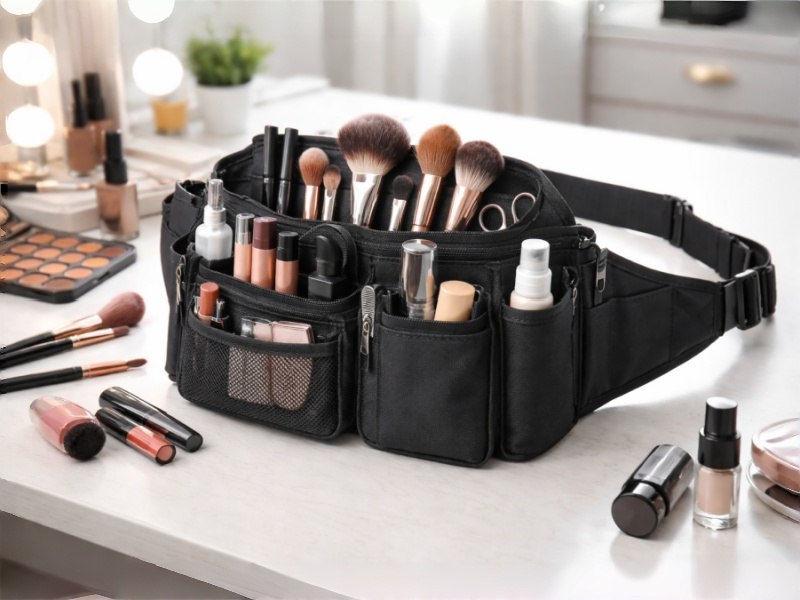
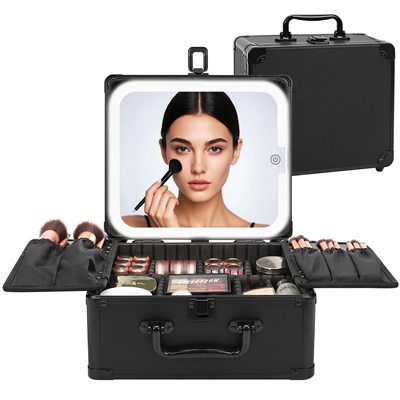
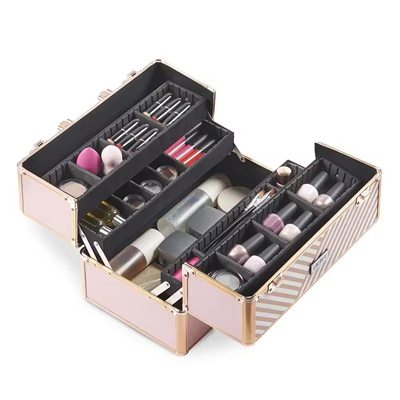
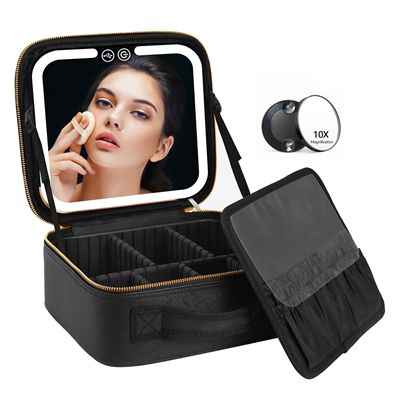
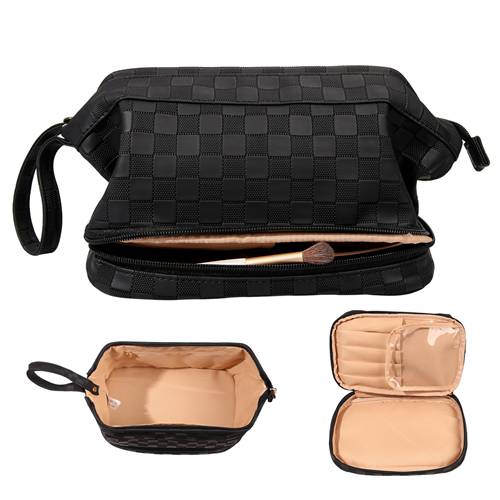
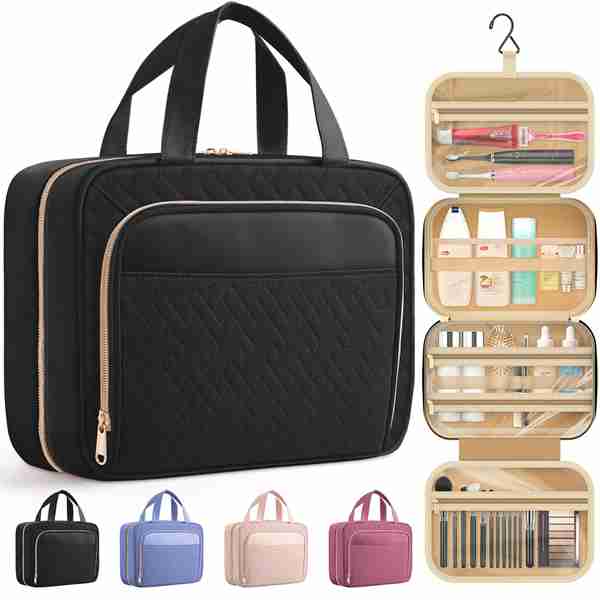
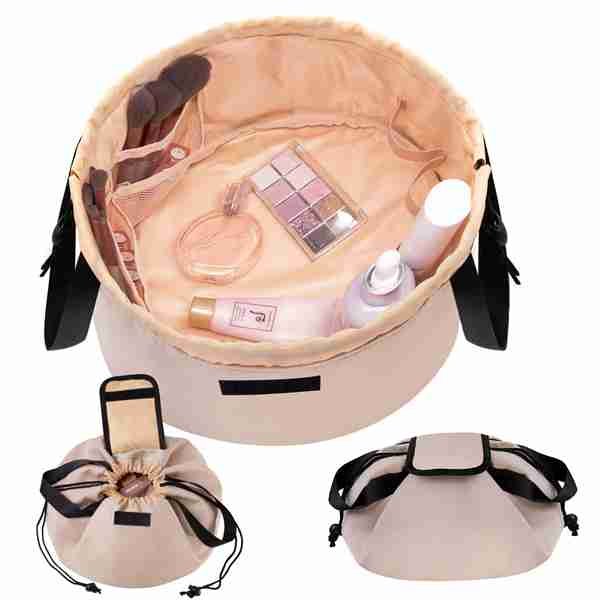
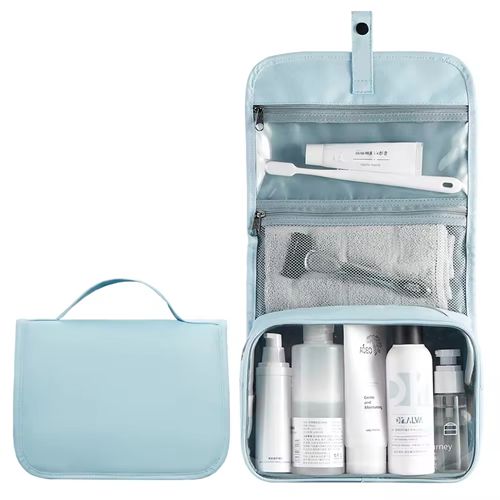
A common mistake is choosing a bag shape because it looks attractive in a sample photo. In reality, bag structure should follow product behavior. A flat zip pouch may work for touch-up items and campaign gifts. A boxy cosmetic case may suit skincare sets and bottle-based routines. A hanging toiletry bag makes more sense when the line is travel-heavy. A drawstring flat-lay makeup bag works well when fast access matters more than strict compartment order.
Here is a simple way to match the shape to the line:
| Bag shape | Best fit |
|---|---|
| Flat pouch | Daily makeup, event gifts, slim sets |
| Boxy case | Skincare kits, bottles, structured sets |
| Hanging bag | Travel programs, hotel, or resort use |
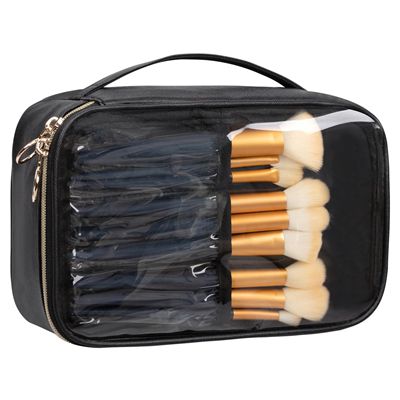
| Drawstring flat-lay | Fast-open routines, brushes, and tabletop use |
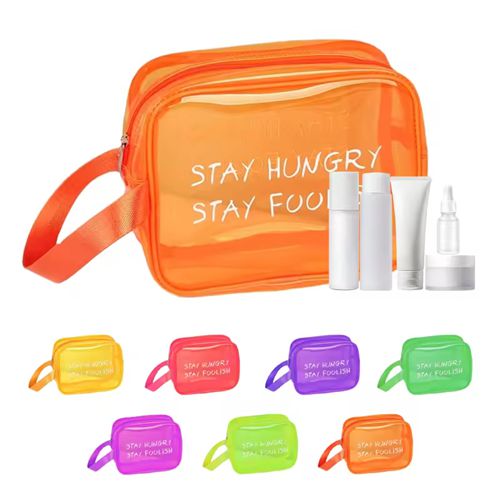
| Clear bag | Airport, stadium, visibility-first needs |
The best shape is usually the one that makes the routine easier in under five seconds. That is what people notice in real life.
Materials Define Price and Feel
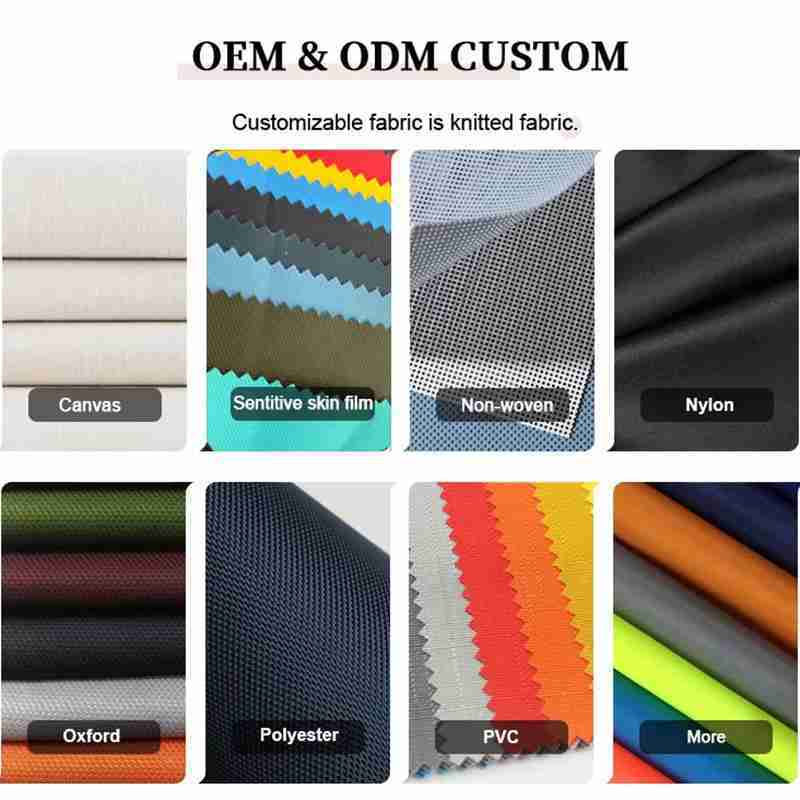
Material decisions do more than change appearance. They shape cost level, surface feel, cleaning ease, and the way the bag is perceived next to the products inside. A soft canvas or cotton look can feel casual, natural, or gift-shop friendly. PVC and other wipe-clean surfaces suit visibility, spill resistance, and travel use. PU gives a more polished fashion look. Neoprene feels soft, padded, and water-resistant. Genuine leather can push the bag into a more premium accessory role, not just a storage role.
A simple material check can save a lot of revisions later:
| Material | Usually chosen for |
|---|---|
| Canvas or cotton | Casual sets, natural look, simple graphics |
| PVC or clear vinyl | Visibility, easy cleaning, and travel needs |
| PU | Fashion-driven finish, polished appearance |
| Neoprene | Soft body, water resistance, protective feel |
| Leather | Higher-value sets, long-term keepability |
The right question is not “Which material looks best?” It is “Which material still feels right after six months of real use?”





Open Fast, Stay Organized
A cosmetic bag does not feel useful because it has many pockets. It feels useful when daily routines become faster, cleaner, and less frustrating. That usually comes down to a few practical details that people notice immediately: a wide opening, a wipe-clean lining, smooth zipper travel, and just enough interior control to stop small items from drifting into one messy corner.
For daily use, speed matters more than heavy structure. People want to unzip once, see everything, and grab what they need without digging. For travel, control matters more. Liquids should stay separate, brushes should not bend, and powders should not get crushed by a loose, collapsing body.
Quick usability check
| Feature | Why it matters |
|---|---|
| Wide zipper opening | Faster visibility and access |
| Light or wipe-clean lining | Easier cleanup after spills |
| Reinforced zipper ends | Better for frequent opening |
| Shallow interior depth | Less digging, less clutter |
| Simple divider layout | Keeps essentials from mixing |
Match Logo to Surface
A logo can raise the perceived value of a cosmetic bag, but only when the application method fits the material. The same artwork can look clean and premium on one surface, yet feel heavy, blurry, or overly promotional on another. Good branding is not only about visibility. It is about fit, finish, and lasting appearance after use.
A simple rule works well here: soft woven surfaces usually suit print or embroidery; smoother synthetic surfaces often suit heat transfer; PU and leather usually look more refined with debossed or embossed branding. For more polished collections, a metal plate or custom zipper pull can add presence, but only when the bag size and style can carry that detail naturally.
Logo method guide
| Surface | Usually works best |
|---|---|
| Canvas, cotton, Nylon, polyester | Screen print, embroidery |
| Nylon/polyester | Heat transfer, print |
| PU / leather | Deboss, emboss |
| Premium structured styles | Metal plate, custom puller |
| Multi-style collections | Woven label and external logo mix |




More Than Makeup Bags
The most effective cosmetic bag projects are often built around a usage scene, not a single product category. A bag that only stores makeup may feel limited. A bag that fits into a wider routine feels more useful, more giftable, and easier to expand into a collection.
That is why strong cosmetic bag lines are often developed around adjacent use cases: skincare sets, travel essentials, brush kits, spa or salon tools, clear pouches for visibility-first use, or gift-with-purchase programs that need to feel more lasting than ordinary packaging.
Expansion ideas that often work well
| Direction | Why it adds value |
|---|---|
| Skincare set bag | Fits bottles, jars, daily routines |
| Travel toiletry version | Stronger use frequency |
| Brush or tool pouch | Good for beauty tools and sets |
| Clear pouch variation | Better visibility and easy gifting |
| Multi-piece set | Easier tiered pricing and bundling |
One base design can often grow into two or three related formats. That makes the line easier to extend without starting from zero every time.
Lock More Before Approval
Many cosmetic bag projects feel “approved” too early. The sample looks good in photos, the size seems correct, and the zipper opens smoothly. But once the run starts, small differences appear: the bag body turns softer, the edge piping looks thicker, the lining tone shifts, the logo sits slightly higher, or the opening shape changes when filled. None of these sounds dramatic alone, yet together they can change the whole feel of the item.
A strong approval process should lock not only visible basics, but also the details that affect repeatability.
What should be locked before bulk?
| Check item | What to confirm |
|---|---|
| Material handfeel | Softness, thickness, sheen, smell |
| Shape when filled | Whether the body collapses or holds form |
| Lining behavior | Wrinkling, wipe-clean finish, attachment stability |
| Logo position | Distance from seams, zipper, and top edge |
| Construction details | Piping thickness, stitch density, zipper curve |
| Packing method | Folded, filled, stuffed, or flat-packed |
The right sample is not just the prettiest one. It is the one that can be repeated without drift.


Trials Need Cost Discipline
Small opening runs can be smart. They reduce exposure, help test new styles, and make seasonal launches easier. But they also become expensive very quickly when too many variables stay open at the same time. A small run with multiple colors, multiple logo methods, custom hardware, special lining, and separate packing rules can carry more hidden costs than a larger run with tighter control.
That is why early cosmetic bag projects work best when the first run is simplified on purpose.
Better first-run cost control
| Decision | Safer move |
|---|---|
| Color count | Start with one core shade |
| Logo method | Use one proven application |
| Structure | Keep one main body size first |
| Hardware | Avoid too many custom parts |
| Packing | Use one standard pack-out method |
| SKU plan | Test fewer variants, expand later |
Lock More Before Approval
Many cosmetic bag projects feel “approved” too early. The sample looks good in photos, the size seems correct, and the zipper opens smoothly. But once the run starts, small differences appear: the bag body turns softer, the edge piping looks thicker, the lining tone shifts, the logo sits slightly higher, or the opening shape changes when filled. None of these sounds dramatic alone, yet together they can change the whole feel of the item.
A strong approval process should lock not only visible basics, but also the details that affect repeatability.
What should be locked before bulk?
| Check item | What to confirm |
|---|---|
| Material handfeel | Softness, thickness, sheen, smell |
| Shape when filled | Whether the body collapses or holds form |
| Lining behavior | Wrinkling, wipe-clean finish, attachment stability |
| Logo position | Distance from seams, zipper, and top edge |
| Construction details | Piping thickness, stitch density, zipper curve |
| Packing method | Folded, filled, stuffed, or flat-packed |
The right sample is not just the prettiest one. It is the one that can be repeated without drift.


Packing Details Still Matter
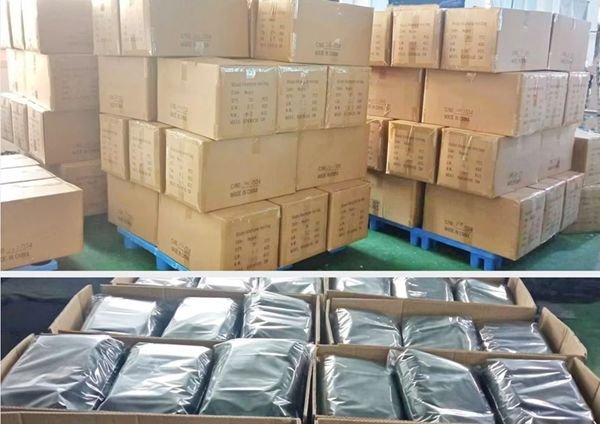
A well-made cosmetic bag can still arrive looking careless. That usually happens at the last stage, not the sewing stage. If the bag is folded the wrong way, the body creases badly. If barcode stickers are placed inconsistently, retail handling becomes messy. If labels shift, hang tags scratch the surface, or cartons are marked unclearly, the item loses its polish before it is even displayed.
The final presentation is not decoration. It is part of quality control.
End-stage details that still matter
| Final detail | What it affects |
|---|---|
| Pack-out direction | Shape retention during transit |
| Stuffing or support | Reduces collapse and deep creases |
| Barcode placement | Easier receiving and stock handling |
| Warning or material labels | Cleaner compliance and fewer corrections |
| Hangtag position | Better presentation, less surface damage |
| Carton marking | Faster sorting, lower packing mistakes |
Make A Sample First?
See your idea come to life before mass production.
At Jundong Factory, we offer free design mockups and custom samples to ensure every detail is perfect — from material and color to logo placement and stitching.
Start your project with confidence today: info@jundongfactory.com.
FAQs About Custom Cosmetic Bags Wholesale
What is a realistic MOQ for custom cosmetic bags?
A realistic MOQ depends less on the bag category itself and more on how many variables are opened at the same time. A simple cosmetic pouch in one color with one logo method is usually easier to start than a structured set with custom hardware, multiple sizes, special lining, and several packing rules.
That is why MOQ should not be viewed as a single fixed number. It is a project condition. The main cost drivers are usually material choice, bag structure, logo application, hardware complexity, color count, and pack-out method. A flat nylon or canvas pouch may be workable at a lower opening quantity than a shaped PU case with metal branding and retail gift-box packing.
For a first run, the safer move is to reduce variables instead of forcing an ambitious setup into a small quantity. Many teams get better results by starting with:
- one core shape
- one main color
- one proven logo method
- one standard packing method
Then, once the first version works, it becomes much easier to expand into more colors, sets, or sizes.
So the better question is not only “What is your MOQ?” It is “What combination of structure, material, branding, and packaging keeps this opening run commercially sensible?” That question usually leads to a much clearer project plan.
What should we prepare before asking for a sample?
A better sample starts with clearer input, not with more messages back and forth. Many delays happen because the first brief only says “we need a cosmetic bag,” while the real project still has too many missing basics.
At minimum, it helps to prepare six things before sampling begins:
| What to prepare | Why it matters |
|---|---|
| Target size | Prevents guessing on fit and capacity |
| Product mix | Decides bag depth, opening, and interior layout |
| Material preference | Aligns look, handfeel, and cost level |
| Logo method | Affects appearance and sampling setup |
| Reference images | Clarifies the style direction faster |
| Packing expectation | Prevents late-stage surprises |
If possible, also include the intended use scene. Is the bag for a gift-with-purchase set, a travel kit, a salon tool pouch, a beauty retail collection, or a private label line? One sentence about the real use scene can save multiple sample revisions, because it changes how the opening, handle, body stiffness, and pocket layout should be approached.
The strongest sample briefs are usually short but precise. They do not need to be over-designed. They just need to make the intended result visible early.a
Which material works best for custom cosmetic bags?
The best material is the one that matches the product’s use scene, price level, and cleaning expectation at the same time. Cosmetic bags are handled often, opened frequently, and exposed to powder, cream, spills, and moisture. So the material should be chosen for real-life use, not only for appearance in a sample photo.
A simple way to compare the main options:
| Material | Usually best for |
|---|---|
| Canvas/cotton | Casual sets, natural look, simple printing |
| Nylon/polyester | Lightweight use, travel, and easier structure control |
| PVC / clear TPU | Visibility, wipe-clean use, travel liquids |
| PU | Fashion-led finish, smoother appearance |
| Neoprene | Soft body, padded feel, light water resistance |
| Leather | Premium keep-forever positioning |
There is no single “best” answer. Canvas can feel warm and approachable, but it may absorb stains more easily. PVC or clear materials are practical for visibility and spill cleanup, but they create a different style of language. PU often gives a cleaner, more polished look. Nylon and polyester are useful when lighter weight, foldability, or frequent travel use matter. Leather can elevate the bag into a long-lasting accessory rather than a short-term add-on.
The right material decision usually comes from one honest question: after six months of real use, what do you still want this bag to feel like?
How do we keep the sample and bulk run consistent?
Sample-to-bulk consistency comes from locking measurable details early, not from hoping the first sample “looks close enough.” Cosmetic bags are especially sensitive to small changes because the visual area is compact. A slight shift in piping thickness, zipper curve, logo position, or body stiffness is easy to notice.
The most dependable approach is to lock the following before the run starts:
- main material code or confirmed swatch
- lining type and color
- logo size and exact placement
- zipper specification and puller style
- body shape when filled
- packing method
One detail that gets missed too often is how the bag behaves when loaded. A bag may look fine when empty, then lose shape once bottles, brushes, or palettes are placed inside. So the approved sample should be checked both empty and filled.
It also helps to keep one clearly identified approval sample as the reference standard during production and inspection. That gives everyone one visual target instead of several slightly different interpretations.
In short, consistency is less about promises and more about disciplined reference control. The more the project is locked before the run, the less drift appears later.
How long does a custom cosmetic bag project usually take?
A realistic timeline should be split into stages, because sample timing and bulk timing are not the same thing. Many teams ask for one total number too early, but cosmetic bag projects move through different steps: brief confirmation, material selection, sample development, revisions, approval, material booking, production, packing, and shipment arrangement.
For first-time custom work, the sample stage usually matters most because that is where shape, material, logo, and interior details are still being corrected. Publicly available factory timelines for similar projects often place custom sampling around several days to nearly two weeks depending on complexity, while bulk timing extends further once materials, packing, and quantity are confirmed. The real difference is not only speed. It is whether decisions are already locked.
Projects usually move faster when they have:
- one clear reference direction
- fewer colors
- fewer structural variations
- one logo method
- one packing plan
They usually slow down when hardware, lining, packaging, and sizes are all still changing after the first sample.
So instead of asking only “How many days?”, it is more practical to ask: Which stage is most likely to delay this project, and what can be locked now to prevent that? That is how timelines become more dependable.
Can custom cosmetic bags use different logo methods, and how should we choose?
Yes—custom cosmetic bags can use several logo methods, but the right choice depends on the surface, the visual mood, and how long the finish needs to stay sharp. The same artwork can feel crisp and premium on one material, then look heavy or unstable on another. That is why logo choice should never be separated from fabric, bag shape, and price positioning.
A practical way to choose is to start from the bag surface:
| Logo method | Usually works best on | Typical visual result |
|---|---|---|
| Screen print | Canvas, cotton, and some polyester | Clear, direct, graphic |
| Heat transfer | Smooth synthetic surfaces | Sharper detail, stronger contrast |
| Emboss / deboss | PU, leather | Quiet, refined, premium |
| Woven label | Multi-style lines, inner branding | Subtle, flexible, easy to repeat |
| Metal plate/custom puller | Structured or higher-value styles | More polished, accessory-like |
The real decision is not “Which method looks most expensive?” It is “Which method still looks right after repeated opening, rubbing, packing, and travel use?” A printed logo may be perfect for a casual canvas pouch. A debossed mark may feel far more natural on a PU cosmetic case. A woven label may be the better choice when the outer look should stay clean, but the line still needs brand recognition.
For first runs, one proven logo method is usually the safer move. Mixed methods can look strong, but they also add approval work, QC pressure, and cost variation. Your uploaded company file also shows support for screen printing, heat transfer, embossed logo, debossed logo, woven label, rubber/PVC patch, and metal plate logo, which fit well with this category’s typical needs.
What bag structure works best for travel kits, skincare sets, and daily makeup use?
The best structure depends on how the contents behave, not on which silhouette looks best in a photo. Cosmetic bags are used in very different ways: some are opened quickly on a vanity, some are packed tightly into luggage, and some need to hold bottles upright or keep tools separated. That is why structure should follow the routine.
A simple structure guide helps:
| Use scene | Usually works best | Why |
|---|---|---|
| Daily makeup touch-ups | Flat pouch or shallow gusset pouch | Fast access, lighter shape |
| Skincare bottle sets | Boxy case | Better depth and upright storage |
| Travel kits | Hanging toiletry bag or structured organizer | Better separation and visibility |
| Brush-heavy routines | Flat-lay or brush pouch | Easier reach, less bending |
| Visibility-first needs | Clear pouch | Easier checking and gifting |
The most common mistake is choosing a bag that looks compact when empty but becomes hard to use when filled. A pouch that is too flat may frustrate bottle-based skincare sets. A very deep case may swallow daily makeup items into one pile. A hanging style may be excellent for travel, yet unnecessary for a compact gift set. The structure should make the intended routine feel easier within seconds.
Your uploaded file already lists cosmetic bags, makeup organizer bags, professional makeup bags, toiletry bags, hanging toiletry bags, travel toiletry bags, and beauty tool bags, which is useful because this category often performs better as a structured family rather than one single form.
Should we start with one cosmetic pouch or develop a small collection?
Starting with one strong base style is usually safer, but developing a small related collection often creates better long-term value. The right choice depends on whether the project is testing a concept or building a fuller routine around it. Publicly visible bag pages often expand one visual idea into several connected formats, such as a main pouch, a toiletry version, a brush case, or a gift-ready set, because one format rarely covers every real use scene.
A useful rule is this:
| Project stage | Better starting move |
|---|---|
| New concept test | One core pouch |
| Travel or skincare line | Two related sizes |
| Gift set or retail display | Small coordinated set |
| Tool-led line | Main pouch + tool/brush format |
A single pouch makes first approval easier. Fewer variables usually mean clearer cost control, faster revisions, and less confusion around packing and labeling. But a small collection can make the line feel more complete and easier to scale. One shared color system, one logo language, and one trim direction can often support several sizes without forcing a full restart each time.
So the decision should follow the role of the bag. If it is mainly a first-run test, start with one core format. If it is part of a broader beauty routine or gift strategy, a mini collection may create much stronger continuity.
What packaging details should be confirmed before bulk starts?
Packaging should be confirmed before bulk starts because many “quality problems” are actually last-stage packing problems. A cosmetic bag can be sewn well and still arrive looking careless if it is folded the wrong way, labeled inconsistently, or packed without enough shape support. Retail-focused public guides repeatedly stress barcode placement, warning labels, packing sequence, and carton marking as part of final execution, not as afterthoughts.
The key items to confirm are:
| Packaging detail | Why it matters |
|---|---|
| Individual pack method | Prevents dust, rubbing, and random creasing |
| Stuffing or support | Helps shape retention in transit |
| Barcode position | Makes receiving and stock handling easier |
| Warning/material labels | Reduces relabeling and compliance issues |
| Hangtag location | Protects the surface and improves display |
| Carton marks | Reduces sorting and shipping errors |
It also helps to confirm whether the bag should be flat-packed, lightly stuffed, or display-shaped. That choice changes carton efficiency, arrival appearance, and even how the zipper line looks after transit. For cosmetic lines sold through retail or e-commerce, a clean final presentation matters almost as much as the bag itself.
Your uploaded file directly supports this area too, listing individual polybag packing, custom packaging bags, color box packaging, gift box packaging, hangtags & labels, instruction cards, warning labels, export packing compliance, and product labeling compliance.
How do we compare cosmetic bag quotes without comparing the wrong things?
A useful quote comparison only works when the hidden cost drivers are written out clearly. Two cosmetic bag prices can look close at first glance, then turn out to be based on very different materials, logo methods, zipper grades, lining standards, packing rules, or quantity assumptions. Public pricing guides across bag categories consistently show that cost moves most with material choice, customization complexity, order volume, and packaging details.
A cleaner quote comparison sheet should include:
| Cost item | What must be clarified |
|---|---|
| Main material | Exact type, thickness, coating, finish |
| Lining | Material, color, wipe-clean treatment, padding |
| Logo method | Print, transfer, emboss, metal plate, label |
| Zipper / hardware | Standard or upgraded grade |
| Structure | Flat pouch, gusset, boxy case, organizer details |
| Packing | Polybag, gift box, barcode, insert card, carton marks |
| Quantity basis | One color or mixed colors, one size or several |
| Price term | Whether freight, duty, or only ex-factory cost is shown |
This matters because a quote that looks cheaper can become more expensive once you add the missing parts back in. Premium zipper hardware, extra interior organization, special lining, and retail-ready packing all change the real cost. Even general bag cost pages note that hardware and add-ons can push pricing upward more than many teams expect.
The best way to compare is to make every quote answer the same specification list. Once the inputs are aligned, the price difference becomes much more meaningful.
Everything You Need to Know Before Customizing Your Bags
A custom cosmetic bag may look simple at first, but the real decision usually depends on material choice, shape, opening style, lining, logo method, storage layout, and the intended use scene. A bag for retail beauty lines, gift-with-purchase sets, travel kits, skincare bundles, makeup organizers, or promotional launches should not all be built the same way.
That is why the most useful questions are rarely about shape alone. They are usually about how the bag opens, how easy it is to clean, how small items stay organized, how the logo works on the surface, and whether the build matches price positioning and repeat use.
The FAQs focus on the points that usually need to be clarified early: material direction, bag shape, lining and pocket setup, branding method, MOQ, trial runs, packaging details, and real-use fit.