 Skip to content
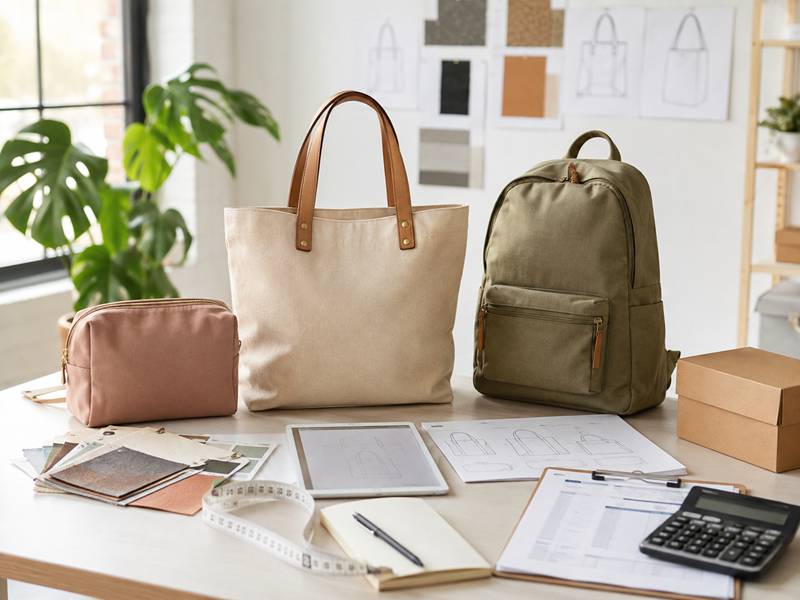
A bag can be commercially successful at a factory cost of $15 and commercially weak at $8. The difference is often not the sewing price. It comes from how the product was developed before production began.
A design may look excellent on screen but consume too much fabric once patterns are laid out. A custom zipper pull may add only a small amount to the piece price but require a separate tooling charge and longer preparation. A rigid structure may create a premium appearance while increasing carton volume enough to change freight economics. A low-cost fabric may reduce the quotation but create extra claims, repairs, or inconsistent appearance later.
Yes, making bags can be profitable when retail value, target cost, materials, construction, order volume, quality requirements, packaging, and delivery are planned as one commercial system. The strongest margin rarely comes from choosing the lowest quotation. It comes from developing a product that looks valuable, performs as intended, can be produced repeatedly, and reaches the intended sales channel without unnecessary cost or avoidable quality problems.
That is why the most important profitability decisions are often made before the first bulk order is placed.
A product team once comparing two travel bags might see only a $0.60 difference between them. One design, however, may need three more sewing operations, a larger carton, a non-stock lining, and more difficult logo alignment. Across 20,000 pieces, those details matter far more than they appear to during sample review.
The real commercial work begins when design ambition meets production reality.
Is It Profitable to Make Bags?
Yes. Bags can be profitable when retail value, target cost, material usage, construction, order quantity, quality requirements, packing, freight, and inventory are planned together. The strongest margin rarely comes from simply finding the lowest unit price. It comes from developing a product that looks valuable, performs reliably, can be produced repeatedly, packs efficiently, and sells at a price that leaves enough room for distribution and operating costs.
A bag may appear simple, but its economics are built from dozens of small decisions. Changing a fabric, adding one zipper pocket, selecting custom hardware, increasing foam thickness, switching logo methods, or using a rigid retail box can each move cost in a different direction.
For this reason, profitability should be evaluated before production starts—not after the first shipment arrives.
A useful way to think about it is:
Selling price − product cost − packing − freight − duty − channel costs − expected quality loss − inventory risk = usable margin
The factory quotation is only one part of that calculation.
Profit Drivers
The most profitable bag is not always the one with the lowest production cost. It is usually the one where production spending closely matches what people can see, feel, use, or value.
Consider two hypothetical travel bags.
| Item | Bag A | Bag B |
|---|---|---|
| Factory cost | $11.20 | $12.40 |
| Intended retail price | $39 | $59 |
| Main fabric | Standard polyester | Better-feel nylon |
| Compartments | 8 | 5 |
| Hardware | Basic | Upgraded |
| Packaging | Large box | Compact protective packing |
| Perceived value | Moderate | Higher |
Bag A costs less, but several of its eight compartments may add sewing time without creating a stronger reason to pay more.
Bag B costs $1.20 more, yet better material feel, stronger hardware, cleaner organization, and better overall presentation may support a much higher retail price.
This is where development decisions matter.
A useful cost review separates features into four groups:
| Cost Type | Examples | Why It Matters |
|---|---|---|
| Visible value | Main fabric, shape, trim, logo | Supports presentation |
| Functional value | Padding, reinforcement, useful pockets | Supports performance |
| Delivery value | Labels, packing, carton protection | Protects order accuracy |
| Low-value complexity | Hidden decoration, redundant panels | Adds cost with little benefit |
The fourth group deserves the most attention.
If a feature adds $0.35 per piece and the order is 20,000 pieces, that single detail adds $7,000.
The key issue is not whether $0.35 sounds small. It is whether the feature earns that $7,000 back through stronger selling value, better durability, fewer claims, or improved usability.
Margin Potential
Different bag categories have different margin potential because some products are easier to compare than others.
A simple drawstring pouch can often be compared mainly by:
- Fabric
- Size
- Printing
- Quantity
A structured backpack may involve:
- Main fabric
- Lining
- Foam
- Webbing
- Zippers
- Buckles
- Laptop compartment
- Back padding
- Strap construction
- Reinforcement
- Logo method
- Internal organization
This gives more opportunities to create meaningful differentiation.
Products with clear functional value often have more room for commercial positioning, including:
- Laptop backpacks
- Business backpacks
- Travel organizers
- Cooler bags
- Cosmetic cases
- Tool bags
- Tactical bags
- EVA cases
- Structured belt bags
- Multi-piece travel sets
But complexity is not the same as value.
Adding more pockets, thicker foam, heavier fabric, or extra hardware can make a bag more expensive without making it more desirable.
A better design review asks:
- Does this feature improve use?
- Does it improve appearance?
- Does it increase durability?
- Does it support the intended retail price?
- Would anyone notice if it disappeared?
If the last answer is “probably not,” the feature deserves another look.
One of the easiest ways to improve margin is to remove invisible complexity while protecting visible and functional value.
Price vs Value
A small cost increase can sometimes create a much larger improvement in perceived value.
Take an illustrative cosmetic case:
| Version | Factory Cost | Main Changes | Intended Retail Price |
|---|---|---|---|
| A | $4.20 | Basic lining, standard zipper, simple print | $18 |
| B | $4.85 | Better lining, cleaner opening, upgraded puller | $26 |
| C | $6.10 | Heavy structure, custom metal parts, gift box | $29 |
Version B may produce the strongest economics.
It costs only $0.65 more than A but may look and feel significantly better.
Version C adds another $1.25, but the extra structure and packaging may not create enough additional retail value.
This is why target costing works better than simply demanding a lower quotation.
Instead of saying:
“Please reduce the price.”
A more useful instruction is:
“We need to keep this product near $5.00 at 5,000 pieces. Which materials or structural details can be adjusted without changing the intended appearance?”
That allows the factory to review the cost where it actually occurs.
Price is affected by material, size, structure, logo, hardware, accessories, packing, quantity, production schedule, testing requirements, and freight method. Jundong’s documented pricing approach follows this project-specific logic rather than treating one reference image as enough for a firm quotation.
The most useful quotation is therefore not necessarily the lowest number.
It is the one that explains what must change when the target cost changes.
Material Economics
Material decisions can improve or damage profitability long before sewing begins.
Fabric should not be judged only by price per meter.
The real material cost also depends on:
- Usable width
- Pattern layout
- Cutting waste
- Coating direction
- Print direction
- Thickness
- Stretch
- Fraying
- Sewing difficulty
- Color consistency
- Minimum fabric quantity
- Weight
- Packing behavior
For example, Fabric A may cost $2.80 per meter and Fabric B $3.10.
If Fabric A creates more cutting waste or requires extra reinforcement, it may not remain the cheaper option once the complete product is calculated.
The intended use should therefore control material selection.
| Product | Material Priority | Common Cost Mistake |
|---|---|---|
| Promotional tote | Printability, efficiency | Fabric heavier than needed |
| Travel bag | Durability, weight, structure | Too much reinforcement |
| Tool bag | Abrasion and load strength | Heavy fabric in every panel |
| Cosmetic case | Appearance, cleanability | Overcomplicated lamination |
| Cooler bag | Outer shell, insulation, lining | Excessive wall thickness |
| EVA case | Shape protection | Ignoring tooling and packed volume |
The smartest design often uses different materials strategically.
A tool bag, for example, may need stronger textile at the base and high-stress areas but not necessarily across every internal pocket.
A travel bag may need premium-feel material on visible panels while using a more practical lining inside.
This targeted approach can preserve appearance and durability without paying premium cost across every square centimeter.
Material claims also need discipline. Recycled content, RPET, chemical restrictions, or named certifications should be confirmed against the actual material and supporting documents rather than assumed from a generic swatch. Jundong’s documented compliance rules specifically require project-level confirmation for such claims.
Volume Economics
Order quantity has a major effect on unit economics because many preparation costs exist before the first piece is finished.
These may include:
- Material procurement
- Pattern preparation
- Printing setup
- Embroidery setup
- Mold or tooling preparation
- Cutting setup
- Sewing line preparation
- Packing setup
- Inspection
Imagine a $150 logo setup charge.
At 300 pieces:
$150 ÷ 300 = $0.50 per piece
At 3,000 pieces:
$150 ÷ 3,000 = $0.05 per piece
The physical logo may be identical, but the setup expense is spread very differently.
The same logic applies to other fixed preparation costs.
For Jundong, standard MOQ is generally 500 pieces per design. Selected simple styles may be reviewed at 200–300 pieces case by case, while some low-unit-price items may require 1,000 pieces or more because material purchasing, setup, cutting, logo application, sewing, packing, and inspection still require a complete production flow.
However, ordering more simply to lower the piece price can create another problem: inventory.
Consider an illustrative example:
| Quantity | Unit Cost | Product Spend | Inventory Exposure |
|---|---|---|---|
| 500 | $8.60 | $4,300 | Lower |
| 2,000 | $7.40 | $14,800 | Moderate |
| 5,000 | $6.95 | $34,750 | Higher |
| 10,000 | $6.70 | $67,000 | Much higher |
Moving from 5,000 to 10,000 pieces saves $0.25 per piece.
That looks attractive.
But the additional 5,000 pieces require another $33,500 in product spend.
If demand is not strong enough, the $0.25 saving becomes irrelevant.
The better quantity is the one that balances:
- Unit cost
- Sales confidence
- Material MOQ
- Cash flow
- Storage
- SKU count
- Reorder speed
- Seasonal risk
For established brands, annual volume can sometimes be more useful than one-order volume.
A program may require 12,000 pieces per year but not need all 12,000 at once. If materials, production scheduling, and repeat-order planning allow, several releases may protect cash flow better than one oversized first order.
Cost Leakage
Some products have acceptable quoted margins but lose money through small costs that were never included in the original calculation.
Common examples include:
- Sample revisions
- Custom molds
- Special color development
- Testing
- Barcode labels
- Hangtags
- Retail boxes
- Extra cartons
- Repacking
- Air freight caused by delays
- Warehouse relabeling
- Quality claims
- Markdown inventory
A simple profitability calculation might look like this:
| Cost Item | Illustrative Amount |
|---|---|
| Factory cost | $8.20 |
| Individual packing | $0.25 |
| Freight allocation | $1.10 |
| Duty/entry allocation | $0.60 |
| Warehousing/handling | $0.45 |
| Expected quality allowance | $0.20 |
| Estimated landed cost | $10.80 |
If the team evaluates the product using only the $8.20 quotation, the margin calculation starts from the wrong number.
A $45 retail bag may appear to have enormous margin against $8.20.
But retail revenue is not the same as retained revenue. Promotions, channel fees, returns, warehousing, fulfillment, and overhead still have to be absorbed.
This is why professional product development should establish at least three numbers early:
Target retail price
What the product must realistically sell for.
Target landed cost
What the product should cost after reaching the intended warehouse or distribution location.
Target factory cost
The portion available for materials, construction, decoration, and packing before freight and related expenses.
Working backward prevents the design from becoming commercially impossible before anyone notices.
Profit Test
Before committing to volume production, a bag should pass a simple commercial test.
The product does not need to be the cheapest.
It needs enough room between cost and selling value to absorb real operating expenses.
A practical review should include:
- Value Does the product look and perform strongly enough for the intended price?
- Cost Are materials and construction appropriate rather than excessive?
- Repeatability Can the approved design be produced consistently at the intended volume?
- Packing Is the product packed efficiently for the intended sales channel?
- Quality exposure Are likely failure areas identified before production?
- Inventory exposure Is the quantity supported by realistic demand?
- Delivery Does the schedule leave enough time for production, inspection, and freight?
If several of these are uncertain, negotiating another $0.10 off the quotation is unlikely to solve the commercial problem.
The strongest bag programs usually become profitable because the right features are kept, unnecessary complexity is removed, materials are selected for their actual job, quantity is commercially sensible, and costly surprises are discovered during development instead of after production.
That is the real difference between a bag that is merely inexpensive to make and one that is genuinely profitable.
How Does Custom Bag Product Development Work?

Custom bag development normally moves from concept review to specification, material selection, structural development, pattern work, sampling, revision, approval, production preparation, bulk production, inspection, and packing. The most important part is not creating the first sample quickly. It is turning the original idea into a design that can be produced repeatedly at the intended cost, quality level, quantity, and delivery schedule.
A finished bag may contain dozens of separate decisions: outer fabric, lining, foam, board, zipper size, webbing width, buckle type, pocket depth, handle reinforcement, logo method, stitch construction, label position, packing method, and carton rules.
If these decisions are made one by one without considering how they affect each other, development becomes slow and expensive.
A more effective process connects four things from the beginning:
- How the bag should look
- How it should perform
- What it should cost
- How reliably it can be produced in volume
That is the difference between creating a good prototype and creating a commercially ready product.
Development Ownership
A bag project needs one clear decision-maker, even when several departments participate.
Design teams may focus on proportion, color, styling, and visual details. Product teams are usually more concerned with function, construction, material, and intended use. Sourcing or procurement teams focus on cost, quantity, schedule, and delivery.
Inside the factory, development may involve:
- Product development
- Pattern technicians
- Sample room
- Material sourcing
- Logo processing
- Production planning
- Quality inspection
- Packing
These functions should not work independently.
For example, changing shoulder-strap width from 25 mm to 38 mm may appear minor, but it can affect webbing availability, buckle size, reinforcement, stitching width, comfort, cost, and even the visual balance of the backpack.
Similarly, replacing a polyester fabric with a thicker nylon may affect:
- Needle selection
- Seam thickness
- Binding
- Foam behavior
- Weight
- Folding
- Packing volume
This is why the strongest development process catches interactions before the sample is approved.
Jundong’s project structure includes product development, design, a professional sample room, production, and quality inspection teams within a factory of more than 600 employees and approximately 18,000㎡.
For a new project, the practical goal is simple: one person should coordinate decisions, but technical feedback should come from the people who actually understand pattern, material, sewing, inspection, and packing.
Initial Review
Development should begin with the intended use of the bag rather than the appearance alone.
A useful first review usually covers:
| Information | Why It Matters |
|---|---|
| Product type | Determines basic construction |
| Reference image or sample | Establishes visual direction |
| Dimensions | Affects capacity and material usage |
| Intended use | Guides durability and structure |
| Quantity | Affects materials and cost |
| Target cost | Guides design decisions |
| Logo artwork | Determines decoration method |
| Packing | Affects cost and shipment volume |
| Delivery date | Controls the development schedule |
| Destination | Helps plan freight and documents |
| Testing needs | May influence materials and labels |
A full tech pack is useful, but development does not always need to start there.
A brand may begin with:
- A sketch
- A reference bag
- A photo
- A design rendering
- A competitor link
- A rough dimension
- A logo file
- A target price
- A use case
Jundong’s documented process allows projects to begin from these kinds of references, while final quotation and sampling still require key specifications such as size, material, logo, quantity, packing, and timeline to be confirmed.
The practical difference between an early estimate and an accurate quotation is important.
A single photograph may show the shape, but it does not reveal:
- Fabric specification
- Lining
- Foam thickness
- Internal reinforcement
- Zipper quality
- Hardware
- Sewing method
- Exact measurements
- Logo process
- Packing requirements
Two bags that look almost identical in a photograph can therefore differ substantially in cost.
Product Specification
The specification should become more detailed as development progresses.
A useful bag specification may include:
- Overall width, height, and depth
- Handle drop
- Strap length
- Pocket dimensions
- Zipper length
- Outer material
- Lining
- Foam or padding
- Webbing width
- Buckle size
- Hardware finish
- Logo size
- Logo position
- Label position
- Color references
- Packing method
Dimensions should also describe how they are measured.
A phrase such as “bag width: 40 cm” can still create confusion if one side is curved or tapered.
The production team needs to know whether the measurement refers to:
- Top opening
- Bottom width
- Widest finished dimension
- Flat measurement
- Finished filled shape
Small ambiguities become larger problems when thousands of pieces are involved.
The same applies to color.
“Black” may sound clear, but different materials may produce different shades because nylon, polyester, PU, webbing, zipper tape, plastic buckles, and metal finishes do not absorb or reflect color identically.
Product development is partly the process of replacing vague descriptions with measurable references.
Pattern Development
The pattern determines much more than the outer shape.
It controls:
- Proportion
- Capacity
- Seam position
- Material consumption
- Sewing access
- Structure
- Consistency
A small pattern change can sometimes improve production dramatically without changing the visible design.
For example, a sharply curved zipper opening may look attractive in a drawing but be difficult to sew consistently.
A slight change to the curve can:
- Improve zipper installation
- Reduce puckering
- Improve opening function
- Reduce rework
- Stabilize the finished shape
Pattern efficiency also affects cost.
A bag with many small decorative panels may create more cutting and alignment work than one designed with larger continuous panels.
If the visual difference is minimal, reducing panel count can improve efficiency without weakening the design.
This is why pattern review should not be treated as a hidden technical step.
It is one of the places where commercial performance is built into the product.
Material Selection
Material selection should consider appearance, function, cost, and production behavior together.
A useful comparison includes more than material name.
For example, nylon can differ by:
- Denier
- Weave
- Coating
- Finish
- Hand feel
- Weight
- Color
- Water resistance
- Backing
Canvas can differ by weight, yarn, weave density, washing treatment, and finish.
PVC and TPU can differ by thickness, transparency, softness, surface finish, and odor.
The material also needs to work with the chosen construction.
A stiff fabric may give a travel bag excellent shape but make tight corners harder to sew.
A soft fabric may feel premium but collapse unless foam or board is added.
A coated material may support water resistance but require a different logo technique.
When materials arrive for production, Jundong’s documented incoming checks can include fabric color, thickness, texture, coating condition, hand feel, lining, zipper specification, webbing, hardware, buckles, labels, and packing materials.
The most useful material decision is therefore not “Which one feels better?”
It is:
“Which one delivers the required appearance and performance with acceptable cost and production stability?”
Prototype Development
The first prototype has several jobs.
It should reveal whether the design works physically.
That includes:
- Proportion
- Capacity
- Opening
- Pocket access
- Strap position
- Handle length
- Hardware position
- Structure
- Logo placement
- Packing
The first sample does not need to be perfect.
Its purpose is to expose what the digital design could not show.
For example, a backpack shoulder strap may look correctly positioned on a drawing but sit too far apart when worn.
A cosmetic bag may have the right dimensions but an opening that is too narrow for practical use.
A tool bag may look strong but place too much load on one seam.
A travel organizer may fit all intended contents but become too thick for efficient packing.
These are valuable findings.
A sample that reveals problems early is doing its job.
Sample Review
Sample review should be systematic rather than based on general impressions.
A useful review can be divided into four areas.
Appearance
Check:
- Overall shape
- Proportion
- Color
- Surface quality
- Logo size
- Logo position
- Hardware finish
- Stitch appearance
Function
Check:
- Zipper operation
- Pocket access
- Handle comfort
- Strap adjustment
- Capacity
- Closure
- Intended loading
- Shape under use
Construction
Check:
- Seam placement
- Reinforcement
- Binding
- Foam
- Internal board
- Stress areas
- Hardware attachment
Packing
Check:
- Folding
- Product protection
- Individual packing
- Carton efficiency
- Label position
- Barcode position
Comments should be measurable.
Avoid feedback such as:
“Make the pocket slightly lower.”
Use:
“Move the pocket opening 15 mm lower.”
Avoid:
“Make the logo smaller.”
Use:
“Reduce logo width from 80 mm to 70 mm.”
This makes the next sample easier to verify and reduces misunderstandings.
Revision Control
Repeated revisions are normal in custom development, but uncontrolled revisions can quickly become expensive.
Every new change should be checked against three things:
- Does it affect another part of the design?
- Does it change cost?
- Does it change the schedule?
For example, changing a zipper from black to a custom color may appear visual only.
It may also affect:
- Component availability
- Minimum order
- Preparation time
- Color matching
- Cost
Changing from screen printing to embroidery may affect the logo appearance but also stitch density, fabric distortion, setup, and production time.
Keeping one consolidated revision document is usually more efficient than sending changes across multiple emails and chat messages.
A simple revision log might look like this:
| Version | Change | Cost Impact | Status |
|---|---|---|---|
| V1 | Original sample | — | Reviewed |
| V2 | Pocket lowered 15 mm | None | Approved |
| V2 | Zipper pull upgraded | +$0.12 | Approved |
| V2 | Logo reduced to 70 mm | None | Approved |
| V3 | Lining changed | +$0.18 | Pending |
This makes development easier to control as more people become involved.
Development Time
Jundong’s standard sample development time is usually 5–7 days, while selected simple styles may sometimes be completed in 2–3 days.
The actual development cycle can be longer because one project may require several sample rounds.
Consider this example:
| Stage | Days |
|---|---|
| First sample | 5–7 |
| Internal review | 2–5 |
| Second sample | 5–7 |
| Final approval | 2–3 |
| Total | 14–22 |
This is only an illustration, not a fixed schedule.
Complexity, special materials, custom hardware, color development, new molds, and slow approval can extend the cycle.
One of the biggest causes of delay is not sample production itself.
It is fragmented feedback.
If comments arrive in several rounds from different departments, one prototype can turn into three.
Fast development therefore depends heavily on clear internal approval.
Production Readiness
A sample should not move into bulk production simply because it looks good.
The product is ready only when the critical specifications are stable.
Before release, confirm:
- Dimensions
- Material
- Color
- Structure
- Lining
- Foam
- Zippers
- Hardware
- Logo
- Labels
- Packing
- Quantity split
- Inspection requirements
The approved sample and production details should become references for bulk production and quality checks. Jundong’s documented process uses approved samples and confirmed production information as inspection references.
This stage is important because late changes can create chain reactions.
A new fabric can affect logo performance.
A new buckle can require different webbing.
A thicker foam can change seam thickness.
A larger box can change carton dimensions.
For this reason, production release should function like a specification freeze.
Anything changed after that should be treated as a controlled revision rather than an informal update.
Bulk Lead Time
Jundong’s standard bulk production time is usually 20–30 days. Actual timing depends on structure, quantity, materials, logo process, packing, production schedule, quality requirements, and freight arrangement.
Production time and freight transit should always be considered separately.
A realistic launch calendar may include:
- Sample approval
- Material booking
- Production preparation
- Cutting
- Logo work
- Sewing
- Inspection
- Packing
- Shipment booking
- Freight
A 20–30 day production period does not mean goods arrive at the destination within 20–30 days.
The shipping method must then be added.
This distinction matters especially for seasonal launches, promotional programs, and scheduled retail deliveries.
Sample Approval
Sample approval is the last inexpensive place to discover a serious problem.
Once several thousand pieces are produced, even a small issue can become costly.
A 3 mm logo placement problem may seem minor on one piece.
Across 10,000 pieces, it is a full production issue.
A zipper that requires excessive force may feel manageable in one sample.
Across a retail program, it may become a return issue.
A carton that is 15% larger than necessary may seem irrelevant in the sample room.
Across a large shipment, it can affect freight and storage.
Sampling at Jundong is used to confirm material, dimensions, structure, logo, and packing before volume production.
The strongest approval process therefore checks one final thing:
If this exact product were repeated thousands of times, would the design, cost, quality, and packing still make sense?
When the answer is yes, development has done more than create a good-looking sample.
It has created a product that is ready to become a reliable commercial program.
What Determines Custom Bag Cost?

Custom bag cost is shaped by far more than fabric and sewing. The final unit price can change with material type, dimensions, construction, logo method, hardware, accessories, packing, quantity, sample requirements, production schedule, testing needs, and delivery terms. Two bags with the same outer size can still have very different costs because one may need more layers, more sewing operations, more expensive components, tighter tolerances, or more complex packing.
A useful quotation should therefore be based on the actual specification rather than the product name alone.
For Jundong projects, pricing is reviewed according to material, size, structure, logo, hardware, accessories, packing, quantity, lead time, testing, and shipping method. A reference photo is useful for initial review, but an accurate quotation still needs key details such as size, material, logo, quantity, packing, and timeline.
Material Cost
Material usually accounts for one of the largest parts of the unit cost, but the real calculation is not simply “fabric price per meter.”
The actual cost depends on:
- Fabric price
- Usable width
- Product dimensions
- Pattern layout
- Cutting waste
- Coating or lamination
- Color requirement
- Minimum fabric quantity
- Material defects
- Matching requirements
- Lining
- Foam
- Reinforcement
- Webbing
- Binding
For example, a 600D polyester may appear less expensive than nylon, but the choice should still depend on the intended use.
A travel bag that needs a lighter hand feel and better appearance may justify nylon. A tool bag may need heavier Oxford fabric in high-stress areas. A cosmetic case may use PU, PVC, TPU, polyester, or another surface material depending on appearance, wipeability, structure, and branding method.
Material consumption also matters.
Suppose two outer fabrics are being considered:
| Item | Fabric A | Fabric B |
|---|---|---|
| Fabric price | $3.20/m | $3.60/m |
| Estimated use per bag | 0.85 m | 0.72 m |
| Material cost per bag | $2.72 | $2.59 |
Although Fabric B costs more per meter, better cutting efficiency makes its actual cost lower.
This is why experienced product teams review consumption, not only the fabric quotation.
Material behavior can also affect labor. Thick laminated fabric, stretch fabric, soft PU, transparent PVC, or stiff EVA structures may require different cutting, sewing, forming, or handling methods.
Jundong’s documented material checks can include color, thickness, texture, coating condition, hand feel, lining, zipper specification, webbing, hardware, buckles, labels, and packing materials before production begins.
The better material choice is the one that gives the required appearance, durability, structure, and cost without creating unnecessary production difficulty.
Structure Cost
Construction often affects cost more than expected.
Every additional panel, pocket, divider, zipper, binding edge, reinforcement piece, foam section, handle attachment, or internal organizer may add:
- Material
- Cutting
- Position marking
- Sewing
- Assembly
- Inspection
A simple tote may have fewer than ten major sewn components.
A technical backpack can contain dozens.
This difference changes labor significantly.
Consider two hypothetical backpacks:
| Feature | Backpack A | Backpack B |
|---|---|---|
| Main compartments | 1 | 2 |
| External pockets | 1 | 4 |
| Laptop sleeve | No | Yes |
| Back padding | Basic | Multi-panel |
| Shoulder straps | Simple | Padded ergonomic |
| Compression straps | No | Yes |
| Reinforcement | Limited | Multiple areas |
| Production complexity | Lower | Higher |
The second version uses more material, but the larger cost increase may come from additional cutting, sewing, alignment, assembly, and checking.
Structural complexity should therefore earn its place.
When cost reduction is needed, review:
- Redundant pockets
- Decorative panels
- Extra internal layers
- Unnecessary binding
- Hidden details
- Excessive reinforcement
- Complicated seam shapes
- Overlapping construction
A small structural simplification repeated across 10,000 pieces can create meaningful savings without visibly lowering quality.
Logo and Hardware
Branding can contribute strongly to perceived value, but different methods have very different cost structures.
Common options include:
- Screen printing
- Heat transfer
- Embroidery
- Woven labels
- Rubber patches
- PVC patches
- Leather patches
- Metal plates
- Embossing
- Debossing
- UV printing
The cost can change according to:
- Logo size
- Number of colors
- Position
- Artwork complexity
- Stitch count
- Mold requirement
- Attachment method
- Setup cost
- Quantity
Embroidery, for example, is often affected by stitch count and size.
A metal plate may need tooling, plating, finishing, logo detail, and attachment hardware.
A rubber patch may need a mold before production begins.
Logo method should therefore be selected according to the bag material and intended visual effect rather than habit.
Jundong’s documented logo options differ by product category. Backpacks may use embroidery, rubber patches, woven labels, or reflective printing; travel bags may use embroidery, leather patches, rubber patches, or metal plates; cosmetic bags may use metal plates, woven labels, screen printing, UV printing, or embossing.
Hardware creates similar cost movement.
A bag may require:
- Zippers
- Pullers
- Buckles
- D-rings
- Hooks
- Rivets
- Magnetic closures
- Metal plates
- Feet
A custom puller costing only $0.15 more than a standard one adds $3,000 to a 20,000-piece program.
That extra cost may be justified if the hardware becomes a visible signature detail.
The correct decision is not “custom is too expensive.”
It is “does this detail create enough value to justify its cost?”
MOQ
MOQ affects price because production includes fixed preparation work that does not disappear at lower quantities.
These activities may include:
- Pattern development
- Material purchasing
- Printing setup
- Embroidery setup
- Cutting preparation
- Production-line preparation
- Packing preparation
- Quality checks
For Jundong, standard MOQ is usually 500 pieces per design. Selected simple styles can be reviewed at 200–300 pieces case by case, while certain lower-unit-price products may require 1,000 pieces or more because the same production stages still need to be completed.
The cost effect can be illustrated simply.
Suppose development and setup add $300 to the program.
| Quantity | Setup Cost Per Piece |
|---|---|
| 300 | $1.00 |
| 500 | $0.60 |
| 1,000 | $0.30 |
| 3,000 | $0.10 |
| 5,000 | $0.06 |
This does not mean a larger order is always better.
Lower unit price must be balanced against cash flow, inventory, SKU count, seasonality, and expected sales.
A 10,000-piece order at $6.80 may be less attractive than a 5,000-piece order at $7.10 if the additional stock sits in storage for months.
MOQ should therefore be treated as an economic decision, not merely a negotiation target.
Cost Sheet
A useful cost breakdown should show the major cost drivers clearly enough to understand why the quotation moves when the design changes.
A practical structure can include:
| Cost Area | Main Elements |
|---|---|
| Outer materials | Fabric, PU, PVC, TPU, EVA, canvas, nylon |
| Internal materials | Lining, foam, mesh, reinforcement, board |
| Components | Zippers, webbing, buckles, hooks, hardware |
| Branding | Print, embroidery, patch, metal logo |
| Construction | Cutting, sewing, assembly |
| Development | Sample work, molds, tooling |
| Packing | Polybag, labels, box, carton |
| Testing | Third-party requirements where applicable |
| Delivery | Freight and agreed trade terms |
Jundong’s documented quotation logic supports reviewing the main cost factors, but the available company facts do not state that a fully itemized internal labor-and-overhead sheet is automatically issued for every project. The level of cost disclosure should therefore be discussed during quotation.
Often the most useful information is not every internal cost line.
It is knowing which specification changes create the largest price movement.
For example:
- Changing fabric may save $0.45
- Removing one zipper pocket may save $0.30
- Changing a metal plate to a woven label may save $0.18
- Compact packing may reduce freight
- Reducing unnecessary foam may save material and carton volume
This gives the product team practical choices.
DFM
Design for production efficiency is one of the strongest tools for controlling cost without making the product feel cheaper.
The goal is to preserve the parts that create value while removing unnecessary difficulty.
Common improvements can include:
- Reducing panel count
- Using one material across several internal parts
- Standardizing zipper sizes
- Simplifying difficult curves
- Reducing unnecessary binding
- Moving reinforcement only to stress areas
- Selecting existing hardware sizes
- Improving seam access
- Reducing duplicate logo applications
- Designing for more efficient folding
Imagine a travel bag with six separate decorative outer panels.
If the same appearance can be achieved with four panels, the design may reduce:
- Cutting operations
- Alignment time
- Sewing time
- Seam variation
- Inspection work
The visible difference may be minimal.
The production difference can be substantial.
Cost engineering works best before the final sample is approved. Once materials are booked, hardware ordered, and specifications frozen, even a simple change can trigger rework.
Hidden Costs
A product can have an attractive factory quotation and still become expensive after delivery.
Important additional costs may include:
- Sample revisions
- Tooling
- Custom molds
- Testing
- Premium packing
- Labels
- Barcode work
- Freight
- Duty
- Repacking
- Warehousing
- Damage
- Rework
- Air freight caused by delay
- Unsold inventory
An illustrative landed-cost calculation might look like this:
| Cost Item | Amount |
|---|---|
| Factory price | $8.20 |
| Individual packing | $0.25 |
| Freight allocation | $1.10 |
| Duty/entry allocation | $0.60 |
| Warehouse handling | $0.45 |
| Quality allowance | $0.20 |
| Estimated landed cost | $10.80 |
If the commercial calculation starts from $8.20 instead of $10.80, margin can be overstated.
Packing deserves particular attention.
A soft bag may fold into a compact polybag.
The same bag inside a rigid gift box can occupy far more carton space.
That may increase freight, warehouse volume, and handling cost.
Jundong can support polybags, hangtags, care labels, woven labels, barcode labels, SKU labels, FBA labels, color boxes, gift boxes, carton marks, and multi-SKU packing depending on project requirements.
Packing should therefore be discussed before the product is ready to ship, not after production is complete.
Cost Control
The most effective cost reduction starts with value.
Before changing specifications, divide the bag into three groups:
Must keep
Features that define use, durability, or visual identity.
Can optimize
Areas where another material, construction, or component may achieve the same result more efficiently.
Can remove
Details that add cost without improving function or appearance enough to matter.
A travel backpack might keep:
- Shoulder comfort
- Main zipper quality
- Laptop protection
- Exterior appearance
It might optimize:
- Internal lining
- Hidden reinforcement
- Secondary hardware
It might remove:
- One unused pocket
- One decorative seam
- Duplicate branding inside the bag
This method protects product quality much better than cutting every component by the same percentage.
The strongest cost discussion is not:
“How can this bag become cheaper?”
It is:
“Where can cost be removed without reducing the reason this product deserves its selling price?”
That is what turns cost control from a negotiation exercise into product development.
Which Custom Bag Manufacturer Is Best?
The best custom bag manufacturer is not simply the factory with the lowest quotation or the largest building. The stronger choice is the factory that can turn an approved design into consistent bulk production while controlling materials, construction, branding, quality, packing, schedule, and cost. Development skill, sample accuracy, production planning, inspection depth, confidentiality, documentation, and repeat-order stability should all be evaluated together.
A polished showroom can create a good first impression, but it tells very little about what happens when 5,000 or 50,000 pieces need to match an approved sample.
A more useful evaluation follows the product through its real working path:
design → sample → material → cutting → logo → sewing → inspection → packing → shipment
Weakness at any one of these stages can eventually become a cost problem.
Factory vs Trading Company
A direct factory relationship can be especially useful for products requiring repeated structural adjustment because pattern technicians, sample teams, production staff, and quality personnel are closer to the project.
A trading company can still be useful when several product categories need to be coordinated across different facilities. The important issue is transparency.
Before committing an important program, confirm:
- Where will the sample actually be made?
- Where will bulk production take place?
- Who controls the pattern?
- Who purchases the main materials?
- Who approves a material substitution?
- Who checks logo execution?
- Who controls final packing?
- Can the actual production site be inspected?
- Who is responsible if bulk production differs from the approved sample?
If those details cannot be explained clearly, the commercial risk is difficult to assess.
For technically demanding bags, direct communication with the development and production teams can also shorten revision cycles.
For example, changing a backpack shoulder strap may affect foam, webbing, buckle width, stitching, reinforcement, and pattern shape. If every technical comment must pass through several unrelated communication layers, a simple revision can become slow or inaccurate.
The goal is not to avoid intermediaries automatically.
The goal is to know exactly who is making the product and who controls each critical decision.
OEM vs ODM
OEM is usually appropriate when the design is already well defined.
The specification may already include dimensions, materials, colors, logo files, pocket construction, hardware, labels, packing, and quality requirements.
In that situation, the factory’s main responsibility is accurate execution.
ODM requires more development input.
A project may begin with a reference image, an old sample, a sketch, or even a product idea that still needs structural work.
Typical ODM support may include:
- Material selection
- Size adjustment
- Pocket development
- Structural improvement
- Hardware selection
- Logo placement
- Pattern development
- Cost-oriented revisions
- Packing development
Jundong supports custom, private-label, OEM, and ODM projects, with internal product development, design, sample room, production, and quality teams.
The important distinction is how much development responsibility the project actually requires.
A fully engineered backpack does not need the same support as a travel-bag concept created from three reference photos.
Before sampling begins, it should be clear whether the factory is expected to reproduce an existing specification or help develop one.
Factory Audit
A useful factory audit should follow the physical production flow rather than spend most of the visit in the meeting room.
Start where materials arrive.
Look at how fabric, lining, zippers, webbing, buckles, hardware, labels, and packing materials are identified and checked.
Then follow the product through:
- Material storage
- Pattern preparation
- Sample room
- Cutting
- Logo application
- Sewing
- In-process inspection
- Finished-goods inspection
- Packing
- Carton storage
- Shipment preparation
For incoming materials, Jundong’s documented inspection scope can include fabric color, thickness, texture, coating condition, hand feel, leather surface, PVC or TPU transparency, lining, insulation, zipper specifications, webbing dimensions, hardware, buckles, labels, and packing materials.
That level of inspection matters because an incorrect material can affect every later stage.
If zipper tape color is wrong after 5,000 pieces have been sewn, the problem is difficult.
If it is discovered before sewing begins, the problem is much easier to contain.
During an audit, practical checks should include:
| Area | What to Verify |
|---|---|
| Sample room | Can patterns and revisions be developed internally? |
| Material control | Are incoming materials checked before use? |
| Cutting | Are panels controlled for size, direction, and defects? |
| Sewing | Are difficult operations standardized? |
| Logo | Is position, color, attachment, or print quality checked? |
| Finished goods | Are dimensions, appearance, and function inspected? |
| Packing | Are SKU, labels, quantities, and carton marks controlled? |
| Records | Can approved specifications and revisions be traced? |
Large international programs often place particular importance on quality systems, documentation, audit readiness, stable bulk execution, production planning, and traceability.
Development Team
One of the best ways to test development ability is to give the factory a problem rather than a finished design.
For example:
- Reduce the product cost by 8% without changing the exterior appearance.
- Improve the backpack’s shoulder comfort.
- Reduce carton volume.
- Replace one unavailable fabric.
- Improve bottom strength.
- Change the logo technique without making the product look cheaper.
- Simplify an expensive internal structure.
Then study the response.
A capable team should explain the consequences of each option.
For example:
“Reducing this foam thickness will save weight, but the side panel may lose shape.”
“Changing from embroidery to a woven label will reduce stitch distortion on this thin fabric.”
“This buckle is available in 25 mm, but the current strap is 30 mm, so the entire strap system would need adjustment.”
“This pocket can be removed without changing the main function, saving fabric, zipper, and sewing operations.”
These comments reveal far more than statements such as “Yes, we can make it.”
Jundong’s documented structure includes product development, design, a professional sample room, production, and quality inspection teams. The company records 20+ years of OEM/ODM experience, 600+ employees, approximately 18,000㎡ of production space, and 80 QC inspectors.
Scale helps, but Jundong’s own operating rules also state that capacity must still be planned according to quantity, timing, and product complexity.
That is an important distinction.
A large facility should not be treated as unlimited capacity.
The schedule still needs to match the actual order.
Sustainable Materials
Sustainability claims should be checked at material and document level rather than accepted as general statements.
For recycled polyester, for example, there are several separate matters:
- Is the material actually RPET?
- What recycled-content claim is being made?
- Is supporting documentation available?
- Is a specific certification required?
- Does the selected fabric fall within that documentation?
- Are traceability records needed for the project?
- Will the final label wording match the available evidence?
Jundong can use RPET for products such as tote bags, backpacks, cooler bags, promotional bags, shopping bags, and lifestyle bags. However, its documented rules specifically state that not every RPET product should be described as GRS certified. If GRS or another material certification is required, availability must be confirmed for the specific material, supply chain, and documents.
The same discipline should apply to other claims.
A recycled fabric, a certified recycled fabric, and a finished bag carrying a specific claim are not automatically the same thing.
Before approving sustainable materials, ask to confirm:
- Material specification
- Available certificate
- Certificate holder
- Scope
- Validity
- Relevant fabric or product code
- Traceability documents where required
- Required label statement
This helps prevent a situation where the physical bag is acceptable but the sustainability claim cannot be supported later.
NNN and NDA
Confidentiality should be discussed before sensitive designs are shared.
Unreleased collections, new IP, proprietary structures, private-label products, channel-exclusive designs, and new product concepts may contain information that should not circulate outside the project.
Jundong’s documented policy states that NDA support can be reviewed for unreleased brand projects, private-label designs, IP-related products, and confidential development work. Sensitive files can be discussed after confidentiality requirements are raised.
The current Jundong documentation does not establish a blanket commitment to sign a specific NNN agreement for every project.
An NNN agreement should therefore be handled separately if required.
The practical approach is:
- Raise confidentiality requirements before sending sensitive files.
- Provide the proposed agreement early.
- Confirm the legal entities that will sign.
- Confirm which information and designs are covered.
- Define permitted use of technical files and samples.
- Clarify whether subcontracted processes are involved.
- Have enforceability reviewed by appropriate legal counsel where the design has significant commercial value.
A contract title alone is not protection.
The value lies in whether the agreement matches the actual relationship, parties, design ownership, permitted use, and legal requirements.
Factory History
Experience matters most when it can be connected to current execution.
Jundong has more than 20 years of OEM/ODM bag experience.
A long operating history can be useful because custom bag programs rarely run perfectly from the first sketch to the final carton.
Real projects encounter situations such as:
- Material delays
- Color revisions
- Sample corrections
- Hardware shortages
- Packaging changes
- Large SKU counts
- Seasonal capacity pressure
- Tight delivery schedules
- Reorders
- Product updates
However, years in business should never be used as the only proof of capability.
A better evaluation connects experience with current evidence.
For example:
20+ years of experience
should be followed by
Can this team understand our current product?
600+ employees
should be followed by
Is capacity available for our schedule?
80 QC inspectors
should be followed by
Which inspection criteria will apply to our design?
Scale becomes meaningful only when it improves actual execution.
Sample Room
The sample room is one of the best places to evaluate product-development capability.
A first sample shows whether an idea can be created once.
A revised sample shows whether the team can understand and control technical changes.
Suppose the first prototype receives these comments:
- Reduce width from 420 mm to 400 mm.
- Move the front zipper pocket 20 mm downward.
- Increase webbing from 25 mm to 32 mm.
- Reduce embroidery width by 12%.
- Replace the inner foam.
- Keep the external silhouette unchanged.
The second sample should reflect those revisions accurately.
This is far more valuable than receiving a visually impressive first prototype that cannot be revised consistently.
Jundong’s documented development process treats approved samples as the basis for production standards. The approved version should be converted into material information, patterns, logo details, packing rules, and QC references before bulk work proceeds.
Sampling is therefore not only about appearance.
It should confirm:
- Materials
- Dimensions
- Structure
- Function
- Branding
- Packing
- Production feasibility
Factory Comparison
A structured comparison can prevent one attractive price from dominating the entire decision.
For a custom bag program, an illustrative weighting system could look like this:
| Evaluation Area | Suggested Weight |
|---|---|
| Development capability | 20% |
| Sample accuracy | 15% |
| Cost competitiveness | 15% |
| Quality control | 15% |
| Production planning | 10% |
| Material capability | 10% |
| Packing and delivery | 5% |
| Compliance support | 5% |
| Communication | 5% |
| Total | 100% |
The percentages should change according to the product.
For a basic tote, cost and capacity may receive more weight.
For a technical backpack, development, structure, and QC may deserve much more.
For a retail gift program, packing accuracy may become critical.
A three-factory comparison might look like this:
| Area | Factory A | Factory B | Factory C |
|---|---|---|---|
| Unit cost | $8.10 | $7.75 | $7.55 |
| Sample accuracy | High | Medium | Low |
| Development support | Strong | Moderate | Limited |
| QC visibility | Strong | Moderate | Unclear |
| Packing control | Strong | Strong | Basic |
| Delivery planning | Clear | Clear | Unclear |
Factory C looks cheapest.
But a $0.55 saving is only valuable if the product arrives correctly.
If the lower quotation creates extra sample rounds, material inconsistency, rework, repacking, delivery delays, or weak repeat-order consistency, the apparent saving can disappear quickly.
The strongest choice is therefore not necessarily the factory that costs the least.
It is the one that gives the product the best chance of moving from approved sample to repeatable bulk production with controlled cost, reliable quality, accurate packing, and a schedule the brand can actually use.
How Can Brands Build a Profitable Bag Program?

A profitable bag program starts with a realistic selling price and works backward through landed cost, product specification, order quantity, quality control, packing, and delivery. Margin is protected before production begins: unnecessary complexity is removed early, samples are tested under real use, approved specifications are converted into bulk standards, and packing is planned for the intended sales channel rather than treated as a last-minute expense.
Target Price
A target price should be set before the design becomes too expensive to change.
The most useful starting calculation is not simply:
Retail price − factory price = profit
A more realistic structure is:
Net sales revenue − landed product cost − channel costs − fulfillment − returns/allowances − operating costs = contribution
Consider an illustrative travel bag intended to retail at $59:
| Item | Illustrative Amount |
|---|---|
| Retail price | $59.00 |
| Promotion/discount allowance | -$5.90 |
| Payment/channel costs | -$6.00 |
| Landed product cost | -$13.50 |
| Fulfillment/handling | -$4.00 |
| Return/quality allowance | -$2.00 |
| Remaining contribution before overhead | $27.60 |
The exact numbers will differ by channel, country, product category, and business model. The purpose is to expose how much room is actually available for the product.
Once the landed-cost ceiling is known, the team can work backward.
If the maximum landed cost is $13.50 and freight, duty, and handling are expected to use $3.50, the product itself may need to stay near $10.00.
That $10 target can then guide real development decisions:
- Main fabric
- Lining
- Foam
- Zippers
- Hardware
- Pocket count
- Reinforcement
- Logo method
- Labels
- Packing
A target cost should be treated as a design condition, not a demand that every specification fit any number.
Jundong’s project guidance states that target price helps guide material and structural recommendations, while final pricing still depends on size, material, structure, logo, accessories, packing, quantity, schedule, testing, and delivery requirements.
A useful commercial review therefore asks:
Which features must remain to support the intended selling price, and where can cost be removed without weakening those features?
That is far more productive than reducing every component equally.
Cost Engineering
Cost engineering should begin during concept development, before the first sample becomes the emotional reference for the entire project.
Once a finished prototype has been approved internally, teams often resist changing it—even when one construction detail adds substantial cost.
Early review allows expensive decisions to be challenged while they are still easy to change.
Start by separating the specification into three groups.
| Group | Examples | Action |
|---|---|---|
| Essential | Load support, main zipper, laptop protection | Protect |
| Value-creating | Exterior fabric, visible hardware, logo | Optimize carefully |
| Low-impact | Hidden decoration, redundant pockets, excess layers | Simplify first |
For a travel backpack, the exterior silhouette, shoulder comfort, zipper operation, laptop protection, and visible finish may deserve protection.
An internal decorative seam, third small zipper pocket, or excessive foam in a low-stress area may not.
Small changes become meaningful at volume.
If four revisions save:
- $0.18 in fabric
- $0.12 in hardware
- $0.20 in sewing
- $0.10 in packing
Total saving is $0.60 per piece.
At 10,000 pieces, that is $6,000.
The product does not need to look cheaper to achieve that saving.
Good cost engineering may involve:
- Reducing panel count
- Standardizing zipper sizes
- Sharing one lining across several parts
- Using stronger material only in high-stress areas
- Simplifying difficult curved seams
- Removing unused compartments
- Selecting readily available hardware dimensions
- Reducing duplicate branding
- Designing the bag to fold more efficiently
Timing matters.
A $0.25 improvement identified before sampling may be simple.
The same improvement after material booking can create re-patterning, sample revisions, canceled components, and schedule disruption.
The most efficient projects therefore review design, material, cost, and packing together rather than sequentially.
Sample Testing
A sample should be tested as the real product will be used, not only inspected on a table.
A backpack intended for a 16-inch laptop should be loaded with that device size.
A travel organizer should be filled with the actual type of contents it is designed to hold.
A tool bag should be reviewed around the intended load areas.
A cosmetic case should be opened, packed, closed, carried, and cleaned.
Depending on the product, practical sample checks may include:
- Finished dimensions
- Capacity
- Zipper opening
- Pocket access
- Strap adjustment
- Handle comfort
- Hardware operation
- Shape retention
- Load behavior
- Logo appearance
- Lining fit
- Packing efficiency
The review should be measurable.
Instead of writing:
“Handle feels a little short.”
Use:
“Increase handle drop from 220 mm to 245 mm.”
Instead of:
“Pocket should be larger.”
Use:
“Increase pocket opening from 145 mm to 170 mm and depth from 160 mm to 190 mm.”
That makes the revision easier to execute and easier to verify.
A sample should also be checked against cost.
It is common for an attractive prototype to become more expensive during development because several “small” upgrades are added separately.
For example:
| Revision | Added Unit Cost |
|---|---|
| Upgraded lining | +$0.25 |
| Custom puller | +$0.18 |
| Extra pocket | +$0.32 |
| Thicker foam | +$0.20 |
| Gift box | +$0.55 |
| Total | +$1.50 |
On a 10,000-piece program, that is $15,000.
Each change may be reasonable on its own. The combined effect still needs to be reviewed before approval.
Jundong’s sampling process is used to confirm material, dimensions, structure, logo, function, packing, and production feasibility. Approved samples then become important references for later production and inspection.
Sample-to-Bulk Control
A successful sample is not enough.
The approved version must be converted into repeatable production information.
That normally includes:
- Final dimensions
- Material specification
- Color
- Pattern
- Lining
- Foam
- Webbing
- Zippers
- Hardware
- Logo size
- Logo position
- Labels
- Packing
- Inspection criteria
The approved sample should become a reference, but it should not be the only reference.
Written production details matter because some characteristics cannot be controlled reliably from appearance alone.
For example, two backpacks may look similar while differing in:
- Webbing width
- Foam thickness
- Zipper specification
- Reinforcement placement
- Pocket depth
- Stitch construction
Jundong documents that approved samples should be converted into production standards and QC references rather than treated as a guarantee that bulk goods will automatically remain correct.
Its QC scope covers incoming materials, cut pieces, logo application, sewing, function, finished goods, packing, and pre-shipment checks. The facility has 80 QC inspectors supporting multi-stage inspection.
A practical control flow looks like this:
| Stage | Main Risk |
|---|---|
| Incoming material | Wrong color, thickness, coating, hardware |
| Cutting | Incorrect dimensions or orientation |
| Logo | Wrong size, color, placement |
| Sewing | Alignment, reinforcement, stitch defects |
| Assembly | Hardware or structural errors |
| Finished goods | Shape, dimensions, function |
| Packing | Wrong SKU, label, quantity |
| Pre-shipment | Carton count, marks, documents |
This approach is important because quality problems become more expensive the later they are discovered.
Finding an incorrect zipper before sewing may affect one component batch.
Finding it after 5,000 bags are completed may require extensive rework.
Quality control therefore protects margin as much as it protects appearance.
Packaging Margin
Packing should be designed at the same time as the product.
It can affect unit cost, carton dimensions, freight volume, storage, barcode scanning, SKU accuracy, damage rate, and presentation.
A soft travel bag may fold into a compact polybag.
Place the same item into a rigid box and the carton may hold far fewer units.
An illustrative comparison:
| Packing Method | Units/Carton | Cartons for 5,000 pcs |
|---|---|---|
| Compact polybag | 20 | 250 |
| Structured retail box | 10 | 500 |
The second option doubles carton count before carton dimensions and weight are even considered.
That does not mean retail boxes should be avoided.
A premium gift set may need them.
The issue is whether the packing supports the selling channel strongly enough to justify its cost.
Packing decisions can include:
- OPP/polybag
- Hangtag
- Care label
- Woven label
- Barcode
- SKU label
- FBA label
- Insert card
- Color box
- Gift box
- Carton mark
- Multi-SKU sorting
Jundong can support these packing and labeling options according to project requirements.
Before approval, confirm:
- Units per carton
- Product folding method
- Carton dimensions
- Carton weight
- Barcode position
- SKU separation
- Style/color identification
- Destination marks
- Retail presentation requirements
Carton efficiency is especially important for soft goods because freight is often influenced heavily by volume.
A beautifully designed bag with inefficient packing can lose part of its margin before it reaches the warehouse.
Production Quantity
The lowest unit price is not always created by the best quantity.
Higher volume often improves unit economics because fixed preparation costs are spread across more pieces, but it also increases inventory exposure.
Jundong’s standard MOQ is usually 500 pieces per design. Selected simple styles may be reviewed at 200–300 pieces, while some low-unit-price items may require 1,000 pieces or more depending on the project.
Consider this illustrative comparison:
| Quantity | Unit Cost | Product Spend |
|---|---|---|
| 1,000 | $9.20 | $9,200 |
| 3,000 | $8.30 | $24,900 |
| 5,000 | $7.95 | $39,750 |
| 10,000 | $7.70 | $77,000 |
Moving from 5,000 to 10,000 pieces saves $0.25 each.
But it also commits another $37,250 to inventory.
That additional stock makes sense only when the sales plan supports it.
Order planning should therefore consider:
- Expected sell-through
- Number of colors
- Number of SKUs
- Seasonality
- Cash flow
- Warehouse capacity
- Reorder timing
- Material availability
Sometimes a slightly higher unit price with a more controlled first release creates a healthier program than maximizing volume too early.
Custom Quote
An accurate quotation depends on how clearly the product is defined.
A complete tech pack is useful, but it is not required to begin an initial review.
Useful starting materials include:
- Reference image
- Existing sample
- Sketch
- Design file
- Dimensions
- Intended use
- Material preference
- Logo artwork
- Quantity
- Packing requirements
- Target cost
- Delivery deadline
- Destination
- Testing requirements
Jundong can begin reviewing a project from a reference photo, sample, sketch, design file, logo, size information, target price, use scenario, packing concept, or other available details. Final quotation and sampling still require important specifications to be confirmed.
For a faster commercial review, it is especially useful to provide these eight items first:
| Priority | Information |
|---|---|
| 1 | Product photo or design |
| 2 | Dimensions |
| 3 | Material idea |
| 4 | Logo artwork |
| 5 | Quantity |
| 6 | Target cost |
| 7 | Packing |
| 8 | Required delivery date |
These details allow material, structure, MOQ, sample approach, production timing, and cost direction to be evaluated together.
A profitable bag program is rarely created by cutting one large expense. More often, it is built through many controlled decisions: the product is designed toward a real target cost, expensive details earn their place, samples are tested rather than admired, bulk follows clear references, quality is checked throughout production, packing fits the channel, and order quantity reflects realistic demand.
That is how margin becomes part of product development instead of something calculated after the goods are already finished.