 Skip to content
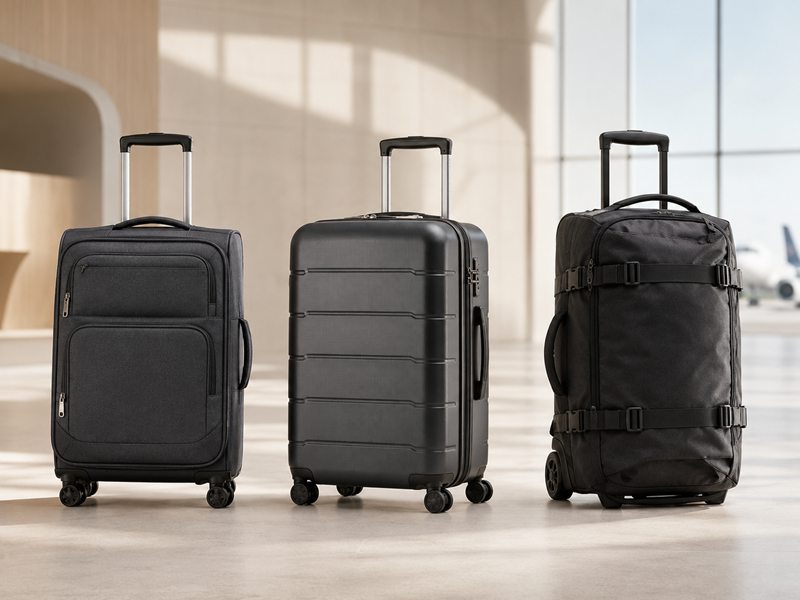
Choosing custom luggage is often treated as a choice between several materials. In reality, successful luggage is a complete system. The outer body influences protection and appearance, but the wheels, trolley handle, bottom support, zipper route, lining, internal boards, dimensions, and carton design determine whether the finished case performs reliably. An attractive shell cannot compensate for noisy wheels, loose trolley tubes, poor weight balance, or a carton that allows the case to arrive distorted.
Travel brands should choose soft shell luggage when flexible capacity, exterior access, and lower development complexity matter most; molded EVA when shape retention and added protection are central; and rolling travel bags when high capacity and easy ground movement lead the brief. Because wheels can be added to both soft and EVA constructions, the final decision should combine body structure, travel use, price position, packing volume, and service expectations.
A travel case may look excellent while standing empty in a studio. Load it with clothing, extend the trolley, pull it across a tiled floor, lift it by the top handle, and pack it into a carton; the weak areas become visible within minutes. The strongest development decisions begin with those real movements, not with a material name on a specification sheet.
What Type of Custom Luggage Fits Your Brand?
The right luggage type is determined by travel use, packed weight, required protection, mobility, empty storage, retail position, and desired visual identity. Soft shell luggage offers flexible capacity and convenient access. Molded EVA provides stronger shape retention and a distinctive profile. Rolling travel bags handle bulky loads, while hybrid designs combine support and flexibility where one structure alone is insufficient.
Product Direction
Selecting luggage by appearance alone creates avoidable problems. A case may look refined in photographs yet become difficult to lift, unstable when loaded, expensive to ship, or too rigid for the intended packing style. Product direction should begin with the journey and load.
The following information should be defined before choosing the structure:
- Primary use: business, leisure, children, team, hotel, equipment, or extended travel
- Carry-on, checked, underseat, or non-airline use
- Intended empty weight
- Expected packed load
- Required internal capacity
- Type of items being carried
- Frequency of travel
- Exterior pocket requirements
- Required level of shape retention
- Two-wheel or four-wheel movement
- Empty storage and nesting needs
- Target retail position
- Planned size and color selection
- Packaging and delivery method
- Expected repair or spare-part support
These requirements often conflict. More internal boards improve shape but add weight. Deeper EVA molding improves appearance but reduces nesting efficiency. Larger wheels improve movement but increase overall dimensions. An expansion zipper adds capacity but can push a carry-on beyond the intended size when fully opened.
The strongest direction balances these trade-offs before the first sample is made.
Soft Shell Luggage
Soft shell luggage uses a sewn textile exterior supported by selected internal layers. Common exterior materials include polyester, nylon, and Oxford fabric. Foam, EVA sheets, PE board, piping, webbing, and reinforced bottom panels can be added to create the required shape.
Soft construction is suitable when flexible packing, exterior access, and easier size adjustment are important. It works well for business carry-ons, crew luggage, travel retail collections, compact trolley cases, and expandable suitcases.
Important structural areas include:
| Area | Main requirement | Common construction |
|---|---|---|
| Front panel | Appearance and pocket support | Fabric, foam, EVA sheet |
| Back panel | Trolley stability | Fabric, foam, PE board |
| Side wall | Shape with limited flexibility | Fabric, piping, EVA sheet |
| Bottom | Wheel and load support | Oxford fabric, base board, reinforced plate |
| Handle area | Lifting strength | Extended webbing and layered stitching |
| Interior | Organization and clean finish | Lining, dividers, straps, mesh |
The textile specification should record material type, weight, coating, backing, color, abrasion expectations, and water-resistance needs. “Polyester luggage” is too broad because a lightly coated fabric and a dense, reinforced textile behave very differently.
Soft shell luggage also allows front pockets, expansion sections, and top-opening access. These features are valuable during business travel, but they must be included in finished dimensional checks. A packed front pocket or opened expansion section can increase the depth beyond the approved size.
Soft Shell Support Levels
Not every soft case should have the same internal stiffness. The support level should reflect the size, packed load, and desired appearance.
| Support level | Structure | Suitable use | Main limitation |
|---|---|---|---|
| Light | Fabric, lining, limited foam | Underseat bags and compact weekend cases | Limited upright stability |
| Medium | Foam, piping, EVA sheet, bottom board | Carry-ons and ordinary travel cases | Requires balanced panel support |
| Firm | EVA sheet, PE board, reinforced base and back | Upright trolley luggage | More weight and less compressibility |
| Hybrid | Molded front, soft side walls, structured base | Premium or technical travel collections | More development control required |
Too little support allows the body to sag, especially around the trolley channel and wheel area. Excessive support makes a soft case heavy and difficult to store. The sample should be reviewed empty, partly filled, and fully loaded because the correct stiffness becomes clear only under different packing conditions.
Airlines do not generally select luggage according to hard or soft construction. The relevant factors are finished dimensions, weight, safe storage, and individual airline rules. A soft case should therefore be developed for a defined airline profile rather than promoted as universally compliant.
Molded EVA Luggage
EVA luggage uses molded ethylene-vinyl acetate panels to create a semi-rigid shell. The molded part may be laminated with polyester, PU, or another surface layer before being assembled with a zipper, lining, wheels, trolley system, and interior components.
EVA is useful when a product needs:
- Defined three-dimensional shaping
- Better resistance to moderate pressure
- A recognizable front profile
- Rounded or character-inspired forms
- Controlled depth
- Light cushioning
- A softer touch than rigid plastic
- Surface areas for molded or applied branding
The shell specification should include EVA thickness, hardness, molded depth, edge radius, surface lamination, finished dimensions, cooling behavior, and zipper route. An EVA panel is not fully controlled merely because its outer length and width are correct. Variations in depth, corner shape, and edge width can affect sewing, balance, nesting, and internal capacity.
A deep molded shell creates more visual impact but occupies more carton volume. It may also require a longer zipper curve and a more complex lining. A shallow shell is easier to pack and may reduce tooling complexity, but it offers less distinctive shaping.
EVA is particularly suitable for children’s luggage, novelty cases, compact protective luggage, and travel products where shape carries much of the visual identity.
Existing vs New EVA Tooling
Existing EVA tooling can shorten preparation and lower the initial development cost. It works when the available size, depth, curvature, and edge construction already match the intended product. Exterior color, surface material, logo, lining, wheels, and interior layout can still provide differentiation.
New tooling is more suitable when the product requires:
- Exclusive outer dimensions
- A unique front or back profile
- Raised ribs or recessed areas
- A character face or shaped outline
- Dedicated logo placement
- Controlled internal depth
- A coordinated multi-size design
- Long-term ownership of the shell form
| Tooling direction | Main advantage | Main restriction |
|---|---|---|
| Existing mold | Faster preparation and lower initial cost | Limited control over size and shape |
| Modified concept using existing mold | Some visual variation through materials and trims | Core shell remains shared |
| Dedicated mold | Greater visual ownership and structural control | Added cost and preparation time |
| Several dedicated sizes | Consistent family appearance | Separate tooling may be needed for each size |
A new mold should not be opened until the shell dimensions, depth, zipper route, wheel clearance, trolley position, and nesting plan are stable. Changing one of these details after a trial shell may require tooling correction.
Rolling Travel Bags
A rolling travel bag is a mobility format rather than a separate shell material. Most versions use a soft textile body fitted with two wheels, a trolley handle, a reinforced bottom, and a wide main opening. EVA panels, foam, boards, or molded bases can be added where more structure is needed.
Rolling travel bags are well suited to:
- Sports teams
- Touring groups
- Uniform and footwear programs
- Long-stay travel
- Outdoor equipment
- Work gear
- Hospitality projects
- Large personal travel loads
The best roller bag is not necessarily the one with the largest capacity. It should remain balanced, clear the ground, turn without twisting, and lift safely when fully packed. Wheel placement, trolley angle, bottom stiffness, handle length, and internal compression all affect performance.
Two-wheel systems are common because they provide directional stability and use fewer wheel assemblies. Four-wheel systems improve movement in terminals but require a more structured base and accurate wheel alignment. Large roller bags often benefit from two protected wheels because the design may travel over curbs, pavement, ramps, and uneven surfaces.
The main body should not hang below the wheel line. Ground clearance should be checked with the agreed load because the bottom may sag after packing.
Rolling Bag Balance
A rolling travel bag can become difficult to use when the center of gravity moves too far from the wheels. Heavy footwear, equipment, or toiletries placed at the wrong end can cause the case to fall forward or require excessive pulling force.
A balanced structure should consider:
- Wheel distance and diameter
- Trolley position relative to the main load
- Bottom board length and stiffness
- Weight of the wheel-end structure
- Standing feet at the opposite end
- Internal compression straps
- Shoe or wet section placement
- Carry-handle position
- Trolley height for the intended user group
- Ground clearance when fully packed
Long bags should be checked for twisting. If the textile body is much wider than the reinforced base, one side may move independently when turning. A molded bottom tray, side rails, internal board, or controlled compression system can improve stability.
The trolley housing also consumes internal space. Its depth and location should be visible in the interior drawing so that the usable packing volume is not overstated. A smooth exterior silhouette may conceal significant wheel and trolley intrusion.
Hybrid Luggage
Hybrid luggage combines soft fabric, molded EVA, boards, foam, and reinforced components according to the job of each area. It is often the strongest direction when a completely soft case lacks identity or a fully molded structure becomes too rigid, heavy, or expensive to transport.
A common hybrid layout may use:
- Molded EVA at the front for shape
- Flexible fabric at the sides for capacity
- Reinforced textile around the zipper
- PE board behind the trolley channel
- A structured base around the wheels
- Foam around high-contact areas
- Webbing running through the handle sections
- Lining panels that cover internal hardware
| Product area | Needed performance | Suitable material |
|---|---|---|
| Front | Appearance and light protection | Molded EVA or padded fabric |
| Side | Flexibility and expansion | Polyester, nylon, or Oxford fabric |
| Back | Trolley support | PE board, EVA sheet, foam |
| Bottom | Load and abrasion control | Molded tray or reinforced Oxford |
| Corners | Surface protection | Piping, layered fabric, rubber guards |
| Handles | Repeated lifting | Webbing, foam wrap, reinforced stitching |
| Interior | Organization | Polyester lining, mesh, straps, dividers |
Hybrid construction should remain purposeful. Adding several materials without a clear function increases assembly complexity and creates more seams, bindings, and transition areas. Every added layer should improve protection, mobility, organization, appearance, or service life.
Use-Case Selection
A travel collection becomes easier to plan when each product is matched to a defined use instead of asking one design to serve every journey.
| Intended use | Strong direction | Valuable features | Main controls |
|---|---|---|---|
| Business carry-on | Medium-structured soft shell | Front access, laptop section, quiet wheels | Dimensions, empty weight, trolley stability |
| Frequent travel | Reinforced soft shell or hybrid | Replaceable parts, organization, durable fabric | Wheel, zipper, handle, abrasion |
| Children’s luggage | Molded EVA | Rounded shape, light weight, visual identity | Handle height, shell accuracy, wheel stability |
| Team travel | Rolling travel bag | Large opening, shoe area, compression | Load balance, bottom support, handles |
| Hospitality retail | Soft shell or EVA | Recognizable color, logo, neat interior | Appearance, packaging, repeat consistency |
| Protective travel | EVA or hybrid | Molded shell, padding, fixed compartments | Internal fit, shell recovery, zipper route |
| Long-stay luggage | Large rolling bag | Capacity, dividers, strong lift handles | Loaded movement, carton volume, weight |
| Multi-size collection | Shared hybrid language | Consistent materials, logo, hardware | Proportion, nesting, size-specific support |
A single collection can include more than one structure. A business series may combine a soft carry-on, rolling duffel, packing cubes, and toiletry bag using the same exterior fabric, lining color, logo method, and hardware finish. Visual consistency does not require every item to share identical construction.
Capacity Planning
External size does not equal usable capacity. Wheels, trolley channels, molded corners, padding, and interior dividers reduce the space available for packing.
Approximate gross internal volume can be calculated as:
Internal length × internal width × internal depth ÷ 1,000 = liters
A compartment measuring 50 × 35 × 20 cm has a geometric volume of:
50 × 35 × 20 ÷ 1,000 = 35 liters
The usable figure will be lower after subtracting:
- Trolley housing
- Wheel recesses
- Curved shell areas
- Molded ribs
- Lining and padding
- Internal dividers
- Shoe sections
- Compression panels
Capacity should be verified through a defined packing trial. A business carry-on might be checked with shirts, trousers, shoes, a laptop, chargers, and toiletries. A team bag might be checked with uniforms, footwear, towels, and equipment. A real packing set shows whether the opening, dividers, and compression system work together.
Weight Planning
Empty weight should be controlled from the first sample because reducing weight later may require changes to the trolley, wheels, boards, EVA shell, or hardware.
Each major assembly should be weighed separately:
| Assembly | Included parts |
|---|---|
| Outer body | Fabric, EVA, foam, boards, piping |
| Mobility | Wheels, housings, axle, trolley |
| Interior | Lining, dividers, straps, pockets |
| Hardware | Zippers, locks, buckles, metal plates |
| Finished luggage | All fixed and removable parts |
Soft shell construction may start lighter, but heavy boards and oversized hardware can remove that advantage. EVA provides stiffness with relatively low weight, although excessive thickness or deep molding adds material. Rolling bags gain weight from the trolley and wheel system even when the textile body is light.
Weight reduction should protect function. Thinner bottom support may save grams but allow dragging. Smaller wheels may reduce weight but perform poorly over uneven surfaces. Decorative metal parts and unnecessary dividers are often safer areas to simplify.
Collection Planning
A focused first collection usually performs better than a large assortment with many unproven combinations. Shared components can create visual consistency and reduce development complexity.
A controlled series may use:
- One exterior material family
- One lining quality
- Shared zipper and hardware finishes
- One wheel construction where size allows
- Coordinated trolley handles
- One logo method
- Limited color selection
- Size-specific support layers
- Common label design
- Efficient nesting between sizes
Color deserves deliberate thought. Black is useful because it is familiar, hides some surface marks, and suits business travel. However, a completely black case can be difficult to identify among similar luggage. Contrast piping, colored zipper pulls, distinctive lining, molded texture, handle accents, or a recognizable logo plate can improve visual identification without making the design overly decorative.
The strongest luggage type is ultimately the one that delivers the intended experience with controlled weight, reliable movement, suitable capacity, recognizable design, efficient packing, and repeatable production. Soft shell, EVA, rolling, and hybrid structures are tools; the journey determines how they should be used.
Soft Shell vs EVA vs Rolling: Which Is Best?

No single construction is superior for every travel product. Soft shell luggage is strongest for flexible capacity and exterior access. Molded EVA offers better shape retention and a distinctive profile. Rolling travel bags suit bulky or irregular loads. Since “rolling” describes mobility rather than shell structure, both soft shell and EVA luggage can include wheels and trolley handles.
Category Difference
Soft shell, EVA, and rolling travel bags are often compared as three separate categories, but they describe different parts of a luggage system.
- Soft shell describes a sewn textile body.
- EVA describes a semi-rigid molded structure.
- Rolling describes a wheel-and-trolley format.
- Hybrid luggage combines several constructions.
A soft shell suitcase can use two wheels or four spinner wheels. An EVA case can also include a trolley and wheels. A rolling travel bag may use a soft fabric body, EVA front panel, molded base, or reinforced bottom board.
A more accurate comparison is:
| Product direction | Body structure | Mobility | Main value |
|---|---|---|---|
| Soft shell upright | Sewn textile with internal support | Two wheels or spinners | Flexible packing and easy access |
| Molded EVA case | Semi-rigid molded shell | Carry handles or wheels | Shape retention and visual identity |
| Rolling travel bag | Mainly textile with reinforced base | Usually two wheels | Large capacity and bulky loads |
| Hybrid trolley case | Fabric, EVA, boards, and molded parts | Two wheels or spinners | Balanced protection and flexibility |
The shell and mobility system should therefore be selected separately before being combined into the finished design.
Core Comparison
The following table compares the main characteristics of each direction. Results can change according to material quality, support layers, hardware, size, and workmanship.
| Evaluation area | Soft shell luggage | Molded EVA luggage | Rolling travel bag | Hybrid luggage |
|---|---|---|---|---|
| Flexible capacity | High | Low | High | Medium to high |
| Shape retention | Medium | High | Low to medium | High |
| Exterior access | High | Medium | Medium | High |
| Pressure protection | Medium | High | Depends on support | High |
| Irregular loads | Medium | Low | High | High |
| Empty storage | Good | Limited | Good | Moderate |
| Molded appearance | Limited | Excellent | Limited | Excellent |
| Size adjustment | Easier | Requires tooling review | Easier | Moderate |
| Nesting efficiency | Good | Depends on shell depth | Good | Depends on structure |
| Carry-on development | Strong | Strong | Depends on dimensions | Strong |
| Large equipment use | Limited | Limited | Excellent | Strong |
| Initial development complexity | Lower | Higher | Medium | Higher |
A high rating does not mean one product will always perform better. A poorly supported soft case may collapse, while a carefully reinforced version can remain stable. A molded EVA case may retain its shape but still fail if the wheels, trolley, zipper, or base are weak.
Protection
Molded EVA usually offers the strongest protection against moderate pressure because its three-dimensional shell spreads contact over a wider area. It helps prevent the case from collapsing directly onto clothing, accessories, headphones, children’s items, or compact equipment.
Protection depends on more than shell stiffness. A luggage sample should be reviewed for:
- Front and side pressure
- Corner contact
- Bottom impact
- Internal load movement
- Trolley housing pressure
- Wheel-area deformation
- Zipper separation
- Handle attachment
- Carton compression
- Surface rubbing during transport
Soft shell luggage can provide reliable protection when foam, EVA sheets, PE boards, piping, reinforced corners, and compression straps are placed correctly. Its flexible body may absorb some movement without cracking, although concentrated pressure can reach the contents more easily.
A rolling travel bag needs special attention around the base. Large loads may pull the textile body downward, forcing the bottom to drag or placing excessive force on the wheel housings. A molded tray, extended board, side rails, or reinforced wheel-end structure can distribute the load more effectively.
Protection Testing
Protection should be evaluated with a defined load rather than an empty display sample. The packed weight should represent the intended use of the product.
| Review area | Test condition | What to inspect |
|---|---|---|
| Body pressure | Case filled to agreed load | Permanent deformation and panel recovery |
| Handle lift | Repeated lifting under load | Stitching, webbing, and attachment movement |
| Wheel movement | Loaded rolling over selected surfaces | Noise, alignment, housing stability |
| Trolley use | Extension, retraction, and pulling | Locking, side movement, tube deformation |
| Zipper route | Case fully packed | Smooth movement and seam pressure |
| Standing stability | Empty, partly filled, fully loaded | Leaning, tipping, and base distortion |
| Carton trial | Packed product stored and moved | Shell recovery, scratches, and wheel pressure |
Soft shell, EVA, and rolling designs should not use identical test conditions automatically. A compact carry-on and a large team travel bag have different intended loads and movement patterns. The approved test load, cycle count, surface, and acceptance criteria should be recorded for each design.
Weight
Soft shell luggage often begins with a lower body weight because woven fabric and selective support use less material than a fully molded structure. However, wheels, trolley tubes, boards, locks, handles, lining, and hardware may account for a significant part of the finished weight.
EVA provides stiffness without the weight of some rigid plastic shells, but excessive thickness, deep molding, heavy lamination, and large molded panels can remove the advantage. Rolling travel bags gain weight from the trolley and wheel system even when the textile body is light.
A weight review should separate the product into assemblies:
| Assembly | Included elements | Main concern |
|---|---|---|
| Outer body | Fabric, EVA, foam, boards, piping | Shape-to-weight balance |
| Wheel system | Wheels, housing, axle, supports | Mobility and durability |
| Trolley system | Tubes, handle, brackets, housing | Stability and internal intrusion |
| Interior | Lining, dividers, straps, pockets | Organization without excess |
| Hardware | Zippers, locks, buckles, metal plates | Function and appearance |
| Packing | Covers, inserts, carton | Shipment weight and protection |
Weight reduction should not weaken the base, handles, or trolley support. Decorative metal pieces, duplicate pockets, oversized zipper pulls, and unnecessary internal panels are usually safer areas to simplify.
Mobility
The strongest rolling luggage moves smoothly under its intended load, remains stable during turns, clears the ground, and stands without leaning. Wheel count alone does not guarantee better movement.
| Wheel system | Main advantages | Main limitations | Suitable use |
|---|---|---|---|
| Two recessed wheels | Directional stability and protected wheel position | Must be tilted while pulling | Rolling duffels and equipment bags |
| Two external wheels | Good ground clearance and easier replacement | Greater external projection | Large travel bags |
| Four single spinners | Multi-directional movement | More exposed wheel assemblies | Upright travel cases |
| Four double spinners | Improved stability and smoother turning | Added weight and component cost | Premium trolley cases |
Two-wheel rolling bags often perform better over curbs, ramps, pavement, and uneven flooring. Spinner cases move more easily through terminals, hotel lobbies, and narrow aisles but require a rigid or reinforced base to keep all four corners aligned.
The sample should be loaded before movement is evaluated. Important observations include:
- Pulling force
- Wheel noise
- Straight-line tracking
- Turning behavior
- Body twisting
- Ground clearance
- Trolley movement
- Stability when standing
- Contact between wheels and fabric
- Performance after repeated rolling
A large bag with smooth wheels may still feel difficult to control if the trolley is too short or the load sits too far from the wheel end.
Capacity
Soft shell luggage provides the greatest flexibility for clothing and ordinary travel items. Fabric walls can accommodate slight changes in packing volume, while expansion zippers and exterior pockets add usable space.
Rolling travel bags often provide the highest capacity for footwear, uniforms, sportswear, outdoor gear, or irregular items. A long U-shaped opening makes loading easier, but the trolley housing and wheel recesses may reduce the bottom space.
EVA luggage keeps a fixed internal shape. The predictable structure supports organized packing but offers less tolerance for overfilling.
Approximate gross internal volume can be calculated as:
Internal length × internal width × internal depth ÷ 1,000 = liters
For example:
52 cm × 36 cm × 21 cm ÷ 1,000 = 39.3 liters
The usable volume will be lower after subtracting:
- Trolley channels
- Wheel housings
- Curved corners
- Molded ribs
- Foam and lining
- Dividers
- Compression panels
- Shoe compartments
- Wet sections
A defined packing trial is more reliable than using outer dimensions. Clothing, shoes, toiletries, devices, and accessories can be arranged according to the intended journey, then photographed and recorded for later comparison.
Access and Organization
Soft shell luggage offers the strongest exterior access. Front pockets can hold travel documents, laptops, chargers, toiletries, and items needed during transit. Top-opening cases also work well in compact hotel rooms because the entire case does not need to open like a clamshell.
Molded EVA cases often use clamshell openings or large zipper panels. Their firm body helps keep dividers and mesh pockets in position. However, deep exterior pockets can interrupt the molded shape and reduce protection.
Rolling travel bags usually use a long U-shaped opening. Large items are easy to load, but internal organization must stop the contents from shifting toward the wheel end.
Useful interior options include:
- Compression straps
- Zipper dividers
- Mesh pockets
- Shoe compartments
- Wet sections
- Laundry pockets
- Document sleeves
- Padded device sections
- Removable packing cubes
- Trolley-channel covers
More compartments do not always improve the product. Each divider adds material, weight, sewing, and cost. The layout should reflect a real packing list instead of filling every empty surface with another pocket.
Storage and Nesting
Soft shell luggage is usually easier to store because the textile body can compress slightly. Several sizes may also nest inside one another, reducing warehouse space and carton volume.
Molded EVA luggage retains its shape when empty. Deep shells and protruding wheels can make nesting difficult. Excessive pressure between nested cases may flatten molded areas, distort zipper curves, or leave marks on the surface material.
Rolling travel bags sit between these two directions. The textile body may fold inward, but the trolley base remains fixed.
A nesting trial should check:
- Clearance around wheels and handles
- Pressure on the EVA shell
- Contact between hardware and fabric
- Zipper deformation
- Lining pressure from trolley tubes
- Recovery after unpacking
- Protective material between cases
- Carton size and gross weight
Carton volume can be calculated as:
Length × width × height in centimeters ÷ 1,000,000 = cubic meters
A carton measuring 60 × 40 × 25 cm occupies:
60 × 40 × 25 ÷ 1,000,000 = 0.060 m³
Small reductions in shell depth or wheel projection can improve packing efficiency across a large order without changing the visible size substantially.
Carry-On Sizing
Soft shell and EVA cases can both work as carry-on luggage. A compact rolling travel bag can also qualify if its complete external dimensions and weight meet the selected airline rules.
There is no single worldwide carry-on size. Limits differ among airlines, routes, aircraft, and cabin classes. Development should therefore begin with named airline profiles rather than a broad “airline approved” statement.
Finished measurements should include:
- Wheels
- Fixed top handle
- Side handle
- Feet
- Corner guards
- Front pockets when filled
- Molded shell depth
- Expansion section
- External lock or attachment
Wheels and fixed handles are normally part of the overall external dimensions used during physical sizing. A 20-inch body can exceed the intended limit after wheels and handles are installed.
Soft luggage may fit a sizer while empty but become too deep when overpacked. EVA remains more dimensionally stable, although deep molding may reduce internal capacity. An expansion zipper should be treated as additional packing depth, not hidden capacity.
Color and Identification
Black remains common in travel luggage because it suits business use, hides some marks, and coordinates easily with different materials. However, a fully black suitcase can be difficult to identify among many similar cases at baggage collection.
A more recognizable design can use:
- Contrast piping
- Colored zipper tape
- Distinctive zipper pulls
- Molded surface patterns
- Branded wheel accents
- Handle color details
- Printed lining
- A metal or rubber logo plate
- Tonal embroidery
- A recognizable panel shape
Soft shell luggage offers more flexibility for textile color blocking and embroidery. EVA supports molded patterns, raised details, and shaped panels. Rolling bags provide large uninterrupted fabric areas for color combinations and patches.
Color selection should also consider surface behavior. Light shades may show dirt more readily. Very dark colors can absorb more visible dust. Glossy laminations reveal scratches, while textured surfaces conceal some wear. The appearance should be reviewed under daylight, indoor retail lighting, and photography lighting before approval.
Retail Position
Premium value is created by the complete use experience rather than the shell material alone. A soft case can sit at a high retail tier when it uses refined textiles, smooth zippers, quiet wheels, stable handles, precise sewing, and well-planned organization. An EVA case can feel inexpensive if the molding is uneven or the surface lamination is loose.
The strongest value signals include:
- Consistent shape
- Smooth wheel movement
- Low trolley movement
- Comfortable lift handles
- Clean piping and binding
- Accurate logo placement
- Flat, fitted lining
- Stable zipper curves
- Controlled color
- Suitable empty weight
- Protective retail packing
- Accessible replacement parts
Added features should have a clear purpose. Heavy metal decoration, extra pockets, oversized wheels, and thick support layers can raise cost and weight without improving travel performance.
Premium design is often quieter and more selective: fewer details, better execution, controlled movement, and materials chosen for long-term use rather than display alone.
Best Fit by Use
| Intended use | Recommended direction | Main reason | Critical control |
|---|---|---|---|
| Business carry-on | Medium-structured soft shell | Exterior access and flexible packing | Dimensions and empty weight |
| Frequent travel | Reinforced soft shell or hybrid | Durable use and organized access | Wheels, trolley, zipper, handles |
| Children’s luggage | Molded EVA | Recognizable shape and light cushioning | Shell accuracy and handle height |
| Team travel | Rolling travel bag | Large opening and high capacity | Loaded balance and bottom support |
| Equipment travel | EVA or hybrid roller | Protection with mobility | Internal fit and wheel strength |
| Hospitality retail | Soft shell or EVA | Branding and coordinated appearance | Color and packing consistency |
| Long-stay travel | Large rolling bag | Bulky load capacity | Weight, ground clearance, lift handles |
| Premium travel series | Hybrid trolley case | Balanced structure and distinctive form | Component and assembly control |
Soft shell is the strongest choice when flexibility, front access, and easier size development lead the specification. EVA is stronger when a defined shape and moderate pressure protection matter more. A rolling travel bag is preferable for large, irregular loads. Hybrid luggage is often the most balanced direction when protection, visual identity, mobility, and packing efficiency must work together.
How Does the Custom Luggage Process Work?

Custom luggage development moves through a defined sequence: travel-use review, structural planning, material and component selection, pattern or mold preparation, sample assembly, loaded performance checks, revision, approval, and bulk production. A reliable process connects every visible feature to measurable specifications so that dimensions, weight, movement, appearance, packing, and bulk consistency can be controlled together.
Project Brief
A strong project brief explains how the luggage will travel, what it will carry, and how it should behave. A reference image may show the desired style, but it rarely defines internal support, loaded weight, trolley height, wheel clearance, usable capacity, or carton requirements.
The starting information should include:
- Product type: soft shell, EVA, rolling bag, or hybrid
- Carry-on, checked, underseat, kids, team, or equipment use
- Finished external dimensions
- Required internal capacity
- Intended packed load
- Desired empty weight
- Two-wheel or spinner movement
- Exterior pocket and opening requirements
- Main compartment layout
- Logo method and position
- Color references
- Size and color selection
- Quantity per design
- Individual packing
- Required completion date
- Destination and delivery method
Dimensions should be stated as finished measurements, including wheels, fixed handles, feet, molded projections, and filled exterior pockets where applicable.
A business carry-on may prioritize compact size, low empty weight, front access, and quiet wheels. A team travel bag may prioritize a wide opening, high capacity, strong lift handles, and bottom support. An EVA children’s case may require accurate molding, rounded shaping, balanced wheel placement, and an appropriate trolley height. These products should not begin with the same brief.
Feasibility Review
The feasibility review determines whether the proposed appearance, structure, components, schedule, and quantity can work together. It should take place before pattern cutting or EVA tooling begins.
Key areas include:
| Review area | Main evaluation |
|---|---|
| Product structure | Soft shell, molded EVA, rolling, or hybrid |
| Finished dimensions | Compatibility with intended travel use |
| Packed load | Required bottom, handle, wheel, and trolley strength |
| Empty weight | Effect of boards, EVA, hardware, and lining |
| Material | Availability, color, coating, backing, and lead time |
| Wheels | Type, diameter, clearance, attachment, and replacement |
| Trolley | Height, stages, tube width, housing, and stability |
| Opening | Zipper route, access, loading, and internal pressure |
| Logo | Material compatibility, size, location, and durability |
| Packing | Nesting, carton volume, shell recovery, and protection |
| Schedule | Material, tooling, sampling, approval, and production time |
Several conflicts may appear during this review. A deep EVA shell may create a stronger visual identity but increase carton volume. Large wheels may improve movement but increase overall dimensions. A front laptop pocket may improve access but add depth to a carry-on. A stronger base may support a heavier load but increase empty weight.
These conflicts should be resolved through priorities. If carry-on dimensions are fixed, the wheel and handle projection must fit within them. If protection is essential, the weight target may need adjustment. If freight efficiency is critical, shell depth and nesting should be reviewed before tooling.
Product Specification
A product specification converts the design into measurable information. It should identify each material, component, dimension, color, logo, and packing detail used in the approved construction.
The main record should include:
| Specification area | Information to record |
|---|---|
| Finished size | Height, width, and depth in millimeters |
| Measurement method | Inclusion of wheels, handles, feet, and pockets |
| Empty weight | Grams or kilograms |
| Capacity | Internal dimensions or packing-trial result |
| Exterior | Material, weight, coating, backing, and color |
| EVA | Thickness, hardness, depth, surface, and dimensions |
| Support layers | Foam, PE board, EVA sheet, base plate |
| Trolley | Tube material, stages, heights, color, and housing |
| Wheels | Type, diameter, housing, position, and color |
| Zippers | Size, tape color, puller, opening route, and lock |
| Handles | Material, padding, position, and reinforcement |
| Interior | Lining, dividers, straps, pockets, and trolley cover |
| Logo | Method, size, color, and coordinates |
| Labels | Main label, care label, barcode, and SKU label |
| Packing | Protective bag, inserts, nesting, and carton |
| Carton | Dimensions, quantity, gross weight, and marks |
The specification should also record accepted tolerances. Textile structures can compress and expand, while molded EVA can change slightly after heating and cooling. The tolerance should reflect the construction without allowing visible inconsistency or functional problems.
Descriptions such as “strong wheels,” “premium fabric,” or “large pocket” are not measurable. Wheel diameter, material identity, fabric specification, pocket dimensions, and agreed performance conditions provide far better control.
Material Selection
Materials should be selected according to load, structure, appearance, travel environment, and intended retail position. The most expensive option is not automatically the most suitable.
Soft shell luggage commonly uses polyester, nylon, or Oxford fabric. The material record should identify:
- Fabric construction
- Weight
- Coating
- Backing
- Color
- Surface texture
- Water-resistance needs
- Abrasion expectations
- Compatibility with printing, embroidery, or applied logos
Hidden materials are equally important. Foam supports shape and cushioning. EVA sheets provide firmer panel control. PE boards support the trolley channel, side walls, and base. Webbing transfers handle loads into a larger area of the body. Piping helps define the outline and protect panel edges.
Molded EVA requires additional controls:
- EVA thickness
- Hardness
- Molded depth
- Surface lamination
- Edge width
- Corner radius
- Compression recovery
- Finished dimensions after cooling
- Zipper compatibility
- Odor and surface requirements where applicable
Material selection should also consider packing. A surface that looks excellent on an individual sample may mark easily when several cases are nested. Protective tissue, non-woven covers, foam sheets, or separate wheel guards may be needed.
Component Selection
Wheels, trolley handles, zippers, lift handles, locks, and hardware should be selected as part of the structure rather than added after the body design is complete.
Wheel selection should consider:
- Two-wheel or four-wheel layout
- Single or double wheels
- Diameter
- Housing material
- Bearing structure
- Rotation noise
- Ground clearance
- Attachment method
- Replaceability
- Color and finish
The trolley system should match case size and intended load. Important details include tube material, number of extension stages, extended height, handle shape, locking positions, internal housing, side movement, and base connection.
The same trolley should not automatically be used across every size. A system suitable for a large checked case may add unnecessary weight to a compact carry-on. A small trolley used on a large rolling bag may feel unstable or place too much force on the base.
Zipper size and opening route also affect performance. Curved EVA shells need a smooth zipper path and controlled edge width. Large rolling bags need a zipper capable of handling pressure from bulky contents. Lock compatibility should be confirmed before zipper pullers and opening directions are approved.
Pattern Development
Soft luggage begins with a pattern that defines panel shape, seam allowances, zipper route, piping, binding, pockets, handles, and reinforcement. The pattern must account for the thickness of foam, boards, lining, and folded material.
A technically correct flat pattern can still produce a distorted case if the support layers are not balanced. Common risks include:
- Front panel pulling toward a pocket
- Side walls bowing outward
- Uneven zipper curves
- Base twisting under load
- Trolley housing pressing into the lining
- Handle reinforcement creating visible stiffness
- Expansion sections changing the standing shape
- Wheel corners sitting at different heights
The first pattern should be checked against finished measurements, not only cut-panel dimensions. Sewing and binding consume material around the edges, while foam and boards change the finished depth.
For a multi-size collection, each size should receive its own structural review. Enlarging every panel by the same percentage does not guarantee correct proportions. Pocket depth, handle length, trolley height, wheel diameter, piping width, and logo position may need individual adjustment.
EVA Tooling
A molded EVA structure needs a confirmed shell drawing before tooling begins. The drawing should define the outer dimensions, depth, curvature, raised areas, recessed sections, edge width, surface texture, logo location, and zipper route.
The preparation sequence may include:
- Confirm the shell concept and finished dimensions.
- Review trolley, wheel, and zipper clearances.
- Create the shell drawing.
- Confirm molded depth and edge construction.
- Prepare tooling.
- Produce a trial shell.
- Check dimensions after cooling.
- Review surface lamination.
- Test zipper and lining compatibility.
- Correct the shell where needed.
- Assemble the complete sample.
A trial shell should be reviewed before full assembly. If the shell is too deep, too shallow, uneven, or dimensionally unstable, building the entire case around it wastes time and materials.
Nesting should also be tested early. A shell may look correct individually yet press against the trolley, wheels, or zipper of another case when nested. Permanent deformation after carton storage can become a larger issue than the visible sample appearance.
Sample Assembly
The first sample should represent the intended structure as closely as possible. Standard temporary parts may support an early shape review, but wheels, trolley, zippers, support layers, and packing must eventually match the intended production specification.
A controlled sample sequence includes:
- Material and component confirmation
- Pattern cutting or EVA molding
- Exterior body assembly
- Pocket and zipper installation
- Support-layer placement
- Wheel and trolley installation
- Handle reinforcement
- Lining and interior assembly
- Logo application
- Label placement
- Finished measurement
- Empty-weight recording
- Loaded-use review
- Packing trial
A sample made only for appearance may hide functional weaknesses. For example, an empty rolling bag can stand correctly because no force pulls on the bottom. After loading, the body may sag below the wheel line. A trolley may lock correctly when stationary but move excessively during pulling. A zipper may run smoothly when empty but bind when the compartment is full.
The sample should therefore be treated as a working product, not a display model.
Performance Checks
Luggage should be checked empty, partly filled, fully loaded, and packed inside its carton. Each condition reveals different behavior.
| Check | Test condition | Main observation |
|---|---|---|
| Finished dimensions | Empty and fully packed | Size change and expansion |
| Empty weight | Complete sample | Comparison with target weight |
| Loaded standing | Agreed packed load | Leaning, tipping, and base shape |
| Rolling | Selected floor surfaces | Noise, alignment, and body drag |
| Turning | Loaded case | Wheel stability and body twisting |
| Trolley | Extended and retracted repeatedly | Locking and side movement |
| Top handle | Loaded lifting | Reinforcement and seam condition |
| Side handle | Loaded lifting | Balance and attachment stability |
| Zipper | Fully packed compartment | Smooth movement and seam pressure |
| EVA recovery | Pressure and carton storage | Permanent deformation |
| Packing | Complete carton | Movement, pressure, and surface damage |
The agreed test load should reflect intended use. A compact overnight case, business carry-on, checked suitcase, and large team bag require different load conditions.
Performance records should identify the test load, surface, cycle count, result, and any visible change. “Passed” without recorded conditions provides little value when later production needs to follow the same standard.
Revision Control
A useful revision record identifies the problem, location, likely cause, proposed change, and effect on connected parts.
| Revision field | Example |
|---|---|
| Area | Bottom panel |
| Observed issue | Fabric drags under full load |
| Likely cause | Insufficient board length |
| Proposed change | Extend board toward front panel |
| Connected effect | Added weight and carton stiffness |
| Verification | Repeat loaded rolling check |
Small changes can affect several areas. Increasing wheel diameter improves ground clearance but raises overall height. Moving the trolley inward may improve balance but reduce internal capacity. Thickening the EVA shell improves shape retention but changes zipper assembly and nesting.
Revision files should use numbered versions and dated photographs. Comments such as “make it stronger” or “make it more premium” should be converted into measurable changes: extend webbing, increase board thickness, reduce trolley movement, change wheel structure, improve stitch density, or adjust material finish.
Only the latest approved version should move into production preparation.
Approval Sample
The approved sample should be supported by a complete written record. A physical sample shows shape, hand feel, movement, and workmanship. The written record controls measurable details and reduces variation.
Approval should cover:
- Finished dimensions
- Empty weight
- Exterior and lining materials
- EVA shell details
- Wheels and trolley
- Zippers and locks
- Handles and reinforcement
- Interior layout
- Logo
- Labels
- Color references
- Packing
- Carton dimensions
- Carton marks
Photographs should show the front, back, sides, top, bottom, interior, wheels, trolley, handles, logo, labels, and packed carton.
Bulk production should not begin from approval of appearance alone. Dimensions, structure, movement, materials, labeling, and packing must be approved together. Any accepted deviation should be recorded so that later inspection does not rely on memory or scattered messages.
Production Preparation
Before bulk production, the approved sample should be translated into a bill of materials, production instructions, inspection requirements, and packing details.
Production readiness includes:
- Approved physical sample available
- Materials and colors confirmed
- Patterns or EVA tooling locked
- Component codes confirmed
- Quantity by size and color fixed
- Logo artwork approved
- Label files approved
- Packing method confirmed
- Carton marks confirmed
- Inspection criteria recorded
- Material availability checked
- Production and delivery schedule confirmed
Pre-production units should be compared with the approved sample before the main quantity advances. This review confirms whether bulk materials, colors, components, dimensions, and construction match the approved direction.
Custom bag samples usually take 5–7 days after the main details and materials are confirmed. Selected simple styles may be completed in 2–3 days. New EVA tooling, exclusive components, several sizes, or special materials require additional preparation. Bulk production usually takes approximately 20–30 days after approval and material readiness.
Delivery Planning
The required arrival date should be planned backward through transport, packing, inspection, production, material preparation, sample approval, and tooling.
| Stage | Required confirmation |
|---|---|
| Destination delivery | Address and required arrival date |
| Transport | Air, sea, rail, or arranged forwarder |
| Shipment preparation | Documents, carton marks, and packing list |
| Inspection | Product, labels, packing, and cartons |
| Bulk production | Quantity, size, color, and schedule |
| Material preparation | Fabric, EVA, lining, components, and packaging |
| Sample approval | Physical sample and written specification |
| Development | Pattern, tooling, materials, and components |
Air transport commonly requires about 7–12 days after dispatch, while sea transport may require approximately 40–45 days depending on the route and shipment arrangement. These periods should be added after production rather than included inside the production time.
A dependable schedule is built from confirmed specifications and material availability. Starting production before the sample, labels, or packing are approved may appear faster at first, but corrections later can consume far more time than the early start saved.
What Affects Price, MOQ, and Lead Time?

Custom luggage cost, minimum order quantity, and delivery time depend on the product structure, material specification, components, decoration, color count, packaging, testing needs, and total quantity per design. A simple soft travel bag using available materials can move quickly, while molded EVA panels, exclusive hardware, multiple sizes, and custom retail boxes require additional development, higher starting quantities, and a longer schedule.
Unit Price
A luggage quotation should reflect the complete construction, not just the shell material and external dimensions. Two bags that look nearly identical in photographs may differ considerably in fabric strength, internal reinforcement, trolley stability, wheel durability, zipper performance, lining quality, packing volume, and expected service life.
The main cost contributors are shown below.
| Cost area | Specification details | Why the cost changes |
|---|---|---|
| Outer body | Polyester, nylon, Oxford fabric, EVA, coating, thickness, density, color | Heavier or specially finished materials cost more and may require a dedicated material run |
| Internal structure | PE board, foam, webbing, corner support, bottom panel, trolley plate | Additional layers improve shape and load support but add material and assembly work |
| Trolley system | Tube material, tube thickness, stage count, locking mechanism, grip shape | A stable system requires better components, accurate installation, and functional checks |
| Wheels | Two-wheel, four-wheel, spinner, wheel diameter, bearing structure, housing | Wheel design affects movement, noise, stability, repair risk, and base construction |
| Zippers | Coil size, reverse coil, water-resistant finish, lock compatibility, pullers | Larger or specialized zippers increase trim cost and may slow assembly around curves |
| Interior | Lining, divider, compression straps, mesh pockets, padded sections | More compartments require additional cutting, sewing, binding, and inspection |
| Branding | Screen print, embroidery, woven label, rubber patch, metal badge, custom puller | Each method has different setup, artwork, tooling, and application requirements |
| Packaging | Polybag, dust bag, printed box, hangtag, corner protector, export carton | Retail presentation and transport protection can materially affect the packed cost |
| Testing | Wheel travel, handle lifting, trolley cycling, zipper use, loaded standing | Test methods may require dedicated samples, fixtures, documentation, or outside laboratories |
| Quantity | Total units and quantity per color or size | Larger production runs distribute setup and development expenses across more units |
Material names alone are not sufficient for comparison. “Polyester,” for example, does not define yarn density, weave, backing, coating, colorfastness, tear strength, or abrasion resistance. “EVA” does not define panel thickness, hardness, surface texture, lamination, rebound performance, or forming depth.
Component descriptions should also be measurable. A quotation that says “spinner wheels” or “aluminum trolley” leaves too much room for interpretation. Wheel diameter, housing construction, axle design, trolley tube dimensions, extension stages, locking positions, handle material, and attachment method should be recorded in the product specification.
A useful comparison places every offer on the same basis:
- Identical finished dimensions, including wheels and fixed handles
- The same material grade, coating, thickness, and color requirement
- Matching wheel and trolley specifications
- The same number of pockets, dividers, straps, and reinforcement layers
- Identical logo methods and logo sizes
- The same packing method and carton quantity
- Matching inspection and test requirements
- The same delivery term and shipping destination
Without this alignment, the lowest unit figure may simply represent a lighter fabric, smaller wheel, thinner lining, reduced reinforcement, less protective packing, or a different freight basis.
The more useful commercial calculation is:
Effective product cost = product value + allocated tooling + packaging + inspection + freight + duty + expected defect and damage cost
A lower ex-works figure can become expensive if weak wheels create returns, oversized cartons increase freight, or poor handle installation causes failures after launch.
MOQ
MOQ is influenced by more than sewing capacity. Material mills, dyeing facilities, molding operations, component producers, print processes, and packaging plants each have their own minimum batch requirements. The final MOQ must accommodate the most restrictive part of the design.
For Jundong luggage programs, the normal starting quantity is 500 pieces per design. Selected simple styles may be reviewed at 200–300 pieces, especially when they use available materials, standard components, limited colors, and straightforward decoration. Large luggage, multiple sizes, special wheels, new trolley systems, molded EVA parts, and protective retail cartons require a project-specific review.
“Per design” should be clarified before approval. Five hundred pieces divided across many colors and sizes may not provide enough quantity for each variation.
| Order structure | MOQ effect | Operational reason |
|---|---|---|
| One design, one color | Lower complexity | Materials and components can run continuously |
| One design, several colors | May increase | Each color requires separate material preparation and line control |
| Several sizes | May increase | Every size needs separate patterns, cutting plans, cartons, and packing checks |
| Custom-dyed fabric | Often increases | Dyeing facilities normally require a minimum material volume per color |
| Available fabric color | More flexible | Existing material can avoid a dedicated dye run |
| Standard wheels and trolley | More flexible | Established components require little or no new setup |
| Exclusive wheel housing | Higher starting quantity | New tooling, assembly trials, and component batching may be required |
| Molded EVA panel | Project dependent | Tool dimensions, forming depth, lamination, and mold output affect feasibility |
| Printed retail box | May increase | Offset printing and box conversion have economical batch thresholds |
| Custom metal badge | May increase | Mold preparation, plating, finishing, and color matching add setup work |
Adding a logo to an existing construction usually has less MOQ impact than changing the body structure. A woven label, print, embroidery, or standard rubber patch can often be integrated without altering the luggage engineering. A proprietary handle, wheel housing, metal trim, or deeply formed EVA panel is different because it creates a new component program.
Color planning deserves particular attention. Combining three colors into a 500-piece order does not automatically make every material available at that volume. The outer fabric might be available, while matching webbing, zipper tape, lining, molded parts, or packaging still require separate batches.
A practical way to support a smaller first release is to reduce variation:
- Use an established body construction
- Select available material colors
- Keep one lining color across the collection
- Share wheels, trolley systems, zipper pulls, and handles between sizes
- Limit the first run to one or two exterior colors
- Use printed or woven branding instead of new metal tooling
- Apply one carton design with size identification labels
- Add further colors after the construction has been proven
This approach preserves the features that influence travel performance while reducing expenses tied to decoration and SKU separation.
Dividing one design into many low-volume variations can create inconsistent materials, partial component batches, complex packing, and a higher risk of assortment errors. A focused launch is often more reliable than a wide collection with very little volume behind each item.
Tooling and Development
Development charges are influenced by how far a concept moves away from established construction and components. A soft travel bag made with available fabric, standard wheels, and an existing trolley system mainly requires pattern development, material preparation, logo work, and sample assembly. A deeply formed EVA case or exclusive rolling platform may also require molds, fixtures, custom plastic parts, or metal tooling.
| Development item | When it may be needed | Cost treatment |
|---|---|---|
| Paper pattern | New body dimensions or compartment layout | Usually included in development or sample work |
| EVA forming mold | New shell outline, depth, texture, or size | Normally quoted separately |
| Metal logo mold | Exclusive badge shape | Separate tooling or setup charge |
| Custom zipper pull | Proprietary puller shape | Mold and component minimum may apply |
| Wheel housing mold | Exclusive mobility design | Tooling, trials, and minimum component volume |
| Plastic handle mold | New grip or attachment structure | Tooling plus verification samples |
| Printed packaging plate | Custom carton or retail box graphics | Setup charge may apply by printing method |
| Testing fixture | Project-specific cycling or load procedure | Reviewed according to the agreed protocol |
Tooling and unit cost should be listed separately. This makes it easier to understand whether a charge is paid once or repeated with every order. It also prevents an artificially low unit figure from hiding substantial development charges elsewhere.
Tool ownership, maintenance, identification, expected service condition, storage period, and future use should be confirmed before payment. If one mold supports several sizes, the quotation should state which inserts or separate tools are included.
Sample costs depend on materials, components, tooling, and the number of revisions. At Jundong, the normal sample schedule is 5–7 days after specifications and materials are confirmed. Selected simple styles may be completed in 2–3 days. New EVA tooling, exclusive hardware, several sizes, or repeated structural changes require additional time.
Sample fees may be refunded or deducted when an order reaches 2,000 pieces, subject to the confirmed commercial terms. This should be recorded in the quotation rather than assumed.
Lead Time
Lead time begins when the required information, payments, approvals, and materials are ready—not simply when an order request is sent. An unclear specification can remain open for weeks even though the sewing period itself is relatively short.
A custom luggage program normally moves through development, approval, material preparation, production, inspection, and transport.
| Stage | Normal timing or controlling factor |
|---|---|
| Specification review | Depends on the completeness of drawings, dimensions, materials, and quantity breakdown |
| Standard sample | Commonly 5–7 days after details and materials are confirmed |
| Simple sample | Selected styles may take 2–3 days |
| Molded or exclusive parts | Added time for tooling, trial parts, fit checks, and correction |
| Sample evaluation | Controlled by review speed and the number of revisions |
| Material preparation | Depends on availability, custom dyeing, coating, molding, and trim batching |
| Bulk production | Commonly 20–30 days after approval and material readiness |
| Final inspection | Scheduled after the goods are complete and packed |
| Air transport | Commonly 7–12 days, depending on route and service |
| Sea transport | Commonly 40–45 days, depending on route, port, and sailing schedule |
These figures are planning references rather than unconditional promises. National holidays, vessel schedules, port congestion, laboratory work, custom materials, and late artwork approval can change the final calendar.
The 20–30-day production period should not be interpreted as the complete concept-to-delivery time. A realistic schedule must include sample preparation, review, possible revision, material booking, production, inspection, export handling, and transit.
For example, if the first sample is approved immediately and all materials are available, the program can proceed relatively smoothly. If the handle position changes after the sample, the pattern, reinforcement, lining openings, trolley clearance, and carton dimensions may all need another review. One apparently small alteration can affect several connected parts.
Lead time becomes more predictable when approvals are managed in sequence:
- Confirm dimensions and capacity.
- Freeze the body structure.
- Approve main materials and colors.
- Confirm wheels, trolley, zippers, handles, and hardware.
- Approve logo size, position, color, and application method.
- Check the physical sample.
- Seal the approved sample and specification.
- Release bulk materials.
- Confirm the production and inspection calendar.
- Book transport early enough for the planned launch date.
Requests made after the approved sample should be treated as formal changes. The effect on materials, cost, workmanship, tooling, packing, and delivery must be reviewed before acceptance.
SKU Complexity
A 2,000-piece program is not necessarily a single efficient run. If it contains four sizes, four colors, and two logo versions, it creates up to 32 combinations. Each combination may require separate material allocation, identification, carton marking, packing lists, and final counting.
The basic calculation is:
Number of SKUs = sizes × colors × artwork versions × packaging versions
A collection with:
- 3 sizes
- 3 exterior colors
- 2 regional label versions
creates:
3 × 3 × 2 = 18 SKUs
Even when the total volume looks substantial, the quantity within each SKU may be small. That fragmentation can affect material usage, line changeovers, packing accuracy, spare quantities, and completion timing.
Shared components help control complexity. One wheel platform, trolley family, lining color, zipper specification, and handle construction can support several exterior options without creating an entirely separate technical setup for every style.
Size sets need special planning because a small carry-on and a large checked case do not use components in the same proportion. The larger item requires more outer material, longer zippers, larger lining panels, stronger support, more carton volume, and often different trolley dimensions. A blended unit figure across all sizes may hide these differences, so pricing by size is generally clearer.
Packaging and Freight
Freight is strongly influenced by packed dimensions. Rolling luggage contains rigid or semi-rigid components that cannot always be compressed efficiently. Trolley tubes, wheel housings, reinforced bases, and shaped EVA panels create fixed volume even when the textile body has some flexibility.
Carton volume is calculated as:
Carton CBM = length × width × height in centimeters ÷ 1,000,000
If a carton measures 80 × 55 × 35 cm:
80 × 55 × 35 ÷ 1,000,000 = 0.154 CBM
If 500 units require 250 cartons of that size:
0.154 × 250 = 38.5 CBM
This example shows why carton planning must take place before the order is finalized. A small reduction in carton depth can create a meaningful freight saving across hundreds of cartons, provided the change does not crush the luggage or place damaging pressure on wheels and trolley parts.
Nesting can improve container use when smaller cases fit inside larger ones. However, nested packing must protect interior lining, wheel housings, metal parts, screen prints, and molded surfaces. Internal pieces should be isolated with suitable bags, tissue, foam, or other protective materials according to the finish.
Overly light packaging may lead to:
- Crushed body panels
- Bent trolley tubes
- Scratched EVA surfaces
- Deformed wheel housings
- Broken retail boxes
- Loose hardware caused by repeated impact
- Higher claims and replacement expense
Excessive packaging creates the opposite problem: more material, larger cartons, increased freight volume, and additional waste. The correct pack balances protection with transport efficiency.
Air transport is useful for urgent launch quantities or replacement units, but dimensional weight can make luggage expensive to ship. Sea transport is more economical for planned volume, though the 40–45-day transit reference requires earlier scheduling. A mixed plan can send a limited opening quantity by air while the main volume travels by sea.
Quote Accuracy
An accurate quotation requires a complete technical brief. Photographs and a target unit figure are not enough because they do not define hidden construction, component grade, packing, or performance expectations.
The following information should be prepared:
| Required information | Details to provide |
|---|---|
| Product type | Carry-on, checked luggage, duffel, rolling travel bag, EVA case, or set |
| Finished size | Include wheels, handles, feet, pockets, and expanded depth |
| Capacity | Target liters or internal usable dimensions |
| Target weight | Maximum acceptable finished weight |
| Main material | Fiber, denier, weave, coating, thickness, EVA structure, or approved reference |
| Components | Wheel format, trolley stages, zipper size, handles, buckles, and locks |
| Interior | Lining, divider, straps, mesh sections, pockets, and reinforcement |
| Decoration | Logo method, size, colors, position, and artwork file |
| Quantity | Total units plus breakdown by size, color, and artwork |
| Packaging | Polybag, dust bag, retail box, tags, barcode, carton limits |
| Destination | Country, port, and requested delivery term |
| Compliance | Chemical, labeling, packaging, or test requirements for the destination |
| Schedule | Sample date, approval date, inspection date, and required arrival date |
The quotation should state its assumptions. If the fabric weight, EVA thickness, wheel construction, packing quantity, or delivery term is not yet confirmed, those items should be marked as provisional. This allows later changes to be traced to an actual specification difference.
For comparison, request a componentized cost format covering:
- Product price by size
- Logo and decoration charges
- Tooling charges
- Sample charges
- Retail packaging
- Export carton
- Testing or third-party inspection
- Spare components, if required
- Delivery term
- Freight estimate, if included
- Payment terms
- Sample and production schedule
A complete breakdown makes value engineering much easier. If the project exceeds its planned cost, individual features can be reviewed without weakening the whole product blindly.
Cost Control
Cost reduction works best when decorative complexity is simplified before performance-related parts are downgraded. Wheels, trolley attachment, handles, zippers, base support, and stress-area reinforcement directly influence how the luggage behaves in use.
Safer cost adjustments may include:
- Reducing the number of exterior colors
- Sharing one lining across several styles
- Using an available zipper pull with a branded pull tab
- Replacing a custom metal badge with embroidery or a rubber patch
- Simplifying nonessential pockets
- Standardizing wheels and trolley systems across a collection
- Using stickers for regional carton identification instead of separately printed cartons
- Launching one core size before adding a complete set
- Keeping one approved body while changing exterior graphics
- Improving carton dimensions through validated nesting
Higher-risk reductions include lighter trolley tubes, weak wheel housings, inadequate base support, low-strength zipper tape, insufficient seam reinforcement, and cartons that cannot protect projecting components. These changes may lower the initial invoice but increase failure, return, and replacement costs.
The most dependable route is to set three priorities before development:
- Features that cannot change
- Features that may be adjusted
- Decorative details that can be removed if necessary
With those priorities established, Jundong can review the construction, quantity by SKU, sample requirements, tooling, production schedule, and packing plan as one connected program. The resulting quotation is more useful because it reflects the luggage that will actually be produced, inspected, packed, and shipped—not an incomplete estimate built around appearance alone.
How Do You Choose the Best Luggage Manufacturer?

The right luggage production partner can translate a product concept into a repeatable specification, control wheels and trolley systems as carefully as fabrics and logos, and show clear evidence for sampling, production, inspection, packing, and delivery. Judge the complete execution system—not a polished showroom, a low quotation, or one attractive sample—because luggage performance depends on dozens of connected materials and components.
Product Fit
Begin with the type of luggage being developed. Experience with backpacks or simple travel bags does not automatically prove competence in wheeled luggage. A rolling case combines textile work, structural support, molded parts, moving components, internal assembly, and transport packaging.
The facility should have proven experience with the intended construction:
| Product category | Technical capabilities to verify |
|---|---|
| Soft-shell luggage | Pattern accuracy, reinforcement, piping, zipper curves, trolley installation, bottom support |
| EVA luggage | Mold development, forming depth, lamination, shell recovery, edge sewing, surface protection |
| Rolling travel bags | Wheel-base strength, load distribution, trolley attachment, balance, handle reinforcement |
| Carry-on luggage | External dimension control, low-weight construction, organized interior, wheel projection |
| Checked luggage | Larger load support, structural stability, stronger lifting areas, protective packing |
| Luggage sets | Size grading, nesting, shared components, carton planning, consistent appearance |
| Children’s luggage | Lightweight structure, suitable dimensions, smooth edges, stable wheels, destination requirements |
Ask to see comparable products with similar dimensions, mobility systems, materials, and internal structures. A 20-inch soft carry-on is not strong evidence for a large EVA checked case. Likewise, a cosmetic EVA case does not demonstrate the ability to install a telescopic trolley, wheel platform, and load-bearing base.
Relevant experience shortens development because the team already understands where failures tend to appear: zipper distortion around corners, trolley interference with the lining, weak wheel attachment, unstable standing, handle tearing, panel collapse, and carton damage.
Engineering Depth
Strong luggage development starts beneath the surface. The body, trolley, wheels, handles, base, lining, and reinforcement must work as one structure. A change to any one of them may affect weight, balance, usable capacity, dimensions, packing, and durability.
A capable engineering review should cover:
- Finished dimensions, including wheels, fixed handles, feet, pockets, and expanded depth
- Internal usable capacity rather than exterior volume alone
- Trolley tube length, extension stages, locking positions, side movement, and handle comfort
- Wheel diameter, housing structure, axle design, ground clearance, alignment, and replacement method
- Load transfer from the top and side handles into reinforced body areas
- Base-board material, thickness, attachment, and resistance to deformation
- Zipper size, tape, pullers, corner radius, lock compatibility, and opening direction
- EVA thickness, hardness, forming depth, surface texture, lamination, and edge construction
- Interior divider placement, compression straps, pockets, and trolley-channel coverage
- Packed dimensions, nesting method, carton protection, and shipping volume
The technical team should be able to explain why a reinforcement is placed in a certain area, how the load reaches the wheel base, and whether a proposed feature creates an avoidable failure risk.
Vague comments such as “the structure is strong” are less useful than a marked drawing or specification showing reinforcement material, location, dimensions, attachment method, and intended function. Decisions recorded in measurable terms are easier to reproduce during bulk production.
Sample Discipline
A good sample should test construction, proportions, usability, and visual execution at the same time. It is not merely a logo demonstration.
Before sample assembly, the project should have enough information to define:
- Product dimensions and target capacity
- Material type, color, thickness, coating, or approved reference
- Wheel and trolley specifications
- Zipper, handle, hardware, lining, and reinforcement details
- Artwork size, color, position, and application method
- Interior organization
- Packaging concept
- Destination and relevant test requirements
- Quantity by size and color
- Target completion date
Jundong’s normal luggage sample time is 5–7 days after details and materials are confirmed. Selected simple styles may be completed in 2–3 days. New EVA tooling, exclusive hardware, several sizes, or structural revisions need additional time.
The sample should be reviewed systematically rather than approved from photographs alone.
| Sample area | What to examine |
|---|---|
| Appearance | Shape, symmetry, color consistency, surface cleanliness, logo position |
| Dimensions | Body size, total size with wheels and handles, expanded depth |
| Mobility | Wheel movement, alignment, noise, turning behavior, ground clearance |
| Trolley | Extension, locking, grip comfort, side movement, retraction |
| Handles | Placement, comfort, lifting stability, reinforced attachment |
| Zippers | Smooth movement, curved sections, seam clearance, puller access |
| Interior | Lining fit, divider alignment, strap location, pocket usability |
| Standing | Balance when empty and loaded, base contact, tipping tendency |
| Packing | Carton fit, protection around wheels and handles, nesting condition |
Approved changes should be listed by revision number. For example, “move handle” is too vague. “Move the top handle 15 mm toward the rear panel and extend the reinforcement by 25 mm at both ends” is reproducible.
The final approved sample should be sealed together with the material swatches, color references, artwork file, measurement chart, component list, packing instructions, and revision record. This approved set becomes the standard for production and inspection.
Component Control
Wheels, trolley systems, handles, zippers, and structural parts often create more after-sale risk than the outer fabric. Their appearance may be similar even when internal construction and performance differ.
Request clear component descriptions and traceable references.
| Component | Details that should be recorded |
|---|---|
| Wheels | Quantity, diameter, material, bearing structure, housing, axle, color |
| Trolley | Tube material, dimensions, stages, locking positions, grip, mounting plate |
| Handles | Material, grip dimensions, attachment method, reinforcement |
| Zippers | Size, coil type, tape color, slider, puller, lock compatibility |
| Base support | Board material, thickness, shape, wheel-base connection |
| EVA panel | Material structure, thickness, hardness, texture, forming depth |
| Lining | Fiber content, weight, color, coating, print, seam construction |
| Hardware | Material, finish, size, color standard, corrosion requirement |
Check whether approved components will be reserved for the full production run. Uncontrolled replacement is a major risk. A wheel, zipper slider, trolley grip, or buckle should not be changed merely because the replacement looks similar.
The component list should include photographs, dimensions, color references, and identification codes where available. If an alternative becomes necessary, a physical sample should be reviewed before use.
Spare components may also be worth planning for long-term luggage collections. A small quantity of matching wheels, trolley grips, or zipper pullers can support service needs after delivery. The required quantity and packing method should be agreed before production.
Quality Control
Quality control for luggage must cover incoming materials, assembly work, functional performance, finished appearance, and transport packing. An inspection performed only after completion may discover problems too late for efficient correction.
A dependable control sequence includes:
- Incoming material and component checks
- Pattern, cutting, or molded-panel verification
- First-piece assembly review
- In-line workmanship and structural checks
- Wheel, trolley, zipper, handle, and standing checks
- Finished-product measurement and appearance inspection
- Packing verification
- Final inspection before shipment
For luggage, inspection should include more than loose threads and stains.
| Control area | Evidence to request |
|---|---|
| Materials | Approved swatches, color references, incoming records |
| Cutting | Pattern identity, direction, panel dimensions, color separation |
| EVA | Forming consistency, lamination, rebound, surface condition |
| Sewing | Stitch consistency, seam allowance, reinforcement, zipper curves |
| Wheels | Movement, alignment, noise, attachment, housing condition |
| Trolley | Extension, locking, retraction, side movement, installation |
| Handles | Attachment, lifting behavior, reinforcement position |
| Finished size | Measurement chart including projecting parts |
| Packing | Polybag, protection, carton quantity, carton marks, packed dimensions |
| Final lot | Inspection report, defect classification, photographs, quantity status |
Functional test conditions should be agreed according to the product design and intended use. Load, cycle count, travel distance, surface type, and acceptance criteria need to be documented before testing. A statement such as “wheel tested” has little value without the test conditions and result.
AQL-based final inspection can be arranged, but final sampling should support—not replace—material control and in-line checks. Ask how defects are classified, who authorizes correction, how repaired pieces are rechecked, and whether records can be linked to the relevant order.
Jundong has 80 quality inspectors supporting incoming, in-line, finished-product, and packing control. For a specific luggage program, the inspection plan should still be defined according to the construction and destination rather than treated as a generic checklist.
Capacity Proof
Headcount and floor area matter only when they support the required processes. A large building without an organized sample room, component control, quality team, and schedule management may still struggle with a complex luggage collection.
Verify the resources directly connected to the project:
- Development and pattern personnel
- Dedicated sample room
- Sewing and assembly capacity
- EVA-forming access when required
- Material and component storage
- In-line inspection coverage
- Functional test equipment
- Finished-product inspection area
- Packing and carton handling
- Export coordination
- Backup planning during peak periods
Jundong operates an 18,000-square-meter facility with more than 600 employees, supported by development, design, sample, production, and quality departments. These figures provide useful scale, but the more important check is how capacity will be allocated to the proposed order.
Ask for a realistic schedule covering material preparation, line start, in-line checks, completion, final inspection, packing, and release. Jundong’s luggage production commonly takes 20–30 days after sample approval and material readiness. This period does not include concept development, revisions, custom tooling, or international transport.
A schedule should name the conditions that activate it. “Twenty days after order” is unclear. “Twenty working days after approved sample, deposit, artwork approval, and full material readiness” is much more useful.
Compliance Fit
Compliance depends on the destination, materials, age group, product claims, packaging, and sales channel. No single certificate makes every luggage style suitable for every country.
Before development, define:
- Destination countries
- Adult or children’s use
- Material restrictions
- Chemical requirements
- Label language and content
- Fiber-content declarations
- Country-of-origin marking
- Packaging and recycling symbols
- Barcode or carton-label formats
- Retailer-specific protocols
- Testing laboratory requirements
Ask whether the facility can work from a test protocol and prepare the correct sample quantities, declarations, material records, and product labels. Existing reports may provide background information, but they should not be assumed to cover a new material, color, coating, print, or component.
Children’s luggage may require additional attention because accessible parts, cords, small components, coatings, and intended age can affect the evaluation. A luggage design carrying a child-oriented graphic is not necessarily classified the same way in every destination, so the intended use must be established early.
Test planning should happen before materials are released. Discovering a restricted coating, incorrect label, or unsuitable component after completion can delay delivery and create expensive rework.
Commercial Clarity
The lowest quotation is rarely the safest basis for selection. Compare the exact construction, component grades, packaging, inspection scope, delivery term, and included services.
A complete quotation should show:
- Product price by size
- Quantity by color and SKU
- Main materials and components
- Logo method and size
- Sample charge
- Tooling charges
- Packaging
- Export carton
- Testing or third-party inspection
- Spare parts, if required
- Payment terms
- Delivery term
- Sample and production timing
- Tooling ownership and storage terms
Jundong’s standard MOQ for luggage is normally 500 pieces per design. Selected simple styles may be reviewed at 200–300 pieces when available materials, standard components, limited colors, and straightforward construction are used. Large sizes, new EVA molds, special wheels, proprietary trolley systems, and protective retail cartons require a separate feasibility review.
Sample fees may be refunded or deducted when the order reaches 2,000 pieces, subject to the confirmed quotation.
When comparing proposals, check whether each includes the same outer material, EVA thickness, trolley system, wheel construction, lining, pockets, reinforcement, logo, packing method, and delivery basis. A small difference in a table may represent a substantial difference in product life or freight expense.
Communication
Good communication is technical, traceable, and timely. It should reduce uncertainty rather than simply provide frequent messages.
Look for the ability to:
- Identify missing information before quoting
- Mark construction risks on drawings or sample photographs
- Explain how a requested change affects cost and timing
- Keep dimensions, artwork, and components under revision control
- Provide written approval records
- Report delays before they affect the required date
- Separate confirmed details from open items
- Coordinate development, production, quality, and shipping information
One contact person is useful, but the project should not depend entirely on that person’s memory. Specifications, approvals, component references, and packing instructions need written records accessible to the relevant teams.
Test communication during sampling. Send a detailed correction list and see whether the reply confirms each item clearly. Strong execution usually produces a marked file, revision status, completion estimate, and notes about connected effects.
Communication quality becomes especially important when a collection contains several sizes or colors. A single unrecorded artwork, lining, or carton change can spread across many SKUs.
Audit Evidence
A physical visit is valuable, but a structured remote review can also reveal a great deal. Ask to see active areas and working records rather than only finished displays.
Useful evidence includes:
- Live sample-room work
- Pattern or technical drawing examples
- Incoming-material inspection
- Component identification and storage
- Luggage assembly in progress
- Wheel and trolley installation
- In-line inspection
- Functional checks
- Finished-product inspection
- Approved samples and revision records
- Packing methods for wheeled luggage
- Export cartons and protective materials
- Corrective-action records with confidential details removed
During a visit, choose one product and follow it through the facility. Compare its approved specification with the materials, work in progress, finished pieces, and carton labels. This provides stronger evidence than viewing unrelated rooms separately.
For an existing design, ask the technical team to identify likely risks without prompting. Experienced luggage specialists commonly notice dimension measurement errors, insufficient trolley clearance, weak wheel-base support, tight zipper curves, poor load balance, and inadequate carton protection.
Selection Scorecard
A weighted evaluation prevents one attractive feature from dominating the decision. The weighting can be adjusted to suit the product, but technical execution and quality control should carry more influence than presentation alone.
| Evaluation area | Suggested weight |
|---|---|
| Relevant luggage experience | 15% |
| Structural and component knowledge | 15% |
| Sample accuracy and revision control | 15% |
| Quality system and inspection evidence | 15% |
| Commercial clarity | 10% |
| Capacity and schedule reliability | 10% |
| Compliance support | 8% |
| Communication quality | 7% |
| Packing and freight planning | 5% |
| Total | 100% |
Score every candidate against the same evidence. A claim without supporting records, samples, photographs, or technical detail should receive less weight than a demonstrated capability.
The final decision should also consider how risks are handled. A strong team does not promise that every design is easy. It identifies difficult areas early, proposes workable alternatives, and records what must be confirmed before proceeding.
Warning Signs
Several signals deserve closer review:
- A quotation is issued without dimensions, materials, components, or packing details.
- Carry-on compatibility is promised worldwide without identifying specific airline limits.
- Every test or certificate is described as automatically available for every design.
- The sample uses unnamed wheels, trolley parts, zippers, or EVA material.
- Bulk components may be replaced without written approval.
- Production time begins before sample and material confirmation.
- Multiple colors and sizes are accepted without a clear quantity breakdown.
- Tooling cost is charged, but ownership and future use are undefined.
- Functional tests are claimed without conditions or records.
- The carton is selected only after production is complete.
- Sample corrections are handled through informal messages with no revision list.
- A very low quotation cannot be reconciled with the required specification.
One warning sign does not always disqualify a facility, but unresolved ambiguity should not move into production. Every major uncertainty eventually becomes a cost, timing, consistency, or service risk.
Project Start
The most effective first step is a compact brief containing the product type, finished dimensions, capacity, target weight, quantity by size and color, preferred materials, wheel and trolley concept, interior layout, logo artwork, packaging, destination, and required arrival date.
Jundong can then review structural feasibility, material options, component compatibility, MOQ, sample work, testing needs, packing, and delivery timing before development begins. With more than 20 years of custom bag experience, a dedicated sample room, an 18,000-square-meter facility, over 600 employees, and 80 quality inspectors, the team can support soft-shell luggage, EVA luggage, rolling travel bags, carry-ons, checked cases, and coordinated luggage sets from concept through shipment.
The strongest partnership begins with a product that is clearly defined, physically verified, commercially transparent, and repeatable at volume.