 Skip to content
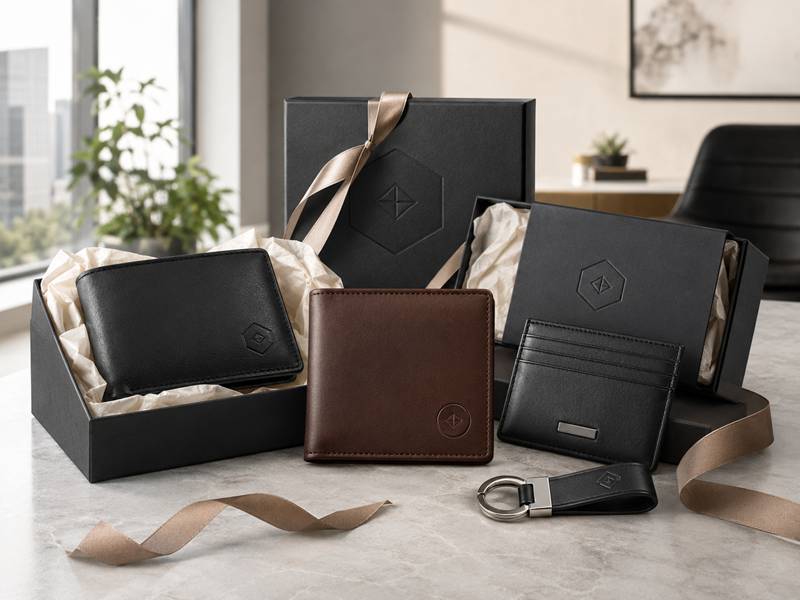
A wallet may be small, but as a corporate gift it carries a surprisingly strong message. People touch it, open it, place cards inside, notice the logo depth, feel the edge finish, and judge the box before the wallet is even used. A pen can disappear into a drawer. A random giveaway may be forgotten after an event. A well-made wallet, card holder, or travel wallet has a better chance of staying in daily use.
A custom logo wallet for corporate gifts should match the gift scene, recipient profile, material level, logo finish, packaging style, and bulk delivery plan. The safest choices are usually slim bifold wallets, card holders, travel wallets, or wallet gift sets with subtle debossing, foil stamping, metal detail, or clean printing, packed in a pouch, rigid box, drawer box, or full gift set package.
The difference between an ordinary wallet and a gift-ready wallet is often found in quiet details: card slots that do not feel too tight, a fold that closes neatly, stitching that follows a clean line, a logo that feels refined instead of loud, and a box that opens without looking cheap. That is why wallet gift projects should be planned as a full presentation, not only as a single item with a mark on it.
What Wallet Type Works Best?

The best wallet type depends on the gift scene, recipient habits, material level, logo finish, packaging style, and total project value. Slim bifold wallets and card holders are the safest choices for broad corporate gift use. Passport wallets, RFID wallets, and wallet sets work better when the gift has a travel, finance, technology, membership, or premium presentation purpose.
A wallet gift should be chosen by daily usefulness first. If the product looks nice in a box but feels too thick, too tight, too shiny, or too limited in storage, it may not stay in use. A good wallet gift should feel natural in the hand, fit common cards smoothly, close neatly after loading, and look polished enough for office, travel, event, and holiday settings.
The wallet type also affects logo quality. A flat card holder is easier for debossing, foil stamping, or a small metal plate. A bifold wallet has more logo positions but must be checked after folding. A passport wallet gives more surface space, but it needs correct document fit and stronger packaging. A zip wallet can feel secure, but zipper quality becomes a major detail. The product shape decides how the logo, package, and gift set will work later.
Gift packaging should be considered at the same time. A slim card holder may fit a small drawer box or pouch. A bifold wallet may need a rigid box with a tray. A passport wallet may need a larger box, tissue wrap, or travel set tray. A wallet-and-keychain set needs enough spacing so the keychain does not scratch the wallet during transport.
| Wallet Type | Common Size Direction | Common Storage | Strong Use Scene | Detail To Review |
|---|---|---|---|---|
| Card holder | About 10 × 7 cm | 3–6 cards | Tech, finance, events, membership gifts | Slot tension and logo scale |
| Slim bifold wallet | About 11 × 9 cm folded | 4–8 cards, cash layer | Staff gifts, holiday gifts, dealer programs | Fold thickness after cards are inserted |
| Long wallet | About 19 × 10 cm | Cards, cash, receipts | Premium lifestyle gifts, VIP sets | Box size and material use |
| Passport wallet | About 10.5 × 14.5 cm or larger | Passport, cards, tickets | Travel, hotel, conference, airline gifts | Passport fit and document pocket shape |
| RFID wallet | Similar to card holder or bifold | Cards with shielding layer | Finance, tech, travel, workplace access | Added layer thickness |
| Zip wallet | Varies by design | Cards, coins, cash | Travel, secure carry, lifestyle sets | Zipper smoothness and corner finish |
| Money clip wallet | Compact slim shape | Cards and folded cash | Minimalist programs | Regional habits and clip strength |
| Wallet set | Depends on components | Wallet plus accessory | VIP, holiday, dealer, membership gifts | Tray fit and component coordination |
A strong wallet gift should pass five practical checks before final style selection:
It should suit the recipient’s daily habits.
It should have enough storage without becoming bulky.
It should offer a stable logo area.
It should fit the chosen packaging without being squeezed.
It should still look neat after cards, cash, or documents are inserted.
The safest choice is not always the most expensive wallet. A well-made card holder in a clean drawer box may feel more modern than a heavy wallet that nobody uses. A slim bifold with subtle debossing may work better than a long wallet if the recipient group is broad. A passport wallet may feel impressive only when the gift story includes travel. The right type should make the gift feel useful, appropriate, and easy to keep.
What Is A Corporate Gift Wallet?
A corporate gift wallet is a wallet, card holder, passport holder, travel wallet, RFID wallet, or small leather-goods item created for staff programs, brand events, dealer meetings, membership gifts, annual gifts, holiday boxes, or VIP appreciation. It should feel like a practical daily item, not only a product carrying a logo.
A strong corporate gift wallet has three layers. The first layer is use: card slots, cash pocket, passport fit, RFID layer, zipper, or accessory pairing. The second layer is presentation: material touch, stitching, edge finish, logo style, pouch, box, card, and tray. The third layer is consistency: every piece should look close to the approved sample in color, logo position, stitching, and packing.
A corporate wallet gift should not feel overbranded. For most professional settings, a small debossed logo, foil mark, metal detail, woven label, or inner logo feels more tasteful than a large printed mark. The product should be something recipients are willing to use in public.
Different gift scenes call for different wallet types:
A bank or insurance brand may prefer an RFID card holder.
A real estate group may choose a boxed bifold wallet.
A tech event may use a slim card holder with clean foil or debossing.
A travel program may use a passport wallet and luggage tag set.
A VIP gift may use a premium bifold wallet with a rigid box and gift card.
The wallet becomes stronger when product, logo, and packaging feel planned together.
Which Wallet Type Fits?
The right wallet type fits the recipient’s carry habits and the event purpose. A card holder works for slim daily carry. A bifold wallet works for broader storage. A passport wallet works for travel. An RFID wallet works when card protection supports the gift story. A set works when a stronger presentation is needed.
A slim bifold wallet is the most familiar option. It usually carries cards, ID, and cash, making it suitable for broad recipient groups. It works well for staff gifts, holiday gifts, dealer gifts, appreciation gifts, and professional events. The main risk is thickness. If the inner layers are too heavy, the wallet may not close neatly after loading.
A card holder feels modern and simple. It suits tech, finance, membership, and event gifting because it is compact, easy to carry, and easy to place in a small gift box. A flat front panel also supports debossing, foil stamping, heat transfer, or a small metal plate. The risk is limited storage, especially for regions where cash or receipts are still common.
A long wallet gives more visual impact and storage, but it is not always the most practical choice. It needs a larger box and more material. It works better for lifestyle gift sets, fashion-related programs, or higher-value presentations.
A passport wallet has a clear travel purpose. It can hold passport, cards, travel documents, and sometimes a pen or SIM card. It works well for conferences, hotels, airlines, dealer trips, overseas events, and executive travel kits. The size must be checked with real passports and travel documents.
| Gift Scene | Better Wallet Type | Practical Reason |
|---|---|---|
| Staff welcome kit | Card holder or slim bifold | Easy to use daily |
| Holiday gift | Boxed bifold or wallet set | Familiar and gift-ready |
| Dealer meeting | Wallet and keychain set | Practical and easy to present |
| Tech event | Card holder or RFID holder | Slim, modern, event-friendly |
| Finance program | RFID wallet or card holder | Card protection story fits well |
| Travel conference | Passport wallet or travel set | Clear travel connection |
| VIP gift | Premium bifold or long wallet | Stronger presentation value |
| Membership reward | Card holder or boxed wallet | Easy to connect with cards and status |
A useful selection method is to decide what the wallet must hold:
Only cards: card holder.
Cards plus cash: slim bifold wallet.
Passport plus cards: passport wallet.
Cards plus coins: zip wallet.
Gift set presentation: wallet with keychain, card holder, pen, or luggage tag.
This keeps the choice practical instead of decorative.
Card Holder Vs Wallet
A card holder is slimmer, lighter, and more modern. A wallet offers more storage and feels more classic. For corporate gifts, card holders are strong for tech, finance, events, and membership programs. Bifold wallets are better for wider recipient groups, holiday gifts, staff programs, and professional appreciation gifts.
A card holder usually has 3–6 card slots and sometimes a middle pocket. It is compact enough for pockets, laptop bags, handbags, and travel pouches. It also keeps packaging smaller, which helps with gift sets and shipping volume. Since the surface is flat, logo placement is easier to control.
The weakness of a card holder is storage. It may not suit people who carry cash, receipts, ID cards, or many cards. If it is too tight, cards become hard to remove. If it is too loose, cards may slip out. Slot tension is one of the most important sample checks.
A bifold wallet usually has 4–8 card slots, a cash compartment, and sometimes hidden slots or an ID window. It feels more complete as a standalone gift. It gives more room for material texture, stitching, edge finish, and inner logo detail. The weakness is thickness. If the wallet becomes bulky after loading cards, the user experience drops.
| Detail | Card Holder | Bifold Wallet |
|---|---|---|
| Carry feel | Slim and light | More substantial |
| Common capacity | 3–6 cards | 4–8 cards plus cash |
| Packaging | Small box, pouch, drawer box | Rigid box, pouch, set box |
| Logo area | Small but stable | More placement options |
| Gift tone | Modern and minimal | Classic and complete |
| Cost direction | Usually more controlled | Usually higher |
| Bulk risk | Slot tension | Fold thickness |
| Good pairing | Keychain, notebook, pen | Keychain, card holder, gift card |
A card holder works best when the gift should feel clean, compact, and modern. A bifold wallet works best when the gift should feel more complete and widely usable.
For mixed recipient groups, a slim bifold wallet is often safer. For younger professional groups, tech programs, finance teams, or event gifts, a card holder can feel sharper and easier to carry.
RFID Wallets: Are They Needed?
RFID wallets are useful when the gift connects to finance, travel, workplace access, card security, membership, or technology. They are not necessary for every wallet project, but they can add value when the recipient group carries cards frequently or when the gift story naturally includes protection.
An RFID wallet usually includes a shielding layer inside the wallet structure. This layer can help block certain contactless card scanning signals, depending on material and construction. It also affects the wallet’s thickness, flexibility, fold feel, and card slot tension. That means RFID should be planned early, not added after the structure is fixed.
RFID works especially well for:
Banking and finance gifts.
Tech company gifts.
Travel wallet sets.
Staff access-card programs.
Membership reward gifts.
Conference gifts with card holders.
Executive travel kits.
RFID does not automatically make a wallet better. If the shielding layer makes the wallet stiff, bulky, or hard to close, the feature may reduce daily comfort. The sample should be tested with cards inserted. The fold should still feel natural. The logo area should stay clean. The slots should hold cards firmly but not too tightly.
| RFID Use Scene | Suitable Type | Review Detail |
|---|---|---|
| Finance program | RFID card holder | Card slot tension |
| Staff access card gift | RFID card holder or bifold | Daily carry comfort |
| Travel gift | RFID passport wallet | Passport and card fit |
| Tech event | RFID slim holder | Thin profile and logo clarity |
| VIP set | RFID boxed wallet | Premium feel and box fit |
RFID is strongest when it supports the product story. A finance gift with RFID protection feels natural. A travel wallet with RFID protection feels useful. A simple holiday wallet may not need it unless the gift position requires an added security detail.
Best Wallet Gift Choice
The best wallet gift choice is a style that people will actually use after receiving it. For many corporate gift programs, the strongest options are slim bifold wallets, card holders, RFID card holders, passport wallets, or wallet-and-keychain sets. The decision should match storage needs, gift level, logo style, package type, and delivery plan.
A good wallet gift should be easy to understand immediately. The recipient should open the box and know where the cards go, how the wallet closes, what the accessory is for, and why the logo is placed there. If the product feels confusing, too bulky, or overly decorated, it may lose daily value.
A practical choice can be made by project priority:
Broad use: slim bifold wallet.
Modern look: card holder.
Security story: RFID card holder.
Travel theme: passport wallet.
Premium feel: boxed bifold wallet or long wallet.
Higher perceived value: wallet and keychain set.
Retail-ready program: wallet with box, hangtag, barcode, and inner label.
Executive gift: subtle logo, better material, rigid box, and gift card.
| Priority | Better Choice | Packaging Direction |
|---|---|---|
| Broad daily use | Slim bifold wallet | Rigid box or pouch |
| Compact carry | Card holder | Small drawer box or pouch |
| Finance or tech angle | RFID card holder | Rigid box with feature card |
| Travel purpose | Passport wallet | Drawer box or travel set box |
| Holiday gift | Bifold + keychain | Rigid set box with greeting card |
| VIP presentation | Premium wallet set | Magnetic or drawer box with tray |
| Retail use | Wallet with full labeling | Box, hangtag, barcode, carton mark |
| Event distribution | Card holder or slim wallet | Light box or pouch |
Before final approval, test the chosen type in real use:
Insert cards into every slot.
Add cash if the design has a cash layer.
Place a passport inside if it is a travel wallet.
Close and open the wallet several times.
Check whether the logo bends or wrinkles.
Place it into the package and shake lightly.
Review whether the box still looks neat after the product is packed.
The best wallet gift should feel simple, useful, and well finished. It does not need to be the most complex style. It needs to match the occasion and stay pleasant to use.
Which Logo Process Fits?

The best logo process for custom wallet gifts depends on the wallet material, surface texture, logo shape, gift level, color needs, and daily wear expectation. Debossing works well for a quiet business look. Foil stamping adds a stronger gift feel. Metal plates look polished on executive sets. Printing works for clear color logos. The logo method should be chosen together with material and packaging, not as a last step.
A wallet is a small product, so logo details are easier to notice. A logo that feels balanced on a backpack may look too large on a card holder. A thin line that looks clear on screen may disappear during debossing. A foil mark that looks premium on a smooth PU surface may crack or lose clarity on heavy-grain material. These small differences decide whether the wallet feels refined or promotional.
The safest way to choose a logo method is to review three things first:
Material surface: smooth, textured, soft, coated, leather-like, fabric, or metal.
Logo design: simple icon, wordmark, fine text, large graphic, initials, or full-color artwork.
Gift tone: quiet, festive, executive, modern, retail-ready, travel-related, or event-focused.
Logo position also matters. A pressed logo near a fold line may distort. A foil logo on a card slot may show uneven pressure. A metal plate near the edge may catch or scratch. A printed logo on a high-touch area may wear faster. A strong logo plan should protect clarity, durability, and taste at the same time.
| Logo Method | Better Material | Visual Feeling | Good Use Scene | Detail To Check |
|---|---|---|---|---|
| Debossing | PU, vegan leather, leather-like material | Subtle, mature, low-key | Staff gifts, executive gifts, finance gifts | Depth, pressure, edge clarity |
| Embossing | Thicker leather-like material | Raised, tactile, visible | Premium sets, special editions | Material thickness, raised edge wear |
| Foil stamping | Smooth PU, selected leather, coated surface | Bright, festive, gift-ready | Holiday gifts, anniversary gifts, VIP boxes | Adhesion, cracking, color match |
| Screen printing | Fabric, PU, simple flat surfaces | Clear, direct, cost-stable | Events, colorful marks, light gifts | Rubbing, color consistency |
| Heat transfer | Smooth synthetic surfaces | Clean and detailed | Modern designs, fine graphics | Flexibility and peeling risk |
| Metal plate | Structured wallets, premium sets | Formal, sharp, polished | Executive gifts, membership sets | Attachment, scratches, weight |
| Woven label | Fabric wallets, casual sets | Soft, retail-like | Lifestyle, travel, casual gift sets | Label edge and sewing position |
| Laser engraving | Metal parts, selected leather surfaces | Precise and clean | Keychains, plates, metal accessories | Burn color, surface reaction |
A logo should feel like part of the wallet. If it looks pasted on, too loud, or poorly matched with the package, the gift loses value even when the wallet structure is good.
What Logo Method Works?
The right logo method should match the material and the gift tone. For most professional wallet gifts, debossing is a safe choice because it creates a pressed mark without extra color. Foil stamping works when a stronger gift effect is needed. Metal plates can lift the look of premium sets. Printing is useful when color accuracy or a simple event logo is important.
Debossing is often used on PU, vegan leather, and leather-like wallets because it feels integrated. It works especially well on black, brown, navy, gray, tan, and dark green surfaces. It gives the wallet a quieter appearance, which is useful when the recipient may carry it every day.
Foil stamping gives stronger visibility. Gold, silver, copper, rose gold, black, or colored foil can make a wallet feel more festive. It works well for holiday gifts, annual gifts, VIP sets, and boxed programs. The surface must be tested because foil behaves differently on smooth, pebbled, soft, or coated materials.
Metal plates, leather patches, and woven labels can create a more structured finish, but they need careful placement. A plate should not be too heavy for a slim card holder. A patch should not lift at the edge. A woven label should not look casual if the wallet is meant for an executive set.
| Gift Style | Better Logo Direction | Why It Works |
|---|---|---|
| Quiet business gift | Debossing | Subtle, durable, suitable for daily carry |
| Holiday gift | Foil stamping | Adds shine and presentation value |
| Executive set | Debossing or metal plate | Formal and restrained |
| Tech or finance gift | Debossing, silver foil, or small plate | Clean and modern |
| Event gift | Screen print or heat transfer | Clear and efficient |
| Travel set | Debossing on wallet, matching mark on luggage tag | Keeps the set consistent |
| Retail-style wallet | Woven label, debossing, hangtag support | Looks complete on shelf or online |
A good logo method should still look right after the wallet is folded, packed, and handled. That is why a real sample is more useful than a flat digital mockup.
Embossing Vs Debossing
Embossing raises the logo above the surface. Debossing presses the logo into the surface. For custom wallet gifts, debossing is usually easier to control and more suitable for a professional look. Embossing can work well when the material is thick enough and the design needs a stronger tactile effect.
Debossing creates a shadow-like mark. It feels quiet and refined because it does not add extra color. It is suitable for leather-like wallets, PU card holders, passport wallets, and boxed executive gifts. The key is pressure control. If the pressure is too light, the logo disappears. If it is too deep, the surface may crack, wrinkle, or deform.
Embossing creates a raised effect. It feels more noticeable in the hand and can look premium when used on stable material. However, raised logos need enough material body. Very thin PU or soft material may not hold the shape well. Fine text, thin lines, and complex marks may also become unclear.
| Detail | Embossing | Debossing |
|---|---|---|
| Surface effect | Raised mark | Pressed mark |
| Visual strength | More visible | More subtle |
| Best material | Thicker leather-like surface | PU, vegan leather, selected leather |
| Best logo type | Simple icon or bold letters | Wordmark, icon, initials |
| Daily-use feel | More tactile | More restrained |
| Main risk | Raised edge wear or soft shape | Too shallow, too deep, or uneven pressure |
| Better gift scene | Special edition, premium set | Professional, finance, executive, daily gifts |
For broad corporate wallet programs, debossing is usually the safer first option. Embossing is worth considering when the material has enough body and the logo design is simple.
A practical sample check should include:
Review logo clarity from hand distance.
Touch the logo edge and check whether it feels clean.
Fold the wallet and see whether the logo area deforms.
Insert cards and check whether pressure changes the logo surface.
Compare several samples to confirm depth consistency.
The best pressed logo should be visible without feeling aggressive.
Is Foil Stamping Better?
Foil stamping is better when the gift needs a more festive, premium, or visible logo effect. It adds metallic or colored shine to the wallet surface and can make a simple wallet feel more gift-ready. Gold, silver, rose gold, copper, black, and colored foil are common choices for wallet gifts, boxes, pouches, and cards.
Foil stamping is not always the better choice for daily-use wallets. It depends on the material surface and the logo position. Smooth PU and selected leather-like surfaces often hold foil clearly. Heavy texture, oily surfaces, soft grain, or curved areas may reduce clarity. If the foil cracks, flakes, or rubs away too quickly, the gift feels lower quality.
Foil stamping should be used carefully on folding areas. A wallet bends every time it opens and closes. If the foil sits near the fold, stress may damage the finish over time. A lower front corner, flat center area, or box lid often works better than a fold line or layered card slot.
| Foil Color | Visual Feeling | Better Use |
|---|---|---|
| Gold | Classic, festive, warm | Holiday gifts, anniversary gifts, executive sets |
| Silver | Clean, modern, cool | Tech, finance, travel sets |
| Rose gold | Soft, stylish, warm | Lifestyle gifts, premium staff sets |
| Copper | Mature, understated | Brown, tan, or dark green wallets |
| Black foil | Quiet and sharp | Light-colored wallets, minimalist gifts |
| White foil | Clean contrast | Dark smooth surfaces |
| Brand-color foil | More expressive | Event campaigns or membership programs |
Foil on the wallet should coordinate with the package. If the wallet has gold foil but the box has silver foil, the set may feel mismatched. If the wallet uses subtle debossing but the box uses a bright foil logo, the opening moment can still feel premium while the wallet stays easy to use every day.
Foil sample checks should include:
Rub the foil surface lightly with dry fingers.
Bend the wallet near the logo area if it sits close to a fold.
Check whether fine letters stay clean.
Review color under indoor and natural light.
Compare foil on wallet and box together.
Foil works best when it supports the gift feeling without making the wallet look too decorative for daily use.
Where Should Logos Sit?
A wallet logo should sit on a flat, stable area where it remains clear after folding, card loading, opening, closing, and daily handling. The safest positions are often the lower front corner, center front on a flat panel, inner panel, gift box lid, pouch front, or accessory surface. For professional gifts, subtle corner logos and inner logos usually feel more refined than oversized front marks.
Logo placement should be decided with the wallet structure in mind. A bifold wallet has fold lines, card slots, cash layers, and edge stitching. A card holder has layered pockets and a smaller logo area. A passport wallet has more surface space, but document pockets can create uneven backing. A zip wallet has zipper curves that can limit flat branding space.
Avoid placing logos:
Across a fold line.
Too close to the stitch edge.
On top of a layered card slot without enough support.
Where cards create uneven pressure from behind.
On a soft bulging pocket.
On a curved corner.
Where a keychain or box insert may rub during transport.
| Logo Position | Better Use | Strength | Detail To Check |
|---|---|---|---|
| Lower front corner | Business gifts, finance gifts | Subtle and elegant | Logo must remain readable |
| Center front | Events, stronger visibility | Clear first impression | Avoid oversized look |
| Inner panel | Executive or understated gifts | Private and refined | Less visible at first opening |
| Card pocket face | Card holders, modern designs | Clean when flat | Pressure may be uneven |
| Cash compartment area | Hidden branding | Subtle inside detail | Less visible |
| Gift box lid | Strong opening moment | Larger logo allowed | Box logo should match wallet finish |
| Pouch front | Soft presentation | Good for simple gifts | Fabric affects clarity |
| Keychain or tag | Gift set coordination | Adds secondary branding | Small detail limits logo complexity |
A logo should be tested on a loaded wallet. Insert cards into every slot, close the wallet, and check whether the logo bends, wrinkles, or shifts visually. A mark that looks perfect on an empty sample may look uneven after cards are added.
For most corporate wallet gifts, tasteful visibility works better than maximum visibility. A recipient is more likely to keep using a wallet when the logo feels balanced and natural.
Logo Size Checklist
Logo size should match the wallet scale, material surface, logo method, and gift tone. On small products, a few millimeters can change the whole look. A card holder may need a smaller logo than a bifold wallet. A gift box can carry a larger logo because it has more surface space and is part of the opening experience.
For many wallet gifts, a front logo width of about 20–50 mm works well. Card holders often look better with smaller marks. Bifold wallets can carry a slightly wider logo if placed on a flat front area. Passport wallets can support medium logos because the surface is larger. Gift boxes can use larger marks, especially when foil stamping or debossing is part of the presentation.
Logo size must also follow the chosen method. Debossing needs enough line thickness to show clearly. Foil stamping needs clean shapes and stable surface contact. Metal plates need enough size for attachment but not so much that they make the wallet heavy. Printing can handle more color and detail, but rubbing should be checked.
| Product | Practical Logo Direction | Size Guidance |
|---|---|---|
| Card holder | Small corner or center mark | Keep refined and readable |
| Slim bifold wallet | Corner, center, or inner mark | Check fold and card loading |
| Long wallet | Medium mark possible | Keep proportion balanced |
| Passport wallet | Medium front mark | Avoid document bend zones |
| Zip wallet | Small front or puller detail | Avoid zipper curve areas |
| Keychain | Initials, icon, or small mark | Fine text may be limited |
| Gift box | Larger logo possible | Match wallet logo style |
| Pouch | Medium print or label | Fabric texture affects clarity |
A practical size review should include:
Can the logo be read at hand distance?
Does it still look refined from one step away?
Does it avoid fold lines and stitch edges?
Can the chosen method show small text clearly?
Does the mark stay flat after cards are inserted?
Does the logo match the pouch, box, card, and accessory?
Does it feel suitable for daily carry after the gift moment?
A good logo should support the wallet’s quality, not overpower it. If the logo is the only thing people notice, the size may be too aggressive. If it disappears completely, the method or placement may need adjustment. The best result sits between visibility and restraint.
How Should Packaging Work?
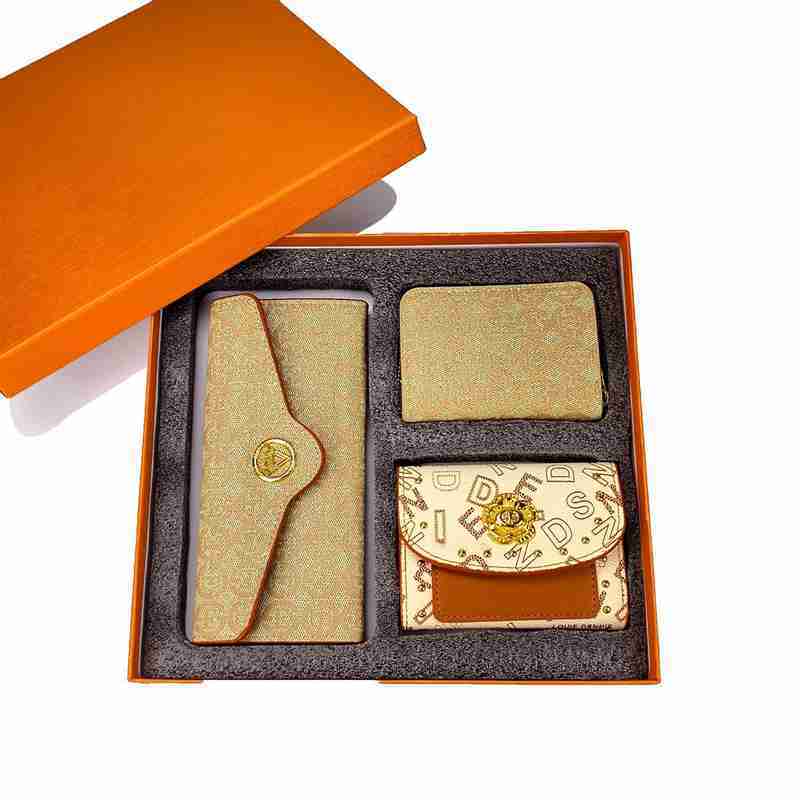
Wallet packaging should protect the wallet surface, improve the opening moment, support the logo style, and keep each piece stable during packing and delivery. For corporate gifts, the package is part of the gift itself. A clean pouch, rigid box, drawer box, magnetic box, insert tray, tissue wrap, card, sleeve, and carton plan can all change how the wallet feels when received.
Wallets are small, so packaging has a strong effect on perceived value. A simple card holder in a clean drawer box can feel more complete than a better wallet placed loosely in thin wrapping. A bifold wallet inside a soft pouch and rigid box can feel warm, polished, and protected. A travel wallet with a tray, luggage tag, and message card can feel like a planned gift set rather than separate items placed together.
Good packaging should solve four practical needs:
It protects the wallet from scratches, pressure marks, dust, crushed corners, and rubbing.
It presents the wallet neatly when the box is opened.
It keeps logo, card, pouch, and box design visually connected.
It supports efficient packing, counting, labeling, carton loading, and delivery.
Packaging should be planned before the wallet sample is approved. Wallet thickness, card slot structure, logo position, pouch material, tissue wrap, box depth, tray cutout, sleeve size, and carton protection all affect the final result. If the box is too tight, the wallet may be squeezed. If the tray is too loose, the wallet may shift and rub against other parts. If the pouch sheds lint, it may stick to dark wallet surfaces. If the box paper is weak, corners may crush before the gift is opened.
| Packaging Part | Main Purpose | Better Use | Detail To Check |
|---|---|---|---|
| Polybag | Basic dust protection | Inner protection, simple distribution | Wrinkle, seal, product visibility |
| Paper sleeve | Light presentation | Card holders, slim wallets | Paper thickness, logo print, fit |
| Fabric pouch | Soft reusable layer | Leather-like wallets, travel gifts | Lint, drawstring, logo clarity |
| Rigid box | Stronger gift feeling | Bifold wallets, card holders | Corner strength, lid fit |
| Drawer box | Smooth opening moment | Wallet sets, card holder sets | Slide smoothness, tray hold |
| Magnetic box | Premium opening | VIP, holiday, executive gifts | Magnet strength, box weight |
| Insert tray | Keeps products in place | Sets with wallet and accessories | Cutout accuracy, item stability |
| Tissue wrap | Adds softness and protection | Premium wallet boxes | Color transfer, wrinkle control |
| Gift card | Adds message and care details | Staff, partner, holiday gifts | Print quality, placement |
| Outer carton | Protects bulk shipment | All projects | Carton strength, mark accuracy |
A strong package should be tested with the actual wallet, not an empty box. Place the wallet inside, close the box, shake it gently, open it again, and check whether the product moved. Stack several boxes and review corner pressure. Add tissue, pouch, card, and sleeve exactly as planned. The full package should still close smoothly and present the wallet neatly.
Packaging should also match the gift level. A small card holder may not need a large magnetic box. A VIP travel wallet may feel underwhelming in only a thin pouch. The right package protects the product, supports the gift message, and avoids unnecessary bulk.
What Makes Packaging Premium?
Premium wallet packaging feels stable, clean, well-proportioned, and coordinated with the wallet inside. It does not need too many layers. It needs the right structure, smooth opening, neat product position, clean logo finish, strong corners, and materials that match the wallet’s value.
Several details create a more premium feeling:
The box opens smoothly without wobbling.
The lid does not feel loose or too tight.
The wallet sits straight inside the tray.
The pouch does not shed lint or stain the wallet.
The tissue wrap looks neat, not crushed.
The printed or foil logo is centered and sharp.
The gift card feels intentional, not randomly inserted.
The box corners remain clean after handling.
The inside material does not scratch the wallet surface.
The color of wallet, box, pouch, and card feels coordinated.
Premium packaging also depends on proportion. A card holder placed in an oversized box can look empty. A bifold wallet squeezed into a shallow box can look cheap. A passport wallet needs enough depth so the product does not curve. A gift set box needs accurate spacing between components, especially when a keychain or metal item is included.
| Premium Detail | Strong Result | Weak Result |
|---|---|---|
| Box structure | Stable and firm in the hand | Soft, thin, easily crushed |
| Product position | Wallet sits centered | Wallet slides inside |
| Opening feel | Smooth and controlled | Lid sticks or falls loose |
| Logo finish | Sharp and aligned | Off-center, uneven, blurry |
| Inside support | Tray holds product neatly | Insert bends or collapses |
| Surface touch | Clean paper, fabric, or coating | Scratches, dust, stains |
| Card placement | Supports the gift message | Looks like a loose flyer |
| Color match | Wallet and package feel connected | Box, pouch, and wallet conflict |
Premium does not always mean expensive. A well-sized kraft box with clean debossing can look better than a large glossy box with weak corners. A soft pouch with a small woven label can feel more useful than a flashy box that gets discarded immediately. The package should fit the wallet, the recipient level, and the use scene.
Which Gift Box Type Fits?
The right gift box depends on wallet type, product thickness, gift level, set components, logo style, and delivery method. Card holders and slim wallets often fit small rigid boxes or drawer boxes. Bifold wallets usually need medium rigid boxes with trays. Passport wallets and travel sets need deeper boxes. VIP and holiday sets often use magnetic boxes or drawer boxes.
A lid-and-base rigid box is the most versatile option. It works for card holders, bifold wallets, long wallets, and many wallet sets. It gives structure, protects better than a pouch, and allows logo printing, foil stamping, debossing, or paper sleeve decoration. The lid fit should be tested carefully. Too loose feels weak; too tight makes opening awkward.
A drawer box creates a more refined opening movement. It is useful for wallet and keychain sets, card holder sets, travel sets, and membership gifts. The drawer should slide smoothly. The tray should keep the items in position even after transport.
A magnetic box creates a stronger gift moment. It works well for VIP gifts, holiday boxes, executive sets, and premium travel wallets. It is heavier and increases carton volume, so it should be used when the gift level justifies it.
| Box Type | Best Use | Strength | Detail To Check |
|---|---|---|---|
| Lid-and-base box | Broad wallet gifts | Stable, familiar, easy to brand | Lid tightness, corner strength |
| Drawer box | Wallet sets, card holder sets | Elegant opening | Sliding feel, tray accuracy |
| Magnetic box | VIP, holiday, executive gifts | Strong presentation | Magnet strength, box weight |
| Folding carton | Cost-controlled projects | Light and efficient | Lower protection level |
| Kraft box | Natural or eco-style gifts | Warm and simple | Surface durability |
| Window box | Retail display | Shows product directly | Scratch and dust risk |
| Set box with tray | Wallet plus accessories | Organized presentation | Tray shape and spacing |
| Sleeve box | Slim products or card holders | Clean and compact | Sleeve fit and friction |
Box size should be decided after the wallet sample is measured. A wallet with a pouch, tissue wrap, card, or RFID feature may need more space than expected. A gift set with a keychain also needs separation so metal parts do not scratch the wallet.
Practical box sizing checks:
Wallet fits without being squeezed.
Tray holds the wallet without bending it.
Tissue and card fit without making the lid tight.
Pouch can be inserted smoothly if included.
The box can be stacked without corner collapse.
Outer carton can hold the planned quantity safely.
The gift looks neat when opened from the recipient’s side.
A good box should make the gift feel ready, protected, and easy to handle.
Pouch Vs Rigid Box
A pouch is lighter, softer, and more practical for simple wallet gifts. A rigid box gives stronger presentation and better shape protection. For small events or simple staff gifts, a pouch may be enough. For holiday, VIP, dealer, membership, executive, or retail-style projects, a rigid box usually feels more complete.
A pouch works well when the wallet itself already has good material and the gift needs a warm, reusable feel. Pouches can be made from microfiber, cotton, velvet-like fabric, suede-like fabric, felt, RPET fabric, canvas, or non-woven fabric. They are also useful inside a box to protect the wallet surface.
The main risk with pouches is surface quality. Some fabrics shed lint. Some drawstrings look weak. Some prints blur on soft texture. Some dyed fabrics may transfer color onto light wallets. A pouch should be tested with the real wallet surface, especially for black, white, tan, and light-gray wallets.
A rigid box offers stronger protection and presentation. It is easier to stack, brand, and use with trays, sleeves, cards, and gift set inserts. It also protects edges and corners better during transport. The tradeoff is higher cost, more space, and heavier cartons.
| Comparison | Pouch | Rigid Box |
|---|---|---|
| Gift feeling | Soft, simple, reusable | Formal and stronger |
| Protection | Protects surface | Protects shape and corners |
| Cost level | Usually lower | Usually higher |
| Shipping volume | Smaller | Larger |
| Logo effect | Softer, less sharp on some fabrics | Cleaner print or foil effect |
| Best use | Simple gifts, inner protection | VIP gifts, holiday sets, retail display |
| Main risk | Lint, weak string, blurred logo | Crushed corner, poor tray fit |
A strong option is pouch plus box. The pouch protects the wallet surface, while the box creates the opening moment. This works well for bifold wallets, passport wallets, travel wallets, and premium gift sets.
For card holders, a small pouch or drawer box may be enough. For long wallets, a rigid box is usually safer because the longer body can bend or rub during shipment. For travel sets, a box with insert tray is usually better because different components need fixed positions.
How To Add Gift Cards?
Gift cards add meaning and structure to wallet packaging. They can carry a thank-you note, holiday greeting, product care tips, RFID explanation, event message, membership note, or a short brand message. A good card makes the gift feel more thoughtful and helps explain why the wallet was chosen.
The card should be designed as part of the opening sequence. If the message should be read first, place the card on top of the tissue or wallet. If the wallet should be seen first, place the card under the wallet or beside it in the tray. If the card includes care instructions, it can sit inside the wallet or under the insert tray.
Common gift card uses:
Staff welcome message.
Partner appreciation note.
Holiday greeting.
VIP membership message.
Wallet care instruction.
RFID feature explanation.
Travel set component introduction.
QR code for registration or event content.
Sustainability note for recycled or vegan materials.
The material should match the gift level. Thin paper may feel weak inside a premium box. Thick card stock, textured paper, matte finish, foil detail, or debossed print can improve the feel. However, the card should not be too thick if it sits directly on the wallet, because pressure may leave marks on soft materials.
| Card Type | Best Use | Placement Option | Detail To Check |
|---|---|---|---|
| Thank-you card | Staff and partner gifts | On top or inside wallet | Tone and print clarity |
| Care card | Leather-like wallets | Under wallet or inside box | Simple useful instructions |
| Holiday card | Seasonal gift boxes | On tissue or beside wallet | Color and wording |
| Event card | Conferences and launches | Top of tray | Date, logo, and theme |
| RFID card | RFID wallets | Under wallet or inside sleeve | Clear feature explanation |
| QR card | Digital registration or campaign | Visible top position | Scan test |
| Sustainability card | RPET, vegan leather, eco packaging | Beside wallet | Claim accuracy |
| Set card | Multi-item gift boxes | Inside lid or tray | Component names and layout |
Proofreading is essential. A spelling error, wrong event name, poor color match, or misplaced QR code can weaken the whole package. The sample package should include the real card, not a blank placeholder, whenever possible.
Gift cards can also help with cultural details. For wallet gifts, some programs include a small symbolic card or note inside the cash compartment so the wallet does not feel empty. This can make the gift feel warmer without adding much cost.
Packaging Cost Guide
Packaging cost depends on structure, material thickness, print method, logo finish, insert tray, pouch material, gift card, sleeve, assembly time, carton strength, and order quantity. A simple pouch costs less than a rigid box. A magnetic box with tray, foil logo, tissue wrap, card, and sleeve costs more but creates a stronger opening experience.
Packaging should be planned by level, not only by unit price. A low-cost event gift may need simple protection and clean presentation. A holiday gift needs better opening value. A VIP or dealer gift may need a box that feels stable and polished. Retail-style programs need labels, barcodes, hangtags, and carton marks.
| Packaging Level | Common Setup | Best Use | Watch Carefully |
|---|---|---|---|
| Basic | Polybag or simple pouch | Simple event gifts | Low presentation value |
| Standard | Pouch plus sleeve or small box | Staff gifts, card holders | Pouch quality and logo clarity |
| Premium | Rigid box, tray, card | Holiday, dealer, appreciation gifts | Box corners and insert fit |
| VIP | Magnetic or drawer box, pouch, tray, card, sleeve | Executive and membership gifts | Cost, weight, carton volume |
| Retail-ready | Box, hangtag, barcode, inner label, carton mark | Store or online programs | Label accuracy and shelf presentation |
Main cost drivers include:
Box paper thickness.
Rigid box structure and assembly time.
Drawer or magnetic mechanism.
Single-color, multi-color, foil, debossed, or embossed logo.
Insert tray material and cutting shape.
Pouch material and string quality.
Gift card paper and print finish.
Tissue wrap and belly band.
Retail labels, barcode, hangtag, or inner label.
Carton protection and packing count.
A weak package may lower total gift value even if the wallet itself is good. Crushed corners, loose trays, color mismatch, and poor logo print are easy to notice when the box is opened. On the other side, an oversized luxury box may increase shipping cost and feel wasteful if the wallet is simple.
A practical cost decision should follow the gift purpose:
For event distribution, keep packaging light and easy to hand out.
For staff gifts, use a pouch or small rigid box with a clean card.
For holiday or appreciation gifts, use a rigid box with tray and greeting card.
For VIP sets, use drawer or magnetic box with fitted insert.
For retail programs, include box, hangtag, barcode, and accurate carton marks.
The right packaging does not need to be the most expensive. It needs to protect the wallet, present it well, and arrive in good condition.
What Gift Set Ideas Work?

Wallet gift sets work best when every item has a clear role and feels naturally connected to the wallet. Strong combinations include wallet with keychain, wallet with card holder, passport wallet with luggage tag, card holder with notebook, RFID wallet with access-card sleeve, or premium wallet with pen and gift card. The set should feel useful, coordinated, and easy to present in one clean package.
A good wallet set is not created by placing many unrelated items in one box. The pieces should share material, color, finish, logo style, hardware tone, or use scene. If the wallet uses black PU with debossed branding, the keychain should not suddenly use glossy bright metal and a loud printed mark unless that contrast is intentional. If the box uses gold foil, the wallet or insert card should carry a related warm detail so the whole set feels connected.
The best sets usually include two or three useful items. More pieces can raise perceived value, but they also increase tray size, packing time, inspection work, carton volume, and the chance of movement during delivery. A wallet, keychain, and card can feel more polished than a five-piece set where the items do not match.
A strong gift set should be planned around the giving scene:
Staff welcome: card holder, notebook, keychain, welcome card.
Client appreciation: bifold wallet, keychain, thank-you card.
Dealer meeting: wallet, keychain, car document holder, card.
Travel event: passport wallet, luggage tag, card holder.
Finance program: RFID wallet, card holder, feature card.
Holiday gift: wallet, keychain, greeting card, rigid box.
VIP membership: premium wallet, card holder, metal pen, magnetic box.
| Gift Set Type | Main Components | Best Use Scene | Detail To Check |
|---|---|---|---|
| Wallet + keychain | Bifold or card holder with keychain | Staff, dealer, holiday gifts | Metal parts should not scratch wallet |
| Wallet + card holder | Bifold wallet with slim card holder | Finance, membership, executive gifts | Avoid duplicated function |
| Passport set | Passport wallet with luggage tag | Travel, hotel, conference programs | Passport fit and tray spacing |
| Card holder set | Card holder with notebook or pen | Tech, finance, events | Size balance inside box |
| RFID set | RFID wallet with feature card | Finance, access-card, travel gifts | Thickness and explanation card |
| Executive set | Wallet with pen and card holder | VIP and formal programs | Material and hardware tone |
| Holiday set | Wallet, keychain, greeting card | Seasonal gifts | Color warmth and box finish |
| Retail-ready set | Wallet, box, hangtag, barcode | Store or online use | Label accuracy and shelf appearance |
Gift set planning should also include packing stability. When a box is opened, each item should sit straight. If a keychain slides over the wallet, it may leave pressure marks or scratches. If a pen rolls loose, the set looks messy. A fitted tray, paper insert, EVA insert, molded pulp tray, elastic loop, cloth pouch, or divider can keep the presentation clean.
Wallet And Keychain Set
A wallet and keychain set is one of the most practical corporate gift combinations because both items are useful, compact, and easy to coordinate. The keychain adds gift value without making the box too large, and it provides a second place for a logo or small design detail. This allows the wallet logo to stay subtle instead of becoming oversized.
This set works well for staff gifts, dealer gifts, automotive programs, real estate handovers, holiday boxes, membership packs, and appreciation gifts. A slim bifold wallet with a matching leather-like keychain feels classic. A card holder with a metal-and-PU keychain feels modern. A passport wallet with a luggage tag may work better for travel programs than a standard keychain.
The keychain should match the wallet in at least three areas:
Material: PU with PU, leather-like with leather-like, metal with matching hardware tone.
Color: same main color or a controlled accent color.
Logo style: debossing with debossing, foil with foil, metal plate with metal detail.
Hardware finish matters. Silver hardware looks clean and modern. Gunmetal feels more understated. Gold feels warmer and more festive. Black metal can look sharp on tech or minimalist sets. Mismatched metal tones can make the set feel less refined.
| Wallet Style | Better Keychain Match | Gift Feeling | Tray Detail |
|---|---|---|---|
| Slim bifold | Leather-like keychain | Classic and practical | Keep keyring away from wallet surface |
| Card holder | Metal + PU keychain | Modern and compact | Use separate cutout |
| Passport wallet | Luggage tag or travel keychain | Travel-ready | Larger tray spacing |
| RFID wallet | Slim access-style keychain | Security-focused | Add small feature card |
| Premium wallet | Metal detail or leather patch keychain | Executive feel | Protect metal from rubbing |
The keychain should not move freely inside the box. If it has metal edges, it should sit in its own tray space or small pouch. A loose keychain can damage the wallet surface before the gift is even opened.
Wallet And Card Holder Set
A wallet and card holder set can feel more premium than a single wallet, but it should be planned carefully because the two items can overlap. The best version gives the recipient two different carry options: the wallet for full storage and the card holder for light daily carry.
This set works well for finance programs, membership gifts, executive gifts, premium staff programs, and retail-style gift boxes. It is especially useful when the brand wants a complete leather-goods presentation without adding unrelated items. A bifold wallet plus a card holder feels practical because the items serve different routines.
The two pieces should look connected but not repetitive. They can share the same material and color, while using slightly different logo placement. For example:
Bifold wallet: lower-corner debossed logo.
Card holder: centered small foil mark.
Gift box: larger foil logo on lid.
Insert card: matching tone and simple message.
The box should make the relationship clear. If the wallet and card holder sit too close together, they may rub. If the tray spaces are uneven, the set may look poorly arranged. If the card holder is almost the same size as the wallet, the set may feel redundant.
| Set Direction | Better Use | Strength | Detail To Watch |
|---|---|---|---|
| Bifold + card holder | Finance, executive, membership gifts | Full carry plus slim carry | Function overlap |
| Long wallet + card holder | Premium lifestyle gifts | Strong visual value | Larger box size |
| RFID wallet + card holder | Security-related gifts | Card protection story | Added thickness |
| Wallet + business card case | Professional events | Office relevance | Clear use difference |
| Wallet + ID holder | Staff programs | Daily practical use | Attachment and card access |
A wallet and card holder set should feel like added convenience, not duplication. If both pieces do the same job, the set may look fuller but feel less meaningful. The best pairing gives the recipient a reason to use each item in different situations.
Travel Wallet Gift Set
A travel wallet gift set works best for conferences, dealer trips, hotel programs, airline-related gifts, incentive travel, executive retreats, and international teams. Common pieces include passport wallet, luggage tag, card holder, document sleeve, pen, keychain, and message card. The value comes from a clear travel scene.
Travel sets are strong because they are easy to understand. A passport wallet holds documents. A luggage tag identifies bags. A card holder keeps payment cards, hotel cards, or travel cards accessible. A pen can help with forms. A gift card can carry the itinerary message, event name, or welcome note.
A passport wallet must be measured with real documents. It should hold a passport without bending the cover. Card slots should feel secure but not tight. A boarding pass or document pocket should allow smooth insertion. If a pen loop is included, it should not press into the passport or make the wallet too thick.
| Travel Set Item | Role In The Set | Detail To Check |
|---|---|---|
| Passport wallet | Holds passport and cards | Passport fit, fold shape, slot tension |
| Luggage tag | Identifies luggage | Strap strength, window clarity |
| Card holder | Holds cards for quick access | Slim profile and logo match |
| Pen | Supports travel forms | Tray position and cap security |
| Document sleeve | Holds ticket, note, or receipt | Size and bend control |
| Keychain | Adds daily use | Metal should not scratch other items |
| Message card | Adds event or travel context | Print clarity and placement |
Travel sets need careful tray planning because the items have different sizes and thicknesses. A passport wallet is flat and wide, a pen is narrow and round, a luggage tag has a strap, and a card holder is compact. If the insert is not shaped well, the set can look messy after transport.
A drawer box or magnetic box often works well for travel sets because it can hold multiple pieces neatly. For lighter programs, a passport wallet with a fabric pouch and a luggage tag can still feel complete if the materials and logo details match.
What Is The Wallet Gift Superstition?
In some cultures, gifting an empty wallet is considered unlucky because it may symbolize empty finances. A common way to avoid this is to place a small amount of money, a coin, a lucky note, a symbolic card, or a message inside the wallet before giving it. For corporate gifts, this can be handled in a tasteful and professional way.
This belief is not universal, but it matters in international gifting. Wallets are often used for finance, dealer, holiday, real estate, membership, and VIP programs, where the idea of prosperity or good fortune may feel natural. A small insert can make the gift warmer without making it overly traditional.
Practical ways to handle this detail include:
Place a thank-you card inside the cash compartment.
Add a small “success and prosperity” message card.
Include a symbolic coin only where culturally suitable.
Use a membership card or welcome card inside the wallet.
Add a product care card so the wallet does not feel empty.
For a finance or dealer gift, the wording should stay polished. Instead of using casual lucky phrases, the card can mention partnership, success, growth, appreciation, or a strong year ahead. This keeps the gesture professional.
| Approach | Best Use | Note |
|---|---|---|
| Thank-you card inside wallet | Broad corporate gifts | Safe and simple |
| Symbolic coin | Selected cultural programs | Check regional suitability |
| Prosperity message card | Finance, dealer, holiday gifts | Keep tone professional |
| Membership card insert | VIP or loyalty gifts | Adds function |
| Care card | Premium wallet gifts | Useful and neutral |
| Event card | Conferences and meetings | Adds context |
This small detail can improve the opening moment. When the recipient opens the wallet and finds a card or message inside, the gift feels less empty and more considered.
Best Set Ideas By Scene
The best wallet set should match the occasion. Staff welcome gifts should be useful and easy to carry. VIP gifts should feel refined. Travel sets should include travel-related pieces. Holiday gifts should feel warm and complete. Finance and tech gifts can focus on slim carry, RFID protection, and clean design.
| Scene | Recommended Set | Packaging Direction | Main Strength |
|---|---|---|---|
| Staff welcome | Card holder + notebook + welcome card | Drawer box or rigid box | Useful for daily work |
| Client appreciation | Bifold wallet + keychain | Rigid box with insert | Familiar and practical |
| VIP membership | Premium wallet + card holder | Magnetic box with tray | Strong presentation |
| Tech event | RFID card holder + cable pouch | Compact drawer box | Modern and light |
| Finance program | RFID wallet + card holder | Clean rigid box | Card-focused value |
| Travel conference | Passport wallet + luggage tag | Drawer or magnetic box | Clear travel use |
| Dealer meeting | Wallet + keychain + thank-you card | Rigid set box | Easy to present |
| Holiday gift | Wallet + keychain + greeting card | Warm color box and sleeve | Seasonal feeling |
| Retail program | Wallet + box + hangtag + barcode | Retail-ready package | Easy display and tracking |
| Executive gift | Wallet + pen + card holder | Premium box with fitted tray | Formal and polished |
A strong set should pass several practical checks:
Each item has a real use.
Materials and colors feel coordinated.
The logo style stays consistent.
The tray holds every item firmly.
Metal parts do not touch soft wallet surfaces.
The box size feels appropriate, not empty or crowded.
The card or message supports the gift scene.
Packing can be repeated neatly across the full order.
Cartons protect box corners during transport.
A wallet gift set should feel complete, not crowded. Two or three well-matched pieces often create a stronger impression than many unrelated accessories. The goal is simple: the recipient opens the box, understands the purpose of each item, and feels the set was designed as one thoughtful gift.
How to Customize With a Wallet Manufacturer?
A custom wallet project should start with the gift scene, not only the wallet style. The most useful plan confirms who will receive the gift, how the wallet will be used, which material level is expected, how the logo should appear, how the package should open, and when the finished goods need to arrive. A good custom process turns a small accessory into a polished gift with controlled size, stitching, logo, box fit, packing, and bulk consistency.
Custom logo wallets look simple, but many small details affect the final result. A card holder may only have a few slots, yet each slot needs the right tension. A bifold wallet may look clean when empty, but become too thick after cards are inserted. A foil logo may look premium on a smooth surface, but lose clarity on heavy texture. A gift box may look beautiful when new, but crush at the corners if the paperboard is too weak. These are the details that decide whether the wallet feels like a useful gift or a rushed branded item.
A practical custom plan should connect six areas from the beginning:
Wallet structure: card holder, bifold wallet, passport wallet, zip wallet, RFID wallet, or gift set.
Material: PU, vegan leather, genuine leather, recycled leather, nylon, canvas, RPET, or mixed trims.
Logo finish: debossing, embossing, foil stamping, printing, heat transfer, metal plate, woven label, patch, or engraving.
Gift package: pouch, paper sleeve, rigid box, drawer box, magnetic box, tray, gift card, tissue wrap, or retail label.
Quality checks: card fit, fold thickness, logo clarity, stitching, edge finish, box strength, and set layout.
Schedule: sample, revision, approval, bulk production, packing, inspection, and delivery.
| Custom Area | What To Confirm Early | Why It Matters |
|---|---|---|
| Wallet type | Card holder, bifold, passport, travel, RFID, zip wallet | Controls size, structure, use scene, and box style |
| Card layout | Slot count, cash layer, ID window, hidden pocket | Affects thickness and daily usability |
| Material | PU, leather, vegan leather, RPET, fabric, mixed trims | Affects touch, look, logo method, and cost |
| Logo method | Debossing, foil, print, metal plate, woven label | Affects gift tone and bulk consistency |
| Logo position | Front corner, center, inner panel, box lid, pouch | Affects visibility, durability, and taste |
| Packaging | Pouch, rigid box, drawer box, tray, card | Affects opening experience and delivery protection |
| Set items | Keychain, card holder, luggage tag, notebook, pen | Affects tray layout, box size, and total cost |
| Quantity | Per style, color, and package type | Affects material preparation and unit cost |
| Schedule | Sample, revision, production, delivery | Protects event, holiday, launch, or staff program timing |
The best custom wallet is not always the most complicated one. A clean card holder with good slot tension, subtle debossing, and a sharp drawer box can feel more premium than a large wallet with too many pockets and weak finishing. A two-piece set with matching color and logo style can feel more refined than a five-piece set with unrelated items. The strongest result comes from clear choices, not feature overload.
How To Make A Customized Wallet?
A customized wallet begins with a clear product brief: wallet type, material, size, card layout, logo finish, package style, quantity, and deadline. After that, a physical sample should be made and checked with real cards, cash, passport, or gift set items before bulk work begins.
The first decision is the wallet structure. A card holder may need 3–6 card slots and a middle pocket. A slim bifold wallet may need 4–8 card slots, one cash layer, and hidden pockets. A passport wallet must fit an actual passport without bending the cover. A travel wallet may need card slots, document space, zipper pocket, and pen loop. A zip wallet needs smooth zipper movement around corners.
The second decision is material. PU and vegan leather are stable for color and logo finish. Genuine leather gives a natural hand feel, though natural variation should be expected. Recycled leather can support a refined look with a sustainability angle. Nylon, canvas, and mixed materials work better for casual, travel, or outdoor-inspired gift sets.
The third decision is logo finish. Debossing is subtle and professional. Foil stamping adds shine and stronger gift value. Printing works when color accuracy is important. Metal plates can feel formal, but they should not be too heavy on slim wallets. Woven labels fit fabric or casual styles.
The fourth decision is packaging. A pouch is light and reusable. A rigid box makes the gift feel more complete. A drawer box gives a smooth opening moment. A magnetic box works well for VIP or holiday sets. A fitted tray is important when wallet, keychain, card holder, pen, or luggage tag are packed together.
| Step | Main Decision | Practical Check |
|---|---|---|
| 1. Gift scene | Staff gift, event gift, holiday gift, VIP gift, travel set | Does the wallet type fit the occasion? |
| 2. Wallet structure | Slots, cash layer, ID window, zipper, RFID layer | Does it hold real items well? |
| 3. Material | PU, leather, vegan leather, RPET, fabric | Does it match the gift level? |
| 4. Logo finish | Debossing, foil, print, metal plate, label | Does it look clean on the chosen surface? |
| 5. Package | Pouch, box, drawer box, tray, gift card | Does it protect and present well? |
| 6. Sample | Physical sample review | Does it work after loading cards? |
| 7. Revision | Adjust size, logo, material, package | Are problems solved before bulk? |
| 8. Approval | Final sample confirmed | Can all details be repeated consistently? |
A practical custom wallet should be tested in the hand. Insert real cards into every slot. Fold the wallet. Open it several times. Place it inside the box. Add the gift card and pouch if included. Shake the package lightly. Review logo clarity under indoor light and natural light. These simple checks prevent many problems before larger quantities are produced.
Who Makes The Highest Quality Wallet?
The highest quality wallets come from teams that control material selection, cutting accuracy, stitching, edge finishing, card slot tension, logo process, package fit, and final inspection. A famous name may create trust, but real quality is visible in the details that repeat across every piece.
High quality is not only about expensive material. A wallet made with premium leather can still feel weak if the fold is uneven, the stitching line waves, the card slots are too tight, or the logo pressure changes from piece to piece. A PU wallet can feel polished when the surface is clean, the panels align, the stitching is straight, the slots hold cards properly, and the box fits the product neatly.
A high-quality wallet should show control in these areas:
Material surface is clean, even, and suitable for the selected logo finish.
Panels are cut accurately and aligned well.
Stitching is straight, with stable tension and clean thread ends.
Card slots hold cards firmly without forcing.
The wallet closes neatly after cards are inserted.
Logo depth, foil, print, or plate position stays consistent.
Edges are painted, folded, sealed, or finished cleanly.
Lining is smooth and does not wrinkle heavily.
Box or pouch does not scratch or squeeze the product.
Bulk pieces match the approved sample.
| Quality Area | Strong Sign | Weak Sign |
|---|---|---|
| Material | Even surface, stable color, good touch | Scratches, stains, uneven grain, strong odor |
| Cutting | Clean edges and matching panels | Uneven corners, size mismatch |
| Stitching | Straight, balanced, secure | Loose thread, skipped stitch, wavy line |
| Card slots | Cards slide in firmly and smoothly | Too tight, too loose, uneven openings |
| Fold | Wallet closes neatly | Twisted, bulky, hard to close |
| Logo | Clear, centered, consistent | Too shallow, too deep, cracked, off-center |
| Edge finish | Smooth and clean | Rough, peeling, messy edge paint |
| Packaging | Product sits neatly | Box too tight, tray loose, corners crushed |
For gift projects, quality should include the full opening experience. The wallet may pass basic checks, but if the box lid feels loose, the pouch sheds lint, the gift card is printed poorly, or the keychain scratches the wallet during transport, the final gift still feels weak.
A strong production partner should be able to review the wallet as both a functional item and a gift presentation. The product must work in daily use, and the package must protect the impression before the wallet is touched.
What Should A Sample Confirm?
A wallet sample should confirm structure, size, material feel, card fit, fold thickness, logo effect, stitching, edge finish, package fit, and set presentation. It should be reviewed with real cards, cash, passport, or accessories depending on the selected wallet type.
For a card holder, insert several standard cards and check slot tension. For a bifold wallet, fill every card slot and close it. For a passport wallet, test an actual passport and travel documents. For a zip wallet, open and close the zipper repeatedly. For a gift set, place every item in the tray and check whether anything shifts or scratches the wallet.
The sample should confirm:
Wallet size and proportion.
Card slot count and position.
Card insertion and removal feel.
Cash, ID, passport, or travel document fit.
Material texture, thickness, color, and hand feel.
Lining strength and inner finish.
Stitching line, seam position, and thread color.
Edge paint, folded edge, sealed edge, or binding quality.
Logo position, size, depth, foil adhesion, or print clarity.
Box size, opening feel, tray fit, pouch quality, and card placement.
Set item coordination.
Outer carton direction if gift boxes need extra protection.
| Sample Area | What To Check | Possible Adjustment |
|---|---|---|
| Card slots | Card fit and tension | Change slot width or layer thickness |
| Fold | Wallet closes after loading | Adjust material thickness or structure |
| Logo | Position, size, clarity, depth | Resize, move, or change method |
| Foil | Shine, adhesion, edge clarity | Change foil color, pressure, or surface |
| Stitching | Straight line and thread match | Adjust thread color or sewing tension |
| Edge | Smoothness and finish | Improve edge paint or folding method |
| Lining | Clean surface and no heavy wrinkles | Change lining or bonding method |
| Box | Fit, opening feel, corner strength | Adjust size, paper, or insert |
| Pouch | Lint, drawstring, logo | Change fabric or print method |
| Set tray | Component position | Revise tray cutout or spacing |
The sample should also be checked after resting with cards inside. Some wallets look fine at first but begin to open, twist, or bulge after loading. If the project includes a box, pouch, tissue, card, or tray, the complete package should be tested, not only the wallet alone.
A final approved sample should become the reference for bulk work. Size, material, logo, card slot layout, stitching, lining, edge finish, and packing should all follow the approved piece as closely as possible.
How Long Does Sampling Take?
Sampling time depends on wallet type, material availability, logo finish, packaging structure, and whether the project includes one item or a full set. A simple card holder with available material may move faster. A gift set with wallet, keychain, custom tray, drawer box, foil logo, and printed card needs more preparation.
For many custom wallet projects, a regular sample usually takes about 5–7 days after key details are confirmed. Simple styles may take around 2–3 days. More complex wallet sets, special materials, RFID layers, metal plates, shaped patches, drawer boxes, or magnetic boxes may need 7–14 days or longer.
| Sample Type | Approximate Time | Suitable Situation |
|---|---|---|
| Simple card holder sample | 2–3 days | Available material, simple logo |
| Regular wallet sample | 5–7 days | Custom size, card slots, logo, pouch or box |
| Passport or travel wallet sample | 5–10 days | Larger size and more compartments |
| RFID wallet sample | 5–10 days | Shielding layer and fold check |
| Gift set sample | 7–14 days | Wallet plus accessories and tray |
| Revised sample | 3–7 days | Adjust logo, slot size, material, or package |
| Special accessory sample | Case by case | Metal plate, custom puller, shaped patch, special box |
Sampling moves faster when the first brief is complete. Helpful information includes:
Wallet style reference.
Material preference.
Target size.
Number of card slots.
Logo artwork.
Logo method and position.
Color plan.
Gift packaging direction.
Gift set components.
Quantity.
Required arrival date.
Destination.
Any special inspection or packing need.
A practical schedule should work backward from the required arrival date. For holiday gifts, annual meetings, brand events, membership launches, or dealer programs, enough time should be left for sample making, sample review, revision, bulk production, inspection, packing, and delivery.
| Stage | Practical Time Need |
|---|---|
| Product detail review | 1–3 days |
| Material and logo confirmation | 1–5 days |
| First sample | 2–14 days depending on complexity |
| Sample review | 1–5 days |
| Revision if needed | 3–7 days |
| Bulk production | Usually 20–30 days after approval |
| Transport | Depends on route and destination |
A fast sample is helpful only when it includes the real material, logo, and package direction. If the sample is only a rough shape without final details, another review round may still be needed before approval.
How Does Price Change?
Custom wallet price changes with wallet size, material, card slot count, RFID layer, lining, edge finish, zipper or metal accessories, logo method, packaging, gift set components, order quantity, inspection detail, and delivery route. Two wallets may look similar in a photo but cost differently because the internal structure and package are not the same.
Major cost drivers include:
Material type and thickness.
Wallet size and number of panels.
Number of card slots and compartments.
RFID shielding layer.
Zipper, snap, money clip, metal plate, or keyring.
Stitching complexity.
Edge paint, folded edge, or sealed edge.
Logo method, size, color, and position.
Mold cost for embossing, debossing, metal plate, or shaped patch.
Box type, insert tray, pouch, gift card, and sleeve.
Gift set components.
Quantity per style and color.
Packing method and carton protection.
Delivery route and timeline.
| Cost Factor | Cost-Control Direction | Higher-Value Direction | Risk If Reduced Too Much |
|---|---|---|---|
| Material | Standard PU or selected fabric | Leather, premium PU, vegan leather, RPET | Weak touch or poor appearance |
| Structure | Simple card holder | Bifold, travel wallet, zip wallet, RFID wallet | Too few functions |
| Card slots | Fewer slots | More slots and hidden pockets | Lower daily usefulness |
| Logo | One simple deboss or print | Foil, metal plate, patch, multi-position logo | Lower gift value |
| Packaging | Pouch or paper sleeve | Rigid box, drawer box, magnetic box | Weak opening experience |
| Set items | Single wallet | Wallet with keychain, card holder, notebook | Less perceived value |
| Edge finish | Simple folded edge | Painted edge or refined finish | Rough hand feel |
| QC focus | Basic check | Logo, slot fit, box, set, carton check | Inconsistent bulk result |
A practical cost plan can be divided into three levels:
Essential wallet gift: card holder or slim bifold wallet, standard material, simple logo, pouch or paper sleeve.
Polished corporate gift: bifold wallet or RFID wallet, better material, debossing or foil, rigid box, gift card.
Premium gift set: wallet plus keychain, card holder, travel item, or pen, refined material, advanced logo, fitted tray, pouch, card, and stronger outer packing.
For Jundong projects, regular MOQ is usually 500 pcs per design. Simple styles may be reviewed at 200–300 pcs depending on material and structure. When order quantity reaches 2000 pcs, sample fees can often be refunded or deducted. Final cost should be based on the approved sample, confirmed material, logo process, package, quantity, and delivery plan.
A wallet gift should not be judged only by the lowest unit cost. Weak card slots, uneven logo depth, poor edge finish, crushed packaging, or mismatched set components can reduce the value of the whole gift. The better approach is to set the target gift level first, then choose the wallet structure, logo, and package that support it.