 Skip to content
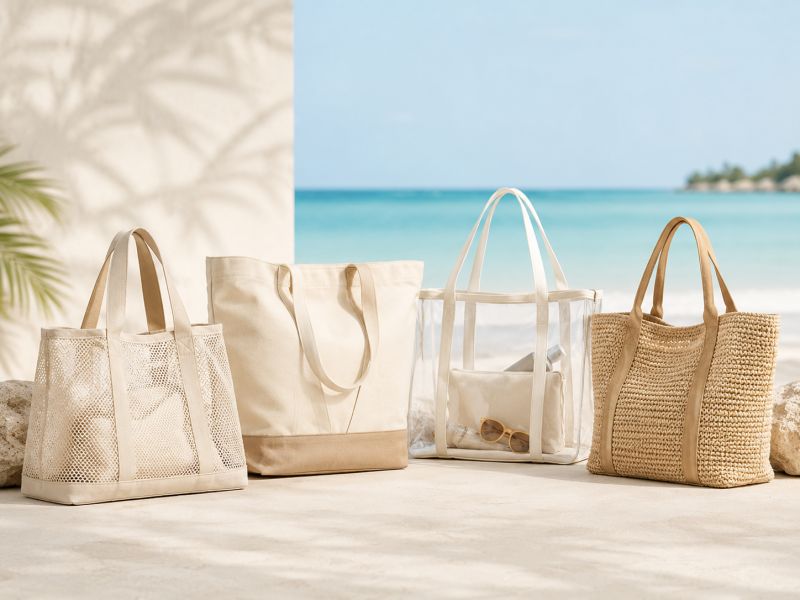
A beach bag looks like an easy accessory until it has to sit beside a new swimwear collection, appear in campaign photos, survive wet towels, carry sunscreen, hold shape on a retail shelf, and still make the logo look clean after repeated use. That is where many summer accessory projects become harder than expected. The bag is not only judged when it is new. It is judged when it is filled, folded, wiped, photographed, shipped, displayed, carried to the pool, dropped on sand, and reused on the next trip.
For swimwear labels, the best beach bag material depends on use, style level, budget, logo needs, and channel. Mesh is strong for wet items and sand release. Canvas gives a clean, structured, printable surface. PVC and TPU are easier to wipe and better for poolside use. Straw-look materials create a vacation mood, but need careful lining, edge, and handle planning.
A beach bag can lift the value of a swimwear collection, but it can also weaken it. A $100 swimsuit packed with a thin, shapeless tote may feel unfinished. A beautiful straw-look tote with weak handles may look great in photos but disappoint on the first beach trip. A waterproof bag that smells too strong, scratches easily, or arrives with creased panels can create complaints before the product is even used.
The smartest beach bag projects start from the real life of the product, not from a trend photo. What will people put inside? Where will it be sold? Is it a gift, a paid accessory, a resort item, a travel kit, or a limited summer set? How important is logo visibility? Does the bag need to fold flat, stand upright, drain water, or look premium in a boutique window?
Once those details are clear, material choice becomes much easier. Mesh, canvas, PVC, TPU, and straw-look materials are not competing for the same job. Each one solves a different problem. The real skill is matching the material to the collection, the use scene, the selling price, and the production plan.
What Do Swimwear Brands Need From Beach Bags?
Swimwear brands need beach bags that do more than look attractive beside a bikini or resort set. The bag must carry wet and dry items, stay comfortable on the shoulder, match the visual mood of the collection, show the logo cleanly, and arrive in sellable condition. A strong beach bag also needs the right capacity, material, handle strength, bottom structure, pocket plan, closure, color control, and packing method.
A beach bag is often the most visible accessory in a swimwear collection. Swimwear may be worn near the pool or beach, but the bag travels through hotel lobbies, airport shops, beach clubs, social photos, fitting rooms, resort stores, and e-commerce parcels. It carries the collection outside the water. That makes it more than a container. It becomes part of the lifestyle image.
The mistake many swimwear labels make is choosing the bag from a single photo. A photo can show color and silhouette, but it cannot show whether the bag holds a wet towel, whether the handle hurts the shoulder, whether sunscreen stains the lining, whether the logo remains clear after folding, or whether the bag looks flat and tired once packed into cartons.
A beach bag should be judged through real-use details:
- Can it hold one towel, swimwear, sunscreen, water bottle, phone, keys, sunglasses, and sandals?
- Does it need to separate wet swimwear from dry items?
- Does sand fall out easily, or does it collect in bottom corners?
- Can the surface be wiped after sunscreen or poolside use?
- Does the handle feel comfortable on bare skin?
- Does the bag keep enough shape for retail display and photography?
- Is the logo method right for the material texture?
- Does the packing method protect the shape, surface, and trim?
- Can the design stay consistent in repeat orders?
A well-planned beach bag does not need every feature. It needs the right features for its role. A gift tote may need a simple structure, light weight, and clean logo. A paid resort tote may need stronger canvas, lining, an inner pocket, reinforced handles, and better packing. A poolside bag may need PVC, TPU, or coated fabric because wiping and wet use matter more than a soft natural hand feel.
The following table gives a practical starting direction:
| Product Role | Main Need | Better Material Direction | Details To Check |
|---|---|---|---|
| Swimwear gift set | Light, attractive, easy to pack | Cotton, light canvas, mesh, polyester | Fold lines, logo clarity, carton quantity |
| Retail beach tote | Stronger value and shelf look | Medium canvas, heavy canvas, straw-look | Handle strength, lining, logo finish |
| Resort shop bag | Vacation mood and durability | Canvas, straw-look, jute-look, rope handle | Shape, edge finish, inner pocket |
| Poolside bag | Easy cleaning and wet use | PVC, TPU, EVA-style structure, coated fabric | Thickness, odor, scratches, folding marks |
| Sport swim bag | Sand release and breathability | Mesh, Oxford trim, polyester mesh | Seam binding, webbing strength |
| Premium capsule item | Strong visual identity | Straw-look, lined canvas, TPU trim | Material consistency, packing protection |
| Family beach bag | Capacity and load strength | Large canvas, mesh with trim, structured PVC | Bottom support, handle reinforcement |
The right beach bag should feel natural when placed beside the swimsuit. If the collection is soft, minimal, and resort-led, a shiny utility bag may feel out of place. If the collection is sporty, colorful, and active, a delicate straw-look tote may not fit the way people actually use it. The bag should speak the same visual language as the swimwear, while still solving real beach problems.
Who Uses Custom Beach Bags?
Custom beach bags are used across many summer and travel scenes: swimwear labels, resort shops, hotel groups, beach clubs, water sports groups, cruise programs, wellness retreats, gift sets, travel retail, online stores, and seasonal retail collections. The same product name can hide very different requirements, so the intended scene should be defined before material and structure are chosen.
For a swimwear label, the bag often completes the collection. It may use the same color mood as the swimwear, the same logo style, the same trim direction, or a matching seasonal print. In this case, the bag must photograph well, feel aligned with the collection, and avoid anything that makes the swimwear look less premium.
For a resort shop or hotel pool program, the bag needs a different balance. Guests may place towels, sunscreen, room cards, slippers, and wet swimwear inside. The surface may touch pool chairs, sand, water drops, and sunscreen bottles. Here, easy cleaning, handle comfort, and capacity are more important than decorative complexity.
For an online store, the first physical impression happens after shipping. A soft tote may fold well and keep freight volume under control. A structured PVC or straw-look bag may need more careful packing so it does not arrive crushed, scratched, or heavily creased. If the bag is sold as a standalone accessory, packing should protect the surface and shape much better than a simple giveaway.
For event or beach club use, visibility matters. A bolder logo, stronger color contrast, and lighter structure may work well. For a premium retail accessory, a quieter logo, better material, lining, and refined handle may feel more suitable.
| Use Scene | Better Capacity | Useful Structure | Main Risk If Poorly Planned |
|---|---|---|---|
| Bikini gift set | 8–15L | Soft tote or drawstring bag | Feels too small or too thin |
| Pool day | 15–25L | Open tote, wipe-clean surface, inner pouch | Wet items stain or smell |
| Resort retail | 18–30L | Lined tote, inner pocket, stable handles | Looks unfinished on shelf |
| Beach club event | 10–20L | Mesh or PVC with visible logo | Weak handles after repeated use |
| Family beach trip | 25–40L | Wide gusset, reinforced bottom | Sagging and handle fatigue |
| Cruise or travel shop | 12–25L | Foldable or semi-structured tote | Packing marks or low perceived value |
A clear product role saves time. “Beach bag” is too broad. “Medium canvas beach tote for a resort swimwear capsule, 45 × 35 × 15 cm, rope handles, inner zipper pocket, one-color logo, individual packing” is much easier to develop and approve. It gives enough direction for material, cost, structure, and sampling.
What Are Popular Beach Bags Called?
Popular beach bags are often called beach totes, beach shoppers, pool bags, mesh beach bags, canvas beach totes, waterproof beach bags, PVC beach bags, TPU beach totes, straw beach bags, raffia-look bags, resort totes, cooler beach bags, foldable beach bags, and summer carry bags. The name usually reflects material, shape, function, or lifestyle setting.
The name matters because it shapes expectations. “Beach tote” sounds broad and retail-ready. “Pool bag” suggests easy cleaning and wet-use practicality. “Mesh beach bag” sounds breathable, sporty, and sand-friendly. “Straw beach tote” suggests vacation, boutique style, and resort photography. “Waterproof beach bag” suggests stronger wet protection, but that wording should be used carefully because real performance depends on material, seams, closure, and construction.
For swimwear collections, the product name should match the real build. A sewn PVC tote may be water-resistant and easy to wipe, but not fully waterproof if the seams are not sealed. A straw-look tote may create a natural vacation feel, but if it uses synthetic woven material, the description should stay clear. A mesh tote may release sand well, but it may not protect small items unless it includes a pouch or pocket.
| Product Name | Visual Feeling | Strong Material Fit | What To Avoid |
|---|---|---|---|
| Beach Tote | Versatile, simple, wearable | Canvas, cotton, straw-look | Too thin for towel use |
| Pool Bag | Clean, wet-use, practical | PVC, TPU, coated fabric | Calling it waterproof without proper construction |
| Mesh Beach Bag | Sporty, breathable, light | Polyester mesh, mesh with Oxford trim | Direct logo print on open mesh |
| Resort Tote | Premium, vacation-led | Canvas, straw-look, rope handle | Rough edges or weak lining |
| Beach Shopper | Large, relaxed, summer lifestyle | Canvas, jute-look, straw-look | Oversizing without handle support |
| Cooler Beach Bag | Picnic, drinks, family trip | Insulated lining, zipper closure | Weak seams around insulation |
| Foldable Beach Bag | Travel, gift, easy packing | Cotton, polyester, light canvas, mesh | Poor shape when loaded |
A good name brings attention, but specifications create the final product. A strong development brief should include size, material, trim, closure, logo method, packing, quantity, and intended use. This avoids confusion and helps the first sample move closer to the final design.
What Beach Bag Type Works Best?
The best beach bag type depends on what the bag must do first. If wet swimwear and sand are the main concern, mesh is usually stronger. If clean retail display and logo quality matter more, canvas is often safer. If the bag will be used around pools, PVC or TPU can be easier to wipe. If the goal is a stronger vacation mood, straw-look materials can create a more premium feeling.
No beach bag type is perfect for every collection. A mesh bag may be practical but can feel too casual if the trim is weak. A canvas tote may look clean but can absorb moisture if there is no lining or coating. A PVC bag may wipe easily but can scratch or crease if packed poorly. A straw-look tote may look beautiful but can lose shape without lining, edge binding, or proper carton protection.
A practical way to choose is to start with the biggest risk:
| Biggest Risk | Better Bag Direction | Why It Helps |
|---|---|---|
| Wet swimwear creates odor | Mesh panels, wet pouch, PVC/TPU inner pocket | Reduces moisture contact |
| Sand stays inside the bag | Mesh body, drainable structure, open bottom details | Easier to shake out |
| Logo looks unclear | Canvas body, solid logo panel, patch, woven label | Cleaner branding surface |
| Bag feels too cheap | Heavier canvas, lining, straw-look texture, better handles | Improves hand feel |
| Bag collapses in photos | Medium/heavy canvas, bottom support, structured PVC | Better shape |
| Freight volume is too high | Foldable tote, soft canvas, mesh | Easier carton planning |
| Surface stains easily | PVC, TPU, coated lining, darker lining | Easier cleaning |
| Handles fail under weight | Wider webbing, box stitching, reinforcement patch | Better load support |
A useful selection guide:
| Collection Style | Better Direction | Material Choice |
|---|---|---|
| Minimal resort swimwear | Clean tote with subtle logo | 12–16 oz canvas, straw-look, cotton rope |
| Sport swimwear | Breathable utility tote | Mesh, Oxford trim, webbing handles |
| Pool club launch | Easy-wipe structured bag | PVC, TPU, EVA-style panels |
| Boutique vacation capsule | Natural texture tote | Straw-look, jute-look, lined canvas |
| Gift with swimwear set | Light and useful tote | Mesh, cotton canvas, polyester |
| Travel retail set | Foldable and reusable | Canvas, mesh, coated polyester |
| Premium beach accessory | Structured, lined, refined | Heavy canvas, straw-look, TPU trim |
The best choice is the one that still feels right after real handling. Fill the sample with a towel, sunscreen bottle, water bottle, phone pouch, sandals, and wet swimwear. Carry it by hand and on the shoulder. Check whether the bottom sags, the handles pull, the logo becomes hidden, and the opening is still easy to use. That test often reveals more than a beautiful product rendering.
Why Is The Bogg Bag Popular?
The Bogg-style beach bag became popular because it solved common beach and pool frustrations: it stands upright, holds many items, wipes clean, handles wet surroundings, and feels sturdy. Its success shows that people do not only want pretty beach accessories. They want products that make a pool or beach day easier.
Most beach trips are messy. Towels take up space. Sunscreen leaks. Water bottles roll around. Sand gets everywhere. Soft totes collapse. Fabric stays damp. Small items disappear under larger items. A structured, easy-wipe bag solves several of these problems at once.
That does not mean every swimwear label should create the same style. The more useful takeaway is that structure matters as much as material. A bag with a stable base, open access, easy cleaning, and reliable handles can feel more valuable than a decorative tote that fails in use.
| Popular Feature | Why People Like It | Design Detail To Study |
|---|---|---|
| Upright body | Easier to load and find items | Base width, wall stiffness, balance |
| Easy-wipe surface | Better for pool and beach use | Material thickness, odor, scratch resistance |
| Large capacity | Fits family or full-day beach items | Handle reinforcement and weight balance |
| Open access | Towels and bottles are easy to reach | Opening width and side stability |
| Strong colors | Highly visible and fun | Color consistency in bulk |
| Durable feel | Encourages repeat use | Handle fixing and bottom strength |
For swimwear collections, this trend can inspire several softer directions:
- Canvas tote with reinforced bottom so it stands better.
- Mesh tote with a structured base and stronger trim.
- PVC tote with softer handles and cleaner edges.
- Straw-look tote with lining and inner support.
- Foldable beach tote with a detachable wet pouch.
- Pool bag with stable base, snap closure, and inner pocket.
The strength of a beach bag is not only in its fabric. It is in how easily the product fits into a real day near water. If people can pack it faster, find items quicker, clean it more easily, and carry it comfortably, the product feels worth keeping.
Are Beach Bags Only Summer Products?
Beach bags are strongly linked with summer, but they are not limited to one season. They can support resort collections, cruise trips, winter sun travel, spring break, pool clubs, hotel programs, wellness retreats, beach cafés, holiday gift sets, and year-round travel shops. For swimwear labels, this means the bag can be more than a short seasonal add-on.
The timing is often the bigger challenge. A simple beach tote may still need material confirmation, sample making, logo testing, revision, packing approval, and bulk production. Standard custom styles often need a sample stage before bulk production. Once approved, many bag projects require around 20–30 days for production, depending on material, structure, quantity, logo, and packing.
A practical calendar:
| Stage | Common Time Needed | What To Confirm |
|---|---|---|
| Concept and use setting | 2–5 days | Product role, size, material direction |
| Material review | 1–5 days | Color, weight, thickness, hand feel |
| First sample | Around 5–7 days for many standard styles | Shape, size, handle, logo, pocket |
| Simple sample option | Around 2–3 days if the style is basic | Basic structure and logo trial |
| Revision | 3–7 days or more | Material change, logo position, handle, lining |
| Bulk production | Around 20–30 days for many projects | Cutting, sewing, logo, inspection, packing |
| Shipping | Depends on method and destination | Carton size, weight, deadline |
Beach bag timing should be planned backward from the selling date, not from the design date. A resort collection may need stock ready before travel season. An online launch may need product photos before inventory arrives. A retail drop may need barcode labels, hangtags, carton marks, and store-ready packing. A gift set may need the bag finished before the swimwear packing schedule.
Different moments call for different design choices:
| Selling Moment | Better Bag Direction |
|---|---|
| Resort capsule | Straw-look tote, rope handle canvas, lined beach shopper |
| Spring break launch | Mesh tote, colorful PVC bag, foldable travel tote |
| Pool club program | PVC, TPU, coated fabric, bold logo |
| Cruise travel | Foldable canvas tote, resort tote, wet pouch set |
| Holiday sun collection | Reusable gift tote, premium resort bag |
| Wellness retreat | Natural canvas, soft cotton, neutral straw-look |
| Online summer drop | Easy-to-ship canvas or mesh tote with clean logo |
A beach bag works best when it is planned as part of the full collection. It should match the swimwear mood, support the selling season, handle real contents, and arrive in good condition. When those needs are clear from the beginning, the material choice becomes easier and the final product feels more complete.
Which Material Works Best?

The right beach bag material depends on the collection mood, use scene, expected capacity, logo style, packing method, and target price level. Mesh is better for wet swimwear and sand release. Canvas gives cleaner branding and stronger retail presence. PVC and TPU are easier to wipe after pool or beach use. Straw-look materials create a vacation mood, but they need careful lining, edge finishing, and handle planning.
A beach bag rarely succeeds because of material alone. It works when the material, size, shape, handle, closure, logo, lining, and packing all support the same product goal. A beautiful straw-look tote may fail if it collapses under one towel and a bottle. A sporty mesh bag may feel too casual beside a premium swimwear set if the trim is weak. A PVC tote may look modern, but it can disappoint if the surface scratches easily or arrives with heavy fold marks.
Material choice should start from the first real use scene:
| Use Scene | Strong Material Direction | Why It Works | Detail To Check |
|---|---|---|---|
| Wet swimsuit after swimming | Mesh, TPU pouch, PVC inner pocket | Reduces trapped moisture | Airflow, pouch seam, odor |
| Poolside towel bag | PVC, TPU, coated canvas | Easier surface cleaning | Thickness, folding marks, handle comfort |
| Resort shop display | Canvas, straw-look, jute-look | Better visual warmth | Lining, shape, logo method |
| Swimwear gift set | Light canvas, cotton, mesh, polyester | Easier folding and packing | Logo clarity, fabric weight |
| Premium vacation capsule | Heavy canvas, straw-look, TPU trim | Stronger hand feel | Edge finish, label, carton protection |
| Sport or surf collection | Mesh, Oxford trim, polyester mesh | Breathable and lightweight | Seam binding, webbing strength |
| Family beach use | Large canvas, structured PVC, mesh with base | More capacity and load support | Base, handle reinforcement |
A good material decision also looks at what may go wrong. Beach bags meet water, sand, sunscreen, towels, bottles, keys, sunglasses, sandals, and sometimes children’s items. That means the product must handle moisture, abrasion, stains, weight, and repeated opening. A soft tote used only for a photo shoot can be simple. A tote sold as a reusable accessory needs stronger details.
Before choosing the material, test the product idea against these practical checks:
| Check | Why It Matters |
|---|---|
| Can it hold one towel without distorting the shape? | Beach towels take more volume than most drawings show |
| Can wet swimwear be separated from dry items? | Damp fabric can stain or create odor |
| Is the logo visible when the bag is filled? | A low logo can disappear after packing |
| Does the handle drop fit shoulder carry? | 23–28 cm often feels more useful for tote-style bags |
| Does the surface clean easily after sunscreen? | Light canvas and natural textures can stain |
| Can the bag be folded without ugly marks? | PVC, TPU, straw-look, and structured bags need packing review |
| Does the bag still match the swimwear mood? | Material texture affects perceived value |
| Does the size fit carton and shipping needs? | Large rigid bags increase volume quickly |
The strongest beach bag is not always the most expensive one. It is the one where material performance matches the exact role. A mesh tote is not meant to feel like a luxury handbag. A canvas tote is not meant to drain water like mesh. A PVC pool bag is not meant to feel like natural straw. Each material has its own job. The right choice is the one that makes the product feel intentional instead of compromised.
Mesh vs Canvas: What Changes?
Mesh and canvas serve different beach bag needs. Mesh is breathable, lightweight, and useful when the bag holds wet swimwear, towels, toys, sandals, or sandy items. Canvas feels more structured, cleaner, and easier to brand. Mesh solves water and sand problems. Canvas solves visual, retail, and logo problems.
Mesh is often used for pool, sport, surf, beach activity, laundry-style bags, and breathable summer totes. Its main benefit is airflow. When wet items sit inside a closed fabric bag, odor can build quickly. Mesh reduces this issue by letting air move through the bag. It also helps sand fall out instead of collecting in the bottom.
Canvas has a different strength. It gives a smoother surface, stronger body, and more polished look. A 12–16 oz canvas tote can hold shape better than a light mesh tote and works well for clean logo placement. It fits resort collections, boutique swimwear, travel sets, and retail shelves where appearance matters as much as function.
| Feature | Mesh | Canvas |
|---|---|---|
| Wet item handling | Strong airflow | Needs lining, coating, or wet pouch |
| Sand release | Strong | Weak unless structure is modified |
| Logo clarity | Better with patch or solid panel | Strong with print, embroidery, label, patch |
| Premium feel | Depends heavily on trim | Easier to elevate |
| Folding | Usually easy | Easy, depending on weight |
| Load support | Needs reinforced seams | Stronger when properly stitched |
| Cleaning | Shake out sand easily | Can stain if untreated |
| Best role | Sport, pool, family beach, activity use | Resort tote, retail accessory, gift set |
A pure mesh bag may look too casual for a premium swimwear line. A pure canvas bag may look great but handle wet contents poorly. That is why mixed-material designs often work well:
- Canvas body with mesh side panels.
- Mesh body with canvas bottom and webbing handles.
- Canvas tote with coated lining.
- Mesh tote with detachable TPU wet pouch.
- Canvas shopper with inner mesh pocket.
- Mesh beach bag with solid front panel for logo.
This blend helps the bag feel more finished while keeping beach function. Mesh brings air and drainage. Canvas brings structure and a cleaner brand surface.
For mesh, check the hole size, stretch, seam binding, trim material, and handle attachment. Too-open mesh may look cheap or allow small items to fall through. Too-dense mesh may lose part of its sand-release value. For canvas, check fabric weight, shrinkage, color, print effect, seam strength, and whether the fabric needs lining.
A practical decision can be made this way: choose mesh when water and sand are the main challenge; choose canvas when display, logo quality, and product value matter more. Choose a combination when the bag needs both.
PVC vs TPU: Which Is Cleaner?
PVC and TPU both work well when a beach bag needs an easy-wipe surface. They are useful for poolside items, sunscreen spills, wet swimwear, cosmetics, towels, and transparent or colored summer designs. PVC is usually more cost-controlled and widely used. TPU often feels softer, more flexible, and more refined, but it should be reviewed carefully for thickness, cost fit, and logo compatibility.
PVC is common for clear totes, pool bags, cosmetic beach pouches, stadium-style bags, and colorful transparent designs. It gives a clean, glossy, water-resistant appearance and can make the product feel fresh and modern. It also pairs well with contrast webbing, rubber patches, printed logos, and metal details.
TPU is often selected when the design needs a softer hand feel or a more premium clear surface. It can work well for higher-positioned pool pouches, soft wet bags, travel beach accessories, and upgraded transparent totes. The material can feel less rigid than PVC, but it should still be tested under real conditions.
| Feature | PVC | TPU |
|---|---|---|
| Surface cleaning | Easy to wipe | Easy to wipe |
| Hand feel | Can be firmer | Often softer |
| Visual effect | Clear, glossy, colorful | Clearer and more flexible in many designs |
| Cost level | Usually more controlled | Often higher |
| Odor | Needs material review | Usually better, still needs checking |
| Logo | Print, patch, label, plate after testing | Print, patch, label, plate after testing |
| Fold marks | Possible | Possible, depends on thickness |
| Best role | Pool tote, clear bag, summer promotion, cosmetic beach pouch | Premium wet pouch, soft clear tote, refined pool accessory |
PVC and TPU should not be chosen only because they look waterproof. A sewn tote may resist splashes but still let water enter through seams, zipper gaps, or an open top. A more accurate product description should match the construction. For example, “easy-wipe PVC pool tote” or “water-resistant TPU beach pouch” is often safer than promising full waterproof performance unless the design truly supports it.
Key checks before approval:
| Check | Why It Matters |
|---|---|
| Thickness | Thin panels may feel weak; thick panels may feel stiff |
| Clarity | Cloudy or uneven panels reduce visual value |
| Odor | Strong smell can hurt first impression |
| Surface marks | Transparent materials show scratches easily |
| Edge finishing | Sharp or hard edges reduce comfort |
| Handle fixing | Stress marks can appear around attachment areas |
| Logo adhesion | Print or transfer must be tested on the final material |
| Folding method | Heavy creases may remain after packing |
| Heat behavior | Poolside and car storage may expose stiffness or deformation |
PVC and TPU are strongest when the visual mood is modern, clean, poolside, colorful, or easy-care. They may feel less suitable for soft natural resort collections unless paired with cotton webbing, softer color, rounded edges, or refined trim.
For a swimwear line, one useful approach is a fabric beach tote paired with a PVC or TPU wet pouch. The main bag keeps a premium look, while the pouch handles damp swimwear, sunscreen, or cosmetics. This gives the product more function without forcing the full bag into a plastic feel.
Canvas vs Straw-Look: Which Feels Premium?
Canvas and straw-look materials both fit beach bags with a more elevated vacation feeling, but they express different styles. Canvas feels clean, strong, simple, and reliable. Straw-look textures feel warmer, more resort-like, and more photogenic. Canvas is easier to brand and control. Straw-look materials create stronger holiday emotion but need more attention to finishing.
Canvas is one of the safest choices for swimwear accessory development. It can be light, medium, or heavy. It supports many logo methods. It can fold for shipping. It can be used for simple gift totes or upgraded retail totes. Natural canvas also pairs well with rope handles, webbing, contrast stitching, inner pockets, and leather-look patches.
Straw-look materials create a different mood. They suggest vacation, sunshine, boutique retail, resort shops, and relaxed luxury. The texture can look beautiful in lifestyle photography. It works well for cruise collections, hotel shops, premium swimwear capsules, and summer accessory lines.
| Feature | Canvas | Straw-Look |
|---|---|---|
| Style | Clean, versatile, modern or casual | Resort, vacation, natural texture |
| Logo surface | Very good | Better with patch, label, or plate |
| Shape | Depends on fabric weight and lining | Needs lining or structure for stability |
| Comfort | Soft and familiar | Edge can feel rough if unfinished |
| Packing | Easier to fold | Needs shape protection in many styles |
| Color control | Easier with standard fabric | Shade and weave may vary |
| Cost control | Flexible | Depends on weave, lining, trim |
| Best role | Branded tote, retail accessory, gift bag | Premium beach tote, resort capsule, boutique display |
Canvas creates a clean stage for the logo. Straw-look creates mood before the logo is even noticed. That is the main difference.
A canvas tote feels more premium when it includes:
- Medium or heavy canvas for better body.
- Inner lining for a cleaner inside.
- Reinforced handle roots.
- Bottom gusset for towel capacity.
- Inner zipper pocket for phone and keys.
- Rope handle or soft cotton webbing.
- Subtle embroidery, woven label, or leather-look patch.
- Clean top edge finishing.
A straw-look tote feels more reliable when it includes:
- Fabric lining to protect contents.
- Edge binding to reduce roughness.
- Reinforced handle stitching.
- Inner pocket for small items.
- Bottom support if the bag must stand.
- Sewn label or patch instead of direct print.
- Carton protection to reduce deformation.
The risk with canvas is choosing fabric that is too thin. A light canvas may work for a gift tote, but if it is used for a paid retail accessory, it can feel weak when loaded. The risk with straw-look material is finishing. A woven texture can look attractive from a distance but feel rough, uneven, or fragile if the edges and handles are not handled well.
For premium swimwear collections, a lined straw-look tote can create a strong vacation identity. For cleaner everyday branding, canvas is often more flexible. For the best balance, a canvas body with straw-look trim, rope handles, or woven label can bring both structure and summer mood.
What Type Handles Wet Items?
Wet items need airflow, water resistance, separation, or easy cleaning. Mesh handles wet swimwear and sand best because it breathes. PVC and TPU work well when wiping and moisture resistance matter. Canvas can work if it has coated lining, a wet pocket, or a detachable pouch. Straw-look materials should usually include lining if damp items may go inside.
Wet use is where many beach bags fail. People rarely carry only dry towels. A real beach day includes damp swimwear, sunscreen, water bottles, wet sandals, and sand-covered items. If the bag cannot separate wet and dry things, even a good-looking design may feel frustrating.
There are several ways to handle wet contents:
| Solution | Material Fit | Best Use |
|---|---|---|
| Full mesh body | Mesh | Swim lessons, surf, pool, sand-heavy use |
| Mesh panels | Canvas + mesh, polyester + mesh | Balanced style and airflow |
| Coated lining | Canvas, polyester | Protects inside from damp contents |
| Detachable wet pouch | Canvas, straw-look, resort tote | Keeps the main bag clean |
| PVC/TPU body | PVC, TPU | Easy-wipe poolside bag |
| Waterproof-feel inner pocket | Canvas, straw-look, mixed-material tote | Separates swimsuit or sunscreen |
| Drain-friendly base | Mesh, structured synthetic designs | Reduces trapped water and sand |
A wet-use design should also protect dry items. Phones, keys, hotel cards, sunglasses, and wallets need separation from damp swimwear. A small inner zipper pocket is useful, but it should not sit at the lowest part of the bag where water may collect. A detachable pouch can be more practical because it can be removed, wiped, or used separately.
Important wet-use checks:
| Check | Why It Matters |
|---|---|
| Does wet swimwear touch the logo area? | Moisture and color transfer may affect appearance |
| Does sunscreen stain the lining? | Light fabrics can mark easily |
| Does sand collect in bottom corners? | Cleaning becomes annoying |
| Does the bag breathe when closed? | Odor can build in closed compartments |
| Are metal parts protected from rust risk? | Beach and pool settings increase exposure |
| Can the wet area be wiped or rinsed? | Easier after use |
| Is there a dry pocket for phone and keys? | Prevents frustration during travel |
A bag does not need to be fully waterproof to handle wet items well. It only needs honest, thoughtful wet-item control. A canvas tote with a TPU pouch may be better than a fully plastic bag for a premium resort line. A mesh tote with a solid logo panel may be better than a canvas bag for swim school or pool use. A straw-look tote with coated lining may keep the vacation look while making the inside more practical.
The material should match how damp the product will become. For occasional wet swimwear, a pouch or lining may be enough. For daily pool use, PVC, TPU, mesh, or coated fabric makes more sense.
Which Material Shows Logos Better?
Canvas usually gives the cleanest logo surface. PVC and TPU can show logos well when the print, patch, or label is tested on the final material. Mesh usually needs a solid panel, woven label, or rubber patch. Straw-look textures often look better with sewn labels, leather-look patches, or metal plates instead of direct print.
Logo quality depends on three things: surface, process, and placement. A good logo file can look poor on the wrong texture. Open mesh breaks a printed graphic. Straw-look texture makes fine lines uneven. Glossy PVC can show scratches or adhesion issues. Heavy canvas may absorb ink differently from light cotton.
| Material | Strong Logo Direction | Watch Carefully |
|---|---|---|
| Canvas | Screen print, embroidery, heat transfer, woven label, patch | Ink feel, folding, thread density |
| Mesh | Woven label, rubber patch, printed solid panel | Direct print may look broken |
| PVC | UV print, screen print, rubber patch, metal plate | Adhesion, scratches, surface marks |
| TPU | Print, patch, label after testing | Heat behavior and adhesion |
| Straw-look | Woven label, leather-look patch, metal plate | Uneven texture and secure stitching |
| Coated polyester | Screen print, heat transfer, reflective logo, patch | Coating compatibility |
Logo size also affects the final feeling. A large centered logo works for beach clubs, events, and high-visibility summer drops. A small woven label or tonal embroidery works better for resort collections and elevated swimwear. A rubber patch fits sport or pool designs. A leather-look patch fits canvas or straw-look totes with a softer vacation mood.
Placement choices:
| Placement | Effect |
|---|---|
| Center front | Strong visibility, clean product photo |
| Lower corner | Subtle, boutique feel |
| Side seam label | Quiet and refined |
| Handle label | Small detail, minimal look |
| Front patch | Stronger texture and durability |
| Transparent panel print | Modern poolside look |
| Inner label | Better for understated collections |
A logo should be tested on the actual material and in the final size. A small trial on a random swatch is not enough when the order uses textured canvas, glossy PVC, soft TPU, open mesh, or straw-look weave. The approved sample should lock the exact logo method, size, color, position, and tolerance.
For swimwear products, the logo should feel connected to the collection instead of forced onto the bag. Sometimes a small label looks more expensive than a large print. Sometimes a bold logo is right because the product is meant for events or beach clubs. The material should guide the logo choice, not fight it.
A strong beach bag logo is readable, durable, and natural to the design. When the material and logo method work together, the bag feels intentional even if the design is simple.
How Do Materials Affect Price?

Beach bag price is shaped by more than the fabric name. Material type, fabric weight, thickness, bag size, lining, handle style, pocket layout, logo process, closure, packing method, order quantity, and carton volume all change the final cost. A canvas tote, mesh beach bag, PVC pool bag, and straw-look resort tote may look similar in size, but their cutting loss, sewing difficulty, logo setup, and packing needs can be very different.
For swimwear collections, the smartest price plan starts with the product role. A gift tote does not need the same structure as a paid resort accessory. A poolside PVC bag does not need the same finishing as a lined straw-look tote. A canvas beach shopper for retail should not be priced like a thin event tote if it needs to carry towels, sunscreen, bottles, and wet swimwear.
Price is not only about making the bag cheaper. It is about placing money where people can feel it: material hand feel, handle comfort, logo clarity, useful size, clean stitching, and safe packing. Cutting the wrong details can make the final product feel weak, even if the first sample looks acceptable in photos.
| Price Factor | What Changes | Why It Matters |
|---|---|---|
| Main material | Mesh, canvas, PVC, TPU, straw-look, coated fabric | Each material has different cost, cutting loss, and sewing needs |
| Material weight | Canvas oz, mesh density, PVC/TPU thickness | Affects structure, hand feel, strength, and freight weight |
| Bag size | Width, height, gusset, capacity | Larger bags use more material and may need stronger handles |
| Lining | Cotton, polyester, coated lining, no lining | Improves finish but adds fabric and sewing time |
| Handle | Cotton webbing, rope, PU, PVC, same-fabric handle | Changes comfort, strength, and visual value |
| Closure | Open top, snap, zipper, drawstring | Affects access, security, and labor |
| Pocket layout | Inner zipper pocket, wet pouch, bottle pocket | Adds fabric, zippers, cutting, and stitching |
| Logo process | Print, embroidery, woven label, patch, plate | Different setup, labor, and durability checks |
| Packing | Folded pack, hangtag, barcode, shape protection | Changes labor, material, and carton size |
| Carton volume | Flat, folded, nested, structured | Larger volume can raise delivery cost |
A low-cost bag can still feel good if the structure is clean and the material fits the use. A higher-priced bag can still fail if the wrong material is selected. For example, a thin canvas tote with a premium logo patch may still feel weak when loaded. A straw-look tote without lining may look attractive but feel unfinished. A PVC bag with poor packing may arrive with strong fold marks. A mesh bag with weak binding may stretch at the seam after repeated use.
A practical price plan should separate “visible value” from “hidden complexity.”
Visible value includes:
- Better fabric hand feel.
- Clean logo placement.
- Comfortable handles.
- Useful capacity.
- Good shape when loaded.
- Strong color harmony.
- Neat edge finishing.
- Retail-ready packing.
Hidden complexity includes:
- Too many inner pockets.
- Decorative zippers that people rarely use.
- Excessive trim layers.
- Multiple logo methods on one bag.
- Heavy lining in a simple gift tote.
- Oversized dimensions that raise carton volume.
- Special hardware when standard trim would look clean.
- Complicated color blocking that increases cutting and sewing time.
The best beach bag price is not always the lowest number. It is the price that keeps the product strong enough for its role. A free gift item should feel useful and clean. A retail accessory should feel durable and finished. A resort piece should look refined and survive real travel use.
Why Does Fabric Weight Matter?
Fabric weight affects structure, hand feel, durability, folding behavior, logo results, and total cost. A lighter material lowers weight and often helps with folded packing, but it may feel weak when filled with towels and bottles. A heavier material improves body and perceived value, but it can raise fabric cost, sewing effort, carton weight, and delivery volume.
For canvas beach bags, weight is one of the first cost drivers. A light cotton or canvas tote can work for gift sets, event use, or folded packing. A medium canvas is better for daily beach totes. A heavier canvas gives better shape and stronger retail presence, especially when the bag is large or designed as a paid accessory.
| Canvas Level | Better Use | Price Effect | What To Watch |
|---|---|---|---|
| Light cotton/canvas | Gift tote, apparel set, foldable bag | Lower material cost and easier packing | May sag when loaded |
| Medium canvas | Daily beach tote, travel tote, resort tote | Balanced cost and quality feel | Needs correct handle reinforcement |
| Heavy canvas | Premium beach shopper, retail tote | Higher fabric cost, stronger body | More weight, higher freight impact |
| Coated canvas | Poolside or easy-clean tote | Higher material cost | Hand feel and coating durability need testing |
For mesh, weight and density change both function and appearance. Open mesh releases sand more easily, but it may look too sporty or too casual for an elevated swimwear line. Denser mesh feels stronger and more refined, but it may release sand less effectively. A mesh beach bag also needs stronger binding and webbing because the open body can stretch under load.
For PVC and TPU, thickness has a large impact on price and user experience. Thin material can feel soft and light, but it may look less durable. Thick material holds shape better, but it can feel stiff, become heavier, and create stronger fold marks during packing. TPU may offer a softer feel than PVC in many designs, but the cost usually needs closer review.
For straw-look materials, weight alone is not enough. Weave density, edge behavior, lining, and handle attachment all affect the final result. A loose weave may look natural but deform more easily. A denser woven texture may feel stronger but needs clean edge finishing to avoid roughness.
A useful material weight check is simple: fill the sample with real items. One towel, one sunscreen bottle, one water bottle, sunglasses case, sandals, and a wet pouch can quickly show whether the chosen material is strong enough. If the bag collapses, pulls at the handles, or loses shape, a cheaper fabric may not be saving money in the right place.
How Does Bag Size Change Cost?
Bag size changes cost because it affects material usage, cutting layout, handle length, lining size, zipper length, pocket size, carton quantity, and load strength. A few centimeters can make a real difference when the order includes hundreds or thousands of pieces. Larger bags also invite heavier loading, so the handles, seams, and base must be stronger.
A beach bag usually needs more volume than a normal tote. Towels are bulky. Sunscreen bottles add weight. Sandals create uneven pressure. A small beach tote may look neat in photos but become disappointing in real use. An oversized tote may look useful but use more fabric, increase sewing time, and take up more carton space.
| Bag Size Direction | Approximate Use | Price Impact | Practical Note |
|---|---|---|---|
| Small pouch | Swimwear, sunscreen, phone | Lower material use | Good for set packing or wet pouch |
| Small tote | One swimsuit, light towel, small items | Controlled cost | May feel limited for beach use |
| Medium tote | Towel, swimsuit, bottle, sunscreen | Balanced cost and use | Often the safest direction |
| Large tote | Towel, sandals, clothes, accessories | Higher material and handle cost | Needs reinforced base |
| Oversized shopper | Family use, resort travel | Higher fabric and freight impact | Carton volume should be checked early |
| Structured pool bag | Towels, bottles, pool gear | Higher packing volume | Needs shape protection |
The gusset often changes usefulness more than people expect. A flat tote can look clean, but it carries less and may bulge awkwardly. A bottom gusset allows towels and bottles to sit better. For many beach totes, a gusset of about 10–18 cm is often more useful than a flat shape, depending on the overall size and product role.
Size also affects logo proportion. A logo that looks balanced on a medium tote may look too small on a large beach shopper. A large print that looks bold on canvas may feel too loud on a straw-look tote. Logo size should always be checked on a real-size sample, not only on a digital mockup.
Before approving size, test these details:
- Can the bag hold one towel without forcing the shape?
- Can a bottle stand inside without making the bag tilt?
- Does the handle drop allow comfortable shoulder carry?
- Does the bag still look balanced beside the swimwear set?
- Will the chosen size fit the intended carton plan?
- Does the bottom need support after the gusset is added?
- Does the bag look too bulky for retail display?
- Can the package size work for online shipping?
A good size plan protects both cost and user experience. Reducing the bag too much may lower material use, but it can also make the product feel less useful. It is often better to keep a practical size and simplify unnecessary details than to produce a beach bag that cannot carry normal beach items.
Do Pockets And Zippers Add Cost?
Pockets and zippers add cost because they require more material, accessories, cutting, sewing, alignment, and inspection. They also add real value when used correctly. The best pocket plan is not the most complex one. It is the one that solves common beach problems: small item storage, wet swimwear separation, bottle placement, travel security, and easier daily use.
An open beach tote is convenient for towels, but people still need a safer place for phone, keys, cards, hotel room key, lip balm, and sunglasses. One inner zipper pocket can make a simple tote feel much more complete. A detachable wet pouch can add stronger value than several decorative pockets. A bottle pocket is useful only if it is sized and placed correctly.
| Feature | Adds Value When | Cost Comes From | Common Risk |
|---|---|---|---|
| Inner zipper pocket | Phone, keys, cards need protection | Fabric, zipper, sewing time | Too small or too deep |
| Wet pouch | Swimwear needs separation | Coated fabric, zipper, extra labor | Poor seam or hard cleaning |
| Bottle pocket | Pool, sport, family beach use | Extra panel and stitching | Wrong size or weak support |
| Top zipper | Travel or retail security matters | Long zipper and more sewing | Hard to close on bulky towels |
| Snap closure | Light security is enough | Hardware and placement | Weak fixing or poor alignment |
| Drawstring | Sport or gift style | Cord, eyelet, channel sewing | Cord may feel cheap if too thin |
| Bottom board | Large tote or retail shape | Extra material and fitting | Too stiff or hard to fold |
| Detachable pouch | Premium set or wet item solution | Extra small item plus packing | Higher cost but strong value |
A zipper is not always needed. For a large beach tote, an open top may be easier because towels and cover-ups are bulky. A snap button may give enough closure without adding the cost and stiffness of a full zipper. A drawstring can work well for sport or gift styles. A full top zipper makes more sense when the bag is used for travel, retail sale, or higher-value accessories.
Pockets should be placed where they are easy to reach. A small inner pocket near the upper back panel is useful for phone and keys. A wet pocket should not leak into the main compartment. A bottle pocket should hold common bottle sizes without pulling the bag out of shape. A hidden pocket may sound nice, but if people cannot reach it easily, it does not add much value.
Feature planning by product role:
| Product Role | Better Feature Choice |
|---|---|
| Swimwear gift tote | No pocket or one simple inner pocket |
| Premium canvas tote | Inner zipper pocket, bottom gusset, reinforced handles |
| Resort straw-look tote | Lining, small inner pocket, magnetic snap |
| Mesh pool bag | Outer mesh pocket, drawstring pouch, webbing handle |
| PVC pool tote | Snap closure, small pouch, easy-wipe pocket |
| Travel beach tote | Top zipper, inner pocket, stronger base |
| Family beach bag | Bottle pocket, wide gusset, reinforced handle |
The common mistake is adding features because they sound attractive, not because they improve use. Every extra pocket and zipper changes the price and production time. For many beach bags, strong handles, a practical size, a clean logo, and one useful pocket create more value than a complex interior that people rarely use.
Which Custom Logo Process Fits?
The logo process affects price because different methods require different setup, labor, materials, testing, and finishing. Screen print is often efficient for clear graphics on canvas or coated fabrics. Embroidery adds texture but takes more time. Woven labels and patches work well on mesh and straw-look textures. Metal plates and rubber patches add a stronger accessory feel, but they raise cost and require secure attachment.
The right logo process should match the material surface. A logo that works on canvas may not work on mesh. A fine-line print may look broken on open fabric. A large heat transfer may not suit textured straw-look material. PVC and TPU need adhesion checks because glossy or flexible surfaces can behave differently from fabric.
| Logo Method | Better Material Fit | Price Level | Best Use |
|---|---|---|---|
| Screen print | Canvas, coated fabric, some PVC after test | Usually controlled | Clean graphic logos, larger visibility |
| Heat transfer | Canvas, polyester, coated fabric | Medium | Multi-color artwork, soft color effects |
| Digital print | Canvas, polyester panels | Medium to higher | Detailed artwork or seasonal graphics |
| Embroidery | Canvas, cotton, thicker fabrics | Medium to higher | Premium texture, smaller logo |
| 3D embroidery | Heavy canvas, structured fabric | Higher | Raised logo effect |
| Woven label | Mesh, canvas, straw-look, webbing | Controlled to medium | Small clean branding |
| Rubber patch | Mesh, PVC, sporty canvas | Medium to higher | Sport, pool, outdoor style |
| Leather-look patch | Canvas, straw-look | Medium to higher | Resort and premium tote styles |
| Metal plate | Straw-look, PVC, structured tote | Higher | Boutique accessory feeling |
Logo size and color count also affect price. A small woven label may cost less and look more refined than a large multi-color print. A one-color screen print is usually more controlled than a complex gradient. Embroidery with dense stitching can become costly, especially on large logos. Metal plates may look refined, but they need mold, hardware, fixing, and inspection.
Logo placement can also influence labor. A center-front logo on a flat panel is easier than a logo across a seam, curved area, pocket, or uneven woven surface. For mesh bags, adding a solid logo panel may add material and sewing cost, but it often improves the final look. For straw-look totes, a patch or label may look cleaner than direct print and reduce logo risk.
A practical logo cost plan:
| Desired Look | Better Logo Choice | Why It Works |
|---|---|---|
| Clean and simple | One-color print on canvas | Clear, controlled, easy to read |
| Premium and subtle | Woven label or small embroidery | Soft, refined, not too loud |
| Sporty and durable | Rubber patch on mesh or Oxford trim | Strong texture and better visibility |
| Resort style | Leather-look patch or metal plate | Matches straw-look and canvas |
| Colorful campaign | Heat transfer or digital print | Better for multi-color artwork |
| Poolside clear bag | Print or patch after material test | Needs adhesion and scratch review |
The most expensive logo is not always the best one. A well-placed small label can look more elegant than a large decorative process. The logo should feel connected to the collection and material. Once approved, the sample should lock the logo size, position, color, and method so that bulk production stays consistent.
How Can Brands Control Price?
Price control starts before the sample is made. The most effective method is to define the product role, keep the main structure clean, choose a suitable material level, protect the details people notice, and remove features that do not improve real use. Cost should be reduced from waste and over-complexity, not from handle strength, logo clarity, or useful capacity.
Many beach bag projects become expensive because too many features are added at the same time. A heavier material, full lining, top zipper, inner zipper pocket, wet pouch, rope handle, metal plate, hangtag, barcode, gift box, and protected packing may all make sense separately. Together, they may push the item beyond the intended price level.
A practical cost-control table:
| Cost Pressure | Better Adjustment | Do Not Sacrifice |
|---|---|---|
| Material cost too high | Adjust weight, use mixed materials, simplify lining | Main hand feel and strength |
| Bag too large | Reduce gusset or height carefully | Practical towel capacity |
| Logo cost too high | Use one clear method instead of several | Logo readability |
| Sewing too complex | Remove unused pockets or decorative trims | Stress-point stitching |
| Packing volume too high | Review folding, carton plan, or shape support | Product protection |
| Premium look too expensive | Upgrade handle or label instead of full structure | Overall material quality |
| PVC folding marks | Adjust packing or panel thickness | Surface appearance |
| Straw-look cost high | Use simpler lining or label method | Edge finish and handle strength |
Details that can often be simplified:
- Multiple inner pockets.
- Decorative zipper pulls.
- Oversized logos.
- Too many trim colors.
- Full lining for a very low-cost gift tote.
- Metal hardware when a woven label works.
- Gift box when folded individual packing is enough.
- Complicated color blocking that adds cutting steps.
Details that should be protected:
- Handle reinforcement.
- Main material strength.
- Clean logo effect.
- Useful size.
- Neat seam finishing.
- Color consistency.
- Basic packing protection.
- Accurate labels and carton marks.
Another strong cost-control method is to create two or three versions before final approval.
| Version | Product Direction | Best For |
|---|---|---|
| Simple version | Light material, one logo, basic packing | Gift set, event, seasonal add-on |
| Core version | Better material, one useful pocket, reinforced handles | Online sale, retail shelf, resort shop |
| Premium version | Stronger structure, lining, upgraded logo, better packing | Limited capsule, hotel shop, high-end swimwear set |
This makes trade-offs easier to see. Instead of cutting details randomly, the product team can decide which version fits the launch.
Order quantity also matters. Small runs carry more pressure because setup, sourcing, logo preparation, sampling, and packing work are spread over fewer pieces. Larger orders usually make more design details easier to absorb. For standard custom bag projects, 500 pieces per design is often a practical starting quantity, while simpler styles may sometimes be reviewed at lower quantities depending on structure and material.
A beach bag should reach the target price without losing the features that make it worth using. If people carry it comfortably, recognize the logo, fit real beach items inside, and receive it in good condition, the price plan is doing its job.
How Does A Factory Make Samples?

A beach bag sample should prove whether the idea can become a real product, not just whether it looks close to a drawing. The sample should confirm material feel, size, shape, handle comfort, logo effect, pocket position, lining quality, closure function, packing method, and whether the same details can be repeated in bulk order. For many standard custom bag styles, sample making usually takes around 5–7 days after key details are clear. Very simple styles may take around 2–3 days, while special materials, custom colors, complex structures, special logo methods, or custom packing may need more time.
A good sample protects the whole launch. It shows if a canvas beach tote feels too soft, if mesh stretches at the seams, if PVC panels show heavy fold marks, if TPU is too thin, if a straw-look tote needs lining, or if the logo position becomes hidden once the bag is filled. These issues are much easier to fix before bulk production starts.
The sample stage should check the full experience of the bag:
| Sample Area | What To Check | Why It Matters |
|---|---|---|
| Material | Weight, texture, stiffness, odor, surface feel | Decides the first impression and real use |
| Size | Width, height, gusset, handle drop | Affects capacity, comfort, and carton planning |
| Shape | Empty shape and loaded shape | Shows whether the bag can stand, fold, or display well |
| Handle | Length, width, grip, stitching, reinforcement | One of the highest-stress parts during use |
| Logo | Size, color, method, position, clarity | Directly affects the product’s visual identity |
| Lining | Thickness, color, seam, water resistance | Important for wet swimwear, sunscreen, and premium feel |
| Size, position, zipper movement | Affects daily convenience | |
| Closure | Open top, zipper, snap, drawstring | Changes use, price, and production time |
| Packing | Folded, flat, protected, hangtag, barcode | Affects delivery condition and retail readiness |
A beach bag should be tested with real items before approval. Place one towel, one bottle, sunscreen, sandals, sunglasses case, phone pouch, and wet swimwear pouch inside. Then check whether the bottom sags, the handles pull, the opening becomes too tight, the logo is still visible, and the bag still feels comfortable on the shoulder.
This simple loading test often reveals what a flat product photo cannot show.
What Should Brands Send First?
A beach bag project becomes easier when the first message includes the core product details. A reference photo is helpful, but it is not enough for accurate sampling. Size, material direction, logo artwork, quantity, packing needs, use scene, timeline, and destination all affect how the sample should be developed.
A clear brief does not need to be long. It only needs to remove guesswork.
| Detail To Send | Example |
|---|---|
| Product type | Canvas beach tote, mesh pool bag, PVC tote, straw-look resort bag |
| Size | 45W × 35H × 15D cm, handle drop 25 cm |
| Material direction | 12 oz canvas, polyester mesh, 0.3 mm PVC, straw-look woven texture |
| Color | Natural canvas, black trim, seasonal pastel, Pantone reference |
| Logo artwork | AI, PDF, SVG, high-resolution PNG, or editable vector file |
| Logo method | Print, embroidery, woven label, rubber patch, leather-look patch |
| Structure | Open top, zipper, snap, lining, inner pocket, wet pouch |
| Quantity | 500 pcs, 1000 pcs, 3000 pcs, or planned launch quantity |
| Packing | Individual bag, hangtag, barcode, carton mark, retail label |
| Use scene | Swimwear gift set, resort shop, pool club, online sale |
| Timing | Sample deadline and bulk delivery target |
| Destination | Country, port, warehouse, or forwarder address |
If the idea is still early, a mood board or rough sketch is still useful. A beach bag can start from a swimsuit print, a resort color palette, a competitor reference, a store display photo, or a simple hand drawing. The key is to explain the intended role of the bag.
A gift tote can be lighter and simpler. A paid retail accessory needs stronger material and cleaner finishing. A resort shop item may need a more polished handle, lining, hangtag, and barcode. A poolside bag may need PVC, TPU, coated fabric, or a detachable wet pouch.
The first brief should also make the logo clear. Logo choice affects the sample from the start. Fine-line artwork may not work well on rough canvas or straw-look texture. A large logo may look broken on mesh unless placed on a solid panel. PVC and TPU need logo testing because glossy or flexible surfaces can affect print adhesion.
A strong first message saves time because the first sample can be closer to the final product.
How Long Does Sampling Take?
For many standard beach bag styles, sampling usually takes around 5–7 days after details are confirmed. Simple styles may take around 2–3 days when materials are available and the logo method is straightforward. More complex designs may need longer, especially when the bag uses custom material color, special hardware, straw-look texture, PVC or TPU testing, lining, pockets, or upgraded packing.
A realistic sample schedule often looks like this:
| Stage | Common Time Needed | What Happens |
|---|---|---|
| Detail review | 1–2 days | Size, material, structure, logo, packing discussion |
| Material check | 1–3 days | Fabric, thickness, color, handle, lining, trim review |
| Pattern setup | 0.5–1 day | Size and cutting pattern are prepared |
| Cutting | 0.5–1 day | Main panels, lining, pocket, handle, trim are cut |
| Sewing | 1–3 days | Body, gusset, handles, pocket, lining, closure are assembled |
| Logo trial | 1–3 days | Print, embroidery, patch, label, or plate is tested |
| Internal check | 0.5–1 day | Size, logo, stitching, handle, surface, packing are reviewed |
| Revision | Depends on changes | Material, size, logo, pocket, handle, or packing may be adjusted |
A simple canvas tote with one-color print can move quickly. A lined straw-look tote with rope handles, inner zipper pocket, metal plate, and retail packing needs more checking. A PVC or TPU bag may need extra time for surface marks, odor, thickness, fold lines, and logo adhesion. A mesh bag may need seam binding and webbing tests because open mesh can stretch.
Sampling may slow down when:
- The logo file is not clear.
- The material color has no reference.
- The size changes after the pattern is made.
- The artwork has too many fine details.
- The material is not a standard stock option.
- The packing method is decided late.
- Several logo methods are tested at once.
- The first feedback is too general.
- The launch date is close but product details are still changing.
The fastest sample is not always the safest sample. A rushed sample can miss hidden problems: weak handles, poor logo placement, wrong pocket size, stiff zipper, strong PVC smell, rough straw-look edge, or packing marks. A better goal is a useful sample that shows what should be approved, what should be adjusted, and what must be locked before bulk production.
How Are Materials Reviewed?
Material review should check appearance, weight, thickness, touch, stiffness, color, odor, cleaning behavior, logo compatibility, seam performance, and packing behavior. A small swatch is helpful, but the real test is how the material behaves when made into a full beach bag.
Beach bags face real-life pressure. They may carry damp swimwear, towels, water bottles, sunscreen, sandals, keys, and sunglasses. They may touch sand, pool chairs, wet floors, luggage, and retail shelves. This is why material review should be practical.
| Material | What To Review | Common Adjustment |
|---|---|---|
| Canvas | Oz weight, hand feel, shrinkage, color, print surface | Use heavier weight, lining, coating, or bottom support |
| Mesh | Hole size, stretch, softness, seam holding | Add binding, webbing trim, solid logo panel |
| PVC | Thickness, clarity, odor, scratches, fold marks | Adjust thickness, edge finish, packing method |
| TPU | Softness, clarity, flexibility, logo adhesion | Test print, heat behavior, folding |
| Straw-look | Weave density, roughness, shade, edge condition | Add lining, binding, patch, protected packing |
| Polyester/Oxford | Density, coating, water resistance, color | Test print, seam strength, lining |
| Neoprene | Thickness, stretch, surface, stitching | Review edge finish and logo method |
| RPET | Texture, color, weight, print effect | Confirm material certificate needs if required |
A material may look good in a swatch but behave differently in a bag. Light canvas may wrinkle or sag once the bag is large. Open mesh may release sand well but make the product feel too casual. PVC may look clean but show scratches during packing. Straw-look material may look premium but feel rough without edge binding.
A useful review should include these quick tests:
- Fill the sample with one towel, bottle, sunscreen, sandals, and wet pouch.
- Carry it by hand and shoulder for several minutes.
- Check whether the handle roots pull.
- Look at the bottom after loading.
- Wipe sunscreen or water from a hidden area if the material allows testing.
- Fold the bag according to the planned packing method.
- Leave the bag folded and check whether marks remain.
- Compare material color under indoor and daylight conditions.
- Check whether the logo surface still looks clean after handling.
Material approval should be connected to the final product role. A lightweight cotton tote can be fine for a gift set. A retail resort tote may need heavier canvas or lining. A pool bag may need PVC, TPU, coated fabric, or a washable pouch. A straw-look bag may need more careful packing so it does not arrive misshapen.
The material should be approved only after it works as a complete bag, not only as a swatch.
How Are Logo Effects Checked?
Logo effects should be checked on the final material, in the final size, and in the final position. A logo may look perfect on a design file but fail on open mesh, rough canvas, glossy PVC, soft TPU, coated fabric, or uneven straw-look texture. The sample stage should confirm logo clarity, color, position, durability, and repeatability.
Logo checking is not only about appearance. It also affects product cost, production time, and final consistency.
| Logo Check | What To Confirm |
|---|---|
| Size | Does it look balanced on the full bag? |
| Position | Is it visible when the bag is filled or folded? |
| Color | Does it match artwork or seasonal color direction? |
| Edge clarity | Are fine lines sharp enough? |
| Surface fit | Does the material support this process? |
| Adhesion | Will it peel, crack, scratch, or lift easily? |
| Alignment | Is it straight against seams and centerline? |
| Bulk repeatability | Can the method stay consistent across all pieces? |
Different materials need different logo choices:
| Material | Safer Logo Direction | Caution |
|---|---|---|
| Canvas | Screen print, embroidery, heat transfer, woven label, patch | Heavy ink may crack if folded repeatedly |
| Mesh | Woven label, rubber patch, solid logo panel | Direct print may break across holes |
| PVC | Screen print, UV print, rubber patch, metal plate | Adhesion and scratches need testing |
| TPU | Print, patch, label after testing | Heat and flexibility may affect logo behavior |
| Straw-look | Woven label, leather-look patch, metal plate | Direct print can look uneven |
| Oxford/polyester | Print, heat transfer, patch, reflective logo | Coating compatibility should be checked |
Logo placement changes the final feeling of the bag. A large centered logo works for beach clubs, event bags, and high-visibility summer drops. A small woven label works better for resort lines, boutique collections, and minimalist swimwear. A rubber patch fits sporty mesh or PVC designs. A leather-look patch fits canvas and straw-look totes with a warmer vacation mood.
Before approval, the logo sample should define:
- Exact logo size in centimeters.
- Exact distance from top, side, seam, or pocket.
- Logo color or thread color.
- Logo method.
- Material surface.
- Artwork version.
- Acceptable tolerance.
- Packing protection if needed.
If the logo is important to the final product, do not approve it only from a digital mockup. A real logo trial on the chosen material is much safer, especially for PVC, TPU, straw-look, coated fabrics, and textured canvas.
When Should A Sample Be Revised?
A sample should be revised when the product does not match the intended use, visual level, comfort, or production plan. Common reasons include weak handles, wrong size, poor material feel, unclear logo, rough edges, sagging bottom, stiff zipper, inconvenient pocket, visible PVC fold marks, straw-look deformation, or packing problems.
Not every small difference requires a new sample. The review should separate critical issues from acceptable tolerance.
| Sample Issue | Revision Needed? | Why |
|---|---|---|
| Handle roots pull when loaded | Yes | High risk during real use |
| Bag cannot hold one towel comfortably | Yes | Capacity problem |
| Logo is unclear on mesh | Yes | Visual identity is affected |
| Canvas feels too thin for retail sale | Yes | Product value feels weak |
| Inner pocket is too small for phone | Yes | Practical function problem |
| Zipper is stiff or uneven | Yes | Daily use problem |
| PVC has strong fold marks | Yes if retail appearance matters | Delivery condition may look poor |
| Straw-look edge feels rough | Yes | Comfort and finish issue |
| Slight natural shade variation | Maybe | Depends on approved color standard |
| Minor folding crease on low-cost gift tote | Maybe | Depends on product role |
Revision feedback should be specific. Clear numbers and marked photos help avoid repeated changes.
Useful feedback examples:
- Increase handle drop from 23 cm to 27 cm.
- Increase gusset from 10 cm to 14 cm.
- Move logo 2 cm higher.
- Reduce logo width from 18 cm to 14 cm.
- Change direct print to woven label.
- Add bottom support.
- Use thicker canvas.
- Add lining to straw-look body.
- Change white lining to beige lining.
- Add inner zipper pocket.
- Soften handle material.
- Change folded packing to flat packing for PVC.
A sample should move to approval only when the key risks are controlled. For a simple gift tote, approval may be faster. For a paid beach accessory, resort tote, or premium swimwear set, review should be stricter because the bag itself must carry value.
After the final sample is approved, the important details should be locked:
| Detail To Lock | Why It Matters |
|---|---|
| Material | Prevents wrong texture, weight, or thickness |
| Color | Controls collection consistency |
| Size | Keeps shape and capacity stable |
| Handle | Controls comfort and load strength |
| Logo | Keeps visual identity consistent |
| Prevents functional changes | |
| Lining | Controls inside finish and wet-use feel |
| Closure | Keeps zipper, snap, or drawstring behavior stable |
| Packing | Protects delivery condition |
| Carton mark | Supports sorting and warehouse handling |
The approved sample becomes the reference for bulk order. If changes happen after approval, they should be recorded clearly. A beach bag sample is not just a preview. It is the product standard that connects design, material, logo, packing, and final delivery.
How Are Bulk Orders Controlled?
Bulk beach bag orders are controlled by turning the approved sample into a clear production standard, then checking each important detail before too many pieces are finished. Material, size, color, logo, handle strength, seam quality, pocket function, closure, lining, packing, and carton marks should all follow the approved sample and written production details. For many custom bag projects, bulk production often takes around 20–30 days after approval, depending on material, quantity, structure, logo, packing, and delivery plan.
Beach bags may look simple, but bulk orders can expose small problems quickly. A handle that feels fine on one sample may become uneven across hundreds or thousands of pieces if stitching rules are unclear. A natural canvas tone may shift slightly between fabric rolls. PVC panels may show scratches if packing is too tight. Mesh may stretch if seam binding is weak. Straw-look bags may lose shape if they are pressed too hard in cartons.
That is why bulk control should not start at final inspection. It should begin before cutting.
A strong production file should lock the following details:
| Detail | What Should Be Locked | Why It Matters |
|---|---|---|
| Material | Fabric type, weight, thickness, texture, coating | Prevents wrong hand feel or structure |
| Color | Body, handle, lining, zipper, thread, logo color | Keeps collection harmony |
| Size | Width, height, gusset, handle drop, pocket size | Controls shape and capacity |
| Logo | Process, size, position, color, artwork version | Keeps visual consistency |
| Handle | Material, length, width, stitch pattern, reinforcement | Reduces breakage risk |
| Structure | Open top, zipper, snap, drawstring, lining, base | Controls use and appearance |
| Stitching | Stitch length, seam allowance, stress-point method | Supports strength and neatness |
| Packing | Fold direction, individual bag, hangtag, barcode, carton | Protects delivery condition |
| Carton | Pieces per carton, carton size, mark, SKU sorting | Supports storage and delivery |
Bulk order control is mainly about preventing repeated errors. If a logo position is wrong on 10 pieces, it can be corrected. If the same mistake continues across 1,000 pieces, it becomes expensive and stressful. Early checks are more useful than late corrections.
For beach bags, the most important control areas usually include:
- Material consistency across fabric rolls.
- Logo size and placement.
- Handle root reinforcement.
- Bottom corner strength.
- Gusset symmetry.
- Pocket size and position.
- Zipper or snap function.
- Lining cleanliness.
- Loose thread trimming.
- PVC or TPU surface scratches.
- Mesh stretch and edge binding.
- Straw-look edge finish and shape.
- Packing method and carton pressure.
- Barcode, hangtag, and carton mark accuracy.
Bulk control should also match the product role. A low-cost gift tote may focus on logo clarity, size, handle strength, and neat packing. A paid resort tote needs stricter control on material feel, shape, lining, handle comfort, and retail appearance. A pool bag made from PVC or TPU needs extra checks on surface marks, odor, thickness, folding, and logo adhesion. A straw-look tote needs careful review of weave, edge binding, lining, and carton protection.
A practical control flow looks like this:
| Stage | Main Check | Problem Prevented |
|---|---|---|
| Pre-production review | Confirm sample, material, logo, packing | Misunderstanding before work starts |
| Material arrival | Check color, weight, thickness, texture | Wrong fabric or shade difference |
| Cutting | Check panel size and cutting accuracy | Uneven shape or size deviation |
| Logo process | Check position, color, clarity, adhesion | Logo mismatch or poor visibility |
| Sewing start | Check first pieces before mass sewing | Repeated seam or structure errors |
| In-line check | Review handles, gusset, pockets, lining | Hidden defects during production |
| Function check | Test zipper, snap, drawstring, pocket | Use problems |
| Surface cleaning | Remove marks, loose threads, dirt | Poor appearance |
| Packing check | Fold method, labels, barcode, carton quantity | Delivery and warehouse issues |
| Final inspection | Compare bulk goods with approved sample | Overall consistency |
The approved sample should remain the main reference. It is not only a visual guide. It is the standard for material feel, size, shape, logo, handle, lining, stitching, and packing. Any change after sample approval should be recorded clearly, even if it seems small. A different lining, handle webbing, zipper pull, or logo process can change the final look.
Which QC Checks Matter Most?
The most important QC checks for beach bags are material accuracy, size tolerance, color consistency, seam strength, handle reinforcement, logo quality, closure function, pocket function, surface cleanliness, packing accuracy, and carton labeling. The exact checklist should follow the bag type, material, and use scene.
A canvas beach tote, mesh pool bag, PVC beach tote, TPU pouch, and straw-look resort tote should not use the same inspection focus. Each material has different weak spots.
| Bag Type | High-Priority Checks |
|---|---|
| Canvas beach tote | Fabric weight, color, print clarity, seam strength, handle stitching |
| Mesh beach bag | Mesh density, stretch, seam binding, webbing strength, edge finish |
| PVC beach bag | Thickness, odor, scratches, transparency, edge comfort, logo adhesion |
| TPU beach pouch | Softness, clarity, folding marks, heat behavior, logo test |
| Straw-look tote | Weave condition, lining, edge binding, handle fixing, shape protection |
| Cooler beach bag | Insulation, zipper, lining seam, leakage concern, handle strength |
| Foldable beach bag | Fold marks, seam strength, pouch fit, logo after folding |
A good beach bag inspection should check both appearance and function. A bag can look clean but still fail if the handle stitching is weak. A zipper can look straight but feel stiff. A logo can be centered but peel on a glossy surface. A straw-look bag can look beautiful from the front but have rough edges inside.
Common inspection details include:
- Measurements compared with approved sample.
- Body panel symmetry.
- Gusset depth.
- Handle drop.
- Handle root reinforcement.
- Stitch length and skipped stitches.
- Loose thread trimming.
- Logo position and color.
- Logo edge clarity.
- Print, embroidery, patch, label, or plate attachment.
- Zipper smoothness.
- Snap alignment.
- Drawstring movement.
- Inner pocket size.
- Lining seam.
- Bottom support.
- Surface marks or dirt.
- PVC or TPU scratches.
- Mesh edge stretch.
- Straw-look deformation.
- Individual packing.
- Hangtag and barcode placement.
- Carton quantity and carton mark.
A simple loaded test is also helpful. Place a towel, bottle, sunscreen, sandals, and wet pouch inside the bag. Lift it by the handles and check whether the handle roots pull, the bottom sags, the side seams twist, or the opening becomes awkward. This does not replace full testing, but it quickly shows whether the design feels practical.
Quality control should focus on the parts people touch and notice first: handle, logo, opening, shape, surface, and inside pocket. These areas affect first impression and daily use more than hidden decorative details.
How Are Colors Matched?
Color matching is controlled through approved swatches, pre-production samples, fabric roll checks, trim comparison, and inspection under suitable lighting. Beach bags often combine several materials, such as canvas, mesh, PVC, TPU, webbing, rope, lining, zipper, thread, label, and patch. Each material reflects or absorbs color differently, so color control should happen by component, not only by overall appearance.
Color is especially important for swimwear collections because the bag may sit beside garments in photos, retail display, and gift sets. A cream canvas body, beige rope handle, natural straw-look panel, ivory lining, and white logo may all look close separately, but together they can appear mismatched if not reviewed carefully.
Color control should include:
| Area | What To Check |
|---|---|
| Main body | Matches approved fabric or approved color direction |
| Handle | Matches or intentionally contrasts with body |
| Lining | Does not look too yellow, gray, or bright compared with outer material |
| Zipper tape | Matches body, lining, or trim plan |
| Thread | Blends well or creates intentional contrast |
| Logo | Clear against background and matches artwork |
| Patch or label | Correct color, material, and placement |
| PVC/TPU panel | Same tint, transparency, and surface tone |
| Straw-look weave | Acceptable shade variation and weave direction |
| Carton-packed pieces | No clear color mix between different material lots |
Natural materials and natural-looking textures often have more shade movement than synthetic flat fabrics. Natural canvas can vary slightly. Straw-look materials can show tone changes through weave direction and fiber color. This can be acceptable when the style is natural and relaxed, but it should still be controlled within the approved standard.
For precise seasonal colors, a Pantone reference or approved swatch should be used. For natural canvas or straw-look products, an acceptable shade boundary should be discussed before production. The goal is not always perfect sameness. Sometimes controlled harmony looks more natural than forced matching.
Color checks should happen before cutting. Once fabric is cut and sewn, correcting color problems becomes much harder. If several materials are used together, the production team should place the full set of components side by side: body fabric, handle, lining, zipper, thread, logo, label, and trim. This full-material view prevents surprises later.
How Are Handles Tested?
Handles should be checked for length, comfort, symmetry, material strength, stitch density, reinforcement, and how the bag behaves when loaded. Beach bags often carry towels, bottles, sunscreen, sandals, wet swimwear, and travel items, so the handle is one of the highest-risk parts of the product.
A beach bag handle has two jobs. It must hold weight, and it must feel comfortable. A handle can be strong but rough. It can look beautiful but pull at the seams. It can feel soft but stretch after use. A good handle choice should match both product style and real carrying behavior.
Common handle directions:
| Handle Type | Best Match | What To Check |
|---|---|---|
| Cotton webbing | Canvas, mesh, gift totes | Width, softness, color, stitch strength |
| Polyester webbing | Sport, pool, mesh, Oxford styles | Strength, edge feel, color match |
| Rope handle | Resort canvas, straw-look tote | Comfort, fraying, end finish |
| PU handle | Premium tote, straw-look, travel style | Edge finish, attachment, flexibility |
| PVC handle | PVC pool bag | Stress marks, comfort, fixing method |
| Same-fabric handle | Soft cotton or canvas tote | Reinforcement and stretch |
| Mixed handle with patch | Premium canvas or straw-look tote | Stitching, balance, visual placement |
Handle drop is also important. If the handle is too short, the bag may be hard to carry on the shoulder. If it is too long, the bag may hang too low and look unbalanced. For tote-style beach bags, a shoulder-friendly handle drop is often around 23–28 cm, depending on bag size, handle type, and intended style.
Handle testing should include:
- Check both handle lengths against the approved sample.
- Compare left and right handle symmetry.
- Inspect box stitching or cross stitching at handle roots.
- Pull lightly at each handle root to check stitch security.
- Fill the bag with real contents and carry it by hand.
- Carry it on the shoulder if the design allows.
- Check whether the bag tilts or twists when loaded.
- Check whether the handle feels sharp, rough, or too narrow.
- Check whether the handle color matches the body and trim.
- Check whether the handle creates pressure marks on PVC or TPU panels.
Handle reinforcement is usually worth protecting, even when cost needs to be controlled. A beach bag with a weak handle feels unreliable quickly. If the design uses heavier material, large size, or wide gusset, handle reinforcement becomes even more important.
What Packaging Fits Retail?
Retail-ready packing should protect the bag, keep it clean, support labeling needs, and help it arrive in sellable condition. The right packing depends on material, shape, sales channel, carton volume, and surface sensitivity. Canvas and mesh can often be folded. PVC and TPU may need protection against scratches and fold marks. Straw-look and structured bags may need more space or shape support.
Packing is not only about covering the product. It affects how the bag looks when opened. A well-made bag can look poor if folded in the wrong place, squeezed into a tight carton, or shipped without surface protection. A simple beach tote can look more polished with clean folding, a neat hangtag, accurate barcode, and correct carton mark.
Packing options:
| Packing Type | Better For | Notes |
|---|---|---|
| Folded individual bag | Canvas, cotton, mesh, polyester tote | Efficient and easy to store |
| Flat packing | PVC, TPU, printed tote, premium canvas | Reduces heavy fold marks |
| Shape-protected packing | Straw-look, structured tote, pool bag | Helps prevent deformation |
| Hangtag | Retail tote, resort bag, gift set | Adds product information and display value |
| Barcode label | Retail and warehouse sorting | Position should be clear and consistent |
| Belly band | Gift set or folded tote | Cleaner presentation |
| Dust bag | Premium resort tote | Adds cost but improves perceived value |
| Carton divider | Structured or surface-sensitive bag | Reduces pressure and rubbing |
| Moisture protection | Long shipping or humid conditions | Useful for natural textures and paper-like materials |
Different materials need different care:
| Bag Type | Packing Focus |
|---|---|
| Canvas tote | Fold neatly, avoid heavy print creasing, keep clean |
| Mesh bag | Avoid snagging, keep trim flat |
| PVC bag | Reduce scratches, avoid hard folding if surface must stay clear |
| TPU bag | Protect surface, avoid sharp pressure |
| Straw-look tote | Prevent crushing, protect edges and handle shape |
| Structured pool bag | Use enough carton space, avoid deformation |
| Cooler beach bag | Avoid zipper pressure, protect insulation shape |
Retail packing should be confirmed before bulk production, not after. Hangtag holes, barcode placement, individual bag size, carton quantity, and folded shape can all affect production and delivery. If a bag is folded after logo printing, the fold line should not damage the print or create a permanent crease across the logo.
For online sales, packing must protect the product during parcel handling. For resort stores, the bag may need to look presentable with minimal unpacking. For gift sets, the folded size may need to match apparel packing. For retail chains, barcode, SKU sorting, carton marks, and label placement may be critical.
A packing review should check:
- Does the bag fit the individual packing neatly?
- Does the fold line affect the logo?
- Does the surface scratch during packing?
- Does the handle deform?
- Does the straw-look body lose shape?
- Does the carton quantity match the packing plan?
- Are barcode and hangtag positions correct?
- Are SKU colors sorted properly?
- Are carton marks easy to read?
- Can the product be opened and displayed without heavy reshaping?
Good packing protects the product value that was built through material, structure, and logo work.
Why Work With A Direct Production Team?
A direct production team helps turn a beach bag idea into a workable product by reviewing material, size, structure, logo, handle, sample, packing, and bulk control together. This matters because beach bags combine fashion appearance with real outdoor use. Every design choice affects another detail.
If the material changes, the logo method may need to change. If the size gets larger, the handle reinforcement may need to be improved. If a zipper is added, sewing time and cost change. If PVC is used, packing should be reviewed earlier. If straw-look texture is selected, lining and edge finishing may become necessary. If the bag will be sold through retail, labels and carton marks should be planned before production.
Common risks that early production review can reduce:
| Risk | Better Control |
|---|---|
| Material feels too weak | Adjust weight, lining, trim, or base |
| Logo does not suit texture | Use patch, label, print, embroidery, or plate more carefully |
| Bag is too large for the target cost | Adjust size, gusset, features, or material level |
| Handle may fail under load | Improve stitching, width, and reinforcement |
| PVC shows fold marks | Review thickness and packing method |
| Straw-look bag deforms | Add lining, support, or protected packing |
| Mesh feels too casual | Add stronger trim, webbing, or solid logo panel |
| Retail packing is unclear | Confirm tags, labels, SKU sorting, and carton marks |
A good production review should ask for practical details before sample approval: product reference, size, material, quantity, logo artwork, packing needs, use scene, launch timing, and destination. These details help avoid vague sampling and repeated revisions.
For swimwear collections, beach bags carry both product value and visual identity. They should be developed with real contents, real packing, and real use in mind. A beautiful drawing is only the start. The final product needs to feel right when carried, photographed, packed, shipped, displayed, and used near water.
When all details are reviewed together, the final beach bag becomes more stable: the material fits the use, the logo fits the surface, the handle fits the load, the packing protects the shape, and the bulk order follows the approved sample.