 Skip to content
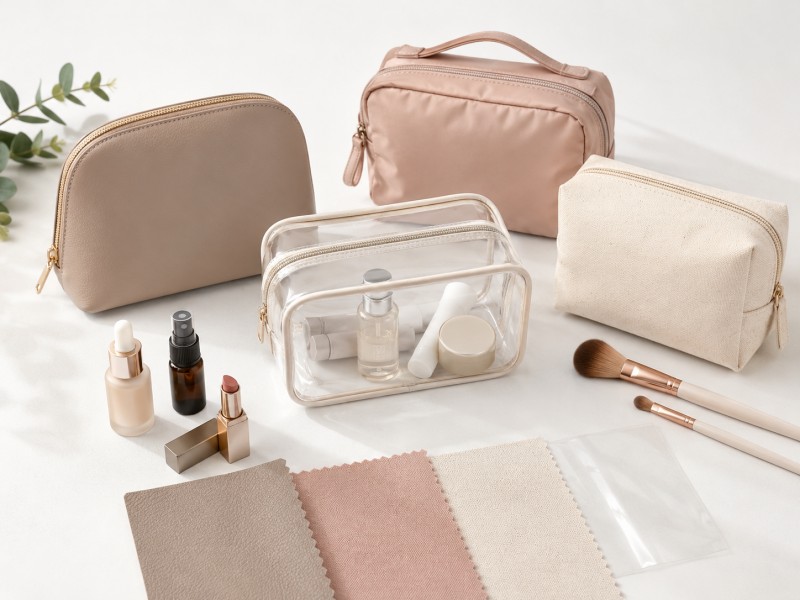
Cosmetic Bag Material Selection for Beauty Brands
A cosmetic bag may look simple at first glance.
A zipper. A pouch shape. A logo. A nice color.
But once a beauty brand starts planning a real product launch, the material choice becomes one of the earliest decisions that can shape the whole project.
The wrong material can make a premium skincare set feel cheap. It can make a clear travel pouch smell strong, crease badly, or scratch too easily. It can make a printed logo look flat. It can make the inside hard to clean after one leaked foundation bottle. It can also push the price, sample timing, packing method, and repeat order quality in the wrong direction.
The right material does the opposite.
It supports the brand look. It protects the beauty items inside. It works with the logo method. It feels right in the hand. It matches the selling channel. It also helps the production team keep the sample and bulk order closer in color, shape, and finish.
For beauty brands, cosmetic bag material selection is not only a fabric choice. It is a product decision.
It connects design, function, cleaning, price, branding, packaging, and production control in one place. Common choices in today’s custom makeup bag projects include nylon, polyester, PU leather, PVC, TPU, EVA, canvas, cotton, rPET, recycled nylon, organic cotton, velvet, satin, and vegan leather. Different material guides on the current web also connect these materials with water resistance, easy cleaning, logo method, sustainability claims, and retail positioning.
A good cosmetic bag material should match the brand position, product use, cleaning need, logo method, lining choice, packaging plan, target cost, sample process, and bulk order standard. Nylon and polyester work well for practical daily pouches. PU leather suits premium gift sets. PVC and TPU fit clear or waterproof travel bags. Canvas, cotton, rPET, and recycled fabrics suit natural or eco-focused beauty projects.
That is the short version.
Now let’s look at how beauty brands can make a smarter choice before sampling.
What Is Cosmetic Bag Material Selection for Beauty Brands?
Cosmetic bag material selection means choosing the outer fabric, lining, coating, structure, logo method, zipper detail, and finish based on how the bag will be used and sold. For beauty brands, the right material should match the product inside, the brand image, the cleaning requirement, the target price, the packaging plan, and the expected bulk order quality.
A beauty pouch is not just a container. It may sit inside a gift box. It may be sold on a retail shelf. It may be used as a gift-with-purchase item. It may travel inside a suitcase. It may hold skincare bottles, brushes, lipsticks, palettes, foundation, perfume samples, or toiletry items.
Each use changes the material decision.
A pouch for a holiday skincare set may need a softer, more premium surface. A travel toiletry kit may need wipe-clean lining and water resistance. A clean beauty campaign may need rPET, cotton canvas, or other responsible material choices. A high-volume promotion may need a practical material that controls cost without looking careless.
This is where many projects go wrong.
Some teams choose the material only by photo. The sample looks good, but the bulk order feels too soft, the bag shape collapses, or the logo does not sit well on the surface. Others choose the lowest-cost material, then spend more time fixing problems with structure, lining, printing, or packaging.
A smarter method starts with use.
Ask what the bag must do. Then choose the material.
For a brand project, that matters. Material choice should not live alone. It should be reviewed together with structure, logo, lining, packing, quantity, timeline, and repeat order needs.
Which Cosmetic Bag Material Is Best for Your Beauty Project?
The best cosmetic bag material depends on the project. Nylon and polyester are good for daily use and larger runs. PU leather works well for premium beauty sets. PVC and TPU are strong choices for clear or waterproof travel pouches. Canvas, cotton, rPET, and recycled nylon are better for natural, clean, or eco-focused beauty programs.
Here is a practical comparison.
| Material | Best Fit | Main Benefit | Watch Carefully |
|---|---|---|---|
| Nylon | Travel makeup bags, daily pouches | Lightweight, strong, practical | Thickness and coating affect structure |
| Polyester | Event bags, high-volume beauty campaigns | Cost-friendly, easy to print | Low-grade fabric can look too basic |
| PU Leather | Premium gift sets, retail cosmetic bags | Clean look, better perceived value | Edge finish, texture, and backing matter |
| PVC | Clear pouches, waterproof cosmetic bags | Transparent, wipe-clean, budget-friendly | Odor, cold crack, scratches, and thickness |
| TPU | Clear travel kits, upgraded clear bags | Softer handfeel, cleaner finish | Higher cost than basic PVC |
| EVA | Semi-structured cases, molded pouches | Shape support and protection | Mold and structure planning may be needed |
| Canvas / Cotton | Clean beauty, lifestyle skincare brands | Natural texture, soft brand feel | Stain and water resistance need lining support |
| rPET | Recycled-material beauty campaigns | Strong eco story, scalable use | Certification and material source should be checked |
| Velvet / Satin | Seasonal gifts, premium kits | Soft, gift-ready surface | Needs careful packing to prevent marks |
A useful material choice usually comes from three layers.
The first layer is visual. Does the material match the brand’s look? Minimal skincare, bold makeup, travel beauty, natural care, luxury gifting, and mass promotion all need different surfaces.
The second layer is functional. Does the material resist water, stains, oil, pressure, and daily handling? A makeup pouch is often touched with wet hands, placed on bathroom counters, or packed beside liquids. A beautiful fabric that stains too easily can create poor daily use.
The third layer is production control. Can the material be sourced steadily? Can the color be repeated? Can the same handfeel return in the next order? Does the logo process work on that surface?
Current material guides often group nylon and polyester as practical choices, PU leather as a more premium option, PVC and TPU as clear or travel-friendly materials, and rPET or Tyvek as options for more responsible product stories.
That does not mean one material is always better than another.
It means the right one depends on the job.
For a skincare brand launching a premium night-care set, PU leather or velvet may create a stronger gift feeling. For a travel-size beauty kit, TPU or coated nylon may be more useful. For a large event campaign, polyester or cotton canvas may make more sense. For a clean beauty collection, rPET or organic cotton can support the brand message.
Before choosing, write down the use scene in one sentence.
For example:
“This pouch will hold three travel-size skincare bottles inside a holiday gift box.”
That one sentence already gives the production team a better direction than “We need a cosmetic bag.”
How Do Materials Affect Brand Position, Price, and User Perception?
Material affects how people judge the product before they use it. A cosmetic bag can make a beauty set feel affordable, practical, natural, premium, travel-ready, or gift-ready. The same logo can look very different on polyester, PU leather, canvas, TPU, or velvet, so material choice should match the brand’s price level and selling channel.
Beauty products are emotional products.
People judge them through color, texture, touch, packaging, and small details. A cosmetic bag sits right inside that experience. It may not be the hero product, but it changes the total feeling of the set.
Think about these examples.
A thin polyester pouch can be suitable for a large event giveaway. It is light, foldable, and efficient for volume. But put the same pouch inside a $120 skincare gift set, and it may feel out of place.
A smooth PU leather pouch may be too costly for a one-day outdoor promotion. But in a premium holiday kit, it can make the set feel more complete.
A clear PVC pouch may work well for a fun, practical travel kit. But for a high-end clean beauty line, a softer TPU or rPET fabric pouch may feel more aligned.
Canvas has a natural and relaxed feeling. It can suit clean beauty, wellness, spa, and lifestyle brands. Yet it may need a coated lining if the pouch will hold liquids.
This is why material is not only a cost item. It is part of the brand language.
Here is a simple decision table.
| Brand Direction | Better Material Direction | Why It Works |
|---|---|---|
| Budget promotion | Polyester, simple PVC, non-woven, cotton | Keeps cost under control |
| Mid-level skincare | Nylon, coated polyester, canvas | Practical and clean |
| Premium gift set | PU leather, velvet, satin, structured nylon | Gives stronger gift value |
| Travel beauty | TPU, PVC, coated nylon, EVA | Wipe-clean and travel-friendly |
| Clean beauty | Cotton, canvas, rPET, recycled nylon | Natural or responsible feel |
| Retail shelf line | PU leather, quilted nylon, printed polyester | Better shape and display value |
Price is not only about material cost.
It is also about how the material cuts, sews, folds, prints, packs, and repeats. PU leather may need better edge control. TPU may need careful handling to avoid marks. Velvet may need protective packing. Canvas may need a lining to prevent stains. rPET may need extra documentation if the brand wants to make recycled-material claims.
A strong beauty project does not always choose the most expensive material.
It chooses the material that makes the product feel believable at its price.
That is the real goal.
PVC vs TPU vs EVA: Which Clear Cosmetic Bag Material Should You Choose?
PVC is often used for clear, waterproof, and cost-sensitive cosmetic pouches. TPU is usually chosen when a brand wants a softer, cleaner, more upgraded clear bag. EVA is better for semi-structured cases or protective shapes. The right choice depends on price, clarity, handfeel, structure, odor control, and travel use.
Clear cosmetic bags are popular because they are practical.
People can see what is inside. They are easy to wipe. They work for travel kits, toiletry sets, summer campaigns, skincare samples, and clear retail pouches.
But clear materials are not all the same.
PVC is common because it is easy to shape, transparent, and cost-friendly. It works well for many promotional and travel-style pouches. For large campaigns, PVC can be a practical choice when the design is simple and the target cost is tight.
TPU usually feels softer and more refined. It can give a cleaner surface, better flexibility, and a more upgraded feel. For beauty brands that want a clear bag but do not want it to feel too basic, TPU is often worth reviewing.
EVA is different. It is not usually chosen just for clear pouch styling. It is better when the product needs shape, padding, or molded protection. EVA works well for structured cases, travel organizers, tool-like beauty kits, or protective pouches.
| Material | Better For | Strong Side | Risk to Check |
|---|---|---|---|
| PVC | Clear promotional pouches, waterproof cosmetic bags | Cost-friendly, transparent, easy wipe | Odor, scratch marks, low-temperature performance |
| TPU | Upgraded clear travel makeup bags | Softer feel, cleaner look, better flexibility | Higher cost than basic PVC |
| EVA | Structured cases and protective kits | Shape support, protection, molded feel | Mold cost, structure planning, bulk size |
For clear cosmetic bags, thickness matters.
Too thin, and the pouch may feel flimsy. Too thick, and it may feel stiff. A clear pouch also needs clean seam work, suitable zipper tape, neat binding, and careful packing. Scratches and pressure marks are more visible on clear surfaces.
If the bag will be used for travel, check whether it needs a flat pouch, gusset pouch, boxy case, or hanging toiletry style. If it will hold liquids, think about seam finish and zipper direction. If it will be used as a retail item, check how it looks under light and whether the logo remains visible when products are inside.
A clear bag is not just clear material.
It is a balance of transparency, touch, structure, cleaning, and brand level.
For projects comparing PVC, TPU, or EVA cosmetic bags, sharing the target size, quantity, logo method, and use case with info@jundongfactory.com can help narrow the material direction before sampling.
How Should Beauty Brands Match Material, Lining, and Zipper Details?
Beauty brands should match outer material with lining and zipper details because the inside of a cosmetic bag often faces more abuse than the outside. Liquids, powders, oils, brushes, and small bottles can stain or scratch the lining. A good material plan should include wipe-clean lining, suitable zipper strength, pocket layout, and logo placement.
A cosmetic bag fails in small places.
The zipper gets stuck. The lining stains. The brush loop tears. The mesh pocket stretches. The zipper pull feels cheap. The pouch shape collapses after packing. These are the issues that can turn a nice-looking sample into a weak retail item.
The outer material sets the look.
The lining decides daily use.
For skincare items, a PEVA or coated lining can help with wipe-clean performance. For premium gift sets, satin or smooth polyester lining may feel better. For travel toiletry kits, waterproof lining and seam handling matter more. For clear PVC or TPU pouches, the design may not need lining, but binding and seam quality become more visible.
| Outer Material | Lining Direction | Good Use |
|---|---|---|
| Nylon | Polyester lining, coated lining | Daily pouches, travel makeup bags |
| Polyester | Polyester, PEVA, coated lining | Promotions, retail kits |
| PU Leather | Smooth polyester, satin lining | Gift sets, private label pouches |
| Canvas / Cotton | PEVA or coated lining | Clean beauty, skincare sets |
| PVC / TPU | No lining, bound seams | Clear waterproof pouches |
| rPET | Recycled polyester lining | Responsible-material beauty projects |
| Velvet | Satin or soft lining | Holiday gifts, premium kits |
Zipper choice also matters.
A beauty pouch may be opened many times each day. The zipper should match the size, fabric thickness, and product value. A small nylon zipper may be fine for a flat pouch. A metal zipper can look better on PU leather but may add weight and cost. A custom zipper pull can turn a simple pouch into a branded item.
Internal structure should be reviewed early.
Does the bag need brush slots? A mesh pocket? A removable divider? A waterproof section? Elastic loops? A hanging hook? A mirror pocket? Bottle standing space?
Every added detail changes production time and price. But it can also make the pouch much more useful.
A good development team should not ask only, “What material do you want?”
It should ask, “What will go inside, how will people use it, and what should they feel when they open it?”
That is where better cosmetic bag design begins.
How Does Logo Method Change with Different Cosmetic Bag Materials?
Logo method should change with the material surface. PU leather works well with debossing, embossing, metal plates, and clean printing. Canvas suits embroidery, screen printing, and woven labels. PVC and TPU often use surface printing, label patches, or zipper branding. The best logo method should look clear, last well, and match the product value.
A logo can make or break a cosmetic bag.
On the right material, it looks clean and intentional. On the wrong material, it can peel, crack, sink, blur, or feel out of scale.
Here is a practical guide.
| Material | Better Logo Choices | Brand Feel |
|---|---|---|
| PU Leather | Debossed logo, embossed logo, foil effect, metal plate | Premium, clean, retail-ready |
| Nylon | Screen print, woven label, rubber patch | Sporty, travel, practical |
| Polyester | Heat transfer, screen print, embroidery | Flexible, campaign-friendly |
| Canvas / Cotton | Embroidery, screen print, woven label | Natural, lifestyle, handmade feel |
| PVC / TPU | Surface print, label patch, zipper pull, sewn tag | Clear, modern, travel-friendly |
| Velvet / Satin | Embroidery, woven label, metal charm | Soft, gift-focused |
| rPET | Print, woven label, recycled-material tag | Responsible, modern |
Logo size is another common issue.
A large logo may look good on a flat mockup, but too heavy on a small pouch. A tiny logo may disappear on textured canvas. A shiny metal plate may look premium on PU leather but too formal for a casual clean beauty line. A heat transfer logo may work well on polyester but not always on heavily textured material.
Placement matters too.
Common logo positions include the front center, lower corner, zipper pull, side label, woven seam tag, metal plate, or inner label. For beauty brands, a subtle logo sometimes feels more premium than a large front print.
The logo method should be tested on the real material before bulk order.
A digital layout cannot show the full truth. It cannot show ink absorption, surface tension, emboss depth, thread texture, or how the logo looks after the bag is filled.
When Should You Choose Sustainable Cosmetic Bag Materials?
Choose sustainable cosmetic bag materials when the bag supports a clean beauty launch, natural skincare set, retail campaign, reusable pouch program, or brand story around lower-impact materials. rPET, recycled nylon, organic cotton, canvas, recycled PU, Tyvek, and plant-based vegan leather can all work, but each needs cost, MOQ, certification, and durability review.
Responsible material choices are now part of many beauty projects.
But they need careful planning.
A recycled material is not automatically better for every pouch. Organic cotton looks natural, but it can stain more easily if not paired with a good lining. rPET can support a recycled-material story, but the brand may need documentation. Recycled nylon can be strong and practical, but price and material supply should be checked. Vegan leather can look premium, but surface quality and durability still matter.
Current search results show that eco-focused makeup bag materials often include rPET, recycled nylon, organic cotton, canvas, recycled PU, plant-based vegan leather, and related options. Some sources also connect rPET and recycled nylon with durability, color control, and campaign use.
Here is a simple way to think about it.
| Material | Better Fit | Key Check |
|---|---|---|
| rPET | Beauty campaigns, travel pouches, gift sets | Recycled content, color, coating |
| Recycled Nylon | Durable travel cosmetic bags | Strength, handfeel, finish |
| Organic Cotton | Clean beauty, natural skincare | Shrinkage, stain control, lining |
| Canvas | Lifestyle pouches, spa sets | Weight, texture, print effect |
| Recycled PU | Premium eco-positioned sets | Surface quality, backing, smell |
| Tyvek | Lightweight campaign pouches | Texture, structure, print result |
| Vegan Leather | Premium non-animal look | Durability, finish, cost |
The biggest mistake is using responsible material only as a claim.
The product still needs to work.
A clean beauty pouch must still hold products safely. A recycled fabric bag must still sew cleanly. A natural cotton pouch must still match the logo and packaging. A premium vegan leather pouch must still feel good in the hand.
For beauty brands, responsible material works best when the whole project supports the same message.
That includes hangtags, labels, packaging, carton marks, and product copy.
A natural-looking pouch packed in careless plastic may feel inconsistent. A recycled-material bag with no visible story may lose marketing value. A responsible material with poor durability can hurt trust.
So the better is not only “Is this material sustainable?”
The better is:
“Can this material support the brand story, product use, cost target, and repeat order plan at the same time?”
How Do Sample, MOQ, Price, and Lead Time Affect Material Choice?
Material choice can change sample time, MOQ, price, color availability, logo setup, packaging cost, and bulk lead time. Stock materials are usually faster and more flexible. Custom colors, special coatings, certified fabrics, molded EVA, and complex logo methods may need more planning. A material should be chosen with both sample approval and bulk production in mind.
Many beauty teams fall in love with a material before checking the project conditions.
Then the problems begin.
The color is not in stock. The MOQ is higher than expected. The logo needs a new process. The sample takes longer. The zipper must be upgraded. The lining adds cost. The packaging needs more space. The bulk order cannot match the first sample if the fabric source changes.
A realistic material plan looks at four things early.
Quantity. Timeline. Target price. Brand level.
| Project Factor | Why It Affects Material |
|---|---|
| Order quantity | Some materials are easier for small runs; others need higher planning |
| Target price | Fabric, lining, logo, zipper, packing, and labor all affect final cost |
| Sample time | Stock materials can move faster than custom-developed materials |
| Logo method | Debossing, embroidery, printing, and metal plates need different setup |
| Color requirement | Pantone matching or custom dyeing may affect MOQ and time |
| Structure | Boxy pouches, hanging bags, and EVA cases need more development |
| Packaging | Gift boxes, barcode labels, and hangtags affect total project cost |
| Repeat order | Stable sourcing helps keep later orders consistent |
These numbers should not be treated as one-size-fits-all. A simple polyester pouch and a structured PU leather travel case do not share the same path. A clear TPU pouch with custom zipper pull and retail packaging needs more checking than a flat cotton pouch with a screen print logo.
The cheapest material is not always the lowest-risk choice.
A slightly better fabric can reduce returns, improve product photos, support a higher retail price, and make the brand look more careful. In many beauty projects, a small upgrade in material can make a visible difference.
The best approach is to review two or three material options at the same time.
For example:
Option A: cost-friendly material for promotion.
Option B: balanced material for retail use.
Option C: premium material for gift set or higher perceived value.
This gives the brand a real choice instead of a blind quote.
What Is the Factory Process for Custom Cosmetic Bag Material Approval?
A custom cosmetic bag material approval process usually starts with use case review, target cost, quantity, size, logo file, and material direction. Then material swatches, lining, zipper, logo method, and structure are checked before sampling. After sample revision and pre-production approval, bulk production should follow confirmed material, color, logo, sewing, packing, and inspection standards.
A strong process reduces surprises.
Here is a practical path.
| Step | What Happens | Why It Matters |
|---|---|---|
| 1. Use case review | Confirm travel, gift, retail, GWP, or storage use | Sets the material direction |
| 2. Size and item check | Review what the pouch will hold | Helps structure and capacity |
| 3. Material options | Compare fabric, PU, PVC, TPU, canvas, rPET, etc. | Gives practical choices |
| 4. Lining and zipper review | Match inner use and opening strength | Improves daily function |
| 5. Logo method check | Review print, embroidery, deboss, label, plate | Protects brand appearance |
| 6. Sample making | Create first sample | Turns idea into real product |
| 7. Revision | Adjust size, material, logo, structure, lining | Reduces bulk risk |
| 8. Pre-production sample | Confirm final standard before production | Helps control consistency |
| 9. Bulk production | Produce according to approved details | Keeps order controlled |
| 10. Inspection and packing | Check material, stitching, logo, structure, labels, cartons | Supports delivery readiness |
For beauty brands, the sample stage is not a formality.
It is the moment where the project becomes real.
A mockup cannot show whether the zipper pulls smoothly. It cannot show whether the pouch stands well. It cannot show whether the lining feels too noisy, whether the PU surface scratches easily, or whether the logo size feels right in hand.
Sample review should be specific.
Instead of saying “make it better,” a brand should review:
- size and capacity
- shape after filling
- material handfeel
- lining cleanliness
- zipper smoothness
- logo position
- logo size
- color accuracy
- sewing neatness
- inside pocket function
- packing method
The pre-production sample is especially useful for repeat orders.
It becomes the reference for bulk production and later reorders. For beauty brands with growing product lines, this helps keep materials, colors, logos, and packaging more consistent over time.
This is also where a real factory process differs from a simple catalog order.
A catalog product asks, “Which existing item do you want?”
A development process asks, “What should this product become for your brand?”
That difference matters.
Who Should Work with a Cosmetic Bag Factory Instead of a Promotional Platform?
Beauty brands should work with a cosmetic bag factory when they need custom material, private label details, controlled samples, special logo methods, lining choices, packaging support, repeat order consistency, or more than a simple ready-made pouch. A promotional platform may fit basic items, but a factory is better for brand-led product development.
Promotional platforms can be useful.
They are often fast for simple pouches, basic logo printing, and small campaigns with limited customization. If the product is not central to the brand experience, that may be enough.
But beauty brands often need more control.
They may need a pouch that matches a skincare set. They may need custom color, special lining, metal logo plate, retail packaging, gift box fit, barcode label, hangtag, carton mark, or multi-SKU coordination.
That is where factory support becomes more valuable.
| Promotional Platform | Cosmetic Bag Factory |
|---|---|
| Good for basic ready-made items | Better for custom material and structure |
| Limited material choices | Wider review of fabric, PU, PVC, TPU, neoprene, leather, lining |
| Basic logo service | More logo method and placement planning |
| Less sample adjustment | More sample revision and pre-production control |
| Often product-first | Project-first and brand-use focused |
| Better for simple campaigns | Better for private label, retail, gift sets, and repeat programs |
A beauty brand should consider factory support when:
- the pouch will be sold as part of a retail set
- the bag must match brand color
- the logo must look premium
- the project needs custom lining or pockets
- the material needs a certain handfeel
- the product must work across several SKUs
- the order may repeat later
- the packaging must fit retail or export needs
- the brand wants more control before bulk production
This does not mean every project needs a complex development path.
A simple pouch can still be simple.
The key is knowing when simplicity is enough and when the product needs stronger control.
If your cosmetic bag will represent your brand in a gift set, retail shelf, subscription box, or long-term product line, treating it as a real product is usually the better move.
How to Choose the Right Cosmetic Bag Material for Your Next Beauty Collection
To choose the right cosmetic bag material, start with the use case, product contents, target price, brand level, cleaning needs, logo method, and order plan. Then compare two or three material routes before sampling. The best choice should look right, clean well, support the logo, fit the packaging, and stay consistent in bulk production.
Here is a clear checklist.
| Decision Area | What to Confirm |
|---|---|
| Use | Travel, retail, gift set, GWP, storage, professional kit |
| Contents | Bottles, brushes, palettes, lipstick, skincare tubes, toiletries |
| Cleaning | Waterproof, wipe-clean, stain-resistant, washable, lined |
| Brand level | Mass promotion, mid-level retail, premium gift, clean beauty |
| Material | Nylon, polyester, PU, PVC, TPU, canvas, cotton, rPET, velvet |
| Logo | Print, embroidery, deboss, metal plate, woven label, zipper pull |
| Structure | Flat pouch, box pouch, hanging bag, organizer, EVA case |
| Packaging | Polybag, hangtag, gift box, color box, barcode label, carton mark |
| Quantity | Trial run, retail launch, seasonal campaign, repeat order |
| Timeline | Sample time, revision time, bulk production, shipping window |
For beauty brands, the best material plan often comes from a few simple:
What will go inside the pouch?
Will the product be sold, gifted, or used as a campaign item?
Should the bag feel premium, natural, playful, or travel-ready?
Does it need to be waterproof or easy to wipe?
Will the logo be printed, embossed, embroidered, or attached as a label?
Does the packaging need to fit a gift box or retail display?
Will the same design be reordered later?
Once these are clear, the material choice becomes much easier.
For example, a clean beauty brand may compare canvas with coated lining, rPET with recycled lining, and organic cotton with embroidery. A travel skincare brand may compare TPU, PVC, and coated nylon. A premium gift set may compare PU leather, velvet, and structured polyester.
The best project does not start with “What is the cheapest material?”
It starts with “What material makes this product feel right, work well, and scale safely?”
That is the decision that helps a cosmetic bag become more than a pouch.
It becomes part of the brand experience.
For a custom cosmetic bag project, you can send the target size, material idea, logo file, quantity, use scene, and packaging needs to info@jundongfactory.com. A suitable material direction can be reviewed before sample development.
Quick FAQs About Cosmetic Bag Material Selection
FAQ 1: What material is best for custom cosmetic bags for beauty brands?
Certainly, the best material for a custom cosmetic bag depends on how the bag will be used, what it will hold, and what feeling the beauty brand wants to create. For daily makeup pouches, nylon and polyester are practical because they are lightweight, durable, and cost-friendly for larger orders. For premium skincare sets, PU leather, velvet, satin, or structured nylon can give a more polished gift-ready look. For travel toiletry kits, PVC, TPU, coated nylon, and EVA are stronger choices because they handle moisture, spills, and suitcase use better.
A simple way to choose is to match material with project type:
| Project Type | Better Material Direction | Why It Works |
|---|---|---|
| Beauty event giveaway | Polyester, cotton, PVC | Cost-friendly and easy to customize |
| Premium skincare gift set | PU leather, velvet, satin | Better handfeel and higher visual value |
| Travel makeup kit | TPU, PVC, coated nylon | Wipe-clean and water-resistant |
| Clean beauty campaign | Canvas, cotton, rPET | Natural or responsible-material story |
| Retail cosmetic pouch | PU leather, quilted nylon, printed polyester | Better display and stronger shape |
Here is the practical truth: no single material is best for every cosmetic bag. A low-cost polyester pouch may be perfect for a large beauty event, but it may feel too basic inside a high-end skincare box. PU leather may look premium, but it may be too much for a budget promotion. TPU may be better than PVC for an upgraded clear pouch, but the price should match the product plan.
The smarter move is to compare two or three material routes before sampling. One route can focus on cost, one on balanced value, and one on premium presentation. This gives your team a real choice instead of guessing from photos.
FAQ 2: Which material is better for waterproof cosmetic bags: PVC, TPU, coated nylon, or EVA?
Sure, PVC, TPU, coated nylon, and EVA can all work for waterproof or water-resistant cosmetic bags, but they are not used in the same way. PVC is often chosen for clear cosmetic pouches, budget-friendly waterproof bags, and travel-size beauty kits. TPU is usually softer, smoother, and better for brands that want a cleaner clear-bag look. Coated nylon is a good choice for travel makeup bags that need strength without a fully transparent style. EVA works better when the bag needs shape, padding, or a semi-rigid structure.
Here is a clear comparison:
| Material | Best Use | Main Strength | What to Check |
|---|---|---|---|
| PVC | Clear makeup bags, budget travel pouches | Transparent and easy to wipe | Odor, scratch marks, cold weather feel |
| TPU | Premium clear travel pouches | Softer and cleaner looking | Higher cost than basic PVC |
| Coated Nylon | Travel toiletry bags, daily makeup kits | Strong, flexible, water-resistant | Coating quality and lining |
| EVA | Molded cases, structured beauty kits | Shape support and protection | Mold cost and packing volume |
The detail many brands miss is this: waterproof material does not automatically make a fully waterproof bag. Seams, zipper type, stitching method, binding, lining, and opening direction also affect how well the bag handles liquid. A PVC pouch with weak zipper finishing may still leak through openings. A coated nylon toiletry bag may resist splashes well, but it is not the same as a sealed dry bag.
For beauty projects, “easy to wipe” is often more useful than extreme waterproofing. Makeup bags usually deal with foundation spills, serum leaks, powder marks, and wet bathroom counters. So, the right goal is often a cleanable structure, not just a waterproof label.
If the bag will hold liquid skincare bottles, ask for lining, seam, zipper, and packing review before sample approval. That small step can prevent many problems later.
FAQ 3: Is PU leather a good choice for premium cosmetic bags?
Absolutely, PU leather is one of the strongest choices for premium cosmetic bags, especially when the project is tied to skincare gift sets, retail beauty collections, private label pouches, holiday campaigns, or higher-value product bundles. It gives a smooth surface, clean structure, and a polished look that works well with debossed logos, embossed logos, metal plates, foil details, or subtle front branding.
PU leather is popular because it can create a premium feeling without using genuine leather. It also wipes clean more easily than many woven fabrics, which is useful for beauty products. A well-made PU cosmetic bag can feel modern, neat, and gift-ready.
But PU leather needs careful review.
Not all PU is the same. The final result depends on:
| Detail | Why It Matters |
|---|---|
| Thickness | Affects structure and handfeel |
| Backing | Influences strength and sewing stability |
| Surface texture | Changes the visual style |
| Edge finish | Affects whether the bag looks premium or rough |
| Logo method | Debossing, embossing, print, or metal plate all look different |
| Lining | Helps protect the inside and lift perceived value |
| Zipper quality | Can make or weaken the premium feel |
PU leather can look excellent when the structure is clean. But if the material is too thin, the bag may wrinkle. If the edge finish is rough, the premium effect disappears. If the logo is too large or placed poorly, the bag may feel less refined.
For beauty brands, PU leather works best when the design stays controlled. A clean shape, balanced logo size, smooth lining, and good zipper can make the product look much more valuable. It is not only about choosing PU. It is about building the whole pouch around that material.
FAQ 4: Should beauty brands choose canvas, cotton, or rPET for clean beauty cosmetic bags?
Definitely, canvas, cotton, and rPET are strong choices for clean beauty cosmetic bags, but each one tells a different story. Canvas and cotton give a natural, soft, lifestyle feeling. They work well for skincare, spa, wellness, organic beauty, and minimalist brand collections. rPET is better when the brand wants to highlight recycled-material use, modern practicality, and repeatable production for larger programs.
Here is how to compare them:
| Material | Better For | Main Benefit | What to Watch |
|---|---|---|---|
| Canvas | Natural skincare sets, spa pouches | Strong texture and lifestyle feel | May need lining for stain control |
| Cotton | Soft beauty pouches, clean beauty gifts | Natural handfeel | Can stain or shrink if not handled well |
| rPET | Recycled-material beauty campaigns | Modern eco story and scalable use | Material source and documentation |
| Recycled Nylon | Durable eco travel makeup bags | Stronger performance | Higher cost than basic polyester |
Canvas and cotton are beautiful when the brand wants a soft, natural look. But beauty products are messy. Foundation, oil, sunscreen, serum, and powder can stain untreated natural fabrics. That is why many clean beauty pouches still need a coated lining, PEVA lining, or washable inner layer.
rPET offers a different strength. It can look cleaner and more modern than cotton, while supporting a recycled-material story. It is often suitable for travel pouches, makeup bags, and campaign kits where durability also matters. If the brand wants to make recycled-content claims, material documentation should be reviewed early.
A clean beauty pouch should not only look natural. It should also work in daily use. The best version often combines natural texture outside with practical lining inside.
That balance feels honest, useful, and easier to trust.
FAQ 5: How does cosmetic bag material affect logo printing and brand presentation?
Of course, cosmetic bag material strongly affects logo clarity, durability, color result, and overall brand presentation. A logo that looks sharp on PU leather may not work the same way on canvas. A heat transfer logo that performs well on polyester may not suit textured cotton. A metal plate may lift a premium pouch, but it may feel too heavy for a lightweight travel bag.
The material decides how the logo sits, shines, presses, stitches, or bonds.
| Material | Better Logo Method | Brand Feeling |
|---|---|---|
| PU Leather | Debossing, embossing, foil, metal plate | Premium and clean |
| Nylon | Screen print, woven label, rubber patch | Travel-ready and practical |
| Polyester | Heat transfer, screen print, embroidery | Flexible for campaigns |
| Canvas / Cotton | Embroidery, screen print, woven label | Natural and lifestyle-driven |
| PVC / TPU | Surface print, patch, zipper pull, side label | Modern and clear |
| Velvet / Satin | Embroidery, woven label, metal charm | Soft and gift-focused |
| rPET | Print, woven label, recycled tag | Modern and responsible |
Logo size also matters. Many teams send a large logo because it looks good on a digital layout. But on a small cosmetic pouch, a large logo can feel too loud. A small logo can look refined on PU leather, but it may disappear on textured canvas. A woven side label may feel more natural than front printing for clean beauty. A metal plate may work well for a premium gift set but not for a flexible travel pouch.
Logo placement should be reviewed with the bag filled, not only flat. Once the pouch has products inside, the surface curve may change. The logo may sit higher, lower, or less visible than expected.
The best practice is simple: test the logo on the real material during sampling. Do not rely only on a mockup. A real sample shows texture, depth, shine, stitching, and proportion in a way a flat file cannot.
FAQ 6: How long does it take to make a custom cosmetic bag sample?
Certainly, sample time depends on material, structure, logo method, lining, zipper details, and how many changes are needed. As a practical reference, Jundong’s provided company information notes that sample time is usually around 5–7 days, while some simpler styles may be completed in 2–3 days. More complex cosmetic bags, special materials, molded EVA cases, custom zipper pulls, or multi-compartment toiletry kits may take longer.
A flat polyester pouch with a simple screen print logo can move quickly. A PU leather bag with custom metal logo, satin lining, shaped bottom, and gift-box packing needs more checking. A clear TPU pouch may need extra review for thickness, transparency, seam finish, and scratch protection. A canvas clean beauty pouch may need fabric shrinkage, lining, embroidery, and color testing.
Here is a simple guide:
| Bag Type | Sample Timing Tendency | Why |
|---|---|---|
| Simple flat pouch | Faster | Fewer structure and material details |
| Basic polyester cosmetic bag | Faster | Easier fabric and logo setup |
| PU leather gift pouch | Medium | Needs logo, edge, lining, zipper review |
| Clear PVC / TPU pouch | Medium | Thickness, seam, and packing need checking |
| Multi-compartment toiletry bag | Longer | More pattern work and internal structure |
| EVA molded case | Longer | Shape and mold-related details may apply |
A sample should not be rushed only for speed. It is the stage where problems are easiest to fix. Once bulk production starts, changes become slower and more expensive.
A strong sample review should cover size, shape, capacity, handfeel, lining, zipper, logo position, logo size, color, stitching, packing, and how the pouch looks when filled. That is what turns a sample into a reliable production reference.
FAQ 7: What MOQ should a beauty brand expect for custom cosmetic bags?
Sure, MOQ depends on the material, color, structure, logo method, packing style, and whether the material is in stock or custom-developed. As a practical reference, Jundong’s provided company information notes that the usual MOQ is around 500 pcs, while some styles may apply for 200–300 pcs depending on the project.
That means MOQ is not only a number. It is connected to how the bag is made.
A simple pouch using stock fabric may allow more flexibility. A custom-dyed material, special coating, certified rPET fabric, custom zipper pull, metal logo plate, or molded EVA structure may need higher planning. If the brand wants a fully custom Pantone color, the fabric mill may have its own minimum requirement. If the project needs special packaging, that packaging may also affect minimum quantities.
| Project Feature | MOQ Impact |
|---|---|
| Stock material | Usually more flexible |
| Custom color | May increase minimum quantity |
| Special lining | Depends on material availability |
| Metal logo plate | May involve mold or setup quantity |
| Certified material | Needs early sourcing check |
| Custom zipper pull | May add accessory minimums |
| Gift box packing | May create packaging minimums |
| Multi-color assortment | Needs careful production planning |
For a new beauty brand, a smaller run may help test design and product fit. For a growing brand, 500 pcs is often a practical starting level because it gives better production efficiency and more stable unit cost. For larger retail or campaign orders, higher volume can improve price, but only if the material and packing plan are already confirmed.
MOQ should be reviewed with the real project details, not guessed from a product photo. Share the size, material, logo, quantity goal, and packing idea early. That makes the MOQ discussion much more accurate.
FAQ 8: How can beauty brands control cosmetic bag cost without making the product look cheap?
Absolutely, cost control does not mean choosing the cheapest material. A better way is to simplify the right parts while protecting the parts people see and touch most: outer material, zipper feel, logo quality, shape, and lining cleanliness. A cosmetic bag can stay cost-smart and still look brand-ready if the design choices are balanced.
Many teams try to reduce cost by downgrading fabric first. Sometimes that works. But often it creates a weak product. Thin fabric, poor zipper, messy logo, and limp structure can make the whole beauty set feel lower in value. A smarter method is to review the full cost structure.
| Cost Area | Smart Control Method |
|---|---|
| Material | Use a balanced fabric instead of the lowest grade |
| Structure | Avoid unnecessary compartments if not needed |
| Logo | Choose the method that fits the material, not the fanciest one |
| Zipper | Keep smooth opening; do not over-design hardware |
| Lining | Use practical lining where spills matter most |
| Color | Use stock colors when timing and cost are tight |
| Packing | Match packing to sales channel; avoid wasteful extras |
| Size | Design around the real product contents |
For example, a polyester pouch can look better with a clean shape, nice zipper pull, and well-placed woven label. A canvas pouch can feel more valuable with a simple lining and neat embroidery. A PU leather bag can stay cost-controlled by using a clean structure instead of adding too many metal parts.
The key is to spend where the user notices.
They notice the first touch. They notice the zipper. They notice the logo. They notice whether the bag stands well. They notice whether the inside stains easily.
A cost-smart cosmetic bag should not feel stripped down. It should feel focused.
FAQ 9: How can a beauty brand avoid sample-to-bulk differences in cosmetic bags?
Definitely, the best way to reduce sample-to-bulk differences is to confirm every visible and functional detail before bulk production: material swatch, color, logo method, lining, zipper, stitching, size, structure, packing, and pre-production sample. A cosmetic bag may look simple, but small differences in fabric thickness, coating, zipper tension, or logo placement can change the final feel.
A good sample should become a standard, not just a nice photo.
Before bulk production, review these items:
| Detail | What to Confirm |
|---|---|
| Material | Thickness, handfeel, coating, texture |
| Color | Pantone reference or approved color swatch |
| Logo | Size, position, method, color, durability |
| Lining | Material, color, seam finish, stain resistance |
| Zipper | Smoothness, puller style, tape color |
| Shape | Flat, boxy, gusseted, standing, hanging |
| Size | Width, height, depth, tolerance |
| Stitching | Thread color, seam neatness, reinforcement |
| Packing | Polybag, hangtag, barcode, gift box, carton mark |
| Reference sample | Approved pre-production sample |
The most common cause of sample-to-bulk issues is unclear approval. If the brand approves only a photo, the factory may not know which detail matters most. If the brand approves a physical sample with notes, the production team has a stronger reference.
For growing beauty brands, keeping an approved sample and a written spec sheet is very useful for repeat orders. It helps later batches stay closer to the original standard.
FAQ 10: What information should a beauty brand prepare before asking for a custom cosmetic bag quote?
Of course, a beauty brand should prepare the bag size, target use, material preference, logo file, quantity, desired price level, lining needs, packing style, and delivery timing before requesting a quote. The clearer the project information, the faster the factory can suggest a practical material plan, sample direction, and cost route.
You do not need to have every detail finished before starting. But a few basics make the discussion much more useful.
| Information to Prepare | Why It Helps |
|---|---|
| Use scene | Travel, gift set, retail, GWP, subscription box, storage |
| Product inside | Bottles, brushes, palettes, lipsticks, toiletries |
| Size | Helps check capacity and structure |
| Material idea | Nylon, PU, PVC, TPU, canvas, rPET, etc. |
| Logo file | Helps choose print, embroidery, debossing, label, or plate |
| Quantity | Affects material sourcing and price |
| Target price level | Helps avoid unsuitable material choices |
| Lining need | Affects cleaning, function, and cost |
| Packing plan | Polybag, hangtag, gift box, barcode, carton marks |
| Timeline | Helps check sample and bulk schedule |
For example, “We need a cosmetic bag” is too broad. A stronger request would be:
“We need a custom PU leather cosmetic pouch for a skincare gift set. Target size is 20 × 12 × 8 cm. The bag will hold three bottles. We want a debossed logo, smooth lining, zipper closure, individual polybag, and 500 pcs for the first run.”
That gives the development team enough context to recommend material thickness, structure, lining, logo method, and sample plan.
If the project is still early, send the product photo, logo file, target quantity, and use scene. Jundong can review material direction, sample route, and production feasibility before the first sample. For custom cosmetic bag projects, you can contact info@jundongfactory.com with your size, logo, material idea, quantity, and packing needs.
Let's work together
With over 10 years of OEM/ODM bag industry experience, I would be happy to share with you the valuable knowledge related to leather products from the perspective of a leading supplier in China.

Factory catalogue
Table of Contents
Latest blogs


Make A Sample First?
If you have your own artwork, logo design files, or just an idea, please provide details about your project requirements, including preferred fabric, color, and customization options, we’re excited to assist you in bringing your custom bag designs to life through our sample production process.