 Skip to content
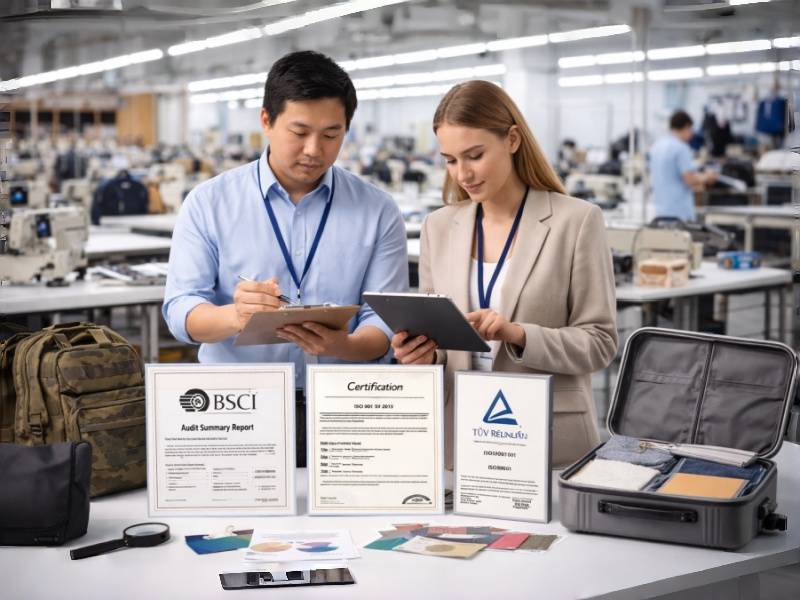
A lot of people treat audits like a shortcut. They see BSCI or ISO 9001 on a factory profile and assume the hard work is done. In real sourcing, that is rarely true. An audit can tell you something useful, but it does not tell you everything. It does not show whether a sample was made carefully. It does not show whether the merchandiser replies clearly when changes happen. It does not show whether the cutting room follows the latest approved spec, or whether the sewing line can keep the same finish from the first carton to the last.
That is why good teams do not ask only, “Do you have BSCI?” or “Are you ISO certified?” They ask what those things actually change inside the factory. They look at how records are kept, how worker issues are handled, how nonconforming goods are controlled, how incoming materials are checked, how corrective actions are closed, and whether the claimed certificate really belongs to the place that will make the order.
BSCI and ISO 9001 do not mean the same thing for a bag factory. amfori BSCI is a social compliance audit system focused on working conditions and responsible business practices across 13 performance areas. ISO 9001 is a quality management standard focused on process control, documented information, monitoring, and continual improvement. One mainly helps teams assess social compliance risk; the other helps them assess how a factory manages consistency and quality. Neither one guarantees a successful bag project on its own, but both can reduce avoidable risk when checked properly.
For bags, the difference matters more than many people think. Soft goods are full of variables: fabric lots, coating behavior, zipper sourcing, logo methods, reinforcement details, tolerance control, packaging rules, and mixed-SKU handling. A factory may look polished on paper but still struggle with repeatability. Another may have strong sample execution and weak documentation. So the real job is not to worship an audit. The real job is to understand what it proves, what it does not prove, and how to use it inside a smarter screening process.
What Do BSCI and ISO Audits Mean for a Bag Factory?
For a bag factory, BSCI mainly signals how the site is assessed on social compliance topics such as working hours, fair remuneration, worker protection, non-discrimination, occupational health and safety, and ethical business behavior. ISO 9001 signals whether the site runs a structured quality management system built around process control, documented information, monitoring, risk-based thinking, and continual improvement. They look at different parts of factory discipline.
The cleanest way to explain it is this: BSCI asks whether the factory’s social operating conditions are being managed responsibly. ISO 9001 asks whether the factory’s quality system is being managed systematically. That is why treating them as interchangeable is a mistake.
amfori states that its BSCI system is built around a Code of Conduct linked to internationally recognized standards and assessed through 13 Performance Areas. Those areas cover social management, worker involvement and protection, freedom of association, non-discrimination, fair remuneration, decent working hours, occupational health and safety, no child labor, special protection for young workers, no precarious employment, no bonded labor, environmental protection, and ethical business behavior.
ISO 9001, by contrast, is not a labor audit. ISO explains that the standard is a quality management system requirement used across many sectors and built around focus, process approach, risk-based thinking, documented information, performance evaluation, and continual improvement. In a bag plant, that usually shows up in document control, inspection flow, version control, corrective action, process monitoring, and how problems are recorded and prevented from repeating.
This is why a BSCI-audited site is not automatically stronger at making bags, and an ISO 9001-certified site is not automatically stronger on labor conditions. One looks more at social compliance risk. The other looks more at system discipline for consistency. Good teams read them together, not as substitutes.
BSCI vs ISO: Which Audit Matters More When Choosing a Bag Factory?

Neither audit is universally “more important.” BSCI tends to matter more when brand reputation, retail entry, or social compliance screening is a major concern. ISO 9001 tends to matter more when the project depends on repeatable quality, version control, traceability, and process consistency. For many custom bag projects, the strongest signal is not choosing one over the other, but checking whether the factory understands what each one is supposed to control.
In practice, the depends on the program. A retail chain that is sensitive to labor-risk exposure may put BSCI near the top of the screening list. A team launching a technical backpack collection with multiple trims, reinforced structures, and packaging rules may place more weight on ISO 9001-style discipline because the project can fall apart through poor control even when the social audit looks fine.
Here is a useful way to think about it:
| Audit | What it mainly helps you assess | What it does not prove by itself |
|---|---|---|
| amfori BSCI | Working conditions, social compliance systems, responsible business conduct | Sample skill, pattern accuracy, cost control, bag-specific technical ability |
| ISO 9001 | Process control, records, corrective action, repeatability, quality management discipline | Labor conditions, wage practices, social compliance performance |
Both rows matter, but not always in the same order.
A common sourcing mistake is to use one certificate as a proxy for total capability. That is how teams end up with a factory that passes paperwork checks but still misses zipper puller direction, logo placement consistency, carton marking rules, or folding specs. For bags, the winning choice is usually the site that combines clean audit history with real soft-goods execution.
Why Do Brand Owners, Importers, and Private Label Teams Ask for These Audits?
Teams ask for audits because they are trying to reduce avoidable risk before an order becomes expensive. BSCI can help them screen for social compliance exposure. ISO 9001 can help them screen for control gaps that lead to inconsistency, rework, delays, and dispute-heavy communication. Audits are not a guarantee, but they can help narrow the field faster when used with sampling and technical review.
Most teams do not ask for audits because they love paperwork. They ask because poor factory discipline creates downstream damage. A labor issue can become a brand issue. A weak quality system can become a late shipment, a high claim rate, or a bad repeat order. A missing document trail can turn a simple change request into a production argument.
That matters even more in bags because soft goods often carry a high “small detail” risk. A few examples:
- body fabric approved in one hand feel, bulk arrives slightly different
- logo patch thickness changes pocket tension
- bartack position shifts and affects strap strength
- carton assortments are correct in count but wrong in color mix
- packaging follows the sample, not the latest shipping instruction
None of those failures are dramatic at the beginning. They become dramatic when thousands of units move at once.
This is also why many teams no longer accept a claim like “we have experience” as enough. They want to see whether the factory has a system for preventing repeat mistakes. They want evidence that problems are recorded, traced, and closed out. When a bag project has custom hardware, retail packaging, hangtag rules, and multiple approvals, a disciplined system is not decoration. It is part of delivery.
If your team is comparing sites for a custom backpack, tote, travel bag, cooler bag, or private label collection, and you want a quote reviewed alongside audit readiness and process fit, Jundong can assess the project details with you at info@jundongfactory.com.
How Do BSCI and ISO Audits Affect the Real Bag Production Process?

Audits affect bag production when they change behavior on the floor, not just documents in a folder. BSCI can influence worker management, health and safety routines, and compliance controls. ISO 9001 can influence approvals, inspection records, change control, training, traceability, and corrective action. In a better-run bag factory, these systems shape how sampling moves into bulk, how defects are handled, and how teams prevent the same issue from happening twice.
On the shop-floor side, BSCI is often felt in areas like worker communication, facility safety, emergency preparedness, overtime management, and the broader compliance environment around daily operations. That may sound separate from bag quality, but it is not fully separate. A chaotic working environment often produces chaotic execution. Poor worker protection and weak site discipline usually spill into planning and control.
ISO 9001 shows up more directly in the handoff between stages. For example, when the approved sample changes from woven label to rubber patch, does the change reach pattern, cutting, sewing, QC, and packing in a controlled way? When bulk fabric shade drifts from lab dip expectations, is the issue documented and escalated? When a carton barcode format changes, is the old version removed from use? ISO does not make those decisions for the factory, but the system requires the factory to manage them in a disciplined way.
This is why strong audit discipline often leads to smoother communication. Not perfect communication. Smoother communication. A site with better records can show what happened, when it changed, who approved it, and how the correction was implemented. That alone can save a project when timelines tighten.
How Can Teams Verify Whether a Factory’s Audit Claim Is Real?
The safest way to verify an audit claim is to ask for the actual certificate or report, then check the site name, address, scope, date, issuing body, and current status. For ISO claims, ISO says certification is issued by external certification bodies, not by ISO itself, and accredited certificates can be checked through IAF CertSearch or by contacting the certification or accreditation body directly. For BSCI, teams should review the report details and confirm they match the actual production site.
This is one of the most overlooked steps in sourcing. Many teams ask, “Do you have BSCI?” but do not ask, “Does that report belong to the exact site that will cut, sew, inspect, and pack my order?”
For ISO 9001, ISO is very clear: ISO does not issue certificates and does not perform certification. Certificates come from external certification bodies. ISO also explains that accredited certifications can be checked using IAF CertSearch or by contacting the relevant certification body or accreditation body.
A practical review checklist looks like this:
| What to check | Why it matters |
|---|---|
| Factory name and address | Confirms the certificate belongs to the real production site |
| Scope | Confirms the certified activities are relevant to the goods being made |
| Issue date / validity / audit cycle | Confirms the claim is current, not outdated |
| Certification body / audit body | Helps confirm authenticity |
| Production subcontracting | Reveals whether key steps happen outside the audited site |
For BSCI, check the report date, the audited site details, and the rating history if available. For ISO, verify the certificate record and the accreditation path. Then do one more thing: compare the document to reality. If the certificate says one address and the sample comes from another workshop, stop and ask why.
How Long Do BSCI and ISO Results Matter, and When Should Teams Recheck?
amfori BSCI states that its audit cycle is two years, starting with a full audit. If a site scores A or B, the next full audit is due within two years; if the result is below B, a follow-up audit is required within two to twelve months. For ISO 9001, the certificate itself should be checked for dates and status, and teams should recheck whenever the factory has changed ownership, address, capacity, or major process structure.
Many people ask, “Is the audit still valid?” A better is, “Is the audit still useful?” Those are not always the same thing.
amfori explains that the BSCI cycle runs for two years, but the follow-up timing depends on the result. A or B can move forward on the normal cycle. Lower grades trigger earlier follow-up. That gives teams a rough time rule, but timing alone is not enough. If the site doubled in headcount, moved workshops, changed ownership, or shifted key processes to subcontractors, an older report may no longer describe current reality very well.
For ISO 9001, teams should not just file the certificate and move on. ISO recommends checking accredited certification through IAF CertSearch or direct confirmation with the issuing bodies. That means the practical rule is simple: recheck before a new program, recheck after major factory change, and recheck when the certificate dates or details look unclear.
What Should a Bag Factory Prepare Before a BSCI or ISO Audit?
Before a BSCI audit, a bag factory should be ready with the policies, records, and supporting documents that show how it manages labor conditions, worker protection, health and safety, wages, hours, and related controls. amfori’s preparation guidance says auditors review relevant documents as part of monitoring activities. Before an ISO 9001 audit, the factory should be ready to show how it controls processes, documents, risks, monitoring, corrective action, and continual improvement.
Preparation is where many factories expose whether the system is real or staged. A staged system looks polished in the meeting room and confused on the floor. A real system is visible in routine records, training consistency, approval flow, line controls, and how quickly staff can explain what happens when something goes wrong.
amfori’s guidance notes that relevant documents are reviewed and verified during monitoring activity. In plain terms, a factory should not prepare only a presentation. It should prepare the underlying records that support the presentation. In a bag plant, that often means worker files, hours and wage records, safety routines, training records, grievance channels, dormitory or canteen controls where relevant, and evidence that corrective actions are actually followed up.
On the ISO 9001 side, the factory should be able to show its control logic from order review through shipment. How are specs issued? How are revisions controlled? How are incoming materials checked? How are line defects recorded? How are nonconforming goods segregated? How are root causes investigated? How are changes approved? ISO emphasizes documented information, monitoring, measurement, performance evaluation, risk-based thinking, and continual improvement. Those are not abstract words in a bag project. They are the difference between “we noticed the problem late” and “we controlled it before it spread.”
If your bag program needs a factory that can support custom development, sample revisions, and disciplined bulk follow-through, Jundong’s team can review the product details and production logic with you at info@jundongfactory.com.
What Should Teams Check Beyond BSCI and ISO When Choosing a Bag Factory?
Audits should be one layer of screening, not the whole decision. Teams should still review sample quality, pattern understanding, trim control, testing support, packaging accuracy, communication speed, approval discipline, and how the factory handles change. A clean certificate does not tell you whether the site can hold shape, color, logo execution, or multi-SKU packing rules across a real bag order.
This is where many expensive mistakes happen. The team sees a certificate and stops thinking. But bag projects fail in very ordinary ways. The sample looks fine; bulk foam thickness changes the profile. The zip brand changes quietly. The shoulder strap webbing passes color approval but feels stiffer in actual use. The carton assortment is mathematically correct but retail-unfriendly. None of this is solved by a logo on a document.
A more grounded screening process should include:
- a sample review against actual use, not just appearance
- a trim and material confirmation process
- clear bulk approval rules
- packaging and labeling checks
- production status reporting that identifies decisions, not just progress
- a method for handling corrective action when defects or changes appear
For some projects, you may also need test support from competent laboratories. ISO explains that ISO/IEC 17025 helps laboratories demonstrate competence and valid results, which matters when claims depend on test reliability. That does not replace factory control, but it matters when material or performance claims are sensitive.
The strongest sourcing decision usually comes from combining three things: credible audit status, proven sample execution, and reliable process behavior during change. Miss one of the three, and trouble usually appears later rather than sooner.
Is a BSCI- or ISO-Audited Factory Always the Right Choice for Your Bag Program?

No. An audited factory is often a safer starting place, but it is not always the right fit. The right fit depends on the bag type, the complexity of the custom details, the approval speed, the MOQ, the packaging rules, the required testing, and how the factory performs in sampling and communication. Audits reduce certain risks. They do not replace technical fit, execution quality, or project management.
This is the final judgment that matters. If your project is simple, low-risk, and speed-driven, a team might accept less audit depth if the execution is very strong and the intended sales channel allows it. If your project touches retail chains, licensed collections, sensitive compliance exposure, or high repeat-order visibility, audit discipline usually becomes far more important.
But even then, the best decision is rarely made by asking only “Do they have BSCI?” or “Are they ISO 9001 certified?” The better decision comes from asking:
- Do the documents belong to the real site?
- Does the site understand bag construction, not just paperwork?
- Can the team control revisions?
- Can they explain defects and close them?
- Can they hold consistency when the order gets complicated?
That is where the difference between a usable factory and a dependable long-term partner becomes visible.
Top 10 FAQs About BSCI and ISO Audits for Bag Factories
FAQ 1: Does a BSCI or ISO audit mean a factory will automatically make better bags?
Not necessarily. A passed audit is useful, but it is not the same as good bag development, clean stitching, stable shape control, or consistent bulk execution. A social compliance audit mainly shows how a site is managed from a labor and responsibility perspective. A quality system certificate shows whether the site has a structured way to control documents, records, nonconforming goods, and corrective action. Those are all valuable. But none of them, on their own, can prove that the factory understands your exact bag structure, logo method, reinforcement logic, or packaging rules.
This is why experienced sourcing teams do not stop at the certificate. They still ask to see recent samples, material approval flow, bulk control records, and packing accuracy. A factory may have clean paperwork and still struggle with zipper alignment, webbing shade consistency, foam thickness tolerance, or mixed-SKU carton control. On the other hand, a factory with solid project control often shows its strength in small details: clear comments on your tech pack, smart feedback during sampling, and fewer surprises between approved sample and shipment.
A better way to judge capability is to combine three checks: audit status, sample performance, and communication discipline. If all three are strong, the project risk usually becomes much easier to manage.
FAQ 2: What is the real difference between BSCI and ISO 9001 for a bag project?
The real difference is simple: BSCI looks more at social responsibility conditions, while ISO 9001 looks more at process and quality system control. For a bag project, that means they reduce different types of risk.
If you are supplying retail channels, licensed programs, or brand-sensitive collections, social compliance matters because reputational problems can damage more than one order. In that case, BSCI is often part of the initial screening. It helps teams understand whether the site has a more disciplined environment around labor conditions, working hours, health and safety, and responsible operations.
ISO 9001 matters in a different way. Bags are detail-heavy products. Even a simple tote can involve fabric lot control, webbing width tolerance, stitch count consistency, logo placement, barcode version control, and outer carton marking rules. A factory with a stronger quality system is usually better at managing these moving parts through records, approvals, and corrective actions.
Think of it this way:
| Audit | What it helps you see | What it does not prove alone |
|---|---|---|
| BSCI | Social responsibility conditions and site discipline | Product execution quality |
| ISO 9001 | Process control and consistency systems | Social compliance performance |
For many bag programs, one is not a replacement for the other. They do different jobs, and good sourcing decisions usually come from reading them together.
FAQ 3: If a factory has BSCI or ISO, do I still need to check samples?
Yes, absolutely. In bag sourcing, samples still tell you things that certificates cannot. A certificate will not show whether the shoulder strap sits at the right angle, whether the gusset holds shape after filling, or whether the zipper tape color looks clean against the body fabric. It will not show whether embroidery pulls the panel, whether a PU badge cracks at the edge, or whether the inside pocket opening is practical in real use.
A useful sample review should go beyond appearance. You should look at construction logic, material feel, logo finish, hardware suitability, weight balance, and packing effect after folding or stuffing. For insulated bags, check whether the lining structure is practical and easy to clean. For backpacks, check strap reinforcement, foam support, and comfort. For travel bags, check handle construction, zipper path, and shape stability when loaded.
It is also smart to compare the sample against the documents the factory uses. Are the comments reflected in the revision? Was the issue clearly understood? Did the team change anything without written confirmation? These are the moments that reveal whether the system behind the sample is real.
A strong sample is not just a nice object. It is often the clearest preview of how the bulk order will behave.
FAQ 4: How can I tell whether an audit belongs to the real factory and not just a trading office?
This is one of the most practical checks in bag sourcing, and many teams skip it. A certificate or audit report is only meaningful if it belongs to the actual production site that will cut, sew, inspect, and pack your order. A trading office may show a genuine document, but if the goods are made somewhere else, the document may not reflect the real production environment at all.
Start by checking the full company name, factory address, scope, and issue date. Then compare those details with the sample paperwork, shipping marks, production photos, video calls, and workshop background. If the certificate shows one site but the sample comes from another place, that gap needs an explanation.
You should also ask direct :
- Will all main production happen at this audited site?
- Which steps are subcontracted, if any?
- Where will cutting, sewing, logo application, and packing happen?
- Can the factory show recent workshop photos tied to this address?
A simple cross-check table can help:
| Item to Check | Why It Matters |
|---|---|
| Company name | Confirms legal identity |
| Factory address | Confirms physical production site |
| Scope | Confirms relevant activities are covered |
| Audit date | Confirms recency |
| Workshop proof | Confirms the site is active and real |
This step is not about distrust. It is about making sure your risk review matches the place that will actually make your bags.
FAQ 5: How long should an audit report still be trusted when choosing a bag factory?
A report should not be treated like something that stays equally useful forever. Even when a document is still within its normal validity cycle, its practical value can drop if the factory has changed a lot. A site may move to a new address, open a new floor, add new lines, replace managers, shift to new subcontractors, or take on much larger order volume. When that happens, an older report may no longer describe the day-to-day reality very well.
For bag projects, this matters because execution depends on routine control. If staffing changed heavily, training quality may change. If the workshop layout changed, material flow may change. If the factory expanded too fast, inspection pressure may rise. Those shifts do not always show up on the certificate itself.
A good rule is to recheck audit information when:
- the project is new and higher in value,
- the site has changed ownership or address,
- the order is more complex than the last one,
- the factory added or changed subcontracting,
- the document is older and the team cannot explain what has changed since then.
In other words, do not ask only, “Is this certificate still valid?” Also ask, “Is this document still a fair picture of the current operation?” That second is often more useful for real sourcing decisions.
FAQ 6: What should I ask a factory besides “Do you have BSCI or ISO?”
That single is too narrow. What you really need is a fuller picture of how the factory runs your kind of bag. A better conversation includes what kind of bags they make most often, how they control changes, how they handle bulk defects, what their sampling process looks like, and how they manage material approvals.
For example, if you are developing a cooler bag, you should ask about insulation structure, leak-sensitive areas, lining join methods, and cleaning practicality. If you are developing a tactical bag, ask about bartack strength, MOLLE consistency, reinforcement logic, and heavy hardware matching. If you are developing a cosmetic bag, ask about shape retention, zipper path neatness, lining wipeability, and logo treatment on coated materials.
You should also ask for signs of working discipline:
- How do they issue revised specs?
- How do they isolate rejected materials?
- How do they confirm logo position?
- How do they handle carton assortment mistakes?
- Who signs off before bulk starts?
These often reveal more than a certificate does. A strong factory usually gives clear, practical replies. A weak one often stays vague or jumps too quickly to price. That difference becomes very visible before the order even starts.
FAQ 7: Will audits affect price when I source custom bags?
Sometimes yes, but not in a simple way. An audited and better-controlled site may not always give the lowest quote. That is because disciplined operations usually carry real internal costs: better records, more training, more inspection attention, more structured compliance work, and less room for careless shortcuts. But that higher quote does not automatically mean the factory is expensive in the long run.
For bags, the true cost is rarely just the unit price. You also need to think about rework risk, delay risk, claim risk, replacement cost, communication time, and brand damage if things go wrong. A cheaper quote can become expensive very quickly if the bulk color is unstable, the logo method is wrong, or the assortment is packed incorrectly.
A more realistic view looks like this:
| Cost Area | Lower Quote Site | Better-Controlled Site |
|---|---|---|
| Unit price | Often lower | Sometimes higher |
| Defect risk | Often less predictable | Usually more controlled |
| Communication time | Can be heavier | Often more efficient |
| Repeat order stability | Less certain | Usually stronger |
So yes, audit-linked discipline can affect price. But the bigger issue is total order cost, not just the first number in the quotation sheet. Good teams compare cost against risk, not cost in isolation.
FAQ 8: Can a small or medium-sized bag factory still be a good choice if it has fewer certifications?
Yes, it can. A smaller site is not automatically weak, and a larger site is not automatically right for your program. What matters is whether the factory can control your project properly. Some small and mid-sized operations are actually better at sample follow-up, detail communication, revision speed, and flexible execution, especially for niche bags, lower MOQ development, and projects that need closer handling.
That said, if your order is for a large retail channel or a program with strict social compliance requirements, formal audit coverage becomes much more important. In those cases, lacking the right documents can block the project before product discussion even begins.
The practical way to evaluate a smaller site is to check:
- whether the team understands your bag type deeply,
- whether they respond clearly on materials and structure,
- whether sample revisions are accurate,
- whether they can show stable process logic,
- whether their real capacity matches your timeline.
A smaller site may be a very good fit for a startup collection, a pilot run, or a development-heavy project where speed and communication matter more than very large-scale output. The key is not size alone. It is whether the site’s strengths match the job in front of it.
FAQ 9: What warning signs should I watch for even if a factory shows audit documents?
There are several warning signs, and they often appear early. One common sign is good paperwork but weak technical conversation. If the team can talk about certificates but cannot explain webbing selection, seam stress, foam choice, zipper grade, or logo limitations, that is a concern. Another sign is inconsistent information. If the address on the document does not match the workshop shown in photos or video, you need to slow down and verify.
Other warning signs include:
- unusually fast agreement to every request without technical feedback,
- unclear about subcontracting,
- no structured reply on sample revisions,
- poor version control on artwork or tech packs,
- reluctance to discuss defect handling,
- bulk promises that sound too broad to be believable.
In bag projects, real capability usually shows through detail. A serious team will often mention practical issues before you ask: edge paint behavior, print registration limits, heavy-load strap concerns, shape collapse during packing, or trim lead time risk. That kind of feedback is a good sign because it shows active thinking.
A document should increase confidence, but it should not switch off judgment. In many cases, the gap between a reliable project and a painful one is not the certificate itself. It is whether the team behind it behaves like people who truly understand the product.
FAQ 10: What is the best way to choose a bag factory when audits, samples, price, and lead time all matter?
The best way is to stop looking for a perfect single indicator. Bag sourcing works better when you compare factories across four layers at the same time: compliance fit, technical fit, commercial fit, and execution fit.
Compliance fit means the site has the documents and operating conditions your project requires.
Technical fit means the team knows your bag type, materials, structure, and logo methods.
Commercial fit means the MOQ, pricing logic, and lead time are workable.
Execution fit means the team is organized, responsive, and able to keep sample decisions aligned with bulk.
A simple decision grid helps:
| Layer | What to Review |
|---|---|
| Compliance fit | Audit documents, site identity, recency |
| Technical fit | Samples, bag structure understanding, material choices |
| Commercial fit | MOQ, cost logic, tooling or sample charges, delivery window |
| Execution fit | Communication speed, revision accuracy, record discipline |
The right choice is usually not the one with the flashiest presentation. It is the one that keeps giving clear, believable, detailed responses across all four layers. When a factory can do that, risk usually becomes easier to control, timelines become easier to trust, and repeat business becomes more realistic.
Start Your Bag Audit-Ready Project With Jundong
A strong bag factory is not defined by a certificate alone. What really matters is whether the factory can turn audit discipline into real daily control: clear sampling steps, stable material handling, accurate recordkeeping, controlled revisions, consistent bulk quality, and reliable packing execution. For bag programs, that is where audit value becomes practical. The right factory does not just pass a check. It shows that the same discipline can protect your product details, delivery rhythm, and repeat-order consistency.
Jundong supports custom bag development with a broad product base, flexible material options, in-house sampling support, and practical experience in handling private label, OEM, and ODM projects. For teams comparing factories, samples, and compliance readiness at the same time, we can help review bag structure, logo method, material choice, MOQ planning, and production flow in a more grounded way, so decisions are easier to make before bulk starts.
If you want to discuss your custom bag project, feel free to contact Jundong at info@jundongfactory.com.