 Skip to content
Dustproof Storage Bags Supplier
Keep dust off, keep brand value on. We supply dustproof storage bags that protect products in warehouses, shipping cartons, retail displays, and closets. Choose from non-woven, cotton, microfiber, polyester, or coated fabrics, with Pantone color matching and logo branding that looks consistent across SKUs. Built for the need for stable quality, clear specs, and repeatable production.
Dustproof Bag RFQ Essentials
A dustproof storage bag may look simple, but for you, product performance depends on a few early decisions that directly affect price, lead time, bulk consistency, and defect risk. If these points are unclear at the RFQ stage, quotes often change later, and sample revisions become harder to control.
The first step is to define the real dust-protection scenario. A bag used for warehouse storage may need a tighter weave fabric, better seam strength, and stronger resistance to stacking friction. A bag used for retail packaging may need a softer hand-feel, cleaner branding, and a better presentation standard. A bag intended for long-term storage may need a more breathable material to reduce odor or mildew risk.
Material should be chosen by function, not habit. Non-woven dust bags are common for low-cost bulk packaging, but they usually offer a less premium feel. Cotton or canvas dust bags are popular for branded and luxury packaging, though the cost is higher, and weave density matters. Microfiber dust bags are often preferred for luxury shoes, handbags, and delicate products because they feel softer and can help reduce surface scratching.
Polyester or RPET dust bags are useful for stable mass production, while coated fabrics can add better dust and moisture control but may reduce breathability.
To get a more accurate quote, the six RFQ points early: finished size and tolerance, fabric weight or thickness, closure type, seam standard, logo method, and color standard. These details shape the real price far more than a simple product photo.
A cleaner sampling process also reduces uncertainty. A practical route is: material sample confirmation, color approval, logo approval, revision sample, and PP sample before mass production. This helps protect your timeline and avoids silent changes in bulk.
For you sourcing custom dustproof bags, branded storage bags, non-woven dust bags, cotton drawstring bags, microfiber dust bags, or private label protective packaging, clear early specifications usually lead to better pricing, smoother sampling, and more stable production.


Dustproof Bags for Every Product
A “dustproof bag” is not one product. It’s a family of SKUs with different fit rules, closure needs, and brand presentation standards.
(A) Choose a fit model
- Loose-fit (warehouse protection)
- Extra space for quick packing, reduces labor time
- Better for bulk storage and low-touch handling
- Downside: premium look is weaker
- Standard-fit (best balance for most brands)
- Moderate ease, stable folding lines, consistent shelf look
- Best for repeat orders and multi-SKU programs
- Tailored-fit (luxury packaging)
- Tighter tolerance, better “presentation” and brand feel
- Downside: more size SKUs, higher development time
(B) Category-specific build rules
| Category | Fit Priority | Suggested Closure | Fabric Notes | Typical Add-ons |
|---|---|---|---|---|
| Shoes | toe and heel volume | drawstring or flap | abrasion resistance | size print, pair divider |
| Apparel | fold lines and breathability | drawstring | breathable (avoid odor) | hang loop, label window |
| Handbags | shape protection | drawstring and stopper | anti-scratch or microfiber | bottom gusset, logo front |
| Electronics | dust and scratch control | zipper preferred | low-lint, anti-static option | inner pocket, foam sleeve |
| Gift Sets | display and branding | flap or ribbon | color consistency | insert card pocket |
(C) Decide the “SKU logic” (so procurement is easy)
A clean SKU system usually uses:
- 3–6 core sizes (S, M, L, XL, and special)
- optional gusset variants only for bulky items (handbags or shoes)
- a single closure platform per collection (e.g., all drawstring or all zipper) to reduce part changes
- unified color standard (Pantone and approved lab dips) for reorders
(D) Pattern details that reduce repacking complaints
- Add corner radius (avoid sharp fold creases that trap dust)
- Use reinforced top channel for drawstring (prevents tearing)
- For zipper bags, add zipper end tack and seam allowance stability
- Control stitch length and seam allowance to stabilize dimensions across bulk runs
(E)Checklist
- Product category and target fit model (loose, standard, tailored)
- Internal dimensions and tolerance
- Closure type and cord, stopper, zip spec
- Logo placement and methods
- Reorder plan (estimate annual volume per size)


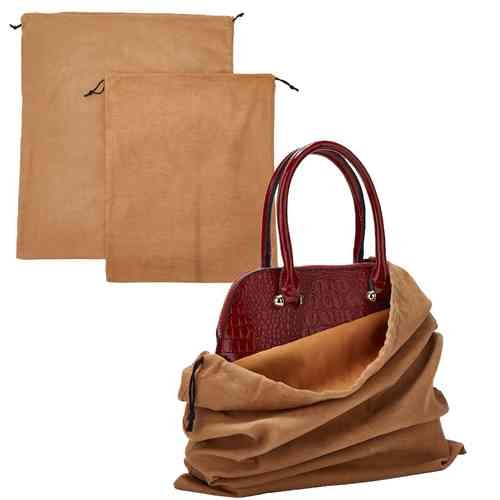

Materials & Branding That Last in Bulk
A dustproof bag’s performance is a combination of fabric behavior, surface branding, and bulk consistency. Here’s how to choose materials and logo methods like a procurement pro.
(1) Fabric decision map
Instead of choosing by “looks,” decide by these 5 technical questions:
A. Will the bag touch high-value surfaces?
- If yes (luxury handbags, coated leather, screens), prioritize anti-scratch or low-lint fabrics like microfiber or tightly woven polyester.
B. Is breathability required?
- For apparel and long-term closet storage, breathable fabrics reduce odor risk. Avoid heavy coatings unless moisture is your bigger problem.
C. How much friction happens in shipping?
- Warehouse stacking causes rubbing. Higher abrasion resistance and stable seam construction matter more than “thicker is better.”
D. Will the bag be reused by the end?
- If yes, upgrade hand-feel and appearance (better fabric, stronger logo method) because this becomes part of your brand experience.
E. Do you need sustainability positioning?
- Consider RPET polyester for a consistent, scalable program (specify yarn or denier and color standards).
(2) Material comparison
| Material | Strengths | Watch-outs | Best Use |
|---|---|---|---|
| Non-woven | low cost, fast | tear risk, basic look | warehouse dust covers |
| Cotton / Canvas | premium feel, breathable | shrink, higher cost | apparel, premium packaging |
| Microfiber | low lint, anti-scratch | cost, heat sensitivity | luxury bags, delicate items |
| Polyester / RPET | stable bulk consistency | static control varies | mass programs, reorders |
| Coated fabric | dust and moisture barrier | less breathable | humid shipping or storage |
(3) Logo & branding methods
We support multiple branding options (woven labels, printing, patches, etc.) and help match them to material choice.
Quick decision guide
- Screen print: best cost for large runs; specify ink type and rub resistance expectation.
- Heat transfer: sharp detail; watch heat marks on microfiber; specify temperature limits.
- Woven label or sewn label: excellent durability; adds sewing steps but is stable across reorders.
- Embroidered patch: premium look; thickness can create pressure marks—avoid for ultra-delicate surfaces.
- Hangtag and insert card: for minimal risk on delicate fabrics, keep bag clean and brand via packaging.
(4) Color control rules
Color mismatch is one of the top reorder problems. The fix is simple:
- lock Pantone and submit lab dips or strike-offs for approval before bulk
- define “pass or fail” tolerance for bulk
- keep one master standard per series (don’t change factory-to-factory)
(5) Write the “anti-surprise” spec lines
Include these lines in your RFQ:
- Fabric: type and weight (gsm), thickness, and weaving description
- Lint requirement: “low-lint” or “no shedding visible on dark surface.”
- Logo: method, size, and placement tolerance (±3 mm)
- Durability: “no cracking or peeling after rubbing test (internal standard agreed).”
- Color: Pantone and approved lab dip required before bulk


QC Evidence: Dustproof Bags Match Sample
A dustproof bag is a soft product, which means small variations can turn into big complaints: “sizes don’t fit,” “logo is tilted,” “cord breaks,” “lint everywhere,” or “color drift vs last order.” Below is a QC framework you can copy into your PO.
(1) Our QC foundation
We run quality control with dedicated staff and equipment—80 quality inspectors plus inspection devices—to monitor incoming materials, in-process work, and final output.
For you, the key is to translate that capability into your acceptance standards.
(2) The 4 checkpoints that prevent “silent changes.”
Checkpoint A — Incoming material verification
- Fabric type, gsm or thickness, hand-feel vs approved swatch
- Color vs approved lab dip or strike-off (series master standard)
- Accessories: cord diameter, stopper spec, zipper model (if applicable)
Checkpoint B — First-article confirmation (pilot pieces)
- Dimension check vs tolerance
- Seam allowance and stitch length validation
- Logo placement and alignment proof (photo with ruler)
Checkpoint C — In-line inspection (during sewing or printing)
- Top channel strength (drawstring bags)
- Zipper end reinforcement (zipper bags)
- Print or transfer adhesion check (quick rub test)
Checkpoint D — Final inspection and packing verification
- AQL sampling plan (agreed level)
- Carton packing method and count accuracy
- Cleanliness: dust or lint control before packing
(3)“Pass or Fail” list
Use simple, measurable rules:
- Size tolerance: e.g., ±5 mm length or width (define per size)
- Logo placement tolerance: ±3 mm; “no visible tilt” standard
- Seam strength: no seam opening under normal pull (define test)
- Closure durability: drawstring or stopper must not break under the pull test
- Appearance: no stains, no oil marks, no loose threads > X mm
- Color: match standard sample (reorder consistency)
(4) Simple tests that catch most defects
You don’t need a lab for everything. Ask for:
- Rubbing test on logo area (dry rub) to check cracking or peeling
- Pull test on drawstring channel (especially at seam ends)
- Zipper cycle test (open or close repeated) for zipper SKUs
- Drop or stack simulation for packed goods (carton integrity and scuffing)
(5) The “QC Evidence Pack” should be requested
Ask the supplier to provide:
- Material confirmation photos (fabric and accessories)
- First-article measurement sheet (with photos)
- In-line QC photos or videos (logo placement and seam construction)
- Final inspection report (AQL summary)
- Packing photos: inner polybag (if any), carton marks, counts


Dustproof Bag Timeline: Sample to Bulk
Dustproof bags are “simple,” but timelines slip when keeping changing the same variables: fabric weight, logo size, closure parts, or packaging rules. A structured sampling path reduces loops.
(1) Recommended workflow
We typically support multi-round development—from material confirmation, color approval, logo approval, revisions, to PP sample—so bulk stays aligned with what you approved.
Stage 1 — RFQ & feasibility (Day 0–3)
- Supplier confirms material availability, closure parts, and logo method suitability
- Output: spec sheet draft, price range, and sample plan
Stage 2 — Material & color approval (Day 3–10)
- Approve fabric swatch (hand-feel, gsm)
- Approve Pantone and lab dip or strike-off for the production fabric
- Output: approved material standard for bulk
Stage 3 — Branding approval (Day 7–14)
- Confirm logo method (screen print, label, patch, transfer)
- Approve placement (tolerance) and artwork file format
- Output: logo approval proof (photo and measurement)
Stage 4 — Prototype sample and revisions (Day 10–21)
- First sewn sample checks: size fit, seam standard, closure performance
- One or more revision rounds until “production-ready.”
Stage 5 — PP sample (pre-production) (Day 21–28+)
- This is the bulk reference sample
- Signs off: color, logo, stitching, packaging, carton marks
Stage 6 — Bulk production & QC evidence (after PP approval)
- In-line QC and final inspection report (AQL as agreed)
- Packing verification and shipment readiness
Tip: If you need a hard launch date, lock “non-negotiables” by the PP stage: fabric GSM, closure parts, logo method, and packaging.
(2) Submission checklist
Keep this list tight. It prevents 80% of sampling delays.
| Item | What to Provide | Common Mistakes to Avoid |
|---|---|---|
| Product use case | shoes, apparel, handbags, electronics | “General storage” means the wrong fabric |
| Size list | inner dimensions and tolerance | no tolerance → re-quotes |
| Fabric target | material type and GSM | Choose by photo only |
| Color | Pantone and approved shade range | approving on screen only |
| Logo | vector file (PDF or SVG), size, placement | Low-res JPG causes blur |
| Closure | drawstring, zipper, flap, and part spec | unspecified cord or stopper |
| Packaging | folding method, inner bag, and carton marks | changes after PP sample |
| QC standard | pass or fail list and AQL level | vague “good quality.” |
| Annual reorder plan | estimated volume per size | no plan → unstable sourcing |
(3) Documents you should archive for reorders
To keep reorders consistent, store:
- approved fabric swatch standard
- approved logo proof & placement photo
- PP sample photos and measurement sheet
- carton marks & packing photos


Lower Cost, Keep Quality — Dustproof Bags
Most suppliers can quote a dust bag, but procurement teams need to know why the price changes. Without visibility into cost drivers, comparing quotes becomes guesswork, and cost-cutting risks unintended quality loss. Below is a practical cost map you can use to compare suppliers and optimize specifications with confidence.
The Seven Biggest Cost Drivers
Material Type and Weight
Higher GSM improves hand-feel and durability, but the cost rises quickly with thickness. The key is balancing perceived quality against actual performance requirements for your specific product.
Bag Size and Pattern Efficiency
Small changes in width or height can significantly impact fabric waste during cutting. Optimizing dimensions to match standard fabric widths reduces material cost without affecting functionality.
Closure System
Drawstrings are generally cost-efficient, requiring minimal parts and labor. Zippers add component cost and multiple sewing steps, but may be necessary for security or premium positioning.
Logo Method
Screen printing is efficient for large volumes but carries defect risks. Sewn woven labels add sewing time but reduce rejection rates and communicate premium quality consistently.
Color Complexity
Multi-color programs increase inventory complexity and approval steps. Fewer core colors streamline reorders and reduce matching challenges across production runs.
Construction Standard
Features like double stitching, binding, and gussets add minutes per piece. While premium seams reduce failure risk, over-building every area unnecessarily inflates cost.
Packaging Requirements
Special folding, individual polybags, inserts, and barcode labeling add labor and materials. These costs accumulate quickly and are often negotiable without affecting product quality.
Practical Ways to Cut Costs Without Sacrificing Quality
Standardize Parts Across SKUs
Using the same cord diameter and stopper style across all sizes reduces part changes, simplifies inventory, and minimizes assembly defects.
Keep SKU Sizes Rational
For most brands, three to six core sizes cover eighty percent of needs. Excessive sizes inflate sampling loops, complicate forecasting, and increase unit cost across the board.
Choose the Right Branding Method
If you need a premium look with stable bulk quality, sewn woven labels often outperform large-area prints. They eliminate cracking and peeling risks, reducing rework and rejection rates in production.
Avoid Over-Building Construction
Double stitching everywhere appears strong, but adds labor without proportional benefit. Add reinforcement only at true stress points: drawstring channel ends, zipper ends, and gusset corners.
Negotiate on Packaging First
Cutting fabric quality invites complaints and returns. Adjust packaging complexity first—folding methods, insert materials, polybag rules—while maintaining the fabric performance your product requires.
Protecting What Matters Most
Every cost decision requires a clear quality boundary. When reducing GSM, keep the low-lint and anti-scratch requirements intact. When unifying sizes, maintain fit models that work for your products. When standardizing closures, ensure channel reinforcement at stress points remains specified.
This approach gives procurement teams the tools to compare suppliers accurately, optimize specifications intelligently, and control total landed cost without compromising the product experience.


Packaging Rules for Smooth Delivery
Packaging is where hidden costs appear: slow packing lines, wrong counts, wrinkled bags, dust re-contamination, and label chaos. A good packing spec is simple, repeatable, and aligned with your logistics.
(1) Choose the packing goal
Scenario A — Warehouse bulk storage (fastest)
- Priority: speed, count accuracy, minimal materials
- Recommended: bundle packing (e.g., 10/20 pcs per inner pack) and master carton
Scenario B — Brand unboxing or premium presentation
- Priority: clean look, shape retention, minimal wrinkles
- Recommended: individual fold standard and insert card (optional), and neat logo facing
Scenario C — E-commerce fulfillment (barcode & SKU control)
- Priority: scan-ready labels, easy pick or pack, low returns
- Recommended: individual polybag and barcode label per unit or per set
(2) Folding rules that prevent “arrives wrinkled or looks cheap.”
A fold spec should define:
- fold lines (2-fold vs 3-fold)
- logo orientation (“logo facing outward”)
- acceptable wrinkle level (visual standard sample)
- whether to include a flat board for premium SKUs
Tip: For microfiber or premium fabrics, avoid tight creases that mark the surface.
(3) Inner packing options
| Inner Pack Option | Pros | Cons | Best For |
|---|---|---|---|
| No polybag | lowest cost | dust risk in transit | short domestic moves |
| Bundle polybag | fast and cleaner | less retail-ready | warehouse bulk |
| Individual polybag | cleanest and barcode-ready | more labor or material | e-com, premium |
| Paper band and bundle | eco look | dust protection weaker | retail bulk packs |
(4) Carton spec that makes reorders easy
Define these items once and reuse forever:
- carton size and maximum carton weight
- pcs per carton (and per inner pack)
- carton marking layout (SKU, color, size, qty, PO, carton no.)
- pallet requirement (if any)
(5) Labeling & barcode rules
If you need barcode control:
- barcode type (UPC, EAN, Code128)
- label size and placement (on polybag or carton)
- human-readable SKU and size code required
- carton label must match inner pack count
(6) Moisture & shipping protection
For sea shipments or humid routes:
- add desiccant per carton (specify grams or carton)
- consider a carton liner bag for long storage
- “clean packing area” requirement to prevent dust re-contamination


Reduce Import Risk with Compliance
zDustproof storage bags can be used for apparel, handbags, shoes, electronics, and gift sets. That means you may face different compliance expectations depending on the market and the product category. A “safe path” is to define requirements early and treat compliance as a selectable package, not a last-minute standard.
| Item | What It Covers | When You Ask For It | Notes to Specify |
|---|---|---|---|
| REACH (SVHC) | restricted substances in the EU | EU import/retail | define material scope (fabric/print/cord) |
| CA Prop 65 | warning-related chemicals (US) | US retail programs | Confirm if ink/transfer is involved |
| CPSIA (if kids) | children’s product rules | kids items or toy-like sets | depends on end use, age grading |
| RoHS (electronics accessory) | restricted substances in electronics | electronics programs | more relevant if hardware parts are included |
| Material Declaration | What materials are used | retailer onboarding | list fabric, coating, ink, cord, stopper |
| Packaging Declaration | packaging materials info | large retailers | polybag, carton, inserts scope |
(3) Odor & cleanliness control
Odor complaints usually come from:
- fresh coatings or certain inks
- sealed packing without ventilation time
- humid shipping routes
Spec options you can add
- “low-odor requirement” with pre-pack airing time
- breathable fabric choice for closet storage
- moisture control for sea shipments (desiccant rule per carton)
- “clean packing area” requirement to reduce dust re-contamination


Make A Sample First?
See your idea come to life before mass production.
At Jundong Factory, we offer free design mockups and custom samples to ensure every detail is perfect — from material and color to logo placement and stitching.
Start your project with confidence today: info@jundongfactory.com.
Dustproof Bags Supplier FAQs
What MOQ should I expect for custom dustproof storage bags, and how can I keep MOQ low without hurting quality?
MOQ for dustproof storage bags is mainly determined by fabric availability, color standardization, and logo or closure complexity, and you can keep MOQ lower by using stock-supported materials, limiting to 1–2 core colors, and standardizing components across sizes.
In real procurement, MOQ isn’t a single number. It’s a combination of constraints:
- Material MOQ (fabric mill or dyeing lot)
- Accessory MOQ (cord, stopper, zipper model)
- Branding MOQ (printing setup, label production)
- SKU fragmentation (too many sizes or colors)
To keep MOQ low while staying “production-ready,” use this decision path:
Lock a material that can be supported in bulk
- Choose a mainstream option (non-woven, polyester, RPET, cotton, microfiber) and specify GSM/thickness early.
- Ask the supplier to confirm material readiness and replacement options if the exact fabric batch changes.
- Reduce color complexity
- Reorders become unstable when color control is loose. Use Pantone and approve lab dips or strike-offs before bulk.
- Start with one master color and one secondary (if needed).
- Standardize the “parts platform.”
- Use the same cord diameter and stopper style across multiple sizes.
- If you must use zippers, avoid mixing zipper suppliers or models across SKUs.
- Pick a logo method that matches your volume
- For low MOQ, sewn woven labels can be easier to control than large-area prints (less rework risk).
- For higher volume, screen print becomes more cost-efficient.
MOQ reduction table (practical view)
| Decision | Helps MOQ Because | What You Must Still Lock |
|---|---|---|
| 1–2 core colors | fewer dye lots | Pantone + approved standard |
| shared cord/stopper | fewer part orders | pull strength requirement |
| 3–6 core sizes | fewer patterns | size tolerance (e.g., ±5 mm) |
| woven label | stable durability | placement tolerance (±3 mm) |
If you want MOQ flexibility and bulk consistency, ask for a sampling path that locks standards before production (material → color → logo → PP sample). Our structured development and QC setup (including 80 QC inspectors) supports repeatable output once standards are approved.
How do I ensure the bag is truly “low-lint” and won’t leave fibers on leather, coated surfaces, or screens?
To guarantee low-lint performance, you must control fabric selection, surface finishing, cutting/sewing cleanliness, and packing rules, then verify with a simple “dark-surface test” plus bulk QC evidence.
“Low-lint” is not a marketing word—it’s a supply chain behavior. Lint issues typically come from:
- fuzzy surface fabrics without controlled finishing
- loose cutting fibers left inside the bag
- sewing thread debris and unclean packing areas
- friction in cartons that “shaves” fibers off unstable surfaces
Step 1 — Choose fabrics that naturally shed less
- Microfiber and tightly woven polyester generally shed less than brushed fabrics.
- If you need breathable cotton, specify a tighter weave and confirm surface finishing.
Step 2 — Write measurable lint expectations
Instead of “low lint,” use a testable line:
- “No visible fiber transfer after 10 wipes on a black PU leather panel.”
- “No loose fibers inside the bag after shake test.”
Step 3 — Add process controls (where lint actually starts)
- Require internal cleaning before packing (shake, blow, inspection).
- Define packing cleanliness: no dust re-contamination before sealing cartons.
Step 4 — Validate during sampling and bulk
- Ask for a first-article photo or video showing internal cleanliness and fabric surface.
- Require in-line inspection proof at the start of bulk production.
Because your supplier’s QC system matters, ask for an evidence pack. Our factory setup includes dedicated inspection capability (with 80 QC inspectors) to monitor consistency through production checkpoints.
Low-lint control table
| Risk Point | Control Method | Proof to Request |
|---|---|---|
| fabric surface sheds | Choose microfiber or tight weave | swatch and surface close-up |
| cutting fibers inside | internal cleaning rule | first-article video |
| packing contamination | clean packing standard | packing photos |
| carton friction | bundle or individual polybag | packing spec confirmation |
How do I prevent color mismatch on reorders (especially when the dust bags must match brand packaging colors)?
Reorder color mismatch is prevented by locking a single master color standard (Pantone and approved lab dip or strike-off) and requiring bulk to match that standard, not “what looks close” on screens or photos.
Color problems usually come from three avoidable gaps:
- No master standard (different people approve different shades)
- Approval happens on screens (lighting and monitor drift)
- Dye lot changes without control (supplier switches fabric source or batch)
Step 1 — Define what “match” means
Write one clear rule:
- “Bulk must match physical standard (lab dip or strike-off) under D65 daylight and indoor lighting.”
If you don’t want to add technical lighting terms, keep it practical:
- “Bulk color must match the approved standard sample in normal daylight; visible drift is not acceptable.”
Step 2 — Approve the right thing
Pantone is a target, but the approved lab dip or strike-off is the real master. Approve:
- the fabric swatch produced with the actual dye or process
- a signed photo and swatch reference stored for reorders
Step 3 — Control variables in production
Ask the supplier to lock:
- fabric supplier/yarn spec (where possible)
- dye house and process notes
- “no substitution without approval” rule for fabric and coatings
Step 4 — Build a reorder-proof file set
Archive these 4 items:
- Pantone reference
- approved lab dip or strike-off swatch
- PP sample photos (logo and fabric under normal light)
- packing photos (to ensure the same “look” on arrival)
Color control table
| Stage | Request | Why It Works |
|---|---|---|
| Sampling | lab dip or strike-off approval | creates a physical master |
| PP Sample | photos and measurement board | ties color to final build |
| Bulk start | First article color check | catches drift early |
| Reorder | Use the same master file set | prevents “new shade.” |
Your supplier’s organization matters. A structured development and QC setup supports stable execution once the color standard is approved.
How do I specify drawstring or zipper durability so closures don’t fail in shipping or reuse?
Closure failures are prevented when you specify parts standards and reinforcement points, and simple durability tests, then require QC proof at first-article and in-line stages. Don’t just write “strong drawstring”—write what “strong” means.
Most closure defects come from:
- weak cord or stopper quality
- tearing at the drawstring channel ends
- zipper end seam opening or slider issues
- inconsistent stitching and seam allowance
(A) Drawstring bags — what to lock
Parts
- cord diameter and material (poly or cotton blend, etc.)
- stopper type and grip performance
Construction
- reinforced top channel (double stitch or binding)
- end-point reinforcement (tack stitch) where the cord pulls hardest
Tests (simple, practical)
- pull test on the channel: “no tearing or seam opening under normal pull.”
- stopper function test: “holds position without slipping.”
(B) Zipper bags — what to lock
Parts
- zipper size and model, slider type (auto-lock if needed)
Construction
- zipper end reinforcement (tack stitch)
- seam allowance stability (prevents zipper waviness)
Tests
- zipper cycle test (open or close repeated)
- end seam stress check (no opening at ends)
Closure durability table
| Closure Type | Must-Spec Items | Reinforcement Point | Proof to Request |
|---|---|---|---|
| Drawstring | cord dia + stopper spec | channel ends | first-article pull test video |
| Zipper | zipper model + slider type | zipper ends | cycle test + in-line photos |
Our sampling and revision process supports confirming these points before bulk, including PP sample alignment to final production.
What AQL level should I use for dustproof storage bags, and what acceptance terms belong in a PO?
For dustproof storage bags, the right AQL depends on whether the bag is brand-facing packaging or warehouse-only protection—but in all cases, your PO should define critical, major, minor defects, key tolerances (size or logo), and require a final inspection summary instead of vague “good quality.”
AQL (Acceptable Quality Limit) is useful because it turns “quality” into a sampling decision. You usually get into trouble when they only say “AQL 2.5” without defining defects. Use this structure:
(1) Classify defects
- Critical (zero tolerance): safety or compliance risk, sharp objects, severe contamination, wrong labeling that causes shipment rejection
- Major: affects function or brand: wrong size beyond tolerance, logo wrong or tilted, closure failure (cord breaks/zipper stuck), severe stains
- Minor: cosmetic but acceptable in small count: small loose thread, slight crease, tiny print speck
(2) Tie AQL to the use case
| Use Case | Typical Focus | Suggested Approach |
|---|---|---|
| Luxury or brand packaging | appearance and logo and low-lint | tighter defect control; strict “major defect” rules |
| E-commerce | labeling and count accuracy | strong packing or label acceptance terms |
| Warehouse storage | function and count | allow minor cosmetics but protect size or closure |
Instead of arguing over a single number, write acceptance terms that matter:
- Size tolerance: e.g., ±5 mm (per size)
- Logo placement tolerance: ±3 mm; “no visible tilt”
- Closure durability: drawstring or zipper must pass agreed pull or cycle checks
- Cleanliness: no stains or oil; low-lint requirement if needed
- Packing: pcs or carton, inner pack rules, carton marks must match
(3) Require proof
Our factory has dedicated inspection capability (including 80 QC inspectors) that supports reporting and consistency. Ask for:
- first-article measurement photos
- in-line QC photos (logo, seam, closure reinforcement)
- final inspection summary (AQL-based sampling result)
PO-ready acceptance snippet
- “Critical defects: 0 allowed. Major defects: defined list; reject if exceeds the agreed AQL. Minor defects: limited per the agreed AQL. Bulk must match approved PP sample and packing spec.”
How do I balance “premium look” vs “cost control” for dustproof bags without making the wrong compromises?
The smartest balance is to protect brand-facing touchpoints (fabric hand-feel, low-lint behavior, logo durability) while simplifying everything that you don’t notice (SKU count, closure part variety, and packaging complexity). Don’t cut the fabric performance that prevents complaints—cut operational complexity first.
you usually compromise in the wrong places:
- They reduce GSM too much, and the bag looks cheap
- They choose a logo method that cracks in shipping
- they add too many sizes or colors and inflate the cost
Use this “priority stack”:
(1) Keep these premium elements
- Hand-feel & surface: choose fabric that matches your brand tier
- Low-lint / anti-scratch (if product surface is sensitive)
- Logo method stability: woven label or controlled print method
- Color control: Pantone and approved standard sample for reorders
(2) Simplify these cost elements
- limit to 3–6 core sizes
- standardize cord or stopper (or zipper model) across SKUs
- reduce packaging extras (inserts, boards) unless truly needed
- Use bundle packing for warehouse shipments
(3) Two spec bundles
| Bundle | What It Looks Like | Best For |
|---|---|---|
| Premium Brand Pack | microfiber or cotton, woven label, fold spec | luxury, retail, gifting |
| Cost-Control Pack | polyester, non-woven + simple print + bundle pack | warehouse, bulk storage |
If you want the “sweet spot,” mix them:
- premium fabric and simple closure, and minimal packaging
- or stable polyester and a woven label, and clean folding
Our development process supports multi-round sample revisions and PP sample alignment, so you can test the premium feel before locking bulk.
If I want an eco-friendly option (RPET / recycled), what should I specify so the claim is credible and consistent in bulk?
A credible RPET or recycled dustproof bag program requires you to lock the material definition (RPET content and yarn spec), proof type (certificate scope), and reorder controls (same supplier and color standard)—otherwise “recycled” becomes inconsistent across batches and hard to defend in retail onboarding.
Many clients want “eco-friendly” dust bags, but the claim fails when:
- “RPET” is used as a label without specifying what part is recycled
- the supplier swaps yarn sources between orders
- the color or hand-feel changes, making reorders look like a different product
Use this practical procurement approach.
(1) Define what is actually recycled
Write it clearly:
“Main fabric: RPET polyester (recycled content target: __%).”
If only part of the product is RPET, state it:
“Main fabric RPET; cord or stopper standard polyester.”
(2) Ask for the right proof
Most programs need one of the following:
- supplier declaration for internal records
- third-party certification evidence (scope matters: material vs facility vs product)
Instead of making broad claims, keep wording safe:
- “Made with recycled polyester (RPET) fabric” (based on documentation provided).
(3) Control bulk consistency
Eco programs still need the basics:
- yarn/denier spec locked
- dyeing standard locked (Pantone + approved lab dip)
- “no substitution without approval” for the RPET fabric source
(4) Make eco choices that don’t hurt performance
- For low-lint needs, choose higher-density weaves and confirm lint expectations.
- For premium branding, combine RPET fabric with a woven label for durability.
Eco-claim control table
| What to Lock | Why It Protects You | What to Request |
|---|---|---|
| RPET content target | avoids vague claims | spec line in PO |
| yarn/denier & supplier | keeps hand-feel stable | supplier confirmation |
| color standard | prevents reorder mismatch | Pantone + lab dip approval |
| documentation type | supports retail onboarding | declaration/cert evidence |
A structured supplier team helps here because eco claims require consistent execution and documentation discipline, not just production.
How do I prevent odor, yellowing, or moisture issues during shipping and storage (especially sea freight)?
Odor, yellowing, and moisture damage are prevented by controlling material chemistry (coatings or inks), ventilation time before packing, humidity protection in cartons, and storage or transport conditions—then writing these as measurable packing rules.
These issues usually appear when:
- coated fabrics or fresh inks are sealed too soon (trapped odor)
- cartons travel through humid routes without desiccant
- Bags are stored long-term in non-ventilated containers
- materials are sensitive to heat or light (risk of yellowing)
(1) Choose low-risk materials for your use case
- For closet storage, prefer breathable fabrics; avoid heavy coatings unless a moisture barrier is required.
- For printed logos, confirm ink or transfer suitability for the selected fabric.
(2) Add a “ventilation” rule
Write:
“Airing or ventilation time required before sealing cartons (___ hours or days).”
This reduces trapped odor dramatically.
(3) Moisture control for sea freight
- specify desiccant per carton (grams/carton)
- Use inner liner bags if storage time is long
- define carton sealing method and pallet wrapping if needed
(4) Storage and inspection controls
Ask for:
- pre-pack cleanliness (no dust re-contamination)
- packing photos and carton marks
- first-article packing confirmation before full bulk packing
Shipping-risk control table
| Risk | Control | PO Line to Add |
|---|---|---|
| odor | ventilation time | “Airing required before packing.” |
| moisture | desiccant | “__g desiccant/carton” |
| yellowing | material choice + avoid heat | “Store away from heat/light.” |
| re-contamination | clean packing | “clean packing area required” |
A disciplined packing process matters as much as manufacturing, especially for international shipments. We support structured production and QC processes that help align bulk packing with approved standards.
What exactly should I approve in samples and PP (pre-production) to avoid “we assumed” issues in bulk?
Bulk problems usually happen because they approved a look but didn’t approve the measurable standards. To prevent, “we assumed,” your PP approval must lock fabric standard, color standard, logo proof, dimensions/tolerance, closure parts, stitching standard, and packing rules—and you should sign off using a simple PP checklist with photos.
Approving “a sample” is not one decision. It’s 7 decisions. Here’s a practical PP approval workflow for dustproof storage bags:
(1) Approve the “material standard.”
- Confirm fabric type and GSM/thickness
- Confirm surface requirement: low-lint / anti-scratch / breathable (as needed)
- Confirm hand-feel vs approved swatch
(2) Approve the “color standard.”
- Pantone is a target, but PP should reference the lab dip or strike-off as the master standard.
- Store the physical swatch with a signed approval note.
(3) Approve logo method and placement as a measurable proof
- Method: print, label, patch, transfer
- Placement tolerance: ±3 mm
- Proof photo with ruler and “logo facing outward” rule if folding is required
(4) Approve dimensions & fit logic
- internal dimensions and tolerance (e.g., ±5 mm)
- gusset requirement (yes or no)
- fit model: loose/standard/tailored
(5) Approve closure parts and reinforcement
- drawstring: cord diameter + stopper spec + channel reinforcement
- zipper: zipper model + end tacks + cycle expectation
(6) Approve stitching & workmanship standard
- stitch length, seam allowance, thread trimming standard
- no stains, no oil marks, acceptable crease level
(7) Approve packing rules
- folding method, inner pack type, pcs/carton, carton marks, desiccant rule (if sea)
PP approval table
| Item | Approved Standard | Evidence |
|---|---|---|
| Fabric | type + gsm | swatch + photo |
| Color | lab dip/strike-off | physical master |
| Logo | method + placement | ruler photo |
| Size | dimensions + tolerance | measurement sheet |
| Closure | parts + reinforcement | test video |
| Stitching | workmanship rules | close-up photos |
| Packing | counts + labels | packing photos |
Our sample → revisions → PP workflow supports locking these standards before mass production.
How do I compare dustproof bag suppliers quickly? What questions reveal who is truly professional?
The best supplier comparison is not based on the cheapest quote—it’s based on whether the supplier can produce a production-ready spec, explain risk points, and offer a QC evidence plan. Ask 10 questions that force clarity; the professional supplier will answer with numbers, photos, and checklists.
Here are the fastest “tell me if you’re professional” questions:
10 supplier-screening questions
- Can you quote using my spec sheet (fabric GSM, tolerance, logo method, packing)?
- What are the top 3 variables that could change price later?
- How will you control reorder color (Pantone and lab dip, strike-off)?
- What’s your plan to control low-lint (process and proof)?
- How do you prevent drawstring channel tearing or zipper end failures (show reinforcement photos)?
- What AQL level do you support, and can you provide a final inspection summary?
- Can you provide first-article measurement photos and in-line QC photos?
- What is your sampling path (material → logo → PP), and how many revision rounds are typical?
- How do you pack (inner packs, carton marks, moisture rules), and can you show packing photos?
- Who owns the master standards (fabric swatch, color master, logo proof) for reorders?
Scorecard table
| Area | Green Flag | Red Flag |
|---|---|---|
| Spec clarity | asks for tolerances & GSM | quotes without details |
| Risk control | names variables + solutions | “No problem,” answers |
| QC evidence | offers photos/reports | “trust us” only |
| Reorder plan | stores master standards | changes every time |
From our factory introduction: structured teams (development and QC) and inspection resources support stable execution, including 80 QC inspectors and a production scale. Use these questions to make sure any supplier can match that level of discipline.
Can you add ID windows, label pockets, or hang loops to dustproof storage bags without increasing defect rate?
Yes—ID windows, label pockets, and hang loops are safe add-ons when you standardize their placement, materials, and stitching method, and treat them as controlled components (not “extra ideas” added after sampling). The defect rate rises only when these add-ons are improvised late or vary across SKUs.
These add-ons usually serve one of two procurement goals:
- Operational control (warehouse/3PL identification, size sorting, barcode scanning)
- Retail presentation
To keep defects low, use this practical approach:
(1) Standardize the add-on “platform.”
Instead of customizing each size differently, define one platform:
- Window size (e.g., fixed W×H)
- Pocket position (distance from top edge)
- Hang loop position (centered or side seam)
This reduces sewing variation and speeds training on the line.
(2) Choose materials that match the bag’s purpose
- For ID windows, use clear film compatible with your market needs (avoid materials that yellow easily).
- For label pockets, use the same base fabric or a stable lining fabric to avoid distortion.
- For hang loops, use webbing or folded fabric with defined width and thickness.
(3) Write workmanship rules
Add PO lines like:
- “Window edges must be double-stitched; no sharp corners (use radius).”
- “Pocket opening must be reinforced; no curling.”
- “Hang loop must withstand normal hanging load; no seam opening.”
(4) Validate during PP
Ask for:
- first-article photo showing window/pocket alignment with a ruler
- simple pull test on hang loop
- packing photos to ensure the film isn’t scratched during transit
Add-on risk control table
| Add-on | Main Risk | Design Control | QC Proof |
|---|---|---|---|
| ID window | film scratching or yellowing | rounded corners and protective packing | close-up photos |
| Label pocket | distortion or curling | stable fabric and reinforced opening | first-article measurement |
| Hang loop | tearing at the stitch | bar-tack reinforcement | pull test video |
We recommend adding these features only after the base bag spec (fabric, size tolerance, closure, logo) is locked—then they become low-risk upgrades instead of defect drivers.
What packing & labeling setup reduces 3PL mistakes for multi-size dustproof bag orders (and speeds pick/pack)?
To reduce 3PL errors, use a “3-layer labeling system”: unit, inner-pack label, carton label, master SKU code rule, and standardize pack counts (e.g., 10/20 pcs per inner pack). Most warehouse mistakes come from mixed sizes, inconsistent counts, and unclear carton marks—not from the bag itself.
If you ship multiple sizes or colors, 3PL mistakes usually look like:
- wrong size picked (S vs M)
- mixed sizes in one carton
- Label on carton doesn’t match inner packs
- barcodes placed inconsistently
Use this proven setup:
(1) Build a simple SKU code system
Example format:
- DPB-Size-Color-Closure
- DPB-M-BLK-DS (drawstring)
- DPB-L-NAV-ZIP (zipper)
Keep it human-readable. Warehouse teams love clarity.
(2) Choose the right packaging level
- Warehouse bulk: bundle and inner-pack label (fastest)
- E-commerce: individual polybag and barcode label (cleanest)
(3) Standardize pack counts
Pick one rule and keep it:
10 pcs or inner pack (small sizes)
20 pcsthe or inner pack (if fabric is thin and stacking is stable)
Then define: inner packs per carton, total pcs per carton.
(4) Label placement rules
- barcode label position: same corner every time
- carton label: 2 sides and top (if needed)
- include: SKU code, size, color, qty, PO, carton number
3PL error-prevention table
| Risk | Fix | What to Specify |
|---|---|---|
| wrong size picked | SKU code + clear size label | label size code big |
| mixed sizes/carton | strict pack rule | “No mixed sizes.” |
| count mismatch | Fixed inner pack qty | 10/20 per pack |
| scan delays | consistent label placement | same corner placement |
Ask your supplier to provide packing photos (first carton approval) before full packing. That small step prevents expensive rework later.
Everything You Need to Know Before Customizing Your Bags
Genuine leather bag sourcing decisions are rarely based on appearance alone. For procurement teams, a reliable evaluation depends on clear answers around MOQ versus bulk pricing, lead time, leather grade and thickness, hardware specifications, edge finishing standards, structure and lining feasibility, packing logic, and repeat-order consistency. This FAQ section is designed to address these operational questions upfront, helping you assess supplier fit quickly while reducing unnecessary internal back-and-forth.
We recommend structuring FAQs around real procurement triggers: what information is required to start sampling, how to prevent sample-to-bulk drift in leather shade, hand-feel, grain, and edge paint, how to align reinforcement architecture with real load conditions, how to manage multi-SKU color programs across different hide lots, and which QC checkpoints protect long-term durability and repeatability. When written clearly, these FAQs also support long-tail search intent, such as “genuine leather bag MOQ,” “leather tote bag manufacturer,” “OEM leather handbag supplier,” or “private label leather bags wholesale.”
For a quick evaluation, you can share your bag type, target dimensions, leather preference (full-grain/top-grain/split), hardware tone, and packing requirements by email. Our team will review your inputs and provide structure recommendations, material system options (leather, lining, reinforcement, and edge finish), and a realistic development route to support your genuine leather bag program from sampling to repeat production.
