 Skip to content
If there’s one question travelers and luggage brands both struggle with, it’s this: what size bag really counts as a carry-on? You’d think it’s the same worldwide — but it’s not. Each airline has its own version of “carry-on approved,” leading to confusion for passengers and manufacturers alike.
For travelers, it can mean a surprise fee at the gate. For brands or OEM factories, it means designing products that must fit dozens of international standards — perfectly.
A carry-on bag is generally defined as any piece of luggage that fits into an airplane’s overhead bin, typically measuring 22 x 14 x 9 inches (55 x 35 x 22 cm) including wheels and handles. Airlines require this size so passengers can store it safely in cabin bins without blocking aisles or exceeding weight limits.
This standard may sound simple, but in reality, it’s full of gray areas — from “soft” enforcement to airline exceptions. For bag manufacturers like Jundong, understanding these nuances is critical. One centimeter off can mean the difference between a “carry-on compliant” bestseller and a rejected shipment.
In this guide, we’ll break down:
- What counts as a carry-on (and what doesn’t)
- Size and weight standards by region
- Measurement tips
- Bag styles that fit best
- OEM/ODM considerations for carry-on bag production
So whether you’re sourcing a new travel line or creating your own private-label brand, this article will show you how to design bags that pass airline checks — and impress your customers.
What Is a Carry-On Bag? Definition & Basic Purpose
A carry-on bag is a small piece of luggage that passengers can bring into the airplane cabin, designed to fit in overhead bins. Unlike checked bags, carry-ons avoid baggage claim delays and reduce the risk of lost items. Airlines set specific size and weight limits to ensure safety, comfort, and storage efficiency.
For most travelers, “carry-on” simply means the bag you keep with you. But in aviation logistics, it’s a precisely defined category. The goal: ensure that every passenger can store one compact bag overhead, while still allowing the cabin crew to close bins safely.
From a manufacturing standpoint, that means carry-on bags must be engineered around a dimension, not just a design. The 22 x 14 x 9 inch limit is based on standard U.S. aircraft bins — yet European and Asian airlines differ slightly.
Many travelers also confuse “carry-on” with “personal item.”
- Carry-on: goes in the overhead bin.
- Personal item: goes under the seat (like a laptop bag or small backpack).
For brands and OEMs, this distinction matters. Designing for “underseat” compliance requires smaller molds, flexible materials, and soft-structured silhouettes.
Jundong helps clients decide early whether they’re developing a carry-on line or a personal item series — saving time and tooling costs.
What Size Bag Is Considered a Carry-On? (Standard Dimensions)

Most airlines define a carry-on as a bag measuring up to 22 x 14 x 9 inches (55 x 35 x 22 cm), including wheels and handles. Weight limits vary from 7 kg (15 lbs) to 12 kg (26 lbs). However, regional differences exist, and some carriers enforce stricter checks.
The official “global average” may seem consistent, but every region tells a different story.
Below is a simplified comparison table based on major airlines worldwide:
| Region | Common Limit (inches/cm) | Weight | Example Airlines |
|---|---|---|---|
| North America | 22 x 14 x 9 (55 x 35 x 22) | 18–22 lbs (8–10 kg) | United, Delta, American |
| Europe | 21.6 x 15.7 x 7.8 (55 x 40 x 20) | 17–22 lbs (8–10 kg) | Lufthansa, Ryanair, Air France |
| Asia-Pacific | 22 x 14 x 9 (55 x 35 x 22) | 15–22 lbs (7–10 kg) | AirAsia, ANA, Singapore Airlines |
| Middle East | 21.6 x 15.7 x 9 (55 x 40 x 23) | 15–17 lbs (7–8 kg) | Emirates, Qatar Airways |
How Do You Measure Your Bag Correctly to Ensure It Qualifies as Carry-On?
When airlines measure luggage, they include wheels, handles, and side pockets — not just the main shell.
To ensure compliance:
- Place your bag on a flat surface.
- Measure total height, width, and depth (including protrusions).
- If it’s expandable, measure when fully zipped (expansion not included).
- Use a soft measuring tape for accuracy.
Many OEM factories use 3D CAD models to simulate these measurements during design — ensuring every bag passes “sizer box” tests.
Are Larger Bags Sometimes Allowed — Exceptions and Gray Areas?
Yes — occasionally. Business-class or elite passengers may get leniency, especially on long-haul flights. Some airlines also allow one personal item + a carry-on bag, giving travelers flexibility.
However, low-cost carriers (Ryanair, AirAsia, EasyJet) are strict; an oversized bag often means an instant check-in fee.
For brands, that’s a crucial design consideration: build for the strictest rule so it’s universally accepted. Jundong follows the “lowest common denominator” approach when designing OEM carry-ons — meaning one bag fits all markets.
Which Types of Bags Qualify as Carry-Ons?
Backpacks, soft duffels, small rolling suitcases, and tote bags can all qualify as carry-ons if they fit airline size limits. The ideal carry-on combines structure, lightweight design, and smart compartments for travel essentials.
Different travelers prefer different carry-on types — and as a brand, understanding this helps you target your ideal audience.
| Bag Type | Ideal For | Key Design Note (for OEMs) |
|---|---|---|
| Backpack | Commuters, digital nomads | Lightweight, padded laptop pocket |
| Tote / Weekender | Women, leisure travelers | Flexible fabric, expandable zipper |
| Roller / Trolley | Frequent flyers | Rigid shell, retractable handle |
| Hybrid Bag | Modern travelers | Backpack straps + wheels combo |
Which Bag Styles Best Fit as Carry-On Bags?
Hybrid designs — such as 40L backpacks with roller capability — are trending. They meet carry-on standards while appealing to minimalist travelers.
Jundong specializes in hybrid OEM development, offering custom molds, trolley frame integration, and reinforced wheel assembly while maintaining carry-on size compliance.
How Do You Measure Your Bag & Prepare Before Flying?
Measure your carry-on by height, width, and depth (including handles and wheels). Check airline limits before travel and avoid expanding compartments. Bags exceeding limits may be gate-checked or incur extra fees.
Travelers frequently mismeasure their bags by ignoring protrusions or expansions.
From a design standpoint, manufacturers like Jundong build “airline sizer tolerance” into every prototype — typically leaving a 1–2 cm buffer.
Common Traveler Mistakes
- Measuring only the shell (not the wheels).
- Overfilling expandable zippers.
- Ignoring weight rules.
- Assuming all airlines follow the same standard.
If a bag fails an airline’s gate test, it’s usually tagged and moved to the cargo hold — inconvenient for travelers and damaging for brand reputation.
That’s why OEM designers test each model in real “sizer boxes” during sampling to ensure compliance across carriers.
Do International Airlines Follow the Same Rules?
No. Carry-on size limits vary worldwide. U.S. carriers typically allow 22 x 14 x 9 inches, while European and Asian airlines may reduce depth or weight. Manufacturers should design for the strictest standard to ensure global compliance.
Here’s where many brands stumble. Designing for “one market” often backfires when scaling globally.
| Airline | Size (inches/cm) | Weight Limit |
|---|---|---|
| United Airlines | 22x14x9 (55x35x22) | 10 kg |
| Lufthansa | 21.6×15.7×9 (55x40x23) | 8 kg |
| AirAsia | 21.6×15.7×7.8 (55x40x20) | 7 kg |
| Emirates | 21.6×15.7×9 (55x40x23) | 7 kg |
Are Larger Bags Sometimes Allowed on International Flights?
Yes — business and first-class passengers often enjoy higher allowances.
However, global export brands cannot rely on these exceptions.
OEM rule: Design to fit Ryanair’s or AirAsia’s smallest standard — it’ll pass everywhere.
Jundong’s OEM clients in Europe and Japan often request universal carry-on molds, meaning one master design works globally without customization per region.
What Features Make a Perfect Carry-On Bag?
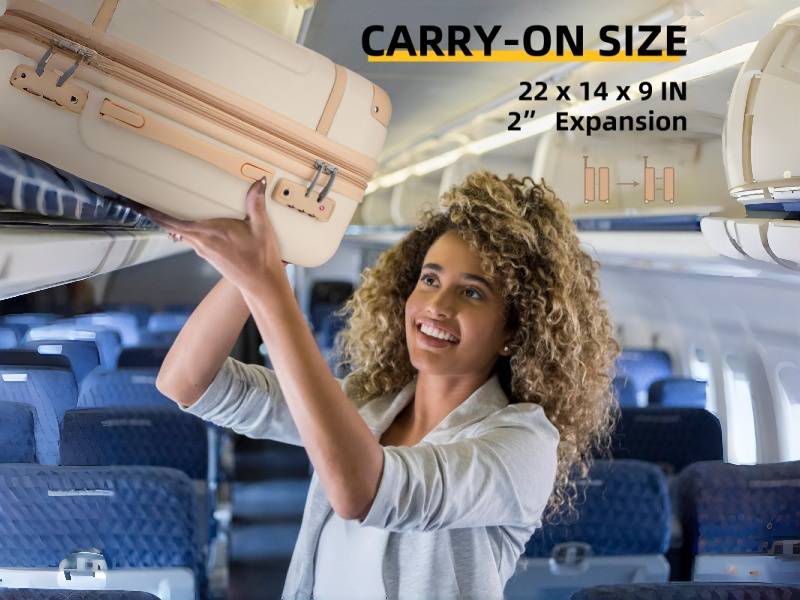
The best carry-on bags balance lightweight structure, durability, and smart storage. Features like USB charging ports, reinforced wheels, waterproof fabrics, and ergonomic handles improve both traveler experience and brand appeal.
Modern travelers expect tech integration and comfort — not just capacity. For manufacturers, this is where product differentiation begins.
Must-Have Functional Features
- Lightweight build (under 2.5 kg)
- Scratch & water-resistant materials (600D Oxford, EVA, or Polycarbonate)
- Integrated USB port
- 360° silent spinner wheels
- Multiple compartments for devices, shoes, and documents
- TSA lock compatibility
OEM brands often combine style with specification — e.g., aluminum frame + vegan leather panels.
At Jundong, designers create custom molds and die-cuts to maintain exact 22x14x9 structure while adding brand-specific finishes.
How Can OEM / ODM Brands Customize Carry-On Bags?
OEM/ODM brands can customize carry-on bags by adjusting dimensions, materials, hardware, and branding to meet airline compliance. Jundong offers end-to-end design, sampling, and mass production for global private-label clients.
Creating an airline-approved carry-on isn’t just about size — it’s about precision manufacturing.
1. Size & Material Customization
- Jundong offers CAD-based design templates matching 22x14x9 standards.
- Fabrics: Polyester, Nylon, Oxford, EVA, or ABS for structure integrity.
- Handle systems and wheels tested 10,000+ cycles.
2. Branding & Aesthetics
- Custom logo embossing, embroidery, or rubber patching.
- Pantone color matching for brand identity.
- Inner lining and zipper branding options.
3. Prototype & Testing
Each new model undergoes:
- Drop testing (1.2 m)
- Load testing (up to 25 kg)
- Pull test for telescopic handles (1,000+ cycles)
4. MOQ & Sampling
| Order Type | MOQ | Lead Time |
|---|---|---|
| OEM Custom | 100 pcs | 25–30 days |
| ODM (Existing Design) | 50 pcs | 15–20 days |
| Sample Development | 1–3 pcs | 5–7 days |
Jundong’s OEM division ensures every carry-on is airline-compliant, export-ready, and brand-personalized — all under one roof.
Is There a “Personal Item” Size Limit Too?
A personal item is smaller than a carry-on, typically fitting under the seat in front of you. Common size limits are 18 x 14 x 8 inches (45 x 35 x 20 cm). Examples include small backpacks, laptop bags, and tote bags.
For brands, pairing a carry-on with a personal-item bag increases SKU value.
Jundong offers matching travel sets — one overhead-size roller bag plus one underseat tote.
These bundles appeal to airlines, travel retailers, and promotional gift buyers alike.
Conclusion: Partner with Jundong to Design Airline-Compliant Carry-On Bags
Carry-on bags might look simple, but designing one that passes every airline test — while meeting user expectations — takes engineering precision and manufacturing expertise.
For global importers, retailers, and private-label brands, the opportunity is clear: travelers want lighter, smarter, and compliant bags. That’s where Jundong comes in.
✅ Over 20 years of OEM/ODM manufacturing
✅ Expertise in carry-on, luggage, and travel accessories
✅ Low MOQ, free design, and fast prototyping
✅ Fabric, color, logo, and structure customization for all markets
Whether you’re building your first private-label travel line or optimizing your existing range, Jundong helps you create carry-on bags that meet every airline’s standard and every traveler’s need.
👉 Contact Jundong today for a free design consultation and quotation.
Let’s build carry-on bags that fly higher — in quality, compliance, and customer satisfaction.